ANATOMY OF
TRACHEO BRONCHIAL TREE,
UPPER AIRWAY,
CLINICAL APPLICATION,
TRACHEOBRONCHIAL TREE IN
NEWBORN
DR ANANTHAKRISHNAN
Upper airway
 Nasal cavity
 Oral cavity
 Pharynx
 Larynx to lower border of cricoid cartilage
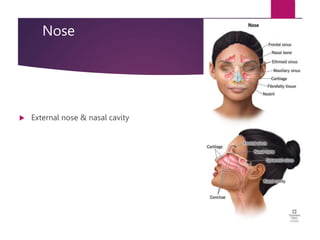
Nose
 External nose & nasal cavity
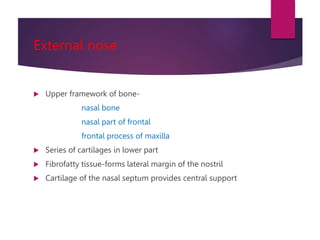
External nose
 Upper framework of bone-
nasal bone
nasal part of frontal
frontal process of maxilla
 Series of cartilages in lower part
 Fibrofatty tissue-forms lateral margin of the nostril
 Cartilage of the nasal septum provides central support
Nasal cavity
 Divided by nasal septum
 Opens to exterior by nares , Opens into nasopharynx by
choanae
 vestibule
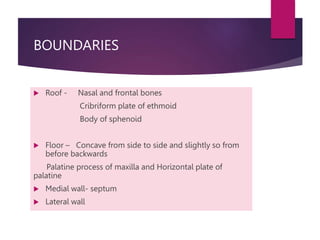
BOUNDARIES
 Roof - Nasal and frontal bones
Cribriform plate of ethmoid
Body of sphenoid
 Floor – Concave from side to side and slightly so from
before backwards
Palatine process of maxilla and Horizontal plate of
palatine
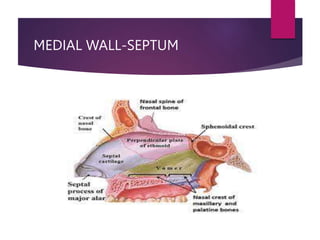
 Medial wall- septum
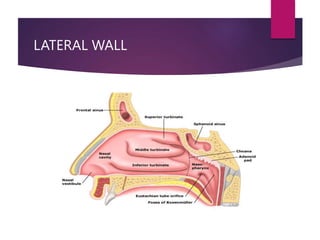
 Lateral wall
MEDIAL WALL-SEPTUM
LATERAL WALL
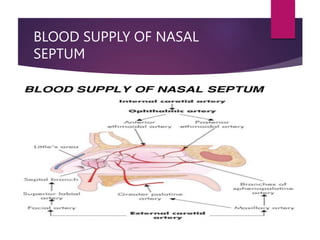
BLOOD SUPPLY OF NASAL
SEPTUM
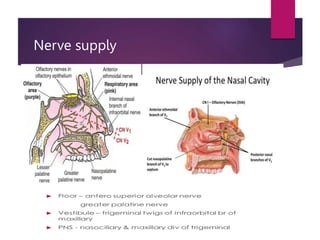
Nerve supply
FUNCTIONS OF NOSE
 Respiratory pathway
 Olfaction
 Resonator in speech
 Defense against microorganisms
 Strong inborn reflex to breathe through nose- natural for babies during
suckling
 Packing the nose after surgery may cause restlessness upon emergence
from an anesthetic
KRATSCHMER REFLEX
stimulation of anterior part of nasal septum leads to
constriction of bronchioles
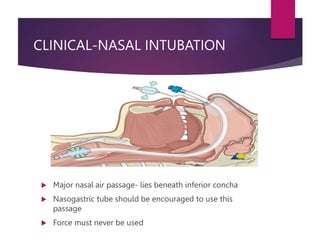
CLINICAL-NASAL INTUBATION
 Major nasal air passage- lies beneath inferior concha
 Nasogastric tube should be encouraged to use this
passage
 Force must never be used
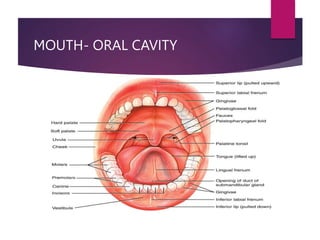
MOUTH- ORAL CAVITY
PHARYNX
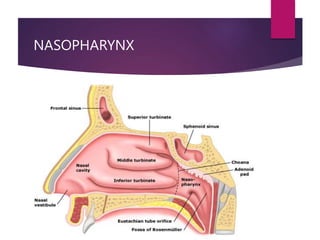
 NASOPHARYNX
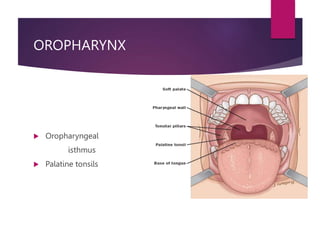
OROPHARYNX
LARYNGOPHARYNX
 Extends from basilar part of occipital bone
of skull to origin of the esophagus
(lower part of cricoid cartilage/ C6 vertebra)
 12-15cm long
 Widest-hyoid bone[5cm]
 Narrowest-pharyngo-oesophageal jn[1.5cm]
 DEVELOPMENT-cranial most part of foregut
NASOPHARYNX
OROPHARYNX
 Oropharyngeal
isthmus
 Palatine tonsils
Blood supply-Tonsils
 Tonsillar branch of facial artery
 Twigs from lingual,ascending palatine,ascending phary
and maxillary arteries
 Venous drainage- venae comitantes of tonsillar br of
facial artery,paratonsillar vein
Nerve supply -Tonsils
 Threefold sensory nerve supply
 Glossopharyngeal nerve via pharyngeal plexus
 Posterior palatine branch of maxillary nerve
 Lingual branch of mandibular nerve
 Infiltration anesthesia of tonsils is
more practicable
Pharynx- clinical
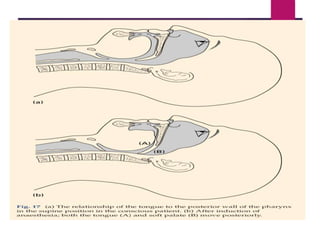
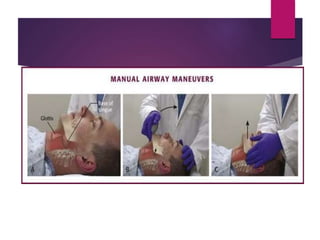
 In anesthesia/ unconscious patient
1. Relaxation of jaw muscles and the tongue falling back
causes obstructed airway
2. Nasal airway blocked by falling back of soft palate
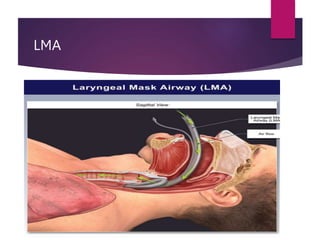
 LARYNGEAL MASK AIRWAY
LMA
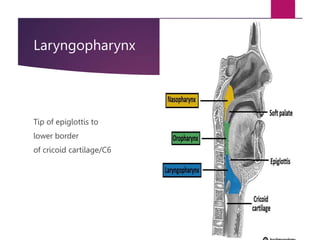
Laryngopharynx
Tip of epiglottis to
lower border
of cricoid cartilage/C6
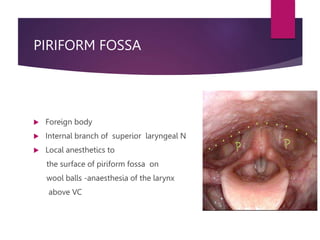
PIRIFORM FOSSA
 Foreign body
 Internal branch of superior laryngeal N
 Local anesthetics to
the surface of piriform fossa on
wool balls -anaesthesia of the larynx
above VC
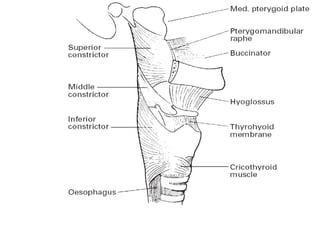
MUSCLES OF PHARYNX
1.Superior constrictor
2.Middle constrictor
3.Inferior constrictor
4.Stylopharyngeus
5.Salphingopharyngeus
6.Palatopharyngeus
LARYNX
 Protective valve
 Articulating cartilages
 C3-C6 vertebra (adults)
 C3-C4(neonate)
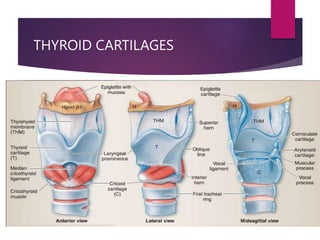
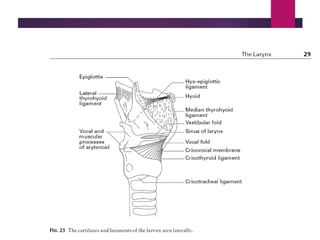
THYROID CARTILAGES
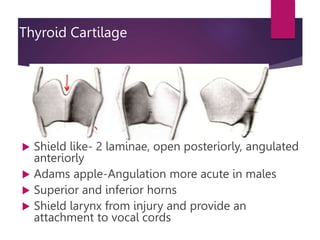
Thyroid Cartilage
 Shield like- 2 laminae, open posteriorly, angulated
anteriorly
 Adams apple-Angulation more acute in males
 Superior and inferior horns
 Shield larynx from injury and provide an
attachment to vocal cords
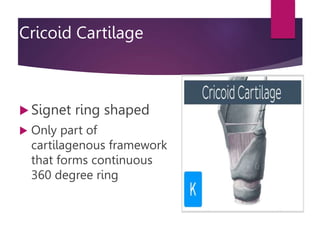
Cricoid Cartilage
 Signet ring shaped
 Only part of
cartilagenous framework
that forms continuous
360 degree ring
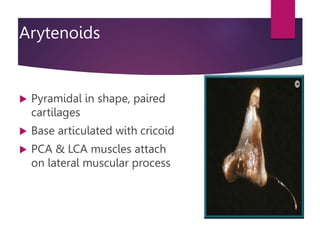
Arytenoids
 Pyramidal in shape, paired
cartilages
 Base articulated with cricoid
 PCA & LCA muscles attach
on lateral muscular process
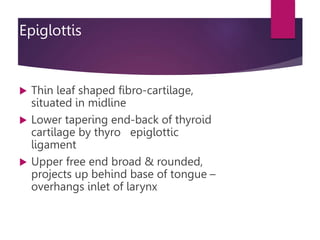
Epiglottis
 Thin leaf shaped fibro-cartilage,
situated in midline
 Lower tapering end-back of thyroid
cartilage by thyro epiglottic
ligament
 Upper free end broad & rounded,
projects up behind base of tongue –
overhangs inlet of larynx
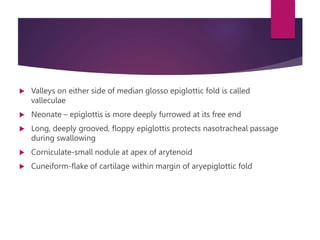
 Valleys on either side of median glosso epiglottic fold is called
valleculae
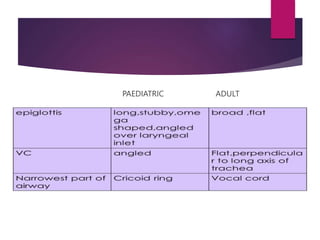
 Neonate – epiglottis is more deeply furrowed at its free end
 Long, deeply grooved, floppy epiglottis protects nasotracheal passage
during swallowing
 Corniculate-small nodule at apex of arytenoid
 Cuneiform-flake of cartilage within margin of aryepiglottic fold
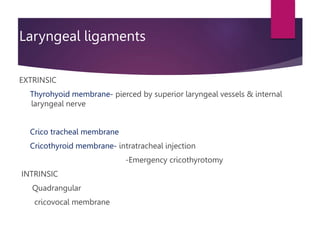
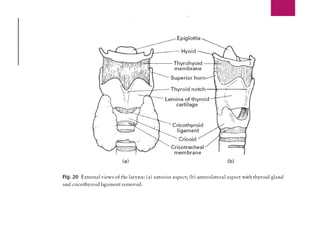
Laryngeal ligaments
EXTRINSIC
Thyrohyoid membrane- pierced by superior laryngeal vessels & internal
laryngeal nerve
Crico tracheal membrane
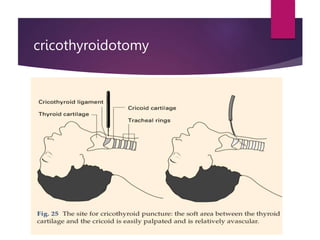
Cricothyroid membrane- intratracheal injection
-Emergency cricothyrotomy
INTRINSIC
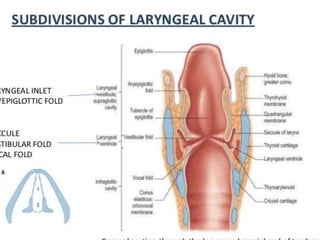
Quadrangular
cricovocal membrane
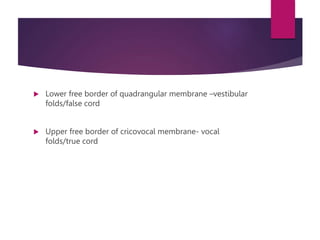
 Lower free border of quadrangular membrane –vestibular
folds/false cord
 Upper free border of cricovocal membrane- vocal
folds/true cord
cricothyroidotomy
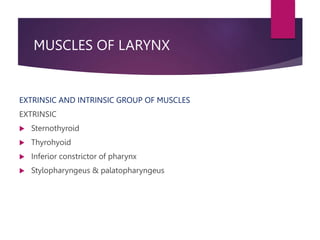
MUSCLES OF LARYNX
EXTRINSIC AND INTRINSIC GROUP OF MUSCLES
EXTRINSIC
 Sternothyroid
 Thyrohyoid
 Inferior constrictor of pharynx
 Stylopharyngeus & palatopharyngeus
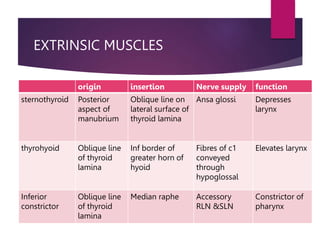
EXTRINSIC MUSCLES
origin insertion Nerve supply function
sternothyroid Posterior
aspect of
manubrium
Oblique line on
lateral surface of
thyroid lamina
Ansa glossi Depresses
larynx
thyrohyoid Oblique line
of thyroid
lamina
Inf border of
greater horn of
hyoid
Fibres of c1
conveyed
through
hypoglossal
Elevates larynx
Inferior
constrictor
Oblique line
of thyroid
lamina
Median raphe Accessory
RLN &SLN
Constrictor of
pharynx
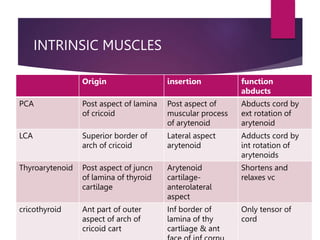
INTRINSIC MUSCLES
Origin insertion function
abducts
PCA Post aspect of lamina
of cricoid
Post aspect of
muscular process
of arytenoid
Abducts cord by
ext rotation of
arytenoid
LCA Superior border of
arch of cricoid
Lateral aspect
arytenoid
Adducts cord by
int rotation of
arytenoids
Thyroarytenoid Post aspect of juncn
of lamina of thyroid
cartilage
Arytenoid
cartilage-
anterolateral
aspect
Shortens and
relaxes vc
cricothyroid Ant part of outer
aspect of arch of
cricoid cart
Inf border of
lamina of thy
cartliage & ant
Only tensor of
cord
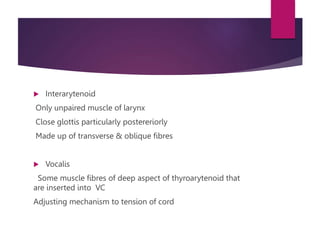
 Interarytenoid
Only unpaired muscle of larynx
Close glottis particularly postereriorly
Made up of transverse & oblique fibres
 Vocalis
Some muscle fibres of deep aspect of thyroarytenoid that
are inserted into VC
Adjusting mechanism to tension of cord
Abductors of cords- PCA
Adductors of the cords- LCA, Interarytenoides
Tensor of VC-Cricothyroid
only intrinsic muscle lies outside
cartilagenous framework
 Regulators of cord tension
cricothyroid(tensor)
thyroarytenoid(relaxor)
vocalis(fine adjustment[relax])
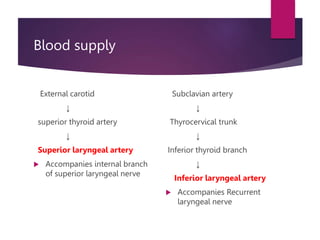
Blood supply
External carotid
↓
superior thyroid artery
↓
Superior laryngeal artery
 Accompanies internal branch
of superior laryngeal nerve
Subclavian artery
↓
Thyrocervical trunk
↓
Inferior thyroid branch
↓
Inferior laryngeal artery
 Accompanies Recurrent
laryngeal nerve
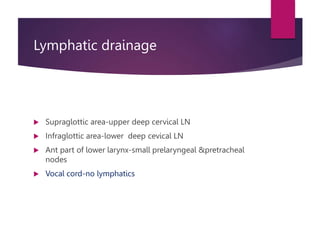
Lymphatic drainage
 Supraglottic area-upper deep cervical LN
 Infraglottic area-lower deep cevical LN
 Ant part of lower larynx-small prelaryngeal &pretracheal
nodes
 Vocal cord-no lymphatics
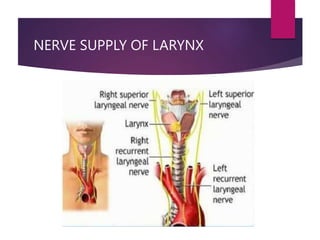
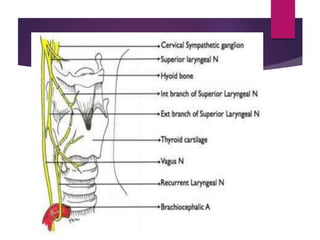
NERVE SUPPLY OF LARYNX
00
SENSORY-above VC- internal laryngeal nerve
below VC- recurent laryngeal nerve
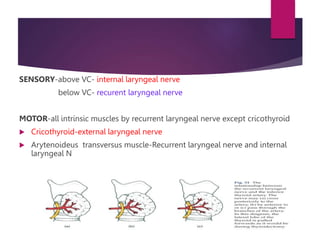
MOTOR-all intrinsic muscles by recurrent laryngeal nerve except cricothyroid
 Cricothyroid-external laryngeal nerve
 Arytenoideus transversus muscle-Recurrent laryngeal nerve and internal
laryngeal N
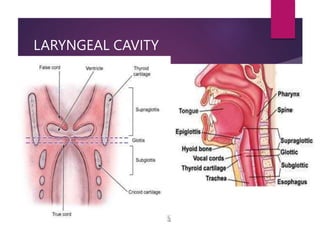
LARYNGEAL CAVITY
Vocal cord
 Pearly white folds of mucous membrane
 Angle of thyroid cartilage to vocal process of arytenoid
 Narrowest part of laryngeal cavity
 Stratified squamous epithelium[larynx-ciliated columnar
epithelium]
 No submucosa with blood vessels
 No mucous glands
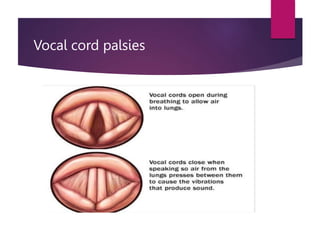
Vocal cord palsies
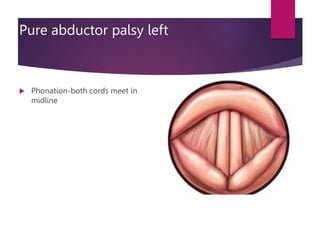
Pure abductor palsy left
 Phonation-both cords meet in
midline
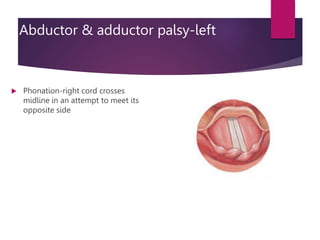
Abductor & adductor palsy-left
 Phonation-right cord crosses
midline in an attempt to meet its
opposite side
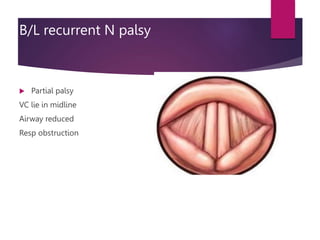
B/L recurrent N palsy
 Partial palsy
VC lie in midline
Airway reduced
Resp obstruction
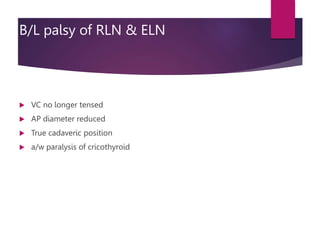
B/L palsy of RLN & ELN
 VC no longer tensed
 AP diameter reduced
 True cadaveric position
 a/w paralysis of cricothyroid
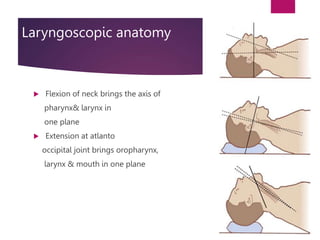
Laryngoscopic anatomy
 Flexion of neck brings the axis of
pharynx& larynx in
one plane
 Extension at atlanto
occipital joint brings oropharynx,
larynx & mouth in one plane
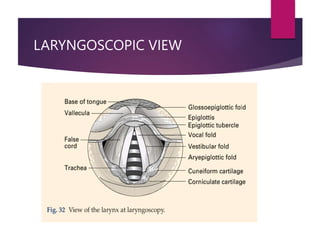
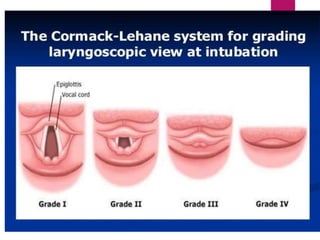
LARYNGOSCOPIC VIEW
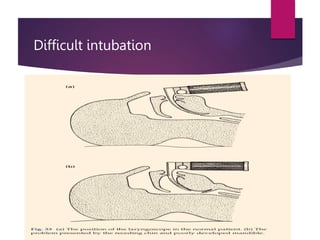
Difficult intubation
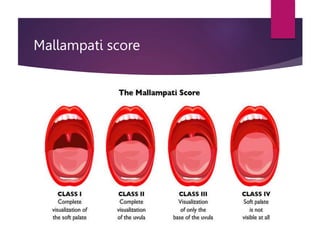
Mallampati score
LARYNX- Paediatric
 C4-C5
 FUNNEL SHAPED
PAEDIATRIC ADULT
TRACHEOBRONCHIAL
TREE
ANATOMY AND
CLINICALAPPLICAT ONS
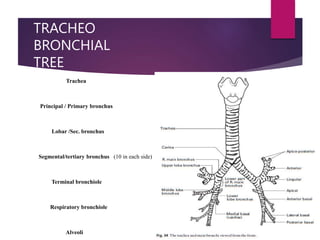
TRACHEO
BRONCHIAL
TREE
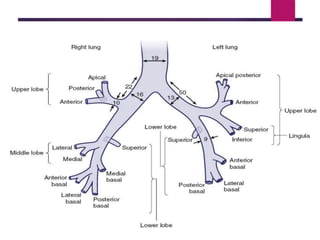
Trachea
Principal / Primary bronchus
Lobar /Sec. bronchus
Segmental/tertiary bronchus (10 in each side)
Terminal bronchiole
Respiratory bronchiole
Alveoli
TRACHEA
EXTEND FROM LOWER END OF
CRICOID CARTILAGE TO TRACHEAL
BIFURCATION
MEMBRANOCARTILAGINOUS TUBE
15 CM LONG IN ADULTS
 Children-4 cm length 3mm diameter
TRACHEA
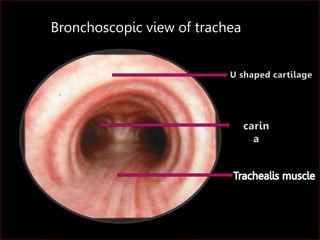
• Cartilages are joined vertically by fibroelastic tissue and closed
posteriorly by non striated trachealis muscle.
• In children : smaller, deeply placed and more mobile.
TRACHEA
 CARINA:
1. keel-shaped cartilage
2. seen as sagittal ridge bronchoscopically.
3. Flattened sharp edge means: enlargement of
the hilar lymph nodes or gross distortion of the
pulmonary anatomy by fibrosis, tumour or
other pathology
Bronchoscopic view of trachea
TRACHEA
 BLOOD SUPPLY: INFERIOR THYROID ARTERIES
 LYMPHATIC DRAINAGE:DEEP CERVICAL
PRETRACHEAL
 NERVE SUPPLY: VAGUS,
RECURRENT LARYNGEAL N
SYMPATHETIC SUPPLY FROM MIDDLE
CERVICAL GANGLION
CLINICAL APPLICATION
TRACHEOSTOMY
 2nd to the 4th rings are covered by the isthmus of the thyroid
So in tracheostomy the lower tracheal rings are chosen to save thyroid
tissue
 First tracheal ring is spared because cricoid rests on it.
CLINICAL APPLICATION
 Thyroidea ima artery, ascending from the arch of the
aorta or from the brachiocephalic artery if present,
erosion of the tracheal wall by a tracheostomy tube
may cause sudden profuse haemorrhage in the
lower part of neck.
 Posteriorly esophagus with RLN on either side in a
groove between trachea and esophagus
CLINICAL APPLICATION
 TRACHEA MOVES WITH RESPIRATION:
Adult-tip of orotracheal tube moves an average of 2 cm
with flexion and with extension of the neck.
infants and children-more critical: displacement of even 1
cm can move the tube above the cords or below the
carina.
CLINICAL APPLICATION
 ENDOTRACHEAL TUBE FIXATION AND CUFF
PRESSURE:
ETT advanced until the cuff is about 2 cm distal to the vocal
cords as proximal positions may cause cuff leaks and pressure
on the recurrent laryngeal nerve. Cuff pressure is then adjusted
to 25 to 30 cm H2O.
 abdominal insufflation can shift the carina cephalad and
convert an acceptable location to an endobronchial one
CLINICAL APPLICATION
 In infants the brachiocephalic artery is higher and crosses
the trachea just as it descends behind the suprasternal notch.
The left brachiocephalic vein may project upwards into the
neck to form an anterior relation of the cervical trachea-a
frightening encounter if found tensely distended with blood
when performing a tracheotomy on an asphyxiating baby.
 In children up to the age of 2 years, the thymus is large and
lies in front of the lower part of the cervical trachea.
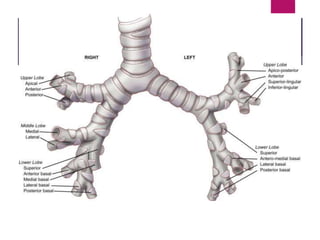
Right main bronchus
 shorter, wider and more vertically placed
 shorter because it gives off its upper lobe bronchus sooner(after a
course of only 2.5 cm)
 wider because it supplies the larger lung
 More vertically placed at 25°(45 deg in children)
Right main bronchus
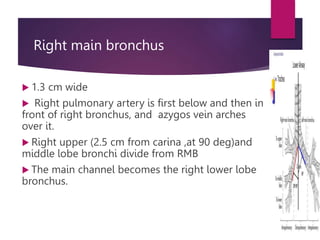
 1.3 cm wide
 Right pulmonary artery is first below and then in
front of right bronchus, and azygos vein arches
over it.
 Right upper (2.5 cm from carina ,at 90 deg)and
middle lobe bronchi divide from RMB
 The main channel becomes the right lower lobe
bronchus.
Left main bronchus
 5 cm long.
1.1 cm wide
45 degress to trachea(same in children)
passes under the aortic arch, in front of
the oesophagus, thoracic duct and
descending aorta, and has the left
pulmonary artery lying first above and then
in front of it.
Left main bronchus
Branches into left upper lobe and the
lingual.
it continues on as the left lower lobe
bronchus.
CLINICAL APPLICATION-
Endobronchial tubes
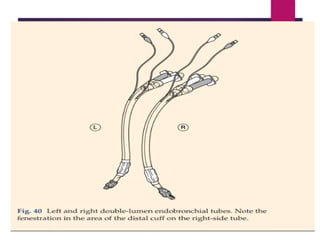
 right-sided endobronchial tubes have an
orifice in the lateral surface of the tube
that coincides with the opening of the
right upper lobe
 No special arrangement in left
endobronchial tube
Increased chance of Right endobronchial
intubation in adults if tube is pushed in
more(either of the sides in children.)
Innervation of bronchial tree
 Sympathetic and parasympathetic innervation
 Sympathetic nerve fibers: T1 – T5 along with branches from inferior
cervical ganglion and some from middle cervical ganglion
 Parasympathetic: vagus nerve
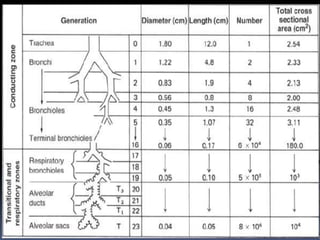
BRONCHIOLES
Typically 1 mm in diameter
Devoid of cartilaginous support and have the
highest proportion of smooth muscle in the wall.
Terminal bronchiole is the last airway component
that does not participate in gas exchange.
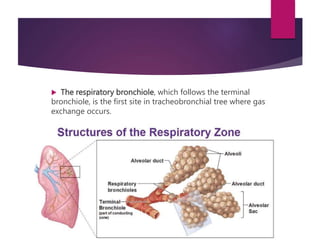
 The respiratory bronchiole, which follows the terminal
bronchiole, is the first site in tracheobronchial tree where gas
exchange occurs.
Respiratory bronchioles
and alveolar ducts
In adults, two or three generations of
respiratory bronchioles lead to alveolar
ducts, of which there are four to five
generations, each with multiple openings
into alveolar sacs.
The final divisions of alveolar ducts
terminate in alveolar sacs that open into
alveolar clusters.
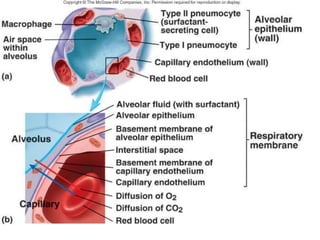
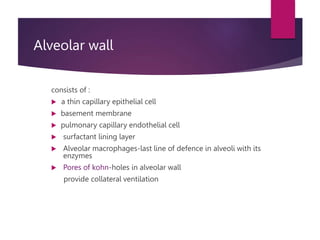
Alveolar wall
consists of :
 a thin capillary epithelial cell
 basement membrane
 pulmonary capillary endothelial cell
 surfactant lining layer
 Alveolar macrophages-last line of defence in alveoli with its
enzymes
 Pores of kohn-holes in alveolar wall
provide collateral ventilation
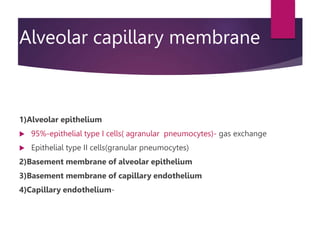
Alveolar capillary membrane
1)Alveolar epithelium
 95%-epithelial type I cells( agranular pneumocytes)- gas exchange
 Epithelial type II cells(granular pneumocytes)
2)Basement membrane of alveolar epithelium
3)Basement membrane of capillary endothelium
4)Capillary endothelium-
Alveolar capillary
membrane
The alveolar-capillary membrane has
two primary functions:
1. Transport of respiratory gases
(oxygen and carbon dioxide)
2. The production of a wide variety of
local and humoral substances.
Alveolar capillary
membrane
TYPEI CELLS:
 cover ~80% of the alveolar surface.
 Contain flattened nuclei and extremely thin cytoplasmic
extensions that provide the surface for gas exchange.
 highly differentiated and metabolically limited
 damaged severely in ALI and ARDS
 type II cells replicate and modify to form new type I
cells.
Alveolar capillary
membrane
TYPE II
 interspersed among type I cells, primarily at
alveolar–septal junctions.
 polygonal cells with vast metabolic and enzymatic
activity and manufacture surfactant.
 modulates local electrolyte balance, as well as
endothelial and lymphatic cell functions.
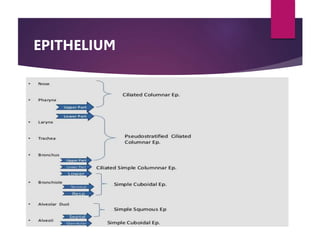
EPITHELIUM
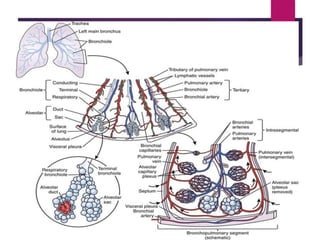
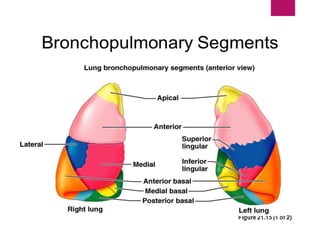
BRONCHOPULMONARY
SEGMENTS
 The anatomic, functional, and surgical units of lung is known as
bronchopulmonary segments.
 Approximately 10 bronchopulmonary segments in each lung
 Each of pyramid shaped, with its apex towards the lung root
 Each segment has its own separate artery (branch of pulmonary
artery) segmental bronchus, autonomic nerves and lymph vessels.
 Segmental veins runs in the connective tissue between adjacent
bps.
 Thus BPS is not bronchovascular segment as it does not have its
own vein.
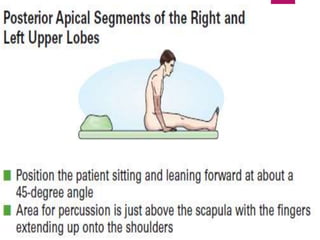
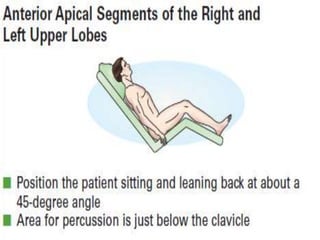
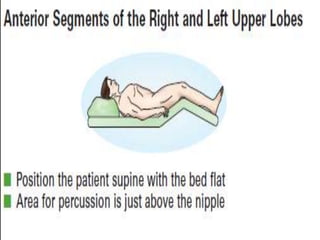
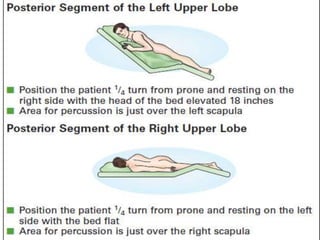
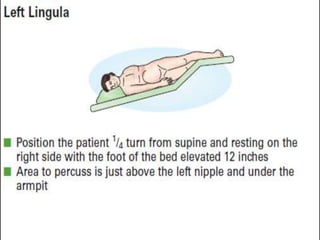
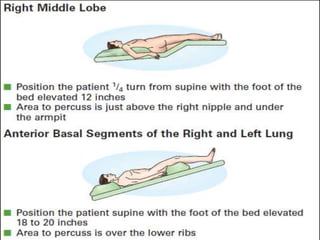
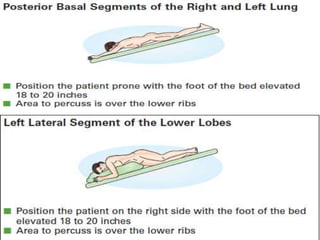
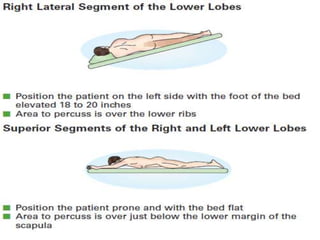
Postural drainage
 Also called as pulmonary toilet
Positioning the patient so that retained secretions in the
bronchopulmonary segments can be drained by gravity
out of the lungs
Positioning the patient is important to allow the bronchi of
each BPS to be vertical so that fluid inside the bronchus
will move toward the main stem bronchi and out of the
lung.
topic tracheobronchial tree upper airway.pptx

topic tracheobronchial tree upper airway.pptx

  • 1.
    ANATOMY OF TRACHEO BRONCHIALTREE, UPPER AIRWAY, CLINICAL APPLICATION, TRACHEOBRONCHIAL TREE IN NEWBORN DR ANANTHAKRISHNAN
  • 2.
    Upper airway  Nasalcavity  Oral cavity  Pharynx  Larynx to lower border of cricoid cartilage
  • 3.
    Nose  External nose& nasal cavity
  • 4.
    External nose  Upperframework of bone- nasal bone nasal part of frontal frontal process of maxilla  Series of cartilages in lower part  Fibrofatty tissue-forms lateral margin of the nostril  Cartilage of the nasal septum provides central support
  • 5.
    Nasal cavity  Dividedby nasal septum  Opens to exterior by nares , Opens into nasopharynx by choanae  vestibule
  • 6.
    BOUNDARIES  Roof -Nasal and frontal bones Cribriform plate of ethmoid Body of sphenoid  Floor – Concave from side to side and slightly so from before backwards Palatine process of maxilla and Horizontal plate of palatine  Medial wall- septum  Lateral wall
  • 7.
  • 8.
  • 9.
    BLOOD SUPPLY OFNASAL SEPTUM
  • 10.
  • 11.
    FUNCTIONS OF NOSE Respiratory pathway  Olfaction  Resonator in speech  Defense against microorganisms  Strong inborn reflex to breathe through nose- natural for babies during suckling  Packing the nose after surgery may cause restlessness upon emergence from an anesthetic
  • 12.
    KRATSCHMER REFLEX stimulation ofanterior part of nasal septum leads to constriction of bronchioles
  • 13.
    CLINICAL-NASAL INTUBATION  Majornasal air passage- lies beneath inferior concha  Nasogastric tube should be encouraged to use this passage  Force must never be used
  • 14.
  • 15.
    PHARYNX  NASOPHARYNX OROPHARYNX LARYNGOPHARYNX  Extendsfrom basilar part of occipital bone of skull to origin of the esophagus (lower part of cricoid cartilage/ C6 vertebra)  12-15cm long  Widest-hyoid bone[5cm]  Narrowest-pharyngo-oesophageal jn[1.5cm]  DEVELOPMENT-cranial most part of foregut
  • 16.
  • 17.
  • 18.
    Blood supply-Tonsils  Tonsillarbranch of facial artery  Twigs from lingual,ascending palatine,ascending phary and maxillary arteries  Venous drainage- venae comitantes of tonsillar br of facial artery,paratonsillar vein
  • 19.
    Nerve supply -Tonsils Threefold sensory nerve supply  Glossopharyngeal nerve via pharyngeal plexus  Posterior palatine branch of maxillary nerve  Lingual branch of mandibular nerve  Infiltration anesthesia of tonsils is more practicable
  • 20.
    Pharynx- clinical  Inanesthesia/ unconscious patient 1. Relaxation of jaw muscles and the tongue falling back causes obstructed airway 2. Nasal airway blocked by falling back of soft palate  LARYNGEAL MASK AIRWAY
  • 22.
  • 24.
    Laryngopharynx Tip of epiglottisto lower border of cricoid cartilage/C6
  • 25.
    PIRIFORM FOSSA  Foreignbody  Internal branch of superior laryngeal N  Local anesthetics to the surface of piriform fossa on wool balls -anaesthesia of the larynx above VC
  • 26.
    MUSCLES OF PHARYNX 1.Superiorconstrictor 2.Middle constrictor 3.Inferior constrictor 4.Stylopharyngeus 5.Salphingopharyngeus 6.Palatopharyngeus
  • 28.
    LARYNX  Protective valve Articulating cartilages  C3-C6 vertebra (adults)  C3-C4(neonate)
  • 29.
  • 30.
    Thyroid Cartilage  Shieldlike- 2 laminae, open posteriorly, angulated anteriorly  Adams apple-Angulation more acute in males  Superior and inferior horns  Shield larynx from injury and provide an attachment to vocal cords
  • 31.
    Cricoid Cartilage  Signetring shaped  Only part of cartilagenous framework that forms continuous 360 degree ring
  • 32.
    Arytenoids  Pyramidal inshape, paired cartilages  Base articulated with cricoid  PCA & LCA muscles attach on lateral muscular process
  • 33.
    Epiglottis  Thin leafshaped fibro-cartilage, situated in midline  Lower tapering end-back of thyroid cartilage by thyro epiglottic ligament  Upper free end broad & rounded, projects up behind base of tongue – overhangs inlet of larynx
  • 34.
     Valleys oneither side of median glosso epiglottic fold is called valleculae  Neonate – epiglottis is more deeply furrowed at its free end  Long, deeply grooved, floppy epiglottis protects nasotracheal passage during swallowing  Corniculate-small nodule at apex of arytenoid  Cuneiform-flake of cartilage within margin of aryepiglottic fold
  • 35.
    Laryngeal ligaments EXTRINSIC Thyrohyoid membrane-pierced by superior laryngeal vessels & internal laryngeal nerve Crico tracheal membrane Cricothyroid membrane- intratracheal injection -Emergency cricothyrotomy INTRINSIC Quadrangular cricovocal membrane
  • 36.
     Lower freeborder of quadrangular membrane –vestibular folds/false cord  Upper free border of cricovocal membrane- vocal folds/true cord
  • 39.
  • 40.
    MUSCLES OF LARYNX EXTRINSICAND INTRINSIC GROUP OF MUSCLES EXTRINSIC  Sternothyroid  Thyrohyoid  Inferior constrictor of pharynx  Stylopharyngeus & palatopharyngeus
  • 41.
    EXTRINSIC MUSCLES origin insertionNerve supply function sternothyroid Posterior aspect of manubrium Oblique line on lateral surface of thyroid lamina Ansa glossi Depresses larynx thyrohyoid Oblique line of thyroid lamina Inf border of greater horn of hyoid Fibres of c1 conveyed through hypoglossal Elevates larynx Inferior constrictor Oblique line of thyroid lamina Median raphe Accessory RLN &SLN Constrictor of pharynx
  • 42.
    INTRINSIC MUSCLES Origin insertionfunction abducts PCA Post aspect of lamina of cricoid Post aspect of muscular process of arytenoid Abducts cord by ext rotation of arytenoid LCA Superior border of arch of cricoid Lateral aspect arytenoid Adducts cord by int rotation of arytenoids Thyroarytenoid Post aspect of juncn of lamina of thyroid cartilage Arytenoid cartilage- anterolateral aspect Shortens and relaxes vc cricothyroid Ant part of outer aspect of arch of cricoid cart Inf border of lamina of thy cartliage & ant Only tensor of cord
  • 43.
     Interarytenoid Only unpairedmuscle of larynx Close glottis particularly postereriorly Made up of transverse & oblique fibres  Vocalis Some muscle fibres of deep aspect of thyroarytenoid that are inserted into VC Adjusting mechanism to tension of cord
  • 44.
    Abductors of cords-PCA Adductors of the cords- LCA, Interarytenoides Tensor of VC-Cricothyroid only intrinsic muscle lies outside cartilagenous framework  Regulators of cord tension cricothyroid(tensor) thyroarytenoid(relaxor) vocalis(fine adjustment[relax])
  • 45.
    Blood supply External carotid ↓ superiorthyroid artery ↓ Superior laryngeal artery  Accompanies internal branch of superior laryngeal nerve Subclavian artery ↓ Thyrocervical trunk ↓ Inferior thyroid branch ↓ Inferior laryngeal artery  Accompanies Recurrent laryngeal nerve
  • 46.
    Lymphatic drainage  Supraglotticarea-upper deep cervical LN  Infraglottic area-lower deep cevical LN  Ant part of lower larynx-small prelaryngeal &pretracheal nodes  Vocal cord-no lymphatics
  • 47.
  • 48.
  • 49.
    SENSORY-above VC- internallaryngeal nerve below VC- recurent laryngeal nerve MOTOR-all intrinsic muscles by recurrent laryngeal nerve except cricothyroid  Cricothyroid-external laryngeal nerve  Arytenoideus transversus muscle-Recurrent laryngeal nerve and internal laryngeal N
  • 50.
  • 52.
    Vocal cord  Pearlywhite folds of mucous membrane  Angle of thyroid cartilage to vocal process of arytenoid  Narrowest part of laryngeal cavity  Stratified squamous epithelium[larynx-ciliated columnar epithelium]  No submucosa with blood vessels  No mucous glands
  • 53.
  • 54.
    Pure abductor palsyleft  Phonation-both cords meet in midline
  • 55.
    Abductor & adductorpalsy-left  Phonation-right cord crosses midline in an attempt to meet its opposite side
  • 56.
    B/L recurrent Npalsy  Partial palsy VC lie in midline Airway reduced Resp obstruction
  • 57.
    B/L palsy ofRLN & ELN  VC no longer tensed  AP diameter reduced  True cadaveric position  a/w paralysis of cricothyroid
  • 58.
    Laryngoscopic anatomy  Flexionof neck brings the axis of pharynx& larynx in one plane  Extension at atlanto occipital joint brings oropharynx, larynx & mouth in one plane
  • 59.
  • 60.
  • 62.
  • 63.
  • 64.
  • 65.
  • 66.
    TRACHEO BRONCHIAL TREE Trachea Principal / Primarybronchus Lobar /Sec. bronchus Segmental/tertiary bronchus (10 in each side) Terminal bronchiole Respiratory bronchiole Alveoli
  • 69.
    TRACHEA EXTEND FROM LOWEREND OF CRICOID CARTILAGE TO TRACHEAL BIFURCATION MEMBRANOCARTILAGINOUS TUBE 15 CM LONG IN ADULTS  Children-4 cm length 3mm diameter
  • 70.
    TRACHEA • Cartilages arejoined vertically by fibroelastic tissue and closed posteriorly by non striated trachealis muscle. • In children : smaller, deeply placed and more mobile.
  • 71.
    TRACHEA  CARINA: 1. keel-shapedcartilage 2. seen as sagittal ridge bronchoscopically. 3. Flattened sharp edge means: enlargement of the hilar lymph nodes or gross distortion of the pulmonary anatomy by fibrosis, tumour or other pathology
  • 72.
  • 73.
    TRACHEA  BLOOD SUPPLY:INFERIOR THYROID ARTERIES  LYMPHATIC DRAINAGE:DEEP CERVICAL PRETRACHEAL  NERVE SUPPLY: VAGUS, RECURRENT LARYNGEAL N SYMPATHETIC SUPPLY FROM MIDDLE CERVICAL GANGLION
  • 74.
    CLINICAL APPLICATION TRACHEOSTOMY  2ndto the 4th rings are covered by the isthmus of the thyroid So in tracheostomy the lower tracheal rings are chosen to save thyroid tissue  First tracheal ring is spared because cricoid rests on it.
  • 75.
    CLINICAL APPLICATION  Thyroideaima artery, ascending from the arch of the aorta or from the brachiocephalic artery if present, erosion of the tracheal wall by a tracheostomy tube may cause sudden profuse haemorrhage in the lower part of neck.  Posteriorly esophagus with RLN on either side in a groove between trachea and esophagus
  • 76.
    CLINICAL APPLICATION  TRACHEAMOVES WITH RESPIRATION: Adult-tip of orotracheal tube moves an average of 2 cm with flexion and with extension of the neck. infants and children-more critical: displacement of even 1 cm can move the tube above the cords or below the carina.
  • 77.
    CLINICAL APPLICATION  ENDOTRACHEALTUBE FIXATION AND CUFF PRESSURE: ETT advanced until the cuff is about 2 cm distal to the vocal cords as proximal positions may cause cuff leaks and pressure on the recurrent laryngeal nerve. Cuff pressure is then adjusted to 25 to 30 cm H2O.  abdominal insufflation can shift the carina cephalad and convert an acceptable location to an endobronchial one
  • 78.
    CLINICAL APPLICATION  Ininfants the brachiocephalic artery is higher and crosses the trachea just as it descends behind the suprasternal notch. The left brachiocephalic vein may project upwards into the neck to form an anterior relation of the cervical trachea-a frightening encounter if found tensely distended with blood when performing a tracheotomy on an asphyxiating baby.  In children up to the age of 2 years, the thymus is large and lies in front of the lower part of the cervical trachea.
  • 79.
    Right main bronchus shorter, wider and more vertically placed  shorter because it gives off its upper lobe bronchus sooner(after a course of only 2.5 cm)  wider because it supplies the larger lung  More vertically placed at 25°(45 deg in children)
  • 80.
    Right main bronchus 1.3 cm wide  Right pulmonary artery is first below and then in front of right bronchus, and azygos vein arches over it.  Right upper (2.5 cm from carina ,at 90 deg)and middle lobe bronchi divide from RMB  The main channel becomes the right lower lobe bronchus.
  • 81.
    Left main bronchus 5 cm long. 1.1 cm wide 45 degress to trachea(same in children) passes under the aortic arch, in front of the oesophagus, thoracic duct and descending aorta, and has the left pulmonary artery lying first above and then in front of it.
  • 82.
    Left main bronchus Branchesinto left upper lobe and the lingual. it continues on as the left lower lobe bronchus.
  • 83.
    CLINICAL APPLICATION- Endobronchial tubes right-sided endobronchial tubes have an orifice in the lateral surface of the tube that coincides with the opening of the right upper lobe  No special arrangement in left endobronchial tube Increased chance of Right endobronchial intubation in adults if tube is pushed in more(either of the sides in children.)
  • 85.
    Innervation of bronchialtree  Sympathetic and parasympathetic innervation  Sympathetic nerve fibers: T1 – T5 along with branches from inferior cervical ganglion and some from middle cervical ganglion  Parasympathetic: vagus nerve
  • 86.
    BRONCHIOLES Typically 1 mmin diameter Devoid of cartilaginous support and have the highest proportion of smooth muscle in the wall. Terminal bronchiole is the last airway component that does not participate in gas exchange.
  • 87.
     The respiratorybronchiole, which follows the terminal bronchiole, is the first site in tracheobronchial tree where gas exchange occurs.
  • 88.
    Respiratory bronchioles and alveolarducts In adults, two or three generations of respiratory bronchioles lead to alveolar ducts, of which there are four to five generations, each with multiple openings into alveolar sacs. The final divisions of alveolar ducts terminate in alveolar sacs that open into alveolar clusters.
  • 90.
    Alveolar wall consists of:  a thin capillary epithelial cell  basement membrane  pulmonary capillary endothelial cell  surfactant lining layer  Alveolar macrophages-last line of defence in alveoli with its enzymes  Pores of kohn-holes in alveolar wall provide collateral ventilation
  • 91.
    Alveolar capillary membrane 1)Alveolarepithelium  95%-epithelial type I cells( agranular pneumocytes)- gas exchange  Epithelial type II cells(granular pneumocytes) 2)Basement membrane of alveolar epithelium 3)Basement membrane of capillary endothelium 4)Capillary endothelium-
  • 92.
    Alveolar capillary membrane The alveolar-capillarymembrane has two primary functions: 1. Transport of respiratory gases (oxygen and carbon dioxide) 2. The production of a wide variety of local and humoral substances.
  • 93.
    Alveolar capillary membrane TYPEI CELLS: cover ~80% of the alveolar surface.  Contain flattened nuclei and extremely thin cytoplasmic extensions that provide the surface for gas exchange.  highly differentiated and metabolically limited  damaged severely in ALI and ARDS  type II cells replicate and modify to form new type I cells.
  • 94.
    Alveolar capillary membrane TYPE II interspersed among type I cells, primarily at alveolar–septal junctions.  polygonal cells with vast metabolic and enzymatic activity and manufacture surfactant.  modulates local electrolyte balance, as well as endothelial and lymphatic cell functions.
  • 95.
  • 96.
    BRONCHOPULMONARY SEGMENTS  The anatomic,functional, and surgical units of lung is known as bronchopulmonary segments.  Approximately 10 bronchopulmonary segments in each lung  Each of pyramid shaped, with its apex towards the lung root  Each segment has its own separate artery (branch of pulmonary artery) segmental bronchus, autonomic nerves and lymph vessels.  Segmental veins runs in the connective tissue between adjacent bps.  Thus BPS is not bronchovascular segment as it does not have its own vein.
  • 100.
    Postural drainage  Alsocalled as pulmonary toilet Positioning the patient so that retained secretions in the bronchopulmonary segments can be drained by gravity out of the lungs Positioning the patient is important to allow the bronchi of each BPS to be vertical so that fluid inside the bronchus will move toward the main stem bronchi and out of the lung.