Root & Viscera of the Neck
Root of the Neck
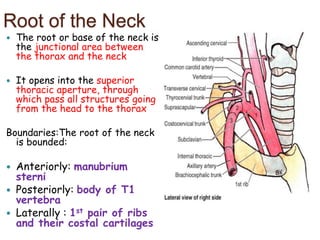
 The root or base of the neck is
the junctional area between
the thorax and the neck
 It opens into the superior
thoracic aperture, through
which pass all structures going
from the head to the thorax
Boundaries:The root of the neck
is bounded:
 Anteriorly: manubrium
sterni
 Posteriorly: body of T1
vertebra
 Laterally : 1st pair of ribs
and their costal cartilages
Arteries in the Root of the neck
The arteries include:
 Brachiocephalic trunk
on the right side &
common carotid and
subclavian arteries
on the left side,
originating from the
arch of aorta
Veins in the Root of the neck
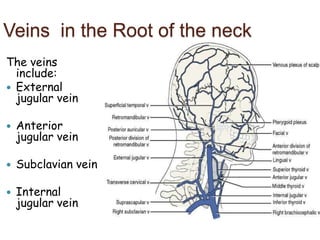
The veins
include:
 External
jugular vein
 Anterior
jugular vein
 Subclavian vein
 Internal
jugular vein
Nerves in the root of the neck
 Vagus nerve
 Phrenic nerve
 Sympathetic trunk
 The cervical portion of the sympathetic trunk
contains three ganglion: Superior cervical,
Middle cervical, and Inferior cervical.
 The inferior cervical (C7) and first thoracic (T1)
ganglia usually fuse to form the stellate ganglia.
 The superior cervical ganglion is found around
the C1-C2 vertebral level, middle cervical
ganglion at C6 vertebral level, and the stellate
ganglion at the C7-T1 vertebral level.
 The superior cervical ganglion supplies
structures in the head and is the largest of the
three ganglia.
Viscera of the neck
 The neck viscera are disposed in three
layers:
 Endocrine layer – thyroid and
parathyroid glands
 Respiratory layer – larynx and trachea
 Alimentary layer – pharynx and
esophagus
 The names of the layers represent the
functions of the viscera
Thyroid gland
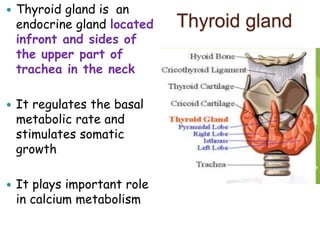
 Thyroid gland is an
endocrine gland located
infront and sides of
the upper part of
trachea in the neck
 It regulates the basal
metabolic rate and
stimulates somatic
growth
 It plays important role
in calcium metabolism
 It lies deep to
the
sternothyroid
and sternohyoid
muscle
 And extends
from the level
of fifth cervical
vertebrae (C5)
to the first
thoracic
vertebrae (T1)
embracing the
upper part of
the trachea
Situation and Extent
Is made up of:
 Two lateral lobes
connected in the
midline by an isthmus
Lateral lobes
 Each lobe is pear
shaped lying on either
side of the larynx &
trachea
 Each lobe extends
from side of the
thyroid cartilage
downwards to the 6th
tracheal ring
Isthmus
 Overlies the 2nd, 3rd &
4th tracheal rings
The lobes have an apex, a
base and Three surfaces:
lateral, medial and
posterior
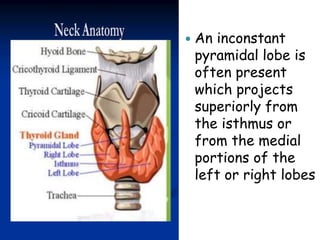
 An inconstant
pyramidal lobe is
often present
which projects
superiorly from
the isthmus or
from the medial
portions of the
left or right lobes
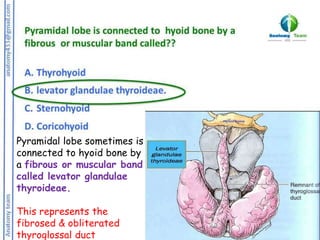
Pyramidal lobe sometimes is
connected to hyoid bone by
a fibrous or muscular band
called levator glandulae
thyroideae.
This represents the
fibrosed & obliterated
thyroglossal duct
Weight & Capsule
 The average gland weighs about 25g.
 It is larger in females than in males and
further increases in size during
menstruation and pregnancy
 The thyroid gland is surrounded by a false
and true capsules
 The true or inner capsule is the condensation
of connective tissue of the gland, which
sends septa deeply into the gland.
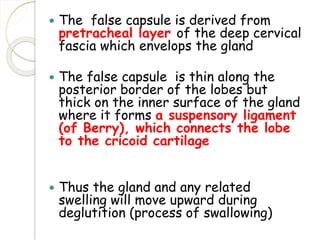
 The false capsule is derived from
pretracheal layer of the deep cervical
fascia which envelops the gland
 The false capsule is thin along the
posterior border of the lobes but
thick on the inner surface of the gland
where it forms a suspensory ligament
(of Berry), which connects the lobe
to the cricoid cartilage
 Thus the gland and any related
swelling will move upward during
deglutition (process of swallowing)
Anterior it is related
to:
 Deep surface of the
sternothyroid,
sternohyoid, and
omohyoid muscles and
anterior border of
sternocleidomastoid
Laterally:
 Carotid sheath, which
contains the common
carotid artery,
internal jugular vein
and the vagus nerve
Relations
Posteriorly
 Longus colli &
longus capitis
muscles
Medially:
Superior part of the lobe is related to the:
 larynx and laryngopharynx
 Cricothyroid and inferior pharyngeal constrictor
muscles
 Thyroid and cricoid cartilages
Inferior part of the lobe is related to:
 The trachea and eosophagus
Arteries:
 The thyroid
gland has a rich
blood supply
with abundant
anastomoses.
 The main
arteries are
the:
 Superior
thyroid artery
 Inferior
thyroid artery
Arteries:
1- Superior thyroid artery:
 Is the first branch of
ECA
 It descends to the
superior pole of each
lobe of the gland with
external laryngeal nerve
(lies immediately behind
the artery)
 Pierces the pretracheal
fascia & divides into an
anterior & posterior
branches which is
distributed to the gland
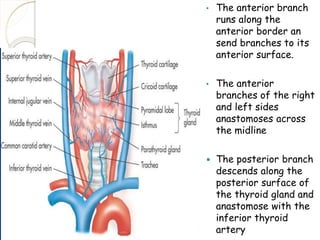
• The anterior branch
runs along the
anterior border an
send branches to its
anterior surface.
• The anterior
branches of the right
and left sides
anastomoses across
the midline
 The posterior branch
descends along the
posterior surface of
the thyroid gland and
anastomose with the
inferior thyroid
artery
2- Inferior thyroid
artery:
 Branch of the
thyrocervical trunk
from the 1st part of
subclavian a.
 Arches up then down
behind the carotid
sheath to reach
behind the lower
border of the gland
where it divides into
(5-6) branches which
penetrate the fascia
separately &
distributed to the
gland
 The recurrent
laryngeal n. lies in
between them.
 3- Thyroidea ima artery:
 Small branch arises from the
brachiocephalic trunk or aortic
arch & enters the lower pole
 They are seen n 10% of individuals.
Relations of superior and recurrent
laryngeal nerves to the arteries
a. Superior thyroid artery is
accompanied by superior
laryngeal nerve
b. Inferior thyroid artery is
accompanied by recurrent laryngeal
nerve
c. Thus during thyroidectomy, the
superior thyroid artery is ligated
near the gland to avoid injury to
the external laryngeal nerve
d. And the inferior thyroid artery is
ligated away from the gland to save
recurrent laryngeal nerve
Veins:
 1- Superior thyroid
vein:
 Formed on the
anterolateral aspect
of the lateral lobe of
the gland
 Crosses in front of
the CCA & receives
tributaries
corresponding to the
branches of the
superior thyroid a.
 It empties in the
IJV
Veins:
2- Middle thyroid
vein:
 Formed at the
lateral surface
of the gland
 This short wide
v. courses
laterally to
empty in the
lower part of
the IJV
Veins:
3- Inferior thyroid veins:
 Arise from the venous
plexus which lies near the
lower pole of the gland &
communicates with the upper
2 veins
 They descend down receiving
tributaries which correspond
to the branches of the
inferior thyroid a.
 Pass behind the manubrium
to end in the corresponding
brachiocephalic vein.
 Sometimes the 2 veins unite
forming a single vein which
empties in the left
brachiocephalic v.
Nerves:
 1- Sensory:
Recurrent
laryngeal n.
 2- Sympathetic
(vasomotor)
nerve: from the
superior, middle
and inferior
cervical ganglia
accompanying the
thyroid arteries.
Lymph:
 Lymphatic from the thyroid gland
drains mainly into the deep cervical,
a few pass into prelaryngeal and
pretracheal nodes, and a few drains
into the thoracic duct
 From the upper pole, they pass with
the Superior thyroid artery to the
Anterosuperior group of deep
cervical nodes
 From the lower pole, they pass with
the Inferior thyroid artery to the
Posteroinferior group of deep
cervical nodes
Thyroid hormones
- Thyroxine (T4) or tetraiodothyronine …93%
- Triiodothyronine (T3) …7%
 Amount secreted:
 Almost all T4 is converted to T3 in tissues.
Target cell
T4
T4
T4
Capillary
(Rich blood supply)
T3
Reverse T3
Applied Anatomy
 A benign enlargement of
the thyroid may
compress or displace any
of its relations; the
trachea and oesophagus
may be narrowed, with
resulting difficulty in
breathing and swallowing,
and the carotid may be
displaced posteriorly
 Hypothyroidism causes
cretinism in infants and
myxoedema in adults
 Any swelling of the
thyroid gland [goitre]
moves with deglutition
 In partial thyroidectomy,
the posterior parts of
both lobes are left
behind to:
1. Avoid the risk of
removing the
parathyroid glands
2. Avoid postoperative
myxoedema caused by
deficiency of thyroid
hormones
Parathyroid gland
They are important because of their role in calcium
metabolism
Called parathyroid glands because of their position
on posterior margins outer surface of thyroid gland
Parathyroid gland
•Usually paired about the
size of a small pea (less
than 5 mm). Each weighs
about 50mg
•Located behind the lobes
of the thyroid gland
Anatomy
Superior glands is
more constant in
position
 Superior glands are
usually imbedded in
fat on posterior
surface of middle or
upper portion of
thyroid lobe within
the pretracheal
fascial capsule
 level with the first
tracheal ring and a
short distance above
the inferior thyroid
artery
Anatomy
 The inferior glands are
usually embedded behind
the lower pole of thyroid
gland
o They are less constant in
position they may lie
o Within the thyroid
capsule
o Behind and outside the
thyroid capsule
o Within the substance of
the lobe near its
posterior border
 In about 5% of cases,
inferior glands are in the
superior mediastinum
Blood supply
 They receive blood supply
from the :
 Inferior thyroid artery
 Anastomosis between
superior and inferior
thyroid arteries
 The veins and lymphatics
are associated with those
of thyroid and the thymus
Nerve supply
 Middle and
superior cervical
ganglia
PTH function
Thyroid_gland.pptx

Thyroid_gland.pptx

  • 1.
    Root & Visceraof the Neck
  • 2.
    Root of theNeck  The root or base of the neck is the junctional area between the thorax and the neck  It opens into the superior thoracic aperture, through which pass all structures going from the head to the thorax Boundaries:The root of the neck is bounded:  Anteriorly: manubrium sterni  Posteriorly: body of T1 vertebra  Laterally : 1st pair of ribs and their costal cartilages
  • 3.
    Arteries in theRoot of the neck The arteries include:  Brachiocephalic trunk on the right side & common carotid and subclavian arteries on the left side, originating from the arch of aorta
  • 4.
    Veins in theRoot of the neck The veins include:  External jugular vein  Anterior jugular vein  Subclavian vein  Internal jugular vein
  • 5.
    Nerves in theroot of the neck  Vagus nerve  Phrenic nerve  Sympathetic trunk
  • 6.
     The cervicalportion of the sympathetic trunk contains three ganglion: Superior cervical, Middle cervical, and Inferior cervical.  The inferior cervical (C7) and first thoracic (T1) ganglia usually fuse to form the stellate ganglia.  The superior cervical ganglion is found around the C1-C2 vertebral level, middle cervical ganglion at C6 vertebral level, and the stellate ganglion at the C7-T1 vertebral level.  The superior cervical ganglion supplies structures in the head and is the largest of the three ganglia.
  • 7.
  • 8.
     The neckviscera are disposed in three layers:  Endocrine layer – thyroid and parathyroid glands  Respiratory layer – larynx and trachea  Alimentary layer – pharynx and esophagus  The names of the layers represent the functions of the viscera
  • 9.
    Thyroid gland  Thyroidgland is an endocrine gland located infront and sides of the upper part of trachea in the neck  It regulates the basal metabolic rate and stimulates somatic growth  It plays important role in calcium metabolism
  • 10.
     It liesdeep to the sternothyroid and sternohyoid muscle  And extends from the level of fifth cervical vertebrae (C5) to the first thoracic vertebrae (T1) embracing the upper part of the trachea Situation and Extent
  • 11.
    Is made upof:  Two lateral lobes connected in the midline by an isthmus Lateral lobes  Each lobe is pear shaped lying on either side of the larynx & trachea  Each lobe extends from side of the thyroid cartilage downwards to the 6th tracheal ring Isthmus  Overlies the 2nd, 3rd & 4th tracheal rings The lobes have an apex, a base and Three surfaces: lateral, medial and posterior
  • 12.
     An inconstant pyramidallobe is often present which projects superiorly from the isthmus or from the medial portions of the left or right lobes
  • 13.
    Pyramidal lobe sometimesis connected to hyoid bone by a fibrous or muscular band called levator glandulae thyroideae. This represents the fibrosed & obliterated thyroglossal duct
  • 14.
    Weight & Capsule The average gland weighs about 25g.  It is larger in females than in males and further increases in size during menstruation and pregnancy  The thyroid gland is surrounded by a false and true capsules  The true or inner capsule is the condensation of connective tissue of the gland, which sends septa deeply into the gland.
  • 15.
     The falsecapsule is derived from pretracheal layer of the deep cervical fascia which envelops the gland  The false capsule is thin along the posterior border of the lobes but thick on the inner surface of the gland where it forms a suspensory ligament (of Berry), which connects the lobe to the cricoid cartilage  Thus the gland and any related swelling will move upward during deglutition (process of swallowing)
  • 16.
    Anterior it isrelated to:  Deep surface of the sternothyroid, sternohyoid, and omohyoid muscles and anterior border of sternocleidomastoid Laterally:  Carotid sheath, which contains the common carotid artery, internal jugular vein and the vagus nerve Relations
  • 17.
    Posteriorly  Longus colli& longus capitis muscles Medially: Superior part of the lobe is related to the:  larynx and laryngopharynx  Cricothyroid and inferior pharyngeal constrictor muscles  Thyroid and cricoid cartilages Inferior part of the lobe is related to:  The trachea and eosophagus
  • 18.
    Arteries:  The thyroid glandhas a rich blood supply with abundant anastomoses.  The main arteries are the:  Superior thyroid artery  Inferior thyroid artery
  • 19.
    Arteries: 1- Superior thyroidartery:  Is the first branch of ECA  It descends to the superior pole of each lobe of the gland with external laryngeal nerve (lies immediately behind the artery)  Pierces the pretracheal fascia & divides into an anterior & posterior branches which is distributed to the gland
  • 20.
    • The anteriorbranch runs along the anterior border an send branches to its anterior surface. • The anterior branches of the right and left sides anastomoses across the midline  The posterior branch descends along the posterior surface of the thyroid gland and anastomose with the inferior thyroid artery
  • 21.
    2- Inferior thyroid artery: Branch of the thyrocervical trunk from the 1st part of subclavian a.  Arches up then down behind the carotid sheath to reach behind the lower border of the gland where it divides into (5-6) branches which penetrate the fascia separately & distributed to the gland  The recurrent laryngeal n. lies in between them.
  • 22.
     3- Thyroideaima artery:  Small branch arises from the brachiocephalic trunk or aortic arch & enters the lower pole  They are seen n 10% of individuals.
  • 23.
    Relations of superiorand recurrent laryngeal nerves to the arteries a. Superior thyroid artery is accompanied by superior laryngeal nerve b. Inferior thyroid artery is accompanied by recurrent laryngeal nerve c. Thus during thyroidectomy, the superior thyroid artery is ligated near the gland to avoid injury to the external laryngeal nerve d. And the inferior thyroid artery is ligated away from the gland to save recurrent laryngeal nerve
  • 24.
    Veins:  1- Superiorthyroid vein:  Formed on the anterolateral aspect of the lateral lobe of the gland  Crosses in front of the CCA & receives tributaries corresponding to the branches of the superior thyroid a.  It empties in the IJV
  • 25.
    Veins: 2- Middle thyroid vein: Formed at the lateral surface of the gland  This short wide v. courses laterally to empty in the lower part of the IJV
  • 26.
    Veins: 3- Inferior thyroidveins:  Arise from the venous plexus which lies near the lower pole of the gland & communicates with the upper 2 veins  They descend down receiving tributaries which correspond to the branches of the inferior thyroid a.  Pass behind the manubrium to end in the corresponding brachiocephalic vein.  Sometimes the 2 veins unite forming a single vein which empties in the left brachiocephalic v.
  • 27.
    Nerves:  1- Sensory: Recurrent laryngealn.  2- Sympathetic (vasomotor) nerve: from the superior, middle and inferior cervical ganglia accompanying the thyroid arteries.
  • 28.
    Lymph:  Lymphatic fromthe thyroid gland drains mainly into the deep cervical, a few pass into prelaryngeal and pretracheal nodes, and a few drains into the thoracic duct  From the upper pole, they pass with the Superior thyroid artery to the Anterosuperior group of deep cervical nodes  From the lower pole, they pass with the Inferior thyroid artery to the Posteroinferior group of deep cervical nodes
  • 29.
    Thyroid hormones - Thyroxine(T4) or tetraiodothyronine …93% - Triiodothyronine (T3) …7%  Amount secreted:  Almost all T4 is converted to T3 in tissues. Target cell T4 T4 T4 Capillary (Rich blood supply) T3 Reverse T3
  • 30.
    Applied Anatomy  Abenign enlargement of the thyroid may compress or displace any of its relations; the trachea and oesophagus may be narrowed, with resulting difficulty in breathing and swallowing, and the carotid may be displaced posteriorly  Hypothyroidism causes cretinism in infants and myxoedema in adults  Any swelling of the thyroid gland [goitre] moves with deglutition  In partial thyroidectomy, the posterior parts of both lobes are left behind to: 1. Avoid the risk of removing the parathyroid glands 2. Avoid postoperative myxoedema caused by deficiency of thyroid hormones
  • 31.
  • 32.
    They are importantbecause of their role in calcium metabolism Called parathyroid glands because of their position on posterior margins outer surface of thyroid gland Parathyroid gland •Usually paired about the size of a small pea (less than 5 mm). Each weighs about 50mg •Located behind the lobes of the thyroid gland
  • 33.
    Anatomy Superior glands is moreconstant in position  Superior glands are usually imbedded in fat on posterior surface of middle or upper portion of thyroid lobe within the pretracheal fascial capsule  level with the first tracheal ring and a short distance above the inferior thyroid artery
  • 34.
    Anatomy  The inferiorglands are usually embedded behind the lower pole of thyroid gland o They are less constant in position they may lie o Within the thyroid capsule o Behind and outside the thyroid capsule o Within the substance of the lobe near its posterior border  In about 5% of cases, inferior glands are in the superior mediastinum
  • 35.
    Blood supply  Theyreceive blood supply from the :  Inferior thyroid artery  Anastomosis between superior and inferior thyroid arteries  The veins and lymphatics are associated with those of thyroid and the thymus
  • 36.
    Nerve supply  Middleand superior cervical ganglia
  • 37.