Antenatal
Care
Session Objectives
• Define antenatal care
• Discuss the aims of antenatal care
• Discuss the number of visits in each trimester
• Calculate EDD
• Review the common terminologies
• Discuss the signs of pregnancy
• List the danger signs of pregnancy
• Describe care during pregnancy
Antenatal Period
 Covers the time of pregnancy from the first day of LMP to
the start of true labour
 Duration of pregnancy: approx. 280 days, 40 weeks
 Divided into 3 trimesters:
1st trimester : 1 to 12 (12 weeks)
2nd trimester: 13 to 27(13 weeks)
3rd trimester: 28 to 40 (15 weeks)
AIMS OF ANTENATAL CARE
⦁ T
o monitor progress of pregnancy
⦁ T
o monitor maternal & fetal well being
⦁ To prepare mother for pregnancy,labour & postnatal
period
⦁ T
o prepare mother for lactation
⦁ T
o vaccinate
⦁ T
o rule out risk factors
⦁ To perform early referral to prevent morbidity &
mortality
NUMBER OF ANTENATAL VISITS
At least 4 RoutineVisits
⦁ FirstVisit --------Within Four Months Or As SoonAs
Possible
⦁ SecondVisit ------At Sixth Month
⦁ ThirdVisit ---------At Eighth Month
⦁ FourthVisit ------ In Ninth Month
Nägele’s Rule
Calculate Expected Date of Birth (EDB,EDD)
⦁ First day of last menstrual period (LMP)
⦁ Add 7 days
⦁ Subtract 3 months
⦁ OR
⦁ First day of LMP+9M +7 DAYS
⦁ Gravida
The term gravid comes from the Latin word gravidus. It is used to describe a
female who is pregnant and is also a medical term for the total number of
confirmed pregnancies a female has had, regardless of the outcome of the
pregnancy
Para
Parity, or "Para", indicates the number of births (including live births and
stillbirths) where pregnancies reached viable gestational age. A multiple
pregnancy (e.g., twins, triplets, etc.) carried to viable gestational age is still
counted as 1
TPAL
T
erm,Preterm,Abortion,Living & Still birth
⦁
Maternal Anatomical & Physiological Changes
Physiological and Hormonal changes Indicative of
Pregnancy:
• Presumptive Signs:of pregnancy are maternal physiological changes that the
women experience
• Probable Signs:maternal physiological and anatomical changes that are
detected upon examination and documented by the examiner
• Positive signs:directly attributable to the fetus
Signs of
Pregnancy
Presumptive
*Amenorrhea
*Fatigue
*Nausea and vomiting
*Urinary frequency
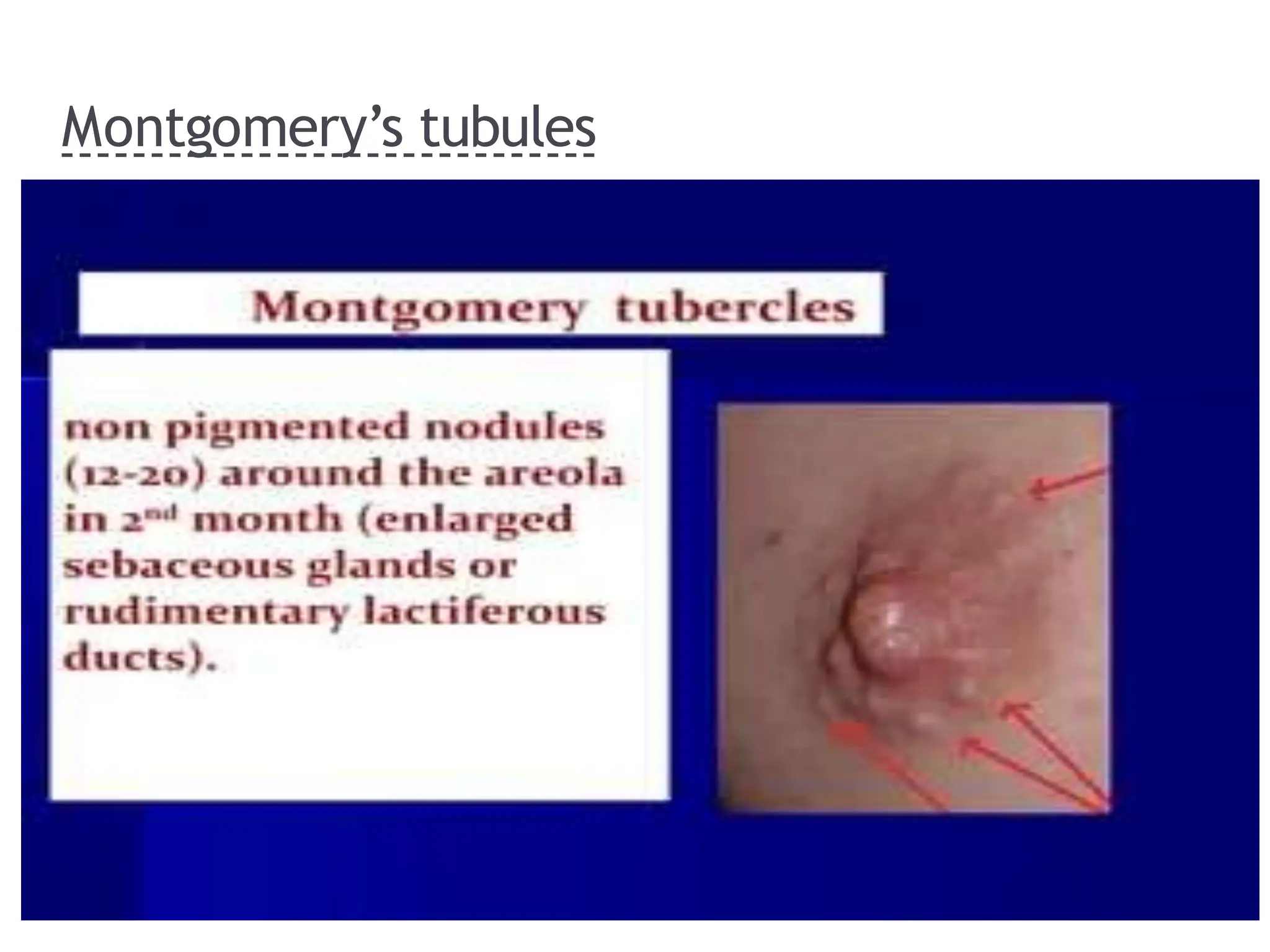
*Breast changes – Darkened
areola,enlarged
Montgomery’
s tubules
*Quickening– slight fluttering
movements ofthe fetus felt
by a woman,usually between
16 to 20 weeks ofgestation.
*Uterine enlargement
*Linea nigra
*Chloasma (mask of
pregnancy)
Probable
*Abdominal enlargement related
to changes in uterine size,shape,
and position
*Cervical changes
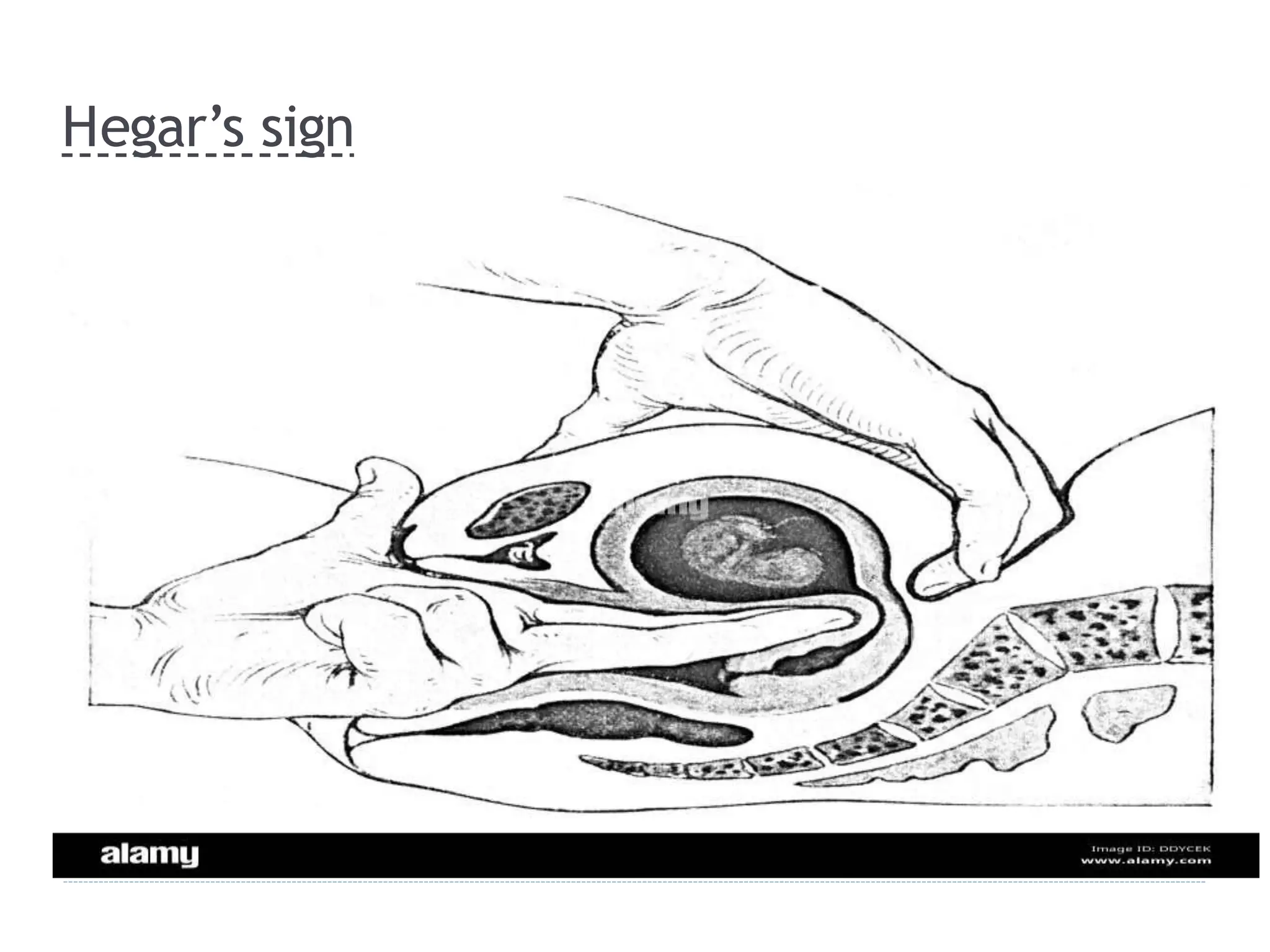
*Hegar’
s sign – softening and
compressibility of lower uterus
*increased vascularity of the
area
*Positive pregnancy test
*Fetal outline felt by examiner
Positive
*Fetal heart sounds
*Visualization offetus by
ultrasound
*Fetal movement palpated by
an experienced examiner
Montgomery’s tubules
Quickening – slight fluttering
Chloasma
Hegar’s sign
Anatomical Changes/ Uterine Enlargement
Changes Reason
Uterine
Growth
(effect of
Estrogen &
Progesterone)
Uterine growth by hyperplasia (increased number of
cells)
Uterine walls increased strength
Increase number of elastic tissues
Chadwick’s
Sign
Goodell’s sign
 in size of uterine blood vessels and lymphatics
 Vascularityand edema
Braxton Hicks
contraction
 Caused due to stretching of uterine muscle cells
Care during Pregnancy
History taking:
⦁ Client Name
⦁ Age
⦁ Husband Name
⦁ Cast
⦁ Religion
⦁ Address
⦁ Telephone Number
⦁ Client Occupation
⦁ Husband Occupation
⦁ Marital Hx
⦁ Blood Group
⦁ Reason Of Visit
⦁ Chief Complain (IfAny) & Its
Detail
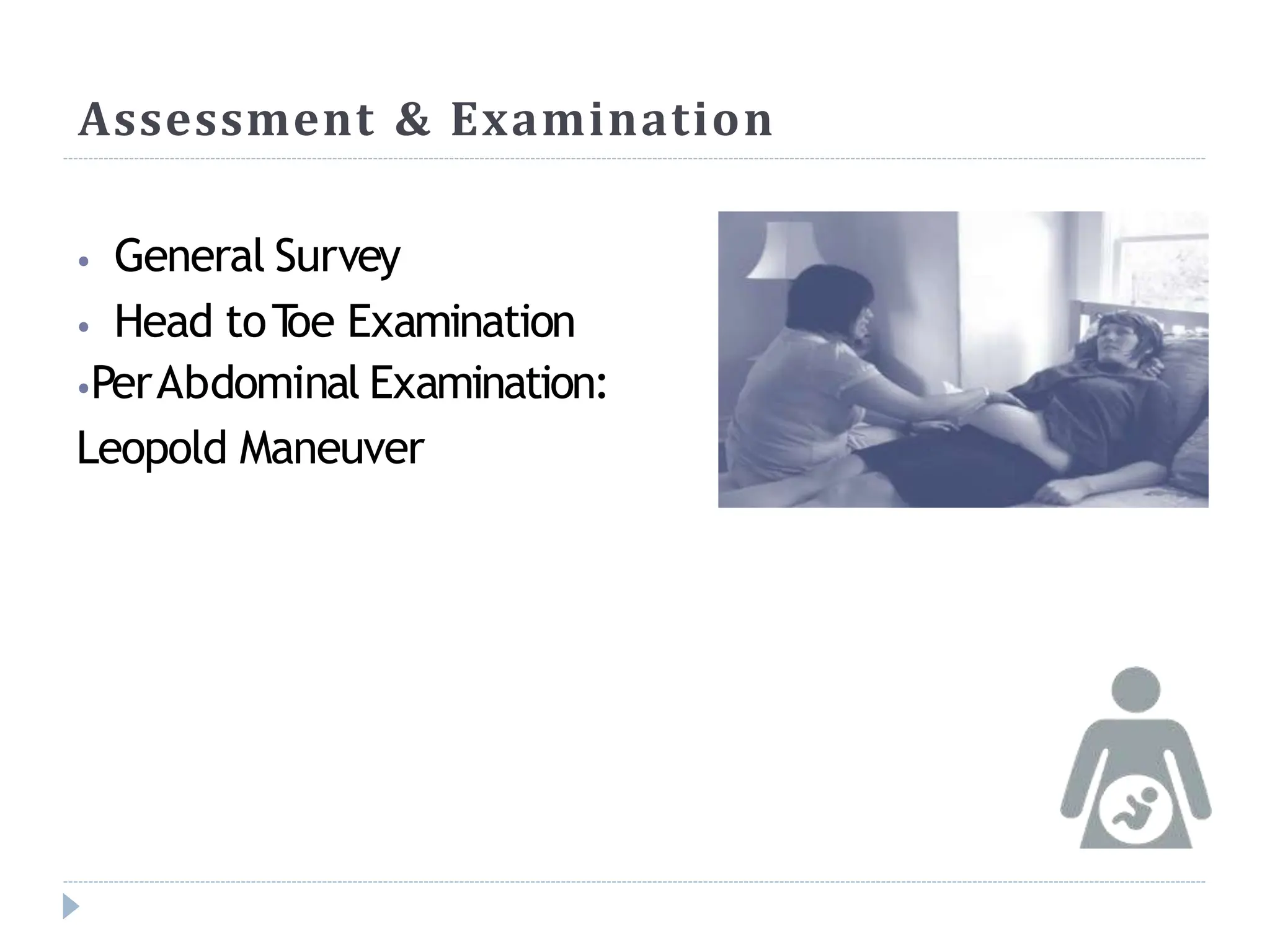
Assessment & Examination
⦁ General Survey
⦁ Head toT
oe Examination
⦁PerAbdominal Examination:
Leopold Maneuver
Leopold Maneuver
Investigations
Initial visit
⦁ Complete Blood Count
⦁ ABO blood group
Urine Detail Report
⦁ Fasting Blood Sugar
⦁ Hep.B & C
⦁ U/S:First trimester--- fetal
viability scan
Follow-up visit
⦁ Hemoglobin
⦁ Oral GlucoseT
olerance
T
est---Second trimester
U/S:
⦁ Anomaly scan---18-20wks
⦁ Growth scan--- 32-33wks
Birth & Emergency Plan
Involvement of husband is highly
important
Birth Plan
⦁ Hospital or home
⦁ Obstetrician,midwife
⦁ Companion in birth
⦁ Arrangement for birth
⦁ Feeding
Emergency Plan
⦁ Money
⦁ Vehicle
⦁ Place of birth
⦁ Care provider
⦁ Blood donor
27
Fetal lie and Presentation
Fetal Lie
The relationship of long
axis of fetus to long axis
of uterus e.g longitudinal,
transverse, oblique
Immunization
• administration of two doses of Td injection is an important step in
the prevention of maternal and neonatal tetanus.
• The first dose of Td should be administered as soon as possible
preferably when the woman register for ANC.
• The second dose is to be given one month after the first
preferably at least one month before the EDD.
• If the woman receives the first dose after 38 weeks of pregnancy
,then the second dose may be given in the postnatal period, after
a gap of four weeks.
• If the woman has been previously immunized with two dose
during a previous pregnancy within the past three years, then give
her only one dose as early as possible in this pregnancy.
Dose of Td
• o.5 ml by deep intramuscular injection.
• It should be given in the upper arm and not in the buttocks as this
might injure the sciatic nerves.
• Inform the woman that there may be a slight swelling pain and or
redness at the site of the injection for a day or two.
Nutritional supplements
• IFA Supplementation
• Help preventing the complication due to anemia.
• besides recommending IFA supplementation counsel the woman
to increase her dietary food of iron rich foods such as green leafy
vegetables, whole pulses , jiggery, meat , poultry and fish.
Prophylactic dose :- 180 tab IFA OD starting after the first trimester
at 12 weeks of gestation until delivery.
Therapeutic dose :- (Hb less than 11 gm% /dl ) or has pallor 200 tab
IFA , BD . If it does not rise in spite, refer the woman to the MO
(medical officer ) at the PHC
Counselling for IFA
• IFA tab must be taken regularly, preferably early in the morning
on an empty stomach .
• In case the woman has nausea and pain in the abdomen, she may
take the tablet after meals or at night . This will help avoid nausea
dispel.
• The myths and misconceptions r/t to IFA and convince the
woman about the importance of IFA supplementation. An
example of a common myths is that the consumption of IFA may
affect the baby’s complexion.
• t is normal to pass black stool while consuming IFA. Tell the
woman not to worry about it. In case of constipation, the woman
should drink more water and add roughage to her diet. IFA tab
should not be consumed with tea, coffee, milk or calcium tab, as
these reduce the absorption of iron.
• Ask the woman to return to you if she has problems taking IFA
tablets.
• Refer her to the MO for further management.
• Emphasis the important of a high protein diet, including items
such as black gram, ground nuts, whole grains, milk, eggs, meats
and nuts for anemic women . Encourage the woman to take
plenty of fruits and vegetables containing vitamin ‘c’( e.g.:-
mango, guava, orange and sweet lime) as these enhance the
absorption.
Care during Pregnancy
Pregnancy care:
• Minor discomforts of pregnancy
• Nutrition during pregnancy and
after delivery
• Preparation for breastfeeding
• Antenatal exercises
• Psychological adjustments
during pregnancy
The Father’
s Role:
• The father’
s role throughout the
transition to parenthood
• Father’
s concerns.
Labor and birth:
• Process of labor and birth
• Pain relief in labor
• Companionship in labor
• Common interventions
used in many labors
• Caesarean section
• Psychological adjustments
to labor and birth
• Skin-to-skin contact with
the newborn and early
breastfeeding.
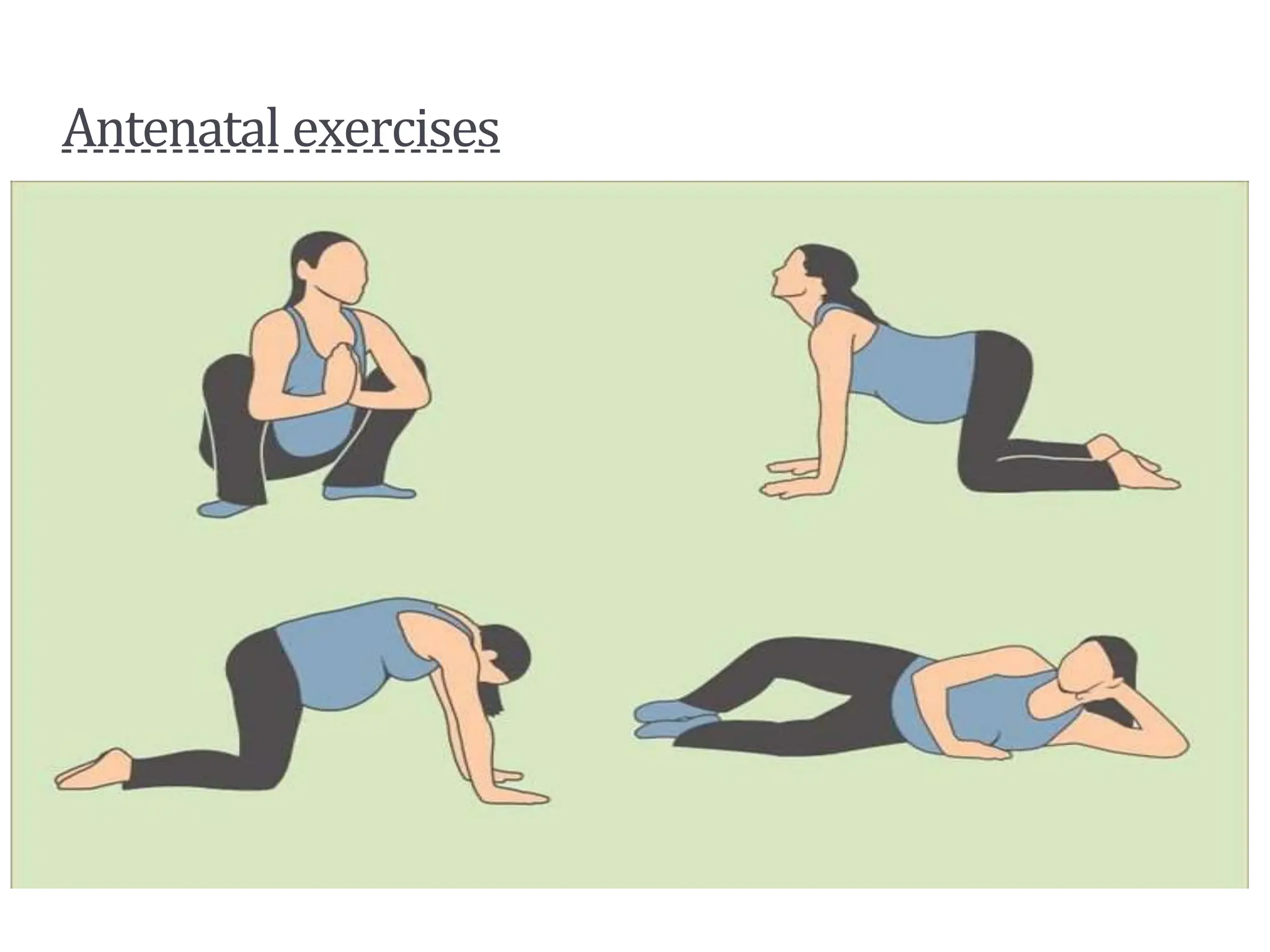
Antenatal exercises
Danger Signs of Pregnancy
⦁ Bleeding /Gush of fluid from vagina
⦁ Abdominal pain
⦁ Temp > 38.3° (101°F) & chills
⦁ Persistent vomiting
⦁ Dysuria/ oliguria
⦁ Dizziness, blurred vision, double vision,
⦁ Severe headache
⦁ Edema of face, hands including legs & feet
⦁ Convulsions (muscles contract and relax quickly and
cause uncontrolled shaking of the body)
⦁ Decreased or absent fetal movement
References
⦁ Fraser, D.M., & Cooper, M.A., (2014). Myles Text Book
For Midwives. (16th ed.). Churchill Living Stone Elsevier.
⦁ WHO. (2002).Essential Antenatal, Perinatal and Post-
Partum Care. World Health Organization, Regional
Office for Europe, Family and Reproductive Health Unit.
⦁ WHO. (2012). Guideline: Daily iron and folic acid
supplementation in pregnant women. Geneva.
⦁ Marchofdimes.com
Thank You

Antenatal Care explanation Mechanism, method

  • 1.
  • 2.
    Session Objectives • Defineantenatal care • Discuss the aims of antenatal care • Discuss the number of visits in each trimester • Calculate EDD • Review the common terminologies • Discuss the signs of pregnancy • List the danger signs of pregnancy • Describe care during pregnancy
  • 3.
    Antenatal Period  Coversthe time of pregnancy from the first day of LMP to the start of true labour  Duration of pregnancy: approx. 280 days, 40 weeks  Divided into 3 trimesters: 1st trimester : 1 to 12 (12 weeks) 2nd trimester: 13 to 27(13 weeks) 3rd trimester: 28 to 40 (15 weeks)
  • 4.
    AIMS OF ANTENATALCARE ⦁ T o monitor progress of pregnancy ⦁ T o monitor maternal & fetal well being ⦁ To prepare mother for pregnancy,labour & postnatal period ⦁ T o prepare mother for lactation ⦁ T o vaccinate ⦁ T o rule out risk factors ⦁ To perform early referral to prevent morbidity & mortality
  • 5.
    NUMBER OF ANTENATALVISITS At least 4 RoutineVisits ⦁ FirstVisit --------Within Four Months Or As SoonAs Possible ⦁ SecondVisit ------At Sixth Month ⦁ ThirdVisit ---------At Eighth Month ⦁ FourthVisit ------ In Ninth Month
  • 6.
    Nägele’s Rule Calculate ExpectedDate of Birth (EDB,EDD) ⦁ First day of last menstrual period (LMP) ⦁ Add 7 days ⦁ Subtract 3 months ⦁ OR ⦁ First day of LMP+9M +7 DAYS
  • 7.
    ⦁ Gravida The termgravid comes from the Latin word gravidus. It is used to describe a female who is pregnant and is also a medical term for the total number of confirmed pregnancies a female has had, regardless of the outcome of the pregnancy Para Parity, or "Para", indicates the number of births (including live births and stillbirths) where pregnancies reached viable gestational age. A multiple pregnancy (e.g., twins, triplets, etc.) carried to viable gestational age is still counted as 1 TPAL T erm,Preterm,Abortion,Living & Still birth ⦁
  • 8.
    Maternal Anatomical &Physiological Changes Physiological and Hormonal changes Indicative of Pregnancy: • Presumptive Signs:of pregnancy are maternal physiological changes that the women experience • Probable Signs:maternal physiological and anatomical changes that are detected upon examination and documented by the examiner • Positive signs:directly attributable to the fetus
  • 9.
    Signs of Pregnancy Presumptive *Amenorrhea *Fatigue *Nausea andvomiting *Urinary frequency *Breast changes – Darkened areola,enlarged Montgomery’ s tubules *Quickening– slight fluttering movements ofthe fetus felt by a woman,usually between 16 to 20 weeks ofgestation. *Uterine enlargement *Linea nigra *Chloasma (mask of pregnancy) Probable *Abdominal enlargement related to changes in uterine size,shape, and position *Cervical changes *Hegar’ s sign – softening and compressibility of lower uterus *increased vascularity of the area *Positive pregnancy test *Fetal outline felt by examiner Positive *Fetal heart sounds *Visualization offetus by ultrasound *Fetal movement palpated by an experienced examiner
  • 10.
  • 11.
  • 13.
  • 14.
  • 15.
    Anatomical Changes/ UterineEnlargement Changes Reason Uterine Growth (effect of Estrogen & Progesterone) Uterine growth by hyperplasia (increased number of cells) Uterine walls increased strength Increase number of elastic tissues Chadwick’s Sign Goodell’s sign  in size of uterine blood vessels and lymphatics  Vascularityand edema Braxton Hicks contraction  Caused due to stretching of uterine muscle cells
  • 16.
    Care during Pregnancy Historytaking: ⦁ Client Name ⦁ Age ⦁ Husband Name ⦁ Cast ⦁ Religion ⦁ Address ⦁ Telephone Number ⦁ Client Occupation ⦁ Husband Occupation ⦁ Marital Hx ⦁ Blood Group ⦁ Reason Of Visit ⦁ Chief Complain (IfAny) & Its Detail
  • 17.
    Assessment & Examination ⦁General Survey ⦁ Head toT oe Examination ⦁PerAbdominal Examination: Leopold Maneuver
  • 18.
  • 19.
    Investigations Initial visit ⦁ CompleteBlood Count ⦁ ABO blood group Urine Detail Report ⦁ Fasting Blood Sugar ⦁ Hep.B & C ⦁ U/S:First trimester--- fetal viability scan Follow-up visit ⦁ Hemoglobin ⦁ Oral GlucoseT olerance T est---Second trimester U/S: ⦁ Anomaly scan---18-20wks ⦁ Growth scan--- 32-33wks
  • 20.
    Birth & EmergencyPlan Involvement of husband is highly important Birth Plan ⦁ Hospital or home ⦁ Obstetrician,midwife ⦁ Companion in birth ⦁ Arrangement for birth ⦁ Feeding Emergency Plan ⦁ Money ⦁ Vehicle ⦁ Place of birth ⦁ Care provider ⦁ Blood donor
  • 21.
    27 Fetal lie andPresentation
  • 22.
    Fetal Lie The relationshipof long axis of fetus to long axis of uterus e.g longitudinal, transverse, oblique
  • 23.
    Immunization • administration oftwo doses of Td injection is an important step in the prevention of maternal and neonatal tetanus. • The first dose of Td should be administered as soon as possible preferably when the woman register for ANC. • The second dose is to be given one month after the first preferably at least one month before the EDD. • If the woman receives the first dose after 38 weeks of pregnancy ,then the second dose may be given in the postnatal period, after a gap of four weeks. • If the woman has been previously immunized with two dose during a previous pregnancy within the past three years, then give her only one dose as early as possible in this pregnancy.
  • 24.
    Dose of Td •o.5 ml by deep intramuscular injection. • It should be given in the upper arm and not in the buttocks as this might injure the sciatic nerves. • Inform the woman that there may be a slight swelling pain and or redness at the site of the injection for a day or two.
  • 25.
    Nutritional supplements • IFASupplementation • Help preventing the complication due to anemia. • besides recommending IFA supplementation counsel the woman to increase her dietary food of iron rich foods such as green leafy vegetables, whole pulses , jiggery, meat , poultry and fish. Prophylactic dose :- 180 tab IFA OD starting after the first trimester at 12 weeks of gestation until delivery. Therapeutic dose :- (Hb less than 11 gm% /dl ) or has pallor 200 tab IFA , BD . If it does not rise in spite, refer the woman to the MO (medical officer ) at the PHC
  • 26.
    Counselling for IFA •IFA tab must be taken regularly, preferably early in the morning on an empty stomach . • In case the woman has nausea and pain in the abdomen, she may take the tablet after meals or at night . This will help avoid nausea dispel. • The myths and misconceptions r/t to IFA and convince the woman about the importance of IFA supplementation. An example of a common myths is that the consumption of IFA may affect the baby’s complexion. • t is normal to pass black stool while consuming IFA. Tell the woman not to worry about it. In case of constipation, the woman should drink more water and add roughage to her diet. IFA tab should not be consumed with tea, coffee, milk or calcium tab, as these reduce the absorption of iron.
  • 27.
    • Ask thewoman to return to you if she has problems taking IFA tablets. • Refer her to the MO for further management. • Emphasis the important of a high protein diet, including items such as black gram, ground nuts, whole grains, milk, eggs, meats and nuts for anemic women . Encourage the woman to take plenty of fruits and vegetables containing vitamin ‘c’( e.g.:- mango, guava, orange and sweet lime) as these enhance the absorption.
  • 28.
    Care during Pregnancy Pregnancycare: • Minor discomforts of pregnancy • Nutrition during pregnancy and after delivery • Preparation for breastfeeding • Antenatal exercises • Psychological adjustments during pregnancy The Father’ s Role: • The father’ s role throughout the transition to parenthood • Father’ s concerns. Labor and birth: • Process of labor and birth • Pain relief in labor • Companionship in labor • Common interventions used in many labors • Caesarean section • Psychological adjustments to labor and birth • Skin-to-skin contact with the newborn and early breastfeeding.
  • 29.
  • 30.
    Danger Signs ofPregnancy ⦁ Bleeding /Gush of fluid from vagina ⦁ Abdominal pain ⦁ Temp > 38.3° (101°F) & chills ⦁ Persistent vomiting ⦁ Dysuria/ oliguria ⦁ Dizziness, blurred vision, double vision, ⦁ Severe headache ⦁ Edema of face, hands including legs & feet ⦁ Convulsions (muscles contract and relax quickly and cause uncontrolled shaking of the body) ⦁ Decreased or absent fetal movement
  • 31.
    References ⦁ Fraser, D.M.,& Cooper, M.A., (2014). Myles Text Book For Midwives. (16th ed.). Churchill Living Stone Elsevier. ⦁ WHO. (2002).Essential Antenatal, Perinatal and Post- Partum Care. World Health Organization, Regional Office for Europe, Family and Reproductive Health Unit. ⦁ WHO. (2012). Guideline: Daily iron and folic acid supplementation in pregnant women. Geneva. ⦁ Marchofdimes.com
  • 32.