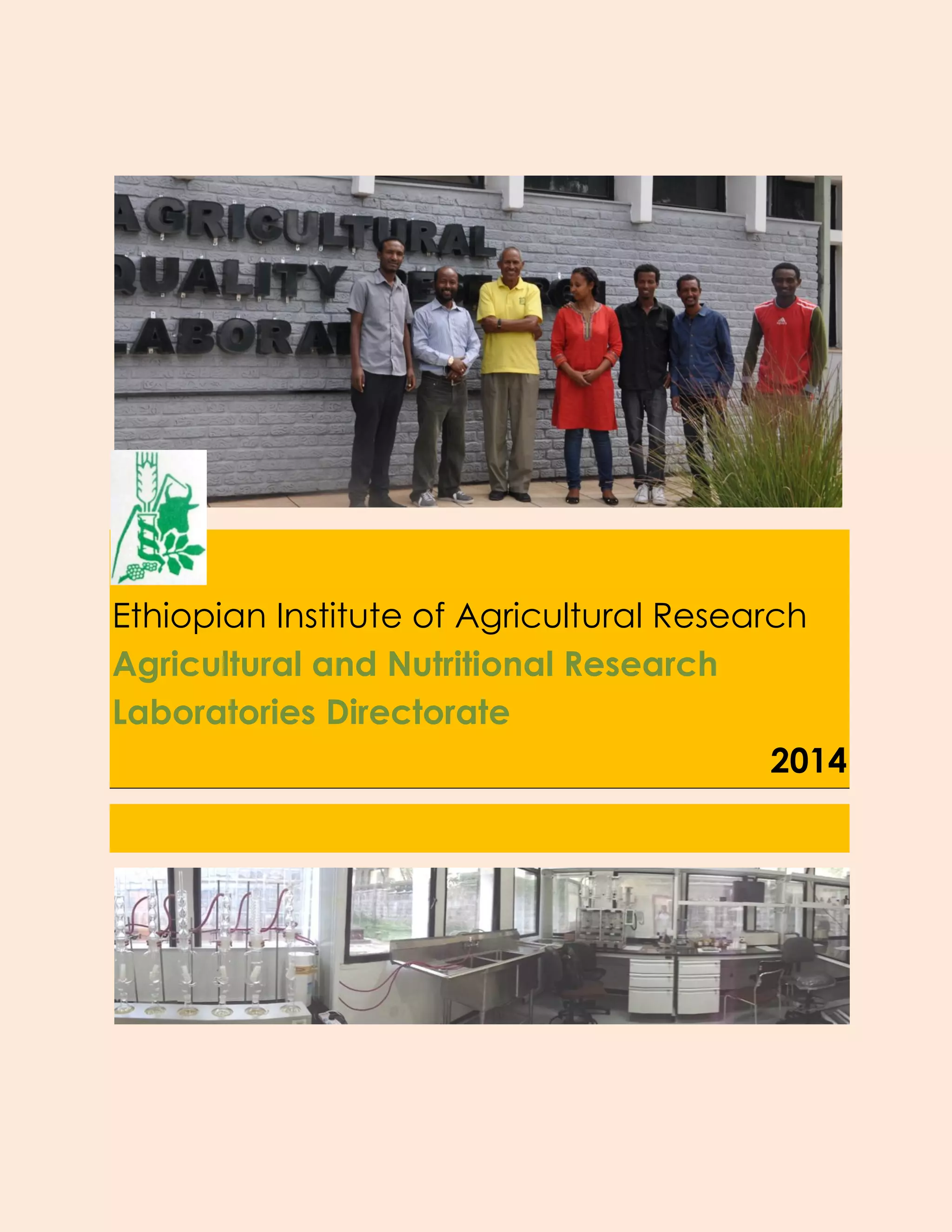
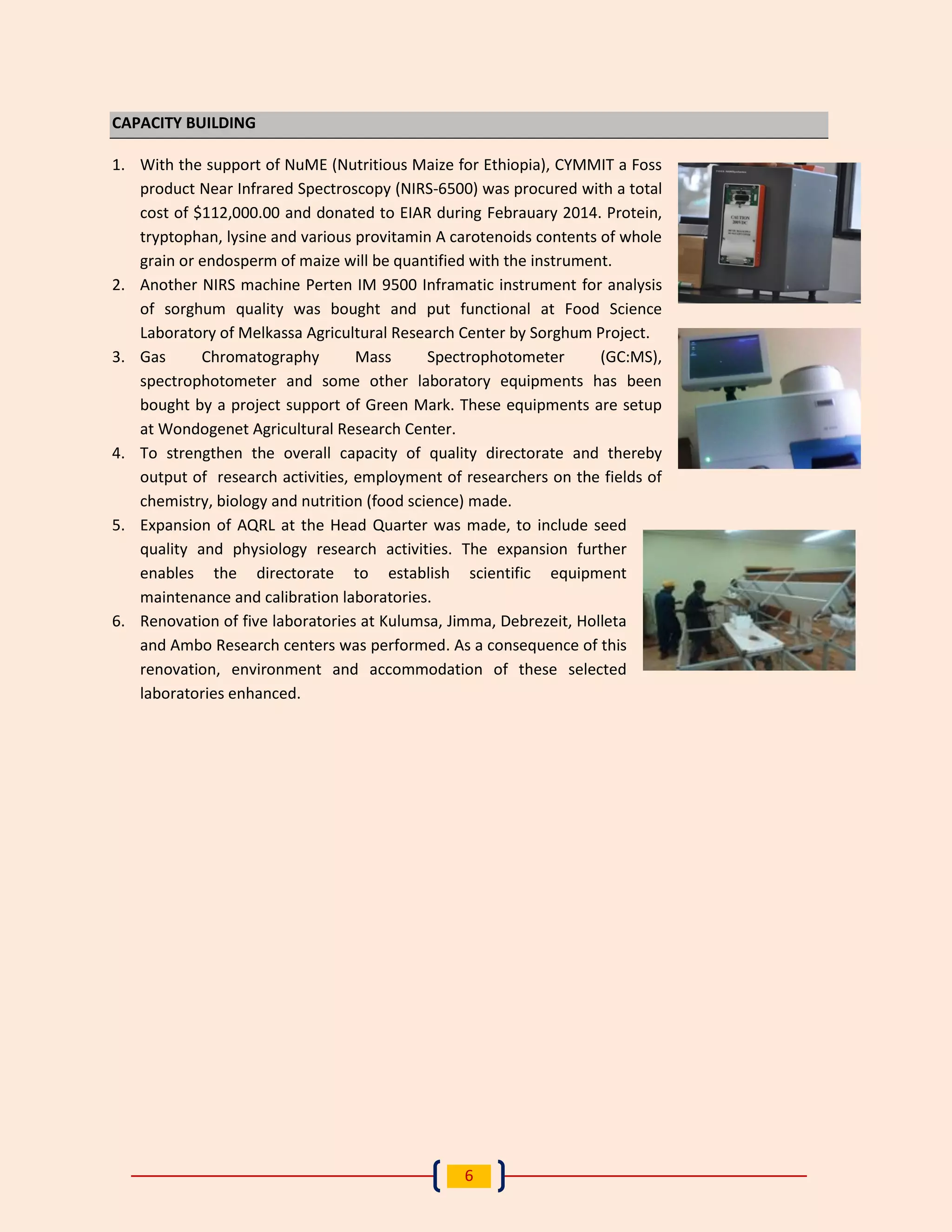
Ethiopian Institute of Agricultural Research Agricultural and Nutritional Research Laboratories Directorate 2014
2 
MONITORING AND EVALUATION 
1. November-December 2013. Laboratories of five research centers were monitored by the quality director and discussions were made with concerned center management. In this program Holleta, Ambo, Kulumsa, Wondogenet and Melkassa were included. 
2. January-February: Technical assessment of laboratories of EIAR made by team involving quality director, lab head of AQRL and GIZ technical 
personnel. In the assessment, laboratories of the following centers were considered: Holleta (Jan 21), Jimma (Jan 23-25), Ambo (Jan 28), Debrezeit (Jan 29), Melkassa (Feb 3), Werer (Feb 4), Kulumsa (Feb 5), Wondogenet (Feb 6), Pawe (Feb 14) and Sebeta. In addition, during this assessment program laboratories of Adet, Gondar and ARARI were included in Amhara regional research. Mehoni center (Feb 12) was also visited for possibility of establishing mini laboratory. 
3. March 13-14: Performance of quality directorate evaluated in a meeting held at head quarter of EIAR. Attendees were quality management representatives, laboratory heads and some selected researchers from different research center of the institute. The following topics were part of evaluation in the program; (a) major milestones of quality directorate starting its establishment on December 2013, in this topic there were 28 milestones raised and 
discussion made on; (b) progress of selected laboratories towards implementing Good Laboratory Practices (GLP) to attain accreditation, where good experiences, challenges, current status of eight laboratories presented and discussions held; (c) Status of research projects and future directions in the designing and implementation of research activities in the directorate was the third topic, where detailed activities of the two major projects of the QD presented and 
discussions held. 
4. April 14-15: Preliminary assessment of AQRL, Holleta dairy and Holleta 
chemistry laboratory made to evaluate the status of accreditation 
process in laboratories. In the assessment an international consultant 
in Quality Africa Network (Pty) Ltd, Mike Mc Nerney, and a certified 
assessor Abdi Duga involved. 
Desktop review of performed tasks by quality directorate in line with laboratory accreditation was made as a starting point of assessment. Besides, assessors were able to discuss some issues with the Director General, Dr. Fentahun Mengistu. 
5. May-June: Two to three times assessment of research laboratories who have applied for accreditation made by internal staff and consultants. Assessment/ audit report have been generated, non-conformances identified and improvement inline with that being made by each
3 
laboratories. In this assessment program Holleta dairy and chemistry laboratories, Ambo microbiology and biocontrol laboratories, Wondogenent Natural Products laboratory and head quarter laboratory are included. Similar assessment will be continued in the new budget year too. TRAININGS 
[1] Awareness creation in laboratory quality management given to laboratory personnel 
[2] November 2013. Training on research undertakings and data management given to eight junior researchers of Agricultural Quality Research Laboratory. 
[3] Ten days training on laboratory management and use of software in enhancing data use and manipulation was given at the head quarter of EIAR. One female and seven male researchers of AQRL involved in the training. 
[4] CIP (International Potato Center) provided a 13 days training to one of AQRL researcher, Dinka Mulugeta, on the method of sampling and analysis of potato qualities. The training was made in Peru. 
[5] Two round trainings on the analysis of potato was given by CIP at Rwanda. Potato quality research focal person, Dinka Mulugeta involved in these training program. 
[6] In collaboration with Ethiopian Health and Nutrition Research Institute, a one month training was given to seven researchers of quality directorate. The training topics included sample preparation of food items and their nutritional analysis. 
[7] November 25-29. Training has been given to 17 laboratory personnel on Laboratory management and calibration by special program arranged by GIZ at Addis Ababa. Researchers from Holleta, Ambo, Kulumsa, Melkassa, Wondogenet, Debrezeit and Agricultural Quality Research Laboratory (AQRL). 
[8] November. A five days training on the the principles and how of laboratory accreditation provided to 30 laboratory staff of research centers of Holleta, Kulumsa, Debrezeit, Melkassa, Wondogenet, Jimma, Head quarter and Ambo. 
[9] Five days of each three trainings given to selected laboratory personnel on method validation , verification and Measurement Uncertainty organized by ENAO. A total of eight researchers involved in these trainings. 
[10] March 19-April 2. Two researchers from quality directorate involved in the training held in India. The topic was "Integrated Food Management: Farm to Fork", held at National Institute of
4 
Food Technology Entrepreneur and Management (NIFTEM). During the training delegates from Tanzania, Ghana, Mauritius, Namibia, Uganda, Madagascar; A total of 21 participants involved. 
During the two weeks training, various topics were covered and dignified professors and other resource persons delivered their experiences. These includes, nutritional compound identification, anti-nutritional analysis, quality parameter determination, pesticides analysis, biotic factors identification, residual components assessment, synbiotics development and analysis, drying (dehydration) technologies, packaging current knowledge and experience etc. 
Practical sessions were in the program that enabled trainees to use laboratories. In addition, visits to prominent industries of rice, milk, meat and probiotic were made. Linkages with the Institutes' professors and delegates of other African countries were also significant contribution of the training. 
[11] April 28-May 3: Five days training was given on Agricultural Innovation System (AIS) and Value Chain Development (VCD) by ASARECA to EAAPP. Ethiopia, Uganda, Kenya and Tanzania are participating countries in the training. Two researchers of quality directorate were involved in the program, out of ten participants from Ethiopia. It was held in Tanzania, Arusha. 
Topics covered in the training were, (a) the concept of innovation and agricultural innovation system; (b) defining innovation and agricultural innovation system; (c) value chain as innovation system; (d) introduction to VCD and rationale for use fo VCD as a development approach; (e) analyzing value chain; (f) designing VC upgrading strategy; (g) value chains for research; (h) value chain development innovation platforms, leadership roles and activities in support of value chain innovation systems; (i) Introduction to a private owned Home-veg value chain/ guest talk. 
[12] April 28-May 7: Two weeks (10 days) training on the use of Near Infrared Spectroscopy (NIRS-6500) and wet chemistry for analysis of Tryptophan and Lysine on maize was given by head quarter of CYMMIT at Mexico. Two researchers of AQRL were involved in the training. 
[13] March 6-7: Hands on training on the use of NIRS for the analysis of crops as a breeding tool was given to researchers of quality directorate at the head quarter of EIAR, AQRL. Researchers from food science laboratory of Melkassa and AQRL were involved in the training. The training was given by Eng. Mohammed Ata from
5 
Foss company in Egypt. 
[14] February 25-29: Hands on training on the use of Perten IM 9500 for quantification of major primary metabolites of sorghum held at Melkassa. The training was given with the newly setup NIRS machine at the Food Science laboratory of Melkassa Agricultural Research Center with the support of Sorghum project. Two researchers each from AQRL and Food Science Lab were involved in the training. The training was given by Dr. Glen Fox, Queens Land University of Australia. The following topics were covered, (a) introductin to IM 9500 Inframatic; (b) advanced feature and function of IM 9500, where trainees were acquainted with the method how to add and delete calibration, calibration setting and its functions in window environment; (c) calibration development, where structure of files and what files needed and how can be copied discussed; (d) Basics of maintenance, in which the how to check instrument with special check special sample, checking and changing the lamp and the method to replace the monochromator belt were discussed. 
[15] Awareness creation on the quality management system of laboratories given for new employees and laboratory assistants in EIAR. 
[16] May 5: Two days training on internal audit system given to selected auditors, laboratory heads and Quality Management leaders at the head quarter of EIAR. Mike Mc Nerney and Abdi Duga gave the lecture. A total of 25 trainees participated, who have been drawn from Holleta, Kulumsa, Melkassa, head quarter, Jimma, Forestry, Debrezeit and Pawe Research Centers. 
[17] A two weeks induction training was given to new employee researchers in the department of biology. Besides the new trainees involved, researchers who are involved in areas of microbiology from Holleta and Sebeta were also involved. The training was given by experienced researchers drawn from Ambo Plant Protection Research Center and others. It was held at Ambo.
6 
CAPACITY BUILDING 
1. With the support of NuME (Nutritious Maize for Ethiopia), CYMMIT a Foss product Near Infrared Spectroscopy (NIRS-6500) was procured with a total cost of $112,000.00 and donated to EIAR during Febrauary 2014. Protein, tryptophan, lysine and various provitamin A carotenoids contents of whole grain or endosperm of maize will be quantified with the instrument. 
2. Another NIRS machine Perten IM 9500 Inframatic instrument for analysis of sorghum quality was bought and put functional at Food Science 
Laboratory of Melkassa Agricultural Research Center by Sorghum Project. 
3. Gas Chromatography Mass Spectrophotometer (GC:MS), spectrophotometer and some other laboratory equipments has been bought by a project support of Green Mark. These equipments are setup at Wondogenet Agricultural Research Center. 
4. To strengthen the overall capacity of quality directorate and thereby output of research activities, employment of researchers on the fields of 
chemistry, biology and nutrition (food science) made. 
5. Expansion of AQRL at the Head Quarter was made, to include seed quality and physiology research activities. The expansion further enables the directorate to establish scientific equipment maintenance and calibration laboratories. 
6. Renovation of five laboratories at Kulumsa, Jimma, Debrezeit, Holleta and Ambo Research centers was performed. As a consequence of this renovation, environment and accommodation of these selected 
laboratories enhanced.
7 
OTHER ACTIVITIES 
[1] Working document of EIAR laboratories entitled "EIAR Lab Quality Manual" developed, involving ten researchers and laboratory assistants drawn from different research centers. The quality manual is prepared on the basis of guidelines of ISO/IEC 17025. November 4- 15, 2013. 
[2] Quality Manual developed by team of researchers has been reviewed within five days at Sisay Hotel of Adama. The review program was very exhaustive, involving various laboratory personnel of EIAR drawn from research centers and GIZ consultants. November 18-22, 2013. 
[3] A group of 20 university students and other laboratory staff visited AQRL by the coordination of Agricultural Transformation Agency (ATA) 
[4] Ten high School female students visited AQRL. GIZ coordinated the visit program 
[5] Practical training and sample analysis services has been given to Addis Ababa, Haremaya and Hawassa University students. These services are were given by AQRL and Holleta chemistry laboratory. 
[6] First round calibration of equipments of Bacteriology and biocontrol laboratories of Ambo; soil, plant and water analysis and chemistry and microbiology of dairy laboratories of Holleta; natural products lab of Wondogenet; Agricultural Quality Research Laboratory of the head quarter; Soil, plant and water analysis laboratory of Jimma and Debrezeit; and Food science laboratory of Melkassa were considered. Coordination and responsibility of this calibration activity was carried out by Legesse Shiferaw. November 4-22, 2013. 
[7] An official Facebook account with a name of "Quality at EIAR" opened for documentation, progress report and communication of events to the community in social media. Information on quality directorate progress is being communicated to the members, who likes the page. Currently there are 120 people we reached and is planned to reach as many people as possible at least in the research system. 
https://www.facebook.com/quality.eiar?ref_type=bookmark 
[8] Quality Directorate of EIAR has started working with DOW chemicals, and PYXERA Global to implement quality related experiences of international organizations. In this project, experiences of the international company in integrated laboratory management and quality laboratory is to be implemented. 
[9] Calibration of laboratory equipments of Holleta, Ambo, Wondogenet, AQRL and Jimma is being recurrently done by assigning one dedicated researcher as an additional task 
[10] Two documents on lists of chemicals, consumables, lab wares and equipments with detailed of specifications and indexing systems developed for quick reference and procurement system. ANRLD believes that these two institutional reference materials will be used throughout the institute and across other agricultural research institutions for ease of procurement system.
8 
[11] Access control system installed in AQRL to regulate movement of people in the laboratory and to bring confidentiality thereof. Finger print access control system is of state of the art technology which is uncommon in other similar laboratories found in the country. 
[12] Overall electrical installation and network problem of AQRL at the head quarter of EIAR is redone due to serious problem in the subjects. Being electrical installation the most causes of instrument failure in most laboratories, the AQRL case will be taken as a model while constructing new and/ or converting other buildings into laboratories. The whole network system is also changed in the way to access every digital equipments in the lab from any corner. EVENTS 
[1] January 23: The first spices, herbs and aromatic producers, processors and exporters platform stakeholder meeting organized by Addis Ababa Chamber of Commerce was held at Ambassador Hotel, Addis Ababa. Aims of this platform meeting are; (a) identifying and prioritizing the major bottlenecks of spices, herbs and aromatic subsector; (b) creating awareness on opportunities of spices, herbs and aromatic trade and investment policies; (c) facilitating joint venture production, processing and export investment opportunities in Ethiopia for both national and international companies; and (d) sharing information and knowledge on spices, herbs and aromatics. Director of Quality management of EIAR involved in the event, and played the facilitation role in some part of technical discussion. 
[2] February 28: A discussion was held on the renovation plan of selected EIAR laboratories with the involvement of directors and expertise of planning, finance and engineering; and technical center representatives of Holleta, Kulumssa, Ambo and Jimma. This event was held at the FRG hall in the head quarter of EIAR. 
[3] April 07: Research staff members of International Potato Center from Peru, Lima visited AQRL on 07/04/2014. During their visit, it was agreed to have strong relationship in quality analysis of potato and sweet potato using the existing instruments and professionals in AQRL. Possibility of procuring freeze dryer for potato quality analysis and further link with the head quarter of International Potato Center raised. 
[4] March 5: Renovation activities of center laboratories at Ambo, Debrezeit, Kulumssa, Wondogenet and Holleta officially started. In this day representatives from each of the above center came to the head office of EIAR and started doing the practical purchasing and planning of their activities in a team.
9 
[5] March 6-7: Installation of NIRS (Near Infrared Spectrophotometer) made at AQRL, the head quarter of EIAR, Debrezeit Research Center and Melkassa Research Center. A Foss product NIRS which is meant to analyze quality protein maize was installed by Eng. Mohammed Ata, an Egyptian expert. During installation a two days training was given to AQRL personnel. Eng. Mohammed has also installed NIRS of Debrezeit Agricultural Research Center. 
Another NIRS machine (Perten IM 9500 Inframatic instrument) which is bought by the support of Sorghum project is installed and a corresponding training was given by Dr. Glen Fox, an Australian scientist from Queens Land University. Four members of quality directorate involved in the installation and training program. 
[6] Meetings of quality management team held, participants being laboratory heads and quality management representatives. Three time discussion held 
[7] March 11: GIZ-NQI (National Quality Infrastructure) director, Dr. Stamm Andreas visited AQRL. A short meeting involving Director General of EIAR, Dr. Fentahun Mengistu was held at the DG office after the visit of Dr. Andreas to AQRL. Dr. Dessalegn Lidetu, officer in GIZ-NQI; Mr Abdi Duga, certified assessor and consultant in GIZ-NQI; Dr Girma Mamo from GIZ project; Mss Gelila Asaminew, head of AQRL; and Mr Solomon Abate, Director of Quality Agricultural Research involved in the discussion. Area of possible further collaboration with the project was raised and agreement reached. 
[8] April 21: Emeritus Prof. Ermias Dagne of Addis Ababa University visited AQRL. During his visit, discussion on how agricultural chemistry could be framed in the arena of EIAR was made. After his visit and discussion, Prof. Ermias, expressed his appreciation of the whole initiative of EIAR towards focusing agricultural chemistry and nutrition, and pledged to contribute in the process. 
[9] MoU signed with NutrAfrica: EIAR with the intention of expanding its research into nutritional development and fortifications, has signed memorandum of understanding with NutrAfrica Agro Industry and Food Processing PVT.Ltd.Co. Ethiopia. According to the agreement, NutrAfrica will facilitate soliciting joint projects towards enhancing nutrition research in EIAR. In addition facilitation of post harvest management system will be studied using factory facilities in the partners. 
[10] May 16: A national workshop on soybean product development, as part of an ongoing project entitled "Enhancement of Agricultural Technologies through Development of Alternative Products" held at
10 
the head quarter of EIAR. In the workshop researchers from Ethiopian Health and Nutrition Research Institute (EHNRI), Ethiopian Science and Technology, Pawe Agricultural Research Center, and AQRL involved. 
[11] May 18: In collaboration with NutrAfrica, Dr. Michelle Grant Executive director of Swiss Federal Institute of Technology Zurich, World Food System visited AQRL. During the visit, possibility of linking the Ethiopian Institute of Agricultural Research with the university was raised on major areas of capacity building. Accordingly draft concept note of collaboration developed and communicated to the university. 
[12] July 2-6: Micronutrient Forum Global Conference of 2014 held at the United Nations Economic Commission for Africa Conference Center (UNECA/CC) in Addis Ababa with the theme of “Bridging Discovery and Delivery”. As a vital partner in efforts to reduce micronutrient malnutrition, EIAR was invited and Bilatu Agza, Food Science Researcher in Quality Directorate, participated in the forum. 
[13] June 05: Awareness creation about the quality directorate and status of laboratories with respect to accreditation process explained to the research community in a one day visit program. The visit program was mainly scheduled to involve EIAR management members, researchers and some partners. Around 400 people visited AQRL during the visit program, where explanation of one year progress of quality directorate, calibration status, technical requirements followed by selected laboratories in EIAR was made. Dr. Fentahun Mengistu, Director General of EIAR has opened the visit officially, and deputy director general, directors of research centers, research programs, national caseteam, project leaders, center process representatives and senior researchers in EIAR were involved as part of the institute. 
In addition, researchers and leaders of FRG II, ILRI, universities and other partners attended the visit program. Majority of comments received from the participants encouraged the progress made by the directorate and commented to widely create the awareness and involve other research centers, and systems in the NARS. 
[14] June 06: The first application for accreditation of laboratories in EIAR made for AQRL of the head quarter. Three parameters were requested; moisture, fat and fiber content determination. Ethiopian National Accreditation Office (ENAO) has taken the national
11 
responsibility of accreditation as third party body. Laboratories which have applied for the accreditation following AQRL are bacteriology and biocontrol laboratories of Ambo, dairy chemistry and microbiology and soil, plant and water analysis laboratories of Holleta; and Natural products laboratory of Wondogenet. 
[15] June 09: World Accreditation Day was celebrated at Ililly International Hotel, Addis Ababa with a motto "Accreditation Deliver confidence in the provision of Energy". Ethiopian National Accreditation Office (ENAO) was the coordinator of the event and various organizations involved in the program, including medical laboratories, metrology institutions, nutrition laboratories, universities, etc. Three lead papers were presented for the audience as a landmark of accreditation concept and application. Among the three papers, EIAR took part in presenting its experiences in upgrading research laboratories and bringing in to an accredited entity. The presentation was made by Solomon Abate, Director of the quality directorate of EIAR, and the title for presentation was "Accreditation in Agricultural Research Laboratories". 
[16] June 18: World metrology day was celebrated with the theme of “Measurements and the Global Energy Challenge” at Ililly International Hotel, Addis Ababa. Being involved in the calibration of many laboratory equipments and taking responsibility to establish an internal calibration mini laboratory, Quality directorate of EIAR has involved in the event. The official opening of the day was made by H.E. W/ro Demitu, Minister of Science and Technology Ministry. 
[17] June 19: The Second Spice, Herbs and Aromatic Plants Producers, Processors and Exporters Platform organized by Addis Ababa Chamber of Commerce held in Addis Ababa, Jupiter International Hotel. Representing EIAR, Quality directorate took part in the occasion as one of the panelists. 
[18] June 26: David Roche, executive director of Coffee Quality Institute (CQI), USA visited Agricultural Quality Research Laboratory (AQRL). His visit to the laboratory was part of a two days discussion on quality flavor profile mapping of Ethiopian Coffee, possibility and application. Experiences of other countries such as Guatemala was raised as best example of such mapping in the coffee industry. Major research process and Jimma Research center directors, deputy director of extension department of MoA, leaders of coffee exporters associations, researchers and coffee project coordinators of Jimma, delegate from Ethiopian Biodiversity Institute have participated the
12 
meeting and visit program. Deputy Director General of EIAR, Dr. Adugna Wakijira chaired the meeting and visit program. 
[19] June 23: The Ethiopian parliamentary committee and Nigerian members of parliament paid visited to AQRL of EIAR. Two members of parliament from Nigeria and agriculture standing committee of the Ethiopian parliament were involved in the visit program. During their stay relevance of quality agricultural research, laboratory enhancement, accreditation, etc were discussion points. Finally they have expressed appreciation of the movement of EIAR towards improving the laboratory status and looking for accreditation program. Both parties urged the institute to push further the quality system in the agricultural sector in general. 
[20] July 11: Review of research activities on milk and milk products made involving responsible researchers in Quality Agricultural Research Directorate. In the one day review program, adulteration of butter, flavored yogurt making, determination of quality parameters of milk and milk products were major topics. Bilatu Agiza who is temporarily appointed to coordinate product development project of the quality directorate, has managed the review workshop. Attendees were Alganesh Tola, Mebrat Hailu and Zerihun Assefa from Holleta dairy laboratory; and Legesse Shiferaw and Bilatu Agiza from AQRL. 
[21] Soybean product development is one of the activities planned to be executed in the project called "Enhancement of Agricultural Technologies Through Development of Alternative Products". To implement this activities, as a followup of the workshop held on the subject on May 16, research team brought from AQRL, Pawe, Melkassa and University reviewed the details of activities to be implemented. In this review detail proposal development and associated works to be done were distributed among team members 
[22] Two consecutive national workshops held on the main theme of strengthening the National Nutrition Program which is being nationally coordinated by MoH. Agricultural and Nutrition Research Laboratories Directorate participated by its four researchers these workshops. Besides being the steering committee members of the two separate components of the national program, which separately being managed by Public Health Research Institute and Industry Ministry, EIAR through ANRLD is nominated as a co-chair of one of the components.

Anrld act summary

  • 1.
    Ethiopian Institute ofAgricultural Research Agricultural and Nutritional Research Laboratories Directorate 2014
  • 2.
    2 MONITORING ANDEVALUATION 1. November-December 2013. Laboratories of five research centers were monitored by the quality director and discussions were made with concerned center management. In this program Holleta, Ambo, Kulumsa, Wondogenet and Melkassa were included. 2. January-February: Technical assessment of laboratories of EIAR made by team involving quality director, lab head of AQRL and GIZ technical personnel. In the assessment, laboratories of the following centers were considered: Holleta (Jan 21), Jimma (Jan 23-25), Ambo (Jan 28), Debrezeit (Jan 29), Melkassa (Feb 3), Werer (Feb 4), Kulumsa (Feb 5), Wondogenet (Feb 6), Pawe (Feb 14) and Sebeta. In addition, during this assessment program laboratories of Adet, Gondar and ARARI were included in Amhara regional research. Mehoni center (Feb 12) was also visited for possibility of establishing mini laboratory. 3. March 13-14: Performance of quality directorate evaluated in a meeting held at head quarter of EIAR. Attendees were quality management representatives, laboratory heads and some selected researchers from different research center of the institute. The following topics were part of evaluation in the program; (a) major milestones of quality directorate starting its establishment on December 2013, in this topic there were 28 milestones raised and discussion made on; (b) progress of selected laboratories towards implementing Good Laboratory Practices (GLP) to attain accreditation, where good experiences, challenges, current status of eight laboratories presented and discussions held; (c) Status of research projects and future directions in the designing and implementation of research activities in the directorate was the third topic, where detailed activities of the two major projects of the QD presented and discussions held. 4. April 14-15: Preliminary assessment of AQRL, Holleta dairy and Holleta chemistry laboratory made to evaluate the status of accreditation process in laboratories. In the assessment an international consultant in Quality Africa Network (Pty) Ltd, Mike Mc Nerney, and a certified assessor Abdi Duga involved. Desktop review of performed tasks by quality directorate in line with laboratory accreditation was made as a starting point of assessment. Besides, assessors were able to discuss some issues with the Director General, Dr. Fentahun Mengistu. 5. May-June: Two to three times assessment of research laboratories who have applied for accreditation made by internal staff and consultants. Assessment/ audit report have been generated, non-conformances identified and improvement inline with that being made by each
  • 3.
    3 laboratories. Inthis assessment program Holleta dairy and chemistry laboratories, Ambo microbiology and biocontrol laboratories, Wondogenent Natural Products laboratory and head quarter laboratory are included. Similar assessment will be continued in the new budget year too. TRAININGS [1] Awareness creation in laboratory quality management given to laboratory personnel [2] November 2013. Training on research undertakings and data management given to eight junior researchers of Agricultural Quality Research Laboratory. [3] Ten days training on laboratory management and use of software in enhancing data use and manipulation was given at the head quarter of EIAR. One female and seven male researchers of AQRL involved in the training. [4] CIP (International Potato Center) provided a 13 days training to one of AQRL researcher, Dinka Mulugeta, on the method of sampling and analysis of potato qualities. The training was made in Peru. [5] Two round trainings on the analysis of potato was given by CIP at Rwanda. Potato quality research focal person, Dinka Mulugeta involved in these training program. [6] In collaboration with Ethiopian Health and Nutrition Research Institute, a one month training was given to seven researchers of quality directorate. The training topics included sample preparation of food items and their nutritional analysis. [7] November 25-29. Training has been given to 17 laboratory personnel on Laboratory management and calibration by special program arranged by GIZ at Addis Ababa. Researchers from Holleta, Ambo, Kulumsa, Melkassa, Wondogenet, Debrezeit and Agricultural Quality Research Laboratory (AQRL). [8] November. A five days training on the the principles and how of laboratory accreditation provided to 30 laboratory staff of research centers of Holleta, Kulumsa, Debrezeit, Melkassa, Wondogenet, Jimma, Head quarter and Ambo. [9] Five days of each three trainings given to selected laboratory personnel on method validation , verification and Measurement Uncertainty organized by ENAO. A total of eight researchers involved in these trainings. [10] March 19-April 2. Two researchers from quality directorate involved in the training held in India. The topic was "Integrated Food Management: Farm to Fork", held at National Institute of
  • 4.
    4 Food TechnologyEntrepreneur and Management (NIFTEM). During the training delegates from Tanzania, Ghana, Mauritius, Namibia, Uganda, Madagascar; A total of 21 participants involved. During the two weeks training, various topics were covered and dignified professors and other resource persons delivered their experiences. These includes, nutritional compound identification, anti-nutritional analysis, quality parameter determination, pesticides analysis, biotic factors identification, residual components assessment, synbiotics development and analysis, drying (dehydration) technologies, packaging current knowledge and experience etc. Practical sessions were in the program that enabled trainees to use laboratories. In addition, visits to prominent industries of rice, milk, meat and probiotic were made. Linkages with the Institutes' professors and delegates of other African countries were also significant contribution of the training. [11] April 28-May 3: Five days training was given on Agricultural Innovation System (AIS) and Value Chain Development (VCD) by ASARECA to EAAPP. Ethiopia, Uganda, Kenya and Tanzania are participating countries in the training. Two researchers of quality directorate were involved in the program, out of ten participants from Ethiopia. It was held in Tanzania, Arusha. Topics covered in the training were, (a) the concept of innovation and agricultural innovation system; (b) defining innovation and agricultural innovation system; (c) value chain as innovation system; (d) introduction to VCD and rationale for use fo VCD as a development approach; (e) analyzing value chain; (f) designing VC upgrading strategy; (g) value chains for research; (h) value chain development innovation platforms, leadership roles and activities in support of value chain innovation systems; (i) Introduction to a private owned Home-veg value chain/ guest talk. [12] April 28-May 7: Two weeks (10 days) training on the use of Near Infrared Spectroscopy (NIRS-6500) and wet chemistry for analysis of Tryptophan and Lysine on maize was given by head quarter of CYMMIT at Mexico. Two researchers of AQRL were involved in the training. [13] March 6-7: Hands on training on the use of NIRS for the analysis of crops as a breeding tool was given to researchers of quality directorate at the head quarter of EIAR, AQRL. Researchers from food science laboratory of Melkassa and AQRL were involved in the training. The training was given by Eng. Mohammed Ata from
  • 5.
    5 Foss companyin Egypt. [14] February 25-29: Hands on training on the use of Perten IM 9500 for quantification of major primary metabolites of sorghum held at Melkassa. The training was given with the newly setup NIRS machine at the Food Science laboratory of Melkassa Agricultural Research Center with the support of Sorghum project. Two researchers each from AQRL and Food Science Lab were involved in the training. The training was given by Dr. Glen Fox, Queens Land University of Australia. The following topics were covered, (a) introductin to IM 9500 Inframatic; (b) advanced feature and function of IM 9500, where trainees were acquainted with the method how to add and delete calibration, calibration setting and its functions in window environment; (c) calibration development, where structure of files and what files needed and how can be copied discussed; (d) Basics of maintenance, in which the how to check instrument with special check special sample, checking and changing the lamp and the method to replace the monochromator belt were discussed. [15] Awareness creation on the quality management system of laboratories given for new employees and laboratory assistants in EIAR. [16] May 5: Two days training on internal audit system given to selected auditors, laboratory heads and Quality Management leaders at the head quarter of EIAR. Mike Mc Nerney and Abdi Duga gave the lecture. A total of 25 trainees participated, who have been drawn from Holleta, Kulumsa, Melkassa, head quarter, Jimma, Forestry, Debrezeit and Pawe Research Centers. [17] A two weeks induction training was given to new employee researchers in the department of biology. Besides the new trainees involved, researchers who are involved in areas of microbiology from Holleta and Sebeta were also involved. The training was given by experienced researchers drawn from Ambo Plant Protection Research Center and others. It was held at Ambo.
  • 6.
    6 CAPACITY BUILDING 1. With the support of NuME (Nutritious Maize for Ethiopia), CYMMIT a Foss product Near Infrared Spectroscopy (NIRS-6500) was procured with a total cost of $112,000.00 and donated to EIAR during Febrauary 2014. Protein, tryptophan, lysine and various provitamin A carotenoids contents of whole grain or endosperm of maize will be quantified with the instrument. 2. Another NIRS machine Perten IM 9500 Inframatic instrument for analysis of sorghum quality was bought and put functional at Food Science Laboratory of Melkassa Agricultural Research Center by Sorghum Project. 3. Gas Chromatography Mass Spectrophotometer (GC:MS), spectrophotometer and some other laboratory equipments has been bought by a project support of Green Mark. These equipments are setup at Wondogenet Agricultural Research Center. 4. To strengthen the overall capacity of quality directorate and thereby output of research activities, employment of researchers on the fields of chemistry, biology and nutrition (food science) made. 5. Expansion of AQRL at the Head Quarter was made, to include seed quality and physiology research activities. The expansion further enables the directorate to establish scientific equipment maintenance and calibration laboratories. 6. Renovation of five laboratories at Kulumsa, Jimma, Debrezeit, Holleta and Ambo Research centers was performed. As a consequence of this renovation, environment and accommodation of these selected laboratories enhanced.
  • 7.
    7 OTHER ACTIVITIES [1] Working document of EIAR laboratories entitled "EIAR Lab Quality Manual" developed, involving ten researchers and laboratory assistants drawn from different research centers. The quality manual is prepared on the basis of guidelines of ISO/IEC 17025. November 4- 15, 2013. [2] Quality Manual developed by team of researchers has been reviewed within five days at Sisay Hotel of Adama. The review program was very exhaustive, involving various laboratory personnel of EIAR drawn from research centers and GIZ consultants. November 18-22, 2013. [3] A group of 20 university students and other laboratory staff visited AQRL by the coordination of Agricultural Transformation Agency (ATA) [4] Ten high School female students visited AQRL. GIZ coordinated the visit program [5] Practical training and sample analysis services has been given to Addis Ababa, Haremaya and Hawassa University students. These services are were given by AQRL and Holleta chemistry laboratory. [6] First round calibration of equipments of Bacteriology and biocontrol laboratories of Ambo; soil, plant and water analysis and chemistry and microbiology of dairy laboratories of Holleta; natural products lab of Wondogenet; Agricultural Quality Research Laboratory of the head quarter; Soil, plant and water analysis laboratory of Jimma and Debrezeit; and Food science laboratory of Melkassa were considered. Coordination and responsibility of this calibration activity was carried out by Legesse Shiferaw. November 4-22, 2013. [7] An official Facebook account with a name of "Quality at EIAR" opened for documentation, progress report and communication of events to the community in social media. Information on quality directorate progress is being communicated to the members, who likes the page. Currently there are 120 people we reached and is planned to reach as many people as possible at least in the research system. https://www.facebook.com/quality.eiar?ref_type=bookmark [8] Quality Directorate of EIAR has started working with DOW chemicals, and PYXERA Global to implement quality related experiences of international organizations. In this project, experiences of the international company in integrated laboratory management and quality laboratory is to be implemented. [9] Calibration of laboratory equipments of Holleta, Ambo, Wondogenet, AQRL and Jimma is being recurrently done by assigning one dedicated researcher as an additional task [10] Two documents on lists of chemicals, consumables, lab wares and equipments with detailed of specifications and indexing systems developed for quick reference and procurement system. ANRLD believes that these two institutional reference materials will be used throughout the institute and across other agricultural research institutions for ease of procurement system.
  • 8.
    8 [11] Accesscontrol system installed in AQRL to regulate movement of people in the laboratory and to bring confidentiality thereof. Finger print access control system is of state of the art technology which is uncommon in other similar laboratories found in the country. [12] Overall electrical installation and network problem of AQRL at the head quarter of EIAR is redone due to serious problem in the subjects. Being electrical installation the most causes of instrument failure in most laboratories, the AQRL case will be taken as a model while constructing new and/ or converting other buildings into laboratories. The whole network system is also changed in the way to access every digital equipments in the lab from any corner. EVENTS [1] January 23: The first spices, herbs and aromatic producers, processors and exporters platform stakeholder meeting organized by Addis Ababa Chamber of Commerce was held at Ambassador Hotel, Addis Ababa. Aims of this platform meeting are; (a) identifying and prioritizing the major bottlenecks of spices, herbs and aromatic subsector; (b) creating awareness on opportunities of spices, herbs and aromatic trade and investment policies; (c) facilitating joint venture production, processing and export investment opportunities in Ethiopia for both national and international companies; and (d) sharing information and knowledge on spices, herbs and aromatics. Director of Quality management of EIAR involved in the event, and played the facilitation role in some part of technical discussion. [2] February 28: A discussion was held on the renovation plan of selected EIAR laboratories with the involvement of directors and expertise of planning, finance and engineering; and technical center representatives of Holleta, Kulumssa, Ambo and Jimma. This event was held at the FRG hall in the head quarter of EIAR. [3] April 07: Research staff members of International Potato Center from Peru, Lima visited AQRL on 07/04/2014. During their visit, it was agreed to have strong relationship in quality analysis of potato and sweet potato using the existing instruments and professionals in AQRL. Possibility of procuring freeze dryer for potato quality analysis and further link with the head quarter of International Potato Center raised. [4] March 5: Renovation activities of center laboratories at Ambo, Debrezeit, Kulumssa, Wondogenet and Holleta officially started. In this day representatives from each of the above center came to the head office of EIAR and started doing the practical purchasing and planning of their activities in a team.
  • 9.
    9 [5] March6-7: Installation of NIRS (Near Infrared Spectrophotometer) made at AQRL, the head quarter of EIAR, Debrezeit Research Center and Melkassa Research Center. A Foss product NIRS which is meant to analyze quality protein maize was installed by Eng. Mohammed Ata, an Egyptian expert. During installation a two days training was given to AQRL personnel. Eng. Mohammed has also installed NIRS of Debrezeit Agricultural Research Center. Another NIRS machine (Perten IM 9500 Inframatic instrument) which is bought by the support of Sorghum project is installed and a corresponding training was given by Dr. Glen Fox, an Australian scientist from Queens Land University. Four members of quality directorate involved in the installation and training program. [6] Meetings of quality management team held, participants being laboratory heads and quality management representatives. Three time discussion held [7] March 11: GIZ-NQI (National Quality Infrastructure) director, Dr. Stamm Andreas visited AQRL. A short meeting involving Director General of EIAR, Dr. Fentahun Mengistu was held at the DG office after the visit of Dr. Andreas to AQRL. Dr. Dessalegn Lidetu, officer in GIZ-NQI; Mr Abdi Duga, certified assessor and consultant in GIZ-NQI; Dr Girma Mamo from GIZ project; Mss Gelila Asaminew, head of AQRL; and Mr Solomon Abate, Director of Quality Agricultural Research involved in the discussion. Area of possible further collaboration with the project was raised and agreement reached. [8] April 21: Emeritus Prof. Ermias Dagne of Addis Ababa University visited AQRL. During his visit, discussion on how agricultural chemistry could be framed in the arena of EIAR was made. After his visit and discussion, Prof. Ermias, expressed his appreciation of the whole initiative of EIAR towards focusing agricultural chemistry and nutrition, and pledged to contribute in the process. [9] MoU signed with NutrAfrica: EIAR with the intention of expanding its research into nutritional development and fortifications, has signed memorandum of understanding with NutrAfrica Agro Industry and Food Processing PVT.Ltd.Co. Ethiopia. According to the agreement, NutrAfrica will facilitate soliciting joint projects towards enhancing nutrition research in EIAR. In addition facilitation of post harvest management system will be studied using factory facilities in the partners. [10] May 16: A national workshop on soybean product development, as part of an ongoing project entitled "Enhancement of Agricultural Technologies through Development of Alternative Products" held at
  • 10.
    10 the headquarter of EIAR. In the workshop researchers from Ethiopian Health and Nutrition Research Institute (EHNRI), Ethiopian Science and Technology, Pawe Agricultural Research Center, and AQRL involved. [11] May 18: In collaboration with NutrAfrica, Dr. Michelle Grant Executive director of Swiss Federal Institute of Technology Zurich, World Food System visited AQRL. During the visit, possibility of linking the Ethiopian Institute of Agricultural Research with the university was raised on major areas of capacity building. Accordingly draft concept note of collaboration developed and communicated to the university. [12] July 2-6: Micronutrient Forum Global Conference of 2014 held at the United Nations Economic Commission for Africa Conference Center (UNECA/CC) in Addis Ababa with the theme of “Bridging Discovery and Delivery”. As a vital partner in efforts to reduce micronutrient malnutrition, EIAR was invited and Bilatu Agza, Food Science Researcher in Quality Directorate, participated in the forum. [13] June 05: Awareness creation about the quality directorate and status of laboratories with respect to accreditation process explained to the research community in a one day visit program. The visit program was mainly scheduled to involve EIAR management members, researchers and some partners. Around 400 people visited AQRL during the visit program, where explanation of one year progress of quality directorate, calibration status, technical requirements followed by selected laboratories in EIAR was made. Dr. Fentahun Mengistu, Director General of EIAR has opened the visit officially, and deputy director general, directors of research centers, research programs, national caseteam, project leaders, center process representatives and senior researchers in EIAR were involved as part of the institute. In addition, researchers and leaders of FRG II, ILRI, universities and other partners attended the visit program. Majority of comments received from the participants encouraged the progress made by the directorate and commented to widely create the awareness and involve other research centers, and systems in the NARS. [14] June 06: The first application for accreditation of laboratories in EIAR made for AQRL of the head quarter. Three parameters were requested; moisture, fat and fiber content determination. Ethiopian National Accreditation Office (ENAO) has taken the national
  • 11.
    11 responsibility ofaccreditation as third party body. Laboratories which have applied for the accreditation following AQRL are bacteriology and biocontrol laboratories of Ambo, dairy chemistry and microbiology and soil, plant and water analysis laboratories of Holleta; and Natural products laboratory of Wondogenet. [15] June 09: World Accreditation Day was celebrated at Ililly International Hotel, Addis Ababa with a motto "Accreditation Deliver confidence in the provision of Energy". Ethiopian National Accreditation Office (ENAO) was the coordinator of the event and various organizations involved in the program, including medical laboratories, metrology institutions, nutrition laboratories, universities, etc. Three lead papers were presented for the audience as a landmark of accreditation concept and application. Among the three papers, EIAR took part in presenting its experiences in upgrading research laboratories and bringing in to an accredited entity. The presentation was made by Solomon Abate, Director of the quality directorate of EIAR, and the title for presentation was "Accreditation in Agricultural Research Laboratories". [16] June 18: World metrology day was celebrated with the theme of “Measurements and the Global Energy Challenge” at Ililly International Hotel, Addis Ababa. Being involved in the calibration of many laboratory equipments and taking responsibility to establish an internal calibration mini laboratory, Quality directorate of EIAR has involved in the event. The official opening of the day was made by H.E. W/ro Demitu, Minister of Science and Technology Ministry. [17] June 19: The Second Spice, Herbs and Aromatic Plants Producers, Processors and Exporters Platform organized by Addis Ababa Chamber of Commerce held in Addis Ababa, Jupiter International Hotel. Representing EIAR, Quality directorate took part in the occasion as one of the panelists. [18] June 26: David Roche, executive director of Coffee Quality Institute (CQI), USA visited Agricultural Quality Research Laboratory (AQRL). His visit to the laboratory was part of a two days discussion on quality flavor profile mapping of Ethiopian Coffee, possibility and application. Experiences of other countries such as Guatemala was raised as best example of such mapping in the coffee industry. Major research process and Jimma Research center directors, deputy director of extension department of MoA, leaders of coffee exporters associations, researchers and coffee project coordinators of Jimma, delegate from Ethiopian Biodiversity Institute have participated the
  • 12.
    12 meeting andvisit program. Deputy Director General of EIAR, Dr. Adugna Wakijira chaired the meeting and visit program. [19] June 23: The Ethiopian parliamentary committee and Nigerian members of parliament paid visited to AQRL of EIAR. Two members of parliament from Nigeria and agriculture standing committee of the Ethiopian parliament were involved in the visit program. During their stay relevance of quality agricultural research, laboratory enhancement, accreditation, etc were discussion points. Finally they have expressed appreciation of the movement of EIAR towards improving the laboratory status and looking for accreditation program. Both parties urged the institute to push further the quality system in the agricultural sector in general. [20] July 11: Review of research activities on milk and milk products made involving responsible researchers in Quality Agricultural Research Directorate. In the one day review program, adulteration of butter, flavored yogurt making, determination of quality parameters of milk and milk products were major topics. Bilatu Agiza who is temporarily appointed to coordinate product development project of the quality directorate, has managed the review workshop. Attendees were Alganesh Tola, Mebrat Hailu and Zerihun Assefa from Holleta dairy laboratory; and Legesse Shiferaw and Bilatu Agiza from AQRL. [21] Soybean product development is one of the activities planned to be executed in the project called "Enhancement of Agricultural Technologies Through Development of Alternative Products". To implement this activities, as a followup of the workshop held on the subject on May 16, research team brought from AQRL, Pawe, Melkassa and University reviewed the details of activities to be implemented. In this review detail proposal development and associated works to be done were distributed among team members [22] Two consecutive national workshops held on the main theme of strengthening the National Nutrition Program which is being nationally coordinated by MoH. Agricultural and Nutrition Research Laboratories Directorate participated by its four researchers these workshops. Besides being the steering committee members of the two separate components of the national program, which separately being managed by Public Health Research Institute and Industry Ministry, EIAR through ANRLD is nominated as a co-chair of one of the components.