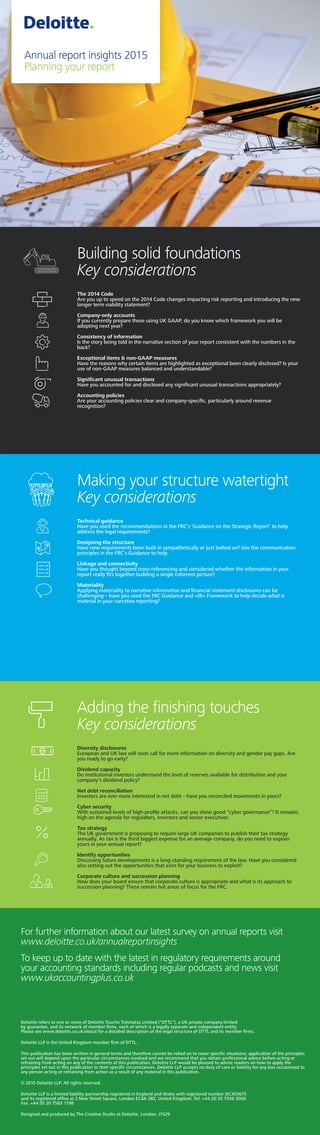
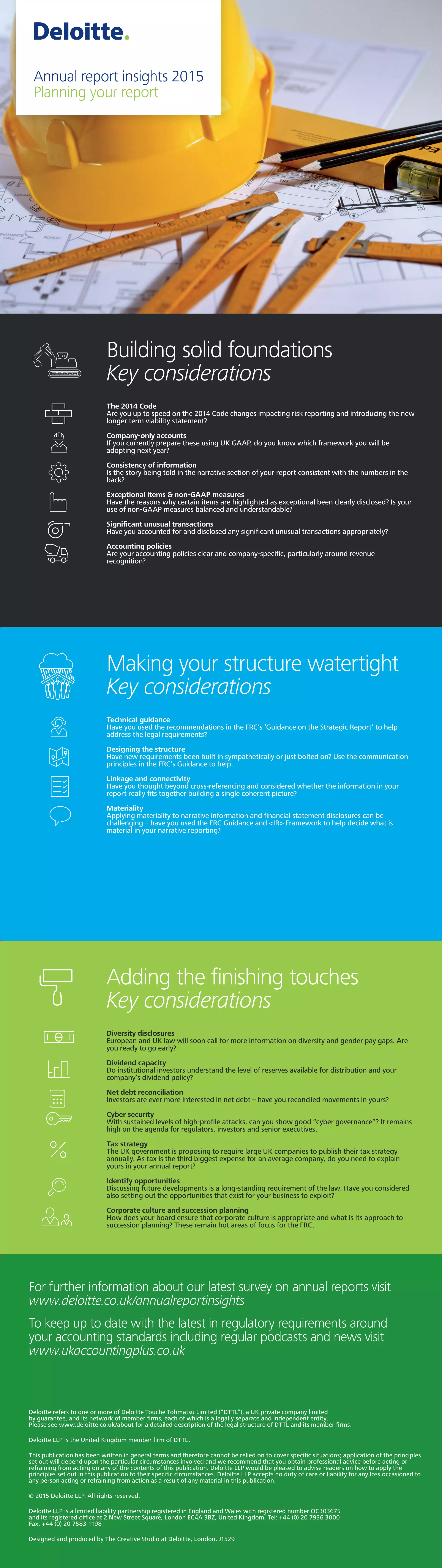
Adding the finishing touches
Key considerations
Deloitte refers to one or more of Deloitte Touche Tohmatsu Limited (“DTTL”), a UK private company limited
by guarantee, and its network of member firms, each of which is a legally separate and independent entity.
Please see www.deloitte.co.uk/about for a detailed description of the legal structure of DTTL and its member firms.
Deloitte LLP is the United Kingdom member firm of DTTL.
This publication has been written in general terms and therefore cannot be relied on to cover specific situations; application of the principles
set out will depend upon the particular circumstances involved and we recommend that you obtain professional advice before acting or
refraining from acting on any of the contents of this publication. Deloitte LLP would be pleased to advise readers on how to apply the
principles set out in this publication to their specific circumstances. Deloitte LLP accepts no duty of care or liability for any loss occasioned to
any person acting or refraining from action as a result of any material in this publication.
© 2015 Deloitte LLP. All rights reserved.
Deloitte LLP is a limited liability partnership registered in England and Wales with registered number OC303675
and its registered office at 2 New Street Square, London EC4A 3BZ, United Kingdom. Tel: +44 (0) 20 7936 3000
Fax: +44 (0) 20 7583 1198
Designed and produced by The Creative Studio at Deloitte, London. J1529
For further information about our latest survey on annual reports visit
www.deloitte.co.uk/annualreportinsights
To keep up to date with the latest in regulatory requirements around
your accounting standards including regular podcasts and news visit
www.ukaccountingplus.co.uk
Annual report insights 2015
Planning your report
Building solid foundations
Key considerations
Making your structure watertight
Key considerations
Technical guidance
Have you used the recommendations in the FRC’s ‘Guidance on the Strategic Report’ to help
address the legal requirements?
Designing the structure
Have new requirements been built in sympathetically or just bolted on? Use the communication
principles in the FRC’s Guidance to help.
Linkage and connectivity
Have you thought beyond cross-referencing and considered whether the information in your
report really fits together building a single coherent picture?
Materiality
Applying materiality to narrative information and financial statement disclosures can be
challenging – have you used the FRC Guidance and <IR> Framework to help decide what is
material in your narrative reporting?
The 2014 Code
Are you up to speed on the 2014 Code changes impacting risk reporting and introducing the new
longer term viability statement?
Company-only accounts
If you currently prepare these using UK GAAP, do you know which framework you will be
adopting next year?
Consistency of information
Is the story being told in the narrative section of your report consistent with the numbers in the
back?
Exceptional items & non-GAAP measures
Have the reasons why certain items are highlighted as exceptional been clearly disclosed? Is your
use of non-GAAP measures balanced and understandable?
Significant unusual transactions
Have you accounted for and disclosed any significant unusual transactions appropriately?
Accounting policies
Are your accounting policies clear and company-specific, particularly around revenue
recognition?
Diversity disclosures
European and UK law will soon call for more information on diversity and gender pay gaps. Are
you ready to go early?
Dividend capacity
Do institutional investors understand the level of reserves available for distribution and your
company’s dividend policy?
Net debt reconciliation
Investors are ever more interested in net debt – have you reconciled movements in yours?
Cyber security
With sustained levels of high-profile attacks, can you show good “cyber governance”? It remains
high on the agenda for regulators, investors and senior executives.
Tax strategy
The UK government is proposing to require large UK companies to publish their tax strategy
annually. As tax is the third biggest expense for an average company, do you need to explain
yours in your annual report?
Identify opportunities
Discussing future developments is a long-standing requirement of the law. Have you considered
also setting out the opportunities that exist for your business to exploit?
Corporate culture and succession planning
How does your board ensure that corporate culture is appropriate and what is its approach to
succession planning? These remain hot areas of focus for the FRC.
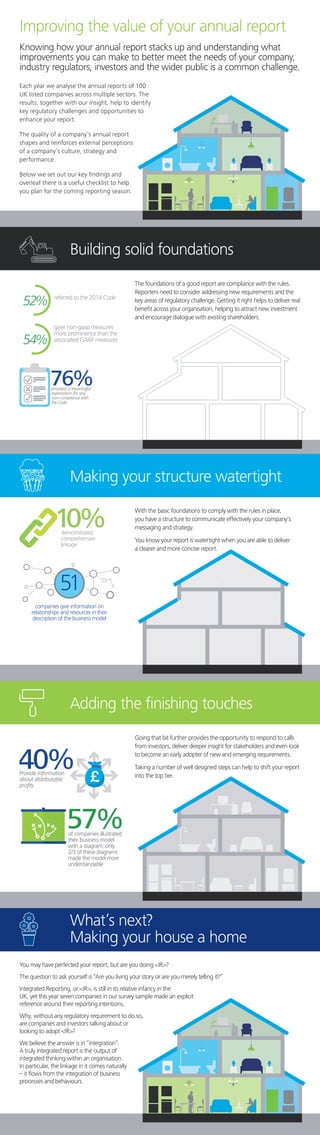
provided a meaningful
explanation for any
non-compliance with
the Code
76%
referred to the 2014 Code
���52%
gave non-gaap measures
more prominence than the
associated GAAP measures
���54%
10%demonstrated
comprehensive
linkage
companies give information on
relationships and resources in their
description of the business model
51
of companies illustrated
their business model
with a diagram; only
2/3 of these diagrams
made the model more
understandable
Provide information
about distributable
profits
40%
57%
£
Going that bit further provides the opportunity to respond to calls
from investors, deliver deeper insight for stakeholders and even look
to become an early adopter of new and emerging requirements.
Taking a number of well designed steps can help to shift your report
into the top tier.
Improving the value of your annual report
Building solid foundations
Making your structure watertight
Adding the finishing touches
What’s next?
Making your house a home
Knowing how your annual report stacks up and understanding what
improvements you can make to better meet the needs of your company,
industry regulators, investors and the wider public is a common challenge.
You may have perfected your report, but are you doing <IR>?
The question to ask yourself is “Are you living your story or are you merely telling it?”
Integrated Reporting, or <IR>, is still in its relative infancy in the
UK, yet this year seven companies in our survey sample made an explicit
reference around their reporting intentions.
Why, without any regulatory requirement to do so,
are companies and investors talking about or
looking to adopt <IR>?
We believe the answer is in “integration”.
A truly integrated report is the output of
integrated thinking within an organisation.
In particular, the linkage in it comes naturally
– it flows from the integration of business
processes and behaviours.
The foundations of a good report are compliance with the rules.
Reporters need to consider addressing new requirements and the
key areas of regulatory challenge. Getting it right helps to deliver real
benefit across your organisation, helping to attract new investment
and encourage dialogue with existing shareholders.
With the basic foundations to comply with the rules in place,
you have a structure to communicate effectively your company’s
messaging and strategy.
You know your report is watertight when you are able to deliver
a clearer and more concise report.
Each year we analyse the annual reports of 100
UK listed companies across multiple sectors. The
results, together with our insight, help to identify
key regulatory challenges and opportunities to
enhance your report.
The quality of a company’s annual report
shapes and reinforces external perceptions
of a company’s culture, strategy and
performance.
Below we set out our key findings and
overleaf there is a useful checklist to help
you plan for the coming reporting season.

Annual Report Insights 2015 infographic

  • 1.
    Adding the finishingtouches Key considerations Deloitte refers to one or more of Deloitte Touche Tohmatsu Limited (“DTTL”), a UK private company limited by guarantee, and its network of member firms, each of which is a legally separate and independent entity. Please see www.deloitte.co.uk/about for a detailed description of the legal structure of DTTL and its member firms. Deloitte LLP is the United Kingdom member firm of DTTL. This publication has been written in general terms and therefore cannot be relied on to cover specific situations; application of the principles set out will depend upon the particular circumstances involved and we recommend that you obtain professional advice before acting or refraining from acting on any of the contents of this publication. Deloitte LLP would be pleased to advise readers on how to apply the principles set out in this publication to their specific circumstances. Deloitte LLP accepts no duty of care or liability for any loss occasioned to any person acting or refraining from action as a result of any material in this publication. © 2015 Deloitte LLP. All rights reserved. Deloitte LLP is a limited liability partnership registered in England and Wales with registered number OC303675 and its registered office at 2 New Street Square, London EC4A 3BZ, United Kingdom. Tel: +44 (0) 20 7936 3000 Fax: +44 (0) 20 7583 1198 Designed and produced by The Creative Studio at Deloitte, London. J1529 For further information about our latest survey on annual reports visit www.deloitte.co.uk/annualreportinsights To keep up to date with the latest in regulatory requirements around your accounting standards including regular podcasts and news visit www.ukaccountingplus.co.uk Annual report insights 2015 Planning your report Building solid foundations Key considerations Making your structure watertight Key considerations Technical guidance Have you used the recommendations in the FRC’s ‘Guidance on the Strategic Report’ to help address the legal requirements? Designing the structure Have new requirements been built in sympathetically or just bolted on? Use the communication principles in the FRC’s Guidance to help. Linkage and connectivity Have you thought beyond cross-referencing and considered whether the information in your report really fits together building a single coherent picture? Materiality Applying materiality to narrative information and financial statement disclosures can be challenging – have you used the FRC Guidance and <IR> Framework to help decide what is material in your narrative reporting? The 2014 Code Are you up to speed on the 2014 Code changes impacting risk reporting and introducing the new longer term viability statement? Company-only accounts If you currently prepare these using UK GAAP, do you know which framework you will be adopting next year? Consistency of information Is the story being told in the narrative section of your report consistent with the numbers in the back? Exceptional items & non-GAAP measures Have the reasons why certain items are highlighted as exceptional been clearly disclosed? Is your use of non-GAAP measures balanced and understandable? Significant unusual transactions Have you accounted for and disclosed any significant unusual transactions appropriately? Accounting policies Are your accounting policies clear and company-specific, particularly around revenue recognition? Diversity disclosures European and UK law will soon call for more information on diversity and gender pay gaps. Are you ready to go early? Dividend capacity Do institutional investors understand the level of reserves available for distribution and your company’s dividend policy? Net debt reconciliation Investors are ever more interested in net debt – have you reconciled movements in yours? Cyber security With sustained levels of high-profile attacks, can you show good “cyber governance”? It remains high on the agenda for regulators, investors and senior executives. Tax strategy The UK government is proposing to require large UK companies to publish their tax strategy annually. As tax is the third biggest expense for an average company, do you need to explain yours in your annual report? Identify opportunities Discussing future developments is a long-standing requirement of the law. Have you considered also setting out the opportunities that exist for your business to exploit? Corporate culture and succession planning How does your board ensure that corporate culture is appropriate and what is its approach to succession planning? These remain hot areas of focus for the FRC.
  • 2.
    provided a meaningful explanationfor any non-compliance with the Code 76% referred to the 2014 Code ���52% gave non-gaap measures more prominence than the associated GAAP measures ���54% 10%demonstrated comprehensive linkage companies give information on relationships and resources in their description of the business model 51 of companies illustrated their business model with a diagram; only 2/3 of these diagrams made the model more understandable Provide information about distributable profits 40% 57% £ Going that bit further provides the opportunity to respond to calls from investors, deliver deeper insight for stakeholders and even look to become an early adopter of new and emerging requirements. Taking a number of well designed steps can help to shift your report into the top tier. Improving the value of your annual report Building solid foundations Making your structure watertight Adding the finishing touches What’s next? Making your house a home Knowing how your annual report stacks up and understanding what improvements you can make to better meet the needs of your company, industry regulators, investors and the wider public is a common challenge. You may have perfected your report, but are you doing <IR>? The question to ask yourself is “Are you living your story or are you merely telling it?” Integrated Reporting, or <IR>, is still in its relative infancy in the UK, yet this year seven companies in our survey sample made an explicit reference around their reporting intentions. Why, without any regulatory requirement to do so, are companies and investors talking about or looking to adopt <IR>? We believe the answer is in “integration”. A truly integrated report is the output of integrated thinking within an organisation. In particular, the linkage in it comes naturally – it flows from the integration of business processes and behaviours. The foundations of a good report are compliance with the rules. Reporters need to consider addressing new requirements and the key areas of regulatory challenge. Getting it right helps to deliver real benefit across your organisation, helping to attract new investment and encourage dialogue with existing shareholders. With the basic foundations to comply with the rules in place, you have a structure to communicate effectively your company’s messaging and strategy. You know your report is watertight when you are able to deliver a clearer and more concise report. Each year we analyse the annual reports of 100 UK listed companies across multiple sectors. The results, together with our insight, help to identify key regulatory challenges and opportunities to enhance your report. The quality of a company’s annual report shapes and reinforces external perceptions of a company’s culture, strategy and performance. Below we set out our key findings and overleaf there is a useful checklist to help you plan for the coming reporting season.