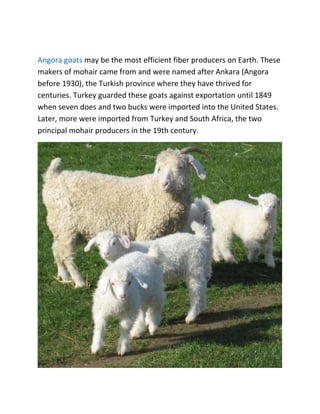
Angora goats may be the most efficient fiber producers on Earth. These
makers of mohair came from and were named after Ankara (Angora
before 1930), the Turkish province where they have thrived for
centuries. Turkey guarded these goats against exportation until 1849
when seven does and two bucks were imported into the United States.
Later, more were imported from Turkey and South Africa, the two
principal mohair producers in the 19th century.
But now the United States has become one of the two biggest
producers (along with South Africa) of mohair — the long, lustrous,
wavy hair that goes into fine garments. The other primary fiber from
goats is cashmere (see "A Small-Scale Agriculture Alternative, Cashmere
Goats", December 1992). But crossing Angora with cashmere goats
results in a fiber called cashgora, with very limited use and
characteristics of neither fine fiber.
The two goat types also differ in temperaments. The angoras are
relaxed and docile, while cashmere and/or Spanish meat goats are
often flighty and high strung. Angora goats, which do produce mohair,
do not produce Angora hair. Only rabbits can produce Angora hair.
Although Angora goats are somewhat delicate, they grow their fleeces
year-round. This puts considerable strain on the animal, and probably
contributes to their lack of hardiness.
About 90 percent of the U.S. mohair clip originates in Texas, but the
goats are raised across wide areas of the United States. They adapt well
to many conditions, but are particularly suited to the arid southwestern
states. Central and southwestern Texas have all the major mohair
warehouses.

Angora meat goats

  • 1.
    Angora goats maybe the most efficient fiber producers on Earth. These makers of mohair came from and were named after Ankara (Angora before 1930), the Turkish province where they have thrived for centuries. Turkey guarded these goats against exportation until 1849 when seven does and two bucks were imported into the United States. Later, more were imported from Turkey and South Africa, the two principal mohair producers in the 19th century.
  • 2.
    But now theUnited States has become one of the two biggest producers (along with South Africa) of mohair — the long, lustrous, wavy hair that goes into fine garments. The other primary fiber from goats is cashmere (see "A Small-Scale Agriculture Alternative, Cashmere Goats", December 1992). But crossing Angora with cashmere goats results in a fiber called cashgora, with very limited use and characteristics of neither fine fiber. The two goat types also differ in temperaments. The angoras are relaxed and docile, while cashmere and/or Spanish meat goats are often flighty and high strung. Angora goats, which do produce mohair, do not produce Angora hair. Only rabbits can produce Angora hair. Although Angora goats are somewhat delicate, they grow their fleeces year-round. This puts considerable strain on the animal, and probably contributes to their lack of hardiness. About 90 percent of the U.S. mohair clip originates in Texas, but the goats are raised across wide areas of the United States. They adapt well to many conditions, but are particularly suited to the arid southwestern states. Central and southwestern Texas have all the major mohair warehouses.