Geo-Political Situation
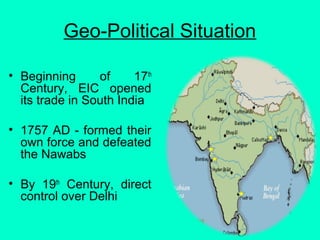
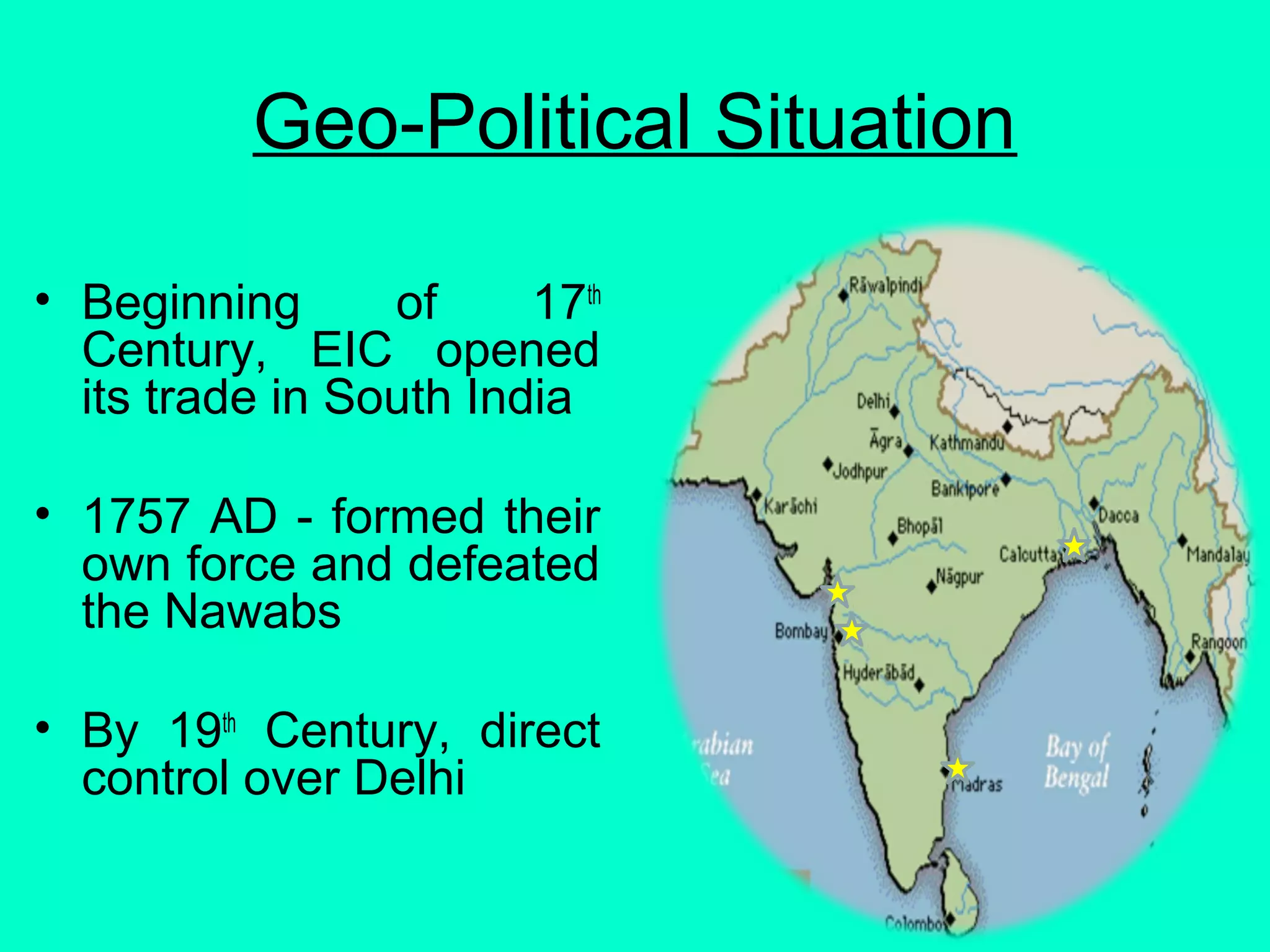
• Beginning of 17th
Century, EIC opened
its trade in South India
• 1757 AD - formed their
own force and defeated
the Nawabs
• By 19th
Century, direct
control over Delhi
Geo-Political Situation
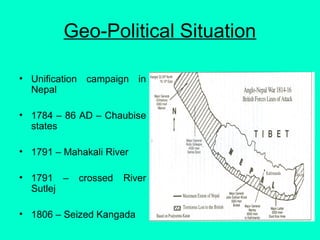
• Unification campaign in
Nepal
• 1784 – 86 AD – Chaubise
states
• 1791 – Mahakali River
• 1791 – crossed River
Sutlej
• 1806 – Seized Kangada
Relation Between Nepal & EIC
• Rise of Gorkhali power
• 1767 – Capt. Kinloch expedition
• 1710 – 1801 – Efforts of
Diplomatic relations
• EIC planned to compel Nepal to
accept British proposals
Causes of War
• Main causes of the war
• Immediate cause of War
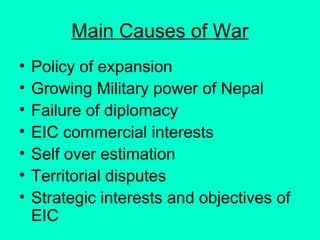
Main Causes of War
• Policy of expansion
• Growing Military power of Nepal
• Failure of diplomacy
• EIC commercial interests
• Self over estimation
• Territorial disputes
• Strategic interests and objectives of
EIC
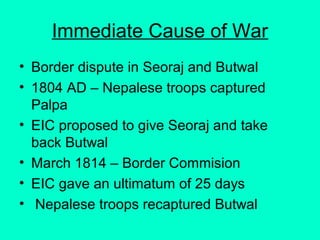
Immediate Cause of War
• Border dispute in Seoraj and Butwal
• 1804 AD – Nepalese troops captured
Palpa
• EIC proposed to give Seoraj and take
back Butwal
• March 1814 – Border Commision
• EIC gave an ultimatum of 25 days
• Nepalese troops recaptured Butwal
12:15:59 PM
Relative strength
12:15:59 PM
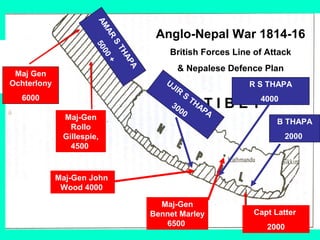
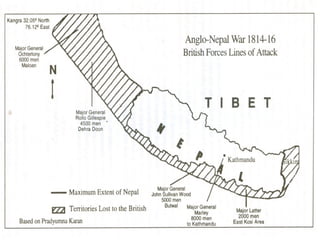
Maj-Gen
Rollo
Gillespie,
4500
Maj-Gen John
Wood 4000
Maj-Gen
Bennet Marley
6500
Capt Latter
2000
Anglo-Nepal War 1814-16
British Forces Line of Attack
& Nepalese Defence Plan
T I B E T
Maj Gen
Ochterlony
6000 AMAR
S
THAPA
5000+
UJIR
S
THAPA
3000
R S THAPA
4000
B THAPA
2000
12:16:00 PM
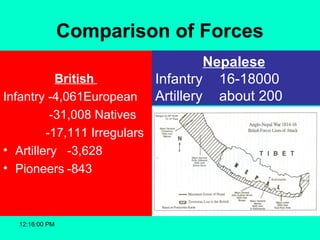
Comparison of Forces
British
Infantry -4,061European
-31,008 Natives
-17,111 Irregulars
• Artillery -3,628
• Pioneers -843
Nepalese
Infantry 16-18000
Artillery about 200
12:16:00 PM
Preparation for War
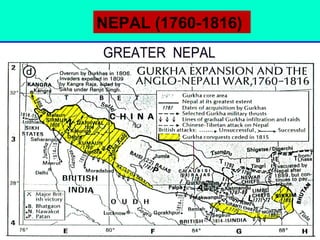
NEPAL (1760-1816)
East India CompanyEast India Company
Preparation for WarPreparation for War
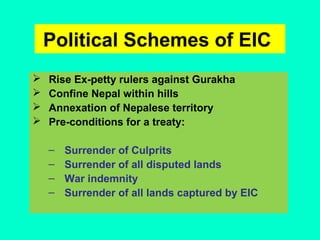
Political Schemes of EIC
 Rise Ex-petty rulers against Gurakha
 Confine Nepal within hills
 Annexation of Nepalese territory
 Pre-conditions for a treaty:
– Surrender of Culprits
– Surrender of all disputed lands
– War indemnity
– Surrender of all lands captured by EIC
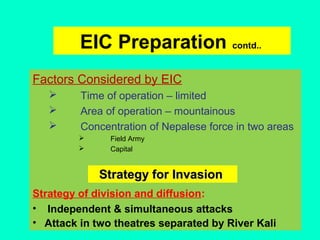
EIC Preparation contd..
Factors Considered by EIC
 Time of operation – limited
 Area of operation – mountainous
 Concentration of Nepalese force in two areas
 Field Army
 Capital
Strategy of division and diffusion:
• Independent & simultaneous attacks
• Attack in two theatres separated by River Kali
Strategy for InvasionStrategy for Invasion
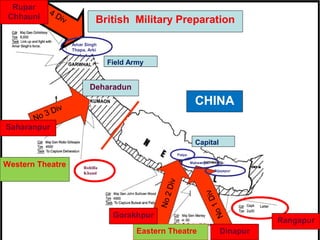
Deharadun
No 4 Div
No 3 Div
No2Div
No1Div
Bijayapur
Amar Singh
Thapa, Arki
Palpa
Makwanpur
Field Army
Western Theatre
Eastern Theatre
British Military Preparation
Rohilla
Khand
CHINA
Rangapur
Gorakhpur
Dinapur
Saharanpur
Rupar
Chhauni
Capital
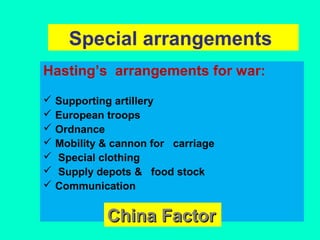
Special arrangements
Hasting’s arrangements for war:
 Supporting artillery
 European troops
 Ordnance
 Mobility & cannon for carriage
 Special clothing
 Supply depots & food stock
 Communication
China FactorChina Factor
NepaleseNepalese Preparation for WarPreparation for War
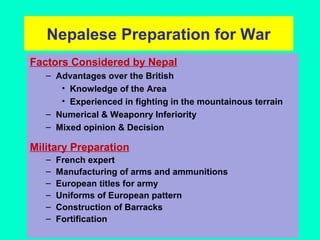
Nepalese Preparation for War
Factors Considered by Nepal
– Advantages over the British
• Knowledge of the Area
• Experienced in fighting in the mountainous terrain
– Numerical & Weaponry Inferiority
– Mixed opinion & Decision
Military Preparation
– French expert
– Manufacturing of arms and ammunitions
– European titles for army
– Uniforms of European pattern
– Construction of Barracks
– Fortification
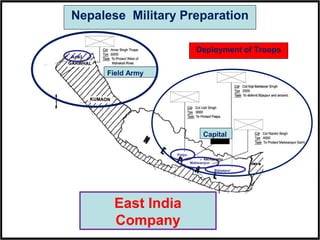
Bijayapur
Arki
Palpa
Makwanpur
Field Army
Nepalese Military Preparation
Capital
East India
Company
Deployment of Troops
Nepalese Political Maneuver
Bhimsen Thapa’s diplomacy against the
common enemy EIC.
 Marathas
 Gwalior
 Punjab
 Rohilla Khand
 Tibet
 China
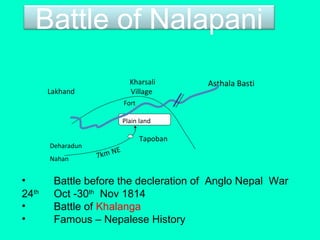
Battle of Nalapani
• Battle before the decleration of Anglo Nepal War
24th
Oct -30th
Nov 1814
• Battle of Khalanga
• Famous – Nepalese History
Plain land
Fort
Deharadun
Nahan 7km NE
Lakhand
Kharsali
Village
Asthala Basti
Tapoban
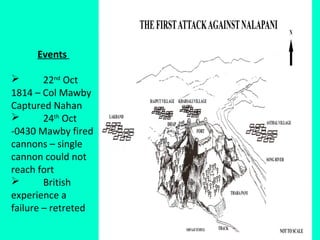
Events
 22nd
Oct
1814 – Col Mawby
Captured Nahan
 24th
Oct
-0430 Mawby fired
cannons – single
cannon could not
reach fort
 British
experience a
failure – retreted
Events
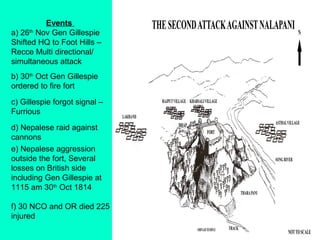
a) 26th
Nov Gen Gillespie
Shifted HQ to Foot Hills –
Recce Multi directional/
simultaneous attack
b) 30th
Oct Gen Gillespie
ordered to fire fort
c) Gillespie forgot signal –
Furrious
d) Nepalese raid against
cannons
e) Nepalese aggression
outside the fort, Several
losses on British side
including Gen Gillespie at
1115 am 30th
Oct 1814
f) 30 NCO and OR died 225
injured
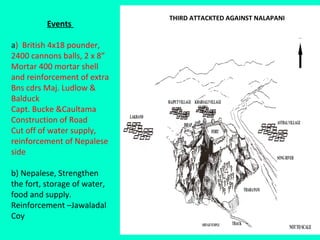
THIRD ATTACKTED AGAINST NALAPANI
Events
a) British 4x18 pounder,
2400 cannons balls, 2 x 8”
Mortar 400 mortar shell
and reinforcement of extra
Bns cdrs Maj. Ludlow &
Balduck
Capt. Bucke &Caultama
Construction of Road
Cut off of water supply,
reinforcement of Nepalese
side
b) Nepalese, Strengthen
the fort, storage of water,
food and supply.
Reinforcement –Jawaladal
Coy
12:16:00 PM
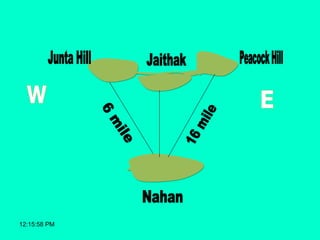
• Battle of Jaithak
12:15:58 PM
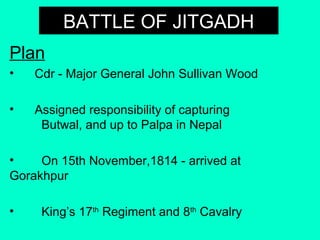
BATTLE OF JITGADHBATTLE OF JITGADH
Plan
• Cdr - Major General John Sullivan Wood
• Assigned responsibility of capturing
Butwal, and up to Palpa in Nepal
• On 15th November,1814 - arrived at
Gorakhpur
• King’s 17th
Regiment and 8th
Cavalry
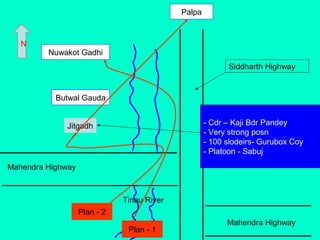
Mahendra Highway
Mahendra Highway
Tinau River
Jitgadh
Butwal Gauda
Siddharth Highway
Nuwakot Gadhi
Palpa
- Cdr – Kaji Bdr Pandey
- Very strong posn
- 100 slodeirs- Gurubox Coy
- Platoon - Sabuj
Plan - 1
Plan - 2
N
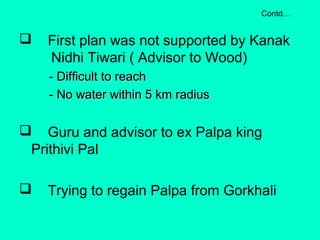
 First plan was not supported by Kanak
Nidhi Tiwari ( Advisor to Wood)
- Difficult to reachDifficult to reach
- No water within 5 km radius- No water within 5 km radius
 Guru and advisor to ex Palpa king
Prithivi Pal
 Trying to regain Palpa from Gorkhali
Contd…
Mahendra Highway
Mahendra Highway
Tinau River
Jitgadh
Butwal Gauda
Nuwakot Gadhi
Palpa
Plan - 1
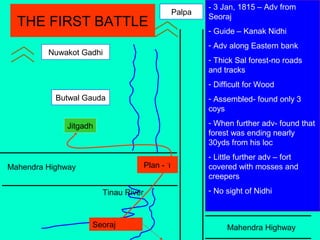
- 3 Jan, 1815 – Adv from
Seoraj
- Guide – Kanak Nidhi
- Adv along Eastern bank
- Thick Sal forest-no roads
and tracks
- Difficult for Wood
- Assembled- found only 3
coys
- When further adv- found that
forest was ending nearly
30yds from his loc
- Little further adv – fort
covered with mosses and
creepers
- No sight of Nidhi
THE FIRST BATTLE
Seoraj
Mahendra Highway
Mahendra Highway
Tinau River
Jitgadh
Butwal Gauda
Nuwakot Gadhi
Palpa
Plan - 1
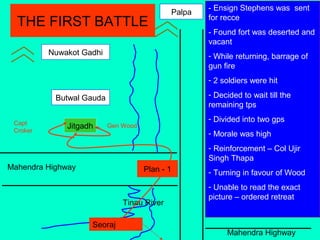
- Ensign Stephens was sent
for recce
- Found fort was deserted and
vacant
- While returning, barrage of
gun fire
- 2 soldiers were hit
- Decided to wait till the
remaining tps
- Divided into two gps
- Morale was high
- Reinforcement – Col Ujir
Singh Thapa
- Turning in favour of Wood
- Unable to read the exact
picture – ordered retreat
THE FIRST BATTLE
Seoraj
Capt
Croker
Gen Wood
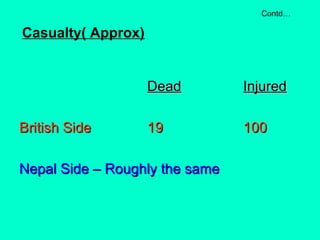
DeadDead InjuredInjured
British SideBritish Side 1919 100100
Nepal Side – Roughly the sameNepal Side – Roughly the same
Contd…
Casualty( Approx)
Mahendra Highway
Mahendra Highway
Tinau River
Jitgadh
Butwal Gauda
Nuwakot Gadhi
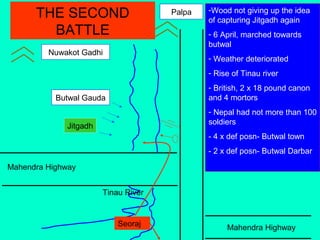
Palpa -Wood not giving up the idea
of capturing Jitgadh again
- 6 April, marched towards
butwal
- Weather deteriorated
- Rise of Tinau river
- British, 2 x 18 pound canon
and 4 mortors
- Nepal had not more than 100
soldiers
- 4 x def posn- Butwal town
- 2 x def posn- Butwal Darbar
THE SECOND
BATTLE
Seoraj
Mahendra Highway
Mahendra Highway
Tinau River
Jitgadh
Butwal Gauda
Nuwakot Gadhi
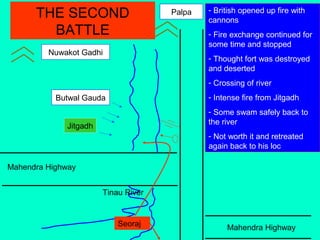
Palpa - British opened up fire with
cannons
- Fire exchange continued for
some time and stopped
- Thought fort was destroyed
and deserted
- Crossing of river
- Intense fire from Jitgadh
- Some swam safely back to
the river
- Not worth it and retreated
again back to his loc
THE SECOND
BATTLE
Seoraj
12:15:58 PM
Battle of Diothal
16th
April 1815
12:15:58 PM
Battle of Diothal
16th
April 1815
• Introduction
• Background
• The Battle
• Aftermath
• Reasons behind Gorkhali Failure
Tactics & Principle of War
British Side
 Political isolation of Nepal
 Attack in various fronts to divide the troops of Nepal
 Detailed preparation logistic planning
 Well thought out time planning for the campaign with
respect to the weather and climate of Nepal
 Use of overwhelming force and multidirectional attack
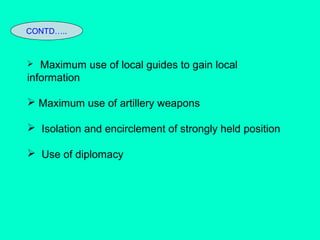
 Maximum use of local guides to gain local
information
 Maximum use of artillery weapons
 Isolation and encirclement of strongly held position
 Use of diplomacy
CONTD…..
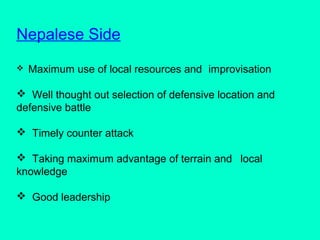
Nepalese Side
 Maximum use of local resources and improvisation
 Well thought out selection of defensive location and
defensive battle
 Timely counter attack
 Taking maximum advantage of terrain and local
knowledge
 Good leadership
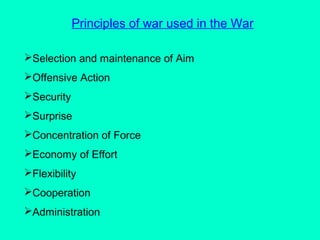
Principles of war used in the War
Selection and maintenance of Aim
Offensive Action
Security
Surprise
Concentration of Force
Economy of Effort
Flexibility
Cooperation
Administration
Strong and weak points of
both sides
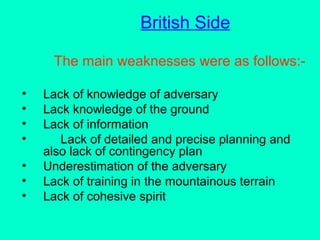
British Side
The main weaknesses were as follows:-
• Lack of knowledge of adversary
• Lack knowledge of the ground
• Lack of information
• Lack of detailed and precise planning and
also lack of contingency plan
• Underestimation of the adversary
• Lack of training in the mountainous terrain
• Lack of cohesive spirit
The positive points were as follows
 Good leadership
 Good logistic support
 Good fighting spirit
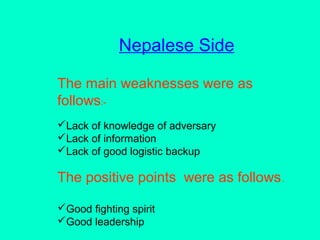
Nepalese Side
The main weaknesses were as
follows:-
Lack of knowledge of adversary
Lack of information
Lack of good logistic backup
The positive points were as follows.
Good fighting spirit
Good leadership
12:15:59 PM
•Results of war
•Effects of war
•Conclusion
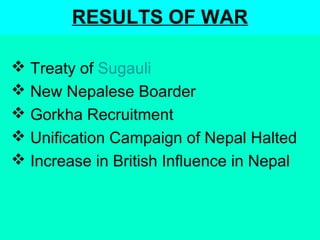
RESULTS OF WAR
 Treaty of Sugauli
 New Nepalese Boarder
 Gorkha Recruitment
 Unification Campaign of Nepal Halted
 Increase in British Influence in Nepal
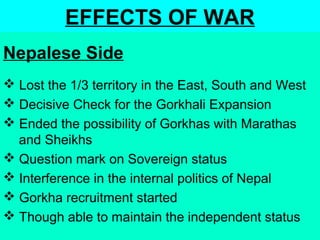
EFFECTS OF WAR
 Lost the 1/3 territory in the East, South and West
 Decisive Check for the Gorkhali Expansion
 Ended the possibility of Gorkhas with Marathas
and Sheikhs
 Question mark on Sovereign status
 Interference in the internal politics of Nepal
 Gorkha recruitment started
 Though able to maintain the independent status
Nepalese Side
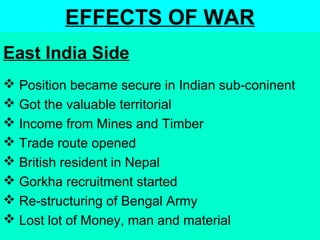
EFFECTS OF WAR
 Position became secure in Indian sub-coninent
 Got the valuable territorial
 Income from Mines and Timber
 Trade route opened
 British resident in Nepal
 Gorkha recruitment started
 Re-structuring of Bengal Army
 Lost lot of Money, man and material
East India Side
CONCLUSION
• After the War, the expansion policy of
Nepal Halted and the size of its territory
was reduced by one third
• Despite of heavy loss in the war, Nepalese
troops were able to demonstrate
outstanding courage, bravery, patriotism
and leadership and able to protect its
sovereignty
• Nepalese became famous all over the
world for their bravery

Anglo nepal war

  • 1.
    Geo-Political Situation • Beginningof 17th Century, EIC opened its trade in South India • 1757 AD - formed their own force and defeated the Nawabs • By 19th Century, direct control over Delhi
  • 2.
    Geo-Political Situation • Unificationcampaign in Nepal • 1784 – 86 AD – Chaubise states • 1791 – Mahakali River • 1791 – crossed River Sutlej • 1806 – Seized Kangada
  • 3.
    Relation Between Nepal& EIC • Rise of Gorkhali power • 1767 – Capt. Kinloch expedition • 1710 – 1801 – Efforts of Diplomatic relations • EIC planned to compel Nepal to accept British proposals
  • 4.
    Causes of War •Main causes of the war • Immediate cause of War
  • 5.
    Main Causes ofWar • Policy of expansion • Growing Military power of Nepal • Failure of diplomacy • EIC commercial interests • Self over estimation • Territorial disputes • Strategic interests and objectives of EIC
  • 6.
    Immediate Cause ofWar • Border dispute in Seoraj and Butwal • 1804 AD – Nepalese troops captured Palpa • EIC proposed to give Seoraj and take back Butwal • March 1814 – Border Commision • EIC gave an ultimatum of 25 days • Nepalese troops recaptured Butwal
  • 7.
  • 8.
    12:15:59 PM Maj-Gen Rollo Gillespie, 4500 Maj-Gen John Wood4000 Maj-Gen Bennet Marley 6500 Capt Latter 2000 Anglo-Nepal War 1814-16 British Forces Line of Attack & Nepalese Defence Plan T I B E T Maj Gen Ochterlony 6000 AMAR S THAPA 5000+ UJIR S THAPA 3000 R S THAPA 4000 B THAPA 2000
  • 9.
    12:16:00 PM Comparison ofForces British Infantry -4,061European -31,008 Natives -17,111 Irregulars • Artillery -3,628 • Pioneers -843 Nepalese Infantry 16-18000 Artillery about 200
  • 10.
  • 11.
  • 12.
  • 13.
    East India CompanyEastIndia Company Preparation for WarPreparation for War
  • 14.
    Political Schemes ofEIC  Rise Ex-petty rulers against Gurakha  Confine Nepal within hills  Annexation of Nepalese territory  Pre-conditions for a treaty: – Surrender of Culprits – Surrender of all disputed lands – War indemnity – Surrender of all lands captured by EIC
  • 15.
    EIC Preparation contd.. FactorsConsidered by EIC  Time of operation – limited  Area of operation – mountainous  Concentration of Nepalese force in two areas  Field Army  Capital Strategy of division and diffusion: • Independent & simultaneous attacks • Attack in two theatres separated by River Kali Strategy for InvasionStrategy for Invasion
  • 16.
    Deharadun No 4 Div No3 Div No2Div No1Div Bijayapur Amar Singh Thapa, Arki Palpa Makwanpur Field Army Western Theatre Eastern Theatre British Military Preparation Rohilla Khand CHINA Rangapur Gorakhpur Dinapur Saharanpur Rupar Chhauni Capital
  • 17.
    Special arrangements Hasting’s arrangementsfor war:  Supporting artillery  European troops  Ordnance  Mobility & cannon for carriage  Special clothing  Supply depots & food stock  Communication China FactorChina Factor
  • 18.
    NepaleseNepalese Preparation forWarPreparation for War
  • 19.
    Nepalese Preparation forWar Factors Considered by Nepal – Advantages over the British • Knowledge of the Area • Experienced in fighting in the mountainous terrain – Numerical & Weaponry Inferiority – Mixed opinion & Decision Military Preparation – French expert – Manufacturing of arms and ammunitions – European titles for army – Uniforms of European pattern – Construction of Barracks – Fortification
  • 20.
    Bijayapur Arki Palpa Makwanpur Field Army Nepalese MilitaryPreparation Capital East India Company Deployment of Troops
  • 21.
    Nepalese Political Maneuver BhimsenThapa’s diplomacy against the common enemy EIC.  Marathas  Gwalior  Punjab  Rohilla Khand  Tibet  China
  • 22.
    Battle of Nalapani •Battle before the decleration of Anglo Nepal War 24th Oct -30th Nov 1814 • Battle of Khalanga • Famous – Nepalese History Plain land Fort Deharadun Nahan 7km NE Lakhand Kharsali Village Asthala Basti Tapoban
  • 23.
    Events  22nd Oct 1814 –Col Mawby Captured Nahan  24th Oct -0430 Mawby fired cannons – single cannon could not reach fort  British experience a failure – retreted
  • 24.
    Events a) 26th Nov GenGillespie Shifted HQ to Foot Hills – Recce Multi directional/ simultaneous attack b) 30th Oct Gen Gillespie ordered to fire fort c) Gillespie forgot signal – Furrious d) Nepalese raid against cannons e) Nepalese aggression outside the fort, Several losses on British side including Gen Gillespie at 1115 am 30th Oct 1814 f) 30 NCO and OR died 225 injured
  • 25.
    THIRD ATTACKTED AGAINSTNALAPANI Events a) British 4x18 pounder, 2400 cannons balls, 2 x 8” Mortar 400 mortar shell and reinforcement of extra Bns cdrs Maj. Ludlow & Balduck Capt. Bucke &Caultama Construction of Road Cut off of water supply, reinforcement of Nepalese side b) Nepalese, Strengthen the fort, storage of water, food and supply. Reinforcement –Jawaladal Coy
  • 26.
  • 27.
  • 28.
    BATTLE OF JITGADHBATTLEOF JITGADH Plan • Cdr - Major General John Sullivan Wood • Assigned responsibility of capturing Butwal, and up to Palpa in Nepal • On 15th November,1814 - arrived at Gorakhpur • King’s 17th Regiment and 8th Cavalry
  • 29.
    Mahendra Highway Mahendra Highway TinauRiver Jitgadh Butwal Gauda Siddharth Highway Nuwakot Gadhi Palpa - Cdr – Kaji Bdr Pandey - Very strong posn - 100 slodeirs- Gurubox Coy - Platoon - Sabuj Plan - 1 Plan - 2 N
  • 30.
     First planwas not supported by Kanak Nidhi Tiwari ( Advisor to Wood) - Difficult to reachDifficult to reach - No water within 5 km radius- No water within 5 km radius  Guru and advisor to ex Palpa king Prithivi Pal  Trying to regain Palpa from Gorkhali Contd…
  • 31.
    Mahendra Highway Mahendra Highway TinauRiver Jitgadh Butwal Gauda Nuwakot Gadhi Palpa Plan - 1 - 3 Jan, 1815 – Adv from Seoraj - Guide – Kanak Nidhi - Adv along Eastern bank - Thick Sal forest-no roads and tracks - Difficult for Wood - Assembled- found only 3 coys - When further adv- found that forest was ending nearly 30yds from his loc - Little further adv – fort covered with mosses and creepers - No sight of Nidhi THE FIRST BATTLE Seoraj
  • 32.
    Mahendra Highway Mahendra Highway TinauRiver Jitgadh Butwal Gauda Nuwakot Gadhi Palpa Plan - 1 - Ensign Stephens was sent for recce - Found fort was deserted and vacant - While returning, barrage of gun fire - 2 soldiers were hit - Decided to wait till the remaining tps - Divided into two gps - Morale was high - Reinforcement – Col Ujir Singh Thapa - Turning in favour of Wood - Unable to read the exact picture – ordered retreat THE FIRST BATTLE Seoraj Capt Croker Gen Wood
  • 33.
    DeadDead InjuredInjured British SideBritishSide 1919 100100 Nepal Side – Roughly the sameNepal Side – Roughly the same Contd… Casualty( Approx)
  • 34.
    Mahendra Highway Mahendra Highway TinauRiver Jitgadh Butwal Gauda Nuwakot Gadhi Palpa -Wood not giving up the idea of capturing Jitgadh again - 6 April, marched towards butwal - Weather deteriorated - Rise of Tinau river - British, 2 x 18 pound canon and 4 mortors - Nepal had not more than 100 soldiers - 4 x def posn- Butwal town - 2 x def posn- Butwal Darbar THE SECOND BATTLE Seoraj
  • 35.
    Mahendra Highway Mahendra Highway TinauRiver Jitgadh Butwal Gauda Nuwakot Gadhi Palpa - British opened up fire with cannons - Fire exchange continued for some time and stopped - Thought fort was destroyed and deserted - Crossing of river - Intense fire from Jitgadh - Some swam safely back to the river - Not worth it and retreated again back to his loc THE SECOND BATTLE Seoraj
  • 36.
    12:15:58 PM Battle ofDiothal 16th April 1815
  • 37.
    12:15:58 PM Battle ofDiothal 16th April 1815 • Introduction • Background • The Battle • Aftermath • Reasons behind Gorkhali Failure
  • 38.
    Tactics & Principleof War British Side  Political isolation of Nepal  Attack in various fronts to divide the troops of Nepal  Detailed preparation logistic planning  Well thought out time planning for the campaign with respect to the weather and climate of Nepal  Use of overwhelming force and multidirectional attack
  • 39.
     Maximum useof local guides to gain local information  Maximum use of artillery weapons  Isolation and encirclement of strongly held position  Use of diplomacy CONTD…..
  • 40.
    Nepalese Side  Maximumuse of local resources and improvisation  Well thought out selection of defensive location and defensive battle  Timely counter attack  Taking maximum advantage of terrain and local knowledge  Good leadership
  • 41.
    Principles of warused in the War Selection and maintenance of Aim Offensive Action Security Surprise Concentration of Force Economy of Effort Flexibility Cooperation Administration
  • 42.
    Strong and weakpoints of both sides
  • 43.
    British Side The mainweaknesses were as follows:- • Lack of knowledge of adversary • Lack knowledge of the ground • Lack of information • Lack of detailed and precise planning and also lack of contingency plan • Underestimation of the adversary • Lack of training in the mountainous terrain • Lack of cohesive spirit
  • 44.
    The positive pointswere as follows  Good leadership  Good logistic support  Good fighting spirit
  • 45.
    Nepalese Side The mainweaknesses were as follows:- Lack of knowledge of adversary Lack of information Lack of good logistic backup The positive points were as follows. Good fighting spirit Good leadership
  • 46.
    12:15:59 PM •Results ofwar •Effects of war •Conclusion
  • 47.
    RESULTS OF WAR Treaty of Sugauli  New Nepalese Boarder  Gorkha Recruitment  Unification Campaign of Nepal Halted  Increase in British Influence in Nepal
  • 48.
    EFFECTS OF WAR Lost the 1/3 territory in the East, South and West  Decisive Check for the Gorkhali Expansion  Ended the possibility of Gorkhas with Marathas and Sheikhs  Question mark on Sovereign status  Interference in the internal politics of Nepal  Gorkha recruitment started  Though able to maintain the independent status Nepalese Side
  • 49.
    EFFECTS OF WAR Position became secure in Indian sub-coninent  Got the valuable territorial  Income from Mines and Timber  Trade route opened  British resident in Nepal  Gorkha recruitment started  Re-structuring of Bengal Army  Lost lot of Money, man and material East India Side
  • 50.
    CONCLUSION • After theWar, the expansion policy of Nepal Halted and the size of its territory was reduced by one third • Despite of heavy loss in the war, Nepalese troops were able to demonstrate outstanding courage, bravery, patriotism and leadership and able to protect its sovereignty • Nepalese became famous all over the world for their bravery