ANEMIA
Pathophysiology of anemia
• Decreased oxygen carrying capacity leading to
tissue hypoxia
• Hypoxia brings about compensatory responses
Compensatory responses
• Increased release of oxygen from hemoglobin
• Increased blood flow to tissues (Hyperdynamic
circulation)
• Maintenance of blood volume
• Redistribution of blood to vital organs
• Compensatory stimulation of respiratory center
• After a point compensationstop
• Impairment of tissue system functioning
• Degree of impairment is directly
proportionalto degree of oxygen
deficiency
• Manifestationof symptoms & signs
Clinical symptoms in anemia are due to:
• Tissue hypoxia
• Compensatorymechanisms
Clinical symptoms & signs
• Generalised muscular weakness,tiredness
& fatigability (due to muscle hypoxia)
• Pallor of skin & mucus membrane: Due to
deficiency of Hb in the blood
• Respiratory system: Breathlessness &
tachypnea (Compensatory stimulationof
respiratory center due to hypoxia)
• Cardiovascularmanifestations
- Palpitation, tachycardia (due to
compensatorymechanisms increasing the
cardiac output)
- Cardiac murmurs (due to raised cardiac
output & decreased viscosity of blood;
turbulence of blood occur while passing
through cardiac valves)
• Central nervous system manifestations
- Headache, lethargy, faintness, confusion&
drowsiness(due to cerebral hypoxia)
• Gastrointestinalsystem symptoms:
anorexia, nausea
• Reproductive system involvement:
Menstrual disturbancessuch as
amenorrhea & menorrhagia
• Renal system involvement: Proteinuria
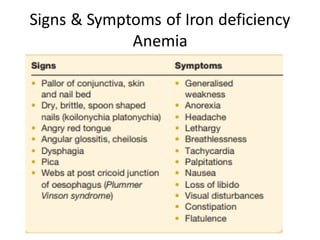
Signs & Symptoms of Iron deficiency
Anemia
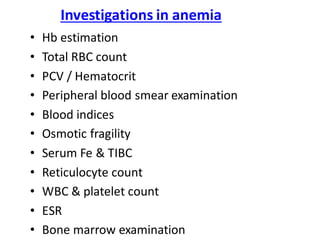
Investigations in anemia
• Hb estimation
• Total RBC count
• PCV / Hematocrit
• Peripheral blood smear examination
• Blood indices
• Osmotic fragility
• Serum Fe & TIBC
• Reticulocyte count
• WBC & platelet count
• ESR
• Bone marrow examination
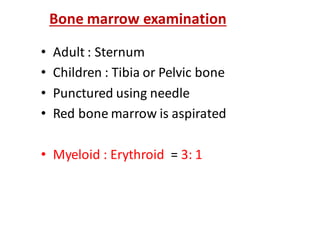
Bone marrow examination
• Adult : Sternum
• Children : Tibia or Pelvic bone
• Punctured using needle
• Red bone marrow is aspirated
• Myeloid : Erythroid = 3: 1
Iron deficiency anemia
• Commonest nutritional deficiency disorder in
developing countries
• Most common cause of anemia in India
• Daily requirement of Iron
• Adult male is 5-10 mg/day
• Adult female is 20 mg/day
• Pregnant & lactating women 40 mg/day
• Dietary sources: Meat, liver, green leafy
vegetables, jaggery
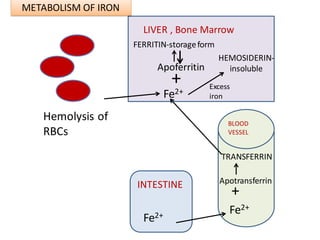
Absorption of iron
• From small intestine (especially duodenum)
• Ferrous form only is absorbed
• Facilitated by acidic contents of stomach
(Gastrectomy lead to iron deficiency
anemia)
• Ascorbic acid & other reducing agents
promote iron absorption
- By reducing ferric iron to ferrous form
- By preventing iron from forming
insoluble iron complexes within the chyme
• Free iron enter the capillaries through basal
part of intestinal epithelial cells
• Free iron + Apotransferrin→Transferrin
• Iron transported in plasma as plasma
transferrin
INTESTINE
Fe2+
BLOOD
VESSEL
Fe2+
Apotransferrin
TRANSFERRIN
+
LIVER , Bone Marrow
Fe2+
Apoferritin
+
FERRITIN-storageform
HEMOSIDERIN-
insoluble
Hemolysis of
RBCs
Excess
iron
METABOLISM OF IRON
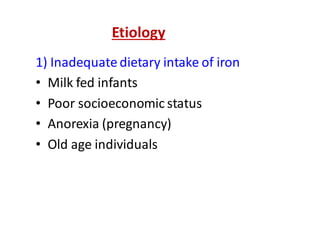
Etiology
1) Inadequate dietary intake of iron
• Milk fed infants
• Poor socioeconomic status
• Anorexia (pregnancy)
• Old age individuals
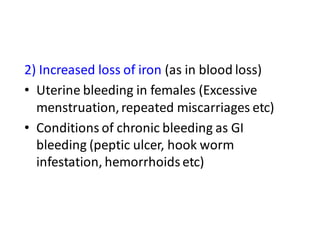
2) Increased loss of iron (as in blood loss)
• Uterine bleeding in females (Excessive
menstruation,repeated miscarriages etc)
• Conditions of chronic bleeding as GI
bleeding (peptic ulcer, hook worm
infestation, hemorrhoids etc)
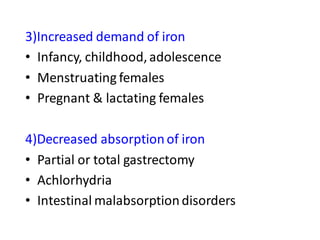
3)Increased demand of iron
• Infancy, childhood,adolescence
• Menstruating females
• Pregnant & lactating females
4)Decreased absorptionof iron
• Partial or total gastrectomy
• Achlorhydria
• Intestinal malabsorptiondisorders
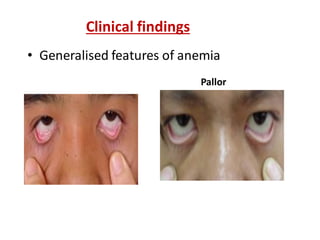
Clinical findings
• Generalised features of anemia
Pallor
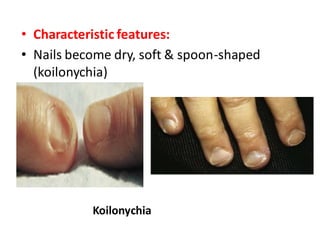
• Characteristic features:
• Nails become dry, soft & spoon-shaped
(koilonychia)
Koilonychia
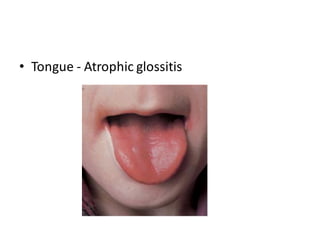
• Tongue - Atrophic glossitis
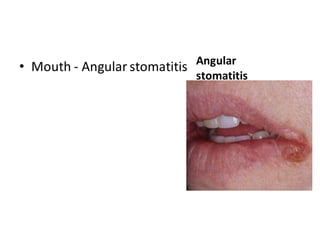
Angular
stomatitis
• Mouth - Angular stomatitis
• Oesophagus - Dysphagia
• (Membranous webs at the postcricoid area:
Plummer-Vinson syndrome)
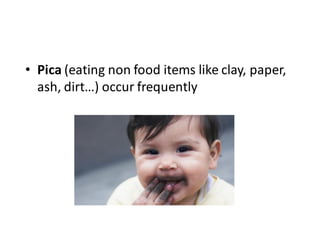
• Pica (eating non food items like clay, paper,
ash, dirt…) occur frequently
Laboratory findings
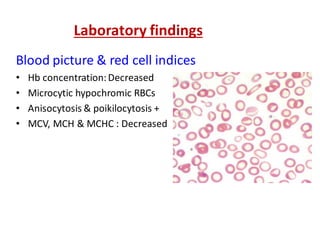
Blood picture & red cell indices
• Hb concentration:Decreased
• Microcytic hypochromic RBCs
• Anisocytosis & poikilocytosis +
• MCV, MCH & MCHC : Decreased
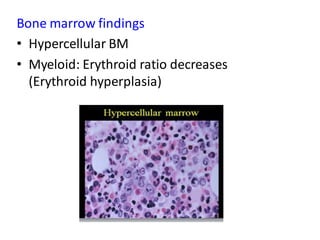
Bone marrow findings
• Hypercellular BM
• Myeloid: Erythroid ratio decreases
(Erythroid hyperplasia)
Biochemical findings
• Serum iron decreases
• Serum ferritin is very low
• Total iron binding capacity (TIBC) is increased
Treatment
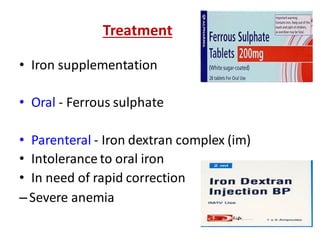
• Iron supplementation
• Oral - Ferrous sulphate
• Parenteral - Iron dextran complex (im)
• Intolerance to oral iron
• In need of rapid correction
–Severe anemia
Long essay
• 1. A 30 year old woman visits a clinic with the
complaints of difficulty in breathing & fatigue.
She has menorrhagia for the past 3 months.
Her Hb level is 6 gm%, PCV 20% & the
reticulocyte count is 8%. Answer the following:
- Name the clinical condition.
- Describe the blood picture in this
condition.
- Classify anemia based on etiology.
- Describe iron deficiency anemia.
(University exam August 2016)
• 2. A 12 year old girl child complaints of lethargy &
fatigability for the last three months. Physical examination
revealed pallor. Routine blood investigation showed Hb-8%
and peripheral smear revealed microcytic hypochromic
RBCs. Answer the following:
- Identify the clinical condition and what is the cause.
- Define anemia.
- Classify anemia based on etiology.
- Enumerate stages of erythropoiesis and discuss the
factors regulating them.
(University exam January 2020)
Megaloblastic anemia
• Characterized by the abnormally large cells
of erythrocyte series with delayed nuclear
maturation due to defective DNA synthesis
Occur commonly in:
• Vitamin B12 deficiency
• Folate deficiency
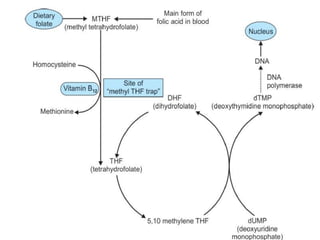
Pathophysiological or biochemical basis
• Role of folate & vitamin B12 in DNA synthesis
Etiology
1) Due to vitamin B12 deficiency
• Inadequate dietary intake
-Vegetarians & breast fed infants
• Malabsorption of vitamin B12
- Gastric causes: Autoimmunecause of failure of secretion
of Intrinsic Factor, gastrectomy & congenital lack of IF
- Intestinal causes: Tropical sprue, ileal resection, Crohn’s
disease, fish tapeworm infestation
2) Due to folate deficiency
• Inadequate dietary intake: Less intake of vegetables,
infants etc
• Malabsorption: Coeliac disease, tropical sprue
• Increased demand: Pregnancy, lactation & infancy
• Effect of drugs eg: Some anticonvulsants, cytotoxic
drugs
Pernicious anemia
• Addisonian pernicious anemia
• Megaloblastic anemia due to vitamin B12
deficiency
• Due to failure of Intrinsic Factor secretion by
stomach
• As autoimmune atrophy of gastric mucosa
• Autoimmune disease
• 45-60 Years
• Females > Males
Features of pernicious anemia
• Features of megaloblastic anemia
• Specific features of pernicious anemia
- Anti-intrinsic factor antibodies in serum
- Abnormal vitamin B12 absorptiontest
corrected by the addition of intrinsic factor
(Schilling test)
Treatment of pernicious anemia
• Regular administrationof vitamin B12 by
intramuscularroute
• Physiotherapy
Clinical features of megaloblastic
anemia
• Generalised features of anemia
• Characteristic features of megaloblastic
anemia:
- Icterus (Unconjugated
hyperbilirubinemia)
- Glossitis
- Angular stomatitis
• Neurological manifestations
Numbness & parasthesias
Ataxia
Decreased reflexes
Subacute combined degeneration
• Vitamin B12 is necessary for formation &
maintenance of myelin sheath
• Folate deficiency cause less neurological
symptoms
Laboratory findings
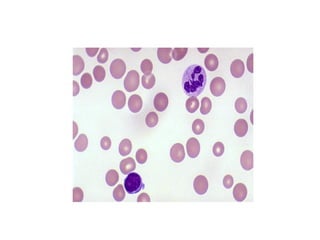
• Blood picture & red cell indices
–Peripheral smear - Macrocytes,
anisocytosis,poikilocytosis
–↑MCV,↑MCH;but normal or ↓MCHC
–Hypersegmented neutrophils (impaired
DNA synthesis)
–Thromobcytopenia
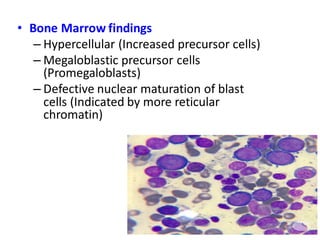
• Bone Marrow findings
– Hypercellular (Increased precursor cells)
– Megaloblastic precursor cells
(Promegaloblasts)
– Defective nuclear maturation of blast
cells (Indicated by more reticular
chromatin)
• Biochemical findings
• Serum bilirubin increased (unconjugated
hyperbilirubinemia)
• Urine urobilinogen increased
• Serum iron & ferritin: Normal or increased
• Serum vitamin B12: Decreased
• Low serum folate levels
• Low red cell folate levels
Treatment
• Hydroxycobalamin as IM 1000µg for 3 weeks
• Physiotherapy
• Identification& elimination of possible cause
• Supportive care

ANEMIA.pdf

  • 1.
  • 2.
    Pathophysiology of anemia •Decreased oxygen carrying capacity leading to tissue hypoxia • Hypoxia brings about compensatory responses
  • 3.
    Compensatory responses • Increasedrelease of oxygen from hemoglobin • Increased blood flow to tissues (Hyperdynamic circulation) • Maintenance of blood volume • Redistribution of blood to vital organs • Compensatory stimulation of respiratory center
  • 4.
    • After apoint compensationstop • Impairment of tissue system functioning • Degree of impairment is directly proportionalto degree of oxygen deficiency • Manifestationof symptoms & signs
  • 5.
    Clinical symptoms inanemia are due to: • Tissue hypoxia • Compensatorymechanisms
  • 6.
    Clinical symptoms &signs • Generalised muscular weakness,tiredness & fatigability (due to muscle hypoxia) • Pallor of skin & mucus membrane: Due to deficiency of Hb in the blood • Respiratory system: Breathlessness & tachypnea (Compensatory stimulationof respiratory center due to hypoxia)
  • 7.
    • Cardiovascularmanifestations - Palpitation,tachycardia (due to compensatorymechanisms increasing the cardiac output) - Cardiac murmurs (due to raised cardiac output & decreased viscosity of blood; turbulence of blood occur while passing through cardiac valves) • Central nervous system manifestations - Headache, lethargy, faintness, confusion& drowsiness(due to cerebral hypoxia)
  • 8.
    • Gastrointestinalsystem symptoms: anorexia,nausea • Reproductive system involvement: Menstrual disturbancessuch as amenorrhea & menorrhagia • Renal system involvement: Proteinuria
  • 9.
    Signs & Symptomsof Iron deficiency Anemia
  • 10.
    Investigations in anemia •Hb estimation • Total RBC count • PCV / Hematocrit • Peripheral blood smear examination • Blood indices • Osmotic fragility • Serum Fe & TIBC • Reticulocyte count • WBC & platelet count • ESR • Bone marrow examination
  • 11.
    Bone marrow examination •Adult : Sternum • Children : Tibia or Pelvic bone • Punctured using needle • Red bone marrow is aspirated • Myeloid : Erythroid = 3: 1
  • 12.
  • 13.
    Iron deficiency anemia •Commonest nutritional deficiency disorder in developing countries • Most common cause of anemia in India • Daily requirement of Iron • Adult male is 5-10 mg/day • Adult female is 20 mg/day • Pregnant & lactating women 40 mg/day • Dietary sources: Meat, liver, green leafy vegetables, jaggery
  • 14.
    Absorption of iron •From small intestine (especially duodenum) • Ferrous form only is absorbed • Facilitated by acidic contents of stomach (Gastrectomy lead to iron deficiency anemia)
  • 15.
    • Ascorbic acid& other reducing agents promote iron absorption - By reducing ferric iron to ferrous form - By preventing iron from forming insoluble iron complexes within the chyme
  • 16.
    • Free ironenter the capillaries through basal part of intestinal epithelial cells • Free iron + Apotransferrin→Transferrin • Iron transported in plasma as plasma transferrin
  • 17.
    INTESTINE Fe2+ BLOOD VESSEL Fe2+ Apotransferrin TRANSFERRIN + LIVER , BoneMarrow Fe2+ Apoferritin + FERRITIN-storageform HEMOSIDERIN- insoluble Hemolysis of RBCs Excess iron METABOLISM OF IRON
  • 18.
    Etiology 1) Inadequate dietaryintake of iron • Milk fed infants • Poor socioeconomic status • Anorexia (pregnancy) • Old age individuals
  • 19.
    2) Increased lossof iron (as in blood loss) • Uterine bleeding in females (Excessive menstruation,repeated miscarriages etc) • Conditions of chronic bleeding as GI bleeding (peptic ulcer, hook worm infestation, hemorrhoids etc)
  • 20.
    3)Increased demand ofiron • Infancy, childhood,adolescence • Menstruating females • Pregnant & lactating females 4)Decreased absorptionof iron • Partial or total gastrectomy • Achlorhydria • Intestinal malabsorptiondisorders
  • 21.
    Clinical findings • Generalisedfeatures of anemia Pallor
  • 22.
    • Characteristic features: •Nails become dry, soft & spoon-shaped (koilonychia) Koilonychia
  • 23.
    • Tongue -Atrophic glossitis
  • 24.
  • 25.
    • Oesophagus -Dysphagia • (Membranous webs at the postcricoid area: Plummer-Vinson syndrome)
  • 26.
    • Pica (eatingnon food items like clay, paper, ash, dirt…) occur frequently
  • 27.
    Laboratory findings Blood picture& red cell indices • Hb concentration:Decreased • Microcytic hypochromic RBCs • Anisocytosis & poikilocytosis + • MCV, MCH & MCHC : Decreased
  • 28.
    Bone marrow findings •Hypercellular BM • Myeloid: Erythroid ratio decreases (Erythroid hyperplasia)
  • 29.
    Biochemical findings • Serumiron decreases • Serum ferritin is very low • Total iron binding capacity (TIBC) is increased
  • 30.
    Treatment • Iron supplementation •Oral - Ferrous sulphate • Parenteral - Iron dextran complex (im) • Intolerance to oral iron • In need of rapid correction –Severe anemia
  • 31.
    Long essay • 1.A 30 year old woman visits a clinic with the complaints of difficulty in breathing & fatigue. She has menorrhagia for the past 3 months. Her Hb level is 6 gm%, PCV 20% & the reticulocyte count is 8%. Answer the following: - Name the clinical condition. - Describe the blood picture in this condition. - Classify anemia based on etiology. - Describe iron deficiency anemia. (University exam August 2016)
  • 32.
    • 2. A12 year old girl child complaints of lethargy & fatigability for the last three months. Physical examination revealed pallor. Routine blood investigation showed Hb-8% and peripheral smear revealed microcytic hypochromic RBCs. Answer the following: - Identify the clinical condition and what is the cause. - Define anemia. - Classify anemia based on etiology. - Enumerate stages of erythropoiesis and discuss the factors regulating them. (University exam January 2020)
  • 33.
  • 34.
    Megaloblastic anemia • Characterizedby the abnormally large cells of erythrocyte series with delayed nuclear maturation due to defective DNA synthesis Occur commonly in: • Vitamin B12 deficiency • Folate deficiency
  • 35.
    Pathophysiological or biochemicalbasis • Role of folate & vitamin B12 in DNA synthesis
  • 37.
    Etiology 1) Due tovitamin B12 deficiency • Inadequate dietary intake -Vegetarians & breast fed infants • Malabsorption of vitamin B12 - Gastric causes: Autoimmunecause of failure of secretion of Intrinsic Factor, gastrectomy & congenital lack of IF - Intestinal causes: Tropical sprue, ileal resection, Crohn’s disease, fish tapeworm infestation
  • 38.
    2) Due tofolate deficiency • Inadequate dietary intake: Less intake of vegetables, infants etc • Malabsorption: Coeliac disease, tropical sprue • Increased demand: Pregnancy, lactation & infancy • Effect of drugs eg: Some anticonvulsants, cytotoxic drugs
  • 39.
    Pernicious anemia • Addisonianpernicious anemia • Megaloblastic anemia due to vitamin B12 deficiency • Due to failure of Intrinsic Factor secretion by stomach • As autoimmune atrophy of gastric mucosa • Autoimmune disease • 45-60 Years • Females > Males
  • 40.
    Features of perniciousanemia • Features of megaloblastic anemia • Specific features of pernicious anemia - Anti-intrinsic factor antibodies in serum - Abnormal vitamin B12 absorptiontest corrected by the addition of intrinsic factor (Schilling test)
  • 41.
    Treatment of perniciousanemia • Regular administrationof vitamin B12 by intramuscularroute • Physiotherapy
  • 42.
    Clinical features ofmegaloblastic anemia • Generalised features of anemia • Characteristic features of megaloblastic anemia: - Icterus (Unconjugated hyperbilirubinemia) - Glossitis - Angular stomatitis
  • 43.
    • Neurological manifestations Numbness& parasthesias Ataxia Decreased reflexes Subacute combined degeneration • Vitamin B12 is necessary for formation & maintenance of myelin sheath • Folate deficiency cause less neurological symptoms
  • 44.
    Laboratory findings • Bloodpicture & red cell indices –Peripheral smear - Macrocytes, anisocytosis,poikilocytosis –↑MCV,↑MCH;but normal or ↓MCHC –Hypersegmented neutrophils (impaired DNA synthesis) –Thromobcytopenia
  • 46.
    • Bone Marrowfindings – Hypercellular (Increased precursor cells) – Megaloblastic precursor cells (Promegaloblasts) – Defective nuclear maturation of blast cells (Indicated by more reticular chromatin)
  • 47.
    • Biochemical findings •Serum bilirubin increased (unconjugated hyperbilirubinemia) • Urine urobilinogen increased • Serum iron & ferritin: Normal or increased • Serum vitamin B12: Decreased • Low serum folate levels • Low red cell folate levels
  • 48.
    Treatment • Hydroxycobalamin asIM 1000µg for 3 weeks • Physiotherapy • Identification& elimination of possible cause • Supportive care