Diagnosis of a case of
Anemia
BHARM STUDENTS-
VICTORIA UNIVERSITY
By kawalya Steven
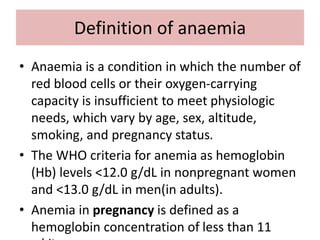
Definition of anaemia
• Anaemia is a condition in which the number of
red blood cells or their oxygen-carrying
capacity is insufficient to meet physiologic
needs, which vary by age, sex, altitude,
smoking, and pregnancy status.
• The WHO criteria for anemia as hemoglobin
(Hb) levels <12.0 g/dL in nonpregnant women
and <13.0 g/dL in men(in adults).
• Anemia in pregnancy is defined as a
hemoglobin concentration of less than 11
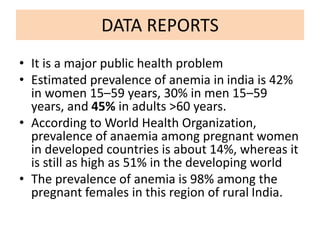
DATA REPORTS
• It is a major public health problem
• Estimated prevalence of anemia in india is 42%
in women 15–59 years, 30% in men 15–59
years, and 45% in adults >60 years.
• According to World Health Organization,
prevalence of anaemia among pregnant women
in developed countries is about 14%, whereas it
is still as high as 51% in the developing world
• The prevalence of anemia is 98% among the
pregnant females in this region of rural India.
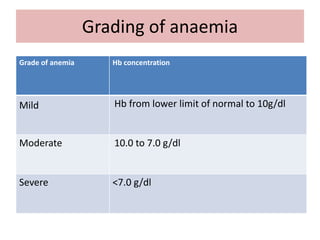
Grading of anaemia
Grade of anemia Hb concentration
Mild Hb from lower limit of normal to 10g/dl
Moderate 10.0 to 7.0 g/dl
Severe <7.0 g/dl
Classification of anemia
• Morphological classification
• Etiological classification
Morphological classification of anemia
Microcytic anemia
(MCV<80fl)
Macrocytic anemia
(MCV>100fl)
Normocytic anemia
(MCV 80-100 fl)
Iron deficiency anemia Megaloblastic anemia Reticulocyte production
normal
Thalassemia Nonmegaloblastic anemia • Recent blood loss
• hemolytic anemia
Sideroblastic anemia • liver disease Reticulocyte production
deficient
Anemia of chronic disease • hemolytic anemia • Anemia of chronic
disease
• alcoholism • aplastic anemia
• myelodysplastic
syndrome
• chronic kidney disease
• hypothyroidism • hypothyroidism
Clinical presentation of anemia
Symptoms
• Fatigue
• Malaise
• Dyspnea and palpitation
• Syncope
• Dizziness
• Menorrhagia
• Loss of appetite
Diagnosis of anemia
History
• Diet history-vegeterian or nonvegeterian
• h/o-chronic blood loss(menorrhagia,hemorrhoids)
• h/o-drugs like anticancerous agents,
chloramphenicol,gold,penicillamine(aplastic anemia)
Dapsone,quinine(hemolytic anemia)
• Family history of anemia(thalassemia,sickle cell
anemia)
• h/o alcohol addiction
• h/o-renal disease,rheumatologic disease
• History of systemic symptoms like fever ,weight
loss,night sweats.
• Obstetric and menstrual history
examination
General examination-
• Pallor
• Icterus
• Edema
• Lymphadenopathy
• Petechiae
Systemic examination
• CVS-flow murmur,loud S1
• Chest –crepts
Investigation
• CBC
• Reticulocyte count
• ESR
• Peripheral blood smear
• LFT(recent viral hepatitis)
• RFT
• Iron profile
• LDH,uric acid
• Vitamin B12 and folic acid level
• Bone marrow examination
• Hg electrophoresis
• Flowcytometry
• Direct and indirect coombs test
• Screening test for hep A,B and C
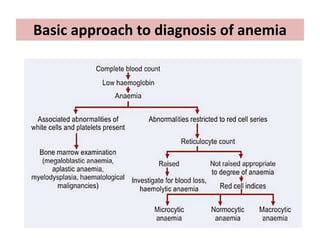
Basic approach to diagnosis of anemia
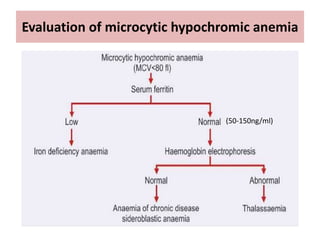
Evaluation of microcytic hypochromic anemia
(50-150ng/ml)
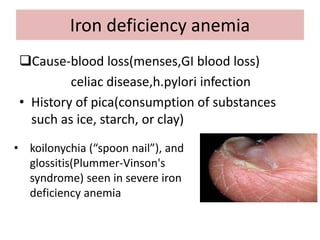
Iron deficiency anemia
Cause-blood loss(menses,GI blood loss)
celiac disease,h.pylori infection
• History of pica(consumption of substances
such as ice, starch, or clay)
• koilonychia (“spoon nail”), and
glossitis(Plummer-Vinson's
syndrome) seen in severe iron
deficiency anemia
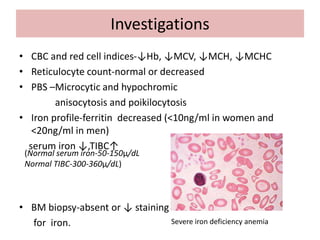
Investigations
• CBC and red cell indices-↓Hb, ↓MCV, ↓MCH, ↓MCHC
• Reticulocyte count-normal or decreased
• PBS –Microcytic and hypochromic
anisocytosis and poikilocytosis
• Iron profile-ferritin decreased (<10ng/ml in women and
<20ng/ml in men)
serum iron ↓,TIBC↑
• BM biopsy-absent or ↓ staining
for iron. Severe iron deficiency anemia
(Normal serum iron-50-150µ/dL
Normal TIBC-300-360µ/dL)
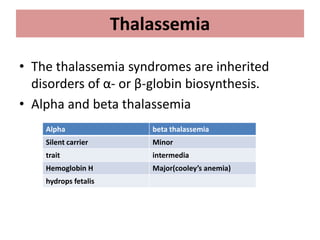
Thalassemia
• The thalassemia syndromes are inherited
disorders of α- or β-globin biosynthesis.
• Alpha and beta thalassemia
Alpha beta thalassemia
Silent carrier Minor
trait intermedia
Hemoglobin H Major(cooley’s anemia)
hydrops fetalis
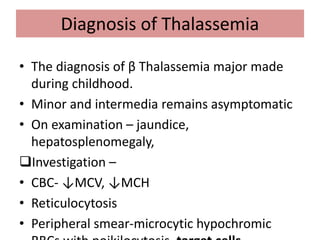
Diagnosis of Thalassemia
• The diagnosis of β Thalassemia major made
during childhood.
• Minor and intermedia remains asymptomatic
• On examination – jaundice,
hepatosplenomegaly,
Investigation –
• CBC- ↓MCV, ↓MCH
• Reticulocytosis
• Peripheral smear-microcytic hypochromic
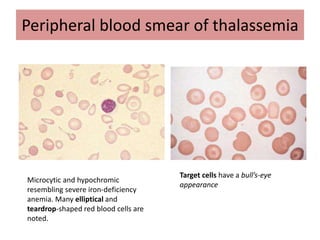
Peripheral blood smear of thalassemia
Microcytic and hypochromic
resembling severe iron-deficiency
anemia. Many elliptical and
teardrop-shaped red blood cells are
noted.
Target cells have a bull’s-eye
appearance
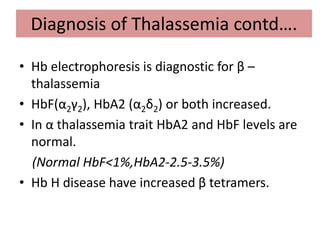
Diagnosis of Thalassemia contd….
• Hb electrophoresis is diagnostic for β –
thalassemia
• HbF(α2γ2), HbA2 (α2δ2) or both increased.
• In α thalassemia trait HbA2 and HbF levels are
normal.
(Normal HbF<1%,HbA2-2.5-3.5%)
• Hb H disease have increased β tetramers.
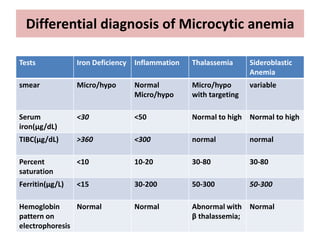
Differential diagnosis of Microcytic anemia
Tests Iron Deficiency Inflammation Thalassemia Sideroblastic
Anemia
smear Micro/hypo Normal
Micro/hypo
Micro/hypo
with targeting
variable
Serum
iron(μg/dL)
<30 <50 Normal to high Normal to high
TIBC(μg/dL) >360 <300 normal normal
Percent
saturation
<10 10-20 30-80 30-80
Ferritin(μg/L) <15 30-200 50-300 50-300
Hemoglobin
pattern on
electrophoresis
Normal Normal Abnormal with
β thalassemia;
Normal
Evaluation of macrocytic anemia
Megaloblastic anemia
• Megaloblastic anemia is a term used to describe
disorders of impaired DNA synthesis in hematopoietic
cells but affects all proliferating cells.
• Due to folic acid or vitamin B12 deficiency
Diagnosis-
• In addition to sx of anemia peripheral neuropathy,
paresthesias,
Seizures and dementia may found due to vit b12
deficiency
• On examination- Jaundice or splenomegaly
• Decreased vibratory and positional sense, ataxia,
Investigations of megaloblastic anemia
• Increased MCV & MCH,normal MCHC
• Low RBC ,WBC,and platelets
• Peripheral smear-oval macrocytes,anisocytosis,poikilocytosis,
Hypersegmented neutrophils
• LDH and indirect bilirubin are elevated
• Raised urine urobilinogen
• Serum vitamin B12 ,or folate or both decresed
(Normal serum vit B12levels 160–200 ng/L and normal serum
folate
2 -15 μg/L)
• Serum methylmalonic acid (MMA) and homocysteine (HC) are
elevated in vitamin B12 deficiency; and only HC is elevated in
folate deficiency.
• Detecting antibodies to intrinsic factor is specific for the
diagnosis of PA.
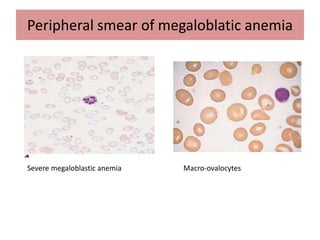
Peripheral smear of megaloblatic anemia
Severe megaloblastic anemia Macro-ovalocytes
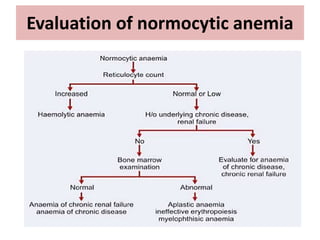
Evaluation of normocytic anemia
Aplastic anemia
• Aplastic anemia is pancytopenia with bone
marrow hypocellularity.
• Inherited-fanconi anemia,dyskeratosis
congenita
• Acquired-radiation,drugs like cytotoxic
drugs,benzene,chloramphenicol,NSAIDS,sulfo
namides,gold,mercury,hydantoin,parvo
virus,hepatitis,EB virus,HIV-1
Diagnosis of aplastic anemia
• History-of bleeding,easy bruising,nose bleeds,heavy
menstrual flow
• Family history of hematologic ds
• Examination-petechiae and ecchymoses
• Lymphadenopathy and splenomegaly are highly atypical
of aplastic anemia. Cafe au lait spots and short stature
suggest Fanconi anemia
• MCV-increased,reticulocytes are absent or few
• Peripheral smear-shows large erythrocytes and a paucity
of platelets and granulocytes.
• Bone Marrow-only red cells,residual lymphocytes,mainly
fat
• Chromosome studies of bone marrow cells for MDS
• Flow cytometry to rule out PNH.
Anemia of chronic kidney disease
• Primarily due to decreased endogenous EPO
production
• Other causes are-Diminished red blood cell
survival, Bleeding diathesis
• Iron deficiency
• Hyperparathyroidism/bone marrow fibrosis
• Chronic inflammation
• Folate or vitamin B12 deficiency
• Comorbid conditions: hypo-/hyperthyroidism,
Diagnosis Anemia of chronic kidney disease
• cbc-normal MCV
• Reticulocyte count-normal
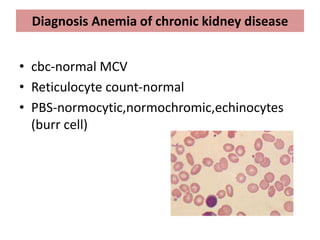
• PBS-normocytic,normochromic,echinocytes
(burr cell)
Hemolytic anemia
• Abnormality intrinsic to red cells-
1. Hereditary spherocytosis
2. Sickle cell disease
3. Thalassemia
4. G-6PD deficiency
• Abnormality extrinsic to red cells
1. Immune
2. Mechanical
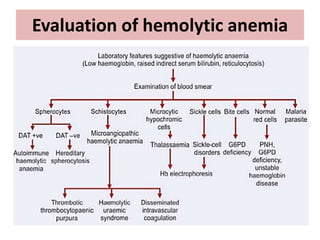
Evaluation of hemolytic anemia
Diagnosis of hemolytic anemia
• General examination- Jaundice, pallor
• Other physical findings Splenomegaly; bossing of skull
• Hemoglobin level From normal to severely reduced
• MCV, MCH Usually increased
• Reticulocytes Increased
• Bilirubin Increased (mostly unconjugated)
• LDH Increased
• Haptoglobin Reduced to absent
• direct Coombs test [DAT] is an indicator of the presence of
antibodies attached to RBC.
• The indirect Coombs test indicates the presence of free
antibody in the plasma.
• A peripheral blood smear-in Intravascular hemolysis may
show red cell fragmentation (i.e., schistocytes,helmet cells)
Hereditary Spherocytosis
• Autosomal dominant
• Jaundice,splenomegaly,gall stones
• MCHC increased
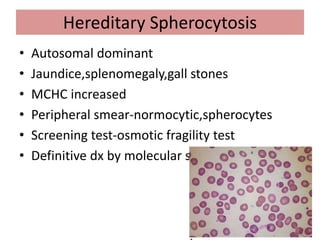
• Peripheral smear-normocytic,spherocytes
• Screening test-osmotic fragility test
• Definitive dx by molecular studies of gene
Sickle cell anemia
• Due to point mutation in 6th place of beta chain
,glutamic acid→valine
• On deoxygenation sickle cells are formed
Clinical presentation
• Vaso-occlusive crisis-acute chest syndrome,pain
crisis
• Aplastic crisis-by parvovirus B19
• Hemolytic crisis-gall stones
• infections
Diagnostic testing of sickle cell anemia
• Reticulocytosis,bilirubin
(indirect↑,LDH↑,leukocy
tosis,thrombocytosis
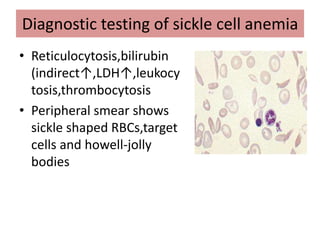
• Peripheral smear shows
sickle shaped RBCs,target
cells and howell-jolly
bodies
Diagnostic testing of sickle cell anemia
Sickling test
Sickling and solubility test –screening test of sickle cell anemia
Diagnostic testing of sickle cell anemia
• HPLC- Hb analysis by high performance liquid chromatography
homozygote
heterozygote
Glucose-6-phosphate dehydrogenase deficiency
• X-linked disorder
• Reduced activity of G6PD
• Inability to remove H2O2
• Accumulated H2O2 leads to oxidation of
hemoglobin with precipitation of globin chains
• May Present as neonatal jaundice
• Incresed bilirubin and Hemoglobinuria.
Peripheral smear of G6PD
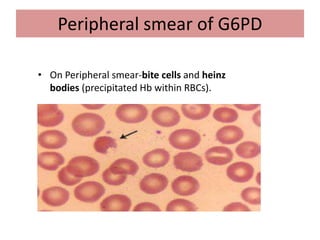
• On Peripheral smear-bite cells and heinz
bodies (precipitated Hb within RBCs).
Autoimmune Hemolytic Anemia
Warm antibody AIHA-by an IgG autoantibody
• Lymphoma,CLL,collagen vascular ds
Cold antibody AIHA-by an IgM autoantibody
• Seen in cold agglutinin ds,mycoplasma EB virus
Diagnosis-
• reticulocytosis,elevated LDH, and indirect
hyperbilirubinemia.
• Peripheral blood smear may show spherocytes,
occasional fragmented RBCs,
• Positive DAT(direct coombs test)
• Warm AIHA: IgG +and/or C3+
• Cold AIHA: IgG-and C3+
Take home message
• Anemia is one of the important cause of morbidity and
mortality in women.
• Iron deficiency anemia is the most common type of
anemia
• Iron deficiency in adult male means GI blood loss until
proven otherwise.
• Hb electrophoresis is diagnostic for thalassemia
• Megaloblastic anemia may present as pancytopenia
• Reticulocytosis present in hemolytic anemia
• Microcytic hypochromic –iron deficiency anemia
• Macrocytic-megaloblastic anemia
• Normocytic normochromic-hemolytic anemia
THANK YOU!

Aneamia diagnosis and classifications Bpharm.pptx

  • 1.
    Diagnosis of acase of Anemia BHARM STUDENTS- VICTORIA UNIVERSITY By kawalya Steven
  • 2.
    Definition of anaemia •Anaemia is a condition in which the number of red blood cells or their oxygen-carrying capacity is insufficient to meet physiologic needs, which vary by age, sex, altitude, smoking, and pregnancy status. • The WHO criteria for anemia as hemoglobin (Hb) levels <12.0 g/dL in nonpregnant women and <13.0 g/dL in men(in adults). • Anemia in pregnancy is defined as a hemoglobin concentration of less than 11
  • 3.
    DATA REPORTS • Itis a major public health problem • Estimated prevalence of anemia in india is 42% in women 15–59 years, 30% in men 15–59 years, and 45% in adults >60 years. • According to World Health Organization, prevalence of anaemia among pregnant women in developed countries is about 14%, whereas it is still as high as 51% in the developing world • The prevalence of anemia is 98% among the pregnant females in this region of rural India.
  • 4.
    Grading of anaemia Gradeof anemia Hb concentration Mild Hb from lower limit of normal to 10g/dl Moderate 10.0 to 7.0 g/dl Severe <7.0 g/dl
  • 5.
    Classification of anemia •Morphological classification • Etiological classification
  • 6.
    Morphological classification ofanemia Microcytic anemia (MCV<80fl) Macrocytic anemia (MCV>100fl) Normocytic anemia (MCV 80-100 fl) Iron deficiency anemia Megaloblastic anemia Reticulocyte production normal Thalassemia Nonmegaloblastic anemia • Recent blood loss • hemolytic anemia Sideroblastic anemia • liver disease Reticulocyte production deficient Anemia of chronic disease • hemolytic anemia • Anemia of chronic disease • alcoholism • aplastic anemia • myelodysplastic syndrome • chronic kidney disease • hypothyroidism • hypothyroidism
  • 7.
    Clinical presentation ofanemia Symptoms • Fatigue • Malaise • Dyspnea and palpitation • Syncope • Dizziness • Menorrhagia • Loss of appetite
  • 8.
    Diagnosis of anemia History •Diet history-vegeterian or nonvegeterian • h/o-chronic blood loss(menorrhagia,hemorrhoids) • h/o-drugs like anticancerous agents, chloramphenicol,gold,penicillamine(aplastic anemia) Dapsone,quinine(hemolytic anemia) • Family history of anemia(thalassemia,sickle cell anemia) • h/o alcohol addiction • h/o-renal disease,rheumatologic disease • History of systemic symptoms like fever ,weight loss,night sweats. • Obstetric and menstrual history
  • 9.
    examination General examination- • Pallor •Icterus • Edema • Lymphadenopathy • Petechiae Systemic examination • CVS-flow murmur,loud S1 • Chest –crepts
  • 10.
    Investigation • CBC • Reticulocytecount • ESR • Peripheral blood smear • LFT(recent viral hepatitis) • RFT • Iron profile • LDH,uric acid • Vitamin B12 and folic acid level • Bone marrow examination • Hg electrophoresis • Flowcytometry • Direct and indirect coombs test • Screening test for hep A,B and C
  • 11.
    Basic approach todiagnosis of anemia
  • 12.
    Evaluation of microcytichypochromic anemia (50-150ng/ml)
  • 13.
    Iron deficiency anemia Cause-bloodloss(menses,GI blood loss) celiac disease,h.pylori infection • History of pica(consumption of substances such as ice, starch, or clay) • koilonychia (“spoon nail”), and glossitis(Plummer-Vinson's syndrome) seen in severe iron deficiency anemia
  • 14.
    Investigations • CBC andred cell indices-↓Hb, ↓MCV, ↓MCH, ↓MCHC • Reticulocyte count-normal or decreased • PBS –Microcytic and hypochromic anisocytosis and poikilocytosis • Iron profile-ferritin decreased (<10ng/ml in women and <20ng/ml in men) serum iron ↓,TIBC↑ • BM biopsy-absent or ↓ staining for iron. Severe iron deficiency anemia (Normal serum iron-50-150µ/dL Normal TIBC-300-360µ/dL)
  • 15.
    Thalassemia • The thalassemiasyndromes are inherited disorders of α- or β-globin biosynthesis. • Alpha and beta thalassemia Alpha beta thalassemia Silent carrier Minor trait intermedia Hemoglobin H Major(cooley’s anemia) hydrops fetalis
  • 16.
    Diagnosis of Thalassemia •The diagnosis of β Thalassemia major made during childhood. • Minor and intermedia remains asymptomatic • On examination – jaundice, hepatosplenomegaly, Investigation – • CBC- ↓MCV, ↓MCH • Reticulocytosis • Peripheral smear-microcytic hypochromic
  • 17.
    Peripheral blood smearof thalassemia Microcytic and hypochromic resembling severe iron-deficiency anemia. Many elliptical and teardrop-shaped red blood cells are noted. Target cells have a bull’s-eye appearance
  • 18.
    Diagnosis of Thalassemiacontd…. • Hb electrophoresis is diagnostic for β – thalassemia • HbF(α2γ2), HbA2 (α2δ2) or both increased. • In α thalassemia trait HbA2 and HbF levels are normal. (Normal HbF<1%,HbA2-2.5-3.5%) • Hb H disease have increased β tetramers.
  • 19.
    Differential diagnosis ofMicrocytic anemia Tests Iron Deficiency Inflammation Thalassemia Sideroblastic Anemia smear Micro/hypo Normal Micro/hypo Micro/hypo with targeting variable Serum iron(μg/dL) <30 <50 Normal to high Normal to high TIBC(μg/dL) >360 <300 normal normal Percent saturation <10 10-20 30-80 30-80 Ferritin(μg/L) <15 30-200 50-300 50-300 Hemoglobin pattern on electrophoresis Normal Normal Abnormal with β thalassemia; Normal
  • 20.
  • 21.
    Megaloblastic anemia • Megaloblasticanemia is a term used to describe disorders of impaired DNA synthesis in hematopoietic cells but affects all proliferating cells. • Due to folic acid or vitamin B12 deficiency Diagnosis- • In addition to sx of anemia peripheral neuropathy, paresthesias, Seizures and dementia may found due to vit b12 deficiency • On examination- Jaundice or splenomegaly • Decreased vibratory and positional sense, ataxia,
  • 22.
    Investigations of megaloblasticanemia • Increased MCV & MCH,normal MCHC • Low RBC ,WBC,and platelets • Peripheral smear-oval macrocytes,anisocytosis,poikilocytosis, Hypersegmented neutrophils • LDH and indirect bilirubin are elevated • Raised urine urobilinogen • Serum vitamin B12 ,or folate or both decresed (Normal serum vit B12levels 160–200 ng/L and normal serum folate 2 -15 μg/L) • Serum methylmalonic acid (MMA) and homocysteine (HC) are elevated in vitamin B12 deficiency; and only HC is elevated in folate deficiency. • Detecting antibodies to intrinsic factor is specific for the diagnosis of PA.
  • 23.
    Peripheral smear ofmegaloblatic anemia Severe megaloblastic anemia Macro-ovalocytes
  • 24.
  • 25.
    Aplastic anemia • Aplasticanemia is pancytopenia with bone marrow hypocellularity. • Inherited-fanconi anemia,dyskeratosis congenita • Acquired-radiation,drugs like cytotoxic drugs,benzene,chloramphenicol,NSAIDS,sulfo namides,gold,mercury,hydantoin,parvo virus,hepatitis,EB virus,HIV-1
  • 26.
    Diagnosis of aplasticanemia • History-of bleeding,easy bruising,nose bleeds,heavy menstrual flow • Family history of hematologic ds • Examination-petechiae and ecchymoses • Lymphadenopathy and splenomegaly are highly atypical of aplastic anemia. Cafe au lait spots and short stature suggest Fanconi anemia • MCV-increased,reticulocytes are absent or few • Peripheral smear-shows large erythrocytes and a paucity of platelets and granulocytes. • Bone Marrow-only red cells,residual lymphocytes,mainly fat • Chromosome studies of bone marrow cells for MDS • Flow cytometry to rule out PNH.
  • 27.
    Anemia of chronickidney disease • Primarily due to decreased endogenous EPO production • Other causes are-Diminished red blood cell survival, Bleeding diathesis • Iron deficiency • Hyperparathyroidism/bone marrow fibrosis • Chronic inflammation • Folate or vitamin B12 deficiency • Comorbid conditions: hypo-/hyperthyroidism,
  • 28.
    Diagnosis Anemia ofchronic kidney disease • cbc-normal MCV • Reticulocyte count-normal • PBS-normocytic,normochromic,echinocytes (burr cell)
  • 29.
    Hemolytic anemia • Abnormalityintrinsic to red cells- 1. Hereditary spherocytosis 2. Sickle cell disease 3. Thalassemia 4. G-6PD deficiency • Abnormality extrinsic to red cells 1. Immune 2. Mechanical
  • 30.
  • 31.
    Diagnosis of hemolyticanemia • General examination- Jaundice, pallor • Other physical findings Splenomegaly; bossing of skull • Hemoglobin level From normal to severely reduced • MCV, MCH Usually increased • Reticulocytes Increased • Bilirubin Increased (mostly unconjugated) • LDH Increased • Haptoglobin Reduced to absent • direct Coombs test [DAT] is an indicator of the presence of antibodies attached to RBC. • The indirect Coombs test indicates the presence of free antibody in the plasma. • A peripheral blood smear-in Intravascular hemolysis may show red cell fragmentation (i.e., schistocytes,helmet cells)
  • 32.
    Hereditary Spherocytosis • Autosomaldominant • Jaundice,splenomegaly,gall stones • MCHC increased • Peripheral smear-normocytic,spherocytes • Screening test-osmotic fragility test • Definitive dx by molecular studies of gene
  • 33.
    Sickle cell anemia •Due to point mutation in 6th place of beta chain ,glutamic acid→valine • On deoxygenation sickle cells are formed Clinical presentation • Vaso-occlusive crisis-acute chest syndrome,pain crisis • Aplastic crisis-by parvovirus B19 • Hemolytic crisis-gall stones • infections
  • 34.
    Diagnostic testing ofsickle cell anemia • Reticulocytosis,bilirubin (indirect↑,LDH↑,leukocy tosis,thrombocytosis • Peripheral smear shows sickle shaped RBCs,target cells and howell-jolly bodies
  • 35.
    Diagnostic testing ofsickle cell anemia Sickling test Sickling and solubility test –screening test of sickle cell anemia
  • 36.
    Diagnostic testing ofsickle cell anemia • HPLC- Hb analysis by high performance liquid chromatography homozygote heterozygote
  • 37.
    Glucose-6-phosphate dehydrogenase deficiency •X-linked disorder • Reduced activity of G6PD • Inability to remove H2O2 • Accumulated H2O2 leads to oxidation of hemoglobin with precipitation of globin chains • May Present as neonatal jaundice • Incresed bilirubin and Hemoglobinuria.
  • 38.
    Peripheral smear ofG6PD • On Peripheral smear-bite cells and heinz bodies (precipitated Hb within RBCs).
  • 39.
    Autoimmune Hemolytic Anemia Warmantibody AIHA-by an IgG autoantibody • Lymphoma,CLL,collagen vascular ds Cold antibody AIHA-by an IgM autoantibody • Seen in cold agglutinin ds,mycoplasma EB virus Diagnosis- • reticulocytosis,elevated LDH, and indirect hyperbilirubinemia. • Peripheral blood smear may show spherocytes, occasional fragmented RBCs, • Positive DAT(direct coombs test) • Warm AIHA: IgG +and/or C3+ • Cold AIHA: IgG-and C3+
  • 40.
    Take home message •Anemia is one of the important cause of morbidity and mortality in women. • Iron deficiency anemia is the most common type of anemia • Iron deficiency in adult male means GI blood loss until proven otherwise. • Hb electrophoresis is diagnostic for thalassemia • Megaloblastic anemia may present as pancytopenia • Reticulocytosis present in hemolytic anemia • Microcytic hypochromic –iron deficiency anemia • Macrocytic-megaloblastic anemia • Normocytic normochromic-hemolytic anemia
  • 41.