ANDROID
(OPERATING SYSTEM)
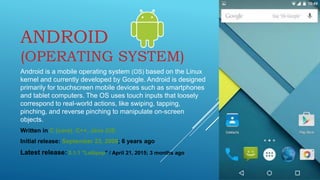
Android is a mobile operating system (OS) based on the Linux
kernel and currently developed by Google. Android is designed
primarily for touchscreen mobile devices such as smartphones
and tablet computers. The OS uses touch inputs that loosely
correspond to real-world actions, like swiping, tapping,
pinching, and reverse pinching to manipulate on-screen
objects.
Written in C (core), C++, Java (UI)
Initial release: September 23, 2008; 6 years ago
Latest release: 5.1.1 "Lollipop" / April 21, 2015; 3 months ago
Version Release date Features
1.0 September 23, 2008
2008
1. Android Market application download and updates through the Market application
2. Web browser to show, zoom and pan full HTML and XHTML web pages – multiple
pages show as windows ("cards")
3. Camera support – however, this version lacked the option to change the camera's
resolution, white balance, quality, etc.
4. Folders allowing the grouping of a number of application icons into a single folder
icon on the Home screen
5. Access to web email servers, supporting POP3, IMAP4, and SMTP
6. Gmail synchronization with the Gmail application
7. Google Contacts synchronization with the People application
8. Google Calendar synchronization with the Calendar application
9. Google Maps with Street View to view maps and satellite imagery, as well as find local
business and obtain driving directions using GPS
10. Google Sync, allowing management of over-the-air synchronization of Gmail, People,
and Calendar
11. Google Search, allowing users to search the Internet and phone applications, contacts,
calendar, etc.
12. Google Talk instant messaging
13. Instant messaging, text messaging, and MMS
14. Media Player, enabling management, importing, and playback of media files –
however, this version lacked video and stereo Bluetooth support.
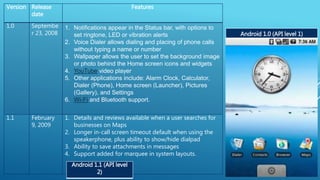
Version Release
date
Features
1.0 Septembe
r 23, 2008
1. Notifications appear in the Status bar, with options to
set ringtone, LED or vibration alerts
2. Voice Dialer allows dialing and placing of phone calls
without typing a name or number
3. Wallpaper allows the user to set the background image
or photo behind the Home screen icons and widgets
4. YouTube video player
5. Other applications include: Alarm Clock, Calculator,
Dialer (Phone), Home screen (Launcher), Pictures
(Gallery), and Settings
6. Wi-Fi and Bluetooth support.
1.1 February
9, 2009
1. Details and reviews available when a user searches for
businesses on Maps
2. Longer in-call screen timeout default when using the
speakerphone, plus ability to show/hide dialpad
3. Ability to save attachments in messages
4. Support added for marquee in system layouts.
Android 1.0 (API level 1)
Android 1.1 (API level
2)
Version Release
date
Features
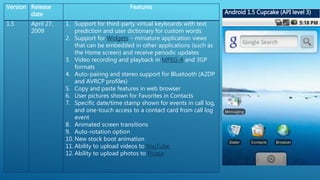
1.5 April 27,
2009
1. Support for third-party virtual keyboards with text
prediction and user dictionary for custom words
2. Support for Widgets – miniature application views
that can be embedded in other applications (such as
the Home screen) and receive periodic updates
3. Video recording and playback in MPEG-4 and 3GP
formats
4. Auto-pairing and stereo support for Bluetooth (A2DP
and AVRCP profiles)
5. Copy and paste features in web browser
6. User pictures shown for Favorites in Contacts
7. Specific date/time stamp shown for events in call log,
and one-touch access to a contact card from call log
event
8. Animated screen transitions
9. Auto-rotation option
10. New stock boot animation
11. Ability to upload videos to YouTube
12. Ability to upload photos to Picasa
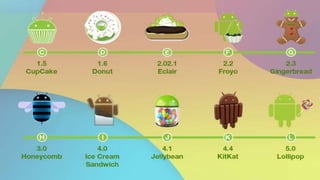
Android 1.5 Cupcake (API level 3)
Version Release
date
Features
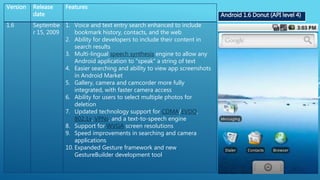
1.6 Septembe
r 15, 2009
1. Voice and text entry search enhanced to include
bookmark history, contacts, and the web
2. Ability for developers to include their content in
search results
3. Multi-lingual speech synthesis engine to allow any
Android application to "speak" a string of text
4. Easier searching and ability to view app screenshots
in Android Market
5. Gallery, camera and camcorder more fully
integrated, with faster camera access
6. Ability for users to select multiple photos for
deletion
7. Updated technology support for CDMA/EVDO,
802.1x, VPNs, and a text-to-speech engine
8. Support for WVGA screen resolutions
9. Speed improvements in searching and camera
applications
10. Expanded Gesture framework and new
GestureBuilder development tool
Android 1.6 Donut (API level 4)
Version Release date Features
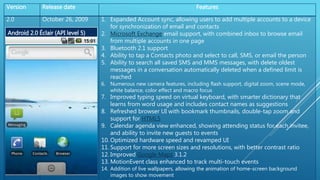
2.0 October 26, 2009 1. Expanded Account sync, allowing users to add multiple accounts to a device
for synchronization of email and contacts
2. Microsoft Exchange email support, with combined inbox to browse email
from multiple accounts in one page
3. Bluetooth 2.1 support
4. Ability to tap a Contacts photo and select to call, SMS, or email the person
5. Ability to search all saved SMS and MMS messages, with delete oldest
messages in a conversation automatically deleted when a defined limit is
reached
6. Numerous new camera features, including flash support, digital zoom, scene mode,
white balance, color effect and macro focus
7. Improved typing speed on virtual keyboard, with smarter dictionary that
learns from word usage and includes contact names as suggestions
8. Refreshed browser UI with bookmark thumbnails, double-tap zoom and
support for HTML5
9. Calendar agenda view enhanced, showing attending status for each invitee,
and ability to invite new guests to events
10. Optimized hardware speed and revamped UI
11. Support for more screen sizes and resolutions, with better contrast ratio
12. Improved Google Maps 3.1.2
13. MotionEvent class enhanced to track multi-touch events
14. Addition of live wallpapers, allowing the animation of home-screen background
images to show movement
Android 2.0 Éclair (API level 5)
Version Release
date
Features
2.0.1 December
3, 2009
1. Minor API changes, bugfixes and framework behavioral changes.
2.1 January 12,
2010
1. Minor amendments to the API and bugfixes
2.2 May 20,
2010
1. Speed, memory, and performance optimizations
2. Additional application speed improvements, implemented through JIT compilation
3. Integration of Chrome's V8 JavaScript engine into the Browser application
4. Support for the Android Cloud to Device Messaging (C2DM) service, enabling push notifications
5. Improved Microsoft Exchange support, including security policies, auto-discovery, GAL look-up,
calendar synchronization & remote wipe
6. Improved application launcher with shortcuts to Phone and Browser applications
7. USB tethering and Wi-Fi hotspot functionality
8. Option to disable data access over mobile network
9. Updated Market application with batch and automatic update features
10. Quick switching between multiple keyboard languages and their dictionaries
11. Support for Bluetooth-enabled car and desk docks
12. Support for numeric and alphanumeric passwords
13. Support for file upload fields in the Browser application
14. The browser now shows all frames of animated GIFs instead of just the first frame only
15. Support for installing applications to the expandable memory
16. Adobe Flash support
17. Support for high-PPI displays (up to 320 ppi), such as four-inch 720p screens
18. Gallery allows users to view picture stacks using a zoom gesture
Android 2.0.1 Éclair (API level
6)
Android 2.1 Éclair (API level 7)
Versi
on
Release date Features
2.2.1 January 18,
2011
1. Bugfixes, security updates and performance
improvements
2.2.2 January 22,
2011
1. Minor bugfixes, including SMS routing issues that
affected the Nexus One
2.2.3 November
21, 2011
1. Two security patches
Android 2.2–2.2.3 Froyo (API level 8)
Version Release date Features
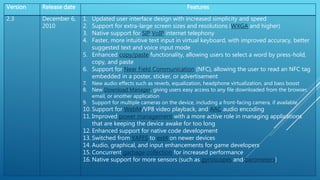
2.3 December 6,
2010
1. Updated user interface design with increased simplicity and speed
2. Support for extra-large screen sizes and resolutions (WXGA and higher)
3. Native support for SIP VoIP internet telephony
4. Faster, more intuitive text input in virtual keyboard, with improved accuracy, better
suggested text and voice input mode
5. Enhanced copy/paste functionality, allowing users to select a word by press-hold,
copy, and paste
6. Support for Near Field Communication (NFC), allowing the user to read an NFC tag
embedded in a poster, sticker, or advertisement
7. New audio effects such as reverb, equalization, headphone virtualization, and bass boost
8. New Download Manager, giving users easy access to any file downloaded from the browser,
email, or another application
9. Support for multiple cameras on the device, including a front-facing camera, if available
10. Support for WebM/VP8 video playback, and AAC audio encoding
11. Improved power management with a more active role in managing applications
that are keeping the device awake for too long
12. Enhanced support for native code development
13. Switched from YAFFS to ext4 on newer devices
14. Audio, graphical, and input enhancements for game developers
15. Concurrent garbage collection for increased performance
16. Native support for more sensors (such as gyroscopes and barometers)
Version Release date Features
2.3.1 December 2010 1. Improvements and bugfixes for the Google Nexus S
2.3.2 January 2011 1. Same as above
2.3.3 February 9, 2011 1. Several improvements and API fixes
2.3.4 April 28, 2011 1. Support for voice or video chat using Google Talk Open Accessory Library
support. Open Accessory was introduced in 3.1 (Honeycomb) but the Open
Accessory Library grants 2.3.4 added support when connecting to a USB
peripheral with compatible software and a compatible application on the
device Switched the default encryption for SSL from AES256-SHA to RC4-
MD5.
2.3.5 July 25, 2011 1. Improved network performance for the Nexus S 4G, among other fixes and
improvements
2. Fixed Bluetooth bug on Samsung Galaxy S
3. Improved Gmail application
4. Shadow animations for list scrolling
5. Camera software enhancements
6. Improved battery efficiency
2.3.6 September 2, 2011 1. Fixed a voice search bug
2.3.7 September 21, 2011 1. Google Wallet support for the Nexus S 4G
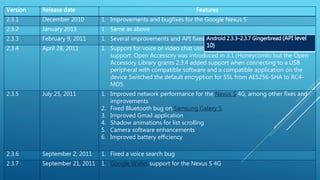
Android 2.3.3–2.3.7 Gingerbread (API level
10)
Version Release date Features
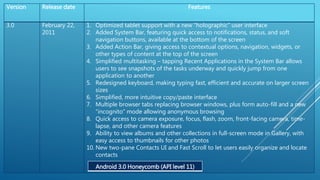
3.0 February 22,
2011
1. Optimized tablet support with a new “holographic” user interface
2. Added System Bar, featuring quick access to notifications, status, and soft
navigation buttons, available at the bottom of the screen
3. Added Action Bar, giving access to contextual options, navigation, widgets, or
other types of content at the top of the screen
4. Simplified multitasking – tapping Recent Applications in the System Bar allows
users to see snapshots of the tasks underway and quickly jump from one
application to another
5. Redesigned keyboard, making typing fast, efficient and accurate on larger screen
sizes
6. Simplified, more intuitive copy/paste interface
7. Multiple browser tabs replacing browser windows, plus form auto-fill and a new
“incognito” mode allowing anonymous browsing
8. Quick access to camera exposure, focus, flash, zoom, front-facing camera, time-
lapse, and other camera features
9. Ability to view albums and other collections in full-screen mode in Gallery, with
easy access to thumbnails for other photos
10. New two-pane Contacts UI and Fast Scroll to let users easily organize and locate
contacts
Android 3.0 Honeycomb (API level 11)
Version Release date Features
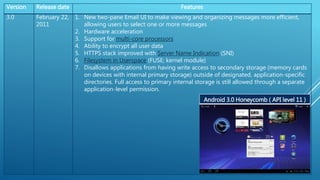
3.0 February 22,
2011
1. New two-pane Email UI to make viewing and organizing messages more efficient,
allowing users to select one or more messages
2. Hardware acceleration
3. Support for multi-core processors
4. Ability to encrypt all user data
5. HTTPS stack improved with Server Name Indication (SNI)
6. Filesystem in Userspace (FUSE; kernel module)
7. Disallows applications from having write access to secondary storage (memory cards
on devices with internal primary storage) outside of designated, application-specific
directories. Full access to primary internal storage is still allowed through a separate
application-level permission.
Android 3.0 Honeycomb ( API level 11 )
Version Release date Features
4.2.1 November 27,
2012
1. Fixed a bug in the People application where December was not displayed on the
date selector when adding an event to a contact
2. Added Bluetooth gamepads and joysticks as supported HID (Human interface
device)
4.2 November 13,
2012
1. Lock screen improvements, including widget support and the ability to swipe directly to
camera
2. Notification power controls ("Quick Settings")
3. "Daydream" screensavers, showing information when idle or docked
4. Multiple user accounts (tablets only)
5. Rewritten Bluetooth stack, switching from Bluez to Broadcom open source BlueDroid,
6. allowing improved support for multiple displays and wireless display (Miracast)
7. Native right-to-left, always-on VPN and application verification. A new NFC stack was
added at the same time.
8. Accessibility improvements: triple-tap to magnify the entire screen, pan and zoom with two
fingers. Speech output and Gesture Mode navigation for blind users
9. New clock application with built-in world clock, stop watch and timer
10. All devices now use the same interface layout, previously adapted from phones on 4.1 for
smaller tablets (with centered software buttons, the system bar at the top of the screen, and
a home screen with a dock and centered application menu), regardless of screen size
11. Increased number of extended notifications and Actionable Notifications for
more applications, allowing users to respond to certain notifications within the
notification bar and without launching the application directly
12. SELinux
13. Premium SMS confirmation
Version Release date Features
3.2 July 15, 2011 1. Improved hardware support, including optimizations for a wider range of tablets
Increased ability of applications to access files on the SD card, e.g. for
synchronization Compatibility display mode for applications that have not been
optimized for tablet screen resolutions New display support functions, giving
developers more control over display appearance on different Android devices
3.2.1 September 20,
2011
1. Bugfixes and minor security, stability and Wi-Fi improvements
2. Update to Android Market with automatic updates and easier-to-read Terms and
Conditions text
3. Update to Google Books
4. Improved Adobe Flash support in browser
5. Improved Chinese handwriting prediction
3.2.2 August 30,
2011
1. Bugfixes and other minor improvements for the Motorola Xoom 4G
3.2.3 1. Bugfixes and other minor improvements for the Motorola Xoom and Motorola
Xoom 4G
3.2.4 December
2011
1. "Pay as You Go" support for 3G and 4G tablets
3.2.5 January 2012 1. Bugfixes and other minor improvements for the Motorola Xoom and Motorola
Xoom 4G
3.2.6 February 2012
1. Fixed data connectivity issues when coming out of airplane mode on the US 4G
Vers
ion
Release
date
Features
4.0 Octobe
r 18,
2011
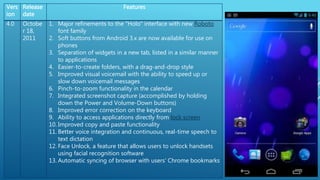
1. Major refinements to the "Holo" interface with new Roboto
font family
2. Soft buttons from Android 3.x are now available for use on
phones
3. Separation of widgets in a new tab, listed in a similar manner
to applications
4. Easier-to-create folders, with a drag-and-drop style
5. Improved visual voicemail with the ability to speed up or
slow down voicemail messages
6. Pinch-to-zoom functionality in the calendar
7. Integrated screenshot capture (accomplished by holding
down the Power and Volume-Down buttons)
8. Improved error correction on the keyboard
9. Ability to access applications directly from lock screen
10. Improved copy and paste functionality
11. Better voice integration and continuous, real-time speech to
text dictation
12. Face Unlock, a feature that allows users to unlock handsets
using facial recognition software
13. Automatic syncing of browser with users' Chrome bookmarks
Vers
ion
Release
date
Features
4.0 Octobe
r 18,
2011
1. Data Usage section in settings that lets users set warnings
when they approach a certain usage limit, and disable data
use when the limit is exceeded
2. Ability to shut down applications from the recent apps list
with a swipe.[88]
3. Improved camera application with zero shutter lag, time
lapse settings, panorama mode, and the ability to zoom
while recording
4. Built-in photo editor
5. New gallery layout, organized by location and person
6. Refreshed "People" application with social network
integration, status updates and hi-res images
7. Android Beam, a near-field communication feature allowing
the rapid short-range exchange of web bookmarks, contact
info, directions, YouTube videos and other data
8. Support for the WebP image format[75]
9. Hardware acceleration of the UI[89]
10. Wi-Fi Direct[90]
11. 1080p video recording for stock Android devices
12. Android VPN Framework (AVF), and TUN (but not TAP)
kernel module. Prior to 4.0, VPN software required rooted
Android.
4.0.1 October 21, 2011
•Fixed minor bugs for the
Samsung Galaxy Nexus.
4.0.2 November 28, 2011
•Fixed minor bugs on the
Verizon Galaxy Nexus, the
US launch of which was
later delayed until
December 2011.[b]
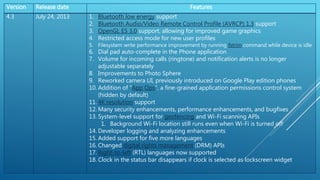
Version Release date Features
4.3 July 24, 2013 1. Bluetooth low energy support
2. Bluetooth Audio/Video Remote Control Profile (AVRCP) 1.3 support
3. OpenGL ES 3.0 support, allowing for improved game graphics
4. Restricted access mode for new user profiles
5. Filesystem write performance improvement by running fstrim command while device is idle
6. Dial pad auto-complete in the Phone application
7. Volume for incoming calls (ringtone) and notification alerts is no longer
adjustable separately
8. Improvements to Photo Sphere
9. Reworked camera UI, previously introduced on Google Play edition phones
10. Addition of "App Ops", a fine-grained application permissions control system
(hidden by default)
11. 4K resolution support
12. Many security enhancements, performance enhancements, and bugfixes
13. System-level support for geofencing and Wi-Fi scanning APIs
1. Background Wi-Fi location still runs even when Wi-Fi is turned off
14. Developer logging and analyzing enhancements
15. Added support for five more languages
16. Changed digital rights management (DRM) APIs
17. Right-to-left (RTL) languages now supported
18. Clock in the status bar disappears if clock is selected as lockscreen widget
Version Release date Features
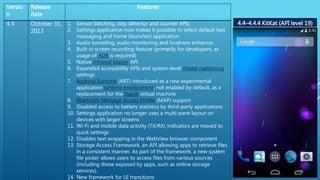
4.4 October 31, 2013 1. Sensor batching, step detector and counter APIs
2. Settings application now makes it possible to select default text messaging
and home (launcher) application
3. Audio tunneling, audio monitoring and loudness enhancer
4. Built-in screen recording feature (primarily for developers, as usage of ADB is
required)
5. Native infrared blaster API
6. Expanded accessibility APIs and system-level closed captioning settings
7. Android Runtime (ART) introduced as a new experimental application
runtime environment, not enabled by default, as a replacement for the
Dalvik virtual machine
8. Bluetooth Message Access Profile (MAP) support
9. Disabled access to battery statistics by third-party applications
10. Settings application no longer uses a multi-pane layout on devices with
larger screens
11. Wi-Fi and mobile data activity (TX/RX) indicators are moved to quick settings
12. Disables text wrapping in the WebView browser component
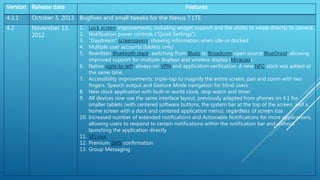
Version Release date Features
4.3.1 October 3, 2013 Bugfixes and small tweaks for the Nexus 7 LTE
4.2 November 13,
2012
1. Lock screen improvements, including widget support and the ability to swipe directly to camera
2. Notification power controls ("Quick Settings")
3. "Daydream" screensavers, showing information when idle or docked
4. Multiple user accounts (tablets only)
5. Rewritten Bluetooth stack, switching from Bluez to Broadcom open source BlueDroid, allowing
improved support for multiple displays and wireless display (Miracast)
6. Native right-to-left, always-on VPN and application verification. A new NFC stack was added at
the same time.
7. Accessibility improvements: triple-tap to magnify the entire screen, pan and zoom with two
fingers. Speech output and Gesture Mode navigation for blind users
8. New clock application with built-in world clock, stop watch and timer
9. All devices now use the same interface layout, previously adapted from phones on 4.1 for
smaller tablets (with centered software buttons, the system bar at the top of the screen, and a
home screen with a dock and centered application menu), regardless of screen size
10. Increased number of extended notifications and Actionable Notifications for more applications,
allowing users to respond to certain notifications within the notification bar and without
launching the application directly
11. SELinux
12. Premium SMS confirmation
13. Group Messaging
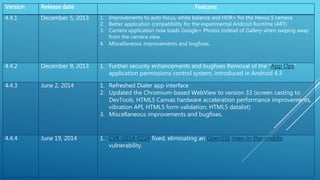
Version Release date Features
4.4.1 December 5, 2013 1. Improvements to auto focus, white balance and HDR+ for the Nexus 5 camera
2. Better application compatibility for the experimental Android Runtime (ART)
3. Camera application now loads Google+ Photos instead of Gallery when swiping away
from the camera view
4. Miscellaneous improvements and bugfixes.
4.4.2 December 9, 2013 1. Further security enhancements and bugfixes Removal of the "App Ops"
application permissions control system, introduced in Android 4.3
4.4.3 June 2, 2014 1. Refreshed Dialer app interface
2. Updated the Chromium-based WebView to version 33 (screen casting to
DevTools, HTML5 Canvas hardware acceleration performance improvements,
vibration API, HTML5 form validation, HTML5 datalist)
3. Miscellaneous improvements and bugfixes.
4.4.4 June 19, 2014 1. CVE-2014-0224 fixed, eliminating an OpenSSL man-in-the-middle
vulnerability.
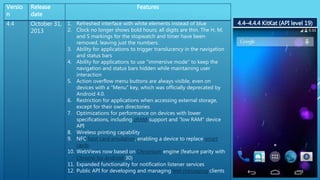
Versio
n
Release
date
Features
4.4 October 31,
2013
1. Refreshed interface with white elements instead of blue
2. Clock no longer shows bold hours; all digits are thin. The H, M,
and S markings for the stopwatch and timer have been
removed, leaving just the numbers.
3. Ability for applications to trigger translucency in the navigation
and status bars
4. Ability for applications to use "immersive mode" to keep the
navigation and status bars hidden while maintaining user
interaction
5. Action overflow menu buttons are always visible, even on
devices with a "Menu" key, which was officially deprecated by
Android 4.0.
6. Restriction for applications when accessing external storage,
except for their own directories
7. Optimizations for performance on devices with lower
specifications, including zRAM support and "low RAM" device
API
8. Wireless printing capability
9. NFC host card emulation, enabling a device to replace smart
cards
10. WebViews now based on Chromium engine (feature parity with
Chrome for Android 30)
11. Expanded functionality for notification listener services
12. Public API for developing and managing text messaging clients
4.4–4.4.4 KitKat (API level 19)
Versio
n
Release
date
Features
4.4 October 31,
2013
1. Sensor batching, step detector and counter APIs
2. Settings application now makes it possible to select default text
messaging and home (launcher) application
3. Audio tunneling, audio monitoring and loudness enhancer
4. Built-in screen recording feature (primarily for developers, as
usage of ADB is required)
5. Native infrared blaster API
6. Expanded accessibility APIs and system-level closed captioning
settings
7. Android Runtime (ART) introduced as a new experimental
application runtime environment, not enabled by default, as a
replacement for the Dalvik virtual machine
8. Bluetooth Message Access Profile (MAP) support
9. Disabled access to battery statistics by third-party applications
10. Settings application no longer uses a multi-pane layout on
devices with larger screens
11. Wi-Fi and mobile data activity (TX/RX) indicators are moved to
quick settings
12. Disables text wrapping in the WebView browser component
13. Storage Access Framework, an API allowing apps to retrieve files
in a consistent manner. As part of the framework, a new system
file picker allows users to access files from various sources
(including those exposed by apps, such as online storage
services).
14. New framework for UI transitions
4.4–4.4.4 KitKat (API level 19)
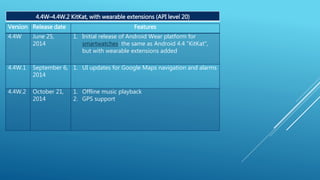
Version Release date Features
4.4W June 25,
2014
1. Initial release of Android Wear platform for
smartwatches: the same as Android 4.4 "KitKat",
but with wearable extensions added
4.4W.1 September 6,
2014
1. UI updates for Google Maps navigation and alarms
4.4W.2 October 21,
2014
1. Offline music playback
2. GPS support
4.4W–4.4W.2 KitKat, with wearable extensions (API level 20)
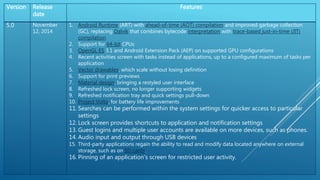
Version Release
date
Features
5.0 November
12, 2014
1. Android Runtime (ART) with ahead-of-time (AOT) compilation and improved garbage collection
(GC), replacing Dalvik that combines bytecode interpretation with trace-based just-in-time (JIT)
compilation
2. Support for 64-bit CPUs
3. OpenGL ES 3.1 and Android Extension Pack (AEP) on supported GPU configurations
4. Recent activities screen with tasks instead of applications, up to a configured maximum of tasks per
application
5. Vector drawables, which scale without losing definition
6. Support for print previews
7. Material design, bringing a restyled user interface
8. Refreshed lock screen, no longer supporting widgets
9. Refreshed notification tray and quick settings pull-down
10. Project Volta, for battery life improvements
11. Searches can be performed within the system settings for quicker access to particular
settings
12. Lock screen provides shortcuts to application and notification settings
13. Guest logins and multiple user accounts are available on more devices, such as phones.
14. Audio input and output through USB devices
15. Third-party applications regain the ability to read and modify data located anywhere on external
storage, such as on SD cards.
16. Pinning of an application's screen for restricted user activity.
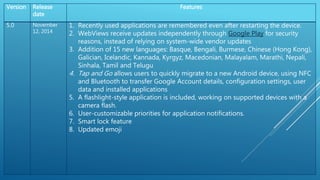
Version Release
date
Features
5.0 November
12, 2014
1. Recently used applications are remembered even after restarting the device.
2. WebViews receive updates independently through Google Play for security
reasons, instead of relying on system-wide vendor updates
3. Addition of 15 new languages: Basque, Bengali, Burmese, Chinese (Hong Kong),
Galician, Icelandic, Kannada, Kyrgyz, Macedonian, Malayalam, Marathi, Nepali,
Sinhala, Tamil and Telugu
4. Tap and Go allows users to quickly migrate to a new Android device, using NFC
and Bluetooth to transfer Google Account details, configuration settings, user
data and installed applications
5. A flashlight-style application is included, working on supported devices with a
camera flash.
6. User-customizable priorities for application notifications.
7. Smart lock feature
8. Updated emoji
Versio
n
Release date Features
5.0.1 December 2,
2014
1. A few bug fixes, including resolving issues
with video playback and password failures
handling
5.0.2 December
19, 2014
1. Fixes a bug with TRIM support, which
prevented devices from the nightly on-
charger cleanups of file system allocations if
the device was turned off while being
charged, or if it was charged during the day.
Changes how alarms wake the CPU, and how
alarms compete for system resources.
Versio
n
Release date Features
5.1 March 9,
2015
1. Ability to join Wi-Fi networks and control paired
Bluetooth devices from quick settings Official
support for multiple SIM cards Device protection:
if a device is lost or stolen it will remain locked
until the owner signs into their Google account,
even if the device is reset to factory settings.
High-definition voice calls, available between
compatible devices running Android 5.1
Improvements to the notification priority system,
to more closely replicate the silent mode that was
removed in Android 5.0.
5.1.1 April 21,
2015
1. Various bug fixes
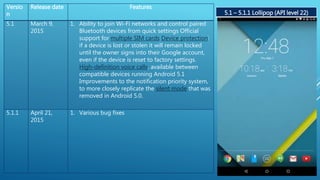
5.1 – 5.1.1 Lollipop (API level 22)

Android OS version history

  • 1.
    ANDROID (OPERATING SYSTEM) Android isa mobile operating system (OS) based on the Linux kernel and currently developed by Google. Android is designed primarily for touchscreen mobile devices such as smartphones and tablet computers. The OS uses touch inputs that loosely correspond to real-world actions, like swiping, tapping, pinching, and reverse pinching to manipulate on-screen objects. Written in C (core), C++, Java (UI) Initial release: September 23, 2008; 6 years ago Latest release: 5.1.1 "Lollipop" / April 21, 2015; 3 months ago
  • 3.
    Version Release dateFeatures 1.0 September 23, 2008 2008 1. Android Market application download and updates through the Market application 2. Web browser to show, zoom and pan full HTML and XHTML web pages – multiple pages show as windows ("cards") 3. Camera support – however, this version lacked the option to change the camera's resolution, white balance, quality, etc. 4. Folders allowing the grouping of a number of application icons into a single folder icon on the Home screen 5. Access to web email servers, supporting POP3, IMAP4, and SMTP 6. Gmail synchronization with the Gmail application 7. Google Contacts synchronization with the People application 8. Google Calendar synchronization with the Calendar application 9. Google Maps with Street View to view maps and satellite imagery, as well as find local business and obtain driving directions using GPS 10. Google Sync, allowing management of over-the-air synchronization of Gmail, People, and Calendar 11. Google Search, allowing users to search the Internet and phone applications, contacts, calendar, etc. 12. Google Talk instant messaging 13. Instant messaging, text messaging, and MMS 14. Media Player, enabling management, importing, and playback of media files – however, this version lacked video and stereo Bluetooth support.
  • 4.
    Version Release date Features 1.0 Septembe r23, 2008 1. Notifications appear in the Status bar, with options to set ringtone, LED or vibration alerts 2. Voice Dialer allows dialing and placing of phone calls without typing a name or number 3. Wallpaper allows the user to set the background image or photo behind the Home screen icons and widgets 4. YouTube video player 5. Other applications include: Alarm Clock, Calculator, Dialer (Phone), Home screen (Launcher), Pictures (Gallery), and Settings 6. Wi-Fi and Bluetooth support. 1.1 February 9, 2009 1. Details and reviews available when a user searches for businesses on Maps 2. Longer in-call screen timeout default when using the speakerphone, plus ability to show/hide dialpad 3. Ability to save attachments in messages 4. Support added for marquee in system layouts. Android 1.0 (API level 1) Android 1.1 (API level 2)
  • 5.
    Version Release date Features 1.5 April27, 2009 1. Support for third-party virtual keyboards with text prediction and user dictionary for custom words 2. Support for Widgets – miniature application views that can be embedded in other applications (such as the Home screen) and receive periodic updates 3. Video recording and playback in MPEG-4 and 3GP formats 4. Auto-pairing and stereo support for Bluetooth (A2DP and AVRCP profiles) 5. Copy and paste features in web browser 6. User pictures shown for Favorites in Contacts 7. Specific date/time stamp shown for events in call log, and one-touch access to a contact card from call log event 8. Animated screen transitions 9. Auto-rotation option 10. New stock boot animation 11. Ability to upload videos to YouTube 12. Ability to upload photos to Picasa Android 1.5 Cupcake (API level 3)
  • 6.
    Version Release date Features 1.6 Septembe r15, 2009 1. Voice and text entry search enhanced to include bookmark history, contacts, and the web 2. Ability for developers to include their content in search results 3. Multi-lingual speech synthesis engine to allow any Android application to "speak" a string of text 4. Easier searching and ability to view app screenshots in Android Market 5. Gallery, camera and camcorder more fully integrated, with faster camera access 6. Ability for users to select multiple photos for deletion 7. Updated technology support for CDMA/EVDO, 802.1x, VPNs, and a text-to-speech engine 8. Support for WVGA screen resolutions 9. Speed improvements in searching and camera applications 10. Expanded Gesture framework and new GestureBuilder development tool Android 1.6 Donut (API level 4)
  • 7.
    Version Release dateFeatures 2.0 October 26, 2009 1. Expanded Account sync, allowing users to add multiple accounts to a device for synchronization of email and contacts 2. Microsoft Exchange email support, with combined inbox to browse email from multiple accounts in one page 3. Bluetooth 2.1 support 4. Ability to tap a Contacts photo and select to call, SMS, or email the person 5. Ability to search all saved SMS and MMS messages, with delete oldest messages in a conversation automatically deleted when a defined limit is reached 6. Numerous new camera features, including flash support, digital zoom, scene mode, white balance, color effect and macro focus 7. Improved typing speed on virtual keyboard, with smarter dictionary that learns from word usage and includes contact names as suggestions 8. Refreshed browser UI with bookmark thumbnails, double-tap zoom and support for HTML5 9. Calendar agenda view enhanced, showing attending status for each invitee, and ability to invite new guests to events 10. Optimized hardware speed and revamped UI 11. Support for more screen sizes and resolutions, with better contrast ratio 12. Improved Google Maps 3.1.2 13. MotionEvent class enhanced to track multi-touch events 14. Addition of live wallpapers, allowing the animation of home-screen background images to show movement Android 2.0 Éclair (API level 5)
  • 8.
    Version Release date Features 2.0.1 December 3,2009 1. Minor API changes, bugfixes and framework behavioral changes. 2.1 January 12, 2010 1. Minor amendments to the API and bugfixes 2.2 May 20, 2010 1. Speed, memory, and performance optimizations 2. Additional application speed improvements, implemented through JIT compilation 3. Integration of Chrome's V8 JavaScript engine into the Browser application 4. Support for the Android Cloud to Device Messaging (C2DM) service, enabling push notifications 5. Improved Microsoft Exchange support, including security policies, auto-discovery, GAL look-up, calendar synchronization & remote wipe 6. Improved application launcher with shortcuts to Phone and Browser applications 7. USB tethering and Wi-Fi hotspot functionality 8. Option to disable data access over mobile network 9. Updated Market application with batch and automatic update features 10. Quick switching between multiple keyboard languages and their dictionaries 11. Support for Bluetooth-enabled car and desk docks 12. Support for numeric and alphanumeric passwords 13. Support for file upload fields in the Browser application 14. The browser now shows all frames of animated GIFs instead of just the first frame only 15. Support for installing applications to the expandable memory 16. Adobe Flash support 17. Support for high-PPI displays (up to 320 ppi), such as four-inch 720p screens 18. Gallery allows users to view picture stacks using a zoom gesture Android 2.0.1 Éclair (API level 6) Android 2.1 Éclair (API level 7)
  • 9.
    Versi on Release date Features 2.2.1January 18, 2011 1. Bugfixes, security updates and performance improvements 2.2.2 January 22, 2011 1. Minor bugfixes, including SMS routing issues that affected the Nexus One 2.2.3 November 21, 2011 1. Two security patches Android 2.2–2.2.3 Froyo (API level 8)
  • 10.
    Version Release dateFeatures 2.3 December 6, 2010 1. Updated user interface design with increased simplicity and speed 2. Support for extra-large screen sizes and resolutions (WXGA and higher) 3. Native support for SIP VoIP internet telephony 4. Faster, more intuitive text input in virtual keyboard, with improved accuracy, better suggested text and voice input mode 5. Enhanced copy/paste functionality, allowing users to select a word by press-hold, copy, and paste 6. Support for Near Field Communication (NFC), allowing the user to read an NFC tag embedded in a poster, sticker, or advertisement 7. New audio effects such as reverb, equalization, headphone virtualization, and bass boost 8. New Download Manager, giving users easy access to any file downloaded from the browser, email, or another application 9. Support for multiple cameras on the device, including a front-facing camera, if available 10. Support for WebM/VP8 video playback, and AAC audio encoding 11. Improved power management with a more active role in managing applications that are keeping the device awake for too long 12. Enhanced support for native code development 13. Switched from YAFFS to ext4 on newer devices 14. Audio, graphical, and input enhancements for game developers 15. Concurrent garbage collection for increased performance 16. Native support for more sensors (such as gyroscopes and barometers)
  • 11.
    Version Release dateFeatures 2.3.1 December 2010 1. Improvements and bugfixes for the Google Nexus S 2.3.2 January 2011 1. Same as above 2.3.3 February 9, 2011 1. Several improvements and API fixes 2.3.4 April 28, 2011 1. Support for voice or video chat using Google Talk Open Accessory Library support. Open Accessory was introduced in 3.1 (Honeycomb) but the Open Accessory Library grants 2.3.4 added support when connecting to a USB peripheral with compatible software and a compatible application on the device Switched the default encryption for SSL from AES256-SHA to RC4- MD5. 2.3.5 July 25, 2011 1. Improved network performance for the Nexus S 4G, among other fixes and improvements 2. Fixed Bluetooth bug on Samsung Galaxy S 3. Improved Gmail application 4. Shadow animations for list scrolling 5. Camera software enhancements 6. Improved battery efficiency 2.3.6 September 2, 2011 1. Fixed a voice search bug 2.3.7 September 21, 2011 1. Google Wallet support for the Nexus S 4G Android 2.3.3–2.3.7 Gingerbread (API level 10)
  • 12.
    Version Release dateFeatures 3.0 February 22, 2011 1. Optimized tablet support with a new “holographic” user interface 2. Added System Bar, featuring quick access to notifications, status, and soft navigation buttons, available at the bottom of the screen 3. Added Action Bar, giving access to contextual options, navigation, widgets, or other types of content at the top of the screen 4. Simplified multitasking – tapping Recent Applications in the System Bar allows users to see snapshots of the tasks underway and quickly jump from one application to another 5. Redesigned keyboard, making typing fast, efficient and accurate on larger screen sizes 6. Simplified, more intuitive copy/paste interface 7. Multiple browser tabs replacing browser windows, plus form auto-fill and a new “incognito” mode allowing anonymous browsing 8. Quick access to camera exposure, focus, flash, zoom, front-facing camera, time- lapse, and other camera features 9. Ability to view albums and other collections in full-screen mode in Gallery, with easy access to thumbnails for other photos 10. New two-pane Contacts UI and Fast Scroll to let users easily organize and locate contacts Android 3.0 Honeycomb (API level 11)
  • 13.
    Version Release dateFeatures 3.0 February 22, 2011 1. New two-pane Email UI to make viewing and organizing messages more efficient, allowing users to select one or more messages 2. Hardware acceleration 3. Support for multi-core processors 4. Ability to encrypt all user data 5. HTTPS stack improved with Server Name Indication (SNI) 6. Filesystem in Userspace (FUSE; kernel module) 7. Disallows applications from having write access to secondary storage (memory cards on devices with internal primary storage) outside of designated, application-specific directories. Full access to primary internal storage is still allowed through a separate application-level permission. Android 3.0 Honeycomb ( API level 11 )
  • 14.
    Version Release dateFeatures 4.2.1 November 27, 2012 1. Fixed a bug in the People application where December was not displayed on the date selector when adding an event to a contact 2. Added Bluetooth gamepads and joysticks as supported HID (Human interface device) 4.2 November 13, 2012 1. Lock screen improvements, including widget support and the ability to swipe directly to camera 2. Notification power controls ("Quick Settings") 3. "Daydream" screensavers, showing information when idle or docked 4. Multiple user accounts (tablets only) 5. Rewritten Bluetooth stack, switching from Bluez to Broadcom open source BlueDroid, 6. allowing improved support for multiple displays and wireless display (Miracast) 7. Native right-to-left, always-on VPN and application verification. A new NFC stack was added at the same time. 8. Accessibility improvements: triple-tap to magnify the entire screen, pan and zoom with two fingers. Speech output and Gesture Mode navigation for blind users 9. New clock application with built-in world clock, stop watch and timer 10. All devices now use the same interface layout, previously adapted from phones on 4.1 for smaller tablets (with centered software buttons, the system bar at the top of the screen, and a home screen with a dock and centered application menu), regardless of screen size 11. Increased number of extended notifications and Actionable Notifications for more applications, allowing users to respond to certain notifications within the notification bar and without launching the application directly 12. SELinux 13. Premium SMS confirmation
  • 15.
    Version Release dateFeatures 3.2 July 15, 2011 1. Improved hardware support, including optimizations for a wider range of tablets Increased ability of applications to access files on the SD card, e.g. for synchronization Compatibility display mode for applications that have not been optimized for tablet screen resolutions New display support functions, giving developers more control over display appearance on different Android devices 3.2.1 September 20, 2011 1. Bugfixes and minor security, stability and Wi-Fi improvements 2. Update to Android Market with automatic updates and easier-to-read Terms and Conditions text 3. Update to Google Books 4. Improved Adobe Flash support in browser 5. Improved Chinese handwriting prediction 3.2.2 August 30, 2011 1. Bugfixes and other minor improvements for the Motorola Xoom 4G 3.2.3 1. Bugfixes and other minor improvements for the Motorola Xoom and Motorola Xoom 4G 3.2.4 December 2011 1. "Pay as You Go" support for 3G and 4G tablets 3.2.5 January 2012 1. Bugfixes and other minor improvements for the Motorola Xoom and Motorola Xoom 4G 3.2.6 February 2012 1. Fixed data connectivity issues when coming out of airplane mode on the US 4G
  • 16.
    Vers ion Release date Features 4.0 Octobe r 18, 2011 1.Major refinements to the "Holo" interface with new Roboto font family 2. Soft buttons from Android 3.x are now available for use on phones 3. Separation of widgets in a new tab, listed in a similar manner to applications 4. Easier-to-create folders, with a drag-and-drop style 5. Improved visual voicemail with the ability to speed up or slow down voicemail messages 6. Pinch-to-zoom functionality in the calendar 7. Integrated screenshot capture (accomplished by holding down the Power and Volume-Down buttons) 8. Improved error correction on the keyboard 9. Ability to access applications directly from lock screen 10. Improved copy and paste functionality 11. Better voice integration and continuous, real-time speech to text dictation 12. Face Unlock, a feature that allows users to unlock handsets using facial recognition software 13. Automatic syncing of browser with users' Chrome bookmarks
  • 17.
    Vers ion Release date Features 4.0 Octobe r 18, 2011 1.Data Usage section in settings that lets users set warnings when they approach a certain usage limit, and disable data use when the limit is exceeded 2. Ability to shut down applications from the recent apps list with a swipe.[88] 3. Improved camera application with zero shutter lag, time lapse settings, panorama mode, and the ability to zoom while recording 4. Built-in photo editor 5. New gallery layout, organized by location and person 6. Refreshed "People" application with social network integration, status updates and hi-res images 7. Android Beam, a near-field communication feature allowing the rapid short-range exchange of web bookmarks, contact info, directions, YouTube videos and other data 8. Support for the WebP image format[75] 9. Hardware acceleration of the UI[89] 10. Wi-Fi Direct[90] 11. 1080p video recording for stock Android devices 12. Android VPN Framework (AVF), and TUN (but not TAP) kernel module. Prior to 4.0, VPN software required rooted Android.
  • 18.
    4.0.1 October 21,2011 •Fixed minor bugs for the Samsung Galaxy Nexus. 4.0.2 November 28, 2011 •Fixed minor bugs on the Verizon Galaxy Nexus, the US launch of which was later delayed until December 2011.[b]
  • 19.
    Version Release dateFeatures 4.3 July 24, 2013 1. Bluetooth low energy support 2. Bluetooth Audio/Video Remote Control Profile (AVRCP) 1.3 support 3. OpenGL ES 3.0 support, allowing for improved game graphics 4. Restricted access mode for new user profiles 5. Filesystem write performance improvement by running fstrim command while device is idle 6. Dial pad auto-complete in the Phone application 7. Volume for incoming calls (ringtone) and notification alerts is no longer adjustable separately 8. Improvements to Photo Sphere 9. Reworked camera UI, previously introduced on Google Play edition phones 10. Addition of "App Ops", a fine-grained application permissions control system (hidden by default) 11. 4K resolution support 12. Many security enhancements, performance enhancements, and bugfixes 13. System-level support for geofencing and Wi-Fi scanning APIs 1. Background Wi-Fi location still runs even when Wi-Fi is turned off 14. Developer logging and analyzing enhancements 15. Added support for five more languages 16. Changed digital rights management (DRM) APIs 17. Right-to-left (RTL) languages now supported 18. Clock in the status bar disappears if clock is selected as lockscreen widget
  • 20.
    Version Release dateFeatures 4.4 October 31, 2013 1. Sensor batching, step detector and counter APIs 2. Settings application now makes it possible to select default text messaging and home (launcher) application 3. Audio tunneling, audio monitoring and loudness enhancer 4. Built-in screen recording feature (primarily for developers, as usage of ADB is required) 5. Native infrared blaster API 6. Expanded accessibility APIs and system-level closed captioning settings 7. Android Runtime (ART) introduced as a new experimental application runtime environment, not enabled by default, as a replacement for the Dalvik virtual machine 8. Bluetooth Message Access Profile (MAP) support 9. Disabled access to battery statistics by third-party applications 10. Settings application no longer uses a multi-pane layout on devices with larger screens 11. Wi-Fi and mobile data activity (TX/RX) indicators are moved to quick settings 12. Disables text wrapping in the WebView browser component
  • 21.
    Version Release dateFeatures 4.3.1 October 3, 2013 Bugfixes and small tweaks for the Nexus 7 LTE 4.2 November 13, 2012 1. Lock screen improvements, including widget support and the ability to swipe directly to camera 2. Notification power controls ("Quick Settings") 3. "Daydream" screensavers, showing information when idle or docked 4. Multiple user accounts (tablets only) 5. Rewritten Bluetooth stack, switching from Bluez to Broadcom open source BlueDroid, allowing improved support for multiple displays and wireless display (Miracast) 6. Native right-to-left, always-on VPN and application verification. A new NFC stack was added at the same time. 7. Accessibility improvements: triple-tap to magnify the entire screen, pan and zoom with two fingers. Speech output and Gesture Mode navigation for blind users 8. New clock application with built-in world clock, stop watch and timer 9. All devices now use the same interface layout, previously adapted from phones on 4.1 for smaller tablets (with centered software buttons, the system bar at the top of the screen, and a home screen with a dock and centered application menu), regardless of screen size 10. Increased number of extended notifications and Actionable Notifications for more applications, allowing users to respond to certain notifications within the notification bar and without launching the application directly 11. SELinux 12. Premium SMS confirmation 13. Group Messaging
  • 22.
    Version Release dateFeatures 4.4.1 December 5, 2013 1. Improvements to auto focus, white balance and HDR+ for the Nexus 5 camera 2. Better application compatibility for the experimental Android Runtime (ART) 3. Camera application now loads Google+ Photos instead of Gallery when swiping away from the camera view 4. Miscellaneous improvements and bugfixes. 4.4.2 December 9, 2013 1. Further security enhancements and bugfixes Removal of the "App Ops" application permissions control system, introduced in Android 4.3 4.4.3 June 2, 2014 1. Refreshed Dialer app interface 2. Updated the Chromium-based WebView to version 33 (screen casting to DevTools, HTML5 Canvas hardware acceleration performance improvements, vibration API, HTML5 form validation, HTML5 datalist) 3. Miscellaneous improvements and bugfixes. 4.4.4 June 19, 2014 1. CVE-2014-0224 fixed, eliminating an OpenSSL man-in-the-middle vulnerability.
  • 23.
    Versio n Release date Features 4.4 October 31, 2013 1.Refreshed interface with white elements instead of blue 2. Clock no longer shows bold hours; all digits are thin. The H, M, and S markings for the stopwatch and timer have been removed, leaving just the numbers. 3. Ability for applications to trigger translucency in the navigation and status bars 4. Ability for applications to use "immersive mode" to keep the navigation and status bars hidden while maintaining user interaction 5. Action overflow menu buttons are always visible, even on devices with a "Menu" key, which was officially deprecated by Android 4.0. 6. Restriction for applications when accessing external storage, except for their own directories 7. Optimizations for performance on devices with lower specifications, including zRAM support and "low RAM" device API 8. Wireless printing capability 9. NFC host card emulation, enabling a device to replace smart cards 10. WebViews now based on Chromium engine (feature parity with Chrome for Android 30) 11. Expanded functionality for notification listener services 12. Public API for developing and managing text messaging clients 4.4–4.4.4 KitKat (API level 19)
  • 24.
    Versio n Release date Features 4.4 October 31, 2013 1.Sensor batching, step detector and counter APIs 2. Settings application now makes it possible to select default text messaging and home (launcher) application 3. Audio tunneling, audio monitoring and loudness enhancer 4. Built-in screen recording feature (primarily for developers, as usage of ADB is required) 5. Native infrared blaster API 6. Expanded accessibility APIs and system-level closed captioning settings 7. Android Runtime (ART) introduced as a new experimental application runtime environment, not enabled by default, as a replacement for the Dalvik virtual machine 8. Bluetooth Message Access Profile (MAP) support 9. Disabled access to battery statistics by third-party applications 10. Settings application no longer uses a multi-pane layout on devices with larger screens 11. Wi-Fi and mobile data activity (TX/RX) indicators are moved to quick settings 12. Disables text wrapping in the WebView browser component 13. Storage Access Framework, an API allowing apps to retrieve files in a consistent manner. As part of the framework, a new system file picker allows users to access files from various sources (including those exposed by apps, such as online storage services). 14. New framework for UI transitions 4.4–4.4.4 KitKat (API level 19)
  • 25.
    Version Release dateFeatures 4.4W June 25, 2014 1. Initial release of Android Wear platform for smartwatches: the same as Android 4.4 "KitKat", but with wearable extensions added 4.4W.1 September 6, 2014 1. UI updates for Google Maps navigation and alarms 4.4W.2 October 21, 2014 1. Offline music playback 2. GPS support 4.4W–4.4W.2 KitKat, with wearable extensions (API level 20)
  • 26.
    Version Release date Features 5.0 November 12,2014 1. Android Runtime (ART) with ahead-of-time (AOT) compilation and improved garbage collection (GC), replacing Dalvik that combines bytecode interpretation with trace-based just-in-time (JIT) compilation 2. Support for 64-bit CPUs 3. OpenGL ES 3.1 and Android Extension Pack (AEP) on supported GPU configurations 4. Recent activities screen with tasks instead of applications, up to a configured maximum of tasks per application 5. Vector drawables, which scale without losing definition 6. Support for print previews 7. Material design, bringing a restyled user interface 8. Refreshed lock screen, no longer supporting widgets 9. Refreshed notification tray and quick settings pull-down 10. Project Volta, for battery life improvements 11. Searches can be performed within the system settings for quicker access to particular settings 12. Lock screen provides shortcuts to application and notification settings 13. Guest logins and multiple user accounts are available on more devices, such as phones. 14. Audio input and output through USB devices 15. Third-party applications regain the ability to read and modify data located anywhere on external storage, such as on SD cards. 16. Pinning of an application's screen for restricted user activity.
  • 27.
    Version Release date Features 5.0 November 12,2014 1. Recently used applications are remembered even after restarting the device. 2. WebViews receive updates independently through Google Play for security reasons, instead of relying on system-wide vendor updates 3. Addition of 15 new languages: Basque, Bengali, Burmese, Chinese (Hong Kong), Galician, Icelandic, Kannada, Kyrgyz, Macedonian, Malayalam, Marathi, Nepali, Sinhala, Tamil and Telugu 4. Tap and Go allows users to quickly migrate to a new Android device, using NFC and Bluetooth to transfer Google Account details, configuration settings, user data and installed applications 5. A flashlight-style application is included, working on supported devices with a camera flash. 6. User-customizable priorities for application notifications. 7. Smart lock feature 8. Updated emoji
  • 28.
    Versio n Release date Features 5.0.1December 2, 2014 1. A few bug fixes, including resolving issues with video playback and password failures handling 5.0.2 December 19, 2014 1. Fixes a bug with TRIM support, which prevented devices from the nightly on- charger cleanups of file system allocations if the device was turned off while being charged, or if it was charged during the day. Changes how alarms wake the CPU, and how alarms compete for system resources.
  • 29.
    Versio n Release date Features 5.1March 9, 2015 1. Ability to join Wi-Fi networks and control paired Bluetooth devices from quick settings Official support for multiple SIM cards Device protection: if a device is lost or stolen it will remain locked until the owner signs into their Google account, even if the device is reset to factory settings. High-definition voice calls, available between compatible devices running Android 5.1 Improvements to the notification priority system, to more closely replicate the silent mode that was removed in Android 5.0. 5.1.1 April 21, 2015 1. Various bug fixes 5.1 – 5.1.1 Lollipop (API level 22)