Buzzvil Client Modularization
Created by Ethan Yoo
What is the App modularization
Modular programming
● Is a software design technique
● Separates a program into modules according to the functionality
Module
● Is independent and interchangeable
● Contains everything necessary
● Contains only one aspect of the desired functionality
“App Modularization is to modularize the Android App.”
Why do we need to modularize app
● Faster build time
● Separation of concerns
● Fine-grained dependency control
● Improved reusability across other apps
● Improved the ownership & the quality of the codebase
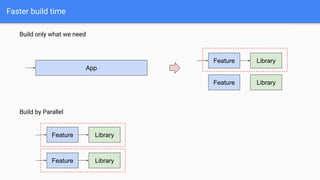
Faster build time
App
Feature
Feature
Library
Library
Build only what we need
Build by Parallel
Feature
Feature
Library
Library
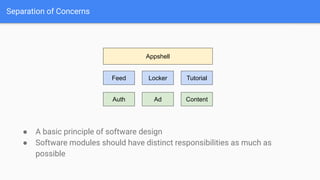
Separation of Concerns
● A basic principle of software design
● Software modules should have distinct responsibilities as much as
possible
Appshell
Feed Locker Tutorial
Auth Ad Content
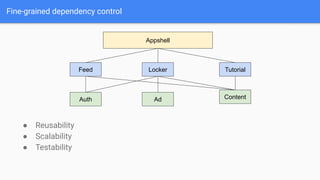
Fine-grained dependency control
● Reusability
● Scalability
● Testability
Appshell
Feed Locker Tutorial
Auth Ad Content
Improved reusability across other apps
H/S
Feed Locker Tutorial
Auth Ad Content
S/J
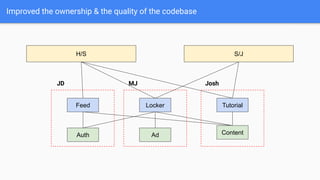
Improved the ownership & the quality of the codebase
H/S
Feed Locker Tutorial
Auth Ad Content
S/J
JD MJ Josh
How to modularize
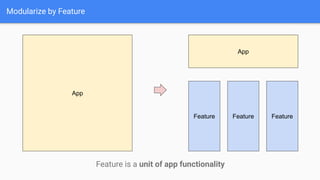
● Modularization by Feature
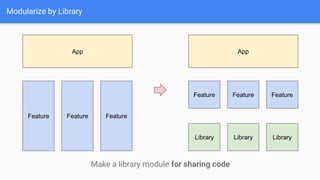
● Modularization by Library
Modularize by Feature
Feature is a unit of app functionality
App
App
Feature Feature Feature
Modularize by Library
App
Feature Feature Feature
App
Feature Feature Feature
Library Library Library
Make a library module for sharing code
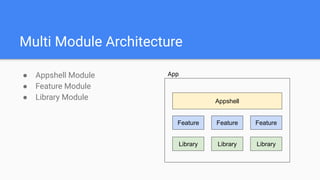
● Appshell Module
● Feature Module
● Library Module
Multi Module Architecture
App
Appshell
Feature Feature Feature
Library Library Library
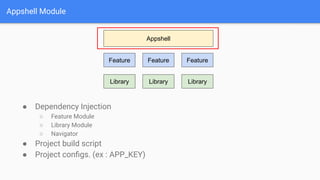
Appshell Module
Appshell
Feature Feature Feature
Library Library Library
● Dependency Injection
○ Feature Module
○ Library Module
○ Navigator
● Project build script
● Project configs. (ex : APP_KEY)
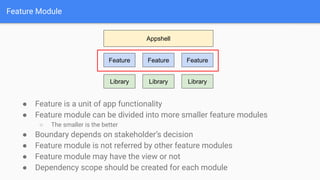
Feature Module
Appshell
Feature Feature Feature
Library Library Library
● Feature is a unit of app functionality
● Feature module can be divided into more smaller feature modules
○ The smaller is the better
● Boundary depends on stakeholder’s decision
● Feature module is not referred by other feature modules
● Feature module may have the view or not
● Dependency scope should be created for each module
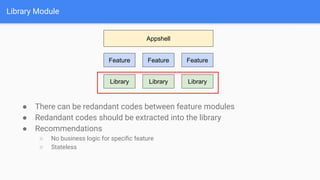
Library Module
Appshell
Feature Feature Feature
Library Library Library
● There can be redandant codes between feature modules
● Redandant codes should be extracted into the library
● Recommendations
○ No business logic for specific feature
○ Stateless
Considerations
● Do we need a core module?
○ Core module is a module that has no state and has removed its business logic completely
● Should android service belong to feature module?
● How can we define auth module?
● Should we design each module to follow a specific architecture?
● Should we make the dynamic feature module?
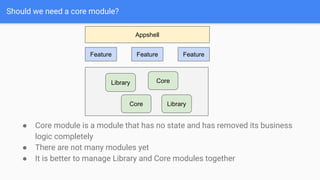
Should we need a core module?
● Core module is a module that has no state and has removed its business
logic completely
● There are not many modules yet
● It is better to manage Library and Core modules together
Library
Core Library
Core
Feature Feature Feature
Appshell
Should android service belong to feature module?
● Android service
○ Could be a feature module
○ Could be a library module, otherwise
○ Depends on the stakeholder’s decision
How can we define auth module?
Appshell
Feed Locker Tutorial
Auth Ad Content
● Define auth module as a library module that has purely authentic logic
without any feature-specific logic
● Define feed module as a feature module that handles to login using auth
module
Should we design each module to follow a specific architecture?
● Each module can be built with independant architecture
● Some modules have data and domain layer
● Some modules have only one class
● Therefore, no rule can be defined for the architecture we must follow
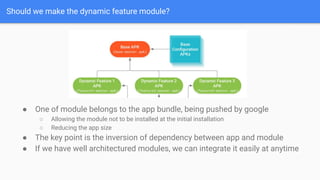
Should we make the dynamic feature module?
● One of module belongs to the app bundle, being pushed by google
○ Allowing the module not to be installed at the initial installation
○ Reducing the app size
● The key point is the inversion of dependency between app and module
● If we have well architectured modules, we can integrate it easily at anytime
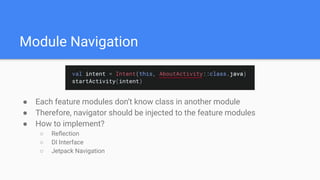
Module Navigation
● Each feature modules don’t know class in another module
● Therefore, navigator should be injected to the feature modules
● How to implement?
○ Reflection
○ DI Interface
○ Jetpack Navigation
Navigation with Reflection (Google)
Google’s example
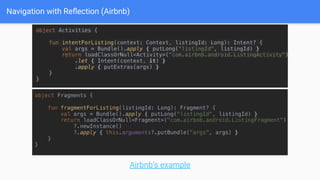
Navigation with Reflection (Airbnb)
Airbnb’s example
Navigation with Interface
Navigation with Jetpack’s Navigation
If you wanna more information, visit this
Which implementation of navigation should we choose
● Navigation is one of the most important module on modularization
● Navigation needs changeable abstraction
● Reflection seems to be the best for now
○ There are use case of major company
○ It can implement without any dependencies
● Jetpack’s navigation seems to be restricted yet
Module Communication
● Callback or Listener Interface
● RxJava
● LiveData
Callback or Listener Interface
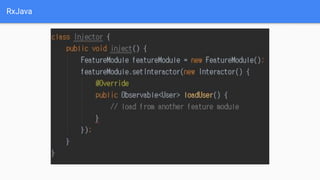
RxJava
LiveData
LiveData
● Callback or Listener : simple and easy
● RxJava : reactive stream and functional operator
● LiveData : reactive stream and lifecycle management
We do not have to enforce certain principles
Source Repository
● Multirepo vs Monorepo
Monorepo is better
Source Control Management
● Git
○ DVCS
○ Based on Snapshot
○ Sensitive to the size of repository
● Mercurial
○ DVCS
○ Based on Patch
○ Not sensitive to the size of repository
Depends on the code scale.
→ Git is better for now
Branching Strategy
● Git Flow
○ Well-defined branching procedures
○ There can be many conflicts during the merging process.
● Trunk Based Development
○ Always ready to be released
○ Universal versioning
○ Simple merging strategy
Trunk Based Development is better for monorepo.
Git Flow
Trunk Based Development
Version Management
● Do not assign a version to each module
○ Management of each version causes dependency hell
● Just assign only universal version
Build Tool
● Gradle
○ Google Standard
○ Simple and easy
○ Slow in many modules
● Buck
○ Used by Facebook, Uber, and Twitter
○ Challenging configuration
○ Fast in many modules
● Bazel
○ Used by Google
○ Challenging configuration
○ Fast in many modules
Depends on the code scale.
Gradle is better for now
Continuous Integration
● There are so many tools for CI
● It does not matter which tool we use
● The most important part is to build and test the exact modules we need
3rd Party Library
● Dagger
● RxJava
● LiveData
● ViewModel
Just use it
Q & A

Android Modularization

  • 1.
  • 2.
    What is theApp modularization Modular programming ● Is a software design technique ● Separates a program into modules according to the functionality Module ● Is independent and interchangeable ● Contains everything necessary ● Contains only one aspect of the desired functionality “App Modularization is to modularize the Android App.”
  • 3.
    Why do weneed to modularize app ● Faster build time ● Separation of concerns ● Fine-grained dependency control ● Improved reusability across other apps ● Improved the ownership & the quality of the codebase
  • 4.
    Faster build time App Feature Feature Library Library Buildonly what we need Build by Parallel Feature Feature Library Library
  • 5.
    Separation of Concerns ●A basic principle of software design ● Software modules should have distinct responsibilities as much as possible Appshell Feed Locker Tutorial Auth Ad Content
  • 6.
    Fine-grained dependency control ●Reusability ● Scalability ● Testability Appshell Feed Locker Tutorial Auth Ad Content
  • 7.
    Improved reusability acrossother apps H/S Feed Locker Tutorial Auth Ad Content S/J
  • 8.
    Improved the ownership& the quality of the codebase H/S Feed Locker Tutorial Auth Ad Content S/J JD MJ Josh
  • 9.
    How to modularize ●Modularization by Feature ● Modularization by Library
  • 10.
    Modularize by Feature Featureis a unit of app functionality App App Feature Feature Feature
  • 11.
    Modularize by Library App FeatureFeature Feature App Feature Feature Feature Library Library Library Make a library module for sharing code
  • 12.
    ● Appshell Module ●Feature Module ● Library Module Multi Module Architecture App Appshell Feature Feature Feature Library Library Library
  • 13.
    Appshell Module Appshell Feature FeatureFeature Library Library Library ● Dependency Injection ○ Feature Module ○ Library Module ○ Navigator ● Project build script ● Project configs. (ex : APP_KEY)
  • 14.
    Feature Module Appshell Feature FeatureFeature Library Library Library ● Feature is a unit of app functionality ● Feature module can be divided into more smaller feature modules ○ The smaller is the better ● Boundary depends on stakeholder’s decision ● Feature module is not referred by other feature modules ● Feature module may have the view or not ● Dependency scope should be created for each module
  • 15.
    Library Module Appshell Feature FeatureFeature Library Library Library ● There can be redandant codes between feature modules ● Redandant codes should be extracted into the library ● Recommendations ○ No business logic for specific feature ○ Stateless
  • 16.
    Considerations ● Do weneed a core module? ○ Core module is a module that has no state and has removed its business logic completely ● Should android service belong to feature module? ● How can we define auth module? ● Should we design each module to follow a specific architecture? ● Should we make the dynamic feature module?
  • 17.
    Should we needa core module? ● Core module is a module that has no state and has removed its business logic completely ● There are not many modules yet ● It is better to manage Library and Core modules together Library Core Library Core Feature Feature Feature Appshell
  • 18.
    Should android servicebelong to feature module? ● Android service ○ Could be a feature module ○ Could be a library module, otherwise ○ Depends on the stakeholder’s decision
  • 19.
    How can wedefine auth module? Appshell Feed Locker Tutorial Auth Ad Content ● Define auth module as a library module that has purely authentic logic without any feature-specific logic ● Define feed module as a feature module that handles to login using auth module
  • 20.
    Should we designeach module to follow a specific architecture? ● Each module can be built with independant architecture ● Some modules have data and domain layer ● Some modules have only one class ● Therefore, no rule can be defined for the architecture we must follow
  • 21.
    Should we makethe dynamic feature module? ● One of module belongs to the app bundle, being pushed by google ○ Allowing the module not to be installed at the initial installation ○ Reducing the app size ● The key point is the inversion of dependency between app and module ● If we have well architectured modules, we can integrate it easily at anytime
  • 22.
    Module Navigation ● Eachfeature modules don’t know class in another module ● Therefore, navigator should be injected to the feature modules ● How to implement? ○ Reflection ○ DI Interface ○ Jetpack Navigation
  • 23.
    Navigation with Reflection(Google) Google’s example
  • 24.
    Navigation with Reflection(Airbnb) Airbnb’s example
  • 25.
  • 26.
  • 27.
  • 28.
    Navigation with Jetpack’sNavigation If you wanna more information, visit this
  • 29.
    Which implementation ofnavigation should we choose ● Navigation is one of the most important module on modularization ● Navigation needs changeable abstraction ● Reflection seems to be the best for now ○ There are use case of major company ○ It can implement without any dependencies ● Jetpack’s navigation seems to be restricted yet
  • 30.
    Module Communication ● Callbackor Listener Interface ● RxJava ● LiveData
  • 31.
  • 32.
  • 33.
  • 34.
    LiveData ● Callback orListener : simple and easy ● RxJava : reactive stream and functional operator ● LiveData : reactive stream and lifecycle management We do not have to enforce certain principles
  • 35.
    Source Repository ● Multirepovs Monorepo Monorepo is better
  • 36.
    Source Control Management ●Git ○ DVCS ○ Based on Snapshot ○ Sensitive to the size of repository ● Mercurial ○ DVCS ○ Based on Patch ○ Not sensitive to the size of repository Depends on the code scale. → Git is better for now
  • 37.
    Branching Strategy ● GitFlow ○ Well-defined branching procedures ○ There can be many conflicts during the merging process. ● Trunk Based Development ○ Always ready to be released ○ Universal versioning ○ Simple merging strategy Trunk Based Development is better for monorepo.
  • 38.
  • 39.
  • 40.
    Version Management ● Donot assign a version to each module ○ Management of each version causes dependency hell ● Just assign only universal version
  • 41.
    Build Tool ● Gradle ○Google Standard ○ Simple and easy ○ Slow in many modules ● Buck ○ Used by Facebook, Uber, and Twitter ○ Challenging configuration ○ Fast in many modules ● Bazel ○ Used by Google ○ Challenging configuration ○ Fast in many modules Depends on the code scale. Gradle is better for now
  • 42.
    Continuous Integration ● Thereare so many tools for CI ● It does not matter which tool we use ● The most important part is to build and test the exact modules we need
  • 43.
    3rd Party Library ●Dagger ● RxJava ● LiveData ● ViewModel Just use it
  • 44.