Programming with Android:
System Architecture
Luca Bedogni Marco Di Felice
Dipartimento di Scienze dell’Informazione
Università di Bologna
Luca Bedogni, Marco Di Felice - Programming with Android – System Architecture 2
Outline
Android Components: Content Providers
Android Components: Services
Android Components: Intents
Android Components: Activities
Android Dalvik Java Virtual Machine
Android Architecture: An Overview
Android Application Distribution and Markets
Luca Bedogni, Marco Di Felice - Programming with Android – System Architecture 3
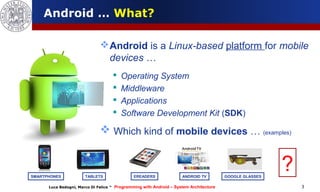
Android … What?
Android is a Linux-based platform for mobile
devices …
 Operating System
 Middleware
 Applications
 Software Development Kit (SDK)
 Which kind of mobile devices … (examples)
SMARTPHONES TABLETS EREADERS ANDROID TV GOOGLE GLASSES
?
Luca Bedogni, Marco Di Felice - Programming with Android – System Architecture 4
Android … When?
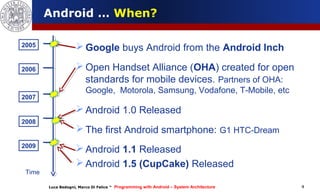
 Google buys Android from the Android Inch
 Open Handset Alliance (OHA) created for open
standards for mobile devices. Partners of OHA:
Google, Motorola, Samsung, Vodafone, T-Mobile, etc
 Android 1.0 Released
 The first Android smartphone: G1 HTC-Dream
 Android 1.1 Released
 Android 1.5 (CupCake) Released
2005
2006
2007
2008
2009
Time
Luca Bedogni, Marco Di Felice - Programming with Android – System Architecture 5
Android … When?
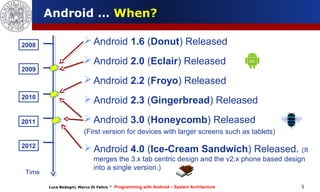
 Android 1.6 (Donut) Released
 Android 2.0 (Eclair) Released
 Android 2.2 (Froyo) Released
 Android 2.3 (Gingerbread) Released
 Android 3.0 (Honeycomb) Released
(First version for devices with larger screens such as tablets)
 Android 4.0 (Ice-Cream Sandwich) Released. (It
merges the 3.x tab centric design and the v2.x phone based design
into a single version.)
2008
2009
2010
2011
2012
Time
Luca Bedogni, Marco Di Felice - Programming with Android – System Architecture 6
Android … When?
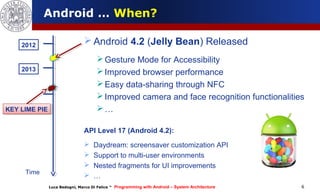
 Android 4.2 (Jelly Bean) Released
Gesture Mode for Accessibility
Improved browser performance
Easy data-sharing through NFC
Improved camera and face recognition functionalities
…
API Level 17 (Android 4.2):
 Daydream: screensaver customization API
 Support to multi-user environments
 Nested fragments for UI improvements
 …
2012
2013
Time
KEY LIME PIEKEY LIME PIE
Luca Bedogni, Marco Di Felice - Programming with Android – System Architecture 7
Android … When?
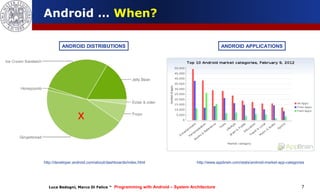
http://developer.android.com/about/dashboards/index.html http://www.appbrain.com/stats/android-market-app-categories
ANDROID DISTRIBUTIONS ANDROID APPLICATIONS
x
Luca Bedogni, Marco Di Felice - Programming with Android – System Architecture 8
Android … When?
ANDROID VERSION
HISTORY AND POPULARITY
(2009-2013)
http://en.wikipedia.org/wiki/Android_version_history
2.3.x2.3.x
2.2.x2.2.x
1.6-2.01.6-2.0
4.x4.x
Luca Bedogni, Marco Di Felice - Programming with Android – System Architecture 9
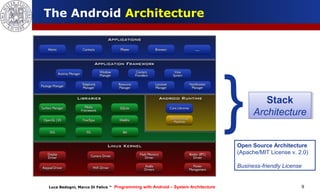
The Android Architecture
} Stack
Architecture
Stack
Architecture
Open Source Architecture
(Apache/MIT License v. 2.0)
Business-friendly License
Luca Bedogni, Marco Di Felice - Programming with Android – System Architecture 10
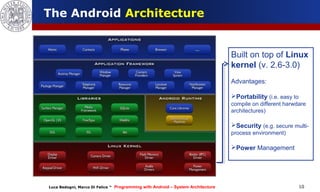
The Android Architecture
Built on top of Linux
kernel (v. 2.6-3.0)
Advantages:
Portability (i.e. easy to
compile on different harwdare
architectures)
Security (e.g. secure multi-
process environment)
Power Management
Luca Bedogni, Marco Di Felice - Programming with Android – System Architecture 11
The Android Architecture
Native Libraries
(C/C++ code)
Graphics (Surface Manager)
Multimedia (Media Framework)
Database DBMS (SQLite)
Font Management
(FreeType)
 WebKit
C libraries (Bionic)
….
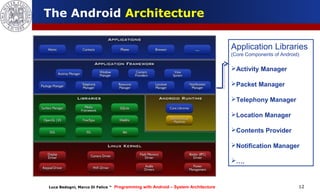
Luca Bedogni, Marco Di Felice - Programming with Android – System Architecture 12
The Android Architecture
Application Libraries
(Core Components of Android)
Activity Manager
Packet Manager
Telephony Manager
Location Manager
Contents Provider
Notification Manager
….
Luca Bedogni, Marco Di Felice - Programming with Android – System Architecture 13
The Android Architecture
Applications
(Written in Java code)
Android Play Store
Entertainment
Productivity
Personalization
Education
Geo-communication
….
Luca Bedogni, Marco Di Felice - Programming with Android – System Architecture 14
The Android Architecture
Dalvik Virtual
Machine (VM)
Novel Java Virtual
Machine implementation
(not using the Oracle JVM)
Open License (Oracle
JVM is not open!)
Optimized for memory-
constrained devices
Faster than Oracle JVM
….
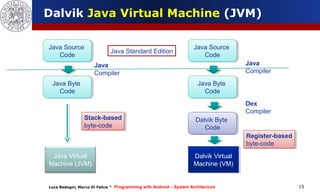
Luca Bedogni, Marco Di Felice - Programming with Android – System Architecture 15
Dalvik Java Virtual Machine (JVM)
Java Source
Code
Java Source
Code
Java Byte
Code
Java Byte
Code
Java Virtual
Machine (JVM)
Java Source
Code
Java Source
Code
Java Byte
Code
Java Byte
Code
Dalvik Byte
Code
Dalvik Byte
Code
Dalvik Virtual
Machine (VM)
Dalvik Virtual
Machine (VM)
Java
Compiler
Java
Compiler
Dex
Compiler
Stack-based
byte-code
Stack-based
byte-code
Register-based
byte-code
Register-based
byte-code
Java Standard Edition
Luca Bedogni, Marco Di Felice - Programming with Android – System Architecture 16
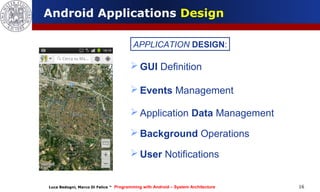
Android Applications Design
 GUI Definition
 Events Management
 Application Data Management
 Background Operations
 User Notifications
APPLICATION DESIGN:
Luca Bedogni, Marco Di Felice - Programming with Android – System Architecture 17
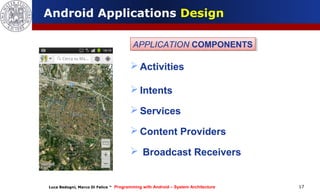
Android Applications Design
 Activities
 Intents
 Services
 Content Providers
 Broadcast Receivers
APPLICATION COMPONENTSAPPLICATION COMPONENTS
Luca Bedogni, Marco Di Felice - Programming with Android – System Architecture 18
Android Components: Activities
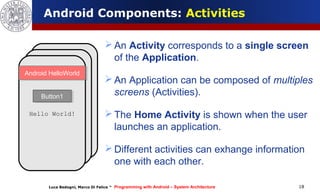
 An Activity corresponds to a single screen
of the Application.
 An Application can be composed of multiples
screens (Activities).
 The Home Activity is shown when the user
launches an application.
 Different activities can exhange information
one with each other.
Hello World!
Android HelloWorldAndroid HelloWorld
Button1Button1
Luca Bedogni, Marco Di Felice - Programming with Android – System Architecture 19
Android Components: Activities
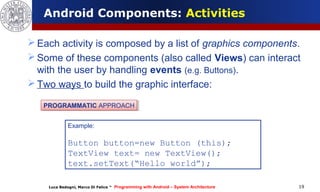
 Each activity is composed by a list of graphics components.
 Some of these components (also called Views) can interact
with the user by handling events (e.g. Buttons).
 Two ways to build the graphic interface:
Example:
Button button=new Button (this);
TextView text= new TextView();
text.setText(“Hello world”);
PROGRAMMATIC APPROACHPROGRAMMATIC APPROACH
Luca Bedogni, Marco Di Felice - Programming with Android – System Architecture 20
Android Components: Activities
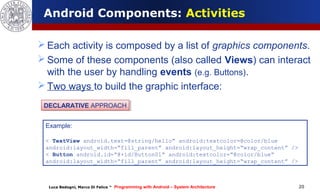
 Each activity is composed by a list of graphics components.
 Some of these components (also called Views) can interact
with the user by handling events (e.g. Buttons).
 Two ways to build the graphic interface:
Example:
< TextView android.text=@string/hello” android:textcolor=@color/blue
android:layout_width=“fill_parent” android:layout_height=“wrap_content” />
< Button android.id=“@+id/Button01” android:textcolor=“@color/blue”
android:layout_width=“fill_parent” android:layout_height=“wrap_content” />
DECLARATIVE APPROACHDECLARATIVE APPROACH
Luca Bedogni, Marco Di Felice - Programming with Android – System Architecture 21
- Build the application layout
through XML files (like HTML)
- Define two different XML layouts
for two different devices
- At runtime, Android detects the
current device configuration and
loads the appropriate resources
for the application
- No need to recompile!
- Just add a new XML file if you
need to support a new device
- Build the application layout
through XML files (like HTML)
- Define two different XML layouts
for two different devices
- At runtime, Android detects the
current device configuration and
loads the appropriate resources
for the application
- No need to recompile!
- Just add a new XML file if you
need to support a new device
EXAMPLE
Device 1
HIGH screen pixel density
Device 2
LOW screen pixel density
XML Layout File
Device 1
XML Layout File
Device 2
Java App Code
Android Components: Activities
Luca Bedogni, Marco Di Felice - Programming with Android – System Architecture 22
Android Components: Activities
 Android applications typically use both the approaches!
DECLARATIVE APPROACHDECLARATIVE APPROACH
PROGRAMMATIC APPROACHPROGRAMMATIC APPROACH
Define the Application layouts and
resources used by the Application
(e.g. labels).
Manages the events, and handles
the interaction with the user.
XML CodeXML Code
Java CodeJava Code
Luca Bedogni, Marco Di Felice - Programming with Android – System Architecture 23
Android Components: Activities
 Views can generate events (caused by human interactions)
that must be managed by the Android-developer.
public void onClick(View arg0) {
if (arg0 == Button) {
// Manage Button events
}
}
ESEMPIOESEMPIO
Button
TextEdit
Luca Bedogni, Marco Di Felice - Programming with Android – System Architecture 24
Android Components: Activities
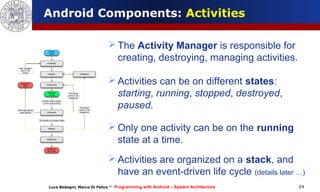
 The Activity Manager is responsible for
creating, destroying, managing activities.
 Activities can be on different states:
starting, running, stopped, destroyed,
paused.
 Only one activity can be on the running
state at a time.
 Activities are organized on a stack, and
have an event-driven life cycle (details later …)
Luca Bedogni, Marco Di Felice - Programming with Android – System Architecture 25
Android Components: Activities
 Main difference between Android-programming and Java
(Oracle) -programming:
Mobile devices have constrained resource capabilities!
 Activity lifetime depends on users’ choice (i.e. change of
visibility) as well as on system contraints (i.e. memory
shortage).
 Developer must implement lifecycle methods to account
for state changes of each Activity …
Luca Bedogni, Marco Di Felice - Programming with Android – System Architecture 26
Android Components: Activities
public class MyApp extends Activity {
public void onCreate() { ... }
public void onPause() { ... }
public void onStop() { ... }
public void onDestroy(){ ... }
….
}
Called when the Activity
is created the first time.
Called when the Activity
is created the first time.
Called when the Activity
is partially visible.
Called when the Activity
is partially visible.
Called when the Activity
is no longer visible.
Called when the Activity
is no longer visible.
Called when the Activity
is dismissed.
Called when the Activity
is dismissed.
Luca Bedogni, Marco Di Felice - Programming with Android – System Architecture 27
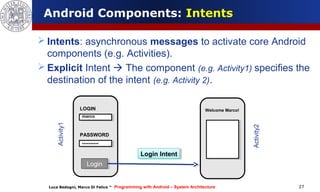
Android Components: Intents
 Intents: asynchronous messages to activate core Android
components (e.g. Activities).
 Explicit Intent  The component (e.g. Activity1) specifies the
destination of the intent (e.g. Activity 2).
LOGIN
PASSWORD
LoginLogin
marco
**********
Welcome Marco!
Login IntentLogin Intent
Activity1
Activity2
Luca Bedogni, Marco Di Felice - Programming with Android – System Architecture 28
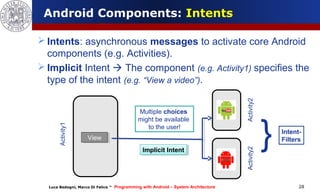
Android Components: Intents
 Intents: asynchronous messages to activate core Android
components (e.g. Activities).
 Implicit Intent  The component (e.g. Activity1) specifies the
type of the intent (e.g. “View a video”).
ViewView
Implicit IntentImplicit Intent
Activity1
Activity2Activity2
Multiple choices
might be available
to the user!
} Intent-
Filters
Luca Bedogni, Marco Di Felice - Programming with Android – System Architecture 29
Android Components: Services
 Services: like Activities, but run in background and do not
provide an user interface.
 Used for non-interactive tasks (e.g. networking).
 Service life-time composed of 3 states:
Starting Destroyed
RunningRunning
(on background)
onCreate()
onStart()
onDestroy()
Luca Bedogni, Marco Di Felice - Programming with Android – System Architecture 30
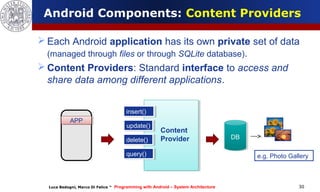
Android Components: Content Providers
 Each Android application has its own private set of data
(managed through files or through SQLite database).
 Content Providers: Standard interface to access and
share data among different applications.
DBDB
APPAPP
insert()insert()
update()update()
delete()delete()
query()query()
Content
Provider
e.g. Photo Gallery
Luca Bedogni, Marco Di Felice - Programming with Android – System Architecture 31
Android Components: Broadcast Receivers
 Publish/Subscribe
paradigm
 Broadcast Receivers:
An application can be
signaled of external
events.
 Notification types: Call
incoming, SMS
delivery, Wifi network
detected, etc
Luca Bedogni, Marco Di Felice - Programming with Android – System Architecture 32
Android Components: Broadcast Receivers
class WifiReceiver extends BroadcastReceiver {
public void onReceive(Context c, Intent intent) {
String s = new StringBuilder();
wifiList = mainWifi.getScanResults();
for(int i = 0; i < wifiList.size(); i++){
s.append(new Integer(i+1).toString() + ".");
s.append((wifiList.get(i)).toString());
s.append("n");
}
mainText.setText(sb);
}
}
BROADCAST RECEIVER exampleBROADCAST RECEIVER example
Luca Bedogni, Marco Di Felice - Programming with Android – System Architecture 33
Android Components: Broadcast Receivers
public class WifiTester extends Activity {
WifiManager mainWifi;
WifiReceiver receiverWifi;
List<ScanResult> wifiList;
public void onCreate(Bundle savedInstanceState) {
…
mainWifi = (WifiManager)
getSystemService(Context.WIFI_SERVICE);
receiverWifi = new WifiReceiver();
registerReceiver(receiverWifi, new
IntentFilter(WifiManager.SCAN_RESULTS_AVAILABLE_ACTION));
mainWifi.startScan();
}
BROADCAST RECEIVER exampleBROADCAST RECEIVER example
Luca Bedogni, Marco Di Felice - Programming with Android – System Architecture 34
Android Components: System API
Using the components described so far, Android
applications can then leverage the system API …
 Telephony Manager data access (call, SMS, etc)
 Sensor management (GPS, accelerometer, etc)
 Network connectivity (Wifi, bluetooth, NFC, etc)
 Web surfing (HTTP client, WebView, etc)
 Storage management (files, SQLite db, etc)
 ….
SOME EXAMPLEs …
Luca Bedogni, Marco Di Felice - Programming with Android – System Architecture 35
Android Components: Google API
… or easily interface with other Google services:
Luca Bedogni, Marco Di Felice - Programming with Android – System Architecture 36
Each Android application is
contained on a single APK file.
 Java Byte-code (compiled for
Dalvik JVM)
 Resources (e.g. images. videos,
XML layout files)
Libraries (optimal native C/C++
code)
APK
FILE
APK
FILE
XML
Files
XML
Files
CC
Android Application Distribution
Luca Bedogni, Marco Di Felice - Programming with Android – System Architecture 37
Android Application Distribution
 Each application must be signed
through a key before being
distributed.
 Applications can be distributed
via Web or via Stores.
 Android Play Store: application
store run by Google … but several
other application stores are
available (they are just normal
applications).
Luca Bedogni, Marco Di Felice - Programming with Android – System Architecture 38
Android Application Security
 Android applications run with a distinct system identity
(Linux user ID and group ID), in an isolated way.
 Applications must explicitly share resources and data.
They do this by declaring the permissions they need for
additional capabilities.
Applications statically declare the permissions they require.
User must give his/her consensus during the installation.
<uses-permission android:name=“android.permission.IACCESS_FINE_LOCATION" />
<uses-permission android:name=“android.permission.INTERNET" />
ANDROIDMANIFEST.XML

Android architecture and Additional Components

  • 1.
    Programming with Android: SystemArchitecture Luca Bedogni Marco Di Felice Dipartimento di Scienze dell’Informazione Università di Bologna
  • 2.
    Luca Bedogni, MarcoDi Felice - Programming with Android – System Architecture 2 Outline Android Components: Content Providers Android Components: Services Android Components: Intents Android Components: Activities Android Dalvik Java Virtual Machine Android Architecture: An Overview Android Application Distribution and Markets
  • 3.
    Luca Bedogni, MarcoDi Felice - Programming with Android – System Architecture 3 Android … What? Android is a Linux-based platform for mobile devices …  Operating System  Middleware  Applications  Software Development Kit (SDK)  Which kind of mobile devices … (examples) SMARTPHONES TABLETS EREADERS ANDROID TV GOOGLE GLASSES ?
  • 4.
    Luca Bedogni, MarcoDi Felice - Programming with Android – System Architecture 4 Android … When?  Google buys Android from the Android Inch  Open Handset Alliance (OHA) created for open standards for mobile devices. Partners of OHA: Google, Motorola, Samsung, Vodafone, T-Mobile, etc  Android 1.0 Released  The first Android smartphone: G1 HTC-Dream  Android 1.1 Released  Android 1.5 (CupCake) Released 2005 2006 2007 2008 2009 Time
  • 5.
    Luca Bedogni, MarcoDi Felice - Programming with Android – System Architecture 5 Android … When?  Android 1.6 (Donut) Released  Android 2.0 (Eclair) Released  Android 2.2 (Froyo) Released  Android 2.3 (Gingerbread) Released  Android 3.0 (Honeycomb) Released (First version for devices with larger screens such as tablets)  Android 4.0 (Ice-Cream Sandwich) Released. (It merges the 3.x tab centric design and the v2.x phone based design into a single version.) 2008 2009 2010 2011 2012 Time
  • 6.
    Luca Bedogni, MarcoDi Felice - Programming with Android – System Architecture 6 Android … When?  Android 4.2 (Jelly Bean) Released Gesture Mode for Accessibility Improved browser performance Easy data-sharing through NFC Improved camera and face recognition functionalities … API Level 17 (Android 4.2):  Daydream: screensaver customization API  Support to multi-user environments  Nested fragments for UI improvements  … 2012 2013 Time KEY LIME PIEKEY LIME PIE
  • 7.
    Luca Bedogni, MarcoDi Felice - Programming with Android – System Architecture 7 Android … When? http://developer.android.com/about/dashboards/index.html http://www.appbrain.com/stats/android-market-app-categories ANDROID DISTRIBUTIONS ANDROID APPLICATIONS x
  • 8.
    Luca Bedogni, MarcoDi Felice - Programming with Android – System Architecture 8 Android … When? ANDROID VERSION HISTORY AND POPULARITY (2009-2013) http://en.wikipedia.org/wiki/Android_version_history 2.3.x2.3.x 2.2.x2.2.x 1.6-2.01.6-2.0 4.x4.x
  • 9.
    Luca Bedogni, MarcoDi Felice - Programming with Android – System Architecture 9 The Android Architecture } Stack Architecture Stack Architecture Open Source Architecture (Apache/MIT License v. 2.0) Business-friendly License
  • 10.
    Luca Bedogni, MarcoDi Felice - Programming with Android – System Architecture 10 The Android Architecture Built on top of Linux kernel (v. 2.6-3.0) Advantages: Portability (i.e. easy to compile on different harwdare architectures) Security (e.g. secure multi- process environment) Power Management
  • 11.
    Luca Bedogni, MarcoDi Felice - Programming with Android – System Architecture 11 The Android Architecture Native Libraries (C/C++ code) Graphics (Surface Manager) Multimedia (Media Framework) Database DBMS (SQLite) Font Management (FreeType)  WebKit C libraries (Bionic) ….
  • 12.
    Luca Bedogni, MarcoDi Felice - Programming with Android – System Architecture 12 The Android Architecture Application Libraries (Core Components of Android) Activity Manager Packet Manager Telephony Manager Location Manager Contents Provider Notification Manager ….
  • 13.
    Luca Bedogni, MarcoDi Felice - Programming with Android – System Architecture 13 The Android Architecture Applications (Written in Java code) Android Play Store Entertainment Productivity Personalization Education Geo-communication ….
  • 14.
    Luca Bedogni, MarcoDi Felice - Programming with Android – System Architecture 14 The Android Architecture Dalvik Virtual Machine (VM) Novel Java Virtual Machine implementation (not using the Oracle JVM) Open License (Oracle JVM is not open!) Optimized for memory- constrained devices Faster than Oracle JVM ….
  • 15.
    Luca Bedogni, MarcoDi Felice - Programming with Android – System Architecture 15 Dalvik Java Virtual Machine (JVM) Java Source Code Java Source Code Java Byte Code Java Byte Code Java Virtual Machine (JVM) Java Source Code Java Source Code Java Byte Code Java Byte Code Dalvik Byte Code Dalvik Byte Code Dalvik Virtual Machine (VM) Dalvik Virtual Machine (VM) Java Compiler Java Compiler Dex Compiler Stack-based byte-code Stack-based byte-code Register-based byte-code Register-based byte-code Java Standard Edition
  • 16.
    Luca Bedogni, MarcoDi Felice - Programming with Android – System Architecture 16 Android Applications Design  GUI Definition  Events Management  Application Data Management  Background Operations  User Notifications APPLICATION DESIGN:
  • 17.
    Luca Bedogni, MarcoDi Felice - Programming with Android – System Architecture 17 Android Applications Design  Activities  Intents  Services  Content Providers  Broadcast Receivers APPLICATION COMPONENTSAPPLICATION COMPONENTS
  • 18.
    Luca Bedogni, MarcoDi Felice - Programming with Android – System Architecture 18 Android Components: Activities  An Activity corresponds to a single screen of the Application.  An Application can be composed of multiples screens (Activities).  The Home Activity is shown when the user launches an application.  Different activities can exhange information one with each other. Hello World! Android HelloWorldAndroid HelloWorld Button1Button1
  • 19.
    Luca Bedogni, MarcoDi Felice - Programming with Android – System Architecture 19 Android Components: Activities  Each activity is composed by a list of graphics components.  Some of these components (also called Views) can interact with the user by handling events (e.g. Buttons).  Two ways to build the graphic interface: Example: Button button=new Button (this); TextView text= new TextView(); text.setText(“Hello world”); PROGRAMMATIC APPROACHPROGRAMMATIC APPROACH
  • 20.
    Luca Bedogni, MarcoDi Felice - Programming with Android – System Architecture 20 Android Components: Activities  Each activity is composed by a list of graphics components.  Some of these components (also called Views) can interact with the user by handling events (e.g. Buttons).  Two ways to build the graphic interface: Example: < TextView android.text=@string/hello” android:textcolor=@color/blue android:layout_width=“fill_parent” android:layout_height=“wrap_content” /> < Button android.id=“@+id/Button01” android:textcolor=“@color/blue” android:layout_width=“fill_parent” android:layout_height=“wrap_content” /> DECLARATIVE APPROACHDECLARATIVE APPROACH
  • 21.
    Luca Bedogni, MarcoDi Felice - Programming with Android – System Architecture 21 - Build the application layout through XML files (like HTML) - Define two different XML layouts for two different devices - At runtime, Android detects the current device configuration and loads the appropriate resources for the application - No need to recompile! - Just add a new XML file if you need to support a new device - Build the application layout through XML files (like HTML) - Define two different XML layouts for two different devices - At runtime, Android detects the current device configuration and loads the appropriate resources for the application - No need to recompile! - Just add a new XML file if you need to support a new device EXAMPLE Device 1 HIGH screen pixel density Device 2 LOW screen pixel density XML Layout File Device 1 XML Layout File Device 2 Java App Code Android Components: Activities
  • 22.
    Luca Bedogni, MarcoDi Felice - Programming with Android – System Architecture 22 Android Components: Activities  Android applications typically use both the approaches! DECLARATIVE APPROACHDECLARATIVE APPROACH PROGRAMMATIC APPROACHPROGRAMMATIC APPROACH Define the Application layouts and resources used by the Application (e.g. labels). Manages the events, and handles the interaction with the user. XML CodeXML Code Java CodeJava Code
  • 23.
    Luca Bedogni, MarcoDi Felice - Programming with Android – System Architecture 23 Android Components: Activities  Views can generate events (caused by human interactions) that must be managed by the Android-developer. public void onClick(View arg0) { if (arg0 == Button) { // Manage Button events } } ESEMPIOESEMPIO Button TextEdit
  • 24.
    Luca Bedogni, MarcoDi Felice - Programming with Android – System Architecture 24 Android Components: Activities  The Activity Manager is responsible for creating, destroying, managing activities.  Activities can be on different states: starting, running, stopped, destroyed, paused.  Only one activity can be on the running state at a time.  Activities are organized on a stack, and have an event-driven life cycle (details later …)
  • 25.
    Luca Bedogni, MarcoDi Felice - Programming with Android – System Architecture 25 Android Components: Activities  Main difference between Android-programming and Java (Oracle) -programming: Mobile devices have constrained resource capabilities!  Activity lifetime depends on users’ choice (i.e. change of visibility) as well as on system contraints (i.e. memory shortage).  Developer must implement lifecycle methods to account for state changes of each Activity …
  • 26.
    Luca Bedogni, MarcoDi Felice - Programming with Android – System Architecture 26 Android Components: Activities public class MyApp extends Activity { public void onCreate() { ... } public void onPause() { ... } public void onStop() { ... } public void onDestroy(){ ... } …. } Called when the Activity is created the first time. Called when the Activity is created the first time. Called when the Activity is partially visible. Called when the Activity is partially visible. Called when the Activity is no longer visible. Called when the Activity is no longer visible. Called when the Activity is dismissed. Called when the Activity is dismissed.
  • 27.
    Luca Bedogni, MarcoDi Felice - Programming with Android – System Architecture 27 Android Components: Intents  Intents: asynchronous messages to activate core Android components (e.g. Activities).  Explicit Intent  The component (e.g. Activity1) specifies the destination of the intent (e.g. Activity 2). LOGIN PASSWORD LoginLogin marco ********** Welcome Marco! Login IntentLogin Intent Activity1 Activity2
  • 28.
    Luca Bedogni, MarcoDi Felice - Programming with Android – System Architecture 28 Android Components: Intents  Intents: asynchronous messages to activate core Android components (e.g. Activities).  Implicit Intent  The component (e.g. Activity1) specifies the type of the intent (e.g. “View a video”). ViewView Implicit IntentImplicit Intent Activity1 Activity2Activity2 Multiple choices might be available to the user! } Intent- Filters
  • 29.
    Luca Bedogni, MarcoDi Felice - Programming with Android – System Architecture 29 Android Components: Services  Services: like Activities, but run in background and do not provide an user interface.  Used for non-interactive tasks (e.g. networking).  Service life-time composed of 3 states: Starting Destroyed RunningRunning (on background) onCreate() onStart() onDestroy()
  • 30.
    Luca Bedogni, MarcoDi Felice - Programming with Android – System Architecture 30 Android Components: Content Providers  Each Android application has its own private set of data (managed through files or through SQLite database).  Content Providers: Standard interface to access and share data among different applications. DBDB APPAPP insert()insert() update()update() delete()delete() query()query() Content Provider e.g. Photo Gallery
  • 31.
    Luca Bedogni, MarcoDi Felice - Programming with Android – System Architecture 31 Android Components: Broadcast Receivers  Publish/Subscribe paradigm  Broadcast Receivers: An application can be signaled of external events.  Notification types: Call incoming, SMS delivery, Wifi network detected, etc
  • 32.
    Luca Bedogni, MarcoDi Felice - Programming with Android – System Architecture 32 Android Components: Broadcast Receivers class WifiReceiver extends BroadcastReceiver { public void onReceive(Context c, Intent intent) { String s = new StringBuilder(); wifiList = mainWifi.getScanResults(); for(int i = 0; i < wifiList.size(); i++){ s.append(new Integer(i+1).toString() + "."); s.append((wifiList.get(i)).toString()); s.append("n"); } mainText.setText(sb); } } BROADCAST RECEIVER exampleBROADCAST RECEIVER example
  • 33.
    Luca Bedogni, MarcoDi Felice - Programming with Android – System Architecture 33 Android Components: Broadcast Receivers public class WifiTester extends Activity { WifiManager mainWifi; WifiReceiver receiverWifi; List<ScanResult> wifiList; public void onCreate(Bundle savedInstanceState) { … mainWifi = (WifiManager) getSystemService(Context.WIFI_SERVICE); receiverWifi = new WifiReceiver(); registerReceiver(receiverWifi, new IntentFilter(WifiManager.SCAN_RESULTS_AVAILABLE_ACTION)); mainWifi.startScan(); } BROADCAST RECEIVER exampleBROADCAST RECEIVER example
  • 34.
    Luca Bedogni, MarcoDi Felice - Programming with Android – System Architecture 34 Android Components: System API Using the components described so far, Android applications can then leverage the system API …  Telephony Manager data access (call, SMS, etc)  Sensor management (GPS, accelerometer, etc)  Network connectivity (Wifi, bluetooth, NFC, etc)  Web surfing (HTTP client, WebView, etc)  Storage management (files, SQLite db, etc)  …. SOME EXAMPLEs …
  • 35.
    Luca Bedogni, MarcoDi Felice - Programming with Android – System Architecture 35 Android Components: Google API … or easily interface with other Google services:
  • 36.
    Luca Bedogni, MarcoDi Felice - Programming with Android – System Architecture 36 Each Android application is contained on a single APK file.  Java Byte-code (compiled for Dalvik JVM)  Resources (e.g. images. videos, XML layout files) Libraries (optimal native C/C++ code) APK FILE APK FILE XML Files XML Files CC Android Application Distribution
  • 37.
    Luca Bedogni, MarcoDi Felice - Programming with Android – System Architecture 37 Android Application Distribution  Each application must be signed through a key before being distributed.  Applications can be distributed via Web or via Stores.  Android Play Store: application store run by Google … but several other application stores are available (they are just normal applications).
  • 38.
    Luca Bedogni, MarcoDi Felice - Programming with Android – System Architecture 38 Android Application Security  Android applications run with a distinct system identity (Linux user ID and group ID), in an isolated way.  Applications must explicitly share resources and data. They do this by declaring the permissions they need for additional capabilities. Applications statically declare the permissions they require. User must give his/her consensus during the installation. <uses-permission android:name=“android.permission.IACCESS_FINE_LOCATION" /> <uses-permission android:name=“android.permission.INTERNET" /> ANDROIDMANIFEST.XML