


Senior regional director
Andriy Varusha
Privileged and Confidential
Delivery Management and KPIs:
How to Win a Customer’s Heart
Privileged and Confidential 2
About myself
• Senior Regional Director position @ Grid Dynamics, responsible for Ukraine and Poland
• 10 + years on managerial positions in IT
• 5 years in professional services – consulting and IT audit
• 5 years in IT outsourcing industry
• Experience of managing complex projects in Enterprise IT
• Experience of living in Ukraine and Poland
Privileged and Confidential 3
Agenda
• Why do we need KPIs and what it is
• KPI pyramid, different layers of metrics for different stakeholders
• KPIs vs organizational structure, overcoming conflicts
• Conclusions and practical tips
Privileged and Confidential 4
Delivery Manager vs Project Manager
• Continuous engagement vs limited in time effort
• DM usually has shared responsibility with customer’s stakeholder over the scope and schedule
• DM is usually more knowledgeable in delivery practices, tools, skills than a PM
• DM is usually a people manager as well
• Business vs budget
Privileged and Confidential 5
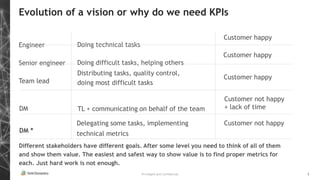
Evolution of a vision or why do we need KPIs
Different stakeholders have different goals. After some level you need to think of all of them
and show them value. The easiest and safest way to show value is to find proper metrics for
each. Just hard work is not enough.
Engineer
Senior engineer
Team lead
Doing technical tasks
Doing difficult tasks, helping others
Distributing tasks, quality control,
doing most difficult tasks
TL + communicating on behalf of the teamDM
DM *
Delegating some tasks, implementing
technical metrics
Customer happy
Customer happy
Customer happy
Customer not happy
+ lack of time
Customer not happy
Privileged and Confidential 6
What is a KPI?
• Measurable indication of a result
• If you’d like to put targets for rather subjective things, still find the most meaningful measurable
metric
• If you can’t find any measurable metric, implement a judgmental scale
• KPIs should be regularly and consistently measured
• KPIs should be regularly reviewed – KPI set as well as target values
Privileged and Confidential 7
What is a KPI?
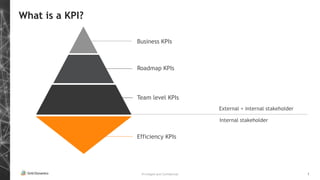
Internal stakeholder
External + internal stakeholder
Business KPIs
Roadmap KPIs
Team level KPIs
Efficiency KPIs
Privileged and Confidential 8
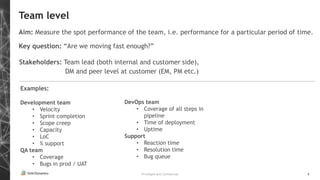
Team level
Aim: Measure the spot performance of the team, i.e. performance for a particular period of time.
Key question: “Are we moving fast enough?”
Examples:
Development team
• Velocity
• Sprint completion
• Scope creep
• Capacity
• LoC
• % support
QA team
• Coverage
• Bugs in prod / UAT
Stakeholders: Team lead (both internal and customer side),
DM and peer level at customer (EM, PM etc.)
DevOps team
• Coverage of all steps in
pipeline
• Time of deployment
• Uptime
Support
• Reaction time
• Resolution time
• Bug queue
Privileged and Confidential 9
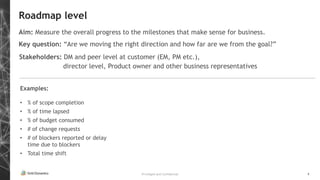
Roadmap level
Aim: Measure the overall progress to the milestones that make sense for business.
Key question: “Are we moving the right direction and how far are we from the goal?”
Examples:
• % of scope completion
• % of time lapsed
• % of budget consumed
• # of change requests
• # of blockers reported or delay
time due to blockers
• Total time shift
Stakeholders: DM and peer level at customer (EM, PM etc.),
director level, Product owner and other business representatives
Privileged and Confidential 10
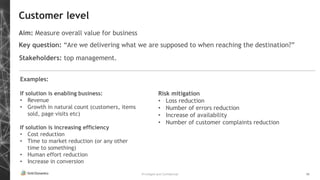
Customer level
Aim: Measure overall value for business
Key question: “Are we delivering what we are supposed to when reaching the destination?”
Examples:
If solution is enabling business:
• Revenue
• Growth in natural count (customers, items
sold, page visits etc)
If solution is increasing efficiency
• Cost reduction
• Time to market reduction (or any other
time to something)
• Human effort reduction
• Increase in conversion
Stakeholders: top management.
Risk mitigation
• Loss reduction
• Number of errors reduction
• Increase of availability
• Number of customer complaints reduction
Privileged and Confidential 11
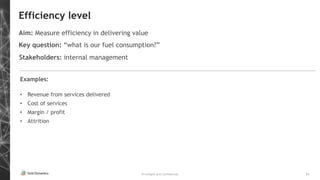
Efficiency level
Aim: Measure efficiency in delivering value
Key question: “what is our fuel consumption?”
Examples:
• Revenue from services delivered
• Cost of services
• Margin / profit
• Attrition
Stakeholders: internal management
Privileged and Confidential 12
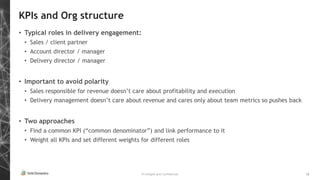
KPIs and Org structure
• Typical roles in delivery engagement:
• Sales / client partner
• Account director / manager
• Delivery director / manager
• Important to avoid polarity
• Sales responsible for revenue doesn’t care about profitability and execution
• Delivery management doesn’t care about revenue and cares only about team metrics so pushes back
• Two approaches
• Find a common KPI (“common denominator”) and link performance to it
• Weight all KPIs and set different weights for different roles
Privileged and Confidential 13
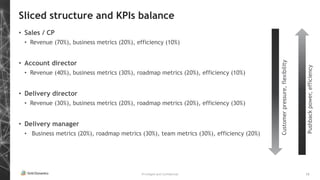
Sliced structure and KPIs balance
• Sales / CP
• Revenue (70%), business metrics (20%), efficiency (10%)
• Account director
• Revenue (40%), business metrics (30%), roadmap metrics (20%), efficiency (10%)
• Delivery director
• Revenue (30%), business metrics (20%), roadmap metrics (20%), efficiency (30%)
• Delivery manager
• Business metrics (20%), roadmap metrics (30%), team metrics (30%), efficiency (20%)
Customerpressure,flexibility
Pushbackpower,efficiency
Privileged and Confidential 14
Conclusions and practical tips
• KPI is just a metric, whenever you have other strong reasons for decisions, ignore mathematics
• Roadmap and team level are quite well derived from each other, business level may be quite
different.
• Standardize team and roadmap level to be able to prepare drill down / aggregated reports
• Business level can be captured only from business manager. Find the real pain point
• If anything is missing – assume it
• Though first aim of reporting metrics is controllability, still it has another positive affect of
traceability
• Better visualize than just present figures
Questions?

Andriy varusha

  • 1.
    Senior regional director AndriyVarusha Privileged and Confidential Delivery Management and KPIs: How to Win a Customer’s Heart
  • 2.
    Privileged and Confidential2 About myself • Senior Regional Director position @ Grid Dynamics, responsible for Ukraine and Poland • 10 + years on managerial positions in IT • 5 years in professional services – consulting and IT audit • 5 years in IT outsourcing industry • Experience of managing complex projects in Enterprise IT • Experience of living in Ukraine and Poland
  • 3.
    Privileged and Confidential3 Agenda • Why do we need KPIs and what it is • KPI pyramid, different layers of metrics for different stakeholders • KPIs vs organizational structure, overcoming conflicts • Conclusions and practical tips
  • 4.
    Privileged and Confidential4 Delivery Manager vs Project Manager • Continuous engagement vs limited in time effort • DM usually has shared responsibility with customer’s stakeholder over the scope and schedule • DM is usually more knowledgeable in delivery practices, tools, skills than a PM • DM is usually a people manager as well • Business vs budget
  • 5.
    Privileged and Confidential5 Evolution of a vision or why do we need KPIs Different stakeholders have different goals. After some level you need to think of all of them and show them value. The easiest and safest way to show value is to find proper metrics for each. Just hard work is not enough. Engineer Senior engineer Team lead Doing technical tasks Doing difficult tasks, helping others Distributing tasks, quality control, doing most difficult tasks TL + communicating on behalf of the teamDM DM * Delegating some tasks, implementing technical metrics Customer happy Customer happy Customer happy Customer not happy + lack of time Customer not happy
  • 6.
    Privileged and Confidential6 What is a KPI? • Measurable indication of a result • If you’d like to put targets for rather subjective things, still find the most meaningful measurable metric • If you can’t find any measurable metric, implement a judgmental scale • KPIs should be regularly and consistently measured • KPIs should be regularly reviewed – KPI set as well as target values
  • 7.
    Privileged and Confidential7 What is a KPI? Internal stakeholder External + internal stakeholder Business KPIs Roadmap KPIs Team level KPIs Efficiency KPIs
  • 8.
    Privileged and Confidential8 Team level Aim: Measure the spot performance of the team, i.e. performance for a particular period of time. Key question: “Are we moving fast enough?” Examples: Development team • Velocity • Sprint completion • Scope creep • Capacity • LoC • % support QA team • Coverage • Bugs in prod / UAT Stakeholders: Team lead (both internal and customer side), DM and peer level at customer (EM, PM etc.) DevOps team • Coverage of all steps in pipeline • Time of deployment • Uptime Support • Reaction time • Resolution time • Bug queue
  • 9.
    Privileged and Confidential9 Roadmap level Aim: Measure the overall progress to the milestones that make sense for business. Key question: “Are we moving the right direction and how far are we from the goal?” Examples: • % of scope completion • % of time lapsed • % of budget consumed • # of change requests • # of blockers reported or delay time due to blockers • Total time shift Stakeholders: DM and peer level at customer (EM, PM etc.), director level, Product owner and other business representatives
  • 10.
    Privileged and Confidential10 Customer level Aim: Measure overall value for business Key question: “Are we delivering what we are supposed to when reaching the destination?” Examples: If solution is enabling business: • Revenue • Growth in natural count (customers, items sold, page visits etc) If solution is increasing efficiency • Cost reduction • Time to market reduction (or any other time to something) • Human effort reduction • Increase in conversion Stakeholders: top management. Risk mitigation • Loss reduction • Number of errors reduction • Increase of availability • Number of customer complaints reduction
  • 11.
    Privileged and Confidential11 Efficiency level Aim: Measure efficiency in delivering value Key question: “what is our fuel consumption?” Examples: • Revenue from services delivered • Cost of services • Margin / profit • Attrition Stakeholders: internal management
  • 12.
    Privileged and Confidential12 KPIs and Org structure • Typical roles in delivery engagement: • Sales / client partner • Account director / manager • Delivery director / manager • Important to avoid polarity • Sales responsible for revenue doesn’t care about profitability and execution • Delivery management doesn’t care about revenue and cares only about team metrics so pushes back • Two approaches • Find a common KPI (“common denominator”) and link performance to it • Weight all KPIs and set different weights for different roles
  • 13.
    Privileged and Confidential13 Sliced structure and KPIs balance • Sales / CP • Revenue (70%), business metrics (20%), efficiency (10%) • Account director • Revenue (40%), business metrics (30%), roadmap metrics (20%), efficiency (10%) • Delivery director • Revenue (30%), business metrics (20%), roadmap metrics (20%), efficiency (30%) • Delivery manager • Business metrics (20%), roadmap metrics (30%), team metrics (30%), efficiency (20%) Customerpressure,flexibility Pushbackpower,efficiency
  • 14.
    Privileged and Confidential14 Conclusions and practical tips • KPI is just a metric, whenever you have other strong reasons for decisions, ignore mathematics • Roadmap and team level are quite well derived from each other, business level may be quite different. • Standardize team and roadmap level to be able to prepare drill down / aggregated reports • Business level can be captured only from business manager. Find the real pain point • If anything is missing – assume it • Though first aim of reporting metrics is controllability, still it has another positive affect of traceability • Better visualize than just present figures
  • 15.

Editor's Notes

  • #3 Only few players will survive long term Strategies: Amazon - cloud ecosystem and retail focus, Google - strong ML capabilities, IBM with deep insight and vertical focus on health and law, Microsoft focuses on employee and enterprise
  • #4 Only few players will survive long term Strategies: Amazon - cloud ecosystem and retail focus, Google - strong ML capabilities, IBM with deep insight and vertical focus on health and law, Microsoft focuses on employee and enterprise
  • #5 Only few players will survive long term Strategies: Amazon - cloud ecosystem and retail focus, Google - strong ML capabilities, IBM with deep insight and vertical focus on health and law, Microsoft focuses on employee and enterprise
  • #7 Only few players will survive long term Strategies: Amazon - cloud ecosystem and retail focus, Google - strong ML capabilities, IBM with deep insight and vertical focus on health and law, Microsoft focuses on employee and enterprise
  • #8 Only few players will survive long term Strategies: Amazon - cloud ecosystem and retail focus, Google - strong ML capabilities, IBM with deep insight and vertical focus on health and law, Microsoft focuses on employee and enterprise
  • #9 Only few players will survive long term Strategies: Amazon - cloud ecosystem and retail focus, Google - strong ML capabilities, IBM with deep insight and vertical focus on health and law, Microsoft focuses on employee and enterprise
  • #10 Only few players will survive long term Strategies: Amazon - cloud ecosystem and retail focus, Google - strong ML capabilities, IBM with deep insight and vertical focus on health and law, Microsoft focuses on employee and enterprise
  • #11 Only few players will survive long term Strategies: Amazon - cloud ecosystem and retail focus, Google - strong ML capabilities, IBM with deep insight and vertical focus on health and law, Microsoft focuses on employee and enterprise
  • #12 Only few players will survive long term Strategies: Amazon - cloud ecosystem and retail focus, Google - strong ML capabilities, IBM with deep insight and vertical focus on health and law, Microsoft focuses on employee and enterprise
  • #13 Only few players will survive long term Strategies: Amazon - cloud ecosystem and retail focus, Google - strong ML capabilities, IBM with deep insight and vertical focus on health and law, Microsoft focuses on employee and enterprise
  • #14 Only few players will survive long term Strategies: Amazon - cloud ecosystem and retail focus, Google - strong ML capabilities, IBM with deep insight and vertical focus on health and law, Microsoft focuses on employee and enterprise
  • #15 Only few players will survive long term Strategies: Amazon - cloud ecosystem and retail focus, Google - strong ML capabilities, IBM with deep insight and vertical focus on health and law, Microsoft focuses on employee and enterprise