www.duanemorris.com
©2012 Duane Morris LLP. All Rights Reserv ed. Duane Morris is a registered serv ice mark of Duane Morris LLP.
Duane Morris – Firm and Affiliate Offices | New York | London | Singapore | Los Angeles | Chicago | Houston | Hanoi | Philadelphia | San Diego | San Francisco | Baltimore | Boston | Washington, D.C.
Las Vegas | Atlanta | Miami | Pittsburgh | Newark | Boca Raton | Wilmington | Cherry Hill | Lake Tahoe | Ho Chi Minh City | Duane Morris LLP – A Delaware limited liability partnership
ANDAs, OTCs, Orphans and Cosmetics
– Key Issues
SDRAN RAC Exam Review Course
Wednesday, August 1, 2012
Michael A. Swit, Esq.
Special Counsel, FDA Law Practice
www.duanemorris.com
Standard Disclaimers
• Views expressed here are solely mine and do not
reflect those of my firm or any of its clients.
• This presentation supports an oral briefing and
should not be relied upon solely on its own to
support any conclusion of law or fact.
• These slides are intended to provide general
educational information and are not intended to
convey legal advice.
2
www.duanemorris.com
Our Topics Today
• Generic Drugs
• OTC Drugs
• Orphan Drugs
• Cosmetics
3
www.duanemorris.com4
What We Will Cover on Generics
♦ Basics
♦ Power
♦ Addressing Abuses – by Rule & Statute
♦ Biosimilars – Basics of New Law
www.duanemorris.com5
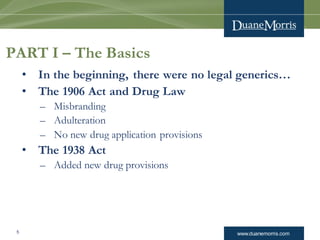
PART I – The Basics
• In the beginning, there were no legal generics…
• The 1906 Act and Drug Law
– Misbranding
– Adulteration
– No new drug application provisions
• The 1938 Act
– Added new drug provisions
www.duanemorris.com6
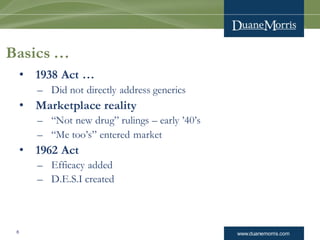
Basics …
• 1938 Act …
– Did not directly address generics
• Marketplace reality
– “Not new drug” rulings – early ’40’s
– “Me too’s” entered market
• 1962 Act
– Efficacy added
– D.E.S.I created
www.duanemorris.com7
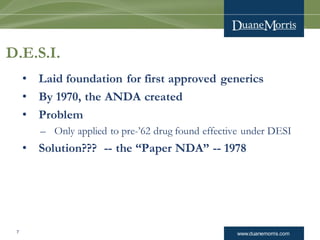
D.E.S.I.
• Laid foundation for first approved generics
• By 1970, the ANDA created
• Problem
– Only applied to pre-’62 drug found effective under DESI
• Solution??? -- the “Paper NDA” -- 1978
www.duanemorris.com8
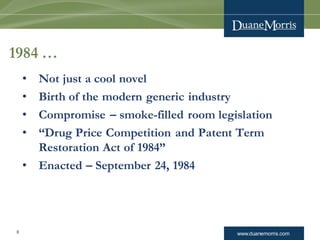
1984 …
• Not just a cool novel
• Birth of the modern generic industry
• Compromise – smoke-filled room legislation
• “Drug Price Competition and Patent Term
Restoration Act of 1984”
• Enacted – September 24, 1984
www.duanemorris.com9
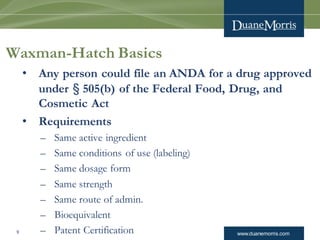
Waxman-Hatch Basics
• Any person could file an ANDA for a drug approved
under § 505(b) of the Federal Food, Drug, and
Cosmetic Act
• Requirements
– Same active ingredient
– Same conditions of use (labeling)
– Same dosage form
– Same strength
– Same route of admin.
– Bioequivalent
– Patent Certification
www.duanemorris.com10
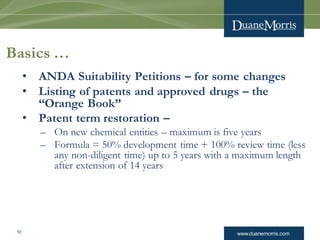
Basics …
• ANDA Suitability Petitions – for some changes
• Listing of patents and approved drugs – the
“Orange Book”
• Patent term restoration –
– On new chemical entities – maximum is five years
– Formula = 50% development time + 100% review time (less
any non-diligent time) up to 5 years with a maximum length
after extension of 14 years
www.duanemorris.com11
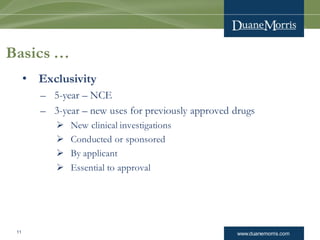
Basics …
• Exclusivity
– 5-year – NCE
– 3-year – new uses for previously approved drugs
 New clinical investigations
 Conducted or sponsored
 By applicant
 Essential to approval
www.duanemorris.com12
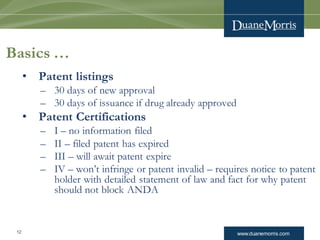
Basics …
• Patent listings
– 30 days of new approval
– 30 days of issuance if drug already approved
• Patent Certifications
– I – no information filed
– II – filed patent has expired
– III – will await patent expire
– IV – won’t infringe or patent invalid – requires notice to patent
holder with detailed statement of law and fact for why patent
should not block ANDA
www.duanemorris.com13
Basics …
• Repealed Roche v. Bolar
• Not an act of infringement if solely related to filing
of information under drug laws
– Note – also applies to devices – Medtronic v. Lilly
– Applies to clinical testing of intermediates – Intermedics v.
Ventritex -- 1991
www.duanemorris.com14
“Roche v. Bolar Exception” …
• Merck KGA v. Integra; USSC # 03-1237 (argued on
4/20/05)
– QUESTION PRESENTED – “… Did the Federal Circuit
err in concluding that this drug-research safe harbor does not
protect animal studies of the sort that are essential to the
development of new drugs, where the research will be
presented to the FDA, and where barring the research until
expiration of the patent could mean years of delay in the
availability of life-saving new drugs?”
– ANSWER – Yes – June 13, 2005 – Supreme Ct. unanimously
reversed the decision
www.duanemorris.com15
“Roche v. Bolar Exception” …
• Merck KGA v. Integra – Holding:
– “The use of patented compounds in preclinical studies is protected under
§271(e)(1) at least as long as there is a reasonable basis to believe that the
compound tested could be the subject of an FDA submission and the
experiments will produce the types of information relevant to an IND or
NDA.”
– “…§271(e)(1) provides a wide berth for the use of patented drugs in activities
related to the federal regulatory process, including uses reasonably related to
the development and submission of any information under the FDCA.”
– Made clear that the protection of §271(e)(1):
 Applies “… even when the patented compounds do not themselves become
the subject of an FDA submission”
 Applies even if the experiments do NOT get included in an ultimate
submission
 Is not limited to the generic drug process
www.duanemorris.com16
Another Waxman-Hatch Creation –
The 505(b)(2) NDA
• Not a completely new product (usually)
• Not a generic
• A product with some differences from a previously
approved product
• Approval requires (usually) clinical data, but the
studies may have been conducted by others.
www.duanemorris.com17
How is 505(b)(2) Different?
• The applicant and FDA may rely on prior FDA
safety and efficacy determinations, based on
studies conducted by someone else even though
the applicant does not have a right of reference to
the data. 21 U.S.C. § 355(b)(2)
• Safety and efficacy can also be supported by
published reports
www.duanemorris.com18
Types of 505(b)(2) NDAs
• New Chemical Entity (rarely)
• Changes to a Previously Approved Drug
– New dosage form, dosing regimen, strength, or route of
administration
– New indication
– New active ingredient
– New inactive ingredient that requires studies beyond
limited confirmatory studies
– Rx  OTC switch (Claritin)
• Duplicates of approved drugs that cannot be
approved under an ANDA
www.duanemorris.com19
Patent and Exclusivity Issues of
505(b)(2) Applications
• 505(b)(2) NDA must include patent
certification(s).
• 505(b)(2) NDA must also list any relevant
patent(s).
• Same Paragraph IV challenge system as ANDAs,
EXCEPT, no 180-day exclusivity period.
• A 505(b)(2) product may itself qualify for 3 or 5
years of new drug exclusivity
www.duanemorris.com20
PART II – Power
Protecting and Preserving
A Drug Franchise Under
Waxman-Hatch
– Exclusivity and the 30-month Stay
www.duanemorris.com21
Market Protections Available
• Patents (and extensions)
– Traditional enforcement
– Listing patents in FDA's "Orange Book"
• Statutory exclusivities/extensions under
Waxman-Hatch
• Other strategies
www.duanemorris.com22
Listing Patents in FDA's "Orange
Book"
• Requires patent certification by generic
competitors
• If approval sought pre-expiration, generic must
notify sponsor of bases for alleged invalidity or
non-infringement.
• Sponsor may sue for infringement and impose 30-
month stay of generic approval.
www.duanemorris.com23
Statutory Exclusivities Under
Waxman-Hatch
• New Chemical Entity (NCE) Exclusivity
– Prohibits the filing of an ANDA (or 505(b)(2) NDA) for a
product that contains the NCE for 5 years after approval of
the first NDA.
 (4 years if ANDA includes a Paragraph IV challenge to listed
patent)
– NCE: "a drug that contains no active moiety that has been
approved by FDA in any other [NDA]."
www.duanemorris.com24
Statutory Exclusivities …
• 3-Year Exclusivity
– Available for NDAs which contain:
 Reports of "new" "clinical trials"
 That were "essential to approval" of the NDA
 Conducted or sponsored by the applicant
– FDA may not approve (but can submit) an ANDA or
505(b)(2) NDA for 3 years after approval
– Applies for new indications, Rx  OTC switch, new
dosing regimen, and some other labeling changes.
www.duanemorris.com25
Statutory Exclusivities -- Other
• Orphan Drug Exclusivity
– 7 year exclusivity
– Drugs for rare conditions (<200,000 people in U.S.)
• Pediatric Exclusivity
– 6-month extension of existing patent or Waxman-Hatch
exclusivity
• 180-day generic (ANDA) exclusivity
www.duanemorris.com26
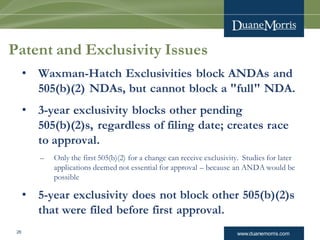
Patent and Exclusivity Issues
• Waxman-Hatch Exclusivities block ANDAs and
505(b)(2) NDAs, but cannot block a "full" NDA.
• 3-year exclusivity blocks other pending
505(b)(2)s, regardless of filing date; creates race
to approval.
– Only the first 505(b)(2) for a change can receive exclusivity. Studies for later
applications deemed not essential for approval – because an ANDA would be
possible
• 5-year exclusivity does not block other 505(b)(2)s
that were filed before first approval.
www.duanemorris.com27
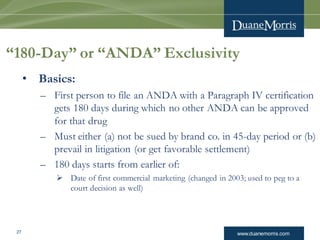
“180-Day” or “ANDA” Exclusivity
• Basics:
– First person to file an ANDA with a Paragraph IV certification
gets 180 days during which no other ANDA can be approved
for that drug
– Must either (a) not be sued by brand co. in 45-day period or (b)
prevail in litigation (or get favorable settlement)
– 180 days starts from earlier of:
 Date of first commercial marketing (changed in 2003; used to peg to a
court decision as well)
www.duanemorris.com28
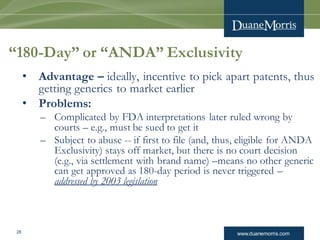
“180-Day” or “ANDA” Exclusivity
• Advantage – ideally, incentive to pick apart patents, thus
getting generics to market earlier
• Problems:
– Complicated by FDA interpretations later ruled wrong by
courts – e.g., must be sued to get it
– Subject to abuse -- if first to file (and, thus, eligible for ANDA
Exclusivity) stays off market, but there is no court decision
(e.g., via settlement with brand name) –means no other generic
can get approved as 180-day period is never triggered –
addressed by 2003 legislation
www.duanemorris.com29
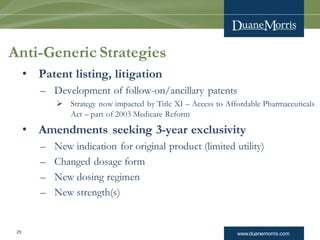
Anti-Generic Strategies
• Patent listing, litigation
– Development of follow-on/ancillary patents
 Strategy now impacted by Title XI – Access to Affordable Pharmaceuticals
Act – part of 2003 Medicare Reform
• Amendments seeking 3-year exclusivity
– New indication for original product (limited utility)
– Changed dosage form
– New dosing regimen
– New strength(s)
www.duanemorris.com30
Part III– Regulatory and Statutory Solutions to
Power Problems
A. FDA June 18, 2003 Final Rule
B. Title XI of The Medicare Improvement Act
of 2003 -- ACCESS TO AFFORDABLE
PHARMACEUTICALS
ACT
www.duanemorris.com31
FDA 30-Month Rule
• No need to give notice to a patent that claims a
use for which ANDA applicant is not seeking
approval
• More specifically defines those patents that
should be listed by brand name companies
– Drug substance – must be same as that which is subject to a
pending or approved NDA
www.duanemorris.com32
FDA 30-Month Rule
– Drug product patents – must be subject to a pending or
approved NDA
– Method of Use patents – only those indications or “conditions
of use” that are in a pending or approved NDA
• “Patent Declaration” required by brand names
relative to patents to be listed
www.duanemorris.com33
FDA Rule -- Orange Book Listing
• Patents that "claim the drug for which the
application was approved," or
• Patents that claim an approved method of use,
• Must be submitted to FDA within 30 days of NDA
approval, or 30-days of issuance (if issued post-
approval)
www.duanemorris.com34
FDA Rule -- 30-Month Stay Limitation
• The 30-month stay of Paragraph IV ANDA
approval may only be imposed with respect to
patents listed at time of initial NDA approval,
not post-approval patents – designed to preclude
multiple certifications by generic applicants – i.e.
“EVERGREENING” by the brand name co.
www.duanemorris.com35
FDA Rule -- Claim-by-Claim ¶-IV
Certifications
• For patents that
– Include both product claim and method of use claim(s),
or
– Contain multiple method of use claims,
• Paragraph IV Certifications and "viii
statements" must be claim-specific.
www.duanemorris.com36
Title XI --
ACCESS TO AFFORDABLE
PHARMACEUTICALS
ACT
Title XI of Public Law 108-173
H.R. 1
Medicare Prescription Drug, Improvement and
Modernization
Act of 2003
www.duanemorris.com37
Title XI – What It Does
• A number of very substantive and technical
changes to the ANDA statutory regime
• Key provisions:
– Statutorily implements “single 30-month stay” rule
– Lifting 30-month stay – makes clear that a court decision
is of “district court” – not just one that could not be
appealed
www.duanemorris.com38
Title XI – What It Does
• Key provisions:
– Declaratory judgment action by ANDA applicant – have
to wait until 45-day period over and not sued
– “Delisting” Counterclaim to Infringement Action --
[505(j)(5)(C)(ii)]
 Not an independent cause of action
– 180-day Exclusivity
 Can be forfeited
 Pegged solely to commercial marketing – thus, implicitly allow
“authorized generics” – by any “first applicant”
www.duanemorris.com39
The Future is Here – “Biosimilars!”
• Previously – no legal mechanism can be used to
support approval of a “generic” biologic
• Why?
– Legally, biologics licensed under Public Health Service Act,
not Waxman-Hatch
– Difficulty in characterization
www.duanemorris.com40
“Generic” “Biologics”
"One cannot completely characterize the biological product
and that in itself is an issue, and quite frankly with
biological products you really don’t have a homogeneous
product, you have a defined range of biological
components for which you find consistency in a particular
clinical outcome. The challenges of analytical technology
are still very great for characterizing biologics."
-- Katherine Zoon, CBER
www.duanemorris.com41
Biosimilars Under 505(b)(2)
• For Biologics originally approved under an NDA,
FDA will accept a 505(b)(2) for a generic or
biosimilar version
– Examples include naturally-derived active ingredients (from
animal or botanical sources) or those derived from
recombinant technology (e.g., insulin, HGH)
– None have a TE rating
– Lovenox® – (LMWH) -- approved in July 2010 and arguably
a biologic – approved as an ANDA
• For BLA-approved products, no “generic” or
abbreviated approval pathway existed
www.duanemorris.com
The 2010 New Law
• Creates an “abbreviated” pathway for Biosimilars
• “Biosimilar” defined
– that the biological product is highly similar to the reference
product notwithstanding minor differences in clinically inactive
components; and
– there are no clinically meaningful differences between the
biological product and the reference product in terms of the
safety, purity, and potency of the product.
– Contrast to small molecule – ANDA – drug must be same
– Reason – so difficult to characterize and process
42
www.duanemorris.com
Basics
• To show biosimilarity, application must contain:
– analytical studies that demonstrate that the biological product is
highly similar to the reference product notwithstanding minor
differences in clinically inactive components;
– animal studies (including the assessment of toxicity); and
– a clinical study or studies (including the assessment of
immunogenicity and pharmacokinetics or pharmacodynamics)
that are sufficient to demonstrate safety, purity, and potency in 1
or more appropriate conditions of use for which the reference
product is licensed and intended to be used and for which
licensure is sought for the biological product.
• FDA can waive any of those
43
www.duanemorris.com
Basics …
• The biological product and reference product must
utilize the same mechanism or mechanisms of action for the
condition or conditions of use prescribed,
recommended, or suggested in the proposed labeling,
but only to the extent the mechanism or mechanisms of
action are known for the reference product;
• The condition or conditions of use prescribed,
recommended, or suggested in the labeling proposed for
the biological product have been previously approved for
the reference product;
44
www.duanemorris.com
Basics …
• The route of administration, the dosage form, and
the strength of the biological product are the same
as those of the reference product
• The facility in which the biological product is
manufactured, processed, packed, or held meets
standards designed to assure that the biological
product continues to be safe, pure, and potent.
45
www.duanemorris.com
Interchangeability
• Not required, but allowed
– The term ‘interchangeable’ or ‘interchangeability,’ in reference to
a biological product -- means that the biological product may be
substituted for the reference product without the intervention of the
health care provider who prescribed the reference product.
• However, to prove interchangeability, FDA has said:
– To establish that two protein products would be therapeutically
equivalent (interchangeable), a sponsor of the follow-on protein
product would need to demonstrate, among other things that
repeated switches from the follow-on protein product to the
referenced product, and vice versa, would have no negative effect on
the safety and effectiveness of the products.
46
www.duanemorris.com
Exclusivity
• Innovator –12 years from date of first licensure
– Retroactive – captures BLAs approved before statute’s
enactment in March 2010
– Can also qualify for pediatric exclusivity extension
– First four years – abbreviated app. can NOT be submitted
47
www.duanemorris.com
Exclusivity …
• First Interchangeable Biosimilar
– Applicant gets period of time where no other interchangeable
for same Reference Product (i.e., innovator) can be approved
– Length varies depending on a variety of factors; earliest of:
 One year of first commercial marketing
 18 months of favorable final court decision in patent litigation
 42 months of approval if First Interchangeable tied up in patent
litigation
 18 months of First Interchangeable if no law suit
48
www.duanemorris.com 49
OVER-THE-COUNTER
-- “OTC” -- DRUGS
www.duanemorris.com50
OTC’s – Three Routes
• OTC Review – monograph system
– Covers bulk of marketed OTCs
– Lacks exclusivity
• Rx – OTC Switches
– May enjoy patent protection
– May enjoy Waxman-Hatch Exclusivity
 Yes – most
 No -- Minoxidil
• Direct-to-OTC
– Very, very rare
– Only ones I know are both local –
 Avanir’s Abreva®;
 SalonPas® -- Hisamatsu
www.duanemorris.com51
Why Switch?
• Preserve franchise in face of impending generic
competition on the Rx
• Boost sales
• Downside
– Usually not reimbursed by insurance
www.duanemorris.com52
OTC’s – Key Issues
• Wellpoint Petition – sought to “force” Claritin OTC
• Will FDA file its own petitions?
• T.E.A. Rule – foreign data can now be used to
support an OTC Switch
• What studies are sufficient to support Waxman-
Hatch Exclusivity?
– Make sure they’re essential – Minoxidil
– More than one similar product can get exclusivity
www.duanemorris.com 53
ORPHAN DRUGS
www.duanemorris.com54
ADOPTING ORPHANS –
The Orphan Drug Act
• Enacted – 1983
• Goal -- create incentives for pharmaceutical
companies to adopt "orphan" drugs for uses for rare
disorders.
• “Orphan" -- many drugs were known as potentially
effective for rare diseases, but had been orphaned --
abandoned for developmental purposes -- by the
pharmaceutical industry due lack of profitability
associated with small patient population (aka “buyers”)
www.duanemorris.com55
Orphans . . .
• Orphan Drug Act -- created four key incentives to
facilitate drug development for rare diseases:
– Seven years marketing exclusivity during which time no
other company can secure approval for the same drug for the
orphan indication
– Protocol assistance
– Tax credits
– Research Grants
www.duanemorris.com56
How Does a Drug Become an
Adoptable Orphan?
• To qualify for benefits under the Orphan Drug
Act, a drug must serve a patient population:
– < 200,000 people in the United States or
– if > 200,000, orphan drug applicant must show it cannot
reasonably recoup its commercial investment in the research
and development of the product –
 rarely used (to the best of my knowledge, never been used).
• Key question for orphan drug status is patient
population --
– the indication sought must be “medically plausible”
– not just a "salami sliced" indication of a greater patient
population that might be otherwise over 200,000.
www.duanemorris.com57
Orphan Designation
• To get orphan drug benefits, a sponsor must apply
for orphan drug designation.
• Process -- sponsor-specific
• 21 CFR 316.20 requires that, among other things,
the sponsor show:
– patient population proposed -- less than 200,000 people per
year.
– is a confidential process with the designation application not
being one subject to public disclosure until after it is
approved, if it is approved.
• Once approved, the designation will appear in a
quarterly cumulative list that the Agency publishes
and makes available on its website.
• Several guidances available
www.duanemorris.com58
Designation Issues – or Can Identical Twins
Be Adopted by Two Different Families?
• Clinical superiority – FDA may regard – for Orphan
Drug Act purposes -- as different, drugs that are
chemically the same and identically labeled if the second
drug is clinically superior to the first drug.
– Skirts Orphan Drug Act's restrictions on approving same drug by ruling
second drug is clinically superior and, therefore, essentially is not the same
drug as that one which enjoys exclusivity.
• “Molecular differentiation” (my term) -- in other
cases, FDA has gone to some length to differentiate a
product on the basis of how its molecular structure
differs from an approved orphan drug.
www.duanemorris.com
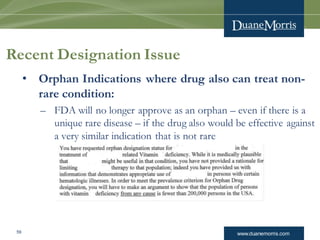
• Orphan Indications where drug also can treat non-
rare condition:
– FDA will no longer approve as an orphan – even if there is a
unique rare disease – if the drug also would be effective against
a very similar indication that is not rare
 Example:
Recent Designation Issue
59
www.duanemorris.com60
Timing Considerations
• When viewed relative to ODA exclusivity provisions,
timing of designation process is KEY…
– Remember -- process is confidential until drug designated; then
published in FED REG.
• Consider not seeking the OD designation until you
have done one or more of the following:
– Confirmed the stability of your proposed formulation;
– Validated that the formulation can be produced on a
commercial scale-up basis; or
– Filed to study the product pursuant to an IND.
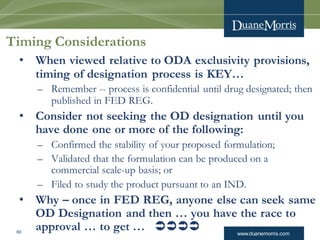
• Why – once in FED REG, anyone else can seek same
OD Designation and then … you have the race to
approval … to get … 
www.duanemorris.com61
Orphan Drug Exclusivity
• Protects the orphan drug for the orphan indication
• 7 years
• Good thing – can’t “remake wheel” (distinguish
Waxman-Hatch exclusivity which does not bar a full
NDA for a drug with W-H exclusivity)
• Beware – less incentive to study approved drugs for
orphan uses – generics may come in and be used
off-label
www.duanemorris.com62
Tax Credits
• Only helpful to a company that is actually enjoying
taxable income that needs to be offset.
• For startups, this may not occur any time in the
short term when the needs of the tax cut might be
most useful.
• See a tax professional -- may be able to give you
more advice as to whether any losses can be carried
forward and for how long so as to be able to take
advantage of the tax cut provisions
• Most observers -- low utility
www.duanemorris.com63
Protocol Assistance
• Orphan Drug sponsors are as eligible for
significant additional assistance from FDA in the
design of its clinical study protocols (caveat:
nature of that aid is not stated very clearly
anywhere)
• LINK any assistance to a clear written agreement
with the Agency as to the nature of the clinical
studies to be performed
www.duanemorris.com64
Research Grants
• Awarded by FDA to qualified applicants pursuant to
criteria being articulated by the Agency.
• While the grants can be somewhat substantial, they
are dependent upon the Agency receiving
appropriate funding by Congress for the grants.
• Fairly constant struggle for FDA -- historically the
gross amount of grants available in a single year
rarely exceeds $2 million and individual grants
normally range from $50,000 to $200,000.
• Qualifying for a grant involves a number of hurdles
www.duanemorris.com65
COSMETICS
www.duanemorris.com66
Definition
• Dictionary:
– [n] a toiletry designed to beautify the body
– [adj] serving an aesthetic purpose in beautifying the body;
"cosmetic surgery"; "enhansive makeup"
– [adj] serving an esthetic rather than a useful purpose;
"cosmetic fenders on cars”
Source: hyperdictionary. http://www.hyperdictionary.com/dictionary/cosmetic
www.duanemorris.com67
Definition
• Federal Food, Drug, and Cosmetic Act:
(1) articles intended to be rubbed, poured, sprinkled, or
sprayed on, introduced into, or otherwise applied to the
human body or any part thereof for cleansing, beautifying,
promoting attractiveness, or altering the appearance, and
(2) articles intended for use as a component of any such
articles; except that such term shall not include soap.
[Section 201(i)]
www.duanemorris.com68
Definition - Case Law
• “Old days”: many of today’s claims might be unapproved new drug claims
– Sudden Change (1969) –
 Product: lotion of bovine albumen & distilled water
 Label/Ad Claim: “Face Life without Surgery”
 Decision: while some may say is puffery, this implies will “affect the
structure … of the body” = DRUG
– Line Away (1969) –
 Product: lotion of bovine albumen & distilled water
 Label/Ad Claim: made in a “pharmaceutical laboratory” under “aseptic
conditions” and was for “discouraging new wrinkles from forming”
 Decision: claims strongly reinforce this is a therapeutic product =
DRUG
– Magic Secret (1971)
 Product: wrinkle remover
 Label/Ad Claim: “pure protein” that causes an “astringent sensation”
 Decision: did not rise to the level of Sudden Change = COSMETIC
www.duanemorris.com69
Definition - Case Law
• Recent years: not much overt regulatory activity
• One recent example – January 2004 – University Medical Products – got
Warning Letter from L.A. District Office
– Products: FACE LIFT Collagen 5 products, including Cell Regeneration
Cream, Intensive Wrinkle Reducing Cream, and Intensive Lifting Complex;
FACE LIFT Daytime Advanced Retinol-A, Nighttime Advanced Retinol-A,
Advanced Under Eye Therapy, Vitamin C Anti-Wrinkle Patch, and Overnight
Moisturizer; and BODY LIFT Anti-Cellulite Thigh Cream, Weight Reducing
Cream, and Anti-Water Retention Lotion
– Alleged Objectionable Claims: Cell Regeneration Cream (red text) and Anti-
Cellulite Thigh Cream (blue text)
 Helps boost collagen production
 Reduces deep wrinkles up to 70%
 Visibly Reduces Deep Wrinkles plus Fine Lines
 Significantly Reduces...Thigh Circumference
 Stimulate the beta receptors in cells to release stored fat.
 Clinically proven to...reduce thigh circumference.
– Status – not sure
www.duanemorris.com70
What do you think …?
• Repairwear Intensive Night Lotion
– Claim: Block and mend fine lines and wrinkles at night; build
natural collagen and replenish antioxidants.
vs.
• Anti-Gravity Firming Eye Lift Cream
– Claim: Densely hydrating cream lifts, brightens, and firms
around the eyes. Helps erase the look of lines.
www.duanemorris.com71
Regulatory Regime
• Limited Duties – see regulations – next slide and
FDA Cosmetics webpage --
http://www.cfsan.fda.gov/~dms/cos-toc.html
• Cosmetics regulation is based in FDA’s Foods
Center – Office of Cosmetics and Colors
• No preclearance – except color additives
• GMPS – no mandatory – Guidelines --
http://www.cfsan.fda.gov/~dms/cos-gmp.html
• Listing – voluntary
• Registration -- voluntary
• Adverse events -- voluntary
www.duanemorris.com72
FDA Regulations Impacting Cosmetics
• 21 CFR Part 1 General enforcement regulations
• 21 CFR Part 2 General administrative rulings and decisions
• 21 CFR Part 20 Public information
• 21 CFR Part 250 Section 250.250 Requirements for drugs and cosmetics -- hexachlorophene
• 21 CFR Part 700 Subpart A (Section 700.3) Cosmetics -- General provisions
• 21 CFR Part 700 Subpart B (Sections 700.11 through 700.35) Requirements for specific
cosmetic products
• 21 CFR Part 701 Subpart A (Sections 701.1 through 701.9) Cosmetic labeling -- General
provisions
• 21 CFR Part 701 Subpart B (Sections 701.10 through 701.19) Package form
• 21 CFR Part 701 Subpart C (Sections 701.20 through 701.30) Labeling of specific ingredients
• 21 CFR Part 710 Voluntary registration of cosmetic product establishments
• 21 CFR Part 720 Voluntary filing of cosmetic product ingredient and cosmetic raw material
composition statements
• 21 CFR Part 740 Cosmetic product warning statements
www.duanemorris.com73
Additional Cosmetics Glosses
• “Cosmeceutical” – no such creature under FDA law or
regulation; if a product is both a drug and a cosmetic,
must meet both
• Imported products – must meet all rules – e.g., Dial®
Soap – import alert on foreign-made Dial® due to
unapproved colors
www.duanemorris.com
Questions?
• Call, e-mail or fax:
Michael A. Swit, Esq.
Special Counsel, FDA Practice
Duane Morris LLP
San Diego, California
direct: 619-744-2215
fax: 619-923-6248
maswit@duanemorris.com
• Follow me on:
– LinkedIn: http://www.linkedin.com/in/michaelswit
– Twitter: https://twitter.com/FDACounsel
74
www.duanemorris.com
About Your Speaker
Michael A. Swit, Esq., is a Special Counsel in the San Diego office of the international law firm,
Duane Morris, LLP, where he focuses his practice on solving FDA legal challenges faced by
highly-regulated pharmaceutical and medical device companies. Before joining Duane Morris in
March 2012, Swit served for seven years as a vice president at The Weinberg Group Inc., a
preeminent scientific and regulatory consulting firm in the Life Sciences. His expertise includes
product development, compliance and enforcement, recalls and crisis management, submissions
and related traditional FDA regulatory activities, labeling and advertising, and clinical research
efforts for all types of life sciences companies, with a particular emphasis on drugs, biologics and
therapeutic biotech products. Mr. Swit has been addressing vital FDA legal and regulatory issues
since 1984, both in private practice with McKenna & Cuneo and Heller Ehrman, and as vice
president, general counsel and secretary of Par Pharmaceutical, a top public generic and specialty
drug firm. He also was, from 1994 to 1998, CEO of FDANews.com, a premier publisher of
regulatory newsletters and other specialty information products for FDA-regulated firms. He has
taught and written on many topics relating to FDA regulation and associated commercial
activities and is a past member of the Food & Drug Law Journal Editorial Board. He earned his
A.B., magna cum laude, with high honors in history, at Bowdoin College, and his law degree at
Emory University.
75

ANDAs, OTCs, Orphans and Cosmetics – Key Issues

  • 1.
    www.duanemorris.com ©2012 Duane MorrisLLP. All Rights Reserv ed. Duane Morris is a registered serv ice mark of Duane Morris LLP. Duane Morris – Firm and Affiliate Offices | New York | London | Singapore | Los Angeles | Chicago | Houston | Hanoi | Philadelphia | San Diego | San Francisco | Baltimore | Boston | Washington, D.C. Las Vegas | Atlanta | Miami | Pittsburgh | Newark | Boca Raton | Wilmington | Cherry Hill | Lake Tahoe | Ho Chi Minh City | Duane Morris LLP – A Delaware limited liability partnership ANDAs, OTCs, Orphans and Cosmetics – Key Issues SDRAN RAC Exam Review Course Wednesday, August 1, 2012 Michael A. Swit, Esq. Special Counsel, FDA Law Practice
  • 2.
    www.duanemorris.com Standard Disclaimers • Viewsexpressed here are solely mine and do not reflect those of my firm or any of its clients. • This presentation supports an oral briefing and should not be relied upon solely on its own to support any conclusion of law or fact. • These slides are intended to provide general educational information and are not intended to convey legal advice. 2
  • 3.
    www.duanemorris.com Our Topics Today •Generic Drugs • OTC Drugs • Orphan Drugs • Cosmetics 3
  • 4.
    www.duanemorris.com4 What We WillCover on Generics ♦ Basics ♦ Power ♦ Addressing Abuses – by Rule & Statute ♦ Biosimilars – Basics of New Law
  • 5.
    www.duanemorris.com5 PART I –The Basics • In the beginning, there were no legal generics… • The 1906 Act and Drug Law – Misbranding – Adulteration – No new drug application provisions • The 1938 Act – Added new drug provisions
  • 6.
    www.duanemorris.com6 Basics … • 1938Act … – Did not directly address generics • Marketplace reality – “Not new drug” rulings – early ’40’s – “Me too’s” entered market • 1962 Act – Efficacy added – D.E.S.I created
  • 7.
    www.duanemorris.com7 D.E.S.I. • Laid foundationfor first approved generics • By 1970, the ANDA created • Problem – Only applied to pre-’62 drug found effective under DESI • Solution??? -- the “Paper NDA” -- 1978
  • 8.
    www.duanemorris.com8 1984 … • Notjust a cool novel • Birth of the modern generic industry • Compromise – smoke-filled room legislation • “Drug Price Competition and Patent Term Restoration Act of 1984” • Enacted – September 24, 1984
  • 9.
    www.duanemorris.com9 Waxman-Hatch Basics • Anyperson could file an ANDA for a drug approved under § 505(b) of the Federal Food, Drug, and Cosmetic Act • Requirements – Same active ingredient – Same conditions of use (labeling) – Same dosage form – Same strength – Same route of admin. – Bioequivalent – Patent Certification
  • 10.
    www.duanemorris.com10 Basics … • ANDASuitability Petitions – for some changes • Listing of patents and approved drugs – the “Orange Book” • Patent term restoration – – On new chemical entities – maximum is five years – Formula = 50% development time + 100% review time (less any non-diligent time) up to 5 years with a maximum length after extension of 14 years
  • 11.
    www.duanemorris.com11 Basics … • Exclusivity –5-year – NCE – 3-year – new uses for previously approved drugs  New clinical investigations  Conducted or sponsored  By applicant  Essential to approval
  • 12.
    www.duanemorris.com12 Basics … • Patentlistings – 30 days of new approval – 30 days of issuance if drug already approved • Patent Certifications – I – no information filed – II – filed patent has expired – III – will await patent expire – IV – won’t infringe or patent invalid – requires notice to patent holder with detailed statement of law and fact for why patent should not block ANDA
  • 13.
    www.duanemorris.com13 Basics … • RepealedRoche v. Bolar • Not an act of infringement if solely related to filing of information under drug laws – Note – also applies to devices – Medtronic v. Lilly – Applies to clinical testing of intermediates – Intermedics v. Ventritex -- 1991
  • 14.
    www.duanemorris.com14 “Roche v. BolarException” … • Merck KGA v. Integra; USSC # 03-1237 (argued on 4/20/05) – QUESTION PRESENTED – “… Did the Federal Circuit err in concluding that this drug-research safe harbor does not protect animal studies of the sort that are essential to the development of new drugs, where the research will be presented to the FDA, and where barring the research until expiration of the patent could mean years of delay in the availability of life-saving new drugs?” – ANSWER – Yes – June 13, 2005 – Supreme Ct. unanimously reversed the decision
  • 15.
    www.duanemorris.com15 “Roche v. BolarException” … • Merck KGA v. Integra – Holding: – “The use of patented compounds in preclinical studies is protected under §271(e)(1) at least as long as there is a reasonable basis to believe that the compound tested could be the subject of an FDA submission and the experiments will produce the types of information relevant to an IND or NDA.” – “…§271(e)(1) provides a wide berth for the use of patented drugs in activities related to the federal regulatory process, including uses reasonably related to the development and submission of any information under the FDCA.” – Made clear that the protection of §271(e)(1):  Applies “… even when the patented compounds do not themselves become the subject of an FDA submission”  Applies even if the experiments do NOT get included in an ultimate submission  Is not limited to the generic drug process
  • 16.
    www.duanemorris.com16 Another Waxman-Hatch Creation– The 505(b)(2) NDA • Not a completely new product (usually) • Not a generic • A product with some differences from a previously approved product • Approval requires (usually) clinical data, but the studies may have been conducted by others.
  • 17.
    www.duanemorris.com17 How is 505(b)(2)Different? • The applicant and FDA may rely on prior FDA safety and efficacy determinations, based on studies conducted by someone else even though the applicant does not have a right of reference to the data. 21 U.S.C. § 355(b)(2) • Safety and efficacy can also be supported by published reports
  • 18.
    www.duanemorris.com18 Types of 505(b)(2)NDAs • New Chemical Entity (rarely) • Changes to a Previously Approved Drug – New dosage form, dosing regimen, strength, or route of administration – New indication – New active ingredient – New inactive ingredient that requires studies beyond limited confirmatory studies – Rx  OTC switch (Claritin) • Duplicates of approved drugs that cannot be approved under an ANDA
  • 19.
    www.duanemorris.com19 Patent and ExclusivityIssues of 505(b)(2) Applications • 505(b)(2) NDA must include patent certification(s). • 505(b)(2) NDA must also list any relevant patent(s). • Same Paragraph IV challenge system as ANDAs, EXCEPT, no 180-day exclusivity period. • A 505(b)(2) product may itself qualify for 3 or 5 years of new drug exclusivity
  • 20.
    www.duanemorris.com20 PART II –Power Protecting and Preserving A Drug Franchise Under Waxman-Hatch – Exclusivity and the 30-month Stay
  • 21.
    www.duanemorris.com21 Market Protections Available •Patents (and extensions) – Traditional enforcement – Listing patents in FDA's "Orange Book" • Statutory exclusivities/extensions under Waxman-Hatch • Other strategies
  • 22.
    www.duanemorris.com22 Listing Patents inFDA's "Orange Book" • Requires patent certification by generic competitors • If approval sought pre-expiration, generic must notify sponsor of bases for alleged invalidity or non-infringement. • Sponsor may sue for infringement and impose 30- month stay of generic approval.
  • 23.
    www.duanemorris.com23 Statutory Exclusivities Under Waxman-Hatch •New Chemical Entity (NCE) Exclusivity – Prohibits the filing of an ANDA (or 505(b)(2) NDA) for a product that contains the NCE for 5 years after approval of the first NDA.  (4 years if ANDA includes a Paragraph IV challenge to listed patent) – NCE: "a drug that contains no active moiety that has been approved by FDA in any other [NDA]."
  • 24.
    www.duanemorris.com24 Statutory Exclusivities … •3-Year Exclusivity – Available for NDAs which contain:  Reports of "new" "clinical trials"  That were "essential to approval" of the NDA  Conducted or sponsored by the applicant – FDA may not approve (but can submit) an ANDA or 505(b)(2) NDA for 3 years after approval – Applies for new indications, Rx  OTC switch, new dosing regimen, and some other labeling changes.
  • 25.
    www.duanemorris.com25 Statutory Exclusivities --Other • Orphan Drug Exclusivity – 7 year exclusivity – Drugs for rare conditions (<200,000 people in U.S.) • Pediatric Exclusivity – 6-month extension of existing patent or Waxman-Hatch exclusivity • 180-day generic (ANDA) exclusivity
  • 26.
    www.duanemorris.com26 Patent and ExclusivityIssues • Waxman-Hatch Exclusivities block ANDAs and 505(b)(2) NDAs, but cannot block a "full" NDA. • 3-year exclusivity blocks other pending 505(b)(2)s, regardless of filing date; creates race to approval. – Only the first 505(b)(2) for a change can receive exclusivity. Studies for later applications deemed not essential for approval – because an ANDA would be possible • 5-year exclusivity does not block other 505(b)(2)s that were filed before first approval.
  • 27.
    www.duanemorris.com27 “180-Day” or “ANDA”Exclusivity • Basics: – First person to file an ANDA with a Paragraph IV certification gets 180 days during which no other ANDA can be approved for that drug – Must either (a) not be sued by brand co. in 45-day period or (b) prevail in litigation (or get favorable settlement) – 180 days starts from earlier of:  Date of first commercial marketing (changed in 2003; used to peg to a court decision as well)
  • 28.
    www.duanemorris.com28 “180-Day” or “ANDA”Exclusivity • Advantage – ideally, incentive to pick apart patents, thus getting generics to market earlier • Problems: – Complicated by FDA interpretations later ruled wrong by courts – e.g., must be sued to get it – Subject to abuse -- if first to file (and, thus, eligible for ANDA Exclusivity) stays off market, but there is no court decision (e.g., via settlement with brand name) –means no other generic can get approved as 180-day period is never triggered – addressed by 2003 legislation
  • 29.
    www.duanemorris.com29 Anti-Generic Strategies • Patentlisting, litigation – Development of follow-on/ancillary patents  Strategy now impacted by Title XI – Access to Affordable Pharmaceuticals Act – part of 2003 Medicare Reform • Amendments seeking 3-year exclusivity – New indication for original product (limited utility) – Changed dosage form – New dosing regimen – New strength(s)
  • 30.
    www.duanemorris.com30 Part III– Regulatoryand Statutory Solutions to Power Problems A. FDA June 18, 2003 Final Rule B. Title XI of The Medicare Improvement Act of 2003 -- ACCESS TO AFFORDABLE PHARMACEUTICALS ACT
  • 31.
    www.duanemorris.com31 FDA 30-Month Rule •No need to give notice to a patent that claims a use for which ANDA applicant is not seeking approval • More specifically defines those patents that should be listed by brand name companies – Drug substance – must be same as that which is subject to a pending or approved NDA
  • 32.
    www.duanemorris.com32 FDA 30-Month Rule –Drug product patents – must be subject to a pending or approved NDA – Method of Use patents – only those indications or “conditions of use” that are in a pending or approved NDA • “Patent Declaration” required by brand names relative to patents to be listed
  • 33.
    www.duanemorris.com33 FDA Rule --Orange Book Listing • Patents that "claim the drug for which the application was approved," or • Patents that claim an approved method of use, • Must be submitted to FDA within 30 days of NDA approval, or 30-days of issuance (if issued post- approval)
  • 34.
    www.duanemorris.com34 FDA Rule --30-Month Stay Limitation • The 30-month stay of Paragraph IV ANDA approval may only be imposed with respect to patents listed at time of initial NDA approval, not post-approval patents – designed to preclude multiple certifications by generic applicants – i.e. “EVERGREENING” by the brand name co.
  • 35.
    www.duanemorris.com35 FDA Rule --Claim-by-Claim ¶-IV Certifications • For patents that – Include both product claim and method of use claim(s), or – Contain multiple method of use claims, • Paragraph IV Certifications and "viii statements" must be claim-specific.
  • 36.
    www.duanemorris.com36 Title XI -- ACCESSTO AFFORDABLE PHARMACEUTICALS ACT Title XI of Public Law 108-173 H.R. 1 Medicare Prescription Drug, Improvement and Modernization Act of 2003
  • 37.
    www.duanemorris.com37 Title XI –What It Does • A number of very substantive and technical changes to the ANDA statutory regime • Key provisions: – Statutorily implements “single 30-month stay” rule – Lifting 30-month stay – makes clear that a court decision is of “district court” – not just one that could not be appealed
  • 38.
    www.duanemorris.com38 Title XI –What It Does • Key provisions: – Declaratory judgment action by ANDA applicant – have to wait until 45-day period over and not sued – “Delisting” Counterclaim to Infringement Action -- [505(j)(5)(C)(ii)]  Not an independent cause of action – 180-day Exclusivity  Can be forfeited  Pegged solely to commercial marketing – thus, implicitly allow “authorized generics” – by any “first applicant”
  • 39.
    www.duanemorris.com39 The Future isHere – “Biosimilars!” • Previously – no legal mechanism can be used to support approval of a “generic” biologic • Why? – Legally, biologics licensed under Public Health Service Act, not Waxman-Hatch – Difficulty in characterization
  • 40.
    www.duanemorris.com40 “Generic” “Biologics” "One cannotcompletely characterize the biological product and that in itself is an issue, and quite frankly with biological products you really don’t have a homogeneous product, you have a defined range of biological components for which you find consistency in a particular clinical outcome. The challenges of analytical technology are still very great for characterizing biologics." -- Katherine Zoon, CBER
  • 41.
    www.duanemorris.com41 Biosimilars Under 505(b)(2) •For Biologics originally approved under an NDA, FDA will accept a 505(b)(2) for a generic or biosimilar version – Examples include naturally-derived active ingredients (from animal or botanical sources) or those derived from recombinant technology (e.g., insulin, HGH) – None have a TE rating – Lovenox® – (LMWH) -- approved in July 2010 and arguably a biologic – approved as an ANDA • For BLA-approved products, no “generic” or abbreviated approval pathway existed
  • 42.
    www.duanemorris.com The 2010 NewLaw • Creates an “abbreviated” pathway for Biosimilars • “Biosimilar” defined – that the biological product is highly similar to the reference product notwithstanding minor differences in clinically inactive components; and – there are no clinically meaningful differences between the biological product and the reference product in terms of the safety, purity, and potency of the product. – Contrast to small molecule – ANDA – drug must be same – Reason – so difficult to characterize and process 42
  • 43.
    www.duanemorris.com Basics • To showbiosimilarity, application must contain: – analytical studies that demonstrate that the biological product is highly similar to the reference product notwithstanding minor differences in clinically inactive components; – animal studies (including the assessment of toxicity); and – a clinical study or studies (including the assessment of immunogenicity and pharmacokinetics or pharmacodynamics) that are sufficient to demonstrate safety, purity, and potency in 1 or more appropriate conditions of use for which the reference product is licensed and intended to be used and for which licensure is sought for the biological product. • FDA can waive any of those 43
  • 44.
    www.duanemorris.com Basics … • Thebiological product and reference product must utilize the same mechanism or mechanisms of action for the condition or conditions of use prescribed, recommended, or suggested in the proposed labeling, but only to the extent the mechanism or mechanisms of action are known for the reference product; • The condition or conditions of use prescribed, recommended, or suggested in the labeling proposed for the biological product have been previously approved for the reference product; 44
  • 45.
    www.duanemorris.com Basics … • Theroute of administration, the dosage form, and the strength of the biological product are the same as those of the reference product • The facility in which the biological product is manufactured, processed, packed, or held meets standards designed to assure that the biological product continues to be safe, pure, and potent. 45
  • 46.
    www.duanemorris.com Interchangeability • Not required,but allowed – The term ‘interchangeable’ or ‘interchangeability,’ in reference to a biological product -- means that the biological product may be substituted for the reference product without the intervention of the health care provider who prescribed the reference product. • However, to prove interchangeability, FDA has said: – To establish that two protein products would be therapeutically equivalent (interchangeable), a sponsor of the follow-on protein product would need to demonstrate, among other things that repeated switches from the follow-on protein product to the referenced product, and vice versa, would have no negative effect on the safety and effectiveness of the products. 46
  • 47.
    www.duanemorris.com Exclusivity • Innovator –12years from date of first licensure – Retroactive – captures BLAs approved before statute’s enactment in March 2010 – Can also qualify for pediatric exclusivity extension – First four years – abbreviated app. can NOT be submitted 47
  • 48.
    www.duanemorris.com Exclusivity … • FirstInterchangeable Biosimilar – Applicant gets period of time where no other interchangeable for same Reference Product (i.e., innovator) can be approved – Length varies depending on a variety of factors; earliest of:  One year of first commercial marketing  18 months of favorable final court decision in patent litigation  42 months of approval if First Interchangeable tied up in patent litigation  18 months of First Interchangeable if no law suit 48
  • 49.
  • 50.
    www.duanemorris.com50 OTC’s – ThreeRoutes • OTC Review – monograph system – Covers bulk of marketed OTCs – Lacks exclusivity • Rx – OTC Switches – May enjoy patent protection – May enjoy Waxman-Hatch Exclusivity  Yes – most  No -- Minoxidil • Direct-to-OTC – Very, very rare – Only ones I know are both local –  Avanir’s Abreva®;  SalonPas® -- Hisamatsu
  • 51.
    www.duanemorris.com51 Why Switch? • Preservefranchise in face of impending generic competition on the Rx • Boost sales • Downside – Usually not reimbursed by insurance
  • 52.
    www.duanemorris.com52 OTC’s – KeyIssues • Wellpoint Petition – sought to “force” Claritin OTC • Will FDA file its own petitions? • T.E.A. Rule – foreign data can now be used to support an OTC Switch • What studies are sufficient to support Waxman- Hatch Exclusivity? – Make sure they’re essential – Minoxidil – More than one similar product can get exclusivity
  • 53.
  • 54.
    www.duanemorris.com54 ADOPTING ORPHANS – TheOrphan Drug Act • Enacted – 1983 • Goal -- create incentives for pharmaceutical companies to adopt "orphan" drugs for uses for rare disorders. • “Orphan" -- many drugs were known as potentially effective for rare diseases, but had been orphaned -- abandoned for developmental purposes -- by the pharmaceutical industry due lack of profitability associated with small patient population (aka “buyers”)
  • 55.
    www.duanemorris.com55 Orphans . .. • Orphan Drug Act -- created four key incentives to facilitate drug development for rare diseases: – Seven years marketing exclusivity during which time no other company can secure approval for the same drug for the orphan indication – Protocol assistance – Tax credits – Research Grants
  • 56.
    www.duanemorris.com56 How Does aDrug Become an Adoptable Orphan? • To qualify for benefits under the Orphan Drug Act, a drug must serve a patient population: – < 200,000 people in the United States or – if > 200,000, orphan drug applicant must show it cannot reasonably recoup its commercial investment in the research and development of the product –  rarely used (to the best of my knowledge, never been used). • Key question for orphan drug status is patient population -- – the indication sought must be “medically plausible” – not just a "salami sliced" indication of a greater patient population that might be otherwise over 200,000.
  • 57.
    www.duanemorris.com57 Orphan Designation • Toget orphan drug benefits, a sponsor must apply for orphan drug designation. • Process -- sponsor-specific • 21 CFR 316.20 requires that, among other things, the sponsor show: – patient population proposed -- less than 200,000 people per year. – is a confidential process with the designation application not being one subject to public disclosure until after it is approved, if it is approved. • Once approved, the designation will appear in a quarterly cumulative list that the Agency publishes and makes available on its website. • Several guidances available
  • 58.
    www.duanemorris.com58 Designation Issues –or Can Identical Twins Be Adopted by Two Different Families? • Clinical superiority – FDA may regard – for Orphan Drug Act purposes -- as different, drugs that are chemically the same and identically labeled if the second drug is clinically superior to the first drug. – Skirts Orphan Drug Act's restrictions on approving same drug by ruling second drug is clinically superior and, therefore, essentially is not the same drug as that one which enjoys exclusivity. • “Molecular differentiation” (my term) -- in other cases, FDA has gone to some length to differentiate a product on the basis of how its molecular structure differs from an approved orphan drug.
  • 59.
    www.duanemorris.com • Orphan Indicationswhere drug also can treat non- rare condition: – FDA will no longer approve as an orphan – even if there is a unique rare disease – if the drug also would be effective against a very similar indication that is not rare  Example: Recent Designation Issue 59
  • 60.
    www.duanemorris.com60 Timing Considerations • Whenviewed relative to ODA exclusivity provisions, timing of designation process is KEY… – Remember -- process is confidential until drug designated; then published in FED REG. • Consider not seeking the OD designation until you have done one or more of the following: – Confirmed the stability of your proposed formulation; – Validated that the formulation can be produced on a commercial scale-up basis; or – Filed to study the product pursuant to an IND. • Why – once in FED REG, anyone else can seek same OD Designation and then … you have the race to approval … to get … 
  • 61.
    www.duanemorris.com61 Orphan Drug Exclusivity •Protects the orphan drug for the orphan indication • 7 years • Good thing – can’t “remake wheel” (distinguish Waxman-Hatch exclusivity which does not bar a full NDA for a drug with W-H exclusivity) • Beware – less incentive to study approved drugs for orphan uses – generics may come in and be used off-label
  • 62.
    www.duanemorris.com62 Tax Credits • Onlyhelpful to a company that is actually enjoying taxable income that needs to be offset. • For startups, this may not occur any time in the short term when the needs of the tax cut might be most useful. • See a tax professional -- may be able to give you more advice as to whether any losses can be carried forward and for how long so as to be able to take advantage of the tax cut provisions • Most observers -- low utility
  • 63.
    www.duanemorris.com63 Protocol Assistance • OrphanDrug sponsors are as eligible for significant additional assistance from FDA in the design of its clinical study protocols (caveat: nature of that aid is not stated very clearly anywhere) • LINK any assistance to a clear written agreement with the Agency as to the nature of the clinical studies to be performed
  • 64.
    www.duanemorris.com64 Research Grants • Awardedby FDA to qualified applicants pursuant to criteria being articulated by the Agency. • While the grants can be somewhat substantial, they are dependent upon the Agency receiving appropriate funding by Congress for the grants. • Fairly constant struggle for FDA -- historically the gross amount of grants available in a single year rarely exceeds $2 million and individual grants normally range from $50,000 to $200,000. • Qualifying for a grant involves a number of hurdles
  • 65.
  • 66.
    www.duanemorris.com66 Definition • Dictionary: – [n]a toiletry designed to beautify the body – [adj] serving an aesthetic purpose in beautifying the body; "cosmetic surgery"; "enhansive makeup" – [adj] serving an esthetic rather than a useful purpose; "cosmetic fenders on cars” Source: hyperdictionary. http://www.hyperdictionary.com/dictionary/cosmetic
  • 67.
    www.duanemorris.com67 Definition • Federal Food,Drug, and Cosmetic Act: (1) articles intended to be rubbed, poured, sprinkled, or sprayed on, introduced into, or otherwise applied to the human body or any part thereof for cleansing, beautifying, promoting attractiveness, or altering the appearance, and (2) articles intended for use as a component of any such articles; except that such term shall not include soap. [Section 201(i)]
  • 68.
    www.duanemorris.com68 Definition - CaseLaw • “Old days”: many of today’s claims might be unapproved new drug claims – Sudden Change (1969) –  Product: lotion of bovine albumen & distilled water  Label/Ad Claim: “Face Life without Surgery”  Decision: while some may say is puffery, this implies will “affect the structure … of the body” = DRUG – Line Away (1969) –  Product: lotion of bovine albumen & distilled water  Label/Ad Claim: made in a “pharmaceutical laboratory” under “aseptic conditions” and was for “discouraging new wrinkles from forming”  Decision: claims strongly reinforce this is a therapeutic product = DRUG – Magic Secret (1971)  Product: wrinkle remover  Label/Ad Claim: “pure protein” that causes an “astringent sensation”  Decision: did not rise to the level of Sudden Change = COSMETIC
  • 69.
    www.duanemorris.com69 Definition - CaseLaw • Recent years: not much overt regulatory activity • One recent example – January 2004 – University Medical Products – got Warning Letter from L.A. District Office – Products: FACE LIFT Collagen 5 products, including Cell Regeneration Cream, Intensive Wrinkle Reducing Cream, and Intensive Lifting Complex; FACE LIFT Daytime Advanced Retinol-A, Nighttime Advanced Retinol-A, Advanced Under Eye Therapy, Vitamin C Anti-Wrinkle Patch, and Overnight Moisturizer; and BODY LIFT Anti-Cellulite Thigh Cream, Weight Reducing Cream, and Anti-Water Retention Lotion – Alleged Objectionable Claims: Cell Regeneration Cream (red text) and Anti- Cellulite Thigh Cream (blue text)  Helps boost collagen production  Reduces deep wrinkles up to 70%  Visibly Reduces Deep Wrinkles plus Fine Lines  Significantly Reduces...Thigh Circumference  Stimulate the beta receptors in cells to release stored fat.  Clinically proven to...reduce thigh circumference. – Status – not sure
  • 70.
    www.duanemorris.com70 What do youthink …? • Repairwear Intensive Night Lotion – Claim: Block and mend fine lines and wrinkles at night; build natural collagen and replenish antioxidants. vs. • Anti-Gravity Firming Eye Lift Cream – Claim: Densely hydrating cream lifts, brightens, and firms around the eyes. Helps erase the look of lines.
  • 71.
    www.duanemorris.com71 Regulatory Regime • LimitedDuties – see regulations – next slide and FDA Cosmetics webpage -- http://www.cfsan.fda.gov/~dms/cos-toc.html • Cosmetics regulation is based in FDA’s Foods Center – Office of Cosmetics and Colors • No preclearance – except color additives • GMPS – no mandatory – Guidelines -- http://www.cfsan.fda.gov/~dms/cos-gmp.html • Listing – voluntary • Registration -- voluntary • Adverse events -- voluntary
  • 72.
    www.duanemorris.com72 FDA Regulations ImpactingCosmetics • 21 CFR Part 1 General enforcement regulations • 21 CFR Part 2 General administrative rulings and decisions • 21 CFR Part 20 Public information • 21 CFR Part 250 Section 250.250 Requirements for drugs and cosmetics -- hexachlorophene • 21 CFR Part 700 Subpart A (Section 700.3) Cosmetics -- General provisions • 21 CFR Part 700 Subpart B (Sections 700.11 through 700.35) Requirements for specific cosmetic products • 21 CFR Part 701 Subpart A (Sections 701.1 through 701.9) Cosmetic labeling -- General provisions • 21 CFR Part 701 Subpart B (Sections 701.10 through 701.19) Package form • 21 CFR Part 701 Subpart C (Sections 701.20 through 701.30) Labeling of specific ingredients • 21 CFR Part 710 Voluntary registration of cosmetic product establishments • 21 CFR Part 720 Voluntary filing of cosmetic product ingredient and cosmetic raw material composition statements • 21 CFR Part 740 Cosmetic product warning statements
  • 73.
    www.duanemorris.com73 Additional Cosmetics Glosses •“Cosmeceutical” – no such creature under FDA law or regulation; if a product is both a drug and a cosmetic, must meet both • Imported products – must meet all rules – e.g., Dial® Soap – import alert on foreign-made Dial® due to unapproved colors
  • 74.
    www.duanemorris.com Questions? • Call, e-mailor fax: Michael A. Swit, Esq. Special Counsel, FDA Practice Duane Morris LLP San Diego, California direct: 619-744-2215 fax: 619-923-6248 maswit@duanemorris.com • Follow me on: – LinkedIn: http://www.linkedin.com/in/michaelswit – Twitter: https://twitter.com/FDACounsel 74
  • 75.
    www.duanemorris.com About Your Speaker MichaelA. Swit, Esq., is a Special Counsel in the San Diego office of the international law firm, Duane Morris, LLP, where he focuses his practice on solving FDA legal challenges faced by highly-regulated pharmaceutical and medical device companies. Before joining Duane Morris in March 2012, Swit served for seven years as a vice president at The Weinberg Group Inc., a preeminent scientific and regulatory consulting firm in the Life Sciences. His expertise includes product development, compliance and enforcement, recalls and crisis management, submissions and related traditional FDA regulatory activities, labeling and advertising, and clinical research efforts for all types of life sciences companies, with a particular emphasis on drugs, biologics and therapeutic biotech products. Mr. Swit has been addressing vital FDA legal and regulatory issues since 1984, both in private practice with McKenna & Cuneo and Heller Ehrman, and as vice president, general counsel and secretary of Par Pharmaceutical, a top public generic and specialty drug firm. He also was, from 1994 to 1998, CEO of FDANews.com, a premier publisher of regulatory newsletters and other specialty information products for FDA-regulated firms. He has taught and written on many topics relating to FDA regulation and associated commercial activities and is a past member of the Food & Drug Law Journal Editorial Board. He earned his A.B., magna cum laude, with high honors in history, at Bowdoin College, and his law degree at Emory University. 75