Humanities I
Dr. Whitney Vandiver
Redlands Community College

ANCIENT EGYPT: THE SPHINX
SPHINX IN MYTH
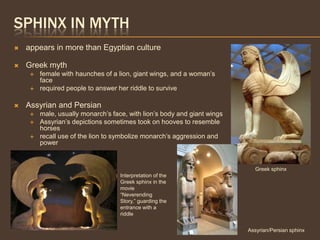
   appears in more than Egyptian culture

   Greek myth
        female with haunches of a lion, giant wings, and a woman’s
         face
        required people to answer her riddle to survive

   Assyrian and Persian
        male, usually monarch’s face, with lion’s body and giant wings
        Assyrian’s depictions sometimes took on hooves to resemble
         horses
        recall use of the lion to symbolize monarch’s aggression and
         power


                                                                            Greek sphinx
                                    Interpretation of the
                                    Greek sphinx in the
                                    movie
                                    “Neverending
                                    Story,” guarding the
                                    entrance with a
                                    riddle


                                                                          Assyrian/Persian sphinx
THE GREAT SPHINX
   largest monolith in the world and oldest surviving statue of
    antiquity
   241 feet long, 63 feet wide, and 66.5 feet high
   buried in sand for a large part of its life


                                                   The Great Sphinx buried
                                                   up to its chest in
                                                   sand, ca. early 1800s
THE GREAT SPHINX
    The Great Sphinx after the start of an
  excavation that only exposed the length
       of its body but little below its chest


                                                The Great Sphinx after another attempt at
                                                excavation in which the front portion and part of
                                                the walls and smaller buildings were exposed
CONSTRUCTION OF THE SPHINX

 U-shaped ditch
   for bedrock
      carving
  rear shelf of
   unfinished
     portions
shallower sections
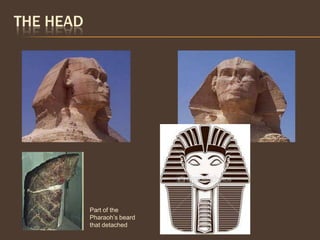
THE HEAD


           Part of the
           Pharaoh’s beard
           that detached
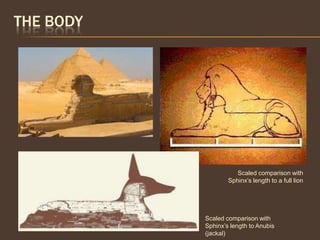
THE BODY


                      Scaled comparison with
                   Sphinx’s length to a full lion


           Scaled comparison with
           Sphinx’s length to Anubis
           (jackal)
THE FACE
EROSION

               water erosion on the walls surrounding
                             the Sphinx


          wind erosion on the front of the Sphinx

Ancient Egypt: The Sphinx

  • 1.
    Humanities I Dr. WhitneyVandiver Redlands Community College ANCIENT EGYPT: THE SPHINX
  • 2.
    SPHINX IN MYTH  appears in more than Egyptian culture  Greek myth  female with haunches of a lion, giant wings, and a woman’s face  required people to answer her riddle to survive  Assyrian and Persian  male, usually monarch’s face, with lion’s body and giant wings  Assyrian’s depictions sometimes took on hooves to resemble horses  recall use of the lion to symbolize monarch’s aggression and power Greek sphinx Interpretation of the Greek sphinx in the movie “Neverending Story,” guarding the entrance with a riddle Assyrian/Persian sphinx
  • 3.
    THE GREAT SPHINX  largest monolith in the world and oldest surviving statue of antiquity  241 feet long, 63 feet wide, and 66.5 feet high  buried in sand for a large part of its life The Great Sphinx buried up to its chest in sand, ca. early 1800s
  • 4.
    THE GREAT SPHINX The Great Sphinx after the start of an excavation that only exposed the length of its body but little below its chest The Great Sphinx after another attempt at excavation in which the front portion and part of the walls and smaller buildings were exposed
  • 5.
    CONSTRUCTION OF THESPHINX U-shaped ditch for bedrock carving rear shelf of unfinished portions shallower sections
  • 6.
    THE HEAD Part of the Pharaoh’s beard that detached
  • 7.
    THE BODY Scaled comparison with Sphinx’s length to a full lion Scaled comparison with Sphinx’s length to Anubis (jackal)
  • 8.
  • 9.
    EROSION water erosion on the walls surrounding the Sphinx wind erosion on the front of the Sphinx

Editor's Notes

  • #3 The sphinx is not a myth unique to Egyptian culture, though it has been popularized mostly through the Great Sphinx created by the Ancient Egyptians. Assyrian and Persian empires. In Greek mythology, the sphinx is a female with the haunches of a lion, usually depicted squatting or standing tall, and long wings that are either arched forward or span outward away from her body. As a creature of myth to be feared, as with a good part of Greek mythology, she was dangerous and required those who encountered her to answer her riddle. If they did so successfully, they were allowed to pass; if they failed, she would strangle them to death (Greek root for “sphinx” comes from the verb “to squeeze”). In Assyrian and Persian myth, the lion’s body and long wings remained a part of the creature, but the face was of a man, usually representing the power and aggression of the monarch. This is almost in reverse of the use of animal depictions of gods in Egyptian culture, which placed animal heads on human bodies, whereas other ancient cultures placed rulers’ heads on animal bodies. In this respect, the use of the sphinx in Egyptian culture is very unique because it follows other cultures’ patterns and puts a pharaoh’s head on the body of a lion.The sphinx continues to occur in popular culture as well. Depicted as the Greek female sphinx in the movie “Neverending Story,” the two statues guard a gate entrance and require a traveler to answer a riddle before passing; otherwise, the traveler will be killed—by lasers from their eyes rather than being mauled to death, but the representation and purpose are equally accomplished. After we have finished the ancient civilization section, I highly recommend watching this movie to see how ancient cultures’ symbols and myths are used in popular culture, especially particular genres of fiction, to create worlds that are foreign to ours while they are historically a part of our ancient history as humankind.
  • #4 Thutmose IV (1425-1417 BC) built and added a stela between the paws of the Sphinx commemorating a story wherein he fell asleep in the shade of the Sphinx, had a dream in which the Sphinx told him to clear away the sand to reveal her again, and after doing so he was rewarded by ruling Egypt. This tells us that as far back as the 15th Century BC, the Sphinx was already buried up to its chest in sand due to wind and lack of protection. When Napoleon’s troops arrived in Egypt in the late 1700s, they found the Sphinx buried in sand up to its neck. Multiple attempts were made to remove the sand and reveal the entire structure, but this was not accomplished in full until 1936, after many failed attempts. It is believed that it as the first time that the Sphinx was exposed in its entirety since before the beginning of the Common Era (AD). However, it has been determined that, since it is built out of soft sandstone, the covering of sand has actually preserved the rock and protected it from the elements of wind and sand erosion. If it had not been covered with sand, it is likely that the majority of the structure would have suffered irreparable damage and eventually have crumbled or fallen apart.
  • #5 Because the Sphinx is now fully exposed, the elements of sand and wind erosion tear away at the soft sandstone daily. As a large portion of the Sphinx has been investigated, along with some internal excavations, the majority of efforts now go toward preserving the structure rather than investigating its secrets. As a result, very few archeological investigations are permitted regarding the Sphinx or the Great Pyramids behind it, as it is thought that any more damage incurred beyond natural elements, such as removed stones or exposed pathways, might contribute to further decay of the structure and cause it to deteriorate at a faster rate.
  • #6 While the stones used to build the Sphinx were quarried, the quarry actually was the area in which the Sphinx was carved, allowing it to be carved rather than simply stacked and built. The first step was to dig a U-shaped ditch, which now surrounds the Sphinx as a wall, to allow for a huge block of bedrock to be accessible for carving, which would become the Sphinx. The deepest enclosure is at the rear shelf where some unfinished portions in the wall itself and questionable aspects of the back of the Sphinx are visible. Shallower shelves can be found to the north and toward the front. Despite being shallower, archeologists have discovered many additional features, such as a smaller blocks and structures, perhaps for workers, with some objects contained within.The hard limestone rock that was quarried from the bedrock of the Sphinx that was not used in carving the Sphinx was removed and used for the nearby Great Pyramids and smaller structures nearby, thereby making use of all of the material within a small distance. However, this is not to minimize the task. The stones used in the Pyramids were large and weighed 15-30 tons, depending on size. Somehow they were removed, carried or lifted out of the quarry, and then used in place in the Pyramids. Because the rock in the middle of the Sphinx is so soft and thought to be of poorer quality than was expected, some scholars suggest that the excavation and quarry of stone was solely to build the pyramids, but the Sphinx was contrived after it was decided that the stones were too poor of quality to use in the Pyramids; however, there is not evidence to suggest this, and it is just as likely, or more so, that the Sphinx was intended and the quarrying began for the Sphinx project in unison or in tandem with the construction of the Pyramids. This is supported by the layers of rock found in the walls of the Sphinx, which were the outside layers of the bedrock. They show poorer quality rock in the middle layers as well, which the construction team would have discovered immediately; therefore, the softer rock in the middle of the Sphinx should have been no surprise to the workers as they carved the statue.
  • #7 The elements included in the design of the Sphinx’s head make it clear that the depiction is that of a pharaoh, The common pharaoh’s headdress, which flares down the sides of the head and stops at the shoulders, surrounds the head; however, the full headdress is not included, meaning that it does not continue down the front of the shoulders. This could be intentional, though weathering could also have eroded a portion that once depicted the longer portion of the headdress. No pieces have been found on the site to suggest that, if they did erode and fall off as identifiable pieces, they were left on the site. They may have been shortened, though, to show the full body of the lion. The front of the forehead shows part of the headdress as well with what was most likely the symbol of a snake (probably cobra or asp) head protruding outward. While some of the outline of the snake remains, the majority of its figure is worn away. The headdress continued upward with other elements, such as feathers or a crown, as has been show in paintings and papyrus depictions of the Sphinx in later dynasties; however, wind and erosion have worn them away. In the 1800s holes were visible at the top of the head where the plumage would have been attached, but they are now filled in with sand and rock. While a fake beard, also a common element with pharaohs’ depictions, was likely included at some point, some scholars believe it was not included when it was first constructed due to a lack of damage from it falling off; however, had it been included in the original design, it is nearly impossible for it to have survived this long due to wind erosion and the amount of sand that encased the structure. It is assumed that, if it was initially included, it eventually detached from the face and the chin was smoothed out, but little support on the surface of the rocks is found to suggest this theory. Remains of what looks like pieces of the pharaoh’s beard, now divided among the British and Cairo museums, are of the design for later dynasties with rock that does not match the original quarries, suggesting even more that the beard was added later only to fall off before it was fully excavated in the modern age.The nose is known to have fallen off before 1400 AD; however, two primary theories arise. Because one can see where rods were inserted and chisels used as some point, allowing the nose to be torn off when pushed to the south of the face, many support the story of a Muslim ruler in the 14th Century AD, recorded by a 15th Century historian, who was angered by local peasants making offerings to the Sphinx with the hopes of improving harvests. The story says that he had the face of the Sphinx vandalized by removing the nose to show his power as stronger than that of the Egyptian gods. Other stories abound that the nose fell off due to a misaimed cannonball during Napoleon’s invasion; however, had the latter been true, it is likely that there would be more accounts of the occurrence. As a result, we are not entirely sure why or how the nose was removed, but we do know that it was removed forcefully and was not the result of wind erosion and poor construction.
  • #8 While up-close the head of the Sphinx might look proportionate with the body, at a distance (top left) it is obvious that the head is disproportionate and too small for the body. Additionally, the back portion, primarily the haunches, are too small for the overall length of the body, which is made much longer by the front legs and paws. While the body is 30:1, the head is only 22:1, a much smaller ratio. The image at the top right shows the comparison of the Sphinx’s body to that of a lion with the same length, showing that the remainder of the body is too small, including everything after the chest. Another comparison, this time with the body and head of a jackal (bottom) shows that the length and size of the body, including the paws, are proportionate with only the head being too small. Because of these disproportions, theories have been suggested that the statue was initially not carved with a human face but instead carved as a full animal, just as a jackal. To support this theory, the head would have needed to have either had a political reason to be replaced with a human’s likeness or have suffered severe damage or erosion so that a new face must have been carved from the existing rock, which would require the new head to be too small for the body with the original head being proportionate to the rest of the body. To this date, we have no documentation of the Sphinx with any other head than what it has now; however, if it were depicted in art or illustrations with another head but without a name, it would be difficult for archeologists to recognize that it is indeed the Sphinx with a different head as opposed to a completely different statue.
  • #9 Because of the theories that perhaps the face of the Sphinx is not original to its construction, along with the fact that we have found no texts or records or how, when, or why it was constructed, we do not know definitively who the face is mean to depict. The strongest case for a match is that of Pharaoh Khafre. In the late 20th Century, Egyptologists used the proposed dates of construction for the Sphinx to begin looking at rulers that might have initiated its construction. Among those was Khafre, for whom multiple statues and busts have been found intact to allow us to see what a 3D image of his face would look like. The Sphinx’s face has been damaged, which is the ultimate obstacle, but based on the structure of ancient Egyptian’s faces, anthropologists created what is thought to be a recreation of the Sphinx’s full face upon its completion (top right). When compared with a front view of a bust of Khafre (top left) and in silhouette form (bottom left), many believe that the match is almost 100%; however, keep in mind that this is based on an educated guess of what the Sphinx’s face looked like, which we can never definitively know. However, given the accepted time period in which the building is thought to have occurred and the pharaohs that were alive and capable of initiating such an undertaking, the suggestion that the face is that of Khafre is a somewhat excepted explanation, though no one states it as fact.
  • #10 In the early 1990s a geologist joined an Egyptologist to examine the types of erosion that had affected not only the Sphinx but the surrounding structures and wall. What they discovered was that while the majority of the erosion on the Sphinx were due to wind erosion, which leaves straight, jagged grooves, but the walls surrounding the Sphinx and which outline the quarry from which the Sphinx was carved had suffered what appeared to be rain erosion. While it isn’t necessarily unexpected that some rain, though very little, would have worn away at the rocks, the amount of water erosion was due to a prolonged exposure to rainfall and possibly periodic flooding in small degrees. This significantly affects the dating of the Sphinx and its structures because of the length of time it would take for the erosion to have reached its current state while also keeping in mind historical documents regarding the flooding of the area in certain dynasties. If the theory is correct, the Sphinx would pre-date Khafre, perhaps by as much as 1,000 years. Supporting an earlier dating system, some archaeologists have examined quarries around the Sphinx that relate to the causeway the was built to lead up to the Sphinx, showing that the rocks and work point to being quarried by Khufu, who was the father of Khafre. Consequently, the Sphinx would have already had to have been built when Khufu built the causeway, meaning that the face on the Sphinx could not have been Khafre if it was part of the original design.As a result of competing evidence and theories pulled from different areas of study, it is unclear in many respects who the face of Sphinx is meant to depict, which some going as far as to say that it is simply Amon Ra, the sun god, given the direction of the Sphinx toward the setting sun and its alignment with certain constellations; even less known is why it was built, as it does not house a burial chamber and little has been discovered regarding its actual purpose in being built, though it is thought that not all of its secrets have been discovered. Even attempts at accurately dating the structure are not conclusive, as different fields project different dynasties responsible for the construction. Finally, with a disproportionate head and body, we are unsure if what we see now is actually the initial design that was intended for the monument. As preservation and little investigation continues, more theories will surely arise, but it is unlikely that we will ever know for certain without documents or texts who is depicted with the face and why it was constructed in the first place.