By April Arreola
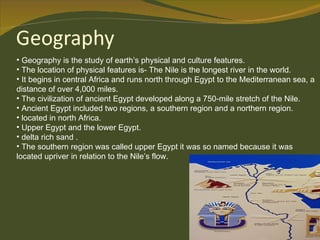
Geography is the study of earth’s physical and culture features. The location of physical features is- The Nile is the longest river in the world. It begins in central Africa and runs north through Egypt to the Mediterranean sea, a distance of over 4,000 miles. The civilization of ancient Egypt developed along a 750-mile stretch of the Nile. Ancient Egypt included two regions, a southern region and a northern region. located in north Africa. Upper Egypt and the lower Egypt. delta rich sand . The southern region was called upper Egypt it was so named because it was located upriver in relation to the Nile’s flow.
2700-2200 B.C. 2050-1750 B. C.E. 1550-1050 B.C E Khufu ruled 2551-2528 B.C.E. Senusret ruled 1971-1926  B.C.E. Tuthmosis1 ruled  1500-1450 B.C.E. Menes ruled 3100-2850  B.C.E. The old kingdom The middle kingdom  The  new kingdom Way Before 3000 BC 2000 BC 1000 BC 4000 BC
lasted  for  about  500  Years, 2700-2200  B.C. The  first  and  second  dynasties  ruled  Egypt  for  about  four  centuries .  A round  2700  B.C.  3 rd  dynast y started the Old Kingdom During this time , the Egyptians continued  to develop their political system. The system they developed was based on the belief that the pharaoh, the ruler Of Egypt ,was both a king and a god. The ancient Egyptians  believed  that  Egypt  belonged  to  the  gods. They  Believed that the pharaoh’s had come to earth in order to manage Egypt for of  The gods. As a result , he had absolute power over all  land  and people in Egypt. Pharaoh’s – The pharaoh’s ruled Egypt as a god . Nobles- Officials and priest helped run the government and temples. Scribes and craftspeople – scribes and Craftspeople wrote and produced goods. Farmers, Servants, and slaves- Most Egyptian were farmers, Servants, or slaves.
At the end of the old kingdom, the wealth and power of the pharaoh s  Declined . The middle kingdom was made in 2050-1750 B.C. In time, nobles gained enough power  to challenge the pharaohs.  By about 2200 B.C. the old kingdom had fallen.  For the next 160 years, local nobles ruled much of Egypt. The kingdom had no central ruler. Finally, around 2050 BC, a powerful pharaoh defeated his rivals , and once  Again all Egypt was united. His rule began the middle Kingdom, a period of  Order and stability which lasted to about 1750 BC. Toward the end of the middle kingdom, however, Egypt began to fall into  Disorder once more. Around 1750 BC, a group
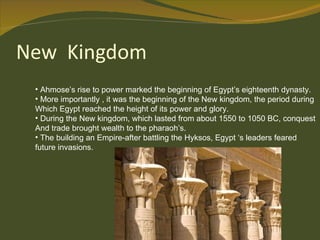
Ahmose’s rise to power marked the beginning of Egypt’s eighteenth dynasty. More importantly , it was the beginning of the New kingdom, the period during  Which Egypt reached the height of its power and glory. During the New kingdom, which lasted from about 1550 to 1050 BC, conquest  And trade brought wealth to the pharaoh’s. The building an Empire-after battling the Hyksos, Egypt ‘s leaders feared future invasions.
King tut – was the 12 th  ruler of Egypt in the eight dynasty. Queen Hatshepsut – is the 2 nd  female pharaoh. Khufu- was the builder of the great pyramid of Giza.

Ancient egypt. april

  • 1.
  • 2.
    Geography is thestudy of earth’s physical and culture features. The location of physical features is- The Nile is the longest river in the world. It begins in central Africa and runs north through Egypt to the Mediterranean sea, a distance of over 4,000 miles. The civilization of ancient Egypt developed along a 750-mile stretch of the Nile. Ancient Egypt included two regions, a southern region and a northern region. located in north Africa. Upper Egypt and the lower Egypt. delta rich sand . The southern region was called upper Egypt it was so named because it was located upriver in relation to the Nile’s flow.
  • 3.
    2700-2200 B.C. 2050-1750B. C.E. 1550-1050 B.C E Khufu ruled 2551-2528 B.C.E. Senusret ruled 1971-1926 B.C.E. Tuthmosis1 ruled 1500-1450 B.C.E. Menes ruled 3100-2850 B.C.E. The old kingdom The middle kingdom The new kingdom Way Before 3000 BC 2000 BC 1000 BC 4000 BC
  • 4.
    lasted for about 500 Years, 2700-2200 B.C. The first and second dynasties ruled Egypt for about four centuries . A round 2700 B.C. 3 rd dynast y started the Old Kingdom During this time , the Egyptians continued to develop their political system. The system they developed was based on the belief that the pharaoh, the ruler Of Egypt ,was both a king and a god. The ancient Egyptians believed that Egypt belonged to the gods. They Believed that the pharaoh’s had come to earth in order to manage Egypt for of The gods. As a result , he had absolute power over all land and people in Egypt. Pharaoh’s – The pharaoh’s ruled Egypt as a god . Nobles- Officials and priest helped run the government and temples. Scribes and craftspeople – scribes and Craftspeople wrote and produced goods. Farmers, Servants, and slaves- Most Egyptian were farmers, Servants, or slaves.
  • 5.
    At the endof the old kingdom, the wealth and power of the pharaoh s Declined . The middle kingdom was made in 2050-1750 B.C. In time, nobles gained enough power to challenge the pharaohs. By about 2200 B.C. the old kingdom had fallen. For the next 160 years, local nobles ruled much of Egypt. The kingdom had no central ruler. Finally, around 2050 BC, a powerful pharaoh defeated his rivals , and once Again all Egypt was united. His rule began the middle Kingdom, a period of Order and stability which lasted to about 1750 BC. Toward the end of the middle kingdom, however, Egypt began to fall into Disorder once more. Around 1750 BC, a group
  • 6.
    Ahmose’s rise topower marked the beginning of Egypt’s eighteenth dynasty. More importantly , it was the beginning of the New kingdom, the period during Which Egypt reached the height of its power and glory. During the New kingdom, which lasted from about 1550 to 1050 BC, conquest And trade brought wealth to the pharaoh’s. The building an Empire-after battling the Hyksos, Egypt ‘s leaders feared future invasions.
  • 7.
    King tut –was the 12 th ruler of Egypt in the eight dynasty. Queen Hatshepsut – is the 2 nd female pharaoh. Khufu- was the builder of the great pyramid of Giza.