CATHERINE JACOB
FINAL YEAR PART 1
CONTENTS
• INTRODUCTION
• DEFINITION
• SOURCES OF ANCHORAGE
• CLASSIFICATION OF ANCHORAGE
• ANCHORAGE SAVERS
• SKELETAL ANCHORAGE
• ANCHORAGE PLANNING
• ANCHORAGE LOSS
• REFERENCE
INTRODUCTION
Teeth can be moved orthodontically by subjecting them to force. However all teeth exhibit
certain amount of resistance to tooth movement
Certain teeth can be used as anchor units in order to move other teeth into a more desirable
position
Apart from teeth , other structures such as palate ,lingual alveolar supporting bone in the
mandible , the occiput and back of the neck can also be used as anchorage units .
DEFINITION
 Louis Ottofy (1923) defined it as “the base against which the orthodontic force or reaction of
orthodontic force is applied”
Graber defined it as “the nature and degree of resistance to displacement offered by an
anatomic unit for the purpose of effecting tooth movement”
White and Gardiner defined it as “ Anchorage is the site of delivery from which a force is
exerted”
Proffit defined it as “ resistance to unwanted tooth movement “
SOURCES OF ANCHORAGE
Intraoral Sources
• Teeth
• Alveolar bone
• Basal jaw bone
• Cortical bone
Extraoral Sources
• Cranium
• Facial bones
• Back of the neck ( Cervical bone )
Muscular Sources
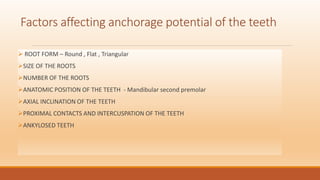
Factors affecting anchorage potential of the teeth
 ROOT FORM – Round , Flat , Triangular
SIZE OF THE ROOTS
NUMBER OF THE ROOTS
ANATOMIC POSITION OF THE TEETH - Mandibular second premolar
AXIAL INCLINATION OF THE TEETH
PROXIMAL CONTACTS AND INTERCUSPATION OF THE TEETH
ANKYLOSED TEETH
Anchorage value
The anchorage value of any tooth is roughly equivalent to its root surface
area.(Modified from Freeman DC.Root surface area related to anchorage in
the Begg technique.Memphis :University of Tennessee Department of
Orthodontics ,M.S Thesis ,1965)
INTRAORAL SOURCES OF ANCHORAGE MUSCULAR SOURCES OF ANCHORAGE
Nance palatal arch Lip bumper
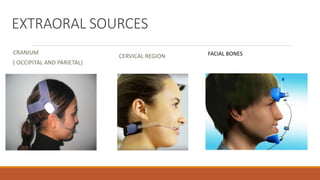
EXTRAORAL SOURCES
CRANIUM
( OCCIPITAL AND PARIETAL)
CERVICAL REGION FACIAL BONES
CLASSIFICATION OF ANCHORAGE
1.According to the manner of force application
1.Simple anchorage
2.Stationary anchorage
3.Reciprocal anchorage
2.According to the jaws involved
1.Intramaxillary anchorage
2.Intermaxillary anchorage
3.According to the site of anchorage
1.Intraoral anchorage
2.Extraoral anchorage
3.Muscular anchorage
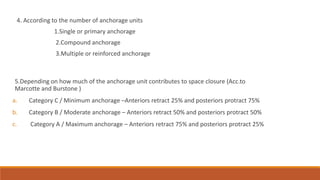
4. According to the number of anchorage units
1.Single or primary anchorage
2.Compound anchorage
3.Multiple or reinforced anchorage
5.Depending on how much of the anchorage unit contributes to space closure (Acc.to
Marcotte and Burstone )
a. Category C / Minimum anchorage –Anteriors retract 25% and posteriors protract 75%
b. Category B / Moderate anchorage – Anteriors retract 50% and posteriors protract 50%
c. Category A / Maximum anchorage – Anteriors retract 75% and posteriors protract 25%
1.SIMPLE ANCHORAGE 2.STATIONARY ANCHORAGE
ACCORDING TO THE MANNER OF FORCE APPLICATION
3.RECIPROCAL ANCHORAGE
Intermaxillary anchorage (Bakers anchorage.) Intramaxillary anchorage
ACCORDING TO THE JAWS INVOLVED
ACCORDING TO THE NUMBER OF ANCHOR UNITS
1. SINGLE ANCHORAGE 2. COMPOUND ANCHORAGE 3. REINFORCED /MULTIPLE
5.DEPENDING ON HOW MUCH OF THE ANCHORAGE UNIT CONTRIBUTES TO SPACE
CLOSURE (Marcotte and Burstone)
ANCHORAGE SAVERS
•Appliances or methods that reduce burden on anchor teeth.
•Examples are ;
 Headgear
Sved bite plane
Transpalatal arch
Lower lingual arch
Nance palatal arch etc….
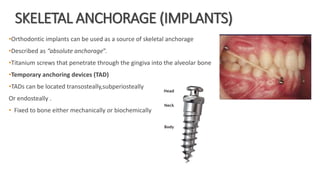
SKELETAL ANCHORAGE (IMPLANTS)
•Orthodontic implants can be used as a source of skeletal anchorage
•Described as “absolute anchorage”.
•Titanium screws that penetrate through the gingiva into the alveolar bone
•Temporary anchoring devices (TAD)
•TADs can be located transosteally,subperiosteally
Or endosteally .
• Fixed to bone either mechanically or biochemically
ANCHORAGE PLANNING
•Anchorage planning is very essential for the success of orthodontic treatment
•Anchorage requirement depends on factors like :
 Number of teeth being moved
 Type of teeth being moved
 Type of tooth movement
 Duration of tooth movement
ANCHORAGE LOSS
• Movement of the anchor unit instead of teeth to be moved.
• Gianelly and Goldman suggested terms maximum,moderate and minimum to
indicate the extent to which active and reactive unit should move when a force is
applied.
• Sometimes anchorage loss can be used for forward movement of molars .
REFERENCE
 Contemporary Orthodontics By William R Proffit (5th Edition)
Textbook of Orthodontics ,S Gowri Shankar ( 1 st Edition)
Grabers Textbook of Orthodontics ( 4th Edition)
British Dental Journal ,Volume 196 No.5 March 2004
(Anchorage Control and Distal Movement by D.Roberts Harry and J. Sandy )
Anchorage

Anchorage

  • 1.
  • 2.
    CONTENTS • INTRODUCTION • DEFINITION •SOURCES OF ANCHORAGE • CLASSIFICATION OF ANCHORAGE • ANCHORAGE SAVERS • SKELETAL ANCHORAGE • ANCHORAGE PLANNING • ANCHORAGE LOSS • REFERENCE
  • 3.
    INTRODUCTION Teeth can bemoved orthodontically by subjecting them to force. However all teeth exhibit certain amount of resistance to tooth movement Certain teeth can be used as anchor units in order to move other teeth into a more desirable position Apart from teeth , other structures such as palate ,lingual alveolar supporting bone in the mandible , the occiput and back of the neck can also be used as anchorage units .
  • 4.
    DEFINITION  Louis Ottofy(1923) defined it as “the base against which the orthodontic force or reaction of orthodontic force is applied” Graber defined it as “the nature and degree of resistance to displacement offered by an anatomic unit for the purpose of effecting tooth movement” White and Gardiner defined it as “ Anchorage is the site of delivery from which a force is exerted” Proffit defined it as “ resistance to unwanted tooth movement “
  • 5.
    SOURCES OF ANCHORAGE IntraoralSources • Teeth • Alveolar bone • Basal jaw bone • Cortical bone Extraoral Sources • Cranium • Facial bones • Back of the neck ( Cervical bone ) Muscular Sources
  • 6.
    Factors affecting anchoragepotential of the teeth  ROOT FORM – Round , Flat , Triangular SIZE OF THE ROOTS NUMBER OF THE ROOTS ANATOMIC POSITION OF THE TEETH - Mandibular second premolar AXIAL INCLINATION OF THE TEETH PROXIMAL CONTACTS AND INTERCUSPATION OF THE TEETH ANKYLOSED TEETH
  • 7.
    Anchorage value The anchoragevalue of any tooth is roughly equivalent to its root surface area.(Modified from Freeman DC.Root surface area related to anchorage in the Begg technique.Memphis :University of Tennessee Department of Orthodontics ,M.S Thesis ,1965)
  • 8.
    INTRAORAL SOURCES OFANCHORAGE MUSCULAR SOURCES OF ANCHORAGE Nance palatal arch Lip bumper
  • 9.
    EXTRAORAL SOURCES CRANIUM ( OCCIPITALAND PARIETAL) CERVICAL REGION FACIAL BONES
  • 10.
    CLASSIFICATION OF ANCHORAGE 1.Accordingto the manner of force application 1.Simple anchorage 2.Stationary anchorage 3.Reciprocal anchorage 2.According to the jaws involved 1.Intramaxillary anchorage 2.Intermaxillary anchorage 3.According to the site of anchorage 1.Intraoral anchorage 2.Extraoral anchorage 3.Muscular anchorage
  • 11.
    4. According tothe number of anchorage units 1.Single or primary anchorage 2.Compound anchorage 3.Multiple or reinforced anchorage 5.Depending on how much of the anchorage unit contributes to space closure (Acc.to Marcotte and Burstone ) a. Category C / Minimum anchorage –Anteriors retract 25% and posteriors protract 75% b. Category B / Moderate anchorage – Anteriors retract 50% and posteriors protract 50% c. Category A / Maximum anchorage – Anteriors retract 75% and posteriors protract 25%
  • 12.
    1.SIMPLE ANCHORAGE 2.STATIONARYANCHORAGE ACCORDING TO THE MANNER OF FORCE APPLICATION
  • 13.
  • 14.
    Intermaxillary anchorage (Bakersanchorage.) Intramaxillary anchorage ACCORDING TO THE JAWS INVOLVED
  • 15.
    ACCORDING TO THENUMBER OF ANCHOR UNITS 1. SINGLE ANCHORAGE 2. COMPOUND ANCHORAGE 3. REINFORCED /MULTIPLE
  • 16.
    5.DEPENDING ON HOWMUCH OF THE ANCHORAGE UNIT CONTRIBUTES TO SPACE CLOSURE (Marcotte and Burstone)
  • 17.
    ANCHORAGE SAVERS •Appliances ormethods that reduce burden on anchor teeth. •Examples are ;  Headgear Sved bite plane Transpalatal arch Lower lingual arch Nance palatal arch etc….
  • 18.
    SKELETAL ANCHORAGE (IMPLANTS) •Orthodonticimplants can be used as a source of skeletal anchorage •Described as “absolute anchorage”. •Titanium screws that penetrate through the gingiva into the alveolar bone •Temporary anchoring devices (TAD) •TADs can be located transosteally,subperiosteally Or endosteally . • Fixed to bone either mechanically or biochemically
  • 19.
    ANCHORAGE PLANNING •Anchorage planningis very essential for the success of orthodontic treatment •Anchorage requirement depends on factors like :  Number of teeth being moved  Type of teeth being moved  Type of tooth movement  Duration of tooth movement ANCHORAGE LOSS • Movement of the anchor unit instead of teeth to be moved. • Gianelly and Goldman suggested terms maximum,moderate and minimum to indicate the extent to which active and reactive unit should move when a force is applied. • Sometimes anchorage loss can be used for forward movement of molars .
  • 20.
    REFERENCE  Contemporary OrthodonticsBy William R Proffit (5th Edition) Textbook of Orthodontics ,S Gowri Shankar ( 1 st Edition) Grabers Textbook of Orthodontics ( 4th Edition) British Dental Journal ,Volume 196 No.5 March 2004 (Anchorage Control and Distal Movement by D.Roberts Harry and J. Sandy )