www.anchorcapital.co.za EMAIL: info@anchorcapital.co.zaTEL: +27 (0) 11 591 0677
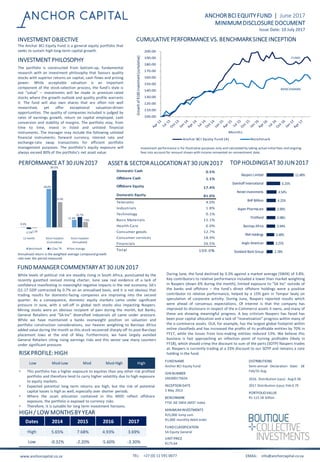
CUMULATIVEPERFORMANCEVS. BENCHMARKSINCEINCEPTION
The Anchor BCI Equity Fund is a general equity portfolio that
seeks to sustain high long-term capital growth.
The portfolio is constructed from bottom-up, fundamental
research with an investment philosophy that favours quality
stocks with superior returns on capital, cash flows and pricing
power. While acceptable valuation is an important
component of the stock-selection process, the fund’s style is
not “value” – investments will be made in premium-rated
stocks where the growth outlook and quality profile warrants
it. The fund will also own shares that are often not well
researched, yet offer exceptional valuation-driven
opportunities. The quality of companies included is judged by
rates of earnings growth, return on capital employed, cash
conversion and stability of margins. The portfolio may, from
time to time, invest in listed and unlisted financial
instruments. The manager may include the following unlisted
financial instruments: forward currency, interest rate and
exchange-rate swap transactions for efficient portfolio
management purposes. The portfolio‘s equity exposure will
always exceed 80% of the portfolio’s net asset value.
INVESTMENT OBJECTIVE
FUNDMANAGERCOMMENTARYAT 30 JUN 2017
While levels of political risk are steadily rising in South Africa, punctuated by the
recently gazetted revised mining charter, June saw real evidence of a lack of
confidence manifesting in meaningful negative impacts in the real economy. SA’s
Q1-17 GDP contracted by 0.7% on an annualised basis, and it is not obvious that
trading results for domestic-facing companies are improving into the second
quarter. As a consequence, domestic equity markets came under significant
pressure in June, with a sell-off in global tech stocks also impacting Naspers.
Mining stocks were an obvious recipient of pain during the month, but Banks,
General Retailers and “SA-Inc” diversified industrials all came under pressure.
While we have maintained a banks overweight position on valuation and
portfolio construction considerations, our heavier weighting to Barclays Africa
added value during the month as this stock recovered sharply off its post-Barclays
placement lows at the end of May. Furthermore, we have largely avoided
General Retailers citing rising earnings risks and this sector saw many counters
under significant pressure.
ANCHORBCIEQUITYFUND | June 2017
MINIMUM DISCLOSUREDOCUMENT
Issue Date: 10 July 2017
TOP HOLDINGSAT 30 JUN2017
INVESTMENT PHILOSOPHY
ASSET & SECTORALLOCATION AT 30 JUN 2017PERFORMANCEAT 30 JUN 2017
FUNDNAME
Anchor BCI Equity Fund
ISIN NUMBER
ZAE000175626
INCEPTION DATE
5 May 2013
BENCHMARK
FTSE JSE SWIX J403T index
MINIMUM INVESTMENTS
R25,000 lump sum
R1,000 monthly debit order
FUNDCLASSIFICATION
SA Equity General
UNIT PRICE
R175.64
DISTRIBUTIONS
Semi-annual Declaration Date: 28
Feb/31 Aug
2016: Distribution (cpu): Aug 0.58
2017 Distribution (cpu): Feb 0.79
PORTFOLIO VALUE
R1 115.18 billion
• This portfolio has a higher exposure to equities than any other risk profiled
portfolio and therefore tend to carry higher volatility due to high exposure
to equity markets.
• Expected potential long term returns are high, but the risk of potential
capital losses is high as well, especially over shorter periods.
• Where the asset allocation contained in this MDD reflect offshore
exposure, the portfolio is exposed to currency risks
• Therefore, it is suitable for long term investment horizons.
Mod-Low Mod Mod-HighLow High
HIGH / LOW MONTHSBY YEAR
RISKPROFILE:HIGH
2.78%
3.25%
3.48%
3.94%
3.98%
3.99%
4.25%
4.54%
6.25%
12.48%
Standard Bank Group
Anglo American
RMI Holdings
Barclays Africa
FirstRand
Aspen Pharmacare
BHP Billiton
Reinet Investments
Steinhoff International
Naspers Limited
100.00
110.00
120.00
130.00
140.00
150.00
160.00
170.00
180.00
190.00
200.00
GrowthofR100investment(cumulative)
Months
Anchor BCI Equity Fund (A) Benchmark
FUND
BENCHMARK
0.3%
58.0%
11.4%
-2.1%
85.5%
15.7%
-1.1%
37.9%
7.9%
12-month Since inception
(Cumulative)
Since inception
(Annualised)
Benchmark A Class TR Peer Average
Dates 2014 2015 2016 2017
High 5.65% 7.68% 4.93% 3.69%
Low -0.32% -2.20% -5.60% -3.30%
Domestic Cash 0.5%
Offshore Cash 1.1%
Offshore Equity 17.4%
Domestic Equity 81.0%
Telecoms 4.0%
Industrials 1.8%
Technology 0.1%
Basic Materials 11.1%
Health Care 6.0%
Consumer goods 12.7%
Consumer services 18.9%
Financials 26.5%
Total 100.0%
Annualised return is the weighted average compound growth
rate over the period measured
Investment performance is for illustrative purposes only and calculated by taking actual initial fees and ongoing
fees into account for amount shown with income reinvested on reinvestment date.
During June, the fund declined by 3.3% against a market average (SWIX) of 3.8%.
Key contributors to relative performance included a lower than market weighting
in Naspers (down 6% during the month), limited exposure to “SA Inc” outside of
the banks and offshore – the fund’s direct offshore holdings were a positive
contributor to relative performance, helped by a 15% gain in Tempur Sealy on
speculation of corporate activity. During June, Naspers reported results which
were ahead of consensus expectations. Of interest is that the company has
improved its disclosure in respect of the e-Commerce assets it owns, and many of
these are showing meaningful progress. A key criticism Naspers has faced has
been poor capital allocation and a lack of “monetisation” progress within many of
the e-commerce assets. OLX, for example, has the largest global footprint within
online classifieds and has increased the profits of its profitable entities by 70% in
FY17, while the losses from loss-making entities reduced 13%. We believe this
business is fast approaching an inflection point of turning profitable (likely in
FY18), which should crimp the discount to sum of the parts (SOTP) Naspers trades
at. Naspers is currently trading at a 33% discount to our SOTP and remains a core
holding in the fund.
www.anchorcapital.co.za EMAIL: info@anchorcapital.co.zaTEL: +27 (0) 11 591 0677
DISCLAIMER
Boutique Collective Investments (RF) (Pty) Ltd (“BCI”) is a registered Manager of the Boutique Collective Investments Scheme, approved in terms of the Collective Investments Schemes Control Act, No 45
of 2002 and is a full member of the Association for Savings and Investment SA. Collective Investment Schemes in securities are generally medium to long term investments. The value of participatory
interests may go up or down and past performance is not necessarily an indication of future performance. The Manager does not guarantee the capital or the return of a portfolio. Collective Investments
are traded at ruling prices and can engage in borrowing and scrip lending. A schedule of fees, charges and maximum commissions is available on request. BCI reserves the right to close the portfolio to
new investors and reopen certain portfolios from time to time in order to manage them more efficiently. Additional information, including application forms, annual or quarterly reports can be obtained
from BCI, free of charge. Performance figures quoted for the portfolio are from Morningstar, as at the date of this document for a lump sum investment, using NAV-NAV with income reinvested and do
not take any upfront manager’s charge into account. Income distributions are declared on the ex-dividend date. Actual investment performance will differ based on the initial fees charge applicable, the
actual investment date, the date of reinvestment and dividend withholding tax. Investments in foreign securities may include additional risks such as potential constraints on liquidity and repatriation of
funds, macroeconomic risk, political risk, foreign exchange risk, tax risk, settlement risk as well as potential limitations on the availability of market information.
Certain investments - including those involving futures, options, equity swaps, and other derivatives may give rise to substantial risk and might not be suitable
for all investors.Boutique Collective Investments (RF) Pty Ltd retains full legal responsibility for the third party named portfolio. Although reasonable steps
have been taken to ensure the validity and accuracy of the information in this document, BCI does not accept any responsibility for any claim, damages, loss
or expense, however it arises, out of or in connection with the information in this document, whether by a client, investor or intermediary. This document
should not be seen as an offer to purchase any specific product and is not to be construed as advice or guidance in any form whatsoever. Investors are
encouraged to obtain independent professional investment and taxation advice before investing with or in any of BCI/the Manager’s products.
Initialfees (BCI) (incl VAT) 0.00%
AdvisoryFee (Max) (inclVAT) 3.42%
OngoingAdvisory Fee (Max)(InclVAT) 1.14%
Annual ManagementFee (inclVAT)
Class A 1.14%
Performance fee None
TER andTransaction Costs (inclVAT)
Basic 1.23%
Portfolio Transaction Cost 0.73%
Total Investment Charge 1.96%
A higher TER ratio does not necessarily imply a poor return, nor
does a low TER imply a good return. The current TER cannot be
regarded as an indication of future TER's.
Transaction Costs are a necessary cost in administering the Fund
and impacts Fund returns. It should not be considered in isolation
as returns may be impacted by many other factors over time
including market returns, the type of Fund, the investment
decisions of the investment manager and the TER. The TER and
Transaction cost is calculated for the 3 year period (annualised)
ending 31 March 2017.
FAIS CONFLICTOF INTERESTDISCLOSURE
Please note that your financial advisor may be a related party to the
co-naming partner and/or BCI. It is your financial advisor’s
responsibility to disclose all fees he/she receives from any related
party. The portfolio’s TER includes all fees paid by portfolio to BCI,
the trustees, the auditors, banks, the co-naming partner, underlying
portfolios, and any other investment consultants/ managers as well
as distribution fees and LISP rebates, if applicable. The portfolio’s
performance numbers are calculated net of the TER expenses. The
investment manager earns a portion of the service charge and
performance fees where applicable. In some instance portfolios
invest in other portfolios which forms part of the BCI Schemes.
These investments will be detailed in this document, as applicable.
Boutique Collective Investments adopted the ASISA Standard on
Effective Annual Cost ("EAC"). The EAC measure allows you to
compare charges on your investments as well as their impact on
your investment returns prior to investing. For further information
regarding the ASISA Standard on Effective Annual Cost and access to
the EAC calculator please visit our website at www.bcis.co.za.
FEES & FAIS DISCLOSURE
AccountHolder Boutique Collective Investments RF
(Pty) Ltd Operations Account
AccountNumber 41-143-612-0
Bank Standard Bank
Branch Menlyn
BranchCode 012345
ValuationTime 15h00
Transaction Time 14h00
Reference Initials and Surname
Please send proof of deposit to Fax (011) 263 6152 or email
instructions@bci-transact.co.za
SUBSCRIPTIONS INFORMATIONAND DISCLOSURES
Investment Manager
Anchor Capital is an authorised Financial Services Provider FSP 39834.
• Additional information, including application forms, annual or quarterly reports can be obtained from BCI, free of
charge or can be accessed on our website (www.bcis.co.za)
• Valuation takes place daily and prices can be viewed on our website (www.bcis.co.za) or in the daily newspaper.
• Actual annual percentage figures are available to existing investors on request.
• Upon request the Manager will provide the investor with quarterly portfolio investment holdings reports.
Management CompanyInformation
Boutique Collective Investments (RF) (Pty) Ltd
Catnia Building
Bella Rosa Village, Bella Rosa Street
Belville, 7530
Tel: 021 007 1500/1/2 | 021 914 1880, Fax: 086 502 5319
Email: clientservices@bcis.co.za
www.bcis.co.za
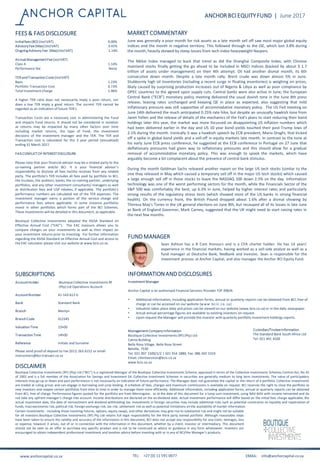
MARKET COMMENTARY
ANCHORBCIEQUITYFUND | June 2017
June was generally a poor month for risk assets as a late month sell off saw most major global equity
indices end the month in negative territory. This followed through to the JSE, which lost 3.8% during
the month, heavily skewed by steep losses from tech index heavyweight Naspers.
The Nikkei Index managed to buck that trend as did the Shanghai Composite Index, with Chinese
mainland stocks finally getting the go ahead to be included in MSCI Indices (backed by about $ 1.7
trillion of assets under management) on their 4th attempt. Oil had another dismal month, its 6th
consecutive down month. Despite a late month rally, Brent crude was down almost 5% in June.
Stubbornly high oil inventories (including a recent surge in floating inventories) is weighing on prices,
likely caused by surprising production increases out of Nigeria & Libya as well as poor compliance by
OPEC countries to the agreed upon supply cuts. Central banks were also active in June; the European
Central Bank (“ECB”) monetary policy meeting delivered the usual dovish tone in the June 8th press
release, leaving rates unchanged and keeping QE in place as expected, also suggesting that mild
inflationary pressure was still supportive of accommodative monetary policy. The US Fed meeting on
June 14th delivered the much anticipated 0.25% rate hike, but despite an unusually hawkish tone from
Janet Yellen and the release of details of the mechanics of the Fed’s plans to start reducing their bond
holdings later this year, the market was more focussed on disappointing US inflation numbers which
had been delivered earlier in the day and US 10 year bond yields touched their post-Trump lows of
2.1% during the month. Ironically it was a hawkish speech by ECB president, Mario Draghi, that kicked
off a spike in global bond yields and a sell-off in equity markets late month. In contrast to the tone at
his early June ECB press conference, he suggested at the ECB conference in Portugal on 27 June that
deflationary pressures had given way to reflationary pressures and this should allow for a gradual
removal of accommodative monetary policy. This was enough to spook the markets, which have
arguably become a bit complacent about the presence of central bank stimulus.
During the month Goldman Sachs released another report on the large US tech stocks (similar to the
one they released in May which caused a temporary sell off in the major US tech stocks) which caused
a large enough sell off in those stocks to leave the NASDAQ 100 down 2.5% on the day. Information
technology was one of the worst performing sectors for the month, while the Financials Sector of the
S&P 500 was comfortably the best, up 6.3% in June, helped by higher interest rates and particularly
strong results of the regulatory stress tests (which showed most of the US banks in strong financial
health). On the currency front, the British Pound dropped about 1.6% after a dismal showing by
Theresa May’s Tories in the UK general elections on June 8th, but recouped all of its losses in late June
as Bank of England Governor, Mark Carney, suggested that the UK might need to start raising rates in
the next few months.
Custodian/TrusteeInformation
The Standard Bank South Africa Ltd
Tel: 021 441 4100
FUNDMANAGER
Sean Ashton has a B Com Honours and is a CFA charter holder. He has 14 years’
experience in the financial markets, having worked as a sell-side analyst as well as a
fund manager at Deutsche Bank, Nedbank and Investec. Sean is responsible for the
investment process at Anchor Capital, and also manages the Anchor BCI Equity Fund.

Anchor bci equity fund

  • 1.
    www.anchorcapital.co.za EMAIL: info@anchorcapital.co.zaTEL:+27 (0) 11 591 0677 CUMULATIVEPERFORMANCEVS. BENCHMARKSINCEINCEPTION The Anchor BCI Equity Fund is a general equity portfolio that seeks to sustain high long-term capital growth. The portfolio is constructed from bottom-up, fundamental research with an investment philosophy that favours quality stocks with superior returns on capital, cash flows and pricing power. While acceptable valuation is an important component of the stock-selection process, the fund’s style is not “value” – investments will be made in premium-rated stocks where the growth outlook and quality profile warrants it. The fund will also own shares that are often not well researched, yet offer exceptional valuation-driven opportunities. The quality of companies included is judged by rates of earnings growth, return on capital employed, cash conversion and stability of margins. The portfolio may, from time to time, invest in listed and unlisted financial instruments. The manager may include the following unlisted financial instruments: forward currency, interest rate and exchange-rate swap transactions for efficient portfolio management purposes. The portfolio‘s equity exposure will always exceed 80% of the portfolio’s net asset value. INVESTMENT OBJECTIVE FUNDMANAGERCOMMENTARYAT 30 JUN 2017 While levels of political risk are steadily rising in South Africa, punctuated by the recently gazetted revised mining charter, June saw real evidence of a lack of confidence manifesting in meaningful negative impacts in the real economy. SA’s Q1-17 GDP contracted by 0.7% on an annualised basis, and it is not obvious that trading results for domestic-facing companies are improving into the second quarter. As a consequence, domestic equity markets came under significant pressure in June, with a sell-off in global tech stocks also impacting Naspers. Mining stocks were an obvious recipient of pain during the month, but Banks, General Retailers and “SA-Inc” diversified industrials all came under pressure. While we have maintained a banks overweight position on valuation and portfolio construction considerations, our heavier weighting to Barclays Africa added value during the month as this stock recovered sharply off its post-Barclays placement lows at the end of May. Furthermore, we have largely avoided General Retailers citing rising earnings risks and this sector saw many counters under significant pressure. ANCHORBCIEQUITYFUND | June 2017 MINIMUM DISCLOSUREDOCUMENT Issue Date: 10 July 2017 TOP HOLDINGSAT 30 JUN2017 INVESTMENT PHILOSOPHY ASSET & SECTORALLOCATION AT 30 JUN 2017PERFORMANCEAT 30 JUN 2017 FUNDNAME Anchor BCI Equity Fund ISIN NUMBER ZAE000175626 INCEPTION DATE 5 May 2013 BENCHMARK FTSE JSE SWIX J403T index MINIMUM INVESTMENTS R25,000 lump sum R1,000 monthly debit order FUNDCLASSIFICATION SA Equity General UNIT PRICE R175.64 DISTRIBUTIONS Semi-annual Declaration Date: 28 Feb/31 Aug 2016: Distribution (cpu): Aug 0.58 2017 Distribution (cpu): Feb 0.79 PORTFOLIO VALUE R1 115.18 billion • This portfolio has a higher exposure to equities than any other risk profiled portfolio and therefore tend to carry higher volatility due to high exposure to equity markets. • Expected potential long term returns are high, but the risk of potential capital losses is high as well, especially over shorter periods. • Where the asset allocation contained in this MDD reflect offshore exposure, the portfolio is exposed to currency risks • Therefore, it is suitable for long term investment horizons. Mod-Low Mod Mod-HighLow High HIGH / LOW MONTHSBY YEAR RISKPROFILE:HIGH 2.78% 3.25% 3.48% 3.94% 3.98% 3.99% 4.25% 4.54% 6.25% 12.48% Standard Bank Group Anglo American RMI Holdings Barclays Africa FirstRand Aspen Pharmacare BHP Billiton Reinet Investments Steinhoff International Naspers Limited 100.00 110.00 120.00 130.00 140.00 150.00 160.00 170.00 180.00 190.00 200.00 GrowthofR100investment(cumulative) Months Anchor BCI Equity Fund (A) Benchmark FUND BENCHMARK 0.3% 58.0% 11.4% -2.1% 85.5% 15.7% -1.1% 37.9% 7.9% 12-month Since inception (Cumulative) Since inception (Annualised) Benchmark A Class TR Peer Average Dates 2014 2015 2016 2017 High 5.65% 7.68% 4.93% 3.69% Low -0.32% -2.20% -5.60% -3.30% Domestic Cash 0.5% Offshore Cash 1.1% Offshore Equity 17.4% Domestic Equity 81.0% Telecoms 4.0% Industrials 1.8% Technology 0.1% Basic Materials 11.1% Health Care 6.0% Consumer goods 12.7% Consumer services 18.9% Financials 26.5% Total 100.0% Annualised return is the weighted average compound growth rate over the period measured Investment performance is for illustrative purposes only and calculated by taking actual initial fees and ongoing fees into account for amount shown with income reinvested on reinvestment date. During June, the fund declined by 3.3% against a market average (SWIX) of 3.8%. Key contributors to relative performance included a lower than market weighting in Naspers (down 6% during the month), limited exposure to “SA Inc” outside of the banks and offshore – the fund’s direct offshore holdings were a positive contributor to relative performance, helped by a 15% gain in Tempur Sealy on speculation of corporate activity. During June, Naspers reported results which were ahead of consensus expectations. Of interest is that the company has improved its disclosure in respect of the e-Commerce assets it owns, and many of these are showing meaningful progress. A key criticism Naspers has faced has been poor capital allocation and a lack of “monetisation” progress within many of the e-commerce assets. OLX, for example, has the largest global footprint within online classifieds and has increased the profits of its profitable entities by 70% in FY17, while the losses from loss-making entities reduced 13%. We believe this business is fast approaching an inflection point of turning profitable (likely in FY18), which should crimp the discount to sum of the parts (SOTP) Naspers trades at. Naspers is currently trading at a 33% discount to our SOTP and remains a core holding in the fund.
  • 2.
    www.anchorcapital.co.za EMAIL: info@anchorcapital.co.zaTEL:+27 (0) 11 591 0677 DISCLAIMER Boutique Collective Investments (RF) (Pty) Ltd (“BCI”) is a registered Manager of the Boutique Collective Investments Scheme, approved in terms of the Collective Investments Schemes Control Act, No 45 of 2002 and is a full member of the Association for Savings and Investment SA. Collective Investment Schemes in securities are generally medium to long term investments. The value of participatory interests may go up or down and past performance is not necessarily an indication of future performance. The Manager does not guarantee the capital or the return of a portfolio. Collective Investments are traded at ruling prices and can engage in borrowing and scrip lending. A schedule of fees, charges and maximum commissions is available on request. BCI reserves the right to close the portfolio to new investors and reopen certain portfolios from time to time in order to manage them more efficiently. Additional information, including application forms, annual or quarterly reports can be obtained from BCI, free of charge. Performance figures quoted for the portfolio are from Morningstar, as at the date of this document for a lump sum investment, using NAV-NAV with income reinvested and do not take any upfront manager’s charge into account. Income distributions are declared on the ex-dividend date. Actual investment performance will differ based on the initial fees charge applicable, the actual investment date, the date of reinvestment and dividend withholding tax. Investments in foreign securities may include additional risks such as potential constraints on liquidity and repatriation of funds, macroeconomic risk, political risk, foreign exchange risk, tax risk, settlement risk as well as potential limitations on the availability of market information. Certain investments - including those involving futures, options, equity swaps, and other derivatives may give rise to substantial risk and might not be suitable for all investors.Boutique Collective Investments (RF) Pty Ltd retains full legal responsibility for the third party named portfolio. Although reasonable steps have been taken to ensure the validity and accuracy of the information in this document, BCI does not accept any responsibility for any claim, damages, loss or expense, however it arises, out of or in connection with the information in this document, whether by a client, investor or intermediary. This document should not be seen as an offer to purchase any specific product and is not to be construed as advice or guidance in any form whatsoever. Investors are encouraged to obtain independent professional investment and taxation advice before investing with or in any of BCI/the Manager’s products. Initialfees (BCI) (incl VAT) 0.00% AdvisoryFee (Max) (inclVAT) 3.42% OngoingAdvisory Fee (Max)(InclVAT) 1.14% Annual ManagementFee (inclVAT) Class A 1.14% Performance fee None TER andTransaction Costs (inclVAT) Basic 1.23% Portfolio Transaction Cost 0.73% Total Investment Charge 1.96% A higher TER ratio does not necessarily imply a poor return, nor does a low TER imply a good return. The current TER cannot be regarded as an indication of future TER's. Transaction Costs are a necessary cost in administering the Fund and impacts Fund returns. It should not be considered in isolation as returns may be impacted by many other factors over time including market returns, the type of Fund, the investment decisions of the investment manager and the TER. The TER and Transaction cost is calculated for the 3 year period (annualised) ending 31 March 2017. FAIS CONFLICTOF INTERESTDISCLOSURE Please note that your financial advisor may be a related party to the co-naming partner and/or BCI. It is your financial advisor’s responsibility to disclose all fees he/she receives from any related party. The portfolio’s TER includes all fees paid by portfolio to BCI, the trustees, the auditors, banks, the co-naming partner, underlying portfolios, and any other investment consultants/ managers as well as distribution fees and LISP rebates, if applicable. The portfolio’s performance numbers are calculated net of the TER expenses. The investment manager earns a portion of the service charge and performance fees where applicable. In some instance portfolios invest in other portfolios which forms part of the BCI Schemes. These investments will be detailed in this document, as applicable. Boutique Collective Investments adopted the ASISA Standard on Effective Annual Cost ("EAC"). The EAC measure allows you to compare charges on your investments as well as their impact on your investment returns prior to investing. For further information regarding the ASISA Standard on Effective Annual Cost and access to the EAC calculator please visit our website at www.bcis.co.za. FEES & FAIS DISCLOSURE AccountHolder Boutique Collective Investments RF (Pty) Ltd Operations Account AccountNumber 41-143-612-0 Bank Standard Bank Branch Menlyn BranchCode 012345 ValuationTime 15h00 Transaction Time 14h00 Reference Initials and Surname Please send proof of deposit to Fax (011) 263 6152 or email instructions@bci-transact.co.za SUBSCRIPTIONS INFORMATIONAND DISCLOSURES Investment Manager Anchor Capital is an authorised Financial Services Provider FSP 39834. • Additional information, including application forms, annual or quarterly reports can be obtained from BCI, free of charge or can be accessed on our website (www.bcis.co.za) • Valuation takes place daily and prices can be viewed on our website (www.bcis.co.za) or in the daily newspaper. • Actual annual percentage figures are available to existing investors on request. • Upon request the Manager will provide the investor with quarterly portfolio investment holdings reports. Management CompanyInformation Boutique Collective Investments (RF) (Pty) Ltd Catnia Building Bella Rosa Village, Bella Rosa Street Belville, 7530 Tel: 021 007 1500/1/2 | 021 914 1880, Fax: 086 502 5319 Email: clientservices@bcis.co.za www.bcis.co.za MARKET COMMENTARY ANCHORBCIEQUITYFUND | June 2017 June was generally a poor month for risk assets as a late month sell off saw most major global equity indices end the month in negative territory. This followed through to the JSE, which lost 3.8% during the month, heavily skewed by steep losses from tech index heavyweight Naspers. The Nikkei Index managed to buck that trend as did the Shanghai Composite Index, with Chinese mainland stocks finally getting the go ahead to be included in MSCI Indices (backed by about $ 1.7 trillion of assets under management) on their 4th attempt. Oil had another dismal month, its 6th consecutive down month. Despite a late month rally, Brent crude was down almost 5% in June. Stubbornly high oil inventories (including a recent surge in floating inventories) is weighing on prices, likely caused by surprising production increases out of Nigeria & Libya as well as poor compliance by OPEC countries to the agreed upon supply cuts. Central banks were also active in June; the European Central Bank (“ECB”) monetary policy meeting delivered the usual dovish tone in the June 8th press release, leaving rates unchanged and keeping QE in place as expected, also suggesting that mild inflationary pressure was still supportive of accommodative monetary policy. The US Fed meeting on June 14th delivered the much anticipated 0.25% rate hike, but despite an unusually hawkish tone from Janet Yellen and the release of details of the mechanics of the Fed’s plans to start reducing their bond holdings later this year, the market was more focussed on disappointing US inflation numbers which had been delivered earlier in the day and US 10 year bond yields touched their post-Trump lows of 2.1% during the month. Ironically it was a hawkish speech by ECB president, Mario Draghi, that kicked off a spike in global bond yields and a sell-off in equity markets late month. In contrast to the tone at his early June ECB press conference, he suggested at the ECB conference in Portugal on 27 June that deflationary pressures had given way to reflationary pressures and this should allow for a gradual removal of accommodative monetary policy. This was enough to spook the markets, which have arguably become a bit complacent about the presence of central bank stimulus. During the month Goldman Sachs released another report on the large US tech stocks (similar to the one they released in May which caused a temporary sell off in the major US tech stocks) which caused a large enough sell off in those stocks to leave the NASDAQ 100 down 2.5% on the day. Information technology was one of the worst performing sectors for the month, while the Financials Sector of the S&P 500 was comfortably the best, up 6.3% in June, helped by higher interest rates and particularly strong results of the regulatory stress tests (which showed most of the US banks in strong financial health). On the currency front, the British Pound dropped about 1.6% after a dismal showing by Theresa May’s Tories in the UK general elections on June 8th, but recouped all of its losses in late June as Bank of England Governor, Mark Carney, suggested that the UK might need to start raising rates in the next few months. Custodian/TrusteeInformation The Standard Bank South Africa Ltd Tel: 021 441 4100 FUNDMANAGER Sean Ashton has a B Com Honours and is a CFA charter holder. He has 14 years’ experience in the financial markets, having worked as a sell-side analyst as well as a fund manager at Deutsche Bank, Nedbank and Investec. Sean is responsible for the investment process at Anchor Capital, and also manages the Anchor BCI Equity Fund.