By: Dr. Ahmed Rabah
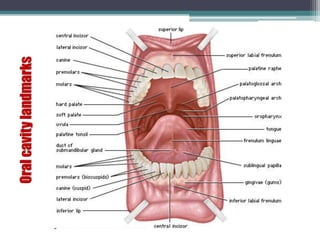
Oralcavitylandmarks
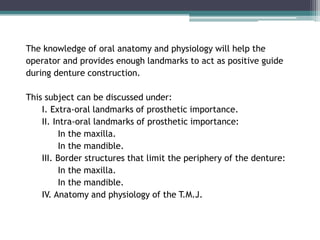
The knowledge of oral anatomy and physiology will help the
operator and provides enough landmarks to act as positive guide
during denture construction.
This subject can be discussed under:
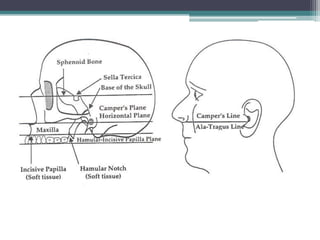
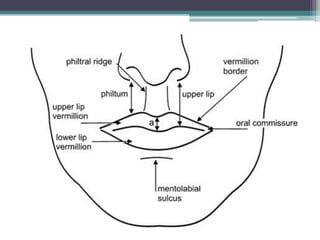
I. Extra-oral landmarks of prosthetic importance.
II. Intra-oral landmarks of prosthetic importance:
In the maxilla.
In the mandible.
III. Border structures that limit the periphery of the denture:
In the maxilla.
In the mandible.
IV. Anatomy and physiology of the T.M.J.
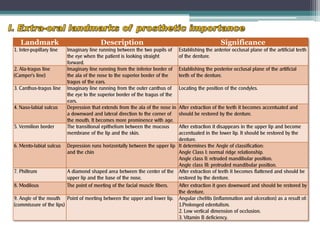
Landmark Description Significance
Angle’s class II Angle’s calss I Angle’s class III
Inter-pupillary line
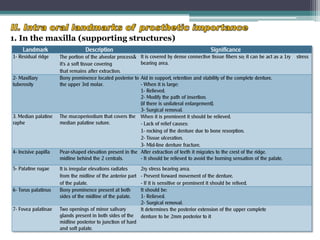
1. In the maxilla (supporting structures)
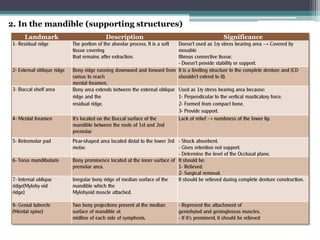
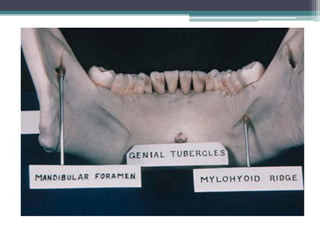
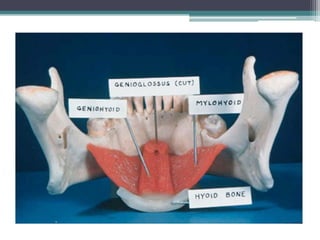
2. In the mandible (supporting structures)
Landmark Description Significance
→
→
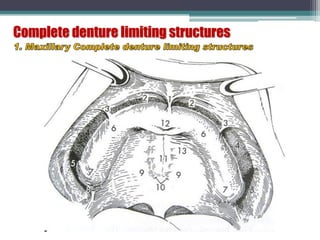
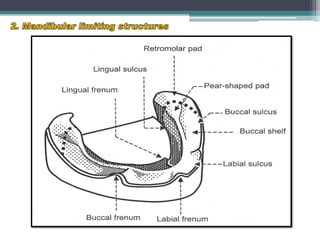
Complete denture limiting structures
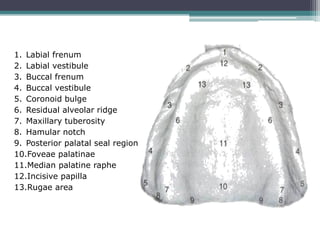
1. Labial frenum
2. Labial vestibule
3. Buccal frenum
4. Buccal vestibule
5. Coronoid bulge
6. Residual alveolar ridge
7. Maxillary tuberosity
8. Hamular notch
9. Posterior palatal seal region
10.Foveae palatinae
11.Median palatine raphe
12.Incisive papilla
13.Rugae area
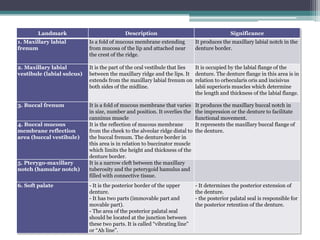
Landmark Description Significance
1. Maxillary labial
frenum
Is a fold of mucous membrane extending
from mucosa of the lip and attached near
the crest of the ridge.
It produces the maxillary labial notch in the
denture border.
2. Maxillary labial
vestibule (labial sulcus)
It is the part of the oral vestibule that lies
between the maxillary ridge and the lips. It
extends from the maxillary labial frenum on
both sides of the midline.
It is occupied by the labial flange of the
denture. The denture flange in this area is in
relation to orbecularis oris and incisivus
labii superioris muscles which determine
the length and thickness of the labial flange.
3. Buccal frenum It is a fold of mucous membrane that varies
in size, number and position. It overlies the
canninus muscle
It produces the maxillary buccal notch in
the impression or the denture to facilitate
functional movement.
4. Buccal mucous
membrane reflection
area (buccal vestibule)
It is the reflection of mucous membrane
from the cheek to the alveolar ridge distal to
the buccal frenum. The denture border in
this area is in relation to buccinator muscle
which limits the height and thickness of the
denture border.
It represents the maxillary buccal flange of
the denture.
5. Pterygo-maxillary
notch (hamular notch)
It is a narrow cleft between the maxillary
tuberosity and the peterygoid hamulus and
filled with connective tissue.
6. Soft palate - It is the posterior border of the upper
denture.
- It has two parts (immovable part and
movable part).
- The area of the posterior palatal seal
should be located at the junction between
these two parts. It is called ā€œvibrating lineā€
or ā€œAh lineā€.
- It determines the posterior extension of
the denture.
- the posterior palatal seal is responsible for
the posterior retention of the denture.
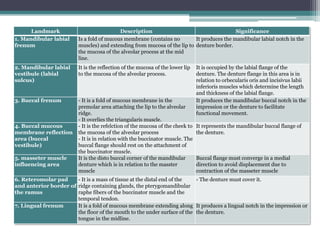
Landmark Description Significance
1. Mandibular labial
frenum
Is a fold of mucous membrane (contains no
muscles) and extending from mucosa of the lip to
the mucosa of the alveolar process at the mid
line.
It produces the mandibular labial notch in the
denture border.
2. Mandibular labial
vestibule (labial
sulcus)
It is the reflection of the mucosa of the lower lip
to the mucosa of the alveolar process.
It is occupied by the labial flange of the
denture. The denture flange in this area is in
relation to orbecularis oris and incisivus labii
inferioris muscles which determine the length
and thickness of the labial flange.
3. Buccal frenum - It is a fold of mucous membrane in the
premolar area attaching the lip to the alveolar
ridge.
- It overlies the triangularis muscle.
It produces the mandibular buccal notch in the
impression or the denture to facilitate
functional movement.
4. Buccal mucous
membrane reflection
area (buccal
vestibule)
- It is the refelction of the mucosa of the cheek to
the mucosa of the alveolar process
- It is in relation with the buccinator muscle. The
buccal flange should rest on the attachment of
the buccinator muscle.
It represents the mandibular buccal flange of
the denture.
5. masseter muscle
influencing area
It is the disto buccal corner of the mandibular
denture which is in relation to the masster
muscle
Buccal flange must converge in a medial
direction to avoid displacement due to
contraction of the masseter muscle
6. Reteromolar pad
and anterior border of
the ramus
- It is a mass of tissue at the distal end of the
ridge containing glands, the pterygomandibular
raphe fibers of the buccinator muscle and the
temporal tendon.
- The denture must cover it.
7. Lingual frenum It is a fold of mucous membrane extending along
the floor of the mouth to the under surface of the
tongue in the midline.
It produces a lingual notch in the impression or
the denture.
Muscles of Mastication
Temporalis Muscle
Origin:
Temporal fossa
Insertion:
Coronoid process and anterior
border of ramus
Function:
1. Elevates and retracts mandible
2. Clenches teeth
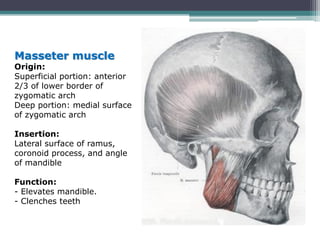
Masseter muscle
Origin:
Superficial portion: anterior
2/3 of lower border of
zygomatic arch
Deep portion: medial surface
of zygomatic arch
Insertion:
Lateral surface of ramus,
coronoid process, and angle
of mandible
Function:
- Elevates mandible.
- Clenches teeth
Medial pterygoid muscle
• Origin:
Medial surface of lateral pterygoid
plate
• Insertion:
Posterior and lower part of medial
surface of ramus, angle of mandible
• Function:
•Elevates, protrudes and latero-trudes
the mandible.
•Clenches teeth
Lateral pterygoid muscle
• Origin:
•Superior head: infratemporal surface
of greater wing of sphenoid bone
•Inferior head: lateral surface of
lateral pterygoid plate
• Insertion:
Anterior portion of condylar neck and
articular disc
• Function:
•Protrudes and laterotrudes the
mandible.
Pulls articular disc forward

Anatomy complete denture

  • 1.
  • 2.
  • 3.
    The knowledge oforal anatomy and physiology will help the operator and provides enough landmarks to act as positive guide during denture construction. This subject can be discussed under: I. Extra-oral landmarks of prosthetic importance. II. Intra-oral landmarks of prosthetic importance: In the maxilla. In the mandible. III. Border structures that limit the periphery of the denture: In the maxilla. In the mandible. IV. Anatomy and physiology of the T.M.J.
  • 4.
  • 5.
    Angle’s class IIAngle’s calss I Angle’s class III Inter-pupillary line
  • 8.
    1. In themaxilla (supporting structures)
  • 9.
    2. In themandible (supporting structures) Landmark Description Significance → →
  • 12.
  • 13.
    1. Labial frenum 2.Labial vestibule 3. Buccal frenum 4. Buccal vestibule 5. Coronoid bulge 6. Residual alveolar ridge 7. Maxillary tuberosity 8. Hamular notch 9. Posterior palatal seal region 10.Foveae palatinae 11.Median palatine raphe 12.Incisive papilla 13.Rugae area
  • 15.
    Landmark Description Significance 1.Maxillary labial frenum Is a fold of mucous membrane extending from mucosa of the lip and attached near the crest of the ridge. It produces the maxillary labial notch in the denture border. 2. Maxillary labial vestibule (labial sulcus) It is the part of the oral vestibule that lies between the maxillary ridge and the lips. It extends from the maxillary labial frenum on both sides of the midline. It is occupied by the labial flange of the denture. The denture flange in this area is in relation to orbecularis oris and incisivus labii superioris muscles which determine the length and thickness of the labial flange. 3. Buccal frenum It is a fold of mucous membrane that varies in size, number and position. It overlies the canninus muscle It produces the maxillary buccal notch in the impression or the denture to facilitate functional movement. 4. Buccal mucous membrane reflection area (buccal vestibule) It is the reflection of mucous membrane from the cheek to the alveolar ridge distal to the buccal frenum. The denture border in this area is in relation to buccinator muscle which limits the height and thickness of the denture border. It represents the maxillary buccal flange of the denture. 5. Pterygo-maxillary notch (hamular notch) It is a narrow cleft between the maxillary tuberosity and the peterygoid hamulus and filled with connective tissue. 6. Soft palate - It is the posterior border of the upper denture. - It has two parts (immovable part and movable part). - The area of the posterior palatal seal should be located at the junction between these two parts. It is called ā€œvibrating lineā€ or ā€œAh lineā€. - It determines the posterior extension of the denture. - the posterior palatal seal is responsible for the posterior retention of the denture.
  • 17.
    Landmark Description Significance 1.Mandibular labial frenum Is a fold of mucous membrane (contains no muscles) and extending from mucosa of the lip to the mucosa of the alveolar process at the mid line. It produces the mandibular labial notch in the denture border. 2. Mandibular labial vestibule (labial sulcus) It is the reflection of the mucosa of the lower lip to the mucosa of the alveolar process. It is occupied by the labial flange of the denture. The denture flange in this area is in relation to orbecularis oris and incisivus labii inferioris muscles which determine the length and thickness of the labial flange. 3. Buccal frenum - It is a fold of mucous membrane in the premolar area attaching the lip to the alveolar ridge. - It overlies the triangularis muscle. It produces the mandibular buccal notch in the impression or the denture to facilitate functional movement. 4. Buccal mucous membrane reflection area (buccal vestibule) - It is the refelction of the mucosa of the cheek to the mucosa of the alveolar process - It is in relation with the buccinator muscle. The buccal flange should rest on the attachment of the buccinator muscle. It represents the mandibular buccal flange of the denture. 5. masseter muscle influencing area It is the disto buccal corner of the mandibular denture which is in relation to the masster muscle Buccal flange must converge in a medial direction to avoid displacement due to contraction of the masseter muscle 6. Reteromolar pad and anterior border of the ramus - It is a mass of tissue at the distal end of the ridge containing glands, the pterygomandibular raphe fibers of the buccinator muscle and the temporal tendon. - The denture must cover it. 7. Lingual frenum It is a fold of mucous membrane extending along the floor of the mouth to the under surface of the tongue in the midline. It produces a lingual notch in the impression or the denture.
  • 18.
    Muscles of Mastication TemporalisMuscle Origin: Temporal fossa Insertion: Coronoid process and anterior border of ramus Function: 1. Elevates and retracts mandible 2. Clenches teeth
  • 19.
    Masseter muscle Origin: Superficial portion:anterior 2/3 of lower border of zygomatic arch Deep portion: medial surface of zygomatic arch Insertion: Lateral surface of ramus, coronoid process, and angle of mandible Function: - Elevates mandible. - Clenches teeth
  • 20.
    Medial pterygoid muscle •Origin: Medial surface of lateral pterygoid plate • Insertion: Posterior and lower part of medial surface of ramus, angle of mandible • Function: •Elevates, protrudes and latero-trudes the mandible. •Clenches teeth Lateral pterygoid muscle • Origin: •Superior head: infratemporal surface of greater wing of sphenoid bone •Inferior head: lateral surface of lateral pterygoid plate • Insertion: Anterior portion of condylar neck and articular disc • Function: •Protrudes and laterotrudes the mandible. Pulls articular disc forward