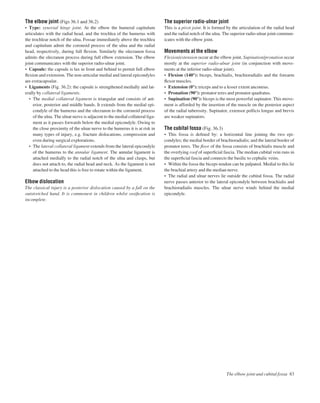
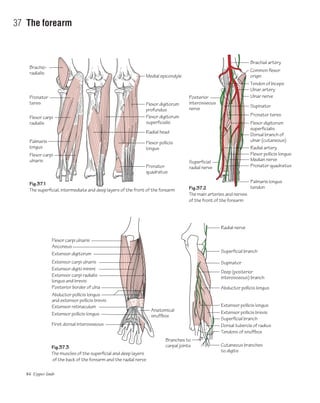
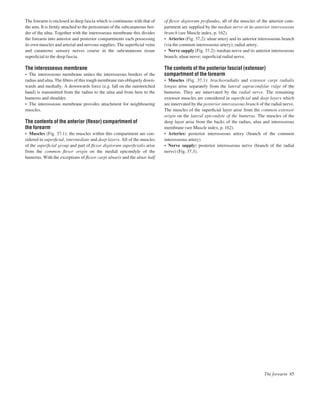
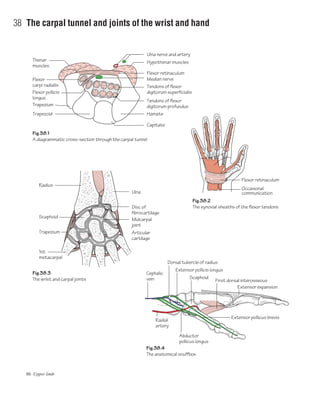
Anatomy at a Glance
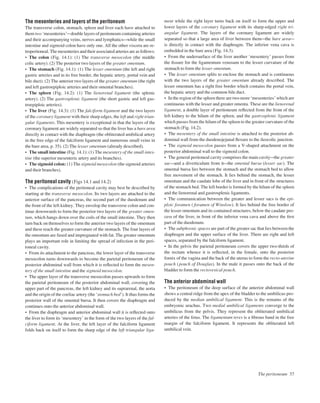
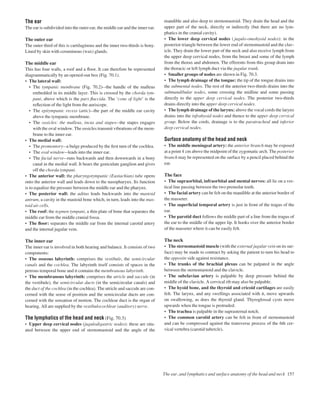
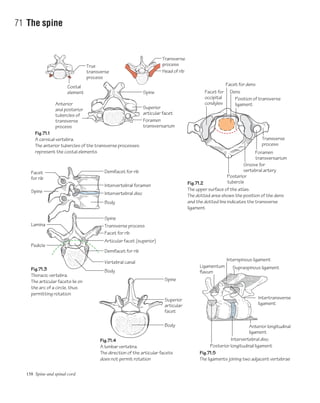
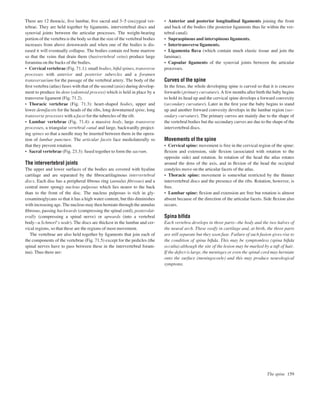
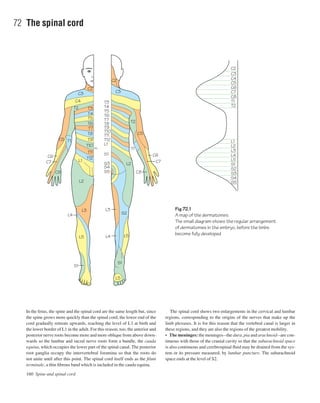
Omar Faiz
David Moffat
Blackwell Science
Anatomy at a Glance
OMAR FAIZ
BSc (Hons), FRCS (Eng)
Specialist Registrar in General Surgery
DAVID MOFFAT
VRD, MD, FRCS
Emeritus Professor of Anatomy
University of Cardiff
Blackwell
Science
© 2002 by Blackwell Science Ltd
a Blackwell Publishing company
Editorial Offices:
Osney Mead, Oxford OX2 0EL, UK
Tel: +44 (0)1865 206206
Blackwell Science, Inc., 350 Main Street, Malden, MA 02148-5018, USA
Tel: +1 781 388 8250
Blackwell Science Asia Pty, 54 University Street, Carlton, Victoria 3053, Australia
Tel: +61 (0)3 9347 0300
Blackwell Wissenschafts Verlag, Kurfürstendamm 57, 10707 Berlin, Germany
Tel: +49 (0)30 32 79 060
The right of the Authors to be identified as the Authors of this Work has been asserted in accordance
with the Copyright, Designs and Patents Act 1988.
All rights reserved. No part of this publication may be reproduced, stored in a retrieval system, or
transmitted, in any form or by any means, electronic, mechanical, photocopying, recording or
otherwise, except as permitted by the UK Copyright, Designs and Patents Act 1988, without the prior
permission of the publisher.
First published 2002 by Blackwell Science Ltd
Reprinted 2002
Library of Congress Cataloging-in-Publication Data
Faiz, Omar.
Anatomy at a glance / Omar Faiz, David Moffat
p. cm.
Includes index.
ISBN 0-632-05934-6 (pbk.)
1. Human anatomy—Outlines, syllabi, etc. I. Moffat, David, MD. II. Title.
[DNLM: 1: Anatomy. QS 4 F175a 2002]
QM31 .F33 2002
611—dc21 2001052646
ISBN 0-632-05934-6
A Catalogue record for this title is available from the British Library.
Set in 9/11A pt Times by Graphicraft Limited, Hong Kong
Printed and bound in Italy by G. Canale & C. SpA, Turin
For further information on
Blackwell Science, visit our website:
www.blackwell-science.com
Contents 3
Preface, 5
The thorax
1 The thoracic wall I, 6
2 The thoracic wall II, 8
3 The mediastinum Iathe contents of the
mediastinum, 10
4 The mediastinum IIathe vessels of the thorax, 12
5 The pleura and airways, 14
6 The lungs, 16
7 The heart I, 18
8 The heart II, 22
9 The nerves of the thorax, 24
10 Surface anatomy of the thorax, 26
The abdomen and pelvis
11 The abdominal wall, 28
12 The arteries of the abdomen, 31
13 The veins and lymphatics of the abdomen, 34
14 The peritoneum, 36
15 The upper gastrointestinal tract I, 38
16 The upper gastrointestinal tract II, 40
17 The lower gastrointestinal tract, 42
18 The liver, gall-bladder and biliary tree, 44
19 The pancreas and spleen, 46
20 The posterior abdominal wall, 48
21 The nerves of the abdomen, 50
22 Surface anatomy of the abdomen, 52
23 The pelvis Iathe bony and ligamentous pelvis, 54
24 The pelvis IIathe contents of the pelvis, 56
25 The perineum, 58
26 The pelvic viscera, 60
The upper limb
27 The osteology of the upper limb, 62
28 Arteries of the upper limb, 66
29 The venous and lymphatic drainage of the upper limb and the
breast, 68
30 Nerves of the upper limb I, 70
31 Nerves of the upper limb II, 72
32 The pectoral and scapular regions, 74
33 The axilla, 76
34 The shoulder (gleno-humeral) joint, 78
35 The arm, 80
36 The elbow joint and cubital fossa, 82
37 The forearm, 84
38 The carpal tunnel and joints of the wrist and hand, 86
39 The hand, 88
40 Surface anatomy of the upper limb, 90
The lower limb
41 The osteology of the lower limb, 92
42 The arteries of the lower limb, 94
43 The veins and lymphatics of the lower limb, 96
44 The nerves of the lower limb I, 98
45 The nerves of the lower limb II, 100
46 The hip joint and gluteal region, 102
47 The thigh, 106
48 The knee joint and popliteal fossa, 109
49 The leg, 112
50 The ankle and foot I, 114
51 The ankle and foot II, 116
52 Surface anatomy of the lower limb, 118
The autonomic nervous system
53 The autonomic nervous system, 120
The head and neck
54 The skull I, 122
55 The skull II, 124
56 Spinal nerves and cranial nerves I–IV, 126
57 The trigeminal nerve (V), 128
58 Cranial nerves VI–XII, 130
59 The arteries I, 132
60 The arteries II and the veins, 134
61 Anterior and posterior triangles, 136
62 The pharynx and larynx, 138
63 The root of the neck, 140
64 The oesophagus and trachea and the thyroid gland, 142
65 The upper part of the neck and the submandibular
region, 144
66 The mouth, palate and nose, 146
67 The face and scalp, 148
68 The cranial cavity, 152
69 The orbit and eyeball, 154
70 The ear, and lymphatics and surface anatomy of the head and
neck, 156
The spine and spinal cord
71 The spine, 158
72 The spinal cord, 160
Muscle index, 162
Index, 168
Contents
The study of anatomy has changed enormously in the last few decades.
No longer do medical students have to spend long hours in the dissect-
ing room searching fruitlessly for the otic ganglion or tracing the small
arteries that form the anastomosis round the elbow joint. They now
need to know only the basic essentials of anatomy with particular
emphasis on their clinical relevance and this is a change that is long
overdue. However, students still have examinations to pass and in this
book the authors, a surgeon and an anatomist, have tried to provide a
means of rapid revision without any frills. To this end, the book follows
the standard format of the at a Glance series and is arranged in short,
easily digested chapters, written largely in note form, with the appro-
priate illustrations on the facing page. Where necessary, clinical appli-
cations are included in italics and there are a number of clinical
illustrations. We thus hope that this book will be helpful in revising and
consolidating the knowledge that has been gained from the dissecting
room and from more detailed and explanatory textbooks.
The anatomical drawings are the work of Jane Fallows, with help
from Roger Hulley, who has transformed our rough sketches into the
finished pages of illustrations that form such an important part of the
book and we should like to thank her for her patience and skill in carry-
ing out this onerous task. Some of the drawings have been borrowed or
adapted from Professor Harold Ellis’s superb book Clinical Anatomy
(9th edn) and we are most grateful to him for his permission to do this.
We should also like to thank Dr Mike Benjamin of Cardiff University
for the surface anatomy photographs. Finally, it is a pleasure to thank
all the staff at Blackwell Science who have had a hand in the prepara-
tion of this book, particularly Fiona Goodgame and Jonathan Rowley.
Omar Faiz
David Moffat
Preface 5
Preface
6 Thorax
1 The thoracic wall I
Cervical
rib
Scalenus
anterior
Brachial
plexus
Subclavian
artery
Subcostal groove
Tubercle
Neck
Head
Facet for
vertebral body
First rib
Thoracic outlet (inlet)
Suprasternal notch
Manubrium
Third rib
Body of sternum
Intercostal
space
Xiphisternum
Costal cartilage
Floating ribs
Angle
Sternocostal
joint
6th
rib
Costochondral
joint
Shaft
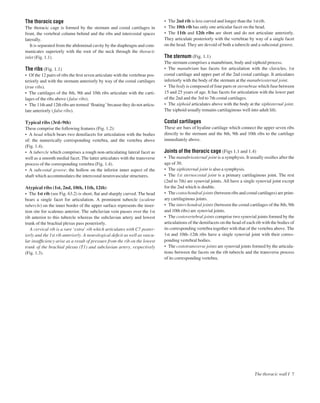
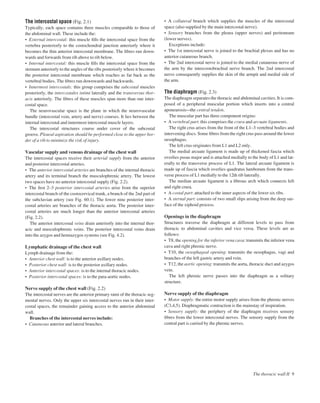
Fig.1.2
A typical rib
Fig.1.1
The thoracic cage. The outlet (inlet)
of the thorax is outlined
Fig.1.4
Joints of the thoracic cage
Fig.1.3
Bilateral cervical ribs.
On the right side the brachial plexus
is shown arching over the rib and
stretching its lowest trunk
T5
T6
Demifacet for head of rib
Transverse process with
facet for rib tubercle
Costovertebral
joint
1 2
5
3
4
1
2
3
4
5
Costochondral joint
Sternocostal joint
Interchondral joint
Xiphisternal joint
Manubriosternal joint
(angle of Louis)
Clavicle
Costal margin
Costotransverse
joint
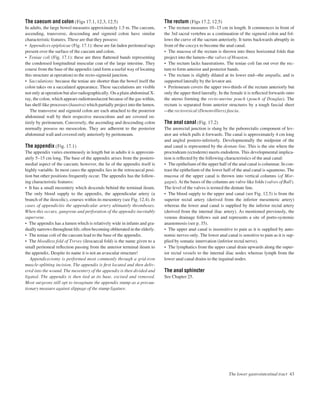
The thoracic cage
The thoracic cage is formed by the sternum and costal cartilages in
front, the vertebral column behind and the ribs and intercostal spaces
laterally.
It is separated from the abdominal cavity by the diaphragm and com-
municates superiorly with the root of the neck through the thoracic
inlet (Fig. 1.1).
The ribs (Fig. 1.1)
• Of the 12 pairs of ribs the first seven articulate with the vertebrae pos-
teriorly and with the sternum anteriorly by way of the costal cartilages
(true ribs).
• The cartilages of the 8th, 9th and 10th ribs articulate with the carti-
lages of the ribs above ( false ribs).
• The 11th and 12th ribs are termed ‘floating’ because they do not articu-
late anteriorly (false ribs).
Typical ribs (3rd–9th)
These comprise the following features (Fig. 1.2):
• A head which bears two demifacets for articulation with the bodies
of: the numerically corresponding vertebra, and the vertebra above
(Fig. 1.4).
• A tubercle which comprises a rough non-articulating lateral facet as
well as a smooth medial facet. The latter articulates with the transverse
process of the corresponding vertebra (Fig. 1.4).
• A subcostal groove: the hollow on the inferior inner aspect of the
shaft which accommodates the intercostal neurovascular structures.
Atypical ribs (1st, 2nd, 10th, 11th, 12th)
• The 1st rib (see Fig. 63.2) is short, flat and sharply curved. The head
bears a single facet for articulation. A prominent tubercle (scalene
tubercle) on the inner border of the upper surface represents the inser-
tion site for scalenus anterior. The subclavian vein passes over the 1st
rib anterior to this tubercle whereas the subclavian artery and lowest
trunk of the brachial plexus pass posteriorly.
A cervical rib is a rare ‘extra’ rib which articulates with C7 poster-
iorly and the 1st rib anteriorly. A neurological deficit as well as vascu-
lar insufficiency arise as a result of pressure from the rib on the lowest
trunk of the brachial plexus (T1) and subclavian artery, respectively
(Fig. 1.3).
• The 2nd rib is less curved and longer than the 1strib.
• The 10th rib has only one articular facet on the head.
• The 11th and 12th ribs are short and do not articulate anteriorly.
They articulate posteriorly with the vertebrae by way of a single facet
on the head. They are devoid of both a tubercle and a subcostal groove.
The sternum (Fig. 1.1)
The sternum comprises a manubrium, body and xiphoid process.
• The manubrium has facets for articulation with the clavicles, 1st
costal cartilage and upper part of the 2nd costal cartilage. It articulates
inferiorly with the body of the sternum at the manubriosternal joint.
• The body is composed of four parts or sternebrae which fuse between
15 and 25 years of age. It has facets for articulation with the lower part
of the 2nd and the 3rd to 7th costal cartilages.
• The xiphoid articulates above with the body at the xiphisternal joint.
The xiphoid usually remains cartilaginous well into adult life.
Costal cartilages
These are bars of hyaline cartilage which connect the upper seven ribs
directly to the sternum and the 8th, 9th and 10th ribs to the cartilage
immediately above.
Joints of the thoracic cage (Figs 1.1 and 1.4)
• The manubriosternal joint is a symphysis. It usually ossifies after the
age of 30.
• The xiphisternal joint is also a symphysis.
• The 1st sternocostal joint is a primary cartilaginous joint. The rest
(2nd to 7th) are synovial joints. All have a single synovial joint except
for the 2nd which is double.
• The costochondral joints (between ribs and costal cartilages) are prim-
ary cartilaginous joints.
• The interchondral joints (between the costal cartilages of the 8th, 9th
and 10th ribs) are synovial joints.
• The costovertebral joints comprise two synovial joints formed by the
articulations of the demifacets on the head of each rib with the bodies of
its corresponding vertebra together with that of the vertebra above. The
1st and 10th–12th ribs have a single synovial joint with their corres-
ponding vertebral bodies.
• The costotransverse joints are synovial joints formed by the articula-
tions between the facets on the rib tubercle and the transverse process
of its corresponding vertebra.
The thoracic wall I 7
8 Thorax
2 The thoracic wall II
Vein
Artery
Nerve
External
Internal Intercostal muscles
Intercostal
Innermost
Xiphisternum
Internal
thoracic artery
Lateral branch
lateral
anterior
Cutaneous
branches
Pleural and
peritoneal
sensory
branches
Intercostal
nerve
Posterior ramus Posterior
intercostal
artery
Anterior
intercostal
artery
Aorta
Spinal
branch
Costal margin
Central tendon
Inferior vena cava
Oesophagus
Aorta
T8
Vertebral
levels
Lateral arcuate ligament
Medial arcuate ligament
Right crus
Psoas major
Quadratus lumborum
Third lumbar vertebra
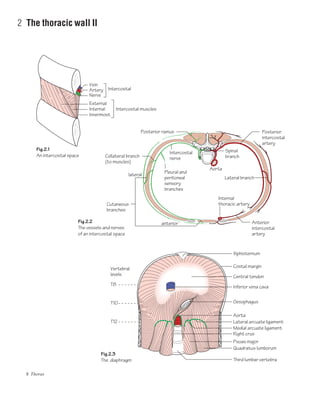
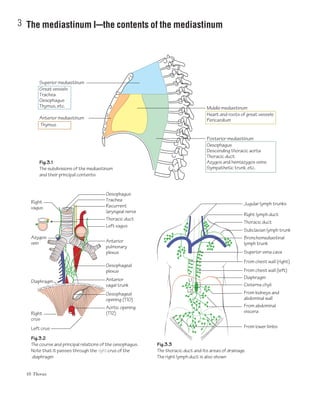
Fig.2.1
An intercostal space
Fig.2.3
The diaphragm
Fig.2.2
The vessels and nerves
of an intercostal space
T10
T12
Collateral branch
(to muscles)
The intercostal space (Fig. 2.1)
Typically, each space contains three muscles comparable to those of
the abdominal wall. These include the:
• External intercostal: this muscle fills the intercostal space from the
vertebra posteriorly to the costochondral junction anteriorly where it
becomes the thin anterior intercostal membrane. The fibres run down-
wards and forwards from rib above to rib below.
• Internal intercostal: this muscle fills the intercostal space from the
sternum anteriorly to the angles of the ribs posteriorly where it becomes
the posterior intercostal membrane which reaches as far back as the
vertebral bodies. The fibres run downwards and backwards.
• Innermost intercostals: this group comprises the subcostal muscles
posteriorly, the intercostales intimi laterally and the transversus thor-
acis anteriorly. The fibres of these muscles span more than one inter-
costal space.
The neurovascular space is the plane in which the neurovascular
bundle (intercostal vein, artery and nerve) courses. It lies between the
internal intercostal and innermost intercostal muscle layers.
The intercostal structures course under cover of the subcostal
groove. Pleural aspiration should be performed close to the upper bor-
der of a rib to minimize the risk of injury.
Vascular supply and venous drainage of the chest wall
The intercostal spaces receive their arterial supply from the anterior
and posterior intercostal arteries.
• The anterior intercostal arteries are branches of the internal thoracic
artery and its terminal branch the musculophrenic artery. The lowest
two spaces have no anterior intercostal supply (Fig. 2.2).
• The first 2–3 posterior intercostal arteries arise from the superior
intercostal branch of the costocervical trunk, a branch of the 2nd part of
the subclavian artery (see Fig. 60.1). The lower nine posterior inter-
costal arteries are branches of the thoracic aorta. The posterior inter-
costal arteries are much longer than the anterior intercostal arteries
(Fig. 2.2).
The anterior intercostal veins drain anteriorly into the internal thor-
acic and musculophrenic veins. The posterior intercostal veins drain
into the azygos and hemiazygos systems (see Fig. 4.2).
Lymphatic drainage of the chest wall
Lymph drainage from the:
• Anterior chest wall: is to the anterior axillary nodes.
• Posterior chest wall: is to the posterior axillary nodes.
• Anterior intercostal spaces: is to the internal thoracic nodes.
• Posterior intercostal spaces: is to the para-aortic nodes.
Nerve supply of the chest wall (Fig. 2.2)
The intercostal nerves are the anterior primary rami of the thoracic seg-
mental nerves. Only the upper six intercostal nerves run in their inter-
costal spaces, the remainder gaining access to the anterior abdominal
wall.
Branches of the intercostal nerves include:
• Cutaneous anterior and lateral branches.
• A collateral branch which supplies the muscles of the intercostal
space (also supplied by the main intercostal nerve).
• Sensory branches from the pleura (upper nerves) and peritoneum
(lower nerves).
Exceptions include:
• The 1st intercostal nerve is joined to the brachial plexus and has no
anterior cutaneous branch.
• The 2nd intercostal nerve is joined to the medial cutaneous nerve of
the arm by the intercostobrachial nerve branch. The 2nd intercostal
nerve consequently supplies the skin of the armpit and medial side of
the arm.
The diaphragm (Fig. 2.3)
The diaphragm separates the thoracic and abdominal cavities. It is com-
posed of a peripheral muscular portion which inserts into a central
aponeurosisathe central tendon.
The muscular part has three component origins:
• A vertebral part: this comprises the crura and arcuate ligaments.
The right crus arises from the front of the L1–3 vertebral bodies and
intervening discs. Some fibres from the right crus pass around the lower
oesophagus.
The left crus originates from L1 and L2 only.
The medial arcuate ligament is made up of thickened fascia which
overlies psoas major and is attached medially to the body of L1 and lat-
erally to the transverse process of L1. The lateral arcuate ligament is
made up of fascia which overlies quadratus lumborum from the trans-
verse process of L1 medially to the 12th rib laterally.
The median arcuate ligament is a fibrous arch which connects left
and right crura.
• A costal part: attached to the inner aspects of the lower six ribs.
• A sternal part: consists of two small slips arising from the deep sur-
face of the xiphoid process.
Openings in the diaphragm
Structures traverse the diaphragm at different levels to pass from
thoracic to abdominal cavities and vice versa. These levels are as
follows:
• T8, the opening for the inferior vena cava: transmits the inferior vena
cava and right phrenic nerve.
• T10, the oesophageal opening: transmits the oesophagus, vagi and
branches of the left gastric artery and vein.
• T12, the aortic opening: transmits the aorta, thoracic duct and azygos
vein.
The left phrenic nerve passes into the diaphragm as a solitary
structure.
Nerve supply of the diaphragm
• Motor supply: the entire motor supply arises from the phrenic nerves
(C3,4,5). Diaphragmatic contraction is the mainstay of inspiration.
• Sensory supply: the periphery of the diaphragm receives sensory
fibres from the lower intercostal nerves. The sensory supply from the
central part is carried by the phrenic nerves.
The thoracic wall II 9
10 Thorax
3 The mediastinum Icthe contents of the mediastinum
Jugular lymph trunks
Thoracic duct
From lower limbs
Superior vena cava
From chest wall (right)
From chest wall (left)
Middle mediastinum
Heart and roots of great vessels
Pericardium
Superior mediastinum
Great vessels
Trachea
Oesophagus
Thymus, etc.
Anterior mediastinum
Thymus
Posterior mediastinum
Oesophagus
Descending thoracic aorta
Thoracic duct
Azygos and hemiazygos veins
Sympathetic trunk, etc.
Diaphragm
L1
L2
Cisterna chyli
From abdominal
viscera
Thoracic duct
Recurrent
laryngeal nerve
Oesophagus
Trachea
Left vagus
Anterior
pulmonary
plexus
Oesophageal
plexus
Anterior
vagal trunk
Oesophageal
opening (T10)
Aortic opening
(T12)
Left crus
Right
vagus
Azygos
vein
Diaphragm
Right
crus
Subclavian lymph trunk
Bronchomediastinal
lymph trunk
Right lymph duct
From kidneys and
abdominal wall
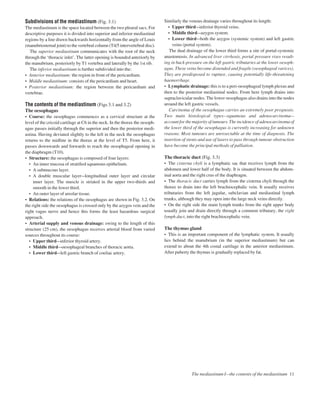
Fig.3.2
The course and principal relations of the oesophagus.
Note that it passes through the right crus of the
diaphragm
Fig.3.3
The thoracic duct and its areas of drainage.
The right lymph duct is also shown
Fig.3.1
The subdivisions of the mediastinum
and their principal contents
Subdivisions of the mediastinum (Fig. 3.1)
The mediastinum is the space located between the two pleural sacs. For
descriptive purposes it is divided into superior and inferior mediastinal
regions by a line drawn backwards horizontally from the angle of Louis
(manubriosternal joint) to the vertebral column (T4/5 intervertebral disc).
The superior mediastinum communicates with the root of the neck
through the ‘thoracic inlet’. The latter opening is bounded anteriorly by
the manubrium, posteriorly by T1 vertebra and laterally by the 1st rib.
The inferior mediastinum is further subdivided into the:
• Anterior mediastinum: the region in front of the pericardium.
• Middle mediastinum: consists of the pericardium and heart.
• Posterior mediastinum: the region between the pericardium and
vertebrae.
The contents of the mediastinum (Figs 3.1 and 3.2)
The oesophagus
• Course: the oesophagus commences as a cervical structure at the
level of the cricoid cartilage at C6 in the neck. In the thorax the oesoph-
agus passes initially through the superior and then the posterior medi-
astina. Having deviated slightly to the left in the neck the oesophagus
returns to the midline in the thorax at the level of T5. From here, it
passes downwards and forwards to reach the oesophageal opening in
the diaphragm (T10).
• Structure: the oesophagus is composed of four layers:
• An inner mucosa of stratified squamous epithelium.
• A submucous layer.
• A double muscular layeralongitudinal outer layer and circular
inner layer. The muscle is striated in the upper two-thirds and
smooth in the lower third.
• An outer layer of areolar tissue.
• Relations: the relations of the oesophagus are shown in Fig. 3.2. On
the right side the oesophagus is crossed only by the azygos vein and the
right vagus nerve and hence this forms the least hazardous surgical
approach.
• Arterial supply and venous drainage: owing to the length of this
structure (25 cm), the oesophagus receives arterial blood from varied
sources throughout its course:
• Upper thirdainferior thyroid artery.
• Middle thirdaoesophageal branches of thoracic aorta.
• Lower thirdaleft gastric branch of coeliac artery.
Similarly the venous drainage varies throughout its length:
• Upper thirdainferior thyroid veins.
• Middle thirdaazygos system.
• Lower thirdaboth the azygos (systemic system) and left gastric
veins (portal system).
The dual drainage of the lower third forms a site of portal-systemic
anastomosis. In advanced liver cirrhosis, portal pressure rises result-
ing in back-pressure on the left gastric tributaries at the lower oesoph-
agus. These veins become distended and fragile (oesophageal varices).
They are predisposed to rupture, causing potentially life-threatening
haemorrhage.
• Lymphatic drainage: this is to a peri-oesophageal lymph plexus and
then to the posterior mediastinal nodes. From here lymph drains into
supraclavicular nodes. The lower oesophagus also drains into the nodes
around the left gastric vessels.
Carcinoma of the oesophagus carries an extremely poor prognosis.
Two main histological typesbsquamous and adenocarcinomab
account for the majority of tumours. The incidence of adenocarcinoma of
the lower third of the oesophagus is currently increasing for unknown
reasons. Most tumours are unresectable at the time of diagnosis. The
insertion of stents and use of lasers to pass through tumour obstruction
have become the principal methods of palliation.
The thoracic duct (Fig. 3.3)
• The cisterna chyli is a lymphatic sac that receives lymph from the
abdomen and lower half of the body. It is situated between the abdom-
inal aorta and the right crus of the diaphragm.
• The thoracic duct carries lymph from the cisterna chyli through the
thorax to drain into the left brachiocephalic vein. It usually receives
tributaries from the left jugular, subclavian and mediastinal lymph
trunks, although they may open into the large neck veins directly.
• On the right side the main lymph trunks from the right upper body
usually join and drain directly through a common tributary, the right
lymph duct, into the right brachiocephalic vein.
The thymus gland
• This is an important component of the lymphatic system. It usually
lies behind the manubrium (in the superior mediastinum) but can
extend to about the 4th costal cartilage in the anterior mediastinum.
After puberty the thymus is gradually replaced by fat.
The mediastinum Ibthe contents of the mediastinum 11
12 Thorax
4 The mediastinum IIcthe vessels of the thorax
Thyrocervical trunk
Suprascapular
Inferior thyroid
Superficial cervical
Scalenus anterior
Dorsal scapular
Subclavian
Anterior intercostals
Internal thoracic (mammary)
Musculophrenic
Superior epigastric
Inferior thyroid
Deep cervical
Left internal jugular
Thoracic duct
Vertebral
Left subclavian
Internal thoracic
Left superior intercostal
Vagus nerve
Phrenic nerve
Crossing arch
of the aorta
Posterior intercostal
Posterior intercostals
(also supply spinal cord)
Bronchial
Oesophageal
Mediastinal
Aortic opening in diaphragm
(T12)
branches
Right lymph duct
Left brachiocephalic
Costocervical trunk
Thyroidea ima
Superior intercostal
Upper two posterior
intercostals
Brachiocephalic
Inferior laryngeal
Right brachiocephalic
Superior vena cava
Right atrium
Azygos
Diaphragm
Accessory hemiazygosT7
T8
Hemiazygos
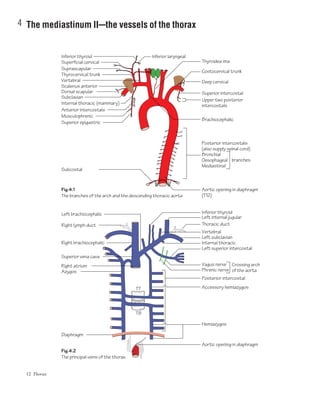
Fig.4.2
The principal veins of the thorax
Fig.4.1
The branches of the arch and the descending thoracic aorta
Vertebral
Subcostal
The thoracic aorta (Fig. 4.1)
The ascending aorta arises from the aortic vestibule behind the
infundibulum of the right ventricle and the pulmonary trunk. It is con-
tinuous with the aortic arch. The arch lies posterior to the lower half of
the manubrium and arches from front to back over the left main
bronchus. The descending thoracic aorta is continuous with the arch
and begins at the lower border of the body of T4. It initially lies slightly
to the left of the midline and then passes medially to gain access to the
abdomen by passing beneath the median arcuate ligament of the
diaphragm at the level of T12. From here it continues as the abdominal
aorta.
The branches of the ascending aorta are the:
• Right and left coronary arteries.
The branches of the aortic arch are the:
• Brachiocephalic artery: arises from the arch behind the manubrium
and courses upwards to bifurcate into right subclavian and right com-
mon carotid branches posterior to the right sternoclavicular joint.
• Left common carotid artery: see p. 133.
• Left subclavian artery.
• Thyroidea ima artery.
The branches of the descending thoracic aorta include the:
• Oesophageal, bronchial, mediastinal, posterior intercostal and sub-
costal arteries.
The subclavian arteries (see Fig. 60.1)
The subclavian arteries become the axillary arteries at the outer bor-
der of the 1st rib. Each artery is divided into three parts by scalenus
anterior:
• 1st part: the part of the artery that lies medial to the medial border of
scalenus anterior. It gives rise to three branches, the: vertebral artery
(p. 135), thyrocervical trunk and internal thoracic (mammary) artery.
The latter artery courses on the posterior surface of the anterior chest
wall one fingerbreadth from the lateral border of the sternum. Along
its course it gives off anterior intercostal, thymic and perforating
branches. The ‘perforators’ pass through the anterior chest wall to
supply the breast. The internal thoracic artery divides behind the 6th
costal cartilage into superior epigastric and musculophrenic branches.
The thyrocervical trunk terminates as the inferior thyroid artery.
• 2nd part: the part of the artery that lies behind scalenus anterior. It
gives rise to the costocervical trunk (see Fig. 60.1).
• 3rd part: the part of the artery that lies lateral to the lateral border of
scalenus anterior. This part gives rise to the dorsal scapular artery.
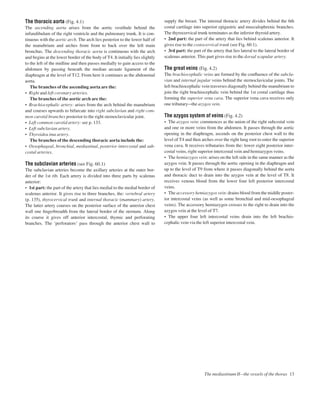
The great veins (Fig. 4.2)
The brachiocephalic veins are formed by the confluence of the subcla-
vian and internal jugular veins behind the sternoclavicular joints. The
left brachiocephalic vein traverses diagonally behind the manubrium to
join the right brachiocephalic vein behind the 1st costal cartilage thus
forming the superior vena cava. The superior vena cava receives only
one tributaryathe azygos vein.
The azygos system of veins (Fig. 4.2)
• The azygos vein: commences as the union of the right subcostal vein
and one or more veins from the abdomen. It passes through the aortic
opening in the diaphragm, ascends on the posterior chest wall to the
level of T4 and then arches over the right lung root to enter the superior
vena cava. It receives tributaries from the: lower eight posterior inter-
costal veins, right superior intercostal vein and hemiazygos veins.
• The hemiazygos vein: arises on the left side in the same manner as the
azygos vein. It passes through the aortic opening in the diaphragm and
up to the level of T9 from where it passes diagonally behind the aorta
and thoracic duct to drain into the azygos vein at the level of T8. It
receives venous blood from the lower four left posterior intercostal
veins.
• The accessory hemiazygos vein: drains blood from the middle poster-
ior intercostal veins (as well as some bronchial and mid-oesophageal
veins). The accessory hemiazygos crosses to the right to drain into the
azygos vein at the level of T7.
• The upper four left intercostal veins drain into the left brachio-
cephalic vein via the left superior intercostal vein.
The mediastinum IIbthe vessels of the thorax 13
14 Thorax
5 The pleura and airways
Apical
Apical
Anterior
Right main bronchus
Left main bronchus
Posterior
Middle
Anterior
Lingular
Anterior basal
Lateral basal
Posterior basal
Trachea
Anterior basal
Lateral basal
Apical of
lower lobe
Medial basal
Posterior basal
Posterior
Cricoid (C6)
Apico-posterior
Pulmonary artery
Bronchus
Pulmonary veins
Lymph node
Cut edge of pleura
Pulmonary ligament
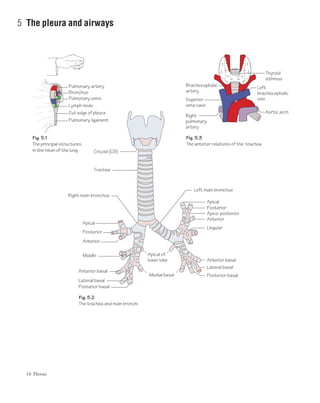
Fig. 5.1
The principal structures
in the hilum of the lung
Fig. 5.2
The trachea and main bronchi
Brachiocephalic
artery
Superior
vena cava
Right
pulmonary
artery
Thyroid
isthmus
Left
brachiocephalic
vein
Aortic arch
Fig. 5.3
The anterior relations of the trachea
The respiratory tract is most often discussed in terms of upper and
lower parts. The upper respiratory tract relates to the nasopharynx and
larynx whereas the lower relates to the trachea, bronchi and lungs.
The pleurae
• Each pleura consists of two layers: a visceral layer which is adherent
to the lung and a parietal layer which lines the inner aspect of the chest
wall, diaphragm and sides of the pericardium and mediastinum.
• At the hilum of the lung the visceral and parietal layers become con-
tinuous. This cuff hangs loosely over the hilum and is known as the pul-
monary ligament. It permits expansion of the pulmonary veins and
movement of hilar structures during respiration (Fig. 5.1).
• The two pleural cavities do not connect.
• The pleural cavity contains a small amount of pleural fluid which acts
as a lubricant decreasing friction between the pleurae.
• During maximal inspiration the lungs almost fill the pleural cavities.
In quiet inspiration the lungs do not expand fully into the costo-
diaphragmatic and costomediastinal recesses of the pleural cavity.
• The parietal pleura is sensitive to pain and touch (carried by the inter-
costal and phrenic nerves). The visceral pleura is sensitive only to
stretch (carried by autonomic afferents from the pulmonary plexus).
Air can enter the pleural cavity following a fractured rib or a torn
lung (pneumothorax). This eliminates the normal negative pleural
pressure, causing the lung to collapse.
Inflammation of the pleura (pleurisy) results from infection of the
adjacent lung (pneumonia). When this occurs the inflammatory process
renders the pleura sticky. Under these circumstances a pleural rub can
often be auscultated over the affected region during inspiration and
expiration. Pus in the pleural cavity (secondary to an infective process)
is termed an empyema.
The trachea (Fig. 5.2)
• Course: the trachea commences at the level of the cricoid cartilage in
the neck (C6). It terminates at the level of the angle of Louis (T4/5)
where it bifurcates into right and left main bronchi.
• Structure: the trachea is a rigid fibroelastic structure. Incom-
plete rings of hyaline cartilage continuously maintain the patency of
the lumen. The trachea is lined internally with ciliated columnar
epithelium.
• Relations: behind the trachea lies the oesophagus. The 2nd, 3rd and
4th tracheal rings are crossed anteriorly by the thyroid isthmus (Figs 5.3
and 64.1).
• Blood supply: the trachea receives its blood supply from branches of
the inferior thyroid and bronchial arteries.
The bronchi and bronchopulmonary segments (Fig. 5.2)
• The right main bronchus is shorter, wider and takes a more vertical
course than the left. The width and vertical course of the right main
bronchus account for the tendency for inhaled foreign bodies to prefer-
entially impact in the right middle and lower lobe bronchi.
• The left main bronchus enters the hilum and divides into a superior
and inferior lobar bronchus. The right main bronchus gives off the
bronchus to the upper lobe prior to entering the hilum and once into the
hilum divides into middle and inferior lobar bronchi.
• Each lobar bronchus divides within the lobe into segmental bronchi.
Each segmental bronchus enters a bronchopulmonary segment.
• Each bronchopulmonary segment is pyramidal in shape with its apex
directed towards the hilum (see Fig. 6.1). It is a structural unit of a lobe
that has its own segmental bronchus, artery and lymphatics. If one
bronchopulmonary segment is diseased it may be resected with pre-
servation of the rest of the lobe. The veins draining each segment are
intersegmental.
Bronchial carcinoma is the commonest cancer among men in the
United Kingdom. Four main histological types occur of which small
cell carries the worst prognosis. The overall prognosis remains
appalling with only 10% of sufferers surviving 5 years. It occurs most
commonly in the mucous membranes lining the major bronchi near the
hilum. Local invasion and spread to hilar and tracheobronchial nodes
occurs early.
The pleura and airways 15
16 Thorax
6 The lungs
1
2
6
10 7
3
5
7
8 9
10
6
2
1
4
3
5
89
3
4
5
5
4
7
8
9 10
6
2
3
2
9 10
1
3
5
4
7
8
9
10
6
6
2
1
3
1
2
6
10
9 8
4
5
1
2
3
4 and 5
6
7
8
9
10
Apical
Posterior (1 and 2 from a common apico-posterior stem on the left side)
Anterior
Lateral and medial middle lobe (superior and inferior lingular on left side)
Superior (apical)
Medial basal (cardiac on left)
Anterior basal (7 and 8 often by a common stem on left)
Lateral basal
Posterior basal
Upper lobe
Middle lobe
Lower lobe
LEFT LUNG RIGHT LUNG
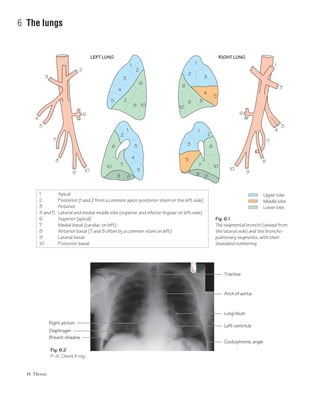
Fig. 6.1
The segmental bronchi (viewed from
the lateral side) and the broncho-
pulmonary segments, with their
standard numbering
Fig. 6.2
P–A. Chest X-ray
Trachea
Arch of aorta
Lung hilum
Left ventricle
Costophrenic angle
Breast shadow
Right atrium
Diaphragm
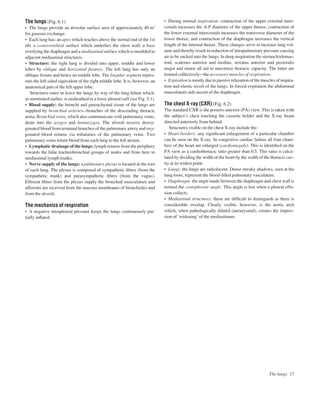
The lungs (Fig. 6.1)
• The lungs provide an alveolar surface area of approximately 40 m2
for gaseous exchange.
• Each lung has: an apex which reaches above the sternal end of the 1st
rib; a costovertebral surface which underlies the chest wall; a base
overlying the diaphragm and a mediastinal surface which is moulded to
adjacent mediastinal structures.
• Structure: the right lung is divided into upper, middle and lower
lobes by oblique and horizontal fissures. The left lung has only an
oblique fissure and hence no middle lobe. The lingular segment repres-
ents the left sided equivalent of the right middle lobe. It is, however, an
anatomical part of the left upper lobe.
Structures enter or leave the lungs by way of the lung hilum which,
as mentioned earlier, is ensheathed in a loose pleural cuff (see Fig. 5.1).
• Blood supply: the bronchi and parenchymal tissue of the lungs are
supplied by bronchial arteriesabranches of the descending thoracic
aorta. Bronchial veins, which also communicate with pulmonary veins,
drain into the azygos and hemiazygos. The alveoli receive deoxy-
genated blood from terminal branches of the pulmonary artery and oxy-
genated blood returns via tributaries of the pulmonary veins. Two
pulmonary veins return blood from each lung to the left atrium.
• Lymphatic drainage of the lungs: lymph returns from the periphery
towards the hilar tracheobronchial groups of nodes and from here to
mediastinal lymph trunks.
• Nerve supply of the lungs: a pulmonary plexus is located at the root
of each lung. The plexus is composed of sympathetic fibres (from the
sympathetic trunk) and parasympathetic fibres (from the vagus).
Efferent fibres from the plexus supply the bronchial musculature and
afferents are received from the mucous membranes of bronchioles and
from the alveoli.
The mechanics of respiration
• A negative intrapleural pressure keeps the lungs continuously par-
tially inflated.
• During normal inspiration: contraction of the upper external inter-
costals increases the A-P diameter of the upper thorax; contraction of
the lower external intercostals increases the transverse diameter of the
lower thorax; and contraction of the diaphragm increases the vertical
length of the internal thorax. These changes serve to increase lung vol-
ume and thereby result in reduction of intrapulmonary pressure causing
air to be sucked into the lungs. In deep inspiration the sternocleidomas-
toid, scalenus anterior and medius, serratus anterior and pectoralis
major and minor all aid to maximize thoracic capacity. The latter are
termed collectivelyathe accessory muscles of respiration.
• Expiration is mostly due to passive relaxation of the muscles of inspira-
tion and elastic recoil of the lungs. In forced expiration the abdominal
musculature aids ascent of the diaphragm.
The chest X-ray (CXR) (Fig. 6.2)
The standard CXR is the postero-anterior (PA) view. This is taken with
the subject’s chest touching the cassette holder and the X-ray beam
directed anteriorly from behind.
Structures visible on the chest X-ray include the:
• Heart borders: any significant enlargement of a particular chamber
can be seen on the X-ray. In congestive cardiac failure all four cham-
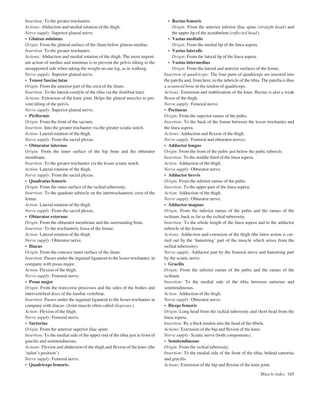
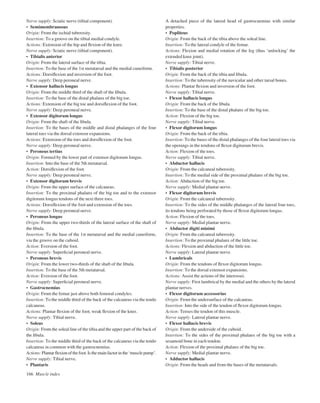
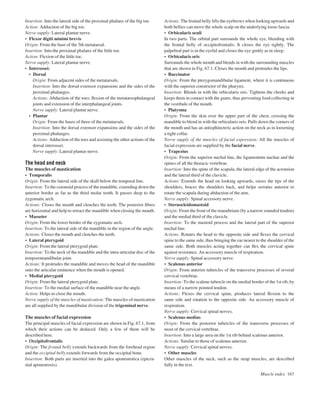
bers of the heart are enlarged (cardiomegaly). This is identified on the
PA view as a cardiothoracic ratio greater than 0.5. This ratio is calcu-
lated by dividing the width of the heart by the width of the thoracic cav-
ity at its widest point.
• Lungs: the lungs are radiolucent. Dense streaky shadows, seen at the
lung roots, represent the blood-filled pulmonary vasculature.
• Diaphragm: the angle made between the diaphragm and chest wall is
termed the costophrenic angle. This angle is lost when a pleural effu-
sion collects.
• Mediastinal structures: these are difficult to distinguish as there is
considerable overlap. Clearly visible, however, is the aortic arch
which, when pathologically dilated (aneurysmal), creates the impres-
sion of ‘widening’ of the mediastinum.
The lungs 17
18 Thorax
7 The heart I
Right vagus
Right phrenic
Brachiocephalic artery
Right
brachiocephalic vein
Right pulmonary veins
Right atrium
Inferior vena cava
Superior vena cava
Inferior thyroid veins
Left subclavian artery
Left common carotid artery
Left vagus
Left phrenic
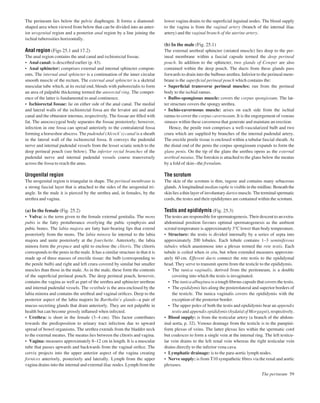
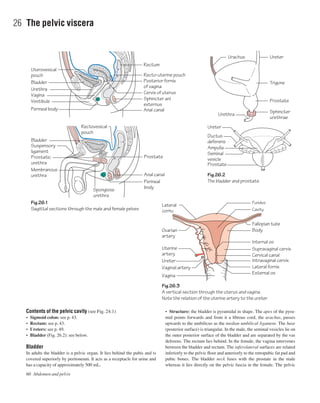
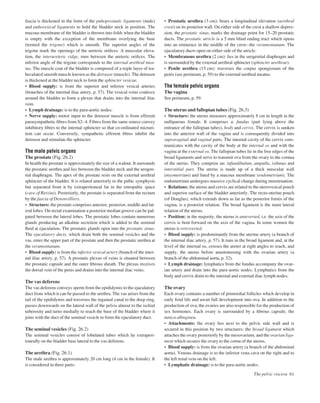
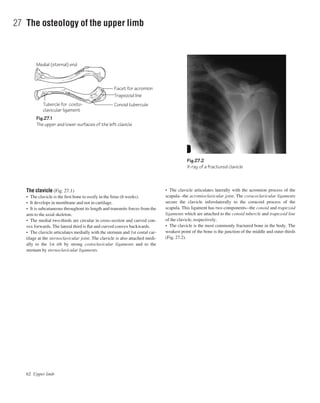
Left brachiocephalic vein
Left pulmonary artery
Left recurrent laryngeal
Left bronchus
Left pulmonary veins
Thyroid
Pulmonary veins
Pericardium Heart
Back of left atrium
Back of right atrium
Inferior vena cava
Parietal pericardium
Visceral pericardium
Arrow in transverse sinus
Pulmonary trunk
Arrow in oblique sinus
Aorta
Right recurrent laryngeal
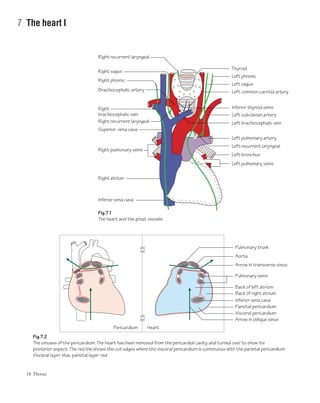
Fig.7.1
The heart and the great vessels
Fig.7.2
The sinuses of the pericardium. The heart has been removed from the pericardial cavity and turned over to show its
posterior aspect. The red line shows the cut edges where the visceral pericardium is continuous with the parietal pericardium.
Visceral layer: blue, parietal layer: red
The heart I 19
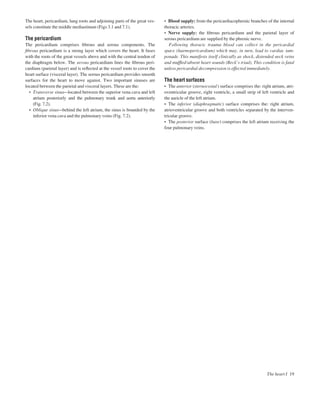
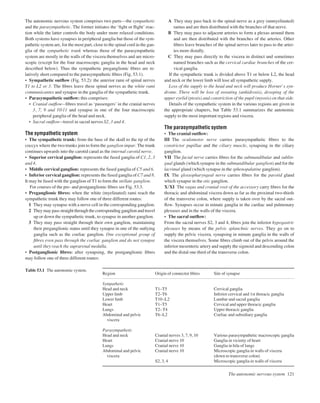
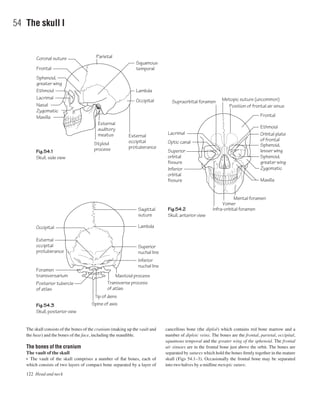
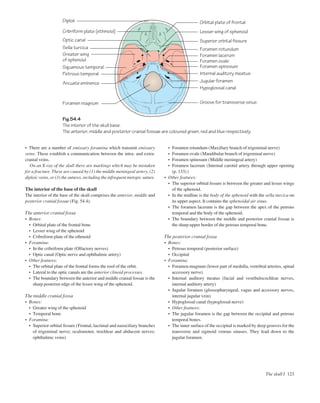
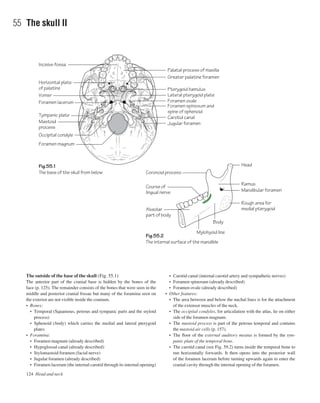
• Blood supply: from the pericardiacophrenic branches of the internal
thoracic arteries.
• Nerve supply: the fibrous pericardium and the parietal layer of
serous pericardium are supplied by the phrenic nerve.
Following thoracic trauma blood can collect in the pericardial
space (haemopericardium) which may, in turn, lead to cardiac tam-
ponade. This manifests itself clinically as shock, distended neck veins
and muffled/absent heart sounds (Beck’s triad). This condition is fatal
unless pericardial decompression is effected immediately.
The heart surfaces
• The anterior (sternocostal) surface comprises the: right atrium, atri-
oventricular groove, right ventricle, a small strip of left ventricle and
the auricle of the left atrium.
• The inferior (diaphragmatic) surface comprises the: right atrium,
atrioventricular groove and both ventricles separated by the interven-
tricular groove.
• The posterior surface (base) comprises the left atrium receiving the
four pulmonary veins.
The heart, pericardium, lung roots and adjoining parts of the great ves-
sels constitute the middle mediastinum (Figs 3.1 and 7.1).
The pericardium
The pericardium comprises fibrous and serous components. The
fibrous pericardium is a strong layer which covers the heart. It fuses
with the roots of the great vessels above and with the central tendon of
the diaphragm below. The serous pericardium lines the fibrous peri-
cardium (parietal layer) and is reflected at the vessel roots to cover the
heart surface (visceral layer). The serous pericardium provides smooth
surfaces for the heart to move against. Two important sinuses are
located between the parietal and visceral layers. These are the:
• Transverse sinusalocated between the superior vena cava and left
atrium posteriorly and the pulmonary trunk and aorta anteriorly
(Fig. 7.2).
• Oblique sinusabehind the left atrium, the sinus is bounded by the
inferior vena cava and the pulmonary veins (Fig. 7.2).
20 Thorax
Portion of right
atrium derived
from sinus
venosus
Crista
terminalis
Inferior
vena cava
Fossa ovalis
Opening of
coronary sinus
Valve of the
coronary sinus
Valve of the inferior
vena cava
Musculi
pectinati
Superior vena cava
Limbus
fossa ovalis
Pulmonary valve
(posterior, anterolateral
and anteromedial cusps)
Mitral
valve
Opening of right coronary artery
Aortic valve
(Anterior (right coronary) cusp,
Left posterior (left coronary) cusp,
right posterior (non-coronary) cusp)
Right atrium
Left atrium
Tricuspid valve
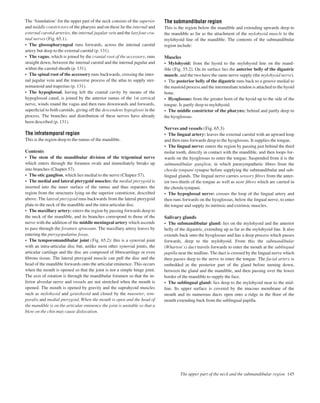
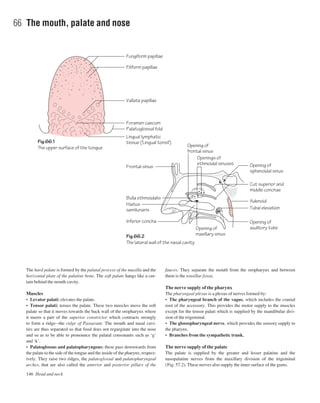
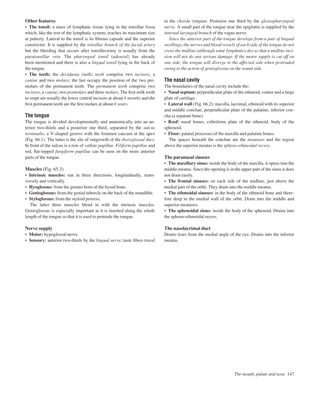
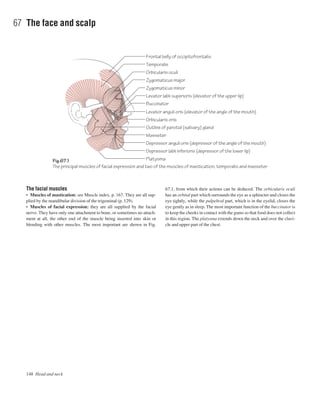
Posterior
cusp
Posterior
cusp
Anterior
cusp
Anterior
cuspSeptal
cusp
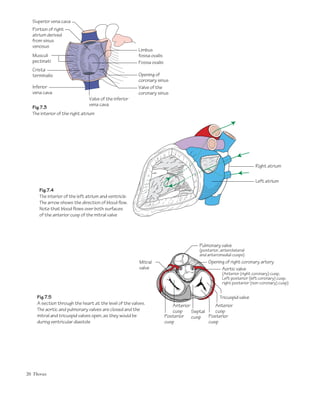
Fig.7.3
The interior of the right atrium
Fig.7.4
The interior of the left atrium and ventricle.
The arrow shows the direction of blood flow.
Note that blood flows over both surfaces
of the anterior cusp of the mitral valve
Fig.7.5
A section through the heart at the level of the valves.
The aortic and pulmonary valves are closed and the
mitral and tricuspid valves open, as they would be
during ventricular diastole
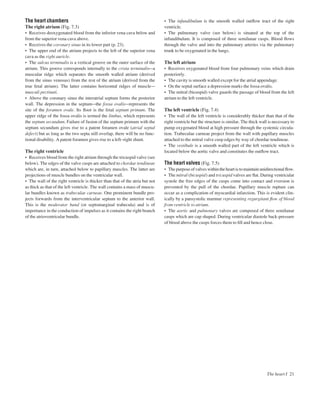
The heart chambers
The right atrium (Fig. 7.3)
• Receives deoxygenated blood from the inferior vena cava below and
from the superior vena cava above.
• Receives the coronary sinus in its lower part (p. 23).
• The upper end of the atrium projects to the left of the superior vena
cava as the right auricle.
• The sulcus terminalis is a vertical groove on the outer surface of the
atrium. This groove corresponds internally to the crista terminalisaa
muscular ridge which separates the smooth walled atrium (derived
from the sinus venosus) from the rest of the atrium (derived from the
true fetal atrium). The latter contains horizontal ridges of musclea
musculi pectinati.
• Above the coronary sinus the interatrial septum forms the posterior
wall. The depression in the septumathe fossa ovalisarepresents the
site of the foramen ovale. Its floor is the fetal septum primum. The
upper ridge of the fossa ovalis is termed the limbus, which represents
the septum secundum. Failure of fusion of the septum primum with the
septum secundum gives rise to a patent foramen ovale (atrial septal
defect) but as long as the two septa still overlap, there will be no func-
tional disability. A patent foramen gives rise to a left–right shunt.
The right ventricle
• Receives blood from the right atrium through the tricuspid valve (see
below). The edges of the valve cusps are attached to chordae tendineae
which are, in turn, attached below to papillary muscles. The latter are
projections of muscle bundles on the ventricular wall.
• The wall of the right ventricle is thicker than that of the atria but not
as thick as that of the left ventricle. The wall contains a mass of muscu-
lar bundles known as trabeculae carneae. One prominent bundle pro-
jects forwards from the interventricular septum to the anterior wall.
This is the moderator band (or septomarginal trabecula) and is of
importance in the conduction of impulses as it contains the right branch
of the atrioventricular bundle.
• The infundibulum is the smooth walled outflow tract of the right
ventricle.
• The pulmonary valve (see below) is situated at the top of the
infundibulum. It is composed of three semilunar cusps. Blood flows
through the valve and into the pulmonary arteries via the pulmonary
trunk to be oxygenated in the lungs.
The left atrium
• Receives oxygenated blood from four pulmonary veins which drain
posteriorly.
• The cavity is smooth walled except for the atrial appendage.
• On the septal surface a depression marks the fossa ovalis.
• The mitral (bicuspid) valve guards the passage of blood from the left
atrium to the left ventricle.
The left ventricle (Fig. 7.4)
• The wall of the left ventricle is considerably thicker than that of the
right ventricle but the structure is similar. The thick wall is necessary to
pump oxygenated blood at high pressure through the systemic circula-
tion. Trabeculae carneae project from the wall with papillary muscles
attached to the mitral valve cusp edges by way of chordae tendineae.
• The vestibule is a smooth walled part of the left ventricle which is
located below the aortic valve and constitutes the outflow tract.
The heart valves (Fig. 7.5)
• Thepurposeofvalveswithintheheartistomaintainunidirectionalflow.
• The mitral (bicuspid) and tricuspid valves are flat. During ventricular
systole the free edges of the cusps come into contact and eversion is
prevented by the pull of the chordae. Papillary muscle rupture can
occur as a complication of myocardial infarction. This is evident clin-
ically by a pansystolic murmur representing regurgitant flow of blood
from ventricle to atrium.
• The aortic and pulmonary valves are composed of three semilunar
cusps which are cup shaped. During ventricular diastole back-pressure
of blood above the cusps forces them to fill and hence close.
The heart I 21
22 Thorax
8 The heart II
Left coronary
artery
Posterior
interventricular
branch
Marginal
artery
50
40
3525
1235
55
65
15
0
Right coronary
artery
Anterior
interventricular
branch
S–A node
Atrial conduction
Ventricular conduction
A–V node
Coronary
sinus
Small
cardiac
vein
Middle
cardiac
vein
Great
cardiac
vein
QRS
TP
Fig.8.1
The coronary arteries.
Variations are common
Fig.8.3
The direction and timing of the spread
of action potential in the conducting
system of the heart.
Times are in msec
Fig.8.2
The venous drainage of the heart
Fig.8.4
An electrocardiogram
The grooves between the four heart chambers represent the sites that
offer the least stretch during systole and, for this reason, are where most
of the vessels supplying the heart are situated.
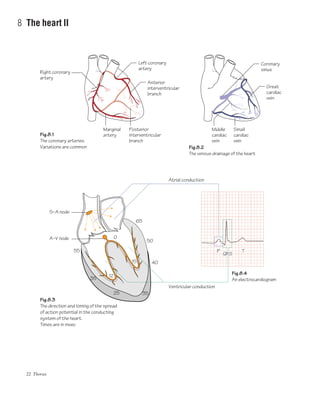
The arterial supply of the heart (Fig. 8.1)
The coronary arteries are responsible for supplying the heart itself with
oxygenated blood.
The coronary arteries are functional end-arteries and hence follow-
ing a total occlusion, the myocardium supplied by the blocked artery is
deprived of its blood supply (myocardial infarction). When the vessel
lumen gradually narrows due to atheromatous change of the walls,
patients complain of gradually increasing chest pain on exertion
(angina). Under these conditions the increased demand placed on the
myocardium cannot be met by the diminished arterial supply. Angina
that is not amenable to pharmacological control can be relieved by
dilating (angioplasty), or surgically bypassing (coronary artery bypass
grafting), the arterial stenosis. The latter procedure is usually per-
formed using a reversed length of great saphenous vein anastomosed to
the proximal aorta and then distally to the coronary artery beyond the
stenosis. Ischaemic heart disease is the leading cause of death in the
western world and consequently a thorough knowledge of the coronary
anatomy is essential.
The origins of the coronary arteries are as follows:
• The left coronary artery arises from the aortic sinus immediately
above the left posterior cusp of the aortic valve (see Fig. 7.5).
• The right coronary artery arises from the aortic sinus immediately
above the anterior cusp of the aortic valve (see Fig. 7.5).
There is considerable variation in size and distribution zones of the
coronary arteries. For example, in some people the posterior interven-
tricular branch of the right coronary artery is large and supplies a large
part of the left ventricle whereas in the majority this is supplied by the
anterior interventricular branch of the left coronary.
Similarly, the sinu-atrial node is usually supplied by a nodal branch
of the right coronary artery but in 30–40% of the population it receives
its supply from the left coronary.
The venous drainage of the heart (Fig. 8.2)
The venous drainage systems in the heart include:
• The veins which accompany the coronary arteries and drain into the
right atrium via the coronary sinus. The coronary sinus drains into the
right atrium to the left of and superior to the opening of the inferior vena
cava. The great cardiac vein follows the anterior interventricular
branch of the left coronary and then sweeps backwards to the left in the
atrioventricular groove. The middle cardiac vein follows the posterior
interventricular artery and, along with the small cardiac vein which fol-
lows the marginal artery, drains into the coronary sinus. The coronary
sinus drains the vast majority of the heart’s venous blood.
• The venae cordis minimi: these are small veins which drain directly
into the cardiac chambers.
• The anterior cardiac veins: these are small veins which cross the atri-
oventricular groove to drain directly into the right atrium.
The conducting system of the heart (Figs 8.3 and 8.4)
• The sinu-atrial (SA) node is the pacemaker of the heart. It is situated
near the top of the crista terminalis, below the superior vena caval
opening into the right atrium. Impulses generated by the SA node are
conducted throughout the atrial musculature to effect synchronous
atrial contraction. Disease or degeneration of any part of the conduc-
tion pathway can lead to dangerous interruption of heart rhythm.
Degeneration of the SA node leads to other sites of the conduction path-
way taking over the pacemaking role, albeit usually at a slower rate.
• Impulses reach the atrioventricular (AV) node which lies in the
interatrial septum just above the opening for the coronary sinus. From
here the impulse is transmitted to the ventricles via the atrioventricular
bundle (of His) which descends in the interventricular septum.
• The bundle of His divides into right and left branches which send
Purkinje fibres to lie within the subendocardium of the ventricles. The
position of the Purkinje fibres accounts for the almost synchronous
contraction of the ventricles.
The nerve supply of the heart
The heart receives both a sympathetic and a parasympathetic nerve
supply so that heart rate can be controlled to demand.
• The parasympathetic supply (bradycardic effect): is derived from the
vagus nerve (p. 25).
• The sympathetic supply (tachycardic and positively inotropic effect):
is derived from the cervical and upper thoracic sympathetic ganglia by
way of superficial and deep cardiac plexuses (p. 25).
The heart II 23
24 Thorax
9 The nerves of the thorax
Subclavian artery
Superior intercostal vein
Arch of aorta
Left recurrent laryngeal nerve
Left pulmonary artery
Posterior pulmonary plexus
Descending aorta
Oesophageal
plexus on oesophagus
Sympathetic trunk
Greater splanchnic nerve
C3
C4
C5
Thoracic duct on side of oesophagus
Central tendon
of diaphragm
Inferior vena cava
Branches to fibrous
and parietal pericardium
Mediastinal pleura
Scalenus anterior
Fig.9.2
The structures on the left
side of the mediastinum.
They are all covered with
the mediastinal pleura
Fig.9.1
The course and distribution
of the right phrenic nerve
Fig.9.3
The structures on the right
side of the mediastinum
Subclavian artery
Subclavian vein
Left brachiocephalic
vein
Superior vena cava
Acending aorta
Bronchus
Pulmonary veins
Hilum of lung
Phrenic nerve
Oesophagus
Trachea
Vagus nerve
Intercostal vessels
and nerves
Posterior
pulmonary plexus
Greater
splanchnic nerve
Oesophageal plexus
on oesophagus
Right atrium
Pulmonary artery
Subclavian vein
Sensory to
diaphragmatic pleura
Sensory to
diaphragmatic peritoneum
Motor to diaphragm
Left common
carotid artery
Subclavian vein
Vagus nerve
Ligamentum
arteriosum
Pulmonary trunk
Left auricle
Phrenic nerve
Left ventricle
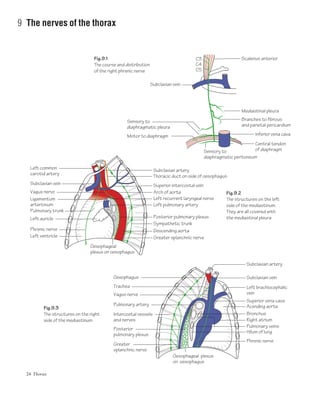
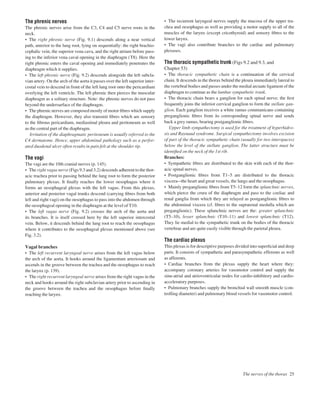
The phrenic nerves
The phrenic nerves arise from the C3, C4 and C5 nerve roots in the
neck.
• The right phrenic nerve (Fig. 9.1) descends along a near vertical
path, anterior to the lung root, lying on sequentially: the right brachio-
cephalic vein, the superior vena cava, and the right atrium before pass-
ing to the inferior vena caval opening in the diaphragm (T8). Here the
right phrenic enters the caval opening and immediately penetrates the
diaphragm which it supplies.
• The left phrenic nerve (Fig. 9.2) descends alongside the left subcla-
vian artery. On the arch of the aorta it passes over the left superior inter-
costal vein to descend in front of the left lung root onto the pericardium
overlying the left ventricle. The left phrenic then pierces the muscular
diaphragm as a solitary structure. Note: the phrenic nerves do not pass
beyond the undersurface of the diaphragm.
• The phrenic nerves are composed mostly of motor fibres which supply
the diaphragm. However, they also transmit fibres which are sensory
to the fibrous pericardium, mediastinal pleura and peritoneum as well
as the central part of the diaphragm.
Irritation of the diaphragmatic peritoneum is usually referred to the
C4 dermatome. Hence, upper abdominal pathology such as a perfor-
ated duodenal ulcer often results in pain felt at the shoulder tip.
The vagi
The vagi are the 10th cranial nerves (p. 145).
• The right vagus nerve (Figs 9.3 and 3.2) descends adherent to the thor-
acic trachea prior to passing behind the lung root to form the posterior
pulmonary plexus. It finally reaches the lower oesophagus where it
forms an oesophageal plexus with the left vagus. From this plexus,
anterior and posterior vagal trunks descend (carrying fibres from both
left and right vagi) on the oesophagus to pass into the abdomen through
the oesophageal opening in the diaphragm at the level of T10.
• The left vagus nerve (Fig. 9.2) crosses the arch of the aorta and
its branches. It is itself crossed here by the left superior intercostal
vein. Below, it descends behind the lung root to reach the oesophagus
where it contributes to the oesophageal plexus mentioned above (see
Fig. 3.2).
Vagal branches
• The left recurrent laryngeal nerve arises from the left vagus below
the arch of the aorta. It hooks around the ligamentum arteriosum and
ascends in the groove between the trachea and the oesophagus to reach
the larynx (p. 139).
• The right recurrent laryngeal nerve arises from the right vagus in the
neck and hooks around the right subclavian artery prior to ascending in
the groove between the trachea and the oesophagus before finally
reaching the larynx.
• The recurrent laryngeal nerves supply the mucosa of the upper tra-
chea and oesophagus as well as providing a motor supply to all of the
muscles of the larynx (except cricothyroid) and sensory fibres to the
lower larynx.
• The vagi also contribute branches to the cardiac and pulmonary
plexuses.
The thoracic sympathetic trunk (Figs 9.2 and 9.3, and
Chapter 53)
• The thoracic sympathetic chain is a continuation of the cervical
chain. It descends in the thorax behind the pleura immediately lateral to
the vertebral bodies and passes under the medial arcuate ligament of the
diaphragm to continue as the lumbar sympathetic trunk.
• The thoracic chain bears a ganglion for each spinal nerve; the first
frequently joins the inferior cervical ganglion to form the stellate gan-
glion. Each ganglion receives a white ramus communicans containing
preganglionic fibres from its corresponding spinal nerve and sends
back a grey ramus, bearing postganglionic fibres.
Upper limb sympathectomy is used for the treatment of hyperhidro-
sis and Raynaud syndrome. Surgical sympathectomy involves excision
of part of the thoracic sympathetic chain (usually for two interspaces)
below the level of the stellate ganglion. The latter structure must be
identified on the neck of the 1st rib.
Branches:
• Sympathetic fibres are distributed to the skin with each of the thor-
acic spinal nerves.
• Postganglionic fibres from T1–5 are distributed to the thoracic
visceraathe heart and great vessels, the lungs and the oesophagus.
• Mainly preganglionic fibres from T5–12 form the splanchnic nerves,
which pierce the crura of the diaphragm and pass to the coeliac and
renal ganglia from which they are relayed as postganglionic fibres to
the abdominal viscera (cf. fibres to the suprarenal medulla which are
preganglionic). These splanchnic nerves are the: greater splanchnic
(T5–10), lesser splanchnic (T10–11) and lowest splanchnic (T12).
They lie medial to the sympathetic trunk on the bodies of the thoracic
vertebrae and are quite easily visible through the parietal pleura.
The cardiac plexus
This plexus is for descriptive purposes divided into superficial and deep
parts. It consists of sympathetic and parasympathetic efferents as well
as afferents.
• Cardiac branches from the plexus supply the heart where they:
accompany coronary arteries for vasomotor control and supply the
sinu-atrial and atrioventricular nodes for cardio-inhibitory and cardio-
acceleratory purposes.
• Pulmonary branches supply the bronchial wall smooth muscle (con-
trolling diameter) and pulmonary blood vessels for vasomotor control.
The nerves of the thorax 25
26 Thorax
10 Surface anatomy of the thorax
2
4
6
8
6 6
8 8
10 10
12 12
10
2
4
6
8
10
Cervical plexus
Cardiac notch of lung
Transverse fissure
Oblique fissure
Costodiaphragmatic recess
Apex of lower lung
Oblique fissure
Beginning of transverse fissure
Costodiaphragmatic recess
Mid-clavicular line
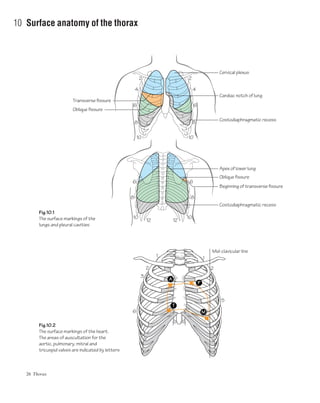
Fig.10.1
The surface markings of the
lungs and pleural cavities
Fig.10.2
The surface markings of the heart.
The areas of auscultation for the
aortic, pulmonary, mitral and
tricuspid valves are indicated by letters
1
2
3
6
5
1
2
P
A
T
M
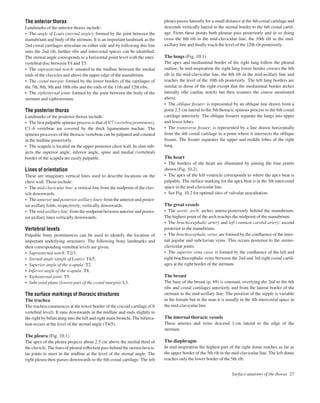
The anterior thorax
Landmarks of the anterior thorax include:
• The angle of Louis (sternal angle): formed by the joint between the
manubrium and body of the sternum. It is an important landmark as the
2nd costal cartilages articulate on either side and by following this line
onto the 2nd rib, further ribs and intercostal spaces can be identified.
The sternal angle corresponds to a horizontal point level with the inter-
vertebral disc between T4 and T5.
• The suprasternal notch: situated in the midline between the medial
ends of the clavicles and above the upper edge of the manubrium.
• The costal margin: formed by the lower borders of the cartilages of
the 7th, 8th, 9th and 10th ribs and the ends of the 11th and 12th ribs.
• The xiphisternal joint: formed by the joint between the body of the
sternum and xiphisternum.
The posterior thorax
Landmarks of the posterior thorax include:
• The first palpable spinous process is that of C7 (vertebra prominens).
C1–6 vertebrae are covered by the thick ligamentum nuchae. The
spinous processes of the thoracic vertebrae can be palpated and counted
in the midline posteriorly.
• The scapula is located on the upper posterior chest wall. In slim sub-
jects the superior angle, inferior angle, spine and medial (vertebral)
border of the scapula are easily palpable.
Lines of orientation
These are imaginary vertical lines used to describe locations on the
chest wall. These include:
• The mid-clavicular line: a vertical line from the midpoint of the clav-
icle downwards.
• The anterior and posterior axillary lines: from the anterior and poster-
ior axillary folds, respectively, vertically downwards.
• The mid-axillary line: from the midpoint between anterior and poster-
ior axillary lines vertically downwards.
Vertebral levels
Palpable bony prominences can be used to identify the location of
important underlying structures. The following bony landmarks and
their corresponding vertebral levels are given:
• Suprasternal notch: T2/3.
• Sternal angle (angle of Louis): T4/5.
• Superior angle of the scapula: T2.
• Inferior angle of the scapula: T8.
• Xiphisternal joint: T9.
• Subcostal plane (lowest part of the costal margin): L3.
The surface markings of thoracic structures
The trachea
The trachea commences at the lower border of the cricoid cartilage (C6
vertebral level). It runs downwards in the midline and ends slightly to
the right by bifurcating into the left and right main bronchi. The bifurca-
tion occurs at the level of the sternal angle (T4/5).
The pleura (Fig. 10.1)
The apex of the pleura projects about 2.5 cm above the medial third of
the clavicle. The lines of pleural reflection pass behind the sternoclavicu-
lar joints to meet in the midline at the level of the sternal angle. The
right pleura then passes downwards to the 6th costal cartilage. The left
pleura passes laterally for a small distance at the 4th costal cartilage and
descends vertically lateral to the sternal border to the 6th costal cartil-
age. From these points both pleurae pass posteriorly and in so doing
cross the 8th rib in the mid-clavicular line, the 10th rib in the mid-
axillary line and finally reach the level of the 12th rib posteriorly.
The lungs (Fig. 10.1)
The apex and mediastinal border of the right lung follow the pleural
outline. In mid-inspiration the right lung lower border crosses the 6th
rib in the mid-clavicular line, the 8th rib in the mid-axillary line and
reaches the level of the 10th rib posteriorly. The left lung borders are
similar to those of the right except that the mediastinal border arches
laterally (the cardiac notch) but then resumes the course mentioned
above.
• The oblique fissure: is represented by an oblique line drawn from a
point 2.5 cm lateral to the 5th thoracic spinous process to the 6th costal
cartilage anteriorly. The oblique fissures separate the lungs into upper
and lower lobes.
• The transverse fissure: is represented by a line drawn horizontally
from the 4th costal cartilage to a point where it intersects the oblique
fissure. The fissure separates the upper and middle lobes of the right
lung.
The heart
• The borders of the heart are illustrated by joining the four points
shown (Fig. 10.2).
• The apex of the left ventricle corresponds to where the apex beat is
palpable. The surface marking for the apex beat is in the 5th intercostal
space in the mid-clavicular line.
• See Fig. 10.2 for optimal sites of valvular auscultation.
The great vessels
• The aortic arch: arches antero-posteriorly behind the manubrium.
The highest point of the arch reaches the midpoint of the manubrium.
• The brachiocephalic artery and left common carotid artery: ascend
posterior to the manubrium.
• The brachiocephalic veins: are formed by the confluence of the inter-
nal jugular and subclavian veins. This occurs posterior to the sterno-
clavicular joints.
• The superior vena cava: is formed by the confluence of the left and
right brachiocephalic veins between the 2nd and 3rd right costal cartil-
ages at the right border of the sternum.
The breast
The base of the breast (p. 69) is constant, overlying the 2nd to the 6th
ribs and costal cartilages anteriorly and from the lateral border of the
sternum to the mid-axillary line. The position of the nipple is variable
in the female but in the man it is usually in the 4th intercostal space in
the mid-clavicular line.
The internal thoracic vessels
These arteries and veins descend 1 cm lateral to the edge of the
sternum.
The diaphragm
In mid-inspiration the highest part of the right dome reaches as far as
the upper border of the 5th rib in the mid-clavicular line. The left dome
reaches only the lower border of the 5th rib.
Surface anatomy of the thorax 27
28 Abdomen and pelvis
11 The abdominal wall
Linea
semilunaris
Serratus
anterior
Superficial
inguinal ring
A
A
A
B
C
Cut edge of external oblique
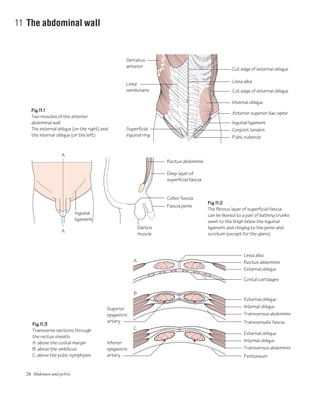
Fig.11.1
Two muscles of the anterior
abdominal wall.
The external oblique (on the right) and
the internal oblique (on the left)
Fig.11.2
The fibrous layer of superficial fascia
can be likened to a pair of bathing trunks
sewn to the thigh below the inguinal
ligament and clinging to the penis and
scrotum (except for the glans)
Fig.11.3
Transverse sections through
the rectus sheath.
A: above the costal margin
B: above the umbilicus
C: above the pubic symphysis
Linea alba
Cut edge of external oblique
Internal oblique
Anterior superior iliac spine
Inguinal ligament
Inguinal
ligament
Conjoint tendon
Pubic tubercle
Rectus abdominis
Dartos
muscle
Rectus abdominis
External oblique
Linea alba
Costal cartilages
External oblique
Internal oblique
Transversus abdominis
Transversalis fascia
Superior
epigastric
artery
Deep layer of
superficial fascia
Fascia penis
Colles' fascia
External oblique
Internal oblique
Transversus abdominis
Peritoneum
Inferior
epigastric
artery
The abdominal wall 29
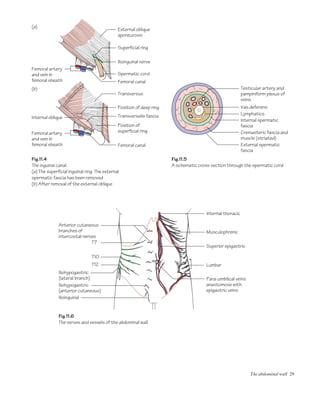
Fig.11.4
The inguinal canal.
(a) The superficial inguinal ring. The external
spermatic fascia has been removed
(b) After removal of the external oblique
Fig.11.6
The nerves and vessels of the abdominal wall
Fig.11.5
A schematic cross section through the spermatic cord
Superficial ring
Femoral artery
and vein in
femoral sheath
External oblique
aponeurosis
Transversus
Transversalis fascia
Position of deep ring
Position of
superficial ring
Ilioinguinal nerve
Spermatic cord
Femoral canal
Femoral canal
Femoral artery
and vein in
femoral sheath
Internal oblique
(b)
(a)
Testicular artery and
pampiniform plexus of
veins
Lymphatics
Internal thoracic
Musculophrenic
T7
Vas deferens
External spermatic
fascia
Cremasteric fascia and
muscle (striated)
Internal spermatic
fascia
Superior epigastric
Para-umbilical veins
anastomose with
epigastric veins
Lumbar
T10
T12
Ilioinguinal
Anterior cutaneous
branches of
intercostal nerves
Iliohypogastric
(lateral branch)
Iliohypogastric
(anterior cutaneous)
deep circumflex iliac artery (a branch of the external iliac artery) an-
teriorly. The two lower intercostal and four lumbar arteries supply the
wall posterolaterally.
Veins of the abdominal wall (Fig. 11.6)
The abdominal wall is a site of porto-systemic anastomosis. The lateral
thoracic, lumbar and superficial epigastric tributaries of the systemic
circulation anastomose around the umbilicus with the para-umbilical
veins which accompany the ligamentum teres and drain into the portal
circulation.
Lymph drainage of the abdominal wall
See p. 35.
The inguinal canal (Fig. 11.4)
The canal is approximately 4 cm long and allows the passage of the
spermatic cord (round ligament in the female) through the lower ab-
dominal wall. The canal passes obliquely from the deep inguinal ring
in a medial direction to the superficial inguinal ring.
• The deep ring: is an opening in the transversalis fascia. It lies half-
way between the anterior superior iliac spine and the pubic tubercle.
The inferior epigastric vessels pass medial to the deep ring.
• The superficial ring: is not a ring but a triangular-shaped defect in
the external oblique aponeurosis lying above and medial to the pubic
tubercle.
The walls of the inguinal canal (Fig. 11.4)
• Anterior: external oblique covers the length of the canal anteriorly.
It is reinforced in its lateral third by internal oblique.
• Superior: internal oblique arches posteriorly to form the roof of the
canal.
• Posterior: transversalis fascia forms the lateral part of the posterior
wall. The conjoint tendon (the combined common insertion of the inter-
nal oblique and transversus into the pectineal line) forms the medial
part of the posterior wall.
• Inferior: the inguinal ligament.
Contents of the inguinal canal
• The spermatic cord (or round ligament in the female).
• The ilioinguinal nerve (L1).
The spermatic cord (Fig. 11.5)
The spermatic cord is covered by three layers which arise from the
layers of the lower abdominal wall as the cord passes through the
inguinal canal. These are the:
• External spermatic fascia: from the external oblique aponeurosis.
• Cremasteric fascia and muscle: from the internal oblique
aponeurosis.
• Internal spermatic fascia: from the transversalis fascia.
The contents of the spermatic cord include the:
• Ductus (vas) deferens (or round ligament).
• Testicular artery: a branch of the abdominal aorta.
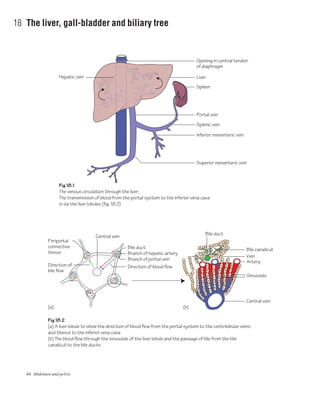
• Pampiniform plexus of veins: these coalesce to form the testicular
vein in the region of the deep ring.
• Lymphatics: from the testis and epididymis draining to the pre-
aortic nodes.
• Autonomic nerves.
30 Abdomen and pelvis
The anterior abdominal wall comprises: skin, superficial fascia, abdom-
inal muscles (and their respective aponeuroses), transversalis fascia,
extraperitoneal fat, and parietal peritoneum.
Skin (Fig. 11.6)
The skin of the abdominal wall is innervated by the anterior rami of the
lower six thoracic intercostal and iliohypogastric (L1) nerves.
Fascia (Fig. 11.2)
There is no deep fascia in the trunk. The superficial fascia is composed
of two layers:
• A superficial fatty layeraCamper’s fasciaawhich is continuous with
the superficial fat over the rest of the body.
• A deep fibrous (membranous) layeraScarpa’s fasciaawhich fades
above and laterally but below blends with the fascia lata of the thigh
just below the inguinal ligament and extends into: the penis as a tubular
sheath; the wall of the scrotum and posteriorly; the perineum where it
fuses with the perineal body and posterior margin of the perineal mem-
brane. It fuses laterally with the pubic arch. The fibrous fascial layer is
referred to as Colles’ fascia in the perineum.
Muscles of the anterior abdominal wall (Fig. 11.1)
These comprise: external oblique, internal oblique, transversus abdo-
minis, rectus abdominis and pyramidalis (see Muscle index, p. 162).
As in the intercostal space, the neurovascular structures pass in the
neurovascular plane between internal oblique and transversus muscle
layers.
The rectus sheath (Fig. 11.3)
The rectus sheath encloses the rectus muscles. It contains also the super-
ior and inferior epigastric vessels and anterior rami of the lower six
thoracic nerves.
The sheath is made up from the aponeuroses of the muscles of the
anterior abdominal wall. The linea alba represents the fusion of the
aponeuroses in the midline. Throughout the major part of the length of
the rectus the aponeuroses of external oblique and the anterior layer
of internal oblique lie in front of the muscle and the posterior layer of
internal oblique and transversus behind. The composition of the sheath
is, however, different above the costal margin and above the pubic
symphysis:
• Above the costal margin: only the external oblique aponeurosis is
present and forms the anterior sheath.
• Above the pubic symphysis: about halfway between the umbilicus
and pubic symphysis the layers passing behind the rectus muscle gradu-
ally fade out and from this point all aponeuroses pass anterior to the
rectus muscle, leaving only the transversalis fascia.
The lateral border of the rectusathe linea semilunarisacan usually
be identified in thin subjects. It crosses the costal margin in the trans-
pyloric plane.
Three tendinous intersections firmly attach the anterior sheath wall
to the muscle itself. They are situated at the level of the xiphoid, the
umbilicus and one between these two. These give the abdominal ‘six-
pack’ appearance in muscular individuals.
Arteries of the abdominal wall (Fig. 11.6)
These include the superior and inferior epigastric arteries (branches of
the internal thoracic and external iliac arteries, respectively) and the
The arteries of the abdomen 31
12 The arteries of the abdomen
Fig.12.1
The abdominal aorta and its branches.
Red labels: ventral branches
Blue labels: lateral branches
Green labels: branches to body wall
Fig.12.2
The coeliac artery and its branches.
The three primary branches are labelled in red
Fig.12.3
The superior mesenteric artery and its branches
Inferior phrenic
Suprarenal
Coeliac
Superior
mesenteric
Inferior
mesenteric
Renal
Ureteric branch
Lumbar
Median sacral
Gonadal
Oesophageal
branches
Left gastric
Right gastric
Right and left hepatic
Superior
mesenteric
artery
Jejunal and
ileal branches
Cystic
Common hepatic
Gastroduodenal
Omental branch
Spleen
Splenic
Short gastric
Jejunal and
ileal branches
Ileocolic
Right colic
Middle colic
Superior
mesenteric
Appendicular
Anterior and posterior
caecal branches
Superior
pancreatico-
duodenal
Superior
pancreaticoduodenal
Inferior
pancreaticoduodenal
Right
gastro-
epiploic
Inferior
pancreatico-
duodenal
Left
gastroepiploic
Pancreatic
branches
32 Abdomen and pelvis
Fig.12.4
The blood supply of the appendix
Fig.12.5
The inferior mesenteric artery and its branches.
Note the anastomosis with the inferior rectal artery (green) halfway down the anal canal
Ileocolic artery
Right colic artery
Mesentery
Ileal branch
Inferior rectal (a branch of the internal pudendal)
Anal canal
Middle colic
(from s.mesenteric)
Superior rectal
Appendicular artery
Meso-appendix
Anterior and posterior
caecal branches
Ileocaecal fold (bloodless fold of Treves)
Marginal artery
Sigmoid branches
Left colic
Inferior mesenteric
The main abdominal branches of the abdominal aorta include the:
• Coeliac trunk: supplies the embryonic foregut: from the lower third
of the oesophagus to the second part of the duodenum.
• Superior mesenteric artery: supplies the midgut: from the second
part of the duodenum to the distal transverse colon.
• Renal arteries.
• Gonadal arteries.
• Inferior mesenteric artery: supplies the hindgut: from the distal
transverse colon to the upper half of the anal canal.
The abdominal aorta (Fig. 12.1)
The abdominal aorta is a continuation of the thoracic aorta as it passes
under the median arcuate ligament of the diaphragm. It descends in the
retroperitoneum and ultimately bifurcates into left and right common
iliac arteries to the left of the midline at the level of L4. The vertebral
bodies and intervertebral discs lie behind the aorta whilst anteriorly,
from above downwards, lie its anterior branches, the coeliac plexus, the
lesser sac, the body of the pancreas, the third part of the duodenum, and
the parietal peritoneum. The main relation to the right of the abdominal
aorta is the inferior vena cava whilst to the left lie the duodenojejunal
junction and inferior mesenteric vein.
The arteries of the abdomen 33
The coeliac trunk (Fig. 12.2)
This trunk arises from the aorta at the level of T12/L1 and after a short
course divides into three terminal branches. These include the:
• Left gastric artery: passes upwards to supply the lower oesophagus
by branches which ascend through the oesophageal hiatus in the
diaphragm. The left gastric then descends in the lesser omentum along
the lesser curve of the stomach which it supplies.
• Splenic artery: passes along the superior border of the pancreas
in the posterior wall of the lesser sac to reach the upper pole of the left
kidney. From here it passes to the hilum of the spleen in the lienorenal
ligament. The splenic artery also gives rise to short gastric branches,
which supply the stomach fundus, and a left gastroepiploic branch
which passes in the gastrosplenic ligament to reach and supply the
greater curve of the stomach.
• Hepatic artery: descends to the right towards the first part of the
duodenum in the posterior wall of the lesser sac. It then passes between
the layers of the free border of the lesser omentum which conveys it to
the porta hepatis in close relation to the portal vein and bile duct (these
structures together constitute the anterior margin of the epiploic fora-
men). Before reaching the porta hepatis it divides into right and left
hepatic arteries and from the right branch the cystic artery is usually
given off. Prior to its ascent towards the porta hepatis the hepatic artery
gives rise to gastroduodenal and right gastric branches. The latter
passes along the lesser curve of the stomach to supply it. The former
passes behind the first part of the duodenum and then branches further
into superior pancreaticoduodenal and right gastroepiploic branches.
The right gastroepiploic branch runs along the lower part of the greater
curvature to supply the stomach.
The superior mesenteric artery (Fig. 12.3)
The superior mesenteric artery arises from the abdominal aorta at the
level of L1. From above downwards, it passes over the left renal vein
behind the neck of the pancreas, over the uncinate process and anterior
to the third part of the duodenum. It then passes obliquely downwards
and towards the right iliac fossa between the layers of the mesentery of
the small intestine where it divides into its terminal branches. The
branches of the superior mesenteric artery include the:
• Inferior pancreaticoduodenal artery: supplies the lower half of the
duodenum and pancreatic head.
• Ileocolic artery: passes in the root of the mesentery over the right
ureter and gonadal vessels to reach the caecum where it divides into ter-
minal caecal and appendicular branches (Fig. 12.4).
• Jejunal and ileal branches: a total of 12–15 branches arise from the
left side of the artery. These branches divide and reunite within the
small bowel mesentery to form a series of arcades which then give rise
to small straight terminal branches which supply the gut wall.
• Right colic artery: passes horizontally in the posterior abdominal
wall to supply the ascending colon.
• Middle colic artery: courses in the transverse mesocolon to supply
the proximal two-thirds of the transverse colon.
The renal arteries
These arise from the abdominal aorta at the level of L2.
The gonadal arteries (ovarian or testicular)
These arteries arise from below the renal arteries and descend obliquely
on the posterior abdominal wall to reach the ovary in the female, or pass
through the inguinal canal in the male to reach the testis.
The inferior mesenteric artery (Fig. 12.5)
The inferior mesenteric artery arises from the abdominal aorta at the
level of L3. It passes downwards and to the left and crosses the left
common iliac artery where it changes its name to the superior rectal
artery. Its branches include:
• The left colic artery: supplies the distal transverse colon, the splenic
flexure and upper descending colon.
• Two or three sigmoid branches: pass into the sigmoid mesocolon
and supply the lower descending and sigmoid colon.
• The superior rectal artery: passes into the pelvis behind the rectum
to form an anastomosis with the middle and inferior rectal arteries. It
supplies the rectum and upper half of the anal canal.
The marginal artery (of Drummond) is an anastomosis of the colic
arteries at the margin of the large intestine. This establishes a strong
collateral circulation throughout the colon.
34 Abdomen and pelvis
13 The veins and lymphatics of the abdomen
Fig.13.1
The inferior vena cava and its tributaries
Fig.13.2
The portal system.
Note the anastomoses with the systemic system (orange) in the oesophagus and the anal canal
Inferior phrenic
Suprarenal
Ureteric branch
Renal
Lumbar
Median sacral
Common iliac
Gonadal
Pancreaticoduodenal
Right colic
Middle colic
Cystic
Oesophageal branches
Right gastric
Left gastric
Right gastroepiploic
Spleen
Splenic
Inferior mesenteric
Superior mesenteric
Left colic
Sigmoid branches
Superior rectal
Portal vein
The portal vein (Fig. 13.2)
The portal venous system receives blood from the length of gut from
the lower third of the oesophagus to the upper half of the anal canal as
well as the spleen, pancreas and gall-bladder. It serves to transfer blood
to the liver where the products of digestion can be metabolized and
stored. Blood from the liver ultimately gains access to the inferior vena
cava by way of the hepatic veins. The portal vein is formed behind the
neck of the pancreas by the union of the superior mesenteric and splenic
veins. It passes behind the first part of the duodenum in front of the in-
ferior vena cava and enters the free border of the lesser omentum. The
vein then ascends towards the porta hepatis in the anterior margin of the
epiploic foramen (of Winslow) in the lesser omentum. At the porta hep-
atis it divides into right and left branches. The veins that correspond to
the branches of the coeliac and superior mesenteric arteries drain into
the portal vein or one of its tributaries. The inferior mesenteric vein
drains into the splenic vein adjacent to the fourth part of the duodenum.
Porto-systemic anastomoses
A number of connections occur between the portal and systemic circula-
tions. When the direct pathway through the liver becomes congested
(such as in cirrhosis) the pressure within the portal vein rises and under
these circumstances the porto-systemic anastomoses form an alternat-
ive route for the blood to take. The sites of porto-systemic anastomosis
include:
• The lower oesophagus (p. 11): formed by tributaries of the left gas-
tric (portal) and oesophageal veins (systemic via the azygos and hemi-
azygos veins).
• The anal canal: formed by the superior rectal (portal) and middle
and inferior rectal veins (systemic).
• The bare area of the liver: formed by the small veins of the portal
system and the phrenic veins (systemic).
• The periumbilical region: formed by small paraumbilical veins
which drain into the left portal vein and the superficial veins of the anter-
ior abdominal wall (systemic).
The inferior vena cava (Fig. 13.1)
The inferior vena cava is formed by the union of the common iliac veins
in front of the body of L5. It ascends in the retroperitoneum on the right
side of the abdominal aorta. Along its course, from below upwards, it
forms the posterior wall of the epiploic foramen of Winslow and is
embedded in the bare area of the liver in front of the right suprarenal
gland. The inferior vena cava passes through the caval opening in the
diaphragm at the level of T8 and drains into the right atrium.
The lymphatic drainage of the abdomen and pelvis
The abdominal wall
Lymph from the skin of the anterolateral abdominal wall above the
level of the umbilicus drains to the anterior axillary lymph nodes. Effer-
ent lymph from the skin below the umbilicus drains to the superficial
inguinal nodes.
The lymph nodes and trunks
The two main lymph node groups of the abdomen are closely related to
the aorta. These comprise the pre-aortic and para-aortic groups.
• The pre-aortic nodes are arranged around the three ventral branches
of the aorta and consequently receive lymph from the territories that are
supplied by these branches. This includes most of the gastrointestinal
tract, liver, gall-bladder, spleen and pancreas. The efferent vessels from
the pre-aortic nodes coalesce to form a variable number of intestinal
trunks which deliver the lymph to the cisterna chyli.
• The para-aortic nodes are arranged around the lateral branches of the
aorta and drain lymph from their corresponding territories, i.e. the kid-
neys, adrenals, gonads, and abdominal wall as well as the common iliac
nodes. The efferent vessels from the para-aortic nodes coalesce to form
a variable number of lumbar trunks which deliver the lymph to the cis-
terna chyli.
Cisterna chyli
The cisterna chyli is a lymphatic sac that lies anterior to the bodies of
the 1st and 2nd lumbar vertebrae. It is formed by the confluence of the
intestinal trunks, the lumbar trunks and lymphatics from the lower tho-
racic wall. It serves as a receptacle for lymph from the abdomen and
lower limbs which is then relayed to the thorax by the thoracic duct
(p. 11).
The lymphatic drainage of the stomach
Lymph from the stomach drains to the coeliac nodes. For the purposes
of description, the stomach can be divided into four quarters where
lymph drains to the nearest appropriate group of nodes.
The lymphatic drainage of the testes
Lymph from the skin of the scrotum and the tunica albuginea drains to
the superficial inguinal nodes. Lymph from the testes, however, drains
along the course of the testicular artery to the para-aortic group of
nodes. Hence, a malignancy of the scrotal skin might result in palpable
enlargement of the superficial inguinal nodes whereas testicular
tumours metastasize to the para-aortic nodes.
The veins and lymphatics of the abdomen 35
36 Abdomen and pelvis
14 The peritoneum
Fig.14.1
A vertical section through the abdomen to show the
peritoneal relations.
Lesser sac
Greater sac
Fig.14.2
A horizontal section through the abdomen.
Note how the epiploic foramen lies between two major veins
Fig.14.3
The peritoneal relations of the liver
(a) Seen from in front
(b) The same liver rotated in the direction of the arrow to show the upper and posterior surfaces.
The narrow spaces between the liver and the diaphragm labelled A and B are the right and left subphrenic spaces
Upper recess of
omental bursa
Diaphragm
Transverse mesocolon
Small intestine
Mesentery
Liver
Epiploic foramen
(in the distance)
Greater omentum
Subphrenic space
Epiploic foramen (of Winslow)
Aorta
Left kidney
Splenic artery
Lienorenal ligament
Spleen
Short gastric
vessels
Gastrosplenic
ligament
Stomach
Lesser omentum
Duodenum (third part)
Transverse colon
Fusion between layers
of greater omentum
Lesser omentum
Pancreas
Stomach
Omental bursa
Portal vein
Inferior vena cava
Hepatic artery
Common bile duct
Liver
(a) (b)
Peritoneum
covering
caudate lobe
Lower layer of
coronary ligament
Right
triangular
ligament
Left triangular
ligament
Inferior vena cava
Upper layer of
coronary ligamentUpper layer of
coronary ligament Bare area
Falciform ligament
Gall bladder
Ligamentum teres
Position of umbilicus
Ligamentum teres
Portal vein, hepatic
artery and bile duct
in free edge of lesser
omentum leading to
porta hepatis
Cut edge of lesser
omentum
A
B
Fissure for
ligamentum venosum
Left triangular
ligament
Fundus of
gall bladder
The mesenteries and layers of the peritoneum
The transverse colon, stomach, spleen and liver each have attached to
them two ‘mesenteries’adouble layers of peritoneum containing arteries
and their accompanying veins, nerves and lymphaticsawhile the small
intestine and sigmoid colon have only one. All the other viscera are re-
troperitoneal. The mesenteries and their associated arteries are as follows:
• The colon (Fig. 14.1): (1) The transverse mesocolon (the middle
colic artery). (2) The posterior two layers of the greater omentum.
• The stomach (Fig. 14.1): (1) The lesser omentum (the left and right
gastric arteries and in its free border, the hepatic artery, portal vein and
bile duct). (2) The anterior two layers of the greater omentum (the right
and left gastroepiploic arteries and their omental branches).
• The spleen (Fig. 14.2): (1) The lienorenal ligament (the splenic
artery). (2) The gastrosplenic ligament (the short gastric and left gas-
troepiploic arteries).
• The liver (Fig. 14.3): (1) The falciform ligament and the two layers
of the coronary ligament with their sharp edges, the left and right trian-
gular ligaments. This mesentery is exceptional in that the layers of the
coronary ligament are widely separated so that the liver has a bare area
directly in contact with the diaphragm (the obliterated umbilical artery
in the free edge of the falciform ligament and numerous small veins in
the bare area, p. 35). (2) The lesser omentum (already described).
• The small intestine (Fig. 14.1): (1) The mesentery of the small intes-
tine (the superior mesenteric artery and its branches).
• The sigmoid colon: (1) The sigmoid mesocolon (the sigmoid arteries
and their branches).
The peritoneal cavity (Figs 14.1 and 14.2)
• The complications of the peritoneal cavity may best be described by
starting at the transverse mesocolon. Its two layers are attached to the
anterior surface of the pancreas, the second part of the duodenum and
the front of the left kidney. They envelop the transverse colon and con-
tinue downwards to form the posterior two layers of the greater omen-
tum, which hangs down over the coils of the small intestine. They then
turn back on themselves to form the anterior two layers of the omentum
and these reach the greater curvature of the stomach. The four layers of
the omentum are fused and impregnated with fat. The greater omentum
plays an important role in limiting the spread of infection in the peri-
toneal cavity.
• From its attachment to the pancreas, the lower layer of the transverse
mesocolon turns downwards to become the parietal peritoneum of the
posterior abdominal wall from which it is reflected to form the mesen-
tery of the small intestine and the sigmoid mesocolon.
• The upper layer of the transverse mesocolon passes upwards to form
the parietal peritoneum of the posterior abdominal wall, covering the
upper part of the pancreas, the left kidney and its suprarenal, the aorta
and the origin of the coeliac artery (the ‘stomach bed’). It thus forms the
posterior wall of the omental bursa. It then covers the diaphragm and
continues onto the anterior abdominal wall.
• From the diaphragm and anterior abdominal wall it is reflected onto
the liver to form its ‘mesentery’ in the form of the two layers of the fal-
ciform ligament. At the liver, the left layer of the falciform ligament
folds back on itself to form the sharp edge of the left triangular liga-
ment while the right layer turns back on itself to form the upper and
lower layers of the coronary ligament with its sharp-edged right tri-
angular ligament. The layers of the coronary ligament are widely
separated so that a large area of liver between themathe bare areaa
is directly in contact with the diaphragm. The inferior vena cava is
embedded in the bare area (Fig. 14.3).
• From the undersurface of the liver another ‘mesentery’ passes from
the fissure for the ligamentum venosum to the lesser curvature of the
stomach to form the lesser omentum.
• The lesser omentum splits to enclose the stomach and is continuous
with the two layers of the greater omentum already described. The
lesser omentum has a right free border which contains the portal vein,
the hepatic artery and the common bile duct.
• In the region of the spleen there are two more ‘mesenteries’ which are
continuous with the lesser and greater omenta. These are the lienorenal
ligament, a double layer of peritoneum reflected from the front of the
left kidney to the hilum of the spleen, and the gastrosplenic ligament
which passes from the hilum of the spleen to the greater curvature of the
stomach (Fig. 14.2).
• The mesentery of the small intestine is attached to the posterior ab-
dominal wall from the duodenojejunal flexure to the ileocolic junction.
• The sigmoid mesocolon passes from a V-shaped attachment on the
posterior abdominal wall to the sigmoid colon.
• The general peritoneal cavity comprises the main cavityathe greater
sacaand a diverticulum from itathe omental bursa (lesser sac). The
omental bursa lies between the stomach and the stomach bed to allow
free movement of the stomach. It lies behind the stomach, the lesser
omentum and the caudate lobe of the liver and in front of the structures
of the stomach bed. The left border is formed by the hilum of the spleen
and the lienorenal and gastrosplenic ligaments.
• The communication between the greater and lesser sacs is the epi-
ploic foramen ( foramen of Winslow). It lies behind the free border of
the lesser omentum and its contained structures, below the caudate pro-
cess of the liver, in front of the inferior vena cava and above the first
part of the duodenum.
• The subphrenic spaces are part of the greater sac that lies between the
diaphragm and the upper surface of the liver. There are right and left
spaces, separated by the falciform ligament.
• In the pelvis the parietal peritoneum covers the upper two-thirds of
the rectum whence it is reflected, in the female, onto the posterior
fornix of the vagina and the back of the uterus to form the recto-uterine
pouch (pouch of Douglas). In the male it passes onto the back of the
bladder to form the rectovesical pouch.
The anterior abdominal wall
• The peritoneum of the deep surface of the anterior abdominal wall
shows a central ridge from the apex of the bladder to the umbilicus pro-
duced by the median umbilical ligament. This is the remains of the
embryonic urachus. Two medial umbilical ligaments converge to the
umbilicus from the pelvis. They represent the obliterated umbilical
arteries of the fetus. The ligamentum teres is a fibrous band in the free
margin of the falciform ligament. It represents the obliterated left
umbilical vein.
The peritoneum 37
38 Abdomen and pelvis
15 The upper gastrointestinal tract I
Fig.15.1
The subdivisions of the stomach
Fig.15.2
The stomach bed. For more detail see fig.19.1.
The stomach is outlined but the shape is by no means constant
Duodenum
Right crus of diaphragm
Suprarenal
Pyloric sphincter
Angular incisure
Lesser curvature
Cardiac notch
Fundus
Body
Greater curvature
Pyloric antrum
Right kidney
Spleen
Aorta
Splenic artery
Splenic flexure of colon
Pancreas
Left kidney
Descending colon
Hepatic
flexure
Ascending
colon
The embryonic gut is divided into foregut, midgut and hindgut, sup-
plied, respectively, by the coeliac, superior mesenteric and inferior
mesenteric arteries. The foregut extends from the oesophagus to the
entrance of the common bile duct into the second part of the duodenum.
The midgut extends down to two-thirds of the way along the transverse
colon. It largely develops outside the abdomen until this congenital
‘umbilical hernia’ is reduced during the 8th–10th week of gestation.
The hindgut extends down to include the upper half of the anal canal.
The abdominal oesophagus
• The abdominal oesophagus measures approximately 1 cm in length.
• It is accompanied by the anterior and posterior vagal trunks from the
left and right vagi and the oesophageal branches of the left gastric
artery.
• The lower third of the oesophagus is a site of porto-systemic venous
anastomosis. This is formed between tributaries of the left gastric and
azygos veins (p. 11).
The stomach (Figs 15.1 and 15.2)
• The notch on the lesser curve, at the junction of the body and pyloric
antrum, is the incisura angularis.
• The pyloric sphincter controls the release of stomach contents into
the duodenum. The sphincter is composed of a thickened layer of circu-
lar smooth muscle which acts as an anatomical, as well as physiolo-
gical, sphincter. The junction of the pylorus and duodenum can be seen
externally as a constriction with an overlying veinathe prepyloric vein
(of Mayo).
• The cardiac orifice represents the point of entry for oesophageal con-
tents into the stomach. The cardiac sphincter acts to prevent reflux of
stomach contents into the oesophagus. Unlike the pylorus there is no
discrete anatomical sphincter at the cardia; however, multiple factors
contribute towards its mechanism. These include: the arrangement of
muscle fibres at the cardiac orifice acting as a physiological sphincter;
the angle at which the oesophagus enters the stomach producing a valve
effect; the right crus of the diaphragm surrounding the oesophagus and
compression of the short segment of intra-abdominal oesophagus by in-
creases in intra-abdominal pressure during straining, preventing reflux.
• The lesser omentum is attached to the lesser curvature and the greater
omentum to the greater curvature. The omenta contain the blood and
lymphatic supply to the stomach.
• The mucosa of the stomach is thrown into foldsarugae.
• Blood supply (see Fig. 12.2): the arterial supply to the stomach is
exclusively from branches of the coeliac axis. Venous drainage is to the
portal system (see Fig. 13.2).
• Nerve supply: the anterior and posterior vagal trunks arise from the
oesophageal plexuses and enter the abdomen through the oesophageal
hiatus. The hepatic branches of the anterior vagus pass to the liver. The
coeliac branch of the posterior vagus passes to the coeliac ganglion
from where it proceeds to supply the intestine down to the distal trans-
verse colon. The anterior and posterior vagal trunks descend along the
lesser curve as the anterior and posterior nerves of Latarjet from which
terminal branches arise to supply the stomach. The vagi provide a
motor and secretory supply to the stomach. The latter includes a supply
to the acid-secreting partathe body.
The duodenum (Figs 19.1 and 19.2)
The duodenum is the first part of the small intestine. It is approximately
25 cm long and curves around the head of the pancreas. Its primary
function is in the absorption of digested products. Despite its relatively
short length the surface area is greatly enhanced by the mucosa being
thrown into folds bearing villi which are visible only at a microscopic
level. With the exception of the first 2.5 cm, which is completely cov-
ered by peritoneum, the duodenum is a retroperitoneal structure. It is
considered in four parts:
• First part (5 cm).
• Second part (7.5 cm)athis part descends around the head of the
pancreas. Internally, in the mid-section, a small eminence may be
found on the posteromedial aspect of the mucosaathe duodenal
papilla. This structure represents the site of the common opening
of the bile duct and main pancreatic duct (of Wirsung). The sphinc-
ter of Oddi guards this common opening. A smaller subsidiary
pancreatic duct (of Santorini) opens into the duodenum a small
distance above the papilla.
• Third part (10 cm)athis part is crossed anteriorly by the root of
the mesentery and superior mesenteric vessels.
• Fourth part (2.5 cm)athis part terminates as the duodenojejunal
junction. The termination of the duodenum is demarcated by a
peritoneal fold stretching from the junction to the right crus of
the diaphragm covering the suspensory ligament of Treitz. The
terminal part of the inferior mesenteric vein lies adjacent to the
duodenojejunal junction and serves as a useful landmark.
• Blood supply (see Fig. 12.2): the superior and inferior pancreatico-
duodenal arteries supply the duodenum and run between this structure
and the pancreatic head. The superior artery arises from the coeliac axis
and the inferior from the superior mesenteric artery.
Peptic ulcer disease
Most peptic ulcers occur in the stomach and proximal duodenum. They
arise as a result of an imbalance between acid secretion and mucosal
defences. Helicobacter pylori infection is a significant aetiological
factor and the eradication of this organism, as well as the attenuation
of acid secretion, form the cornerstones of medical treatment. In a
minority of cases the symptoms are not controlled by medical treatment
alone and surgery is required. ‘Very highly selective vagotomy’ is a
technique where only the afferent vagal fibres to the acid-secreting
body are denervated thus not compromising the motor supply to the
stomach and hence bypassing the need for a drainage procedure (e.g.
gastrojejunostomy).
The upper gastrointestinal tract I 39
40 Abdomen and pelvis
16 The upper gastrointestinal tract II
Thicker wall
(feels full)
Jejunal branches
Redder
wall
Ileal branches
From superior mesenteric artery
Thinner wall
(feels empty)
Simple arcades Multiple arcades
Fig.16.1
The jejunum and the ileum can be distinguished by their colour, feel and the complexity of the arterial arcades
Fig.16.2
Small bowel obstruction, showing dilated bowel loops
Jejunum Ileum
The small intestine (Fig. 16.1)
The small intestine is approximately 6 m long and comprises the duo-
denum, jejunum and ileum. A large internal surface area throughout the
small intestine facilitates absorption of digested products. The small
intestine is suspended from the posterior abdominal wall by its mesen-
tery which contains the superior mesenteric vessels, lymphatics and auto-
nomic nerves. The origin of the mesentery measures approximately 15
cm and passes from the duodenojejunal flexure to the right sacro-iliac
joint. The distal border is obviously the same length as the intestine.
No sharp distinction occurs between the jejunum and ileum; however,
certain characteristics help distinguish between them:
• Excluding the duodenum, the proximal two-fifths of the small intes-
tine comprises jejunum whereas the remaining distal three-fifths com-
prises ileum. Loops of jejunum tend to occupy the umbilical region
whereas the ileum occupies the lower abdomen and pelvis.
• The mucosa of the small intestine is thrown into circular foldsathe
valvulae conniventes. These are more prominent in the jejunum than in
the ileum.
• The diameter of the jejunum tends to be greater than that of the ileum.
• The mesentery to the jejunum tends to be thicker than that for the
ileum.
• The superior mesenteric vessels (see Fig. 12.3) pass over the third
part of the duodenum to enter the root of the mesentery and pass
towards the right iliac region on the posterior abdominal wall. Jejunal
and ileal branches arise which divide and re-anastomose within the
mesentery to produce arcades. End-artery vessels arise from the
arcades to supply the gut wall. The arterial supply to the jejunum con-
sists of few arcades and little terminal branching whereas the vessels to
the ileum form numerous arcades and much terminal branching of end-
arteries passing to the gut wall.
Small bowel obstruction (Fig. 16.2)
Small bowel obstruction (SBO) can occur due to luminal, mural or
extraluminal factors that result in luminal blockage. Post surgical
adhesions and herniae are the most frequent causes. Many cases
resolve with conservative measures only; however, if any deterioration
in the clinical picture occurs to suggest intestinal infarction or perfora-
tion an exploratory laparotomy is mandatory. The classical X-ray fea-
tures of SBO are those of dilated small bowel loops. These can be
distinguished from large bowel as the valvulae conniventes (present
only in the small bowel) can be identified traversing the entire lumen
whereas the small bowel haustra only partially traverse the lumen.
The upper gastrointestinal tract II 41
42 Abdomen and pelvis
17 The lower gastrointestinal tract
Teniae coli
Fig.17.2
A coronal section through the pelvis to show the
anal sphincters and the ischiorectal fossa
Fig.17.1
The various positions in which the appendix may be found.
In the pelvic position the appendix may be close to the ovary in the female
Appendices
epiploicae
Retrocaecal
Pelvic
Subcaecal
Ovary in female
Rectum
Longitudinal muscle
Submucosa
Sphincter ani internus
Pre-ileal
Retro-ileal
Retrocolic
Circular muscle
Levator ani
Obturator internus
Fat of ischiorectal fossa
Sphincter
ani
externus
Deep
Superficial
Subcutaneous
Pudendal canal
Adductor muscles
Inferior rectal
vesels and nerve
The caecum and colon (Figs 17.1, 12.3, 12.5)
In adults, the large bowel measures approximately 1.5 m. The caecum,
ascending, transverse, descending and sigmoid colon have similar
characteristic features. These are that they possess:
• Appendices epiploicae (Fig. 17.1): these are fat-laden peritoneal tags
present over the surface of the caecum and colon.
• Teniae coli (Fig. 17.1): these are three flattened bands representing
the condensed longitudinal muscular coat of the large intestine. They
course from the base of the appendix (and form a useful way of locating
this structure at operation) to the recto-sigmoid junction.
• Sacculations: because the teniae are shorter than the bowel itself the
colon takes on a sacculated appearance. These sacculations are visible
not only at operation but also radiographically. On a plain abdominal X-
ray, the colon, which appears radiotranslucent because of the gas within,
has shelf-like processes (haustra) which partially project into the lumen.
The transverse and sigmoid colon are each attached to the posterior
abdominal wall by their respective mesocolons and are covered en-
tirely by peritoneum. Conversely, the ascending and descending colon
normally possess no mesocolon. They are adherent to the posterior
abdominal wall and covered only anteriorly by peritoneum.
The appendix (Fig. 17.1)
The appendix varies enormously in length but in adults it is approxim-
ately 5–15 cm long. The base of the appendix arises from the postero-
medial aspect of the caecum; however, the lie of the appendix itself is
highly variable. In most cases the appendix lies in the retrocaecal posi-
tion but other positions frequently occur. The appendix has the follow-
ing characteristic features:
• It has a small mesentery which descends behind the terminal ileum.
The only blood supply to the appendix, the appendicular artery (a
branch of the ileocolic), courses within its mesentery (see Fig. 12.4). In
cases of appendicitis the appendicular artery ultimately thromboses.
When this occurs, gangrene and perforation of the appendix inevitably
supervene.
• The appendix has a lumen which is relatively wide in infants and gra-
dually narrows throughout life, often becoming obliterated in the elderly.
• The teniae coli of the caecum lead to the base of the appendix.
• The bloodless fold of Treves (ileocaecal fold) is the name given to a
small peritoneal reflection passing from the anterior terminal ileum to
the appendix. Despite its name it is not an avascular structure!
Appendicectomy is performed most commonly through a grid-iron
muscle-splitting incision. The appendix is first located and then deliv-
ered into the wound. The mesentery of the appendix is then divided and
ligated. The appendix is then tied at its base, excised and removed.
Most surgeons still opt to invaginate the appendix stump as a precau-
tionary measure against slippage of the stump ligature.
The rectum (Figs 17.2, 12.5)
• The rectum measures 10–15 cm in length. It commences in front of
the 3rd sacral vertebra as a continuation of the sigmoid colon and fol-
lows the curve of the sacrum anteriorly. It turns backwards abruptly in
front of the coccyx to become the anal canal.
• The mucosa of the rectum is thrown into three horizontal folds that
project into the lumenathe valves of Houston.
• The rectum lacks haustrations. The teniae coli fan out over the rec-
tum to form anterior and posterior bands.
• The rectum is slightly dilated at its lower endathe ampulla, and is
supported laterally by the levator ani.
• Peritoneum covers the upper two-thirds of the rectum anteriorly but
only the upper third laterally. In the female it is reflected forwards onto
the uterus forming the recto-uterine pouch (pouch of Douglas). The
rectum is separated from anterior structures by a tough fascial sheet
athe rectovesical (Denonvilliers) fascia.
The anal canal (Fig. 17.2)
The anorectal junction is slung by the puborectalis component of lev-
ator ani which pulls it forwards. The canal is approximately 4 cm long
and angled postero-inferiorly. Developmentally the midpoint of the
anal canal is represented by the dentate line. This is the site where the
proctodeum (ectoderm) meets endoderm. This developmental implica-
tion is reflected by the following characteristics of the anal canal:
• The epithelium of the upper half of the anal canal is columnar. In con-
trast the epithelium of the lower half of the anal canal is squamous. The
mucosa of the upper canal is thrown into vertical columns (of Mor-
gagni). At the bases of the columns are valve-like folds (valves of Ball).
The level of the valves is termed the dentate line.
• The blood supply to the upper anal canal (see Fig. 12.5) is from the
superior rectal artery (derived from the inferior mesenteric artery)
whereas the lower anal canal is supplied by the inferior rectal artery
(derived from the internal iliac artery). As mentioned previously, the
venous drainage follows suit and represents a site of porto-systemic
anastomosis (see p. 35).
• The upper anal canal is insensitive to pain as it is supplied by auto-
nomic nerves only. The lower anal canal is sensitive to pain as it is sup-
plied by somatic innervation (inferior rectal nerve).
• The lymphatics from the upper canal drain upwards along the super-
ior rectal vessels to the internal iliac nodes whereas lymph from the
lower anal canal drains to the inguinal nodes.
The anal sphincter
See Chapter 25.
The lower gastrointestinal tract 43
44 Abdomen and pelvis
18 The liver, gall-bladder and biliary tree
Fig.18.1
The venous circulation through the liver.
The transmission of blood from the portal system to the inferior vena cava
is via the liver lobules (fig. 18.2)
Fig.18.2
(a) A liver lobule to show the direction of blood flow from the portal system to the centrilobular veins
and thence to the inferior vena cava
(b) The blood flow through the sinusoids of the liver lobule and the passage of bile from the bile
canaliculi to the bile ducts
Opening in central tendon
of diaphragm
Portal vein
Liver
Spleen
Splenic vein
Bile canaliculiBile duct
Branch of hepatic artery
Branch of portal vein
Periportal
connective
tissue
Direction of
bile flow
Bile duct
Inferior mesenteric vein
Superior mesenteric vein
(a) (b)
Hepatic vein
Direction of blood flow
Artery
Sinusoids
Vein
Central vein
Central vein
The liver (see Fig. 14.3)
• The liver predominantly occupies the right hypochondrium but the
left lobe extends to the epigastrium. Its domed upper (diaphragmatic)
surface is related to the diaphragm and its lower border follows the con-
tour of the right costal margin. When the liver is enlarged the lower
border becomes palpable below the costal margin.
• The liver anatomically consists of a large right lobe, and a smaller left
lobe. These are separated antero-superiorly by the falciform ligament
and postero-inferiorly by fissures for the ligamentum venosum and liga-
mentum teres. In the anatomical classification the right lobe includes
the caudate and quadrate lobes. Functionally, however, the caudate and
most of the quadrate lobes are units of the left lobe as they receive their
blood supplies from the left hepatic artery and deliver their bile into the
left hepatic duct. Hence, the functional classification of the liver defines
the right and left lobes as separated by a vertical plane extending pos-
teriorly from the gall-bladder to the inferior vena cava (IVC).
• When the postero-inferior (visceral) surface of the liver is seen from
behind an H-shaped arrangement of grooves and fossae is identified.
The boundaries of the H are formed as follows:
• Right anterior limbathe gall-bladder fossa.
• Right posterior limbathe groove for the IVC.
• Left anterior limbathe fissure containing the ligamentum teres
(the fetal remnant of the left umbilical vein which returns oxygen-
ated blood from the placenta to the fetus).
• Left posterior limbathe fissure for the ligamentum venosum (the
latter structure is the fetal remnant of the ductus venosus; in the
fetus the ductus venosus serves to partially bypass the liver by
transporting blood from the left umbilical vein to the IVC).
• Horizontal limbathe porta hepatis. The caudate and quadrate
lobes of the liver are the areas defined above and below the hori-
zontal bar of the H, respectively.
• The porta hepatis is the hilum of the liver. It transmits (from pos-
terior to anterior) the: portal vein (Fig. 18.1); branches of the hepatic
artery and hepatic ducts. The porta is enclosed within a double layer of
peritoneumathe lesser omentum, which is firmly attached to the liga-
mentum venosum in its fissure.
• The liver is covered by peritoneum with the exception of the ‘bare
area’.
• The liver is made up of multiple functional unitsalobules (Fig. 18.2).
Branches of the portal vein and hepatic artery transport blood through
portal canals into a central vein by way of sinusoids which traverse the
lobules. The central veins ultimately coalesce into the right, left and
central hepatic veins which drain blood from corresponding liver areas
backwards into the IVC. The portal canals also contain tributaries of the
hepatic ducts which serve to drain bile from the lobule down the biliary
tree from where it can be concentrated in the gall-bladder and eventu-
ally released into the duodenum. The extensive length of gut that is
drained by the portal vein explains the predisposition for intestinal
tumours to metastasize to the liver.
The gall-bladder (see Fig. 14.3)
The gall-bladder lies adherent to the undersurface of the liver in the
transpyloric plane (p. 53) at the junction of the right and quadrate lobes.
The duodenum and the transverse colon are behind it.
The gall-bladder acts as a reservoir for bile which it concentrates.
It usually contains approximately 50 mL of bile which is released
through the cystic and then common bile ducts into the duodenum in
response to gall-bladder contraction induced by gut hormones.
• Structure: the gall-bladder comprises a fundus, a body and a neck
(which opens into the cystic duct).
• Blood supply: the arterial supply to the gall-bladder is derived from
two sources: the cystic artery which is usually, but not always, a branch
of the right hepatic artery, and small branches of the hepatic arteries
which pass via the fossa in which the gall-bladder lies. The cystic artery
represents the most significant source of arterial supply. There is, how-
ever, no corresponding cystic vein but venous drainage occurs via
small veins passing through the gall-bladder bed.
The biliary tree
The common hepatic duct is formed by the confluence of the right and
left hepatic ducts in the porta hepatis. The common hepatic duct is
joined by the cystic duct to form the common bile duct. This structure
courses, sequentially, in the free edge of the lesser omentum, behind the
first part of the duodenum and in the groove between the second part of
the duodenum and the head of the pancreas. It ultimately opens at the
papilla on the medial aspect of the second part of the duodenum.
The common bile duct usually, but not always, joins with the main
pancreatic duct (of Wirsung) (p. 47).
Cholelithiasis
Gallstones are composed of either cholesterol, bile pigment, or, more
commonly, a mixture of these two constituents. Cholesterol stones form
due to an altered composition of bile resulting in the precipitation of
cholesterol crystals. Most gallstones are asymptomatic; however,
when they migrate down the biliary tree they can be responsible for a
diverse array of complications such as: acute cholecystitis, biliary
colic, cholangitis and pancreatitis.
The liver, gall-bladder and biliary tree 45
46 Abdomen and pelvis
19 The pancreas and spleen
Fig.19.1
The relations of the pancreas
Fig.19.2
The ducts of the pancreas and the biliary system
Fig.19.3
The relations of the spleen
Inferior vena cava
Right and left hepatic ducts
Right gastroepiploic artery
Superior
pancreaticoduodenal artery
Inferior
pancreaticoduodenal artery
Superior mesenteric
artery and vein
Portal vein
Common bile duct
Hepatic artery
Right gastric artery
Gastroduodenal artery
Left gastric artery
Coeliac artery
Splenic artery
Inferior mesenteric
artery and vein
Cystic duct
Right hepatic artery
Pancreatic duct
(of Wirsung)
Tail of pancreas
Body
Neck
Superior
mesenteric vessels
Common bile ductNeck
Body
Gall bladder
(displaced)
Uncinate process
Fundus
Duodenal papilla
(of Vater)
Accessory duct
(of Santorini)
Spleen
Diaphragm
Ribs 9,
10 and 11Splenic
artery
Tail of
pacreas
Left kidney
and suprarenal
Splenic flexure
of colon
Cystic artery
The pancreas (Figs 19.1 and 19.2)
The pancreas has a: head, neck, body and tail. It is a retroperitoneal
organ which lies roughly along the transpyloric plane. The head is
bound laterally by the curved duodenum and the tail extends to the
hilum of the spleen in the lienorenal ligament. The superior mesenteric
vessels pass behind the pancreas, then anteriorly, over the uncinate
process and third part of the duodenum into the root of the small bowel
mesentery. The inferior vena cava, aorta, coeliac plexus, left kidney
(and its vessels) and the left adrenal gland are posterior pancreatic rela-
tions. In addition, the portal vein is formed behind the pancreatic neck
by the confluence of the splenic and superior mesenteric veins. The
lesser sac and stomach are anterior pancreatic relations.
• Structure: the main pancreatic duct (of Wirsung) courses the length
of the gland, ultimately draining pancreatic secretions into the ampulla
of Vater, together with the common bile duct, and thence into the sec-
ond part of the duodenum. An accessory duct (of Santorini) drains the
uncinate process of the pancreas, opening slightly proximal to the
ampulla into the second part of the duodenum.
• Blood supply: the pancreatic head receives its supply from the
superior and inferior pancreaticoduodenal arteries. The splenic artery
courses along the upper border of the body of the pancreas which it sup-
plies by means of a large branchathe arteria pancreatica magnaaand
numerous smaller branches.
• Function: the pancreas is a lobulated structure which performs both
exocrine and endocrine functions. The exocrine secretory glands drain
pancreatic juice into the pancreatic ducts and, from there, ultimately
into the duodenum. The secretion is essential for the digestion and
absorption of proteins, fats and carbohydrates. The endocrine pancreas
is responsible for the production and secretion of glucagon and insulin,
which take place in specialized cells of the islets of Langerhans.
Acute pancreatitis
The presence of gallstones and a history of excessive alcohol intake are
the predominant associations for pancreatitis. The mechanism by
which these aetiological factors result in pancreatic injury is unknown;
however, they both appear to result in activation of pancreatic exocrine
pro-enzymes with resultant autodigestion. Even today, the mortality
rate for severe acute pancreatitis remains in the region of 20%.
The spleen (Fig. 19.3)
The spleen is approximately the size of a clenched fist and lies directly
below the left hemidiaphragm which, in addition to the pleura, separ-
ates it from the overlying 9th, 10th and 11th ribs.
• Peritoneal attachments: the splenic capsule is fibrous with peri-
toneum adherent to its surface. The gastrosplenic and lienorenal liga-
ments attach it to the stomach and kidney, respectively. The former
ligament carries the short gastric and left gastroepiploic vessels to the
fundus and greater curvature of the stomach, and the latter ligament
carries the splenic vessels and tail of the pancreas towards the left
kidney.
• Blood supply: is from the splenic artery to the hilum of the spleen.
Venous drainage is to the splenic vein, thence to the portal vein.
• Structure: the spleen is a highly vascular reticulo-endothelial organ.
It consists of a thin capsule from which trabeculae extend into the
splenic pulp. In the spleen, the immunological centres, i.e. the lym-
phoid follicles (the white pulp), are scattered throughout richly vascu-
larized sinusoids (the red pulp).
Splenectomy
As the spleen is a highly vascular organ, any injury to it can be life-
threatening. Under these circumstances splenectomy must be carried
out urgently. The technique used differs slightly when the procedure is
performed for emergency as opposed to elective indications, but the
principles are similar. Splenectomy involves: ligature of the splenic
vessels approaching the hilum (taking care not to injure the tail of the
pancreas or colon); and dissection of the splenic pediclesbthe gastro-
splenic (including the short gastric vessels) and lienorenal ligaments.
As the spleen is an important immunological organ, postsplenectomy
patients are rendered immunocompromised to capsulated bacteria.
The latter organisms (e.g. meningococcus, pneumococcus) require
opsonization for elimination and splenic lymphoid follicles are the
principal sites where this takes place. Hence, following splenectomy,
all patients are routinely vaccinated against the capsulated bacteria,
and children, who are the group most at risk of sepsis, are maintained
on long-term antibiotic prophylaxis.
The pancreas and spleen 47
48 Abdomen and pelvis
20 The posterior abdominal wall
Fig.20.1
The structures of the posterior abdominal wall
Fig.20.2
A section through the right kidney.
The small diagram shows how the renal columns
represent the cortices of adjacent fused lobes
Fig.20.3
The anterior relations of the kidneys
Fig.20.4
The posterior relations of the kidneys
Inferior phrenic artery
Oesophagus
Coeliac artery
Superior mesenteric artery
Iliohypogastric nerve
Ilioinguinal nerve
Inferior mesenteric artery
Femoral nerve
Lateral cutaneous nerve of thigh
Quadratus
lumborum
Psoas major
Genitofemoral
nerve
Median sacral artery
Major calix
Gonadal artery
Outline of pleura
12th rib
Diaphragm
Ureter
Hilar fat
Renal columns
Arcuate
vessels
Interlobar
artery
Pyramid
Minor
calices
Papilla
Spleen
Suprarenal
Stomach
Pancreas
Colon
Liver
Colon
Small
intestine
Duodenum
Small
intestine
Transversus abdominis
Ilio-inguinal nerve
Quadratus lumborum
Psoas major
Subcostal nerve
Transversus
The structures of the posterior abdominal wall (Fig. 20.1)
These include:
• Muscles: including psoas major and quadratus lumborum (see
Muscle index, p. 162).
• The abdominal aorta and its branches: see p. 32.
• The inferior vena cava (IVC) and its tributaries: see p. 35.
• The kidneys.
• The ureters.
• The adrenal (suprarenal) glands.
• The lumbar sympathetic trunks and plexuses and the lumbar plexus
(see p. 51).
The kidneys (Fig. 20.2)
• Structure: the kidney has its own fibrous capsule and is surrounded
by perinephric fat which, in turn, is enclosed by renal fascia. Each kid-
ney is approximately 10–12 cm long and consists of an outer cortex, an
inner medulla and a pelvis.
The hilum of the kidney is situated medially and transmits from front
to back the: renal vein, renal artery, ureteric pelvis as well as lymphatics
and sympathetic vasomotor nerves.
The renal pelvis divides into two or three major calices and these, in
turn, divide into minor calices which receive urine from the medullary
pyramids by way of the papillae.
• Position: the kidneys lie in the retroperitoneum against the posterior
abdominal wall. The right kidney lies approximately 1 cm lower than
the left.
• Relations: See Figs 20.3 and 20.4.
• Blood supply: the renal arteries arise from the aorta at the level of
L2. Together, the renal arteries direct 25% of the cardiac output
towards the kidneys. Each renal artery divides into five segmental
arteries at the hilum which, in turn, divide sequentially into lobar,
interlobar, arcuate and cortical radial branches. The cortical radial
branches give rise to the afferent arterioles which supply the glomeruli
and go on to become efferent arterioles. The differential pressures
between afferent and efferent arterioles lead to the production of an
ultrafiltrate which then passes through, and is modified by, the nephron
to produce urine.
The right renal artery passes behind the IVC. The left renal vein is
long as it courses in front of the aorta to drain into the IVC.
• Lymphatic drainage: to the para-aortic lymph nodes.
The ureter (Fig. 20.1)
The ureter is considered in abdominal, pelvic and intravesical portions.
• Structure: the ureter is approximately 20–30 cm long and courses
from the hilum of the kidney to the bladder. It has a muscular wall and
is lined by transitional epithelium. At operation it can be recognized by
its peristalsis.
• Course: from the renal pelvis at the hilum the course of the ureter can
be summarized as follows:
• It passes along the medial part of psoas major behind, but adherent
to, the peritoneum.
• It then crosses the common iliac bifurcation anterior to the
sacro-iliac joint and courses over the lateral wall of the pelvis to the
ischial spine.
• At the ischial spine the ureter passes forwards and medially to enter
the bladder obliquely. The intravesical portion of the ureter is
approximately 2 cm long and its passage through the bladder wall
produces a sphincter-like effect. In the male the ureter is crossed
superficially near its termination by the vas deferens. In the female
the ureter passes above the lateral fornix of the vagina but below
the broad ligament and uterine vessels.
• Blood supply: as the ureter is an abdominal and pelvic structure it
receives a blood supply from multiple sources:
• The upper ureterareceives direct branches from the aorta, renal
and gonadal arteries.
• The lower ureterareceives branches of the internal iliac and in-
ferior vesical arteries.
Ureteric stones
Most ureteric calculi arise for unknown reasons, although inadequate
urinary drainage, the presence of infected urine, and hypercalcaemia
are definite predisposing factors. The presence of an impacted ureteric
stone is characterized by haematuria and agonizing colicky pain
(ureteric colic), which classically radiates from loin to groin. Large
impacted stones can lead to hydronephrosis and/or infection of the
affected kidney and consequently need to be broken up or removed by
interventional or open procedures.
Adrenal (suprarenal) glands (Fig. 20.1)
The adrenal glands comprise an outer cortex and inner medulla. The
cortex is derived from mesoderm and is responsible for the production
of steroid hormones (glucocorticoids, mineralocorticoids and sex
steroids). The medulla is derived from ectoderm (neural crest) and acts
as a part of the autonomic nervous system. It receives sympathetic
preganglionic fibres from the greater splanchnic nerves which
stimulate the medulla to secrete noradrenaline and adrenaline into the
bloodstream.
• Position: the adrenals are small glands which lie in the renal fascia
on the upper poles of the kidneys. The right gland lies behind the right
lobe of the liver and immediately posterolateral to the IVC. The left
adrenal is anteriorly related to the lesser sac and stomach.
• Blood supply: the phrenic, renal arteries and aorta all contribute
branches to the adrenal glands. Venous drainage is on the right to the
IVC and on the left to the left renal vein.
The posterior abdominal wall 49
50 Abdomen and pelvis
21 The nerves of the abdomen
Fig.21.1
The lumbar plexus
Fig.21.2
The sympathetic system in the abdomen and pelvis
Nerves
T12 (subcostal)
L1
L2
L3
L4
L5Lateral
cutaneous
of thigh
Genitofemoral
Femoral
Obturator
Lumbosacral trunk
Ilioinguinal
Iliohypogastric
Subcostal
Coeliac ganglia
Suprarenal branch
Cut psoas major
Sympathetic trunk
Lumbar sympathetic ganglia
(usually 4)
Superior hypogastric plexus
(presacral nerves)
Pelvic sympathetic ganglia
Grey rami
Grey rami
Grey and white rami
(white rami on first
two lumbar nerves only)
Medial arcuate
ligament
Inferior hypogastric plexus
The lumbar plexus (Fig. 21.1)
• The lumbar plexus is formed from the anterior primary rami of L1–4.
The trunks of the plexus lie within the substance of psoas major and,
with the exceptions of the obturator and genitofemoral nerves, emerge
at its lateral border.
• The 12th intercostal nerve is also termed the subcostal nerve as it has
no intercostal space but, instead, runs below the rib in the neurovascu-
lar plane to supply the abdominal wall.
• The iliohypogastric nerve is the main trunk of the 1st lumbar nerve. It
supplies the skin of the upper buttock, by way of a lateral cutaneous
branch, and terminates by piercing the external oblique above the
superficial inguinal ring where it supplies the overlying skin of the
mons pubis. The ilioinguinal nerve is the collateral branch of the iliohy-
pogastric. The ilioinguinal runs in the neurovascular plane of the
abdominal wall to emerge through the superficial inguinal ring to pro-
vide a cutaneous supply to the skin of the medial thigh, the root of the
penis and anterior one third of the scrotum (or labium majus in the
female).
• The genitofemoral nerve (L1,2) emerges from the anterior surface of
psoas major. It courses inferiorly and divides into: a genital component
that enters the spermatic cord and supplies the cremaster (in the male),
and a femoral component that supplies the skin of the thigh overlying
the femoral triangle.
• The lateral cutaneous nerve of the thigh (L2,3), having emerged
from the lateral border of psoas major, encircles the iliac fossa to pass
under the inguinal ligament (p. 99).
• The femoral nerve (L2–4, posterior division): see p. 99.
• The obturator nerve (L2–4, anterior division): see p. 99.
• A large part of L4 joins with L5 to contribute to the sacral plexus as
the lumbosacral trunk.
Lumbar sympathetic chain (Fig. 21.2)
• Sympathetic supply: the lumbar sympathetic chain is a continuation
of the thoracic sympathetic chain as it passes under the medial arcuate
ligament of the diaphragm. The chain passes anterior to the lumbar ver-
tebral bodies and usually carries four ganglia which send grey rami
communicans to the lumbar spinal nerves. The upper two ganglia
receive white rami from L1 and L2.
The lumbar sympathetic chain, the splanchnic nerves and the vagus
contribute sympathetic and parasympathetic branches to plexuses
(coeliac, superior mesenteric, renal and inferior mesenteric) around the
abdominal aorta. In addition, other branches continue inferiorly to form
the superior hypogastric plexus (presacral nerves) from where they
branch into right and left inferior hypogastric plexuses. The latter also
receive a parasympathetic supply from the pelvic splanchnic nerves. The
branches from the inferior hypogastric plexuses are distributed to the
pelvic viscera along the course and branches of the internal iliac artery.
The coeliac ganglia are prominent and lie around the origins of the
coeliac and superior mesenteric arteries.
• Parasympathetic supply: to the pelvic viscera arises from the anter-
ior primary rami of S2,3,4athe pelvic splanchnic nerves. The latter
parasympathetic supply reaches proximally as far as the junction
between the hindgut and midgut on the transverse colon.
Lumbar sympathectomy
This procedure is performed in cases of severe peripheral vascular dis-
ease of the lower limbs where vascular reconstructive surgery is not
possible and skin necrosis is imminent. The operation involves excision
of the 2nd to 4th lumbar ganglia with the intermediate chain.
The nerves of the abdomen 51
52 Abdomen and pelvis
22 Surface anatomy of the abdomen
L1
L2
L3
L4
Transpyloric plane
Costal margin
Vertical line
Subcostal plane
Level of umbilicus
Transtubercular plane
(a)
(b) Pubic tubercle
Conjoint
tendon
Inferior
epigastric
artery
Deep
ring
Superficial
ring
External oblique
aponeurosis
Spermatic cord
External spermatic fascia
Internal spermatic fascia
Internal oblique
Transversus
Fig.22.1
The nine regions
of the abdomen
Fig.22.2
McBurney's point and some
of the structures that may be
palpated in the abdomen
Fig.22.3
A horizontal section through the inguinal canal. Diagrammatic.
(a) and (b) show the sites of indirect and direct herniae respectively
Cremasteric fascia and muscle
Lower end of rectus abdominus
Transversalis fascia
Peritoneum
Linea alba
Epigastrium
Umbilical
Suprapubic
Hypochondrium
Lumbar
Iliac fossa
Liver, lower edge
(sometimes)
Sigmoid colon
(sometimes)
Linea semilunaris
(lateral border of rectus)
Spleen, anterior notched
margin (when grossly enlarged)
Gall bladder
(when distended)
Lower pole of right
kidney (sometimes)
McBurney's point
Inguinal ligament
Deep inguinal ring
and inferior
epigastric artery
Vertebral levels (Fig. 22.1)
(In each case the lower border is referred to.)
• T9: xiphoid process.
• L1: the transpyloric plane (of Addison). This horizontal plane passes
approximately through the tip of the 9th costal cartilage, the pylorus,
pancreatic neck, duodenojejunal flexure, the gall-bladder fundus and
the hila of the kidneys. This plane also corresponds to the level at which
the spinal cord terminates and the lateral edge of rectus abdominis
crosses the costal margin.
• L2: the subcostal plane. This plane corresponds to a line joining the
lowest points of the thoracic cageathe lower margin of the 10th rib
laterally.
• L3: the level of the umbilicus (in a young slim person).
• L4: the transtubercular plane. This corresponds to a line which joins
the tubercles of the iliac crests.
Lines of orientation
Vertical lines: these are imaginary and most often used with the sub-
costal and intertubercular planes, for purposes of description, to subdi-
vide the abdomen into nine regions (Fig. 22.1). They pass vertically, on
either side, through the point halfway between the anterior superior
iliac spine and the pubic tubercle. More commonly used, for descrip-
tion of pain location, are quadrants. The latter are imaginary lines aris-
ing by the bisection of the umbilicus by vertical and horizontal lines.
Surface markings of the abdominal wall
• The costal margin (Fig. 22.1) is the inferior margin of the thoracic
cage. It includes the costal cartilages anteriorly, the 7th–10th ribs later-
ally and the cartilages of the 11th and 12th ribs posteriorly.
• The symphysis pubis is an easily palpable secondary cartilaginous
joint which lies between the pubic bones in the midline. The pubic
tubercle is an important landmark and is identifiable on the superior
surface of the pubis.
• The inguinal ligament (Figs 11.1 and 22.2) is attached laterally to the
anterior superior iliac spine and medially to the pubic tubercle.
• The superficial inguinal ring (see Fig. 11.1) is a triangular-shaped
defect in the external oblique aponeurosis. It is situated above and
medial to the pubic tubercle.
• The spermatic cord can be felt passing medial to the pubic tubercle
and descending into the scrotum.
• The deep inguinal ring (Fig. 22.3) lies halfway along a line from the
anterior superior iliac spine to the pubic tubercle.
• The linea alba (see Fig. 11.1) is formed by the fusion of the aponeu-
roses of the muscles of the anterior abdominal wall. It extends as a de-
pression in the midline from the xiphoid process to the symphysis pubis.
• The linea semilunaris is the lateral edge of the rectus abdominis
muscle. It crosses the costal margin at the tip of the 9th costal cartilage.
Inguinal herniae (Figs 22.3 and 52.1)
• Indirect inguinal herniae: arise as a result of persistence of the pro-
cessus vaginalis of the embryo. Abdominal contents bulge through the
deep inguinal ring, into the canal, and eventually into the scrotum. This
hernia can be controlled by digital pressure over the deep ring.
• Direct inguinal herniae: arise as a result of weakness in the poster-
ior wall of the inguinal canal. This hernia cannot be controlled by
digital pressure over the deep ring and only rarely does the hernia pass
into the scrotum.
The clinical distinction between direct and indirect inguinal hernias
can be difficult. At operation, however, the relation of the hernial neck
to the inferior epigastric artery defines the hernia type, i.e. the neck of
the sac of an indirect hernia lies lateral to the artery whereas that of a
direct type always lies medial to it.
Surface markings of the abdominal viscera (Fig. 22.2)
• Liver: the lower border of the liver is usually just palpable on deep
inspiration in slim individuals. The upper border follows the undersur-
face of the diaphragm and reaches a level just below the nipple on each
side.
• Spleen: this organ lies below the left hemidiaphragm deep to the 9th,
10th and 11th ribs posteriorly. The anterior notch reaches the mid-
axillary line anteriorly.
• Gall-bladder: the fundus of the gall-bladder lies in the transpyloric
plane (L1). The surface marking corresponds to a point where the lat-
eral border of rectus abdominis (linea semilunaris) crosses the costal
margin.
• Pancreas: the pancreatic neck lies on the level of the transpyloric
plane (L1). The pancreatic head lies to the right and below the neck
whereas the body and tail pass upwards and to the left.
• Aorta: the aorta bifurcates to the left of the midline at the level of L4.
• Kidneys: the kidney hila lie on the level of the transpyloric plane
(L1). The lower pole of the right kidney usually extends 3 cm below the
level of the left and is often palpable in slim subjects.
• Appendix: McBurney’s point represents the surface marking for the
base of the appendix. This point lies one third of the way along a line
joining the anterior superior iliac spine and the umbilicus. McBurney’s
point is important surgically as it represents the usual site of maximal
tenderness in appendicitis and also serves as the central point for the
incision made when performing an appendicectomy.
• Bladder: in adults the bladder is a pelvic organ and can be palpated
above the symphysis pubis only when full or enlarged.
Surface anatomy of the abdomen 53
54 Abdomen and pelvis
23 The pelvis Icthe bony and ligamentous pelvis
Iliac crest
Anterior gluteal line
Posterior gluteal line
Greater sciatic notch
Lesser sciatic notch
Iliac fossa
Auricular
surface
Iliopectineal
line
Pubic
symphysis
Pubic
tubercle
Spine of ischium
Ischial tuberosity
Ramus of ischiumInferior ramus
Body of pubis
Pubic crest
Acetabulum
Anterior inferior
iliac spine
Anterior superior
iliac spine
Inferior gluteal line
Pubic tubercle
Obturator foramen
Transverse tubercle
Auricular surface
Posterior sacral
foramen
Posterior superior
iliac spine
Fig.23.1
The lateral surface of the left hip bone
Fig.23.3
The posterior surface of the sacrum
Fig.23.4
The sacrospinous and sacrotuberous ligaments resist
rotation of the sacrum due to the body weight
Fig.23.5
The male pelvic floor from above.
The blue line represents the origin
of levator ani from the obturator
fascia
Fig.23.2
The medial surface of the left hip bone
Sacral hiatus
Body weight
Greater sciatic foramen
Articular tubercle
Ala
Superior articular
facet
Spinous tubercle
Lesser sciatic foramen
Sacrospinous ligament
False
pelvis
Pelvic brim
True pelvis
Sacrotuberous ligament
Perineal body
Prostate Obturator fascia
Obturator internus
Levator prostatae
PiriformisSacral nerves
Spine of ischium
Puborectalis
Anterior edge
of levator ani
Coccygeus
Recto-anal junction
Ischiococcygeus
The pelvis is bounded posteriorly by the sacrum and coccyx and antero-
laterally by the innominate bones.
Os innominatum (hip bone) (Figs 23.1 and 23.2)
This bone comprises three component parts, the: ilium, ischium and
pubis. By adulthood the constituent bones have fused together at the
acetabulum. Posteriorly each hip bone articulates with the sacrum at the
sacro-iliac joint (a synovial joint).
• Ilium: the iliac crest forms the upper border of the bone. It runs back-
wards from the anterior superior iliac spine to the posterior superior
iliac spine. Below each of these bony landmarks are the corresponding
inferior spines. The outer surface of the ilium is termed the gluteal sur-
face as it is where the gluteal muscles are attached. The inferior, anter-
ior and posterior gluteal lines demarcate the bony attachments of the
glutei. The inner surface of the ilium is smooth and hollowed out to
form the iliac fossa. It gives attachment to the iliacus muscle. The
auricular surface of the ilium articulates with the sacrum at the sacro-
iliac joints (synovial joints). Posterior, interosseous and anterior sacro-
iliac ligaments strengthen the sacro-iliac joints. The iliopectineal line
courses anteriorly on the inner surface of the ilium from the auricular
surface to the pubis. It forms the lateral margin of the pelvic brim (see
below).
• Ischium: comprises a spine on its posterior part which demarcates
the greater (above) and lesser sciatic (below) notches. The ischial
tuberosity is a thickening on the lower part of the body of the ischium
which bears weight in the sitting position. The ischial ramus projects
forwards from the tuberosity to meet and fuse with the inferior pubic
ramus.
• Pubis: comprises a body and superior and inferior pubic rami. It
articulates with the pubic bone of the other side at the symphysis pubis
(a secondary cartilaginous joint). The superior surface of the body
bears the pubic crest and the pubic tubercle (Fig. 23.1).
The obturator foramen is a large opening bounded by the rami of the
pubis and ischium.
The sacrum and coccyx (Fig. 23.3)
• The sacrum comprises five fused vertebrae. The anterior and lateral
aspects of the sacrum are termed the central and lateral masses, respect-
ively. The upper anterior part is termed the sacral promontory. Four
anterior sacral foramina on each side transmit the upper four sacral
anterior primary rami. Posteriorly, the fused pedicles and laminae form
the sacral canal representing a continuation of the vertebral canal.
Inferiorly, the canal terminates at the sacral hiatus. Sacral cornua
bound the hiatus inferiorly on either side. The subarachnoid space ter-
minates at the level of S2. The sacrum is tilted anteriorly to form the
lumbosacral angle with the lumbar vertebra.
• The coccyx articulates superiorly with the sacrum. It comprises
between three and five fused rudimentary vertebrae.
The obturator membrane
The obturator membrane is a sheet of fibrous tissue which covers the
obturator foramen with the exception of a small area for the passage of
the obturator nerve and vessels which traverse the canal to pass from
the pelvis to gain access to the thigh.
The pelvic cavity
The pelvic brim (also termed the pelvic inlet) separates the pelvis into
the false pelvis (above) and the true pelvis (below). The brim is formed
by the sacral promontory behind, the iliopectineal lines laterally and the
symphysis pubis anteriorly. The pelvic outlet is bounded by the coccyx
behind, the ischial tuberosities laterally and the pubic arch anteriorly.
The true pelvis (pelvic cavity) lies between the inlet and outlet. The
false pelvis is best considered as part of the abdominal cavity.
The ligaments of the pelvis (Fig. 23.4)
These include the:
• Sacrotuberous ligament: extends from the lateral part of the sacrum
and coccyx to the ischial tuberosity.
• Sacrospinous ligament: extends from the lateral part of the sacrum
and coccyx to the ischial spine.
The above ligaments, together with the sacro-iliac ligaments, bind
the sacrum and coccyx to the os and prevent excessive movement at the
sacro-iliac joints. In addition, these ligaments create the greater and
lesser sciatic foramina with the greater and lesser sciatic notches.
The pelvic floor (Fig. 23.5)
The pelvic floor muscles: support the viscera; produce a sphincter
action on the rectum and vagina and help to produce increases in intra-
abdominal pressure during straining. The rectum, urethra and vagina
(in the female) traverse the pelvic floor to gain access to the exterior.
The levator ani and coccygeus muscles form the pelvic floor, while piri-
formis covers the front of the sacrum.
• Levator ani: arises from the posterior aspect of the pubis, the fascia
overlying obturator internus on the side wall of the pelvis and the
ischial spine. From this broad origin fibres sweep backwards towards
the midline as follows:
• Anterior fibres (sphincter vaginae or levator prostatae)athese
fibres surround the vagina in the female (prostate in the male) and
insert into the perineal body. The latter structure is a fibromuscular
node which lies anterior to the anal canal.
• Intermediate fibres (puborectalis)athese fibres surround the
anorectal junction and also insert into the deep part of the anal
sphincter. They provide an important voluntary sphincter action at
the anorectal junction.
• Posterior fibres (iliococcygeus)athese fibres insert into the lateral
aspect of the coccyx and a median fibrous raphe (the anococcygeal
body).
• Coccygeus: arises from the ischial spine and inserts into the lower
sacrum and coccyx.
Sex differences in the pelvis
The female pelvis differs from that of the male for the purpose of child-
bearing. The major sex differences include:
1 The pelvic inlet is oval in the female. In the male the sacral promon-
tory is prominent, producing a heart-shaped inlet.
2 The pelvic outlet is wider in females as the ischial tuberosities are
everted.
3 The pelvic cavity is more spacious in the female than in the male.
4 The false pelvis is shallow in the female.
5 The pubic arch (the angle between the inferior pubic rami) is wider
and more rounded in the female when compared with that of the male.
The pelvis Ibthe bony and ligamentous pelvis 55
56 Abdomen and pelvis
24 The pelvis IIcthe contents of the pelvis
External
iliac vessels
Round
ligament
Ligament
of the ovary
Round ligament
Uterine artery
Cut edge of
broad ligament
Ureter Transverse
cervical ligament
Internal iliac
vessels
Uterine tube
Uterosacral
ligament
Pubocervical
ligament
Bladder
Rectum
Cervix
Endopelvic
fascia
Cardinal
ligaments
Infundibulopelvic
ligament
Ureter
Fimbriated end
of tube
Ovary
Internal pudendal artery
Attachment of levator ani
Mesovarium
Obturator artery
Ductus deferens
Inferior epigastric artery
External iliac artery
Deep circumflex
iliac artery
Ureter
Obliterated umbilical artery Inferior vesical and middle
rectal arteries
Tendon of obturator internus
Inferior gluteal artery
Superior gluteal artery
Obturator nerve
Iliolumbar artery
Lateral sacral artery
Fig. 24.2
The broad ligament cut off close to the uterus
Fig. 24.1
The ligaments of the uterus
Fig. 24.3
The pelvic arteries in the male
Pelvic fascia (Fig. 24.1)
The pelvic fascia is the term given to the connective tissue that lines the
pelvis covering levator ani and obturator internus. It is continuous with
the fascial layers of the abdominal wall above and the perineum below.
Endopelvic fascia is the term given to the loose connective tissue that
covers the pelvic viscera. The endopelvic fascia is condensed into fas-
cial ligaments which act as supports for the cervix and vagina. These
ligaments include the:
• Cardinal (Mackenrodt’s) ligaments: pass laterally from the cervix
and upper vagina to the pelvic side walls.
• Utero-sacral ligaments: pass backwards from the cervix and va-
ginal fornices to the fascia overlying the sacro-iliac joints.
• Pubocervical ligaments: extend anteriorly from the cardinal liga-
ments to the pubis (puboprostatic in the male).
• Pubovesical ligaments: from the back of the symphysis pubis to the
bladder neck.
The broad and round ligaments (Fig. 24.2)
• Broad ligament: is a double fold of peritoneum which hangs
between the lateral aspect of the uterus and the pelvic side walls. The
ureter passes forwards under this ligament, but above and lateral to the
lateral fornix of the vagina, to gain access to the bladder. The broad liga-
ment contains the following structures:
• Fallopian tube.
• Ovary.
• Ovarian ligament.
• Round ligament (see below).
• Uterine and ovarian vessels.
• Nerves and lymphatics.
• Round ligament: is a cord-like fibromuscular structure which is the
female equivalent of the gubernaculum in the male. It passes from the
lateral angle of the uterus to the labium majus by coursing in the broad
ligament and then through the inguinal canal (p. 30).
Arteries of the pelvis (Fig. 24.3)
• Common iliac arteries: arise from the aortic bifurcation to the left of
the midline at the level of the umbilicus. These arteries, in turn, bifur-
cate into external and internal iliac branches anterior to the sacro-iliac
joints on either side.
• External iliac artery: courses from its origin (described above) to
become the femoral artery as it passes under the inguinal ligament at
the mid-inguinal point. The external iliac artery gives rise to branches
which supply the anterior abdominal wall. These include the: deep cir-
cumflex iliac artery and inferior epigastric artery. The latter branch
gains access to the rectus sheath, which it supplies, and eventually
anastomoses with the superior epigastric artery.
• Internal iliac artery: courses from its origin (described above)
to divide into anterior and posterior trunks at the level of the greater
sciatic foramen.
Branches of the anterior trunk
• Obturator artery: passes with the obturator nerve through the obtur-
ator canal to enter the thigh.
• Umbilical artery: although the distal part is obliterated the proximal
part is patent and gives rise to the superior vesical artery which con-
tributes a supply to the bladder.
• Inferior vesical artery: as well as contributing a supply to the blad-
der it also gives off a branch to the vas deferens (in the male).
• Middle rectal artery: anastomoses with the superior and inferior
rectal arteries to supply the rectum.
• Internal pudendal artery: is the predominant supply to the per-
ineum. It exits the pelvis briefly through the greater sciatic foramen but
then re-enters below piriformis through the lesser sciatic foramen to
enter the pudendal canal together with the pudendal nerve.
• Uterine artery: passes medially on the pelvic floor and then over the
ureter and lateral fornix of the vagina to ascend the lateral aspect of the
uterus between the layers of the broad ligament.
• Inferior gluteal artery: passes out of the pelvis through the greater
sciatic foramen to the gluteal region which it supplies.
• Vaginal artery.
Branches of the posterior trunk
• Superior gluteal artery: contributes a supply to the gluteal muscles.
It leaves the pelvis through the greater sciatic foramen.
• Ilio-lumbar artery.
• Lateral sacral artery.
Veins of the pelvis
The right and left common iliac veins join to form the inferior vena
cava behind the right common iliac artery but anterolateral to the body
of L5. The overall arrangement of pelvic venous drainage reciprocates
that of the arterial supply.
Nerves of the pelvis
Sacral plexus (see p. 100).
The pelvis IIbthe contents of the pelvis 57
58 Abdomen and pelvis
25 The perineum
Fig.25.3
The testis and epididymis
Fig.25.2
The female perineum
Fig.25.1
The male perineum
Crus clitoris
Glans clitoris
Pampiniform
plexus
Epididymis
Testis
Testicular
artery
Vas deferens
Tunica
vaginalis
Bulbospongiosus
Muscles
Ischiocavernosus
Superficial transverse
perineal muscle
External anal sphincter
Levator ani
Gluteus maximus
Urethra
Bulb
Vagina
Bartholin's gland
Perineal membrane
Perineal body
Ischial tuberosity
Bulbospongiosus
Muscles
Ischiocavernosus
Superficial transverse
perineal muscle
External sphincter ani
Levator ani
Gluteus maximus
Dorsal vein
Corpus cavernosum
Corpus spongiosum
with urethra
Penile
Crus
Bulb
Perineal membrane
Perineal body
The perineum lies below the pelvic diaphragm. It forms a diamond-
shaped area when viewed from below that can be divided into an anter-
ior urogenital region and a posterior anal region by a line joining the
ischial tuberosities horizontally.
Anal region (Figs 25.1 and 17.2)
The anal region contains the anal canal and ischiorectal fossae.
• Anal canal: is described earlier (p. 43).
• Anal sphincter: comprises external and internal sphincter compon-
ents. The internal anal sphincter is a continuation of the inner circular
smooth muscle of the rectum. The external anal sphincter is a skeletal
muscular tube which, at its rectal end, blends with puborectalis to form
an area of palpable thickening termed the anorectal ring. The compet-
ence of the latter is fundamental to anal continence.
• Ischiorectal fossae: lie on either side of the anal canal. The medial
and lateral walls of the ischiorectal fossa are the levator ani and anal
canal and the obturator internus, respectively. The fossae are filled with
fat. The anococcygeal body separates the fossae posteriorly; however,
infection in one fossa can spread anteriorly to the contralateral fossa
forming a horseshoe abscess. The pudendal (Alcock’s) canal is a sheath
in the lateral wall of the ischiorectal fossa. It conveys the pudendal
nerve and internal pudendal vessels from the lesser sciatic notch to the
deep perineal pouch (see below). The inferior rectal branches of the
pudendal nerve and internal pudendal vessels course transversely
across the fossa to reach the anus.
Urogenital region
The urogenital region is triangular in shape. The perineal membrane is
a strong fascial layer that is attached to the sides of the urogenital tri-
angle. In the male it is pierced by the urethra and, in females, by the
urethra and vagina.
(a) In the female (Fig. 25.2)
• Vulva: is the term given to the female external genitalia. The mons
pubis is the fatty protuberance overlying the pubic symphysis and
pubic bones. The labia majora are fatty hair-bearing lips that extend
posteriorly from the mons. The labia minora lie internal to the labia
majora and unite posteriorly at the fourchette. Anteriorly, the labia
minora form the prepuce and split to enclose the clitoris. The clitoris
corresponds to the penis in the male. It has a similar structure in that it is
made up of three masses of erectile tissue: the bulb (corresponding to
the penile bulb) and right and left crura covered by similar but smaller
muscles than those in the male. As in the male, these form the contents
of the superficial perineal pouch. The deep perineal pouch, however,
contains the vagina as well as part of the urethra and sphincter urethrae
and internal pudendal vessels. The vestibule is the area enclosed by the
labia minora and contains the urethral and vaginal orifices. Deep to the
posterior aspect of the labia majoris lie Bartholin’s glandsaa pair of
mucus-secreting glands that drain anteriorly. They are not palpable in
health but can become grossly inflamed when infected.
• Urethra: is short in the female (3–4 cm). This factor contributes
towards the predisposition to urinary tract infection due to upward
spread of bowel organisms. The urethra extends from the bladder neck
to the external meatus. The meatus lies between the clitoris and vagina.
• Vagina: measures approximately 8–12 cm in length. It is a muscular
tube that passes upwards and backwards from the vaginal orifice. The
cervix projects into the upper anterior aspect of the vagina creating
fornices anteriorly, posteriorly and laterally. Lymph from the upper
vagina drains into the internal and external iliac nodes. Lymph from the
lower vagina drains to the superficial inguinal nodes. The blood supply
to the vagina is from the vaginal artery (branch of the internal iliac
artery) and the vaginal branch of the uterine artery.
(b) In the male (Fig. 25.1)
The external urethral sphincter (striated muscle) lies deep to the per-
ineal membrane within a fascial capsule termed the deep perineal
pouch. In addition to the sphincter, two glands of Cowper are also
contained within the deep pouch. The ducts from these glands pass
forwards to drain into the bulbous urethra. Inferior to the perineal mem-
brane is the superficial perineal pouch which contains the:
• Superficial transverse perineal muscles: run from the perineal
body to the ischial ramus.
• Bulbo-spongiosus muscle: covers the corpus spongiosum. The lat-
ter structure covers the spongy urethra.
• Ischio-cavernosus muscle: arises on each side from the ischial
ramus to cover the corpus cavernosum. It is the engorgement of venous
sinuses within these cavernosa that generate and maintain an erection.
Hence, the penile root comprises a well-vascularized bulb and two
crura which are supplied by branches of the internal pudendal artery.
The erectile penile tissue is enclosed within a tubular fascial sheath. At
the distal end of the penis the corpus spongiosum expands to form the
glans penis. On the tip of the glans the urethra opens as the external
urethral meatus. The foreskin is attached to the glans below the meatus
by a fold of skinathe frenulum.
The scrotum
The skin of the scrotum is thin, rugose and contains many sebaceous
glands. A longitudinal median raphe is visible in the midline. Beneath the
skin lies a thin layer of involuntary dartos muscle. The terminal spermatic
cords, the testes and their epididymes are contained within the scrotum.
Testis and epididymis (Fig. 25.3)
The testes are responsible for spermatogenesis. Their descent to an extra-
abdominal position favours optimal spermatogenesis as the ambient
scrotal temperature is approximately 3°C lower than body temperature.
• Structure: the testis is divided internally by a series of septa into
approximately 200 lobules. Each lobule contains 1–3 seminiferous
tubules which anastomose into a plexus termed the rete testis. Each
tubule is coiled when in situ, but when extended measures approxim-
ately 60 cm. Efferent ducts connect the rete testis to the epididymal
head. They serve to transmit sperm from the testicle to the epididymis.
• The tunica vaginalis, derived from the peritoneum, is a double
covering into which the testis is invaginated.
• The tunica albuginea is a tough fibrous capsule that covers the testis.
• The epididymis lies along the posterolateral and superior borders of
the testicle. The tunica vaginalis covers the epididymis with the
exception of the posterior border.
• The upper poles of both the testis and epididymis bear an appendix
testis and appendix epididymis (hydatid of Morgagni), respectively.
• Blood supply: is from the testicular artery (a branch of the abdom-
inal aorta, p. 32). Venous drainage from the testicle is to the pampini-
form plexus of veins. The latter plexus lies within the spermatic cord
but coalesces to form a single vein at the internal ring. The left testicu-
lar vein drains to the left renal vein whereas the right testicular vein
drains directly to the inferior vena cava.
• Lymphatic drainage: is to the para-aortic lymph nodes.
• Nerve supply: is from T10 sympathetic fibres via the renal and aortic
plexuses.
The perineum 59
60 Abdomen and pelvis
26 The pelvic viscera
Contents of the pelvic cavity (see Fig. 24.1)
• Sigmoid colon: see p. 43.
• Rectum: see p. 43.
• Ureters: see p. 49.
• Bladder (Fig. 26.2): see below.
Bladder
In adults the bladder is a pelvic organ. It lies behind the pubis and is
covered superiorly by peritoneum. It acts as a receptacle for urine and
has a capacity of approximately 500 mL.
• Structure: the bladder is pyramidal in shape. The apex of the pyra-
mid points forwards and from it a fibrous cord, the urachus, passes
upwards to the umbilicus as the median umbilical ligament. The base
(posterior surface) is triangular. In the male, the seminal vesicles lie on
the outer posterior surface of the bladder and are separated by the vas
deferens. The rectum lies behind. In the female, the vagina intervenes
between the bladder and rectum. The inferolateral surfaces are related
inferiorly to the pelvic floor and anteriorly to the retropubic fat pad and
pubic bones. The bladder neck fuses with the prostate in the male
whereas it lies directly on the pelvic fascia in the female. The pelvic
Body
Internal os
Supravaginal cervix
Intravaginal cervix
Cervical canal
Lateral fornix
External os
Vagina
Fallopian tube
Bladder
Spongiose
urethra
Ureter
Vaginal artery
Uterine
artery
Ovarian
artery
Lateral
cornu
Rectovesical
pouch
Cavity
Fundus
Fig.26.3
A vertical section through the uterus and vagina.
Note the relation of the uterine artery to the ureter
Fig.26.1
Sagittal sections through the male and female pelves
Prostate
Ureter
Ductus
deferens
Seminal
vesicle
Urachus
Fig.26.2
The bladder and prostate
Ampulla
Prostate
Urethra
Trigone
Ureter
Sphincter
urethrae
Prostate
Rectum
Uterovesical
pouch Recto-uterine pouch
Anal canal
Perineal
body
Prostatic
urethra
Membranous
urethra
Suspensory
ligament
Bladder
Urethra
Vagina
Vestibule
Perineal body
Posterior fornix
of vagina
Cervix of uterus
Sphincter ani
externus
Anal canal
fascia is thickened in the form of the puboprostatic ligaments (male)
and pubovesical ligaments to hold the bladder neck in position. The
mucous membrane of the bladder is thrown into folds when the bladder
is empty with the exception of the membrane overlying the base
(termed the trigone) which is smooth. The superior angles of the
trigone mark the openings of the ureteric orifices. A muscular eleva-
tion, the interureteric ridge, runs between the ureteric orifices. The
inferior angle of the trigone corresponds to the internal urethral mea-
tus. The muscle coat of the bladder is composed of a triple layer of tra-
beculated smooth muscle known as the detrusor (muscle). The detrusor
is thickened at the bladder neck to form the sphincter vesicae.
• Blood supply: is from the superior and inferior vesical arteries
(branches of the internal iliac artery, p. 57). The vesical veins coalesce
around the bladder to form a plexus that drains into the internal iliac
vein.
• Lymph drainage: is to the para-aortic nodes.
• Nerve supply: motor input to the detrusor muscle is from efferent
parasympathetic fibres from S2–4. Fibres from the same source convey
inhibitory fibres to the internal sphincter so that co-ordinated micturi-
tion can occur. Conversely, sympathetic efferent fibres inhibit the
detrusor and stimulate the sphincter.
The male pelvic organs
The prostate (Fig. 26.2)
In health the prostate is approximately the size of a walnut. It surrounds
the prostatic urethra and lies between the bladder neck and the urogen-
ital diaphragm. The apex of the prostate rests on the external urethral
sphincter of the bladder. It is related anteriorly to the pubic symphysis
but separated from it by extraperitoneal fat in the retropubic space
(cave of Retzius). Posteriorly, the prostate is separated from the rectum
by the fascia of Denonvilliers.
• Structure: the prostate comprises anterior, posterior, middle and lat-
eral lobes. On rectal examination a posterior median groove can be pal-
pated between the lateral lobes. The prostatic lobes contain numerous
glands producing an alkaline secretion which is added to the seminal
fluid at ejaculation. The prostatic glands open into the prostatic sinus.
The ejaculatory ducts, which drain both the seminal vesicles and the
vas, enter the upper part of the prostate and then the prostatic urethra at
the verumontanum.
• Blood supply: is from the inferior vesical artery (branch of the inter-
nal iliac artery, p. 57). A prostatic plexus of veins is situated between
the prostatic capsule and the outer fibrous sheath. The plexus receives
the dorsal vein of the penis and drains into the internal iliac veins.
The vas deferens
The vas deferens conveys sperm from the epididymis to the ejaculatory
duct from which it can be passed to the urethra. The vas arises from the
tail of the epididymis and traverses the inguinal canal to the deep ring,
passes downwards on the lateral wall of the pelvis almost to the ischial
tuberosity and turns medially to reach the base of the bladder where it
joins with the duct of the seminal vesicle to form the ejaculatory duct.
The seminal vesicles (Fig. 26.2)
The seminal vesicles consist of lobulated tubes which lie extraperi-
toneally on the bladder base lateral to the vas deferens.
The urethra (Fig. 26.1)
The male urethra is approximately 20 cm long (4 cm in the female). It
is considered in three parts:
• Prostatic urethra (3 cm): bears a longitudinal elevation (urethral
crest) on its posterior wall. On either side of the crest a shallow depres-
sion, the prostatic sinus, marks the drainage point for 15–20 prostatic
ducts. The prostatic utricle is a 5 mm blind ending tract which opens
into an eminence in the middle of the crestathe verumontanum. The
ejaculatory ducts open on either side of the utricle.
• Membranous urethra (2 cm): lies in the urogenital diaphragm and
is surrounded by the external urethral sphincter (sphincter urethrae).
• Penile urethra (15 cm): traverses the corpus spongiosum of the
penis (see perineum, p. 59) to the external urethral meatus.
The female pelvic organs
The vagina
See perineum, p. 59.
The uterus and fallopian tubes (Fig. 26.3)
• Structure: the uterus measures approximately 8 cm in length in the
nulliparous female. It comprises a: fundus (part lying above the
entrance of the fallopian tubes), body and cervix. The cervix is sunken
into the anterior wall of the vagina and is consequently divided into
supravaginal and vaginal parts. The internal cavity of the cervix com-
municates with the cavity of the body at the internal os and with the
vagina at the external os. The fallopian tubes lie in the free edges of the
broad ligaments and serve to transmit ova from the ovary to the cornua
of the uterus. They comprise an: infundibulum, ampulla, isthmus and
interstitial part. The uterus is made up of a thick muscular wall
(myometrium) and lined by a mucous membrane (endometrium). The
endometrium undergoes massive cyclical change during menstruation.
• Relations: the uterus and cervix are related to the uterovesical pouch
and superior surface of the bladder anteriorly. The recto-uterine pouch
(of Douglas), which extends down as far as the posterior fornix of the
vagina, is a posterior relation. The broad ligament is the main lateral
relation of the uterus.
• Position: in the majority, the uterus is anteverted, i.e. the axis of the
cervix is bent forward on the axis of the vagina. In some women the
uterus is retroverted.
• Blood supply: is predominantly from the uterine artery (a branch of
the internal iliac artery, p. 57). It runs in the broad ligament and, at the
level of the internal os, crosses the ureter at right angles to reach, and
supply, the uterus before anastomosing with the ovarian artery (a
branch of the abdominal aorta, p. 32).
• Lymph drainage: lymphatics from the fundus accompany the ovar-
ian artery and drain into the para-aortic nodes. Lymphatics from the
body and cervix drain to the internal and external iliac lymph nodes.
The ovary
Each ovary contains a number of primordial follicles which develop in
early fetal life and await full development into ova. In addition to the
production of ova, the ovaries are also responsible for the production of
sex hormones. Each ovary is surrounded by a fibrous capsule, the
tunica albuginea.
• Attachments: the ovary lies next to the pelvic side wall and is
secured in this position by two structures: the broad ligament which
attaches the ovary posteriorly by the mesovarium; and the ovarian liga-
ment which secures the ovary to the cornu of the uterus.
• Blood supply: is from the ovarian artery (a branch of the abdominal
aorta). Venous drainage is to the inferior vena cava on the right and to
the left renal vein on the left.
• Lymphatic drainage: is to the para-aortic nodes.
The pelvic viscera 61
The clavicle (Fig. 27.1)
• The clavicle is the first bone to ossify in the fetus (6 weeks).
• It develops in membrane and not in cartilage.
• It is subcutaneous throughout its length and transmits forces from the
arm to the axial skeleton.
• The medial two-thirds are circular in cross-section and curved con-
vex forwards. The lateral third is flat and curved convex backwards.
• The clavicle articulates medially with the sternum and 1st costal car-
tilage at the sternoclavicular joint. The clavicle is also attached medi-
ally to the 1st rib by strong costoclavicular ligaments and to the
sternum by sternoclavicular ligaments.
62 Upper limb
27 The osteology of the upper limb
Fig.27.1
The upper and lower surfaces of the left clavicle
Fig.27.2
X-ray of a fractured clavicle
Facet for acromion
Medial (sternal) end
Trapezoid line
Tubercle for costo-
clavicular ligament
Conoid tubercule
• The clavicle articulates laterally with the acromion process of the
scapulaathe acromioclavicular joint. The coracoclavicular ligaments
secure the clavicle inferolaterally to the coracoid process of the
scapula. This ligament has two componentsathe conoid and trapezoid
ligaments which are attached to the conoid tubercle and trapezoid line
of the clavicle, respectively.
• The clavicle is the most commonly fractured bone in the body. The
weakest point of the bone is the junction of the middle and outer thirds
(Fig. 27.2).
• The greater and lesser tubercles provide attachment for the rotator
cuff muscles. The tubercles are separated by the intertubercular sulcus
in which the long head of biceps tendon courses.
• A faint spiral groove is visible on the posterior aspect of the humeral
shaft traversing obliquely downwards and laterally. The medial and lat-
eral heads of triceps originate on either side of this groove. The radial
nerve passes between the two heads.
• The ulnar nerve winds forwards in a groove behind the medial
epicondyle.
• At the elbow joint: the trochlea articulates with the trochlear notch of
the ulna; and the rounded capitulum with the radial head. The medial
border of the trochlea projects inferiorly a little further than the lateral
border. This accounts for the carrying angle, i.e. the slight lateral angle
made between the arm and forearm when the elbow is extended.
The osteology of the upper limb 63
The scapula (Fig. 27.3)
• The scapula is triangular in shape. It provides an attachment for
numerous muscles.
• The glenoid fossa articulates with the humeral head (gleno-humeral
joint), and the acromion process with the clavicle (acromioclavicular
joint).
The humerus (Fig. 27.4)
• The humeral head consists of one third of a sphere. The rounded head
articulates with the shallow glenoid. This arrangement permits a wide
range of shoulder movement.
• The anatomical neck separates the head from the greater and lesser
tubercles. The surgical neck lies below the anatomical neck between
the upper end of the humerus and shaft. The axillary nerve and cir-
cumflex vessels wind around the surgical neck of the humerus. These
are at risk of injury in shoulder dislocations and humeral neck fractures
(see Fig. 34.3).
Fig.27.3
Posterior and anterior views of the left scapula
Fig.27.4
Anterior and posterior views of the left humerus
Acromion
Coracoid processSuperior angle
Medial border
Greater tubercle
Glenoid fossa
Acromion
Spine Head
Supraspinous
fossa
Infraspinous
fossa
Suprascapular notch
Spinoglenoid notch
Intertubercular
sulcus
Medial
supracondylar
ridge
Medial
epicondyle
Lesser
tubercle
Subscapular fossa
Lateral border
Anatomical
neck
Surgical
neck
Deltoid
tuberosity
Spiral
groove
Olecranon
fossa
Trochlea
Capitulum
The radius and ulna (Fig. 27.5)
• Both the radius and ulna have interosseous, anterior and posterior
borders.
• The biceps tendon inserts into the roughened posterior part of the
radial tuberosity. The anterior part of the tuberosity is smooth where it
is covered by a bursa.
• The radial head is at its proximal end whilst the ulnar head is at its
distal end.
• The lower end of the radius articulates with the scaphoid and lunate
carpal bones at the wrist joint. The distal ulna does not participate
directly in the wrist joint.
• The dorsal tubercle (of Lister) is located on the posterior surface of
the distal radius.
64 Upper limb
• In pronation/supination movements the radial head rotates in the
radial notch of the ulna and the radial shaft pivots around the relatively
fixed ulna (connected by the interosseous ligament). The distal radius
rotates around the head of the ulna.
A Colles fracture is a common injury occurring at the wrist in the
elderly and usually osteoporotic population. It classically follows a fall
on the outstretched hand. The fracture line is usually about 2.5 cm
proximal to the wrist and the distal fragment displaces posteriorly (din-
nerfork deformity when viewed from the side) and radially. Some
degree of shortening often occurs due to impaction of the component
parts (Fig. 27.6).
Fig.27.6
X-ray of a fracture of the lower end
of the radius (Colles' fracture)
Radial styloidFig.27.5
The left radius and ulna in (a) supination and (b) pronation
Supinator
crest
Trochlear
notch
Olecranon
Head
of ulna
Head
of
radius
Coronoid
process
Ulna styloid
Radial
tuberosity
Tuberosity
of the
ulna
Interosseous
borders
Dorsal
tubercle
Attachment
of
pronator
teres
The hand (Fig. 27.7)
The carpal bones are arranged into two rows. The palmar aspect of the
carpus is concave. This is brought about by the shapes of the con-
stituent bones and the flexor retinaculum bridging the bones anteriorly
to form the carpal tunnel (see Fig. 38.1).
The scaphoid may be fractured through a fall on the outstretched
hand. This injury is common in young adults and must be suspected
clinically when tenderness is elicited by deep palpation in the anatomi-
cal snuffbox. Radiographic changes are often not apparent and, if
effective treatment is not implemented, permanent wrist weakness and
secondary osteoarthritis may follow. The blood supply to the scaphoid
enters via its proximal and distal ends. However, in as many as one
third of cases the blood supply enters only from the distal end. Under
these circumstances the proximal scaphoid fragment may be deprived
of arterial supply and undergo avascular necrosis.
The osteology of the upper limb 65
Fig.27.7
The skeleton of the left hand, holding a cross-section through the carpal tunnel
Triquetral
Lunate Tubercle of scaphoid
Hook of hamate
Pisiform
Trapezium
Pisiform
Triquetral
Flexor retinaculum
Scaphoid
Lunate
Trapezoid
Capitate
66 Upper limb
28 Arteries of the upper limb
Flexor carpi radialis
Radial artery
Ulnar
nerve
Radialis
indicis
Radial artery
Princeps
pollicis
Ulnar
artery
Deep palmar arch
Palmar metacarpal
Superficial
palmar arch
Ulnar artery
Ulnar nerve
Pisiform
Deep branch of ulnar
Flexor retinaculum
Lateral thoracic
Radial
nerve
Radial nerve
Common interosseous
Posterior interosseous
Anterior interosseous
Median nerve
Profunda brachii
Circumflex scapular
Axillary nerve
Subscapular
Thoracoacromial
artery
Fig.28.1
The arterial system of the upper limb.
The main nerves that are related to
the arteries are shown in green.
Only the major arterial branches
are labelled
The axillary artery
• Course: the axillary artery commences at the lateral border of the 1st
rib as a continuation of the subclavian artery (see Fig. 60.1) and ends at
the inferior border of teres major where it continues as the brachial
artery. The axillary vein is a medial relation throughout its course. It is
crossed anteriorly by pectoralis minor which subdivides it into three
parts:
• First part (medial to pectoralis minor).
• Second part (behind pectoralis minor)agives off the lateral
thoracic artery (which helps to supply the breast) and the thora-
coacromial artery (p. 75).
• Third part (lateral to pectoralis minor)agives off the subscapular
artery which follows the lateral border of the scapula and gives off
the circumflex scapular artery.
The brachial artery
• Course: the brachial artery commences at the inferior border of teres
major as a continuation of the axillary artery and ends by bifurcating
into the radial and ulnar arteries at the level of the neck of the radius. It
lies immediately below the deep fascia throughout its course. The
brachial artery is crossed superficially by the median nerve in the mid-
arm from lateral to medial and hence lies between the median nerve
(medial relation) and biceps tendon (lateral relation) in the cubital fossa
(see Fig. 36.3).
• Branches:
• Profunda brachiiaarises near the origin of the brachial artery and
winds behind the humerus with the radial nerve in the spiral groove
before taking part in the anastomosis around the elbow joint.
• Other branchesainclude a nutrient artery to the humerus and
superior and inferior ulnar collateral branches which ultimately
take part in the anastomosis around the elbow.
‘Volkman’s ischaemic contracture’ is a deformity arising as a result
of brachial artery spasm following injury (usually from fractures of the
distal humerus). The reduced arterial flow results in ischaemic necro-
sis of the forearm musculature which is eventually replaced by short-
ened fibrous tissue. In the classical deformity the forearm is wasted and
the wrist joint flexed with the fingers extended. When the wrist is
extended the fingers flex.
The radial artery
• Course: the radial artery arises at the level of the neck of the radius
from the bifurcation of the brachial artery. It passes over the biceps ten-
don to lie firstly on supinator then descends on the radial side of the
forearm, lying under the edge of brachioradialis in the upper half of
its course and then between the tendons of brachioradialis and flexor
carpi radialis in the lower forearm. The radial artery passes sequentially
over supinator, pronator teres, the radial head of flexor digitorum
superficialis, flexor pollicis longus and pronator quadratus. At the wrist
the artery lies on the distal radius lateral to the tendon of flexor carpi
radialis. This is where the radial pulse is best felt.
• Branches:
• Palmar and dorsal carpal branches are given off at the wrist.
• A superficial palmar branch arises at the wrist which supplies the
thenar muscles and consequently anastomoses with the superficial
palmar branch of the ulnar artery to form the superficial palmar
arch.
• The radial artery passes backwards under the tendons of abductor
pollicis longus and extensor pollicis brevis to enter the anatomical
snuffbox. It consequently passes over the scaphoid and trapezium
in the snuffbox and exits by passing between the two heads of
adductor pollicis to enter the palm and forms the deep palmar arch
with a contribution from the ulnar artery (deep palmar branch). It
gives off the princeps pollicis to the thumb and the radialis indicis
to the index finger.
• The deep palmar arch gives off three palmar metacarpal arteries
which subsequently join the common palmar digital arteries (from
the superficial arch) to supply the digits.
The ulnar artery
• Course: the ulnar artery commences as the terminal bifurcation of
the brachial artery at the level of the neck of the radius. It passes deep to
the deep head of pronator teres and deep to the fibrous arch of flexor
digitorum superficialis and descends on flexor digitorum profundus
with the ulnar nerve lying medial to it and flexor carpi ulnaris overlap-
ping it in the proximal half of the forearm.
At the wrist both the ulnar artery and nerve lie lateral (radial) to
flexor carpi ulnaris and pass over the flexor retinaculum giving carpal
branches which contribute to the dorsal and palmar carpal arches.
• Branches:
• A deep palmar branch completes the deep palmar arch (see above)
and the ulnar artery continues as the superficial palmar arch which
is completed by the superficial palmar branch of the radial artery.
• The common interosseous artery (see below).
The common interosseous artery
The common interosseous artery is the first ulnar branch to arise and it
subdivides into the:
• Anterior interosseous artery: descends with the interosseous branch
of the median nerve on the anterior surface of the interosseous
membrane. It predominantly supplies the flexor compartment of the
forearm.
• Posterior interosseous artery: passes above the upper border of the
interosseous membrane to enter the extensor compartment where it
runs with the deep branch of the radial nerve supplying the extensor
muscles of the forearm, eventually anastomosing with the anterior
interosseous artery.
Arteries of the upper limb 67
68 Upper limb
29 The venous and lymphatic drainage of the upper limb and the breast
Fig. 29.2
The lymph nodes of the axilla and the lymphatic drainage of the breast
Fig. 29.3
A section through the breast to show its major relations.
The inset shows the radial arrangement of the
lactiferous ducts
Fig. 29.1
The superficial venous
system of the upper
limb and two major
cutaneous nerves
Cephalic vein pierces
clavipectoral fascia
Deltoid
Pectoralis major
Pectoralis
minor
Pectoralis
major
Cephalic vein
Median
cubital vein
Tendon
of biceps
Lateral
cutaneous
nerve of
forearm
Medial cutaneous nerve
of forearm
Brachial artery
Median nerve
Bicipital aponeurosis
Basilic vein
Right lymph duct
Lateral group
Central group
Axillary vessels
Supratrochlear group
Inferior deep cervical
(supraclavicular) group
Delto-pectoral group
Apical group
Posterior group
Anterior (pectoral) group
Parasternal group
(inside chest)
Suspensory ligament
Intercostals
Rib
Alveoli of breast
Lactiferous duct
Lactiferous
sinus
Nipple
Areola
Montgomery's
gland
Fat
Venous drainage of the upper limb (Fig. 29.1)
As in the lower limb the venous drainage comprises interconnected
superficial and deep systems.
• The superficial system: comprises the cephalic and basilic veins.
• The cephalic vein commences from the lateral end of the dorsal
venous network overlying the anatomical snuffbox. It ascends the
lateral, then anterolateral, aspects of the forearm and arm and
finally courses in the deltopectoral groove to pierce the clavipec-
toral fascia and drain into the axillary vein.
• The basilic vein commences from the medial end of the dorsal
venous network. It ascends along the medial then anteromedial
aspects of the forearm and arm to pierce the deep fascia (in the
region of the mid-arm) to join with the venae comitantes of the
brachial artery to form the axillary vein.
The two superficial veins are usually connected by a median cubital
vein in the cubital fossa.
• The deep veins: consist of venae comitantes (veins which accom-
pany arteries).
The superficial veins of the upper limb are of extreme clinical import-
ance for phlebotomy and peripheral venous access. The most com-
monly used sites are the median cubital vein in the antecubital fossa and
the cephalic vein in the forearm.
Lymphatic drainage of the chest wall and
upper limb (Fig. 29.2)
Lymph from the chest wall and upper limb drains centrally via axillary,
supratrochlear and infraclavicular lymph nodes.
Axillary lymph node groups
There are approximately 30–50 lymph nodes in the axilla. They are
arranged into five groups:
• Anterior (pectoral) group: these lie along the anterior part of the
medial wall of the axilla. They receive lymph from the upper anterior
part of the trunk wall and breast.
• Posterior (subscapular) group: these lie along the posterior part of
the medial wall of the axilla. They receive lymph from the upper pos-
terior trunk wall down as far as the iliac crest.
• Lateral group: these lie immediately medial to the axillary vein.
They receive lymph from the upper limb and the breast.
• Central group: these lie within the fat of the axilla. They receive
lymph from all of the groups named above.
• Apical group: these lie in the apex of the axilla. They receive lymph
from all of the groups mentioned above. From here lymph is passed to
the thoracic duct (on the left) or right lymphatic trunks (see Fig. 3.3),
with some passing to the inferior deep cervical (supraclavicular)
group.
Lymph node groups in the arm
• The supratrochlear group of nodes lie subcutaneously above the
medial epicondyle. They drain lymph from the ulnar side of the forearm
and hand. Lymph from this group passes to the lateral group of axillary
lymph nodes and thence drains centrally.
• A small amount of lymph from the radial side of the upper limb
drains directly into the infraclavicular group of nodes. This group is
arranged around the cephalic vein in the deltopectoral groove. From
this point the efferent vessels pass through the clavipectoral fascia to
drain into the apical group of axillary nodes and thence centrally.
This information can be applied to the clinical scenario. If a patient
presents with an infected insect bite of the thumb, the infraclavicular
nodes would reactively enlarge. If, however, infection occurred on the
patient’s little finger, lymphadenopathy of the supratrochlear nodes
would result.
The breast (Fig. 29.3)
The breasts are present in both sexes and have similar characteristics
until puberty when, in the female, they enlarge and develop the capac-
ity for milk production. The breasts are essentially specialized skin
glands comprising fat, glandular and connective tissue. The base of the
breast lies in a constant position on the anterior chest wall. It extends
from the 2nd to 6th ribs anteriorly and from the lateral edge of the ster-
num to the mid-axillary line laterally. A part of the breast, the axillary
tail, extends laterally through the deep fascia beneath pectoralis to enter
the axilla. Each breast comprises 15–30 functional ducto-lobular units
arranged radially around the nipple. The lobes are separated by fibrous
septa (suspensory ligaments) which pass from the deep fascia to the
overlying skin thereby giving the breast structure. A lactiferous duct
arises from each lobe and converges on the nipple. In its terminal por-
tion the duct is dilated (lactiferous sinus) and thence continues to the
nipple from where milk can be expressed. The areola is the darkened
skin that surrounds the nipple. Its surface is usually irregular due to
multiple small tuberclesaMontgomery’s glands.
• Blood supply: is from the perforating branches of the internal
thoracic artery (p. 13) and the lateral thoracic and thoracoacromial
branches of the axillary artery (p. 67). The venous drainage corres-
ponds to the arterial supply.
• Lymphatic drainage: from the lateral half of the breast is to the
anterior axillary nodes. Lymph from the medial breast drains into the
internal mammary nodes (adjacent to the internal thoracic vessels
beneath the chest wall).
Lymph drainage in carcinoma of the breast
The axillary lymph nodes represent an early site of metastasis from prim-
ary breast malignancies and their surgical removal and subsequent
examination provide important prognostic information as well as a
basis for choice of adjuvant treatment. Damage to axillary lymphatics
during surgical clearance of axillary nodes or resulting from radio-
therapy to the axilla increases the likelihood of subsequent upper limb
lymphoedema.
The venous and lymphatic drainage of the upper limb and the breast 69
70 Upper limb
30 Nerves of the upper limb I
Fig. 30.1
The brachial plexus.
Lateral cord, red;
medial cord, yellow;
posterior cord, green
Dorsal scapular nerve
(Rhomboids, levator scapulae)
Trunks
Upper
Middle
Lower
Suprascapular nerve
(supraspinatus, infraspinatus)
Long thoracic nerve
(serratus anterior)
Medial pectoral nerve
(pectoralis major, pectoralis minor)
Thoracodorsal nerve
(latissimus dorsi)
Medial cutaneous nerve of arm
Subscapular nerves
(subscapularis, teres major)
Lateral pectoral nerve
(pectoralis major
pectoralis minor)
Musculocutaneous nerve
Radial nerve
Axillary nerve
Radial nerve
Profunda brachii artery
Branches to triceps
Pierces lateral
intermuscular
septum
Superficial
radial nerve
(supplies
dorsum of hand
and lateral
31/2 digits)
Posterior cutaneous nerve
of forearm (supplies the
posterior skin of forearm)
Branches to brachialis and
brachioradialis plus extensor
carpi radialis longus
Posterior interosseous nerve
pierces supinator and supplies it.
Also supplies:
Extensor carpi radialis longus and brevis
Extensors digitorum, digiti minimi,
carpi ulnaris
Abductor pollicis longus
Extensor pollicis brevis and longus
Extensor indicis
Medial cutaneous nerve of forearm
Ulnar nerve
Median nerve
Fig.30.2
The course and main
branches of the
radial nerve
Fig.30.3
The course and main
branches of the median nerve
Lateral and medial roots
Brachial artery
Median nerve
Pronator teres
Ulnar artery
Flexor retinaculum
Anterior interosseous branch
to flexor pollicis longus,
1/2flexor digitorum profundus
and pronator quadratus
Branches to flexor carpi radialis
flexor digitorum superficialis,
palmaris longus
Palmar cutaneous branch
To lateral two (1st and 2nd)
lumbricals
Recurrent branch to;
abductor pollicis brevis,
flexor pollicis brevis,
opponens pollicis
Cutaneous branches to the
palmar skin of lateral 31/2 digits
Deep head of pronator teres
The brachial plexus (C5,6,7,8,T1) (Fig. 30.1)
• The plexus arises as five roots. These are the anterior primary rami of
C5,6,7,8,T1. The roots lie between scalenus anterior and scalenus
medius.
• The three trunks (upper, middle and lower) lie in the posterior tri-
angle of the neck. They pass over the 1st rib to lie behind the clavicle.
• The divisions form behind the middle third of the clavicle around the
axillary artery.
• The cords lie in the axilla and are related medially, laterally and pos-
teriorly to the second part of the axillary artery.
• Terminal nerves arise from the cords surrounding the third part of the
axillary artery.
The axillary nerve (C5,6)
• Type: mixed sensory and motor nerve.
• Origin: it arises from the posterior cord of the brachial plexus.
• Course: it passes through the quadrangular space with the posterior
circumflex humeral artery. It provides: a motor supply to deltoid and
teres minor; a sensory supply to the skin overlying deltoid; and an articu-
lar branch to the shoulder joint.
• Effect of injury: the axillary nerve is particularly prone to injury
from the downward displacement of the humeral head during shoulder
dislocations.
• Motor deficitaloss of deltoid abduction with rapid wasting of this
muscle. Loss of teres minor function is not detectable clinically.
• Sensory deficitais limited to the ‘badge’ region overlying the
lower half of deltoid.
The radial nerve (C5,6,7,8,T1) (Fig. 30.2)
• Type: mixed sensory and motor.
• Origin: it arises as a continuation of the posterior cord of the brachial
plexus.
• Course and branches: it runs with the profunda brachii artery
between the long and medial heads of triceps into the posterior com-
partment and down between the medial and lateral heads of triceps.
At the midpoint of the arm it enters the anterior compartment by piercing
the lateral intermuscular septum. In the region of the lateral epicondyle
the radial nerve lies under the cover of brachioradialis and divides
into the superficial radial and posterior interosseous nerves.
The branches of the radial nerve include: branches to triceps, bra-
chioradialis and brachialis as well as some cutaneous branches. It ter-
minates by dividing into two major nerves:
• The posterior interosseous nerveapasses between the two heads
of supinator at a point three fingerbreadths distal to the radial
head thus passing into the posterior compartment. It supplies the
extensor muscles of the forearm.
• The superficial radial nerveadescends the forearm under the cover
of brachioradialis with the radial artery on its medial side. It termin-
ates as cutaneous branches supplying the skin of the back of the
wrist and hand.
• Effect of injury (Fig. 31.2): e.g. humeral shaft fracture resulting in
damage to the radial nerve in the spiral groove.
• Motor deficitaloss of all forearm extensors: wristdrop.
• Sensory deficitausually small due to overlap: sensory loss over the
anatomical snuffbox is usually constant.
The musculocutaneous nerve (C5,6,7)
• Type: mixed sensory and motor.
• Origin: it arises from the lateral cord of the brachial plexus.
• Course: it passes laterally through the two conjoined heads of cora-
cobrachialis and then descends the arm between brachialis and biceps,
supplying all three of these muscles en route. It pierces the deep fascia
just below the elbow (and becomes the lateral cutaneous nerve of the
forearm). Here it supplies the skin of the lateral forearm as far as the
wrist.
The median nerve (C6,7,8,T1) (Fig. 30.3)
• Type: mixed sensory and motor.
• Origin: it arises from the confluence of two roots from the medial
and lateral cords lateral to the axillary artery in the axilla.
• Course and branches: the median nerve initially lies lateral to the
brachial artery but crosses it medially in the mid-arm. In the cubital
fossa it lies medial to the brachial artery which lies medial to the bicipi-
tal tendon. The median nerve passes deep to the bicipital aponeurosis
then between the two heads of pronator teres. A short distance below
this the anterior interosseous branch is given off. This branch descends
with the anterior interosseous artery to supply the deep muscles of the
flexor compartment of the forearm except for the ulnar half of flexor
digitorum profundus. In the forearm the median nerve lies between
flexor digitorum superficialis and flexor digitorum profundus and
supplies the remaining flexors except for flexor carpi ulnaris. A short
distance above the wrist it emerges from the lateral side of flexor
digitorum superficialis and gives off the palmar cutaneous branch
which provides a sensory supply to the skin overlying the thenar
eminence.
At the wrist the median nerve passes beneath the flexor retinaculum
(i.e. through the carpal tunnel) in the midline and divides here into its
terminal branches: the recurrent branch to the muscles of the thenar
eminence (but not adductor pollicis); the branches to the 1st and 2nd
lumbricals; and the cutaneous supply to the palmar skin of the thumb,
index, middle and lateral half of the ring fingers.
• Effect of injury (see Fig. 31.2): e.g. compression as in carpal tunnel
syndrome.
• Motor deficitaweakness and wasting of the thenar muscles.
• Sensory deficitainvolves the skin over the lateral palm and lateral
three digits. This is highly variable due to overlap.
Nerves of the upper limb I 71
Dorsal cutaneous branch
(backs of medial 11/2 digits)
Fig.31.1
The course and main
branches of the ulnar nerve
Fig.31.2
Some common nerve palsies and the associated areas of altered sensation.
These are very variable
Brachial artery
Ulnar nerve
Flexor carpi ulnaris
Flexor retinculum
Adductor pollicis
Deep branch to;
Flexor digiti minimi
Abductor digiti minimi
Opponens digit minimi
Medial two lumbricals
All the interossei
Adductor pollicis
Superficial branch
(palmar 11/2 digits)
Ulnar artery
(a)
Radial nerve palsy
(b)
Median nerve palsy
Wasting of
thumb muscles
(c)
Ulnar nerve palsy
Pierces medial
intermuscular septum
72 Upper limb
31 Nerves of the upper limb II
The ulnar nerve (C8,T1) (Fig. 31.1)
• Type: mixed sensory and motor.
• Origin: from the medial cord of the brachial plexus.
• Course and branches: it runs on coracobrachialis to the mid-arm
where it pierces the medial intermuscular septum with the superior
ulnar collateral artery to enter the posterior compartment. It winds
under the medial epicondyle and passes between the two heads of
flexor carpi ulnaris to enter the forearm and supplies flexor cari ulnaris
and half of flexor digitorum profundus. In the lower forearm the artery
lies lateral to the ulnar nerve and the tendon of flexor carpi ulnaris. Here
dorsal and palmar cutaneous branches are given off. The ulnar nerve
passes superficial to the flexor retinaculum and subsequently divides
into terminal branches. These are:
• The superficial terminal branchaterminates as terminal digital
nerves supplying the skin of the little and medial half of the ring
fingers.
• The deep terminal branchasupplies the hypothenar muscles as
well as two lumbricals, the interossei and adductor pollicis.
• Effect of injury (Fig. 31.2): occurs commonly at the elbow (e.g.
fracture of the medial epicondyle) or at the wrist due to a laceration.
• Motor deficitawith low lesions the hand becomes ‘clawed’. Owing
to the loss of interossei and lumbrical function the metacarpopha-
langeal joints of the ring and little fingers hyperextend and their
interphalangeal joints flex. The ‘clawing’ is attributed to the un-
opposed action of the extensors and flexor digitorum profundus.
When injury occurs at the elbow or above, the ring and little fingers
are straighter because the ulnar supply to flexor digitorum profun-
dus is lost. The small muscles of the hand waste with the exception
of the thenar and lateral two lumbrical muscles (supplied by the
median nerve).
• Sensory deficitaoccurs to the palmar and dorsal surfaces of the
hand and medial 11/2 digits. The loss is highly variable due to
overlap.
Other branches of the brachial plexus
Supraclavicular branches
• Suprascapular nerve (C5,6): passes through the suprascapular
notch to supply supra- and infraspinatus muscles.
• Long thoracic nerve (of Bell) (C5,6,7): supplies serratus anterior.
Infraclavicular branches
• Medial and lateral pectoral nerves: supply pectoralis major and
minor.
• Medial cutaneous nerves of the arm and forearm.
• Thoracodorsal nerve (C6,7,8): supplies latissimus dorsi.
• Upper and lower subscapular nerves: supply subscapularis and
teres major.
Brachial plexus injuries
Erb–Duchenne paralysis
Excessive downward traction on the upper limb during birth can result
in injury to the C5 and C6 roots. This results in paralysis of the deltoid,
the short muscles of the shoulder, brachialis and biceps. The combined
effect is that the arm hangs down by the side with the forearm pronated
and the palm facing backwards. This has been termed the ‘waiter’s tip’
position.
Klumpke’s paralysis
Excessive upward traction on the upper limb can result in injury to the
T1 root. As the latter is the nerve supply to the intrinsic muscles of the
hand this injury results in ‘clawing’ (extension of the metacarpopha-
langeal joints and flexion of the interphalangeal joints) due to the
unopposed action of the long flexors and extensors of the fingers. There
is often an associated Horner’s syndrome (ptosis, pupillary constric-
tion and ipsilateral anhidrosis) as the traction injury often involves the
cervical sympathetic chain.
Nerves of the upper limb II 73
74 Upper limb
32 The pectoral and scapular regions
Fig. 32.3
Muscles of the scapular region and back
Fig. 32.4
The triangular and quadrangular spaces
Fig. 32.2
Muscles of the pectoral region and upper arm
Fig. 32.1
The sterno-clavicular joint
Supraspinatus
Axillary nerve
and posterior
circumflex
humeral artery
Teres minor
Triceps
Circumflex
scapular artery
Suprascapular artery
Deltopectoral triangle
Sternocleidomastoid
Cephalic vein
Thoracoacromial
artery
Lateral pectoral
nerve
Pectoralis minor
Pectoralis major (clavicular head)
Deltoid
Pectoralis major
(sternocostal
head)
Coraco-
brachialis
Biceps
Triceps
(medial head)
Serratus
anterior
Brachialis
Trapezius
Costoclavicular
ligament Intra-articular
disc
Manubrium
sterni
First costal
cartilage
Clavicle
Biceps
Brachialis
Coraco-brachialis
Levator scapulae
Supraspinatus
Infraspinatus
Teres minor
Teres major
Latissimus
dorsi
Infraspinatus
and teres
minor
External
oblique
Infraspinatus
Deltoid
Trapezius
Biceps tendon
Brachioradialis
Bicipital aponeurosis
The upper limb is attached to the axial skeleton by way of the scapula
and clavicle. It should be noted that this involves only two small
jointsathe acromioclavicular and sternoclavicular joints. The main
attachment between the upper limb and the axial skeleton is muscular.
The muscles of the outer chest wall (Figs 32.2 and 32.3)
See Muscle index, p. 162.
• Muscles of the outer anterior chest wall include pectoralis major and
pectoralis minor.
• Muscles of the back and shoulder include: latissimus dorsi, trapez-
ius, deltoid, levator scapulae, serratus anterior, teres major and minor,
rhomboids major and minor, subscapularis, supraspinatus and
infraspinatus.
The sternoclavicular joint (Fig. 32.1)
• Type: atypical synovial joint.
• The articulation is between the sternal end of the clavicle and the
manubrium. The articular surfaces are covered with fibrocartilage as
opposed to the usual hyaline.
• A fibrocartilaginous articular disc separates the joint into two
cavities.
• The fulcrum of movement at this joint is the costoclavicular liga-
ment, i.e. when the lateral end of the clavicle moves upwards the medial
end moves downwards.
The acromioclavicular joint
• Type: atypical synovial joint.
• The articulation is between the lateral end of the clavicle and the
medial border of the acromion. As for the sternoclavicular joint, the
articular surfaces are covered with fibrocartilage and an articular disc
hangs into the joint from above.
• This is a weak joint. The main bond between the clavicle and the
scapula is the coracoclavicular ligament (see Fig. 34.1).
The deltopectoral triangle, clavipectoral fascia and the
anatomical spaces (Fig. 32.2)
• The deltopectoral triangle is the region that is bounded by deltoid,
pectoralis major and superiorly by the small bare length of clavicle that
does not provide an origin for either of these muscles.
• The clavipectoral fascia is a sheet of strong connective tissue. The
uppermost part of this fascia forms the floor of the deltopectoral tri-
angle. It is attached superiorly to the clavicle around the subclavius
muscle. Below it splits to enclose pectoralis minor. The fascia con-
tinues downwards as the suspensory ligament of the axilla and becomes
continuous with the fascial floor of the armpit. The clavipectoral fascia
is pierced by four structures in total. Two structures drain inwards: (1)
the cephalic vein and (2) lymphatics from the infraclavicular nodes.
Similarly, two structures pierce the fascia to pass outwards: (3) the tho-
racoacromial artery and (4) the lateral pectoral nerve (which supplies
pectoralis major and minor).
• Two important anatomical spaces are found in the shoulder region
(Fig. 32.4):
• The quadrangular space is an intermuscular space through which
the axillary nerve and posterior circumflex humeral vessels pass
through backwards to encircle the surgical neck of the humerus. It
is bounded above by subscapularis and teres minor and below by
teres major. The long head of triceps and the surgical neck of the
humerus are medial and lateral boundaries, respectively.
• The triangular space is bounded by teres major, teres minor and
the long head of triceps. The circumflex scapular artery passes
from front to back through this space to gain access to the
infraspinous fossa.
The pectoral and scapular regions 75
76 Upper limb
33 The axilla
Fig.33.1
Vertical and horizontal sections through the axilla; the planes of the sections are shown in the central diagram
Fig.33.2
The main contents of the axilla from the front.
The posterior cord is hidden behind the axillary artery
Short head of biceps
Coracobrachialis
Pectoralis minor
Pectoralis major
Serratus anterior
C5
C6
C7
C8
T1
Subscapularis
Lateral cord
Lateral cord
Lateral pectoral
Axillary artery
Medial cord
Axillary vein
Posterior cord
Latissimus
dorsi (tendon)
Trapezius
Clavicle
Subclavius
Clavipectoral
fascia
Axillary space
Pectoralis
minor
Musculocutaneous
Pectoralis
major
Fascial floor
of axilla
Thoracoacromial artery
Median
Long head
of biceps
(tendon)
Chest wall
Axillary artery
Axillary vein
Medial pectoral
Medial cord
Lateral thoracic artery
Medial cutaneous
of arm
Pectoralis minor
Medial cutaneous
of forearm
Ulnar
Radial
Cephalic vein
The major nerves and vessels supplying and draining the upper limb
pass through the axilla.
The axilla is a three-sided pyramid. Its apex is the small region
between the 1st rib, the clavicle and the scapula through which the
major nerves and vessels pass.
The walls of the axilla are composed as follows:
• The anterior wall is made up from the pectoralis major and minor
muscles and the clavipectoral fascia.
• The posterior wall is made up of the subscapularis, teres major and
latissimus dorsi.
• The medial wall consists of the upper part of serratus anterior, the
upper ribs and intercostals.
• The lateral wall is almost non-existent but can be seen as the latis-
simus dorsi as it inserts into the floor of the intertubercular (bicipital)
sulcus. Running downwards from above are the corachobrachialis and
short head of biceps as well as the long head of biceps in the intertuber-
cular sulcus.
The contents of the axilla (Figs 33.1 and 33.2)
• The axillary artery: an important anastomosis exists between the
subclavian artery and third part of the axillary arteryathe scapular
anastomosis. It compensates for compromised flow that may occur due
to axillary artery obstruction. The principal arteries involved are the
suprascapular, from the third part of the subclavian artery, and the sub-
scapular, from the third part of the axillary artery with contributions
from other arteries.
• The axillary vein: is formed by the confluence of the venae comit-
antes of the axillary artery and the basilic vein (p. 69). It becomes the
subclavian vein at the lateral border of the 1st rib. The named tributar-
ies of the axillary vein correspond to those of the axillary artery.
• The cords and branches of the brachial plexus: see p. 71.
• The axillary lymph nodes: see p. 69.
• Fat.
Axillary clearance
In breast cancer surgery the axillary lymph nodes are cleared rou-
tinely. During the dissection for this procedure one must clearly iden-
tify the axillary vein, and the thoracodorsal (C6,7,8) and long thoracic
(C5,6,7) nerves. Injury to the thoracodorsal nerve results in paralysis
of latissimus dorsi. Injury to the long thoracic nerve causes paralysis of
serratus anterior resulting in weakened arm abduction. On clinical
examination the latter injury results in winging of the scapula.
The axilla 77
78 Upper limb
34 The shoulder (gleno-humeral) joint
Fig. 34.2
Anterior aspect of the shoulder joint
Fig. 34.3
X-ray of a dislocated shoulder
Fig. 34.1
The glenoid cavity and its associated
ligaments and rotator cuff muscles
Coracoclavicular
ligament
Supraspinatus
(seen through
suprascapular notch)
Coraco-acromial
ligament
Acromion
Supraspinatus
Coraco-acromial
ligament
Subacromial bursa
Tendon of supraspinatus,
blending with capsular
ligament
Coracohumeral ligament
Subscapularis
Sheath of synovial
membrane
Long head of biceps
Opening of subscapularis
bursa
Infraspinatus
Teres minor
Long head
of triceps
Long head
of triceps
Long head
of biceps
Subscapularis
Subscapular
bursa
Glenoid fossa
Capsular ligament
See Figs 34.1 and 34.2.
• Type: the shoulder is a synovial ‘ball and socket’ joint which permits
multiaxial movement. It is formed by the articulation of the humeral
head with the shallow glenoid fossa of the scapula (see p. 63). The
glenoid is slightly deepened by a fibrocartilaginous rimathe glenoid
labrum. Both articular surfaces are covered with hyaline cartilage.
• The capsule: of the shoulder joint is lax permitting a wide range of
movement. It is attached medially to the margins of the glenoid and lat-
erally to the anatomical neck of the humerus except inferiorly where it
extends to the surgical neck. The capsule is significantly strengthened
by slips from the surrounding rotator cuff muscle tendons.
• Stability: is afforded by the rotator cuff and the ligaments around the
shoulder joint. The latter comprise: three gleno-humeral ligaments
which are weak reinforcements of the capsule anteriorly; a coraco-
humeral ligament which reinforces the capsule superiorly; and a cora-
coacromial ligament which protects the joint superiorly. The main
stability of the shoulder is afforded by the rotator cuff. The cuff com-
prises: subscapularis, supraspinatus, infraspinatus and teres minor
(see Muscle index, p. 162) which pass in front of, above and behind the
joint, respectively. Each of these muscles can perform its own function
and when all are relaxed free movement is possible, but when all are
contracted they massively reinforce shoulder stability.
• Bursae: two large bursae are associated with the shoulder joint. The
subscapular bursa separates the shoulder capsule from the tendon of
subscapularis which passes directly anterior to it. The subscapular
bursa communicates with the shoulder joint. The subacromial bursa
separates the shoulder capsule from the coracoacromial ligament
above. The subacromial bursa does not communicate with the joint.
The tendon of supraspinatus lies in the floor of the bursa. Inflammation
of the bursa due to adjacent inflammation of the supraspinatus tendon
caused by impingement of the supraspinatus tendon on the coracoacro-
mial ligament gives rise to severe pain and limitation of shoulder
abduction (classically between 60 and 120°) known as the painful arc
syndrome.
• The synovial membrane: lines the capsule and covers the articular
surfaces. It surrounds the intracapsular tendon of biceps and extends
slightly beyond the transverse humeral ligament as a sheath. It forms
the subscapular bursa anteriorly by protruding through the anterior wall
of the capsule.
• Nerve supply: from the axillary (C5,6) and suprascapular nerves
(C5,6).
Shoulder movements
The shoulder is a ‘ball and socket’ joint allowing a wide range of move-
ment. Much of this range is attributed to the articulation of the shallow
glenoid with a rounded humeral head. The drawback, however, is that
of compromised stability of the joint.
The principal muscles acting on the shoulder joint are:
• Flexion (0–90°): pectoralis major, coracobrachialis and deltoid
(anterior fibres).
• Extension (0–45°): teres major, latissimus dorsi and deltoid (poster-
ior fibres).
• Internal (medial) rotators (0–40°): pectoralis major, latissimus
dorsi, teres major, deltoid (anterior fibres) and subscapularis.
• External (lateral) rotators (0–55°): infraspinatus, teres minor and
deltoid (posterior fibres).
• Adductors (0–45°): pectoralis major and latissimus dorsi.
• Abductors (0–180°): supraspinatus, deltoid, trapezius and serratus
anterior.
Abduction at the shoulder joint is initiated by supraspinatus; deltoid
continues it as soon as it obtains sufficient leverage. Almost simultan-
eously the scapula is rotated so that the glenoid faces upwards; this
action is produced by the lower fibres of serratus anterior which are
inserted into the inferior angle of the scapula and by the trapezius which
pulls the lateral end of the spine of the scapula upwards and the medial
end downwards.
Shoulder dislocation (Fig. 34.3)
As has been described above, stability of the shoulder joint is mostly
afforded anteriorly, superiorly and posteriorly by the rotator cuff.
Inferiorly, however, the shoulder is unsupported and strong abduction,
coupled with external rotation, can force the head of the humerus
downwards and forwards (sometimes damaging the axillary nerve) to
the point that the joint dislocates. This is termed the anterior shoulder
dislocation as the head usually comes to lie anteriorly in the subcora-
coid position. Sometimes the force of the injury is sufficient to tear the
glenoid labrum anteriorly thereby facilitating recurrence. A surgical pro-
cedure is always required when the latter has led to repeated dislocations.
The shoulder (gleno-humeral) joint 79
80 Upper limb
35 The arm
Pectoralis
major
Deltoid
Brachial artery
on brachialis
Median nerve
Biceps
retracted
Fig.35.1
The main blood vessels and nerves
of the front of the arm
Fig.35.3
Cross-section through the arm just above the elbow.
The thick black lines represent the deep fascia and the intermuscular septa
Fig.35.2
The major nerves in the back of the arm
Bicipital
aponeurosis
Axillary nerve
Teres minor
Infraspinatus
Deltoid
(pulled back)
Lateral head of
triceps
Radial nerve
Deep branch
Superficial branch
Medial head of
triceps
Suprascapular nerve
Long head
of triceps
Supinator
Supraspinatus
Loose connective tissue
Median nerve
Brachial artery
Basilic vein
Brachialis
Medial intermuscular septum
Ulnar nerve
Humerus
Deep fascia
Triceps
Fat of superficial fascia
Skin
Biceps brachiiCephalic vein
Brachioradialis
Radial nerve
Extensor carpi
radialis longus
Lateral
intermuscular
septum
Brachioradialis
Tendon of
biceps
Lateral
cutaneous
nerve of
forearm
When viewed in cross-section the arm consists of skin and subcutan-
eous tissue in which the superficial veins and sensory nerves course.
Below lies a deep fascial layer. Medial and lateral intermuscular septa
arise from the supracondylar lines of the humerus and extend to the
deep fascia thereby dividing the arm into anterior and posterior
compartments.
The anterior (flexor) compartment contents include (Figs 35.1
and 35.3):
• The flexor muscles: coracobrachialis, biceps and brachialis (see
Muscle index, p. 162).
• The brachial artery and branches: see p. 67.
• The median nerve: see p. 71.
• The ulnar nerve (in the upper arm onlyaas it pierces the medial inter-
muscular septum to pass into the posterior compartment in the mid-
arm): see p. 73.
• The musculocutaneous nerve and branches (remember that, after pro-
viding muscular supply to the flexor compartment, this nerve pierces
the deep fascia in the mid-arm to become the lateral cutaneous nerve of
the forearm): see p. 71.
• The basilic vein (in the upper arm onlyain the lower arm it is sub-
cutaneous): see p. 69.
The posterior (extensor) compartment contents include
(Figs 35.2 and 35.3):
• The extensor muscles: triceps (see Muscle index, p. 162).
• The radial nerve and branches: see p. 71.
• The profunda brachii artery: see p. 67.
• The ulnar nerve (in the lower arm only): see p. 73.
The arm 81
82 Upper limb
36 The elbow joint and cubital fossa
Fig.36.1
The bones of the elbow joint;
the dotted lines represent the
attachments of the capsular ligament
Fig.36.2
The ligaments of the elbow joint
and the superior radio-ulnar joint
Fig.36.3
The cubital fossa. It is crossed by the median cubital vein
Radial fossa
Capitulum
Coronoid
fossa
Trochlea
Coronoid
process of ulna
Head of radius
Radial tuberosity
Triceps
tendon
Lax part of capsule
Attachment of
capsular ligament
Medial
ligament
Biceps
Brachialis
Biceps tendon
Brachioradialis
Pronator
teres
Ulna
Annular
ligament
Annular ligament
Tendon of biceps
Radius
Interosseous membrane
Ulna
Triceps
tendon
Lateral
ligament
Median nerve
Brachial artery
Medial epicondyle
Bicipital aponeurosis
Flexor carpi radialis
Palmaris longus
Flexor carpi ulnaris
The elbow joint (Figs 36.1 and 36.2)
• Type: synovial hinge joint. At the elbow the humeral capitulum
articulates with the radial head, and the trochlea of the humerus with
the trochlear notch of the ulna. Fossae immediately above the trochlea
and capitulum admit the coronoid process of the ulna and the radial
head, respectively, during full flexion. Similarly the olecranon fossa
admits the olecranon process during full elbow extension. The elbow
joint communicates with the superior radio-ulnar joint.
• Capsule: the capsule is lax in front and behind to permit full elbow
flexion and extension. The non-articular medial and lateral epicondyles
are extracapsular.
• Ligaments (Fig. 36.2): the capsule is strengthened medially and lat-
erally by collateral ligaments.
• The medial collateral ligament is triangular and consists of ant-
erior, posterior and middle bands. It extends from the medial epi-
condyle of the humerus and the olecranon to the coronoid process
of the ulna. The ulnar nerve is adjacent to the medial collateral liga-
ment as it passes forwards below the medial epicondyle. Owing to
the close proximity of the ulnar nerve to the humerus it is at risk in
many types of injury, e.g. fracture dislocations, compression and
even during surgical explorations.
• The lateral collateral ligament extends from the lateral epicondyle
of the humerus to the annular ligament. The annular ligament is
attached medially to the radial notch of the ulna and clasps, but
does not attach to, the radial head and neck. As the ligament is not
attached to the head this is free to rotate within the ligament.
Elbow dislocation
The classical injury is a posterior dislocation caused by a fall on the
outstretched hand. It is commonest in children whilst ossification is
incomplete.
The superior radio-ulnar joint
This is a pivot joint. It is formed by the articulation of the radial head
and the radial notch of the ulna. The superior radio-ulnar joint commun-
icates with the elbow joint.
Movements at the elbow
Flexion/extension occur at the elbow joint. Supination/pronation occur
mostly at the superior radio-ulnar joint (in conjunction with move-
ments at the inferior radio-ulnar joint).
• Flexion (140°): biceps, brachialis, brachioradialis and the forearm
flexor muscles.
• Extension (0°): triceps and to a lesser extent anconeus.
• Pronation (90°): pronator teres and pronator quadratus.
• Supination (90°): biceps is the most powerful supinator. This move-
ment is afforded by the insertion of the muscle on the posterior aspect
of the radial tuberosity. Supinator, extensor pollicis longus and brevis
are weaker supinators.
The cubital fossa (Fig. 36.3)
• This fossa is defined by: a horizontal line joining the two epi-
condyles; the medial border of brachioradialis; and the lateral border of
pronator teres. The floor of the fossa consists of brachialis muscle and
the overlying roof of superficial fascia. The median cubital vein runs in
the superficial fascia and connects the basilic to cephalic veins.
• Within the fossa the biceps tendon can be palpated. Medial to this lie
the brachial artery and the median nerve.
• The radial and ulnar nerves lie outside the cubital fossa. The radial
nerve passes anterior to the lateral epicondyle between brachialis and
brachioradialis muscles. The ulnar nerve winds behind the medial
epicondyle.
The elbow joint and cubital fossa 83
84 Upper limb
37 The forearm
Brachio-
radialis
Pronator
teres
Flexor carpi
radialis
Palmaris
longus
Flexor carpi
ulnaris
Flexor digitorum
profundus
Medial epicondyle
Flexor digitorum
superficialis
Radial head
Flexor pollicis
longus
Pronator
quadratus
Ulnar artery
Tendon of biceps
Pronator teres
Radial artery
Flexor pollicis longus
Pronator quadratus
First dorsal interosseous
Extensor pollicis longus
Fig.37.1
The superficial, intermediate and deep layers of the front of the forearm Fig.37.2
The main arteries and nerves
of the front of the forearm
Fig.37.3
The muscles of the superficial and deep layers
of the back of the forearm and the radial nerve
Common flexor
origin
Brachial artery
Supinator
Flexor digitorum
superficialis
Median nerveSuperficial
radial nerve
Radial nerve
Superficial branch
Supinator
Posterior
interosseous
nerve
Palmaris longus
tendon
Dorsal branch of
ulnar (cutaneous)
Deep (posterior
interosseous) branch
Superficial branch
Dorsal tubercle of radius
Anatomical
snuffbox
Cutaneous branches
to digits
Branches to
carpal joints
Tendons of snuffbox
Extensor retinaculum
Abductor pollicis longus
and extensor pollicis brevis
Extensor pollicis longus
Extensor pollicis brevis
Abductor pollicis longusPosterior border of ulna
Extensor carpi radialis
longus and brevis
Extensor digiti minimi
Extensor carpi ulnaris
Extensor digitorum
Anconeus
Flexor carpi ulnaris
Ulnar nerve
The forearm is enclosed in deep fascia which is continuous with that of
the arm. It is firmly attached to the periosteum of the subcutaneous bor-
der of the ulna. Together with the interosseous membrane this divides
the forearm into anterior and posterior compartments each possessing
its own muscles and arterial and nervous supplies. The superficial veins
and cutaneous sensory nerves course in the subcutaneous tissue
superficial to the deep fascia.
The interosseous membrane
• The interosseous membrane unites the interosseous borders of the
radius and ulna. The fibres of this tough membrane run obliquely down-
wards and medially. A downwards force (e.g. fall on the outstretched
hand) is transmitted from the radius to the ulna and from here to the
humerus and shoulder.
• The interosseous membrane provides attachment for neighbouring
muscles.
The contents of the anterior (flexor) compartment of
the forearm
• Muscles (Fig. 37.1): the muscles within this compartment are con-
sidered in superficial, intermediate and deep layers. All of the muscles
of the superficial group and part of flexor digitorum superficialis arise
from the common flexor origin on the medial epicondyle of the
humerus. With the exceptions of flexor carpi ulnaris and the ulnar half
of flexor digitorum profundus, all of the muscles of the anterior com-
partment are supplied by the median nerve or its anterior interosseous
branch (see Muscle index, p. 162).
• Arteries (Fig. 37.2): ulnar artery and its anterior interosseous branch
(via the common interosseous artery); radial artery.
• Nerve supply (Fig. 37.2): median nerve and its anterior interosseous
branch; ulnar nerve; superficial radial nerve.
The contents of the posterior fascial (extensor)
compartment of the forearm
• Muscles (Fig. 37.1): brachioradialis and extensor carpi radialis
longus arise separately from the lateral supracondylar ridge of the
humerus. They are innervated by the radial nerve. The remaining
extensor muscles are considered in superficial and deep layers which
are innervated by the posterior interosseous branch of the radial nerve.
The muscles of the superficial layer arise from the common extensor
origin on the lateral epicondyle of the humerus. The muscles of the
deep layer arise from the backs of the radius, ulna and interosseous
membrane (see Muscle index, p. 162).
• Arteries: posterior interosseous artery (branch of the common
interosseous artery).
• Nerve supply: posterior interosseous nerve (branch of the radial
nerve) (Fig. 37.3).
The forearm 85
86 Upper limb
38 The carpal tunnel and joints of the wrist and hand
First dorsal interosseous
Extensor expansion
Vein
Ulna
Midcarpal
joint
Radius
Scaphoid
Trapezium
1st
metacarpal
Cephalic
vein
Radial
artery
Scaphoid
Dorsal tubercle of radius
Extensor pollicis longus
Extensor pollicus brevis
Abductor
pollicus longus
Articular
cartilage
Trapezoid
Capitate
Hamate
Median nerve
Flexor retinaculum
Hypothenar musclesThenar
muscles
Ulna nerve and artery
Fig.38.1
A diagrammatic cross-section through the carpal tunnel
Fig.38.2
The synovial sheaths of the flexor tendons
Fig.38.3
The wrist and carpal joints
Fig.38.4
The anatomical snuffbox
Tendons of flexor
digitorum superficialis
Tendons of flexor
digitorum profundusTrapezium
Flexor
carpi radialis
Flexor pollicis
longus
Flexor retinaculum
Occasional
communication
Disc of
fibrocartilage
The flexor retinaculum and carpal tunnel (Fig. 38.1)
The carpal tunnel is formed by the carpal bones and the overlying flexor
retinaculum. It is through this tunnel that most, but not all, of the fore-
arm tendons and the median nerve pass. The flexor retinaculum is
attached to four bony pointsathe pisiform, the hook of the hamate, the
scaphoid and the trapezium.
The carpal tunnel is narrow and no arteries or veins are transmitted
through it for risk of potential compression. The median nerve is how-
ever at risk of compression when the tunnel is narrowed for any reason.
This is the carpal tunnel syndrome and results in signs of median nerve
motor and sensory impairment. Note that the ulnar nerve and artery
pass over the retinaculum and are thus outside the carpal tunnel.
The synovial sheaths of the flexor tendons (Fig. 38.2)
The diagram illustrates the arrangement of the synovial sheaths that
surround the flexor tendons. It can be seen that flexor pollicis longus
has its own sheath and flexor digitorum superficialis and profundus
share one which ends in the palm (except that for the little finger).
The wrist (radiocarpal) joint (Fig. 38.3)
• Type: the wrist is a condyloid synovial joint. The distal radius and a
triangular disc of fibrocartilage covering the distal ulna form the prox-
imal articulating surface. This disc is attached to the edge of the ulnar
notch of the radius and to the base of the styloid process of the ulna and
separates the wrist joint from the inferior radio-ulnar joint. The distal
articulating surface is formed by the scaphoid and lunate bones with the
triquetral participating in adduction.
• Capsule: a defined capsule surrounds the joint. It is thickened on
either side by the radial and ulnar collateral ligaments.
• Nerve supply: from the anterior interosseous (median) and posterior
interosseous (radial) nerves.
Wrist movements
Flexion/extension movements occurring at the wrist are accompanied
by movements at the midcarpal joint. Of a total of 80° of wrist flexion
the majority occurs at the midcarpal joint whereas in extension a corres-
ponding increased amount occurs at the wrist joint.
The muscles acting on the wrist joint include:
• Flexion: all long muscles crossing the joint anteriorly.
• Extension: all long muscles crossing the joint posteriorly.
• Abduction: flexor carpi radialis and extensors carpi radialis longus
and brevis.
• Adduction: flexor carpi ulnaris and extensor carpi ulnaris.
The joints of the hand (Fig. 38.3)
• Intercarpal joints: the midcarpal joint, located between the prox-
imal and distal rows of carpal bones, is the most important of these as it
participates in wrist movement (see above).
• Carpometacarpal joints: the most important of these is the 1st car-
pometacarpal (thumb) joint. This is a saddle-shaped joint between the
trapezium and the 1st metacarpal. It is a condyloid synovial joint which
is separate from others in the hand, permitting a range of movement
similar to that of a ball and socket joint. The most important movement
of the thumb is opposition in which the thumb is opposed to the fingers
as in holding a pen.
• Metacarpophalangeal joints: are synovial condyloid joints.
• Interphalangeal joints: are synovial hinge joints.
The anatomical snuffbox
Figure 38.4 illustrates the boundaries and contents of the anatomical
snuffbox.
The carpal tunnel and joints of the wrist and hand 87
88 Upper limb
39 The hand
Fig.39.1
The superficial muscles of the hand
Fig.39.2
The palmar (L.) and dorsal (R.) interossei
and their actions in abduction and adduction
Fig.39.3
The ulnar (yellow) and median (green) nerves in the hand.
Note particularly the recurrent branch of the median nerve which supplies the thenar muscles
Abductor pollicis longus
Opponens pollicis
Abductor pollicis
brevis
Flexor pollicis brevis
Flexor pollicis
longus
Adductor pollicis
Flexor carpi radialis
Flexor pollicis longus
Superficial transverse
metacarpal ligament
Palmar aponeurosis
Flexor digiti minimi
Flexor retinaculum
Pisiform
Flexor carpi ulnaris
Abductor digiti minimi
Long flexor tendons
Palmar (adduct) Dorsal (abduct)
Median nerve
1st lumbrical
Ulnar nerve
Deep branch
Palmar digital
nerves
Palmar
cutaneous nerve
Branch to
thenar muscles
Palmaris longus
The palm of the hand (Fig. 39.1)
• Skin: the skin of the palm is bound to underlying fascia by fibrous
bands.
• Deep fascia: the palmar aponeurosis is a triangular layer which is
attached to the distal border of the flexor retinaculum. Distally the
aponeurosis splits into four slips at the bases of the fingers which blend
with the fibrous flexor sheaths (see below). The aponeurosis provides
firm attachment of the overlying skin with protection of the underlying
structures.
• Fibrous flexor sheaths: these are fibrous tunnels in which the flexor
tendons and their synovial sheaths lie. They arise from the metacarpal
heads and pass to the bases of the distal phalanges on the anterior aspect
of the digits. They insert into the sides of the phalanges. These sheaths
are lax over the joints and thick over the phalanges and hence do not
restrict flexion.
• Synovial flexor sheaths: these are sheaths that limit friction between
the flexor tendons and the carpal tunnel and fibrous flexor sheaths.
• Long flexor tendons: the tendons of flexor digitorum superficialis
(FDS) divide into two halves at the level of the proximal phalanx and
pass around flexor digitorum profundus (FDP) where they reunite. At
this point they then split again to insert into the sides of the middle pha-
lanx. FDP continues along its path to insert into the distal phalanx.
Flexor pollicis longus (FPL) passes through the carpal tunnel in its own
synovial sheath and inserts into the distal phalanx. The tendons of
flexor carpi radialis, palmaris longus and flexor carpi ulnaris pass
through the forearm and also insert in the proximal hand (see Muscle
index, p. 162).
Muscles of the hand (Fig. 39.1)
• The thenar muscles: these are the short muscles of the thumb. They
include: abductor pollicis brevis, flexor pollicis brevis, opponens pol-
licis and adductor pollicis.
• The hypothenar muscles: these are the short muscles of the little
finger. They include abductor digiti minimi, flexor digiti minimi and
opponens digiti minimi.
• Lumbricals: these four muscles arise from the tendons of flexor digi-
torum profundus. They insert into the radial side of each of the prox-
imal phalanges and into the dorsal extensor expansions. The lumbricals
serve to flex the metacarpophalangeal joints without flexing the inter-
phalangeal joints.
• The interosseous muscles (Fig. 39.2): these comprise eight muscles
which arise from the shafts of the metacarpals. They are responsible for
flexion at the metacarpophalangeal joints and extension of the interpha-
langeal joints. They also perform abduction and adduction movements
of the fingers. These movements occur around the middle finger hence
adduction is the bringing together of all fingers towards the middle
finger, abduction is moving them away from the middle finger. The
dorsal interossei each arise from two metacarpals and insert into the
proximal phalanges so as to provide adduction (P.AD). The dorsal
interossei arise from only one metacarpal and are inserted into the prox-
imal phalanges so as to provide abduction (D.AB). Note that the middle
finger cannot be adducted (and hence has no palmar interosseous) but
can be abducted in either direction so it has two dorsal interosseous
insertions.
The dorsum of the hand
• Skin: unlike the palm of the hand the skin is thin and freely mobile
over the underlying tendons.
• Long extensor tendons: the four tendons of extensor digitorum
(ED) pass under the extensor retinaculum. On the dorsum of the hand
the ED tendon to the index finger is accompanied by the tendon of ex-
tensor indicis. The ED tendon to the little finger is accompanied by the
double tendon of extensor digiti minimi. The ED tendons of the little,
ring and middle fingers are connected to each other by fibrous slips. On
the posterior surface of each finger the extensor tendon spreads to form
a dorsal digital expansion. This expansion is triangular shaped and at its
apex splits into three parts: a middle slip which is attached to the base of
the middle phalanx; and two lateral slips which converge to attach to
the base of the distal phalanx. The base of the expansion receives the
appropriate interossei and lumbricals. The tendons of abductor pollicis
longus, extensor pollicis brevis and longus form the boundaries of the
anatomical snuffbox and proceed to insert into the thumb.
Neurovascular structures of the hand (Fig. 39.3)
See chapters on upper limb: arteries, nerves, veins and lymphatics.
Movements of the fingers and thumb
The hand is required to perform a versatile range of movement extend-
ing from a firm grasp, such as that needed to carry heavy bags, to preci-
sion gripping such as that required to hold a pencil. For precision grips
the thumb is used to oppose the index finger in which the interpha-
langeal joint is extended and the metacarpophalangeal joint is flexed.
The thumb opposition is carried out mainly by opponens pollicis whilst
the lumbricals and interossei are responsible for maintaining flexion at
the metacarpophalangeal joints and extension at the interphalangeal
joints. Since the thumb is at right angles to the plane of the fingers,
abduction of the thumb is a movement away from the plane of the palm.
This is used in testing the integrity of the median nerve (abductor pollicis).
The hand 89
90 Upper limb
40 Surface anatomy of the upper limb
Fig.40.1
The axilla with the arm fully abducted Fig.40.2
The biceps tendon and aponeurosis which are
a guide to the positions of the brachial artery
and the median nerve at the elbow
Fig.40.3
Strong contraction of the pectoral
muscles produced by adduction
Fig.40.5
The anatomical snuffbox.
Details are shown in Fig.38.4
Fig.40.4
The visible tendons at the front of the wrist.
Palmaris longus is a guide to the position of the median nerve
Pectoralis major
Latissimus dorsi
and teres major
Clavicular head
Deltopectoral triangle
Sternocostal head
of pectoralis major
Extensor pollicis longus
Extensor pollicis brevis
Abductor pollicis longus
Serratus
anterior
Cephalic vein
Biceps brachii
Basilic vein
Flexor carpi radialis
Palmaris longus
Flexor carpi ulnaris
Biceps tendon
Aponeurosis
Bones and joints
• Vertebrae: if a finger is passed down the posterior neck in the mid-
line the first bony structure palpated is the spinous process of the 7th
cervical vertebra (vertebra prominens)athe first six spinous processes
are covered by the ligamentum nuchae.
• Scapula: the acromion process can be palpated as a lateral extension
of the spine of the scapula. The spine, superior angle, inferior angle
and medial border are palpable posteriorly. The coracoid process can
be palpated below the clavicle anteriorly within the lateral part of the
deltopectoral triangle (Fig 40.1).
• Clavicle: is subcutaneous and therefore palpable throughout its
length.
• Humerus: the head is palpable in the axilla with the shoulder
abducted. The lesser tuberosity can be felt lateral to the coracoid pro-
cess. When the arm is externally and internally rotated the lesser
tuberosity can be felt moving next to the fixed coracoid process.
• Elbow: the medial and lateral epicondyles of the humerus and ole-
cranon process of the ulna can be palpated in line when the elbow is
extended. With the elbow flexed they form a triangle. This assumes
importance clinically in differentiating supracondylar fractures of the
humerus, where the ‘triangle’ is preserved, from elbow dislocations
where the olecranon comes into line with the epicondyles.
• Radius: the radial head can be felt in a hollow distal to the lateral
epicondyle on the posterolateral aspect of the extended elbow. The
head can be felt rotating when the forearm is pronated and supinated.
• Ulna: the posterior border is subcutaneous and therefore palpable.
• Wrist: the styloid processes of the radius and ulna are palpable. The
dorsal tubercle (of Lister) can be felt on the posterior aspect of the dis-
tal radius.
• Hand: the pisiform can be palpated at the base of the hypothenar
eminence. The hook of the hamate can be felt on deep palpation in the
hypothenar eminence just distal to the pisiform. The scaphoid bone can
be felt within the anatomical snuffbox (Fig, 40.5).
The soft tissues
• Axilla: the anterior axillary fold (formed by the lateral border of pec-
toralis major) and the posterior axillary fold (formed by latissimus dorsi
as it passes around the lower border of teres major) are easily palpable
(Fig. 40.1).
• Pectoralis major: contracts strongly during arm adduction (Fig.
40.3); this is useful in the examination of breast lumps.
• Breast: the base of the breast overlaps the 2nd to 6th ribs and extends
from the sternum to the mid-axillary line. The nipple (in males) usually
overlies the 4th intercostal space.
• Anterior wrist: the proximal transverse crease corresponds to the
level of the wrist joint. The distal transverse crease lies at the level of
the proximal border of the flexor retinaculum.
• Anatomical snuffbox: the boundaries are formed medially by ex-
tensor pollicis longus and laterally by the tendons of abductor pollicis
longus and extensor pollicis brevis.
Vessels
• The subclavian artery can be felt pulsating as it crosses the 1st rib.
• The brachial artery bifurcates into radial and ulnar branches at the
level of the neck of the radius. The brachial pulse is felt by pressing lat-
erally at a point medial to the bicipital tendon (Fig. 40.2). This is the
pulse used when taking blood pressure measurements.
• At the wrist the radial artery courses on the radial side of flexor carpi
radialis (Fig. 40.4) and the ulnar artery and nerve course on the radial
side of flexor carpi ulnaris. The pulses of both are easily felt at these
points. The radial artery can also be felt in the anatomical snuffbox.
• The superficial palmar arch is impalpable and reaches as far as the
proximal palmar crease. The deep palmar arch reaches a point approx-
imately one fingerbreadth proximal to the superficial arch.
• The dorsal venous network (on the dorsum of the hand) drains later-
ally into the cephalic vein and medially into the basilic. These veins can
be identified in most lean subjects. The median cubital vein is usually
visible in the cubital fossa.
Nerves
The ulnar nerve can usually be rolled as it courses behind the medial
epicondyleaan important point when considering surgical approaches
to the elbow and fractures of the medial epicondyle.
The surface markings of impalpable nerves must be known for safe
surgical incisions. These correspond to:
• Axillary nerve: winds around behind the surgical neck of the
humerus.
• Radial nerve: crosses from medial to lateral behind the humeral
shaft at its midpoint.
• Posterior interosseous branch (of radial nerve): winds around the
radius three fingerbreadths distal to the head of the radius.
• Median nerve (at the wrist): lies in the midline, just lateral to the ten-
don of palmaris longus.
• Ulnar nerve (at the wrist): lies immediately medial to the ulnar
artery.
Surface anatomy of the upper limb 91
92 Lower limb
41 The osteology of the lower limb
Greater trochanter
Fig.41.1
The femur, anterior and posterior views
and the lower end from below
Fig.41.2
The front and back of the tibia, fibula and ankle region.
The interosseous membrane and its openings are also shown
Fig.41.4
The knee viewed from the lateral side
showing the common peroneal nerve
Fig.41.3
Diagram to explain the borders and surfaces
of the fibula (see text)
Head
Medial condyle
Head of fibula
Tubercle
Intercondyle eminence
Epiphyseal line
Soleal line
Vertical line
Fibular collateral ligament
Tendon of biceps (cut)
Superficial peroneal nerve
Deep peroneal nerve
Peroneal nerve
Interosseous membrane
Talus
Sustentaculum tali
Attachment of
tendo calcaneus
Lateral surface
Anterior border
Medial surface
Medial malleolus
Lateral malleolus
Intertrochanteric
line
Trochanteric fossa
Quadrate tubercle
Nutrient foramina
Intertrochanteric
crest
Gluteal tuberosity
Spiral line
Linea aspera
Popliteal surface
Adductor
tubercle
Lesser
trochanter
Medial epicondyle
Intercondylar fossa
Medial crest
Posterior surface
Posterior surface
Medial border
Anterior surface
Posterior surface
Lateral
surface
Lateral
surface
Medial border
Anterior surface
Posterior border
Anterior border
Anterior border
Posterior border
Patellar surface
The femur (Fig. 41.1)
The femur is the longest bone in the body. It has the following charac-
teristic features:
• The femoral head articulates with the acetabulum of the hip bone at
the hip joint. It extends from the femoral neck and is rounded, smooth
and covered with articular cartilage. This configuration permits a wide
range of movement. The head faces medially, upwards and forwards
into the acetabulum. The fovea is the central depression on the head to
which the ligamentum teres is attached.
• The femoral neck forms an angle of 125° with the femoral shaft.
Pathological lessening or widening of the angle is termed coxa vara
and coxa valga deformity, respectively.
• The femoral shaft constitutes the length of the bone. At its upper end
it carries the greater trochanter and, posteromedially, the lesser
trochanter. Anteriorly the rough trochanteric line, and posteriorly the
smooth trochanteric crest, demarcate the junction between the shaft
and neck. The linea aspera is the crest seen running longitudinally
along the posterior surface of the femur splitting in the lower portion
into the supracondylar lines. The medial supracondylar line terminates
at the adductor tubercle.
• The lower end of the femur comprises the medial and lateral femoral
condyles. These bear the articular surfaces for articulation with the tibia
at the knee joint. The lateral condyle is more prominent than the medial.
This prevents lateral displacement of the patella. The condyles are sep-
arated posteriorly by a deep intercondylar notch. Anteriorly the lower
femoral aspect is smooth for articulation with the posterior surface of
the patella.
The tibia (Fig. 41.2)
The tibia serves to transfer weight from the femur to the talus. It has the
following characteristics:
• The flattened upper end of the tibiaathe tibial plateauacomprises
medial and lateral tibial condyles for articulation with the respective
femoral condyles. In contrast to the femoral condyles, the medial tibial
condyle is the larger of the two.
• The intercondylar area is the space between the tibial condyles on
which can be seen two projectionsathe medial and lateral intercondy-
lar tubercles. Together these constitute the intercondylar eminence.
The horns of the lateral meniscus are attached close to either side of the
eminence.
• On the anterior upper shaft the tibial tuberosity is easily identifiable.
This is the site of insertion of the ligamentum patellae.
• The shaft is triangular in cross-section. It has anterior, medial and lat-
eral borders and posterior, lateral and medial surfaces.
• The anterior border and medial surface of the shaft are subcutaneous
throughout its length. For this reason the tibial shaft is the commonest
site for open fractures.
• On the posterior surface of the shaft an oblique lineathe soleal
lineademarcates the tibial origin of soleus. Popliteus inserts into the
triangular area above the soleal line.
• The fibula articulates with the tibia superiorly at an articular facet
on the postero-inferior aspect of the lateral condyleathe superior
tibiofibular joint (synovial).
• The fibular notch is situated laterally on the lower end of the tibia for
articulation with the fibula at the inferior tibiofibular joint ( fibrous).
• The tibia projects inferiorly as the medial malleolus. It constitutes the
medial part of the mortice that stabilizes the talus. The medial malleolus
is grooved posteriorly for the passage of the tendon of tibialis posterior.
The fibula (Fig. 41.2)
The fibula does not form part of the knee joint and does not participate
in weight transmission. The main functions of the fibula are to provide
origin for muscles and to participate in the ankle joint. It has the follow-
ing characteristic features:
• The styloid process is a prominence on the fibular head onto which
the tendon of biceps is inserted (around the lateral collateral ligament)
(Fig. 41.4).
• The fibular neck separates the head from the fibular shaft. The com-
mon peroneal nerve winds around the neck prior to dividing into
superficial and deep branches. This nerve is subject to injury in fibular
neck fractures with resulting footdrop (Fig. 41.4).
• The fibula is triangular in cross-section. It has anterior, medial
(interosseous) and posterior borders with anterior, lateral and posterior
surfaces. The medial crest is on the posterior surface (Fig. 41.3).
• The lower end of the fibula constitutes the lateral malleolus. This is
the lateral part of the mortice that stabilizes the talus. It bears a smooth
medial surface for articulation with the talus. The posterior aspect of
the malleolus is grooved for the passage of the tendons of peroneus
longus and brevis. The lateral malleolus projects further downwards
than the medial malleolus.
The patella
• The ligamentum patellae, which is attached to the apex of the patella
and the tibial tuberosity, is the true insertion of the quadriceps and the
patella is thus a sesamoid bone (the largest in the body). This arrange-
ment constitutes the extensor mechanism. Injuries can occur to any
part of the mechanism due to forcible quadriceps contraction, e.g. rup-
tured quadriceps expansion, rupture of the ligamentum patellae or
avulsion of the tibial tuberosity.
• The posterior surface of the patella is smooth and covered with articu-
lar cartilage. It is divided into a large lateral and a smaller medial facet
for articulation with the femoral condyles.
Bones of the foot
See p. 114.
The osteology of the lower limb 93
94 Lower limb
42 The arteries of the lower limb
Superficial external pudendal
Deep external pudendal
Profunda femoris
Medial circumflex
Superficial epigastric
(to abdominal wall)
Fig.42.1
The course and major branches of the femoral artery
Fig.42.2
The medial and lateral plantar arteries
Femoral sheath
Femoral vein
Gap in adductor magnus
Popliteal
Soleus arch
Posterior tibial
Anterior tibial
Dorsalis pedis
Extensor retinaculum
Passes into sole to form
deep plantar arch
First dorsal metatarsal
Arcuate
Peroneal
Anastomosis
with dorsal
artery
Medial
plantar artery
Abductor
hallucis
Flexor digitorum
accessorius
Lateral plantar
artery
Deep plantar arch
Plantar metatarsal
artery
Deep peroneal
nerve
Genicular
arteries
to knee joint
Perforating
arteries
Lateral
circumflex
Femoral nerve
Superficial
circumflex
iliac
Femoral
Fig.42.3
An angiogram of the lower limbs showing stenosis
of the femoral artery on the right side.
(The profunda is often known as the deep femoral
and the continuation of the femoral artery as the
superficial femoral)
Stenosis
Right femoral artery
Profunda femoris
The femoral artery
• Course: the femoral artery commences as a continuation of the ex-
ternal iliac artery behind the inguinal ligament at the mid-inguinal point.
In the groin the femoral vein lies immediately medial to the artery and
both are enclosed in the femoral sheath. In contrast, the femoral nerve
lies immediately lateral to the femoral sheath. The femoral artery
descends the thigh to pass under sartorius and then through the adductor
(Hunter’s) canal to become the popliteal artery.
• Branches:
• Branches in the upper part of the femoral triangleafour
branches are given off which supply the superficial tissues of the
lower abdominal wall and perineum (see Fig. 44.1).
• Profunda femorisaarises from the lateral side of the femoral
artery 4 cm below the inguinal ligament. Near its origin it gives rise
to medial and lateral circumflex femoral branches. These con-
tribute to the trochanteric and cruciate anastomoses (see below).
The profunda descends deep to adductor longus in the medial com-
partment of the thigh and gives rise to four perforating branches.
These circle the femur posteriorly perforating, and supplying, all
muscles in their path. The profunda and perforating branches ulti-
mately anastomose with the genicular branches of the popliteal
artery.
The trochanteric anastomosis
This arterial anastomosis is formed by branches from the medial and
lateral circumflex femoral, the superior gluteal and, usually, the in-
ferior gluteal arteries. It lies close to the trochanteric fossa and pro-
vides branches that ascend the femoral neck beneath the retinacular
fibres of the capsule to supply the femoral head.
The cruciate anastomosis
This anastomosis constitutes a collateral supply. It is formed by: the
transverse branches of the medial and lateral circumflex femoral arter-
ies, the descending branch of the inferior gluteal artery and the ascend-
ing branch of the 1st perforating branch of the profunda.
The popliteal artery
• Course: the femoral artery continues as the popliteal artery as it
passes through the hiatus in adductor magnus to enter the popliteal
space. From above, it descends on the posterior surface of the femur,
the capsule of the knee joint and then on the fascia overlying popliteus
to pass under the fibrous arch of soleus where it bifurcates into anterior
and posterior tibial arteries. In the fossa it is the deepest structure, ren-
dering it difficult to feel its pulsations. The popliteal vein crosses the
artery superficially and the tibial nerve crosses from lateral to medial
over the vein. The peroneal branch of the posterior tibial may arise
early to form the popliteal trifurcation.
• Branches: muscular, sural and five genicular arteries are given off.
The last form a rich anastomosis around the knee.
The anterior tibial artery
• Course: the anterior tibial artery passes anteriorly from its origin,
accompanied by its venae comitantes, over the upper border of the inter-
osseous membrane and then descends over the anterior surface of the
membrane giving off muscular branches to the extensor compartment
of the leg. The artery crosses the front of the ankle joint midway be-
tween the malleoli where it becomes the dorsalis pedis artery. Tibialis
anterior and extensor digitorum longus flank the artery throughout its
course on its medial and lateral sides, respectively. Extensor hallucis
longus commences on the lateral side but crosses the artery to lie
medial by the end of its course. The dorsalis pedis artery passes on the
dorsum of the foot to the level of the base of the metatarsals and then
between the two heads of the first dorsal interosseous muscle to gain
access to the sole and complete the deep plantar arch. Prior to passing to
the sole it gives off the 1st dorsal metatarsal branch and via an arcuate
branch the three remaining dorsal metatarsal branches (Fig. 42.1).
• Branches of the anterior tibial artery include: muscular and
malleolar branches.
The posterior tibial artery
• Course: the posterior tibial artery arises as a terminal branch of the
popliteal artery. It is accompanied by its venae comitantes and supplies
the flexor compartment of the leg. Approximately midway down the
calf the tibial nerve crosses behind the artery from medial to lateral.
The artery ultimately passes behind the medial malleolus to divide into
medial and lateral plantar arteries under the flexor retinaculum. The
latter branches gain access to the sole deep to abductor hallucis.
Posterior to the medial malleolus the structures which can be
identifiedafrom front to backaare: tibialis posterior, flexor digitorum
longus, posterior tibial artery and venae comitantes, the tibial nerve and
flexor hallucis longus.
• Branches:
• Peroneal arteryathis artery usually arises from the posterior tibial
artery approximately 2.5 cm along its length. It courses between
tibialis posterior and flexor hallucis longus and supplies the per-
oneal (lateral) compartment of the leg. It ends by dividing into a
perforating branch that pierces the interosseous membrane and a
lateral calcaneal branch.
• Other branchesathe posterior tibial artery gives rise to nutrient
and muscular branches throughout its course.
• Lateral plantar arteryapasses between flexor accessorius and
flexor digitorum brevis to the lateral aspect of the sole where it
divides into superficial and deep branches. The deep branch runs
between the 3rd and 4th muscle layers of the sole to continue as the
deep plantar arch which is completed by the termination of the
dorsalis pedis artery. The arch gives rise to plantar metatarsal
branches which supply the toes (Fig. 42.2).
• Medial plantar arteryaruns on the medial aspect of the sole and
sends branches which join with the plantar metatarsal branches of
the lateral plantar artery to supply the toes.
Peripheral vascular disease (Fig. 42.3)
Atheroma causes narrowing of the peripheral arteries with a con-
sequent reduction in flow. Whilst flow may be adequate for tissue
perfusion at rest, exercise causes pain due to ischaemia (intermittent
claudication). When symptoms are intolerable, pain is present at
rest or ischaemic ulceration has occurred, arterial reconstruction is
required. Reconstruction is performed using either the patient’s own
saphenous vein or a synthetic graft (Dacron or PTFE) to bypass the
occlusion. Disease which is limited in extent may be suitable for inter-
ventional procedures such as percutaneous transluminal angioplasty
(PTA) or stent insertion.
The arteries of the lower limb 95
96 Lower limb
43 The veins and lymphatics of the lower limb
Popliteal lymph nodes
From lower abdomen
Inguinal lymph nodes
From perineum
and gluteal region
Great saphenous vein
Short saphenous vein
Fig.43.1
The superficial veins and lymphatics of the lower limb.
The arrows indicate the direction of lymph flow
Fig.43.3
Lymphoedema of the lower limb
Vein linking great
and small saphenous
veins
Fig.43.2
The termination of the great saphenous vein
Superficial epigastric
Superficial external
pudendal
Edge of saphenous opening
Great saphenous vein
Superficial
circumflex
iliac
Femoral
artery
Pubic tubercle
Femoral vein
Deep fascia of thigh
Inguinal ligament
The superficial veins of the lower limb (Fig. 43.1)
The superficial system comprises the great and small saphenous veins.
These are of utmost clinical importance as they are predisposed
towards becoming varicose and consequently often require surgery.
They are also the commonly used conduits for coronary artery surgery.
• The great saphenous vein arises from the medial end of the dorsal
venous network on the foot. It passes anterior to the medial malleolus,
along the anteromedial aspect of the calf (with the saphenous nerve),
migrates posteriorly to a handbreadth behind patella at the knee and
then courses forward to ascend the anteromedial thigh. It pierces the
cribriform fascia to drain into the femoral vein at the saphenous open-
ing. The terminal part of the great saphenous vein usually receives
superficial tributaries from the external genitalia and the lower abdom-
inal wall (Fig. 43.2). At surgery these help to distinguish the saphenous
from the femoral vein as the only tributary draining into the latter is the
saphenous vein. Anteromedial and posterolateral femoral (lateral
accessory) tributaries, from the medial and lateral aspects of the thigh,
also sometimes drain into the great saphenous vein below the saphen-
ous opening.
The great saphenous vein is connected to the deep venous system at
multiple levels by perforating veins. These usually occur above and
below the medial malleolus, in the gaiter area, in the mid-calf region,
below the knee and one long connection in the lower thigh. The valves
in the perforators are directed inwards so that blood flows from
superficial to deep systems from where it can be pumped upwards
assisted by the muscular contractions of the calf muscles. The deep sys-
tem is consequently at higher pressure than the superficial and thus,
should the valves in the perforators become incompetent, the increased
pressure is transmitted to the superficial system and these veins become
varicose.
• The small saphenous vein arises from the lateral end of the dorsal
venous network on the foot. It passes behind the lateral malleolus and
over the back of the calf to pierce the deep fascia in an inconstant posi-
tion to drain into the popliteal vein.
The deep veins of the lower limb
The deep veins of the calf are the venae comitantes of the anterior and
posterior tibial arteries which go on to become the popliteal and
femoral veins. The deep veins form an extensive network within the
posterior compartment of the calfathe soleal plexus from which blood
is assisted upwards against gravitational forces by muscular contrac-
tion during exercise. Failure of this ‘muscle pump’ to work efficiently,
as occurs, for instance, during long flights in cramped conditions, may
cause deep venous thrombosis (DVT).
Varicose veins
These are classified as:
• Primary: due to inherent valve dysfunction.
• Secondary: due to impedance of flow within the deep venous circula-
tion. These can occur in pregnancy or due to obstruction caused by
pelvic tumours or previous deep venous thrombosis.
In both cases the superficial veins are subjected to increased pres-
sure and become varicose.
The lymphatics of the lower limb (Fig. 43.1)
The lymph nodes of the groin are arranged into superficial and deep
groups. The superficial inguinal group lie in the superficial fascia and
are arranged in two chains:
• Longitudinal chain: these lie along the terminal portion of the saphen-
ous vein. They receive lymph from the majority of the superficial tis-
sues of the lower limb.
• Horizontal chain: these lie parallel to the inguinal ligament. They
receive lymph from the superficial tissues of the: lower trunk below the
level of the umbilicus, the buttock, the external genitalia and the lower
half of the anal canal. The superficial nodes drain into the deep nodes
through the saphenous opening in the deep fascia.
The deep inguinal nodes are situated medial to the femoral vein.
They are usually three in number. These nodes receive lymph from all
of the tissues deep to the fascia lata of the lower limb. In addition they
also receive lymph from the skin and superficial tissues of the heel and
lateral aspect of the foot by way of the popliteal nodes. The deep nodes
convey lymph to external iliac and thence to the para-aortic nodes.
Obstruction of lymphatics results in lymphoedema (Fig. 43.3). This
can be congenital, due to aberrant lymphatic formation, or acquired
such as post radiotherapy or following certain infections. In develop-
ing countries infection with Filaria bancrofti is a significant cause of
lymphoedema that can progress to massive proportions requiring limb
reduction or even amputation.
The veins and lymphatics of the lower limb 97
98 Lower limb
44 The nerves of the lower limb I
Inguinal ligament
Pubic tubercle
Adductor longus
Femoral vein
Great saphenous vein
Femoral artery
Gracilis
Saphenous nerve
To vastus medialis
Deep fascia
(Skin of medial leg
and foot)
Lateral cutaneous
nerve of thigh
Tensor fasciae latae
Femoral nerve
Iliacus
Psoas
Pectineus
Sartorius
Rectus femoris
Nerve to sartorius
Fig.44.1
The femoral nerve and its major branches.
The upper diagram shows the structures
that pass under the inguinal ligament
Fig.44.2
The anterior and posterior divisions
of the obturator nerve
Inguinal ligament
External oblique aponeurosis
Femoral nerve
Femoral artery
Femoral vein
Femoral canal
Pectineus
Pubic tubercle
Lacunar ligament
To pectineus
Branch to
knee joint
Gracilis
Anterior division
Adductor
longus
Adductor brevis
Posterior
division
Pectineus
Obturator
externus
Lateral cutaneous
nerve of thigh
Anterior superior
iliac spine
Iliacus
Psoas
tendon
To vastus lateralis
To vastus intermedius
and rectus femoris
Medial cutaneous
nerve of thigh
(Skin of medial thigh)
Intermediate
cutaneous nerve
of thigh
(Skin of front of thigh)
The lumbar plexus (T12–L5) (see Fig. 21.1)
See Chapter 21.
• Origins: from the anterior primary rami of T12–L5.
• Course: the majority of the branches of the plexus pass through the
substance of psoas major and emerge at its lateral border except for the
genitofemoral and obturator nerves.
• Branches:
• Intra-abdominal branchesathese are described in Chapter 21.
• Femoral nerve (L2,3,4)asee below.
• Obturator nerve (L2,3,4)asee below.
• Lateral cutaneous nerve of the thigh (L2,3)acrosses the iliac
fossa over iliacus and passes under the lateral part of the inguinal
ligament to enter the superficial tissue of the lateral thigh which it
supplies. Obese patients sometimes describe paraesthesiae over the
lateral thigh. This is termed meralgia paraesthetica and results from
compression of this nerve as it passes under the inguinal ligament.
The femoral nerve (L2,3,4) (Fig. 44.1)
• Origins: the posterior divisions of the anterior primary rami of
L2,3,4.
• Course: the femoral nerve traverses psoas to emerge at its lateral
border. It descends through the iliac fossa to pass under the inguinal
ligament. At this point it lies on iliacus, which it supplies, and is situ-
ated immediately lateral to the femoral sheath. It branches within the
femoral triangle only a short distance (5 cm) beyond the inguinal liga-
ment. The lateral circumflex femoral artery passes through these
branches to divide them into superficial and deep divisions:
• Superficial divisionaconsists of medial and intermediate cutan-
eous branches, which supply the skin over the anterior and medial
aspects of the thigh, and two muscular branches. The latter supply
sartorius and pectineus.
• Deep divisionaconsists of four muscular branches which supply
the components of quadriceps femoris and one cutaneous nervea
the saphenous nerve. The latter nerve is the only branch to extend
beyond the knee. It pierces the deep fascia overlying the adductor
canal and descends through the leg, accompanied by the great
saphenous vein, to supply the skin over the medial aspect of the leg
and foot.
The obturator nerve (L2,3,4) (Fig. 44.2)
• Origins: the anterior divisions of the anterior primary rami of
L2,3,4.
• Course: the obturator nerve emerges at the medial border of psoas
(cf. other nerves which traverse psoas to emerge at the lateral border).
It passes over the pelvic brim to pass through the upper aspect of the
obturator foramen with other obturator vessels. In the obturator notch
it divides into anterior and posterior divisions which pass in front
of and behind adductor brevis to supply the muscles of the adductor
compartment:
• Anterior divisionagives rise to an articular branch to the hip joint
as well as muscular branches to adductor longus, brevis and gra-
cilis. It terminates by supplying the skin of the medial aspect of the
thigh.
• Posterior divisionasupplies muscular branches to obturator
externus, adductor brevis and magnus and obturator externus as
well as an articular branch to the knee.
The nerves of the lower limb I 99
100 Lower limb
45 The nerves of the lower limb II
Deep branch
L IV
L V
S I
S II
S III
S IV
S V
Coccygeal
Lumbosacral trunk
Superior gluteal nerve
(L 4, 5, S 1)
Inferior gluteal nerve
(L 5, S 1, 2)
Nerve to quadratus
femoris (L 4, 5, S 1)
To obturator
internus (L 5, S 1, 2)
Sciatic
Posterior cutaneous
nerve of thigh (S 1, 2, 3)
Perforating cutaneous
nerve (S 2, 3)
Pudendal
(S 2, 3, 4)
Superficial
branch
Medial plantar
Lateral plantar
Fig.45.1
The sacral plexus
Fig.45.2
The sciatic nerve and its major branches
Fig.45.3
The medial and lateral plantar nerves
Nerve to quadratus femoris (L 4, 5, S 1)
Nerve to obturator internus (L 5, S 1, 2)
Lateral cutaneous nerve of the calf
Knee joint
Sural communicating nerve
Superficial peroneal nerve
(supplies:
peroneus longus, brevis, and skin)
Deep peroneal nerve
(supplies:
extensor digitorum longus
tibialis anterior
extensor hallucis longus
peroneus tertius
extensor digitorum brevis
and skin of the 1st dorsal web space)
Muscular branches to hamstrings
(semitendinosus, semimembranosus
and biceps femoris) and hamstring
part of adductor magnus
Muscular branches to:
plantaris
popliteus
gastrocnemius
soleus
Sciatic nerve (L 4–S 3)
Common peroneal nerve (L 4–S 2)
Tibial nerve (L 4, 5, S 1, 2, 3)
Knee joint
Sural nerve
(skin of lower lateral calf,
lateral foot and little toe)
Muscular branches to:
flexor digitorum longus
flexor hallucis longus
tibialis posterior
Medial plantar
(L 4, 5)
Lateral plantar
(S 1, 2)
Deep peroneal
Superficial
peroneal
The sacral plexus (L4–S4) (Fig. 45.1)
• Origins: from the anterior primary rami of L4–S4.
• Course: the sacral nerves emerge through the anterior sacral foram-
ina. The nerves unite, and are joined by the lumbosacral trunk (L4,5),
anterior to piriformis.
• Branches: the branches of the sacral plexus include:
• The superior gluteal nerve (L4,5,S1)aarises from the roots of the
sciatic nerve and passes through the greater sciatic foramen above
the upper border of piriformis. In the gluteal region it runs below
the middle gluteal line between gluteus medius and minimis (both
of which it supplies) before terminating in the substance of tensor
fasciae latae.
• The inferior gluteal nerve (L5,S1,2)aarises from the roots of the
sciatic nerve and passes through the greater sciatic foramen below
piriformis. In the gluteal region it penetrates and supplies gluteus
maximus.
• The posterior cutaneous nerve of the thigh (S1, 2, 3)apasses
through the greater sciatic foramen below piriformis. Its branches
supply the skin of the scrotum, buttock and back of the thigh up to
the knee.
• The perforating cutaneous nerve (S2, 3)aperforates gluteus
maximus to supply the skin of the buttock.
• The pudendal nerve (S2, 3, 4)apasses briefly into the gluteal
region by passing out of the greater sciatic foramen below pirifor-
mis over the sacrospinous ligament and passes back into the pelvis
through the lesser sciatic foramen. It runs forwards in the pudendal
(Alcock’s) canal and gives off its inferior rectal branch in the
ischio-rectal fossa. It continues its course to the perineum and
divides into dorsal and perineal branches that pass deep and
superficial to the urogenital diaphragm, respectively.
• The sciatic nerveasee below.
The sciatic nerve (L4–S3) (Fig. 45.2)
• Origins: anterior primary rami of L4,5,S1,S2,S3.
• Course: the sciatic nerve passes through the greater sciatic foramen
below piriformis under the cover of gluteus maximus. In the gluteal
region it passes over the superior gemellus, obturator internus and in-
ferior gemellus and then over quadratus femoris and adductor magnus
in the thigh as it descends in the midline. The sciatic divides into its
terminal branches, the tibial and common peroneal nerves, usually just
below the mid-thigh, although a higher division is not uncommon.
• Branches:
• Muscular branchesato the hamstrings and the ischial part of
adductor magnus.
• Nerve to obturator internus (L5,S1,2)asupplies obturator inter-
nus and the superior gemellus.
• Nerve to quadratus femoris (L4,5,S1)asupplies quadratus
femoris and the inferior gemellus.
• Tibial nerveasee below.
• Common peroneal nerveasee below.
The tibial nerve (L4–S3) (Fig. 45.2)
• Origins: it is a terminal branch of the sciatic nerve.
• Course: it traverses the popliteal fossa over the popliteal vein and
artery from the lateral to medial side. It leaves the popliteal fossa by
passing under the fibrous arch of soleus and, in the leg, descends with
the posterior tibial artery under the cover of this muscle. The nerve
crosses the posterior tibial artery from medial to lateral in the mid-calf
and, together with the artery, passes behind the medial malleolus and
then under the flexor retinaculum where it divides into its terminal
branches, the medial and lateral plantar nerves.
• Main branches:
• Genicular branchesato the knee joint.
• Muscular branchesato plantaris, soleus, gastrocnemius and the
deep muscles at the back of the leg.
• Sural nerveaarises in the popliteal fossa and is joined by the sural
communicating branch of the deep peroneal nerve. It pierces the
deep fascia in the calf and descends subcutaneously with the small
saphenous vein. It passes behind the lateral malleolus and under the
flexor retinaculum to divide into its cutaneous terminal branches
which supply the skin of the lower lateral calf, foot and little toe.
• Medial plantar nerve (L4,5) (Fig. 45.3)aruns with the medial
plantar artery between abductor hallucis and flexor digitorum bre-
vis. It sends four motor branches and a cutaneous supply to the
medial 31
/2 digits.
• Lateral plantar nerve (S1,2) (Fig. 45.3)aruns with the lateral
plantar artery to the base of the 5th metatarsal where it divides into
superficial and deep branches. These collectively supply the skin of
the lateral 11
/2 digits and the remaining muscles of the sole.
The common peroneal nerve (L4–S2) (Fig. 45.2)
• Origin: a terminal branch of the sciatic nerve.
• Course: it passes along the medial border of the biceps tendon along
the superolateral margin of the popliteal fossa. The nerve winds around
the neck of the fibula and, in the substance of peroneus longus, it divides
into its terminal branches, the superficial and deep peroneal nerves.
• Branches:
• Genicular branches to the knee joint.
• Lateral cutaneous nerve of the calf.
• A sural communicating branch.
• Superficial peroneal nerve (L5,S1,2)athis branch runs in and
supplies the muscles of the lateral (peroneal) compartment of the
leg. In addition it supplies the skin over the lateral lower two-thirds
of the leg and the whole of the dorsum of the foot except for the
area between the 1st and 2nd toes, which is supplied by the deep
peroneal nerve.
• Deep peroneal nerve (L4,5,S1,2)aruns with the anterior tibial
vessels over the interosseous membrane into the anterior compart-
ment of the leg and then over the ankle to the dorsum of the foot. It
supplies all of the muscles of the anterior compartment as well as
providing a cutaneous supply to the area between the 1st and 2nd toes.
The nerves of the lower limb II 101
The hip joint (Figs 46.1, 46.2 and 46.5)
• Type: the hip is a synovial ball and socket joint. The articulation is
between the rounded femoral head and the acetabulum which, like the
shoulder, is deepened at its margins by a fibrocartilaginous rimathe
labrum acetabulare. The central and inferior parts of the acetabulum
are devoid of articulating surface. This region is termed the acetabular
notch from which the ligamentum teres passes to the fovea on the
femoral head. The inferior margin below the acetabular notch is com-
pleted by the transverse acetabular ligament.
• Capsule: the capsule of the hip joint is attached above to the acetabu-
lar margin, including the transverse acetabular ligament. The capsule
attaches to the femur anteriorly at the trochanteric line and to the bases
of the trochanters. Posteriorly the capsule attaches to the femur at a
higher levelaapproximately 1 cm above the trochanteric crest. The
capsular fibres are reflected from the lower attachment upwards on the
femoral neck as retinacula. These fibres are of extreme importance as
they carry with them a blood supply to the femoral head.
• Stability: the stability of the hip is dependent predominantly on bony
factors. Ligamentous stability is provided by three ligaments:
(a) Iliofemoral ligament (Bigelow’s ligament)ais inverted, Yshaped
and strong. It arises from the anterior inferior iliac spine and
inserts at either end of the trochanteric line. This ligament pre-
vents hyperextension at the hip.
(b) Pubofemoral ligamentaarises from the iliopubic junction and
passes to the capsule over the trochanteric line where it attaches.
(c) Ischiofemoral ligamentafibres arise from the ischium and some
encircle laterally to attach to the base of the greater trochanter.
The majority of the fibres, however, spiral and blend with the
capsule around the neck of the femurathe zona orbicularis.
102 Lower limb
46 The hip joint and gluteal region
Fig.46.1
The front of the hip joint
Fig.46.2
The structures around the acetabulum
Anterior inferior iliac spine
Pubofemoral ligament
Lesser trochanter
Iliofemoral (Bigelow's) ligament
Greater trochanter
Iliofemoral ligament
Pubofemoral
ligament
Obturator
membrane
Ischiofemoral
ligament
Transverse
ligament
Ligamentum
teres
Fat pad
Articular cartilage
Origins of rectus femoris
Labrum
acetabulare
Cut edge of
capsular
ligament
Sacrospinous
ligament
Sacrotuberous
ligament
The hip joint and gluteal region 103
• Synovium: the synovial membrane lines the capsule of the hip joint
and is reflected back along the femoral neck. It invests the ligamentum
teres as a sleeve and attaches to the articular margins. A psoas bursa
occurs in 10% of the population. This is an outpouching of synovial
membrane through a defect in the anterior capsular wall under the
psoas tendon.
• Blood supply (Fig. 46.6): the femoral head derives its blood supply
from three main sources:
1 Vessels which pass along the neck with the capsular retinacula and
enter the head through large foramina at the base of the head.
These are derived from branches of the circumflex femoral arteries
via the cruciate and trochanteric anastomoses. This is the most
important supply in the adult.
2 Vessels in the ligamentum teres which enter the head through
small foramina in the fovea. These are derived from branches of
the obturator artery.
3 Through the diaphysis via nutrient femoral vessels.
• Nerve supply: is from branches of the femoral, sciatic and obturator
nerves.
Fig.46.3
The superficial muscles of the gluteal region
Gluteus medius
Tensor fasciae latae
Aponeurosis covering
erector spinae
Iliotibial tract
Gracilis
Adductor magnus
Semitendinosus
Biceps femoris
Vastus lateralis
Gluteus maximus
Hip movements
A wide range of movement is possible at the hip due to the ball and
socket articulation.
• Flexion (0–120°): iliacus and psoas predominantly. Rectus femoris,
sartorius and pectineus to a lesser degree.
• Extension (0–20°): gluteus maximus and the hamstrings.
• Adduction (0–30°): adductor magnus, longus and brevis predomin-
antly. Gracilis and pectineus to a lesser degree.
104 Lower limb
• Abduction (0–45°): gluteus medius, gluteus minimis and tensor fas-
ciae latae.
• Lateral rotation (0–45°): piriformis, obturators, the gemelli,
quadratus femoris and gluteus maximus.
• Medial rotation (0–45°): tensor fasciae latae, gluteus medius and
gluteus minimis.
• Circumduction: this is a combination of all movements utilizing all
muscle groups mentioned.
Fig.46.4
The deeper structures in the gluteal region after the removal of gluteus maximus and medius
Gluteus medius Gluteus medius
Gluteus minimus
Piriformis
Obturator internus and gemelli
Quadratus femoris
Adductor magnus
Inferior gluteal artery
Superior gluteal artery and nerve
Inferior gluteal nerve
Posterior cutaneous nerve of thigh
Opening in adductor magnus
Biceps (short head)
Biceps (long head)
Semimembranosus tendon
Sciatic nerve
Gluteus maximus
Vastus lateralis
Biceps femoris
Semimembranosus
Gastrocnemius
Semitendinosus
Femoral insertion
of gluteus maximus
Sciatic nerve
Internal pudendal nerve
and artery
The fractured neck of femur (Fig. 46.6)
Femoral neck fractures are common following falls among the elderly
osteoporotic population. Fractures in this region present a consider-
able risk of avascular necrosis if the fracture line is intracapsular as
the retinacula, which carry the main arterial supply, are torn. In con-
trast, extracapsular femoral neck fractures present no risk of avascular
necrosis.
If the fracture components are not impacted the usual clinical pre-
sentation is that of shortening and external rotation of the affected
limb. This occurs as the adductors, hamstrings and rectus femoris pull
upwards on the distal fragment whilst piriformis, the gemelli, obtur-
ators, gluteus maximus and gravity produce lateral rotation.
The gluteal region (Figs 46.3 and 46.4)
The gluteal region is limited above by the iliac crest and below by the
transverse skin creaseathe gluteal fold. The fold occurs as the overly-
ing skin is bound to the underlying deep fascia and not, as is often
thought, by the contour of gluteus maximus. The greater and lesser
sciatic foramina are formed by the pelvis and sacrotuberous and
sacrospinous ligaments (Fig. 46.5). Through these, structures pass
from the pelvis to the gluteal region.
Contents of the gluteal region (Fig. 46.4)
• Muscles: of the gluteal region include: gluteus maximus, gluteus
medius, gluteus minimis, tensor fasciae latae, piriformis, gemellus
superior, gemellus inferior, obturator internus and quadratus femoris
(see Muscle index, p. 164).
• Nerves: of the gluteal region include the: sciatic nerve (L4,5,S1–3),
posterior cutaneous nerve of the thigh, superior (L4,5,S1,2) and in-
ferior gluteal (L5,S1,2) nerves, nerve to quadratus femoris (L4,5,S1)
and the pudendal nerve (S2–4).
• Arteries: of the gluteal region include the: superior and inferior
gluteal arteries. These anastomose with the medial and lateral femoral
circumflex arteries, and the first perforating branch of the profunda, to
form the trochanteric and cruciate anastomoses, respectively.
The hip joint and gluteal region 105
Fig.46.5
The ligaments of the back of the hip.
The smaller diagram shows how the sacrotuberous and
sacrospinous ligaments resist rotation of the sacrum
Fig.46.6
The terminology of fractures of the neck of the femur.
Fractures near the head can cause avascular
necrosis because of the disruption of the arterial
supply to the head
Long and short
posterior ligaments
Iliolumbar
ligament
Ischiofemoral ligament
Sacrotuberous
ligament
Arteries from capsule in retinacula
Artery in
ligamentum teres
Greater sciatic
foramen
Sacrospinous
ligament
Sacrotuberous
ligament
Body weight
Subcapital
Cervical Intracapsular
Extracapsular
Basal
Pertrochanteric
The thigh is divided into flexor, extensor and adductor compartments.
The membranous superficial fascia of the abdominal wall fuses to the
fascia lata, the deep fascia of the lower limb, at the skin crease of the
hip joint just below the inguinal ligament.
The deep fascia of the thigh (fascia lata)
This layer of strong fascia covers the thigh. It is attached above to the
inguinal ligament and bony margins of the pelvis and below to the tibial
condyles, head of the fibula and patella. Three fascial septa pass from
the deep surface of the fascia lata to insert onto the linea aspera of the
femur and consequently divide the thigh into three compartments.
On the lateral side the fascia lata is condensed to form the iliotibial
tract (Fig. 47.4). The tract is attached above to the iliac crest and
receives the insertions of tensor fasciae latae and three-quarters of glu-
teus maximus. These muscles are also enveloped in deep fascia. The ili-
otibial tract inserts into the lateral condyle of the tibia.
The saphenous opening is a gap in the deep fascia which is filled with
loose connective tissueathe cribriform fascia. The lateral border of the
opening, the falciform margin, curves in front of the femoral vessels
whereas on the medial side it curves behind to attach to the iliopectineal
line (Fig. 43.1). The great saphenous vein pierces the cribriform fascia
to drain into the femoral vein. Superficial branches of the femoral artery
and lymphatics are also transmitted through the saphenous opening.
106 Lower limb
47 The thigh
Fig.47.1
The muscles of the front of the thigh.
The femoral triangle is outlined
Fig.47.2
Psoas, iliacus and the adductor
group of muscles
Inguinal ligamentTensor fasciae
latae
Psoas tendon
Pectineus
Adductor longus
Gracilis
Sartorius
Vastus medialis
Ligamentum patellae
Femoral triangle
Iliacus
Diaphragm
Right crus
Quadratus
lumborum
Rectus femoris
Vastus lateralis
Iliotibial tract
Patellar
retinacula
Psoas major
Iliacus
Inguinal ligament
Pectineus
Adductor longus
Adductor magnus
Opening in adductor
magnus (for passage
of femoral vessels
to popliteal fossa)
The thigh 107
Fig.47.3
A section through the thigh to show the adductor (subsartorial) canal
Saphenous nerve
Rectus femoris
Nerve to vastus medialis
Vastus lateralis
Sartorius
Vastus medialis
Femoral vessels
Iliotibial tract
Great saphenous vein
Vastus intermedius
Adductor longus Sciatic nerve
Gracilis Short
Profunda vessels
Long
Adductor brevis
heads of biceps
Adductor magnus
Semimembranosus
Semitendinosus
The superficial fascia of the thigh
Contents of the subcutaneous tissue include:
• Nerves: the femoral branch of the genitofemoral nerve (p. 51), the
medial, intermediate (branches of the femoral nerve, p. 99) and lateral
femoral cutaneous nerves (L2,3, p. 99) and branches of the obturator
nerve (p. 99) supply the skin of the anterior thigh. The back of the thigh
receives its sensory supply from the posterior cutaneous nerve of the
thigh.
• Superficial arteries: these include the four superficial branches of
the femoral artery: the superficial circumflex iliac artery, superficial
epigastric artery, superficial external pudendal artery and the deep
external pudendal artery.
• Superficial veins and lymphatics: venous tributaries of the anterior
thigh drain into the great saphenous vein whilst some in the lower pos-
terior thigh drain into the popliteal vein. The great saphenous vein is
also accompanied by large lymphatics which pass to the superficial
inguinal nodes and, from there, through the cribriform fascia to the
deep inguinal nodes.
The femoral triangle (Figs 44.1 and 47.1)
The boundaries of the femoral triangle are: the inguinal ligament
above, the medial border of sartorius and the medial border of adductor
longus.
• The floor consists of: adductor longus, pectineus, psoas tendon and
iliacus (see Muscle index, p. 165).
• The roof consists of: fascia lata. The saphenous opening is in the
upper part of the triangle.
• The contents include (from lateral to medial) the: femoral nerve,
artery, vein and their branches and tributaries. The femoral canal is situ-
ated medial to the femoral vein. Transversalis fascia and psoas fascia
fuse and evaginate to form the femoral sheath below the inguinal liga-
ment. The sheath encloses the femoral artery, vein and canal but the
femoral nerve lies outside on its lateral aspect (see Fig. 44.1).
The contents of the anterior compartment of the thigh
(Fig. 47.3)
• Muscles: these constitute the hip flexors and knee extensors, i.e. sar-
torius, iliacus, psoas, pectineus and quadriceps femoris (see Muscle
index, p. 165).
• Arteries: the femoral artery and its branches (p. 95).
• Veins: the femoral vein is a continuation of the popliteal vein as
it passes through the hiatus in adductor magnus. It receives its main
tributaryathe great saphenous veinathrough the saphenous opening.
• Lymphatics: from the anterior compartment pass to the deep inguinal
lymph nodes which lie along the terminal part of the femoral vein.
• Nerves: the femoral nerve (L2,3,4, p. 99) divides a short distance
below the inguinal ligament into anterior and posterior divisions. Only
the saphenous branch passes beyond the knee.
The contents of the medial compartment of the thigh
(Figs 47.2 and 47.3)
• Muscles: these comprise the hip adductors: gracilis, adductor
longus, adductor brevis, adductor magnus and obturator externus (a
lateral rotator of the thigh at the hip) (see Muscle index, p. 165).
• Arteries: profunda femoris (p. 95) as well as its medial circumflex
femoral and perforating branches and the obturator artery.
• Veins: profunda femoris and obturator veins.
• Nerves: the anterior and posterior divisions of the obturator nerve
(p. 99).
The contents of the posterior compartment of the thigh
(Fig. 47.3)
• Muscles: these are the hamstrings and effect knee flexion and hip ex-
tension.Theyinclude:bicepsfemoris,semitendinosus,semimembranosus
and the hamstring part of adductor magnus (see Muscle index, p. 165).
• Arteries: the perforating branches of profunda femoris.
• Veins: the venae comitantes of the small arteries.
• Nerves: the sciatic nerve (L4,5,S1–3, p. 101). The muscles of the
posterior compartment are supplied by the tibial component of the sci-
atic nerve with the exception of the short head of biceps femoris which
is supplied by the common peroneal component.
108 Lower limb
The adductor (subsartorial or Hunter’s) canal
The adductor canal serves to transmit structures from the apex of the
femoral triangle through the hiatus in adductor magnus into the
popliteal fossa. It commences in the mid-portion of the thigh and is
formed by the following walls:
• The posterior wall: adductor longus, with adductor magnus in the
lower part of the thigh.
• The lateral wall: vastus medialis.
• The roof: thickened fascia underlying sartorius.
The contents of the adductor canal
These include: the femoral artery, the femoral vein which lies deep to
the femoral artery, lymphatics, the saphenous branch of the femoral
nerve (which passes behind sartorius to leave the canal and descends
the lower limb with the great saphenous vein), the nerve to vastus medi-
alis (in the upper part) and the subsartorial plexus. This plexus is
formed by branches from the saphenous nerve (terminal branch of the
femoral nerve, p. 99), the anterior division of the obturator nerve and
the intermediate cutaneous nerve of the thigh (branch of the femoral
nerve, p. 99). It supplies the skin over the medial aspect of the knee.
Fig.47.4
The lateral side of the thigh.
Note the two muscles inserted
into the iliotibial tract
Iliac crest
Fascia covering gluteus medius
Tensor fasciae latae
Gluteus maximus
Iliotibial tract
Rectus femoris
Vastus lateralis
Biceps femoris (long head)
The knee joint and popliteal fossa 109
48 The knee joint and popliteal fossa
Vastus medialis
Fig.48.1
Knee joint, medial aspect
Fig.48.2
Knee joint, lateral aspect after removal of part of the capsular ligament
Fig.48.3
Knee joint, posterior aspect after removal of the capsular ligament
Patella
Patellar retinaculum
Ligamentum patellae
Semitendinosus
Adductor
magnus tendon
Quadriceps
Dotted line indicates
the extent of the
suprapatellar bursa
Patella
Lateral patellar
retinaculum
Cut edge of capsular
ligament
Popliteal surface of femur
Ligamentum patellae
Lateral meniscus
Iliotibial tract
Tibial collateral
ligament
Lateral epicondyle
Lateral head of
gastrocnemius
Medial head of gastrocnemius
Tibial collateral ligament
Posterior menisco-femoral
ligament
Semimembranosus tendon
Oblique popliteal ligament
Posterior cruciate ligament
Fibular collateral
ligament
Popliteus
Biceps tendon
Gracilis
Sartorius
Plantaris
Lateral head of gastrocnemius
Anterior menisco-femoral ligament
Popliteus tendon
Fibular collateral ligament
110 Lower limb
• The medial (tibial) collateral ligament (Figs 48.1 and 48.3)acon-
sists of superficial and deep parts. The superficial component is
attached above to the femoral epicondyle and below to the subcuta-
neous surface of the tibia. The deep component is firmly attached to
the medial meniscus.
• The lateral (fibular) collateral ligament (Fig. 48.2)ais attached to
the femoral epicondyle above and, along with biceps femoris, to
the head of the fibula below. Unlike the medial collateral ligament
it lies away from the capsule and meniscus.
The collateral ligaments are taut in full extension and it is in this
position that they are liable to injury when subjected to extreme val-
gus/varus strain.
Behind the knee the oblique popliteal ligament, a reflected exten-
sion from the semimembranosus tendon, strengthens the capsule (Fig.
48.3). Anteriorly the capsule is reinforced by the ligamentum patellae
and the patellar retinacula. The latter are reflected fibrous expansions
arising from vastus lateralis and medialis muscles which blend with the
capsule anteriorly (Fig. 48.1).
The knee joint (Figs 48.1–48.5)
• Type: it is a synovial modified hinge joint which also permits a small
degree of rotation. In the knee joint the femoral and tibial condyles
articulate as does the patella and patellar surface of the femur. Note: the
fibula does not contribute to the knee joint.
• Capsule: the articular surfaces are covered by articular cartilage. The
capsule is attached to the margins of the articular surfaces except anter-
iorly where it dips downwards. In the anterior part of the capsule there
is a large opening through which the synovial membrane is continuous
with the suprapatellar bursa (Fig. 48.2). This bursa extends superiorly
three fingerbreadths above the patella between the femur and quad-
riceps. When an effusion has collected fluctuation can be elicited.
Posteriorly the capsule communicates with another bursa under the
medial head of gastrocnemius and often, through it, with the bursa of
semimembranosus. Posterolaterally another opening in the capsule per-
mits the passage of the tendon of popliteus.
• Extracapsular ligaments: the capsule of the knee joint is reinforced
by ligaments.
Fig.48.4
Anterior view of the flexed knee joint after division of the quadriceps
and retraction of the patella
Fig.48.5
The upper surface of the tibia and related structures.
The dotted line indicates the synovial membrane in the vicinity of the cruciate ligaments.
The small diagrams show how the cruciate ligaments resist forward and backward displacement of the femur
Lateral condyle
Fibular collateral ligament
Ligamentum patellae
Medial meniscus
Patella (turned back)
Tibial collateral ligament
Fat
Coronary ligament
Medial meniscus
Anterior cruciate ligament
Posterior cruciate ligament
Medial condyle
Deep infrapatellar
bursa
Cut edge of
capsular ligament
Lateral meniscus
Fibular collateral
ligament
Posterior menisco-
femoral ligament
Tendon of popliteus
Posterior cruciate ligament
Anterior
cruciate ligament
Posterior
cruciate ligament
Tibial collateral
ligament
Anterior cruciate
ligament
Transverse ligament
• Intracapsular ligaments: the cruciate ligaments are enclosed
within the knee joint (Figs 48.4 and 48.5).
• The anterior cruciate ligamentapasses from the front of the inter-
condylar area of the tibia to the medial side of the lateral femoral
condyle. This ligament prevents hyperextension and resists for-
ward movement of the tibia on the femur.
• The posterior cruciate ligamentapasses from the back of the inter-
condylar area of the tibia to the lateral side of the medial condyle. It
becomes taut in hyperflexion and resists posterior displacement of
the tibia on the femur.
• The menisci (semilunar cartilages): these are crescentic fibrocarti-
laginous ‘shock absorbers’ within the joint. They lie within deepened
grooves on the articular surfaces of the tibial condyles (Fig. 48.5). The
medial meniscus is C shaped and larger than the lateral meniscus. The
menisci are attached to the tibial intercondylar area by their horns and
around their periphery by small coronary ligaments. The lateral menis-
cus is loosely attached to the tibia and connected to the femur by two
meniscofemoral ligaments (see Fig. 48.3).
The menisci are especially prone to flexion/rotation injuries of the
knee. The classic medial meniscus injury occurs when a footballer
twists the knee during running. It is a combination of external rotation
and abduction in flexion.
• Blood supply: is from the rich anastomosis formed by the genicular
branches of the popliteal artery.
• Nerve supply: is from branches of the femoral, tibial, common per-
oneal and obturator nerves.
Knee movements
Flexion and extension are the principal movements at the knee. Some
rotation is possible when the knee is flexed but is lost in extension.
During the terminal stages of extension the large medial tibial condyle
screws forwards onto the femoral condyle to lock the joint. Conversely,
the first stage of flexion is unlocking the joint by internal rotation of the
medial tibial condyleaan action performed by popliteus.
The principal muscles acting on the knee are:
• Extension: quadriceps femoris.
• Flexion: predominantly the hamstrings but also gracilis, gastrocne-
mius and sartorius.
• Rotation: popliteus effects internal (medial) rotatory movement of
the tibia.
The popliteal fossa (Fig. 48.6)
The femoral artery and vein pass through the hiatus in adductor magnus
to enter the popliteal fossa and in so doing become the popliteal vessels.
The popliteal fossa is rhomboidal in shape. Its boundaries are:
the biceps tendon (superolateral) and semimembranosus reinforced
by semitendinosus (superomedial). The medial and lateral heads of
gastrocnemius form the inferomedial and inferolateral boundaries,
respectively.
• The roof consists of: deep fascia which is penetrated at an inconstant
position by the small saphenous vein as it drains into the popliteal vein.
• The floor consists of (from above downwards): the posterior lower
femur, the posterior surface of the knee joint and popliteus.
• The contents of the fossa include (from deep to superficial): the
popliteal artery, vein and tibial nerve. The common peroneal nerve
runs along the medial border of biceps tendon and then out of the fossa.
Other contents include fat and popliteal lymph nodes.
The popliteal pulse is notoriously difficult to feel because the artery
lies deep to other structures. Whenever a popliteal pulse is easily pal-
pable the possibility of aneurysmal change should be considered.
The knee joint and popliteal fossa 111
Fig.48.6
The right popliteal fossa
Biceps femoris
Tibial nerve
Popliteal surface of femur
Plantaris
Common peroneal nerve
Lateral cutaneous nerve of calf
Sural communicating nerve
Sural nerve
Semitendinosus
Semimembranosus
Gracilis
Popliteal vein
Popliteal artery
Gastrocnemius
(medial head)
112 Lower limb
49 The leg
Fig.49.1
The extensor (dorsiflexor) group of muscles
Fig.49.3
The superficial muscles of the calf
Fig.49.4
Cross-section through the leg, to be studied in conjunction with Fig.41.4
Fig.49.2
The lateral side of the leg and foot
Ligamentum
patellae
Extensor digitorum
longus
Vastus
medialis
Sartorius
Gastrocnemius
and soleus
Gastrocnemius
(medial head)
Medial ligament
of knee joint
Popliteus
Tibialis posterior
Flexor hallucis
longus
Extensor
digitorum longus
Extensor
hallucis longus
Peroneus
brevis
Peroneus
longus
Fibula
Flexor
hallucis longus
Soleus
Gastrocnemius
Tibialis
anterior
Subcutaneous
surface of tibia
Rectus femoris
Gastrocnemius
(lateral head)
Tibialis anterior
Tibia
Deep peroneal nerve
and anterior tibial
vessels
Tibialis posterior
Great saphenous
vein
Flexor digitorum
longus
Tibial vessels and
nerve
Small saphenous
vein
Plantaris
Head of fibula
Soleus
Gastrocnemius
Peroneus longus
Tendo calcaneus
Vastus lateralis
Peroneus longus
and brevis
Extensor hallucis longus
Superior and inferior
extensor retinacula
Extensor digitorum brevis
Peroneus tertius
Vastus lateralis
Biceps femoris
Peroneus longus
Soleus
Gastrocnemius
Peroneus brevis
Peroneus retinaculum
Peroneus tertius
Iliotibial tract
Flexor digitorum
longus
Within the leg there are three predominant muscle groups: extensor,
peroneal and flexor. Each of these groups has an individual blood and
nerve supply.
Students are often confused about the description of movements
of the foot. Extension of the foot (dorsiflexion) refers to lifting the
toes and the ball of the foot upwards. Conversely, foot flexion (plan-
tarflexion) is the opposing action.
The deep fascia of the leg
The deep fascia of the leg is continuous above with the deep fascia of
the thigh. It envelops the leg and fuses with the periosteum of the tibia
at the anterior and medial borders. Other fascial septa, and the inter-
osseous membrane, divide the leg into four compartments: extensor,
peroneal, superficial and deep flexor.
Following fractures of the leg, oedema within one or more compart-
ments can lead to obstruction to blood flow with consequent infarction
of tissuebthe ‘compartment syndrome’. When this occurs immediate
decompression (fasciotomy) of all four compartments is necessary.
The superior and inferior tibiofibular joints
These are, respectively, synovial and fibrous joints between the tibia
and fibula at their proximal and distal ends.
The interosseous membrane (Fig. 49.4)
The interosseous borders of the tibia and fibula are connected by a
strong sheet of connective tissueathe interosseous membrane. The
fibres of the membrane run obliquely downwards from tibia to fibula.
Its function is to bind together the bones of the leg as well as providing
a surface for muscle attachment.
The extensor aspects of the leg and dorsum of the foot
(Figs 49.1 and 49.4)
The extensor group consists of four muscles in the leg (see below) and
extensor digitorum brevis in the foot. These muscles dorsiflex the foot.
The contents of the extensor compartment of the leg are as follows:
• Muscles: tibialis anterior, extensor hallucis longus, extensor digito-
rum longus and peroneus tertius (unimportant in function) (see Muscle
index, p. 166).
• Artery: the anterior tibial artery (p. 95) and its venae comitantes
form the vascular supply of the extensor compartment. The artery con-
tinues as the dorsalis pedis artery in the foot.
• Nerves: the deep peroneal nerve (p. 101) supplies all of the muscles
of the extensor compartment. Injury to this nerve results in the inability
to dorsiflex the footafootdrop.
The extensor retinacula (Fig. 49.1)
These are thickenings of the deep fascia of the leg. They serve to stabil-
ize the underlying extensor tendons.
• The superior extensor retinaculum: is a transverse band attached to
the anterior borders of the tibia and fibula.
• The inferior extensor retinaculum: is Y shaped. Medially the two
limbs attach to the medial malleolus and the plantar aponeurosis and
laterally the single limb is attached to the calcaneus.
The peroneal compartment of the leg (Figs 49.2 and 49.4)
This compartment consists of two musclesaperoneus longus and
brevis. These muscles are the predominant foot everters. The contents
of the peroneal compartment include:
• Muscles: peroneus longus and brevis (see Muscle index, p. 166).
• Artery: the peroneal artery (p. 95).
• Nerve: the superficial peroneal nerve (p. 101).
Peroneal retinacula (Fig. 49.2)
The superior peroneal retinaculum is a thickening of deep fascia
attached from the lateral malleolus to the calcaneus. The inferior per-
oneal retinaculum is a similar band of fascia which is continuous with
the inferior extensor retinaculum. The tendons of peroneus longus and
brevis pass in their synovial sheaths beneath.
The flexor aspect of the leg (Fig. 49.3)
The flexor muscles of the calf are considered in two groupsasuperficial
and deep flexor groups. All flexor muscles of the calf receive their
nerve and arterial supplies from the tibial nerve and the posterior tibial
artery, respectively.
The contents of the flexor compartment of the calf include:
• Superficial flexor muscle group: gastrocnemius, soleus and plan-
taris (the last is rudimentary in humans). Note that all of these muscles
are inserted into the middle third of the posterior surface of the cal-
caneus via the tendocalcaneus (Achilles tendon). A small bursa (the
retrocalcaneal bursa) occupies the space between the upper third of the
posterior surface of the calcaneus and the Achilles tendon. Within
soleus, and to a lesser extent gastrocnemius, there is an extensive
venous plexus. These muscles act as a muscle pump squeezing venous
blood upwards during their contraction. It is in these veins that deep
venous thromboses readily occur post surgery in the immobile patient.
• Deep flexor muscle group: tibialis posterior, flexor digitorum
longus, flexor hallucis longus (see Muscle index, p. 166).
• Artery: posterior tibial artery (p. 95).
• Nerve: tibial nerve (p. 101).
The leg 113
114 Lower limb
50 The ankle and foot I
Fig.50.1
The ankle joint from behind, to show how the talus
is held in position by ligaments between the tibia
and fibula above and the calcaneus below
Fig.50.2
The bones of the foot, medial and lateral aspects.
The major joints are shown
Fig.50.4
The ankle joint, medial aspect
Fig.50.3
The ankle joint, lateral aspect after removal
of the capsular ligament
Interosseous
tibiofibular
ligament
Interosseous
talocalcaneal
ligament
Calcaneofibular
ligament
Peroneus longus
Deltoid
ligament
Tibialis
posterior
Flexor
digitorum
longus
Flexor
hallucis longus
Plantar
calcaneonavicular
(spring) ligament Long plantar ligament
Tendo
calcaneus
Peroneus brevis
Deltoid
ligament
Sustentaculum tali
Sesamoid bone
Facet for medial malleolus
Talus
1 2
3
4
5
Calcaneus
Navicular
Talus
Anterior tibiofibular
ligament
Posterior
tibiofibular
ligament
Position
of bursa
First
metatarsal
Tuberosity
of navicular
Calcaneofibular ligament
Cervical ligament
Medial
cuneiform
Cuboid
Bifurcate ligament
Long plantar ligament
Navicular
Tuberosity of navicular
Medial cuneiform
First metatarsal
Head of talus
Subtalar joint
Midtarsal (talonavicular)
Tarsometatarsal
Metatarsophalangeal
Midtarsal (calcaneocuboid)
1.
2.
3.
4.
5.
Joints
Cuboid
Sinus tarsi Facet for
lateral
malleolus
Posterior
talofibular
ligament
The ankle joint (Fig. 50.1)
• Type: the ankle is a synovial hinge joint involving the tibia, fibula
and talus. The articular surfaces are covered with cartilage and synovial
membrane lines the rest of the joint.
• Capsule: the capsule encloses the articular surfaces. The capsule is
reinforced on either side by strong collateral ligaments but is lax anter-
iorly to permit uninhibited hinged movement.
• Ligaments: the medial collateral (deltoid) ligament consists of a
deep component which is a vertical band passing from the medial
malleolus to the talus. The superficial component of this ligament is fan
shaped and extends from the medial malleolus to (from front to back):
the tuberosity of the navicular, the spring ligament (see below), the sus-
tentaculum tali and the posterior tubercle of the talus (Figs 50.1 and 50.4).
The lateral collateral ligament consists of three bands: the anterior
and posterior talofibular ligaments and the calcaneofibular ligament
(Fig. 50.3). Abduction/adduction forces on the ankle can cause a
sprainaan incomplete tear of one of the collateral ligaments. Complete
tears of the ligaments also occur and lead to painful instability at the
ankle joint on clinical examination. Severe forces on the ankle joint can
result in fracture or fracture dislocation.
The movements at the ankle
It is important to note that the inversion and eversion movements of
the foot do not occur at the ankle joint except in full plantarflexion.
These occur at the subtalar and midtarsal joints (see below). Only
dorsiflexion (extension) and plantarflexion (flexion) occur at the ankle.
The principal muscles are:
• Dorsiflexion: tibialis anterior and to a lesser extent extensor hallucis
longus and extensor digitorum longus.
• Plantarflexion: gastrocnemius and soleus and to a lesser extent
tibialis posterior, flexor hallucis longus and flexor digitorum longus.
The foot bones (Fig. 50.2)
With the exception of the metatarsals and phalanges the foot bones are
termed collectively the tarsal bones.
• Talus: has a body with facets on the superior, medial and lateral sur-
faces for articulation with the tibia, medial malleolus and lateral malle-
olus, respectively. There is a groove on the posterior surface of the
body for the tendon of flexor hallucis longus. To the groove’s lateral
side is the posterior (lateral) tubercle, sometimes known as the os
trigonum, as it ossifies from a separate centre to the talus. A head pro-
jects distally which articulates with the navicular. The head is con-
nected to the body by a neck.
• Calcaneus: has two facets on the superior surface which participate
in the subtalar (talocalcaneal and talocalcaneonavicular) joint. The
posterior surface has three areas: a roughened middle part where the
tendocalcaneus inserts; a smooth upper part which is separated from
the tendocalcaneus by a bursa (retrocalcaneal bursa) (Fig. 50.4); and a
lower part which is covered by a fibro-fatty pad that forms the heel.
Medial and lateral tubercles are present on the inferior surface to which
the plantar aponeurosis is attached. The sustentaculum tali is a distinct-
ive projection on the medial surface which forms a shelf for the support
of the talus. The peroneal tubercle, a small projection on the lateral sur-
face of the calcaneus, separates the tendons of peroneus longus and
brevis. The anterior surface has a facet for articulation with the cuboid.
• Cuboid: has a grooved undersurface for the tendon of peroneus
longus.
• Navicular: has facets for the articulations with the head of the talus
posteriorly and the three cuneiforms anteriorly. It has a tuberosity on its
medial aspect which provides attachment for tibialis posterior.
• Cuneiforms: there are three cuneiforms which articulate anteriorly
with the metatarsals and posteriorly with the navicular. Their wedge-
shape helps to maintain the transverse arch of the foot.
• Metatarsals and phalanges: these are similar to the metacarpals and
phalanges of the hand. Note the articulations of the heads of the
metatarsals. The 1st metatarsal is large and is important for balance.
The head is grooved on its inferior surface for the two sesamoid bones
within the tendon of flexor hallucis brevis.
The foot joints
• Subtalar joint (Fig. 50.2): this compound joint comprises the talo-
calcaneal and the talocalcaneonavicular joints. Inversion and eversion
movements occur at the subtalar joint.
• The talcocalcaneal jointais a synovial plane joint formed by the
articulation of the upper surface of the calcaneus with the lower
surface of the talus.
• The talocalcaneonavicular jointais a synovial ball and socket
joint between the head of the talus and the sustentaculum tali, the
spring ligament and the navicular.
• Midtarsal joint (Fig. 50.2): is also a compound joint which con-
tributes towards foot inversion/eversion movements. This joint is com-
posed of the calcaneocuboid joint and the talonavicular component of
the talocalcaneonavicular joint.
• The calcaneocuboid jointais a synovial plane joint formed
between the anterior surface of the calcaneus and the posterior
surface of the cuboid.
• Other foot joints (Fig. 50.2): these include other tarsal joints, tar-
sometatarsal (synovial plane), intermetatarsal (synovial plane), meta-
tarsophalangeal (synovial condyloid) and interphalangeal (synovial
hinge) joints.
The ankle and foot I 115
116 Lower limb
51 The ankle and foot II
Fig.51.1
The structures on the front of the ankle
and the dorsum of the foot
Fig.51.2
The deep ligaments of the sole of the foot
Peronei
Superficial
peroneal
nerve
(cut off)
Fig.51.3
The first layer of muscles in the sole of the foot
Flexor
hallucis longus
Extensor
digitorum brevis
Dorsal
metatarsal
arteries
Gastrocnemius
and soleus
Tibia
Flexor
digitorum
longus
Extensor digitorum
Tibialis anterior
Extensor hallucis longus
Tendon of
peroneus longus
Long plantar
ligament
Extensor retinacula Under-surface of
spring ligament
Sustentaculum
tali
Tendon of
tibialis posterior
Navicular
Dorsalis pedis
Dorsalis pedis passes
into sole
Adductor
hallucis
Abductor
hallucis
Plantar
aponeurosis
Flexor
digitorum
brevis
Abductor
digiti
minimi
Fig.51.5
The third layer of muscles in the sole of the foot
Sesamoid
bones
Flexor digiti
minimi brevis
Flexor
hallucis brevis
Abductor
hallucis
Tibialis
posterior tendon
Transverse and
oblique heads of
adductor
pollucis
Fibrous covering
of peroneus
longus tendon
Fig.51.4
The second layer of muscles in the sole of the foot
Flexor hallucis
brevis
2nd and 3rd lumbricals
Abductor
hallucis
Flexor digitorum
longus
Flexor hallucis
longus
Plantar aponeurosis
Flexor digitorum
brevis
Flexor digitorum
accessorius
Flexor digiti
minimi brevis
Abductor digiti minimi
Ligaments of the foot
• Spring (plantar calcaneonavicular) ligament (Fig. 51.2): runs
from the sustentaculum tali to the tuberosity of the navicular forming a
support for the head of the talus.
• Bifurcate ligament: is Y shaped and runs from the anterior part of
the calcaneus to the cuboid and navicular bones. It reinforces the
capsule of the talocalcaneonavicular joint.
• Long plantar ligament (Figs 51.2 and 50.3): runs from the under-
surface of the calcaneus to the cuboid and bases of the lateral meta-
tarsals. The ligament runs over the tendon of peroneus longus.
• Short plantar ligament: runs from the undersurface of the calca-
neus to the cuboid.
• Medial and lateral (talocalcaneal) ligaments: strengthen the
capsule of the talocalcaneal joint.
• Interosseous talocalcaneal ligament: runs in the sinus tarsi, a
tunnel formed by deep sulci on the talus and calcaneus.
• Deep transverse metacarpal ligaments: join the plantar ligaments
of the metatarsophalangeal joints of the five toes.
The arches of the foot
The integrity of the foot is maintained by two longitudinal (medial and
lateral) arches and a single transverse arch. The arches are held
together by a combination of bony, ligamentous and muscular factors
so that standing weight is taken on the posterior part of the calcaneum
and the metatarsal heads as a result of the integrity of the arches.
• Medial longitudinal arch (see Fig. 50.2): comprises calcaneus, talus
(the apex of the arch), navicular, the three cuneiforms and three medial
metatarsals. The arch is bound together by the spring ligament, muscles
and supported from above by tibialis anterior and posterior.
• Lateral longitudinal arch (see Fig. 50.2): comprises calcaneus,
cuboid and the two lateral metatarsals. The arch is bound together by
the long and short plantar ligaments and supported from above by per-
oneus longus and brevis.
• Transverse arch: comprises the cuneiforms and bases of the meta-
tarsals. The arch is bound together by the deep transverse ligament,
plantar ligaments and the interossei. It is supported from above by per-
oneus longus and brevis.
The dorsum of the foot (Fig. 51.1)
The skin of the dorsum of the foot is supplied by cutaneous branches of
the superficial peroneal, deep peroneal, saphenous and sural nerves.
The dorsal venous arch lies within the subcutaneous tissue overlying
the metatarsal heads. It receives blood from most of the superficial tis-
sues of the foot via digital and communicating branches. The great
saphenous vein commences from the medial end of the arch and the
small saphenous vein from the lateral end.
Structures on the dorsum of the foot (Fig. 51.1)
• Muscles: extensor digitorum brevis arises from the calcaneus. Other
muscles insert on the dorsum of the foot but arise from the leg. These
include: tibialis anterior, extensor hallucis longus, extensor digitorum
longus, peroneus tertius and peroneus brevis. Each tendon of extensor
digitorum longus is joined on its lateral side by a tendon from extensor
digitorum brevis. The tendons of extensor digitorum longus and per-
oneus tertius share a common synovial sheath whilst the other tendons
have individual sheaths.
• Arterial supply: is from the dorsalis pedis arteryathe continuation
of the anterior tibial artery. The dorsalis pedis ends by passing to the
sole where it completes the plantar arch (p. 95).
• Nerve supply: is from the deep peroneal nerve via its medial and lat-
eral terminal branches. The latter supplies extensor digitorum brevis
whereas the former receives cutaneous branches from the skin.
The sole of the foot
The sole is described as consisting of an aponeurosis and four muscle
layers. The skin of the sole is supplied by the medial and lateral plantar
branches of the tibial nerve. The medial calcaneal branch of the tibial
nerve innervates a small area on the medial aspect of the heel.
The plantar aponeurosis
This aponeurosis lies deep to the superficial fascia of the sole and
covers the 1st layer of muscles. It is attached to the calcaneus behind
and sends a deep slip to each toe as well as blending superficially with
the skin creases at the base of the toes. The slips that are sent to each toe
split into two parts which pass on either side of the flexor tendons and
fuse with the deep transverse metatarsal ligaments.
The muscular layers of the sole
• 1st layer consists of: abductor hallucis, flexor digitorum brevis and
abductor digiti minimi (Fig. 51.3).
• 2nd layer consists of: flexor digitorum accessorius, the lumbricals
and the tendons of flexor digitorum longus and flexor hallucis longus
(Fig. 51.4).
• 3rd layer consists of: flexor hallucis brevis, adductor hallucis and
flexor digiti minimi brevis (Fig. 51.5).
• 4th layer consists of: the dorsal and plantar interossei and the ten-
dons of peroneus longus and tibialis posterior.
Neurovascular structures of the sole
• Arterial supply: is from the posterior tibial artery which divides into
medial and lateral plantar branches. The latter branch contributes the
major part of the deep plantar arch (p. 95).
• Nerve supply: is from the tibial nerve which also divides into medial
and lateral plantar branches (p. 101).
The ankle and foot II 117
118 Lower limb
52 Surface anatomy of the lower limb
Fig.52.1
The anatomy of femoral and inguinal herniae.
Note the relation of the deep inguinal ring
to the inferior epigastric artery and the
relation of the two types of hernia to the
pubic tubercle
Fig.52.2
The surface markings of the sciatic nerve
Fig.52.4
Visible structures on the medial side
of the lower limb
Fig.52.5
The lateral aspect of the foot to show
the tendons that can be recognised
Iliacus
Position of
deep ring
Psoas
tendon
Pectineus
Femoral hernia
Inguinal hernia
Tendon of adductor
longus
Superficial ring
Linea alba
External oblique
aponeurosis
Inferior epigastric
artery
1/3
1/3
1/3
1/2
1/2
Pubic tubercle
Greater
trochanter
Ischial
tuberosity
Posterior
superior
iliac spine
Injection
area
Lacunar
(Gimbernat's)
ligament
Fig.52.3
The structures on the medial side of the ankle
Posterior
tibiofibular ligament
Posterior
talofibular ligament
Calcaneofibular
ligament
Posterior surface
of calcaneus
Medial malleolus
Articular surface
of talus
Deltoid ligament
Flexor hallucis longus
Posterior tibial nerve
Posterior tibial artery
Tibialis posterior
Flexor digitorum
longus
Semi membranosus
Semi tendinosus
Short saphenous
vein
Extensor digitorum
longus
Peroneus longus
and brevis
Tibialis anterior
Surface landmarks around the hip and gluteal region
• The anterior superior iliac spine is a prominent landmark at the
anterior end of the iliac crest.
• The greater trochanter of the femur lies approximately a hands-
breadth below the iliac crest. It is made more prominent by adducting
the hip.
• The ischial tuberosity is covered by gluteus maximus when the hip
is extended. It can be palpated in the lower part of the buttock with the
hip flexed.
• The femoral pulse (Fig. 52.1) is most easily felt halfway between
the anterior superior iliac spine and the symphysis pubis (mid-inguinal
point). The femoral head lies deep to the femoral artery at the mid-
inguinal point. The femoral vein lies medial, and the femoral nerve lat-
eral, to the artery at this point.
• The femoral canal (Fig. 52.1) lies medial to the femoral vein within
the femoral sheath. The sac of a femoral hernia passes through the canal
to expand below the deep fascia. The hernial sac always lies below and
lateral to the pubic tubercle (cf. the neck of an inguinal hernia which is
always situated above and medial to the tubercle). The risk of strangula-
tion is high in femoral herniae as the femoral canal is narrow and blood
flow to viscera within the hernial sac can easily be impaired.
• The great saphenous vein pierces the cribriform fascia in the saph-
enous opening of the deep fascia to drain into the femoral vein 4 cm
below and lateral to the pubic tubercle (Fig. 43.2).
• In thin subjects the horizontal chain of superficial inguinal lymph
nodes is palpable. It lies below and parallel to the inguinal ligament.
• The sciatic nerve has a curved course throughout the gluteal region.
Consider two linesaone connects the posterior superior iliac spine and
the ischial tuberosity and the other connects the greater trochanter and
the ischial tuberosity (Fig. 52.2). The nerve descends the thigh in the
midline posteriorly. The division of the sciatic nerve into tibial and
common peroneal components occurs usually at a point a handsbreadth
above the popliteal crease but is highly variable. Sciatic nerve damage
is occasionally caused by badly placed intramuscular injections. The
safest site for intramuscular injection is consequently the upper outer
quadrant of the buttock.
• The common peroneal nerve winds superficially around the neck of
the fibula. In thin subjects it can be palpated at this point. Footdrop can
result from fibular neck fractures where damage to this nerve has
occurred.
Surface landmarks around the knee
• The patella and ligamentum patellae are easily palpable with the
limb extended and relaxed. The ligamentum patellae can be traced to its
attachment at the tibial tuberosity.
• The adductor tubercle can be felt on the medial aspect of the femur
above the medial condyle.
• The femoral and tibial condyles are prominent landmarks. With the
knee in flexion the joint line, and outer edges of the menisci within, are
palpable. The medial and lateral collateral ligaments are palpable on
either side of the knee and can be followed to their bony attachments.
• The subcutaneous border of the tibia is palpable throughout its
length.
• The fibular head is palpable laterally (Fig. 52.4). The shaft of the
fibula is mostly covered but is subcutaneous for the terminal 10 cm.
• The popliteal pulse is difficult to feel as it lies deep to the tibial nerve
and popliteal vein. It is best felt by palpating in the popliteal fossa with
the patient prone and the knee flexed.
Surface landmarks around the ankle
• The medial and lateral malleoli are prominent at the ankle. The lat-
eral is more elongated and descends a little further than the medial.
• When the foot is dorsiflexed the tendons of tibialis anterior, extensor
hallucis longus and extensor digitorum are visible on the anterior
aspect of the ankle and the dorsum of the foot.
• The tendons of peroneus longus and brevis pass behind the lateral
malleolus.
• Passing behind the medial malleolus lie: the tendons of tibialis pos-
terior and flexor digitorum longus, the posterior tibial artery and its
venae comitantes, the tibial nerve and flexor hallucis longus (Fig.
52.3).
Surface landmarks around the foot (Fig. 52.5)
• The head of the talus is palpable immediately anterior to the distal
tibia.
• The base of the 5th metatarsal is palpable on the lateral border of
the foot. The tendon of peroneus brevis inserts onto the tuberosity on
the base.
• The heel is formed by the calcaneus. The tendocalcaneus (Achilles)
is palpable above the heel. Sudden stretch of this can lead to rupture.
When this occurs a gap in the tendon is often palpable.
• The tuberosity of the navicular can be palpated 2.5 cm anterior to
the medial malleolus. It receives most of the tendon of tibialis posterior.
• The peroneal tubercle of the calcaneum can be felt 2.5 cm below
the tip of the lateral malleolus.
• The sustentaculum tali can be felt 2.5 cm below the medial malleo-
lus. The tendon of tibialis posterior lies above the sustentaculum tali
and the tendon of flexor hallucis longus winds beneath it.
• The dorsalis pedis pulse is located on the dorsum of the foot be-
tween the tendons of extensor hallucis longus and extensor digitorum.
• The posterior tibial pulse is best felt halfway between the medial
malleolus and the heel.
• The dorsal venous arch is visible on the dorsum of the foot. The
small saphenous vein drains the lateral end of the arch and passes pos-
terior to the lateral malleolus to ascend the calf and drain into the
popliteal vein. The great saphenous vein passes anterior to the medial
malleolus to ascend the length of the lower limb and drain into the
femoral vein. This vein can be accessed consistently by ‘cutting down’
anterior to, and above, the medial malleolus following local anaesthe-
sia. This is used in emergency situations when intravenous access is
difficult but required urgently.
Surface anatomy of the lower limb 119
120 Autonomic nervous system
53 The autonomic nervous system
Fig.53.1
The different lengths of the pre- and postganglionic fibres
of the autonomic nervous system.
Preganglionic fibres: red
Postganglionic fibres: green
Fig.53.3
The various possible courses of the preganglionic fibres (1, 2 & 3)
and postganglionic fibres (A, B and C) of the sympathetic nervous system
Fig.53.2
The sympathetic (right) and parasympathetic
(left) outflows
Visible
ganglion
Sympathetic Sympathetic
Parasympathetic
Parasympathetic
Microscopic
ganglion
Cranial
outflow
3, 7, 9, 10/11
Sacral outflow
S 2, 3, 4
Spinal cord
T1
L2
Cauda
equina
B
B
C
1
2
3A
A
To blood
vessels
Spinal
nerve
Artery
Coeliac
ganglionSuprarenal
medulla
Gut
Splanchnic nerve
(preganglionic)
Descending branch
Branch to blood vessels
Preganglionic fibres
White ramus
Sympathetic trunk
Grey
ramusVisceral
branch
The autonomic nervous system comprises two parts—the sympathetic
and the parasympathetic. The former initiates the ‘fight or flight’ reac-
tion while the latter controls the body under more relaxed conditions.
Both systems have synapses in peripheral ganglia but those of the sym-
pathetic system are, for the most part, close to the spinal cord in the gan-
glia of the sympathetic trunk whereas those of the parasympathetic
system are mostly in the walls of the viscera themselves and are micro-
scopic (except for the four macroscopic ganglia in the head and neck
described below). Thus the sympathetic preganglionic fibres are re-
latively short compared to the parasympathetic fibres (Fig. 53.1).
• Sympathetic outflow (Fig. 53.2): the anterior rami of spinal nerves
T1 to L2 or 3. The fibres leave these spinal nerves as the white rami
communicantes and synapse in the ganglia of the sympathetic trunk.
• Parasympathetic outflow: this comprises:
• Cranial outflowafibres travel as ‘passengers’ in the cranial nerves
3, 7, 9 and 10/11 and synapse in one of the four macroscopic
peripheral ganglia of the head and neck.
• Sacral outflowatravel in sacral nerves S2, 3 and 4.
The sympathetic system
• The sympathetic trunk: from the base of the skull to the tip of the
coccyx where the two trunks join to form the ganglion impar. The trunk
continues upwards into the carotid canal as the internal carotid nerve.
• Superior cervical ganglion: represents the fused ganglia of C1, 2, 3
and 4.
• Middle cervical ganglion: represents the fused ganglia of C5 and 6.
• Inferior cervical ganglion: represents the fused ganglia of C7 and 8.
It may be fused with the ganglion of T1 to form the stellate ganglion.
For courses of the pre- and postganglionic fibres see Fig. 53.3.
• Preganglionic fibres: when the white (myelinated) rami reach the
sympathetic trunk they may follow one of three different routes:
1 They may synapse with a nerve cell in the corresponding ganglion.
2 They may pass straight through the corresponding ganglion and travel
up or down the sympathetic trunk, to synapse in another ganglion.
3 They may pass straight through their own ganglion, maintaining
their preganglionic status until they synapse in one of the outlying
ganglia such as the coeliac ganglion. One exceptional group of
fibres even pass through the coeliac ganglion and do not synapse
until they reach the suprarenal medulla.
• Postganglionic fibres: after synapsing, the postganglionic fibres
may follow one of three different routes:
A They may pass back to the spinal nerve as a grey (unmyelinated)
ramus and are then distributed with the branches of that nerve.
B They may pass to adjacent arteries to form a plexus around them
and are then distributed with the branches of the arteries. Other
fibres leave branches of the spinal nerves later to pass to the arter-
ies more distally.
C They may pass directly to the viscera in distinct and sometimes
named branches such as the cervical cardiac branches of the cer-
vical ganglia.
If the sympathetic trunk is divided above T1 or below L2, the head
and neck or the lower limb will lose all sympathetic supply.
Loss of the supply to the head and neck will produce Horner’s syn-
drome. There will be loss of sweating (anhidrosis), drooping of the
upper eyelid (ptosis) and constriction of the pupil (myosis) on that side.
Details of the sympathetic system in the various regions are given in
the appropriate chapters, but Table 53.1 summarizes the autonomic
supply to the most important regions and viscera.
The parasympathetic system
• The cranial outflow:
III The oculomotor nerve carries parasympathetic fibres to the
constrictor pupillae and the ciliary muscle, synapsing in the ciliary
ganglion.
VII The facial nerve carries fibres for the submandibular and sublin-
gual glands (which synapse in the submandibular ganglion) and for the
lacrimal gland (which synapse in the sphenopalatine ganglion).
IX The glossopharyngeal nerve carries fibres for the parotid gland
which synapse in the otic ganglion.
X/XI The vagus and cranial root of the accessory carry fibres for the
thoracic and abdominal viscera down as far as the proximal two-thirds
of the transverse colon, where supply is taken over by the sacral out-
flow. Synapses occur in minute ganglia in the cardiac and pulmonary
plexuses and in the walls of the viscera.
• The sacral outflow:
From the sacral nerves S2, 3 and 4, fibres join the inferior hypogastric
plexuses by means of the pelvic splanchnic nerves. They go on to
supply the pelvic viscera, synapsing in minute ganglia in the walls of
the viscera themselves. Some fibres climb out of the pelvis around the
inferior mesenteric artery and supply the sigmoid and descending colon
and the distal one third of the transverse colon.
The autonomic nervous system 121
Region Origin of connector fibres Site of synapse
Sympathetic
Head and neck T1–T5 Cervical ganglia
Upper limb T2–T6 Inferior cervical and 1st thoracic ganglia
Lower limb T10–L2 Lumbar and sacral ganglia
Heart T1–T5 Cervical and upper thoracic ganglia
Lungs T2–T4 Upper thoracic ganglia
Abdominal and pelvic T6–L2 Coeliac and subsidiary ganglia
viscera
Parasympathetic
Head and neck Cranial nerves 3, 7, 9, 10 Various parasympathetic macroscopic ganglia
Heart Cranial nerve 10 Ganglia in vicinity of heart
Lungs Cranial nerve 10 Ganglia in hila of lungs
Abdominal and pelvic Cranial nerve 10 Microscopic ganglia in walls of viscera
viscera (down to transverse colon)
S2, 3, 4 Microscopic ganglia in walls of viscera
Table 53.1 The autonomic system.
122 Head and neck
54 The skull I
Fig.54.1
Skull, side view
Fig.54.3
Skull, posterior view
Fig.54.2
Skull, anterior view
Styloid
process
ParietalCoronal suture
Frontal
Sphenoid,
greater wing
Ethmoid
Lacrimal
Nasal
Zygomatic
Maxilla
Squamous
temporal
Ethmoid
Frontal
Orbital plate
of frontal
Sphenoid,
lesser wing
Sphenoid,
greater wing
Lambda
Occipital
External
occipital
protuberance
External
auditory
meatus Lacrimal
Optic canal
Superior
orbital
fissure
Inferior
orbital
fissure
Metopic suture (uncommon)
Position of frontal air sinus
Infra-orbital foramen
Vomer
Mental foramen
Supraorbital foramen
Zygomatic
Maxilla
LambdaOccipital
External
occipital
protuberance
Posterior tubercle
of atlas
Foramen
transversarium
Spine of axis
Tip of dens
Transverse process
of atlas
Mastoid process
Sagittal
suture
Superior
nuchal line
Inferior
nuchal line
The skull consists of the bones of the cranium (making up the vault and
the base) and the bones of the face, including the mandible.
The bones of the cranium
The vault of the skull
• The vault of the skull comprises a number of flat bones, each of
which consists of two layers of compact bone separated by a layer of
cancellous bone (the diploë) which contains red bone marrow and a
number of diploic veins. The bones are the frontal, parietal, occipital,
squamous temporal and the greater wing of the sphenoid. The frontal
air sinuses are in the frontal bone just above the orbit. The bones are
separated by sutures which hold the bones firmly together in the mature
skull (Figs 54.1–3). Occasionally the frontal bone may be separated
into two halves by a midline metopic suture.
The skull I 123
Fig.54.4
The interior of the skull base.
The anterior, middle and posterior cranial fossae are coloured green, red and blue respectively
Orbital plate of frontalDiploë
Lesser wing of sphenoid
Superior orbital fissure
Foramen rotundum
Foramen ovale
Foramen spinosum
Foramen lacerum
Internal auditory meatus
Jugular foramen
Hypoglossal canal
Groove for transverse sinus
Cribriform plate (ethmoid)
Optic canal
Sella turcica
Greater wing
of sphenoid
Squamous temporal
Petrous temporal
Arcuate eminence
Foramen magnum
• Foramen rotundum (Maxillary branch of trigeminal nerve)
• Foramen ovale (Mandibular branch of trigeminal nerve)
• Foramen spinosum (Middle meningeal artery)
• Foramen lacerum (Internal carotid artery through upper opening
(p. 133))
• Other features:
• The superior orbital fissure is between the greater and lesser wings
of the sphenoid.
• In the midline is the body of the sphenoid with the sella turcica on
its upper aspect. It contains the sphenoidal air sinus.
• The foramen lacerum is the gap between the apex of the petrous
temporal and the body of the sphenoid.
• The boundary between the middle and posterior cranial fossae is
the sharp upper border of the petrous temporal bone.
The posterior cranial fossa
• Bones:
• Petrous temporal (posterior surface)
• Occipital
• Foramina:
• Foramen magnum (lower part of medulla, vertebral arteries, spinal
accessory nerve)
• Internal auditory meatus (facial and vestibulocochlear nerves,
internal auditory artery)
• Jugular foramen (glossopharyngeal, vagus and accessory nerves,
internal jugular vein)
• Hypoglossal canal (hypoglossal nerve)
• Other features:
• The jugular foramen is the gap between the occipital and petrous
temporal bones.
• The inner surface of the occipital is marked by deep grooves for the
transverse and sigmoid venous sinuses. They lead down to the
jugular foramen.
• There are a number of emissary foramina which transmit emissary
veins. These establish a communication between the intra- and extra-
cranial veins.
On an X-ray of the skull there are markings which may be mistaken
for a fracture. These are caused by (1) the middle meningeal artery, (2)
diploic veins, or (3) the sutures, including the infrequent metopic suture.
The interior of the base of the skull
The interior of the base of the skull comprises the anterior, middle and
posterior cranial fossae (Fig. 54.4).
The anterior cranial fossa
• Bones:
• Orbital plate of the frontal bone
• Lesser wing of the sphenoid
• Cribriform plate of the ethmoid
• Foramina:
• In the cribriform plate (Olfactory nerves)
• Optic canal (Optic nerve and ophthalmic artery)
• Other features:
• The orbital plate of the frontal forms the roof of the orbit.
• Lateral to the optic canals are the anterior clinoid processes.
• The boundary between the anterior and middle cranial fossae is the
sharp posterior edge of the lesser wing of the sphenoid.
The middle cranial fossa
• Bones:
• Greater wing of the sphenoid
• Temporal bone
• Foramina:
• Superior orbital fissure (Frontal, lacrimal and nasociliary branches
of trigeminal nerve; oculomotor, trochlear and abducent nerves;
ophthalmic veins)
The outside of the base of the skull (Fig. 55.1)
The anterior part of the cranial base is hidden by the bones of the
face (p. 125). The remainder consists of the bones that were seen in the
middle and posterior cranial fossae but many of the foramina seen on
the exterior are not visible inside the cranium.
• Bones:
• Temporal (Squamous, petrous and tympanic parts and the styloid
process)
• Sphenoid (body) which carries the medial and lateral pterygoid
plates
• Foramina:
• Foramen magnum (already described)
• Hypoglossal canal (already described)
• Stylomastoid foramen (facial nerve)
• Jugular foramen (already described)
• Foramen lacerum (the internal carotid through its internal opening)
• Carotid canal (internal carotid artery and sympathetic nerves)
• Foramen spinosum (already described)
• Foramen ovale (already described)
• Other features:
• The area between and below the nuchal lines is for the attachment
of the extensor muscles of the neck.
• The occipital condyles, for articulation with the atlas, lie on either
side of the foramen magnum.
• The mastoid process is part of the petrous temporal and contains
the mastoid air cells (p. 157).
• The floor of the external auditory meatus is formed by the tym-
panic plate of the temporal bone.
• The carotid canal (see Fig. 59.2) turns inside the temporal bone to
run horizontally forwards. It then opens into the posterior wall
of the foramen lacerum before turning upwards again to enter the
cranial cavity through the internal opening of the foramen.
124 Head and neck
55 The skull II
Fig.55.1
The base of the skull from below
Fig.55.2
The internal surface of the mandible
Palatal process of maxilla
Incisive fossa
Horizontal plate
of palatine
Greater palatine foramen
Jugular foramen
Carotid canal
Lateral pterygoid plate
Pterygoid hamulus
Foramen ovale
Foramen spinosum and
spine of sphenoid
Ramus
Head
Mandibular foramen
Rough area for
medial pterygoid
Vomer
Foramen lacerum
Foramen magnum
Mastoid
process
Occipital condyle
Alveolar
part of body
Mylohyoid line
Body
Coronoid process
Course of
lingual nerve
Tympanic plate
The skull II 125
• Behind the foramen spinosum is the spine of the sphenoid which
lies medial to the mandibular fossa for articulation with the head of
the mandible.
• In front of this is the articular eminence, onto which the head of the
mandible moves when the mouth is open.
The bones of the face (Figs 54.2 and 55.2)
The bones of the face are suspended below the front of the cranium and
comprise the bones of the upper jaw, the bones around the orbit and
nasal cavities and the mandible.
• Bones:
• Maxilla
• Pterygoid plates of the sphenoid
• Palatine
• Zygomatic
• Nasal
• Frontal
• Lacrimal
• Bones of the orbit and nasal cavities (see below)
• Foramina:
• Supraorbital (Supraorbital nerve)
• Infraorbital (Infraorbital nerve)
• Mental (Mental nerve)
• Greater and lesser palatine foramina (Greater and lesser palatine
nerves)
• Foramina of the incisive fossa (Nasopalatine nerves and vessels)
• Other features:
• The pterygoid plates of the sphenoid support the back of the
maxilla.
• Between these two bones is the pterygomaxillary fissure which
leads into the pterygopalatine fossa.
• The hard palate is formed by the palatine process of the maxilla
and the horizontal plate of the palatine.
• The teeth are borne in the maxilla.
• The maxilla contains the large maxillary air sinus.
• The bones of the orbit: the orbital margins are formed by the
frontal, zygomatic and maxillary bones.
• The ethmoid lies between the two orbits and contains the ethmoidal
air cells.
• The lacrimal has a fossa for the lacrimal sac.
• At the back of the orbit are the greater and lesser wings of the sphe-
noid with the superior orbital fissure between them. Also the optic
canal and the infraorbital fissure.
• The bones of the nasal cavity are the maxilla, the inferior concha,
the ethmoid, the vomer, the nasal septum and the perpendicular
plate of the palatine.
The mandible (Fig. 55.2) consists of the body and two rami. Each
ramus divides into a coronoid process and the head, for articulation
with the mandibular fossa. The mandibular foramen transmits the in-
ferior alveolar nerve and vessels.
126 Head and neck
56 Spinal nerves and cranial nerves I–IV
Fig.56.1
The optic chiasma.
Only the fibres from the nasal side of the retina
(i.e., the temporal fields of vision) cross in the chiasma
Fig.56.3
The trochlear and abducent nerves.
The trochlear nerve arises from the dorsal surface of the brain
Fig.56.4
The main sensory nerves of the face and neck
Fig.56.2
The oculomotor nerve.
Parasympathetic fibres are shown in orange
Nasal
field of vision
Optic tract
Position of pituitary
Optic chiasma
Optic nerve
Superior
oblique
Superior orbital
fissure Cavernous
sinus
Temporal
field of vision Cavernous
sinus
To
levator palpebrae superioris
and superior rectus
To
medial rectus
To
inferior rectus
To
inferior oblique
To
sphincter pupillae
and ciliaris
Superior orbital
fissure
Parasympathetic fibres
Ciliary ganglion
Trochlear
nerve
Abducent
nerve
Petrous
temporal
bone
Short ciliary nerves
Lateral
rectus
Internal
carotid
artery
Ophthalmic V
Maxillary V
Mandibular V
Greater occipital
Lesser occipital
Auriculotemporal
Infraorbital
Supraorbital
Mental
Sternomastoid
Clavicle
Greater auricular
Transverse
cutaneous
Supraclavicular
The head and neck are supplied by the first four spinal and the 12 cra-
nial nerves.
The spinal nerves
• C1: supplies the small suboccipital muscles. Its anterior ramus joins the
hypoglossal nerve but leaves it later to form the descendens hypoglossi.
• C2: The posterior ramus forms the greater occipital nerve which is
sensory to the scalp.
• The posterior rami of C2, 3 and 4 provide muscular and sensory
branches to the back. Their anterior rami provide muscular branches,
including the descendens cervicalis (see hypoglossal nerve). They also
supply sensory branches: the greater auricular, lesser occipital, an-
terior cutaneous and the three supraclavicular nerves (Fig. 56.4). The
greater auricular supplies the skin in the parotid region, the only sens-
ory supply to the face which is not derived from the trigeminal. The
others supply the skin of the neck and the upper part of the thorax.
• The remaining cervical nerves (C5–8) join the brachial plexus.
The cranial nerves (Figs 56.1–3)
• I. The olfactory nerve: the cell bodies of the olfactory nerve are in
the nasal mucosa. Their axons form the olfactory nerves which ascend
through the cribriform plate to synapse in the olfactory bulb of the
brain.
• II. The optic nerve (Fig. 56.1): the eye and optic nerve develop as an
outgrowth of the embryonic brain and the nerve is therefore enveloped
in meninges. The cell bodies are in the retina and the axons pass back in
the optic nerve to the optic chiasma where the axons from the nasal
halves of the retina cross over but those from the temporal side continue
on the same side. They then form the optic tract on each side.
• III. The oculomotor nerve (Fig. 56.2): arises from the brain just in
front of the pons, traverses the cavernous sinus and enters the orbit
through the superior orbital fissure. Supplies the levator palpebrae
superioris, superior, inferior and medial rectus muscles and the inferior
oblique. It also carries parasympathetic fibres to the ciliary ganglion
where the fibres synapse and then pass in the short ciliary nerves to the
sphincter pupillae and the ciliary muscles (see Chapter 69).
• IV. The trochlear nerve (Fig. 56.3): arises from the dorsal surface
of the brain just behind the inferior colliculus, winds round the mid-
brain and enters the cavernous sinus. It enters the orbit through the
superior orbital fissure and supplies the superior oblique.
Spinal nerves and cranial nerves I–IV 127
128 Head and neck
57 The trigeminal nerve (V)
Fig.57.1
The course and branches of the ophthalmic division
of the trigeminal nerve.
Parasympathetic fibres are shown in orange
Fig.57.2
The course and branches of the maxillary division of the trigeminal nerve.
Parasympathetic fibres are shown in orange
Supratrochlear
Infratrochlear
Supraorbital
Skin of face
Parasympathetic
fibres from
sphenopalatine ganglion
Frontal
Lacrimal
Superior orbital
fissure
Ophthalmic division
Ethmoidal
Nasociliary
Optic nerve
Long posterior
ciliary
Fig.57.3
The course and main branches of the mandibular division of the trigeminal nerve.
The fibres of the chorda tympani are shown in yellow
Lingual
Foramen ovale
Infra-orbital
Sphenopalatine
Buccal
Deep temporal (to temporalis)
Mandibular division
Sphenopalatine ganglion
Auriculotemporal
Otic ganglion
Muscular branches
Chorda tympani
Parotid gland
Inferior alveolar
Submandibular ganglion
Mylohyoid nerve
Submandibular gland
F. rotundum
Ophthalmic division
Maxillary division
Lacrimal gland
Nasal branches
Greater palatine
Lesser palatine
Posterior superior dental
Incisive fossa
The trigeminal nerve (Figs 56.4 and 57.1–3) arises from the brain at the
side of the pons by a motor and a sensory root. The sensory root carries
the trigeminal ganglion which consists of the cell bodies of the sensory
axons and lies in a depression on the petrous temporal bone. It then
divides into ophthalmic, maxillary and mandibular divisions. The
motor root forms part of the mandibular division.
(a) The ophthalmic division (Fig. 57.1)
This traverses the cavernous sinus and enters the orbit via the superior
orbital fissure where it divides into frontal, lacrimal and nasociliary
branches. The frontal nerve lies just under the roof of the orbit and
divides into supraorbital and supratrochlear nerves which emerge
from the orbit and supply the front of the scalp. The lacrimal nerve lies
laterally and supplies the skin of the eyelids and face. It also carries
parasympathetic secretomotor fibres from the sphenopalatine ganglion
to the lacrimal gland. The nasociliary nerve crosses the optic nerve and
runs along the medial wall of the orbit to emerge onto the face as the
infratrochlear nerve. It gives off the ethmoidal nerves to the ethmoidal
sinuses and the long ciliary nerves to the eye which carry sensory fibres
from the cornea and sympathetic fibres to the dilator pupillae. All
branches of the ophthalmic division are sensory.
(b) The maxillary division (Fig. 57.2)
This leaves the cranial cavity through the foramen rotundum and enters
the pterygopalatine fossa. It has the sphenopalatine ganglion attached
to it which transmits parasympathetic fibres to the lacrimal gland via
communications with the lacrimal nerve. The branches of the maxillary
nerve are the greater and lesser palatine nerves to the hard and soft
palates, the sphenopalatine nerve to the nasal cavity and thence via the
nasal septum, to the incisive fossa to supply the hard palate. The pos-
terior superior dental nerve enters the back of the maxilla and supplies
the teeth. The maxillary nerve leaves the sphenopalatine fossa via the
inferior orbital fissure, travels in the floor of the orbit where it gives the
middle and anterior superior dental nerves, and emerges onto the face
through the infraorbital foramen as the infraorbital nerve. All branches
of the maxillary division are sensory.
(c) The mandibular division (Fig. 57.3)
This leaves the cranial cavity through the foramen ovale and immedi-
ately breaks up into branches. These are: the mainly sensory inferior
alveolar nerve, which enters the mandibular foramen to supply the
teeth before emerging onto the face as the mental nerve. This nerve
does have one motor branch, the mylohyoid nerve, which supplies the
mylohyoid and the anterior belly of the digastric. The lingual nerve lies
close to the mandible just behind the third molar and then passes for-
wards to supply the tongue. It is joined by the chorda tympani which
carries taste fibres from the anterior two-thirds of the tongue and
parasympathetic secretomotor fibres to the submandibular and sublin-
gual salivary glands. These synapse in the submandibular ganglion
which is attached to the lingual nerve. The auriculotemporal nerve sup-
plies sensory fibres to the side of the scalp. It also carries parasympath-
etic secretomotor fibres, which have synapsed in the otic ganglion, to
the parotid gland. The buccal nerve carries sensory fibres from the face.
There are muscular branches to the muscles of mastication, including
the deep temporal nerves which supply temporalis. The mandibular
division thus contains both motor and sensory branches.
The trigeminal nerve (V) 129
130 Head and neck
58 Cranial nerves VI–XII
Fig.58.1
The course of the facial nerve.
The nerve passes through the middle ear and the parotid gland
Fig.58.2
The vagus and accessory nerves.
The spinal root of the accessory is shown in yellow
Greater petrosal
Buccal
Marginal
mandibular
Cervical
Temporal
Zygomatic
Internal auditory meatus
Facial nerve
Middle ear
Stylomastoid foramen
Chorda tympani
Foramen
magnum
To sternomastoid
and trapezius
Internal jugular vein
Cardiac branch
Subclavian artery
Spinal accessory
Vagus
Pharyngeal
Superior laryngeal
Cranial accessory
Internal carotid
Cardiac branch
Internal laryngeal
External laryngeal
Cricothyroid
Recurrent laryngeal (left)
External carotid
• VI. The abducent nerve (see Fig. 56.3): leaves the brain at the pos-
terior border of the pons and has a long intracranial course (so is often
the first nerve to be affected in raised intracranial pressure) to the cav-
ernous sinus, where it is closely applied to the internal carotid artery,
and thence to the orbit via the superior orbital fissure. It supplies the lat-
eral rectus.
• VII. The facial nerve (Fig. 58.1): this leaves the brain near the cere-
bellum and passes laterally into the internal auditory meatus. It reaches
the medial wall of the middle ear and turns backwards and down-
wards to leave the skull via the stylomastoid foramen. It then traverses
the parotid gland, in which it divides into five branches (temporal,
zygomatic, buccal, marginal mandibular and cervical) which are
distributed to the muscles of facial expression, the platysma and the
posterior belly of the digastric. In the middle ear it gives off the greater
petrosal branch which carries parasympathetic fibres to the
sphenopalatine ganglion and thence to the lacrimal gland. In the middle
ear it also gives off the chorda tympani which joins the lingual nerve
and is distributed with it. Sensory fibres in the chorda tympani have
their cell bodies in the geniculate ganglion which lies on the facial
nerve where it turns downwards.
• VIII. The vestibulocochlear (auditory) nerve: this leaves the brain
next to the facial nerve and enters the internal auditory meatus. It
divides into vestibular and cochlear nerves.
• IX. The glossopharyngeal nerve (see Fig. 65.1): leaves the brain at
the side of the medulla and passes through the jugular foramen. It then
curves forwards between the internal and external carotid arteries to
enter the pharynx between the superior and middle constrictors. It sup-
plies sensory fibres to the posterior one third of the tongue (including
taste) and the pharynx. It also gives a branch to the carotid body and
sinus.
• X. The vagus nerve (Fig. 58.2): arises from the side of the medulla
and passes through the jugular foramen. It is joined by the accessory
nerve but the spinal root of the accessory leaves it again almost imme-
diately. The cranial root is distributed with the vagus (hence the
nameait is accessory to the vagus). The vagus carries two ganglia for
the cell bodies of its sensory fibres. It descends between the internal
carotid artery and the jugular vein, within the carotid sheath, and enters
the thorax where its further course is described in Chapters 2 and 3. In
the neck the vagus (and cranial root of the accessory) gives the follow-
ing branches:
• The pharyngeal branch which runs below and parallel to the glos-
sopharyngeal nerve and supplies the striated muscle of the palate
and pharynx.
• Superior and inferior cardiac branches which descend into the
thorax to take part in the cardiac plexuses.
• The superior laryngeal nerve which divides into internal and exter-
nal laryngeal nerves. The former enters the larynx by piercing the
thyrohyoid membrane and is sensory to the larynx above the level of
the vocal cords, and the latter is motor to the cricothyroid muscle.
• The recurrent laryngeal nerve. On the right side it loops under the
subclavian artery before ascending to the larynx behind the com-
mon carotid artery. On the left side it arises from the vagus just
below the arch of the aorta and ascends to the larynx in the groove
between the trachea and oesophagus. The recurrent laryngeal
nerves supply all the muscles of the larynx except for cricopharyn-
geus and are sensory to the larynx below the vocal cords.
• XI. The accessory nerve (Fig. 58.2): the cranial root arises from the
side of the medulla with the vagus and is distributed with it. The spinal
root arises from the side of the upper five segments of the spinal cord,
enters the cranial cavity through the foramen magnum and joins the
vagus. It leaves the vagus below the jugular foramen and passes back-
wards to enter sternomastoid, which it supplies. It then crosses the pos-
terior triangle to supply trapezius (see Fig. 61.3).
• XII. The hypoglossal nerve (Figs 59.1 and 65.1): arises from the
side of the medulla ventral to the vagus and cranial accessory and
passes through the hypoglossal canal. Below the skull it is joined by the
anterior ramus of C1 and it then runs downwards and forward, across
the carotid sheath and the upward loop of the lingual artery to enter the
tongue. It supplies the intrinsic and extrinsic muscles of the tongue. It
gives off the descendens hypoglossi but this is actually composed of
fibres from C1. This joins the descendens cervicalis, derived from C2
and 3, to form the ansa cervicalis. From this, branches arise to supply
the ‘strap muscles’, i.e. sternothyroid, sternohyoid, thyrohyoid and
omohyoid.
Cranial nerves VI–XII 131
132 Head and neck
59 The arteries I
Fig.59.1
The course and main branches of the external carotid artery.
The inferior thyroid artery is also shown
Fig.59.3
Carotid angiogram showing internal carotid stenosis
Fig.59.2
The intracranial course of the internal carotid artery.
The intracranial parts of the two vertebral arteries are also shown diagrammatically
although they are in a different plane
Foramen spinosum
Superficial
temporal
Middle meningeal
Inferior thyroid
Recurrent laryngeal
nerve
Superior thyroid
Carotid sinus
Lingual
Laryngeal branch
Thyrocervical trunk
Subclavian
Thyroid
Dorsal
lingual
Facial
Internal carotid
External carotid
Hypoglossal nerve
Tonsillar branch
Maxillary
Occipital
Anterior cerebral
Striate arteries
Middle cerebral
Posterior communicating
Superior cerebellar
Cavernous sinus
Internal auditory
Posterior cerebral
Anterior inferior cerebellar
Vertebral
Posterior inferior cerebellar
Anterior and posterior spinal
Carotid canal
Internal
carotid
Anterior clinoid process
Central artery
of retina
Ophthalmic
artery
Optic canal
Abducent
nerve
Foramen
lacerum
The common carotid artery
Arises from the brachiocephalic artery on the right and from the arch of
the aorta on the left (Chapter 4). Each common carotid passes up the
neck in the carotid sheath (Fig. 61.1), along with the internal jugular
vein and the vagus nerve. At the level of the upper border of the thyroid
cartilage it divides into internal and external carotid arteries. There are
no branches.
The external carotid artery (Fig. 59.1)
Ascends in the neck a little in front of the internal carotid to divide into
its two terminal branches, the maxillary and superficial temporal arter-
ies, in the substance of the parotid gland.
Branches:
• The superior thyroid artery: runs downwards on the side of the
pharynx before passing forwards to the upper pole of the thyroid gland
where it divides into two branches. The upper branch follows the upper
border of the gland towards the isthmus and the lower passes down the
posterior border to anastomose with the inferior thyroid artery. There
are a number of branches to the larynx.
• The lingual artery: arises at the level of the tip of the greater horn of
the hyoid and loops upwards for a short distance before running for-
ward deep to hyoglossus to enter and supply the tongue. It gives a num-
ber of dorsal lingual arteries. The upward loop of the lingual is crossed
by the hypoglossal nerve.
• The facial artery: travels forwards, deep to the mandible where it is
embedded in the back of the submandibular gland. It then curls round
the lower border of the mandible to reach the face. Here it follows a tor-
tuous course at the side of the mouth and lateral to the nose to reach the
medial angle of the eye where it anastomoses with branches of the oph-
thalmic artery. It gives off a tonsillar branch in the neck, superior and
inferior labial branches and nasal branches. The facial arteries anasto-
mose very freely across the midline and with other arteries on the face.
• The occipital artery: passes backwards, medial to the mastoid pro-
cess, and supplies the back of the scalp.
• The superficial temporal artery: emerges from the parotid gland
and runs up in front of the ear where its pulsations may be felt. It is dis-
tributed to the side of the scalp and the forehead.
• The maxillary artery: emerges from the parotid gland and passes
deep to the neck of the mandible. It ends by entering the pterygopala-
tine fossa through the pterygomaxillary fissure. Its principal branches
are to the local muscles including the deep temporal arteries to tem-
poralis and:
• The inferior alveolar arteryaenters the mandibular canal to supply
the teeth.
• The middle meningeal arteryaruns upwards to pass through the
foramen spinosum. Inside the skull it passes laterally and then
ascends on the squamous temporal bone in a deep groove, which it
shares with the corresponding vein. The anterior branch passes
upwards and backwards towards the vertex and the posterior branch
passes backwards. It supplies the dura mater and the bones of the
cranium. After head injuries it may bleed to produce a subdural
haemorrhage, the symptoms of which may be delayed for some time
after the injury.
• Branches which accompany the branches of the maxillary nerve in
the pterygopalatine fossa and have the same names.
The internal carotid artery (Figs 59.2 and 59.3)
At its origin from the common carotid artery it is enlarged to form the
carotid sinus, a slight dilatation which has baroreceptors supplied by
the glossopharyngeal nerve in its wall. Associated with this is the
carotid body, a chemoreceptor supplied by the same nerve. The inter-
nal carotid has no branches in the neck. It enters the cranial cavity via
the carotid canal in the petrous temporal bone, accompanied by a sym-
pathetic plexus. Within the skull it passes forwards in the cavernous
sinus and then turns backwards behind the anterior clinoid process to
break up into its three terminal branches.
Branches:
• The ophthalmic artery: enters the orbit through the superior orbital
fissure and follows the nasociliary nerve. It gives the important central
retinal artery which enters the optic nerve and supplies the retina. This
is an end-artery so that occlusion causes immediate blindness. Other
branches are described on p. 155.
• The anterior cerebral artery: winds round the genu of the corpus
callosum and supplies the front and medial surfaces of the cerebral
hemisphere. It anastomoses with its fellow of the opposite side.
• The middle cerebral artery: traverses the lateral sulcus on the lat-
eral surface of the hemisphere and supplies the hemisphere (including
the main motor and sensory areas) as well as giving the striate arteries
which supply deep structures including the internal capsule.
• The posterior communicating artery: a small artery which passes
backwards to join the posterior cerebral artery, a terminal branch of
the vertebral artery.
These arteries and the communications between them form the
Circle of Willis so that there is (usually) free communication between
the branches of the two internal carotid arteries across the midline.
There is, however, considerable variation in the arrangement of the
circle.
The arteries I 133
134 Head and neck
60 The arteries II and the veins
Fig.60.2
The intracranial venous sinuses
Fig.60.3
Vertebral angiogram
Fig.60.1
The branches of the subclavian artery
Scalenus anterior
Inferior
thyroid artery
Vertebral artery
Thyrocervical
trunk
C6
Axillary artery
Dorsal scapular
(usually)
Subclavian artery
Internal thoracic artery
First rib
Costocervical
trunk
Subclavian artery
Beginning of superior
sagittal sinus
Beginning of inferior
sagittal sinus
Superior ophthalmic vein
Costocervical
trunk
First rib
Superior
intercostal artery
Apex of lung
Intercavernous sinuses
Cavernous sinus
Superior petrosal sinus
Inferior petrosal sinus
Jugular foramen
Sigmoid sinus
Transverse sinus
Great cerebral vein
Straight sinus
Tentorium cerebelli
Transverse sinus
Posterior
inferior
cerebellar
artery
Posterior
cerebral
artery
Vertebral
artery
The subclavian artery (Figs 60.1 and 63.1)
Arises from the brachiocephalic artery on the right and the arch of the
aorta on the left. It arches across the upper surface of the 1st rib to
become the axillary artery. It is in close contact with the apex of the
lung and lies behind scalenus anterior at the root of the neck.
Branches:
• The internal thoracic artery: see p. 13.
• The vertebral artery: runs upwards to enter the foramen transver-
sarium of the 6th cervical vertebra. It passes through corresponding
foramina in the other cervical vertebra to reach the upper surface of the
atlas. Here it turns medially in a groove and then enters the cranial cav-
ity through the foramen magnum. Here it joins its fellow of the opposite
side to form the basilar artery. It gives off the anterior and posterior
spinal arteries which descend to supply the spinal cord, and the poster-
ior inferior cerebellar artery which supplies not only the cerebellum
but also the medulla. The basilar artery passes forwards on the under-
surface of the medulla and pons and gives the anterior inferior cerebel-
lar artery, branches to the brainstem and to the inner ear (the internal
auditory artery) and ends by dividing into the superior cerebellar and
posterior cerebral arteries. The latter is joined by the posterior com-
municating artery (p. 133).
• The costocervical trunk: a small artery that passes backwards to
supply muscles of the back. It also supplies the superior thoracic artery
(see Chapter 3).
• The thyrocervical trunk: gives off the superficial cervical and
suprascapular arteries and then passes medially as the inferior thyroid
artery across the vertebral artery to reach the middle of the posterior
border of the thyroid. It has a variable relation to the recurrent laryngeal
nerve, lying in front or behind them, but may branch early with the
nerve passing between the branches.
• The dorsal scapular artery: usually given off from the third part
(Fig. 63.1). It descends along the medial border of the scapula but may
arise in common with the superficial cervical artery.
The veins
The veins of the brain drain into dural venous sinuses (Fig. 60.2). The
most important of these are:
• The superior sagittal sinus: passes backwards in the midline in the
attached border of the falx cerebri from just above the cribriform plate
to the occipital region, where it communicates with the straight sinus,
and then turns to the right to form the right transverse sinus. It then
winds down on the back of the petrous temporal as the sigmoid sinus
which passes through the right jugular foramen to form the right inter-
nal jugular vein.
• The inferior sagittal sinus: begins near the origin of the superior
sagittal sinus and runs in the free border of the falx cerebri. It is joined
by the great cerebral vein to form the straight sinus which lies in the
attachment of the falx to the tentorium cerebelli. The straight sinus
turns to the left to form the left transverse sinus and then the sigmoid
sinus. The latter leaves the skull through the left jugular foramen.
• The cavernous sinus: this lies at the side of the pituitary fossa and
contains the internal carotid artery. It receives the superior and inferior
ophthalmic veins and is connected to some smaller sinusesathe super-
ior and inferior petrosal sinuses and the sphenoidal sinus. The two
cavernous sinuses are joined in front and behind the pituitary by the
intercavernous sinuses.
• The emissary veins: see p. 123.
• The internal jugular vein: passes down the neck from the jugular
foramen, in the carotid sheath along with the internal and common
carotid arteries and the vagus nerve. It ends by joining the subclavian
vein to form the brachiocephalic vein. It receives veins corresponding
to the branches of the external carotid artery ( facial, lingual, pharyn-
geal, and the superior and middle thyroid veins). The inferior thyroid
veins pass downwards in front of the trachea to open into the left bra-
chiocephalic vein.
The facial vein communicates around the orbit with tributaries of the
ophthalmic veins so that infections of the face may spread to the cav-
ernous sinus if not properly treated.
• The external jugular vein: begins in the parotid gland by the joining
of the retromandibular vein with other small veins. It passes obliquely
across sternomastoid to open into the subclavian vein. It receives the
transverse cervical, suprascapular and anterior jugular veins near its
lower end.
• The anterior jugular vein: begins below the chin and runs down the
neck near the midline. It then passes deep to sternomastoid to join the
external jugular vein.
• The subclavian vein: lies in a groove on the 1st rib but is separated
from the subclavian artery by the scalenus anterior. It receives the
external jugular vein, veins corresponding to the branches of the sub-
clavian artery and, at its junction with the internal jugular vein, the thor-
acic duct on the left and the right lymph duct on the right.
• The vertebral vein: this is formed at the level of the 6th foramen
transversarium from the vertebral plexus of veins that accompany the
vertebral artery.
The arteries II and the veins 135
136 Head and neck
61 Anterior and posterior triangles
Fig.61.1
The basic plan of the neck in cross-section.
The arrows indicate the posterior triangle
Fig.61.3
The main structures in the posterior triangle Fig.61.4
Subdivisions of the anterior triangle
Pretracheal fascia
Investing layer of deep fascia
Common carotid artery
Skin and superficial fascia
Sternomastoid
Internal jugular vein
Vagus nerve
Prevertebral fascia
Trapezius
Fig.61.2
A more detailed plan of the neck, based on Fig. 61.1.
There are still some structures omitted from the diagram
for the sake of simplicity, for example the strap muscles
Parotid Digastric triangle
Semispinalis
Lesser occipital
Splenius capitis
Levator scapulae
Trapezius
Submental
triangle Carotid
triangle
Hyoid bone
Brachial plexus
(upper trunk)
Scalenus anterior
External jugular
vein
Transverse
cutaneous
Supraclavicular
nerves
Anterior jugular
vein
Omohyoid
Greater auricular
Anterior belly of digastric
Posterior belly of digastric
Sternocleidomastoid
Muscular
triangle
Omohyoid
External jugular
Trachea
Sternomastoid
Thyroid
Pretracheal fascia
Carotid sheath
Sympathetic trunk
Vagus
Trapezius
Splenius
Scalenus anterior
Scalenus medius
Levator scapulae
Spinal nerve
Plane of accessory
nerve
Vertebral artery
Semispinalis
Left recurrent laryngeal nerve
Thoracic duct
Longus colli
Long thoracic
nerve
Prevertebral
fascia
Accessory nerve
Scalenus medius
The neck consists essentially of five blocks of tissue running longitudin-
ally (Figs 61.1 and 61.2). These are as follows:
1 The cervical vertebrae surrounded by a number of muscles and
enclosed in a dense layer of prevertebral fascia.
2 The pharynx and larynx, partially enclosed in a thin layer of pre-
tracheal fascia. Below the level of C6 these give way to the oesophagus
and trachea.
3 & 4 Two vascular packets consisting of the common and internal
carotid arteries, the internal jugular vein and the vagus nerve, all
enclosed in the fascial carotid sheath.
5 An outer enclosing sheath consisting of the sternomastoid and
trapezius and the investing layer of deep fascia of the neck.
The anterior triangle
The anterior triangle (Fig. 61.4) is bounded by:
• The lower border of the mandible and its backward continuation.
• The anterior border of sternomastoid.
• The midline of the neck.
The anterior triangle is subdivided into:
(a) The digastric triangle, bounded by:
• The lower border of the mandible.
• The two bellies of the digastric.
(b) The carotid triangle, bounded by:
• The superior belly of the omohyoid.
• The posterior belly of the digastric.
• The anterior border of sternomastoid.
(c) The muscular triangle, bounded by:
• The superior belly of the omohyoid.
• The anterior border of sternomastoid.
• The midline of the neck.
The contents of these triangles are mostly structures that are continu-
ous, without interruption, from one triangle to another so that it is more
convenient to describe them individually in other chapters.
The posterior triangle (Fig. 61.3)
The posterior triangle is bounded by:
• The posterior border of sternomastoid.
• The anterior border of trapezius.
• The middle part of the clavicle.
Stretching between the two muscles is the investing layer of deep
fascia which splits to enclose them and continues to the anterior tri-
angle. Embedded in the deep fascia is the spinal part of the accessory
nerve which leaves the sternomastoid about halfway down its posterior
border and passes into trapezius two fingerbreadths above the clavicle.
It supplies both muscles. Four cutaneous nerves (transverse cervical,
supraclavicular, greater auricular and lesser occipital) also emerge
near the accessory nerve and supply the skin of the neck and the upper
part of the chest. The external jugular vein begins near the upper end of
sternomastoid and runs down obliquely across this muscle to enter the
subclavian vein. It is joined by the anterior jugular and other small
veins at its lower end. The inferior belly of the omohyoid muscle
crosses the lower part of the triangle.
The floor of the posterior triangle is the prevertebral fascia, deep
to which lie, from below upwards: scalenus anterior, scalenus medius
and posterior, levator scapulae, and splenius capitis.
Structures deep to the prevertebral fascia
• The upper, middle and lower trunks of the brachial plexus which
emerge between the scalenus anterior and the scalenus medius, the
lower trunk resting on the 1st rib.
• The supraclavicular branches of the brachial plexus (p. 73).
Anterior and posterior triangles 137
138 Head and neck
62 The pharynx and larynx
Fig.62.5
The larynx as seen through a laryngoscope
Fig.62.4
The muscles causing abduction, adduction and relaxation
of the vocal cords. Tightening of the cords is shown in Fig.62.3
Fig.62.3
Left, the cricothyroid muscle and right, the posterior crico-arytenoid
Fig.62.2
A midline section of the larynx to show the
cricovocal membrane and vocal ligaments
Fig.62.1
The pharynx and larynx, and some of the related nerves
Pterygomandibular
ligament
Superior constrictor
Buccinator
Cricoid cartilage
Inferior constrictor
Attachment of
sternohyoid
Attachment of
thyrohyoid
Stylohyoid ligament
Stylopharyngeus
Oesophagus
Vocal fold
Vestibular fold
Epiglottis
Epiglottic
tubercle
Glossoepiglottic
fold
Base of tongue
Trachea
False
cord
Aryepiglottic
fold
Vallecula
Epiglottis
Cricothyroid
Position of
synovial joint
Vocal ligament
Thyro-arytenoid
muscle
Vocal process
Lateral
crico-arytenoid
Posteror
crico-arytenoid
Greater horn of hyoid
Epiglottis
Ala of thyroid cartilage
Arytenoid
Muscular process
Crico-arytenoid muscle
(posterior)
Cricoid
Epiglottis
Vocal process
Thyroid
cartilage
Vocal
ligament
Cricovocal
membrane
Cricoid
First ring
of trachea
Arytenoid
Muscular
process
Crico-
arytenoid
joint
Facet for
inferior horn
of thyroid
Glossopharyngeal
Nerves
Superior laryngeal
Internal laryngeal
External laryngeal
Recurrent laryngeal
Cricothyroid
The pharynx
This is an incomplete striated muscular tube, opening in front into the
nasal cavity, the mouth and the larynx, thus being made up of the
nasopharynx, the oropharynx and the laryngopharynx. The muscular
coat (Fig. 62.1) is formed by:
• The superior constrictor: arises from the pterygomandibular liga-
ment (which spans between the pterygoid hamulus and the mandible
just behind the third molar tooth).
• The middle constrictor: arises from the stylohyoid ligament and the
lesser and greater horns of the hyoid bone.
• The inferior constrictor: arises from the thyroid and cricoid
cartilages.
The constrictors encircle the pharynx and interdigitate posteriorly.
The gaps between the constrictors are filled in by fascia. There is also
an inner longitudinal layer of muscle. The nasopharynx is lined by cili-
ated columnar epithelium and on its posterior wall is situated a mass of
lymphatic tissue, the pharyngeal tonsil or adenoid. The pharyngotym-
panic (Eustachian) tube opens into the nasopharynx at the level of the
floor of the nose, the cartilage of the tube producing a distinct bulge
behind the opening.
• Nerve supply:
• Motorapharyngeal branch of the vagus (p. 131).
• Sensoryaglossopharyngeal (p. 131).
The larynx
Palpable components
• Hyoid bone, level of C3.
• Thyroid cartilage, level of C4 and 5.
• Cricoid cartilage, level of C6.
Other components
• Arytenoid cartilages: attached to upper border of the cricoid by syn-
ovial joints so that they can slide and rotate. Each has an anterior vocal
process and a lateral muscular process (Figs 62.2 and 62.3).
• Epiglottis: a leaf-shaped piece of elastic cartilage attached to the
back of the thyroid cartilage (Fig. 62.2) and projecting upwards behind
the hyoid.
• Thyrohyoid ligament: joins the hyoid and the thyroid (Fig. 62.1).
• Cricovocal membrane (cricothyroid ligament): attached to the
upper border of the cricoid and passes inside the thyroid to be attached
to the back of the thyroid and to the vocal processes of the arytenoids
(Fig. 62.2). The upper border is thickened to form the vocal ligament
which, with the mucous membrane that covers it, forms the vocal
cords.
• Cricothyroid joint: a small synovial joint between the inferior horn
of the thyroid cartilage and the cricoid, permitting a hinge-like move-
ment (Fig. 62.3).
• Pyriform fossa: the fossa between the posterior border of the thyroid
cartilage and the cricoid and arytenoid cartilages. It is important be-
cause a carcinoma in this region can remain ‘silent’ until it has spread
to the cervical lymph nodes whereas a tumour of the vocal cords pro-
duces early voice changes.
• Mucous membrane: mostly respiratory epithelium (ciliated colum-
nar) but over the vocal cords it changes to stratified squamous so that
the cords have a pearly appearance (Fig. 62.5).
• Vestibular folds: a pair of additional folds above the vocal folds
( false cords). The space between the vocal and vestibular folds is the
sinus of the larynx.
The intrinsic muscles of the larynx
• Cricothyroid (Figs 62.1 and 62.3): situated on the outside of the
larynx. Tenses the vocal cords.
• Thyroarytenoid (Fig. 62.4): from the back of the thyroid cartilage to
the vocal process of the arytenoid. Relaxes the vocal cords.
• Posterior cricoarytenoid (Figs 62.3 and 62.4): from the back of the
cricoid to the muscular process of the arytenoid. Abducts the vocal
cords.
• Lateral cricoarytenoid (Fig. 62.4): adducts the vocal cords.
• Interarytenoids and aryepiglottic muscle: form a ‘sphincter’, to-
gether with the epiglottis, in order to close off the entrance to the larynx
(glottis) during swallowing.
• Nerve supply:
• Motorarecurrent laryngeal nerve, except for the cricothyroid
which is supplied by the external laryngeal nerve.
• Sensoryaabove the vocal cords, the internal laryngeal nerve
which enters the larynx through the thyrohyoid membrane. Below
the vocal cords, the recurrent laryngeal nerve (which is therefore a
mixed nerve) which enters the larynx just behind the cricothyroid
joint.
Laryngoscopy (Fig. 62.5)
The vocal cords may be seen by means of a warmed, angled mirror
passed to the back of the throat. Only the edges of the cords can be seen
because of the shadow of the false cords. Adduction of the cords may be
observed by asking the patient to say a high-pitched ‘eeeee’ while
abduction occurs when saying ‘Ahhh’. If one of the recurrent laryngeal
nerves is divided, the cord lies in a position midway between adduction
and abduction but this does not produce very severe voice changes
because the uninjured cord can cross the midline to reach the para-
lysed cord. However, if both nerves are cut the cords lie in the cadaveric
position, i.e. in the mid-position. If both nerves are damaged but not
completely divided the cords are adducted since the abductors are
more affected than the adductors (Semon’s law). This may cause
breathing difficulties.
The pharynx and larynx 139
The area defined by the first thoracic vertebra, the first ribs and the
manubrium sterni is called the thoracic inlet (or outlet) (Fig. 63.1).
Through this relatively confined space pass the trachea and oesopha-
gus, the carotid and subclavian arteries and the corresponding large
veins as well as the apices of the lungs and important nerves.
The scalene muscles
• Scalenus anterior: passes down from the transverse processes of
some of the cervical vertebrae and is inserted by means of a narrow ten-
don into the scalene tubercle on the medial border of the 1st rib.
• Scalenus medius: is behind scalenus anterior and is inserted by mus-
cular fibres into a large area of the 1st rib. The subclavian artery and the
trunks of the brachial plexus are between the two muscles and the sub-
clavian vein is in front of scalenus anterior. The gap between the two
muscles may be narrow and the tough tendon of scalenus anterior may
compress the lower trunk of the brachial plexus and/or the subclavian
artery, giving rise to one form of the thoracic outlet syndrome (see also
cervical rib, p. 7).
140 Head and neck
63 The root of the neck
Fig.63.1
The deep structures at the root of the neck and in the thoracic outlet.
The curved arrow on the right side of the diagram indicates the course of the thoracic duct
Fig.63.2
The structures related to the upper surface of the first rib
Vertebral artery
Inferior thyroid artery
Sympathetic trunk
Subclavian artery
Vagus
Carotid sheath
Inferior cervical ganglion
Sympathetic trunk
Superior intercostal artery
1st thoracic nerve
8th cervical nerve
Scalene tubercle,
for attachment of
scalenus anterior
Costoclavicular ligament
Subclavian vein
Thoracic duct
Internal thoracic artery
Scalenus posterior
Attachment of scalenus medius
Serratus anterior
(first digitation)
Lower trunk of brachial plexus
Subclavian artery
Subclavian vein
Dorsal scapular artery
Suprascapular artery, nerve
Superficial cervical artery
Upper trunk of brachial plexus
Phrenic nerve
Scalenus anterior
Scalenus medius
Middle cervical ganglion
Subclavius
The root of the neck 141
The arteries
• The subclavian artery (p. 135): on the right side, from the brachio-
cephalic artery and, on the left, directly from the arch of the aorta. It
arches over the apex of the lung and crosses the 1st rib in a shallow
groove, which it shares with the lower trunk of the brachial plexus
(Fig. 63.2). At the outer border of the 1st rib it becomes the axillary
artery. It has five branches (p. 135):
• The vertebral artery.
• The internal thoracic artery.
• The thyrocervical trunk.
• The costocervical trunk.
• The dorsal scapular artery.
The veins
• The subclavian vein: begins at the outer border of the 1st rib and lies
in a shallow groove on the upper surface of the rib in front of scalenus
anterior. At the medial border of this muscle it is joined by the internal
jugular vein to form the brachiocephalic vein. The internal jugular vein
is enclosed in the carotid sheath, along with the common carotid artery
and the vagus nerve. Other veins entering it accompany the small arter-
ies but the inferior thyroid veins are solitary and run down from the
lower border of the thyroid gland, in front of the trachea, to reach the
left brachiocephalic vein in the thorax.
The nerves
• The upper, middle and lower trunks of the brachial plexus:
emerge from between the scalenus anterior and medius and pass down
into the axilla. The suprascapular nerve arises from the upper trunk and
joins the corresponding artery before passing back to the suprascapular
notch. For further details, see Chapter 30.
• The phrenic nerve: is formed by branches from the 3rd, 4th and 5th
(mainly the 4th) cervical nerves and descends on the anterior surface of
scalenus anterior before crossing the subclavian artery and entering the
thorax.
• The vagus nerve: this crosses the subclavian artery and descends
into the thorax. On the right side it gives off the right recurrent laryn-
geal nerve which hooks under the artery and ascends, deep to the com-
mon carotid, to reach the larynx. The left recurrent laryngeal, having
arisen in the thorax, runs upwards between the trachea and oesophagus.
• The sympathetic trunk: descends close to the vertebral artery. The
middle cervical ganglion is close to the entry of the artery into the fora-
men transversarium of C6 and the inferior cervical ganglion is near the
neck of the 1st rib behind the origin of the vertebral artery. It may be
fused with the 1st thoracic ganglion to form the stellate ganglion.
The thoracic duct (Fig. 63.1)
On the left side only. The duct ascends out of the thorax between the
trachea and oesophagus and arches laterally between the carotid sheath
in front and the vertebral artery behind. It ends by joining the junction
between the internal jugular and subclavian veins.
The oesophagus
The oesophagus begins at the level of the cricoid cartilage and runs
down behind and slightly to the left of the trachea. The left recurrent
laryngeal nerve is in the groove between the oesophagus and trachea
and the thoracic duct is to the left of the oesophagus.
The trachea
The trachea begins at the level of the cricoid cartilage and ends by
dividing into left and right bronchi at the level of the manubriosternal
joint. The trachea can be palpated in the midline just above the sup-
rasternal notch and can be seen in an X-ray as a dark shadow. The upper
part of the trachea is crossed by the isthmus of the thyroid. The trachea,
bronchi and lungs develop from a groove in the floor of the embryonic
pharynx which normally separates off except at the upper end. Anomal-
ies of the separation process are not uncommon (tracheo-oesophageal
fistula), the commonest variety (85%) being that in which the upper
segment of the oesophagus ends blindly while the upper end of the lower
segment communicates with the trachea.
The infrahyoid (‘strap’) muscles
• Sternothyroid: arises from the back of the manubrium and ascends
to be attached to the outer surface of the thyroid cartilage.
• Thyrohyoid: is a continuation of the latter and is attached to the
hyoid bone.
• Sternohyoid: is superficial to the other two and runs from the
manubrium to the lower border of the hyoid.
• Omohyoid: the superior belly is attached to the hyoid and runs down
to its intermediate tendon and then continues as the inferior belly across
the posterior triangle to be attached to the scapula.
These infrahyoid muscles are all supplied by the ansa cervicalis (C1,
2 and 3). Their function is to fix the hyoid bone so that the suprahyoid
muscles have a fixed base. Their main importance lies in their close
relation to the thyroid gland.
The thyroid gland
The thyroid is an endocrine gland with an extremely rich blood supply
(Fig. 64.1). Its isthmus lies across the 3rd, 4th and 5th rings of the tra-
chea and the lobes lie on either side, reaching up as far as the ‘pocket’
under the attachment of sternothyroid to the thyroid cartilage. It is
enclosed in the thin pretracheal fascia and also has its own fibrous
capsule. When the gland is enlarged, the strap muscles are stretched
tightly over it and the carotid sheath is displaced laterally. An important
diagnostic feature is that swellings of the thyroid move on swallowing.
• Blood supply:
• The superior thyroid arteryacomes from the external carotid and
runs down to enter the ‘pocket’ between the sternothyroid and the
thyroid cartilage where it is close to the external laryngeal nerve. It
divides into two branches which run down the posterior border and
along the upper border.
• The inferior thyroid arteryahas been described above (p. 135)
and there is a very free anastomosis between the two arteries and
between their branches and the small arteries of the trachea and
oesophagus. It is thus possible to tie all four arteries during subtotal
thyroidectomy and still leave an adequate blood supply to the
remaining thyroid tissue and the parathyroids.
• Venous drainage: there are three veins on each side: the superior
and middle thyroid veins drain into the internal jugular and the inferior
into the left brachiocephalic.
142 Head and neck
64 The oesophagus and trachea and the thyroid gland
Right recurrent
laryngeal nerve
Superior thyroid artery
Thyrohyoid
Sternothyroid
Cricothyroid
Fig.64.1
The thyroid and its blood supply. A large part of the right lobe has been removed
Inferior thyroid artery
Common carotid artery
Inferior thyroid veins
Left brachiocephalic vein
Inferior thyroid
artery
The oesophagus and trachea and the thyroid gland 143
Developmental anomalies
The thyroid develops as an outgrowth from the floor of the pharynx
(thyroglossal duct) in the position of the future foramen caecum of the
tongue. It descends ventral to the larynx before dividing into two lobes.
The stem of the outgrowth, the thyroglossal duct, normally disappears
although it may remain in part. Aberrant thyroid tissue may occur any-
where along the course of the duct or thyroglossal cysts may appear.
Such thyroid remnants move upwards when the tongue is protruded.
Infection of a persistent thyroglossal duct may occur, when the duct
must be excised.
The parathyroid glands
There are two parathyroids, superior and inferior, on each side. They
are about the size of a pea and are embedded in the back of the thyroid
(but outside its capsule). They develop from the third (inferior parathy-
roid) and fourth (superior parathyroid) pharyngeal pouches of the
embryo. The thymus also develops from the third pouch and may drag
the inferior gland down with it so that the adult gland may lie in the
thorax.
144 Head and neck
65 The upper part of the neck and the submandibular region
Fig.65.2
The temporomandibular joint
Fig.65.1
The last four cranial nerves and their relation to the large vessels
Fig.65.3
The extrinsic muscle of the tongue and the related nerves
Fibrocartilage
External
auditory
meatus
Mastoid
process
Head of
mandible
Lingual branch
of V
Stylohyoid and
styloglossus
XII
Submandibular duct
Lingual artery
Hyoid
Disc
Lateral
pterygoid
Styloid
process
Hypoglossal nerve
Internal carotid artery
Glossopharyngeal nerve
Superior laryngeal nerve
Hypoglossal nerve
Lingual artery
Internal laryngeal nerve
External laryngeal nerve
Occipital artery
Spinal accessory nerve
C2
C3
Vagus nerve
Sublingual gland
Genioglossus
Geniohyoid
Hyoglossus
Superior ramus of
ansa cervicalis
Internal jugular vein
The ‘foundation’ for the upper part of the neck consists of the superior
and middle constrictors of the pharynx and on these lie the internal and
external carotid arteries, the internal jugular vein and the last four cra-
nial nerves (Fig. 65.1).
• The glossopharyngeal runs forwards, across the internal carotid
artery but deep to the external carotid (p. 131).
• The vagus, which is joined by the cranial root of the accessory, runs
straight down, between the internal carotid and the internal jugular and
within the carotid sheath (p. 131).
• The spinal root of the accessory runs backwards, crossing the inter-
nal jugular vein and the transverse process of the atlas to supply ster-
nomastoid and trapezius (p. 131).
• The hypoglossal, having left the cranial cavity by means of the
hypoglossal canal, is joined by the anterior ramus of the 1st cervical
nerve, winds round the vagus and then runs downwards and forwards,
superficial to both carotids, giving off the descendens hypoglossi in the
process. The branches and distribution of these nerves have already
been described (p. 131).
The infratemporal region
This is the region deep to the ramus of the mandible.
Contents
• The stem of the mandibular division of the trigeminal nerve
which enters through the foramen ovale and immediately breaks up
into branches (Chapter 57).
• The otic ganglion, which lies medial to the nerve (Chapter 57).
• The medial and lateral pterygoid muscles: the medial pterygoid is
inserted into the inner surface of the ramus and thus separates the
region from the structures lying on the superior constrictor, described
above. The lateral pterygoid runs backwards from the lateral pterygoid
plate to the neck of the mandible and the intra-articular disc.
• The maxillary artery: enters the region by passing forwards deep to
the neck of the mandible, and its branches correspond to those of the
nerve with the addition of the middle meningeal artery which ascends
to pass through the foramen spinosum. The maxillary artery leaves by
entering the pterygopalatine fossa.
• The temporomandibular joint (Fig. 65.2): this is a synovial joint
with an intra-articular disc but, unlike most other synovial joints, the
articular cartilage and the disc are composed of fibrocartilage or even
fibrous tissue. The lateral pterygoid muscle can pull the disc and the
head of the mandible forwards onto the articular eminence. This occurs
when the mouth is opened so that the joint is not a simple hinge joint.
The axis of rotation is through the mandibular foramen so that the in-
ferior alveolar nerve and vessels are not stretched when the mouth is
opened. The mouth is opened by gravity and the suprahyoid muscles
such as mylohyoid and geniohyoid and closed by the masseter, tem-
poralis and medial pterygoid. When the mouth is open and the head of
the mandible is on the articular eminence the joint is unstable so that a
blow on the chin may cause dislocation.
The submandibular region
This is the region below the mandible and extending upwards deep to
the mandible as far as the attachment of the mylohyoid muscle to the
mylohyoid line of the mandible. The contents of the submandibular
region include:
Muscles
• Mylohyoid: from the hyoid to the mylohyoid line on the mand-
ible (Fig. 55.2). On its surface lies the anterior belly of the digastric
muscle, and the two have the same nerve supply (the mylohyoid nerve).
• The posterior belly of the digastric runs back to a groove medial to
the mastoid process and the intermediate tendon is attached to the hyoid
bone.
• Hyoglossus: from the greater horn of the hyoid up to the side of the
tongue. Is partly deep to mylohyoid.
• The middle constrictor of the pharynx: behind and partly deep to
the hyoglossus.
Nerves and vessels (Fig. 65.3)
• The lingual artery: leaves the external carotid with an upward loop
and then runs forwards deep to the hyoglossus. It supplies the tongue.
• The lingual nerve: enters the region by passing just behind the third
molar tooth, directly in contact with the mandible, and then loops for-
wards on the hyoglossus to enter the tongue. Suspended from it is the
submandibular ganglion, in which parasympathetic fibres from the
chorda tympani synapse before supplying the submandibular and sub-
lingual glands. The lingual nerve carries sensory fibres from the anter-
ior two-thirds of the tongue as well as taste fibres which are carried in
the chorda tympani.
• The hypoglossal nerve: crosses the loop of the lingual artery and
then runs forwards on the hyoglossus, below the lingual nerve, to enter
the tongue and supply its intrinsic and extrinsic muscles.
Salivary glands
• The submandibular gland: lies on the mylohyoid and the anterior
belly of the digastric, extending up as far as the mylohyoid line. It also
extends back onto the hyoglossus and has a deep process which passes
forwards, deep to the mylohyoid. From this the submandibular
(Wharton’s) duct travels forwards to enter the mouth at the sublingual
papilla near the midline. The duct is crossed by the lingual nerve which
then passes deep to the nerve to enter the tongue. The facial artery is
embedded in the posterior part of the gland before turning down,
between the gland and the mandible, and then passing over the lower
border of the mandible to supply the face.
• The sublingual gland: lies deep to the mylohyoid near to the mid-
line. Its upper surface is covered by the mucous membrane of the
mouth and its numerous ducts open onto a ridge in the floor of the
mouth extending back from the sublingual papilla.
The upper part of the neck and the submandibular region 145
The hard palate is formed by the palatal process of the maxilla and the
horizontal plate of the palatine bone. The soft palate hangs like a cur-
tain behind the mouth cavity.
Muscles
• Levator palati: elevates the palate.
• Tensor palati: tenses the palate. These two muscles move the soft
palate so that it moves towards the back wall of the oropharynx where
it meets a part of the superior constrictor which contracts strongly
to form a ridgeathe ridge of Passavant. The mouth and nasal cavi-
ties are thus separated so that food does not regurgitate into the nose
and so as to be able to pronounce the palatal consonants such as ‘g’
and ‘k’.
• Palatoglossus and palatopharyngeus: these pass downwards from
the palate to the side of the tongue and the inside of the pharynx, respect-
ively. They raise two ridges, the palatoglossal and palatopharyngeal
arches, that are also called the anterior and posterior pillars of the
fauces. They separate the mouth from the oropharynx and between
them is the tonsillar fossa.
The nerve supply of the pharynx
The pharyngeal plexus is a plexus of nerves formed by:
• The pharyngeal branch of the vagus, which includes the cranial
root of the accessory. This provides the motor supply to the muscles
except for the tensor palati which is supplied by the mandibular divi-
sion of the trigeminal.
• The glossopharyngeal nerve, which provides the sensory supply to
the pharynx.
• Branches from the sympathetic trunk.
The nerve supply of the palate
The palate is supplied by the greater and lesser palatine and the
nasopalatine nerves from the maxillary division of the trigeminal
(Fig. 57.2). These nerves also supply the inner surface of the gums.
146 Head and neck
66 The mouth, palate and nose
Fig.66.1
The upper surface of the tongue
Fig.66.2
The lateral wall of the nasal cavity
Fungiform papillae
Filiform papillae
Frontal sinus Opening of
sphenoidal sinus
Openings of
ethmoidal sinuses
Opening of
frontal sinus
Vallate papillae
Foramen caecum
Palatoglossal fold
Lingual lymphatic
tissue ('Lingual tonsil')
Bulla ethmoidalis
Hiatus
semilunaris
Inferior concha
Cut superior and
middle conchae
Adenoid
Tubal elevation
Opening of
auditory tubeOpening of
maxillary sinus
The mouth, palate and nose 147
Other features
• The tonsil: a mass of lymphatic tissue lying in the tonsillar fossa
which, like the rest of the lymphatic system, reaches its maximum size
at puberty. Lateral to the tonsil is its fibrous capsule and the superior
constrictor. It is supplied by the tonsillar branch of the facial artery
but the bleeding that occurs after tonsillectomy is usually from the
paratonsillar vein. The pharyngeal tonsil (adenoid) has already
been mentioned and there is also a lingual tonsil lying in the back of
the tongue.
• The teeth: the deciduous (milk) teeth comprise two incisors, a
canine and two molars; the last occupy the position of the two pre-
molars of the permanent teeth. The permanent teeth comprise two
incisors, a canine, two premolars and three molars. The first milk teeth
to erupt are usually the lower central incisors at about 6 months and the
first permanent teeth are the first molars at about 6 years.
The tongue
The tongue is divided developmentally and anatomically into an an-
terior two-thirds and a posterior one third, separated by the sulcus
terminalis, a V-shaped groove with the foramen caecum at the apex
(Fig. 66.1). The latter is the site of outgrowth of the thyroglossal duct.
In front of the sulcus is a row of vallate papillae. Filiform papillae and
red, flat-topped fungiform papillae can be seen on the more anterior
parts of the tongue.
Muscles (Fig. 65.3)
• Intrinsic muscles: run in three directions, longitudinally, trans-
versely and vertically.
• Hyoglossus: from the greater horn of the hyoid bone.
• Genioglossus: from the genial tubercle on the back of the mandible.
• Styloglossus: from the styloid process.
The latter three muscles blend in with the intrinsic muscles.
Genioglossus is especially important as it is inserted along the whole
length of the tongue so that it is used to protrude the tongue.
Nerve supply
• Motor: hypoglossal nerve.
• Sensory: anterior two-thirds by the lingual nerve; taste fibres travel
in the chorda tympani. Posterior one third by the glossopharyngeal
nerve. A small part of the tongue near the epiglottis is supplied by the
internal laryngeal branch of the vagus nerve.
Since the anterior part of the tongue develops from a pair of lingual
swellings, the nerves and blood vessels of each side of the tongue do not
cross the midline (although some lymphatics do) so that a midline inci-
sion will not do any serious damage. If the motor supply is cut off on
one side, the tongue will diverge to the affected side when protruded
owing to the action of genioglossus on the sound side.
The nasal cavity
The boundaries of the nasal cavity include the:
• Nasal septum: perpendicular plate of the ethmoid, vomer and a large
plate of cartilage.
• Lateral wall (Fig. 66.2): maxilla, lacrimal, ethmoid with its superior
and middle conchae, perpendicular plate of the palatine, inferior con-
cha (a separate bone).
• Roof: nasal bones, cribriform plate of the ethmoid, body of the
sphenoid.
• Floor: palatal processes of the maxilla and palatine bones.
The spaces beneath the conchae are the meatuses and the region
above the superior meatus is the spheno-ethmoidal recess.
The paranasal sinuses
• The maxillary sinus: inside the body of the maxilla, it opens into the
middle meatus. Since the opening is in the upper part of the sinus it does
not drain easily.
• The frontal sinuses: on each side of the midline, just above the
medial part of the orbit. They drain into the middle meatus.
• The ethmoidal sinuses: in the body of the ethmoid bone and there-
fore deep to the medial wall of the orbit. Drain into the middle and
superior meatuses.
• The sphenoidal sinus: inside the body of the sphenoid. Drains into
the spheno-ethmoidal recess.
The nasolacrimal duct
Drains tears from the medial angle of the eye. Drains into the inferior
meatus.
148 Head and neck
67 The face and scalp
Fig.67.1
The principal muscles of facial expression and two of the muscles of mastication, temporalis and masseter
Frontal belly of occipitofrontalis
Temporalis
Orbicularis oculi
Zygomaticus major
Zygomaticus minor
Levator labii superioris (elevator of the upper lip)
Levator anguli oris (elevator of the angle of the mouth)
Orbicularis oris
Outline of parotid (salivary) gland
Masseter
Depressor anguli oris (depressor of the angle of the mouth)
Depressor labii inferioris (depressor of the lower lip)
Platysma
Buccinator
The facial muscles
• Muscles of mastication: see Muscle index, p. 167. They are all sup-
plied by the mandibular division of the trigeminal (p. 129).
• Muscles of facial expression: they are all supplied by the facial
nerve. They have only one attachment to bone, or sometimes no attach-
ment at all, the other end of the muscle being inserted into skin or
blending with other muscles. The most important are shown in Fig.
67.1, from which their actions can be deduced. The orbicularis oculi
has an orbital part which surrounds the eye as a sphincter and closes the
eye tightly, while the palpebral part, which is in the eyelid, closes the
eye gently as in sleep. The most important function of the buccinator is
to keep the cheeks in contact with the gums so that food does not collect
in this region. The platysma extends down the neck and over the clavi-
cle and upper part of the chest.
The face and scalp 149
Fig.67.2
A horizontal section through the parotid to show its relations
Facial nerve
Parotid
Sternocleidomastoid
Mastoid process
Posterior belly of digastric
Carotid sheath
Parotid duct
Masseter
Mandible
Medial pterygoid
Retromandibular vein
Maxillary artery
Wall of pharynx
External carotid artery
Styloid process and 3 'stylo-' muscles
The parotid gland
Situated mainly behind the mandible but spills over it onto the face. It
extends deeply to come into contact with the pharynx and posteriorly it
is moulded around the mastoid process and sternomastoid. The parotid
duct extends forwards across masseter to enter the mouth opposite
the second upper molar. The whole gland is enclosed in dense fascia so
that swelling of the gland, as in mumps for instance, is very painful.
Three structures pass through the gland (Fig. 67.2). These are, from
superficial to deep: the facial nerve, the retromandibular vein (the
beginning of the external jugular) and the external carotid artery, with
its maxillary and superficial temporal branches.
Nerves of the face
• The facial nerve: having left the stylomastoid foramen, the facial
nerve enters the parotid and divides into frontal, zygomatic, buccal,
marginal mandibular and cervical branches (Fig. 67.3), with some
intercommunicating branches between them. Note that the marginal
mandibular branch lies below the mandible for part of its course so that
submandibular incisions are made well below the mandible. The cer-
vical branch supplies platysma. Lesions of the facial nerve, for example
by tumours of the parotid, cause unilateral drooping of the face with
loss of the normal skin creases, and it can be shown up by asking the
patient to whistle or close up his eyes tightly.
• The trigeminal nerve: sensory to the whole face (Fig. 67.3) except
for the area over the parotid (see Chapter 57).
150 Head and neck
Zygomatic branch
Fig.67.3
The principal nerves and blood vessels of the face
Temporal branch
Superficial
temporal artery
Lesser occipital nerve
Parotid duct
Greater auricular nerve
Posterior auricular vein
Retromandibular vein
Supraorbital artery and nerve
Supratrochlear artery
Facial vein
Facial artery
Infraorbital nerve
Labial branches
Buccal branch
Marginal mandibular branch
Mental nerve
Cervical branch
Blood vessels of the face (Fig. 67.3)
• The facial artery (see p. 133): enters the face by passing over the
lower border of the mandible at the anterior border of masseter. It has a
tortuous course, passes close to the corner of the mouth and then along-
side the nose to end near the medial angle of the eye. It anastomoses
freely across the midline and with other arteries on the face.
• The facial vein: follows a straighter path than the artery and anasto-
moses at the medial angle of the eye with the ophthalmic veins and thus
with the cavernous sinus. This is a possible route for infection to travel
from the face to the sinus.
The eye
• The conjunctiva: covers the surface of the eye and is reflected onto
the inner surface of the eyelids, the angle of reflection forming the
fornix of the conjunctival sac. The conjunctiva over the surface of the
eye is thin so that a conjunctival haemorrhage is bright red as the blood
remains fully oxygenated.
• The tarsal plates: are composed of dense fibrous tissue, more com-
pact in the upper than the lower eyelid. Outside these are the muscle
fibres of the palpebral part of the orbicularis oculi, some loose areolar
tissue and skin. Partly embedded in the deep surface of the tarsal plates
are the tarsal (Meibomian) glands which open onto the edge of the eye-
lids and produce a modified form of sebum.
• The lacrimal gland: is in the upper lateral part of the orbit, lying in a
shallow hollow in the bone. Its secretions pass through 9–12 ducts into
the superior fornix of the conjunctiva and thence across the eye to the
medial angle (canthus). From here the tears pass into the lacrimal
puncta, two minute openings in the upper and lower eyelids, and thence
into the lacrimal sac lying in a groove in the lacrimal bone. This drains
the tears into the nasolacrimal duct which opens into the inferior mea-
tus of the nose.
The face and scalp 151
Fig.67.4
The nerves and blood vessels of the scalp.
The dotted line shows a temporal 'flap'
Greater occipital
Lesser occipital
Auriculotemporal
Supraorbital
Supratrochear
Nerves Arteries
Supraorbital
Supratrochear
Superficial temporal
Posterior auricular
Occipital
The scalp
The scalp is made up of five layers which form a useful mnemonic:
• Skin.
• Cutaneous fat and connective tissue.
• Aponeurosis (epicranial): this is a tough sheet of dense connective
tissue into which are inserted the occipital and frontal bellies of the
occipitofrontalis muscle.
• Loose areolar tissue: this forms a plane of cleavage in head injuries
so that, in some cases, ‘scalping’ can occur. It also forms a plane in
which blood can spread for a long distance.
• Pericranium: the periosteum of the outside of the skull.
Blood vessels and nerves
All enter from the periphery and are shown in Fig. 67.4. The vessels
anastomose freely. Incisions can be centred on one artery which can
keep a large flap of skin viable.
Emissary veins
Small veins that pass through the skull and unite the veins of the scalp
with the intracranial veins. They form a possible route for infection to
reach the cranial cavity.
The meninges
The meninges comprise the dura, pia and arachnoid mater. The cere-
brospinal fluid is produced in the choroid plexuses of the lateral, 3rd
and 4th ventricles of the brain and leaves through the three foramina in
the roof of the 3rd ventricle. It passes into the subarachnoid space
between the arachnoid and pia and serves to protect the brain and spinal
cord.
• The dura mater (Fig. 68.1): the fibrous layer is closely adherent to
the bone but the serous layer separates from the fibrous layer in places
to form the dural venous sinuses which are lined by endothelium. It
also forms two large sheetsathe falx cerebri and the tentorium cere-
belli (see below).
• The arachnoid mater: deep to the dura. Bridges over the sulci and
fissures of the brain. The subarachnoid space contains the cerebrospinal
fluid.
• The pia mater: follows the contours of the brain, dipping into the
sulci.
152 Head and neck
68 The cranial cavity
Cerebral veins
Fig.68.1
The principal folds of serous dura
Fig.68.3
A cross-section through the cavernous sinus
Fig.68.2
A cross-section through the superior sagittal sinus to show the arachnoid villi
projecting into the sinus
Falx cerebri
Emissary vein
Fibrous dura
Inferior
sagittal sinus
Arachnoid villus
Cerebral vein
draining into lacuna
Pia
Arachnoid
Brain covered by pia
Tentorium cerebelli
Diaphragma sellae
Oculomotor nerve
Trochlear nerve
Ophthalmic branch
Maxillary branch
Mandibular branch
Pituitary
Endothelium of superior
sagittal sinus
Diaphragma sellae
Internal carotid artery
Abducent nerve
Serous dura
Sphenoidal sinus
Endothelium of
cavernous sinus
Fibrous dura
Emissary vein
The cranial cavity 153
The falx cerebri
The falx cerebri projects down in the sagittal plane to separate partially
the two cerebral hemispheres. It tapers to a point anteriorly but pos-
teriorly it is attached to the tentorium. The superior sagittal sinus
(Fig. 68.2) is in its attached border and the inferior sagittal sinus is in its
free border. Veins from the cerebral hemispheres drain into the superior
sagittal sinus or into diverticula from it, the lacunae laterales. In places
the underlying arachnoid sends small outgrowths through the serous
dura to project into the sinus. These are the arachnoid villi and they are
the site of absorption of cerebrospinal fluid into the bloodstream. In
later life they clump together to form arachnoid villi which make
indentations in the skull.
The tentorium cerebelli
The tentorium cerebelli forms a roof over the posterior cranial fossa
and the cerebellum. Its free border is attached to the posterior clinoid
processes and through the opening passes the brainstem. The trans-
verse sinuses are in the attached border of the tentorium.
There are two smaller projections of serous duraathe falx cerebelli
between the two cerebellar hemispheres and the diaphragma sellae
which forms a roof over the pituitary fossa and the pituitary gland.
The cavernous sinus (Fig. 68.3)
The cavernous sinus lies on either side of the pituitary fossa and the
body of the sphenoid. Like the other venous sinuses, it is formed by a
layer of serous dura lined by endothelium. In addition, a layer of serous
dura from the posterior cranial fossa projects forwards into the side of
the cavernous sinus to form the cavum trigeminale.
Contents
• Internal carotid artery: see p. 133.
• Oculomotor nerve: see p. 127.
• Trochlear nerve: see p. 127.
• Abducent nerve: see p. 131.
• Three divisions of the trigeminal nerve: see p. 129.
154 Head and neck
69 The orbit and eyeball
Fig.69.1
The back of the orbit to show the origins of the muscles that move the eyeball
and the nerves that enter through the superior orbital fissure and the optic canal
Fig.69.2
The muscles that move the eyeball seen from above
Fig.69.3
The arteries and nerves of the orbit
Superior obliqueFrontal
Lacrimal
Trochlear
Abducent
Nasociliary
Optic nerve
Ophthalmic artery
Central artery of retina
Oculomotor
Fibrous ring
Inferior oblique
Superior oblique
Supra-orbital
Supratrochlear
Infratrochlear
Ethmoidal
Ethmoidal
Long ciliary
Short ciliary
Ciliary ganglion
Frontal
Optic
Nasociliary
Lacrimal
Supra-orbital
Dorsal nasal
Supratrochlear
Anterior ciliary
Lacrimal
Long posterior ciliary
Short posterior ciliary
Optic nerve
Ophthalmic
Medial rectus
Superior rectus
Lateral rectus
Levator palpebrae
superioris
Axis of
orbit
Axis of
eyeball
Oculomotor
NervesArteries
The bony walls of the orbit have already been described (Chapter 55).
The orbit contains the eyeball and optic nerve, along with the 3rd, 4th
and 6th cranial nerves and the three branches of the ophthalmic division
of the trigeminal nerve.
The parasympathetic ciliary ganglion is attached to a branch of the
oculomotor nerve.
The ophthalmic artery supplies the contents of the orbit, and the
superior and inferior ophthalmic veins drain it, passing through the
superior orbital fissure.
• The superior orbital fissure: this slit-like opening is divided into
two parts by the fibrous ring that forms the origin of the main muscles
that move the eyeball. The ring also includes the optic canal (Fig. 69.1).
It is the portal of entry for a number of important structures:
• Above the ringafrontal, lacrimal and trochlear nerves.
• Within the ringatwo divisions of the oculomotor, the nasociliary
and the abducent nerves.
• The optic canal: transmits the optic nerve and the ophthalmic artery.
• The inferior orbital fissure: transmits the maxillary nerve and some
small veins.
• The muscles of the eyeball (Fig. 69.2), except for the inferior
oblique, take origin from the fibrous ring and spread out to form a fibro-
muscular cone that encloses the eyeball. The ring also gives origin to
the levator palpebrae superioris which is inserted into the upper eyelid
and opens the eye.
• The lateral rectusaturns the eyeball laterally.
• The medial rectusaturns the eyeball medially.
• The superior rectusabecause of the different long axes of the orbit
and of the eyeball, turns the eye upwards and medially.
• The inferior rectusafor the same reason, turns the eye downwards
and medially.
• The superior obliqueapasses along the medial wall of the orbit,
turns sharply through a fibrous pulley and is inserted into the upper
part of the eyeball, below the superior rectus. It turns the eye down-
wards and laterally. When this muscle and the inferior rectus con-
tract together, the eye turns directly downwards.
• The inferior obliqueaarises from the floor of the orbit, passes
under the eyeball like a hammock and is inserted into its lateral
side. It turns the eye upwards and laterally. Together with the supe-
rior rectus it turns the eye directly upwards.
• The nerve supply of the orbital muscles: the lateral rectus (‘abduc-
tor’) of the eye is supplied by the abducent nerve, the superior rectus
(the ‘muscle with the pulley’) is supplied by the trochlear nerve. All the
others, including levator palpebrae superioris, are supplied by the ocu-
lomotor nerve.
• The other nerves and the vessels of the orbit are shown in Fig.
69.3. The most important branch of the ophthalmic artery is the central
artery of the retina which enters the optic nerve and is the only blood
supply to the retina.
The eyeball (Fig. 69.4)
The eyeball is composed of three layers. The outermost is a tough
fibrous layer, the sclera. Within this is the very vascular choroid and
inside this again is the sensory part of the eye, the retina. Anteriorly, the
sclera is replaced by the transparent cornea, which is devoid of vessels
or lymphatics and can therefore be transplanted. At the corneoscleral
junction there is an important venous structure, the sinus venosus scle-
rae (canal of Schlemm). Behind the cornea, the choroid is replaced by
the ciliary body, with its radially arranged ciliary processes, and the
iris. The ciliary body contains the circular and radial smooth muscle
fibres of the ciliary muscle, supplied by parasympathetic fibres from the
ciliary ganglion via the oculomotor nerve. These, when they contract,
relax the lens capsule and allow the lens to expand; thus they are used in
near vision. The iris contains smooth muscle fibres of the dilator pupil-
lae and sphincter pupillae, supplied, respectively, by the sympathetic
system (from the superior cervical ganglion) and the parasympathetic
system (from the oculomotor nerve via the ciliary ganglion). The lens
lies behind the pupil and is enclosed in a delicate capsule. It is sus-
pended from the ciliary processes by the suspensory ligament.
The ciliary body secretes the aqueous humour into the posterior
chamber of the eye (lying behind the pupil). The aqueous then passes
through the pupil into the anterior chamber and is reabsorbed into the
sinus venosus sclerae. Any interference with this process can give rise
to a dangerous increase in intra-ocular pressure, a condition known as
glaucoma.
Behind the lens the eyeball is occupied by the gelatinous vitreous
humour.
The retina consists of an inner nervous layer and an outer pigmented
layer. The nervous layer has an innermost layer of ganglion cells whose
axons pass back to form the optic nerve. Outside this is a layer of bipo-
lar neurones and then the receptor layer of rods and cones. Near the
posterior pole of the eye is the yellowish macula lutea, the receptor area
for central vision. The optic disc is a circular pale area marking the end
of the optic nerve and the site of entry of the central artery of the retina.
This divides into upper and lower branches, each of which gives tem-
poral and nasal branches. Since the subarachnoid space and its contained
cerebrospinal fluid reach to the back of the eyeball, any increase in
intracranial pressure can give rise to changes in the optic disc which
are visible through an ophthalmoscope.
The orbit and eyeball 155
Fig.69.4
The eyeball in section and detail of the iridocorneal angle
Cornea
Conjunctiva
Iris
Sclera
Choroid Retina
Vitreous
body
Aqueous
humour
Central
artery
Sheath of
meninges
Optic nerve
Fovea
centralis
Cornea
Suspensory
ligament
Lens
Sclera
Choroid
Circular and
radiating
ciliary muscles
Sinus venosus sclerae
Conjunctiva
Anterior
chamber
Posterior
chamber
Iris
156 Head and neck
70 The ear, and lymphatics and surface anatomy of the head and neck
Pars flaccida
Fig.70.2
The left tympanic membrane, as seen through an auriscope.
The 'cone of light' is caused by the reflection of the light of
the auriscope
Fig.70.3
The principal groups of lymph nodes of the head and neck arranged as a triangle.
The inset (right) shows the two major groups into which the others eventually drain
Fig.70.1
A diagram representing the middle ear as an opened-out box
Cone of light
Incus
Ridge produced by lateral semicircular canal
Lateral process
of malleus
Long process of
incus
Anterior Posterior
Handle of malleus
Greater petrosal nerve
Lesser petrosal nerve
Auditory tube
Tympanic plexus
Promontory
Internal carotid artery
Tympanic branch
Pre-auricular
Tegmen tympani
Geniculate ganglion
Facial nerve
Stapes
Aditus
Malleus
Tympanic
membrane
Chorda
tympani
Glossopharyngeal nerve
Internal jugular vein
Round window
Post-auricular
Buccal
Submental
Submandibular
Upper deep cervical
Upper deep cervical
Sternocleidomastoid
Lower deep cervical
Infrahyoid
Paratracheal
Inferior deep cervical
Occipital
The ear
The ear is subdivided into the outer ear, the middle ear and the inner ear.
The outer ear
The outer third of this is cartilaginous and the inner two-thirds is bony.
Lined by skin with ceruminous (wax) glands.
The middle ear
This has four walls, a roof and a floor. It can therefore be represented
diagrammatically by an opened-out box (Fig. 70.1).
• The lateral wall:
• The tympanic membrane (Fig. 70.2)athe handle of the malleus
embedded in its middle layer. This is crossed by the chorda tym-
pani, above which is the pars flaccida. The ‘cone of light’ is the
reflection of the light from the auriscope.
• The epitympanic recess (attic)athe part of the middle ear cavity
above the tympanic membrane.
• The ossicles: the malleus, incus and stapesathe stapes engages
with the oval window. The ossicles transmit vibrations of the mem-
brane to the inner ear.
• The medial wall:
• The promontoryaa bulge produced by the first turn of the cochlea.
• The oval windowaleads into the inner ear.
• The facial nervearuns backwards and then downwards in a bony
canal in the medial wall. It bears the geniculate ganglion and gives
off the chorda tympani.
• The anterior wall: the pharyngotympanic (Eustachian) tube opens
onto the anterior wall and leads down to the nasopharynx. Its function
is to equalize the pressure between the middle ear and the pharynx.
• The posterior wall: the aditus leads backwards into the mastoid
antrum, a cavity in the mastoid bone which, in turn, leads into the mas-
toid air cells.
• The roof: the tegmen tympani, a thin plate of bone that separates the
middle ear from the middle cranial fossa.
• The floor: separates the middle ear from the internal carotid artery
and the internal jugular vein.
The inner ear
The inner ear is involved in both hearing and balance. It consists of two
components:
• The osseous labyrinth: comprises the vestibule, the semicircular
canals and the cochlea. The labyrinth itself consists of spaces in the
petrous temporal bone and it contains the membranous labyrinth.
• The membranous labyrinth: comprises the utricle and saccule (in
the vestibule), the semicircular ducts (in the semicircular canals) and
the duct of the cochlea (in the cochlea). The utricle and saccule are con-
cerned with the sense of position and the semicircular ducts are con-
cerned with the sensation of motion. The cochlear duct is the organ of
hearing. All are supplied by the vestibulocochlear (auditory) nerve.
The lymphatics of the head and neck (Fig. 70.3)
• Upper deep cervical nodes (jugulodigastric nodes): these are situ-
ated between the upper end of sternomastoid and the angle of the
mandible and also deep to sternomastoid. They drain the head and the
upper part of the neck, directly or indirectly (but there are no lym-
phatics in the cranial cavity).
• The lower deep cervical nodes (jugulo-omohyoid nodes): in the
posterior triangle between the lower end of sternomastoid and the clav-
icle. They drain the lower part of the neck and also receive lymph from
the upper deep cervical nodes, from the breast and some of the lymph
from the thorax and abdomen. The efferents from this group drain into
the thoracic or left lymph duct via the jugular trunk.
• Smaller groups of nodes are shown in Fig. 70.3.
• The lymph drainage of the tongue: the tip of the tongue drains into
the submental nodes. The rest of the anterior two-thirds drains into the
submandibular nodes, some crossing the midline and some passing
directly to the upper deep cervical nodes. The posterior two-thirds
drains directly into the upper deep cervical nodes.
• The lymph drainage of the larynx: above the vocal cords the larynx
drains into the infrahyoid nodes and thence to the upper deep cervical
group. Below the cords, drainage is to the paratracheal and inferior
deep cervical nodes.
Surface anatomy of the head and neck
• The middle meningeal artery: the anterior branch may be exposed
at a point 4 cm above the midpoint of the zygomatic arch. The posterior
branch may be represented on the surface by a pencil placed behind the
ear.
The face
• The supraorbital, infraorbital and mental nerves: all lie on a ver-
tical line passing between the two premolar teeth.
• The facial artery can be felt on the mandible at the anterior border of
the masseter.
• The superficial temporal artery is just in front of the tragus of the
ear.
• The parotid duct follows the middle part of a line from the tragus of
the ear to the middle of the upper lip. It hooks over the anterior border
of the masseter where it can be easily felt.
The neck
• The sternomastoid muscle (with the external jugular vein on its sur-
face) may be made to contract by asking the patient to turn his head to
the opposite side against resistance.
• The trunks of the brachial plexus can be palpated in the angle
between the sternomastoid and the clavicle.
• The subclavian artery is palpable by deep pressure behind the
middle of the clavicle. A cervical rib may also be palpable.
• The hyoid bone, and the thyroid and cricoid cartilages are easily
felt. The larynx, and any swellings associated with it, move upwards
on swallowing, as does the thyroid gland. Thyroglossal cysts move
upwards when the tongue is protruded.
• The trachea is palpable in the suprasternal notch.
• The common carotid artery can be felt in front of sternomastoid
and can be compressed against the transverse process of the 6th cer-
vical vertebra (carotid tubercle).
The ear, and lymphatics and surface anatomy of the head and neck 157
158 Spine and spinal cord
71 The spine
Fig.71.2
The upper surface of the atlas.
The dotted area shows the position of the dens
and the dotted line indicates the transverse
ligament
Fig.71.5
The ligaments joining two adjacent vertebrae
Fig.71.1
A cervical vertebra.
The anterior tubercles of the transverse processes
represent the costal elements
Fig.71.3
Thoracic vertebra.
The articular facets lie on
the arc of a circle, thus
permitting rotation
Anterior
and posterior
tubercles of
transverse
process
Foramen
transversarium
Superior
articular facet
Spine Facet for
occipital
condyles
Costal
element
Facet for dens
Dens
Position of transverse
ligament
Foramen
transversarium
Transverse
process
Posterior
tubercle
Posterior longitudinal ligament
Intervertebral disc
Interspinous ligament
Supraspinous ligamentLigamentum
flavum
Anterior longitudinal
ligament
Intertransverse
ligament
Groove for
vertebral arteryDemifacet for rib
Transverse
processTrue
transverse
process
Head of rib
Intervertebral foramen
Intervertebral disc
Body
Fig.71.4
A lumbar vertebra.
The direction of the articular facets
does not permit rotation
Superior
articular
facet
Spine
Body
Spine
Facet for rib
Articular facet (superior)
Transverse process
Demifacet for rib
Pedicle
Spine
Lamina
Facet
for rib
Vertebral canal
Body
There are 12 thoracic, five lumbar, five sacral and 3–5 coccygeal ver-
tebrae. They are held together by ligaments, intervertebral discs and
synovial joints between the articular processes. The weight-bearing
portion of the vertebra is the body so that the size of the vertebral bodies
increases from above downwards and when one of the bodies is dis-
eased it will eventually collapse. The bodies contain red bone marrow
so that the veins that drain them (basivertebral veins) produce large
foramina on the backs of the bodies.
• Cervical vertebrae (Fig. 71.1): small bodies, bifid spines, transverse
processes with anterior and posterior tubercles and a foramen
transversarium for the passage of the vertebral artery. The body of the
first vertebra (atlas) fuses with that of the second (axis) during develop-
ment to produce its dens (odontoid process) which is held in place by a
transverse ligament (Fig. 71.2).
• Thoracic vertebrae (Fig. 71.3): heart-shaped bodies, upper and
lower demifacets for the heads of the ribs, long downturned spine, long
transverse processes with a facet for the tubercles of the rib.
• Lumbar vertebrae (Fig. 71.4): a massive body, large transverse
processes, a triangular vertebral canal and large, backwardly project-
ing spines so that a needle may be inserted between them in the opera-
tion of lumbar puncture. The articular facets face mediolaterally so
that they prevent rotation.
• Sacral vertebrae (Fig. 23.3): fused together to form the sacrum.
The intervertebral joints
The upper and lower surfaces of the bodies are covered with hyaline
cartilage and are separated by the fibrocartilaginous intervertebral
discs. Each disc has a peripheral fibrous ring (annulus fibrosus) and a
central more spongy nucleus pulposus which lies nearer to the back
than to the front of the disc. The nucleus pulposus is rich in gly-
cosaminoglycans so that it has a high water content, but this diminishes
with increasing age. The nucleus may then herniate through the annulus
fibrosus, passing backwards (compressing the spinal cord), posterolat-
erally (compressing a spinal nerve) or upwards (into a vertebral
bodyaa Schmorl’s node). The discs are thickest in the lumbar and cer-
vical regions, so that these are the regions of most movement.
The vertebrae are also held together by ligaments that join each of
the components of the vertebrae (Fig. 71.5) except for the pedicles (the
spinal nerves have to pass between these in the intervertebral foram-
ina). Thus there are:
• Anterior and posterior longitudinal ligaments joining the front
and back of the bodies (the posterior ligaments thus lie within the ver-
tebral canal).
• Supraspinous and interspinous ligaments.
• Intertransverse ligaments.
• Ligamenta flava (which contain much elastic tissue and join the
laminae).
• Capsular ligaments of the synovial joints between the articular
processes.
Curves of the spine
In the fetus, the whole developing spine is curved so that it is concave
forwards (primary curvature). A few months after birth the baby begins
to hold its head up and the cervical spine develops a forward convexity
(secondary curvature). Later in the first year the baby begins to stand
up and another forward convexity develops in the lumbar region (sec-
ondary curvature). The primary curves are mainly due to the shape of
the vertebral bodies but the secondary curves are due to the shape of the
intervertebral discs.
Movements of the spine
• Cervical spine: movement is free in the cervical region of the spine:
flexion and extension, side flexion (associated with rotation to the
opposite side) and rotation. In rotation of the head the atlas rotates
around the dens of the axis, and in flexion of the head the occipital
condyles move on the articular facets of the atlas.
• Thoracic spine: movement is somewhat restricted by the thinner
intervertebral discs and the presence of the ribs. Rotation, however, is
free.
• Lumbar spine: flexion and extension are free but rotation is almost
absent because of the direction of the articular facets. Side flexion also
occurs.
Spina bifida
Each vertebra develops in three partsbthe body and the two halves of
the neural arch. These ossify in cartilage and, at birth, the three parts
are still separate but they soon fuse. Failure of such fusion gives rise to
the condition of spina bifida. This may be symptomless (spina bifida
occulta) although the site of the lesion may be marked by a tuft of hair.
If the defect is large, the meninges or even the spinal cord may herniate
onto the surface (meningocoele) and this may produce neurological
symptoms.
The spine 159
In the fetus, the spine and the spinal cord are the same length but, since
the spine grows more quickly than the spinal cord, the lower end of the
cord gradually retreats upwards, reaching the level of L3 at birth and
the lower border of L1 in the adult. For this reason, too, the anterior and
posterior nerve roots become more and more oblique from above down-
wards so the lumbar and sacral nerve roots form a bundle, the cauda
equina, which occupies the lower part of the spinal canal. The posterior
root ganglia occupy the intervertebral foramina so that the roots do
not unite until after this point. The spinal cord itself ends as the filum
terminale, a thin fibrous band which is included in the cauda equina.
The spinal cord shows two enlargements in the cervical and lumbar
regions, corresponding to the origins of the nerves that make up the
limb plexuses. It is for this reason that the vertebral canal is larger in
these regions, and they are also the regions of the greatest mobility.
• The meninges: the meningesathe dura, pia and arachnoidaare con-
tinuous with those of the cranial cavity so that the subarachnoid space
is also continuous and cerebrospinal fluid may be drained from the sys-
tem or its pressure measured, by lumbar puncture. The subarachnoid
space ends at the level of S2.
160 Spine and spinal cord
72 The spinal cord
C3 C3
C2
C4 C4
T2 T3
T4
T5
T7
T8
T9
T10
T11
T12
L1
L2
L3
L5
L4
S1
L5
S1
L4 L5
S2
L3
S5
S3
S4
S1
L1
L2
T12
T11
T10
T9
T8
T7
T6
T5
T4
T3
T2
T1
C2
C3
C4
C5
C6
C7
C8
T1
T2
L2
L1
L3
L4
L5
S1
S2
S3
S4
S5
C5
C6
C7
C8
C5
C6
C7
T1
C8
T6
Fig.72.1
A map of the dermatomes.
The small diagram shows the regular arrangement
of dermatomes in the embryo, before the limbs
become fully developed
C2
The spinal cord 161
• The blood supply of the spinal cord: the spinal cord is supplied
with blood by spinal arteries that are derived from the vertebral, inter-
costal, lumbar and lateral sacral arteries. Each artery divides into dor-
sal and ventral branches that follow the corresponding nerve roots to
the spinal cord where they form longitudinally arranged anterior and
paired posterior spinal arteries. These longitudinal anastomoses, how-
ever, are incomplete and the spinal arteries themselves vary in size. The
largest are in the lower thoracic and upper lumbar regions, and the
blood supply of the cord may be jeopardized if some of these larger
spinal arteries are damaged, for example in resection of the thoracic
aorta.
The spinal nerves
As has been described in Chapter 2, the spinal nerves from T2 to L1
supply segmental areas of skin and muscles but elsewhere they form
plexuses so that the areas supplied by each nerve become more complic-
ated. Each named peripheral nerve may contain components of more
than one spinal nerve and each spinal nerve may contribute fibres to
more than one peripheral nerve. However, the area of skin supplied by
any one spinal nerve (a dermatome) can be mapped out and these are
shown in Fig. 72.1. Knowledge of the dermatome map is of great value
in diagnosing lesions of the spinal nerves but it must be remembered
that these areas are subject to some variation from one person to
another and there is also a good deal of overlap. Thus a lesion of, say,
T4 may cause little or no loss of sensation because of overlap with T3
and T5.
Similarly, certain groups of muscles (myotomes) can be recognized
as being supplied by particular spinal nerves. For example, C5 supplies
the abductors of the shoulder, the flexors of the elbow and the supin-
ators so that a lesion of this nerve or of the upper trunk of the brachial
plexus will cause the arm to be held in a position of adduction of the
shoulder, extension of the elbow and pronation (Erb–Duchenne para-
lysis). Similarly, T1 supplies the small muscles of the hand so that a
lesion of this nerve, due perhaps to the presence of a cervical rib, will
cause global wasting of the hand muscles.
162 Muscle index
The abdomen
All the muscles of the anterior abdominal wall serve to protect the vis-
cera by their contraction, to produce movement and to increase the
intra-abdominal pressure, as in defecation, coughing, parturition, etc.
All these muscles are supplied by the lower six thoracic and the first
lumbar nerves.
• External oblique
Origin: From the outer surfaces of the lower eight ribs to the iliac crest
as far forward as the anterior superior spine.
Insertion: The free lower border forms the inguinal ligament between
the anterior superior iliac spine and the pubic tubercle. The muscle
becomes aponeurotic and reaches the midline where it interdigitates
with the opposite side to form the linea alba. The superficial inguinal
ring is a gap in the aponeurosis above and medial to the pubic tubercle.
The aponeurosis contributes to the anterior rectus sheath.
Actions: Flexion of the spine, side flexion and rotation of the trunkathe
right external oblique produces rotation to the left.
• Internal oblique
Origin: From the thoracolumbar fascia, the iliac crest and the lateral
half of the inguinal ligament.
Insertion: Into an aponeurosis which is attached to the costal margin
and to the linea aspera, after splitting to enclose the rectus abdominis,
thus contributing to the rectus sheath. The lower fibres from the
inguinal ligament contribute to the conjoint tendon which is attached to
the pubic crest and the pectineal line.
Actions: Flexion of the spine, side flexion and rotation of the trunkathe
right internal oblique produces rotation to the right.
• Transversus abdominis
Origin: From the thoracolumbar fascia, the iliac crest and the lateral
one third of the inguinal ligament. Also from the inner surfaces of the
lower six ribs, interdigitating with the diaphragm.
Insertion: The aponeurosis passes to the linea aspera, contributing to
the rectus sheath. The lower fibres help to form the conjoint tendon.
Actions: Most of the fibres are transverse and thus pull in and flatten the
abdominal wall.
• Rectus abdominis
Origin: From the anterior surfaces of the 5th, 6th and 7th costal
cartilages.
Insertion: The pubic crest and tubercle and the front of the symphysis.
There are three tendinous intersections in the upper part of the muscle
which are adherent to the anterior rectus sheath.
Actions: The muscle is enclosed in the rectus sheath. A strong flexor of
the trunk, it can also tilt the pelvis backwards. In a person lying prone,
rectus contracts when the head is lifted from the pillow or when the leg
is raised from the bed.
For further important details of the muscles of the anterior abdom-
inal wall, see the inguinal canal and the rectus sheath (p. 30).
• The diaphragm
Origin: From the inner surfaces of the lower six ribs, from the back of
the xiphisternum, from the right and left crura which are attached,
respectively, to the upper three and the upper two lumbar vertebrae, and
from the medial and lateral arcuate ligaments which bridge over the
psoas major and quadratus lumborum.
Insertion: The fibres (striated muscle) are inserted into the central
tendon.
Actions: The diaphragm is involved in respiration. When the muscle
fibres contract, the diaphragm is lowered, thus increasing the vertical
dimension of the thorax. In the later stages of contraction, using the
liver as a fulcrum it raises the lower ribs, thus increasing the width of
the lower thorax. At the same time, it increases the intra-abdominal
pressure and is thus used in expulsive effortsadefecation, micturition,
parturition, etc.
Nerve supply: Phrenic nerve (C3, 4 and 5).
• Quadratus lumborum
Origin: From the posterior part of the iliac crest.
Insertion: To the 12th rib.
Action: Side flexion of the trunk.
Nerve supply: Adjacent lumbar nerves.
• Psoas major: see lower limb (p. 165).
The upper limb
• Latissimus dorsi
Origin: From the spines of the lower six thoracic vertebrae, the lumbar
spines via the thoracolumbar fascia and the medial part of the iliac
crest.
Insertion: To the floor of the intertubercular sulcus, curving round teres
major.
Actions: Adduction and medial rotation of the arm. Can hold up the
lower limb girdle as in crutch walking.
Nerve supply: Thoracodorsal nerve.
• Serratus anterior
Origin: From the lateral surfaces of the upper eight ribs.
Insertion: Into the medial border of the scapula.
Actions: Protraction of the scapula and rotation so that the glenoid
points upwards, thus helping in abduction of the upper limb. Helps to
keep the scapula in contact with the chest wall.
Nerve supply: Long thoracic nerve.
• Levator scapulae
Origin: From the transverse processes of the upper cervical vertebrae.
Insertion: To the medial border of the scapula above the spine.
Action: Elevates the scapula.
Nerve supply: C3 and 4.
• The rhomboids
Origin: From spines of thoracic vertebrae.
Insertion: To the medial border of the scapula.
Action: Bracing back the scapula.
Nerve supply: Dorsal scapular nerve.
• Trapezius: See p. 167.
• Pectoralis major
Origin: From the sternum and the upper six costal cartilages and from
the medial half of the clavicle.
Insertion: To the lateral lip of the intertubercular sulcus.
Actions: Adduction, flexion and medial rotation of the arm.
Nerve supply: Medial and lateral pectoral nerves.
• Pectoralis minor
Origin: From the 3rd, 4th and 5th ribs.
Muscle index
Insertion: To the coracoid process.
Action: Depresses the tip of the shoulder.
Nerve supply: Medial and lateral pectoral nerves.
• Deltoid
Origin: From the lateral third of the clavicle, the acromion and the
spine of the scapula.
Insertion: To the deltoid tubercle on the lateral surface of the humerus.
Actions: Abduction of the upper limb (assisted by supraspinatus and
serratus anterior), flexion (anterior fibres) and extension (posterior
fibres) of the arm.
Nerve supply: Axillary nerve.
• Teres major
Origin: From the lower angle of the scapula.
Insertion: To the medial lip of the intertubercular sulcus.
Actions: Adduction and medial rotation of the arm.
Nerve supply: Lower subscapular nerve.
• The rotator cuff
Consists of subscapularis, supraspinatus, infraspinatus and teres
minor. Acting together, these muscles maintain the stability of the
shoulder joint as well as having their own individual actions, as
follows:
• Subscapularis
Origin: From the subscapular fossa.
Insertion: Passes in front of the shoulder joint to the lesser tuberos-
ity of the humerus.
Action: Medial rotation of the arm.
Nerve supply: Subscapular nerves.
• Supraspinatus
Origin: From the supraspinous fossa.
Insertion: To the top of the greater tuberosity of the humerus.
Action: Initiates abduction of the arm.
Nerve supply: Suprascapular nerve.
• Infraspinatus
Origin: From the infraspinous fossa.
Insertion: To the back of the greater tuberosity.
Action: Lateral rotation of the arm.
Nerve supply: Suprascapular nerve.
• Teres minor
Origin: From the lateral border of the scapula.
Insertion: To the humerus below infraspinatus.
Action: Lateral rotation of the arm.
Nerve supply: Axillary nerve.
• Coracobrachialis
Origin: From the coracoid process along with the short head of biceps.
Insertion: To the medial side of the humerus.
Action: Moves the arm upwards and medially.
Nerve supply: Musculocutaneous nerve.
• Biceps brachii
Origin: Long head from the supraglenoid tubercle and short head from
the coracoid process (with coracobrachialis).
Insertion: To the radial tuberosity and, via the bicipital aponeurosis,
into the deep fascia of the forearm.
Actions: Flexion and supination of the forearm.
Nerve supply: Musculocutaneous nerve.
• Brachialis
Origin: From the front of the lower part of the humerus.
Insertion: To the tubercle on the ulna just below the coronoid process.
Action: Flexion of the elbow.
Nerve supply: Musculocutaneous nerve and radial nerve.
• Triceps
Origin: Three heads: long from the infraglenoid tubercle, lateral from
the humerus above the spiral line, and medial from the back of the
lower part of the humerus.
Insertion: Into the olecranon.
Action: Extensor of the elbow.
Nerve supply: Radial nerve.
• Pronator teres
Origin: From the common flexor origin on the medial epicondyle of the
humerus.
Insertion: To the lateral surface of the shaft of the radius.
Action: Pronation of the forearm.
Nerve supply: Median nerve.
• Flexor carpi radialis
Origin: From the common flexor origin.
Insertion: To the base of metacarpals 2 and 3.
Actions: Flexion and abduction of wrist.
Nerve supply: Median nerve.
• Palmaris longus
Origin: From the common flexor origin.
Insertion: To the flexor retinaculum and the palmar aponeurosis.
Action: Flexor of the wrist. (Often absent.)
Nerve supply: Median nerve.
• Flexor carpi ulnaris
Origin: From the common flexor origin and the posterior border of the
ulna.
Insertion: To the pisiform and thence by the pisometacarpal ligament
to the 5th metacarpal.
Actions: Flexion and adduction of the wrist.
Nerve supply: Ulnar nerve.
• Flexor digitorum superficialis
Origin: From the common flexor origin and the shaft of the radius.
Insertion: To the sides of the middle phalanges of the four fingers. The
tendons are perforated by the tendons of flexor digitorum profundus.
Actions: Flexion of the proximal two phalanges and of the wrist.
Nerve supply: Median nerve.
• Flexor pollicis longus
Origin: From the front of the shaft of the radius.
Insertion: To the distal phalanx of the thumb.
Actions: Flexion of all the joints of the thumb.
Nerve supply: Median nerve.
• Flexor digitorum profundus
Origin: From the front of the shaft of the ulna and its posterior border.
Insertion: To the distal phalanges of the four fingers, the tendons pass-
ing through those of flexor digitorum superficialis.
Actions: Flexion of the fingers and the wrist.
Nerve supply: Half by the median nerve and half by the ulnar nerve.
• Pronator quadratus
Origin: From the lower end of the front of the radius.
Insertion: To the lower end of the ulna.
Action: Pronator of the forearm.
Nerve supply: Median nerve.
• Brachioradialis
Origin: From the lateral supracondylar ridge of the humerus.
Insertion: To the lower end of the radius.
Action: Flexion of the elbow.
Nerve supply: Radial nerve.
• Extensor carpi radialis longus and brevis
Origin: From the lateral supracondylar ridge of the humerus.
Muscle index 163
Insertion: To the bases of the 2nd and 3rd metacarpals.
Actions: Extension and abduction of the wrist.
Nerve supply: Radial nerve.
• Extensor digitorum
Origin: From the common extensor origin on the lateral epicondyle of
the humerus.
Insertion: To the bases of the middle and distal phalanges of the four
fingers via the extensor expansion.
Actions: Extension of the fingers and of the wrist (but see also the lum-
bricals and interossei).
Nerve supply: Radial (posterior interosseous) nerve.
• Extensor digiti minimi
Origin: From the common extensor origin.
Insertion: To the extensor expansion of the little finger.
Action: Extension of the little finger.
Nerve supply: Radial (posterior interosseous) nerve.
• Extensor carpi ulnaris
Origin: From the common extensor origin and from the posterior bor-
der of the ulna.
Insertion: To the base of the 5th metacarpal.
Actions: Extension and adduction of the wrist.
Nerve supply: Radial (posterior interosseous) nerve.
• Supinator
Origin: From the lateral side of the humerus and the ulna.
Insertion: It wraps around the radius from behind to be inserted into the
upper part of its shaft.
Action: Supination.
Nerve supply: Radial (posterior interosseous) nerve.
• Abductor pollicis longus
Origin: From the posterior surfaces of the radius and ulna.
Insertion: To the base of the 1st metacarpal.
Actions: Abduction and extension of the thumb.
Nerve supply: Radial (posterior interosseous) nerve.
• Extensor pollicis brevis
Origin: From the back of the radius.
Insertion: To the base of the proximal phalanx of the thumb.
Action: Extension of the proximal phalanx of the thumb.
Nerve supply: Radial (posterior interosseous) nerve.
• Extensor pollicis longus
Origin: From the back of the ulna.
Insertion: Into the base of the distal phalanx of the thumb.
Actions: Extension of all the joints of the thumb.
Nerve supply: Radial (posterior interosseous) nerve.
• Extensor indicis
Origin: From the back of the ulna.
Insertion: To the side of the extensor digitorum tendon to the index
finger.
Action: Helps to extend the index finger.
Nerve supply: Radial (posterior interosseous) nerve.
• Abductor pollicis brevis
Origin: From the flexor retinaculum and adjacent carpal bones.
Insertion: To the base of the proximal phalanx of the thumb.
Action: Abduction of the thumb.
Nerve supply: Median nerve.
• Flexor pollicis brevis
Origin: From the flexor retinaculum and adjacent carpal bones.
Insertion: To the base of the proximal phalanx of the thumb. Its tendon
contains a sesamoid bone.
Action: Flexion of the proximal phalanx of the thumb.
164 Muscle index
Nerve supply: Median nerve.
• Opponens pollicis
Origin: From the flexor retinaculum and adjacent carpal bones.
Insertion: To the shaft of the 1st metacarpal.
Action: Produces opposition of the thumb.
Nerve supply: Median nerve.
• Adductor pollicis
Origin: Oblique head from the bases of metacarpals; transverse head
from the shaft of the 3rd metacarpal.
Insertion: To the base of the medial side of the proximal phalanx of the
thumb. The tendon contains a sesamoid bone.
Action: Adduction of the thumb.
Nerve supply: Deep branch of the ulnar nerve.
• Abductor digiti minimi
Origin: From the pisiform bone.
Insertion: To the base of the proximal phalanx of the little finger.
Action: Abduction of the little finger.
Nerve supply: Ulnar nerve.
• Flexor digiti minimi
Origin: From the flexor retinaculum and adjacent carpal bone.
Insertion: To the base of the proximal phalanx of the little finger.
Action: Flexes the proximal phalanx of the little finger.
Nerve supply: Ulnar nerve.
• Opponens digiti minimi
Origin: From the flexor retinaculum and adjacent carpal bones.
Insertion: To the shaft of the fifth metacarpal.
Action: Opposition of the little finger.
Nerve supply: Ulnar nerve.
• The lumbrical muscles
Origins: The four muscles arise from the sides of the tendons of the
flexor digitorum profundus.
Insertions: To the lateral sides of the dorsal extensor expansions of the
extensor digitorum tendon.
Actions: Flexion of the metacarpophalangeal joints and extension of
the interphalangeal joints.
Nerve supply: Medial two muscles by the ulnar nerve and lateral two by
the median nerve.
• The interossei
Origins: Dorsal from adjacent sides of four metacarpals and palmar
from one side of each metacarpal.
Insertions: Both dorsal and palmar are inserted into the sides of the
proximal phalanges and the dorsal extensor expansions in such a way
that the dorsal interossei abduct the fingers and the palmar adduct them
(Fig. 39.2).
Actions: Adduction and abduction as above. Both sets of muscles pro-
duce flexion of the metacarpophalangeal joints and extension of the
interphalangeal joints, as in the ‘precision grip’.
Nerve supply: All by the deep branch of the ulnar nerve.
The lower limb
• Gluteus maximus
Origin: From the posterior part of the gluteal surface of the ilium, the
back of the sacrum and its associated ligaments.
Insertion: To the gluteal tuberosity of the femur (25%) and the ilio-
tibial tract (75%).
Actions: Extension and lateral rotation of the thigh.
Nerve supply: Inferior gluteal nerve.
• Gluteus medius
Origin: From the gluteal surface of the ilium.
Insertion: To the greater trochanter.
Actions: Abduction and medial rotation of the thigh.
Nerve supply: Superior gluteal nerve.
• Gluteus minimus
Origin: From the gluteal surface of the ilium below gluteus medius.
Insertion: To the greater trochanter.
Actions: Abduction and medial rotation of the thigh. The most import-
ant action of medius and minimus is to prevent the pelvis tilting to the
unsupported side when taking the weight on one leg, as in walking.
Nerve supply: Superior gluteal nerve.
• Tensor fasciae latae
Origin: From the anterior part of the crest of the ilium.
Insertion: To the lateral condyle of the tibia via the iliotibial tract.
Actions: Extension of the knee joint. Helps the gluteal muscles to pre-
vent tilting of the pelvis.
Nerve supply: Superior gluteal nerve.
• Piriformis
Origin: From the front of the sacrum.
Insertion: Into the greater trochanter via the greater sciatic notch.
Action: Lateral rotation of the thigh.
Nerve supply: From the sacral plexus.
• Obturator internus
Origin: From the inner surface of the hip bone and the obturator
membrane.
Insertion: To the greater trochanter via the lesser sciatic notch.
Action: Lateral rotation of the thigh.
Nerve supply: From the sacral plexus.
• Quadratus femoris
Origin: From the outer surface of the ischial tuberosity.
Insertion: To the quadrate tubercle on the intertrochanteric crest of the
femur.
Action: Lateral rotation of the thigh.
Nerve supply: From the sacral plexus.
• Obturator externus
Origin: From the obturator membrane and the surrounding bone.
Insertion: To the trochanteric fossa of the femur.
Action: Lateral rotation of the thigh.
Nerve supply: Obturator nerve.
• Iliacus
Origin: From the concave inner surface of the ilium.
Insertion: Passes under the inguinal ligament to the lesser trochanter, in
company with psoas major.
Action: Flexion of the thigh.
Nerve supply: Femoral nerve.
• Psoas major
Origin: From the transverse processes and the sides of the bodies and
intervertebral discs of the lumbar vertebrae.
Insertion: Passes under the inguinal ligament to the lesser trochanter in
company with iliacus. (Joint muscle often called iliopsoas.)
Action: Flexion of the thigh.
Nerve supply: Femoral nerve.
• Sartorius
Origin: From the anterior superior iliac spine.
Insertion: To the medial side of the upper end of the tibia just in front of
gracilis and semitendinosus.
Actions: Flexion and abduction of the thigh and flexion of the knee (the
‘tailor’s position’).
Nerve supply: Femoral nerve.
• Quadriceps femoris:
• Rectus femoris
Origin: From the anterior inferior iliac spine (straight head) and
the upper lip of the acetabulum (reflected head).
• Vastus medialis
Origin: From the medial lip of the linea aspera.
• Vastus lateralis
Origin: From the lateral lip of the linea aspera.
• Vastus intermedius
Origin: From the lateral and anterior surfaces of the femur.
Insertion of quadriceps: The four parts of quadriceps are inserted into
the patella and, from here, to the tubercle of the tibia. The patella is thus
a sesamoid bone in the tendon of quadriceps.
Actions: Extension and stabilization of the knee. Rectus is also a weak
flexor of the thigh.
Nerve supply: Femoral nerve.
• Pectineus
Origin: From the superior ramus of the pubis.
Insertion: To the back of the femur between the lesser trochanter and
the linea aspera.
Actions: Adduction and flexion of the thigh.
Nerve supply: Femoral and obturator nerves.
• Adductor longus
Origin: From the front of the pubis just below the pubic tubercle.
Insertion: To the middle third of the linea aspera.
Action: Adduction of the thigh.
Nerve supply: Obturator nerve.
• Adductor brevis
Origin: From the inferior ramus of the pubis.
Insertion: To the upper part of the linea aspera.
Action: Adduction of the thigh.
Nerve supply: Obturator nerve.
• Adductor magnus
Origin: From the inferior ramus of the pubis and the ramus of the
ischium, back as far as the ischial tuberosity.
Insertion: To the whole length of the linea aspera and to the adductor
tubercle of the femur.
Actions: Adduction and extension of the thigh (the latter action is car-
ried out by the ‘hamstring’ part of the muscle which arises from the
ischial tuberosity).
Nerve supply: Adductor part by the femoral nerve and hamstring part
by the sciatic nerve.
• Gracilis
Origin: From the inferior ramus of the pubis and the ramus of the
ischium.
Insertion: To the medial side of the tibia between sartorius and
semitendinosus.
Action: Adduction of the thigh.
Nerve supply: Obturator nerve.
• Biceps femoris
Origin: Long head from the ischial tuberosity and short head from the
linea aspera.
Insertion: By a thick tendon into the head of the fibula.
Actions: Extension of the hip and flexion of the knee.
Nerve supply: Sciatic nerve (both components).
• Semitendinosus
Origin: From the ischial tuberosity.
Insertion: To the medial side of the front of the tibia, behind sartorius
and gracilis.
Actions: Extension of the hip and flexion of the knee joint.
Muscle index 165
Nerve supply: Sciatic nerve (tibial component).
• Semimembranosus
Origin: From the ischial tuberosity.
Insertion: To a groove on the tibial medial condyle.
Actions: Extension of the hip and flexion of the knee.
Nerve supply: Sciatic nerve (tibial component).
• Tibialis anterior
Origin: From the lateral surface of the tibia.
Insertion: To the base of the 1st metatarsal and the medial cuneiform.
Actions: Dorsiflexion and inversion of the foot.
Nerve supply: Deep peroneal nerve.
• Extensor hallucis longus
Origin: From the middle third of the shaft of the fibula.
Insertion: To the base of the distal phalanx of the big toe.
Actions: Extension of the big toe and dorsiflexion of the foot.
Nerve supply: Deep peroneal nerve.
• Extensor digitorum longus
Origin: From the shaft of the fibula.
Insertion: To the bases of the middle and distal phalanges of the four
lateral toes via the dorsal extensor expansions.
Actions: Extension of the toes and dorsiflexion of the foot.
Nerve supply: Deep peroneal nerve.
• Peroneus tertius
Origin: Formed by the lower part of extensor digitorum longus.
Insertion: Into the base of the 5th metatarsal.
Action: Dorsiflexion of the foot.
Nerve supply: Deep peroneal nerve.
• Extensor digitorum brevis
Origin: From the upper surface of the calcaneus.
Insertion: To the proximal phalanx of the big toe and to the extensor
digitorum longus tendons of the next three toes.
Actions: Dorsiflexion of the foot and extension of the toes.
Nerve supply: Deep peroneal nerve.
• Peroneus longus
Origin: From the upper two-thirds of the lateral surface of the shaft of
the fibula.
Insertion: To the base of the 1st metatarsal and the medial cuneiform,
via the groove on the cuboid.
Action: Eversion of the foot.
Nerve supply: Superficial peroneal nerve.
• Peroneus brevis
Origin: From the lower two-thirds of the shaft of the fibula.
Insertion: To the base of the 5th metatarsal.
Action: Eversion of the foot.
Nerve supply: Superficial peroneal nerve.
• Gastrocnemius
Origin: From the femur just above both femoral condyles.
Insertion: To the middle third of the back of the calcaneus via the tendo
calcaneus.
Actions: Plantar flexion of the foot; weak flexion of the knee.
Nerve supply: Tibial nerve.
• Soleus
Origin: From the soleal line of the tibia and the upper part of the back of
the fibula.
Insertion: To the middle third of the back of the calcaneus via the tendo
calcaneus in common with the gastrocnemius.
Actions:Plantarflexionofthefoot.Isthemainfactorinthe‘musclepump’.
Nerve supply: Tibial nerve.
• Plantaris
166 Muscle index
A detached piece of the lateral head of gastrocnemius with similar
properties.
• Popliteus
Origin: From the back of the tibia above the soleal line.
Insertion: To the lateral condyle of the femur.
Actions: Flexion and medial rotation of the leg (thus ‘unlocking’ the
extended knee joint).
Nerve supply: Tibial nerve.
• Tibialis posterior
Origin: From the back of the tibia and fibula.
Insertion: To the tuberosity of the navicular and other tarsal bones.
Actions: Plantar flexion and inversion of the foot.
Nerve supply: Tibial nerve.
• Flexor hallucis longus
Origin: From the back of the fibula.
Insertion: To the base of the distal phalanx of the big toe.
Action: Flexion of the big toe.
Nerve supply: Tibial nerve.
• Flexor digitorum longus
Origin: From the back of the tibia.
Insertion: To the bases of the distal phalanges of the four lateral toes via
the openings in the tendons of flexor digitorum brevis.
Action: Flexion of the toes.
Nerve supply: Tibial nerve.
• Abductor hallucis
Origin: From the calcaneal tuberosity.
Insertion: To the medial side of the proximal phalanx of the big toe.
Action: Abduction of the big toe.
Nerve supply: Medial plantar nerve.
• Flexor digitorum brevis
Origin: From the calcaneal tuberosity.
Insertion: To the sides of the middle phalanges of the lateral four toes,
its tendons being perforated by those of flexor digitorum longus.
Action: Flexion of the toes.
Nerve supply: Medial plantar nerve.
• Abductor digiti minimi
Origin: From the calcaneal tuberosity.
Insertion: To the proximal phalanx of the little toe.
Actions: Flexion and abduction of the little toe.
Nerve supply: Lateral plantar nerve.
• Lumbricals
Origin: From the tendons of flexor digitorum longus.
Insertion: To the dorsal extensor expansions.
Actions: Assist the actions of the interossei.
Nerve supply: First lumbrical by the medial and the others by the lateral
plantar nerves.
• Flexor digitorum accessorius
Origin: From the undersurface of the calcaneus.
Insertion: Into the side of the tendon of flexor digitorum longus.
Action: Tenses the tendon of this muscle.
Nerve supply: Lateral plantar nerve.
• Flexor hallucis brevis
Origin: From the underside of the cuboid.
Insertion: To the sides of the proximal phalanx of the big toe with a
sesamoid bone in each tendon.
Action: Flexion of the proximal phalanx of the big toe.
Nerve supply: Medial plantar nerve.
• Adductor hallucis
Origin: From the heads and from the bases of the metatarsals.
Insertion: Into the lateral side of the proximal phalanx of the big toe.
Action: Adduction of the big toe.
Nerve supply: Lateral plantar nerve.
• Flexor digiti minimi brevis
Origin: From the base of the 5th metatarsal.
Insertion: Into the proximal phalanx of the little toe.
Action: Flexion of the little toe.
Nerve supply: Lateral plantar nerve.
• Interossei:
• Dorsal
Origin: From adjacent sides of the metatarsals.
Insertion: Into the dorsal extensor expansions and the sides of the
proximal phalanges.
Actions: Abduction of the toes; flexion of the metatarsophalangeal
joints and extension of the interphalangeal joints.
Nerve supply: Lateral plantar nerve.
• Plantar
Origin: From the bases of three of the metatarsals.
Insertion: Into the dorsal extensor expansions and the sides of the
proximal phalanges.
Actions: Adduction of the toes and assisting the other actions of the
dorsal interossei.
Nerve supply: Lateral plantar nerve.
The head and neck
The muscles of mastication
• Temporalis
Origin: From the lateral side of the skull below the temporal line.
Insertion: To the coronoid process of the mandible, extending down the
anterior border as far as the third molar tooth. It passes deep to the
zygomatic arch.
Actions: Closes the mouth and clenches the teeth. The posterior fibres
are horizontal and help to retract the mandible when closing the mouth.
• Masseter
Origin: From the lower border of the zygomatic arch.
Insertion: To the lateral side of the mandible in the region of the angle.
Actions: Closes the mouth and clenches the teeth.
• Lateral pterygoid
Origin: From the lateral pterygoid plate.
Insertion: To the neck of the mandible and the intra-articular disc of the
temporomandibular joint.
Actions: It protrudes the mandible and moves the head of the mandible
onto the articular eminence when the mouth is opened.
• Medial pterygoid
Origin: From the lateral pterygoid plate.
Insertion: To the medial surface of the mandible near the angle.
Action: Helps to close the mouth.
Nerve supply of the muscles of mastication: The muscles of mastication
are all supplied by the mandibular division of the trigeminal nerve.
The muscles of facial expression
The principal muscles of facial expression are shown in Fig. 67.1, from
which their actions can be deduced. Only a few of them will be
described here.
• Occipitofrontalis
Origin: The frontal belly extends backwards from the forehead region
and the occipital belly extends forwards from the occipital bone.
Insertion: Both parts are inserted into the galea aponeurotica (epicra-
nial aponeurosis).
Actions: The frontal belly lifts the eyebrows when looking upwards and
both bellies can move the whole scalp on the underlying loose fascia.
• Orbicularis oculi
In two parts. The orbital part surrounds the whole eye, blending with
the frontal belly of occipitofrontalis. It closes the eye tightly. The
palpebral part is in the eyelid and closes the eye gently as in sleep.
• Orbicularis oris
Surrounds the whole mouth and blends in with the surrounding muscles
that are shown in Fig. 67.1. Closes the mouth and protrudes the lips.
• Buccinator
Origin: From the pterygomandibular ligament, where it is continuous
with the superior constrictor of the pharynx.
Insertion: Blends in with the orbicularis oris. Tightens the cheeks and
keeps them in contact with the gums, thus preventing food collecting in
the vestibule of the mouth.
• Platysma
Origin: From the skin over the upper part of the chest, crossing the
mandible to blend in with the orbicularis oris. Pulls down the corners of
the mouth and has an antisphincteric action on the neck as in loosening
a tight collar.
Nerve supply of the muscles of facial expression: All the muscles of
facial expression are supplied by the facial nerve.
• Trapezius
Origin: From the superior nuchal line, the ligamentum nuchae and the
spines of all the thoracic vertebrae.
Insertion: Into the spine of the scapula, the lateral edge of the acromion
and the lateral third of the clavicle.
Actions: Extends the head on looking upwards, raises the tips of the
shoulders, braces the shoulders back, and helps serratus anterior to
rotate the scapula during abduction of the arm.
Nerve supply: Spinal accessory nerve.
• Sternocleidomastoid
Origin: From the front of the manubrium (by a narrow rounded tendon)
and the medial third of the clavicle.
Insertion: To the mastoid process and the lateral part of the superior
nuchal line.
Actions: Rotates the head to the opposite side and flexes the cervical
spine to the same side, thus bringing the ear nearer to the shoulder of the
same side. Both muscles acting together can flex the cervical spine
against resistance. An accessory muscle of respiration.
Nerve supply: Spinal accessory nerve.
• Scalenus anterior
Origin: From anterior tubercles of the transverse processes of several
cervical vertebrae.
Insertion: To the scalene tubercle on the medial border of the 1st rib, by
means of a narrow pointed tendon.
Actions: Flexes the cervical spine, produces lateral flexion to the
same side and rotation to the opposite side. An accessory muscle of
respiration.
Nerve supply: Cervical spinal nerves.
• Scalenus medius
Origin: From the posterior tubercles of the transverse processes of
most of the cervical vertebrae.
Insertion: Into a large area on the 1st rib behind scalenus anterior.
Actions: Similar to those of scalenus anterior.
Nerve supply: Cervical spinal nerves.
• Other muscles
Other muscles of the neck, such as the strap muscles, are described
fully in the text.
Muscle index 167
168 Index
The index is arranged in word-by-word sequence; page numbers in italics refer to figures.
annular ligament, 83
annulus fibrosus, 159
anorectal ring, 59
ansa cervicalis, 131
anterior
abdominal wall, 30, 37, 162
cerebral artery, 133
chest wall, 9
clinoid processes, 123
cranial fossae, 123
cruciate ligament, 111
cutaneous nerve, 127
gluteal line, 55
inferior cerebellar artery, 135
inferior iliac spine, 102
intercostal artery, 9
intercostal spaces, 9
intercostal veins, 9
interosseous artery, 67
interosseous branch, 71, 85
jugular vein, 135
longitudinal ligaments, 159
mediastinum, 11
notch (spleen), 53
pillars of the fauces, 146
rectus sheath, 162
sacral foramina, 55
sacro-iliac ligament, 55
shoulder dislocation, 79
spinal artery, 135, 161
superior dental nerve, 129
superior iliac spine, 55, 119
thorax, 27
tibial artery, 95
venae comitantes, 97, 113
triangle of neck, 136–7
trunk, branches, 57
tubercle, 159
wrist, 91
aorta, 9, 53
aortic
arch, 13, 135, 141
valve, 20, 21
apical lymph nodes, 69
aponeurosis, 90, 151
appendicectomy, 43
appendices epiploicae, 43
appendicitis, 43
appendix, 42, 43
blood supply, 32
epididymis, 59
testis, 59
aqueous humour, 155
arachnoid
mater, 152, 160
villi, 152, 153
arcuate
branch, 49
ligaments, 9
areola, 69
areolar tissue, 151
arm, 80–1
see also forearm
arteria pancreatica magna, 47
arterial reconstruction, 95
arteries, 132–5
abdomen, 31–3
abdominal wall, 29, 30
epigastric, 30
foot, 117
forearm, 85
leg, 113
lower limb, 94–5
neck, 141
orbit, 154
pelvis, 57
thigh, 107, 108
upper limb, 66–7
articular
eminence, 125
facets, 158, 159
aryepiglottic muscle, 139
arytenoid cartilages, 139
ascending aorta, 13
atheroma, 95
atlas, 158, 159
atrioventricular
bundle, 23
node, 23
attic, 157
atypical synovial joint, 75
auditory nerve, 131, 157
auricular surface of the ilium, 55
auriculotemporal nerve, 129
auriscope, 156, 157
auscultation, valvular, 27
autodigestion, 47
autonomic nervous system, 120–1
avascular necrosis, 65, 105
axilla, 68, 69, 75, 76–7, 90, 91
axillary
artery, 67, 76, 77, 135
clearance, 77
lymph nodes, 69, 77
nerve, 71, 79, 91
tail, 69
vein, 67, 69, 77
axons, 127
azygos vein, 13, 17
back, muscles, 74
Bartholin’s glands, 59
base (skull), 123, 124–5
basilar artery, 135
basilic vein, 69, 81
basivertebral veins, 159
biceps, 73, 81, 83
brachii, 163
femoris, 108, 165
tendon, 64, 90
bifid spines, 159
bifurcate ligament, 117
Bigelow’s ligament, 102
bile
canaliculi, 44
ducts, 44
biliary
colic, 45
system, 46
tree, 44–5
bladder, 53, 60–1
blindness, 133
blood vessels, arm, 80
bloodless fold of Treves, 43
body of the sphenoid, 123
brachial
artery, 67, 69, 81, 90, 91
plexus, 6, 7, 70, 71
branches, 71, 73, 137
injuries, 71, 73
trunks, 141, 157
brachialis, 71, 73, 81, 83, 163
brachiocephalic
artery, 13, 135, 141
vein, 13, 135, 141
brachioradialis, 71, 85, 163
Index
abdomen
arteries, 31–3
lymphatics, 34–5
muscles, 162
nerves, 50–1
surface anatomy, 52–3
veins, 34–5
abdominal
aorta, 31, 32
oesophagus, 39
viscera, surface markings, 53
abdominal wall, 28–30
lymphatic drainage, 30, 35
surface markings, 53
abducent nerve, 126, 131, 155
abductor
digiti minimi, 89, 117, 166
hallucis, 117, 166
pollicis, 89
pollicis brevis, 89, 164
pollicis longus, 164
accessory
duct (of Santorini), 47
hemiazygos vein, 13
muscles of respiration, 17
nerve, 130, 131
cranial root, 121
spinal root, 137, 145
acetabular notch, 102
acetabulum, 93, 102
Achilles tendon, 113, 115, 119
acromioclavicular joint, 62, 75
acromion process, 91
action potential, heart, 22
acute cholecystitis, 45
acute pancreatitis, 47
adductor
brevis, 108, 165
canal, 95, 107, 108
digiti minimi, 164
hallucis, 166–7
longus, 108, 165
magnus, 108, 165
muscles, 105, 106
pollicis, 164
tubercle, 93, 119
adenocarcinomas, oesophagus, 11
adenoid, 139, 147
aditus (middle ear), 157
adrenal glands, 49
airways, 14–15
Alcock’s canal, 59
ampulla
of rectum, 43
of Vater, 47
anal
canal, 43, 59
sphincter, 42, 59
anastomoses, porto-systemic, 34, 35
anatomical snuffbox, 65, 67, 86, 87, 90, 91
anatomical spaces, 75
anconeus, 83
angina, 23
angiograms
carotid, 132
vertebral, 134
angioplasty, 23
angle of Louis, 27
angular incisure, 39
anhidrosis, 121
ankle, 92, 114–17, 118
joint, 114, 115
surface anatomy, 119
Index 169
breast, 91
cancer, 77
carcinomas, 69
lymphatic drainage, 68–9
surface markings, 27
venous drainage, 68–9
broad ligament, 56, 57, 61
bronchi, 14, 15, 142
bronchial
arteries, 13, 17
carcinomas, 15
veins, 17
bronchopulmonary segments, 15, 16
buccal nerve, 129, 131
buccinator, 148, 167
bulbospongiosus, 59
bundle of His, 23
caecum, 43
calcaneocuboid joint, 115
calcaneus, 114, 115, 119
calf, 97
muscles, 112, 113
Camper’s fascia, 30
canal of Schlemm, 155
canine teeth, 147
canthus, 150
capsular ligaments, 82, 109, 159
capsule (eyeball), 155
carcinomas
breast, 69
bronchial, 15
larynx, 139
oesophagus, 11
cardiac
orifice, 39
plexus, 25
tamponade, 19
veins, 24, 25
cardinal ligaments, 57
cardiomegaly, 17
carotid
body, 133
canal, 124
sheath, 137, 142
sinus, 133
triangle, 137
carpal tunnel, 65, 86–7
syndrome, 71, 87
carpometacarpal joints, 87
carrying angle, 63
cauda equina, 160
cave of Retzius, 61
cavernous sinus, 127, 135, 152, 153
cavum trigeminale, 153
central
mass (sacrum), 55
retinal artery, 133, 155
tendon, 9
centrilobular veins, 44
cephalic vein, 69, 75
cerebrospinal fluid, 152, 155
cervical
cardiac branches, 121
nerve, 127, 131, 149
rib, 6, 7
spine, 159
sympathetic chain, 73
vertebrae, 137, 158, 159
cervix, 61
chemoreceptors, 133
chest wall, 9, 69
muscles, 75
chest X-ray (CXR), 16, 17
cholangitis, 45
cholelithiasis, 45
cholesterol stones, 45
chorda tympani, 128, 129, 131, 145, 147, 157
choroid, 155
ciliary
body, 155
ganglion, 127, 155
muscle, 121, 155
processes, 155
Circle of Willis, 133
circumflex scapular artery, 67
cisterna chyli, 11, 35
clavicle, 62, 91, 137
clavipectoral fascia, 75
clitoris, 59
coccygeus, 55
coccyx, 55
cochlea, 157
cochlear nerve, 131
coeliac
ganglion, 51, 121
trunk, 32, 33
colic arteries, 33
collateral ligaments, 83, 115
Colles’ fascia, 30
Colles’ fracture, 64
colon, 43
common
carotid artery, 133, 157
extensor origin, 85
flexor origin, 85
iliac arteries, 57
interosseous artery, 67
palmar digital arteries, 67
peroneal nerve, 92, 100, 101, 111, 119
compartment syndrome, 113
condyloid synovial joints, 87
cone of light, 156, 157
conjoint tendon, 162
conjunctiva, 150
conjunctival
fornix, 150
haemorrhage, 150
conoid
ligament, 62
tubercle, 62
constrictor pupillae, 121
coracoacromial ligament, 79
coracobrachialis, 79, 81, 163
coracoclavicular ligaments, 62, 75
coracohumeral ligament, 79
coracoid process, 91
cornea, 155
coronary
arteries, 22, 23
bypass grafting, 23
surgery, 97
ligament, 36, 37
corpus
cavernosum, 59
spongiosum, 59
cortical radial branch, 49
costal
cartilages, 7
margin, 27, 45, 53
costocervical trunk, 13, 135, 141
costochondral joint, 7
costoclavicular ligaments, 62, 75
costophrenic angle, 17
costotransverse joint, 7
costovertebral joint, 7
Cowper’s glands, 59
coxa
valga, 93
vara, 93
cranial
cavity, 152–3
nerves, 126–7, 130–1, 144, 145
outflow, 121
root, 131
cranium, 123
cribriform
fascia, 106, 107
plate of ethmoid, 123
cricoid cartilage, 139, 157
cricothyroid
joint, 139
ligament, 139
muscle, 138, 139
cricovocal membrane, 138, 139
cruciate
anastomosis, 95
ligaments, 110, 111
cubital fossa, 82–3
cuboid bone, 115
cuneiform bone, 115
cutaneous nerves, 68, 127, 137
CXR (chest X-ray), 16, 17
dartos, 59
deciduous teeth, 147
deep
circumflex iliac artery, 30
external pudendal artery, 107
fascia of neck, 137
flexor muscles, 113
inguinal ring, 53, 118
palmar arch, 67, 91
palmar branch, 67
perineal pouch, 59
peroneal nerve, 101, 113
plantar arch, 95, 117
temporal arteries, 133
temporal nerves, 129
terminal branch, 73
transverse metacarpal ligaments, 117
transverse metatarsal ligaments, 117
veins, 69, 97
venous thrombosis, 97, 113
deltoid, 71, 75, 79, 115, 163
injuries, 73
deltopectoral triangle, 75, 91
demifacets, 159
Denonvilliers’ fascia, 43, 61
dens, 158, 159
dentate line, 43
dermatomes, 160, 161
descendens
cervicalis, 127, 131
hypoglossi, 127, 131, 145
descending thoracic aorta, 12, 13
detrusor, 61
diaphragm, 8, 9, 162
chest X-rays, 17
surface markings, 27
diaphragma selli, 153
digastric
muscle, 145
triangle, 137
dilator pupillae, 155
diploë, 123
diploic veins, 123
direct inguinal hernia, 53
distal transverse crease, 91
dorsal
carpal arch, 67
carpal branch, 67
cutaneous branch, 73
interosseous muscle, 88, 89, 95, 117, 167
lingual arteries, 133
metatarsal branch, 95
scapular artery, 13, 135, 141
tubercle (of Lister), 64, 91
venous arch, 119
venous network, 69, 91
dorsalis
pedis artery, 95, 113
pedis pulse, 119
dorsiflexor muscles, 112
ductus deferens see vas deferens
duodenal ulcer, perforated, 25
duodenum, 39
blood supply, 39
dura mater, 160
fibrous layer, 152
serous layer, 152
dural venous sinuses, 135, 152
DVT (deep venous thrombosis), 97, 113
ear, 156–7
ED (extensor digitorum), 89, 119, 164
efferent ducts, 59
ejaculatory ducts, 61
elbow, 91
joint, 82–3
electrocardiograms, 22
embryonic pharynx, 142
170 Index
emissary
foramina, 123
veins, 123, 135, 151
empyema, 15
endometrium, 61
endopelvic fascia, 57
epidymis, 58, 59
epigastric arteries, 30
epiglottis, 139
epitympanic recess, 157
Erb–Duchenne paralysis, 73, 161
ethmoid, 125
ethmoidal
nerves, 129
sinuses, 147
Eustachian tube, 139, 157
expiration, mechanisms, 17
extensor
carpi radialis brevis, 87, 163–4
carpi radialis longus, 85, 87, 163–4
carpi ulnaris, 164
digiti minimi, 164
digitorum, 89, 119, 164
digitorum brevis, 113, 166
digitorum longus, 113, 115, 166
hallucis longus, 113, 115, 119, 166
indicis, 164
muscles, 81, 112
pollicis brevis, 83, 164
pollicis longus, 83, 164
external
anal sphincter, 59
auditory meatus, 124
carotid artery, 132, 133, 145, 149
iliac artery, 57, 95
intercostal muscles, 9
jugular vein, 135, 137, 157
laryngeal nerve, 131, 139
oblique muscles, 28, 30, 162
urethral meatus, 59
extrinsic muscle (tongue), 144
eye, 129, 148, 150
anterior chamber, 155
posterior chamber, 155
eyeball, 154–5
face, 123, 148–50
bones, 125
nerves, 126, 149
facial
artery, 133, 145, 150, 157
muscles, 148
nerve, 121, 130, 131, 149, 157
vein, 135, 150
facial expression, muscles, 148, 167
falciform
ligament, 36, 37, 45
margin, 106
fallopian tubes, 61
false
cords, 139
pelvis, 55
ribs, 7
falx
cerebelli, 153
cerebri, 152, 153
fascia
of Denonvilliers, 43, 61
lata, 106
fasciotomy, 113
FDP (flexor digitorum profundus), 85, 87, 89, 163
FDS (flexor digitorum superficialis), 85, 87, 89, 163
femoral
artery, 94, 95, 107
canal, 107, 119
condyles, 93, 119
head, 93, 103
hernia, 118
neck, 93, 103
fractures, 105
nerve, 51, 98, 99, 107
pulse, 119
shaft, 93
sheath, 107
triangle, 95, 106, 107
vein, 97, 106, 107
femur, 92, 93, 110
fibrocartilage, 75
fibrous flexor sheaths, 89
fibula, 92, 93, 114
fibular
head, 93, 119
neck, 93
notch, 93
fight or flight reaction, 121
Filaria bancrofti, 97
filiform papillae, 147
filum terminale, 160
fingers, movements, 89
flexor
carpi radialis, 87, 163
carpi ulnaris, 85, 87, 163
digiti minimi, 89, 164
digiti minimi brevis, 117, 167
digitorum accessorius, 117, 166
digitorum brevis, 117, 166
digitorum longus, 113, 115, 117, 119, 166
digitorum profundus, 85, 87, 89, 163
digitorum superficialis, 85, 87, 89, 163
hallucis brevis, 117, 166
hallucis longus, 113, 115, 117, 119, 166
muscles, 81, 83, 113
pollicis brevis, 89, 164
pollicis longus, 87, 89, 163
retinaculum, 65, 87
tendons, synovial sheaths, 86, 87
foot, 112, 114–17
dorsum, 116, 117
joints, 115
movements, 113
muscles, 116, 117
sole, 116, 117
surface anatomy, 119
tendons, 118
foramen
caecum (tongue), 143
epiploic, 36, 37
lacerum, 123, 124
magnum, 123, 124, 135
ovale, 123, 124
rotundum, 123
spinosum, 123, 124, 125, 145
transversarium, 159
of Winslow, 37
forearm, 84–5
lateral cutaneous nerve, 71
fourchette, 59
fovea, 93, 102
FPL (flexor pollicis longus), 87, 89, 163
frenulum of glans penis, 59
frontal
air sinuses, 123
bone, 123, 125
nerve, 129, 149
sinuses, 147
fundus of uterus, 61
fungiform papillae, 147
gall-bladder, 44–5, 53
fossa, 45
gallstones, 45, 47
ganglia, 121
ganglion impar, 121
gastric arteries, 31, 33
gastrocnemius, 113, 115, 166
gastrosplenic ligament, 36, 37, 47
gemellus
inferior, 105
superior, 105
genicular
artery, 95
branches, 101
geniculate ganglion, 131
genioglossus muscle, 147
geniohyoid muscle, 145
genitofemoral nerve, 51, 107
genu of the corpus callosum, 133
glans penis, 59
glaucoma, 155
glenohumeral
joint, 78–9
ligaments, 79
glenoid
cavity, 78
fossa, 63
labrum, 79
glossopharyngeal nerve, 121, 131, 145, 146,
147
glottis, 139
gluteal
fold, 105
surface (ilium), 55
gluteal region, 105
deep structures, 104
superficial muscles, 103
surface anatomy, 119
gluteus
maximus, 105, 164
medius, 105, 164–5
minimus, 165
gonadal arteries, 33
gracilis, 108, 165
great
saphenous vein, 97, 106, 107, 119
vessels, 18
surface markings, 27
greater
auricular nerve, 127, 137
occipital nerve, 127
palatine foramen, 125
palatine nerves, 129
petrosal branch, 131
sciatic foramina, 55
sciatic notch, 55
trochanter, 93, 119
tubercle (humerus), 63
wings of sphenoid, 123
groin, lymph nodes, 97
haematuria, 49
haemopericardium, 19
haemorrhage, 11
hamstrings, 105, 108
hand, 65, 88–9, 91
‘clawed’, 73
nerves, 72–3, 88
hard palate, 146
haustra, 43
head
injuries, 133
lymphatics, 156–7
muscles, 167
surface anatomy, 156–7
heart, 18–23
borders, 17
surface markings, 26
surfaces, 19
heel, 119
hemiazygos vein, 13, 17
hepatic
arteries, 31, 33, 45
veins, 45
hernia, 52
hip
bone, 54, 55
joint, 93, 102–5
surface anatomy, 119
hook of the hamate, 91
Horner’s syndrome, 73, 121
humeral
capitulum, 63, 83
head, 63, 79
shaft, fracture, 71
humerus, 63, 91
anatomical neck, 63
surgical neck, 63
Hunter’s canal, 95, 107, 108
hyaline cartilage, 79
hydatid of Morgagni, 59
hydronephrosis, 49
hyoglossus muscle, 145, 147
hyoid bone, 139, 157
Index 171
hypercalcaemia, 49
hyperhidrosis, 25
hypogastric plexuses, 121
hypoglossal
canal, 123, 124
nerve, 131, 133, 145
hypothenar muscles, 89
ileal branches, 33
ileocaecal fold, 43
ileocolic artery, 31, 33
ileum, 40, 41
iliac
crest, 55
fossa, 55
iliacus, 106, 107, 165
iliococcygeus, 55
iliofemoral ligament, 102
iliohypogastric nerve, 51
ilioinguinal nerve, 51
iliolumbar artery, 57
iliopectineal line, 55
iliotibial tract, 106, 108
ilium, 55
incisive fossa, foramina, 125
incisors, 147
incisura angularis, 39
incus, 157
indirect inguinal hernia, 53
inferior
alveolar artery, 133
alveolar nerve, 129
cardiac branch, 131
cervical ganglion, 121, 141
colliculus, 127
concha, 125
constrictor, 139
deep cervical lymph nodes, 69, 157
epigastric artery, 53, 118
extensor retinaculum, 113
gluteal artery, 57, 95, 105
gluteal line, 55
gluteal nerve, 101, 105
hypogastric plexus, 51
labial branch, 133
mediastinum, 11
mesenteric artery, 32, 33
oblique muscle, 155
ophthalmic vein, 155
orbital fissure, 155
parathyroid gland, 143
peroneal retinaculum, 113
petrosal sinus, 135
pubic ramus, 55
rectal branches, 59
rectus muscle, 155
sagittal sinus, 135, 153
thyroid artery, 132, 141, 142
thyroid vein, 135, 142
tibiofibular joint, 93, 113
ulnar collateral branch, 67
vena cava, 9, 34, 35, 44, 45, 49
vesical artery, 57, 61
infraclavicular lymph nodes, 69, 75
infrahyoid
lymph nodes, 157
muscles, 131, 142
infraorbital
foramen, 125
nerve, 129, 157
infraspinatus, 75, 79, 163
infratemporal region, 145
infratrochlear nerve, 129
inguinal
canal, 29, 30, 52, 162
hernia, 53, 118
ligament, 53, 98, 107, 162
inner ear, 157
innermost intercostals, 9
insect bites, 69
inspiration, mechanisms, 17
interarytenoid muscles, 139
intercavernous sinuses, 135
interchondral joint, 7
intercondylar
area, 93
eminence, 93
notch, 93
intercostal
artery, 161
nerves, 9
space, 8, 9
intercostales intimi, 9
interlobar branch, 49
intermediate cutaneous nerve, 99
intermittent claudication, 95
internal
anal sphincter, 59
auditory artery, 135
auditory meatus, 123
capsule, 133
carotid artery, 132, 133, 145
carotid nerve, 121
carotid stenosis, 132
iliac artery, 57
intercostal muscle, 9
jugular vein, 13, 135, 137, 141, 145
laryngeal branch, 147
laryngeal nerve, 131, 139
oblique muscles, 28, 30, 162
pudendal artery, 57
thoracic artery, 13, 135, 141
urethral meatus, 61
interosseous
borders, 64
membrane, 85, 92, 113
muscles, 88, 89, 164, 167
sacro-iliac ligament, 55
talocalcaneal ligament, 117
interphalangeal joints, 73, 87
interspinous ligaments, 159
intertransverse ligaments, 159
intertubercular sulcus, 63
interureteric ridge, 61
intervertebral
discs, 159
joints, 159
intestinal tumours, 45
intra-abdominal branches, 99
intracranial venous sinuses, 134
intramuscular injections, 119
intrinsic muscles of tongue, 147
ipsilateral anhidrosis, 73
iridocorneal angle, 155
iris, 155
ischaemia, 95
ischaemic necrosis, 67
ischial
ramus, 55
tuberosity, 55, 119
ischiocavernosus, 59
ischiofemoral ligament, 102
ischiorectal fossae, 42, 59
ischium, 55
IVC (inferior vena cava), 9, 34, 35, 44, 45, 49
jejunal branches, 33
jejunum, 40
jugular
foramen, 123, 124
trunk, 157
jugulo-omohyoid lymph nodes, 157
jugulodigastric lymph nodes, 157
kidney, 48, 49, 53
Klumpke’s paralysis, 73
knee, 92
injuries, 111
joint, 109–11
nerves, 101
labia
majora, 59
minora, 59
labrum acetabulare, 102
lacrimal
bone, 125
gland, 121, 129, 150
nerve, 129
puncta, 150
sac, 125, 150
lactiferous
ducts, 68
sinus, 69
lacunae laterales, 153
laryngopharynx, 139
laryngoscopy, 138, 139
larynx, 137, 138–9
carcinomas, 139
lymph drainage, 157
lateral
calcaneal branch, 95
circumflex femoral artery, 95, 99
collateral ligament, 83, 93, 110, 115, 119
cricoarytenoid, 139
cutaneous nerve, 71, 99
calf, 101
thigh, 51
epicondyle of humerus, 85, 91
femoral cutaneous nerve, 107
head of triceps, 63
intercondylar tubercles, 93
ligament of foot, 117
longitudinal arch of foot, 117
malleolus, 93
mass (sacrum), 55
meniscus, 111
pectoral nerve, 73, 75
plantar artery, 94, 95, 117
plantar nerve, 100, 101, 117
pterygoid muscle, 145, 167
pterygoid plate, 124
rectus muscle, 155
sacral artery, 57, 161
sulcus, 133
supracondylar ridge, 85
thoracic artery, 67
latissimus dorsi, 75, 79, 162
paralysis, 77
left
atrium, 20, 21
common carotid artery, 13
coronary artery, 13
crus, 9
phrenic nerve, 25
recurrent laryngeal nerve, 25, 142
subclavian artery, 13
vagus nerve, 24, 25
ventricle, 20, 21
leg, 112–13
lens, 155
lesser
occipital nerve, 127, 137
palatine foramen, 125
palatine nerves, 129
sciatic foramina, 55
sciatic notch, 55
trochanter, 93
tubercle (humerus), 63
tuberosity, 91
wing of sphenoid, 123
levator
ani, 54, 55
palati, 146
palpebrae superioris, 155
prostatae, 55
scapulae, 75, 162
lienorenal ligament, 36, 37, 47
ligamenta flava, 159
ligamentum
nuchae, 91
patellae, 93, 110, 119
teres, 36, 37, 45, 93, 102, 103
venosum, 45
linea
alba, 28, 30, 53, 162
aspera, 93
semilunaris, 28, 30, 53
lingual
artery, 133, 145
nerve, 129, 145, 147
tonsil, 147
vein, 135
172 Index
lingular segment, 17
liver, 44–5, 53
cirrhosis, 11
hilum, 45
lobules, 44, 45
lobar branch, 49
long
ciliary nerves, 129
extensor tendons, 89
flexor tendons, 89
plantar ligament, 117
thoracic nerve (of Bell), 73, 77
longitudinal arches of foot, 117
lower
deep cervical lymph nodes, 157
gastrointestinal tract, 42–3
subscapular nerve, 73
ureter, 49
lower limb
arteries, 94–5
leg, 112–13
lymphatics, 96–7
lymphoedema, 96, 97
muscles, 164–7
nerves, 98–101
osteology, 92–3
surface anatomy, 118–19
veins, 96–7
lumbar
artery, 161
plexus, 50, 51, 99
puncture, 159, 160
spine, 159
sympathectomy, 51
sympathetic chain, 51
vertebrae, 158, 159
lumbosacral angle, 55
lumbrical muscles, 71, 89, 117, 164,
166
lunate bone, 64
lung, 16–17, 142
collapse, 15
hilum, 14, 15
surface markings, 26, 27
lymph, 69
lower limb, 96
lymph nodes, 35, 68, 69
head and neck, 156
lower limb, 97
lymphadenopathy, 69
lymphatics, 75
abdomen, 34–5
breast, 68
chest, 9, 10, 11, 68, 69
head, 156–7
lower limb, 96–7
neck, 156–7
thigh, 107
upper limb, 69
lymphoedema
lower limb, 96, 97
upper limb, 69
McBurney’s point, 52, 53
Mackenrodt’s ligaments, 57
macula lutea, 155
malleus, 157
mandible, 124, 125, 145
mandibular
division, 129
foramen, 125
fossa, 125
nerve, 149
manubriosternal joint, 7
manubrium, 7
marginal artery (of Drummond), 32, 33
marginal mandibular nerve, 131
masseter, 145, 148, 167
mastication, muscles, 148, 167
mastoid
air cells, 124, 157
antrum, 157
process, 124
maxilla, 125
maxillary
air sinus, 125
artery, 133, 145, 149
division, 129
nerve, 133
sinus, 147
meatuses of nose, 147
median cubital vein, 91
medial
circumflex femoral branch, 95
collateral ligament, 83, 110, 115, 119
crest, 93
cutaneous branch, 99
cutaneous nerve, 73
epicondyle of humerus, 63, 91
fracture, 73
head of gastrocnemius, 110
head of triceps, 63
intercondylar tubercles, 93
ligament, 117
longitudinal arch of foot, 117
malleolus, 93, 119
meniscus, 111
pectoral nerve, 73
plantar artery, 94, 95, 117
plantar nerve, 100, 101, 117
pterygoid muscle, 145, 167
pterygoid plate, 124
rectus muscle, 155
median
cubital vein, 69, 82
nerve, 70, 71, 81, 85, 88, 90, 91
raphe (scrotum), 59
umbilical ligament, 37, 60
mediastinal
artery, 13
structures, chest X-rays, 17
mediastinum, 10–13, 24
middle, 19
Meibomian glands, 150
membranous
labyrinth, 157
urethra, 61
meninges, 152, 159, 160
meningococcus, 47
meningocoele, 159
menisci, 111, 119
meniscofemoral ligaments, 111
mental
foramen, 125
nerve, 129, 157
meralgia paraesthetica, 99
mesenteric artery, 32
mesenteries, 36, 37
mesocolons, 37
metacarpals, 89
metacarpophalangeal joints, 73, 87
metatarsals, 115, 119
metopic suture, 123
midcarpal joint, 87
middle
cerebral artery, 133
cervical ganglion, 121, 141
constrictor, 139, 145
cranial fossae, 123
ear, 130, 156, 157
mediastinum, 11
meningeal artery, 123, 133, 145, 157
rectal artery, 57
superior dental nerve, 129
thyroid vein, 135, 142
midtarsal joint, 115
milk teeth, 147
mitral (bicuspid) valve, 20, 21
molars, 147
mons pubis, 59
Montgomery’s glands, 69
mouth, 145, 146–7
mucous membranes, 15, 139
muscles
abdomen, 162
abdominal wall, 30
calf, 112, 113
chest wall, 75
eyeball, 155
foot, 116, 117
forearm, 84, 85
head, 167
leg, 113
lower limb, 164–7
neck, 167
nerves, 101
pectoral region, 74
scapular region, 74
thigh, 106
upper limb, 74, 75, 162–4
triangle, 137
musculocutaneous nerve, 71, 81
mylohyoid
muscle, 145
nerve, 129
myocardial infarction, 23
myometrium, 61
myosis, 121
myotomes, 161
nasal
bone, 125
branch of facial artery, 133
cavity, 125, 146, 147
septum, 125, 147
nasociliary nerve, 129
nasolacrimal duct, 147, 150
nasopalatine nerves, 125
nasopharynx, 139
navicular bone of foot, 115, 119
neck, 136, 137
arteries, 141
lymphatics, 156–7
muscles, 167
nerves, 126, 141
root, 140–1
surface anatomy, 156–7
upper, 144–5
veins, 141
nerves
abdomen, 50–1
arm, 80
face, 126, 149
foot, 117
forearm, 85
leg, 113
lower limb, 98–101
muscles, 101
neck, 126, 141
orbit, 154
palsies, 72
thigh, 107, 108
thorax, 24–5
upper limb, 70–3, 91
nose, 146–7
nucleus pulposus, 159
nutrient artery, 67, 95
oblique popliteal ligament, 110
obturator
artery, 57, 103
externus, 108, 165
fascia, 54
foramen, 53, 99
internus, 105, 165
nerve, 101
membrane, 55
nerve, 51, 98, 99, 107
occipital
artery, 133
bone, 123
condyles, 124
occipitofrontalis muscle, 151, 167
oculomotor nerve, 121, 126, 127,
155
odontoid process, 159
oedema, 113
oesophageal
artery, 13
varices, 11
oesophagus, 9, 10, 11, 137, 142
carcinomas, 11
Index 173
olecranon process, 91
olfactory nerve, 123, 127
omenta, 36, 37, 39
omohyoid muscle, 142
ophthalmic
artery, 123, 133, 155
division, 129
veins, 135
opponens
digiti minimi, 89, 164
pollicis, 89, 164
optic
canal, 123, 154, 155
chiasma, 126, 127
disc, 155
nerve, 123, 127, 129
tract, 127
orbicularis
oculi, 148, 167
oris, 167
orbit, 125, 135, 154–5
orbital muscle, 148
oropharynx, 139
os
innominatum, 54, 55
trigonum, 115
osseous labyrinth, 157
ossicles, 157
osteoarthritis, 65
otic ganglion, 121, 145
outer ear, 157
oval window, 157
ovarian ligament, 61
ovary, 61
palate, 146–7
palatine
bone, 125
horizontal plate, 125, 146
perpendicular plate, 125
process of maxilla, 125, 146
palatoglossal arch, 146
palatoglossus muscle, 146
palatopharyngeal arch, 146
palatopharyngeus muscle, 146
palm (of hand), 89
palmar
aponeurosis, 89
carpal arch, 67
carpal branch, 67
cutaneous branch of median nerve, 71
cutaneous branch of ulnar nerve, 73
interosseous muscle, 88
metacarpal arteries, 67
skin, cutaneous supply, 71
palmaris longus, 90, 163
palpebral muscle, 148
pancreas, 46–7, 53
pancreatic duct (of Santorini), 39
pancreatic duct (of Wirsung), 39, 45,
47
pancreaticoduodenal artery, 31, 33
pancreatitis, 45, 47
paranasal sinuses, 147
parasympathetic
fibres, 126, 128
nervous system, 51, 120, 121, 155
outflow, 121
parathyroid glands, 143
paratonsillar vein, 147
paratracheal lymph nodes, 157
parietal bone, 123
parotid
duct, 149, 157
gland, 121, 130, 149
tumours, 149
pars flaccida, 157
patella, 93, 110, 119
injuries, 93
patellar retinacula, 110
pectineus, 107, 165
pectoral
muscles, 90
region, 74–5
pectoralis
major, 75, 79, 91, 162
minor, 67, 75, 162–3
pudendal canal, 59
pelvic
arteries, 56
brim, 55
cavity, 55
contents, 60
fascia, 57
floor, 54, 55
outlet, 55
splanchnic nerves, 51, 121
tumours, 97
viscera, 60–1
pelvis, 50, 54–7, 60, 105
lymphatic drainage, 35
sex differences, 55
penile urethra, 61
penis, 59
peptic ulcer disease, 39
percutaneous transluminal angioplasty (PTA), 95
perforating
arteries, 95
cutaneous nerve, 101
veins, 97
pericardium, 18, 19
pericranium, 151
perineal
body, 55
membrane, 59
perinephric fat, 49
perineum, 58–9
peripheral nerve, 161
peripheral vascular disease, 51, 95
peritoneal cavity, 37
peritoneum, 36–7
permanent teeth, 147
peroneal
artery, 95, 113
compartment, 113
retinacula, 113
tubercle, 115, 119
peroneus
brevis, 113, 119, 166
longus, 113, 119, 166
tertius, 113, 166
petrous temporal, 123
phalanges, 115
pharyngeal
branch of vagus, 131, 146
plexus, 146
tonsil, 139, 147
vein, 135
pharyngotympanic tube, 139, 157
pharynx, 137, 138–9, 143, 145, 146
phrenic nerve, 25, 141
pia mater, 152, 160
piriformis muscle, 105, 165
pisiform bone, 91
pivot joints, 83
plantar
aponeurosis, 117
calcaneonavicular, 117
interosseous, 167
metatarsal branch, 95
plantaris, 113, 166
platysma, 148, 167
pleura, 9, 14–15
surface markings, 27
pleural aspiration, 9
pleural cavity, 15
surface markings, 26
pleurisy, 15
pneumococcus, 47
pneumonia, 15
pneumothorax, 15
popliteal
artery, 95, 111
fossa, 111, 111
lymph nodes, 111
pulse, 119
trifurcation, 95
vein, 95, 97, 107, 111
popliteus, 93, 110, 166
porta hepatis, 45
portal
system, 44
vein, 34, 35, 45
posterior
abdominal wall, 48–9
cerebral artery, 133, 135
chest wall, 9
communicating artery, 133, 135
cranial fossa, 123
crico-arytenoid, 138, 139
cruciate ligament, 111
cutaneous nerve of thigh, 101, 105
gluteal line, 55
inferior cerebellar artery, 135
intercostal artery, 9, 13
intercostal spaces, 9
interosseous artery, 67
interosseous branch, 85, 91
interosseous nerve, 71
longitudinal ligaments, 159
mediastinum, 11
pillar of fauces, 146
rami, 127
sacro-iliac ligament, 55
spinal artery, 135, 161
superior dental nerve, 129
superior iliac spine, 55
tibial artery, 95, 113
venae comitantes, 97, 119
tibial pulse, 119
triangle, 136–7
trunk, branches, 57
tubercle, 115, 159
postganglionic fibres, 120, 121
pouch of Douglas, 43
preganglionic fibres, 120, 121
premolars, 147
prepuce, 59
presacral nerves, 51
pretracheal fascia, 137, 142
prevertebral fascia, 137
princeps pollicis, 67
processus vaginalis, 53
profunda
brachii artery, 67, 71, 81
femoris artery, 95, 108
promontory of tympanic cavity, 157
pronation, mechanisms, 64
pronator
quadratus, 83, 163
teres, 83, 163
prostate, 60, 61
prostatic
sinus, 61
urethra, 61
utricle, 61
proximal
phalanges, 89
transverse crease, 91
psoas, 106, 107
bursa, 103
major, 162, 165
PTA (percutaneous transluminal angioplasty),
95
pterygoid plates of the sphenoid, 125
pterygomandibular ligament, 139
pterygomaxillary fissure, 125
pterygopalatine fossa, 125, 129, 133, 145
ptosis, 73, 121
pubic
arch, 55
crest, 55
tubercle, 53, 55, 118
pubis, 55
pubocervical ligaments, 57
pubofemoral ligament, 102
puboprostatic ligaments, 61
puborectalis, 55
pubovesical ligaments, 57, 61
pudendal
canal, 59
nerve, 101, 105
174 Index
pulmonary
ligament, 15
plexus, 17
valve, 20, 21
pupil, 155
pupillary constriction, 73
pyloric sphincter, 38, 39
pyramidalis, 30
pyriform fossa, 139
quadrangular space, 74, 75
quadratus
femoris, 105, 165
nerve, 101, 105
lumborum, 162
quadriceps femoris, 93, 107, 110, 165
radial
artery, 67, 85, 91
collateral ligament, 87
head, 63, 64, 91
nerve, 63, 70, 71, 81, 84, 85, 91
tuberosity, 64
radialis indicis, 67
radiocarpal joint, 87
radius, 64, 91
Raynaud’s syndrome, 25
recto-uterine pouch (of Douglas), 43, 61
rectovesical fascia, 43, 61
rectum, 42, 43
rectus
abdominis, 28, 30, 162
femoris, 105, 165
sheath, 28, 30, 162
recurrent branch
laryngeal nerve, 131, 139
median nerve, 71, 88
red pulp, 47
renal
arteries, 32, 33, 49
columns, 48
cortex, 49
fascia, 49
medulla, 49
pelvis, 49
veins, 49
respiration, mechanisms, 17
rete testis, 59
retina, 126, 127, 155
retinacula of hip joint, 102, 105
retrocalcaneal bursa, 113, 115
retromandibular vein, 135, 149
rhomboids, 162
major, 75
minor, 75
ribs, 6, 7, 140
ridge of Passavant, 146
right
atrium, 20, 21
common carotid, 13
coronary artery, 13
crus of diaphragm, 9, 10
internal jugular vein, 135
lymph duct, 10, 11, 135
lymphatic trunks, 69
phrenic nerve, 24, 25
subclavian, 13
transverse sinus, 135
vagus nerve, 24, 25
ventricle, 21
rotator cuff muscles, 63, 78, 79, 163
round ligament, 57
rugae of stomach, 39
saccule of labyrinth, 157
sacral
canal, 55
cornua, 55
hiatus, 55
outflow, 121
plexus, 57, 100, 101
promontory, 55
vertebrae, 159
sacro-iliac joint, 55
sacrospinous ligament, 54, 55, 105
sacrotuberous ligament, 54, 55, 105
sacrum, 54, 55, 159
salivary glands, 145
saphenous
nerve, 99
opening, 106
sartorius, 107, 165
SBO (small bowel obstruction), 40, 41
scalene
muscles, 140
tubercle, 7
scalenus
anterior, 140, 167
medius, 140, 167
scalp, 151
scaphoid bone, 64, 65, 91
scapula, 27, 63, 91
scapular
anastomosis, 77
inferior angle, 91
region, 74–5
Scarpa’s fascia, 30
Schmorl’s node, 159
sciatic
foramina, 105
nerve, 100, 101, 105, 107, 118
damage, 119
sclera, 155
scrotum, 53, 59
segmental
arteries, 49
bronchus, 16
sella turcica, 123
semicircular
canals, 157
ducts, 157
semilunar cartilages, 111
semimembranosus, 108, 166
bursa, 110
seminal vesicles, 61
seminiferous tubules, 59
semitendinosus, 108, 165–6
sensory
fibres, 145
nerves, 126
serous dura, 152
serratus anterior, 75, 79, 162
paralysis, 77
sex hormones, 61
short plantar ligament, 117
shoulder, 78–9
dislocations, 71, 78, 79
sigmoid
branches, 32, 33
sinus, 135
sinu-atrial (SA) node, 22, 23
sinus
of larynx, 139
venosus sclerae, 155
skin
abdominal wall, 30
hand, 89
skull, 122–5
small
bowel obstruction, 40, 41
intestine, 41
mesentery of, 36, 37
saphenous vein, 97, 119
soft palate, 146
soleal
line, 93
plexus, 97
soleus, 113, 115, 166
spermatic cord, 29, 30, 53
spermatogenesis, 59
spheno-ethmoidal recess, 147
sphenoid, 124
sphenoidal
air sinus, 123, 135, 147
sphenopalatine
ganglion, 121, 129
nerve, 129
sphincter
of Oddi, 39
pupillae, 155
urethrae, 61
vaginae, 55
vesicae, 61
spina bifida, 159
spinal
arteries, 161
cord, 159, 160–1
nerves, 121, 126–7, 161
root, 131
spine, 158–9
of scapula, 91
splanchnic nerves, 24, 25
spleen, 46–7, 53
splenectomy, 47
splenic
artery, 31, 33
lymphoid follicles, 47
pedicles, 47
spring ligament, 117
squamous carcinomas, oesophagus, 11
squamous temporal, 123
stapes, 157
stellate ganglion, 121, 141
stent insertion, 95
sternal angle, 27
sternebrae, 7
sternoclavicular
joint, 62, 74, 75
ligaments, 62
sternocleidomastoid, 167
sternocostal joint, 7
sternohyoid muscle, 142
sternomastoid, 137, 157
sternothyroid, 142
sternum, 7
steroid hormones, 49
stomach, 38, 39
lymphatic drainage, 35
straight sinus, 135
strap muscles, 131, 142
striate arteries, 133
styloglossus muscle, 147
stylohyoid ligament, 139
styloid process, 91, 93
stylomastoid foramen, 124
subacromial bursa, 79
subarachnoid space, 152, 155, 160
subclavian
artery, 7, 13, 91, 134, 135, 140, 141, 157
vein, 13, 135, 141
subcostal
artery, 13
muscle, 9
nerve, 51
plane, 53
subdural haemorrhage, 133
sublingual
gland, 121, 145
papilla, 145
submandibular
duct, 145
ganglion, 121, 145
gland, 121, 145
lymph nodes, 157
region, 144–5
submental lymph nodes, 157
subsartorial canal, 95, 107, 108
subsartorial plexus, 108
subscapular
artery, 67
bursa, 79
subscapularis, 75, 79, 163
subtalar joint, 115
sulcus terminalis, 147
superficial
cervical artery, 135
cervical ganglion, 155
circumflex iliac artery, 107
epigastric artery, 107
external pudendal artery, 107
inguinal lymph nodes, 119
Index 175
inguinal ring, 53, 162
palmar arch, 67, 91
palmar branch (radial artery), 67
perineal pouch, 59
peroneal nerve, 101, 113
radial nerve, 71, 85
temporal artery, 133, 149, 157
transverse perineal muscles, 59
superior
angle of scapula, 91
cardiac branch, 131
cerebellar artery, 135
cervical ganglion, 121
constrictor muscle, 139, 145, 146
extensor retinaculum, 113
flexor muscles, 113
gluteal artery, 57, 95, 105
gluteal nerve, 101, 105
hypogastric plexus, 51
labial branch, 133
laryngeal nerve, 131
mediastinum, 11
mesenteric artery, 31, 33
oblique muscle, 155
ophthalmic vein, 155
orbital fissure, 123, 127, 129, 154, 155
parathyroid gland, 143
peroneal retinaculum, 113
petrosal sinus, 135
radio-ulnar joint, 82, 83
rectal artery, 32, 33
rectus muscle, 155
sagittal sinus, 135, 152, 153
thoracic artery, 135
thyroid artery, 133, 142
thyroid vein, 135, 142
tibiofibular joint, 93, 113
ulnar collateral branch, 67
vena cava, 13
vesical artery, 57
supination, mechanism, 64
supinator, 83, 164
supraclavicular nerves, 127, 137
supracondylar lines, 93
suprahyoid muscles, 145
supraorbital
foramen, 125
nerve, 129, 157
suprapatellar bursa, 110
suprarenal
glands, 49
medulla, 121
suprascapular
artery, 135
nerve, 73
vein, 135
supraspinatus, 75, 79, 163
supraspinous ligaments, 159
suprasternal notch, 27
supratrochlear
lymph nodes, 69
nerve, 129
supravaginal cervix, 61
sural
artery, 95
communicating branch, 101
nerve, 101
suspensory ligaments
of axilla, 69, 75
of eye, 155
of Treitz, 39
sustentaculum tali, 115, 119
sutures, 123
sympathectomy, upper limb, 25
sympathetic
nervous system, 50, 51, 120, 121,
155
outflow, 121
trunk, 121, 141
symphysis pubis, 53, 55
synapses, 121
synovial
ball and socket joints, 79, 102
flexor sheaths, 89
hinge joints, 83, 115, 145
modified, 110
membrane, 79, 110
synovium, 103
synthetic grafts, 95
talocalcaneal
joint, 115
ligament, 117
talocalcaneonavicular joint, 115
talus, 114, 115, 119
tarsal
bones, 115
glands, 150
joints, 115
plates, 150
taste fibres, 145
teeth, 147
tegmen tympani, 157
temporal
bone, 123, 124
tympanic plate, 124
nerve, 131
temporalis, 145, 148, 167
temporomandibular joint, 144, 145
tendo calcaneus, 113, 115, 119
tendons, wrist, 90
teniae coli, 42, 43
tensor
fasciae latae, 105, 165
palati muscle, 146
tentorium cerebelli, 152, 153
teres
major, 75, 79, 163
inferior border, 67
minor, 71, 75, 79, 163
testicular artery, 59
testis, 58, 59
lymphatic drainage, 35
thenar muscles, 88, 89
thigh, 106–8
thoracic
aorta, 12, 13
cage, 6, 7
duct, 10, 11, 69, 135, 140, 141, 142
inlet, 6, 7
outlet, 6, 140
syndrome, 140
spine, 159
sympathetic trunk, 25
vertebrae, 158, 159
wall, 6–9
thoracoacromial artery, 67, 75
thoracodorsal nerve, 73
injuries, 77
thorax
lines of orientation, 27
nerves, 24–5
surface anatomy, 26–7
vessels, 12–13
thumb, movements, 89
thymus gland, 11
development, 143
thyroarytenoid muscle, 139
thyrocervical trunk, 13, 135, 141
thyroglossal
cysts, 143, 157
duct, 143, 147
thyrohyoid
ligament, 139
muscle, 142
thyroid
cartilage, 139, 157
gland, 142–3, 157
thyroidea ima artery, 13
tibia, 92, 93, 110, 114, 119
tibial
condyles, 93, 119
nerve, 95, 100, 101, 111, 113, 119
plateau, 93
tuberosity, 93, 119
tibialis
anterior, 113, 115, 119, 166
posterior, 113, 115, 119, 166
toes, 95
tongue, 143, 144, 146
lymph drainage, 157
tonsil, 147
tonsillar
branch of facial artery, 133, 147
fossa, 146
tonsillectomy, 147
trachea, 14, 15, 137, 142, 157
surface markings, 27
tracheo-oesophageal fistula, 142
transpyloric plane (of Addison), 53
transtubercular plane, 53
transverse
acetabular ligament, 102
arch, 117
cervical nerve, 137
cervical vein, 135
ligament, 158
process, 159
anterior tubercles, 158
sinuses, 153
transversus
abdominis, 28, 30, 162
thoracis, 9
trapezius, 75, 137, 162, 167
trapezoid
ligament, 62
line, 62
triangular
ligaments, 36, 37
space, 74, 75
triceps, 71, 81, 83, 163
tricuspid valves, 20, 21
trigeminal
ganglion, 129
nerve, 128–9, 149
mandibular division, 145
trigone, 61
trochanteric
anastomosis, 95
crest, 93, 102
line, 93, 102
trochlea, 63
trochlear
nerve, 126, 127, 155
notch of ulna, 63
true
pelvis, 55
ribs, 7
trunks, 35
tumours
intestinal, 45
oesophagus, 11
parotid gland, 149
vocal cords, 139
tunica
albuginea, 59, 61
vaginalis, 59
tympanic membrane, 156, 157
ulna, 64, 91
olecranon process, 91
ulnar
artery, 67, 85, 91
collateral ligament, 87
head, 64
nerve, 63, 72, 73, 81, 88, 91
umbilical artery, 57
uncinate process, 47
upper
deep cervical lymph nodes, 157
gastrointestinal tract, 38–41
subscapular nerve, 73
ureter, 49
upper limb
arm, 80–1
arteries, 66–7
bones, 91
joints, 91
lymphatic drainage, 68–9
lymphoedema, 69
muscles, 74, 75, 162–4
nerves, 70–3, 91
176 Index
upper limb (cont.)
osteology, 62–5
soft tissues, 91
surface anatomy, 90–1
venous drainage, 68–9
vessels, 91
urachus, 60
ureter, 49, 60
ureteric
colic, 49
stones, 49
urethra, 59, 61
urethral
crest, 61
sphincter, 59
urogenital region, 59
uterine artery, 57, 60
utero-sacral ligaments, 57
uterus, 56, 60, 61
utricle, 157
vagina, 59, 60, 61
vaginal
artery, 57, 59
branch of uterine artery, 59
cervix, 61
fornices, 59
vagus nerve, 121, 130, 131, 141, 145
vallate papilla, 147
valves of Houston, 43
varicose veins, 97
high saphenous ligation, 96
vas (ductus) deferens, 57, 61
vastus medialis, 108, 165
vault (skull), 123
veins, 134–5
abdomen, 34–5
abdominal wall, 29, 30
neck, 141
pelvis, 57
venous
plexus, 113
sinuses, 134, 135, 152
vertebrae, 91, 158
vertebral
arteries, 13, 132, 135, 141, 161
bodies, 159
canal, 159
vein, 135
verumontanum, 61
vestibular
folds, 139
nerve, 131
vestibule, 59, 157
vestibulocochlear nerve, 131, 157
vitreous humour, 155
vocal
cords, 138, 139
tumours, 139
ligaments, 138, 139
Volkman’s ischaemic contracture, 67
vomer, 125
vulva, 59
weakened arm abduction, 77
Wharton’s duct, 145
white pulp, 47
white rami communicantes, 121
wrist, 91
injuries, 64
joints, 86–7
nerves, 71
tendons, 90
xiphisternal joint, 7, 27
xiphoid, 7
process, 53
zona orbicularis, 102
zygomatic
bone, 125
nerve, 131, 149

Anatomy ata glance

  • 1.
    Anatomy at aGlance Omar Faiz David Moffat Blackwell Science
  • 2.
    Anatomy at aGlance OMAR FAIZ BSc (Hons), FRCS (Eng) Specialist Registrar in General Surgery DAVID MOFFAT VRD, MD, FRCS Emeritus Professor of Anatomy University of Cardiff Blackwell Science
  • 3.
    © 2002 byBlackwell Science Ltd a Blackwell Publishing company Editorial Offices: Osney Mead, Oxford OX2 0EL, UK Tel: +44 (0)1865 206206 Blackwell Science, Inc., 350 Main Street, Malden, MA 02148-5018, USA Tel: +1 781 388 8250 Blackwell Science Asia Pty, 54 University Street, Carlton, Victoria 3053, Australia Tel: +61 (0)3 9347 0300 Blackwell Wissenschafts Verlag, Kurfürstendamm 57, 10707 Berlin, Germany Tel: +49 (0)30 32 79 060 The right of the Authors to be identified as the Authors of this Work has been asserted in accordance with the Copyright, Designs and Patents Act 1988. All rights reserved. No part of this publication may be reproduced, stored in a retrieval system, or transmitted, in any form or by any means, electronic, mechanical, photocopying, recording or otherwise, except as permitted by the UK Copyright, Designs and Patents Act 1988, without the prior permission of the publisher. First published 2002 by Blackwell Science Ltd Reprinted 2002 Library of Congress Cataloging-in-Publication Data Faiz, Omar. Anatomy at a glance / Omar Faiz, David Moffat p. cm. Includes index. ISBN 0-632-05934-6 (pbk.) 1. Human anatomy—Outlines, syllabi, etc. I. Moffat, David, MD. II. Title. [DNLM: 1: Anatomy. QS 4 F175a 2002] QM31 .F33 2002 611—dc21 2001052646 ISBN 0-632-05934-6 A Catalogue record for this title is available from the British Library. Set in 9/11A pt Times by Graphicraft Limited, Hong Kong Printed and bound in Italy by G. Canale & C. SpA, Turin For further information on Blackwell Science, visit our website: www.blackwell-science.com
  • 4.
    Contents 3 Preface, 5 Thethorax 1 The thoracic wall I, 6 2 The thoracic wall II, 8 3 The mediastinum Iathe contents of the mediastinum, 10 4 The mediastinum IIathe vessels of the thorax, 12 5 The pleura and airways, 14 6 The lungs, 16 7 The heart I, 18 8 The heart II, 22 9 The nerves of the thorax, 24 10 Surface anatomy of the thorax, 26 The abdomen and pelvis 11 The abdominal wall, 28 12 The arteries of the abdomen, 31 13 The veins and lymphatics of the abdomen, 34 14 The peritoneum, 36 15 The upper gastrointestinal tract I, 38 16 The upper gastrointestinal tract II, 40 17 The lower gastrointestinal tract, 42 18 The liver, gall-bladder and biliary tree, 44 19 The pancreas and spleen, 46 20 The posterior abdominal wall, 48 21 The nerves of the abdomen, 50 22 Surface anatomy of the abdomen, 52 23 The pelvis Iathe bony and ligamentous pelvis, 54 24 The pelvis IIathe contents of the pelvis, 56 25 The perineum, 58 26 The pelvic viscera, 60 The upper limb 27 The osteology of the upper limb, 62 28 Arteries of the upper limb, 66 29 The venous and lymphatic drainage of the upper limb and the breast, 68 30 Nerves of the upper limb I, 70 31 Nerves of the upper limb II, 72 32 The pectoral and scapular regions, 74 33 The axilla, 76 34 The shoulder (gleno-humeral) joint, 78 35 The arm, 80 36 The elbow joint and cubital fossa, 82 37 The forearm, 84 38 The carpal tunnel and joints of the wrist and hand, 86 39 The hand, 88 40 Surface anatomy of the upper limb, 90 The lower limb 41 The osteology of the lower limb, 92 42 The arteries of the lower limb, 94 43 The veins and lymphatics of the lower limb, 96 44 The nerves of the lower limb I, 98 45 The nerves of the lower limb II, 100 46 The hip joint and gluteal region, 102 47 The thigh, 106 48 The knee joint and popliteal fossa, 109 49 The leg, 112 50 The ankle and foot I, 114 51 The ankle and foot II, 116 52 Surface anatomy of the lower limb, 118 The autonomic nervous system 53 The autonomic nervous system, 120 The head and neck 54 The skull I, 122 55 The skull II, 124 56 Spinal nerves and cranial nerves I–IV, 126 57 The trigeminal nerve (V), 128 58 Cranial nerves VI–XII, 130 59 The arteries I, 132 60 The arteries II and the veins, 134 61 Anterior and posterior triangles, 136 62 The pharynx and larynx, 138 63 The root of the neck, 140 64 The oesophagus and trachea and the thyroid gland, 142 65 The upper part of the neck and the submandibular region, 144 66 The mouth, palate and nose, 146 67 The face and scalp, 148 68 The cranial cavity, 152 69 The orbit and eyeball, 154 70 The ear, and lymphatics and surface anatomy of the head and neck, 156 The spine and spinal cord 71 The spine, 158 72 The spinal cord, 160 Muscle index, 162 Index, 168 Contents
  • 6.
    The study ofanatomy has changed enormously in the last few decades. No longer do medical students have to spend long hours in the dissect- ing room searching fruitlessly for the otic ganglion or tracing the small arteries that form the anastomosis round the elbow joint. They now need to know only the basic essentials of anatomy with particular emphasis on their clinical relevance and this is a change that is long overdue. However, students still have examinations to pass and in this book the authors, a surgeon and an anatomist, have tried to provide a means of rapid revision without any frills. To this end, the book follows the standard format of the at a Glance series and is arranged in short, easily digested chapters, written largely in note form, with the appro- priate illustrations on the facing page. Where necessary, clinical appli- cations are included in italics and there are a number of clinical illustrations. We thus hope that this book will be helpful in revising and consolidating the knowledge that has been gained from the dissecting room and from more detailed and explanatory textbooks. The anatomical drawings are the work of Jane Fallows, with help from Roger Hulley, who has transformed our rough sketches into the finished pages of illustrations that form such an important part of the book and we should like to thank her for her patience and skill in carry- ing out this onerous task. Some of the drawings have been borrowed or adapted from Professor Harold Ellis’s superb book Clinical Anatomy (9th edn) and we are most grateful to him for his permission to do this. We should also like to thank Dr Mike Benjamin of Cardiff University for the surface anatomy photographs. Finally, it is a pleasure to thank all the staff at Blackwell Science who have had a hand in the prepara- tion of this book, particularly Fiona Goodgame and Jonathan Rowley. Omar Faiz David Moffat Preface 5 Preface
  • 7.
    6 Thorax 1 Thethoracic wall I Cervical rib Scalenus anterior Brachial plexus Subclavian artery Subcostal groove Tubercle Neck Head Facet for vertebral body First rib Thoracic outlet (inlet) Suprasternal notch Manubrium Third rib Body of sternum Intercostal space Xiphisternum Costal cartilage Floating ribs Angle Sternocostal joint 6th rib Costochondral joint Shaft Fig.1.2 A typical rib Fig.1.1 The thoracic cage. The outlet (inlet) of the thorax is outlined Fig.1.4 Joints of the thoracic cage Fig.1.3 Bilateral cervical ribs. On the right side the brachial plexus is shown arching over the rib and stretching its lowest trunk T5 T6 Demifacet for head of rib Transverse process with facet for rib tubercle Costovertebral joint 1 2 5 3 4 1 2 3 4 5 Costochondral joint Sternocostal joint Interchondral joint Xiphisternal joint Manubriosternal joint (angle of Louis) Clavicle Costal margin Costotransverse joint
  • 8.
    The thoracic cage Thethoracic cage is formed by the sternum and costal cartilages in front, the vertebral column behind and the ribs and intercostal spaces laterally. It is separated from the abdominal cavity by the diaphragm and com- municates superiorly with the root of the neck through the thoracic inlet (Fig. 1.1). The ribs (Fig. 1.1) • Of the 12 pairs of ribs the first seven articulate with the vertebrae pos- teriorly and with the sternum anteriorly by way of the costal cartilages (true ribs). • The cartilages of the 8th, 9th and 10th ribs articulate with the carti- lages of the ribs above ( false ribs). • The 11th and 12th ribs are termed ‘floating’ because they do not articu- late anteriorly (false ribs). Typical ribs (3rd–9th) These comprise the following features (Fig. 1.2): • A head which bears two demifacets for articulation with the bodies of: the numerically corresponding vertebra, and the vertebra above (Fig. 1.4). • A tubercle which comprises a rough non-articulating lateral facet as well as a smooth medial facet. The latter articulates with the transverse process of the corresponding vertebra (Fig. 1.4). • A subcostal groove: the hollow on the inferior inner aspect of the shaft which accommodates the intercostal neurovascular structures. Atypical ribs (1st, 2nd, 10th, 11th, 12th) • The 1st rib (see Fig. 63.2) is short, flat and sharply curved. The head bears a single facet for articulation. A prominent tubercle (scalene tubercle) on the inner border of the upper surface represents the inser- tion site for scalenus anterior. The subclavian vein passes over the 1st rib anterior to this tubercle whereas the subclavian artery and lowest trunk of the brachial plexus pass posteriorly. A cervical rib is a rare ‘extra’ rib which articulates with C7 poster- iorly and the 1st rib anteriorly. A neurological deficit as well as vascu- lar insufficiency arise as a result of pressure from the rib on the lowest trunk of the brachial plexus (T1) and subclavian artery, respectively (Fig. 1.3). • The 2nd rib is less curved and longer than the 1strib. • The 10th rib has only one articular facet on the head. • The 11th and 12th ribs are short and do not articulate anteriorly. They articulate posteriorly with the vertebrae by way of a single facet on the head. They are devoid of both a tubercle and a subcostal groove. The sternum (Fig. 1.1) The sternum comprises a manubrium, body and xiphoid process. • The manubrium has facets for articulation with the clavicles, 1st costal cartilage and upper part of the 2nd costal cartilage. It articulates inferiorly with the body of the sternum at the manubriosternal joint. • The body is composed of four parts or sternebrae which fuse between 15 and 25 years of age. It has facets for articulation with the lower part of the 2nd and the 3rd to 7th costal cartilages. • The xiphoid articulates above with the body at the xiphisternal joint. The xiphoid usually remains cartilaginous well into adult life. Costal cartilages These are bars of hyaline cartilage which connect the upper seven ribs directly to the sternum and the 8th, 9th and 10th ribs to the cartilage immediately above. Joints of the thoracic cage (Figs 1.1 and 1.4) • The manubriosternal joint is a symphysis. It usually ossifies after the age of 30. • The xiphisternal joint is also a symphysis. • The 1st sternocostal joint is a primary cartilaginous joint. The rest (2nd to 7th) are synovial joints. All have a single synovial joint except for the 2nd which is double. • The costochondral joints (between ribs and costal cartilages) are prim- ary cartilaginous joints. • The interchondral joints (between the costal cartilages of the 8th, 9th and 10th ribs) are synovial joints. • The costovertebral joints comprise two synovial joints formed by the articulations of the demifacets on the head of each rib with the bodies of its corresponding vertebra together with that of the vertebra above. The 1st and 10th–12th ribs have a single synovial joint with their corres- ponding vertebral bodies. • The costotransverse joints are synovial joints formed by the articula- tions between the facets on the rib tubercle and the transverse process of its corresponding vertebra. The thoracic wall I 7
  • 9.
    8 Thorax 2 Thethoracic wall II Vein Artery Nerve External Internal Intercostal muscles Intercostal Innermost Xiphisternum Internal thoracic artery Lateral branch lateral anterior Cutaneous branches Pleural and peritoneal sensory branches Intercostal nerve Posterior ramus Posterior intercostal artery Anterior intercostal artery Aorta Spinal branch Costal margin Central tendon Inferior vena cava Oesophagus Aorta T8 Vertebral levels Lateral arcuate ligament Medial arcuate ligament Right crus Psoas major Quadratus lumborum Third lumbar vertebra Fig.2.1 An intercostal space Fig.2.3 The diaphragm Fig.2.2 The vessels and nerves of an intercostal space T10 T12 Collateral branch (to muscles)
  • 10.
    The intercostal space(Fig. 2.1) Typically, each space contains three muscles comparable to those of the abdominal wall. These include the: • External intercostal: this muscle fills the intercostal space from the vertebra posteriorly to the costochondral junction anteriorly where it becomes the thin anterior intercostal membrane. The fibres run down- wards and forwards from rib above to rib below. • Internal intercostal: this muscle fills the intercostal space from the sternum anteriorly to the angles of the ribs posteriorly where it becomes the posterior intercostal membrane which reaches as far back as the vertebral bodies. The fibres run downwards and backwards. • Innermost intercostals: this group comprises the subcostal muscles posteriorly, the intercostales intimi laterally and the transversus thor- acis anteriorly. The fibres of these muscles span more than one inter- costal space. The neurovascular space is the plane in which the neurovascular bundle (intercostal vein, artery and nerve) courses. It lies between the internal intercostal and innermost intercostal muscle layers. The intercostal structures course under cover of the subcostal groove. Pleural aspiration should be performed close to the upper bor- der of a rib to minimize the risk of injury. Vascular supply and venous drainage of the chest wall The intercostal spaces receive their arterial supply from the anterior and posterior intercostal arteries. • The anterior intercostal arteries are branches of the internal thoracic artery and its terminal branch the musculophrenic artery. The lowest two spaces have no anterior intercostal supply (Fig. 2.2). • The first 2–3 posterior intercostal arteries arise from the superior intercostal branch of the costocervical trunk, a branch of the 2nd part of the subclavian artery (see Fig. 60.1). The lower nine posterior inter- costal arteries are branches of the thoracic aorta. The posterior inter- costal arteries are much longer than the anterior intercostal arteries (Fig. 2.2). The anterior intercostal veins drain anteriorly into the internal thor- acic and musculophrenic veins. The posterior intercostal veins drain into the azygos and hemiazygos systems (see Fig. 4.2). Lymphatic drainage of the chest wall Lymph drainage from the: • Anterior chest wall: is to the anterior axillary nodes. • Posterior chest wall: is to the posterior axillary nodes. • Anterior intercostal spaces: is to the internal thoracic nodes. • Posterior intercostal spaces: is to the para-aortic nodes. Nerve supply of the chest wall (Fig. 2.2) The intercostal nerves are the anterior primary rami of the thoracic seg- mental nerves. Only the upper six intercostal nerves run in their inter- costal spaces, the remainder gaining access to the anterior abdominal wall. Branches of the intercostal nerves include: • Cutaneous anterior and lateral branches. • A collateral branch which supplies the muscles of the intercostal space (also supplied by the main intercostal nerve). • Sensory branches from the pleura (upper nerves) and peritoneum (lower nerves). Exceptions include: • The 1st intercostal nerve is joined to the brachial plexus and has no anterior cutaneous branch. • The 2nd intercostal nerve is joined to the medial cutaneous nerve of the arm by the intercostobrachial nerve branch. The 2nd intercostal nerve consequently supplies the skin of the armpit and medial side of the arm. The diaphragm (Fig. 2.3) The diaphragm separates the thoracic and abdominal cavities. It is com- posed of a peripheral muscular portion which inserts into a central aponeurosisathe central tendon. The muscular part has three component origins: • A vertebral part: this comprises the crura and arcuate ligaments. The right crus arises from the front of the L1–3 vertebral bodies and intervening discs. Some fibres from the right crus pass around the lower oesophagus. The left crus originates from L1 and L2 only. The medial arcuate ligament is made up of thickened fascia which overlies psoas major and is attached medially to the body of L1 and lat- erally to the transverse process of L1. The lateral arcuate ligament is made up of fascia which overlies quadratus lumborum from the trans- verse process of L1 medially to the 12th rib laterally. The median arcuate ligament is a fibrous arch which connects left and right crura. • A costal part: attached to the inner aspects of the lower six ribs. • A sternal part: consists of two small slips arising from the deep sur- face of the xiphoid process. Openings in the diaphragm Structures traverse the diaphragm at different levels to pass from thoracic to abdominal cavities and vice versa. These levels are as follows: • T8, the opening for the inferior vena cava: transmits the inferior vena cava and right phrenic nerve. • T10, the oesophageal opening: transmits the oesophagus, vagi and branches of the left gastric artery and vein. • T12, the aortic opening: transmits the aorta, thoracic duct and azygos vein. The left phrenic nerve passes into the diaphragm as a solitary structure. Nerve supply of the diaphragm • Motor supply: the entire motor supply arises from the phrenic nerves (C3,4,5). Diaphragmatic contraction is the mainstay of inspiration. • Sensory supply: the periphery of the diaphragm receives sensory fibres from the lower intercostal nerves. The sensory supply from the central part is carried by the phrenic nerves. The thoracic wall II 9
  • 11.
    10 Thorax 3 Themediastinum Icthe contents of the mediastinum Jugular lymph trunks Thoracic duct From lower limbs Superior vena cava From chest wall (right) From chest wall (left) Middle mediastinum Heart and roots of great vessels Pericardium Superior mediastinum Great vessels Trachea Oesophagus Thymus, etc. Anterior mediastinum Thymus Posterior mediastinum Oesophagus Descending thoracic aorta Thoracic duct Azygos and hemiazygos veins Sympathetic trunk, etc. Diaphragm L1 L2 Cisterna chyli From abdominal viscera Thoracic duct Recurrent laryngeal nerve Oesophagus Trachea Left vagus Anterior pulmonary plexus Oesophageal plexus Anterior vagal trunk Oesophageal opening (T10) Aortic opening (T12) Left crus Right vagus Azygos vein Diaphragm Right crus Subclavian lymph trunk Bronchomediastinal lymph trunk Right lymph duct From kidneys and abdominal wall Fig.3.2 The course and principal relations of the oesophagus. Note that it passes through the right crus of the diaphragm Fig.3.3 The thoracic duct and its areas of drainage. The right lymph duct is also shown Fig.3.1 The subdivisions of the mediastinum and their principal contents
  • 12.
    Subdivisions of themediastinum (Fig. 3.1) The mediastinum is the space located between the two pleural sacs. For descriptive purposes it is divided into superior and inferior mediastinal regions by a line drawn backwards horizontally from the angle of Louis (manubriosternal joint) to the vertebral column (T4/5 intervertebral disc). The superior mediastinum communicates with the root of the neck through the ‘thoracic inlet’. The latter opening is bounded anteriorly by the manubrium, posteriorly by T1 vertebra and laterally by the 1st rib. The inferior mediastinum is further subdivided into the: • Anterior mediastinum: the region in front of the pericardium. • Middle mediastinum: consists of the pericardium and heart. • Posterior mediastinum: the region between the pericardium and vertebrae. The contents of the mediastinum (Figs 3.1 and 3.2) The oesophagus • Course: the oesophagus commences as a cervical structure at the level of the cricoid cartilage at C6 in the neck. In the thorax the oesoph- agus passes initially through the superior and then the posterior medi- astina. Having deviated slightly to the left in the neck the oesophagus returns to the midline in the thorax at the level of T5. From here, it passes downwards and forwards to reach the oesophageal opening in the diaphragm (T10). • Structure: the oesophagus is composed of four layers: • An inner mucosa of stratified squamous epithelium. • A submucous layer. • A double muscular layeralongitudinal outer layer and circular inner layer. The muscle is striated in the upper two-thirds and smooth in the lower third. • An outer layer of areolar tissue. • Relations: the relations of the oesophagus are shown in Fig. 3.2. On the right side the oesophagus is crossed only by the azygos vein and the right vagus nerve and hence this forms the least hazardous surgical approach. • Arterial supply and venous drainage: owing to the length of this structure (25 cm), the oesophagus receives arterial blood from varied sources throughout its course: • Upper thirdainferior thyroid artery. • Middle thirdaoesophageal branches of thoracic aorta. • Lower thirdaleft gastric branch of coeliac artery. Similarly the venous drainage varies throughout its length: • Upper thirdainferior thyroid veins. • Middle thirdaazygos system. • Lower thirdaboth the azygos (systemic system) and left gastric veins (portal system). The dual drainage of the lower third forms a site of portal-systemic anastomosis. In advanced liver cirrhosis, portal pressure rises result- ing in back-pressure on the left gastric tributaries at the lower oesoph- agus. These veins become distended and fragile (oesophageal varices). They are predisposed to rupture, causing potentially life-threatening haemorrhage. • Lymphatic drainage: this is to a peri-oesophageal lymph plexus and then to the posterior mediastinal nodes. From here lymph drains into supraclavicular nodes. The lower oesophagus also drains into the nodes around the left gastric vessels. Carcinoma of the oesophagus carries an extremely poor prognosis. Two main histological typesbsquamous and adenocarcinomab account for the majority of tumours. The incidence of adenocarcinoma of the lower third of the oesophagus is currently increasing for unknown reasons. Most tumours are unresectable at the time of diagnosis. The insertion of stents and use of lasers to pass through tumour obstruction have become the principal methods of palliation. The thoracic duct (Fig. 3.3) • The cisterna chyli is a lymphatic sac that receives lymph from the abdomen and lower half of the body. It is situated between the abdom- inal aorta and the right crus of the diaphragm. • The thoracic duct carries lymph from the cisterna chyli through the thorax to drain into the left brachiocephalic vein. It usually receives tributaries from the left jugular, subclavian and mediastinal lymph trunks, although they may open into the large neck veins directly. • On the right side the main lymph trunks from the right upper body usually join and drain directly through a common tributary, the right lymph duct, into the right brachiocephalic vein. The thymus gland • This is an important component of the lymphatic system. It usually lies behind the manubrium (in the superior mediastinum) but can extend to about the 4th costal cartilage in the anterior mediastinum. After puberty the thymus is gradually replaced by fat. The mediastinum Ibthe contents of the mediastinum 11
  • 13.
    12 Thorax 4 Themediastinum IIcthe vessels of the thorax Thyrocervical trunk Suprascapular Inferior thyroid Superficial cervical Scalenus anterior Dorsal scapular Subclavian Anterior intercostals Internal thoracic (mammary) Musculophrenic Superior epigastric Inferior thyroid Deep cervical Left internal jugular Thoracic duct Vertebral Left subclavian Internal thoracic Left superior intercostal Vagus nerve Phrenic nerve Crossing arch of the aorta Posterior intercostal Posterior intercostals (also supply spinal cord) Bronchial Oesophageal Mediastinal Aortic opening in diaphragm Aortic opening in diaphragm (T12) branches Right lymph duct Left brachiocephalic Costocervical trunk Thyroidea ima Superior intercostal Upper two posterior intercostals Brachiocephalic Inferior laryngeal Right brachiocephalic Superior vena cava Right atrium Azygos Diaphragm Accessory hemiazygosT7 T8 Hemiazygos Fig.4.2 The principal veins of the thorax Fig.4.1 The branches of the arch and the descending thoracic aorta Vertebral Subcostal
  • 14.
    The thoracic aorta(Fig. 4.1) The ascending aorta arises from the aortic vestibule behind the infundibulum of the right ventricle and the pulmonary trunk. It is con- tinuous with the aortic arch. The arch lies posterior to the lower half of the manubrium and arches from front to back over the left main bronchus. The descending thoracic aorta is continuous with the arch and begins at the lower border of the body of T4. It initially lies slightly to the left of the midline and then passes medially to gain access to the abdomen by passing beneath the median arcuate ligament of the diaphragm at the level of T12. From here it continues as the abdominal aorta. The branches of the ascending aorta are the: • Right and left coronary arteries. The branches of the aortic arch are the: • Brachiocephalic artery: arises from the arch behind the manubrium and courses upwards to bifurcate into right subclavian and right com- mon carotid branches posterior to the right sternoclavicular joint. • Left common carotid artery: see p. 133. • Left subclavian artery. • Thyroidea ima artery. The branches of the descending thoracic aorta include the: • Oesophageal, bronchial, mediastinal, posterior intercostal and sub- costal arteries. The subclavian arteries (see Fig. 60.1) The subclavian arteries become the axillary arteries at the outer bor- der of the 1st rib. Each artery is divided into three parts by scalenus anterior: • 1st part: the part of the artery that lies medial to the medial border of scalenus anterior. It gives rise to three branches, the: vertebral artery (p. 135), thyrocervical trunk and internal thoracic (mammary) artery. The latter artery courses on the posterior surface of the anterior chest wall one fingerbreadth from the lateral border of the sternum. Along its course it gives off anterior intercostal, thymic and perforating branches. The ‘perforators’ pass through the anterior chest wall to supply the breast. The internal thoracic artery divides behind the 6th costal cartilage into superior epigastric and musculophrenic branches. The thyrocervical trunk terminates as the inferior thyroid artery. • 2nd part: the part of the artery that lies behind scalenus anterior. It gives rise to the costocervical trunk (see Fig. 60.1). • 3rd part: the part of the artery that lies lateral to the lateral border of scalenus anterior. This part gives rise to the dorsal scapular artery. The great veins (Fig. 4.2) The brachiocephalic veins are formed by the confluence of the subcla- vian and internal jugular veins behind the sternoclavicular joints. The left brachiocephalic vein traverses diagonally behind the manubrium to join the right brachiocephalic vein behind the 1st costal cartilage thus forming the superior vena cava. The superior vena cava receives only one tributaryathe azygos vein. The azygos system of veins (Fig. 4.2) • The azygos vein: commences as the union of the right subcostal vein and one or more veins from the abdomen. It passes through the aortic opening in the diaphragm, ascends on the posterior chest wall to the level of T4 and then arches over the right lung root to enter the superior vena cava. It receives tributaries from the: lower eight posterior inter- costal veins, right superior intercostal vein and hemiazygos veins. • The hemiazygos vein: arises on the left side in the same manner as the azygos vein. It passes through the aortic opening in the diaphragm and up to the level of T9 from where it passes diagonally behind the aorta and thoracic duct to drain into the azygos vein at the level of T8. It receives venous blood from the lower four left posterior intercostal veins. • The accessory hemiazygos vein: drains blood from the middle poster- ior intercostal veins (as well as some bronchial and mid-oesophageal veins). The accessory hemiazygos crosses to the right to drain into the azygos vein at the level of T7. • The upper four left intercostal veins drain into the left brachio- cephalic vein via the left superior intercostal vein. The mediastinum IIbthe vessels of the thorax 13
  • 15.
    14 Thorax 5 Thepleura and airways Apical Apical Anterior Right main bronchus Left main bronchus Posterior Middle Anterior Lingular Anterior basal Lateral basal Posterior basal Trachea Anterior basal Lateral basal Apical of lower lobe Medial basal Posterior basal Posterior Cricoid (C6) Apico-posterior Pulmonary artery Bronchus Pulmonary veins Lymph node Cut edge of pleura Pulmonary ligament Fig. 5.1 The principal structures in the hilum of the lung Fig. 5.2 The trachea and main bronchi Brachiocephalic artery Superior vena cava Right pulmonary artery Thyroid isthmus Left brachiocephalic vein Aortic arch Fig. 5.3 The anterior relations of the trachea
  • 16.
    The respiratory tractis most often discussed in terms of upper and lower parts. The upper respiratory tract relates to the nasopharynx and larynx whereas the lower relates to the trachea, bronchi and lungs. The pleurae • Each pleura consists of two layers: a visceral layer which is adherent to the lung and a parietal layer which lines the inner aspect of the chest wall, diaphragm and sides of the pericardium and mediastinum. • At the hilum of the lung the visceral and parietal layers become con- tinuous. This cuff hangs loosely over the hilum and is known as the pul- monary ligament. It permits expansion of the pulmonary veins and movement of hilar structures during respiration (Fig. 5.1). • The two pleural cavities do not connect. • The pleural cavity contains a small amount of pleural fluid which acts as a lubricant decreasing friction between the pleurae. • During maximal inspiration the lungs almost fill the pleural cavities. In quiet inspiration the lungs do not expand fully into the costo- diaphragmatic and costomediastinal recesses of the pleural cavity. • The parietal pleura is sensitive to pain and touch (carried by the inter- costal and phrenic nerves). The visceral pleura is sensitive only to stretch (carried by autonomic afferents from the pulmonary plexus). Air can enter the pleural cavity following a fractured rib or a torn lung (pneumothorax). This eliminates the normal negative pleural pressure, causing the lung to collapse. Inflammation of the pleura (pleurisy) results from infection of the adjacent lung (pneumonia). When this occurs the inflammatory process renders the pleura sticky. Under these circumstances a pleural rub can often be auscultated over the affected region during inspiration and expiration. Pus in the pleural cavity (secondary to an infective process) is termed an empyema. The trachea (Fig. 5.2) • Course: the trachea commences at the level of the cricoid cartilage in the neck (C6). It terminates at the level of the angle of Louis (T4/5) where it bifurcates into right and left main bronchi. • Structure: the trachea is a rigid fibroelastic structure. Incom- plete rings of hyaline cartilage continuously maintain the patency of the lumen. The trachea is lined internally with ciliated columnar epithelium. • Relations: behind the trachea lies the oesophagus. The 2nd, 3rd and 4th tracheal rings are crossed anteriorly by the thyroid isthmus (Figs 5.3 and 64.1). • Blood supply: the trachea receives its blood supply from branches of the inferior thyroid and bronchial arteries. The bronchi and bronchopulmonary segments (Fig. 5.2) • The right main bronchus is shorter, wider and takes a more vertical course than the left. The width and vertical course of the right main bronchus account for the tendency for inhaled foreign bodies to prefer- entially impact in the right middle and lower lobe bronchi. • The left main bronchus enters the hilum and divides into a superior and inferior lobar bronchus. The right main bronchus gives off the bronchus to the upper lobe prior to entering the hilum and once into the hilum divides into middle and inferior lobar bronchi. • Each lobar bronchus divides within the lobe into segmental bronchi. Each segmental bronchus enters a bronchopulmonary segment. • Each bronchopulmonary segment is pyramidal in shape with its apex directed towards the hilum (see Fig. 6.1). It is a structural unit of a lobe that has its own segmental bronchus, artery and lymphatics. If one bronchopulmonary segment is diseased it may be resected with pre- servation of the rest of the lobe. The veins draining each segment are intersegmental. Bronchial carcinoma is the commonest cancer among men in the United Kingdom. Four main histological types occur of which small cell carries the worst prognosis. The overall prognosis remains appalling with only 10% of sufferers surviving 5 years. It occurs most commonly in the mucous membranes lining the major bronchi near the hilum. Local invasion and spread to hilar and tracheobronchial nodes occurs early. The pleura and airways 15
  • 17.
    16 Thorax 6 Thelungs 1 2 6 10 7 3 5 7 8 9 10 6 2 1 4 3 5 89 3 4 5 5 4 7 8 9 10 6 2 3 2 9 10 1 3 5 4 7 8 9 10 6 6 2 1 3 1 2 6 10 9 8 4 5 1 2 3 4 and 5 6 7 8 9 10 Apical Posterior (1 and 2 from a common apico-posterior stem on the left side) Anterior Lateral and medial middle lobe (superior and inferior lingular on left side) Superior (apical) Medial basal (cardiac on left) Anterior basal (7 and 8 often by a common stem on left) Lateral basal Posterior basal Upper lobe Middle lobe Lower lobe LEFT LUNG RIGHT LUNG Fig. 6.1 The segmental bronchi (viewed from the lateral side) and the broncho- pulmonary segments, with their standard numbering Fig. 6.2 P–A. Chest X-ray Trachea Arch of aorta Lung hilum Left ventricle Costophrenic angle Breast shadow Right atrium Diaphragm
  • 18.
    The lungs (Fig.6.1) • The lungs provide an alveolar surface area of approximately 40 m2 for gaseous exchange. • Each lung has: an apex which reaches above the sternal end of the 1st rib; a costovertebral surface which underlies the chest wall; a base overlying the diaphragm and a mediastinal surface which is moulded to adjacent mediastinal structures. • Structure: the right lung is divided into upper, middle and lower lobes by oblique and horizontal fissures. The left lung has only an oblique fissure and hence no middle lobe. The lingular segment repres- ents the left sided equivalent of the right middle lobe. It is, however, an anatomical part of the left upper lobe. Structures enter or leave the lungs by way of the lung hilum which, as mentioned earlier, is ensheathed in a loose pleural cuff (see Fig. 5.1). • Blood supply: the bronchi and parenchymal tissue of the lungs are supplied by bronchial arteriesabranches of the descending thoracic aorta. Bronchial veins, which also communicate with pulmonary veins, drain into the azygos and hemiazygos. The alveoli receive deoxy- genated blood from terminal branches of the pulmonary artery and oxy- genated blood returns via tributaries of the pulmonary veins. Two pulmonary veins return blood from each lung to the left atrium. • Lymphatic drainage of the lungs: lymph returns from the periphery towards the hilar tracheobronchial groups of nodes and from here to mediastinal lymph trunks. • Nerve supply of the lungs: a pulmonary plexus is located at the root of each lung. The plexus is composed of sympathetic fibres (from the sympathetic trunk) and parasympathetic fibres (from the vagus). Efferent fibres from the plexus supply the bronchial musculature and afferents are received from the mucous membranes of bronchioles and from the alveoli. The mechanics of respiration • A negative intrapleural pressure keeps the lungs continuously par- tially inflated. • During normal inspiration: contraction of the upper external inter- costals increases the A-P diameter of the upper thorax; contraction of the lower external intercostals increases the transverse diameter of the lower thorax; and contraction of the diaphragm increases the vertical length of the internal thorax. These changes serve to increase lung vol- ume and thereby result in reduction of intrapulmonary pressure causing air to be sucked into the lungs. In deep inspiration the sternocleidomas- toid, scalenus anterior and medius, serratus anterior and pectoralis major and minor all aid to maximize thoracic capacity. The latter are termed collectivelyathe accessory muscles of respiration. • Expiration is mostly due to passive relaxation of the muscles of inspira- tion and elastic recoil of the lungs. In forced expiration the abdominal musculature aids ascent of the diaphragm. The chest X-ray (CXR) (Fig. 6.2) The standard CXR is the postero-anterior (PA) view. This is taken with the subject’s chest touching the cassette holder and the X-ray beam directed anteriorly from behind. Structures visible on the chest X-ray include the: • Heart borders: any significant enlargement of a particular chamber can be seen on the X-ray. In congestive cardiac failure all four cham- bers of the heart are enlarged (cardiomegaly). This is identified on the PA view as a cardiothoracic ratio greater than 0.5. This ratio is calcu- lated by dividing the width of the heart by the width of the thoracic cav- ity at its widest point. • Lungs: the lungs are radiolucent. Dense streaky shadows, seen at the lung roots, represent the blood-filled pulmonary vasculature. • Diaphragm: the angle made between the diaphragm and chest wall is termed the costophrenic angle. This angle is lost when a pleural effu- sion collects. • Mediastinal structures: these are difficult to distinguish as there is considerable overlap. Clearly visible, however, is the aortic arch which, when pathologically dilated (aneurysmal), creates the impres- sion of ‘widening’ of the mediastinum. The lungs 17
  • 19.
    18 Thorax 7 Theheart I Right vagus Right phrenic Brachiocephalic artery Right brachiocephalic vein Right pulmonary veins Right atrium Inferior vena cava Superior vena cava Inferior thyroid veins Left subclavian artery Left common carotid artery Left vagus Left phrenic Left brachiocephalic vein Left pulmonary artery Left recurrent laryngeal Left bronchus Left pulmonary veins Thyroid Pulmonary veins Pericardium Heart Back of left atrium Back of right atrium Inferior vena cava Parietal pericardium Visceral pericardium Arrow in transverse sinus Pulmonary trunk Arrow in oblique sinus Aorta Right recurrent laryngeal Right recurrent laryngeal Fig.7.1 The heart and the great vessels Fig.7.2 The sinuses of the pericardium. The heart has been removed from the pericardial cavity and turned over to show its posterior aspect. The red line shows the cut edges where the visceral pericardium is continuous with the parietal pericardium. Visceral layer: blue, parietal layer: red
  • 20.
    The heart I19 • Blood supply: from the pericardiacophrenic branches of the internal thoracic arteries. • Nerve supply: the fibrous pericardium and the parietal layer of serous pericardium are supplied by the phrenic nerve. Following thoracic trauma blood can collect in the pericardial space (haemopericardium) which may, in turn, lead to cardiac tam- ponade. This manifests itself clinically as shock, distended neck veins and muffled/absent heart sounds (Beck’s triad). This condition is fatal unless pericardial decompression is effected immediately. The heart surfaces • The anterior (sternocostal) surface comprises the: right atrium, atri- oventricular groove, right ventricle, a small strip of left ventricle and the auricle of the left atrium. • The inferior (diaphragmatic) surface comprises the: right atrium, atrioventricular groove and both ventricles separated by the interven- tricular groove. • The posterior surface (base) comprises the left atrium receiving the four pulmonary veins. The heart, pericardium, lung roots and adjoining parts of the great ves- sels constitute the middle mediastinum (Figs 3.1 and 7.1). The pericardium The pericardium comprises fibrous and serous components. The fibrous pericardium is a strong layer which covers the heart. It fuses with the roots of the great vessels above and with the central tendon of the diaphragm below. The serous pericardium lines the fibrous peri- cardium (parietal layer) and is reflected at the vessel roots to cover the heart surface (visceral layer). The serous pericardium provides smooth surfaces for the heart to move against. Two important sinuses are located between the parietal and visceral layers. These are the: • Transverse sinusalocated between the superior vena cava and left atrium posteriorly and the pulmonary trunk and aorta anteriorly (Fig. 7.2). • Oblique sinusabehind the left atrium, the sinus is bounded by the inferior vena cava and the pulmonary veins (Fig. 7.2).
  • 21.
    20 Thorax Portion ofright atrium derived from sinus venosus Crista terminalis Inferior vena cava Fossa ovalis Opening of coronary sinus Valve of the coronary sinus Valve of the inferior vena cava Musculi pectinati Superior vena cava Limbus fossa ovalis Pulmonary valve (posterior, anterolateral and anteromedial cusps) Mitral valve Opening of right coronary artery Aortic valve (Anterior (right coronary) cusp, Left posterior (left coronary) cusp, right posterior (non-coronary) cusp) Right atrium Left atrium Tricuspid valve Posterior cusp Posterior cusp Anterior cusp Anterior cuspSeptal cusp Fig.7.3 The interior of the right atrium Fig.7.4 The interior of the left atrium and ventricle. The arrow shows the direction of blood flow. Note that blood flows over both surfaces of the anterior cusp of the mitral valve Fig.7.5 A section through the heart at the level of the valves. The aortic and pulmonary valves are closed and the mitral and tricuspid valves open, as they would be during ventricular diastole
  • 22.
    The heart chambers Theright atrium (Fig. 7.3) • Receives deoxygenated blood from the inferior vena cava below and from the superior vena cava above. • Receives the coronary sinus in its lower part (p. 23). • The upper end of the atrium projects to the left of the superior vena cava as the right auricle. • The sulcus terminalis is a vertical groove on the outer surface of the atrium. This groove corresponds internally to the crista terminalisaa muscular ridge which separates the smooth walled atrium (derived from the sinus venosus) from the rest of the atrium (derived from the true fetal atrium). The latter contains horizontal ridges of musclea musculi pectinati. • Above the coronary sinus the interatrial septum forms the posterior wall. The depression in the septumathe fossa ovalisarepresents the site of the foramen ovale. Its floor is the fetal septum primum. The upper ridge of the fossa ovalis is termed the limbus, which represents the septum secundum. Failure of fusion of the septum primum with the septum secundum gives rise to a patent foramen ovale (atrial septal defect) but as long as the two septa still overlap, there will be no func- tional disability. A patent foramen gives rise to a left–right shunt. The right ventricle • Receives blood from the right atrium through the tricuspid valve (see below). The edges of the valve cusps are attached to chordae tendineae which are, in turn, attached below to papillary muscles. The latter are projections of muscle bundles on the ventricular wall. • The wall of the right ventricle is thicker than that of the atria but not as thick as that of the left ventricle. The wall contains a mass of muscu- lar bundles known as trabeculae carneae. One prominent bundle pro- jects forwards from the interventricular septum to the anterior wall. This is the moderator band (or septomarginal trabecula) and is of importance in the conduction of impulses as it contains the right branch of the atrioventricular bundle. • The infundibulum is the smooth walled outflow tract of the right ventricle. • The pulmonary valve (see below) is situated at the top of the infundibulum. It is composed of three semilunar cusps. Blood flows through the valve and into the pulmonary arteries via the pulmonary trunk to be oxygenated in the lungs. The left atrium • Receives oxygenated blood from four pulmonary veins which drain posteriorly. • The cavity is smooth walled except for the atrial appendage. • On the septal surface a depression marks the fossa ovalis. • The mitral (bicuspid) valve guards the passage of blood from the left atrium to the left ventricle. The left ventricle (Fig. 7.4) • The wall of the left ventricle is considerably thicker than that of the right ventricle but the structure is similar. The thick wall is necessary to pump oxygenated blood at high pressure through the systemic circula- tion. Trabeculae carneae project from the wall with papillary muscles attached to the mitral valve cusp edges by way of chordae tendineae. • The vestibule is a smooth walled part of the left ventricle which is located below the aortic valve and constitutes the outflow tract. The heart valves (Fig. 7.5) • Thepurposeofvalveswithintheheartistomaintainunidirectionalflow. • The mitral (bicuspid) and tricuspid valves are flat. During ventricular systole the free edges of the cusps come into contact and eversion is prevented by the pull of the chordae. Papillary muscle rupture can occur as a complication of myocardial infarction. This is evident clin- ically by a pansystolic murmur representing regurgitant flow of blood from ventricle to atrium. • The aortic and pulmonary valves are composed of three semilunar cusps which are cup shaped. During ventricular diastole back-pressure of blood above the cusps forces them to fill and hence close. The heart I 21
  • 23.
    22 Thorax 8 Theheart II Left coronary artery Posterior interventricular branch Marginal artery 50 40 3525 1235 55 65 15 0 Right coronary artery Anterior interventricular branch S–A node Atrial conduction Ventricular conduction A–V node Coronary sinus Small cardiac vein Middle cardiac vein Great cardiac vein QRS TP Fig.8.1 The coronary arteries. Variations are common Fig.8.3 The direction and timing of the spread of action potential in the conducting system of the heart. Times are in msec Fig.8.2 The venous drainage of the heart Fig.8.4 An electrocardiogram
  • 24.
    The grooves betweenthe four heart chambers represent the sites that offer the least stretch during systole and, for this reason, are where most of the vessels supplying the heart are situated. The arterial supply of the heart (Fig. 8.1) The coronary arteries are responsible for supplying the heart itself with oxygenated blood. The coronary arteries are functional end-arteries and hence follow- ing a total occlusion, the myocardium supplied by the blocked artery is deprived of its blood supply (myocardial infarction). When the vessel lumen gradually narrows due to atheromatous change of the walls, patients complain of gradually increasing chest pain on exertion (angina). Under these conditions the increased demand placed on the myocardium cannot be met by the diminished arterial supply. Angina that is not amenable to pharmacological control can be relieved by dilating (angioplasty), or surgically bypassing (coronary artery bypass grafting), the arterial stenosis. The latter procedure is usually per- formed using a reversed length of great saphenous vein anastomosed to the proximal aorta and then distally to the coronary artery beyond the stenosis. Ischaemic heart disease is the leading cause of death in the western world and consequently a thorough knowledge of the coronary anatomy is essential. The origins of the coronary arteries are as follows: • The left coronary artery arises from the aortic sinus immediately above the left posterior cusp of the aortic valve (see Fig. 7.5). • The right coronary artery arises from the aortic sinus immediately above the anterior cusp of the aortic valve (see Fig. 7.5). There is considerable variation in size and distribution zones of the coronary arteries. For example, in some people the posterior interven- tricular branch of the right coronary artery is large and supplies a large part of the left ventricle whereas in the majority this is supplied by the anterior interventricular branch of the left coronary. Similarly, the sinu-atrial node is usually supplied by a nodal branch of the right coronary artery but in 30–40% of the population it receives its supply from the left coronary. The venous drainage of the heart (Fig. 8.2) The venous drainage systems in the heart include: • The veins which accompany the coronary arteries and drain into the right atrium via the coronary sinus. The coronary sinus drains into the right atrium to the left of and superior to the opening of the inferior vena cava. The great cardiac vein follows the anterior interventricular branch of the left coronary and then sweeps backwards to the left in the atrioventricular groove. The middle cardiac vein follows the posterior interventricular artery and, along with the small cardiac vein which fol- lows the marginal artery, drains into the coronary sinus. The coronary sinus drains the vast majority of the heart’s venous blood. • The venae cordis minimi: these are small veins which drain directly into the cardiac chambers. • The anterior cardiac veins: these are small veins which cross the atri- oventricular groove to drain directly into the right atrium. The conducting system of the heart (Figs 8.3 and 8.4) • The sinu-atrial (SA) node is the pacemaker of the heart. It is situated near the top of the crista terminalis, below the superior vena caval opening into the right atrium. Impulses generated by the SA node are conducted throughout the atrial musculature to effect synchronous atrial contraction. Disease or degeneration of any part of the conduc- tion pathway can lead to dangerous interruption of heart rhythm. Degeneration of the SA node leads to other sites of the conduction path- way taking over the pacemaking role, albeit usually at a slower rate. • Impulses reach the atrioventricular (AV) node which lies in the interatrial septum just above the opening for the coronary sinus. From here the impulse is transmitted to the ventricles via the atrioventricular bundle (of His) which descends in the interventricular septum. • The bundle of His divides into right and left branches which send Purkinje fibres to lie within the subendocardium of the ventricles. The position of the Purkinje fibres accounts for the almost synchronous contraction of the ventricles. The nerve supply of the heart The heart receives both a sympathetic and a parasympathetic nerve supply so that heart rate can be controlled to demand. • The parasympathetic supply (bradycardic effect): is derived from the vagus nerve (p. 25). • The sympathetic supply (tachycardic and positively inotropic effect): is derived from the cervical and upper thoracic sympathetic ganglia by way of superficial and deep cardiac plexuses (p. 25). The heart II 23
  • 25.
    24 Thorax 9 Thenerves of the thorax Subclavian artery Superior intercostal vein Arch of aorta Left recurrent laryngeal nerve Left pulmonary artery Posterior pulmonary plexus Descending aorta Oesophageal plexus on oesophagus Sympathetic trunk Greater splanchnic nerve C3 C4 C5 Thoracic duct on side of oesophagus Central tendon of diaphragm Inferior vena cava Branches to fibrous and parietal pericardium Mediastinal pleura Scalenus anterior Fig.9.2 The structures on the left side of the mediastinum. They are all covered with the mediastinal pleura Fig.9.1 The course and distribution of the right phrenic nerve Fig.9.3 The structures on the right side of the mediastinum Subclavian artery Subclavian vein Left brachiocephalic vein Superior vena cava Acending aorta Bronchus Pulmonary veins Hilum of lung Phrenic nerve Oesophagus Trachea Vagus nerve Intercostal vessels and nerves Posterior pulmonary plexus Greater splanchnic nerve Oesophageal plexus on oesophagus Right atrium Pulmonary artery Subclavian vein Sensory to diaphragmatic pleura Sensory to diaphragmatic peritoneum Motor to diaphragm Left common carotid artery Subclavian vein Vagus nerve Ligamentum arteriosum Pulmonary trunk Left auricle Phrenic nerve Left ventricle
  • 26.
    The phrenic nerves Thephrenic nerves arise from the C3, C4 and C5 nerve roots in the neck. • The right phrenic nerve (Fig. 9.1) descends along a near vertical path, anterior to the lung root, lying on sequentially: the right brachio- cephalic vein, the superior vena cava, and the right atrium before pass- ing to the inferior vena caval opening in the diaphragm (T8). Here the right phrenic enters the caval opening and immediately penetrates the diaphragm which it supplies. • The left phrenic nerve (Fig. 9.2) descends alongside the left subcla- vian artery. On the arch of the aorta it passes over the left superior inter- costal vein to descend in front of the left lung root onto the pericardium overlying the left ventricle. The left phrenic then pierces the muscular diaphragm as a solitary structure. Note: the phrenic nerves do not pass beyond the undersurface of the diaphragm. • The phrenic nerves are composed mostly of motor fibres which supply the diaphragm. However, they also transmit fibres which are sensory to the fibrous pericardium, mediastinal pleura and peritoneum as well as the central part of the diaphragm. Irritation of the diaphragmatic peritoneum is usually referred to the C4 dermatome. Hence, upper abdominal pathology such as a perfor- ated duodenal ulcer often results in pain felt at the shoulder tip. The vagi The vagi are the 10th cranial nerves (p. 145). • The right vagus nerve (Figs 9.3 and 3.2) descends adherent to the thor- acic trachea prior to passing behind the lung root to form the posterior pulmonary plexus. It finally reaches the lower oesophagus where it forms an oesophageal plexus with the left vagus. From this plexus, anterior and posterior vagal trunks descend (carrying fibres from both left and right vagi) on the oesophagus to pass into the abdomen through the oesophageal opening in the diaphragm at the level of T10. • The left vagus nerve (Fig. 9.2) crosses the arch of the aorta and its branches. It is itself crossed here by the left superior intercostal vein. Below, it descends behind the lung root to reach the oesophagus where it contributes to the oesophageal plexus mentioned above (see Fig. 3.2). Vagal branches • The left recurrent laryngeal nerve arises from the left vagus below the arch of the aorta. It hooks around the ligamentum arteriosum and ascends in the groove between the trachea and the oesophagus to reach the larynx (p. 139). • The right recurrent laryngeal nerve arises from the right vagus in the neck and hooks around the right subclavian artery prior to ascending in the groove between the trachea and the oesophagus before finally reaching the larynx. • The recurrent laryngeal nerves supply the mucosa of the upper tra- chea and oesophagus as well as providing a motor supply to all of the muscles of the larynx (except cricothyroid) and sensory fibres to the lower larynx. • The vagi also contribute branches to the cardiac and pulmonary plexuses. The thoracic sympathetic trunk (Figs 9.2 and 9.3, and Chapter 53) • The thoracic sympathetic chain is a continuation of the cervical chain. It descends in the thorax behind the pleura immediately lateral to the vertebral bodies and passes under the medial arcuate ligament of the diaphragm to continue as the lumbar sympathetic trunk. • The thoracic chain bears a ganglion for each spinal nerve; the first frequently joins the inferior cervical ganglion to form the stellate gan- glion. Each ganglion receives a white ramus communicans containing preganglionic fibres from its corresponding spinal nerve and sends back a grey ramus, bearing postganglionic fibres. Upper limb sympathectomy is used for the treatment of hyperhidro- sis and Raynaud syndrome. Surgical sympathectomy involves excision of part of the thoracic sympathetic chain (usually for two interspaces) below the level of the stellate ganglion. The latter structure must be identified on the neck of the 1st rib. Branches: • Sympathetic fibres are distributed to the skin with each of the thor- acic spinal nerves. • Postganglionic fibres from T1–5 are distributed to the thoracic visceraathe heart and great vessels, the lungs and the oesophagus. • Mainly preganglionic fibres from T5–12 form the splanchnic nerves, which pierce the crura of the diaphragm and pass to the coeliac and renal ganglia from which they are relayed as postganglionic fibres to the abdominal viscera (cf. fibres to the suprarenal medulla which are preganglionic). These splanchnic nerves are the: greater splanchnic (T5–10), lesser splanchnic (T10–11) and lowest splanchnic (T12). They lie medial to the sympathetic trunk on the bodies of the thoracic vertebrae and are quite easily visible through the parietal pleura. The cardiac plexus This plexus is for descriptive purposes divided into superficial and deep parts. It consists of sympathetic and parasympathetic efferents as well as afferents. • Cardiac branches from the plexus supply the heart where they: accompany coronary arteries for vasomotor control and supply the sinu-atrial and atrioventricular nodes for cardio-inhibitory and cardio- acceleratory purposes. • Pulmonary branches supply the bronchial wall smooth muscle (con- trolling diameter) and pulmonary blood vessels for vasomotor control. The nerves of the thorax 25
  • 27.
    26 Thorax 10 Surfaceanatomy of the thorax 2 4 6 8 6 6 8 8 10 10 12 12 10 2 4 6 8 10 Cervical plexus Cardiac notch of lung Transverse fissure Oblique fissure Costodiaphragmatic recess Apex of lower lung Oblique fissure Beginning of transverse fissure Costodiaphragmatic recess Mid-clavicular line Fig.10.1 The surface markings of the lungs and pleural cavities Fig.10.2 The surface markings of the heart. The areas of auscultation for the aortic, pulmonary, mitral and tricuspid valves are indicated by letters 1 2 3 6 5 1 2 P A T M
  • 28.
    The anterior thorax Landmarksof the anterior thorax include: • The angle of Louis (sternal angle): formed by the joint between the manubrium and body of the sternum. It is an important landmark as the 2nd costal cartilages articulate on either side and by following this line onto the 2nd rib, further ribs and intercostal spaces can be identified. The sternal angle corresponds to a horizontal point level with the inter- vertebral disc between T4 and T5. • The suprasternal notch: situated in the midline between the medial ends of the clavicles and above the upper edge of the manubrium. • The costal margin: formed by the lower borders of the cartilages of the 7th, 8th, 9th and 10th ribs and the ends of the 11th and 12th ribs. • The xiphisternal joint: formed by the joint between the body of the sternum and xiphisternum. The posterior thorax Landmarks of the posterior thorax include: • The first palpable spinous process is that of C7 (vertebra prominens). C1–6 vertebrae are covered by the thick ligamentum nuchae. The spinous processes of the thoracic vertebrae can be palpated and counted in the midline posteriorly. • The scapula is located on the upper posterior chest wall. In slim sub- jects the superior angle, inferior angle, spine and medial (vertebral) border of the scapula are easily palpable. Lines of orientation These are imaginary vertical lines used to describe locations on the chest wall. These include: • The mid-clavicular line: a vertical line from the midpoint of the clav- icle downwards. • The anterior and posterior axillary lines: from the anterior and poster- ior axillary folds, respectively, vertically downwards. • The mid-axillary line: from the midpoint between anterior and poster- ior axillary lines vertically downwards. Vertebral levels Palpable bony prominences can be used to identify the location of important underlying structures. The following bony landmarks and their corresponding vertebral levels are given: • Suprasternal notch: T2/3. • Sternal angle (angle of Louis): T4/5. • Superior angle of the scapula: T2. • Inferior angle of the scapula: T8. • Xiphisternal joint: T9. • Subcostal plane (lowest part of the costal margin): L3. The surface markings of thoracic structures The trachea The trachea commences at the lower border of the cricoid cartilage (C6 vertebral level). It runs downwards in the midline and ends slightly to the right by bifurcating into the left and right main bronchi. The bifurca- tion occurs at the level of the sternal angle (T4/5). The pleura (Fig. 10.1) The apex of the pleura projects about 2.5 cm above the medial third of the clavicle. The lines of pleural reflection pass behind the sternoclavicu- lar joints to meet in the midline at the level of the sternal angle. The right pleura then passes downwards to the 6th costal cartilage. The left pleura passes laterally for a small distance at the 4th costal cartilage and descends vertically lateral to the sternal border to the 6th costal cartil- age. From these points both pleurae pass posteriorly and in so doing cross the 8th rib in the mid-clavicular line, the 10th rib in the mid- axillary line and finally reach the level of the 12th rib posteriorly. The lungs (Fig. 10.1) The apex and mediastinal border of the right lung follow the pleural outline. In mid-inspiration the right lung lower border crosses the 6th rib in the mid-clavicular line, the 8th rib in the mid-axillary line and reaches the level of the 10th rib posteriorly. The left lung borders are similar to those of the right except that the mediastinal border arches laterally (the cardiac notch) but then resumes the course mentioned above. • The oblique fissure: is represented by an oblique line drawn from a point 2.5 cm lateral to the 5th thoracic spinous process to the 6th costal cartilage anteriorly. The oblique fissures separate the lungs into upper and lower lobes. • The transverse fissure: is represented by a line drawn horizontally from the 4th costal cartilage to a point where it intersects the oblique fissure. The fissure separates the upper and middle lobes of the right lung. The heart • The borders of the heart are illustrated by joining the four points shown (Fig. 10.2). • The apex of the left ventricle corresponds to where the apex beat is palpable. The surface marking for the apex beat is in the 5th intercostal space in the mid-clavicular line. • See Fig. 10.2 for optimal sites of valvular auscultation. The great vessels • The aortic arch: arches antero-posteriorly behind the manubrium. The highest point of the arch reaches the midpoint of the manubrium. • The brachiocephalic artery and left common carotid artery: ascend posterior to the manubrium. • The brachiocephalic veins: are formed by the confluence of the inter- nal jugular and subclavian veins. This occurs posterior to the sterno- clavicular joints. • The superior vena cava: is formed by the confluence of the left and right brachiocephalic veins between the 2nd and 3rd right costal cartil- ages at the right border of the sternum. The breast The base of the breast (p. 69) is constant, overlying the 2nd to the 6th ribs and costal cartilages anteriorly and from the lateral border of the sternum to the mid-axillary line. The position of the nipple is variable in the female but in the man it is usually in the 4th intercostal space in the mid-clavicular line. The internal thoracic vessels These arteries and veins descend 1 cm lateral to the edge of the sternum. The diaphragm In mid-inspiration the highest part of the right dome reaches as far as the upper border of the 5th rib in the mid-clavicular line. The left dome reaches only the lower border of the 5th rib. Surface anatomy of the thorax 27
  • 29.
    28 Abdomen andpelvis 11 The abdominal wall Linea semilunaris Serratus anterior Superficial inguinal ring A A A B C Cut edge of external oblique Fig.11.1 Two muscles of the anterior abdominal wall. The external oblique (on the right) and the internal oblique (on the left) Fig.11.2 The fibrous layer of superficial fascia can be likened to a pair of bathing trunks sewn to the thigh below the inguinal ligament and clinging to the penis and scrotum (except for the glans) Fig.11.3 Transverse sections through the rectus sheath. A: above the costal margin B: above the umbilicus C: above the pubic symphysis Linea alba Cut edge of external oblique Internal oblique Anterior superior iliac spine Inguinal ligament Inguinal ligament Conjoint tendon Pubic tubercle Rectus abdominis Dartos muscle Rectus abdominis External oblique Linea alba Costal cartilages External oblique Internal oblique Transversus abdominis Transversalis fascia Superior epigastric artery Deep layer of superficial fascia Fascia penis Colles' fascia External oblique Internal oblique Transversus abdominis Peritoneum Inferior epigastric artery
  • 30.
    The abdominal wall29 Fig.11.4 The inguinal canal. (a) The superficial inguinal ring. The external spermatic fascia has been removed (b) After removal of the external oblique Fig.11.6 The nerves and vessels of the abdominal wall Fig.11.5 A schematic cross section through the spermatic cord Superficial ring Femoral artery and vein in femoral sheath External oblique aponeurosis Transversus Transversalis fascia Position of deep ring Position of superficial ring Ilioinguinal nerve Spermatic cord Femoral canal Femoral canal Femoral artery and vein in femoral sheath Internal oblique (b) (a) Testicular artery and pampiniform plexus of veins Lymphatics Internal thoracic Musculophrenic T7 Vas deferens External spermatic fascia Cremasteric fascia and muscle (striated) Internal spermatic fascia Superior epigastric Para-umbilical veins anastomose with epigastric veins Lumbar T10 T12 Ilioinguinal Anterior cutaneous branches of intercostal nerves Iliohypogastric (lateral branch) Iliohypogastric (anterior cutaneous)
  • 31.
    deep circumflex iliacartery (a branch of the external iliac artery) an- teriorly. The two lower intercostal and four lumbar arteries supply the wall posterolaterally. Veins of the abdominal wall (Fig. 11.6) The abdominal wall is a site of porto-systemic anastomosis. The lateral thoracic, lumbar and superficial epigastric tributaries of the systemic circulation anastomose around the umbilicus with the para-umbilical veins which accompany the ligamentum teres and drain into the portal circulation. Lymph drainage of the abdominal wall See p. 35. The inguinal canal (Fig. 11.4) The canal is approximately 4 cm long and allows the passage of the spermatic cord (round ligament in the female) through the lower ab- dominal wall. The canal passes obliquely from the deep inguinal ring in a medial direction to the superficial inguinal ring. • The deep ring: is an opening in the transversalis fascia. It lies half- way between the anterior superior iliac spine and the pubic tubercle. The inferior epigastric vessels pass medial to the deep ring. • The superficial ring: is not a ring but a triangular-shaped defect in the external oblique aponeurosis lying above and medial to the pubic tubercle. The walls of the inguinal canal (Fig. 11.4) • Anterior: external oblique covers the length of the canal anteriorly. It is reinforced in its lateral third by internal oblique. • Superior: internal oblique arches posteriorly to form the roof of the canal. • Posterior: transversalis fascia forms the lateral part of the posterior wall. The conjoint tendon (the combined common insertion of the inter- nal oblique and transversus into the pectineal line) forms the medial part of the posterior wall. • Inferior: the inguinal ligament. Contents of the inguinal canal • The spermatic cord (or round ligament in the female). • The ilioinguinal nerve (L1). The spermatic cord (Fig. 11.5) The spermatic cord is covered by three layers which arise from the layers of the lower abdominal wall as the cord passes through the inguinal canal. These are the: • External spermatic fascia: from the external oblique aponeurosis. • Cremasteric fascia and muscle: from the internal oblique aponeurosis. • Internal spermatic fascia: from the transversalis fascia. The contents of the spermatic cord include the: • Ductus (vas) deferens (or round ligament). • Testicular artery: a branch of the abdominal aorta. • Pampiniform plexus of veins: these coalesce to form the testicular vein in the region of the deep ring. • Lymphatics: from the testis and epididymis draining to the pre- aortic nodes. • Autonomic nerves. 30 Abdomen and pelvis The anterior abdominal wall comprises: skin, superficial fascia, abdom- inal muscles (and their respective aponeuroses), transversalis fascia, extraperitoneal fat, and parietal peritoneum. Skin (Fig. 11.6) The skin of the abdominal wall is innervated by the anterior rami of the lower six thoracic intercostal and iliohypogastric (L1) nerves. Fascia (Fig. 11.2) There is no deep fascia in the trunk. The superficial fascia is composed of two layers: • A superficial fatty layeraCamper’s fasciaawhich is continuous with the superficial fat over the rest of the body. • A deep fibrous (membranous) layeraScarpa’s fasciaawhich fades above and laterally but below blends with the fascia lata of the thigh just below the inguinal ligament and extends into: the penis as a tubular sheath; the wall of the scrotum and posteriorly; the perineum where it fuses with the perineal body and posterior margin of the perineal mem- brane. It fuses laterally with the pubic arch. The fibrous fascial layer is referred to as Colles’ fascia in the perineum. Muscles of the anterior abdominal wall (Fig. 11.1) These comprise: external oblique, internal oblique, transversus abdo- minis, rectus abdominis and pyramidalis (see Muscle index, p. 162). As in the intercostal space, the neurovascular structures pass in the neurovascular plane between internal oblique and transversus muscle layers. The rectus sheath (Fig. 11.3) The rectus sheath encloses the rectus muscles. It contains also the super- ior and inferior epigastric vessels and anterior rami of the lower six thoracic nerves. The sheath is made up from the aponeuroses of the muscles of the anterior abdominal wall. The linea alba represents the fusion of the aponeuroses in the midline. Throughout the major part of the length of the rectus the aponeuroses of external oblique and the anterior layer of internal oblique lie in front of the muscle and the posterior layer of internal oblique and transversus behind. The composition of the sheath is, however, different above the costal margin and above the pubic symphysis: • Above the costal margin: only the external oblique aponeurosis is present and forms the anterior sheath. • Above the pubic symphysis: about halfway between the umbilicus and pubic symphysis the layers passing behind the rectus muscle gradu- ally fade out and from this point all aponeuroses pass anterior to the rectus muscle, leaving only the transversalis fascia. The lateral border of the rectusathe linea semilunarisacan usually be identified in thin subjects. It crosses the costal margin in the trans- pyloric plane. Three tendinous intersections firmly attach the anterior sheath wall to the muscle itself. They are situated at the level of the xiphoid, the umbilicus and one between these two. These give the abdominal ‘six- pack’ appearance in muscular individuals. Arteries of the abdominal wall (Fig. 11.6) These include the superior and inferior epigastric arteries (branches of the internal thoracic and external iliac arteries, respectively) and the
  • 32.
    The arteries ofthe abdomen 31 12 The arteries of the abdomen Fig.12.1 The abdominal aorta and its branches. Red labels: ventral branches Blue labels: lateral branches Green labels: branches to body wall Fig.12.2 The coeliac artery and its branches. The three primary branches are labelled in red Fig.12.3 The superior mesenteric artery and its branches Inferior phrenic Suprarenal Coeliac Superior mesenteric Inferior mesenteric Renal Ureteric branch Lumbar Median sacral Gonadal Oesophageal branches Left gastric Right gastric Right and left hepatic Superior mesenteric artery Jejunal and ileal branches Cystic Common hepatic Gastroduodenal Omental branch Spleen Splenic Short gastric Jejunal and ileal branches Ileocolic Right colic Middle colic Superior mesenteric Appendicular Anterior and posterior caecal branches Superior pancreatico- duodenal Superior pancreaticoduodenal Inferior pancreaticoduodenal Right gastro- epiploic Inferior pancreatico- duodenal Left gastroepiploic Pancreatic branches
  • 33.
    32 Abdomen andpelvis Fig.12.4 The blood supply of the appendix Fig.12.5 The inferior mesenteric artery and its branches. Note the anastomosis with the inferior rectal artery (green) halfway down the anal canal Ileocolic artery Right colic artery Mesentery Ileal branch Inferior rectal (a branch of the internal pudendal) Anal canal Middle colic (from s.mesenteric) Superior rectal Appendicular artery Meso-appendix Anterior and posterior caecal branches Ileocaecal fold (bloodless fold of Treves) Marginal artery Sigmoid branches Left colic Inferior mesenteric The main abdominal branches of the abdominal aorta include the: • Coeliac trunk: supplies the embryonic foregut: from the lower third of the oesophagus to the second part of the duodenum. • Superior mesenteric artery: supplies the midgut: from the second part of the duodenum to the distal transverse colon. • Renal arteries. • Gonadal arteries. • Inferior mesenteric artery: supplies the hindgut: from the distal transverse colon to the upper half of the anal canal. The abdominal aorta (Fig. 12.1) The abdominal aorta is a continuation of the thoracic aorta as it passes under the median arcuate ligament of the diaphragm. It descends in the retroperitoneum and ultimately bifurcates into left and right common iliac arteries to the left of the midline at the level of L4. The vertebral bodies and intervertebral discs lie behind the aorta whilst anteriorly, from above downwards, lie its anterior branches, the coeliac plexus, the lesser sac, the body of the pancreas, the third part of the duodenum, and the parietal peritoneum. The main relation to the right of the abdominal aorta is the inferior vena cava whilst to the left lie the duodenojejunal junction and inferior mesenteric vein.
  • 34.
    The arteries ofthe abdomen 33 The coeliac trunk (Fig. 12.2) This trunk arises from the aorta at the level of T12/L1 and after a short course divides into three terminal branches. These include the: • Left gastric artery: passes upwards to supply the lower oesophagus by branches which ascend through the oesophageal hiatus in the diaphragm. The left gastric then descends in the lesser omentum along the lesser curve of the stomach which it supplies. • Splenic artery: passes along the superior border of the pancreas in the posterior wall of the lesser sac to reach the upper pole of the left kidney. From here it passes to the hilum of the spleen in the lienorenal ligament. The splenic artery also gives rise to short gastric branches, which supply the stomach fundus, and a left gastroepiploic branch which passes in the gastrosplenic ligament to reach and supply the greater curve of the stomach. • Hepatic artery: descends to the right towards the first part of the duodenum in the posterior wall of the lesser sac. It then passes between the layers of the free border of the lesser omentum which conveys it to the porta hepatis in close relation to the portal vein and bile duct (these structures together constitute the anterior margin of the epiploic fora- men). Before reaching the porta hepatis it divides into right and left hepatic arteries and from the right branch the cystic artery is usually given off. Prior to its ascent towards the porta hepatis the hepatic artery gives rise to gastroduodenal and right gastric branches. The latter passes along the lesser curve of the stomach to supply it. The former passes behind the first part of the duodenum and then branches further into superior pancreaticoduodenal and right gastroepiploic branches. The right gastroepiploic branch runs along the lower part of the greater curvature to supply the stomach. The superior mesenteric artery (Fig. 12.3) The superior mesenteric artery arises from the abdominal aorta at the level of L1. From above downwards, it passes over the left renal vein behind the neck of the pancreas, over the uncinate process and anterior to the third part of the duodenum. It then passes obliquely downwards and towards the right iliac fossa between the layers of the mesentery of the small intestine where it divides into its terminal branches. The branches of the superior mesenteric artery include the: • Inferior pancreaticoduodenal artery: supplies the lower half of the duodenum and pancreatic head. • Ileocolic artery: passes in the root of the mesentery over the right ureter and gonadal vessels to reach the caecum where it divides into ter- minal caecal and appendicular branches (Fig. 12.4). • Jejunal and ileal branches: a total of 12–15 branches arise from the left side of the artery. These branches divide and reunite within the small bowel mesentery to form a series of arcades which then give rise to small straight terminal branches which supply the gut wall. • Right colic artery: passes horizontally in the posterior abdominal wall to supply the ascending colon. • Middle colic artery: courses in the transverse mesocolon to supply the proximal two-thirds of the transverse colon. The renal arteries These arise from the abdominal aorta at the level of L2. The gonadal arteries (ovarian or testicular) These arteries arise from below the renal arteries and descend obliquely on the posterior abdominal wall to reach the ovary in the female, or pass through the inguinal canal in the male to reach the testis. The inferior mesenteric artery (Fig. 12.5) The inferior mesenteric artery arises from the abdominal aorta at the level of L3. It passes downwards and to the left and crosses the left common iliac artery where it changes its name to the superior rectal artery. Its branches include: • The left colic artery: supplies the distal transverse colon, the splenic flexure and upper descending colon. • Two or three sigmoid branches: pass into the sigmoid mesocolon and supply the lower descending and sigmoid colon. • The superior rectal artery: passes into the pelvis behind the rectum to form an anastomosis with the middle and inferior rectal arteries. It supplies the rectum and upper half of the anal canal. The marginal artery (of Drummond) is an anastomosis of the colic arteries at the margin of the large intestine. This establishes a strong collateral circulation throughout the colon.
  • 35.
    34 Abdomen andpelvis 13 The veins and lymphatics of the abdomen Fig.13.1 The inferior vena cava and its tributaries Fig.13.2 The portal system. Note the anastomoses with the systemic system (orange) in the oesophagus and the anal canal Inferior phrenic Suprarenal Ureteric branch Renal Lumbar Median sacral Common iliac Gonadal Pancreaticoduodenal Right colic Middle colic Cystic Oesophageal branches Right gastric Left gastric Right gastroepiploic Spleen Splenic Inferior mesenteric Superior mesenteric Left colic Sigmoid branches Superior rectal Portal vein
  • 36.
    The portal vein(Fig. 13.2) The portal venous system receives blood from the length of gut from the lower third of the oesophagus to the upper half of the anal canal as well as the spleen, pancreas and gall-bladder. It serves to transfer blood to the liver where the products of digestion can be metabolized and stored. Blood from the liver ultimately gains access to the inferior vena cava by way of the hepatic veins. The portal vein is formed behind the neck of the pancreas by the union of the superior mesenteric and splenic veins. It passes behind the first part of the duodenum in front of the in- ferior vena cava and enters the free border of the lesser omentum. The vein then ascends towards the porta hepatis in the anterior margin of the epiploic foramen (of Winslow) in the lesser omentum. At the porta hep- atis it divides into right and left branches. The veins that correspond to the branches of the coeliac and superior mesenteric arteries drain into the portal vein or one of its tributaries. The inferior mesenteric vein drains into the splenic vein adjacent to the fourth part of the duodenum. Porto-systemic anastomoses A number of connections occur between the portal and systemic circula- tions. When the direct pathway through the liver becomes congested (such as in cirrhosis) the pressure within the portal vein rises and under these circumstances the porto-systemic anastomoses form an alternat- ive route for the blood to take. The sites of porto-systemic anastomosis include: • The lower oesophagus (p. 11): formed by tributaries of the left gas- tric (portal) and oesophageal veins (systemic via the azygos and hemi- azygos veins). • The anal canal: formed by the superior rectal (portal) and middle and inferior rectal veins (systemic). • The bare area of the liver: formed by the small veins of the portal system and the phrenic veins (systemic). • The periumbilical region: formed by small paraumbilical veins which drain into the left portal vein and the superficial veins of the anter- ior abdominal wall (systemic). The inferior vena cava (Fig. 13.1) The inferior vena cava is formed by the union of the common iliac veins in front of the body of L5. It ascends in the retroperitoneum on the right side of the abdominal aorta. Along its course, from below upwards, it forms the posterior wall of the epiploic foramen of Winslow and is embedded in the bare area of the liver in front of the right suprarenal gland. The inferior vena cava passes through the caval opening in the diaphragm at the level of T8 and drains into the right atrium. The lymphatic drainage of the abdomen and pelvis The abdominal wall Lymph from the skin of the anterolateral abdominal wall above the level of the umbilicus drains to the anterior axillary lymph nodes. Effer- ent lymph from the skin below the umbilicus drains to the superficial inguinal nodes. The lymph nodes and trunks The two main lymph node groups of the abdomen are closely related to the aorta. These comprise the pre-aortic and para-aortic groups. • The pre-aortic nodes are arranged around the three ventral branches of the aorta and consequently receive lymph from the territories that are supplied by these branches. This includes most of the gastrointestinal tract, liver, gall-bladder, spleen and pancreas. The efferent vessels from the pre-aortic nodes coalesce to form a variable number of intestinal trunks which deliver the lymph to the cisterna chyli. • The para-aortic nodes are arranged around the lateral branches of the aorta and drain lymph from their corresponding territories, i.e. the kid- neys, adrenals, gonads, and abdominal wall as well as the common iliac nodes. The efferent vessels from the para-aortic nodes coalesce to form a variable number of lumbar trunks which deliver the lymph to the cis- terna chyli. Cisterna chyli The cisterna chyli is a lymphatic sac that lies anterior to the bodies of the 1st and 2nd lumbar vertebrae. It is formed by the confluence of the intestinal trunks, the lumbar trunks and lymphatics from the lower tho- racic wall. It serves as a receptacle for lymph from the abdomen and lower limbs which is then relayed to the thorax by the thoracic duct (p. 11). The lymphatic drainage of the stomach Lymph from the stomach drains to the coeliac nodes. For the purposes of description, the stomach can be divided into four quarters where lymph drains to the nearest appropriate group of nodes. The lymphatic drainage of the testes Lymph from the skin of the scrotum and the tunica albuginea drains to the superficial inguinal nodes. Lymph from the testes, however, drains along the course of the testicular artery to the para-aortic group of nodes. Hence, a malignancy of the scrotal skin might result in palpable enlargement of the superficial inguinal nodes whereas testicular tumours metastasize to the para-aortic nodes. The veins and lymphatics of the abdomen 35
  • 37.
    36 Abdomen andpelvis 14 The peritoneum Fig.14.1 A vertical section through the abdomen to show the peritoneal relations. Lesser sac Greater sac Fig.14.2 A horizontal section through the abdomen. Note how the epiploic foramen lies between two major veins Fig.14.3 The peritoneal relations of the liver (a) Seen from in front (b) The same liver rotated in the direction of the arrow to show the upper and posterior surfaces. The narrow spaces between the liver and the diaphragm labelled A and B are the right and left subphrenic spaces Upper recess of omental bursa Diaphragm Transverse mesocolon Small intestine Mesentery Liver Epiploic foramen (in the distance) Greater omentum Subphrenic space Epiploic foramen (of Winslow) Aorta Left kidney Splenic artery Lienorenal ligament Spleen Short gastric vessels Gastrosplenic ligament Stomach Lesser omentum Duodenum (third part) Transverse colon Fusion between layers of greater omentum Lesser omentum Pancreas Stomach Omental bursa Portal vein Inferior vena cava Hepatic artery Common bile duct Liver (a) (b) Peritoneum covering caudate lobe Lower layer of coronary ligament Right triangular ligament Left triangular ligament Inferior vena cava Upper layer of coronary ligamentUpper layer of coronary ligament Bare area Falciform ligament Gall bladder Ligamentum teres Position of umbilicus Ligamentum teres Portal vein, hepatic artery and bile duct in free edge of lesser omentum leading to porta hepatis Cut edge of lesser omentum A B Fissure for ligamentum venosum Left triangular ligament Fundus of gall bladder
  • 38.
    The mesenteries andlayers of the peritoneum The transverse colon, stomach, spleen and liver each have attached to them two ‘mesenteries’adouble layers of peritoneum containing arteries and their accompanying veins, nerves and lymphaticsawhile the small intestine and sigmoid colon have only one. All the other viscera are re- troperitoneal. The mesenteries and their associated arteries are as follows: • The colon (Fig. 14.1): (1) The transverse mesocolon (the middle colic artery). (2) The posterior two layers of the greater omentum. • The stomach (Fig. 14.1): (1) The lesser omentum (the left and right gastric arteries and in its free border, the hepatic artery, portal vein and bile duct). (2) The anterior two layers of the greater omentum (the right and left gastroepiploic arteries and their omental branches). • The spleen (Fig. 14.2): (1) The lienorenal ligament (the splenic artery). (2) The gastrosplenic ligament (the short gastric and left gas- troepiploic arteries). • The liver (Fig. 14.3): (1) The falciform ligament and the two layers of the coronary ligament with their sharp edges, the left and right trian- gular ligaments. This mesentery is exceptional in that the layers of the coronary ligament are widely separated so that the liver has a bare area directly in contact with the diaphragm (the obliterated umbilical artery in the free edge of the falciform ligament and numerous small veins in the bare area, p. 35). (2) The lesser omentum (already described). • The small intestine (Fig. 14.1): (1) The mesentery of the small intes- tine (the superior mesenteric artery and its branches). • The sigmoid colon: (1) The sigmoid mesocolon (the sigmoid arteries and their branches). The peritoneal cavity (Figs 14.1 and 14.2) • The complications of the peritoneal cavity may best be described by starting at the transverse mesocolon. Its two layers are attached to the anterior surface of the pancreas, the second part of the duodenum and the front of the left kidney. They envelop the transverse colon and con- tinue downwards to form the posterior two layers of the greater omen- tum, which hangs down over the coils of the small intestine. They then turn back on themselves to form the anterior two layers of the omentum and these reach the greater curvature of the stomach. The four layers of the omentum are fused and impregnated with fat. The greater omentum plays an important role in limiting the spread of infection in the peri- toneal cavity. • From its attachment to the pancreas, the lower layer of the transverse mesocolon turns downwards to become the parietal peritoneum of the posterior abdominal wall from which it is reflected to form the mesen- tery of the small intestine and the sigmoid mesocolon. • The upper layer of the transverse mesocolon passes upwards to form the parietal peritoneum of the posterior abdominal wall, covering the upper part of the pancreas, the left kidney and its suprarenal, the aorta and the origin of the coeliac artery (the ‘stomach bed’). It thus forms the posterior wall of the omental bursa. It then covers the diaphragm and continues onto the anterior abdominal wall. • From the diaphragm and anterior abdominal wall it is reflected onto the liver to form its ‘mesentery’ in the form of the two layers of the fal- ciform ligament. At the liver, the left layer of the falciform ligament folds back on itself to form the sharp edge of the left triangular liga- ment while the right layer turns back on itself to form the upper and lower layers of the coronary ligament with its sharp-edged right tri- angular ligament. The layers of the coronary ligament are widely separated so that a large area of liver between themathe bare areaa is directly in contact with the diaphragm. The inferior vena cava is embedded in the bare area (Fig. 14.3). • From the undersurface of the liver another ‘mesentery’ passes from the fissure for the ligamentum venosum to the lesser curvature of the stomach to form the lesser omentum. • The lesser omentum splits to enclose the stomach and is continuous with the two layers of the greater omentum already described. The lesser omentum has a right free border which contains the portal vein, the hepatic artery and the common bile duct. • In the region of the spleen there are two more ‘mesenteries’ which are continuous with the lesser and greater omenta. These are the lienorenal ligament, a double layer of peritoneum reflected from the front of the left kidney to the hilum of the spleen, and the gastrosplenic ligament which passes from the hilum of the spleen to the greater curvature of the stomach (Fig. 14.2). • The mesentery of the small intestine is attached to the posterior ab- dominal wall from the duodenojejunal flexure to the ileocolic junction. • The sigmoid mesocolon passes from a V-shaped attachment on the posterior abdominal wall to the sigmoid colon. • The general peritoneal cavity comprises the main cavityathe greater sacaand a diverticulum from itathe omental bursa (lesser sac). The omental bursa lies between the stomach and the stomach bed to allow free movement of the stomach. It lies behind the stomach, the lesser omentum and the caudate lobe of the liver and in front of the structures of the stomach bed. The left border is formed by the hilum of the spleen and the lienorenal and gastrosplenic ligaments. • The communication between the greater and lesser sacs is the epi- ploic foramen ( foramen of Winslow). It lies behind the free border of the lesser omentum and its contained structures, below the caudate pro- cess of the liver, in front of the inferior vena cava and above the first part of the duodenum. • The subphrenic spaces are part of the greater sac that lies between the diaphragm and the upper surface of the liver. There are right and left spaces, separated by the falciform ligament. • In the pelvis the parietal peritoneum covers the upper two-thirds of the rectum whence it is reflected, in the female, onto the posterior fornix of the vagina and the back of the uterus to form the recto-uterine pouch (pouch of Douglas). In the male it passes onto the back of the bladder to form the rectovesical pouch. The anterior abdominal wall • The peritoneum of the deep surface of the anterior abdominal wall shows a central ridge from the apex of the bladder to the umbilicus pro- duced by the median umbilical ligament. This is the remains of the embryonic urachus. Two medial umbilical ligaments converge to the umbilicus from the pelvis. They represent the obliterated umbilical arteries of the fetus. The ligamentum teres is a fibrous band in the free margin of the falciform ligament. It represents the obliterated left umbilical vein. The peritoneum 37
  • 39.
    38 Abdomen andpelvis 15 The upper gastrointestinal tract I Fig.15.1 The subdivisions of the stomach Fig.15.2 The stomach bed. For more detail see fig.19.1. The stomach is outlined but the shape is by no means constant Duodenum Right crus of diaphragm Suprarenal Pyloric sphincter Angular incisure Lesser curvature Cardiac notch Fundus Body Greater curvature Pyloric antrum Right kidney Spleen Aorta Splenic artery Splenic flexure of colon Pancreas Left kidney Descending colon Hepatic flexure Ascending colon
  • 40.
    The embryonic gutis divided into foregut, midgut and hindgut, sup- plied, respectively, by the coeliac, superior mesenteric and inferior mesenteric arteries. The foregut extends from the oesophagus to the entrance of the common bile duct into the second part of the duodenum. The midgut extends down to two-thirds of the way along the transverse colon. It largely develops outside the abdomen until this congenital ‘umbilical hernia’ is reduced during the 8th–10th week of gestation. The hindgut extends down to include the upper half of the anal canal. The abdominal oesophagus • The abdominal oesophagus measures approximately 1 cm in length. • It is accompanied by the anterior and posterior vagal trunks from the left and right vagi and the oesophageal branches of the left gastric artery. • The lower third of the oesophagus is a site of porto-systemic venous anastomosis. This is formed between tributaries of the left gastric and azygos veins (p. 11). The stomach (Figs 15.1 and 15.2) • The notch on the lesser curve, at the junction of the body and pyloric antrum, is the incisura angularis. • The pyloric sphincter controls the release of stomach contents into the duodenum. The sphincter is composed of a thickened layer of circu- lar smooth muscle which acts as an anatomical, as well as physiolo- gical, sphincter. The junction of the pylorus and duodenum can be seen externally as a constriction with an overlying veinathe prepyloric vein (of Mayo). • The cardiac orifice represents the point of entry for oesophageal con- tents into the stomach. The cardiac sphincter acts to prevent reflux of stomach contents into the oesophagus. Unlike the pylorus there is no discrete anatomical sphincter at the cardia; however, multiple factors contribute towards its mechanism. These include: the arrangement of muscle fibres at the cardiac orifice acting as a physiological sphincter; the angle at which the oesophagus enters the stomach producing a valve effect; the right crus of the diaphragm surrounding the oesophagus and compression of the short segment of intra-abdominal oesophagus by in- creases in intra-abdominal pressure during straining, preventing reflux. • The lesser omentum is attached to the lesser curvature and the greater omentum to the greater curvature. The omenta contain the blood and lymphatic supply to the stomach. • The mucosa of the stomach is thrown into foldsarugae. • Blood supply (see Fig. 12.2): the arterial supply to the stomach is exclusively from branches of the coeliac axis. Venous drainage is to the portal system (see Fig. 13.2). • Nerve supply: the anterior and posterior vagal trunks arise from the oesophageal plexuses and enter the abdomen through the oesophageal hiatus. The hepatic branches of the anterior vagus pass to the liver. The coeliac branch of the posterior vagus passes to the coeliac ganglion from where it proceeds to supply the intestine down to the distal trans- verse colon. The anterior and posterior vagal trunks descend along the lesser curve as the anterior and posterior nerves of Latarjet from which terminal branches arise to supply the stomach. The vagi provide a motor and secretory supply to the stomach. The latter includes a supply to the acid-secreting partathe body. The duodenum (Figs 19.1 and 19.2) The duodenum is the first part of the small intestine. It is approximately 25 cm long and curves around the head of the pancreas. Its primary function is in the absorption of digested products. Despite its relatively short length the surface area is greatly enhanced by the mucosa being thrown into folds bearing villi which are visible only at a microscopic level. With the exception of the first 2.5 cm, which is completely cov- ered by peritoneum, the duodenum is a retroperitoneal structure. It is considered in four parts: • First part (5 cm). • Second part (7.5 cm)athis part descends around the head of the pancreas. Internally, in the mid-section, a small eminence may be found on the posteromedial aspect of the mucosaathe duodenal papilla. This structure represents the site of the common opening of the bile duct and main pancreatic duct (of Wirsung). The sphinc- ter of Oddi guards this common opening. A smaller subsidiary pancreatic duct (of Santorini) opens into the duodenum a small distance above the papilla. • Third part (10 cm)athis part is crossed anteriorly by the root of the mesentery and superior mesenteric vessels. • Fourth part (2.5 cm)athis part terminates as the duodenojejunal junction. The termination of the duodenum is demarcated by a peritoneal fold stretching from the junction to the right crus of the diaphragm covering the suspensory ligament of Treitz. The terminal part of the inferior mesenteric vein lies adjacent to the duodenojejunal junction and serves as a useful landmark. • Blood supply (see Fig. 12.2): the superior and inferior pancreatico- duodenal arteries supply the duodenum and run between this structure and the pancreatic head. The superior artery arises from the coeliac axis and the inferior from the superior mesenteric artery. Peptic ulcer disease Most peptic ulcers occur in the stomach and proximal duodenum. They arise as a result of an imbalance between acid secretion and mucosal defences. Helicobacter pylori infection is a significant aetiological factor and the eradication of this organism, as well as the attenuation of acid secretion, form the cornerstones of medical treatment. In a minority of cases the symptoms are not controlled by medical treatment alone and surgery is required. ‘Very highly selective vagotomy’ is a technique where only the afferent vagal fibres to the acid-secreting body are denervated thus not compromising the motor supply to the stomach and hence bypassing the need for a drainage procedure (e.g. gastrojejunostomy). The upper gastrointestinal tract I 39
  • 41.
    40 Abdomen andpelvis 16 The upper gastrointestinal tract II Thicker wall (feels full) Jejunal branches Redder wall Ileal branches From superior mesenteric artery Thinner wall (feels empty) Simple arcades Multiple arcades Fig.16.1 The jejunum and the ileum can be distinguished by their colour, feel and the complexity of the arterial arcades Fig.16.2 Small bowel obstruction, showing dilated bowel loops Jejunum Ileum
  • 42.
    The small intestine(Fig. 16.1) The small intestine is approximately 6 m long and comprises the duo- denum, jejunum and ileum. A large internal surface area throughout the small intestine facilitates absorption of digested products. The small intestine is suspended from the posterior abdominal wall by its mesen- tery which contains the superior mesenteric vessels, lymphatics and auto- nomic nerves. The origin of the mesentery measures approximately 15 cm and passes from the duodenojejunal flexure to the right sacro-iliac joint. The distal border is obviously the same length as the intestine. No sharp distinction occurs between the jejunum and ileum; however, certain characteristics help distinguish between them: • Excluding the duodenum, the proximal two-fifths of the small intes- tine comprises jejunum whereas the remaining distal three-fifths com- prises ileum. Loops of jejunum tend to occupy the umbilical region whereas the ileum occupies the lower abdomen and pelvis. • The mucosa of the small intestine is thrown into circular foldsathe valvulae conniventes. These are more prominent in the jejunum than in the ileum. • The diameter of the jejunum tends to be greater than that of the ileum. • The mesentery to the jejunum tends to be thicker than that for the ileum. • The superior mesenteric vessels (see Fig. 12.3) pass over the third part of the duodenum to enter the root of the mesentery and pass towards the right iliac region on the posterior abdominal wall. Jejunal and ileal branches arise which divide and re-anastomose within the mesentery to produce arcades. End-artery vessels arise from the arcades to supply the gut wall. The arterial supply to the jejunum con- sists of few arcades and little terminal branching whereas the vessels to the ileum form numerous arcades and much terminal branching of end- arteries passing to the gut wall. Small bowel obstruction (Fig. 16.2) Small bowel obstruction (SBO) can occur due to luminal, mural or extraluminal factors that result in luminal blockage. Post surgical adhesions and herniae are the most frequent causes. Many cases resolve with conservative measures only; however, if any deterioration in the clinical picture occurs to suggest intestinal infarction or perfora- tion an exploratory laparotomy is mandatory. The classical X-ray fea- tures of SBO are those of dilated small bowel loops. These can be distinguished from large bowel as the valvulae conniventes (present only in the small bowel) can be identified traversing the entire lumen whereas the small bowel haustra only partially traverse the lumen. The upper gastrointestinal tract II 41
  • 43.
    42 Abdomen andpelvis 17 The lower gastrointestinal tract Teniae coli Fig.17.2 A coronal section through the pelvis to show the anal sphincters and the ischiorectal fossa Fig.17.1 The various positions in which the appendix may be found. In the pelvic position the appendix may be close to the ovary in the female Appendices epiploicae Retrocaecal Pelvic Subcaecal Ovary in female Rectum Longitudinal muscle Submucosa Sphincter ani internus Pre-ileal Retro-ileal Retrocolic Circular muscle Levator ani Obturator internus Fat of ischiorectal fossa Sphincter ani externus Deep Superficial Subcutaneous Pudendal canal Adductor muscles Inferior rectal vesels and nerve
  • 44.
    The caecum andcolon (Figs 17.1, 12.3, 12.5) In adults, the large bowel measures approximately 1.5 m. The caecum, ascending, transverse, descending and sigmoid colon have similar characteristic features. These are that they possess: • Appendices epiploicae (Fig. 17.1): these are fat-laden peritoneal tags present over the surface of the caecum and colon. • Teniae coli (Fig. 17.1): these are three flattened bands representing the condensed longitudinal muscular coat of the large intestine. They course from the base of the appendix (and form a useful way of locating this structure at operation) to the recto-sigmoid junction. • Sacculations: because the teniae are shorter than the bowel itself the colon takes on a sacculated appearance. These sacculations are visible not only at operation but also radiographically. On a plain abdominal X- ray, the colon, which appears radiotranslucent because of the gas within, has shelf-like processes (haustra) which partially project into the lumen. The transverse and sigmoid colon are each attached to the posterior abdominal wall by their respective mesocolons and are covered en- tirely by peritoneum. Conversely, the ascending and descending colon normally possess no mesocolon. They are adherent to the posterior abdominal wall and covered only anteriorly by peritoneum. The appendix (Fig. 17.1) The appendix varies enormously in length but in adults it is approxim- ately 5–15 cm long. The base of the appendix arises from the postero- medial aspect of the caecum; however, the lie of the appendix itself is highly variable. In most cases the appendix lies in the retrocaecal posi- tion but other positions frequently occur. The appendix has the follow- ing characteristic features: • It has a small mesentery which descends behind the terminal ileum. The only blood supply to the appendix, the appendicular artery (a branch of the ileocolic), courses within its mesentery (see Fig. 12.4). In cases of appendicitis the appendicular artery ultimately thromboses. When this occurs, gangrene and perforation of the appendix inevitably supervene. • The appendix has a lumen which is relatively wide in infants and gra- dually narrows throughout life, often becoming obliterated in the elderly. • The teniae coli of the caecum lead to the base of the appendix. • The bloodless fold of Treves (ileocaecal fold) is the name given to a small peritoneal reflection passing from the anterior terminal ileum to the appendix. Despite its name it is not an avascular structure! Appendicectomy is performed most commonly through a grid-iron muscle-splitting incision. The appendix is first located and then deliv- ered into the wound. The mesentery of the appendix is then divided and ligated. The appendix is then tied at its base, excised and removed. Most surgeons still opt to invaginate the appendix stump as a precau- tionary measure against slippage of the stump ligature. The rectum (Figs 17.2, 12.5) • The rectum measures 10–15 cm in length. It commences in front of the 3rd sacral vertebra as a continuation of the sigmoid colon and fol- lows the curve of the sacrum anteriorly. It turns backwards abruptly in front of the coccyx to become the anal canal. • The mucosa of the rectum is thrown into three horizontal folds that project into the lumenathe valves of Houston. • The rectum lacks haustrations. The teniae coli fan out over the rec- tum to form anterior and posterior bands. • The rectum is slightly dilated at its lower endathe ampulla, and is supported laterally by the levator ani. • Peritoneum covers the upper two-thirds of the rectum anteriorly but only the upper third laterally. In the female it is reflected forwards onto the uterus forming the recto-uterine pouch (pouch of Douglas). The rectum is separated from anterior structures by a tough fascial sheet athe rectovesical (Denonvilliers) fascia. The anal canal (Fig. 17.2) The anorectal junction is slung by the puborectalis component of lev- ator ani which pulls it forwards. The canal is approximately 4 cm long and angled postero-inferiorly. Developmentally the midpoint of the anal canal is represented by the dentate line. This is the site where the proctodeum (ectoderm) meets endoderm. This developmental implica- tion is reflected by the following characteristics of the anal canal: • The epithelium of the upper half of the anal canal is columnar. In con- trast the epithelium of the lower half of the anal canal is squamous. The mucosa of the upper canal is thrown into vertical columns (of Mor- gagni). At the bases of the columns are valve-like folds (valves of Ball). The level of the valves is termed the dentate line. • The blood supply to the upper anal canal (see Fig. 12.5) is from the superior rectal artery (derived from the inferior mesenteric artery) whereas the lower anal canal is supplied by the inferior rectal artery (derived from the internal iliac artery). As mentioned previously, the venous drainage follows suit and represents a site of porto-systemic anastomosis (see p. 35). • The upper anal canal is insensitive to pain as it is supplied by auto- nomic nerves only. The lower anal canal is sensitive to pain as it is sup- plied by somatic innervation (inferior rectal nerve). • The lymphatics from the upper canal drain upwards along the super- ior rectal vessels to the internal iliac nodes whereas lymph from the lower anal canal drains to the inguinal nodes. The anal sphincter See Chapter 25. The lower gastrointestinal tract 43
  • 45.
    44 Abdomen andpelvis 18 The liver, gall-bladder and biliary tree Fig.18.1 The venous circulation through the liver. The transmission of blood from the portal system to the inferior vena cava is via the liver lobules (fig. 18.2) Fig.18.2 (a) A liver lobule to show the direction of blood flow from the portal system to the centrilobular veins and thence to the inferior vena cava (b) The blood flow through the sinusoids of the liver lobule and the passage of bile from the bile canaliculi to the bile ducts Opening in central tendon of diaphragm Portal vein Liver Spleen Splenic vein Bile canaliculiBile duct Branch of hepatic artery Branch of portal vein Periportal connective tissue Direction of bile flow Bile duct Inferior mesenteric vein Superior mesenteric vein (a) (b) Hepatic vein Direction of blood flow Artery Sinusoids Vein Central vein Central vein
  • 46.
    The liver (seeFig. 14.3) • The liver predominantly occupies the right hypochondrium but the left lobe extends to the epigastrium. Its domed upper (diaphragmatic) surface is related to the diaphragm and its lower border follows the con- tour of the right costal margin. When the liver is enlarged the lower border becomes palpable below the costal margin. • The liver anatomically consists of a large right lobe, and a smaller left lobe. These are separated antero-superiorly by the falciform ligament and postero-inferiorly by fissures for the ligamentum venosum and liga- mentum teres. In the anatomical classification the right lobe includes the caudate and quadrate lobes. Functionally, however, the caudate and most of the quadrate lobes are units of the left lobe as they receive their blood supplies from the left hepatic artery and deliver their bile into the left hepatic duct. Hence, the functional classification of the liver defines the right and left lobes as separated by a vertical plane extending pos- teriorly from the gall-bladder to the inferior vena cava (IVC). • When the postero-inferior (visceral) surface of the liver is seen from behind an H-shaped arrangement of grooves and fossae is identified. The boundaries of the H are formed as follows: • Right anterior limbathe gall-bladder fossa. • Right posterior limbathe groove for the IVC. • Left anterior limbathe fissure containing the ligamentum teres (the fetal remnant of the left umbilical vein which returns oxygen- ated blood from the placenta to the fetus). • Left posterior limbathe fissure for the ligamentum venosum (the latter structure is the fetal remnant of the ductus venosus; in the fetus the ductus venosus serves to partially bypass the liver by transporting blood from the left umbilical vein to the IVC). • Horizontal limbathe porta hepatis. The caudate and quadrate lobes of the liver are the areas defined above and below the hori- zontal bar of the H, respectively. • The porta hepatis is the hilum of the liver. It transmits (from pos- terior to anterior) the: portal vein (Fig. 18.1); branches of the hepatic artery and hepatic ducts. The porta is enclosed within a double layer of peritoneumathe lesser omentum, which is firmly attached to the liga- mentum venosum in its fissure. • The liver is covered by peritoneum with the exception of the ‘bare area’. • The liver is made up of multiple functional unitsalobules (Fig. 18.2). Branches of the portal vein and hepatic artery transport blood through portal canals into a central vein by way of sinusoids which traverse the lobules. The central veins ultimately coalesce into the right, left and central hepatic veins which drain blood from corresponding liver areas backwards into the IVC. The portal canals also contain tributaries of the hepatic ducts which serve to drain bile from the lobule down the biliary tree from where it can be concentrated in the gall-bladder and eventu- ally released into the duodenum. The extensive length of gut that is drained by the portal vein explains the predisposition for intestinal tumours to metastasize to the liver. The gall-bladder (see Fig. 14.3) The gall-bladder lies adherent to the undersurface of the liver in the transpyloric plane (p. 53) at the junction of the right and quadrate lobes. The duodenum and the transverse colon are behind it. The gall-bladder acts as a reservoir for bile which it concentrates. It usually contains approximately 50 mL of bile which is released through the cystic and then common bile ducts into the duodenum in response to gall-bladder contraction induced by gut hormones. • Structure: the gall-bladder comprises a fundus, a body and a neck (which opens into the cystic duct). • Blood supply: the arterial supply to the gall-bladder is derived from two sources: the cystic artery which is usually, but not always, a branch of the right hepatic artery, and small branches of the hepatic arteries which pass via the fossa in which the gall-bladder lies. The cystic artery represents the most significant source of arterial supply. There is, how- ever, no corresponding cystic vein but venous drainage occurs via small veins passing through the gall-bladder bed. The biliary tree The common hepatic duct is formed by the confluence of the right and left hepatic ducts in the porta hepatis. The common hepatic duct is joined by the cystic duct to form the common bile duct. This structure courses, sequentially, in the free edge of the lesser omentum, behind the first part of the duodenum and in the groove between the second part of the duodenum and the head of the pancreas. It ultimately opens at the papilla on the medial aspect of the second part of the duodenum. The common bile duct usually, but not always, joins with the main pancreatic duct (of Wirsung) (p. 47). Cholelithiasis Gallstones are composed of either cholesterol, bile pigment, or, more commonly, a mixture of these two constituents. Cholesterol stones form due to an altered composition of bile resulting in the precipitation of cholesterol crystals. Most gallstones are asymptomatic; however, when they migrate down the biliary tree they can be responsible for a diverse array of complications such as: acute cholecystitis, biliary colic, cholangitis and pancreatitis. The liver, gall-bladder and biliary tree 45
  • 47.
    46 Abdomen andpelvis 19 The pancreas and spleen Fig.19.1 The relations of the pancreas Fig.19.2 The ducts of the pancreas and the biliary system Fig.19.3 The relations of the spleen Inferior vena cava Right and left hepatic ducts Right gastroepiploic artery Superior pancreaticoduodenal artery Inferior pancreaticoduodenal artery Superior mesenteric artery and vein Portal vein Common bile duct Hepatic artery Right gastric artery Gastroduodenal artery Left gastric artery Coeliac artery Splenic artery Inferior mesenteric artery and vein Cystic duct Right hepatic artery Pancreatic duct (of Wirsung) Tail of pancreas Body Neck Superior mesenteric vessels Common bile ductNeck Body Gall bladder (displaced) Uncinate process Fundus Duodenal papilla (of Vater) Accessory duct (of Santorini) Spleen Diaphragm Ribs 9, 10 and 11Splenic artery Tail of pacreas Left kidney and suprarenal Splenic flexure of colon Cystic artery
  • 48.
    The pancreas (Figs19.1 and 19.2) The pancreas has a: head, neck, body and tail. It is a retroperitoneal organ which lies roughly along the transpyloric plane. The head is bound laterally by the curved duodenum and the tail extends to the hilum of the spleen in the lienorenal ligament. The superior mesenteric vessels pass behind the pancreas, then anteriorly, over the uncinate process and third part of the duodenum into the root of the small bowel mesentery. The inferior vena cava, aorta, coeliac plexus, left kidney (and its vessels) and the left adrenal gland are posterior pancreatic rela- tions. In addition, the portal vein is formed behind the pancreatic neck by the confluence of the splenic and superior mesenteric veins. The lesser sac and stomach are anterior pancreatic relations. • Structure: the main pancreatic duct (of Wirsung) courses the length of the gland, ultimately draining pancreatic secretions into the ampulla of Vater, together with the common bile duct, and thence into the sec- ond part of the duodenum. An accessory duct (of Santorini) drains the uncinate process of the pancreas, opening slightly proximal to the ampulla into the second part of the duodenum. • Blood supply: the pancreatic head receives its supply from the superior and inferior pancreaticoduodenal arteries. The splenic artery courses along the upper border of the body of the pancreas which it sup- plies by means of a large branchathe arteria pancreatica magnaaand numerous smaller branches. • Function: the pancreas is a lobulated structure which performs both exocrine and endocrine functions. The exocrine secretory glands drain pancreatic juice into the pancreatic ducts and, from there, ultimately into the duodenum. The secretion is essential for the digestion and absorption of proteins, fats and carbohydrates. The endocrine pancreas is responsible for the production and secretion of glucagon and insulin, which take place in specialized cells of the islets of Langerhans. Acute pancreatitis The presence of gallstones and a history of excessive alcohol intake are the predominant associations for pancreatitis. The mechanism by which these aetiological factors result in pancreatic injury is unknown; however, they both appear to result in activation of pancreatic exocrine pro-enzymes with resultant autodigestion. Even today, the mortality rate for severe acute pancreatitis remains in the region of 20%. The spleen (Fig. 19.3) The spleen is approximately the size of a clenched fist and lies directly below the left hemidiaphragm which, in addition to the pleura, separ- ates it from the overlying 9th, 10th and 11th ribs. • Peritoneal attachments: the splenic capsule is fibrous with peri- toneum adherent to its surface. The gastrosplenic and lienorenal liga- ments attach it to the stomach and kidney, respectively. The former ligament carries the short gastric and left gastroepiploic vessels to the fundus and greater curvature of the stomach, and the latter ligament carries the splenic vessels and tail of the pancreas towards the left kidney. • Blood supply: is from the splenic artery to the hilum of the spleen. Venous drainage is to the splenic vein, thence to the portal vein. • Structure: the spleen is a highly vascular reticulo-endothelial organ. It consists of a thin capsule from which trabeculae extend into the splenic pulp. In the spleen, the immunological centres, i.e. the lym- phoid follicles (the white pulp), are scattered throughout richly vascu- larized sinusoids (the red pulp). Splenectomy As the spleen is a highly vascular organ, any injury to it can be life- threatening. Under these circumstances splenectomy must be carried out urgently. The technique used differs slightly when the procedure is performed for emergency as opposed to elective indications, but the principles are similar. Splenectomy involves: ligature of the splenic vessels approaching the hilum (taking care not to injure the tail of the pancreas or colon); and dissection of the splenic pediclesbthe gastro- splenic (including the short gastric vessels) and lienorenal ligaments. As the spleen is an important immunological organ, postsplenectomy patients are rendered immunocompromised to capsulated bacteria. The latter organisms (e.g. meningococcus, pneumococcus) require opsonization for elimination and splenic lymphoid follicles are the principal sites where this takes place. Hence, following splenectomy, all patients are routinely vaccinated against the capsulated bacteria, and children, who are the group most at risk of sepsis, are maintained on long-term antibiotic prophylaxis. The pancreas and spleen 47
  • 49.
    48 Abdomen andpelvis 20 The posterior abdominal wall Fig.20.1 The structures of the posterior abdominal wall Fig.20.2 A section through the right kidney. The small diagram shows how the renal columns represent the cortices of adjacent fused lobes Fig.20.3 The anterior relations of the kidneys Fig.20.4 The posterior relations of the kidneys Inferior phrenic artery Oesophagus Coeliac artery Superior mesenteric artery Iliohypogastric nerve Ilioinguinal nerve Inferior mesenteric artery Femoral nerve Lateral cutaneous nerve of thigh Quadratus lumborum Psoas major Genitofemoral nerve Median sacral artery Major calix Gonadal artery Outline of pleura 12th rib Diaphragm Ureter Hilar fat Renal columns Arcuate vessels Interlobar artery Pyramid Minor calices Papilla Spleen Suprarenal Stomach Pancreas Colon Liver Colon Small intestine Duodenum Small intestine Transversus abdominis Ilio-inguinal nerve Quadratus lumborum Psoas major Subcostal nerve Transversus
  • 50.
    The structures ofthe posterior abdominal wall (Fig. 20.1) These include: • Muscles: including psoas major and quadratus lumborum (see Muscle index, p. 162). • The abdominal aorta and its branches: see p. 32. • The inferior vena cava (IVC) and its tributaries: see p. 35. • The kidneys. • The ureters. • The adrenal (suprarenal) glands. • The lumbar sympathetic trunks and plexuses and the lumbar plexus (see p. 51). The kidneys (Fig. 20.2) • Structure: the kidney has its own fibrous capsule and is surrounded by perinephric fat which, in turn, is enclosed by renal fascia. Each kid- ney is approximately 10–12 cm long and consists of an outer cortex, an inner medulla and a pelvis. The hilum of the kidney is situated medially and transmits from front to back the: renal vein, renal artery, ureteric pelvis as well as lymphatics and sympathetic vasomotor nerves. The renal pelvis divides into two or three major calices and these, in turn, divide into minor calices which receive urine from the medullary pyramids by way of the papillae. • Position: the kidneys lie in the retroperitoneum against the posterior abdominal wall. The right kidney lies approximately 1 cm lower than the left. • Relations: See Figs 20.3 and 20.4. • Blood supply: the renal arteries arise from the aorta at the level of L2. Together, the renal arteries direct 25% of the cardiac output towards the kidneys. Each renal artery divides into five segmental arteries at the hilum which, in turn, divide sequentially into lobar, interlobar, arcuate and cortical radial branches. The cortical radial branches give rise to the afferent arterioles which supply the glomeruli and go on to become efferent arterioles. The differential pressures between afferent and efferent arterioles lead to the production of an ultrafiltrate which then passes through, and is modified by, the nephron to produce urine. The right renal artery passes behind the IVC. The left renal vein is long as it courses in front of the aorta to drain into the IVC. • Lymphatic drainage: to the para-aortic lymph nodes. The ureter (Fig. 20.1) The ureter is considered in abdominal, pelvic and intravesical portions. • Structure: the ureter is approximately 20–30 cm long and courses from the hilum of the kidney to the bladder. It has a muscular wall and is lined by transitional epithelium. At operation it can be recognized by its peristalsis. • Course: from the renal pelvis at the hilum the course of the ureter can be summarized as follows: • It passes along the medial part of psoas major behind, but adherent to, the peritoneum. • It then crosses the common iliac bifurcation anterior to the sacro-iliac joint and courses over the lateral wall of the pelvis to the ischial spine. • At the ischial spine the ureter passes forwards and medially to enter the bladder obliquely. The intravesical portion of the ureter is approximately 2 cm long and its passage through the bladder wall produces a sphincter-like effect. In the male the ureter is crossed superficially near its termination by the vas deferens. In the female the ureter passes above the lateral fornix of the vagina but below the broad ligament and uterine vessels. • Blood supply: as the ureter is an abdominal and pelvic structure it receives a blood supply from multiple sources: • The upper ureterareceives direct branches from the aorta, renal and gonadal arteries. • The lower ureterareceives branches of the internal iliac and in- ferior vesical arteries. Ureteric stones Most ureteric calculi arise for unknown reasons, although inadequate urinary drainage, the presence of infected urine, and hypercalcaemia are definite predisposing factors. The presence of an impacted ureteric stone is characterized by haematuria and agonizing colicky pain (ureteric colic), which classically radiates from loin to groin. Large impacted stones can lead to hydronephrosis and/or infection of the affected kidney and consequently need to be broken up or removed by interventional or open procedures. Adrenal (suprarenal) glands (Fig. 20.1) The adrenal glands comprise an outer cortex and inner medulla. The cortex is derived from mesoderm and is responsible for the production of steroid hormones (glucocorticoids, mineralocorticoids and sex steroids). The medulla is derived from ectoderm (neural crest) and acts as a part of the autonomic nervous system. It receives sympathetic preganglionic fibres from the greater splanchnic nerves which stimulate the medulla to secrete noradrenaline and adrenaline into the bloodstream. • Position: the adrenals are small glands which lie in the renal fascia on the upper poles of the kidneys. The right gland lies behind the right lobe of the liver and immediately posterolateral to the IVC. The left adrenal is anteriorly related to the lesser sac and stomach. • Blood supply: the phrenic, renal arteries and aorta all contribute branches to the adrenal glands. Venous drainage is on the right to the IVC and on the left to the left renal vein. The posterior abdominal wall 49
  • 51.
    50 Abdomen andpelvis 21 The nerves of the abdomen Fig.21.1 The lumbar plexus Fig.21.2 The sympathetic system in the abdomen and pelvis Nerves T12 (subcostal) L1 L2 L3 L4 L5Lateral cutaneous of thigh Genitofemoral Femoral Obturator Lumbosacral trunk Ilioinguinal Iliohypogastric Subcostal Coeliac ganglia Suprarenal branch Cut psoas major Sympathetic trunk Lumbar sympathetic ganglia (usually 4) Superior hypogastric plexus (presacral nerves) Pelvic sympathetic ganglia Grey rami Grey rami Grey and white rami (white rami on first two lumbar nerves only) Medial arcuate ligament Inferior hypogastric plexus
  • 52.
    The lumbar plexus(Fig. 21.1) • The lumbar plexus is formed from the anterior primary rami of L1–4. The trunks of the plexus lie within the substance of psoas major and, with the exceptions of the obturator and genitofemoral nerves, emerge at its lateral border. • The 12th intercostal nerve is also termed the subcostal nerve as it has no intercostal space but, instead, runs below the rib in the neurovascu- lar plane to supply the abdominal wall. • The iliohypogastric nerve is the main trunk of the 1st lumbar nerve. It supplies the skin of the upper buttock, by way of a lateral cutaneous branch, and terminates by piercing the external oblique above the superficial inguinal ring where it supplies the overlying skin of the mons pubis. The ilioinguinal nerve is the collateral branch of the iliohy- pogastric. The ilioinguinal runs in the neurovascular plane of the abdominal wall to emerge through the superficial inguinal ring to pro- vide a cutaneous supply to the skin of the medial thigh, the root of the penis and anterior one third of the scrotum (or labium majus in the female). • The genitofemoral nerve (L1,2) emerges from the anterior surface of psoas major. It courses inferiorly and divides into: a genital component that enters the spermatic cord and supplies the cremaster (in the male), and a femoral component that supplies the skin of the thigh overlying the femoral triangle. • The lateral cutaneous nerve of the thigh (L2,3), having emerged from the lateral border of psoas major, encircles the iliac fossa to pass under the inguinal ligament (p. 99). • The femoral nerve (L2–4, posterior division): see p. 99. • The obturator nerve (L2–4, anterior division): see p. 99. • A large part of L4 joins with L5 to contribute to the sacral plexus as the lumbosacral trunk. Lumbar sympathetic chain (Fig. 21.2) • Sympathetic supply: the lumbar sympathetic chain is a continuation of the thoracic sympathetic chain as it passes under the medial arcuate ligament of the diaphragm. The chain passes anterior to the lumbar ver- tebral bodies and usually carries four ganglia which send grey rami communicans to the lumbar spinal nerves. The upper two ganglia receive white rami from L1 and L2. The lumbar sympathetic chain, the splanchnic nerves and the vagus contribute sympathetic and parasympathetic branches to plexuses (coeliac, superior mesenteric, renal and inferior mesenteric) around the abdominal aorta. In addition, other branches continue inferiorly to form the superior hypogastric plexus (presacral nerves) from where they branch into right and left inferior hypogastric plexuses. The latter also receive a parasympathetic supply from the pelvic splanchnic nerves. The branches from the inferior hypogastric plexuses are distributed to the pelvic viscera along the course and branches of the internal iliac artery. The coeliac ganglia are prominent and lie around the origins of the coeliac and superior mesenteric arteries. • Parasympathetic supply: to the pelvic viscera arises from the anter- ior primary rami of S2,3,4athe pelvic splanchnic nerves. The latter parasympathetic supply reaches proximally as far as the junction between the hindgut and midgut on the transverse colon. Lumbar sympathectomy This procedure is performed in cases of severe peripheral vascular dis- ease of the lower limbs where vascular reconstructive surgery is not possible and skin necrosis is imminent. The operation involves excision of the 2nd to 4th lumbar ganglia with the intermediate chain. The nerves of the abdomen 51
  • 53.
    52 Abdomen andpelvis 22 Surface anatomy of the abdomen L1 L2 L3 L4 Transpyloric plane Costal margin Vertical line Subcostal plane Level of umbilicus Transtubercular plane (a) (b) Pubic tubercle Conjoint tendon Inferior epigastric artery Deep ring Superficial ring External oblique aponeurosis Spermatic cord External spermatic fascia Internal spermatic fascia Internal oblique Transversus Fig.22.1 The nine regions of the abdomen Fig.22.2 McBurney's point and some of the structures that may be palpated in the abdomen Fig.22.3 A horizontal section through the inguinal canal. Diagrammatic. (a) and (b) show the sites of indirect and direct herniae respectively Cremasteric fascia and muscle Lower end of rectus abdominus Transversalis fascia Peritoneum Linea alba Epigastrium Umbilical Suprapubic Hypochondrium Lumbar Iliac fossa Liver, lower edge (sometimes) Sigmoid colon (sometimes) Linea semilunaris (lateral border of rectus) Spleen, anterior notched margin (when grossly enlarged) Gall bladder (when distended) Lower pole of right kidney (sometimes) McBurney's point Inguinal ligament Deep inguinal ring and inferior epigastric artery
  • 54.
    Vertebral levels (Fig.22.1) (In each case the lower border is referred to.) • T9: xiphoid process. • L1: the transpyloric plane (of Addison). This horizontal plane passes approximately through the tip of the 9th costal cartilage, the pylorus, pancreatic neck, duodenojejunal flexure, the gall-bladder fundus and the hila of the kidneys. This plane also corresponds to the level at which the spinal cord terminates and the lateral edge of rectus abdominis crosses the costal margin. • L2: the subcostal plane. This plane corresponds to a line joining the lowest points of the thoracic cageathe lower margin of the 10th rib laterally. • L3: the level of the umbilicus (in a young slim person). • L4: the transtubercular plane. This corresponds to a line which joins the tubercles of the iliac crests. Lines of orientation Vertical lines: these are imaginary and most often used with the sub- costal and intertubercular planes, for purposes of description, to subdi- vide the abdomen into nine regions (Fig. 22.1). They pass vertically, on either side, through the point halfway between the anterior superior iliac spine and the pubic tubercle. More commonly used, for descrip- tion of pain location, are quadrants. The latter are imaginary lines aris- ing by the bisection of the umbilicus by vertical and horizontal lines. Surface markings of the abdominal wall • The costal margin (Fig. 22.1) is the inferior margin of the thoracic cage. It includes the costal cartilages anteriorly, the 7th–10th ribs later- ally and the cartilages of the 11th and 12th ribs posteriorly. • The symphysis pubis is an easily palpable secondary cartilaginous joint which lies between the pubic bones in the midline. The pubic tubercle is an important landmark and is identifiable on the superior surface of the pubis. • The inguinal ligament (Figs 11.1 and 22.2) is attached laterally to the anterior superior iliac spine and medially to the pubic tubercle. • The superficial inguinal ring (see Fig. 11.1) is a triangular-shaped defect in the external oblique aponeurosis. It is situated above and medial to the pubic tubercle. • The spermatic cord can be felt passing medial to the pubic tubercle and descending into the scrotum. • The deep inguinal ring (Fig. 22.3) lies halfway along a line from the anterior superior iliac spine to the pubic tubercle. • The linea alba (see Fig. 11.1) is formed by the fusion of the aponeu- roses of the muscles of the anterior abdominal wall. It extends as a de- pression in the midline from the xiphoid process to the symphysis pubis. • The linea semilunaris is the lateral edge of the rectus abdominis muscle. It crosses the costal margin at the tip of the 9th costal cartilage. Inguinal herniae (Figs 22.3 and 52.1) • Indirect inguinal herniae: arise as a result of persistence of the pro- cessus vaginalis of the embryo. Abdominal contents bulge through the deep inguinal ring, into the canal, and eventually into the scrotum. This hernia can be controlled by digital pressure over the deep ring. • Direct inguinal herniae: arise as a result of weakness in the poster- ior wall of the inguinal canal. This hernia cannot be controlled by digital pressure over the deep ring and only rarely does the hernia pass into the scrotum. The clinical distinction between direct and indirect inguinal hernias can be difficult. At operation, however, the relation of the hernial neck to the inferior epigastric artery defines the hernia type, i.e. the neck of the sac of an indirect hernia lies lateral to the artery whereas that of a direct type always lies medial to it. Surface markings of the abdominal viscera (Fig. 22.2) • Liver: the lower border of the liver is usually just palpable on deep inspiration in slim individuals. The upper border follows the undersur- face of the diaphragm and reaches a level just below the nipple on each side. • Spleen: this organ lies below the left hemidiaphragm deep to the 9th, 10th and 11th ribs posteriorly. The anterior notch reaches the mid- axillary line anteriorly. • Gall-bladder: the fundus of the gall-bladder lies in the transpyloric plane (L1). The surface marking corresponds to a point where the lat- eral border of rectus abdominis (linea semilunaris) crosses the costal margin. • Pancreas: the pancreatic neck lies on the level of the transpyloric plane (L1). The pancreatic head lies to the right and below the neck whereas the body and tail pass upwards and to the left. • Aorta: the aorta bifurcates to the left of the midline at the level of L4. • Kidneys: the kidney hila lie on the level of the transpyloric plane (L1). The lower pole of the right kidney usually extends 3 cm below the level of the left and is often palpable in slim subjects. • Appendix: McBurney’s point represents the surface marking for the base of the appendix. This point lies one third of the way along a line joining the anterior superior iliac spine and the umbilicus. McBurney’s point is important surgically as it represents the usual site of maximal tenderness in appendicitis and also serves as the central point for the incision made when performing an appendicectomy. • Bladder: in adults the bladder is a pelvic organ and can be palpated above the symphysis pubis only when full or enlarged. Surface anatomy of the abdomen 53
  • 55.
    54 Abdomen andpelvis 23 The pelvis Icthe bony and ligamentous pelvis Iliac crest Anterior gluteal line Posterior gluteal line Greater sciatic notch Lesser sciatic notch Iliac fossa Auricular surface Iliopectineal line Pubic symphysis Pubic tubercle Spine of ischium Ischial tuberosity Ramus of ischiumInferior ramus Body of pubis Pubic crest Acetabulum Anterior inferior iliac spine Anterior superior iliac spine Inferior gluteal line Pubic tubercle Obturator foramen Transverse tubercle Auricular surface Posterior sacral foramen Posterior superior iliac spine Fig.23.1 The lateral surface of the left hip bone Fig.23.3 The posterior surface of the sacrum Fig.23.4 The sacrospinous and sacrotuberous ligaments resist rotation of the sacrum due to the body weight Fig.23.5 The male pelvic floor from above. The blue line represents the origin of levator ani from the obturator fascia Fig.23.2 The medial surface of the left hip bone Sacral hiatus Body weight Greater sciatic foramen Articular tubercle Ala Superior articular facet Spinous tubercle Lesser sciatic foramen Sacrospinous ligament False pelvis Pelvic brim True pelvis Sacrotuberous ligament Perineal body Prostate Obturator fascia Obturator internus Levator prostatae PiriformisSacral nerves Spine of ischium Puborectalis Anterior edge of levator ani Coccygeus Recto-anal junction Ischiococcygeus
  • 56.
    The pelvis isbounded posteriorly by the sacrum and coccyx and antero- laterally by the innominate bones. Os innominatum (hip bone) (Figs 23.1 and 23.2) This bone comprises three component parts, the: ilium, ischium and pubis. By adulthood the constituent bones have fused together at the acetabulum. Posteriorly each hip bone articulates with the sacrum at the sacro-iliac joint (a synovial joint). • Ilium: the iliac crest forms the upper border of the bone. It runs back- wards from the anterior superior iliac spine to the posterior superior iliac spine. Below each of these bony landmarks are the corresponding inferior spines. The outer surface of the ilium is termed the gluteal sur- face as it is where the gluteal muscles are attached. The inferior, anter- ior and posterior gluteal lines demarcate the bony attachments of the glutei. The inner surface of the ilium is smooth and hollowed out to form the iliac fossa. It gives attachment to the iliacus muscle. The auricular surface of the ilium articulates with the sacrum at the sacro- iliac joints (synovial joints). Posterior, interosseous and anterior sacro- iliac ligaments strengthen the sacro-iliac joints. The iliopectineal line courses anteriorly on the inner surface of the ilium from the auricular surface to the pubis. It forms the lateral margin of the pelvic brim (see below). • Ischium: comprises a spine on its posterior part which demarcates the greater (above) and lesser sciatic (below) notches. The ischial tuberosity is a thickening on the lower part of the body of the ischium which bears weight in the sitting position. The ischial ramus projects forwards from the tuberosity to meet and fuse with the inferior pubic ramus. • Pubis: comprises a body and superior and inferior pubic rami. It articulates with the pubic bone of the other side at the symphysis pubis (a secondary cartilaginous joint). The superior surface of the body bears the pubic crest and the pubic tubercle (Fig. 23.1). The obturator foramen is a large opening bounded by the rami of the pubis and ischium. The sacrum and coccyx (Fig. 23.3) • The sacrum comprises five fused vertebrae. The anterior and lateral aspects of the sacrum are termed the central and lateral masses, respect- ively. The upper anterior part is termed the sacral promontory. Four anterior sacral foramina on each side transmit the upper four sacral anterior primary rami. Posteriorly, the fused pedicles and laminae form the sacral canal representing a continuation of the vertebral canal. Inferiorly, the canal terminates at the sacral hiatus. Sacral cornua bound the hiatus inferiorly on either side. The subarachnoid space ter- minates at the level of S2. The sacrum is tilted anteriorly to form the lumbosacral angle with the lumbar vertebra. • The coccyx articulates superiorly with the sacrum. It comprises between three and five fused rudimentary vertebrae. The obturator membrane The obturator membrane is a sheet of fibrous tissue which covers the obturator foramen with the exception of a small area for the passage of the obturator nerve and vessels which traverse the canal to pass from the pelvis to gain access to the thigh. The pelvic cavity The pelvic brim (also termed the pelvic inlet) separates the pelvis into the false pelvis (above) and the true pelvis (below). The brim is formed by the sacral promontory behind, the iliopectineal lines laterally and the symphysis pubis anteriorly. The pelvic outlet is bounded by the coccyx behind, the ischial tuberosities laterally and the pubic arch anteriorly. The true pelvis (pelvic cavity) lies between the inlet and outlet. The false pelvis is best considered as part of the abdominal cavity. The ligaments of the pelvis (Fig. 23.4) These include the: • Sacrotuberous ligament: extends from the lateral part of the sacrum and coccyx to the ischial tuberosity. • Sacrospinous ligament: extends from the lateral part of the sacrum and coccyx to the ischial spine. The above ligaments, together with the sacro-iliac ligaments, bind the sacrum and coccyx to the os and prevent excessive movement at the sacro-iliac joints. In addition, these ligaments create the greater and lesser sciatic foramina with the greater and lesser sciatic notches. The pelvic floor (Fig. 23.5) The pelvic floor muscles: support the viscera; produce a sphincter action on the rectum and vagina and help to produce increases in intra- abdominal pressure during straining. The rectum, urethra and vagina (in the female) traverse the pelvic floor to gain access to the exterior. The levator ani and coccygeus muscles form the pelvic floor, while piri- formis covers the front of the sacrum. • Levator ani: arises from the posterior aspect of the pubis, the fascia overlying obturator internus on the side wall of the pelvis and the ischial spine. From this broad origin fibres sweep backwards towards the midline as follows: • Anterior fibres (sphincter vaginae or levator prostatae)athese fibres surround the vagina in the female (prostate in the male) and insert into the perineal body. The latter structure is a fibromuscular node which lies anterior to the anal canal. • Intermediate fibres (puborectalis)athese fibres surround the anorectal junction and also insert into the deep part of the anal sphincter. They provide an important voluntary sphincter action at the anorectal junction. • Posterior fibres (iliococcygeus)athese fibres insert into the lateral aspect of the coccyx and a median fibrous raphe (the anococcygeal body). • Coccygeus: arises from the ischial spine and inserts into the lower sacrum and coccyx. Sex differences in the pelvis The female pelvis differs from that of the male for the purpose of child- bearing. The major sex differences include: 1 The pelvic inlet is oval in the female. In the male the sacral promon- tory is prominent, producing a heart-shaped inlet. 2 The pelvic outlet is wider in females as the ischial tuberosities are everted. 3 The pelvic cavity is more spacious in the female than in the male. 4 The false pelvis is shallow in the female. 5 The pubic arch (the angle between the inferior pubic rami) is wider and more rounded in the female when compared with that of the male. The pelvis Ibthe bony and ligamentous pelvis 55
  • 57.
    56 Abdomen andpelvis 24 The pelvis IIcthe contents of the pelvis External iliac vessels Round ligament Ligament of the ovary Round ligament Uterine artery Cut edge of broad ligament Ureter Transverse cervical ligament Internal iliac vessels Uterine tube Uterosacral ligament Pubocervical ligament Bladder Rectum Cervix Endopelvic fascia Cardinal ligaments Infundibulopelvic ligament Ureter Fimbriated end of tube Ovary Internal pudendal artery Attachment of levator ani Mesovarium Obturator artery Ductus deferens Inferior epigastric artery External iliac artery Deep circumflex iliac artery Ureter Obliterated umbilical artery Inferior vesical and middle rectal arteries Tendon of obturator internus Inferior gluteal artery Superior gluteal artery Obturator nerve Iliolumbar artery Lateral sacral artery Fig. 24.2 The broad ligament cut off close to the uterus Fig. 24.1 The ligaments of the uterus Fig. 24.3 The pelvic arteries in the male
  • 58.
    Pelvic fascia (Fig.24.1) The pelvic fascia is the term given to the connective tissue that lines the pelvis covering levator ani and obturator internus. It is continuous with the fascial layers of the abdominal wall above and the perineum below. Endopelvic fascia is the term given to the loose connective tissue that covers the pelvic viscera. The endopelvic fascia is condensed into fas- cial ligaments which act as supports for the cervix and vagina. These ligaments include the: • Cardinal (Mackenrodt’s) ligaments: pass laterally from the cervix and upper vagina to the pelvic side walls. • Utero-sacral ligaments: pass backwards from the cervix and va- ginal fornices to the fascia overlying the sacro-iliac joints. • Pubocervical ligaments: extend anteriorly from the cardinal liga- ments to the pubis (puboprostatic in the male). • Pubovesical ligaments: from the back of the symphysis pubis to the bladder neck. The broad and round ligaments (Fig. 24.2) • Broad ligament: is a double fold of peritoneum which hangs between the lateral aspect of the uterus and the pelvic side walls. The ureter passes forwards under this ligament, but above and lateral to the lateral fornix of the vagina, to gain access to the bladder. The broad liga- ment contains the following structures: • Fallopian tube. • Ovary. • Ovarian ligament. • Round ligament (see below). • Uterine and ovarian vessels. • Nerves and lymphatics. • Round ligament: is a cord-like fibromuscular structure which is the female equivalent of the gubernaculum in the male. It passes from the lateral angle of the uterus to the labium majus by coursing in the broad ligament and then through the inguinal canal (p. 30). Arteries of the pelvis (Fig. 24.3) • Common iliac arteries: arise from the aortic bifurcation to the left of the midline at the level of the umbilicus. These arteries, in turn, bifur- cate into external and internal iliac branches anterior to the sacro-iliac joints on either side. • External iliac artery: courses from its origin (described above) to become the femoral artery as it passes under the inguinal ligament at the mid-inguinal point. The external iliac artery gives rise to branches which supply the anterior abdominal wall. These include the: deep cir- cumflex iliac artery and inferior epigastric artery. The latter branch gains access to the rectus sheath, which it supplies, and eventually anastomoses with the superior epigastric artery. • Internal iliac artery: courses from its origin (described above) to divide into anterior and posterior trunks at the level of the greater sciatic foramen. Branches of the anterior trunk • Obturator artery: passes with the obturator nerve through the obtur- ator canal to enter the thigh. • Umbilical artery: although the distal part is obliterated the proximal part is patent and gives rise to the superior vesical artery which con- tributes a supply to the bladder. • Inferior vesical artery: as well as contributing a supply to the blad- der it also gives off a branch to the vas deferens (in the male). • Middle rectal artery: anastomoses with the superior and inferior rectal arteries to supply the rectum. • Internal pudendal artery: is the predominant supply to the per- ineum. It exits the pelvis briefly through the greater sciatic foramen but then re-enters below piriformis through the lesser sciatic foramen to enter the pudendal canal together with the pudendal nerve. • Uterine artery: passes medially on the pelvic floor and then over the ureter and lateral fornix of the vagina to ascend the lateral aspect of the uterus between the layers of the broad ligament. • Inferior gluteal artery: passes out of the pelvis through the greater sciatic foramen to the gluteal region which it supplies. • Vaginal artery. Branches of the posterior trunk • Superior gluteal artery: contributes a supply to the gluteal muscles. It leaves the pelvis through the greater sciatic foramen. • Ilio-lumbar artery. • Lateral sacral artery. Veins of the pelvis The right and left common iliac veins join to form the inferior vena cava behind the right common iliac artery but anterolateral to the body of L5. The overall arrangement of pelvic venous drainage reciprocates that of the arterial supply. Nerves of the pelvis Sacral plexus (see p. 100). The pelvis IIbthe contents of the pelvis 57
  • 59.
    58 Abdomen andpelvis 25 The perineum Fig.25.3 The testis and epididymis Fig.25.2 The female perineum Fig.25.1 The male perineum Crus clitoris Glans clitoris Pampiniform plexus Epididymis Testis Testicular artery Vas deferens Tunica vaginalis Bulbospongiosus Muscles Ischiocavernosus Superficial transverse perineal muscle External anal sphincter Levator ani Gluteus maximus Urethra Bulb Vagina Bartholin's gland Perineal membrane Perineal body Ischial tuberosity Bulbospongiosus Muscles Ischiocavernosus Superficial transverse perineal muscle External sphincter ani Levator ani Gluteus maximus Dorsal vein Corpus cavernosum Corpus spongiosum with urethra Penile Crus Bulb Perineal membrane Perineal body
  • 60.
    The perineum liesbelow the pelvic diaphragm. It forms a diamond- shaped area when viewed from below that can be divided into an anter- ior urogenital region and a posterior anal region by a line joining the ischial tuberosities horizontally. Anal region (Figs 25.1 and 17.2) The anal region contains the anal canal and ischiorectal fossae. • Anal canal: is described earlier (p. 43). • Anal sphincter: comprises external and internal sphincter compon- ents. The internal anal sphincter is a continuation of the inner circular smooth muscle of the rectum. The external anal sphincter is a skeletal muscular tube which, at its rectal end, blends with puborectalis to form an area of palpable thickening termed the anorectal ring. The compet- ence of the latter is fundamental to anal continence. • Ischiorectal fossae: lie on either side of the anal canal. The medial and lateral walls of the ischiorectal fossa are the levator ani and anal canal and the obturator internus, respectively. The fossae are filled with fat. The anococcygeal body separates the fossae posteriorly; however, infection in one fossa can spread anteriorly to the contralateral fossa forming a horseshoe abscess. The pudendal (Alcock’s) canal is a sheath in the lateral wall of the ischiorectal fossa. It conveys the pudendal nerve and internal pudendal vessels from the lesser sciatic notch to the deep perineal pouch (see below). The inferior rectal branches of the pudendal nerve and internal pudendal vessels course transversely across the fossa to reach the anus. Urogenital region The urogenital region is triangular in shape. The perineal membrane is a strong fascial layer that is attached to the sides of the urogenital tri- angle. In the male it is pierced by the urethra and, in females, by the urethra and vagina. (a) In the female (Fig. 25.2) • Vulva: is the term given to the female external genitalia. The mons pubis is the fatty protuberance overlying the pubic symphysis and pubic bones. The labia majora are fatty hair-bearing lips that extend posteriorly from the mons. The labia minora lie internal to the labia majora and unite posteriorly at the fourchette. Anteriorly, the labia minora form the prepuce and split to enclose the clitoris. The clitoris corresponds to the penis in the male. It has a similar structure in that it is made up of three masses of erectile tissue: the bulb (corresponding to the penile bulb) and right and left crura covered by similar but smaller muscles than those in the male. As in the male, these form the contents of the superficial perineal pouch. The deep perineal pouch, however, contains the vagina as well as part of the urethra and sphincter urethrae and internal pudendal vessels. The vestibule is the area enclosed by the labia minora and contains the urethral and vaginal orifices. Deep to the posterior aspect of the labia majoris lie Bartholin’s glandsaa pair of mucus-secreting glands that drain anteriorly. They are not palpable in health but can become grossly inflamed when infected. • Urethra: is short in the female (3–4 cm). This factor contributes towards the predisposition to urinary tract infection due to upward spread of bowel organisms. The urethra extends from the bladder neck to the external meatus. The meatus lies between the clitoris and vagina. • Vagina: measures approximately 8–12 cm in length. It is a muscular tube that passes upwards and backwards from the vaginal orifice. The cervix projects into the upper anterior aspect of the vagina creating fornices anteriorly, posteriorly and laterally. Lymph from the upper vagina drains into the internal and external iliac nodes. Lymph from the lower vagina drains to the superficial inguinal nodes. The blood supply to the vagina is from the vaginal artery (branch of the internal iliac artery) and the vaginal branch of the uterine artery. (b) In the male (Fig. 25.1) The external urethral sphincter (striated muscle) lies deep to the per- ineal membrane within a fascial capsule termed the deep perineal pouch. In addition to the sphincter, two glands of Cowper are also contained within the deep pouch. The ducts from these glands pass forwards to drain into the bulbous urethra. Inferior to the perineal mem- brane is the superficial perineal pouch which contains the: • Superficial transverse perineal muscles: run from the perineal body to the ischial ramus. • Bulbo-spongiosus muscle: covers the corpus spongiosum. The lat- ter structure covers the spongy urethra. • Ischio-cavernosus muscle: arises on each side from the ischial ramus to cover the corpus cavernosum. It is the engorgement of venous sinuses within these cavernosa that generate and maintain an erection. Hence, the penile root comprises a well-vascularized bulb and two crura which are supplied by branches of the internal pudendal artery. The erectile penile tissue is enclosed within a tubular fascial sheath. At the distal end of the penis the corpus spongiosum expands to form the glans penis. On the tip of the glans the urethra opens as the external urethral meatus. The foreskin is attached to the glans below the meatus by a fold of skinathe frenulum. The scrotum The skin of the scrotum is thin, rugose and contains many sebaceous glands. A longitudinal median raphe is visible in the midline. Beneath the skin lies a thin layer of involuntary dartos muscle. The terminal spermatic cords, the testes and their epididymes are contained within the scrotum. Testis and epididymis (Fig. 25.3) The testes are responsible for spermatogenesis. Their descent to an extra- abdominal position favours optimal spermatogenesis as the ambient scrotal temperature is approximately 3°C lower than body temperature. • Structure: the testis is divided internally by a series of septa into approximately 200 lobules. Each lobule contains 1–3 seminiferous tubules which anastomose into a plexus termed the rete testis. Each tubule is coiled when in situ, but when extended measures approxim- ately 60 cm. Efferent ducts connect the rete testis to the epididymal head. They serve to transmit sperm from the testicle to the epididymis. • The tunica vaginalis, derived from the peritoneum, is a double covering into which the testis is invaginated. • The tunica albuginea is a tough fibrous capsule that covers the testis. • The epididymis lies along the posterolateral and superior borders of the testicle. The tunica vaginalis covers the epididymis with the exception of the posterior border. • The upper poles of both the testis and epididymis bear an appendix testis and appendix epididymis (hydatid of Morgagni), respectively. • Blood supply: is from the testicular artery (a branch of the abdom- inal aorta, p. 32). Venous drainage from the testicle is to the pampini- form plexus of veins. The latter plexus lies within the spermatic cord but coalesces to form a single vein at the internal ring. The left testicu- lar vein drains to the left renal vein whereas the right testicular vein drains directly to the inferior vena cava. • Lymphatic drainage: is to the para-aortic lymph nodes. • Nerve supply: is from T10 sympathetic fibres via the renal and aortic plexuses. The perineum 59
  • 61.
    60 Abdomen andpelvis 26 The pelvic viscera Contents of the pelvic cavity (see Fig. 24.1) • Sigmoid colon: see p. 43. • Rectum: see p. 43. • Ureters: see p. 49. • Bladder (Fig. 26.2): see below. Bladder In adults the bladder is a pelvic organ. It lies behind the pubis and is covered superiorly by peritoneum. It acts as a receptacle for urine and has a capacity of approximately 500 mL. • Structure: the bladder is pyramidal in shape. The apex of the pyra- mid points forwards and from it a fibrous cord, the urachus, passes upwards to the umbilicus as the median umbilical ligament. The base (posterior surface) is triangular. In the male, the seminal vesicles lie on the outer posterior surface of the bladder and are separated by the vas deferens. The rectum lies behind. In the female, the vagina intervenes between the bladder and rectum. The inferolateral surfaces are related inferiorly to the pelvic floor and anteriorly to the retropubic fat pad and pubic bones. The bladder neck fuses with the prostate in the male whereas it lies directly on the pelvic fascia in the female. The pelvic Body Internal os Supravaginal cervix Intravaginal cervix Cervical canal Lateral fornix External os Vagina Fallopian tube Bladder Spongiose urethra Ureter Vaginal artery Uterine artery Ovarian artery Lateral cornu Rectovesical pouch Cavity Fundus Fig.26.3 A vertical section through the uterus and vagina. Note the relation of the uterine artery to the ureter Fig.26.1 Sagittal sections through the male and female pelves Prostate Ureter Ductus deferens Seminal vesicle Urachus Fig.26.2 The bladder and prostate Ampulla Prostate Urethra Trigone Ureter Sphincter urethrae Prostate Rectum Uterovesical pouch Recto-uterine pouch Anal canal Perineal body Prostatic urethra Membranous urethra Suspensory ligament Bladder Urethra Vagina Vestibule Perineal body Posterior fornix of vagina Cervix of uterus Sphincter ani externus Anal canal
  • 62.
    fascia is thickenedin the form of the puboprostatic ligaments (male) and pubovesical ligaments to hold the bladder neck in position. The mucous membrane of the bladder is thrown into folds when the bladder is empty with the exception of the membrane overlying the base (termed the trigone) which is smooth. The superior angles of the trigone mark the openings of the ureteric orifices. A muscular eleva- tion, the interureteric ridge, runs between the ureteric orifices. The inferior angle of the trigone corresponds to the internal urethral mea- tus. The muscle coat of the bladder is composed of a triple layer of tra- beculated smooth muscle known as the detrusor (muscle). The detrusor is thickened at the bladder neck to form the sphincter vesicae. • Blood supply: is from the superior and inferior vesical arteries (branches of the internal iliac artery, p. 57). The vesical veins coalesce around the bladder to form a plexus that drains into the internal iliac vein. • Lymph drainage: is to the para-aortic nodes. • Nerve supply: motor input to the detrusor muscle is from efferent parasympathetic fibres from S2–4. Fibres from the same source convey inhibitory fibres to the internal sphincter so that co-ordinated micturi- tion can occur. Conversely, sympathetic efferent fibres inhibit the detrusor and stimulate the sphincter. The male pelvic organs The prostate (Fig. 26.2) In health the prostate is approximately the size of a walnut. It surrounds the prostatic urethra and lies between the bladder neck and the urogen- ital diaphragm. The apex of the prostate rests on the external urethral sphincter of the bladder. It is related anteriorly to the pubic symphysis but separated from it by extraperitoneal fat in the retropubic space (cave of Retzius). Posteriorly, the prostate is separated from the rectum by the fascia of Denonvilliers. • Structure: the prostate comprises anterior, posterior, middle and lat- eral lobes. On rectal examination a posterior median groove can be pal- pated between the lateral lobes. The prostatic lobes contain numerous glands producing an alkaline secretion which is added to the seminal fluid at ejaculation. The prostatic glands open into the prostatic sinus. The ejaculatory ducts, which drain both the seminal vesicles and the vas, enter the upper part of the prostate and then the prostatic urethra at the verumontanum. • Blood supply: is from the inferior vesical artery (branch of the inter- nal iliac artery, p. 57). A prostatic plexus of veins is situated between the prostatic capsule and the outer fibrous sheath. The plexus receives the dorsal vein of the penis and drains into the internal iliac veins. The vas deferens The vas deferens conveys sperm from the epididymis to the ejaculatory duct from which it can be passed to the urethra. The vas arises from the tail of the epididymis and traverses the inguinal canal to the deep ring, passes downwards on the lateral wall of the pelvis almost to the ischial tuberosity and turns medially to reach the base of the bladder where it joins with the duct of the seminal vesicle to form the ejaculatory duct. The seminal vesicles (Fig. 26.2) The seminal vesicles consist of lobulated tubes which lie extraperi- toneally on the bladder base lateral to the vas deferens. The urethra (Fig. 26.1) The male urethra is approximately 20 cm long (4 cm in the female). It is considered in three parts: • Prostatic urethra (3 cm): bears a longitudinal elevation (urethral crest) on its posterior wall. On either side of the crest a shallow depres- sion, the prostatic sinus, marks the drainage point for 15–20 prostatic ducts. The prostatic utricle is a 5 mm blind ending tract which opens into an eminence in the middle of the crestathe verumontanum. The ejaculatory ducts open on either side of the utricle. • Membranous urethra (2 cm): lies in the urogenital diaphragm and is surrounded by the external urethral sphincter (sphincter urethrae). • Penile urethra (15 cm): traverses the corpus spongiosum of the penis (see perineum, p. 59) to the external urethral meatus. The female pelvic organs The vagina See perineum, p. 59. The uterus and fallopian tubes (Fig. 26.3) • Structure: the uterus measures approximately 8 cm in length in the nulliparous female. It comprises a: fundus (part lying above the entrance of the fallopian tubes), body and cervix. The cervix is sunken into the anterior wall of the vagina and is consequently divided into supravaginal and vaginal parts. The internal cavity of the cervix com- municates with the cavity of the body at the internal os and with the vagina at the external os. The fallopian tubes lie in the free edges of the broad ligaments and serve to transmit ova from the ovary to the cornua of the uterus. They comprise an: infundibulum, ampulla, isthmus and interstitial part. The uterus is made up of a thick muscular wall (myometrium) and lined by a mucous membrane (endometrium). The endometrium undergoes massive cyclical change during menstruation. • Relations: the uterus and cervix are related to the uterovesical pouch and superior surface of the bladder anteriorly. The recto-uterine pouch (of Douglas), which extends down as far as the posterior fornix of the vagina, is a posterior relation. The broad ligament is the main lateral relation of the uterus. • Position: in the majority, the uterus is anteverted, i.e. the axis of the cervix is bent forward on the axis of the vagina. In some women the uterus is retroverted. • Blood supply: is predominantly from the uterine artery (a branch of the internal iliac artery, p. 57). It runs in the broad ligament and, at the level of the internal os, crosses the ureter at right angles to reach, and supply, the uterus before anastomosing with the ovarian artery (a branch of the abdominal aorta, p. 32). • Lymph drainage: lymphatics from the fundus accompany the ovar- ian artery and drain into the para-aortic nodes. Lymphatics from the body and cervix drain to the internal and external iliac lymph nodes. The ovary Each ovary contains a number of primordial follicles which develop in early fetal life and await full development into ova. In addition to the production of ova, the ovaries are also responsible for the production of sex hormones. Each ovary is surrounded by a fibrous capsule, the tunica albuginea. • Attachments: the ovary lies next to the pelvic side wall and is secured in this position by two structures: the broad ligament which attaches the ovary posteriorly by the mesovarium; and the ovarian liga- ment which secures the ovary to the cornu of the uterus. • Blood supply: is from the ovarian artery (a branch of the abdominal aorta). Venous drainage is to the inferior vena cava on the right and to the left renal vein on the left. • Lymphatic drainage: is to the para-aortic nodes. The pelvic viscera 61
  • 63.
    The clavicle (Fig.27.1) • The clavicle is the first bone to ossify in the fetus (6 weeks). • It develops in membrane and not in cartilage. • It is subcutaneous throughout its length and transmits forces from the arm to the axial skeleton. • The medial two-thirds are circular in cross-section and curved con- vex forwards. The lateral third is flat and curved convex backwards. • The clavicle articulates medially with the sternum and 1st costal car- tilage at the sternoclavicular joint. The clavicle is also attached medi- ally to the 1st rib by strong costoclavicular ligaments and to the sternum by sternoclavicular ligaments. 62 Upper limb 27 The osteology of the upper limb Fig.27.1 The upper and lower surfaces of the left clavicle Fig.27.2 X-ray of a fractured clavicle Facet for acromion Medial (sternal) end Trapezoid line Tubercle for costo- clavicular ligament Conoid tubercule • The clavicle articulates laterally with the acromion process of the scapulaathe acromioclavicular joint. The coracoclavicular ligaments secure the clavicle inferolaterally to the coracoid process of the scapula. This ligament has two componentsathe conoid and trapezoid ligaments which are attached to the conoid tubercle and trapezoid line of the clavicle, respectively. • The clavicle is the most commonly fractured bone in the body. The weakest point of the bone is the junction of the middle and outer thirds (Fig. 27.2).
  • 64.
    • The greaterand lesser tubercles provide attachment for the rotator cuff muscles. The tubercles are separated by the intertubercular sulcus in which the long head of biceps tendon courses. • A faint spiral groove is visible on the posterior aspect of the humeral shaft traversing obliquely downwards and laterally. The medial and lat- eral heads of triceps originate on either side of this groove. The radial nerve passes between the two heads. • The ulnar nerve winds forwards in a groove behind the medial epicondyle. • At the elbow joint: the trochlea articulates with the trochlear notch of the ulna; and the rounded capitulum with the radial head. The medial border of the trochlea projects inferiorly a little further than the lateral border. This accounts for the carrying angle, i.e. the slight lateral angle made between the arm and forearm when the elbow is extended. The osteology of the upper limb 63 The scapula (Fig. 27.3) • The scapula is triangular in shape. It provides an attachment for numerous muscles. • The glenoid fossa articulates with the humeral head (gleno-humeral joint), and the acromion process with the clavicle (acromioclavicular joint). The humerus (Fig. 27.4) • The humeral head consists of one third of a sphere. The rounded head articulates with the shallow glenoid. This arrangement permits a wide range of shoulder movement. • The anatomical neck separates the head from the greater and lesser tubercles. The surgical neck lies below the anatomical neck between the upper end of the humerus and shaft. The axillary nerve and cir- cumflex vessels wind around the surgical neck of the humerus. These are at risk of injury in shoulder dislocations and humeral neck fractures (see Fig. 34.3). Fig.27.3 Posterior and anterior views of the left scapula Fig.27.4 Anterior and posterior views of the left humerus Acromion Coracoid processSuperior angle Medial border Greater tubercle Glenoid fossa Acromion Spine Head Supraspinous fossa Infraspinous fossa Suprascapular notch Spinoglenoid notch Intertubercular sulcus Medial supracondylar ridge Medial epicondyle Lesser tubercle Subscapular fossa Lateral border Anatomical neck Surgical neck Deltoid tuberosity Spiral groove Olecranon fossa Trochlea Capitulum
  • 65.
    The radius andulna (Fig. 27.5) • Both the radius and ulna have interosseous, anterior and posterior borders. • The biceps tendon inserts into the roughened posterior part of the radial tuberosity. The anterior part of the tuberosity is smooth where it is covered by a bursa. • The radial head is at its proximal end whilst the ulnar head is at its distal end. • The lower end of the radius articulates with the scaphoid and lunate carpal bones at the wrist joint. The distal ulna does not participate directly in the wrist joint. • The dorsal tubercle (of Lister) is located on the posterior surface of the distal radius. 64 Upper limb • In pronation/supination movements the radial head rotates in the radial notch of the ulna and the radial shaft pivots around the relatively fixed ulna (connected by the interosseous ligament). The distal radius rotates around the head of the ulna. A Colles fracture is a common injury occurring at the wrist in the elderly and usually osteoporotic population. It classically follows a fall on the outstretched hand. The fracture line is usually about 2.5 cm proximal to the wrist and the distal fragment displaces posteriorly (din- nerfork deformity when viewed from the side) and radially. Some degree of shortening often occurs due to impaction of the component parts (Fig. 27.6). Fig.27.6 X-ray of a fracture of the lower end of the radius (Colles' fracture) Radial styloidFig.27.5 The left radius and ulna in (a) supination and (b) pronation Supinator crest Trochlear notch Olecranon Head of ulna Head of radius Coronoid process Ulna styloid Radial tuberosity Tuberosity of the ulna Interosseous borders Dorsal tubercle Attachment of pronator teres
  • 66.
    The hand (Fig.27.7) The carpal bones are arranged into two rows. The palmar aspect of the carpus is concave. This is brought about by the shapes of the con- stituent bones and the flexor retinaculum bridging the bones anteriorly to form the carpal tunnel (see Fig. 38.1). The scaphoid may be fractured through a fall on the outstretched hand. This injury is common in young adults and must be suspected clinically when tenderness is elicited by deep palpation in the anatomi- cal snuffbox. Radiographic changes are often not apparent and, if effective treatment is not implemented, permanent wrist weakness and secondary osteoarthritis may follow. The blood supply to the scaphoid enters via its proximal and distal ends. However, in as many as one third of cases the blood supply enters only from the distal end. Under these circumstances the proximal scaphoid fragment may be deprived of arterial supply and undergo avascular necrosis. The osteology of the upper limb 65 Fig.27.7 The skeleton of the left hand, holding a cross-section through the carpal tunnel Triquetral Lunate Tubercle of scaphoid Hook of hamate Pisiform Trapezium Pisiform Triquetral Flexor retinaculum Scaphoid Lunate Trapezoid Capitate
  • 67.
    66 Upper limb 28Arteries of the upper limb Flexor carpi radialis Radial artery Ulnar nerve Radialis indicis Radial artery Princeps pollicis Ulnar artery Deep palmar arch Palmar metacarpal Superficial palmar arch Ulnar artery Ulnar nerve Pisiform Deep branch of ulnar Flexor retinaculum Lateral thoracic Radial nerve Radial nerve Common interosseous Posterior interosseous Anterior interosseous Median nerve Profunda brachii Circumflex scapular Axillary nerve Subscapular Thoracoacromial artery Fig.28.1 The arterial system of the upper limb. The main nerves that are related to the arteries are shown in green. Only the major arterial branches are labelled
  • 68.
    The axillary artery •Course: the axillary artery commences at the lateral border of the 1st rib as a continuation of the subclavian artery (see Fig. 60.1) and ends at the inferior border of teres major where it continues as the brachial artery. The axillary vein is a medial relation throughout its course. It is crossed anteriorly by pectoralis minor which subdivides it into three parts: • First part (medial to pectoralis minor). • Second part (behind pectoralis minor)agives off the lateral thoracic artery (which helps to supply the breast) and the thora- coacromial artery (p. 75). • Third part (lateral to pectoralis minor)agives off the subscapular artery which follows the lateral border of the scapula and gives off the circumflex scapular artery. The brachial artery • Course: the brachial artery commences at the inferior border of teres major as a continuation of the axillary artery and ends by bifurcating into the radial and ulnar arteries at the level of the neck of the radius. It lies immediately below the deep fascia throughout its course. The brachial artery is crossed superficially by the median nerve in the mid- arm from lateral to medial and hence lies between the median nerve (medial relation) and biceps tendon (lateral relation) in the cubital fossa (see Fig. 36.3). • Branches: • Profunda brachiiaarises near the origin of the brachial artery and winds behind the humerus with the radial nerve in the spiral groove before taking part in the anastomosis around the elbow joint. • Other branchesainclude a nutrient artery to the humerus and superior and inferior ulnar collateral branches which ultimately take part in the anastomosis around the elbow. ‘Volkman’s ischaemic contracture’ is a deformity arising as a result of brachial artery spasm following injury (usually from fractures of the distal humerus). The reduced arterial flow results in ischaemic necro- sis of the forearm musculature which is eventually replaced by short- ened fibrous tissue. In the classical deformity the forearm is wasted and the wrist joint flexed with the fingers extended. When the wrist is extended the fingers flex. The radial artery • Course: the radial artery arises at the level of the neck of the radius from the bifurcation of the brachial artery. It passes over the biceps ten- don to lie firstly on supinator then descends on the radial side of the forearm, lying under the edge of brachioradialis in the upper half of its course and then between the tendons of brachioradialis and flexor carpi radialis in the lower forearm. The radial artery passes sequentially over supinator, pronator teres, the radial head of flexor digitorum superficialis, flexor pollicis longus and pronator quadratus. At the wrist the artery lies on the distal radius lateral to the tendon of flexor carpi radialis. This is where the radial pulse is best felt. • Branches: • Palmar and dorsal carpal branches are given off at the wrist. • A superficial palmar branch arises at the wrist which supplies the thenar muscles and consequently anastomoses with the superficial palmar branch of the ulnar artery to form the superficial palmar arch. • The radial artery passes backwards under the tendons of abductor pollicis longus and extensor pollicis brevis to enter the anatomical snuffbox. It consequently passes over the scaphoid and trapezium in the snuffbox and exits by passing between the two heads of adductor pollicis to enter the palm and forms the deep palmar arch with a contribution from the ulnar artery (deep palmar branch). It gives off the princeps pollicis to the thumb and the radialis indicis to the index finger. • The deep palmar arch gives off three palmar metacarpal arteries which subsequently join the common palmar digital arteries (from the superficial arch) to supply the digits. The ulnar artery • Course: the ulnar artery commences as the terminal bifurcation of the brachial artery at the level of the neck of the radius. It passes deep to the deep head of pronator teres and deep to the fibrous arch of flexor digitorum superficialis and descends on flexor digitorum profundus with the ulnar nerve lying medial to it and flexor carpi ulnaris overlap- ping it in the proximal half of the forearm. At the wrist both the ulnar artery and nerve lie lateral (radial) to flexor carpi ulnaris and pass over the flexor retinaculum giving carpal branches which contribute to the dorsal and palmar carpal arches. • Branches: • A deep palmar branch completes the deep palmar arch (see above) and the ulnar artery continues as the superficial palmar arch which is completed by the superficial palmar branch of the radial artery. • The common interosseous artery (see below). The common interosseous artery The common interosseous artery is the first ulnar branch to arise and it subdivides into the: • Anterior interosseous artery: descends with the interosseous branch of the median nerve on the anterior surface of the interosseous membrane. It predominantly supplies the flexor compartment of the forearm. • Posterior interosseous artery: passes above the upper border of the interosseous membrane to enter the extensor compartment where it runs with the deep branch of the radial nerve supplying the extensor muscles of the forearm, eventually anastomosing with the anterior interosseous artery. Arteries of the upper limb 67
  • 69.
    68 Upper limb 29The venous and lymphatic drainage of the upper limb and the breast Fig. 29.2 The lymph nodes of the axilla and the lymphatic drainage of the breast Fig. 29.3 A section through the breast to show its major relations. The inset shows the radial arrangement of the lactiferous ducts Fig. 29.1 The superficial venous system of the upper limb and two major cutaneous nerves Cephalic vein pierces clavipectoral fascia Deltoid Pectoralis major Pectoralis minor Pectoralis major Cephalic vein Median cubital vein Tendon of biceps Lateral cutaneous nerve of forearm Medial cutaneous nerve of forearm Brachial artery Median nerve Bicipital aponeurosis Basilic vein Right lymph duct Lateral group Central group Axillary vessels Supratrochlear group Inferior deep cervical (supraclavicular) group Delto-pectoral group Apical group Posterior group Anterior (pectoral) group Parasternal group (inside chest) Suspensory ligament Intercostals Rib Alveoli of breast Lactiferous duct Lactiferous sinus Nipple Areola Montgomery's gland Fat
  • 70.
    Venous drainage ofthe upper limb (Fig. 29.1) As in the lower limb the venous drainage comprises interconnected superficial and deep systems. • The superficial system: comprises the cephalic and basilic veins. • The cephalic vein commences from the lateral end of the dorsal venous network overlying the anatomical snuffbox. It ascends the lateral, then anterolateral, aspects of the forearm and arm and finally courses in the deltopectoral groove to pierce the clavipec- toral fascia and drain into the axillary vein. • The basilic vein commences from the medial end of the dorsal venous network. It ascends along the medial then anteromedial aspects of the forearm and arm to pierce the deep fascia (in the region of the mid-arm) to join with the venae comitantes of the brachial artery to form the axillary vein. The two superficial veins are usually connected by a median cubital vein in the cubital fossa. • The deep veins: consist of venae comitantes (veins which accom- pany arteries). The superficial veins of the upper limb are of extreme clinical import- ance for phlebotomy and peripheral venous access. The most com- monly used sites are the median cubital vein in the antecubital fossa and the cephalic vein in the forearm. Lymphatic drainage of the chest wall and upper limb (Fig. 29.2) Lymph from the chest wall and upper limb drains centrally via axillary, supratrochlear and infraclavicular lymph nodes. Axillary lymph node groups There are approximately 30–50 lymph nodes in the axilla. They are arranged into five groups: • Anterior (pectoral) group: these lie along the anterior part of the medial wall of the axilla. They receive lymph from the upper anterior part of the trunk wall and breast. • Posterior (subscapular) group: these lie along the posterior part of the medial wall of the axilla. They receive lymph from the upper pos- terior trunk wall down as far as the iliac crest. • Lateral group: these lie immediately medial to the axillary vein. They receive lymph from the upper limb and the breast. • Central group: these lie within the fat of the axilla. They receive lymph from all of the groups named above. • Apical group: these lie in the apex of the axilla. They receive lymph from all of the groups mentioned above. From here lymph is passed to the thoracic duct (on the left) or right lymphatic trunks (see Fig. 3.3), with some passing to the inferior deep cervical (supraclavicular) group. Lymph node groups in the arm • The supratrochlear group of nodes lie subcutaneously above the medial epicondyle. They drain lymph from the ulnar side of the forearm and hand. Lymph from this group passes to the lateral group of axillary lymph nodes and thence drains centrally. • A small amount of lymph from the radial side of the upper limb drains directly into the infraclavicular group of nodes. This group is arranged around the cephalic vein in the deltopectoral groove. From this point the efferent vessels pass through the clavipectoral fascia to drain into the apical group of axillary nodes and thence centrally. This information can be applied to the clinical scenario. If a patient presents with an infected insect bite of the thumb, the infraclavicular nodes would reactively enlarge. If, however, infection occurred on the patient’s little finger, lymphadenopathy of the supratrochlear nodes would result. The breast (Fig. 29.3) The breasts are present in both sexes and have similar characteristics until puberty when, in the female, they enlarge and develop the capac- ity for milk production. The breasts are essentially specialized skin glands comprising fat, glandular and connective tissue. The base of the breast lies in a constant position on the anterior chest wall. It extends from the 2nd to 6th ribs anteriorly and from the lateral edge of the ster- num to the mid-axillary line laterally. A part of the breast, the axillary tail, extends laterally through the deep fascia beneath pectoralis to enter the axilla. Each breast comprises 15–30 functional ducto-lobular units arranged radially around the nipple. The lobes are separated by fibrous septa (suspensory ligaments) which pass from the deep fascia to the overlying skin thereby giving the breast structure. A lactiferous duct arises from each lobe and converges on the nipple. In its terminal por- tion the duct is dilated (lactiferous sinus) and thence continues to the nipple from where milk can be expressed. The areola is the darkened skin that surrounds the nipple. Its surface is usually irregular due to multiple small tuberclesaMontgomery’s glands. • Blood supply: is from the perforating branches of the internal thoracic artery (p. 13) and the lateral thoracic and thoracoacromial branches of the axillary artery (p. 67). The venous drainage corres- ponds to the arterial supply. • Lymphatic drainage: from the lateral half of the breast is to the anterior axillary nodes. Lymph from the medial breast drains into the internal mammary nodes (adjacent to the internal thoracic vessels beneath the chest wall). Lymph drainage in carcinoma of the breast The axillary lymph nodes represent an early site of metastasis from prim- ary breast malignancies and their surgical removal and subsequent examination provide important prognostic information as well as a basis for choice of adjuvant treatment. Damage to axillary lymphatics during surgical clearance of axillary nodes or resulting from radio- therapy to the axilla increases the likelihood of subsequent upper limb lymphoedema. The venous and lymphatic drainage of the upper limb and the breast 69
  • 71.
    70 Upper limb 30Nerves of the upper limb I Fig. 30.1 The brachial plexus. Lateral cord, red; medial cord, yellow; posterior cord, green Dorsal scapular nerve (Rhomboids, levator scapulae) Trunks Upper Middle Lower Suprascapular nerve (supraspinatus, infraspinatus) Long thoracic nerve (serratus anterior) Medial pectoral nerve (pectoralis major, pectoralis minor) Thoracodorsal nerve (latissimus dorsi) Medial cutaneous nerve of arm Subscapular nerves (subscapularis, teres major) Lateral pectoral nerve (pectoralis major pectoralis minor) Musculocutaneous nerve Radial nerve Axillary nerve Radial nerve Profunda brachii artery Branches to triceps Pierces lateral intermuscular septum Superficial radial nerve (supplies dorsum of hand and lateral 31/2 digits) Posterior cutaneous nerve of forearm (supplies the posterior skin of forearm) Branches to brachialis and brachioradialis plus extensor carpi radialis longus Posterior interosseous nerve pierces supinator and supplies it. Also supplies: Extensor carpi radialis longus and brevis Extensors digitorum, digiti minimi, carpi ulnaris Abductor pollicis longus Extensor pollicis brevis and longus Extensor indicis Medial cutaneous nerve of forearm Ulnar nerve Median nerve Fig.30.2 The course and main branches of the radial nerve Fig.30.3 The course and main branches of the median nerve Lateral and medial roots Brachial artery Median nerve Pronator teres Ulnar artery Flexor retinaculum Anterior interosseous branch to flexor pollicis longus, 1/2flexor digitorum profundus and pronator quadratus Branches to flexor carpi radialis flexor digitorum superficialis, palmaris longus Palmar cutaneous branch To lateral two (1st and 2nd) lumbricals Recurrent branch to; abductor pollicis brevis, flexor pollicis brevis, opponens pollicis Cutaneous branches to the palmar skin of lateral 31/2 digits Deep head of pronator teres
  • 72.
    The brachial plexus(C5,6,7,8,T1) (Fig. 30.1) • The plexus arises as five roots. These are the anterior primary rami of C5,6,7,8,T1. The roots lie between scalenus anterior and scalenus medius. • The three trunks (upper, middle and lower) lie in the posterior tri- angle of the neck. They pass over the 1st rib to lie behind the clavicle. • The divisions form behind the middle third of the clavicle around the axillary artery. • The cords lie in the axilla and are related medially, laterally and pos- teriorly to the second part of the axillary artery. • Terminal nerves arise from the cords surrounding the third part of the axillary artery. The axillary nerve (C5,6) • Type: mixed sensory and motor nerve. • Origin: it arises from the posterior cord of the brachial plexus. • Course: it passes through the quadrangular space with the posterior circumflex humeral artery. It provides: a motor supply to deltoid and teres minor; a sensory supply to the skin overlying deltoid; and an articu- lar branch to the shoulder joint. • Effect of injury: the axillary nerve is particularly prone to injury from the downward displacement of the humeral head during shoulder dislocations. • Motor deficitaloss of deltoid abduction with rapid wasting of this muscle. Loss of teres minor function is not detectable clinically. • Sensory deficitais limited to the ‘badge’ region overlying the lower half of deltoid. The radial nerve (C5,6,7,8,T1) (Fig. 30.2) • Type: mixed sensory and motor. • Origin: it arises as a continuation of the posterior cord of the brachial plexus. • Course and branches: it runs with the profunda brachii artery between the long and medial heads of triceps into the posterior com- partment and down between the medial and lateral heads of triceps. At the midpoint of the arm it enters the anterior compartment by piercing the lateral intermuscular septum. In the region of the lateral epicondyle the radial nerve lies under the cover of brachioradialis and divides into the superficial radial and posterior interosseous nerves. The branches of the radial nerve include: branches to triceps, bra- chioradialis and brachialis as well as some cutaneous branches. It ter- minates by dividing into two major nerves: • The posterior interosseous nerveapasses between the two heads of supinator at a point three fingerbreadths distal to the radial head thus passing into the posterior compartment. It supplies the extensor muscles of the forearm. • The superficial radial nerveadescends the forearm under the cover of brachioradialis with the radial artery on its medial side. It termin- ates as cutaneous branches supplying the skin of the back of the wrist and hand. • Effect of injury (Fig. 31.2): e.g. humeral shaft fracture resulting in damage to the radial nerve in the spiral groove. • Motor deficitaloss of all forearm extensors: wristdrop. • Sensory deficitausually small due to overlap: sensory loss over the anatomical snuffbox is usually constant. The musculocutaneous nerve (C5,6,7) • Type: mixed sensory and motor. • Origin: it arises from the lateral cord of the brachial plexus. • Course: it passes laterally through the two conjoined heads of cora- cobrachialis and then descends the arm between brachialis and biceps, supplying all three of these muscles en route. It pierces the deep fascia just below the elbow (and becomes the lateral cutaneous nerve of the forearm). Here it supplies the skin of the lateral forearm as far as the wrist. The median nerve (C6,7,8,T1) (Fig. 30.3) • Type: mixed sensory and motor. • Origin: it arises from the confluence of two roots from the medial and lateral cords lateral to the axillary artery in the axilla. • Course and branches: the median nerve initially lies lateral to the brachial artery but crosses it medially in the mid-arm. In the cubital fossa it lies medial to the brachial artery which lies medial to the bicipi- tal tendon. The median nerve passes deep to the bicipital aponeurosis then between the two heads of pronator teres. A short distance below this the anterior interosseous branch is given off. This branch descends with the anterior interosseous artery to supply the deep muscles of the flexor compartment of the forearm except for the ulnar half of flexor digitorum profundus. In the forearm the median nerve lies between flexor digitorum superficialis and flexor digitorum profundus and supplies the remaining flexors except for flexor carpi ulnaris. A short distance above the wrist it emerges from the lateral side of flexor digitorum superficialis and gives off the palmar cutaneous branch which provides a sensory supply to the skin overlying the thenar eminence. At the wrist the median nerve passes beneath the flexor retinaculum (i.e. through the carpal tunnel) in the midline and divides here into its terminal branches: the recurrent branch to the muscles of the thenar eminence (but not adductor pollicis); the branches to the 1st and 2nd lumbricals; and the cutaneous supply to the palmar skin of the thumb, index, middle and lateral half of the ring fingers. • Effect of injury (see Fig. 31.2): e.g. compression as in carpal tunnel syndrome. • Motor deficitaweakness and wasting of the thenar muscles. • Sensory deficitainvolves the skin over the lateral palm and lateral three digits. This is highly variable due to overlap. Nerves of the upper limb I 71
  • 73.
    Dorsal cutaneous branch (backsof medial 11/2 digits) Fig.31.1 The course and main branches of the ulnar nerve Fig.31.2 Some common nerve palsies and the associated areas of altered sensation. These are very variable Brachial artery Ulnar nerve Flexor carpi ulnaris Flexor retinculum Adductor pollicis Deep branch to; Flexor digiti minimi Abductor digiti minimi Opponens digit minimi Medial two lumbricals All the interossei Adductor pollicis Superficial branch (palmar 11/2 digits) Ulnar artery (a) Radial nerve palsy (b) Median nerve palsy Wasting of thumb muscles (c) Ulnar nerve palsy Pierces medial intermuscular septum 72 Upper limb 31 Nerves of the upper limb II
  • 74.
    The ulnar nerve(C8,T1) (Fig. 31.1) • Type: mixed sensory and motor. • Origin: from the medial cord of the brachial plexus. • Course and branches: it runs on coracobrachialis to the mid-arm where it pierces the medial intermuscular septum with the superior ulnar collateral artery to enter the posterior compartment. It winds under the medial epicondyle and passes between the two heads of flexor carpi ulnaris to enter the forearm and supplies flexor cari ulnaris and half of flexor digitorum profundus. In the lower forearm the artery lies lateral to the ulnar nerve and the tendon of flexor carpi ulnaris. Here dorsal and palmar cutaneous branches are given off. The ulnar nerve passes superficial to the flexor retinaculum and subsequently divides into terminal branches. These are: • The superficial terminal branchaterminates as terminal digital nerves supplying the skin of the little and medial half of the ring fingers. • The deep terminal branchasupplies the hypothenar muscles as well as two lumbricals, the interossei and adductor pollicis. • Effect of injury (Fig. 31.2): occurs commonly at the elbow (e.g. fracture of the medial epicondyle) or at the wrist due to a laceration. • Motor deficitawith low lesions the hand becomes ‘clawed’. Owing to the loss of interossei and lumbrical function the metacarpopha- langeal joints of the ring and little fingers hyperextend and their interphalangeal joints flex. The ‘clawing’ is attributed to the un- opposed action of the extensors and flexor digitorum profundus. When injury occurs at the elbow or above, the ring and little fingers are straighter because the ulnar supply to flexor digitorum profun- dus is lost. The small muscles of the hand waste with the exception of the thenar and lateral two lumbrical muscles (supplied by the median nerve). • Sensory deficitaoccurs to the palmar and dorsal surfaces of the hand and medial 11/2 digits. The loss is highly variable due to overlap. Other branches of the brachial plexus Supraclavicular branches • Suprascapular nerve (C5,6): passes through the suprascapular notch to supply supra- and infraspinatus muscles. • Long thoracic nerve (of Bell) (C5,6,7): supplies serratus anterior. Infraclavicular branches • Medial and lateral pectoral nerves: supply pectoralis major and minor. • Medial cutaneous nerves of the arm and forearm. • Thoracodorsal nerve (C6,7,8): supplies latissimus dorsi. • Upper and lower subscapular nerves: supply subscapularis and teres major. Brachial plexus injuries Erb–Duchenne paralysis Excessive downward traction on the upper limb during birth can result in injury to the C5 and C6 roots. This results in paralysis of the deltoid, the short muscles of the shoulder, brachialis and biceps. The combined effect is that the arm hangs down by the side with the forearm pronated and the palm facing backwards. This has been termed the ‘waiter’s tip’ position. Klumpke’s paralysis Excessive upward traction on the upper limb can result in injury to the T1 root. As the latter is the nerve supply to the intrinsic muscles of the hand this injury results in ‘clawing’ (extension of the metacarpopha- langeal joints and flexion of the interphalangeal joints) due to the unopposed action of the long flexors and extensors of the fingers. There is often an associated Horner’s syndrome (ptosis, pupillary constric- tion and ipsilateral anhidrosis) as the traction injury often involves the cervical sympathetic chain. Nerves of the upper limb II 73
  • 75.
    74 Upper limb 32The pectoral and scapular regions Fig. 32.3 Muscles of the scapular region and back Fig. 32.4 The triangular and quadrangular spaces Fig. 32.2 Muscles of the pectoral region and upper arm Fig. 32.1 The sterno-clavicular joint Supraspinatus Axillary nerve and posterior circumflex humeral artery Teres minor Triceps Circumflex scapular artery Suprascapular artery Deltopectoral triangle Sternocleidomastoid Cephalic vein Thoracoacromial artery Lateral pectoral nerve Pectoralis minor Pectoralis major (clavicular head) Deltoid Pectoralis major (sternocostal head) Coraco- brachialis Biceps Triceps (medial head) Serratus anterior Brachialis Trapezius Costoclavicular ligament Intra-articular disc Manubrium sterni First costal cartilage Clavicle Biceps Brachialis Coraco-brachialis Levator scapulae Supraspinatus Infraspinatus Teres minor Teres major Latissimus dorsi Infraspinatus and teres minor External oblique Infraspinatus Deltoid Trapezius Biceps tendon Brachioradialis Bicipital aponeurosis
  • 76.
    The upper limbis attached to the axial skeleton by way of the scapula and clavicle. It should be noted that this involves only two small jointsathe acromioclavicular and sternoclavicular joints. The main attachment between the upper limb and the axial skeleton is muscular. The muscles of the outer chest wall (Figs 32.2 and 32.3) See Muscle index, p. 162. • Muscles of the outer anterior chest wall include pectoralis major and pectoralis minor. • Muscles of the back and shoulder include: latissimus dorsi, trapez- ius, deltoid, levator scapulae, serratus anterior, teres major and minor, rhomboids major and minor, subscapularis, supraspinatus and infraspinatus. The sternoclavicular joint (Fig. 32.1) • Type: atypical synovial joint. • The articulation is between the sternal end of the clavicle and the manubrium. The articular surfaces are covered with fibrocartilage as opposed to the usual hyaline. • A fibrocartilaginous articular disc separates the joint into two cavities. • The fulcrum of movement at this joint is the costoclavicular liga- ment, i.e. when the lateral end of the clavicle moves upwards the medial end moves downwards. The acromioclavicular joint • Type: atypical synovial joint. • The articulation is between the lateral end of the clavicle and the medial border of the acromion. As for the sternoclavicular joint, the articular surfaces are covered with fibrocartilage and an articular disc hangs into the joint from above. • This is a weak joint. The main bond between the clavicle and the scapula is the coracoclavicular ligament (see Fig. 34.1). The deltopectoral triangle, clavipectoral fascia and the anatomical spaces (Fig. 32.2) • The deltopectoral triangle is the region that is bounded by deltoid, pectoralis major and superiorly by the small bare length of clavicle that does not provide an origin for either of these muscles. • The clavipectoral fascia is a sheet of strong connective tissue. The uppermost part of this fascia forms the floor of the deltopectoral tri- angle. It is attached superiorly to the clavicle around the subclavius muscle. Below it splits to enclose pectoralis minor. The fascia con- tinues downwards as the suspensory ligament of the axilla and becomes continuous with the fascial floor of the armpit. The clavipectoral fascia is pierced by four structures in total. Two structures drain inwards: (1) the cephalic vein and (2) lymphatics from the infraclavicular nodes. Similarly, two structures pierce the fascia to pass outwards: (3) the tho- racoacromial artery and (4) the lateral pectoral nerve (which supplies pectoralis major and minor). • Two important anatomical spaces are found in the shoulder region (Fig. 32.4): • The quadrangular space is an intermuscular space through which the axillary nerve and posterior circumflex humeral vessels pass through backwards to encircle the surgical neck of the humerus. It is bounded above by subscapularis and teres minor and below by teres major. The long head of triceps and the surgical neck of the humerus are medial and lateral boundaries, respectively. • The triangular space is bounded by teres major, teres minor and the long head of triceps. The circumflex scapular artery passes from front to back through this space to gain access to the infraspinous fossa. The pectoral and scapular regions 75
  • 77.
    76 Upper limb 33The axilla Fig.33.1 Vertical and horizontal sections through the axilla; the planes of the sections are shown in the central diagram Fig.33.2 The main contents of the axilla from the front. The posterior cord is hidden behind the axillary artery Short head of biceps Coracobrachialis Pectoralis minor Pectoralis major Serratus anterior C5 C6 C7 C8 T1 Subscapularis Lateral cord Lateral cord Lateral pectoral Axillary artery Medial cord Axillary vein Posterior cord Latissimus dorsi (tendon) Trapezius Clavicle Subclavius Clavipectoral fascia Axillary space Pectoralis minor Musculocutaneous Pectoralis major Fascial floor of axilla Thoracoacromial artery Median Long head of biceps (tendon) Chest wall Axillary artery Axillary vein Medial pectoral Medial cord Lateral thoracic artery Medial cutaneous of arm Pectoralis minor Medial cutaneous of forearm Ulnar Radial Cephalic vein
  • 78.
    The major nervesand vessels supplying and draining the upper limb pass through the axilla. The axilla is a three-sided pyramid. Its apex is the small region between the 1st rib, the clavicle and the scapula through which the major nerves and vessels pass. The walls of the axilla are composed as follows: • The anterior wall is made up from the pectoralis major and minor muscles and the clavipectoral fascia. • The posterior wall is made up of the subscapularis, teres major and latissimus dorsi. • The medial wall consists of the upper part of serratus anterior, the upper ribs and intercostals. • The lateral wall is almost non-existent but can be seen as the latis- simus dorsi as it inserts into the floor of the intertubercular (bicipital) sulcus. Running downwards from above are the corachobrachialis and short head of biceps as well as the long head of biceps in the intertuber- cular sulcus. The contents of the axilla (Figs 33.1 and 33.2) • The axillary artery: an important anastomosis exists between the subclavian artery and third part of the axillary arteryathe scapular anastomosis. It compensates for compromised flow that may occur due to axillary artery obstruction. The principal arteries involved are the suprascapular, from the third part of the subclavian artery, and the sub- scapular, from the third part of the axillary artery with contributions from other arteries. • The axillary vein: is formed by the confluence of the venae comit- antes of the axillary artery and the basilic vein (p. 69). It becomes the subclavian vein at the lateral border of the 1st rib. The named tributar- ies of the axillary vein correspond to those of the axillary artery. • The cords and branches of the brachial plexus: see p. 71. • The axillary lymph nodes: see p. 69. • Fat. Axillary clearance In breast cancer surgery the axillary lymph nodes are cleared rou- tinely. During the dissection for this procedure one must clearly iden- tify the axillary vein, and the thoracodorsal (C6,7,8) and long thoracic (C5,6,7) nerves. Injury to the thoracodorsal nerve results in paralysis of latissimus dorsi. Injury to the long thoracic nerve causes paralysis of serratus anterior resulting in weakened arm abduction. On clinical examination the latter injury results in winging of the scapula. The axilla 77
  • 79.
    78 Upper limb 34The shoulder (gleno-humeral) joint Fig. 34.2 Anterior aspect of the shoulder joint Fig. 34.3 X-ray of a dislocated shoulder Fig. 34.1 The glenoid cavity and its associated ligaments and rotator cuff muscles Coracoclavicular ligament Supraspinatus (seen through suprascapular notch) Coraco-acromial ligament Acromion Supraspinatus Coraco-acromial ligament Subacromial bursa Tendon of supraspinatus, blending with capsular ligament Coracohumeral ligament Subscapularis Sheath of synovial membrane Long head of biceps Opening of subscapularis bursa Infraspinatus Teres minor Long head of triceps Long head of triceps Long head of biceps Subscapularis Subscapular bursa Glenoid fossa Capsular ligament
  • 80.
    See Figs 34.1and 34.2. • Type: the shoulder is a synovial ‘ball and socket’ joint which permits multiaxial movement. It is formed by the articulation of the humeral head with the shallow glenoid fossa of the scapula (see p. 63). The glenoid is slightly deepened by a fibrocartilaginous rimathe glenoid labrum. Both articular surfaces are covered with hyaline cartilage. • The capsule: of the shoulder joint is lax permitting a wide range of movement. It is attached medially to the margins of the glenoid and lat- erally to the anatomical neck of the humerus except inferiorly where it extends to the surgical neck. The capsule is significantly strengthened by slips from the surrounding rotator cuff muscle tendons. • Stability: is afforded by the rotator cuff and the ligaments around the shoulder joint. The latter comprise: three gleno-humeral ligaments which are weak reinforcements of the capsule anteriorly; a coraco- humeral ligament which reinforces the capsule superiorly; and a cora- coacromial ligament which protects the joint superiorly. The main stability of the shoulder is afforded by the rotator cuff. The cuff com- prises: subscapularis, supraspinatus, infraspinatus and teres minor (see Muscle index, p. 162) which pass in front of, above and behind the joint, respectively. Each of these muscles can perform its own function and when all are relaxed free movement is possible, but when all are contracted they massively reinforce shoulder stability. • Bursae: two large bursae are associated with the shoulder joint. The subscapular bursa separates the shoulder capsule from the tendon of subscapularis which passes directly anterior to it. The subscapular bursa communicates with the shoulder joint. The subacromial bursa separates the shoulder capsule from the coracoacromial ligament above. The subacromial bursa does not communicate with the joint. The tendon of supraspinatus lies in the floor of the bursa. Inflammation of the bursa due to adjacent inflammation of the supraspinatus tendon caused by impingement of the supraspinatus tendon on the coracoacro- mial ligament gives rise to severe pain and limitation of shoulder abduction (classically between 60 and 120°) known as the painful arc syndrome. • The synovial membrane: lines the capsule and covers the articular surfaces. It surrounds the intracapsular tendon of biceps and extends slightly beyond the transverse humeral ligament as a sheath. It forms the subscapular bursa anteriorly by protruding through the anterior wall of the capsule. • Nerve supply: from the axillary (C5,6) and suprascapular nerves (C5,6). Shoulder movements The shoulder is a ‘ball and socket’ joint allowing a wide range of move- ment. Much of this range is attributed to the articulation of the shallow glenoid with a rounded humeral head. The drawback, however, is that of compromised stability of the joint. The principal muscles acting on the shoulder joint are: • Flexion (0–90°): pectoralis major, coracobrachialis and deltoid (anterior fibres). • Extension (0–45°): teres major, latissimus dorsi and deltoid (poster- ior fibres). • Internal (medial) rotators (0–40°): pectoralis major, latissimus dorsi, teres major, deltoid (anterior fibres) and subscapularis. • External (lateral) rotators (0–55°): infraspinatus, teres minor and deltoid (posterior fibres). • Adductors (0–45°): pectoralis major and latissimus dorsi. • Abductors (0–180°): supraspinatus, deltoid, trapezius and serratus anterior. Abduction at the shoulder joint is initiated by supraspinatus; deltoid continues it as soon as it obtains sufficient leverage. Almost simultan- eously the scapula is rotated so that the glenoid faces upwards; this action is produced by the lower fibres of serratus anterior which are inserted into the inferior angle of the scapula and by the trapezius which pulls the lateral end of the spine of the scapula upwards and the medial end downwards. Shoulder dislocation (Fig. 34.3) As has been described above, stability of the shoulder joint is mostly afforded anteriorly, superiorly and posteriorly by the rotator cuff. Inferiorly, however, the shoulder is unsupported and strong abduction, coupled with external rotation, can force the head of the humerus downwards and forwards (sometimes damaging the axillary nerve) to the point that the joint dislocates. This is termed the anterior shoulder dislocation as the head usually comes to lie anteriorly in the subcora- coid position. Sometimes the force of the injury is sufficient to tear the glenoid labrum anteriorly thereby facilitating recurrence. A surgical pro- cedure is always required when the latter has led to repeated dislocations. The shoulder (gleno-humeral) joint 79
  • 81.
    80 Upper limb 35The arm Pectoralis major Deltoid Brachial artery on brachialis Median nerve Biceps retracted Fig.35.1 The main blood vessels and nerves of the front of the arm Fig.35.3 Cross-section through the arm just above the elbow. The thick black lines represent the deep fascia and the intermuscular septa Fig.35.2 The major nerves in the back of the arm Bicipital aponeurosis Axillary nerve Teres minor Infraspinatus Deltoid (pulled back) Lateral head of triceps Radial nerve Deep branch Superficial branch Medial head of triceps Suprascapular nerve Long head of triceps Supinator Supraspinatus Loose connective tissue Median nerve Brachial artery Basilic vein Brachialis Medial intermuscular septum Ulnar nerve Humerus Deep fascia Triceps Fat of superficial fascia Skin Biceps brachiiCephalic vein Brachioradialis Radial nerve Extensor carpi radialis longus Lateral intermuscular septum Brachioradialis Tendon of biceps Lateral cutaneous nerve of forearm
  • 82.
    When viewed incross-section the arm consists of skin and subcutan- eous tissue in which the superficial veins and sensory nerves course. Below lies a deep fascial layer. Medial and lateral intermuscular septa arise from the supracondylar lines of the humerus and extend to the deep fascia thereby dividing the arm into anterior and posterior compartments. The anterior (flexor) compartment contents include (Figs 35.1 and 35.3): • The flexor muscles: coracobrachialis, biceps and brachialis (see Muscle index, p. 162). • The brachial artery and branches: see p. 67. • The median nerve: see p. 71. • The ulnar nerve (in the upper arm onlyaas it pierces the medial inter- muscular septum to pass into the posterior compartment in the mid- arm): see p. 73. • The musculocutaneous nerve and branches (remember that, after pro- viding muscular supply to the flexor compartment, this nerve pierces the deep fascia in the mid-arm to become the lateral cutaneous nerve of the forearm): see p. 71. • The basilic vein (in the upper arm onlyain the lower arm it is sub- cutaneous): see p. 69. The posterior (extensor) compartment contents include (Figs 35.2 and 35.3): • The extensor muscles: triceps (see Muscle index, p. 162). • The radial nerve and branches: see p. 71. • The profunda brachii artery: see p. 67. • The ulnar nerve (in the lower arm only): see p. 73. The arm 81
  • 83.
    82 Upper limb 36The elbow joint and cubital fossa Fig.36.1 The bones of the elbow joint; the dotted lines represent the attachments of the capsular ligament Fig.36.2 The ligaments of the elbow joint and the superior radio-ulnar joint Fig.36.3 The cubital fossa. It is crossed by the median cubital vein Radial fossa Capitulum Coronoid fossa Trochlea Coronoid process of ulna Head of radius Radial tuberosity Triceps tendon Lax part of capsule Attachment of capsular ligament Medial ligament Biceps Brachialis Biceps tendon Brachioradialis Pronator teres Ulna Annular ligament Annular ligament Tendon of biceps Radius Interosseous membrane Ulna Triceps tendon Lateral ligament Median nerve Brachial artery Medial epicondyle Bicipital aponeurosis Flexor carpi radialis Palmaris longus Flexor carpi ulnaris
  • 84.
    The elbow joint(Figs 36.1 and 36.2) • Type: synovial hinge joint. At the elbow the humeral capitulum articulates with the radial head, and the trochlea of the humerus with the trochlear notch of the ulna. Fossae immediately above the trochlea and capitulum admit the coronoid process of the ulna and the radial head, respectively, during full flexion. Similarly the olecranon fossa admits the olecranon process during full elbow extension. The elbow joint communicates with the superior radio-ulnar joint. • Capsule: the capsule is lax in front and behind to permit full elbow flexion and extension. The non-articular medial and lateral epicondyles are extracapsular. • Ligaments (Fig. 36.2): the capsule is strengthened medially and lat- erally by collateral ligaments. • The medial collateral ligament is triangular and consists of ant- erior, posterior and middle bands. It extends from the medial epi- condyle of the humerus and the olecranon to the coronoid process of the ulna. The ulnar nerve is adjacent to the medial collateral liga- ment as it passes forwards below the medial epicondyle. Owing to the close proximity of the ulnar nerve to the humerus it is at risk in many types of injury, e.g. fracture dislocations, compression and even during surgical explorations. • The lateral collateral ligament extends from the lateral epicondyle of the humerus to the annular ligament. The annular ligament is attached medially to the radial notch of the ulna and clasps, but does not attach to, the radial head and neck. As the ligament is not attached to the head this is free to rotate within the ligament. Elbow dislocation The classical injury is a posterior dislocation caused by a fall on the outstretched hand. It is commonest in children whilst ossification is incomplete. The superior radio-ulnar joint This is a pivot joint. It is formed by the articulation of the radial head and the radial notch of the ulna. The superior radio-ulnar joint commun- icates with the elbow joint. Movements at the elbow Flexion/extension occur at the elbow joint. Supination/pronation occur mostly at the superior radio-ulnar joint (in conjunction with move- ments at the inferior radio-ulnar joint). • Flexion (140°): biceps, brachialis, brachioradialis and the forearm flexor muscles. • Extension (0°): triceps and to a lesser extent anconeus. • Pronation (90°): pronator teres and pronator quadratus. • Supination (90°): biceps is the most powerful supinator. This move- ment is afforded by the insertion of the muscle on the posterior aspect of the radial tuberosity. Supinator, extensor pollicis longus and brevis are weaker supinators. The cubital fossa (Fig. 36.3) • This fossa is defined by: a horizontal line joining the two epi- condyles; the medial border of brachioradialis; and the lateral border of pronator teres. The floor of the fossa consists of brachialis muscle and the overlying roof of superficial fascia. The median cubital vein runs in the superficial fascia and connects the basilic to cephalic veins. • Within the fossa the biceps tendon can be palpated. Medial to this lie the brachial artery and the median nerve. • The radial and ulnar nerves lie outside the cubital fossa. The radial nerve passes anterior to the lateral epicondyle between brachialis and brachioradialis muscles. The ulnar nerve winds behind the medial epicondyle. The elbow joint and cubital fossa 83
  • 85.
    84 Upper limb 37The forearm Brachio- radialis Pronator teres Flexor carpi radialis Palmaris longus Flexor carpi ulnaris Flexor digitorum profundus Medial epicondyle Flexor digitorum superficialis Radial head Flexor pollicis longus Pronator quadratus Ulnar artery Tendon of biceps Pronator teres Radial artery Flexor pollicis longus Pronator quadratus First dorsal interosseous Extensor pollicis longus Fig.37.1 The superficial, intermediate and deep layers of the front of the forearm Fig.37.2 The main arteries and nerves of the front of the forearm Fig.37.3 The muscles of the superficial and deep layers of the back of the forearm and the radial nerve Common flexor origin Brachial artery Supinator Flexor digitorum superficialis Median nerveSuperficial radial nerve Radial nerve Superficial branch Supinator Posterior interosseous nerve Palmaris longus tendon Dorsal branch of ulnar (cutaneous) Deep (posterior interosseous) branch Superficial branch Dorsal tubercle of radius Anatomical snuffbox Cutaneous branches to digits Branches to carpal joints Tendons of snuffbox Extensor retinaculum Abductor pollicis longus and extensor pollicis brevis Extensor pollicis longus Extensor pollicis brevis Abductor pollicis longusPosterior border of ulna Extensor carpi radialis longus and brevis Extensor digiti minimi Extensor carpi ulnaris Extensor digitorum Anconeus Flexor carpi ulnaris Ulnar nerve
  • 86.
    The forearm isenclosed in deep fascia which is continuous with that of the arm. It is firmly attached to the periosteum of the subcutaneous bor- der of the ulna. Together with the interosseous membrane this divides the forearm into anterior and posterior compartments each possessing its own muscles and arterial and nervous supplies. The superficial veins and cutaneous sensory nerves course in the subcutaneous tissue superficial to the deep fascia. The interosseous membrane • The interosseous membrane unites the interosseous borders of the radius and ulna. The fibres of this tough membrane run obliquely down- wards and medially. A downwards force (e.g. fall on the outstretched hand) is transmitted from the radius to the ulna and from here to the humerus and shoulder. • The interosseous membrane provides attachment for neighbouring muscles. The contents of the anterior (flexor) compartment of the forearm • Muscles (Fig. 37.1): the muscles within this compartment are con- sidered in superficial, intermediate and deep layers. All of the muscles of the superficial group and part of flexor digitorum superficialis arise from the common flexor origin on the medial epicondyle of the humerus. With the exceptions of flexor carpi ulnaris and the ulnar half of flexor digitorum profundus, all of the muscles of the anterior com- partment are supplied by the median nerve or its anterior interosseous branch (see Muscle index, p. 162). • Arteries (Fig. 37.2): ulnar artery and its anterior interosseous branch (via the common interosseous artery); radial artery. • Nerve supply (Fig. 37.2): median nerve and its anterior interosseous branch; ulnar nerve; superficial radial nerve. The contents of the posterior fascial (extensor) compartment of the forearm • Muscles (Fig. 37.1): brachioradialis and extensor carpi radialis longus arise separately from the lateral supracondylar ridge of the humerus. They are innervated by the radial nerve. The remaining extensor muscles are considered in superficial and deep layers which are innervated by the posterior interosseous branch of the radial nerve. The muscles of the superficial layer arise from the common extensor origin on the lateral epicondyle of the humerus. The muscles of the deep layer arise from the backs of the radius, ulna and interosseous membrane (see Muscle index, p. 162). • Arteries: posterior interosseous artery (branch of the common interosseous artery). • Nerve supply: posterior interosseous nerve (branch of the radial nerve) (Fig. 37.3). The forearm 85
  • 87.
    86 Upper limb 38The carpal tunnel and joints of the wrist and hand First dorsal interosseous Extensor expansion Vein Ulna Midcarpal joint Radius Scaphoid Trapezium 1st metacarpal Cephalic vein Radial artery Scaphoid Dorsal tubercle of radius Extensor pollicis longus Extensor pollicus brevis Abductor pollicus longus Articular cartilage Trapezoid Capitate Hamate Median nerve Flexor retinaculum Hypothenar musclesThenar muscles Ulna nerve and artery Fig.38.1 A diagrammatic cross-section through the carpal tunnel Fig.38.2 The synovial sheaths of the flexor tendons Fig.38.3 The wrist and carpal joints Fig.38.4 The anatomical snuffbox Tendons of flexor digitorum superficialis Tendons of flexor digitorum profundusTrapezium Flexor carpi radialis Flexor pollicis longus Flexor retinaculum Occasional communication Disc of fibrocartilage
  • 88.
    The flexor retinaculumand carpal tunnel (Fig. 38.1) The carpal tunnel is formed by the carpal bones and the overlying flexor retinaculum. It is through this tunnel that most, but not all, of the fore- arm tendons and the median nerve pass. The flexor retinaculum is attached to four bony pointsathe pisiform, the hook of the hamate, the scaphoid and the trapezium. The carpal tunnel is narrow and no arteries or veins are transmitted through it for risk of potential compression. The median nerve is how- ever at risk of compression when the tunnel is narrowed for any reason. This is the carpal tunnel syndrome and results in signs of median nerve motor and sensory impairment. Note that the ulnar nerve and artery pass over the retinaculum and are thus outside the carpal tunnel. The synovial sheaths of the flexor tendons (Fig. 38.2) The diagram illustrates the arrangement of the synovial sheaths that surround the flexor tendons. It can be seen that flexor pollicis longus has its own sheath and flexor digitorum superficialis and profundus share one which ends in the palm (except that for the little finger). The wrist (radiocarpal) joint (Fig. 38.3) • Type: the wrist is a condyloid synovial joint. The distal radius and a triangular disc of fibrocartilage covering the distal ulna form the prox- imal articulating surface. This disc is attached to the edge of the ulnar notch of the radius and to the base of the styloid process of the ulna and separates the wrist joint from the inferior radio-ulnar joint. The distal articulating surface is formed by the scaphoid and lunate bones with the triquetral participating in adduction. • Capsule: a defined capsule surrounds the joint. It is thickened on either side by the radial and ulnar collateral ligaments. • Nerve supply: from the anterior interosseous (median) and posterior interosseous (radial) nerves. Wrist movements Flexion/extension movements occurring at the wrist are accompanied by movements at the midcarpal joint. Of a total of 80° of wrist flexion the majority occurs at the midcarpal joint whereas in extension a corres- ponding increased amount occurs at the wrist joint. The muscles acting on the wrist joint include: • Flexion: all long muscles crossing the joint anteriorly. • Extension: all long muscles crossing the joint posteriorly. • Abduction: flexor carpi radialis and extensors carpi radialis longus and brevis. • Adduction: flexor carpi ulnaris and extensor carpi ulnaris. The joints of the hand (Fig. 38.3) • Intercarpal joints: the midcarpal joint, located between the prox- imal and distal rows of carpal bones, is the most important of these as it participates in wrist movement (see above). • Carpometacarpal joints: the most important of these is the 1st car- pometacarpal (thumb) joint. This is a saddle-shaped joint between the trapezium and the 1st metacarpal. It is a condyloid synovial joint which is separate from others in the hand, permitting a range of movement similar to that of a ball and socket joint. The most important movement of the thumb is opposition in which the thumb is opposed to the fingers as in holding a pen. • Metacarpophalangeal joints: are synovial condyloid joints. • Interphalangeal joints: are synovial hinge joints. The anatomical snuffbox Figure 38.4 illustrates the boundaries and contents of the anatomical snuffbox. The carpal tunnel and joints of the wrist and hand 87
  • 89.
    88 Upper limb 39The hand Fig.39.1 The superficial muscles of the hand Fig.39.2 The palmar (L.) and dorsal (R.) interossei and their actions in abduction and adduction Fig.39.3 The ulnar (yellow) and median (green) nerves in the hand. Note particularly the recurrent branch of the median nerve which supplies the thenar muscles Abductor pollicis longus Opponens pollicis Abductor pollicis brevis Flexor pollicis brevis Flexor pollicis longus Adductor pollicis Flexor carpi radialis Flexor pollicis longus Superficial transverse metacarpal ligament Palmar aponeurosis Flexor digiti minimi Flexor retinaculum Pisiform Flexor carpi ulnaris Abductor digiti minimi Long flexor tendons Palmar (adduct) Dorsal (abduct) Median nerve 1st lumbrical Ulnar nerve Deep branch Palmar digital nerves Palmar cutaneous nerve Branch to thenar muscles Palmaris longus
  • 90.
    The palm ofthe hand (Fig. 39.1) • Skin: the skin of the palm is bound to underlying fascia by fibrous bands. • Deep fascia: the palmar aponeurosis is a triangular layer which is attached to the distal border of the flexor retinaculum. Distally the aponeurosis splits into four slips at the bases of the fingers which blend with the fibrous flexor sheaths (see below). The aponeurosis provides firm attachment of the overlying skin with protection of the underlying structures. • Fibrous flexor sheaths: these are fibrous tunnels in which the flexor tendons and their synovial sheaths lie. They arise from the metacarpal heads and pass to the bases of the distal phalanges on the anterior aspect of the digits. They insert into the sides of the phalanges. These sheaths are lax over the joints and thick over the phalanges and hence do not restrict flexion. • Synovial flexor sheaths: these are sheaths that limit friction between the flexor tendons and the carpal tunnel and fibrous flexor sheaths. • Long flexor tendons: the tendons of flexor digitorum superficialis (FDS) divide into two halves at the level of the proximal phalanx and pass around flexor digitorum profundus (FDP) where they reunite. At this point they then split again to insert into the sides of the middle pha- lanx. FDP continues along its path to insert into the distal phalanx. Flexor pollicis longus (FPL) passes through the carpal tunnel in its own synovial sheath and inserts into the distal phalanx. The tendons of flexor carpi radialis, palmaris longus and flexor carpi ulnaris pass through the forearm and also insert in the proximal hand (see Muscle index, p. 162). Muscles of the hand (Fig. 39.1) • The thenar muscles: these are the short muscles of the thumb. They include: abductor pollicis brevis, flexor pollicis brevis, opponens pol- licis and adductor pollicis. • The hypothenar muscles: these are the short muscles of the little finger. They include abductor digiti minimi, flexor digiti minimi and opponens digiti minimi. • Lumbricals: these four muscles arise from the tendons of flexor digi- torum profundus. They insert into the radial side of each of the prox- imal phalanges and into the dorsal extensor expansions. The lumbricals serve to flex the metacarpophalangeal joints without flexing the inter- phalangeal joints. • The interosseous muscles (Fig. 39.2): these comprise eight muscles which arise from the shafts of the metacarpals. They are responsible for flexion at the metacarpophalangeal joints and extension of the interpha- langeal joints. They also perform abduction and adduction movements of the fingers. These movements occur around the middle finger hence adduction is the bringing together of all fingers towards the middle finger, abduction is moving them away from the middle finger. The dorsal interossei each arise from two metacarpals and insert into the proximal phalanges so as to provide adduction (P.AD). The dorsal interossei arise from only one metacarpal and are inserted into the prox- imal phalanges so as to provide abduction (D.AB). Note that the middle finger cannot be adducted (and hence has no palmar interosseous) but can be abducted in either direction so it has two dorsal interosseous insertions. The dorsum of the hand • Skin: unlike the palm of the hand the skin is thin and freely mobile over the underlying tendons. • Long extensor tendons: the four tendons of extensor digitorum (ED) pass under the extensor retinaculum. On the dorsum of the hand the ED tendon to the index finger is accompanied by the tendon of ex- tensor indicis. The ED tendon to the little finger is accompanied by the double tendon of extensor digiti minimi. The ED tendons of the little, ring and middle fingers are connected to each other by fibrous slips. On the posterior surface of each finger the extensor tendon spreads to form a dorsal digital expansion. This expansion is triangular shaped and at its apex splits into three parts: a middle slip which is attached to the base of the middle phalanx; and two lateral slips which converge to attach to the base of the distal phalanx. The base of the expansion receives the appropriate interossei and lumbricals. The tendons of abductor pollicis longus, extensor pollicis brevis and longus form the boundaries of the anatomical snuffbox and proceed to insert into the thumb. Neurovascular structures of the hand (Fig. 39.3) See chapters on upper limb: arteries, nerves, veins and lymphatics. Movements of the fingers and thumb The hand is required to perform a versatile range of movement extend- ing from a firm grasp, such as that needed to carry heavy bags, to preci- sion gripping such as that required to hold a pencil. For precision grips the thumb is used to oppose the index finger in which the interpha- langeal joint is extended and the metacarpophalangeal joint is flexed. The thumb opposition is carried out mainly by opponens pollicis whilst the lumbricals and interossei are responsible for maintaining flexion at the metacarpophalangeal joints and extension at the interphalangeal joints. Since the thumb is at right angles to the plane of the fingers, abduction of the thumb is a movement away from the plane of the palm. This is used in testing the integrity of the median nerve (abductor pollicis). The hand 89
  • 91.
    90 Upper limb 40Surface anatomy of the upper limb Fig.40.1 The axilla with the arm fully abducted Fig.40.2 The biceps tendon and aponeurosis which are a guide to the positions of the brachial artery and the median nerve at the elbow Fig.40.3 Strong contraction of the pectoral muscles produced by adduction Fig.40.5 The anatomical snuffbox. Details are shown in Fig.38.4 Fig.40.4 The visible tendons at the front of the wrist. Palmaris longus is a guide to the position of the median nerve Pectoralis major Latissimus dorsi and teres major Clavicular head Deltopectoral triangle Sternocostal head of pectoralis major Extensor pollicis longus Extensor pollicis brevis Abductor pollicis longus Serratus anterior Cephalic vein Biceps brachii Basilic vein Flexor carpi radialis Palmaris longus Flexor carpi ulnaris Biceps tendon Aponeurosis
  • 92.
    Bones and joints •Vertebrae: if a finger is passed down the posterior neck in the mid- line the first bony structure palpated is the spinous process of the 7th cervical vertebra (vertebra prominens)athe first six spinous processes are covered by the ligamentum nuchae. • Scapula: the acromion process can be palpated as a lateral extension of the spine of the scapula. The spine, superior angle, inferior angle and medial border are palpable posteriorly. The coracoid process can be palpated below the clavicle anteriorly within the lateral part of the deltopectoral triangle (Fig 40.1). • Clavicle: is subcutaneous and therefore palpable throughout its length. • Humerus: the head is palpable in the axilla with the shoulder abducted. The lesser tuberosity can be felt lateral to the coracoid pro- cess. When the arm is externally and internally rotated the lesser tuberosity can be felt moving next to the fixed coracoid process. • Elbow: the medial and lateral epicondyles of the humerus and ole- cranon process of the ulna can be palpated in line when the elbow is extended. With the elbow flexed they form a triangle. This assumes importance clinically in differentiating supracondylar fractures of the humerus, where the ‘triangle’ is preserved, from elbow dislocations where the olecranon comes into line with the epicondyles. • Radius: the radial head can be felt in a hollow distal to the lateral epicondyle on the posterolateral aspect of the extended elbow. The head can be felt rotating when the forearm is pronated and supinated. • Ulna: the posterior border is subcutaneous and therefore palpable. • Wrist: the styloid processes of the radius and ulna are palpable. The dorsal tubercle (of Lister) can be felt on the posterior aspect of the dis- tal radius. • Hand: the pisiform can be palpated at the base of the hypothenar eminence. The hook of the hamate can be felt on deep palpation in the hypothenar eminence just distal to the pisiform. The scaphoid bone can be felt within the anatomical snuffbox (Fig, 40.5). The soft tissues • Axilla: the anterior axillary fold (formed by the lateral border of pec- toralis major) and the posterior axillary fold (formed by latissimus dorsi as it passes around the lower border of teres major) are easily palpable (Fig. 40.1). • Pectoralis major: contracts strongly during arm adduction (Fig. 40.3); this is useful in the examination of breast lumps. • Breast: the base of the breast overlaps the 2nd to 6th ribs and extends from the sternum to the mid-axillary line. The nipple (in males) usually overlies the 4th intercostal space. • Anterior wrist: the proximal transverse crease corresponds to the level of the wrist joint. The distal transverse crease lies at the level of the proximal border of the flexor retinaculum. • Anatomical snuffbox: the boundaries are formed medially by ex- tensor pollicis longus and laterally by the tendons of abductor pollicis longus and extensor pollicis brevis. Vessels • The subclavian artery can be felt pulsating as it crosses the 1st rib. • The brachial artery bifurcates into radial and ulnar branches at the level of the neck of the radius. The brachial pulse is felt by pressing lat- erally at a point medial to the bicipital tendon (Fig. 40.2). This is the pulse used when taking blood pressure measurements. • At the wrist the radial artery courses on the radial side of flexor carpi radialis (Fig. 40.4) and the ulnar artery and nerve course on the radial side of flexor carpi ulnaris. The pulses of both are easily felt at these points. The radial artery can also be felt in the anatomical snuffbox. • The superficial palmar arch is impalpable and reaches as far as the proximal palmar crease. The deep palmar arch reaches a point approx- imately one fingerbreadth proximal to the superficial arch. • The dorsal venous network (on the dorsum of the hand) drains later- ally into the cephalic vein and medially into the basilic. These veins can be identified in most lean subjects. The median cubital vein is usually visible in the cubital fossa. Nerves The ulnar nerve can usually be rolled as it courses behind the medial epicondyleaan important point when considering surgical approaches to the elbow and fractures of the medial epicondyle. The surface markings of impalpable nerves must be known for safe surgical incisions. These correspond to: • Axillary nerve: winds around behind the surgical neck of the humerus. • Radial nerve: crosses from medial to lateral behind the humeral shaft at its midpoint. • Posterior interosseous branch (of radial nerve): winds around the radius three fingerbreadths distal to the head of the radius. • Median nerve (at the wrist): lies in the midline, just lateral to the ten- don of palmaris longus. • Ulnar nerve (at the wrist): lies immediately medial to the ulnar artery. Surface anatomy of the upper limb 91
  • 93.
    92 Lower limb 41The osteology of the lower limb Greater trochanter Fig.41.1 The femur, anterior and posterior views and the lower end from below Fig.41.2 The front and back of the tibia, fibula and ankle region. The interosseous membrane and its openings are also shown Fig.41.4 The knee viewed from the lateral side showing the common peroneal nerve Fig.41.3 Diagram to explain the borders and surfaces of the fibula (see text) Head Medial condyle Head of fibula Tubercle Intercondyle eminence Epiphyseal line Soleal line Vertical line Fibular collateral ligament Tendon of biceps (cut) Superficial peroneal nerve Deep peroneal nerve Peroneal nerve Interosseous membrane Talus Sustentaculum tali Attachment of tendo calcaneus Lateral surface Anterior border Medial surface Medial malleolus Lateral malleolus Intertrochanteric line Trochanteric fossa Quadrate tubercle Nutrient foramina Intertrochanteric crest Gluteal tuberosity Spiral line Linea aspera Popliteal surface Adductor tubercle Lesser trochanter Medial epicondyle Intercondylar fossa Medial crest Posterior surface Posterior surface Medial border Anterior surface Posterior surface Lateral surface Lateral surface Medial border Anterior surface Posterior border Anterior border Anterior border Posterior border Patellar surface
  • 94.
    The femur (Fig.41.1) The femur is the longest bone in the body. It has the following charac- teristic features: • The femoral head articulates with the acetabulum of the hip bone at the hip joint. It extends from the femoral neck and is rounded, smooth and covered with articular cartilage. This configuration permits a wide range of movement. The head faces medially, upwards and forwards into the acetabulum. The fovea is the central depression on the head to which the ligamentum teres is attached. • The femoral neck forms an angle of 125° with the femoral shaft. Pathological lessening or widening of the angle is termed coxa vara and coxa valga deformity, respectively. • The femoral shaft constitutes the length of the bone. At its upper end it carries the greater trochanter and, posteromedially, the lesser trochanter. Anteriorly the rough trochanteric line, and posteriorly the smooth trochanteric crest, demarcate the junction between the shaft and neck. The linea aspera is the crest seen running longitudinally along the posterior surface of the femur splitting in the lower portion into the supracondylar lines. The medial supracondylar line terminates at the adductor tubercle. • The lower end of the femur comprises the medial and lateral femoral condyles. These bear the articular surfaces for articulation with the tibia at the knee joint. The lateral condyle is more prominent than the medial. This prevents lateral displacement of the patella. The condyles are sep- arated posteriorly by a deep intercondylar notch. Anteriorly the lower femoral aspect is smooth for articulation with the posterior surface of the patella. The tibia (Fig. 41.2) The tibia serves to transfer weight from the femur to the talus. It has the following characteristics: • The flattened upper end of the tibiaathe tibial plateauacomprises medial and lateral tibial condyles for articulation with the respective femoral condyles. In contrast to the femoral condyles, the medial tibial condyle is the larger of the two. • The intercondylar area is the space between the tibial condyles on which can be seen two projectionsathe medial and lateral intercondy- lar tubercles. Together these constitute the intercondylar eminence. The horns of the lateral meniscus are attached close to either side of the eminence. • On the anterior upper shaft the tibial tuberosity is easily identifiable. This is the site of insertion of the ligamentum patellae. • The shaft is triangular in cross-section. It has anterior, medial and lat- eral borders and posterior, lateral and medial surfaces. • The anterior border and medial surface of the shaft are subcutaneous throughout its length. For this reason the tibial shaft is the commonest site for open fractures. • On the posterior surface of the shaft an oblique lineathe soleal lineademarcates the tibial origin of soleus. Popliteus inserts into the triangular area above the soleal line. • The fibula articulates with the tibia superiorly at an articular facet on the postero-inferior aspect of the lateral condyleathe superior tibiofibular joint (synovial). • The fibular notch is situated laterally on the lower end of the tibia for articulation with the fibula at the inferior tibiofibular joint ( fibrous). • The tibia projects inferiorly as the medial malleolus. It constitutes the medial part of the mortice that stabilizes the talus. The medial malleolus is grooved posteriorly for the passage of the tendon of tibialis posterior. The fibula (Fig. 41.2) The fibula does not form part of the knee joint and does not participate in weight transmission. The main functions of the fibula are to provide origin for muscles and to participate in the ankle joint. It has the follow- ing characteristic features: • The styloid process is a prominence on the fibular head onto which the tendon of biceps is inserted (around the lateral collateral ligament) (Fig. 41.4). • The fibular neck separates the head from the fibular shaft. The com- mon peroneal nerve winds around the neck prior to dividing into superficial and deep branches. This nerve is subject to injury in fibular neck fractures with resulting footdrop (Fig. 41.4). • The fibula is triangular in cross-section. It has anterior, medial (interosseous) and posterior borders with anterior, lateral and posterior surfaces. The medial crest is on the posterior surface (Fig. 41.3). • The lower end of the fibula constitutes the lateral malleolus. This is the lateral part of the mortice that stabilizes the talus. It bears a smooth medial surface for articulation with the talus. The posterior aspect of the malleolus is grooved for the passage of the tendons of peroneus longus and brevis. The lateral malleolus projects further downwards than the medial malleolus. The patella • The ligamentum patellae, which is attached to the apex of the patella and the tibial tuberosity, is the true insertion of the quadriceps and the patella is thus a sesamoid bone (the largest in the body). This arrange- ment constitutes the extensor mechanism. Injuries can occur to any part of the mechanism due to forcible quadriceps contraction, e.g. rup- tured quadriceps expansion, rupture of the ligamentum patellae or avulsion of the tibial tuberosity. • The posterior surface of the patella is smooth and covered with articu- lar cartilage. It is divided into a large lateral and a smaller medial facet for articulation with the femoral condyles. Bones of the foot See p. 114. The osteology of the lower limb 93
  • 95.
    94 Lower limb 42The arteries of the lower limb Superficial external pudendal Deep external pudendal Profunda femoris Medial circumflex Superficial epigastric (to abdominal wall) Fig.42.1 The course and major branches of the femoral artery Fig.42.2 The medial and lateral plantar arteries Femoral sheath Femoral vein Gap in adductor magnus Popliteal Soleus arch Posterior tibial Anterior tibial Dorsalis pedis Extensor retinaculum Passes into sole to form deep plantar arch First dorsal metatarsal Arcuate Peroneal Anastomosis with dorsal artery Medial plantar artery Abductor hallucis Flexor digitorum accessorius Lateral plantar artery Deep plantar arch Plantar metatarsal artery Deep peroneal nerve Genicular arteries to knee joint Perforating arteries Lateral circumflex Femoral nerve Superficial circumflex iliac Femoral Fig.42.3 An angiogram of the lower limbs showing stenosis of the femoral artery on the right side. (The profunda is often known as the deep femoral and the continuation of the femoral artery as the superficial femoral) Stenosis Right femoral artery Profunda femoris
  • 96.
    The femoral artery •Course: the femoral artery commences as a continuation of the ex- ternal iliac artery behind the inguinal ligament at the mid-inguinal point. In the groin the femoral vein lies immediately medial to the artery and both are enclosed in the femoral sheath. In contrast, the femoral nerve lies immediately lateral to the femoral sheath. The femoral artery descends the thigh to pass under sartorius and then through the adductor (Hunter’s) canal to become the popliteal artery. • Branches: • Branches in the upper part of the femoral triangleafour branches are given off which supply the superficial tissues of the lower abdominal wall and perineum (see Fig. 44.1). • Profunda femorisaarises from the lateral side of the femoral artery 4 cm below the inguinal ligament. Near its origin it gives rise to medial and lateral circumflex femoral branches. These con- tribute to the trochanteric and cruciate anastomoses (see below). The profunda descends deep to adductor longus in the medial com- partment of the thigh and gives rise to four perforating branches. These circle the femur posteriorly perforating, and supplying, all muscles in their path. The profunda and perforating branches ulti- mately anastomose with the genicular branches of the popliteal artery. The trochanteric anastomosis This arterial anastomosis is formed by branches from the medial and lateral circumflex femoral, the superior gluteal and, usually, the in- ferior gluteal arteries. It lies close to the trochanteric fossa and pro- vides branches that ascend the femoral neck beneath the retinacular fibres of the capsule to supply the femoral head. The cruciate anastomosis This anastomosis constitutes a collateral supply. It is formed by: the transverse branches of the medial and lateral circumflex femoral arter- ies, the descending branch of the inferior gluteal artery and the ascend- ing branch of the 1st perforating branch of the profunda. The popliteal artery • Course: the femoral artery continues as the popliteal artery as it passes through the hiatus in adductor magnus to enter the popliteal space. From above, it descends on the posterior surface of the femur, the capsule of the knee joint and then on the fascia overlying popliteus to pass under the fibrous arch of soleus where it bifurcates into anterior and posterior tibial arteries. In the fossa it is the deepest structure, ren- dering it difficult to feel its pulsations. The popliteal vein crosses the artery superficially and the tibial nerve crosses from lateral to medial over the vein. The peroneal branch of the posterior tibial may arise early to form the popliteal trifurcation. • Branches: muscular, sural and five genicular arteries are given off. The last form a rich anastomosis around the knee. The anterior tibial artery • Course: the anterior tibial artery passes anteriorly from its origin, accompanied by its venae comitantes, over the upper border of the inter- osseous membrane and then descends over the anterior surface of the membrane giving off muscular branches to the extensor compartment of the leg. The artery crosses the front of the ankle joint midway be- tween the malleoli where it becomes the dorsalis pedis artery. Tibialis anterior and extensor digitorum longus flank the artery throughout its course on its medial and lateral sides, respectively. Extensor hallucis longus commences on the lateral side but crosses the artery to lie medial by the end of its course. The dorsalis pedis artery passes on the dorsum of the foot to the level of the base of the metatarsals and then between the two heads of the first dorsal interosseous muscle to gain access to the sole and complete the deep plantar arch. Prior to passing to the sole it gives off the 1st dorsal metatarsal branch and via an arcuate branch the three remaining dorsal metatarsal branches (Fig. 42.1). • Branches of the anterior tibial artery include: muscular and malleolar branches. The posterior tibial artery • Course: the posterior tibial artery arises as a terminal branch of the popliteal artery. It is accompanied by its venae comitantes and supplies the flexor compartment of the leg. Approximately midway down the calf the tibial nerve crosses behind the artery from medial to lateral. The artery ultimately passes behind the medial malleolus to divide into medial and lateral plantar arteries under the flexor retinaculum. The latter branches gain access to the sole deep to abductor hallucis. Posterior to the medial malleolus the structures which can be identifiedafrom front to backaare: tibialis posterior, flexor digitorum longus, posterior tibial artery and venae comitantes, the tibial nerve and flexor hallucis longus. • Branches: • Peroneal arteryathis artery usually arises from the posterior tibial artery approximately 2.5 cm along its length. It courses between tibialis posterior and flexor hallucis longus and supplies the per- oneal (lateral) compartment of the leg. It ends by dividing into a perforating branch that pierces the interosseous membrane and a lateral calcaneal branch. • Other branchesathe posterior tibial artery gives rise to nutrient and muscular branches throughout its course. • Lateral plantar arteryapasses between flexor accessorius and flexor digitorum brevis to the lateral aspect of the sole where it divides into superficial and deep branches. The deep branch runs between the 3rd and 4th muscle layers of the sole to continue as the deep plantar arch which is completed by the termination of the dorsalis pedis artery. The arch gives rise to plantar metatarsal branches which supply the toes (Fig. 42.2). • Medial plantar arteryaruns on the medial aspect of the sole and sends branches which join with the plantar metatarsal branches of the lateral plantar artery to supply the toes. Peripheral vascular disease (Fig. 42.3) Atheroma causes narrowing of the peripheral arteries with a con- sequent reduction in flow. Whilst flow may be adequate for tissue perfusion at rest, exercise causes pain due to ischaemia (intermittent claudication). When symptoms are intolerable, pain is present at rest or ischaemic ulceration has occurred, arterial reconstruction is required. Reconstruction is performed using either the patient’s own saphenous vein or a synthetic graft (Dacron or PTFE) to bypass the occlusion. Disease which is limited in extent may be suitable for inter- ventional procedures such as percutaneous transluminal angioplasty (PTA) or stent insertion. The arteries of the lower limb 95
  • 97.
    96 Lower limb 43The veins and lymphatics of the lower limb Popliteal lymph nodes From lower abdomen Inguinal lymph nodes From perineum and gluteal region Great saphenous vein Short saphenous vein Fig.43.1 The superficial veins and lymphatics of the lower limb. The arrows indicate the direction of lymph flow Fig.43.3 Lymphoedema of the lower limb Vein linking great and small saphenous veins Fig.43.2 The termination of the great saphenous vein Superficial epigastric Superficial external pudendal Edge of saphenous opening Great saphenous vein Superficial circumflex iliac Femoral artery Pubic tubercle Femoral vein Deep fascia of thigh Inguinal ligament
  • 98.
    The superficial veinsof the lower limb (Fig. 43.1) The superficial system comprises the great and small saphenous veins. These are of utmost clinical importance as they are predisposed towards becoming varicose and consequently often require surgery. They are also the commonly used conduits for coronary artery surgery. • The great saphenous vein arises from the medial end of the dorsal venous network on the foot. It passes anterior to the medial malleolus, along the anteromedial aspect of the calf (with the saphenous nerve), migrates posteriorly to a handbreadth behind patella at the knee and then courses forward to ascend the anteromedial thigh. It pierces the cribriform fascia to drain into the femoral vein at the saphenous open- ing. The terminal part of the great saphenous vein usually receives superficial tributaries from the external genitalia and the lower abdom- inal wall (Fig. 43.2). At surgery these help to distinguish the saphenous from the femoral vein as the only tributary draining into the latter is the saphenous vein. Anteromedial and posterolateral femoral (lateral accessory) tributaries, from the medial and lateral aspects of the thigh, also sometimes drain into the great saphenous vein below the saphen- ous opening. The great saphenous vein is connected to the deep venous system at multiple levels by perforating veins. These usually occur above and below the medial malleolus, in the gaiter area, in the mid-calf region, below the knee and one long connection in the lower thigh. The valves in the perforators are directed inwards so that blood flows from superficial to deep systems from where it can be pumped upwards assisted by the muscular contractions of the calf muscles. The deep sys- tem is consequently at higher pressure than the superficial and thus, should the valves in the perforators become incompetent, the increased pressure is transmitted to the superficial system and these veins become varicose. • The small saphenous vein arises from the lateral end of the dorsal venous network on the foot. It passes behind the lateral malleolus and over the back of the calf to pierce the deep fascia in an inconstant posi- tion to drain into the popliteal vein. The deep veins of the lower limb The deep veins of the calf are the venae comitantes of the anterior and posterior tibial arteries which go on to become the popliteal and femoral veins. The deep veins form an extensive network within the posterior compartment of the calfathe soleal plexus from which blood is assisted upwards against gravitational forces by muscular contrac- tion during exercise. Failure of this ‘muscle pump’ to work efficiently, as occurs, for instance, during long flights in cramped conditions, may cause deep venous thrombosis (DVT). Varicose veins These are classified as: • Primary: due to inherent valve dysfunction. • Secondary: due to impedance of flow within the deep venous circula- tion. These can occur in pregnancy or due to obstruction caused by pelvic tumours or previous deep venous thrombosis. In both cases the superficial veins are subjected to increased pres- sure and become varicose. The lymphatics of the lower limb (Fig. 43.1) The lymph nodes of the groin are arranged into superficial and deep groups. The superficial inguinal group lie in the superficial fascia and are arranged in two chains: • Longitudinal chain: these lie along the terminal portion of the saphen- ous vein. They receive lymph from the majority of the superficial tis- sues of the lower limb. • Horizontal chain: these lie parallel to the inguinal ligament. They receive lymph from the superficial tissues of the: lower trunk below the level of the umbilicus, the buttock, the external genitalia and the lower half of the anal canal. The superficial nodes drain into the deep nodes through the saphenous opening in the deep fascia. The deep inguinal nodes are situated medial to the femoral vein. They are usually three in number. These nodes receive lymph from all of the tissues deep to the fascia lata of the lower limb. In addition they also receive lymph from the skin and superficial tissues of the heel and lateral aspect of the foot by way of the popliteal nodes. The deep nodes convey lymph to external iliac and thence to the para-aortic nodes. Obstruction of lymphatics results in lymphoedema (Fig. 43.3). This can be congenital, due to aberrant lymphatic formation, or acquired such as post radiotherapy or following certain infections. In develop- ing countries infection with Filaria bancrofti is a significant cause of lymphoedema that can progress to massive proportions requiring limb reduction or even amputation. The veins and lymphatics of the lower limb 97
  • 99.
    98 Lower limb 44The nerves of the lower limb I Inguinal ligament Pubic tubercle Adductor longus Femoral vein Great saphenous vein Femoral artery Gracilis Saphenous nerve To vastus medialis Deep fascia (Skin of medial leg and foot) Lateral cutaneous nerve of thigh Tensor fasciae latae Femoral nerve Iliacus Psoas Pectineus Sartorius Rectus femoris Nerve to sartorius Fig.44.1 The femoral nerve and its major branches. The upper diagram shows the structures that pass under the inguinal ligament Fig.44.2 The anterior and posterior divisions of the obturator nerve Inguinal ligament External oblique aponeurosis Femoral nerve Femoral artery Femoral vein Femoral canal Pectineus Pubic tubercle Lacunar ligament To pectineus Branch to knee joint Gracilis Anterior division Adductor longus Adductor brevis Posterior division Pectineus Obturator externus Lateral cutaneous nerve of thigh Anterior superior iliac spine Iliacus Psoas tendon To vastus lateralis To vastus intermedius and rectus femoris Medial cutaneous nerve of thigh (Skin of medial thigh) Intermediate cutaneous nerve of thigh (Skin of front of thigh)
  • 100.
    The lumbar plexus(T12–L5) (see Fig. 21.1) See Chapter 21. • Origins: from the anterior primary rami of T12–L5. • Course: the majority of the branches of the plexus pass through the substance of psoas major and emerge at its lateral border except for the genitofemoral and obturator nerves. • Branches: • Intra-abdominal branchesathese are described in Chapter 21. • Femoral nerve (L2,3,4)asee below. • Obturator nerve (L2,3,4)asee below. • Lateral cutaneous nerve of the thigh (L2,3)acrosses the iliac fossa over iliacus and passes under the lateral part of the inguinal ligament to enter the superficial tissue of the lateral thigh which it supplies. Obese patients sometimes describe paraesthesiae over the lateral thigh. This is termed meralgia paraesthetica and results from compression of this nerve as it passes under the inguinal ligament. The femoral nerve (L2,3,4) (Fig. 44.1) • Origins: the posterior divisions of the anterior primary rami of L2,3,4. • Course: the femoral nerve traverses psoas to emerge at its lateral border. It descends through the iliac fossa to pass under the inguinal ligament. At this point it lies on iliacus, which it supplies, and is situ- ated immediately lateral to the femoral sheath. It branches within the femoral triangle only a short distance (5 cm) beyond the inguinal liga- ment. The lateral circumflex femoral artery passes through these branches to divide them into superficial and deep divisions: • Superficial divisionaconsists of medial and intermediate cutan- eous branches, which supply the skin over the anterior and medial aspects of the thigh, and two muscular branches. The latter supply sartorius and pectineus. • Deep divisionaconsists of four muscular branches which supply the components of quadriceps femoris and one cutaneous nervea the saphenous nerve. The latter nerve is the only branch to extend beyond the knee. It pierces the deep fascia overlying the adductor canal and descends through the leg, accompanied by the great saphenous vein, to supply the skin over the medial aspect of the leg and foot. The obturator nerve (L2,3,4) (Fig. 44.2) • Origins: the anterior divisions of the anterior primary rami of L2,3,4. • Course: the obturator nerve emerges at the medial border of psoas (cf. other nerves which traverse psoas to emerge at the lateral border). It passes over the pelvic brim to pass through the upper aspect of the obturator foramen with other obturator vessels. In the obturator notch it divides into anterior and posterior divisions which pass in front of and behind adductor brevis to supply the muscles of the adductor compartment: • Anterior divisionagives rise to an articular branch to the hip joint as well as muscular branches to adductor longus, brevis and gra- cilis. It terminates by supplying the skin of the medial aspect of the thigh. • Posterior divisionasupplies muscular branches to obturator externus, adductor brevis and magnus and obturator externus as well as an articular branch to the knee. The nerves of the lower limb I 99
  • 101.
    100 Lower limb 45The nerves of the lower limb II Deep branch L IV L V S I S II S III S IV S V Coccygeal Lumbosacral trunk Superior gluteal nerve (L 4, 5, S 1) Inferior gluteal nerve (L 5, S 1, 2) Nerve to quadratus femoris (L 4, 5, S 1) To obturator internus (L 5, S 1, 2) Sciatic Posterior cutaneous nerve of thigh (S 1, 2, 3) Perforating cutaneous nerve (S 2, 3) Pudendal (S 2, 3, 4) Superficial branch Medial plantar Lateral plantar Fig.45.1 The sacral plexus Fig.45.2 The sciatic nerve and its major branches Fig.45.3 The medial and lateral plantar nerves Nerve to quadratus femoris (L 4, 5, S 1) Nerve to obturator internus (L 5, S 1, 2) Lateral cutaneous nerve of the calf Knee joint Sural communicating nerve Superficial peroneal nerve (supplies: peroneus longus, brevis, and skin) Deep peroneal nerve (supplies: extensor digitorum longus tibialis anterior extensor hallucis longus peroneus tertius extensor digitorum brevis and skin of the 1st dorsal web space) Muscular branches to hamstrings (semitendinosus, semimembranosus and biceps femoris) and hamstring part of adductor magnus Muscular branches to: plantaris popliteus gastrocnemius soleus Sciatic nerve (L 4–S 3) Common peroneal nerve (L 4–S 2) Tibial nerve (L 4, 5, S 1, 2, 3) Knee joint Sural nerve (skin of lower lateral calf, lateral foot and little toe) Muscular branches to: flexor digitorum longus flexor hallucis longus tibialis posterior Medial plantar (L 4, 5) Lateral plantar (S 1, 2) Deep peroneal Superficial peroneal
  • 102.
    The sacral plexus(L4–S4) (Fig. 45.1) • Origins: from the anterior primary rami of L4–S4. • Course: the sacral nerves emerge through the anterior sacral foram- ina. The nerves unite, and are joined by the lumbosacral trunk (L4,5), anterior to piriformis. • Branches: the branches of the sacral plexus include: • The superior gluteal nerve (L4,5,S1)aarises from the roots of the sciatic nerve and passes through the greater sciatic foramen above the upper border of piriformis. In the gluteal region it runs below the middle gluteal line between gluteus medius and minimis (both of which it supplies) before terminating in the substance of tensor fasciae latae. • The inferior gluteal nerve (L5,S1,2)aarises from the roots of the sciatic nerve and passes through the greater sciatic foramen below piriformis. In the gluteal region it penetrates and supplies gluteus maximus. • The posterior cutaneous nerve of the thigh (S1, 2, 3)apasses through the greater sciatic foramen below piriformis. Its branches supply the skin of the scrotum, buttock and back of the thigh up to the knee. • The perforating cutaneous nerve (S2, 3)aperforates gluteus maximus to supply the skin of the buttock. • The pudendal nerve (S2, 3, 4)apasses briefly into the gluteal region by passing out of the greater sciatic foramen below pirifor- mis over the sacrospinous ligament and passes back into the pelvis through the lesser sciatic foramen. It runs forwards in the pudendal (Alcock’s) canal and gives off its inferior rectal branch in the ischio-rectal fossa. It continues its course to the perineum and divides into dorsal and perineal branches that pass deep and superficial to the urogenital diaphragm, respectively. • The sciatic nerveasee below. The sciatic nerve (L4–S3) (Fig. 45.2) • Origins: anterior primary rami of L4,5,S1,S2,S3. • Course: the sciatic nerve passes through the greater sciatic foramen below piriformis under the cover of gluteus maximus. In the gluteal region it passes over the superior gemellus, obturator internus and in- ferior gemellus and then over quadratus femoris and adductor magnus in the thigh as it descends in the midline. The sciatic divides into its terminal branches, the tibial and common peroneal nerves, usually just below the mid-thigh, although a higher division is not uncommon. • Branches: • Muscular branchesato the hamstrings and the ischial part of adductor magnus. • Nerve to obturator internus (L5,S1,2)asupplies obturator inter- nus and the superior gemellus. • Nerve to quadratus femoris (L4,5,S1)asupplies quadratus femoris and the inferior gemellus. • Tibial nerveasee below. • Common peroneal nerveasee below. The tibial nerve (L4–S3) (Fig. 45.2) • Origins: it is a terminal branch of the sciatic nerve. • Course: it traverses the popliteal fossa over the popliteal vein and artery from the lateral to medial side. It leaves the popliteal fossa by passing under the fibrous arch of soleus and, in the leg, descends with the posterior tibial artery under the cover of this muscle. The nerve crosses the posterior tibial artery from medial to lateral in the mid-calf and, together with the artery, passes behind the medial malleolus and then under the flexor retinaculum where it divides into its terminal branches, the medial and lateral plantar nerves. • Main branches: • Genicular branchesato the knee joint. • Muscular branchesato plantaris, soleus, gastrocnemius and the deep muscles at the back of the leg. • Sural nerveaarises in the popliteal fossa and is joined by the sural communicating branch of the deep peroneal nerve. It pierces the deep fascia in the calf and descends subcutaneously with the small saphenous vein. It passes behind the lateral malleolus and under the flexor retinaculum to divide into its cutaneous terminal branches which supply the skin of the lower lateral calf, foot and little toe. • Medial plantar nerve (L4,5) (Fig. 45.3)aruns with the medial plantar artery between abductor hallucis and flexor digitorum bre- vis. It sends four motor branches and a cutaneous supply to the medial 31 /2 digits. • Lateral plantar nerve (S1,2) (Fig. 45.3)aruns with the lateral plantar artery to the base of the 5th metatarsal where it divides into superficial and deep branches. These collectively supply the skin of the lateral 11 /2 digits and the remaining muscles of the sole. The common peroneal nerve (L4–S2) (Fig. 45.2) • Origin: a terminal branch of the sciatic nerve. • Course: it passes along the medial border of the biceps tendon along the superolateral margin of the popliteal fossa. The nerve winds around the neck of the fibula and, in the substance of peroneus longus, it divides into its terminal branches, the superficial and deep peroneal nerves. • Branches: • Genicular branches to the knee joint. • Lateral cutaneous nerve of the calf. • A sural communicating branch. • Superficial peroneal nerve (L5,S1,2)athis branch runs in and supplies the muscles of the lateral (peroneal) compartment of the leg. In addition it supplies the skin over the lateral lower two-thirds of the leg and the whole of the dorsum of the foot except for the area between the 1st and 2nd toes, which is supplied by the deep peroneal nerve. • Deep peroneal nerve (L4,5,S1,2)aruns with the anterior tibial vessels over the interosseous membrane into the anterior compart- ment of the leg and then over the ankle to the dorsum of the foot. It supplies all of the muscles of the anterior compartment as well as providing a cutaneous supply to the area between the 1st and 2nd toes. The nerves of the lower limb II 101
  • 103.
    The hip joint(Figs 46.1, 46.2 and 46.5) • Type: the hip is a synovial ball and socket joint. The articulation is between the rounded femoral head and the acetabulum which, like the shoulder, is deepened at its margins by a fibrocartilaginous rimathe labrum acetabulare. The central and inferior parts of the acetabulum are devoid of articulating surface. This region is termed the acetabular notch from which the ligamentum teres passes to the fovea on the femoral head. The inferior margin below the acetabular notch is com- pleted by the transverse acetabular ligament. • Capsule: the capsule of the hip joint is attached above to the acetabu- lar margin, including the transverse acetabular ligament. The capsule attaches to the femur anteriorly at the trochanteric line and to the bases of the trochanters. Posteriorly the capsule attaches to the femur at a higher levelaapproximately 1 cm above the trochanteric crest. The capsular fibres are reflected from the lower attachment upwards on the femoral neck as retinacula. These fibres are of extreme importance as they carry with them a blood supply to the femoral head. • Stability: the stability of the hip is dependent predominantly on bony factors. Ligamentous stability is provided by three ligaments: (a) Iliofemoral ligament (Bigelow’s ligament)ais inverted, Yshaped and strong. It arises from the anterior inferior iliac spine and inserts at either end of the trochanteric line. This ligament pre- vents hyperextension at the hip. (b) Pubofemoral ligamentaarises from the iliopubic junction and passes to the capsule over the trochanteric line where it attaches. (c) Ischiofemoral ligamentafibres arise from the ischium and some encircle laterally to attach to the base of the greater trochanter. The majority of the fibres, however, spiral and blend with the capsule around the neck of the femurathe zona orbicularis. 102 Lower limb 46 The hip joint and gluteal region Fig.46.1 The front of the hip joint Fig.46.2 The structures around the acetabulum Anterior inferior iliac spine Pubofemoral ligament Lesser trochanter Iliofemoral (Bigelow's) ligament Greater trochanter Iliofemoral ligament Pubofemoral ligament Obturator membrane Ischiofemoral ligament Transverse ligament Ligamentum teres Fat pad Articular cartilage Origins of rectus femoris Labrum acetabulare Cut edge of capsular ligament Sacrospinous ligament Sacrotuberous ligament
  • 104.
    The hip jointand gluteal region 103 • Synovium: the synovial membrane lines the capsule of the hip joint and is reflected back along the femoral neck. It invests the ligamentum teres as a sleeve and attaches to the articular margins. A psoas bursa occurs in 10% of the population. This is an outpouching of synovial membrane through a defect in the anterior capsular wall under the psoas tendon. • Blood supply (Fig. 46.6): the femoral head derives its blood supply from three main sources: 1 Vessels which pass along the neck with the capsular retinacula and enter the head through large foramina at the base of the head. These are derived from branches of the circumflex femoral arteries via the cruciate and trochanteric anastomoses. This is the most important supply in the adult. 2 Vessels in the ligamentum teres which enter the head through small foramina in the fovea. These are derived from branches of the obturator artery. 3 Through the diaphysis via nutrient femoral vessels. • Nerve supply: is from branches of the femoral, sciatic and obturator nerves. Fig.46.3 The superficial muscles of the gluteal region Gluteus medius Tensor fasciae latae Aponeurosis covering erector spinae Iliotibial tract Gracilis Adductor magnus Semitendinosus Biceps femoris Vastus lateralis Gluteus maximus
  • 105.
    Hip movements A widerange of movement is possible at the hip due to the ball and socket articulation. • Flexion (0–120°): iliacus and psoas predominantly. Rectus femoris, sartorius and pectineus to a lesser degree. • Extension (0–20°): gluteus maximus and the hamstrings. • Adduction (0–30°): adductor magnus, longus and brevis predomin- antly. Gracilis and pectineus to a lesser degree. 104 Lower limb • Abduction (0–45°): gluteus medius, gluteus minimis and tensor fas- ciae latae. • Lateral rotation (0–45°): piriformis, obturators, the gemelli, quadratus femoris and gluteus maximus. • Medial rotation (0–45°): tensor fasciae latae, gluteus medius and gluteus minimis. • Circumduction: this is a combination of all movements utilizing all muscle groups mentioned. Fig.46.4 The deeper structures in the gluteal region after the removal of gluteus maximus and medius Gluteus medius Gluteus medius Gluteus minimus Piriformis Obturator internus and gemelli Quadratus femoris Adductor magnus Inferior gluteal artery Superior gluteal artery and nerve Inferior gluteal nerve Posterior cutaneous nerve of thigh Opening in adductor magnus Biceps (short head) Biceps (long head) Semimembranosus tendon Sciatic nerve Gluteus maximus Vastus lateralis Biceps femoris Semimembranosus Gastrocnemius Semitendinosus Femoral insertion of gluteus maximus Sciatic nerve Internal pudendal nerve and artery
  • 106.
    The fractured neckof femur (Fig. 46.6) Femoral neck fractures are common following falls among the elderly osteoporotic population. Fractures in this region present a consider- able risk of avascular necrosis if the fracture line is intracapsular as the retinacula, which carry the main arterial supply, are torn. In con- trast, extracapsular femoral neck fractures present no risk of avascular necrosis. If the fracture components are not impacted the usual clinical pre- sentation is that of shortening and external rotation of the affected limb. This occurs as the adductors, hamstrings and rectus femoris pull upwards on the distal fragment whilst piriformis, the gemelli, obtur- ators, gluteus maximus and gravity produce lateral rotation. The gluteal region (Figs 46.3 and 46.4) The gluteal region is limited above by the iliac crest and below by the transverse skin creaseathe gluteal fold. The fold occurs as the overly- ing skin is bound to the underlying deep fascia and not, as is often thought, by the contour of gluteus maximus. The greater and lesser sciatic foramina are formed by the pelvis and sacrotuberous and sacrospinous ligaments (Fig. 46.5). Through these, structures pass from the pelvis to the gluteal region. Contents of the gluteal region (Fig. 46.4) • Muscles: of the gluteal region include: gluteus maximus, gluteus medius, gluteus minimis, tensor fasciae latae, piriformis, gemellus superior, gemellus inferior, obturator internus and quadratus femoris (see Muscle index, p. 164). • Nerves: of the gluteal region include the: sciatic nerve (L4,5,S1–3), posterior cutaneous nerve of the thigh, superior (L4,5,S1,2) and in- ferior gluteal (L5,S1,2) nerves, nerve to quadratus femoris (L4,5,S1) and the pudendal nerve (S2–4). • Arteries: of the gluteal region include the: superior and inferior gluteal arteries. These anastomose with the medial and lateral femoral circumflex arteries, and the first perforating branch of the profunda, to form the trochanteric and cruciate anastomoses, respectively. The hip joint and gluteal region 105 Fig.46.5 The ligaments of the back of the hip. The smaller diagram shows how the sacrotuberous and sacrospinous ligaments resist rotation of the sacrum Fig.46.6 The terminology of fractures of the neck of the femur. Fractures near the head can cause avascular necrosis because of the disruption of the arterial supply to the head Long and short posterior ligaments Iliolumbar ligament Ischiofemoral ligament Sacrotuberous ligament Arteries from capsule in retinacula Artery in ligamentum teres Greater sciatic foramen Sacrospinous ligament Sacrotuberous ligament Body weight Subcapital Cervical Intracapsular Extracapsular Basal Pertrochanteric
  • 107.
    The thigh isdivided into flexor, extensor and adductor compartments. The membranous superficial fascia of the abdominal wall fuses to the fascia lata, the deep fascia of the lower limb, at the skin crease of the hip joint just below the inguinal ligament. The deep fascia of the thigh (fascia lata) This layer of strong fascia covers the thigh. It is attached above to the inguinal ligament and bony margins of the pelvis and below to the tibial condyles, head of the fibula and patella. Three fascial septa pass from the deep surface of the fascia lata to insert onto the linea aspera of the femur and consequently divide the thigh into three compartments. On the lateral side the fascia lata is condensed to form the iliotibial tract (Fig. 47.4). The tract is attached above to the iliac crest and receives the insertions of tensor fasciae latae and three-quarters of glu- teus maximus. These muscles are also enveloped in deep fascia. The ili- otibial tract inserts into the lateral condyle of the tibia. The saphenous opening is a gap in the deep fascia which is filled with loose connective tissueathe cribriform fascia. The lateral border of the opening, the falciform margin, curves in front of the femoral vessels whereas on the medial side it curves behind to attach to the iliopectineal line (Fig. 43.1). The great saphenous vein pierces the cribriform fascia to drain into the femoral vein. Superficial branches of the femoral artery and lymphatics are also transmitted through the saphenous opening. 106 Lower limb 47 The thigh Fig.47.1 The muscles of the front of the thigh. The femoral triangle is outlined Fig.47.2 Psoas, iliacus and the adductor group of muscles Inguinal ligamentTensor fasciae latae Psoas tendon Pectineus Adductor longus Gracilis Sartorius Vastus medialis Ligamentum patellae Femoral triangle Iliacus Diaphragm Right crus Quadratus lumborum Rectus femoris Vastus lateralis Iliotibial tract Patellar retinacula Psoas major Iliacus Inguinal ligament Pectineus Adductor longus Adductor magnus Opening in adductor magnus (for passage of femoral vessels to popliteal fossa)
  • 108.
    The thigh 107 Fig.47.3 Asection through the thigh to show the adductor (subsartorial) canal Saphenous nerve Rectus femoris Nerve to vastus medialis Vastus lateralis Sartorius Vastus medialis Femoral vessels Iliotibial tract Great saphenous vein Vastus intermedius Adductor longus Sciatic nerve Gracilis Short Profunda vessels Long Adductor brevis heads of biceps Adductor magnus Semimembranosus Semitendinosus The superficial fascia of the thigh Contents of the subcutaneous tissue include: • Nerves: the femoral branch of the genitofemoral nerve (p. 51), the medial, intermediate (branches of the femoral nerve, p. 99) and lateral femoral cutaneous nerves (L2,3, p. 99) and branches of the obturator nerve (p. 99) supply the skin of the anterior thigh. The back of the thigh receives its sensory supply from the posterior cutaneous nerve of the thigh. • Superficial arteries: these include the four superficial branches of the femoral artery: the superficial circumflex iliac artery, superficial epigastric artery, superficial external pudendal artery and the deep external pudendal artery. • Superficial veins and lymphatics: venous tributaries of the anterior thigh drain into the great saphenous vein whilst some in the lower pos- terior thigh drain into the popliteal vein. The great saphenous vein is also accompanied by large lymphatics which pass to the superficial inguinal nodes and, from there, through the cribriform fascia to the deep inguinal nodes. The femoral triangle (Figs 44.1 and 47.1) The boundaries of the femoral triangle are: the inguinal ligament above, the medial border of sartorius and the medial border of adductor longus. • The floor consists of: adductor longus, pectineus, psoas tendon and iliacus (see Muscle index, p. 165). • The roof consists of: fascia lata. The saphenous opening is in the upper part of the triangle. • The contents include (from lateral to medial) the: femoral nerve, artery, vein and their branches and tributaries. The femoral canal is situ- ated medial to the femoral vein. Transversalis fascia and psoas fascia fuse and evaginate to form the femoral sheath below the inguinal liga- ment. The sheath encloses the femoral artery, vein and canal but the femoral nerve lies outside on its lateral aspect (see Fig. 44.1). The contents of the anterior compartment of the thigh (Fig. 47.3) • Muscles: these constitute the hip flexors and knee extensors, i.e. sar- torius, iliacus, psoas, pectineus and quadriceps femoris (see Muscle index, p. 165). • Arteries: the femoral artery and its branches (p. 95). • Veins: the femoral vein is a continuation of the popliteal vein as it passes through the hiatus in adductor magnus. It receives its main tributaryathe great saphenous veinathrough the saphenous opening. • Lymphatics: from the anterior compartment pass to the deep inguinal lymph nodes which lie along the terminal part of the femoral vein. • Nerves: the femoral nerve (L2,3,4, p. 99) divides a short distance below the inguinal ligament into anterior and posterior divisions. Only the saphenous branch passes beyond the knee.
  • 109.
    The contents ofthe medial compartment of the thigh (Figs 47.2 and 47.3) • Muscles: these comprise the hip adductors: gracilis, adductor longus, adductor brevis, adductor magnus and obturator externus (a lateral rotator of the thigh at the hip) (see Muscle index, p. 165). • Arteries: profunda femoris (p. 95) as well as its medial circumflex femoral and perforating branches and the obturator artery. • Veins: profunda femoris and obturator veins. • Nerves: the anterior and posterior divisions of the obturator nerve (p. 99). The contents of the posterior compartment of the thigh (Fig. 47.3) • Muscles: these are the hamstrings and effect knee flexion and hip ex- tension.Theyinclude:bicepsfemoris,semitendinosus,semimembranosus and the hamstring part of adductor magnus (see Muscle index, p. 165). • Arteries: the perforating branches of profunda femoris. • Veins: the venae comitantes of the small arteries. • Nerves: the sciatic nerve (L4,5,S1–3, p. 101). The muscles of the posterior compartment are supplied by the tibial component of the sci- atic nerve with the exception of the short head of biceps femoris which is supplied by the common peroneal component. 108 Lower limb The adductor (subsartorial or Hunter’s) canal The adductor canal serves to transmit structures from the apex of the femoral triangle through the hiatus in adductor magnus into the popliteal fossa. It commences in the mid-portion of the thigh and is formed by the following walls: • The posterior wall: adductor longus, with adductor magnus in the lower part of the thigh. • The lateral wall: vastus medialis. • The roof: thickened fascia underlying sartorius. The contents of the adductor canal These include: the femoral artery, the femoral vein which lies deep to the femoral artery, lymphatics, the saphenous branch of the femoral nerve (which passes behind sartorius to leave the canal and descends the lower limb with the great saphenous vein), the nerve to vastus medi- alis (in the upper part) and the subsartorial plexus. This plexus is formed by branches from the saphenous nerve (terminal branch of the femoral nerve, p. 99), the anterior division of the obturator nerve and the intermediate cutaneous nerve of the thigh (branch of the femoral nerve, p. 99). It supplies the skin over the medial aspect of the knee. Fig.47.4 The lateral side of the thigh. Note the two muscles inserted into the iliotibial tract Iliac crest Fascia covering gluteus medius Tensor fasciae latae Gluteus maximus Iliotibial tract Rectus femoris Vastus lateralis Biceps femoris (long head)
  • 110.
    The knee jointand popliteal fossa 109 48 The knee joint and popliteal fossa Vastus medialis Fig.48.1 Knee joint, medial aspect Fig.48.2 Knee joint, lateral aspect after removal of part of the capsular ligament Fig.48.3 Knee joint, posterior aspect after removal of the capsular ligament Patella Patellar retinaculum Ligamentum patellae Semitendinosus Adductor magnus tendon Quadriceps Dotted line indicates the extent of the suprapatellar bursa Patella Lateral patellar retinaculum Cut edge of capsular ligament Popliteal surface of femur Ligamentum patellae Lateral meniscus Iliotibial tract Tibial collateral ligament Lateral epicondyle Lateral head of gastrocnemius Medial head of gastrocnemius Tibial collateral ligament Posterior menisco-femoral ligament Semimembranosus tendon Oblique popliteal ligament Posterior cruciate ligament Fibular collateral ligament Popliteus Biceps tendon Gracilis Sartorius Plantaris Lateral head of gastrocnemius Anterior menisco-femoral ligament Popliteus tendon Fibular collateral ligament
  • 111.
    110 Lower limb •The medial (tibial) collateral ligament (Figs 48.1 and 48.3)acon- sists of superficial and deep parts. The superficial component is attached above to the femoral epicondyle and below to the subcuta- neous surface of the tibia. The deep component is firmly attached to the medial meniscus. • The lateral (fibular) collateral ligament (Fig. 48.2)ais attached to the femoral epicondyle above and, along with biceps femoris, to the head of the fibula below. Unlike the medial collateral ligament it lies away from the capsule and meniscus. The collateral ligaments are taut in full extension and it is in this position that they are liable to injury when subjected to extreme val- gus/varus strain. Behind the knee the oblique popliteal ligament, a reflected exten- sion from the semimembranosus tendon, strengthens the capsule (Fig. 48.3). Anteriorly the capsule is reinforced by the ligamentum patellae and the patellar retinacula. The latter are reflected fibrous expansions arising from vastus lateralis and medialis muscles which blend with the capsule anteriorly (Fig. 48.1). The knee joint (Figs 48.1–48.5) • Type: it is a synovial modified hinge joint which also permits a small degree of rotation. In the knee joint the femoral and tibial condyles articulate as does the patella and patellar surface of the femur. Note: the fibula does not contribute to the knee joint. • Capsule: the articular surfaces are covered by articular cartilage. The capsule is attached to the margins of the articular surfaces except anter- iorly where it dips downwards. In the anterior part of the capsule there is a large opening through which the synovial membrane is continuous with the suprapatellar bursa (Fig. 48.2). This bursa extends superiorly three fingerbreadths above the patella between the femur and quad- riceps. When an effusion has collected fluctuation can be elicited. Posteriorly the capsule communicates with another bursa under the medial head of gastrocnemius and often, through it, with the bursa of semimembranosus. Posterolaterally another opening in the capsule per- mits the passage of the tendon of popliteus. • Extracapsular ligaments: the capsule of the knee joint is reinforced by ligaments. Fig.48.4 Anterior view of the flexed knee joint after division of the quadriceps and retraction of the patella Fig.48.5 The upper surface of the tibia and related structures. The dotted line indicates the synovial membrane in the vicinity of the cruciate ligaments. The small diagrams show how the cruciate ligaments resist forward and backward displacement of the femur Lateral condyle Fibular collateral ligament Ligamentum patellae Medial meniscus Patella (turned back) Tibial collateral ligament Fat Coronary ligament Medial meniscus Anterior cruciate ligament Posterior cruciate ligament Medial condyle Deep infrapatellar bursa Cut edge of capsular ligament Lateral meniscus Fibular collateral ligament Posterior menisco- femoral ligament Tendon of popliteus Posterior cruciate ligament Anterior cruciate ligament Posterior cruciate ligament Tibial collateral ligament Anterior cruciate ligament Transverse ligament
  • 112.
    • Intracapsular ligaments:the cruciate ligaments are enclosed within the knee joint (Figs 48.4 and 48.5). • The anterior cruciate ligamentapasses from the front of the inter- condylar area of the tibia to the medial side of the lateral femoral condyle. This ligament prevents hyperextension and resists for- ward movement of the tibia on the femur. • The posterior cruciate ligamentapasses from the back of the inter- condylar area of the tibia to the lateral side of the medial condyle. It becomes taut in hyperflexion and resists posterior displacement of the tibia on the femur. • The menisci (semilunar cartilages): these are crescentic fibrocarti- laginous ‘shock absorbers’ within the joint. They lie within deepened grooves on the articular surfaces of the tibial condyles (Fig. 48.5). The medial meniscus is C shaped and larger than the lateral meniscus. The menisci are attached to the tibial intercondylar area by their horns and around their periphery by small coronary ligaments. The lateral menis- cus is loosely attached to the tibia and connected to the femur by two meniscofemoral ligaments (see Fig. 48.3). The menisci are especially prone to flexion/rotation injuries of the knee. The classic medial meniscus injury occurs when a footballer twists the knee during running. It is a combination of external rotation and abduction in flexion. • Blood supply: is from the rich anastomosis formed by the genicular branches of the popliteal artery. • Nerve supply: is from branches of the femoral, tibial, common per- oneal and obturator nerves. Knee movements Flexion and extension are the principal movements at the knee. Some rotation is possible when the knee is flexed but is lost in extension. During the terminal stages of extension the large medial tibial condyle screws forwards onto the femoral condyle to lock the joint. Conversely, the first stage of flexion is unlocking the joint by internal rotation of the medial tibial condyleaan action performed by popliteus. The principal muscles acting on the knee are: • Extension: quadriceps femoris. • Flexion: predominantly the hamstrings but also gracilis, gastrocne- mius and sartorius. • Rotation: popliteus effects internal (medial) rotatory movement of the tibia. The popliteal fossa (Fig. 48.6) The femoral artery and vein pass through the hiatus in adductor magnus to enter the popliteal fossa and in so doing become the popliteal vessels. The popliteal fossa is rhomboidal in shape. Its boundaries are: the biceps tendon (superolateral) and semimembranosus reinforced by semitendinosus (superomedial). The medial and lateral heads of gastrocnemius form the inferomedial and inferolateral boundaries, respectively. • The roof consists of: deep fascia which is penetrated at an inconstant position by the small saphenous vein as it drains into the popliteal vein. • The floor consists of (from above downwards): the posterior lower femur, the posterior surface of the knee joint and popliteus. • The contents of the fossa include (from deep to superficial): the popliteal artery, vein and tibial nerve. The common peroneal nerve runs along the medial border of biceps tendon and then out of the fossa. Other contents include fat and popliteal lymph nodes. The popliteal pulse is notoriously difficult to feel because the artery lies deep to other structures. Whenever a popliteal pulse is easily pal- pable the possibility of aneurysmal change should be considered. The knee joint and popliteal fossa 111 Fig.48.6 The right popliteal fossa Biceps femoris Tibial nerve Popliteal surface of femur Plantaris Common peroneal nerve Lateral cutaneous nerve of calf Sural communicating nerve Sural nerve Semitendinosus Semimembranosus Gracilis Popliteal vein Popliteal artery Gastrocnemius (medial head)
  • 113.
    112 Lower limb 49The leg Fig.49.1 The extensor (dorsiflexor) group of muscles Fig.49.3 The superficial muscles of the calf Fig.49.4 Cross-section through the leg, to be studied in conjunction with Fig.41.4 Fig.49.2 The lateral side of the leg and foot Ligamentum patellae Extensor digitorum longus Vastus medialis Sartorius Gastrocnemius and soleus Gastrocnemius (medial head) Medial ligament of knee joint Popliteus Tibialis posterior Flexor hallucis longus Extensor digitorum longus Extensor hallucis longus Peroneus brevis Peroneus longus Fibula Flexor hallucis longus Soleus Gastrocnemius Tibialis anterior Subcutaneous surface of tibia Rectus femoris Gastrocnemius (lateral head) Tibialis anterior Tibia Deep peroneal nerve and anterior tibial vessels Tibialis posterior Great saphenous vein Flexor digitorum longus Tibial vessels and nerve Small saphenous vein Plantaris Head of fibula Soleus Gastrocnemius Peroneus longus Tendo calcaneus Vastus lateralis Peroneus longus and brevis Extensor hallucis longus Superior and inferior extensor retinacula Extensor digitorum brevis Peroneus tertius Vastus lateralis Biceps femoris Peroneus longus Soleus Gastrocnemius Peroneus brevis Peroneus retinaculum Peroneus tertius Iliotibial tract Flexor digitorum longus
  • 114.
    Within the legthere are three predominant muscle groups: extensor, peroneal and flexor. Each of these groups has an individual blood and nerve supply. Students are often confused about the description of movements of the foot. Extension of the foot (dorsiflexion) refers to lifting the toes and the ball of the foot upwards. Conversely, foot flexion (plan- tarflexion) is the opposing action. The deep fascia of the leg The deep fascia of the leg is continuous above with the deep fascia of the thigh. It envelops the leg and fuses with the periosteum of the tibia at the anterior and medial borders. Other fascial septa, and the inter- osseous membrane, divide the leg into four compartments: extensor, peroneal, superficial and deep flexor. Following fractures of the leg, oedema within one or more compart- ments can lead to obstruction to blood flow with consequent infarction of tissuebthe ‘compartment syndrome’. When this occurs immediate decompression (fasciotomy) of all four compartments is necessary. The superior and inferior tibiofibular joints These are, respectively, synovial and fibrous joints between the tibia and fibula at their proximal and distal ends. The interosseous membrane (Fig. 49.4) The interosseous borders of the tibia and fibula are connected by a strong sheet of connective tissueathe interosseous membrane. The fibres of the membrane run obliquely downwards from tibia to fibula. Its function is to bind together the bones of the leg as well as providing a surface for muscle attachment. The extensor aspects of the leg and dorsum of the foot (Figs 49.1 and 49.4) The extensor group consists of four muscles in the leg (see below) and extensor digitorum brevis in the foot. These muscles dorsiflex the foot. The contents of the extensor compartment of the leg are as follows: • Muscles: tibialis anterior, extensor hallucis longus, extensor digito- rum longus and peroneus tertius (unimportant in function) (see Muscle index, p. 166). • Artery: the anterior tibial artery (p. 95) and its venae comitantes form the vascular supply of the extensor compartment. The artery con- tinues as the dorsalis pedis artery in the foot. • Nerves: the deep peroneal nerve (p. 101) supplies all of the muscles of the extensor compartment. Injury to this nerve results in the inability to dorsiflex the footafootdrop. The extensor retinacula (Fig. 49.1) These are thickenings of the deep fascia of the leg. They serve to stabil- ize the underlying extensor tendons. • The superior extensor retinaculum: is a transverse band attached to the anterior borders of the tibia and fibula. • The inferior extensor retinaculum: is Y shaped. Medially the two limbs attach to the medial malleolus and the plantar aponeurosis and laterally the single limb is attached to the calcaneus. The peroneal compartment of the leg (Figs 49.2 and 49.4) This compartment consists of two musclesaperoneus longus and brevis. These muscles are the predominant foot everters. The contents of the peroneal compartment include: • Muscles: peroneus longus and brevis (see Muscle index, p. 166). • Artery: the peroneal artery (p. 95). • Nerve: the superficial peroneal nerve (p. 101). Peroneal retinacula (Fig. 49.2) The superior peroneal retinaculum is a thickening of deep fascia attached from the lateral malleolus to the calcaneus. The inferior per- oneal retinaculum is a similar band of fascia which is continuous with the inferior extensor retinaculum. The tendons of peroneus longus and brevis pass in their synovial sheaths beneath. The flexor aspect of the leg (Fig. 49.3) The flexor muscles of the calf are considered in two groupsasuperficial and deep flexor groups. All flexor muscles of the calf receive their nerve and arterial supplies from the tibial nerve and the posterior tibial artery, respectively. The contents of the flexor compartment of the calf include: • Superficial flexor muscle group: gastrocnemius, soleus and plan- taris (the last is rudimentary in humans). Note that all of these muscles are inserted into the middle third of the posterior surface of the cal- caneus via the tendocalcaneus (Achilles tendon). A small bursa (the retrocalcaneal bursa) occupies the space between the upper third of the posterior surface of the calcaneus and the Achilles tendon. Within soleus, and to a lesser extent gastrocnemius, there is an extensive venous plexus. These muscles act as a muscle pump squeezing venous blood upwards during their contraction. It is in these veins that deep venous thromboses readily occur post surgery in the immobile patient. • Deep flexor muscle group: tibialis posterior, flexor digitorum longus, flexor hallucis longus (see Muscle index, p. 166). • Artery: posterior tibial artery (p. 95). • Nerve: tibial nerve (p. 101). The leg 113
  • 115.
    114 Lower limb 50The ankle and foot I Fig.50.1 The ankle joint from behind, to show how the talus is held in position by ligaments between the tibia and fibula above and the calcaneus below Fig.50.2 The bones of the foot, medial and lateral aspects. The major joints are shown Fig.50.4 The ankle joint, medial aspect Fig.50.3 The ankle joint, lateral aspect after removal of the capsular ligament Interosseous tibiofibular ligament Interosseous talocalcaneal ligament Calcaneofibular ligament Peroneus longus Deltoid ligament Tibialis posterior Flexor digitorum longus Flexor hallucis longus Plantar calcaneonavicular (spring) ligament Long plantar ligament Tendo calcaneus Peroneus brevis Deltoid ligament Sustentaculum tali Sesamoid bone Facet for medial malleolus Talus 1 2 3 4 5 Calcaneus Navicular Talus Anterior tibiofibular ligament Posterior tibiofibular ligament Position of bursa First metatarsal Tuberosity of navicular Calcaneofibular ligament Cervical ligament Medial cuneiform Cuboid Bifurcate ligament Long plantar ligament Navicular Tuberosity of navicular Medial cuneiform First metatarsal Head of talus Subtalar joint Midtarsal (talonavicular) Tarsometatarsal Metatarsophalangeal Midtarsal (calcaneocuboid) 1. 2. 3. 4. 5. Joints Cuboid Sinus tarsi Facet for lateral malleolus Posterior talofibular ligament
  • 116.
    The ankle joint(Fig. 50.1) • Type: the ankle is a synovial hinge joint involving the tibia, fibula and talus. The articular surfaces are covered with cartilage and synovial membrane lines the rest of the joint. • Capsule: the capsule encloses the articular surfaces. The capsule is reinforced on either side by strong collateral ligaments but is lax anter- iorly to permit uninhibited hinged movement. • Ligaments: the medial collateral (deltoid) ligament consists of a deep component which is a vertical band passing from the medial malleolus to the talus. The superficial component of this ligament is fan shaped and extends from the medial malleolus to (from front to back): the tuberosity of the navicular, the spring ligament (see below), the sus- tentaculum tali and the posterior tubercle of the talus (Figs 50.1 and 50.4). The lateral collateral ligament consists of three bands: the anterior and posterior talofibular ligaments and the calcaneofibular ligament (Fig. 50.3). Abduction/adduction forces on the ankle can cause a sprainaan incomplete tear of one of the collateral ligaments. Complete tears of the ligaments also occur and lead to painful instability at the ankle joint on clinical examination. Severe forces on the ankle joint can result in fracture or fracture dislocation. The movements at the ankle It is important to note that the inversion and eversion movements of the foot do not occur at the ankle joint except in full plantarflexion. These occur at the subtalar and midtarsal joints (see below). Only dorsiflexion (extension) and plantarflexion (flexion) occur at the ankle. The principal muscles are: • Dorsiflexion: tibialis anterior and to a lesser extent extensor hallucis longus and extensor digitorum longus. • Plantarflexion: gastrocnemius and soleus and to a lesser extent tibialis posterior, flexor hallucis longus and flexor digitorum longus. The foot bones (Fig. 50.2) With the exception of the metatarsals and phalanges the foot bones are termed collectively the tarsal bones. • Talus: has a body with facets on the superior, medial and lateral sur- faces for articulation with the tibia, medial malleolus and lateral malle- olus, respectively. There is a groove on the posterior surface of the body for the tendon of flexor hallucis longus. To the groove’s lateral side is the posterior (lateral) tubercle, sometimes known as the os trigonum, as it ossifies from a separate centre to the talus. A head pro- jects distally which articulates with the navicular. The head is con- nected to the body by a neck. • Calcaneus: has two facets on the superior surface which participate in the subtalar (talocalcaneal and talocalcaneonavicular) joint. The posterior surface has three areas: a roughened middle part where the tendocalcaneus inserts; a smooth upper part which is separated from the tendocalcaneus by a bursa (retrocalcaneal bursa) (Fig. 50.4); and a lower part which is covered by a fibro-fatty pad that forms the heel. Medial and lateral tubercles are present on the inferior surface to which the plantar aponeurosis is attached. The sustentaculum tali is a distinct- ive projection on the medial surface which forms a shelf for the support of the talus. The peroneal tubercle, a small projection on the lateral sur- face of the calcaneus, separates the tendons of peroneus longus and brevis. The anterior surface has a facet for articulation with the cuboid. • Cuboid: has a grooved undersurface for the tendon of peroneus longus. • Navicular: has facets for the articulations with the head of the talus posteriorly and the three cuneiforms anteriorly. It has a tuberosity on its medial aspect which provides attachment for tibialis posterior. • Cuneiforms: there are three cuneiforms which articulate anteriorly with the metatarsals and posteriorly with the navicular. Their wedge- shape helps to maintain the transverse arch of the foot. • Metatarsals and phalanges: these are similar to the metacarpals and phalanges of the hand. Note the articulations of the heads of the metatarsals. The 1st metatarsal is large and is important for balance. The head is grooved on its inferior surface for the two sesamoid bones within the tendon of flexor hallucis brevis. The foot joints • Subtalar joint (Fig. 50.2): this compound joint comprises the talo- calcaneal and the talocalcaneonavicular joints. Inversion and eversion movements occur at the subtalar joint. • The talcocalcaneal jointais a synovial plane joint formed by the articulation of the upper surface of the calcaneus with the lower surface of the talus. • The talocalcaneonavicular jointais a synovial ball and socket joint between the head of the talus and the sustentaculum tali, the spring ligament and the navicular. • Midtarsal joint (Fig. 50.2): is also a compound joint which con- tributes towards foot inversion/eversion movements. This joint is com- posed of the calcaneocuboid joint and the talonavicular component of the talocalcaneonavicular joint. • The calcaneocuboid jointais a synovial plane joint formed between the anterior surface of the calcaneus and the posterior surface of the cuboid. • Other foot joints (Fig. 50.2): these include other tarsal joints, tar- sometatarsal (synovial plane), intermetatarsal (synovial plane), meta- tarsophalangeal (synovial condyloid) and interphalangeal (synovial hinge) joints. The ankle and foot I 115
  • 117.
    116 Lower limb 51The ankle and foot II Fig.51.1 The structures on the front of the ankle and the dorsum of the foot Fig.51.2 The deep ligaments of the sole of the foot Peronei Superficial peroneal nerve (cut off) Fig.51.3 The first layer of muscles in the sole of the foot Flexor hallucis longus Extensor digitorum brevis Dorsal metatarsal arteries Gastrocnemius and soleus Tibia Flexor digitorum longus Extensor digitorum Tibialis anterior Extensor hallucis longus Tendon of peroneus longus Long plantar ligament Extensor retinacula Under-surface of spring ligament Sustentaculum tali Tendon of tibialis posterior Navicular Dorsalis pedis Dorsalis pedis passes into sole Adductor hallucis Abductor hallucis Plantar aponeurosis Flexor digitorum brevis Abductor digiti minimi Fig.51.5 The third layer of muscles in the sole of the foot Sesamoid bones Flexor digiti minimi brevis Flexor hallucis brevis Abductor hallucis Tibialis posterior tendon Transverse and oblique heads of adductor pollucis Fibrous covering of peroneus longus tendon Fig.51.4 The second layer of muscles in the sole of the foot Flexor hallucis brevis 2nd and 3rd lumbricals Abductor hallucis Flexor digitorum longus Flexor hallucis longus Plantar aponeurosis Flexor digitorum brevis Flexor digitorum accessorius Flexor digiti minimi brevis Abductor digiti minimi
  • 118.
    Ligaments of thefoot • Spring (plantar calcaneonavicular) ligament (Fig. 51.2): runs from the sustentaculum tali to the tuberosity of the navicular forming a support for the head of the talus. • Bifurcate ligament: is Y shaped and runs from the anterior part of the calcaneus to the cuboid and navicular bones. It reinforces the capsule of the talocalcaneonavicular joint. • Long plantar ligament (Figs 51.2 and 50.3): runs from the under- surface of the calcaneus to the cuboid and bases of the lateral meta- tarsals. The ligament runs over the tendon of peroneus longus. • Short plantar ligament: runs from the undersurface of the calca- neus to the cuboid. • Medial and lateral (talocalcaneal) ligaments: strengthen the capsule of the talocalcaneal joint. • Interosseous talocalcaneal ligament: runs in the sinus tarsi, a tunnel formed by deep sulci on the talus and calcaneus. • Deep transverse metacarpal ligaments: join the plantar ligaments of the metatarsophalangeal joints of the five toes. The arches of the foot The integrity of the foot is maintained by two longitudinal (medial and lateral) arches and a single transverse arch. The arches are held together by a combination of bony, ligamentous and muscular factors so that standing weight is taken on the posterior part of the calcaneum and the metatarsal heads as a result of the integrity of the arches. • Medial longitudinal arch (see Fig. 50.2): comprises calcaneus, talus (the apex of the arch), navicular, the three cuneiforms and three medial metatarsals. The arch is bound together by the spring ligament, muscles and supported from above by tibialis anterior and posterior. • Lateral longitudinal arch (see Fig. 50.2): comprises calcaneus, cuboid and the two lateral metatarsals. The arch is bound together by the long and short plantar ligaments and supported from above by per- oneus longus and brevis. • Transverse arch: comprises the cuneiforms and bases of the meta- tarsals. The arch is bound together by the deep transverse ligament, plantar ligaments and the interossei. It is supported from above by per- oneus longus and brevis. The dorsum of the foot (Fig. 51.1) The skin of the dorsum of the foot is supplied by cutaneous branches of the superficial peroneal, deep peroneal, saphenous and sural nerves. The dorsal venous arch lies within the subcutaneous tissue overlying the metatarsal heads. It receives blood from most of the superficial tis- sues of the foot via digital and communicating branches. The great saphenous vein commences from the medial end of the arch and the small saphenous vein from the lateral end. Structures on the dorsum of the foot (Fig. 51.1) • Muscles: extensor digitorum brevis arises from the calcaneus. Other muscles insert on the dorsum of the foot but arise from the leg. These include: tibialis anterior, extensor hallucis longus, extensor digitorum longus, peroneus tertius and peroneus brevis. Each tendon of extensor digitorum longus is joined on its lateral side by a tendon from extensor digitorum brevis. The tendons of extensor digitorum longus and per- oneus tertius share a common synovial sheath whilst the other tendons have individual sheaths. • Arterial supply: is from the dorsalis pedis arteryathe continuation of the anterior tibial artery. The dorsalis pedis ends by passing to the sole where it completes the plantar arch (p. 95). • Nerve supply: is from the deep peroneal nerve via its medial and lat- eral terminal branches. The latter supplies extensor digitorum brevis whereas the former receives cutaneous branches from the skin. The sole of the foot The sole is described as consisting of an aponeurosis and four muscle layers. The skin of the sole is supplied by the medial and lateral plantar branches of the tibial nerve. The medial calcaneal branch of the tibial nerve innervates a small area on the medial aspect of the heel. The plantar aponeurosis This aponeurosis lies deep to the superficial fascia of the sole and covers the 1st layer of muscles. It is attached to the calcaneus behind and sends a deep slip to each toe as well as blending superficially with the skin creases at the base of the toes. The slips that are sent to each toe split into two parts which pass on either side of the flexor tendons and fuse with the deep transverse metatarsal ligaments. The muscular layers of the sole • 1st layer consists of: abductor hallucis, flexor digitorum brevis and abductor digiti minimi (Fig. 51.3). • 2nd layer consists of: flexor digitorum accessorius, the lumbricals and the tendons of flexor digitorum longus and flexor hallucis longus (Fig. 51.4). • 3rd layer consists of: flexor hallucis brevis, adductor hallucis and flexor digiti minimi brevis (Fig. 51.5). • 4th layer consists of: the dorsal and plantar interossei and the ten- dons of peroneus longus and tibialis posterior. Neurovascular structures of the sole • Arterial supply: is from the posterior tibial artery which divides into medial and lateral plantar branches. The latter branch contributes the major part of the deep plantar arch (p. 95). • Nerve supply: is from the tibial nerve which also divides into medial and lateral plantar branches (p. 101). The ankle and foot II 117
  • 119.
    118 Lower limb 52Surface anatomy of the lower limb Fig.52.1 The anatomy of femoral and inguinal herniae. Note the relation of the deep inguinal ring to the inferior epigastric artery and the relation of the two types of hernia to the pubic tubercle Fig.52.2 The surface markings of the sciatic nerve Fig.52.4 Visible structures on the medial side of the lower limb Fig.52.5 The lateral aspect of the foot to show the tendons that can be recognised Iliacus Position of deep ring Psoas tendon Pectineus Femoral hernia Inguinal hernia Tendon of adductor longus Superficial ring Linea alba External oblique aponeurosis Inferior epigastric artery 1/3 1/3 1/3 1/2 1/2 Pubic tubercle Greater trochanter Ischial tuberosity Posterior superior iliac spine Injection area Lacunar (Gimbernat's) ligament Fig.52.3 The structures on the medial side of the ankle Posterior tibiofibular ligament Posterior talofibular ligament Calcaneofibular ligament Posterior surface of calcaneus Medial malleolus Articular surface of talus Deltoid ligament Flexor hallucis longus Posterior tibial nerve Posterior tibial artery Tibialis posterior Flexor digitorum longus Semi membranosus Semi tendinosus Short saphenous vein Extensor digitorum longus Peroneus longus and brevis Tibialis anterior
  • 120.
    Surface landmarks aroundthe hip and gluteal region • The anterior superior iliac spine is a prominent landmark at the anterior end of the iliac crest. • The greater trochanter of the femur lies approximately a hands- breadth below the iliac crest. It is made more prominent by adducting the hip. • The ischial tuberosity is covered by gluteus maximus when the hip is extended. It can be palpated in the lower part of the buttock with the hip flexed. • The femoral pulse (Fig. 52.1) is most easily felt halfway between the anterior superior iliac spine and the symphysis pubis (mid-inguinal point). The femoral head lies deep to the femoral artery at the mid- inguinal point. The femoral vein lies medial, and the femoral nerve lat- eral, to the artery at this point. • The femoral canal (Fig. 52.1) lies medial to the femoral vein within the femoral sheath. The sac of a femoral hernia passes through the canal to expand below the deep fascia. The hernial sac always lies below and lateral to the pubic tubercle (cf. the neck of an inguinal hernia which is always situated above and medial to the tubercle). The risk of strangula- tion is high in femoral herniae as the femoral canal is narrow and blood flow to viscera within the hernial sac can easily be impaired. • The great saphenous vein pierces the cribriform fascia in the saph- enous opening of the deep fascia to drain into the femoral vein 4 cm below and lateral to the pubic tubercle (Fig. 43.2). • In thin subjects the horizontal chain of superficial inguinal lymph nodes is palpable. It lies below and parallel to the inguinal ligament. • The sciatic nerve has a curved course throughout the gluteal region. Consider two linesaone connects the posterior superior iliac spine and the ischial tuberosity and the other connects the greater trochanter and the ischial tuberosity (Fig. 52.2). The nerve descends the thigh in the midline posteriorly. The division of the sciatic nerve into tibial and common peroneal components occurs usually at a point a handsbreadth above the popliteal crease but is highly variable. Sciatic nerve damage is occasionally caused by badly placed intramuscular injections. The safest site for intramuscular injection is consequently the upper outer quadrant of the buttock. • The common peroneal nerve winds superficially around the neck of the fibula. In thin subjects it can be palpated at this point. Footdrop can result from fibular neck fractures where damage to this nerve has occurred. Surface landmarks around the knee • The patella and ligamentum patellae are easily palpable with the limb extended and relaxed. The ligamentum patellae can be traced to its attachment at the tibial tuberosity. • The adductor tubercle can be felt on the medial aspect of the femur above the medial condyle. • The femoral and tibial condyles are prominent landmarks. With the knee in flexion the joint line, and outer edges of the menisci within, are palpable. The medial and lateral collateral ligaments are palpable on either side of the knee and can be followed to their bony attachments. • The subcutaneous border of the tibia is palpable throughout its length. • The fibular head is palpable laterally (Fig. 52.4). The shaft of the fibula is mostly covered but is subcutaneous for the terminal 10 cm. • The popliteal pulse is difficult to feel as it lies deep to the tibial nerve and popliteal vein. It is best felt by palpating in the popliteal fossa with the patient prone and the knee flexed. Surface landmarks around the ankle • The medial and lateral malleoli are prominent at the ankle. The lat- eral is more elongated and descends a little further than the medial. • When the foot is dorsiflexed the tendons of tibialis anterior, extensor hallucis longus and extensor digitorum are visible on the anterior aspect of the ankle and the dorsum of the foot. • The tendons of peroneus longus and brevis pass behind the lateral malleolus. • Passing behind the medial malleolus lie: the tendons of tibialis pos- terior and flexor digitorum longus, the posterior tibial artery and its venae comitantes, the tibial nerve and flexor hallucis longus (Fig. 52.3). Surface landmarks around the foot (Fig. 52.5) • The head of the talus is palpable immediately anterior to the distal tibia. • The base of the 5th metatarsal is palpable on the lateral border of the foot. The tendon of peroneus brevis inserts onto the tuberosity on the base. • The heel is formed by the calcaneus. The tendocalcaneus (Achilles) is palpable above the heel. Sudden stretch of this can lead to rupture. When this occurs a gap in the tendon is often palpable. • The tuberosity of the navicular can be palpated 2.5 cm anterior to the medial malleolus. It receives most of the tendon of tibialis posterior. • The peroneal tubercle of the calcaneum can be felt 2.5 cm below the tip of the lateral malleolus. • The sustentaculum tali can be felt 2.5 cm below the medial malleo- lus. The tendon of tibialis posterior lies above the sustentaculum tali and the tendon of flexor hallucis longus winds beneath it. • The dorsalis pedis pulse is located on the dorsum of the foot be- tween the tendons of extensor hallucis longus and extensor digitorum. • The posterior tibial pulse is best felt halfway between the medial malleolus and the heel. • The dorsal venous arch is visible on the dorsum of the foot. The small saphenous vein drains the lateral end of the arch and passes pos- terior to the lateral malleolus to ascend the calf and drain into the popliteal vein. The great saphenous vein passes anterior to the medial malleolus to ascend the length of the lower limb and drain into the femoral vein. This vein can be accessed consistently by ‘cutting down’ anterior to, and above, the medial malleolus following local anaesthe- sia. This is used in emergency situations when intravenous access is difficult but required urgently. Surface anatomy of the lower limb 119
  • 121.
    120 Autonomic nervoussystem 53 The autonomic nervous system Fig.53.1 The different lengths of the pre- and postganglionic fibres of the autonomic nervous system. Preganglionic fibres: red Postganglionic fibres: green Fig.53.3 The various possible courses of the preganglionic fibres (1, 2 & 3) and postganglionic fibres (A, B and C) of the sympathetic nervous system Fig.53.2 The sympathetic (right) and parasympathetic (left) outflows Visible ganglion Sympathetic Sympathetic Parasympathetic Parasympathetic Microscopic ganglion Cranial outflow 3, 7, 9, 10/11 Sacral outflow S 2, 3, 4 Spinal cord T1 L2 Cauda equina B B C 1 2 3A A To blood vessels Spinal nerve Artery Coeliac ganglionSuprarenal medulla Gut Splanchnic nerve (preganglionic) Descending branch Branch to blood vessels Preganglionic fibres White ramus Sympathetic trunk Grey ramusVisceral branch
  • 122.
    The autonomic nervoussystem comprises two parts—the sympathetic and the parasympathetic. The former initiates the ‘fight or flight’ reac- tion while the latter controls the body under more relaxed conditions. Both systems have synapses in peripheral ganglia but those of the sym- pathetic system are, for the most part, close to the spinal cord in the gan- glia of the sympathetic trunk whereas those of the parasympathetic system are mostly in the walls of the viscera themselves and are micro- scopic (except for the four macroscopic ganglia in the head and neck described below). Thus the sympathetic preganglionic fibres are re- latively short compared to the parasympathetic fibres (Fig. 53.1). • Sympathetic outflow (Fig. 53.2): the anterior rami of spinal nerves T1 to L2 or 3. The fibres leave these spinal nerves as the white rami communicantes and synapse in the ganglia of the sympathetic trunk. • Parasympathetic outflow: this comprises: • Cranial outflowafibres travel as ‘passengers’ in the cranial nerves 3, 7, 9 and 10/11 and synapse in one of the four macroscopic peripheral ganglia of the head and neck. • Sacral outflowatravel in sacral nerves S2, 3 and 4. The sympathetic system • The sympathetic trunk: from the base of the skull to the tip of the coccyx where the two trunks join to form the ganglion impar. The trunk continues upwards into the carotid canal as the internal carotid nerve. • Superior cervical ganglion: represents the fused ganglia of C1, 2, 3 and 4. • Middle cervical ganglion: represents the fused ganglia of C5 and 6. • Inferior cervical ganglion: represents the fused ganglia of C7 and 8. It may be fused with the ganglion of T1 to form the stellate ganglion. For courses of the pre- and postganglionic fibres see Fig. 53.3. • Preganglionic fibres: when the white (myelinated) rami reach the sympathetic trunk they may follow one of three different routes: 1 They may synapse with a nerve cell in the corresponding ganglion. 2 They may pass straight through the corresponding ganglion and travel up or down the sympathetic trunk, to synapse in another ganglion. 3 They may pass straight through their own ganglion, maintaining their preganglionic status until they synapse in one of the outlying ganglia such as the coeliac ganglion. One exceptional group of fibres even pass through the coeliac ganglion and do not synapse until they reach the suprarenal medulla. • Postganglionic fibres: after synapsing, the postganglionic fibres may follow one of three different routes: A They may pass back to the spinal nerve as a grey (unmyelinated) ramus and are then distributed with the branches of that nerve. B They may pass to adjacent arteries to form a plexus around them and are then distributed with the branches of the arteries. Other fibres leave branches of the spinal nerves later to pass to the arter- ies more distally. C They may pass directly to the viscera in distinct and sometimes named branches such as the cervical cardiac branches of the cer- vical ganglia. If the sympathetic trunk is divided above T1 or below L2, the head and neck or the lower limb will lose all sympathetic supply. Loss of the supply to the head and neck will produce Horner’s syn- drome. There will be loss of sweating (anhidrosis), drooping of the upper eyelid (ptosis) and constriction of the pupil (myosis) on that side. Details of the sympathetic system in the various regions are given in the appropriate chapters, but Table 53.1 summarizes the autonomic supply to the most important regions and viscera. The parasympathetic system • The cranial outflow: III The oculomotor nerve carries parasympathetic fibres to the constrictor pupillae and the ciliary muscle, synapsing in the ciliary ganglion. VII The facial nerve carries fibres for the submandibular and sublin- gual glands (which synapse in the submandibular ganglion) and for the lacrimal gland (which synapse in the sphenopalatine ganglion). IX The glossopharyngeal nerve carries fibres for the parotid gland which synapse in the otic ganglion. X/XI The vagus and cranial root of the accessory carry fibres for the thoracic and abdominal viscera down as far as the proximal two-thirds of the transverse colon, where supply is taken over by the sacral out- flow. Synapses occur in minute ganglia in the cardiac and pulmonary plexuses and in the walls of the viscera. • The sacral outflow: From the sacral nerves S2, 3 and 4, fibres join the inferior hypogastric plexuses by means of the pelvic splanchnic nerves. They go on to supply the pelvic viscera, synapsing in minute ganglia in the walls of the viscera themselves. Some fibres climb out of the pelvis around the inferior mesenteric artery and supply the sigmoid and descending colon and the distal one third of the transverse colon. The autonomic nervous system 121 Region Origin of connector fibres Site of synapse Sympathetic Head and neck T1–T5 Cervical ganglia Upper limb T2–T6 Inferior cervical and 1st thoracic ganglia Lower limb T10–L2 Lumbar and sacral ganglia Heart T1–T5 Cervical and upper thoracic ganglia Lungs T2–T4 Upper thoracic ganglia Abdominal and pelvic T6–L2 Coeliac and subsidiary ganglia viscera Parasympathetic Head and neck Cranial nerves 3, 7, 9, 10 Various parasympathetic macroscopic ganglia Heart Cranial nerve 10 Ganglia in vicinity of heart Lungs Cranial nerve 10 Ganglia in hila of lungs Abdominal and pelvic Cranial nerve 10 Microscopic ganglia in walls of viscera viscera (down to transverse colon) S2, 3, 4 Microscopic ganglia in walls of viscera Table 53.1 The autonomic system.
  • 123.
    122 Head andneck 54 The skull I Fig.54.1 Skull, side view Fig.54.3 Skull, posterior view Fig.54.2 Skull, anterior view Styloid process ParietalCoronal suture Frontal Sphenoid, greater wing Ethmoid Lacrimal Nasal Zygomatic Maxilla Squamous temporal Ethmoid Frontal Orbital plate of frontal Sphenoid, lesser wing Sphenoid, greater wing Lambda Occipital External occipital protuberance External auditory meatus Lacrimal Optic canal Superior orbital fissure Inferior orbital fissure Metopic suture (uncommon) Position of frontal air sinus Infra-orbital foramen Vomer Mental foramen Supraorbital foramen Zygomatic Maxilla LambdaOccipital External occipital protuberance Posterior tubercle of atlas Foramen transversarium Spine of axis Tip of dens Transverse process of atlas Mastoid process Sagittal suture Superior nuchal line Inferior nuchal line The skull consists of the bones of the cranium (making up the vault and the base) and the bones of the face, including the mandible. The bones of the cranium The vault of the skull • The vault of the skull comprises a number of flat bones, each of which consists of two layers of compact bone separated by a layer of cancellous bone (the diploë) which contains red bone marrow and a number of diploic veins. The bones are the frontal, parietal, occipital, squamous temporal and the greater wing of the sphenoid. The frontal air sinuses are in the frontal bone just above the orbit. The bones are separated by sutures which hold the bones firmly together in the mature skull (Figs 54.1–3). Occasionally the frontal bone may be separated into two halves by a midline metopic suture.
  • 124.
    The skull I123 Fig.54.4 The interior of the skull base. The anterior, middle and posterior cranial fossae are coloured green, red and blue respectively Orbital plate of frontalDiploë Lesser wing of sphenoid Superior orbital fissure Foramen rotundum Foramen ovale Foramen spinosum Foramen lacerum Internal auditory meatus Jugular foramen Hypoglossal canal Groove for transverse sinus Cribriform plate (ethmoid) Optic canal Sella turcica Greater wing of sphenoid Squamous temporal Petrous temporal Arcuate eminence Foramen magnum • Foramen rotundum (Maxillary branch of trigeminal nerve) • Foramen ovale (Mandibular branch of trigeminal nerve) • Foramen spinosum (Middle meningeal artery) • Foramen lacerum (Internal carotid artery through upper opening (p. 133)) • Other features: • The superior orbital fissure is between the greater and lesser wings of the sphenoid. • In the midline is the body of the sphenoid with the sella turcica on its upper aspect. It contains the sphenoidal air sinus. • The foramen lacerum is the gap between the apex of the petrous temporal and the body of the sphenoid. • The boundary between the middle and posterior cranial fossae is the sharp upper border of the petrous temporal bone. The posterior cranial fossa • Bones: • Petrous temporal (posterior surface) • Occipital • Foramina: • Foramen magnum (lower part of medulla, vertebral arteries, spinal accessory nerve) • Internal auditory meatus (facial and vestibulocochlear nerves, internal auditory artery) • Jugular foramen (glossopharyngeal, vagus and accessory nerves, internal jugular vein) • Hypoglossal canal (hypoglossal nerve) • Other features: • The jugular foramen is the gap between the occipital and petrous temporal bones. • The inner surface of the occipital is marked by deep grooves for the transverse and sigmoid venous sinuses. They lead down to the jugular foramen. • There are a number of emissary foramina which transmit emissary veins. These establish a communication between the intra- and extra- cranial veins. On an X-ray of the skull there are markings which may be mistaken for a fracture. These are caused by (1) the middle meningeal artery, (2) diploic veins, or (3) the sutures, including the infrequent metopic suture. The interior of the base of the skull The interior of the base of the skull comprises the anterior, middle and posterior cranial fossae (Fig. 54.4). The anterior cranial fossa • Bones: • Orbital plate of the frontal bone • Lesser wing of the sphenoid • Cribriform plate of the ethmoid • Foramina: • In the cribriform plate (Olfactory nerves) • Optic canal (Optic nerve and ophthalmic artery) • Other features: • The orbital plate of the frontal forms the roof of the orbit. • Lateral to the optic canals are the anterior clinoid processes. • The boundary between the anterior and middle cranial fossae is the sharp posterior edge of the lesser wing of the sphenoid. The middle cranial fossa • Bones: • Greater wing of the sphenoid • Temporal bone • Foramina: • Superior orbital fissure (Frontal, lacrimal and nasociliary branches of trigeminal nerve; oculomotor, trochlear and abducent nerves; ophthalmic veins)
  • 125.
    The outside ofthe base of the skull (Fig. 55.1) The anterior part of the cranial base is hidden by the bones of the face (p. 125). The remainder consists of the bones that were seen in the middle and posterior cranial fossae but many of the foramina seen on the exterior are not visible inside the cranium. • Bones: • Temporal (Squamous, petrous and tympanic parts and the styloid process) • Sphenoid (body) which carries the medial and lateral pterygoid plates • Foramina: • Foramen magnum (already described) • Hypoglossal canal (already described) • Stylomastoid foramen (facial nerve) • Jugular foramen (already described) • Foramen lacerum (the internal carotid through its internal opening) • Carotid canal (internal carotid artery and sympathetic nerves) • Foramen spinosum (already described) • Foramen ovale (already described) • Other features: • The area between and below the nuchal lines is for the attachment of the extensor muscles of the neck. • The occipital condyles, for articulation with the atlas, lie on either side of the foramen magnum. • The mastoid process is part of the petrous temporal and contains the mastoid air cells (p. 157). • The floor of the external auditory meatus is formed by the tym- panic plate of the temporal bone. • The carotid canal (see Fig. 59.2) turns inside the temporal bone to run horizontally forwards. It then opens into the posterior wall of the foramen lacerum before turning upwards again to enter the cranial cavity through the internal opening of the foramen. 124 Head and neck 55 The skull II Fig.55.1 The base of the skull from below Fig.55.2 The internal surface of the mandible Palatal process of maxilla Incisive fossa Horizontal plate of palatine Greater palatine foramen Jugular foramen Carotid canal Lateral pterygoid plate Pterygoid hamulus Foramen ovale Foramen spinosum and spine of sphenoid Ramus Head Mandibular foramen Rough area for medial pterygoid Vomer Foramen lacerum Foramen magnum Mastoid process Occipital condyle Alveolar part of body Mylohyoid line Body Coronoid process Course of lingual nerve Tympanic plate
  • 126.
    The skull II125 • Behind the foramen spinosum is the spine of the sphenoid which lies medial to the mandibular fossa for articulation with the head of the mandible. • In front of this is the articular eminence, onto which the head of the mandible moves when the mouth is open. The bones of the face (Figs 54.2 and 55.2) The bones of the face are suspended below the front of the cranium and comprise the bones of the upper jaw, the bones around the orbit and nasal cavities and the mandible. • Bones: • Maxilla • Pterygoid plates of the sphenoid • Palatine • Zygomatic • Nasal • Frontal • Lacrimal • Bones of the orbit and nasal cavities (see below) • Foramina: • Supraorbital (Supraorbital nerve) • Infraorbital (Infraorbital nerve) • Mental (Mental nerve) • Greater and lesser palatine foramina (Greater and lesser palatine nerves) • Foramina of the incisive fossa (Nasopalatine nerves and vessels) • Other features: • The pterygoid plates of the sphenoid support the back of the maxilla. • Between these two bones is the pterygomaxillary fissure which leads into the pterygopalatine fossa. • The hard palate is formed by the palatine process of the maxilla and the horizontal plate of the palatine. • The teeth are borne in the maxilla. • The maxilla contains the large maxillary air sinus. • The bones of the orbit: the orbital margins are formed by the frontal, zygomatic and maxillary bones. • The ethmoid lies between the two orbits and contains the ethmoidal air cells. • The lacrimal has a fossa for the lacrimal sac. • At the back of the orbit are the greater and lesser wings of the sphe- noid with the superior orbital fissure between them. Also the optic canal and the infraorbital fissure. • The bones of the nasal cavity are the maxilla, the inferior concha, the ethmoid, the vomer, the nasal septum and the perpendicular plate of the palatine. The mandible (Fig. 55.2) consists of the body and two rami. Each ramus divides into a coronoid process and the head, for articulation with the mandibular fossa. The mandibular foramen transmits the in- ferior alveolar nerve and vessels.
  • 127.
    126 Head andneck 56 Spinal nerves and cranial nerves I–IV Fig.56.1 The optic chiasma. Only the fibres from the nasal side of the retina (i.e., the temporal fields of vision) cross in the chiasma Fig.56.3 The trochlear and abducent nerves. The trochlear nerve arises from the dorsal surface of the brain Fig.56.4 The main sensory nerves of the face and neck Fig.56.2 The oculomotor nerve. Parasympathetic fibres are shown in orange Nasal field of vision Optic tract Position of pituitary Optic chiasma Optic nerve Superior oblique Superior orbital fissure Cavernous sinus Temporal field of vision Cavernous sinus To levator palpebrae superioris and superior rectus To medial rectus To inferior rectus To inferior oblique To sphincter pupillae and ciliaris Superior orbital fissure Parasympathetic fibres Ciliary ganglion Trochlear nerve Abducent nerve Petrous temporal bone Short ciliary nerves Lateral rectus Internal carotid artery Ophthalmic V Maxillary V Mandibular V Greater occipital Lesser occipital Auriculotemporal Infraorbital Supraorbital Mental Sternomastoid Clavicle Greater auricular Transverse cutaneous Supraclavicular
  • 128.
    The head andneck are supplied by the first four spinal and the 12 cra- nial nerves. The spinal nerves • C1: supplies the small suboccipital muscles. Its anterior ramus joins the hypoglossal nerve but leaves it later to form the descendens hypoglossi. • C2: The posterior ramus forms the greater occipital nerve which is sensory to the scalp. • The posterior rami of C2, 3 and 4 provide muscular and sensory branches to the back. Their anterior rami provide muscular branches, including the descendens cervicalis (see hypoglossal nerve). They also supply sensory branches: the greater auricular, lesser occipital, an- terior cutaneous and the three supraclavicular nerves (Fig. 56.4). The greater auricular supplies the skin in the parotid region, the only sens- ory supply to the face which is not derived from the trigeminal. The others supply the skin of the neck and the upper part of the thorax. • The remaining cervical nerves (C5–8) join the brachial plexus. The cranial nerves (Figs 56.1–3) • I. The olfactory nerve: the cell bodies of the olfactory nerve are in the nasal mucosa. Their axons form the olfactory nerves which ascend through the cribriform plate to synapse in the olfactory bulb of the brain. • II. The optic nerve (Fig. 56.1): the eye and optic nerve develop as an outgrowth of the embryonic brain and the nerve is therefore enveloped in meninges. The cell bodies are in the retina and the axons pass back in the optic nerve to the optic chiasma where the axons from the nasal halves of the retina cross over but those from the temporal side continue on the same side. They then form the optic tract on each side. • III. The oculomotor nerve (Fig. 56.2): arises from the brain just in front of the pons, traverses the cavernous sinus and enters the orbit through the superior orbital fissure. Supplies the levator palpebrae superioris, superior, inferior and medial rectus muscles and the inferior oblique. It also carries parasympathetic fibres to the ciliary ganglion where the fibres synapse and then pass in the short ciliary nerves to the sphincter pupillae and the ciliary muscles (see Chapter 69). • IV. The trochlear nerve (Fig. 56.3): arises from the dorsal surface of the brain just behind the inferior colliculus, winds round the mid- brain and enters the cavernous sinus. It enters the orbit through the superior orbital fissure and supplies the superior oblique. Spinal nerves and cranial nerves I–IV 127
  • 129.
    128 Head andneck 57 The trigeminal nerve (V) Fig.57.1 The course and branches of the ophthalmic division of the trigeminal nerve. Parasympathetic fibres are shown in orange Fig.57.2 The course and branches of the maxillary division of the trigeminal nerve. Parasympathetic fibres are shown in orange Supratrochlear Infratrochlear Supraorbital Skin of face Parasympathetic fibres from sphenopalatine ganglion Frontal Lacrimal Superior orbital fissure Ophthalmic division Ethmoidal Nasociliary Optic nerve Long posterior ciliary Fig.57.3 The course and main branches of the mandibular division of the trigeminal nerve. The fibres of the chorda tympani are shown in yellow Lingual Foramen ovale Infra-orbital Sphenopalatine Buccal Deep temporal (to temporalis) Mandibular division Sphenopalatine ganglion Auriculotemporal Otic ganglion Muscular branches Chorda tympani Parotid gland Inferior alveolar Submandibular ganglion Mylohyoid nerve Submandibular gland F. rotundum Ophthalmic division Maxillary division Lacrimal gland Nasal branches Greater palatine Lesser palatine Posterior superior dental Incisive fossa
  • 130.
    The trigeminal nerve(Figs 56.4 and 57.1–3) arises from the brain at the side of the pons by a motor and a sensory root. The sensory root carries the trigeminal ganglion which consists of the cell bodies of the sensory axons and lies in a depression on the petrous temporal bone. It then divides into ophthalmic, maxillary and mandibular divisions. The motor root forms part of the mandibular division. (a) The ophthalmic division (Fig. 57.1) This traverses the cavernous sinus and enters the orbit via the superior orbital fissure where it divides into frontal, lacrimal and nasociliary branches. The frontal nerve lies just under the roof of the orbit and divides into supraorbital and supratrochlear nerves which emerge from the orbit and supply the front of the scalp. The lacrimal nerve lies laterally and supplies the skin of the eyelids and face. It also carries parasympathetic secretomotor fibres from the sphenopalatine ganglion to the lacrimal gland. The nasociliary nerve crosses the optic nerve and runs along the medial wall of the orbit to emerge onto the face as the infratrochlear nerve. It gives off the ethmoidal nerves to the ethmoidal sinuses and the long ciliary nerves to the eye which carry sensory fibres from the cornea and sympathetic fibres to the dilator pupillae. All branches of the ophthalmic division are sensory. (b) The maxillary division (Fig. 57.2) This leaves the cranial cavity through the foramen rotundum and enters the pterygopalatine fossa. It has the sphenopalatine ganglion attached to it which transmits parasympathetic fibres to the lacrimal gland via communications with the lacrimal nerve. The branches of the maxillary nerve are the greater and lesser palatine nerves to the hard and soft palates, the sphenopalatine nerve to the nasal cavity and thence via the nasal septum, to the incisive fossa to supply the hard palate. The pos- terior superior dental nerve enters the back of the maxilla and supplies the teeth. The maxillary nerve leaves the sphenopalatine fossa via the inferior orbital fissure, travels in the floor of the orbit where it gives the middle and anterior superior dental nerves, and emerges onto the face through the infraorbital foramen as the infraorbital nerve. All branches of the maxillary division are sensory. (c) The mandibular division (Fig. 57.3) This leaves the cranial cavity through the foramen ovale and immedi- ately breaks up into branches. These are: the mainly sensory inferior alveolar nerve, which enters the mandibular foramen to supply the teeth before emerging onto the face as the mental nerve. This nerve does have one motor branch, the mylohyoid nerve, which supplies the mylohyoid and the anterior belly of the digastric. The lingual nerve lies close to the mandible just behind the third molar and then passes for- wards to supply the tongue. It is joined by the chorda tympani which carries taste fibres from the anterior two-thirds of the tongue and parasympathetic secretomotor fibres to the submandibular and sublin- gual salivary glands. These synapse in the submandibular ganglion which is attached to the lingual nerve. The auriculotemporal nerve sup- plies sensory fibres to the side of the scalp. It also carries parasympath- etic secretomotor fibres, which have synapsed in the otic ganglion, to the parotid gland. The buccal nerve carries sensory fibres from the face. There are muscular branches to the muscles of mastication, including the deep temporal nerves which supply temporalis. The mandibular division thus contains both motor and sensory branches. The trigeminal nerve (V) 129
  • 131.
    130 Head andneck 58 Cranial nerves VI–XII Fig.58.1 The course of the facial nerve. The nerve passes through the middle ear and the parotid gland Fig.58.2 The vagus and accessory nerves. The spinal root of the accessory is shown in yellow Greater petrosal Buccal Marginal mandibular Cervical Temporal Zygomatic Internal auditory meatus Facial nerve Middle ear Stylomastoid foramen Chorda tympani Foramen magnum To sternomastoid and trapezius Internal jugular vein Cardiac branch Subclavian artery Spinal accessory Vagus Pharyngeal Superior laryngeal Cranial accessory Internal carotid Cardiac branch Internal laryngeal External laryngeal Cricothyroid Recurrent laryngeal (left) External carotid
  • 132.
    • VI. Theabducent nerve (see Fig. 56.3): leaves the brain at the pos- terior border of the pons and has a long intracranial course (so is often the first nerve to be affected in raised intracranial pressure) to the cav- ernous sinus, where it is closely applied to the internal carotid artery, and thence to the orbit via the superior orbital fissure. It supplies the lat- eral rectus. • VII. The facial nerve (Fig. 58.1): this leaves the brain near the cere- bellum and passes laterally into the internal auditory meatus. It reaches the medial wall of the middle ear and turns backwards and down- wards to leave the skull via the stylomastoid foramen. It then traverses the parotid gland, in which it divides into five branches (temporal, zygomatic, buccal, marginal mandibular and cervical) which are distributed to the muscles of facial expression, the platysma and the posterior belly of the digastric. In the middle ear it gives off the greater petrosal branch which carries parasympathetic fibres to the sphenopalatine ganglion and thence to the lacrimal gland. In the middle ear it also gives off the chorda tympani which joins the lingual nerve and is distributed with it. Sensory fibres in the chorda tympani have their cell bodies in the geniculate ganglion which lies on the facial nerve where it turns downwards. • VIII. The vestibulocochlear (auditory) nerve: this leaves the brain next to the facial nerve and enters the internal auditory meatus. It divides into vestibular and cochlear nerves. • IX. The glossopharyngeal nerve (see Fig. 65.1): leaves the brain at the side of the medulla and passes through the jugular foramen. It then curves forwards between the internal and external carotid arteries to enter the pharynx between the superior and middle constrictors. It sup- plies sensory fibres to the posterior one third of the tongue (including taste) and the pharynx. It also gives a branch to the carotid body and sinus. • X. The vagus nerve (Fig. 58.2): arises from the side of the medulla and passes through the jugular foramen. It is joined by the accessory nerve but the spinal root of the accessory leaves it again almost imme- diately. The cranial root is distributed with the vagus (hence the nameait is accessory to the vagus). The vagus carries two ganglia for the cell bodies of its sensory fibres. It descends between the internal carotid artery and the jugular vein, within the carotid sheath, and enters the thorax where its further course is described in Chapters 2 and 3. In the neck the vagus (and cranial root of the accessory) gives the follow- ing branches: • The pharyngeal branch which runs below and parallel to the glos- sopharyngeal nerve and supplies the striated muscle of the palate and pharynx. • Superior and inferior cardiac branches which descend into the thorax to take part in the cardiac plexuses. • The superior laryngeal nerve which divides into internal and exter- nal laryngeal nerves. The former enters the larynx by piercing the thyrohyoid membrane and is sensory to the larynx above the level of the vocal cords, and the latter is motor to the cricothyroid muscle. • The recurrent laryngeal nerve. On the right side it loops under the subclavian artery before ascending to the larynx behind the com- mon carotid artery. On the left side it arises from the vagus just below the arch of the aorta and ascends to the larynx in the groove between the trachea and oesophagus. The recurrent laryngeal nerves supply all the muscles of the larynx except for cricopharyn- geus and are sensory to the larynx below the vocal cords. • XI. The accessory nerve (Fig. 58.2): the cranial root arises from the side of the medulla with the vagus and is distributed with it. The spinal root arises from the side of the upper five segments of the spinal cord, enters the cranial cavity through the foramen magnum and joins the vagus. It leaves the vagus below the jugular foramen and passes back- wards to enter sternomastoid, which it supplies. It then crosses the pos- terior triangle to supply trapezius (see Fig. 61.3). • XII. The hypoglossal nerve (Figs 59.1 and 65.1): arises from the side of the medulla ventral to the vagus and cranial accessory and passes through the hypoglossal canal. Below the skull it is joined by the anterior ramus of C1 and it then runs downwards and forward, across the carotid sheath and the upward loop of the lingual artery to enter the tongue. It supplies the intrinsic and extrinsic muscles of the tongue. It gives off the descendens hypoglossi but this is actually composed of fibres from C1. This joins the descendens cervicalis, derived from C2 and 3, to form the ansa cervicalis. From this, branches arise to supply the ‘strap muscles’, i.e. sternothyroid, sternohyoid, thyrohyoid and omohyoid. Cranial nerves VI–XII 131
  • 133.
    132 Head andneck 59 The arteries I Fig.59.1 The course and main branches of the external carotid artery. The inferior thyroid artery is also shown Fig.59.3 Carotid angiogram showing internal carotid stenosis Fig.59.2 The intracranial course of the internal carotid artery. The intracranial parts of the two vertebral arteries are also shown diagrammatically although they are in a different plane Foramen spinosum Superficial temporal Middle meningeal Inferior thyroid Recurrent laryngeal nerve Superior thyroid Carotid sinus Lingual Laryngeal branch Thyrocervical trunk Subclavian Thyroid Dorsal lingual Facial Internal carotid External carotid Hypoglossal nerve Tonsillar branch Maxillary Occipital Anterior cerebral Striate arteries Middle cerebral Posterior communicating Superior cerebellar Cavernous sinus Internal auditory Posterior cerebral Anterior inferior cerebellar Vertebral Posterior inferior cerebellar Anterior and posterior spinal Carotid canal Internal carotid Anterior clinoid process Central artery of retina Ophthalmic artery Optic canal Abducent nerve Foramen lacerum
  • 134.
    The common carotidartery Arises from the brachiocephalic artery on the right and from the arch of the aorta on the left (Chapter 4). Each common carotid passes up the neck in the carotid sheath (Fig. 61.1), along with the internal jugular vein and the vagus nerve. At the level of the upper border of the thyroid cartilage it divides into internal and external carotid arteries. There are no branches. The external carotid artery (Fig. 59.1) Ascends in the neck a little in front of the internal carotid to divide into its two terminal branches, the maxillary and superficial temporal arter- ies, in the substance of the parotid gland. Branches: • The superior thyroid artery: runs downwards on the side of the pharynx before passing forwards to the upper pole of the thyroid gland where it divides into two branches. The upper branch follows the upper border of the gland towards the isthmus and the lower passes down the posterior border to anastomose with the inferior thyroid artery. There are a number of branches to the larynx. • The lingual artery: arises at the level of the tip of the greater horn of the hyoid and loops upwards for a short distance before running for- ward deep to hyoglossus to enter and supply the tongue. It gives a num- ber of dorsal lingual arteries. The upward loop of the lingual is crossed by the hypoglossal nerve. • The facial artery: travels forwards, deep to the mandible where it is embedded in the back of the submandibular gland. It then curls round the lower border of the mandible to reach the face. Here it follows a tor- tuous course at the side of the mouth and lateral to the nose to reach the medial angle of the eye where it anastomoses with branches of the oph- thalmic artery. It gives off a tonsillar branch in the neck, superior and inferior labial branches and nasal branches. The facial arteries anasto- mose very freely across the midline and with other arteries on the face. • The occipital artery: passes backwards, medial to the mastoid pro- cess, and supplies the back of the scalp. • The superficial temporal artery: emerges from the parotid gland and runs up in front of the ear where its pulsations may be felt. It is dis- tributed to the side of the scalp and the forehead. • The maxillary artery: emerges from the parotid gland and passes deep to the neck of the mandible. It ends by entering the pterygopala- tine fossa through the pterygomaxillary fissure. Its principal branches are to the local muscles including the deep temporal arteries to tem- poralis and: • The inferior alveolar arteryaenters the mandibular canal to supply the teeth. • The middle meningeal arteryaruns upwards to pass through the foramen spinosum. Inside the skull it passes laterally and then ascends on the squamous temporal bone in a deep groove, which it shares with the corresponding vein. The anterior branch passes upwards and backwards towards the vertex and the posterior branch passes backwards. It supplies the dura mater and the bones of the cranium. After head injuries it may bleed to produce a subdural haemorrhage, the symptoms of which may be delayed for some time after the injury. • Branches which accompany the branches of the maxillary nerve in the pterygopalatine fossa and have the same names. The internal carotid artery (Figs 59.2 and 59.3) At its origin from the common carotid artery it is enlarged to form the carotid sinus, a slight dilatation which has baroreceptors supplied by the glossopharyngeal nerve in its wall. Associated with this is the carotid body, a chemoreceptor supplied by the same nerve. The inter- nal carotid has no branches in the neck. It enters the cranial cavity via the carotid canal in the petrous temporal bone, accompanied by a sym- pathetic plexus. Within the skull it passes forwards in the cavernous sinus and then turns backwards behind the anterior clinoid process to break up into its three terminal branches. Branches: • The ophthalmic artery: enters the orbit through the superior orbital fissure and follows the nasociliary nerve. It gives the important central retinal artery which enters the optic nerve and supplies the retina. This is an end-artery so that occlusion causes immediate blindness. Other branches are described on p. 155. • The anterior cerebral artery: winds round the genu of the corpus callosum and supplies the front and medial surfaces of the cerebral hemisphere. It anastomoses with its fellow of the opposite side. • The middle cerebral artery: traverses the lateral sulcus on the lat- eral surface of the hemisphere and supplies the hemisphere (including the main motor and sensory areas) as well as giving the striate arteries which supply deep structures including the internal capsule. • The posterior communicating artery: a small artery which passes backwards to join the posterior cerebral artery, a terminal branch of the vertebral artery. These arteries and the communications between them form the Circle of Willis so that there is (usually) free communication between the branches of the two internal carotid arteries across the midline. There is, however, considerable variation in the arrangement of the circle. The arteries I 133
  • 135.
    134 Head andneck 60 The arteries II and the veins Fig.60.2 The intracranial venous sinuses Fig.60.3 Vertebral angiogram Fig.60.1 The branches of the subclavian artery Scalenus anterior Inferior thyroid artery Vertebral artery Thyrocervical trunk C6 Axillary artery Dorsal scapular (usually) Subclavian artery Internal thoracic artery First rib Costocervical trunk Subclavian artery Beginning of superior sagittal sinus Beginning of inferior sagittal sinus Superior ophthalmic vein Costocervical trunk First rib Superior intercostal artery Apex of lung Intercavernous sinuses Cavernous sinus Superior petrosal sinus Inferior petrosal sinus Jugular foramen Sigmoid sinus Transverse sinus Great cerebral vein Straight sinus Tentorium cerebelli Transverse sinus Posterior inferior cerebellar artery Posterior cerebral artery Vertebral artery
  • 136.
    The subclavian artery(Figs 60.1 and 63.1) Arises from the brachiocephalic artery on the right and the arch of the aorta on the left. It arches across the upper surface of the 1st rib to become the axillary artery. It is in close contact with the apex of the lung and lies behind scalenus anterior at the root of the neck. Branches: • The internal thoracic artery: see p. 13. • The vertebral artery: runs upwards to enter the foramen transver- sarium of the 6th cervical vertebra. It passes through corresponding foramina in the other cervical vertebra to reach the upper surface of the atlas. Here it turns medially in a groove and then enters the cranial cav- ity through the foramen magnum. Here it joins its fellow of the opposite side to form the basilar artery. It gives off the anterior and posterior spinal arteries which descend to supply the spinal cord, and the poster- ior inferior cerebellar artery which supplies not only the cerebellum but also the medulla. The basilar artery passes forwards on the under- surface of the medulla and pons and gives the anterior inferior cerebel- lar artery, branches to the brainstem and to the inner ear (the internal auditory artery) and ends by dividing into the superior cerebellar and posterior cerebral arteries. The latter is joined by the posterior com- municating artery (p. 133). • The costocervical trunk: a small artery that passes backwards to supply muscles of the back. It also supplies the superior thoracic artery (see Chapter 3). • The thyrocervical trunk: gives off the superficial cervical and suprascapular arteries and then passes medially as the inferior thyroid artery across the vertebral artery to reach the middle of the posterior border of the thyroid. It has a variable relation to the recurrent laryngeal nerve, lying in front or behind them, but may branch early with the nerve passing between the branches. • The dorsal scapular artery: usually given off from the third part (Fig. 63.1). It descends along the medial border of the scapula but may arise in common with the superficial cervical artery. The veins The veins of the brain drain into dural venous sinuses (Fig. 60.2). The most important of these are: • The superior sagittal sinus: passes backwards in the midline in the attached border of the falx cerebri from just above the cribriform plate to the occipital region, where it communicates with the straight sinus, and then turns to the right to form the right transverse sinus. It then winds down on the back of the petrous temporal as the sigmoid sinus which passes through the right jugular foramen to form the right inter- nal jugular vein. • The inferior sagittal sinus: begins near the origin of the superior sagittal sinus and runs in the free border of the falx cerebri. It is joined by the great cerebral vein to form the straight sinus which lies in the attachment of the falx to the tentorium cerebelli. The straight sinus turns to the left to form the left transverse sinus and then the sigmoid sinus. The latter leaves the skull through the left jugular foramen. • The cavernous sinus: this lies at the side of the pituitary fossa and contains the internal carotid artery. It receives the superior and inferior ophthalmic veins and is connected to some smaller sinusesathe super- ior and inferior petrosal sinuses and the sphenoidal sinus. The two cavernous sinuses are joined in front and behind the pituitary by the intercavernous sinuses. • The emissary veins: see p. 123. • The internal jugular vein: passes down the neck from the jugular foramen, in the carotid sheath along with the internal and common carotid arteries and the vagus nerve. It ends by joining the subclavian vein to form the brachiocephalic vein. It receives veins corresponding to the branches of the external carotid artery ( facial, lingual, pharyn- geal, and the superior and middle thyroid veins). The inferior thyroid veins pass downwards in front of the trachea to open into the left bra- chiocephalic vein. The facial vein communicates around the orbit with tributaries of the ophthalmic veins so that infections of the face may spread to the cav- ernous sinus if not properly treated. • The external jugular vein: begins in the parotid gland by the joining of the retromandibular vein with other small veins. It passes obliquely across sternomastoid to open into the subclavian vein. It receives the transverse cervical, suprascapular and anterior jugular veins near its lower end. • The anterior jugular vein: begins below the chin and runs down the neck near the midline. It then passes deep to sternomastoid to join the external jugular vein. • The subclavian vein: lies in a groove on the 1st rib but is separated from the subclavian artery by the scalenus anterior. It receives the external jugular vein, veins corresponding to the branches of the sub- clavian artery and, at its junction with the internal jugular vein, the thor- acic duct on the left and the right lymph duct on the right. • The vertebral vein: this is formed at the level of the 6th foramen transversarium from the vertebral plexus of veins that accompany the vertebral artery. The arteries II and the veins 135
  • 137.
    136 Head andneck 61 Anterior and posterior triangles Fig.61.1 The basic plan of the neck in cross-section. The arrows indicate the posterior triangle Fig.61.3 The main structures in the posterior triangle Fig.61.4 Subdivisions of the anterior triangle Pretracheal fascia Investing layer of deep fascia Common carotid artery Skin and superficial fascia Sternomastoid Internal jugular vein Vagus nerve Prevertebral fascia Trapezius Fig.61.2 A more detailed plan of the neck, based on Fig. 61.1. There are still some structures omitted from the diagram for the sake of simplicity, for example the strap muscles Parotid Digastric triangle Semispinalis Lesser occipital Splenius capitis Levator scapulae Trapezius Submental triangle Carotid triangle Hyoid bone Brachial plexus (upper trunk) Scalenus anterior External jugular vein Transverse cutaneous Supraclavicular nerves Anterior jugular vein Omohyoid Greater auricular Anterior belly of digastric Posterior belly of digastric Sternocleidomastoid Muscular triangle Omohyoid External jugular Trachea Sternomastoid Thyroid Pretracheal fascia Carotid sheath Sympathetic trunk Vagus Trapezius Splenius Scalenus anterior Scalenus medius Levator scapulae Spinal nerve Plane of accessory nerve Vertebral artery Semispinalis Left recurrent laryngeal nerve Thoracic duct Longus colli Long thoracic nerve Prevertebral fascia Accessory nerve Scalenus medius
  • 138.
    The neck consistsessentially of five blocks of tissue running longitudin- ally (Figs 61.1 and 61.2). These are as follows: 1 The cervical vertebrae surrounded by a number of muscles and enclosed in a dense layer of prevertebral fascia. 2 The pharynx and larynx, partially enclosed in a thin layer of pre- tracheal fascia. Below the level of C6 these give way to the oesophagus and trachea. 3 & 4 Two vascular packets consisting of the common and internal carotid arteries, the internal jugular vein and the vagus nerve, all enclosed in the fascial carotid sheath. 5 An outer enclosing sheath consisting of the sternomastoid and trapezius and the investing layer of deep fascia of the neck. The anterior triangle The anterior triangle (Fig. 61.4) is bounded by: • The lower border of the mandible and its backward continuation. • The anterior border of sternomastoid. • The midline of the neck. The anterior triangle is subdivided into: (a) The digastric triangle, bounded by: • The lower border of the mandible. • The two bellies of the digastric. (b) The carotid triangle, bounded by: • The superior belly of the omohyoid. • The posterior belly of the digastric. • The anterior border of sternomastoid. (c) The muscular triangle, bounded by: • The superior belly of the omohyoid. • The anterior border of sternomastoid. • The midline of the neck. The contents of these triangles are mostly structures that are continu- ous, without interruption, from one triangle to another so that it is more convenient to describe them individually in other chapters. The posterior triangle (Fig. 61.3) The posterior triangle is bounded by: • The posterior border of sternomastoid. • The anterior border of trapezius. • The middle part of the clavicle. Stretching between the two muscles is the investing layer of deep fascia which splits to enclose them and continues to the anterior tri- angle. Embedded in the deep fascia is the spinal part of the accessory nerve which leaves the sternomastoid about halfway down its posterior border and passes into trapezius two fingerbreadths above the clavicle. It supplies both muscles. Four cutaneous nerves (transverse cervical, supraclavicular, greater auricular and lesser occipital) also emerge near the accessory nerve and supply the skin of the neck and the upper part of the chest. The external jugular vein begins near the upper end of sternomastoid and runs down obliquely across this muscle to enter the subclavian vein. It is joined by the anterior jugular and other small veins at its lower end. The inferior belly of the omohyoid muscle crosses the lower part of the triangle. The floor of the posterior triangle is the prevertebral fascia, deep to which lie, from below upwards: scalenus anterior, scalenus medius and posterior, levator scapulae, and splenius capitis. Structures deep to the prevertebral fascia • The upper, middle and lower trunks of the brachial plexus which emerge between the scalenus anterior and the scalenus medius, the lower trunk resting on the 1st rib. • The supraclavicular branches of the brachial plexus (p. 73). Anterior and posterior triangles 137
  • 139.
    138 Head andneck 62 The pharynx and larynx Fig.62.5 The larynx as seen through a laryngoscope Fig.62.4 The muscles causing abduction, adduction and relaxation of the vocal cords. Tightening of the cords is shown in Fig.62.3 Fig.62.3 Left, the cricothyroid muscle and right, the posterior crico-arytenoid Fig.62.2 A midline section of the larynx to show the cricovocal membrane and vocal ligaments Fig.62.1 The pharynx and larynx, and some of the related nerves Pterygomandibular ligament Superior constrictor Buccinator Cricoid cartilage Inferior constrictor Attachment of sternohyoid Attachment of thyrohyoid Stylohyoid ligament Stylopharyngeus Oesophagus Vocal fold Vestibular fold Epiglottis Epiglottic tubercle Glossoepiglottic fold Base of tongue Trachea False cord Aryepiglottic fold Vallecula Epiglottis Cricothyroid Position of synovial joint Vocal ligament Thyro-arytenoid muscle Vocal process Lateral crico-arytenoid Posteror crico-arytenoid Greater horn of hyoid Epiglottis Ala of thyroid cartilage Arytenoid Muscular process Crico-arytenoid muscle (posterior) Cricoid Epiglottis Vocal process Thyroid cartilage Vocal ligament Cricovocal membrane Cricoid First ring of trachea Arytenoid Muscular process Crico- arytenoid joint Facet for inferior horn of thyroid Glossopharyngeal Nerves Superior laryngeal Internal laryngeal External laryngeal Recurrent laryngeal Cricothyroid
  • 140.
    The pharynx This isan incomplete striated muscular tube, opening in front into the nasal cavity, the mouth and the larynx, thus being made up of the nasopharynx, the oropharynx and the laryngopharynx. The muscular coat (Fig. 62.1) is formed by: • The superior constrictor: arises from the pterygomandibular liga- ment (which spans between the pterygoid hamulus and the mandible just behind the third molar tooth). • The middle constrictor: arises from the stylohyoid ligament and the lesser and greater horns of the hyoid bone. • The inferior constrictor: arises from the thyroid and cricoid cartilages. The constrictors encircle the pharynx and interdigitate posteriorly. The gaps between the constrictors are filled in by fascia. There is also an inner longitudinal layer of muscle. The nasopharynx is lined by cili- ated columnar epithelium and on its posterior wall is situated a mass of lymphatic tissue, the pharyngeal tonsil or adenoid. The pharyngotym- panic (Eustachian) tube opens into the nasopharynx at the level of the floor of the nose, the cartilage of the tube producing a distinct bulge behind the opening. • Nerve supply: • Motorapharyngeal branch of the vagus (p. 131). • Sensoryaglossopharyngeal (p. 131). The larynx Palpable components • Hyoid bone, level of C3. • Thyroid cartilage, level of C4 and 5. • Cricoid cartilage, level of C6. Other components • Arytenoid cartilages: attached to upper border of the cricoid by syn- ovial joints so that they can slide and rotate. Each has an anterior vocal process and a lateral muscular process (Figs 62.2 and 62.3). • Epiglottis: a leaf-shaped piece of elastic cartilage attached to the back of the thyroid cartilage (Fig. 62.2) and projecting upwards behind the hyoid. • Thyrohyoid ligament: joins the hyoid and the thyroid (Fig. 62.1). • Cricovocal membrane (cricothyroid ligament): attached to the upper border of the cricoid and passes inside the thyroid to be attached to the back of the thyroid and to the vocal processes of the arytenoids (Fig. 62.2). The upper border is thickened to form the vocal ligament which, with the mucous membrane that covers it, forms the vocal cords. • Cricothyroid joint: a small synovial joint between the inferior horn of the thyroid cartilage and the cricoid, permitting a hinge-like move- ment (Fig. 62.3). • Pyriform fossa: the fossa between the posterior border of the thyroid cartilage and the cricoid and arytenoid cartilages. It is important be- cause a carcinoma in this region can remain ‘silent’ until it has spread to the cervical lymph nodes whereas a tumour of the vocal cords pro- duces early voice changes. • Mucous membrane: mostly respiratory epithelium (ciliated colum- nar) but over the vocal cords it changes to stratified squamous so that the cords have a pearly appearance (Fig. 62.5). • Vestibular folds: a pair of additional folds above the vocal folds ( false cords). The space between the vocal and vestibular folds is the sinus of the larynx. The intrinsic muscles of the larynx • Cricothyroid (Figs 62.1 and 62.3): situated on the outside of the larynx. Tenses the vocal cords. • Thyroarytenoid (Fig. 62.4): from the back of the thyroid cartilage to the vocal process of the arytenoid. Relaxes the vocal cords. • Posterior cricoarytenoid (Figs 62.3 and 62.4): from the back of the cricoid to the muscular process of the arytenoid. Abducts the vocal cords. • Lateral cricoarytenoid (Fig. 62.4): adducts the vocal cords. • Interarytenoids and aryepiglottic muscle: form a ‘sphincter’, to- gether with the epiglottis, in order to close off the entrance to the larynx (glottis) during swallowing. • Nerve supply: • Motorarecurrent laryngeal nerve, except for the cricothyroid which is supplied by the external laryngeal nerve. • Sensoryaabove the vocal cords, the internal laryngeal nerve which enters the larynx through the thyrohyoid membrane. Below the vocal cords, the recurrent laryngeal nerve (which is therefore a mixed nerve) which enters the larynx just behind the cricothyroid joint. Laryngoscopy (Fig. 62.5) The vocal cords may be seen by means of a warmed, angled mirror passed to the back of the throat. Only the edges of the cords can be seen because of the shadow of the false cords. Adduction of the cords may be observed by asking the patient to say a high-pitched ‘eeeee’ while abduction occurs when saying ‘Ahhh’. If one of the recurrent laryngeal nerves is divided, the cord lies in a position midway between adduction and abduction but this does not produce very severe voice changes because the uninjured cord can cross the midline to reach the para- lysed cord. However, if both nerves are cut the cords lie in the cadaveric position, i.e. in the mid-position. If both nerves are damaged but not completely divided the cords are adducted since the abductors are more affected than the adductors (Semon’s law). This may cause breathing difficulties. The pharynx and larynx 139
  • 141.
    The area definedby the first thoracic vertebra, the first ribs and the manubrium sterni is called the thoracic inlet (or outlet) (Fig. 63.1). Through this relatively confined space pass the trachea and oesopha- gus, the carotid and subclavian arteries and the corresponding large veins as well as the apices of the lungs and important nerves. The scalene muscles • Scalenus anterior: passes down from the transverse processes of some of the cervical vertebrae and is inserted by means of a narrow ten- don into the scalene tubercle on the medial border of the 1st rib. • Scalenus medius: is behind scalenus anterior and is inserted by mus- cular fibres into a large area of the 1st rib. The subclavian artery and the trunks of the brachial plexus are between the two muscles and the sub- clavian vein is in front of scalenus anterior. The gap between the two muscles may be narrow and the tough tendon of scalenus anterior may compress the lower trunk of the brachial plexus and/or the subclavian artery, giving rise to one form of the thoracic outlet syndrome (see also cervical rib, p. 7). 140 Head and neck 63 The root of the neck Fig.63.1 The deep structures at the root of the neck and in the thoracic outlet. The curved arrow on the right side of the diagram indicates the course of the thoracic duct Fig.63.2 The structures related to the upper surface of the first rib Vertebral artery Inferior thyroid artery Sympathetic trunk Subclavian artery Vagus Carotid sheath Inferior cervical ganglion Sympathetic trunk Superior intercostal artery 1st thoracic nerve 8th cervical nerve Scalene tubercle, for attachment of scalenus anterior Costoclavicular ligament Subclavian vein Thoracic duct Internal thoracic artery Scalenus posterior Attachment of scalenus medius Serratus anterior (first digitation) Lower trunk of brachial plexus Subclavian artery Subclavian vein Dorsal scapular artery Suprascapular artery, nerve Superficial cervical artery Upper trunk of brachial plexus Phrenic nerve Scalenus anterior Scalenus medius Middle cervical ganglion Subclavius
  • 142.
    The root ofthe neck 141 The arteries • The subclavian artery (p. 135): on the right side, from the brachio- cephalic artery and, on the left, directly from the arch of the aorta. It arches over the apex of the lung and crosses the 1st rib in a shallow groove, which it shares with the lower trunk of the brachial plexus (Fig. 63.2). At the outer border of the 1st rib it becomes the axillary artery. It has five branches (p. 135): • The vertebral artery. • The internal thoracic artery. • The thyrocervical trunk. • The costocervical trunk. • The dorsal scapular artery. The veins • The subclavian vein: begins at the outer border of the 1st rib and lies in a shallow groove on the upper surface of the rib in front of scalenus anterior. At the medial border of this muscle it is joined by the internal jugular vein to form the brachiocephalic vein. The internal jugular vein is enclosed in the carotid sheath, along with the common carotid artery and the vagus nerve. Other veins entering it accompany the small arter- ies but the inferior thyroid veins are solitary and run down from the lower border of the thyroid gland, in front of the trachea, to reach the left brachiocephalic vein in the thorax. The nerves • The upper, middle and lower trunks of the brachial plexus: emerge from between the scalenus anterior and medius and pass down into the axilla. The suprascapular nerve arises from the upper trunk and joins the corresponding artery before passing back to the suprascapular notch. For further details, see Chapter 30. • The phrenic nerve: is formed by branches from the 3rd, 4th and 5th (mainly the 4th) cervical nerves and descends on the anterior surface of scalenus anterior before crossing the subclavian artery and entering the thorax. • The vagus nerve: this crosses the subclavian artery and descends into the thorax. On the right side it gives off the right recurrent laryn- geal nerve which hooks under the artery and ascends, deep to the com- mon carotid, to reach the larynx. The left recurrent laryngeal, having arisen in the thorax, runs upwards between the trachea and oesophagus. • The sympathetic trunk: descends close to the vertebral artery. The middle cervical ganglion is close to the entry of the artery into the fora- men transversarium of C6 and the inferior cervical ganglion is near the neck of the 1st rib behind the origin of the vertebral artery. It may be fused with the 1st thoracic ganglion to form the stellate ganglion. The thoracic duct (Fig. 63.1) On the left side only. The duct ascends out of the thorax between the trachea and oesophagus and arches laterally between the carotid sheath in front and the vertebral artery behind. It ends by joining the junction between the internal jugular and subclavian veins.
  • 143.
    The oesophagus The oesophagusbegins at the level of the cricoid cartilage and runs down behind and slightly to the left of the trachea. The left recurrent laryngeal nerve is in the groove between the oesophagus and trachea and the thoracic duct is to the left of the oesophagus. The trachea The trachea begins at the level of the cricoid cartilage and ends by dividing into left and right bronchi at the level of the manubriosternal joint. The trachea can be palpated in the midline just above the sup- rasternal notch and can be seen in an X-ray as a dark shadow. The upper part of the trachea is crossed by the isthmus of the thyroid. The trachea, bronchi and lungs develop from a groove in the floor of the embryonic pharynx which normally separates off except at the upper end. Anomal- ies of the separation process are not uncommon (tracheo-oesophageal fistula), the commonest variety (85%) being that in which the upper segment of the oesophagus ends blindly while the upper end of the lower segment communicates with the trachea. The infrahyoid (‘strap’) muscles • Sternothyroid: arises from the back of the manubrium and ascends to be attached to the outer surface of the thyroid cartilage. • Thyrohyoid: is a continuation of the latter and is attached to the hyoid bone. • Sternohyoid: is superficial to the other two and runs from the manubrium to the lower border of the hyoid. • Omohyoid: the superior belly is attached to the hyoid and runs down to its intermediate tendon and then continues as the inferior belly across the posterior triangle to be attached to the scapula. These infrahyoid muscles are all supplied by the ansa cervicalis (C1, 2 and 3). Their function is to fix the hyoid bone so that the suprahyoid muscles have a fixed base. Their main importance lies in their close relation to the thyroid gland. The thyroid gland The thyroid is an endocrine gland with an extremely rich blood supply (Fig. 64.1). Its isthmus lies across the 3rd, 4th and 5th rings of the tra- chea and the lobes lie on either side, reaching up as far as the ‘pocket’ under the attachment of sternothyroid to the thyroid cartilage. It is enclosed in the thin pretracheal fascia and also has its own fibrous capsule. When the gland is enlarged, the strap muscles are stretched tightly over it and the carotid sheath is displaced laterally. An important diagnostic feature is that swellings of the thyroid move on swallowing. • Blood supply: • The superior thyroid arteryacomes from the external carotid and runs down to enter the ‘pocket’ between the sternothyroid and the thyroid cartilage where it is close to the external laryngeal nerve. It divides into two branches which run down the posterior border and along the upper border. • The inferior thyroid arteryahas been described above (p. 135) and there is a very free anastomosis between the two arteries and between their branches and the small arteries of the trachea and oesophagus. It is thus possible to tie all four arteries during subtotal thyroidectomy and still leave an adequate blood supply to the remaining thyroid tissue and the parathyroids. • Venous drainage: there are three veins on each side: the superior and middle thyroid veins drain into the internal jugular and the inferior into the left brachiocephalic. 142 Head and neck 64 The oesophagus and trachea and the thyroid gland Right recurrent laryngeal nerve Superior thyroid artery Thyrohyoid Sternothyroid Cricothyroid Fig.64.1 The thyroid and its blood supply. A large part of the right lobe has been removed Inferior thyroid artery Common carotid artery Inferior thyroid veins Left brachiocephalic vein Inferior thyroid artery
  • 144.
    The oesophagus andtrachea and the thyroid gland 143 Developmental anomalies The thyroid develops as an outgrowth from the floor of the pharynx (thyroglossal duct) in the position of the future foramen caecum of the tongue. It descends ventral to the larynx before dividing into two lobes. The stem of the outgrowth, the thyroglossal duct, normally disappears although it may remain in part. Aberrant thyroid tissue may occur any- where along the course of the duct or thyroglossal cysts may appear. Such thyroid remnants move upwards when the tongue is protruded. Infection of a persistent thyroglossal duct may occur, when the duct must be excised. The parathyroid glands There are two parathyroids, superior and inferior, on each side. They are about the size of a pea and are embedded in the back of the thyroid (but outside its capsule). They develop from the third (inferior parathy- roid) and fourth (superior parathyroid) pharyngeal pouches of the embryo. The thymus also develops from the third pouch and may drag the inferior gland down with it so that the adult gland may lie in the thorax.
  • 145.
    144 Head andneck 65 The upper part of the neck and the submandibular region Fig.65.2 The temporomandibular joint Fig.65.1 The last four cranial nerves and their relation to the large vessels Fig.65.3 The extrinsic muscle of the tongue and the related nerves Fibrocartilage External auditory meatus Mastoid process Head of mandible Lingual branch of V Stylohyoid and styloglossus XII Submandibular duct Lingual artery Hyoid Disc Lateral pterygoid Styloid process Hypoglossal nerve Internal carotid artery Glossopharyngeal nerve Superior laryngeal nerve Hypoglossal nerve Lingual artery Internal laryngeal nerve External laryngeal nerve Occipital artery Spinal accessory nerve C2 C3 Vagus nerve Sublingual gland Genioglossus Geniohyoid Hyoglossus Superior ramus of ansa cervicalis Internal jugular vein
  • 146.
    The ‘foundation’ forthe upper part of the neck consists of the superior and middle constrictors of the pharynx and on these lie the internal and external carotid arteries, the internal jugular vein and the last four cra- nial nerves (Fig. 65.1). • The glossopharyngeal runs forwards, across the internal carotid artery but deep to the external carotid (p. 131). • The vagus, which is joined by the cranial root of the accessory, runs straight down, between the internal carotid and the internal jugular and within the carotid sheath (p. 131). • The spinal root of the accessory runs backwards, crossing the inter- nal jugular vein and the transverse process of the atlas to supply ster- nomastoid and trapezius (p. 131). • The hypoglossal, having left the cranial cavity by means of the hypoglossal canal, is joined by the anterior ramus of the 1st cervical nerve, winds round the vagus and then runs downwards and forwards, superficial to both carotids, giving off the descendens hypoglossi in the process. The branches and distribution of these nerves have already been described (p. 131). The infratemporal region This is the region deep to the ramus of the mandible. Contents • The stem of the mandibular division of the trigeminal nerve which enters through the foramen ovale and immediately breaks up into branches (Chapter 57). • The otic ganglion, which lies medial to the nerve (Chapter 57). • The medial and lateral pterygoid muscles: the medial pterygoid is inserted into the inner surface of the ramus and thus separates the region from the structures lying on the superior constrictor, described above. The lateral pterygoid runs backwards from the lateral pterygoid plate to the neck of the mandible and the intra-articular disc. • The maxillary artery: enters the region by passing forwards deep to the neck of the mandible, and its branches correspond to those of the nerve with the addition of the middle meningeal artery which ascends to pass through the foramen spinosum. The maxillary artery leaves by entering the pterygopalatine fossa. • The temporomandibular joint (Fig. 65.2): this is a synovial joint with an intra-articular disc but, unlike most other synovial joints, the articular cartilage and the disc are composed of fibrocartilage or even fibrous tissue. The lateral pterygoid muscle can pull the disc and the head of the mandible forwards onto the articular eminence. This occurs when the mouth is opened so that the joint is not a simple hinge joint. The axis of rotation is through the mandibular foramen so that the in- ferior alveolar nerve and vessels are not stretched when the mouth is opened. The mouth is opened by gravity and the suprahyoid muscles such as mylohyoid and geniohyoid and closed by the masseter, tem- poralis and medial pterygoid. When the mouth is open and the head of the mandible is on the articular eminence the joint is unstable so that a blow on the chin may cause dislocation. The submandibular region This is the region below the mandible and extending upwards deep to the mandible as far as the attachment of the mylohyoid muscle to the mylohyoid line of the mandible. The contents of the submandibular region include: Muscles • Mylohyoid: from the hyoid to the mylohyoid line on the mand- ible (Fig. 55.2). On its surface lies the anterior belly of the digastric muscle, and the two have the same nerve supply (the mylohyoid nerve). • The posterior belly of the digastric runs back to a groove medial to the mastoid process and the intermediate tendon is attached to the hyoid bone. • Hyoglossus: from the greater horn of the hyoid up to the side of the tongue. Is partly deep to mylohyoid. • The middle constrictor of the pharynx: behind and partly deep to the hyoglossus. Nerves and vessels (Fig. 65.3) • The lingual artery: leaves the external carotid with an upward loop and then runs forwards deep to the hyoglossus. It supplies the tongue. • The lingual nerve: enters the region by passing just behind the third molar tooth, directly in contact with the mandible, and then loops for- wards on the hyoglossus to enter the tongue. Suspended from it is the submandibular ganglion, in which parasympathetic fibres from the chorda tympani synapse before supplying the submandibular and sub- lingual glands. The lingual nerve carries sensory fibres from the anter- ior two-thirds of the tongue as well as taste fibres which are carried in the chorda tympani. • The hypoglossal nerve: crosses the loop of the lingual artery and then runs forwards on the hyoglossus, below the lingual nerve, to enter the tongue and supply its intrinsic and extrinsic muscles. Salivary glands • The submandibular gland: lies on the mylohyoid and the anterior belly of the digastric, extending up as far as the mylohyoid line. It also extends back onto the hyoglossus and has a deep process which passes forwards, deep to the mylohyoid. From this the submandibular (Wharton’s) duct travels forwards to enter the mouth at the sublingual papilla near the midline. The duct is crossed by the lingual nerve which then passes deep to the nerve to enter the tongue. The facial artery is embedded in the posterior part of the gland before turning down, between the gland and the mandible, and then passing over the lower border of the mandible to supply the face. • The sublingual gland: lies deep to the mylohyoid near to the mid- line. Its upper surface is covered by the mucous membrane of the mouth and its numerous ducts open onto a ridge in the floor of the mouth extending back from the sublingual papilla. The upper part of the neck and the submandibular region 145
  • 147.
    The hard palateis formed by the palatal process of the maxilla and the horizontal plate of the palatine bone. The soft palate hangs like a cur- tain behind the mouth cavity. Muscles • Levator palati: elevates the palate. • Tensor palati: tenses the palate. These two muscles move the soft palate so that it moves towards the back wall of the oropharynx where it meets a part of the superior constrictor which contracts strongly to form a ridgeathe ridge of Passavant. The mouth and nasal cavi- ties are thus separated so that food does not regurgitate into the nose and so as to be able to pronounce the palatal consonants such as ‘g’ and ‘k’. • Palatoglossus and palatopharyngeus: these pass downwards from the palate to the side of the tongue and the inside of the pharynx, respect- ively. They raise two ridges, the palatoglossal and palatopharyngeal arches, that are also called the anterior and posterior pillars of the fauces. They separate the mouth from the oropharynx and between them is the tonsillar fossa. The nerve supply of the pharynx The pharyngeal plexus is a plexus of nerves formed by: • The pharyngeal branch of the vagus, which includes the cranial root of the accessory. This provides the motor supply to the muscles except for the tensor palati which is supplied by the mandibular divi- sion of the trigeminal. • The glossopharyngeal nerve, which provides the sensory supply to the pharynx. • Branches from the sympathetic trunk. The nerve supply of the palate The palate is supplied by the greater and lesser palatine and the nasopalatine nerves from the maxillary division of the trigeminal (Fig. 57.2). These nerves also supply the inner surface of the gums. 146 Head and neck 66 The mouth, palate and nose Fig.66.1 The upper surface of the tongue Fig.66.2 The lateral wall of the nasal cavity Fungiform papillae Filiform papillae Frontal sinus Opening of sphenoidal sinus Openings of ethmoidal sinuses Opening of frontal sinus Vallate papillae Foramen caecum Palatoglossal fold Lingual lymphatic tissue ('Lingual tonsil') Bulla ethmoidalis Hiatus semilunaris Inferior concha Cut superior and middle conchae Adenoid Tubal elevation Opening of auditory tubeOpening of maxillary sinus
  • 148.
    The mouth, palateand nose 147 Other features • The tonsil: a mass of lymphatic tissue lying in the tonsillar fossa which, like the rest of the lymphatic system, reaches its maximum size at puberty. Lateral to the tonsil is its fibrous capsule and the superior constrictor. It is supplied by the tonsillar branch of the facial artery but the bleeding that occurs after tonsillectomy is usually from the paratonsillar vein. The pharyngeal tonsil (adenoid) has already been mentioned and there is also a lingual tonsil lying in the back of the tongue. • The teeth: the deciduous (milk) teeth comprise two incisors, a canine and two molars; the last occupy the position of the two pre- molars of the permanent teeth. The permanent teeth comprise two incisors, a canine, two premolars and three molars. The first milk teeth to erupt are usually the lower central incisors at about 6 months and the first permanent teeth are the first molars at about 6 years. The tongue The tongue is divided developmentally and anatomically into an an- terior two-thirds and a posterior one third, separated by the sulcus terminalis, a V-shaped groove with the foramen caecum at the apex (Fig. 66.1). The latter is the site of outgrowth of the thyroglossal duct. In front of the sulcus is a row of vallate papillae. Filiform papillae and red, flat-topped fungiform papillae can be seen on the more anterior parts of the tongue. Muscles (Fig. 65.3) • Intrinsic muscles: run in three directions, longitudinally, trans- versely and vertically. • Hyoglossus: from the greater horn of the hyoid bone. • Genioglossus: from the genial tubercle on the back of the mandible. • Styloglossus: from the styloid process. The latter three muscles blend in with the intrinsic muscles. Genioglossus is especially important as it is inserted along the whole length of the tongue so that it is used to protrude the tongue. Nerve supply • Motor: hypoglossal nerve. • Sensory: anterior two-thirds by the lingual nerve; taste fibres travel in the chorda tympani. Posterior one third by the glossopharyngeal nerve. A small part of the tongue near the epiglottis is supplied by the internal laryngeal branch of the vagus nerve. Since the anterior part of the tongue develops from a pair of lingual swellings, the nerves and blood vessels of each side of the tongue do not cross the midline (although some lymphatics do) so that a midline inci- sion will not do any serious damage. If the motor supply is cut off on one side, the tongue will diverge to the affected side when protruded owing to the action of genioglossus on the sound side. The nasal cavity The boundaries of the nasal cavity include the: • Nasal septum: perpendicular plate of the ethmoid, vomer and a large plate of cartilage. • Lateral wall (Fig. 66.2): maxilla, lacrimal, ethmoid with its superior and middle conchae, perpendicular plate of the palatine, inferior con- cha (a separate bone). • Roof: nasal bones, cribriform plate of the ethmoid, body of the sphenoid. • Floor: palatal processes of the maxilla and palatine bones. The spaces beneath the conchae are the meatuses and the region above the superior meatus is the spheno-ethmoidal recess. The paranasal sinuses • The maxillary sinus: inside the body of the maxilla, it opens into the middle meatus. Since the opening is in the upper part of the sinus it does not drain easily. • The frontal sinuses: on each side of the midline, just above the medial part of the orbit. They drain into the middle meatus. • The ethmoidal sinuses: in the body of the ethmoid bone and there- fore deep to the medial wall of the orbit. Drain into the middle and superior meatuses. • The sphenoidal sinus: inside the body of the sphenoid. Drains into the spheno-ethmoidal recess. The nasolacrimal duct Drains tears from the medial angle of the eye. Drains into the inferior meatus.
  • 149.
    148 Head andneck 67 The face and scalp Fig.67.1 The principal muscles of facial expression and two of the muscles of mastication, temporalis and masseter Frontal belly of occipitofrontalis Temporalis Orbicularis oculi Zygomaticus major Zygomaticus minor Levator labii superioris (elevator of the upper lip) Levator anguli oris (elevator of the angle of the mouth) Orbicularis oris Outline of parotid (salivary) gland Masseter Depressor anguli oris (depressor of the angle of the mouth) Depressor labii inferioris (depressor of the lower lip) Platysma Buccinator The facial muscles • Muscles of mastication: see Muscle index, p. 167. They are all sup- plied by the mandibular division of the trigeminal (p. 129). • Muscles of facial expression: they are all supplied by the facial nerve. They have only one attachment to bone, or sometimes no attach- ment at all, the other end of the muscle being inserted into skin or blending with other muscles. The most important are shown in Fig. 67.1, from which their actions can be deduced. The orbicularis oculi has an orbital part which surrounds the eye as a sphincter and closes the eye tightly, while the palpebral part, which is in the eyelid, closes the eye gently as in sleep. The most important function of the buccinator is to keep the cheeks in contact with the gums so that food does not collect in this region. The platysma extends down the neck and over the clavi- cle and upper part of the chest.
  • 150.
    The face andscalp 149 Fig.67.2 A horizontal section through the parotid to show its relations Facial nerve Parotid Sternocleidomastoid Mastoid process Posterior belly of digastric Carotid sheath Parotid duct Masseter Mandible Medial pterygoid Retromandibular vein Maxillary artery Wall of pharynx External carotid artery Styloid process and 3 'stylo-' muscles The parotid gland Situated mainly behind the mandible but spills over it onto the face. It extends deeply to come into contact with the pharynx and posteriorly it is moulded around the mastoid process and sternomastoid. The parotid duct extends forwards across masseter to enter the mouth opposite the second upper molar. The whole gland is enclosed in dense fascia so that swelling of the gland, as in mumps for instance, is very painful. Three structures pass through the gland (Fig. 67.2). These are, from superficial to deep: the facial nerve, the retromandibular vein (the beginning of the external jugular) and the external carotid artery, with its maxillary and superficial temporal branches. Nerves of the face • The facial nerve: having left the stylomastoid foramen, the facial nerve enters the parotid and divides into frontal, zygomatic, buccal, marginal mandibular and cervical branches (Fig. 67.3), with some intercommunicating branches between them. Note that the marginal mandibular branch lies below the mandible for part of its course so that submandibular incisions are made well below the mandible. The cer- vical branch supplies platysma. Lesions of the facial nerve, for example by tumours of the parotid, cause unilateral drooping of the face with loss of the normal skin creases, and it can be shown up by asking the patient to whistle or close up his eyes tightly. • The trigeminal nerve: sensory to the whole face (Fig. 67.3) except for the area over the parotid (see Chapter 57).
  • 151.
    150 Head andneck Zygomatic branch Fig.67.3 The principal nerves and blood vessels of the face Temporal branch Superficial temporal artery Lesser occipital nerve Parotid duct Greater auricular nerve Posterior auricular vein Retromandibular vein Supraorbital artery and nerve Supratrochlear artery Facial vein Facial artery Infraorbital nerve Labial branches Buccal branch Marginal mandibular branch Mental nerve Cervical branch Blood vessels of the face (Fig. 67.3) • The facial artery (see p. 133): enters the face by passing over the lower border of the mandible at the anterior border of masseter. It has a tortuous course, passes close to the corner of the mouth and then along- side the nose to end near the medial angle of the eye. It anastomoses freely across the midline and with other arteries on the face. • The facial vein: follows a straighter path than the artery and anasto- moses at the medial angle of the eye with the ophthalmic veins and thus with the cavernous sinus. This is a possible route for infection to travel from the face to the sinus. The eye • The conjunctiva: covers the surface of the eye and is reflected onto the inner surface of the eyelids, the angle of reflection forming the fornix of the conjunctival sac. The conjunctiva over the surface of the eye is thin so that a conjunctival haemorrhage is bright red as the blood remains fully oxygenated. • The tarsal plates: are composed of dense fibrous tissue, more com- pact in the upper than the lower eyelid. Outside these are the muscle fibres of the palpebral part of the orbicularis oculi, some loose areolar tissue and skin. Partly embedded in the deep surface of the tarsal plates are the tarsal (Meibomian) glands which open onto the edge of the eye- lids and produce a modified form of sebum. • The lacrimal gland: is in the upper lateral part of the orbit, lying in a shallow hollow in the bone. Its secretions pass through 9–12 ducts into the superior fornix of the conjunctiva and thence across the eye to the medial angle (canthus). From here the tears pass into the lacrimal puncta, two minute openings in the upper and lower eyelids, and thence into the lacrimal sac lying in a groove in the lacrimal bone. This drains the tears into the nasolacrimal duct which opens into the inferior mea- tus of the nose.
  • 152.
    The face andscalp 151 Fig.67.4 The nerves and blood vessels of the scalp. The dotted line shows a temporal 'flap' Greater occipital Lesser occipital Auriculotemporal Supraorbital Supratrochear Nerves Arteries Supraorbital Supratrochear Superficial temporal Posterior auricular Occipital The scalp The scalp is made up of five layers which form a useful mnemonic: • Skin. • Cutaneous fat and connective tissue. • Aponeurosis (epicranial): this is a tough sheet of dense connective tissue into which are inserted the occipital and frontal bellies of the occipitofrontalis muscle. • Loose areolar tissue: this forms a plane of cleavage in head injuries so that, in some cases, ‘scalping’ can occur. It also forms a plane in which blood can spread for a long distance. • Pericranium: the periosteum of the outside of the skull. Blood vessels and nerves All enter from the periphery and are shown in Fig. 67.4. The vessels anastomose freely. Incisions can be centred on one artery which can keep a large flap of skin viable. Emissary veins Small veins that pass through the skull and unite the veins of the scalp with the intracranial veins. They form a possible route for infection to reach the cranial cavity.
  • 153.
    The meninges The meningescomprise the dura, pia and arachnoid mater. The cere- brospinal fluid is produced in the choroid plexuses of the lateral, 3rd and 4th ventricles of the brain and leaves through the three foramina in the roof of the 3rd ventricle. It passes into the subarachnoid space between the arachnoid and pia and serves to protect the brain and spinal cord. • The dura mater (Fig. 68.1): the fibrous layer is closely adherent to the bone but the serous layer separates from the fibrous layer in places to form the dural venous sinuses which are lined by endothelium. It also forms two large sheetsathe falx cerebri and the tentorium cere- belli (see below). • The arachnoid mater: deep to the dura. Bridges over the sulci and fissures of the brain. The subarachnoid space contains the cerebrospinal fluid. • The pia mater: follows the contours of the brain, dipping into the sulci. 152 Head and neck 68 The cranial cavity Cerebral veins Fig.68.1 The principal folds of serous dura Fig.68.3 A cross-section through the cavernous sinus Fig.68.2 A cross-section through the superior sagittal sinus to show the arachnoid villi projecting into the sinus Falx cerebri Emissary vein Fibrous dura Inferior sagittal sinus Arachnoid villus Cerebral vein draining into lacuna Pia Arachnoid Brain covered by pia Tentorium cerebelli Diaphragma sellae Oculomotor nerve Trochlear nerve Ophthalmic branch Maxillary branch Mandibular branch Pituitary Endothelium of superior sagittal sinus Diaphragma sellae Internal carotid artery Abducent nerve Serous dura Sphenoidal sinus Endothelium of cavernous sinus Fibrous dura Emissary vein
  • 154.
    The cranial cavity153 The falx cerebri The falx cerebri projects down in the sagittal plane to separate partially the two cerebral hemispheres. It tapers to a point anteriorly but pos- teriorly it is attached to the tentorium. The superior sagittal sinus (Fig. 68.2) is in its attached border and the inferior sagittal sinus is in its free border. Veins from the cerebral hemispheres drain into the superior sagittal sinus or into diverticula from it, the lacunae laterales. In places the underlying arachnoid sends small outgrowths through the serous dura to project into the sinus. These are the arachnoid villi and they are the site of absorption of cerebrospinal fluid into the bloodstream. In later life they clump together to form arachnoid villi which make indentations in the skull. The tentorium cerebelli The tentorium cerebelli forms a roof over the posterior cranial fossa and the cerebellum. Its free border is attached to the posterior clinoid processes and through the opening passes the brainstem. The trans- verse sinuses are in the attached border of the tentorium. There are two smaller projections of serous duraathe falx cerebelli between the two cerebellar hemispheres and the diaphragma sellae which forms a roof over the pituitary fossa and the pituitary gland. The cavernous sinus (Fig. 68.3) The cavernous sinus lies on either side of the pituitary fossa and the body of the sphenoid. Like the other venous sinuses, it is formed by a layer of serous dura lined by endothelium. In addition, a layer of serous dura from the posterior cranial fossa projects forwards into the side of the cavernous sinus to form the cavum trigeminale. Contents • Internal carotid artery: see p. 133. • Oculomotor nerve: see p. 127. • Trochlear nerve: see p. 127. • Abducent nerve: see p. 131. • Three divisions of the trigeminal nerve: see p. 129.
  • 155.
    154 Head andneck 69 The orbit and eyeball Fig.69.1 The back of the orbit to show the origins of the muscles that move the eyeball and the nerves that enter through the superior orbital fissure and the optic canal Fig.69.2 The muscles that move the eyeball seen from above Fig.69.3 The arteries and nerves of the orbit Superior obliqueFrontal Lacrimal Trochlear Abducent Nasociliary Optic nerve Ophthalmic artery Central artery of retina Oculomotor Fibrous ring Inferior oblique Superior oblique Supra-orbital Supratrochlear Infratrochlear Ethmoidal Ethmoidal Long ciliary Short ciliary Ciliary ganglion Frontal Optic Nasociliary Lacrimal Supra-orbital Dorsal nasal Supratrochlear Anterior ciliary Lacrimal Long posterior ciliary Short posterior ciliary Optic nerve Ophthalmic Medial rectus Superior rectus Lateral rectus Levator palpebrae superioris Axis of orbit Axis of eyeball Oculomotor NervesArteries
  • 156.
    The bony wallsof the orbit have already been described (Chapter 55). The orbit contains the eyeball and optic nerve, along with the 3rd, 4th and 6th cranial nerves and the three branches of the ophthalmic division of the trigeminal nerve. The parasympathetic ciliary ganglion is attached to a branch of the oculomotor nerve. The ophthalmic artery supplies the contents of the orbit, and the superior and inferior ophthalmic veins drain it, passing through the superior orbital fissure. • The superior orbital fissure: this slit-like opening is divided into two parts by the fibrous ring that forms the origin of the main muscles that move the eyeball. The ring also includes the optic canal (Fig. 69.1). It is the portal of entry for a number of important structures: • Above the ringafrontal, lacrimal and trochlear nerves. • Within the ringatwo divisions of the oculomotor, the nasociliary and the abducent nerves. • The optic canal: transmits the optic nerve and the ophthalmic artery. • The inferior orbital fissure: transmits the maxillary nerve and some small veins. • The muscles of the eyeball (Fig. 69.2), except for the inferior oblique, take origin from the fibrous ring and spread out to form a fibro- muscular cone that encloses the eyeball. The ring also gives origin to the levator palpebrae superioris which is inserted into the upper eyelid and opens the eye. • The lateral rectusaturns the eyeball laterally. • The medial rectusaturns the eyeball medially. • The superior rectusabecause of the different long axes of the orbit and of the eyeball, turns the eye upwards and medially. • The inferior rectusafor the same reason, turns the eye downwards and medially. • The superior obliqueapasses along the medial wall of the orbit, turns sharply through a fibrous pulley and is inserted into the upper part of the eyeball, below the superior rectus. It turns the eye down- wards and laterally. When this muscle and the inferior rectus con- tract together, the eye turns directly downwards. • The inferior obliqueaarises from the floor of the orbit, passes under the eyeball like a hammock and is inserted into its lateral side. It turns the eye upwards and laterally. Together with the supe- rior rectus it turns the eye directly upwards. • The nerve supply of the orbital muscles: the lateral rectus (‘abduc- tor’) of the eye is supplied by the abducent nerve, the superior rectus (the ‘muscle with the pulley’) is supplied by the trochlear nerve. All the others, including levator palpebrae superioris, are supplied by the ocu- lomotor nerve. • The other nerves and the vessels of the orbit are shown in Fig. 69.3. The most important branch of the ophthalmic artery is the central artery of the retina which enters the optic nerve and is the only blood supply to the retina. The eyeball (Fig. 69.4) The eyeball is composed of three layers. The outermost is a tough fibrous layer, the sclera. Within this is the very vascular choroid and inside this again is the sensory part of the eye, the retina. Anteriorly, the sclera is replaced by the transparent cornea, which is devoid of vessels or lymphatics and can therefore be transplanted. At the corneoscleral junction there is an important venous structure, the sinus venosus scle- rae (canal of Schlemm). Behind the cornea, the choroid is replaced by the ciliary body, with its radially arranged ciliary processes, and the iris. The ciliary body contains the circular and radial smooth muscle fibres of the ciliary muscle, supplied by parasympathetic fibres from the ciliary ganglion via the oculomotor nerve. These, when they contract, relax the lens capsule and allow the lens to expand; thus they are used in near vision. The iris contains smooth muscle fibres of the dilator pupil- lae and sphincter pupillae, supplied, respectively, by the sympathetic system (from the superior cervical ganglion) and the parasympathetic system (from the oculomotor nerve via the ciliary ganglion). The lens lies behind the pupil and is enclosed in a delicate capsule. It is sus- pended from the ciliary processes by the suspensory ligament. The ciliary body secretes the aqueous humour into the posterior chamber of the eye (lying behind the pupil). The aqueous then passes through the pupil into the anterior chamber and is reabsorbed into the sinus venosus sclerae. Any interference with this process can give rise to a dangerous increase in intra-ocular pressure, a condition known as glaucoma. Behind the lens the eyeball is occupied by the gelatinous vitreous humour. The retina consists of an inner nervous layer and an outer pigmented layer. The nervous layer has an innermost layer of ganglion cells whose axons pass back to form the optic nerve. Outside this is a layer of bipo- lar neurones and then the receptor layer of rods and cones. Near the posterior pole of the eye is the yellowish macula lutea, the receptor area for central vision. The optic disc is a circular pale area marking the end of the optic nerve and the site of entry of the central artery of the retina. This divides into upper and lower branches, each of which gives tem- poral and nasal branches. Since the subarachnoid space and its contained cerebrospinal fluid reach to the back of the eyeball, any increase in intracranial pressure can give rise to changes in the optic disc which are visible through an ophthalmoscope. The orbit and eyeball 155 Fig.69.4 The eyeball in section and detail of the iridocorneal angle Cornea Conjunctiva Iris Sclera Choroid Retina Vitreous body Aqueous humour Central artery Sheath of meninges Optic nerve Fovea centralis Cornea Suspensory ligament Lens Sclera Choroid Circular and radiating ciliary muscles Sinus venosus sclerae Conjunctiva Anterior chamber Posterior chamber Iris
  • 157.
    156 Head andneck 70 The ear, and lymphatics and surface anatomy of the head and neck Pars flaccida Fig.70.2 The left tympanic membrane, as seen through an auriscope. The 'cone of light' is caused by the reflection of the light of the auriscope Fig.70.3 The principal groups of lymph nodes of the head and neck arranged as a triangle. The inset (right) shows the two major groups into which the others eventually drain Fig.70.1 A diagram representing the middle ear as an opened-out box Cone of light Incus Ridge produced by lateral semicircular canal Lateral process of malleus Long process of incus Anterior Posterior Handle of malleus Greater petrosal nerve Lesser petrosal nerve Auditory tube Tympanic plexus Promontory Internal carotid artery Tympanic branch Pre-auricular Tegmen tympani Geniculate ganglion Facial nerve Stapes Aditus Malleus Tympanic membrane Chorda tympani Glossopharyngeal nerve Internal jugular vein Round window Post-auricular Buccal Submental Submandibular Upper deep cervical Upper deep cervical Sternocleidomastoid Lower deep cervical Infrahyoid Paratracheal Inferior deep cervical Occipital
  • 158.
    The ear The earis subdivided into the outer ear, the middle ear and the inner ear. The outer ear The outer third of this is cartilaginous and the inner two-thirds is bony. Lined by skin with ceruminous (wax) glands. The middle ear This has four walls, a roof and a floor. It can therefore be represented diagrammatically by an opened-out box (Fig. 70.1). • The lateral wall: • The tympanic membrane (Fig. 70.2)athe handle of the malleus embedded in its middle layer. This is crossed by the chorda tym- pani, above which is the pars flaccida. The ‘cone of light’ is the reflection of the light from the auriscope. • The epitympanic recess (attic)athe part of the middle ear cavity above the tympanic membrane. • The ossicles: the malleus, incus and stapesathe stapes engages with the oval window. The ossicles transmit vibrations of the mem- brane to the inner ear. • The medial wall: • The promontoryaa bulge produced by the first turn of the cochlea. • The oval windowaleads into the inner ear. • The facial nervearuns backwards and then downwards in a bony canal in the medial wall. It bears the geniculate ganglion and gives off the chorda tympani. • The anterior wall: the pharyngotympanic (Eustachian) tube opens onto the anterior wall and leads down to the nasopharynx. Its function is to equalize the pressure between the middle ear and the pharynx. • The posterior wall: the aditus leads backwards into the mastoid antrum, a cavity in the mastoid bone which, in turn, leads into the mas- toid air cells. • The roof: the tegmen tympani, a thin plate of bone that separates the middle ear from the middle cranial fossa. • The floor: separates the middle ear from the internal carotid artery and the internal jugular vein. The inner ear The inner ear is involved in both hearing and balance. It consists of two components: • The osseous labyrinth: comprises the vestibule, the semicircular canals and the cochlea. The labyrinth itself consists of spaces in the petrous temporal bone and it contains the membranous labyrinth. • The membranous labyrinth: comprises the utricle and saccule (in the vestibule), the semicircular ducts (in the semicircular canals) and the duct of the cochlea (in the cochlea). The utricle and saccule are con- cerned with the sense of position and the semicircular ducts are con- cerned with the sensation of motion. The cochlear duct is the organ of hearing. All are supplied by the vestibulocochlear (auditory) nerve. The lymphatics of the head and neck (Fig. 70.3) • Upper deep cervical nodes (jugulodigastric nodes): these are situ- ated between the upper end of sternomastoid and the angle of the mandible and also deep to sternomastoid. They drain the head and the upper part of the neck, directly or indirectly (but there are no lym- phatics in the cranial cavity). • The lower deep cervical nodes (jugulo-omohyoid nodes): in the posterior triangle between the lower end of sternomastoid and the clav- icle. They drain the lower part of the neck and also receive lymph from the upper deep cervical nodes, from the breast and some of the lymph from the thorax and abdomen. The efferents from this group drain into the thoracic or left lymph duct via the jugular trunk. • Smaller groups of nodes are shown in Fig. 70.3. • The lymph drainage of the tongue: the tip of the tongue drains into the submental nodes. The rest of the anterior two-thirds drains into the submandibular nodes, some crossing the midline and some passing directly to the upper deep cervical nodes. The posterior two-thirds drains directly into the upper deep cervical nodes. • The lymph drainage of the larynx: above the vocal cords the larynx drains into the infrahyoid nodes and thence to the upper deep cervical group. Below the cords, drainage is to the paratracheal and inferior deep cervical nodes. Surface anatomy of the head and neck • The middle meningeal artery: the anterior branch may be exposed at a point 4 cm above the midpoint of the zygomatic arch. The posterior branch may be represented on the surface by a pencil placed behind the ear. The face • The supraorbital, infraorbital and mental nerves: all lie on a ver- tical line passing between the two premolar teeth. • The facial artery can be felt on the mandible at the anterior border of the masseter. • The superficial temporal artery is just in front of the tragus of the ear. • The parotid duct follows the middle part of a line from the tragus of the ear to the middle of the upper lip. It hooks over the anterior border of the masseter where it can be easily felt. The neck • The sternomastoid muscle (with the external jugular vein on its sur- face) may be made to contract by asking the patient to turn his head to the opposite side against resistance. • The trunks of the brachial plexus can be palpated in the angle between the sternomastoid and the clavicle. • The subclavian artery is palpable by deep pressure behind the middle of the clavicle. A cervical rib may also be palpable. • The hyoid bone, and the thyroid and cricoid cartilages are easily felt. The larynx, and any swellings associated with it, move upwards on swallowing, as does the thyroid gland. Thyroglossal cysts move upwards when the tongue is protruded. • The trachea is palpable in the suprasternal notch. • The common carotid artery can be felt in front of sternomastoid and can be compressed against the transverse process of the 6th cer- vical vertebra (carotid tubercle). The ear, and lymphatics and surface anatomy of the head and neck 157
  • 159.
    158 Spine andspinal cord 71 The spine Fig.71.2 The upper surface of the atlas. The dotted area shows the position of the dens and the dotted line indicates the transverse ligament Fig.71.5 The ligaments joining two adjacent vertebrae Fig.71.1 A cervical vertebra. The anterior tubercles of the transverse processes represent the costal elements Fig.71.3 Thoracic vertebra. The articular facets lie on the arc of a circle, thus permitting rotation Anterior and posterior tubercles of transverse process Foramen transversarium Superior articular facet Spine Facet for occipital condyles Costal element Facet for dens Dens Position of transverse ligament Foramen transversarium Transverse process Posterior tubercle Posterior longitudinal ligament Intervertebral disc Interspinous ligament Supraspinous ligamentLigamentum flavum Anterior longitudinal ligament Intertransverse ligament Groove for vertebral arteryDemifacet for rib Transverse processTrue transverse process Head of rib Intervertebral foramen Intervertebral disc Body Fig.71.4 A lumbar vertebra. The direction of the articular facets does not permit rotation Superior articular facet Spine Body Spine Facet for rib Articular facet (superior) Transverse process Demifacet for rib Pedicle Spine Lamina Facet for rib Vertebral canal Body
  • 160.
    There are 12thoracic, five lumbar, five sacral and 3–5 coccygeal ver- tebrae. They are held together by ligaments, intervertebral discs and synovial joints between the articular processes. The weight-bearing portion of the vertebra is the body so that the size of the vertebral bodies increases from above downwards and when one of the bodies is dis- eased it will eventually collapse. The bodies contain red bone marrow so that the veins that drain them (basivertebral veins) produce large foramina on the backs of the bodies. • Cervical vertebrae (Fig. 71.1): small bodies, bifid spines, transverse processes with anterior and posterior tubercles and a foramen transversarium for the passage of the vertebral artery. The body of the first vertebra (atlas) fuses with that of the second (axis) during develop- ment to produce its dens (odontoid process) which is held in place by a transverse ligament (Fig. 71.2). • Thoracic vertebrae (Fig. 71.3): heart-shaped bodies, upper and lower demifacets for the heads of the ribs, long downturned spine, long transverse processes with a facet for the tubercles of the rib. • Lumbar vertebrae (Fig. 71.4): a massive body, large transverse processes, a triangular vertebral canal and large, backwardly project- ing spines so that a needle may be inserted between them in the opera- tion of lumbar puncture. The articular facets face mediolaterally so that they prevent rotation. • Sacral vertebrae (Fig. 23.3): fused together to form the sacrum. The intervertebral joints The upper and lower surfaces of the bodies are covered with hyaline cartilage and are separated by the fibrocartilaginous intervertebral discs. Each disc has a peripheral fibrous ring (annulus fibrosus) and a central more spongy nucleus pulposus which lies nearer to the back than to the front of the disc. The nucleus pulposus is rich in gly- cosaminoglycans so that it has a high water content, but this diminishes with increasing age. The nucleus may then herniate through the annulus fibrosus, passing backwards (compressing the spinal cord), posterolat- erally (compressing a spinal nerve) or upwards (into a vertebral bodyaa Schmorl’s node). The discs are thickest in the lumbar and cer- vical regions, so that these are the regions of most movement. The vertebrae are also held together by ligaments that join each of the components of the vertebrae (Fig. 71.5) except for the pedicles (the spinal nerves have to pass between these in the intervertebral foram- ina). Thus there are: • Anterior and posterior longitudinal ligaments joining the front and back of the bodies (the posterior ligaments thus lie within the ver- tebral canal). • Supraspinous and interspinous ligaments. • Intertransverse ligaments. • Ligamenta flava (which contain much elastic tissue and join the laminae). • Capsular ligaments of the synovial joints between the articular processes. Curves of the spine In the fetus, the whole developing spine is curved so that it is concave forwards (primary curvature). A few months after birth the baby begins to hold its head up and the cervical spine develops a forward convexity (secondary curvature). Later in the first year the baby begins to stand up and another forward convexity develops in the lumbar region (sec- ondary curvature). The primary curves are mainly due to the shape of the vertebral bodies but the secondary curves are due to the shape of the intervertebral discs. Movements of the spine • Cervical spine: movement is free in the cervical region of the spine: flexion and extension, side flexion (associated with rotation to the opposite side) and rotation. In rotation of the head the atlas rotates around the dens of the axis, and in flexion of the head the occipital condyles move on the articular facets of the atlas. • Thoracic spine: movement is somewhat restricted by the thinner intervertebral discs and the presence of the ribs. Rotation, however, is free. • Lumbar spine: flexion and extension are free but rotation is almost absent because of the direction of the articular facets. Side flexion also occurs. Spina bifida Each vertebra develops in three partsbthe body and the two halves of the neural arch. These ossify in cartilage and, at birth, the three parts are still separate but they soon fuse. Failure of such fusion gives rise to the condition of spina bifida. This may be symptomless (spina bifida occulta) although the site of the lesion may be marked by a tuft of hair. If the defect is large, the meninges or even the spinal cord may herniate onto the surface (meningocoele) and this may produce neurological symptoms. The spine 159
  • 161.
    In the fetus,the spine and the spinal cord are the same length but, since the spine grows more quickly than the spinal cord, the lower end of the cord gradually retreats upwards, reaching the level of L3 at birth and the lower border of L1 in the adult. For this reason, too, the anterior and posterior nerve roots become more and more oblique from above down- wards so the lumbar and sacral nerve roots form a bundle, the cauda equina, which occupies the lower part of the spinal canal. The posterior root ganglia occupy the intervertebral foramina so that the roots do not unite until after this point. The spinal cord itself ends as the filum terminale, a thin fibrous band which is included in the cauda equina. The spinal cord shows two enlargements in the cervical and lumbar regions, corresponding to the origins of the nerves that make up the limb plexuses. It is for this reason that the vertebral canal is larger in these regions, and they are also the regions of the greatest mobility. • The meninges: the meningesathe dura, pia and arachnoidaare con- tinuous with those of the cranial cavity so that the subarachnoid space is also continuous and cerebrospinal fluid may be drained from the sys- tem or its pressure measured, by lumbar puncture. The subarachnoid space ends at the level of S2. 160 Spine and spinal cord 72 The spinal cord C3 C3 C2 C4 C4 T2 T3 T4 T5 T7 T8 T9 T10 T11 T12 L1 L2 L3 L5 L4 S1 L5 S1 L4 L5 S2 L3 S5 S3 S4 S1 L1 L2 T12 T11 T10 T9 T8 T7 T6 T5 T4 T3 T2 T1 C2 C3 C4 C5 C6 C7 C8 T1 T2 L2 L1 L3 L4 L5 S1 S2 S3 S4 S5 C5 C6 C7 C8 C5 C6 C7 T1 C8 T6 Fig.72.1 A map of the dermatomes. The small diagram shows the regular arrangement of dermatomes in the embryo, before the limbs become fully developed C2
  • 162.
    The spinal cord161 • The blood supply of the spinal cord: the spinal cord is supplied with blood by spinal arteries that are derived from the vertebral, inter- costal, lumbar and lateral sacral arteries. Each artery divides into dor- sal and ventral branches that follow the corresponding nerve roots to the spinal cord where they form longitudinally arranged anterior and paired posterior spinal arteries. These longitudinal anastomoses, how- ever, are incomplete and the spinal arteries themselves vary in size. The largest are in the lower thoracic and upper lumbar regions, and the blood supply of the cord may be jeopardized if some of these larger spinal arteries are damaged, for example in resection of the thoracic aorta. The spinal nerves As has been described in Chapter 2, the spinal nerves from T2 to L1 supply segmental areas of skin and muscles but elsewhere they form plexuses so that the areas supplied by each nerve become more complic- ated. Each named peripheral nerve may contain components of more than one spinal nerve and each spinal nerve may contribute fibres to more than one peripheral nerve. However, the area of skin supplied by any one spinal nerve (a dermatome) can be mapped out and these are shown in Fig. 72.1. Knowledge of the dermatome map is of great value in diagnosing lesions of the spinal nerves but it must be remembered that these areas are subject to some variation from one person to another and there is also a good deal of overlap. Thus a lesion of, say, T4 may cause little or no loss of sensation because of overlap with T3 and T5. Similarly, certain groups of muscles (myotomes) can be recognized as being supplied by particular spinal nerves. For example, C5 supplies the abductors of the shoulder, the flexors of the elbow and the supin- ators so that a lesion of this nerve or of the upper trunk of the brachial plexus will cause the arm to be held in a position of adduction of the shoulder, extension of the elbow and pronation (Erb–Duchenne para- lysis). Similarly, T1 supplies the small muscles of the hand so that a lesion of this nerve, due perhaps to the presence of a cervical rib, will cause global wasting of the hand muscles.
  • 163.
    162 Muscle index Theabdomen All the muscles of the anterior abdominal wall serve to protect the vis- cera by their contraction, to produce movement and to increase the intra-abdominal pressure, as in defecation, coughing, parturition, etc. All these muscles are supplied by the lower six thoracic and the first lumbar nerves. • External oblique Origin: From the outer surfaces of the lower eight ribs to the iliac crest as far forward as the anterior superior spine. Insertion: The free lower border forms the inguinal ligament between the anterior superior iliac spine and the pubic tubercle. The muscle becomes aponeurotic and reaches the midline where it interdigitates with the opposite side to form the linea alba. The superficial inguinal ring is a gap in the aponeurosis above and medial to the pubic tubercle. The aponeurosis contributes to the anterior rectus sheath. Actions: Flexion of the spine, side flexion and rotation of the trunkathe right external oblique produces rotation to the left. • Internal oblique Origin: From the thoracolumbar fascia, the iliac crest and the lateral half of the inguinal ligament. Insertion: Into an aponeurosis which is attached to the costal margin and to the linea aspera, after splitting to enclose the rectus abdominis, thus contributing to the rectus sheath. The lower fibres from the inguinal ligament contribute to the conjoint tendon which is attached to the pubic crest and the pectineal line. Actions: Flexion of the spine, side flexion and rotation of the trunkathe right internal oblique produces rotation to the right. • Transversus abdominis Origin: From the thoracolumbar fascia, the iliac crest and the lateral one third of the inguinal ligament. Also from the inner surfaces of the lower six ribs, interdigitating with the diaphragm. Insertion: The aponeurosis passes to the linea aspera, contributing to the rectus sheath. The lower fibres help to form the conjoint tendon. Actions: Most of the fibres are transverse and thus pull in and flatten the abdominal wall. • Rectus abdominis Origin: From the anterior surfaces of the 5th, 6th and 7th costal cartilages. Insertion: The pubic crest and tubercle and the front of the symphysis. There are three tendinous intersections in the upper part of the muscle which are adherent to the anterior rectus sheath. Actions: The muscle is enclosed in the rectus sheath. A strong flexor of the trunk, it can also tilt the pelvis backwards. In a person lying prone, rectus contracts when the head is lifted from the pillow or when the leg is raised from the bed. For further important details of the muscles of the anterior abdom- inal wall, see the inguinal canal and the rectus sheath (p. 30). • The diaphragm Origin: From the inner surfaces of the lower six ribs, from the back of the xiphisternum, from the right and left crura which are attached, respectively, to the upper three and the upper two lumbar vertebrae, and from the medial and lateral arcuate ligaments which bridge over the psoas major and quadratus lumborum. Insertion: The fibres (striated muscle) are inserted into the central tendon. Actions: The diaphragm is involved in respiration. When the muscle fibres contract, the diaphragm is lowered, thus increasing the vertical dimension of the thorax. In the later stages of contraction, using the liver as a fulcrum it raises the lower ribs, thus increasing the width of the lower thorax. At the same time, it increases the intra-abdominal pressure and is thus used in expulsive effortsadefecation, micturition, parturition, etc. Nerve supply: Phrenic nerve (C3, 4 and 5). • Quadratus lumborum Origin: From the posterior part of the iliac crest. Insertion: To the 12th rib. Action: Side flexion of the trunk. Nerve supply: Adjacent lumbar nerves. • Psoas major: see lower limb (p. 165). The upper limb • Latissimus dorsi Origin: From the spines of the lower six thoracic vertebrae, the lumbar spines via the thoracolumbar fascia and the medial part of the iliac crest. Insertion: To the floor of the intertubercular sulcus, curving round teres major. Actions: Adduction and medial rotation of the arm. Can hold up the lower limb girdle as in crutch walking. Nerve supply: Thoracodorsal nerve. • Serratus anterior Origin: From the lateral surfaces of the upper eight ribs. Insertion: Into the medial border of the scapula. Actions: Protraction of the scapula and rotation so that the glenoid points upwards, thus helping in abduction of the upper limb. Helps to keep the scapula in contact with the chest wall. Nerve supply: Long thoracic nerve. • Levator scapulae Origin: From the transverse processes of the upper cervical vertebrae. Insertion: To the medial border of the scapula above the spine. Action: Elevates the scapula. Nerve supply: C3 and 4. • The rhomboids Origin: From spines of thoracic vertebrae. Insertion: To the medial border of the scapula. Action: Bracing back the scapula. Nerve supply: Dorsal scapular nerve. • Trapezius: See p. 167. • Pectoralis major Origin: From the sternum and the upper six costal cartilages and from the medial half of the clavicle. Insertion: To the lateral lip of the intertubercular sulcus. Actions: Adduction, flexion and medial rotation of the arm. Nerve supply: Medial and lateral pectoral nerves. • Pectoralis minor Origin: From the 3rd, 4th and 5th ribs. Muscle index
  • 164.
    Insertion: To thecoracoid process. Action: Depresses the tip of the shoulder. Nerve supply: Medial and lateral pectoral nerves. • Deltoid Origin: From the lateral third of the clavicle, the acromion and the spine of the scapula. Insertion: To the deltoid tubercle on the lateral surface of the humerus. Actions: Abduction of the upper limb (assisted by supraspinatus and serratus anterior), flexion (anterior fibres) and extension (posterior fibres) of the arm. Nerve supply: Axillary nerve. • Teres major Origin: From the lower angle of the scapula. Insertion: To the medial lip of the intertubercular sulcus. Actions: Adduction and medial rotation of the arm. Nerve supply: Lower subscapular nerve. • The rotator cuff Consists of subscapularis, supraspinatus, infraspinatus and teres minor. Acting together, these muscles maintain the stability of the shoulder joint as well as having their own individual actions, as follows: • Subscapularis Origin: From the subscapular fossa. Insertion: Passes in front of the shoulder joint to the lesser tuberos- ity of the humerus. Action: Medial rotation of the arm. Nerve supply: Subscapular nerves. • Supraspinatus Origin: From the supraspinous fossa. Insertion: To the top of the greater tuberosity of the humerus. Action: Initiates abduction of the arm. Nerve supply: Suprascapular nerve. • Infraspinatus Origin: From the infraspinous fossa. Insertion: To the back of the greater tuberosity. Action: Lateral rotation of the arm. Nerve supply: Suprascapular nerve. • Teres minor Origin: From the lateral border of the scapula. Insertion: To the humerus below infraspinatus. Action: Lateral rotation of the arm. Nerve supply: Axillary nerve. • Coracobrachialis Origin: From the coracoid process along with the short head of biceps. Insertion: To the medial side of the humerus. Action: Moves the arm upwards and medially. Nerve supply: Musculocutaneous nerve. • Biceps brachii Origin: Long head from the supraglenoid tubercle and short head from the coracoid process (with coracobrachialis). Insertion: To the radial tuberosity and, via the bicipital aponeurosis, into the deep fascia of the forearm. Actions: Flexion and supination of the forearm. Nerve supply: Musculocutaneous nerve. • Brachialis Origin: From the front of the lower part of the humerus. Insertion: To the tubercle on the ulna just below the coronoid process. Action: Flexion of the elbow. Nerve supply: Musculocutaneous nerve and radial nerve. • Triceps Origin: Three heads: long from the infraglenoid tubercle, lateral from the humerus above the spiral line, and medial from the back of the lower part of the humerus. Insertion: Into the olecranon. Action: Extensor of the elbow. Nerve supply: Radial nerve. • Pronator teres Origin: From the common flexor origin on the medial epicondyle of the humerus. Insertion: To the lateral surface of the shaft of the radius. Action: Pronation of the forearm. Nerve supply: Median nerve. • Flexor carpi radialis Origin: From the common flexor origin. Insertion: To the base of metacarpals 2 and 3. Actions: Flexion and abduction of wrist. Nerve supply: Median nerve. • Palmaris longus Origin: From the common flexor origin. Insertion: To the flexor retinaculum and the palmar aponeurosis. Action: Flexor of the wrist. (Often absent.) Nerve supply: Median nerve. • Flexor carpi ulnaris Origin: From the common flexor origin and the posterior border of the ulna. Insertion: To the pisiform and thence by the pisometacarpal ligament to the 5th metacarpal. Actions: Flexion and adduction of the wrist. Nerve supply: Ulnar nerve. • Flexor digitorum superficialis Origin: From the common flexor origin and the shaft of the radius. Insertion: To the sides of the middle phalanges of the four fingers. The tendons are perforated by the tendons of flexor digitorum profundus. Actions: Flexion of the proximal two phalanges and of the wrist. Nerve supply: Median nerve. • Flexor pollicis longus Origin: From the front of the shaft of the radius. Insertion: To the distal phalanx of the thumb. Actions: Flexion of all the joints of the thumb. Nerve supply: Median nerve. • Flexor digitorum profundus Origin: From the front of the shaft of the ulna and its posterior border. Insertion: To the distal phalanges of the four fingers, the tendons pass- ing through those of flexor digitorum superficialis. Actions: Flexion of the fingers and the wrist. Nerve supply: Half by the median nerve and half by the ulnar nerve. • Pronator quadratus Origin: From the lower end of the front of the radius. Insertion: To the lower end of the ulna. Action: Pronator of the forearm. Nerve supply: Median nerve. • Brachioradialis Origin: From the lateral supracondylar ridge of the humerus. Insertion: To the lower end of the radius. Action: Flexion of the elbow. Nerve supply: Radial nerve. • Extensor carpi radialis longus and brevis Origin: From the lateral supracondylar ridge of the humerus. Muscle index 163
  • 165.
    Insertion: To thebases of the 2nd and 3rd metacarpals. Actions: Extension and abduction of the wrist. Nerve supply: Radial nerve. • Extensor digitorum Origin: From the common extensor origin on the lateral epicondyle of the humerus. Insertion: To the bases of the middle and distal phalanges of the four fingers via the extensor expansion. Actions: Extension of the fingers and of the wrist (but see also the lum- bricals and interossei). Nerve supply: Radial (posterior interosseous) nerve. • Extensor digiti minimi Origin: From the common extensor origin. Insertion: To the extensor expansion of the little finger. Action: Extension of the little finger. Nerve supply: Radial (posterior interosseous) nerve. • Extensor carpi ulnaris Origin: From the common extensor origin and from the posterior bor- der of the ulna. Insertion: To the base of the 5th metacarpal. Actions: Extension and adduction of the wrist. Nerve supply: Radial (posterior interosseous) nerve. • Supinator Origin: From the lateral side of the humerus and the ulna. Insertion: It wraps around the radius from behind to be inserted into the upper part of its shaft. Action: Supination. Nerve supply: Radial (posterior interosseous) nerve. • Abductor pollicis longus Origin: From the posterior surfaces of the radius and ulna. Insertion: To the base of the 1st metacarpal. Actions: Abduction and extension of the thumb. Nerve supply: Radial (posterior interosseous) nerve. • Extensor pollicis brevis Origin: From the back of the radius. Insertion: To the base of the proximal phalanx of the thumb. Action: Extension of the proximal phalanx of the thumb. Nerve supply: Radial (posterior interosseous) nerve. • Extensor pollicis longus Origin: From the back of the ulna. Insertion: Into the base of the distal phalanx of the thumb. Actions: Extension of all the joints of the thumb. Nerve supply: Radial (posterior interosseous) nerve. • Extensor indicis Origin: From the back of the ulna. Insertion: To the side of the extensor digitorum tendon to the index finger. Action: Helps to extend the index finger. Nerve supply: Radial (posterior interosseous) nerve. • Abductor pollicis brevis Origin: From the flexor retinaculum and adjacent carpal bones. Insertion: To the base of the proximal phalanx of the thumb. Action: Abduction of the thumb. Nerve supply: Median nerve. • Flexor pollicis brevis Origin: From the flexor retinaculum and adjacent carpal bones. Insertion: To the base of the proximal phalanx of the thumb. Its tendon contains a sesamoid bone. Action: Flexion of the proximal phalanx of the thumb. 164 Muscle index Nerve supply: Median nerve. • Opponens pollicis Origin: From the flexor retinaculum and adjacent carpal bones. Insertion: To the shaft of the 1st metacarpal. Action: Produces opposition of the thumb. Nerve supply: Median nerve. • Adductor pollicis Origin: Oblique head from the bases of metacarpals; transverse head from the shaft of the 3rd metacarpal. Insertion: To the base of the medial side of the proximal phalanx of the thumb. The tendon contains a sesamoid bone. Action: Adduction of the thumb. Nerve supply: Deep branch of the ulnar nerve. • Abductor digiti minimi Origin: From the pisiform bone. Insertion: To the base of the proximal phalanx of the little finger. Action: Abduction of the little finger. Nerve supply: Ulnar nerve. • Flexor digiti minimi Origin: From the flexor retinaculum and adjacent carpal bone. Insertion: To the base of the proximal phalanx of the little finger. Action: Flexes the proximal phalanx of the little finger. Nerve supply: Ulnar nerve. • Opponens digiti minimi Origin: From the flexor retinaculum and adjacent carpal bones. Insertion: To the shaft of the fifth metacarpal. Action: Opposition of the little finger. Nerve supply: Ulnar nerve. • The lumbrical muscles Origins: The four muscles arise from the sides of the tendons of the flexor digitorum profundus. Insertions: To the lateral sides of the dorsal extensor expansions of the extensor digitorum tendon. Actions: Flexion of the metacarpophalangeal joints and extension of the interphalangeal joints. Nerve supply: Medial two muscles by the ulnar nerve and lateral two by the median nerve. • The interossei Origins: Dorsal from adjacent sides of four metacarpals and palmar from one side of each metacarpal. Insertions: Both dorsal and palmar are inserted into the sides of the proximal phalanges and the dorsal extensor expansions in such a way that the dorsal interossei abduct the fingers and the palmar adduct them (Fig. 39.2). Actions: Adduction and abduction as above. Both sets of muscles pro- duce flexion of the metacarpophalangeal joints and extension of the interphalangeal joints, as in the ‘precision grip’. Nerve supply: All by the deep branch of the ulnar nerve. The lower limb • Gluteus maximus Origin: From the posterior part of the gluteal surface of the ilium, the back of the sacrum and its associated ligaments. Insertion: To the gluteal tuberosity of the femur (25%) and the ilio- tibial tract (75%). Actions: Extension and lateral rotation of the thigh. Nerve supply: Inferior gluteal nerve. • Gluteus medius Origin: From the gluteal surface of the ilium.
  • 166.
    Insertion: To thegreater trochanter. Actions: Abduction and medial rotation of the thigh. Nerve supply: Superior gluteal nerve. • Gluteus minimus Origin: From the gluteal surface of the ilium below gluteus medius. Insertion: To the greater trochanter. Actions: Abduction and medial rotation of the thigh. The most import- ant action of medius and minimus is to prevent the pelvis tilting to the unsupported side when taking the weight on one leg, as in walking. Nerve supply: Superior gluteal nerve. • Tensor fasciae latae Origin: From the anterior part of the crest of the ilium. Insertion: To the lateral condyle of the tibia via the iliotibial tract. Actions: Extension of the knee joint. Helps the gluteal muscles to pre- vent tilting of the pelvis. Nerve supply: Superior gluteal nerve. • Piriformis Origin: From the front of the sacrum. Insertion: Into the greater trochanter via the greater sciatic notch. Action: Lateral rotation of the thigh. Nerve supply: From the sacral plexus. • Obturator internus Origin: From the inner surface of the hip bone and the obturator membrane. Insertion: To the greater trochanter via the lesser sciatic notch. Action: Lateral rotation of the thigh. Nerve supply: From the sacral plexus. • Quadratus femoris Origin: From the outer surface of the ischial tuberosity. Insertion: To the quadrate tubercle on the intertrochanteric crest of the femur. Action: Lateral rotation of the thigh. Nerve supply: From the sacral plexus. • Obturator externus Origin: From the obturator membrane and the surrounding bone. Insertion: To the trochanteric fossa of the femur. Action: Lateral rotation of the thigh. Nerve supply: Obturator nerve. • Iliacus Origin: From the concave inner surface of the ilium. Insertion: Passes under the inguinal ligament to the lesser trochanter, in company with psoas major. Action: Flexion of the thigh. Nerve supply: Femoral nerve. • Psoas major Origin: From the transverse processes and the sides of the bodies and intervertebral discs of the lumbar vertebrae. Insertion: Passes under the inguinal ligament to the lesser trochanter in company with iliacus. (Joint muscle often called iliopsoas.) Action: Flexion of the thigh. Nerve supply: Femoral nerve. • Sartorius Origin: From the anterior superior iliac spine. Insertion: To the medial side of the upper end of the tibia just in front of gracilis and semitendinosus. Actions: Flexion and abduction of the thigh and flexion of the knee (the ‘tailor’s position’). Nerve supply: Femoral nerve. • Quadriceps femoris: • Rectus femoris Origin: From the anterior inferior iliac spine (straight head) and the upper lip of the acetabulum (reflected head). • Vastus medialis Origin: From the medial lip of the linea aspera. • Vastus lateralis Origin: From the lateral lip of the linea aspera. • Vastus intermedius Origin: From the lateral and anterior surfaces of the femur. Insertion of quadriceps: The four parts of quadriceps are inserted into the patella and, from here, to the tubercle of the tibia. The patella is thus a sesamoid bone in the tendon of quadriceps. Actions: Extension and stabilization of the knee. Rectus is also a weak flexor of the thigh. Nerve supply: Femoral nerve. • Pectineus Origin: From the superior ramus of the pubis. Insertion: To the back of the femur between the lesser trochanter and the linea aspera. Actions: Adduction and flexion of the thigh. Nerve supply: Femoral and obturator nerves. • Adductor longus Origin: From the front of the pubis just below the pubic tubercle. Insertion: To the middle third of the linea aspera. Action: Adduction of the thigh. Nerve supply: Obturator nerve. • Adductor brevis Origin: From the inferior ramus of the pubis. Insertion: To the upper part of the linea aspera. Action: Adduction of the thigh. Nerve supply: Obturator nerve. • Adductor magnus Origin: From the inferior ramus of the pubis and the ramus of the ischium, back as far as the ischial tuberosity. Insertion: To the whole length of the linea aspera and to the adductor tubercle of the femur. Actions: Adduction and extension of the thigh (the latter action is car- ried out by the ‘hamstring’ part of the muscle which arises from the ischial tuberosity). Nerve supply: Adductor part by the femoral nerve and hamstring part by the sciatic nerve. • Gracilis Origin: From the inferior ramus of the pubis and the ramus of the ischium. Insertion: To the medial side of the tibia between sartorius and semitendinosus. Action: Adduction of the thigh. Nerve supply: Obturator nerve. • Biceps femoris Origin: Long head from the ischial tuberosity and short head from the linea aspera. Insertion: By a thick tendon into the head of the fibula. Actions: Extension of the hip and flexion of the knee. Nerve supply: Sciatic nerve (both components). • Semitendinosus Origin: From the ischial tuberosity. Insertion: To the medial side of the front of the tibia, behind sartorius and gracilis. Actions: Extension of the hip and flexion of the knee joint. Muscle index 165
  • 167.
    Nerve supply: Sciaticnerve (tibial component). • Semimembranosus Origin: From the ischial tuberosity. Insertion: To a groove on the tibial medial condyle. Actions: Extension of the hip and flexion of the knee. Nerve supply: Sciatic nerve (tibial component). • Tibialis anterior Origin: From the lateral surface of the tibia. Insertion: To the base of the 1st metatarsal and the medial cuneiform. Actions: Dorsiflexion and inversion of the foot. Nerve supply: Deep peroneal nerve. • Extensor hallucis longus Origin: From the middle third of the shaft of the fibula. Insertion: To the base of the distal phalanx of the big toe. Actions: Extension of the big toe and dorsiflexion of the foot. Nerve supply: Deep peroneal nerve. • Extensor digitorum longus Origin: From the shaft of the fibula. Insertion: To the bases of the middle and distal phalanges of the four lateral toes via the dorsal extensor expansions. Actions: Extension of the toes and dorsiflexion of the foot. Nerve supply: Deep peroneal nerve. • Peroneus tertius Origin: Formed by the lower part of extensor digitorum longus. Insertion: Into the base of the 5th metatarsal. Action: Dorsiflexion of the foot. Nerve supply: Deep peroneal nerve. • Extensor digitorum brevis Origin: From the upper surface of the calcaneus. Insertion: To the proximal phalanx of the big toe and to the extensor digitorum longus tendons of the next three toes. Actions: Dorsiflexion of the foot and extension of the toes. Nerve supply: Deep peroneal nerve. • Peroneus longus Origin: From the upper two-thirds of the lateral surface of the shaft of the fibula. Insertion: To the base of the 1st metatarsal and the medial cuneiform, via the groove on the cuboid. Action: Eversion of the foot. Nerve supply: Superficial peroneal nerve. • Peroneus brevis Origin: From the lower two-thirds of the shaft of the fibula. Insertion: To the base of the 5th metatarsal. Action: Eversion of the foot. Nerve supply: Superficial peroneal nerve. • Gastrocnemius Origin: From the femur just above both femoral condyles. Insertion: To the middle third of the back of the calcaneus via the tendo calcaneus. Actions: Plantar flexion of the foot; weak flexion of the knee. Nerve supply: Tibial nerve. • Soleus Origin: From the soleal line of the tibia and the upper part of the back of the fibula. Insertion: To the middle third of the back of the calcaneus via the tendo calcaneus in common with the gastrocnemius. Actions:Plantarflexionofthefoot.Isthemainfactorinthe‘musclepump’. Nerve supply: Tibial nerve. • Plantaris 166 Muscle index A detached piece of the lateral head of gastrocnemius with similar properties. • Popliteus Origin: From the back of the tibia above the soleal line. Insertion: To the lateral condyle of the femur. Actions: Flexion and medial rotation of the leg (thus ‘unlocking’ the extended knee joint). Nerve supply: Tibial nerve. • Tibialis posterior Origin: From the back of the tibia and fibula. Insertion: To the tuberosity of the navicular and other tarsal bones. Actions: Plantar flexion and inversion of the foot. Nerve supply: Tibial nerve. • Flexor hallucis longus Origin: From the back of the fibula. Insertion: To the base of the distal phalanx of the big toe. Action: Flexion of the big toe. Nerve supply: Tibial nerve. • Flexor digitorum longus Origin: From the back of the tibia. Insertion: To the bases of the distal phalanges of the four lateral toes via the openings in the tendons of flexor digitorum brevis. Action: Flexion of the toes. Nerve supply: Tibial nerve. • Abductor hallucis Origin: From the calcaneal tuberosity. Insertion: To the medial side of the proximal phalanx of the big toe. Action: Abduction of the big toe. Nerve supply: Medial plantar nerve. • Flexor digitorum brevis Origin: From the calcaneal tuberosity. Insertion: To the sides of the middle phalanges of the lateral four toes, its tendons being perforated by those of flexor digitorum longus. Action: Flexion of the toes. Nerve supply: Medial plantar nerve. • Abductor digiti minimi Origin: From the calcaneal tuberosity. Insertion: To the proximal phalanx of the little toe. Actions: Flexion and abduction of the little toe. Nerve supply: Lateral plantar nerve. • Lumbricals Origin: From the tendons of flexor digitorum longus. Insertion: To the dorsal extensor expansions. Actions: Assist the actions of the interossei. Nerve supply: First lumbrical by the medial and the others by the lateral plantar nerves. • Flexor digitorum accessorius Origin: From the undersurface of the calcaneus. Insertion: Into the side of the tendon of flexor digitorum longus. Action: Tenses the tendon of this muscle. Nerve supply: Lateral plantar nerve. • Flexor hallucis brevis Origin: From the underside of the cuboid. Insertion: To the sides of the proximal phalanx of the big toe with a sesamoid bone in each tendon. Action: Flexion of the proximal phalanx of the big toe. Nerve supply: Medial plantar nerve. • Adductor hallucis Origin: From the heads and from the bases of the metatarsals.
  • 168.
    Insertion: Into thelateral side of the proximal phalanx of the big toe. Action: Adduction of the big toe. Nerve supply: Lateral plantar nerve. • Flexor digiti minimi brevis Origin: From the base of the 5th metatarsal. Insertion: Into the proximal phalanx of the little toe. Action: Flexion of the little toe. Nerve supply: Lateral plantar nerve. • Interossei: • Dorsal Origin: From adjacent sides of the metatarsals. Insertion: Into the dorsal extensor expansions and the sides of the proximal phalanges. Actions: Abduction of the toes; flexion of the metatarsophalangeal joints and extension of the interphalangeal joints. Nerve supply: Lateral plantar nerve. • Plantar Origin: From the bases of three of the metatarsals. Insertion: Into the dorsal extensor expansions and the sides of the proximal phalanges. Actions: Adduction of the toes and assisting the other actions of the dorsal interossei. Nerve supply: Lateral plantar nerve. The head and neck The muscles of mastication • Temporalis Origin: From the lateral side of the skull below the temporal line. Insertion: To the coronoid process of the mandible, extending down the anterior border as far as the third molar tooth. It passes deep to the zygomatic arch. Actions: Closes the mouth and clenches the teeth. The posterior fibres are horizontal and help to retract the mandible when closing the mouth. • Masseter Origin: From the lower border of the zygomatic arch. Insertion: To the lateral side of the mandible in the region of the angle. Actions: Closes the mouth and clenches the teeth. • Lateral pterygoid Origin: From the lateral pterygoid plate. Insertion: To the neck of the mandible and the intra-articular disc of the temporomandibular joint. Actions: It protrudes the mandible and moves the head of the mandible onto the articular eminence when the mouth is opened. • Medial pterygoid Origin: From the lateral pterygoid plate. Insertion: To the medial surface of the mandible near the angle. Action: Helps to close the mouth. Nerve supply of the muscles of mastication: The muscles of mastication are all supplied by the mandibular division of the trigeminal nerve. The muscles of facial expression The principal muscles of facial expression are shown in Fig. 67.1, from which their actions can be deduced. Only a few of them will be described here. • Occipitofrontalis Origin: The frontal belly extends backwards from the forehead region and the occipital belly extends forwards from the occipital bone. Insertion: Both parts are inserted into the galea aponeurotica (epicra- nial aponeurosis). Actions: The frontal belly lifts the eyebrows when looking upwards and both bellies can move the whole scalp on the underlying loose fascia. • Orbicularis oculi In two parts. The orbital part surrounds the whole eye, blending with the frontal belly of occipitofrontalis. It closes the eye tightly. The palpebral part is in the eyelid and closes the eye gently as in sleep. • Orbicularis oris Surrounds the whole mouth and blends in with the surrounding muscles that are shown in Fig. 67.1. Closes the mouth and protrudes the lips. • Buccinator Origin: From the pterygomandibular ligament, where it is continuous with the superior constrictor of the pharynx. Insertion: Blends in with the orbicularis oris. Tightens the cheeks and keeps them in contact with the gums, thus preventing food collecting in the vestibule of the mouth. • Platysma Origin: From the skin over the upper part of the chest, crossing the mandible to blend in with the orbicularis oris. Pulls down the corners of the mouth and has an antisphincteric action on the neck as in loosening a tight collar. Nerve supply of the muscles of facial expression: All the muscles of facial expression are supplied by the facial nerve. • Trapezius Origin: From the superior nuchal line, the ligamentum nuchae and the spines of all the thoracic vertebrae. Insertion: Into the spine of the scapula, the lateral edge of the acromion and the lateral third of the clavicle. Actions: Extends the head on looking upwards, raises the tips of the shoulders, braces the shoulders back, and helps serratus anterior to rotate the scapula during abduction of the arm. Nerve supply: Spinal accessory nerve. • Sternocleidomastoid Origin: From the front of the manubrium (by a narrow rounded tendon) and the medial third of the clavicle. Insertion: To the mastoid process and the lateral part of the superior nuchal line. Actions: Rotates the head to the opposite side and flexes the cervical spine to the same side, thus bringing the ear nearer to the shoulder of the same side. Both muscles acting together can flex the cervical spine against resistance. An accessory muscle of respiration. Nerve supply: Spinal accessory nerve. • Scalenus anterior Origin: From anterior tubercles of the transverse processes of several cervical vertebrae. Insertion: To the scalene tubercle on the medial border of the 1st rib, by means of a narrow pointed tendon. Actions: Flexes the cervical spine, produces lateral flexion to the same side and rotation to the opposite side. An accessory muscle of respiration. Nerve supply: Cervical spinal nerves. • Scalenus medius Origin: From the posterior tubercles of the transverse processes of most of the cervical vertebrae. Insertion: Into a large area on the 1st rib behind scalenus anterior. Actions: Similar to those of scalenus anterior. Nerve supply: Cervical spinal nerves. • Other muscles Other muscles of the neck, such as the strap muscles, are described fully in the text. Muscle index 167
  • 169.
    168 Index The indexis arranged in word-by-word sequence; page numbers in italics refer to figures. annular ligament, 83 annulus fibrosus, 159 anorectal ring, 59 ansa cervicalis, 131 anterior abdominal wall, 30, 37, 162 cerebral artery, 133 chest wall, 9 clinoid processes, 123 cranial fossae, 123 cruciate ligament, 111 cutaneous nerve, 127 gluteal line, 55 inferior cerebellar artery, 135 inferior iliac spine, 102 intercostal artery, 9 intercostal spaces, 9 intercostal veins, 9 interosseous artery, 67 interosseous branch, 71, 85 jugular vein, 135 longitudinal ligaments, 159 mediastinum, 11 notch (spleen), 53 pillars of the fauces, 146 rectus sheath, 162 sacral foramina, 55 sacro-iliac ligament, 55 shoulder dislocation, 79 spinal artery, 135, 161 superior dental nerve, 129 superior iliac spine, 55, 119 thorax, 27 tibial artery, 95 venae comitantes, 97, 113 triangle of neck, 136–7 trunk, branches, 57 tubercle, 159 wrist, 91 aorta, 9, 53 aortic arch, 13, 135, 141 valve, 20, 21 apical lymph nodes, 69 aponeurosis, 90, 151 appendicectomy, 43 appendices epiploicae, 43 appendicitis, 43 appendix, 42, 43 blood supply, 32 epididymis, 59 testis, 59 aqueous humour, 155 arachnoid mater, 152, 160 villi, 152, 153 arcuate branch, 49 ligaments, 9 areola, 69 areolar tissue, 151 arm, 80–1 see also forearm arteria pancreatica magna, 47 arterial reconstruction, 95 arteries, 132–5 abdomen, 31–3 abdominal wall, 29, 30 epigastric, 30 foot, 117 forearm, 85 leg, 113 lower limb, 94–5 neck, 141 orbit, 154 pelvis, 57 thigh, 107, 108 upper limb, 66–7 articular eminence, 125 facets, 158, 159 aryepiglottic muscle, 139 arytenoid cartilages, 139 ascending aorta, 13 atheroma, 95 atlas, 158, 159 atrioventricular bundle, 23 node, 23 attic, 157 atypical synovial joint, 75 auditory nerve, 131, 157 auricular surface of the ilium, 55 auriculotemporal nerve, 129 auriscope, 156, 157 auscultation, valvular, 27 autodigestion, 47 autonomic nervous system, 120–1 avascular necrosis, 65, 105 axilla, 68, 69, 75, 76–7, 90, 91 axillary artery, 67, 76, 77, 135 clearance, 77 lymph nodes, 69, 77 nerve, 71, 79, 91 tail, 69 vein, 67, 69, 77 axons, 127 azygos vein, 13, 17 back, muscles, 74 Bartholin’s glands, 59 base (skull), 123, 124–5 basilar artery, 135 basilic vein, 69, 81 basivertebral veins, 159 biceps, 73, 81, 83 brachii, 163 femoris, 108, 165 tendon, 64, 90 bifid spines, 159 bifurcate ligament, 117 Bigelow’s ligament, 102 bile canaliculi, 44 ducts, 44 biliary colic, 45 system, 46 tree, 44–5 bladder, 53, 60–1 blindness, 133 blood vessels, arm, 80 bloodless fold of Treves, 43 body of the sphenoid, 123 brachial artery, 67, 69, 81, 90, 91 plexus, 6, 7, 70, 71 branches, 71, 73, 137 injuries, 71, 73 trunks, 141, 157 brachialis, 71, 73, 81, 83, 163 brachiocephalic artery, 13, 135, 141 vein, 13, 135, 141 brachioradialis, 71, 85, 163 Index abdomen arteries, 31–3 lymphatics, 34–5 muscles, 162 nerves, 50–1 surface anatomy, 52–3 veins, 34–5 abdominal aorta, 31, 32 oesophagus, 39 viscera, surface markings, 53 abdominal wall, 28–30 lymphatic drainage, 30, 35 surface markings, 53 abducent nerve, 126, 131, 155 abductor digiti minimi, 89, 117, 166 hallucis, 117, 166 pollicis, 89 pollicis brevis, 89, 164 pollicis longus, 164 accessory duct (of Santorini), 47 hemiazygos vein, 13 muscles of respiration, 17 nerve, 130, 131 cranial root, 121 spinal root, 137, 145 acetabular notch, 102 acetabulum, 93, 102 Achilles tendon, 113, 115, 119 acromioclavicular joint, 62, 75 acromion process, 91 action potential, heart, 22 acute cholecystitis, 45 acute pancreatitis, 47 adductor brevis, 108, 165 canal, 95, 107, 108 digiti minimi, 164 hallucis, 166–7 longus, 108, 165 magnus, 108, 165 muscles, 105, 106 pollicis, 164 tubercle, 93, 119 adenocarcinomas, oesophagus, 11 adenoid, 139, 147 aditus (middle ear), 157 adrenal glands, 49 airways, 14–15 Alcock’s canal, 59 ampulla of rectum, 43 of Vater, 47 anal canal, 43, 59 sphincter, 42, 59 anastomoses, porto-systemic, 34, 35 anatomical snuffbox, 65, 67, 86, 87, 90, 91 anatomical spaces, 75 anconeus, 83 angina, 23 angiograms carotid, 132 vertebral, 134 angioplasty, 23 angle of Louis, 27 angular incisure, 39 anhidrosis, 121 ankle, 92, 114–17, 118 joint, 114, 115 surface anatomy, 119
  • 170.
    Index 169 breast, 91 cancer,77 carcinomas, 69 lymphatic drainage, 68–9 surface markings, 27 venous drainage, 68–9 broad ligament, 56, 57, 61 bronchi, 14, 15, 142 bronchial arteries, 13, 17 carcinomas, 15 veins, 17 bronchopulmonary segments, 15, 16 buccal nerve, 129, 131 buccinator, 148, 167 bulbospongiosus, 59 bundle of His, 23 caecum, 43 calcaneocuboid joint, 115 calcaneus, 114, 115, 119 calf, 97 muscles, 112, 113 Camper’s fascia, 30 canal of Schlemm, 155 canine teeth, 147 canthus, 150 capsular ligaments, 82, 109, 159 capsule (eyeball), 155 carcinomas breast, 69 bronchial, 15 larynx, 139 oesophagus, 11 cardiac orifice, 39 plexus, 25 tamponade, 19 veins, 24, 25 cardinal ligaments, 57 cardiomegaly, 17 carotid body, 133 canal, 124 sheath, 137, 142 sinus, 133 triangle, 137 carpal tunnel, 65, 86–7 syndrome, 71, 87 carpometacarpal joints, 87 carrying angle, 63 cauda equina, 160 cave of Retzius, 61 cavernous sinus, 127, 135, 152, 153 cavum trigeminale, 153 central mass (sacrum), 55 retinal artery, 133, 155 tendon, 9 centrilobular veins, 44 cephalic vein, 69, 75 cerebrospinal fluid, 152, 155 cervical cardiac branches, 121 nerve, 127, 131, 149 rib, 6, 7 spine, 159 sympathetic chain, 73 vertebrae, 137, 158, 159 cervix, 61 chemoreceptors, 133 chest wall, 9, 69 muscles, 75 chest X-ray (CXR), 16, 17 cholangitis, 45 cholelithiasis, 45 cholesterol stones, 45 chorda tympani, 128, 129, 131, 145, 147, 157 choroid, 155 ciliary body, 155 ganglion, 127, 155 muscle, 121, 155 processes, 155 Circle of Willis, 133 circumflex scapular artery, 67 cisterna chyli, 11, 35 clavicle, 62, 91, 137 clavipectoral fascia, 75 clitoris, 59 coccygeus, 55 coccyx, 55 cochlea, 157 cochlear nerve, 131 coeliac ganglion, 51, 121 trunk, 32, 33 colic arteries, 33 collateral ligaments, 83, 115 Colles’ fascia, 30 Colles’ fracture, 64 colon, 43 common carotid artery, 133, 157 extensor origin, 85 flexor origin, 85 iliac arteries, 57 interosseous artery, 67 palmar digital arteries, 67 peroneal nerve, 92, 100, 101, 111, 119 compartment syndrome, 113 condyloid synovial joints, 87 cone of light, 156, 157 conjoint tendon, 162 conjunctiva, 150 conjunctival fornix, 150 haemorrhage, 150 conoid ligament, 62 tubercle, 62 constrictor pupillae, 121 coracoacromial ligament, 79 coracobrachialis, 79, 81, 163 coracoclavicular ligaments, 62, 75 coracohumeral ligament, 79 coracoid process, 91 cornea, 155 coronary arteries, 22, 23 bypass grafting, 23 surgery, 97 ligament, 36, 37 corpus cavernosum, 59 spongiosum, 59 cortical radial branch, 49 costal cartilages, 7 margin, 27, 45, 53 costocervical trunk, 13, 135, 141 costochondral joint, 7 costoclavicular ligaments, 62, 75 costophrenic angle, 17 costotransverse joint, 7 costovertebral joint, 7 Cowper’s glands, 59 coxa valga, 93 vara, 93 cranial cavity, 152–3 nerves, 126–7, 130–1, 144, 145 outflow, 121 root, 131 cranium, 123 cribriform fascia, 106, 107 plate of ethmoid, 123 cricoid cartilage, 139, 157 cricothyroid joint, 139 ligament, 139 muscle, 138, 139 cricovocal membrane, 138, 139 cruciate anastomosis, 95 ligaments, 110, 111 cubital fossa, 82–3 cuboid bone, 115 cuneiform bone, 115 cutaneous nerves, 68, 127, 137 CXR (chest X-ray), 16, 17 dartos, 59 deciduous teeth, 147 deep circumflex iliac artery, 30 external pudendal artery, 107 fascia of neck, 137 flexor muscles, 113 inguinal ring, 53, 118 palmar arch, 67, 91 palmar branch, 67 perineal pouch, 59 peroneal nerve, 101, 113 plantar arch, 95, 117 temporal arteries, 133 temporal nerves, 129 terminal branch, 73 transverse metacarpal ligaments, 117 transverse metatarsal ligaments, 117 veins, 69, 97 venous thrombosis, 97, 113 deltoid, 71, 75, 79, 115, 163 injuries, 73 deltopectoral triangle, 75, 91 demifacets, 159 Denonvilliers’ fascia, 43, 61 dens, 158, 159 dentate line, 43 dermatomes, 160, 161 descendens cervicalis, 127, 131 hypoglossi, 127, 131, 145 descending thoracic aorta, 12, 13 detrusor, 61 diaphragm, 8, 9, 162 chest X-rays, 17 surface markings, 27 diaphragma selli, 153 digastric muscle, 145 triangle, 137 dilator pupillae, 155 diploë, 123 diploic veins, 123 direct inguinal hernia, 53 distal transverse crease, 91 dorsal carpal arch, 67 carpal branch, 67 cutaneous branch, 73 interosseous muscle, 88, 89, 95, 117, 167 lingual arteries, 133 metatarsal branch, 95 scapular artery, 13, 135, 141 tubercle (of Lister), 64, 91 venous arch, 119 venous network, 69, 91 dorsalis pedis artery, 95, 113 pedis pulse, 119 dorsiflexor muscles, 112 ductus deferens see vas deferens duodenal ulcer, perforated, 25 duodenum, 39 blood supply, 39 dura mater, 160 fibrous layer, 152 serous layer, 152 dural venous sinuses, 135, 152 DVT (deep venous thrombosis), 97, 113 ear, 156–7 ED (extensor digitorum), 89, 119, 164 efferent ducts, 59 ejaculatory ducts, 61 elbow, 91 joint, 82–3 electrocardiograms, 22 embryonic pharynx, 142
  • 171.
    170 Index emissary foramina, 123 veins,123, 135, 151 empyema, 15 endometrium, 61 endopelvic fascia, 57 epidymis, 58, 59 epigastric arteries, 30 epiglottis, 139 epitympanic recess, 157 Erb–Duchenne paralysis, 73, 161 ethmoid, 125 ethmoidal nerves, 129 sinuses, 147 Eustachian tube, 139, 157 expiration, mechanisms, 17 extensor carpi radialis brevis, 87, 163–4 carpi radialis longus, 85, 87, 163–4 carpi ulnaris, 164 digiti minimi, 164 digitorum, 89, 119, 164 digitorum brevis, 113, 166 digitorum longus, 113, 115, 166 hallucis longus, 113, 115, 119, 166 indicis, 164 muscles, 81, 112 pollicis brevis, 83, 164 pollicis longus, 83, 164 external anal sphincter, 59 auditory meatus, 124 carotid artery, 132, 133, 145, 149 iliac artery, 57, 95 intercostal muscles, 9 jugular vein, 135, 137, 157 laryngeal nerve, 131, 139 oblique muscles, 28, 30, 162 urethral meatus, 59 extrinsic muscle (tongue), 144 eye, 129, 148, 150 anterior chamber, 155 posterior chamber, 155 eyeball, 154–5 face, 123, 148–50 bones, 125 nerves, 126, 149 facial artery, 133, 145, 150, 157 muscles, 148 nerve, 121, 130, 131, 149, 157 vein, 135, 150 facial expression, muscles, 148, 167 falciform ligament, 36, 37, 45 margin, 106 fallopian tubes, 61 false cords, 139 pelvis, 55 ribs, 7 falx cerebelli, 153 cerebri, 152, 153 fascia of Denonvilliers, 43, 61 lata, 106 fasciotomy, 113 FDP (flexor digitorum profundus), 85, 87, 89, 163 FDS (flexor digitorum superficialis), 85, 87, 89, 163 femoral artery, 94, 95, 107 canal, 107, 119 condyles, 93, 119 head, 93, 103 hernia, 118 neck, 93, 103 fractures, 105 nerve, 51, 98, 99, 107 pulse, 119 shaft, 93 sheath, 107 triangle, 95, 106, 107 vein, 97, 106, 107 femur, 92, 93, 110 fibrocartilage, 75 fibrous flexor sheaths, 89 fibula, 92, 93, 114 fibular head, 93, 119 neck, 93 notch, 93 fight or flight reaction, 121 Filaria bancrofti, 97 filiform papillae, 147 filum terminale, 160 fingers, movements, 89 flexor carpi radialis, 87, 163 carpi ulnaris, 85, 87, 163 digiti minimi, 89, 164 digiti minimi brevis, 117, 167 digitorum accessorius, 117, 166 digitorum brevis, 117, 166 digitorum longus, 113, 115, 117, 119, 166 digitorum profundus, 85, 87, 89, 163 digitorum superficialis, 85, 87, 89, 163 hallucis brevis, 117, 166 hallucis longus, 113, 115, 117, 119, 166 muscles, 81, 83, 113 pollicis brevis, 89, 164 pollicis longus, 87, 89, 163 retinaculum, 65, 87 tendons, synovial sheaths, 86, 87 foot, 112, 114–17 dorsum, 116, 117 joints, 115 movements, 113 muscles, 116, 117 sole, 116, 117 surface anatomy, 119 tendons, 118 foramen caecum (tongue), 143 epiploic, 36, 37 lacerum, 123, 124 magnum, 123, 124, 135 ovale, 123, 124 rotundum, 123 spinosum, 123, 124, 125, 145 transversarium, 159 of Winslow, 37 forearm, 84–5 lateral cutaneous nerve, 71 fourchette, 59 fovea, 93, 102 FPL (flexor pollicis longus), 87, 89, 163 frenulum of glans penis, 59 frontal air sinuses, 123 bone, 123, 125 nerve, 129, 149 sinuses, 147 fundus of uterus, 61 fungiform papillae, 147 gall-bladder, 44–5, 53 fossa, 45 gallstones, 45, 47 ganglia, 121 ganglion impar, 121 gastric arteries, 31, 33 gastrocnemius, 113, 115, 166 gastrosplenic ligament, 36, 37, 47 gemellus inferior, 105 superior, 105 genicular artery, 95 branches, 101 geniculate ganglion, 131 genioglossus muscle, 147 geniohyoid muscle, 145 genitofemoral nerve, 51, 107 genu of the corpus callosum, 133 glans penis, 59 glaucoma, 155 glenohumeral joint, 78–9 ligaments, 79 glenoid cavity, 78 fossa, 63 labrum, 79 glossopharyngeal nerve, 121, 131, 145, 146, 147 glottis, 139 gluteal fold, 105 surface (ilium), 55 gluteal region, 105 deep structures, 104 superficial muscles, 103 surface anatomy, 119 gluteus maximus, 105, 164 medius, 105, 164–5 minimus, 165 gonadal arteries, 33 gracilis, 108, 165 great saphenous vein, 97, 106, 107, 119 vessels, 18 surface markings, 27 greater auricular nerve, 127, 137 occipital nerve, 127 palatine foramen, 125 palatine nerves, 129 petrosal branch, 131 sciatic foramina, 55 sciatic notch, 55 trochanter, 93, 119 tubercle (humerus), 63 wings of sphenoid, 123 groin, lymph nodes, 97 haematuria, 49 haemopericardium, 19 haemorrhage, 11 hamstrings, 105, 108 hand, 65, 88–9, 91 ‘clawed’, 73 nerves, 72–3, 88 hard palate, 146 haustra, 43 head injuries, 133 lymphatics, 156–7 muscles, 167 surface anatomy, 156–7 heart, 18–23 borders, 17 surface markings, 26 surfaces, 19 heel, 119 hemiazygos vein, 13, 17 hepatic arteries, 31, 33, 45 veins, 45 hernia, 52 hip bone, 54, 55 joint, 93, 102–5 surface anatomy, 119 hook of the hamate, 91 Horner’s syndrome, 73, 121 humeral capitulum, 63, 83 head, 63, 79 shaft, fracture, 71 humerus, 63, 91 anatomical neck, 63 surgical neck, 63 Hunter’s canal, 95, 107, 108 hyaline cartilage, 79 hydatid of Morgagni, 59 hydronephrosis, 49 hyoglossus muscle, 145, 147 hyoid bone, 139, 157
  • 172.
    Index 171 hypercalcaemia, 49 hyperhidrosis,25 hypogastric plexuses, 121 hypoglossal canal, 123, 124 nerve, 131, 133, 145 hypothenar muscles, 89 ileal branches, 33 ileocaecal fold, 43 ileocolic artery, 31, 33 ileum, 40, 41 iliac crest, 55 fossa, 55 iliacus, 106, 107, 165 iliococcygeus, 55 iliofemoral ligament, 102 iliohypogastric nerve, 51 ilioinguinal nerve, 51 iliolumbar artery, 57 iliopectineal line, 55 iliotibial tract, 106, 108 ilium, 55 incisive fossa, foramina, 125 incisors, 147 incisura angularis, 39 incus, 157 indirect inguinal hernia, 53 inferior alveolar artery, 133 alveolar nerve, 129 cardiac branch, 131 cervical ganglion, 121, 141 colliculus, 127 concha, 125 constrictor, 139 deep cervical lymph nodes, 69, 157 epigastric artery, 53, 118 extensor retinaculum, 113 gluteal artery, 57, 95, 105 gluteal line, 55 gluteal nerve, 101, 105 hypogastric plexus, 51 labial branch, 133 mediastinum, 11 mesenteric artery, 32, 33 oblique muscle, 155 ophthalmic vein, 155 orbital fissure, 155 parathyroid gland, 143 peroneal retinaculum, 113 petrosal sinus, 135 pubic ramus, 55 rectal branches, 59 rectus muscle, 155 sagittal sinus, 135, 153 thyroid artery, 132, 141, 142 thyroid vein, 135, 142 tibiofibular joint, 93, 113 ulnar collateral branch, 67 vena cava, 9, 34, 35, 44, 45, 49 vesical artery, 57, 61 infraclavicular lymph nodes, 69, 75 infrahyoid lymph nodes, 157 muscles, 131, 142 infraorbital foramen, 125 nerve, 129, 157 infraspinatus, 75, 79, 163 infratemporal region, 145 infratrochlear nerve, 129 inguinal canal, 29, 30, 52, 162 hernia, 53, 118 ligament, 53, 98, 107, 162 inner ear, 157 innermost intercostals, 9 insect bites, 69 inspiration, mechanisms, 17 interarytenoid muscles, 139 intercavernous sinuses, 135 interchondral joint, 7 intercondylar area, 93 eminence, 93 notch, 93 intercostal artery, 161 nerves, 9 space, 8, 9 intercostales intimi, 9 interlobar branch, 49 intermediate cutaneous nerve, 99 intermittent claudication, 95 internal anal sphincter, 59 auditory artery, 135 auditory meatus, 123 capsule, 133 carotid artery, 132, 133, 145 carotid nerve, 121 carotid stenosis, 132 iliac artery, 57 intercostal muscle, 9 jugular vein, 13, 135, 137, 141, 145 laryngeal branch, 147 laryngeal nerve, 131, 139 oblique muscles, 28, 30, 162 pudendal artery, 57 thoracic artery, 13, 135, 141 urethral meatus, 61 interosseous borders, 64 membrane, 85, 92, 113 muscles, 88, 89, 164, 167 sacro-iliac ligament, 55 talocalcaneal ligament, 117 interphalangeal joints, 73, 87 interspinous ligaments, 159 intertransverse ligaments, 159 intertubercular sulcus, 63 interureteric ridge, 61 intervertebral discs, 159 joints, 159 intestinal tumours, 45 intra-abdominal branches, 99 intracranial venous sinuses, 134 intramuscular injections, 119 intrinsic muscles of tongue, 147 ipsilateral anhidrosis, 73 iridocorneal angle, 155 iris, 155 ischaemia, 95 ischaemic necrosis, 67 ischial ramus, 55 tuberosity, 55, 119 ischiocavernosus, 59 ischiofemoral ligament, 102 ischiorectal fossae, 42, 59 ischium, 55 IVC (inferior vena cava), 9, 34, 35, 44, 45, 49 jejunal branches, 33 jejunum, 40 jugular foramen, 123, 124 trunk, 157 jugulo-omohyoid lymph nodes, 157 jugulodigastric lymph nodes, 157 kidney, 48, 49, 53 Klumpke’s paralysis, 73 knee, 92 injuries, 111 joint, 109–11 nerves, 101 labia majora, 59 minora, 59 labrum acetabulare, 102 lacrimal bone, 125 gland, 121, 129, 150 nerve, 129 puncta, 150 sac, 125, 150 lactiferous ducts, 68 sinus, 69 lacunae laterales, 153 laryngopharynx, 139 laryngoscopy, 138, 139 larynx, 137, 138–9 carcinomas, 139 lymph drainage, 157 lateral calcaneal branch, 95 circumflex femoral artery, 95, 99 collateral ligament, 83, 93, 110, 115, 119 cricoarytenoid, 139 cutaneous nerve, 71, 99 calf, 101 thigh, 51 epicondyle of humerus, 85, 91 femoral cutaneous nerve, 107 head of triceps, 63 intercondylar tubercles, 93 ligament of foot, 117 longitudinal arch of foot, 117 malleolus, 93 mass (sacrum), 55 meniscus, 111 pectoral nerve, 73, 75 plantar artery, 94, 95, 117 plantar nerve, 100, 101, 117 pterygoid muscle, 145, 167 pterygoid plate, 124 rectus muscle, 155 sacral artery, 57, 161 sulcus, 133 supracondylar ridge, 85 thoracic artery, 67 latissimus dorsi, 75, 79, 162 paralysis, 77 left atrium, 20, 21 common carotid artery, 13 coronary artery, 13 crus, 9 phrenic nerve, 25 recurrent laryngeal nerve, 25, 142 subclavian artery, 13 vagus nerve, 24, 25 ventricle, 20, 21 leg, 112–13 lens, 155 lesser occipital nerve, 127, 137 palatine foramen, 125 palatine nerves, 129 sciatic foramina, 55 sciatic notch, 55 trochanter, 93 tubercle (humerus), 63 tuberosity, 91 wing of sphenoid, 123 levator ani, 54, 55 palati, 146 palpebrae superioris, 155 prostatae, 55 scapulae, 75, 162 lienorenal ligament, 36, 37, 47 ligamenta flava, 159 ligamentum nuchae, 91 patellae, 93, 110, 119 teres, 36, 37, 45, 93, 102, 103 venosum, 45 linea alba, 28, 30, 53, 162 aspera, 93 semilunaris, 28, 30, 53 lingual artery, 133, 145 nerve, 129, 145, 147 tonsil, 147 vein, 135
  • 173.
    172 Index lingular segment,17 liver, 44–5, 53 cirrhosis, 11 hilum, 45 lobules, 44, 45 lobar branch, 49 long ciliary nerves, 129 extensor tendons, 89 flexor tendons, 89 plantar ligament, 117 thoracic nerve (of Bell), 73, 77 longitudinal arches of foot, 117 lower deep cervical lymph nodes, 157 gastrointestinal tract, 42–3 subscapular nerve, 73 ureter, 49 lower limb arteries, 94–5 leg, 112–13 lymphatics, 96–7 lymphoedema, 96, 97 muscles, 164–7 nerves, 98–101 osteology, 92–3 surface anatomy, 118–19 veins, 96–7 lumbar artery, 161 plexus, 50, 51, 99 puncture, 159, 160 spine, 159 sympathectomy, 51 sympathetic chain, 51 vertebrae, 158, 159 lumbosacral angle, 55 lumbrical muscles, 71, 89, 117, 164, 166 lunate bone, 64 lung, 16–17, 142 collapse, 15 hilum, 14, 15 surface markings, 26, 27 lymph, 69 lower limb, 96 lymph nodes, 35, 68, 69 head and neck, 156 lower limb, 97 lymphadenopathy, 69 lymphatics, 75 abdomen, 34–5 breast, 68 chest, 9, 10, 11, 68, 69 head, 156–7 lower limb, 96–7 neck, 156–7 thigh, 107 upper limb, 69 lymphoedema lower limb, 96, 97 upper limb, 69 McBurney’s point, 52, 53 Mackenrodt’s ligaments, 57 macula lutea, 155 malleus, 157 mandible, 124, 125, 145 mandibular division, 129 foramen, 125 fossa, 125 nerve, 149 manubriosternal joint, 7 manubrium, 7 marginal artery (of Drummond), 32, 33 marginal mandibular nerve, 131 masseter, 145, 148, 167 mastication, muscles, 148, 167 mastoid air cells, 124, 157 antrum, 157 process, 124 maxilla, 125 maxillary air sinus, 125 artery, 133, 145, 149 division, 129 nerve, 133 sinus, 147 meatuses of nose, 147 median cubital vein, 91 medial circumflex femoral branch, 95 collateral ligament, 83, 110, 115, 119 crest, 93 cutaneous branch, 99 cutaneous nerve, 73 epicondyle of humerus, 63, 91 fracture, 73 head of gastrocnemius, 110 head of triceps, 63 intercondylar tubercles, 93 ligament, 117 longitudinal arch of foot, 117 malleolus, 93, 119 meniscus, 111 pectoral nerve, 73 plantar artery, 94, 95, 117 plantar nerve, 100, 101, 117 pterygoid muscle, 145, 167 pterygoid plate, 124 rectus muscle, 155 median cubital vein, 69, 82 nerve, 70, 71, 81, 85, 88, 90, 91 raphe (scrotum), 59 umbilical ligament, 37, 60 mediastinal artery, 13 structures, chest X-rays, 17 mediastinum, 10–13, 24 middle, 19 Meibomian glands, 150 membranous labyrinth, 157 urethra, 61 meninges, 152, 159, 160 meningococcus, 47 meningocoele, 159 menisci, 111, 119 meniscofemoral ligaments, 111 mental foramen, 125 nerve, 129, 157 meralgia paraesthetica, 99 mesenteric artery, 32 mesenteries, 36, 37 mesocolons, 37 metacarpals, 89 metacarpophalangeal joints, 73, 87 metatarsals, 115, 119 metopic suture, 123 midcarpal joint, 87 middle cerebral artery, 133 cervical ganglion, 121, 141 constrictor, 139, 145 cranial fossae, 123 ear, 130, 156, 157 mediastinum, 11 meningeal artery, 123, 133, 145, 157 rectal artery, 57 superior dental nerve, 129 thyroid vein, 135, 142 midtarsal joint, 115 milk teeth, 147 mitral (bicuspid) valve, 20, 21 molars, 147 mons pubis, 59 Montgomery’s glands, 69 mouth, 145, 146–7 mucous membranes, 15, 139 muscles abdomen, 162 abdominal wall, 30 calf, 112, 113 chest wall, 75 eyeball, 155 foot, 116, 117 forearm, 84, 85 head, 167 leg, 113 lower limb, 164–7 neck, 167 nerves, 101 pectoral region, 74 scapular region, 74 thigh, 106 upper limb, 74, 75, 162–4 triangle, 137 musculocutaneous nerve, 71, 81 mylohyoid muscle, 145 nerve, 129 myocardial infarction, 23 myometrium, 61 myosis, 121 myotomes, 161 nasal bone, 125 branch of facial artery, 133 cavity, 125, 146, 147 septum, 125, 147 nasociliary nerve, 129 nasolacrimal duct, 147, 150 nasopalatine nerves, 125 nasopharynx, 139 navicular bone of foot, 115, 119 neck, 136, 137 arteries, 141 lymphatics, 156–7 muscles, 167 nerves, 126, 141 root, 140–1 surface anatomy, 156–7 upper, 144–5 veins, 141 nerves abdomen, 50–1 arm, 80 face, 126, 149 foot, 117 forearm, 85 leg, 113 lower limb, 98–101 muscles, 101 neck, 126, 141 orbit, 154 palsies, 72 thigh, 107, 108 thorax, 24–5 upper limb, 70–3, 91 nose, 146–7 nucleus pulposus, 159 nutrient artery, 67, 95 oblique popliteal ligament, 110 obturator artery, 57, 103 externus, 108, 165 fascia, 54 foramen, 53, 99 internus, 105, 165 nerve, 101 membrane, 55 nerve, 51, 98, 99, 107 occipital artery, 133 bone, 123 condyles, 124 occipitofrontalis muscle, 151, 167 oculomotor nerve, 121, 126, 127, 155 odontoid process, 159 oedema, 113 oesophageal artery, 13 varices, 11 oesophagus, 9, 10, 11, 137, 142 carcinomas, 11
  • 174.
    Index 173 olecranon process,91 olfactory nerve, 123, 127 omenta, 36, 37, 39 omohyoid muscle, 142 ophthalmic artery, 123, 133, 155 division, 129 veins, 135 opponens digiti minimi, 89, 164 pollicis, 89, 164 optic canal, 123, 154, 155 chiasma, 126, 127 disc, 155 nerve, 123, 127, 129 tract, 127 orbicularis oculi, 148, 167 oris, 167 orbit, 125, 135, 154–5 orbital muscle, 148 oropharynx, 139 os innominatum, 54, 55 trigonum, 115 osseous labyrinth, 157 ossicles, 157 osteoarthritis, 65 otic ganglion, 121, 145 outer ear, 157 oval window, 157 ovarian ligament, 61 ovary, 61 palate, 146–7 palatine bone, 125 horizontal plate, 125, 146 perpendicular plate, 125 process of maxilla, 125, 146 palatoglossal arch, 146 palatoglossus muscle, 146 palatopharyngeal arch, 146 palatopharyngeus muscle, 146 palm (of hand), 89 palmar aponeurosis, 89 carpal arch, 67 carpal branch, 67 cutaneous branch of median nerve, 71 cutaneous branch of ulnar nerve, 73 interosseous muscle, 88 metacarpal arteries, 67 skin, cutaneous supply, 71 palmaris longus, 90, 163 palpebral muscle, 148 pancreas, 46–7, 53 pancreatic duct (of Santorini), 39 pancreatic duct (of Wirsung), 39, 45, 47 pancreaticoduodenal artery, 31, 33 pancreatitis, 45, 47 paranasal sinuses, 147 parasympathetic fibres, 126, 128 nervous system, 51, 120, 121, 155 outflow, 121 parathyroid glands, 143 paratonsillar vein, 147 paratracheal lymph nodes, 157 parietal bone, 123 parotid duct, 149, 157 gland, 121, 130, 149 tumours, 149 pars flaccida, 157 patella, 93, 110, 119 injuries, 93 patellar retinacula, 110 pectineus, 107, 165 pectoral muscles, 90 region, 74–5 pectoralis major, 75, 79, 91, 162 minor, 67, 75, 162–3 pudendal canal, 59 pelvic arteries, 56 brim, 55 cavity, 55 contents, 60 fascia, 57 floor, 54, 55 outlet, 55 splanchnic nerves, 51, 121 tumours, 97 viscera, 60–1 pelvis, 50, 54–7, 60, 105 lymphatic drainage, 35 sex differences, 55 penile urethra, 61 penis, 59 peptic ulcer disease, 39 percutaneous transluminal angioplasty (PTA), 95 perforating arteries, 95 cutaneous nerve, 101 veins, 97 pericardium, 18, 19 pericranium, 151 perineal body, 55 membrane, 59 perinephric fat, 49 perineum, 58–9 peripheral nerve, 161 peripheral vascular disease, 51, 95 peritoneal cavity, 37 peritoneum, 36–7 permanent teeth, 147 peroneal artery, 95, 113 compartment, 113 retinacula, 113 tubercle, 115, 119 peroneus brevis, 113, 119, 166 longus, 113, 119, 166 tertius, 113, 166 petrous temporal, 123 phalanges, 115 pharyngeal branch of vagus, 131, 146 plexus, 146 tonsil, 139, 147 vein, 135 pharyngotympanic tube, 139, 157 pharynx, 137, 138–9, 143, 145, 146 phrenic nerve, 25, 141 pia mater, 152, 160 piriformis muscle, 105, 165 pisiform bone, 91 pivot joints, 83 plantar aponeurosis, 117 calcaneonavicular, 117 interosseous, 167 metatarsal branch, 95 plantaris, 113, 166 platysma, 148, 167 pleura, 9, 14–15 surface markings, 27 pleural aspiration, 9 pleural cavity, 15 surface markings, 26 pleurisy, 15 pneumococcus, 47 pneumonia, 15 pneumothorax, 15 popliteal artery, 95, 111 fossa, 111, 111 lymph nodes, 111 pulse, 119 trifurcation, 95 vein, 95, 97, 107, 111 popliteus, 93, 110, 166 porta hepatis, 45 portal system, 44 vein, 34, 35, 45 posterior abdominal wall, 48–9 cerebral artery, 133, 135 chest wall, 9 communicating artery, 133, 135 cranial fossa, 123 crico-arytenoid, 138, 139 cruciate ligament, 111 cutaneous nerve of thigh, 101, 105 gluteal line, 55 inferior cerebellar artery, 135 intercostal artery, 9, 13 intercostal spaces, 9 interosseous artery, 67 interosseous branch, 85, 91 interosseous nerve, 71 longitudinal ligaments, 159 mediastinum, 11 pillar of fauces, 146 rami, 127 sacro-iliac ligament, 55 spinal artery, 135, 161 superior dental nerve, 129 superior iliac spine, 55 tibial artery, 95, 113 venae comitantes, 97, 119 tibial pulse, 119 triangle, 136–7 trunk, branches, 57 tubercle, 115, 159 postganglionic fibres, 120, 121 pouch of Douglas, 43 preganglionic fibres, 120, 121 premolars, 147 prepuce, 59 presacral nerves, 51 pretracheal fascia, 137, 142 prevertebral fascia, 137 princeps pollicis, 67 processus vaginalis, 53 profunda brachii artery, 67, 71, 81 femoris artery, 95, 108 promontory of tympanic cavity, 157 pronation, mechanisms, 64 pronator quadratus, 83, 163 teres, 83, 163 prostate, 60, 61 prostatic sinus, 61 urethra, 61 utricle, 61 proximal phalanges, 89 transverse crease, 91 psoas, 106, 107 bursa, 103 major, 162, 165 PTA (percutaneous transluminal angioplasty), 95 pterygoid plates of the sphenoid, 125 pterygomandibular ligament, 139 pterygomaxillary fissure, 125 pterygopalatine fossa, 125, 129, 133, 145 ptosis, 73, 121 pubic arch, 55 crest, 55 tubercle, 53, 55, 118 pubis, 55 pubocervical ligaments, 57 pubofemoral ligament, 102 puboprostatic ligaments, 61 puborectalis, 55 pubovesical ligaments, 57, 61 pudendal canal, 59 nerve, 101, 105
  • 175.
    174 Index pulmonary ligament, 15 plexus,17 valve, 20, 21 pupil, 155 pupillary constriction, 73 pyloric sphincter, 38, 39 pyramidalis, 30 pyriform fossa, 139 quadrangular space, 74, 75 quadratus femoris, 105, 165 nerve, 101, 105 lumborum, 162 quadriceps femoris, 93, 107, 110, 165 radial artery, 67, 85, 91 collateral ligament, 87 head, 63, 64, 91 nerve, 63, 70, 71, 81, 84, 85, 91 tuberosity, 64 radialis indicis, 67 radiocarpal joint, 87 radius, 64, 91 Raynaud’s syndrome, 25 recto-uterine pouch (of Douglas), 43, 61 rectovesical fascia, 43, 61 rectum, 42, 43 rectus abdominis, 28, 30, 162 femoris, 105, 165 sheath, 28, 30, 162 recurrent branch laryngeal nerve, 131, 139 median nerve, 71, 88 red pulp, 47 renal arteries, 32, 33, 49 columns, 48 cortex, 49 fascia, 49 medulla, 49 pelvis, 49 veins, 49 respiration, mechanisms, 17 rete testis, 59 retina, 126, 127, 155 retinacula of hip joint, 102, 105 retrocalcaneal bursa, 113, 115 retromandibular vein, 135, 149 rhomboids, 162 major, 75 minor, 75 ribs, 6, 7, 140 ridge of Passavant, 146 right atrium, 20, 21 common carotid, 13 coronary artery, 13 crus of diaphragm, 9, 10 internal jugular vein, 135 lymph duct, 10, 11, 135 lymphatic trunks, 69 phrenic nerve, 24, 25 subclavian, 13 transverse sinus, 135 vagus nerve, 24, 25 ventricle, 21 rotator cuff muscles, 63, 78, 79, 163 round ligament, 57 rugae of stomach, 39 saccule of labyrinth, 157 sacral canal, 55 cornua, 55 hiatus, 55 outflow, 121 plexus, 57, 100, 101 promontory, 55 vertebrae, 159 sacro-iliac joint, 55 sacrospinous ligament, 54, 55, 105 sacrotuberous ligament, 54, 55, 105 sacrum, 54, 55, 159 salivary glands, 145 saphenous nerve, 99 opening, 106 sartorius, 107, 165 SBO (small bowel obstruction), 40, 41 scalene muscles, 140 tubercle, 7 scalenus anterior, 140, 167 medius, 140, 167 scalp, 151 scaphoid bone, 64, 65, 91 scapula, 27, 63, 91 scapular anastomosis, 77 inferior angle, 91 region, 74–5 Scarpa’s fascia, 30 Schmorl’s node, 159 sciatic foramina, 105 nerve, 100, 101, 105, 107, 118 damage, 119 sclera, 155 scrotum, 53, 59 segmental arteries, 49 bronchus, 16 sella turcica, 123 semicircular canals, 157 ducts, 157 semilunar cartilages, 111 semimembranosus, 108, 166 bursa, 110 seminal vesicles, 61 seminiferous tubules, 59 semitendinosus, 108, 165–6 sensory fibres, 145 nerves, 126 serous dura, 152 serratus anterior, 75, 79, 162 paralysis, 77 sex hormones, 61 short plantar ligament, 117 shoulder, 78–9 dislocations, 71, 78, 79 sigmoid branches, 32, 33 sinus, 135 sinu-atrial (SA) node, 22, 23 sinus of larynx, 139 venosus sclerae, 155 skin abdominal wall, 30 hand, 89 skull, 122–5 small bowel obstruction, 40, 41 intestine, 41 mesentery of, 36, 37 saphenous vein, 97, 119 soft palate, 146 soleal line, 93 plexus, 97 soleus, 113, 115, 166 spermatic cord, 29, 30, 53 spermatogenesis, 59 spheno-ethmoidal recess, 147 sphenoid, 124 sphenoidal air sinus, 123, 135, 147 sphenopalatine ganglion, 121, 129 nerve, 129 sphincter of Oddi, 39 pupillae, 155 urethrae, 61 vaginae, 55 vesicae, 61 spina bifida, 159 spinal arteries, 161 cord, 159, 160–1 nerves, 121, 126–7, 161 root, 131 spine, 158–9 of scapula, 91 splanchnic nerves, 24, 25 spleen, 46–7, 53 splenectomy, 47 splenic artery, 31, 33 lymphoid follicles, 47 pedicles, 47 spring ligament, 117 squamous carcinomas, oesophagus, 11 squamous temporal, 123 stapes, 157 stellate ganglion, 121, 141 stent insertion, 95 sternal angle, 27 sternebrae, 7 sternoclavicular joint, 62, 74, 75 ligaments, 62 sternocleidomastoid, 167 sternocostal joint, 7 sternohyoid muscle, 142 sternomastoid, 137, 157 sternothyroid, 142 sternum, 7 steroid hormones, 49 stomach, 38, 39 lymphatic drainage, 35 straight sinus, 135 strap muscles, 131, 142 striate arteries, 133 styloglossus muscle, 147 stylohyoid ligament, 139 styloid process, 91, 93 stylomastoid foramen, 124 subacromial bursa, 79 subarachnoid space, 152, 155, 160 subclavian artery, 7, 13, 91, 134, 135, 140, 141, 157 vein, 13, 135, 141 subcostal artery, 13 muscle, 9 nerve, 51 plane, 53 subdural haemorrhage, 133 sublingual gland, 121, 145 papilla, 145 submandibular duct, 145 ganglion, 121, 145 gland, 121, 145 lymph nodes, 157 region, 144–5 submental lymph nodes, 157 subsartorial canal, 95, 107, 108 subsartorial plexus, 108 subscapular artery, 67 bursa, 79 subscapularis, 75, 79, 163 subtalar joint, 115 sulcus terminalis, 147 superficial cervical artery, 135 cervical ganglion, 155 circumflex iliac artery, 107 epigastric artery, 107 external pudendal artery, 107 inguinal lymph nodes, 119
  • 176.
    Index 175 inguinal ring,53, 162 palmar arch, 67, 91 palmar branch (radial artery), 67 perineal pouch, 59 peroneal nerve, 101, 113 radial nerve, 71, 85 temporal artery, 133, 149, 157 transverse perineal muscles, 59 superior angle of scapula, 91 cardiac branch, 131 cerebellar artery, 135 cervical ganglion, 121 constrictor muscle, 139, 145, 146 extensor retinaculum, 113 flexor muscles, 113 gluteal artery, 57, 95, 105 gluteal nerve, 101, 105 hypogastric plexus, 51 labial branch, 133 laryngeal nerve, 131 mediastinum, 11 mesenteric artery, 31, 33 oblique muscle, 155 ophthalmic vein, 155 orbital fissure, 123, 127, 129, 154, 155 parathyroid gland, 143 peroneal retinaculum, 113 petrosal sinus, 135 radio-ulnar joint, 82, 83 rectal artery, 32, 33 rectus muscle, 155 sagittal sinus, 135, 152, 153 thoracic artery, 135 thyroid artery, 133, 142 thyroid vein, 135, 142 tibiofibular joint, 93, 113 ulnar collateral branch, 67 vena cava, 13 vesical artery, 57 supination, mechanism, 64 supinator, 83, 164 supraclavicular nerves, 127, 137 supracondylar lines, 93 suprahyoid muscles, 145 supraorbital foramen, 125 nerve, 129, 157 suprapatellar bursa, 110 suprarenal glands, 49 medulla, 121 suprascapular artery, 135 nerve, 73 vein, 135 supraspinatus, 75, 79, 163 supraspinous ligaments, 159 suprasternal notch, 27 supratrochlear lymph nodes, 69 nerve, 129 supravaginal cervix, 61 sural artery, 95 communicating branch, 101 nerve, 101 suspensory ligaments of axilla, 69, 75 of eye, 155 of Treitz, 39 sustentaculum tali, 115, 119 sutures, 123 sympathectomy, upper limb, 25 sympathetic nervous system, 50, 51, 120, 121, 155 outflow, 121 trunk, 121, 141 symphysis pubis, 53, 55 synapses, 121 synovial ball and socket joints, 79, 102 flexor sheaths, 89 hinge joints, 83, 115, 145 modified, 110 membrane, 79, 110 synovium, 103 synthetic grafts, 95 talocalcaneal joint, 115 ligament, 117 talocalcaneonavicular joint, 115 talus, 114, 115, 119 tarsal bones, 115 glands, 150 joints, 115 plates, 150 taste fibres, 145 teeth, 147 tegmen tympani, 157 temporal bone, 123, 124 tympanic plate, 124 nerve, 131 temporalis, 145, 148, 167 temporomandibular joint, 144, 145 tendo calcaneus, 113, 115, 119 tendons, wrist, 90 teniae coli, 42, 43 tensor fasciae latae, 105, 165 palati muscle, 146 tentorium cerebelli, 152, 153 teres major, 75, 79, 163 inferior border, 67 minor, 71, 75, 79, 163 testicular artery, 59 testis, 58, 59 lymphatic drainage, 35 thenar muscles, 88, 89 thigh, 106–8 thoracic aorta, 12, 13 cage, 6, 7 duct, 10, 11, 69, 135, 140, 141, 142 inlet, 6, 7 outlet, 6, 140 syndrome, 140 spine, 159 sympathetic trunk, 25 vertebrae, 158, 159 wall, 6–9 thoracoacromial artery, 67, 75 thoracodorsal nerve, 73 injuries, 77 thorax lines of orientation, 27 nerves, 24–5 surface anatomy, 26–7 vessels, 12–13 thumb, movements, 89 thymus gland, 11 development, 143 thyroarytenoid muscle, 139 thyrocervical trunk, 13, 135, 141 thyroglossal cysts, 143, 157 duct, 143, 147 thyrohyoid ligament, 139 muscle, 142 thyroid cartilage, 139, 157 gland, 142–3, 157 thyroidea ima artery, 13 tibia, 92, 93, 110, 114, 119 tibial condyles, 93, 119 nerve, 95, 100, 101, 111, 113, 119 plateau, 93 tuberosity, 93, 119 tibialis anterior, 113, 115, 119, 166 posterior, 113, 115, 119, 166 toes, 95 tongue, 143, 144, 146 lymph drainage, 157 tonsil, 147 tonsillar branch of facial artery, 133, 147 fossa, 146 tonsillectomy, 147 trachea, 14, 15, 137, 142, 157 surface markings, 27 tracheo-oesophageal fistula, 142 transpyloric plane (of Addison), 53 transtubercular plane, 53 transverse acetabular ligament, 102 arch, 117 cervical nerve, 137 cervical vein, 135 ligament, 158 process, 159 anterior tubercles, 158 sinuses, 153 transversus abdominis, 28, 30, 162 thoracis, 9 trapezius, 75, 137, 162, 167 trapezoid ligament, 62 line, 62 triangular ligaments, 36, 37 space, 74, 75 triceps, 71, 81, 83, 163 tricuspid valves, 20, 21 trigeminal ganglion, 129 nerve, 128–9, 149 mandibular division, 145 trigone, 61 trochanteric anastomosis, 95 crest, 93, 102 line, 93, 102 trochlea, 63 trochlear nerve, 126, 127, 155 notch of ulna, 63 true pelvis, 55 ribs, 7 trunks, 35 tumours intestinal, 45 oesophagus, 11 parotid gland, 149 vocal cords, 139 tunica albuginea, 59, 61 vaginalis, 59 tympanic membrane, 156, 157 ulna, 64, 91 olecranon process, 91 ulnar artery, 67, 85, 91 collateral ligament, 87 head, 64 nerve, 63, 72, 73, 81, 88, 91 umbilical artery, 57 uncinate process, 47 upper deep cervical lymph nodes, 157 gastrointestinal tract, 38–41 subscapular nerve, 73 ureter, 49 upper limb arm, 80–1 arteries, 66–7 bones, 91 joints, 91 lymphatic drainage, 68–9 lymphoedema, 69 muscles, 74, 75, 162–4 nerves, 70–3, 91
  • 177.
    176 Index upper limb(cont.) osteology, 62–5 soft tissues, 91 surface anatomy, 90–1 venous drainage, 68–9 vessels, 91 urachus, 60 ureter, 49, 60 ureteric colic, 49 stones, 49 urethra, 59, 61 urethral crest, 61 sphincter, 59 urogenital region, 59 uterine artery, 57, 60 utero-sacral ligaments, 57 uterus, 56, 60, 61 utricle, 157 vagina, 59, 60, 61 vaginal artery, 57, 59 branch of uterine artery, 59 cervix, 61 fornices, 59 vagus nerve, 121, 130, 131, 141, 145 vallate papilla, 147 valves of Houston, 43 varicose veins, 97 high saphenous ligation, 96 vas (ductus) deferens, 57, 61 vastus medialis, 108, 165 vault (skull), 123 veins, 134–5 abdomen, 34–5 abdominal wall, 29, 30 neck, 141 pelvis, 57 venous plexus, 113 sinuses, 134, 135, 152 vertebrae, 91, 158 vertebral arteries, 13, 132, 135, 141, 161 bodies, 159 canal, 159 vein, 135 verumontanum, 61 vestibular folds, 139 nerve, 131 vestibule, 59, 157 vestibulocochlear nerve, 131, 157 vitreous humour, 155 vocal cords, 138, 139 tumours, 139 ligaments, 138, 139 Volkman’s ischaemic contracture, 67 vomer, 125 vulva, 59 weakened arm abduction, 77 Wharton’s duct, 145 white pulp, 47 white rami communicantes, 121 wrist, 91 injuries, 64 joints, 86–7 nerves, 71 tendons, 90 xiphisternal joint, 7, 27 xiphoid, 7 process, 53 zona orbicularis, 102 zygomatic bone, 125 nerve, 131, 149