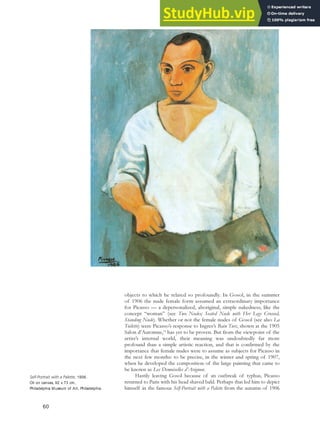
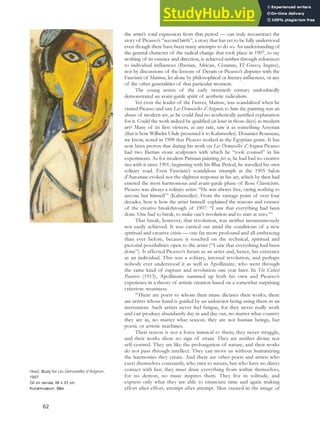
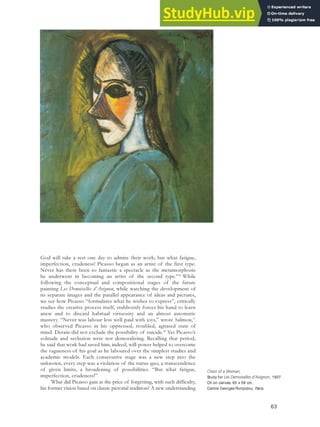
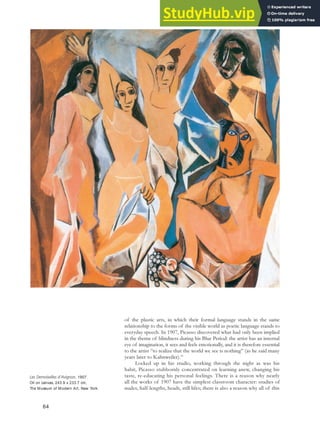
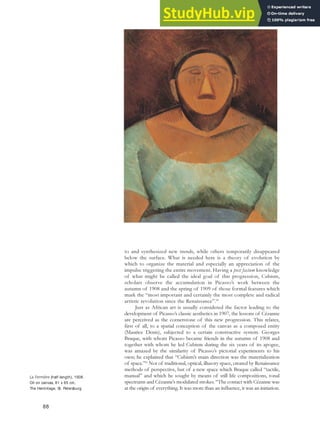
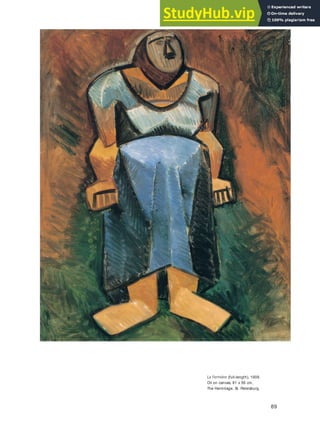
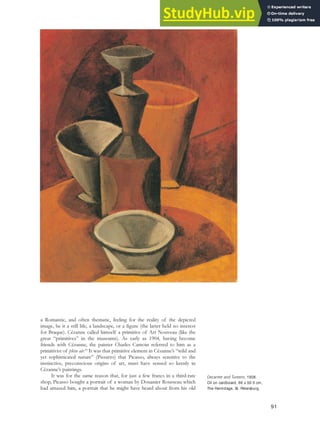
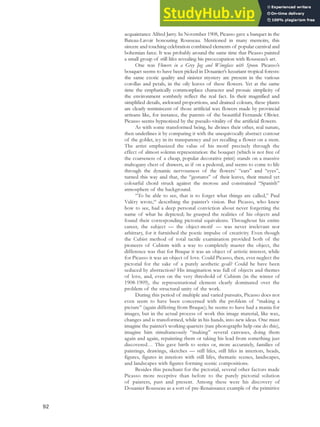
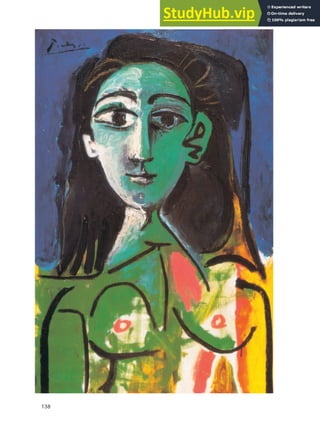
PICASSO
Pablo
PICASSO
Pablo
Text: Anatoli Podoksik
Layout: Baseline Co. Ltd
61A-63A Vo Van Tan Street
4th floor
District 3, Ho Chi Minh City
ISBN : 978-1-78042-299-2
© Confidential Concepts, worldwide, USA
© Sirrocco, London, UK (English version)
© Picasso Estate / Artists Rights Society, New York, USA
All rights reserved. No part of this may be reproduced or adapted without
the permission of the copyright holder, throughout the world.
Unless otherwise specified, copyright on the works reproduced lies with
the respective photographers, artists, heirs or estates. Despite intensive
research, it has not always been possible to establish copyright ownership.
Where this is the case, we would appreciate notification.
Anatoli Podoksik
Raphael’s great superiority is the result of his capacity to feel deeply which, in his case, destroys form. The form in his
works is what it should be in ours: only a pretext for the transmission of ideas, sensations, diverse poesies.
Honoré de Balzac. Le Chef-d’œuvre inconnu.
Pablo Picasso
1881-1973
Contents
Life and Work 7
Notes 142
Chronology of the Artist's Life 144
Bibliography 156
Index 158
6
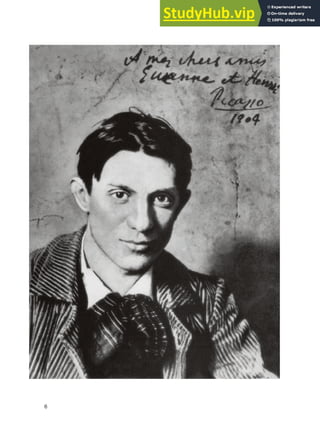
Pablo Picasso, Photograph, 1904.
Dedicated to Suzanne and Henri Bloch.
Portrait of the Artist’s Father, 1896.
Oil on canvas and cardboard, 42.3 x 30.8 cm,
Museo Picasso, Barcelona.
Although, as Picasso himself put it, he “led the life of a painter”
from very early childhood, and although he expressed himself through
the plastic arts for eighty uninterrupted years, the essence of Picasso’s
creative genius differs from that usually associated with the notion of
“artiste-peintre”. It might be more correct to consider him an artist-poet
because his lyricism, his psyche, unfettered by mundane reality, his gift
for the metaphoric transformation of reality are no less inherent in his
visual art than they are in the mental imagery of a poet. According to
Pierre Daix, “Picasso always considered himself a poet who was more
prone to express himself through drawings, paintings and sculptures.”1
Always? That calls for clarification. It certainly applies to the 1930s, when
he wrote poetry, and to the 1940s and 1950s, when he turned to writing
plays. There is, however, no doubt that from the outset Picasso was
always “a painter among poets, a poet among painters”.2
Picasso had a craving for poetry and attracted poets like a magnet.
When they first met, Guillaume Apollinaire was struck by the young
Spaniard’s unerring ability “to straddle the lexical barrier” and grasp the
fine points of recited poetry. One may say without fear of exaggeration
that while Picasso’s close friendship with the poets Jacob, Apollinaire,
Salmon, Cocteau, Reverdy, and Éluard left an imprint on each of the
major periods of his work, it is no less true that his own innovative work
had a strong influence on French (and not only French) twentieth-century
poetry. And this assessment of Picasso’s art — so visual and obvious, yet
at times so blinding, opaque and mysterious — as that of a poet, is
dictated by the artist’s own view of his work. Picasso once said: “After all,
the arts are all the same; you can write a picture in words just as you can
paint sensations in a poem.”3
He even expressed the following thought:
“If I had been born Chinese, I would not be a painter but a writer. I’d
write my pictures.”4
Picasso, however, was born a Spaniard and, so they say, began to
draw before he could speak. As an infant he was instinctively attracted to
the artist’s tools. In early childhood he could spend hours in happy
concentration drawing spirals with a sense and meaning known only to
himself; or, shunning children’s games, trace his first pictures in the sand.
This early self-expression held out promise of a rare gift.
The first phase of life, preverbal, preconscious, knows neither dates
nor facts. It is a dream-like state dominated by the body’s rhythms and
external sensations. The rhythms of the heart and lungs, the caresses of
warm hands, the rocking of the cradle, the intonation of voices — that is
what it consists of. Now the memory awakens, and two black eyes follow
the movements of things in space, master desired objects, express
emotions. Sight, that great gift, begins to discern objects, imbues ever new
shapes, captures ever-broader horizons. Millions of as yet meaningless
visual images enter the infantile world of internal sight where they strike
Life and Work
7
immanent powers of intuition, ancient voices, and strange caprices of
instinct. The shock of purely sensual (visual-plastic) impressions is
especially strong in the South, where the raging power of light
sometimes blinds, sometimes etches each form with infinite clarity.
And the still mute, inexperienced perception of a child born in
these parts responds to this shock with a certain inexplicable
melancholy, an irrational sort of nostalgia for form. Such is the lyricism
of the Iberian Mediterranean, a land of naked truths, of a dramatic
“search for life for life’s sake”,5
in the words of Garcia Lorca, one who
knew these sensations well. Not a shade of the Romantic here: there is
8
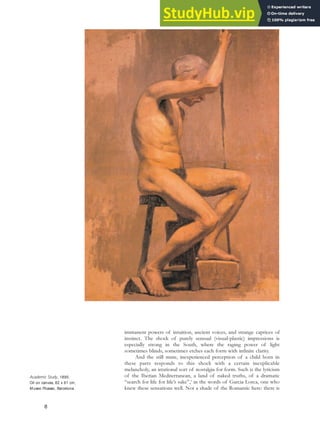
Academic Study, 1895.
Oil on canvas, 82 x 61 cm,
Museo Picasso, Barcelona.
no room for sentimentality amid the sharp, exact contours and there
exists only one physical world. “Like all Spanish artists, I am a realist”,
Picasso would say later.
Gradually the child acquires words, fragments of speech, building
blocks of language. Words are abstractions, creations of consciousness
made to reflect the external world and express the internal. Words are the
subjects of imagination, which endows them with images, reasons,
meanings, and conveys to them a measure of infinity. Words are the
instrument of learning and the instrument of poetry. They create the
second, purely human, reality of mental abstractions.
In time, after having become friends with poets, Picasso would
discover that the visual and verbal modes of expression are identical for
the creative imagination. It was then that he began to introduce elements
of poetic technique into his work: forms with multiple meanings,
metaphors of shape and colour, quotations, rhymes, plays on words,
paradoxes, and other tropes that allow the mental world to be made
visible. Picasso’s visual poetry attained total fulfilment and concrete
freedom by the mid-1940s in a series of paintings of nudes, portraits,
and interiors executed with “singing” and “aromatic” colours; these
qualities are also evident in a multitude of India ink drawings traced as
if by gusts of wind.
“We are not executors; we live our work.”6
That is the way in which
Picasso expressed how much his work was intertwined with his life; he also
used the word “diary” with reference to his work. D.H. Kahnweiler, who
knew Picasso for over sixty-five years, wrote: “It is true that I have
described his œuvre as ‘fanatically autobiographical’. That is the same as
saying that he depended only on himself, on his Erlebnis. He was always
free, owing nothing to anyone but himself.”7
Jaime Sabartés, who knew
Picasso most of his life, also stressed his complete independence from
external conditions and situations. Indeed, everything convincingly shows
that if Picasso depended on anything at all in his art, it was the constant
need to express his inner state with the utmost fullness. One may, as
Sabartés did, compare Picasso’s œuvre with therapy; one may, as
Kahnweiler did, regard Picasso as a Romantic artist. However, it was
precisely the need for self-expression through creativity that lent his art
that universal quality that is inherent in such human documents as
Rousseau’s Confessions, Goethe’s The Sorrows of Young Werther and Rimbaud’s
A Season in Hell. Let it also be noted that Picasso looked upon his art in a
somewhat impersonal manner, took pleasure in the thought that the works,
which he dated meticulously and helped scholars to catalogue, could serve
as material for some future science. He imagined that branch of learning
as being a “science of man — which will seek to learn about man in
general through the study of the creative man.”8
But something akin to a scientific approach to Picasso’s œuvre has
long been current in that it has been divided into periods, explained
both by creative contacts (so-called influences, often only hypothetical)
and reflections of biographical events (in 1980 a book called Picasso: Art
as Autobiography9
appeared). If Picasso’s work has for us the general
significance of universal human experience, this is due to its expressing,
with the most exhaustive completeness, man’s internal life and all the
laws of its development. Only by approaching his œuvre in this way can
we hope to understand its rules, the logic of its evolution, and the
transition from one putative period to another.
The works of Picasso published in the present volume — the entire
collection in Russian museums — cover those early periods which, based
on considerations of style (less often subject matter), have been classified
as Steinlenian (or Lautrecian), Stained Glass, Blue, Circus, Rose, Classic,
“African”, proto-Cubist, Cubist (analytic and synthetic)… the definitions
Study of a Nude, Seen from the Back, 1895.
Oil on wood, 22.3 x 13.7 cm,
Museo Picasso, Barcelona.
9
could be even more detailed. However, from the viewpoint of the “science
of man”, these periods correspond to the years 1900-1914, when Picasso
was between nineteen and thirty-three, the time which saw the formation
and flowering of his unique personality.
There is no question about the absolute significance of this stage in
spiritual and psychological growth (as Goethe said, to create something,
you must be something); the Russian collection’s extraordinarily
monolithic and chronological concentration allows us to examine, through
the logic of that inner process, those works which belong to possibly the
least accessible phase of Picasso’s activity.
By 1900, the date of the earliest painting in the Russian collection,
Picasso’s Spanish childhood and years of study belonged to the past. And
yet certain cardinal points of his early life should not be ignored.
Málaga must be mentioned, for it was there, on 25 October 1881,
that Pablo Ruiz Picasso was born and there that he spent the first
ten years of his life. Although he never depicted that town on the
Andalusian coast, Málaga was the cradle of his spirit, the land of his
childhood, the soil in which many of the themes and images of his
mature work are rooted. He first saw a picture of Hercules in Málaga‘s
municipal museum, witnessed bullfights on the Plaza de Toros, and at
home watched the cooing doves that served as models for his father,
a painter of “pictures for dining rooms”, as Picasso put it. The young
Pablo drew all of this (see Pigeons) and by the age of eight took up
brush and oils to paint a bullfight (see The Picador). His father allowed
him to draw the feet of the doves in his pictures, for the boy did this
well and with real knowledge. He had a favourite pigeon with which
he refused to part, and when the time came for him to start school,
he carried the bird in a cage to classes. School was a place that
demanded obedience — Pablo hated it from the first day and opposed
it furiously. And that was how it would always be: a revolt against
everything that felt like school, that encroached upon originality and
individual freedom, that dictated general rules, determined norms,
imposed outlooks. He would never agree to adapt to his environment,
to betray himself or, in psychological terms, to exchange the pleasure
principle for reality.
The Ruiz Picasso family never lived an easy life. Financial
difficulties forced them to move to La Coruña, where Pablo’s father was
offered a position as teacher of drawing and painting in a secondary
school. On the one hand, Málaga, with its voluptuous and gentle nature,
“the bright star in the sky of Mauritanian Andalusia, the Orient without
poison, the Occident without activity” (as Lorca put it); and, on the
other, La Coruña on the northern tip of the Iberian peninsula with its
stormy Atlantic Ocean, rains and billowing fog. The two towns are not
only the geographical, but also the psychological poles of Spain. For
Picasso they were stages in life: Málaga the cradle and La Coruña the
port of departure.
When the Ruiz Picasso family moved to La Coruña in 1891 with
the ten-year-old Pablo, a somewhat rural atmosphere reigned over the
town; artistically speaking, it was far more provincial than Málaga,
which had its own artistic milieu to which Picasso’s father belonged.
La Coruña did, however, have a School of Fine Arts. There the young
Pablo Ruiz began his systematic studies of drawing and with prodigious
speed completed (by the age of thirteen!) the academic Plaster Cast and
Nature Drawing Classes. What strikes one most in his works from this
time is not so much the phenomenal accuracy and exactitude of
execution (both of which are mandatory for classroom model
exercises) as what the young artist introduced into this frankly boring
material: a treatment of light and shade that transformed the plaster
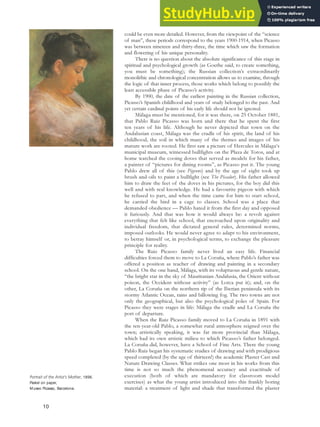
Portrait of the Artist’s Mother, 1896.
Pastel on paper,
Museo Picasso, Barcelona.
10
torsos, hands and feet into living images of bodily perfection overflowing
with poetic mystery.
He did not, however, limit his drawing to the classroom; he drew at
home, all the time, using whatever subject matter came to hand: portraits
of the family, genre scenes, romantic subjects, animals. In keeping with
the times, he “published” his own journals — La Coruña and Asul y Blanco
(Blue and White) — writing them by hand and illustrating them with
cartoons. Let us note here that the young Picasso’s spontaneous drawings
have a narrative, dramatic quality; for him the image and the word were
11
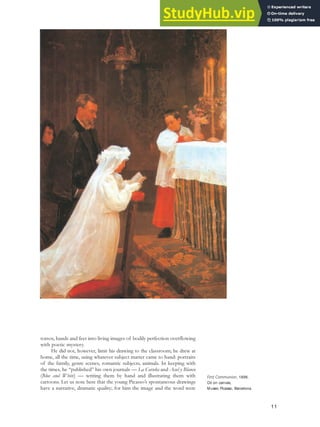
First Communion, 1896.
Oil on canvas,
Museo Picasso, Barcelona.
almost identical. Both of these points are extremely significant to the
future development of Picasso’s art.
At home, under his father’s tutelage — the good man was so
impressed by his son’s achievements that he gave him his palette, brushes
and paints — during his last year in La Coruña, Pablo began to paint live
models in oils (see Portrait of an Old Man and Beggar in a Cap). These
portraits and figures, free of academic slickness, speak not only of the
early maturity of the thirteen-year-old painter, but also of the purely
Spanish nature of his gift: a preoccupation with human beings, whom he
treated with profound seriousness and strict realism, uncovering the
monolithic and “cubic” character of these images. They look less like
school studies than psychological portraits, less like portraits than universal
human characters akin to the Biblical personages of Zurbarán and Ribera.
Kahnweiler testifies that in his old age Picasso spoke with greater
approval of these early paintings than of those done in Barcelona,
where the Ruiz Picasso family moved in the autumn of 1895 and where
Pablo immediately enrolled as a student of painting in the School of
Fine Arts called La Lonja. But the academic classes of Barcelona had
little to offer in the way of developing the talent of the young creator
of the La Coruña masterpieces; he could improve his craftsmanship on
his own. However, it seemed at that time that “proper schooling” was
the only way of becoming a painter. So as not to upset his father,
Picasso spent two more years at La Lonja during which time he could
not but fall, albeit temporarily, under the deadening influence of
academism, inculcated by the official school along with certain
professional skills. “I hate the period of my training at Barcelona,”
Picasso confessed to Kahnweiler.10
However, the studio which his father rented for him (when he was
only fourteen) and which gave him a certain freedom from both school
and the stifling atmosphere of family relations was a real support for his
independence. “A studio for an adolescent who feels his vocation with
overwhelming force is almost like a first love: all his illusions meet and
crystallize in it,” writes Josép Palau i Fabre.11
It was here that Picasso
summarized the achievements of his school years by executing his first
large canvas: The First Communion (winter of 1895-1896) — an interior
composition with figures, drapery and still life, displaying beautiful lighting
effects — and Science and Charity (beginning of 1897) — a huge canvas
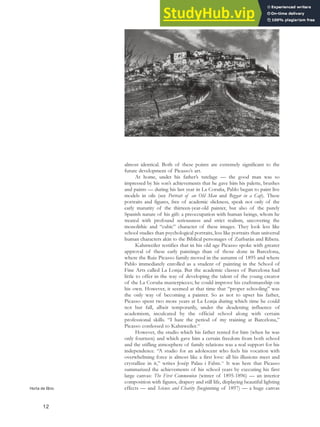
Horta de Ebro.
12
with larger-than-life figures, something akin to a real allegory. The latter
received honourable mention at the national exhibition of fine arts in
Madrid and was later awarded a gold medal at an exhibition in Málaga.
If one assesses the early Picasso’s creative biography from the
standpoint of a Bildungsroman, then his departure from home for Madrid in
the autumn of 1897, supposedly to continue his formal education at the
Royal Academy of San Fernando, in fact ushered in the period of post-study
years — his years of wandering. Moving from place to place, Picasso
began the haphazard travel that is typical of this period and corresponds
to the inner uncertainty, the search for self-identity and the urge for
independence that denote the forming of personality in a young man.
13
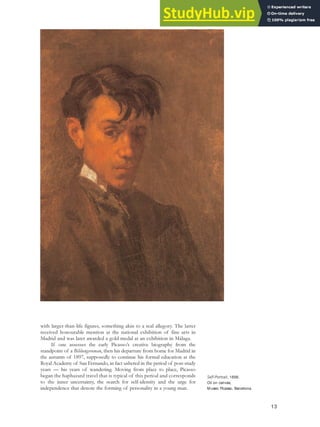
Self-Portrait, 1896.
Oil on canvas,
Museo Picasso, Barcelona.
Pablo Picasso’s years of travel consisted of several phases within
a seven-year period, from sixteen to twenty-three, from his initial
departure to Madrid, the country’s artistic capital, in 1897, to his final
settling in Paris, artistic capital of the world, in the spring of 1904. As it
had during his first visit, on his way to Barcelona in 1895, Madrid to
Picasso meant first and foremost the Prado Museum, which he
frequented more often than the Royal Academy of San Fernando in
order to copy the Old Masters (he was particularly attracted by
Velazquez). However, as Sabartés was to note, “Madrid left a minimal
imprint on the development of his spirit.”12
It might be said that the
most important events for Picasso in the Spanish capital were the harsh
winter of 1897-1898 and the subsequent illness that symbolically marked
the end of his “academic career”.
In contrast, the time spent at Horta de Ebro — a village in the
mountainous area of Catalonia, where he went to convalesce and where
he remained for eight long months (until the spring of 1899) — was of
such significance for Picasso that even decades later he would invariably
repeat: “All that I know, I learnt in Palarés’s village.”13
Together with
Manuel Palarés, a friend he had met in Barcelona, who invited him to live
in the family home at Horta, Pablo carried his easel and sketchbook
over all the mountain paths surrounding the village, which had preserved
the harsh quality of a medieval town. With Palarés, Picasso scaled the
mountains, spent much of the summer living in a cave, sleeping on
beds of lavender, washing in mountain springs, and wandering along
cliffs with the risk of plunging into the turbulent river far below. He
experienced nature’s power and came to know the eternal values of a
simple life with its work and holidays.
Indeed, the months spent at Horta were significant not so much
in the sense of artistic production (only a few studies and the
sketchbooks have survived) as for their key role in the young Picasso’s
creative biography, with its long process of maturing. This basically
short biographic period merits a special chapter in Picasso’s
Bildungsroman, a chapter portraying scenes of bucolic solitude spent
amid pure, powerful and life-giving nature, reflecting feelings of
freedom and fulfilment, offering a view of natural man and of life
flowing in harmony with the epic rhythms of the seasons. But, as is
always the case in Spain, this chapter also includes the brutal interplay
of the forces of temptation, salvation and death — those “backstage
players” in the drama of human existence.
Palau i Fabre, who described Picasso’s first stay at Horta, notes:
“It seems more than paradoxical — I nearly said providential — that
Picasso should have been reborn, so to speak, at that time, when he left
Madrid and the copying of the great masters of the past in order to
strengthen his links with the primitive forces of the country.”14
Another point: the value of the young Picasso’s experience at
Horta de Ebro is that it should provide scholars with food for
thought, regarding both the question of his Mediterranean sources
and Iberian archaism at a crucial moment of his formation in 1906
and his second trip to Horta ten years later (1909), which marked a
new stage in his artistic development: Cubism. After his first stay at
Horta de Ebro, a matured and renewed Picasso returned to Barcelona,
which he now saw in a new light: as a centre of progressive trends
and as a city open to modern ideas. Indeed, Barcelona’s cultural
atmosphere was, on the eve of the twentieth century, brimming with
optimism. Calls for a Catalan regional renaissance, the agitation of
anarchists, the latest technological wonders (the automobile, electricity,
the phonograph, the cinema), and the novel idea of mass production
served as a backdrop for the growing certainty in young minds that the
14
new century would usher in an unparalleled flowering of the arts. It
was therefore not surprisingly in Barcelona, attracted to contemporary
Europe, and not elsewhere in patriarchal, lethargic Spain, that
Modernism appeared. The Catalan version of cosmopolitan, artistic
fin-de-siècle tendencies combined a broad spectrum of ideological and
aesthetic influences, from Scandinavian symbolism to Pre-Raphaelism,
from Wagner and Nietzsche to French Impressionism and the style of
popular Parisian journals.
Picasso, who was not yet eighteen, had reached the point of his
greatest rebelliousness; he repudiated academia’s anemic aesthetics along
with realism’s pedestrian prose and, quite naturally, joined those who called
themselves modernists, that is, the non-conformist artists and writers,
those whom Sabartés called “the élite of Catalan thought” and who were
grouped around the artists’ café Els Quatre Gats.
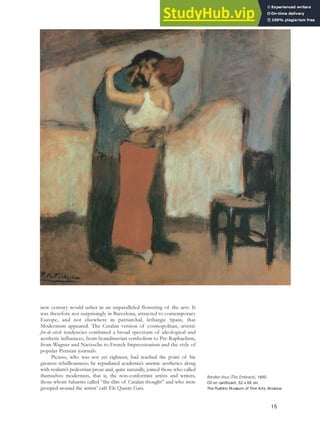
Rendez-Vous (The Embrace), 1900.
Oil on cardboard, 52 x 56 cm,
The Pushkin Museum of Fine Arts, Moscow.
15
16
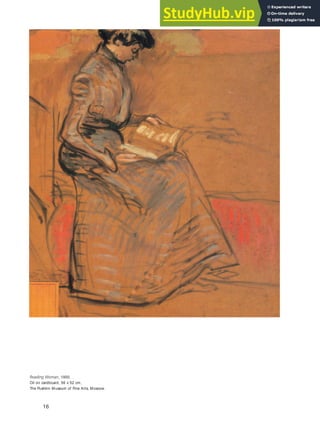
Reading Woman, 1900.
Oil on cardboard, 56 x 52 cm,
The Pushkin Museum of Fine Arts, Moscow.
17
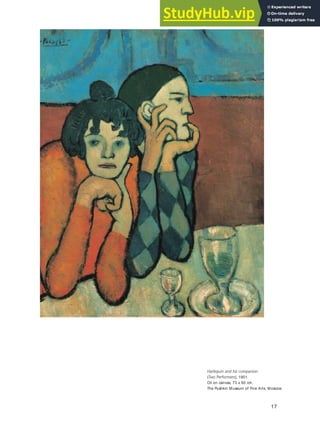
Harlequin and his companion
(Two Performers), 1901.
Oil on canvas, 73 x 60 cm,
The Pushkin Museum of Fine Arts, Moscow.
Much has been said concerning the influence of Barcelona
modernism on Picasso’s turn-of-the-century work, regarding which
Cirlot notes: “Critics find it very useful to be able to talk about
‘influences’ because it enables them to explain something they do not
understand by something they do, often completely erroneously and
resulting in utter confusion.”15
Indeed, the issue of temporary
influences of style (Ramón Casas, Isidro Nonell, Hermenegildo
Angladay Camarasa), which tends only to obscure the authentic, natural
elements of Picasso’s profound talent, should be eliminated from our
consideration. Barcelona modernism served to give the young Picasso
an avant-garde education and to liberate his artistic thinking from
classroom clichés. But this avant-garde university was also merely the
arena for his coming-to-be. Picasso, who in 1916 compared himself
with a tenor who reaches a note higher than the one written in the
score,16
was never the slave of what attracted him; in fact, Picasso
invariably begins where influence ends. True, during those Barcelona
years Picasso was much taken with the graphic “argot” practised by
contemporary Parisian magazines (the style of Forain and Steinlen, who
drew for Gil Bias and La Vie Parisienne, among others). He cultivated the
same kind of sharp, trenchant style, which excludes the superfluous and
yet, through the interplay of a few lines and dots, manages to give living
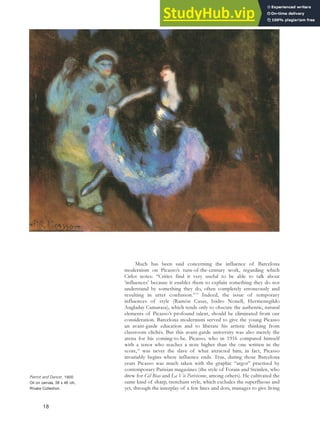
Pierrot and Dancer, 1900.
Oil on canvas, 38 x 46 cm,
Private Collection.
18
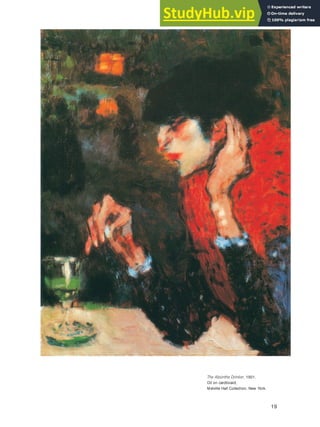
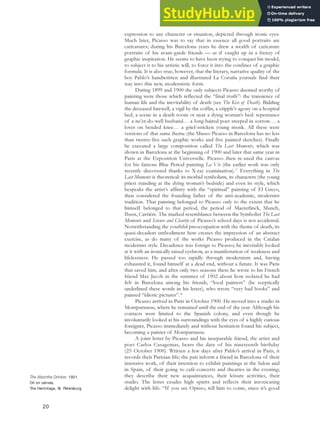
The Absinthe Drinker, 1901.
Oil on cardboard,
Melville Hall Collection, New York.
19
expression to any character or situation, depicted through ironic eyes.
Much later, Picasso was to say that in essence all good portraits are
caricatures; during his Barcelona years he drew a wealth of caricature
portraits of his avant-garde friends — as if caught up in a frenzy of
graphic inspiration. He seems to have been trying to conquer his model,
to subject it to his artistic will, to force it into the confines of a graphic
formula. It is also true, however, that the literary, narrative quality of the
boy Pablo’s handwritten and illustrated La Coruña journals find their
way into this new, modernistic form.
During 1899 and 1900 the only subjects Picasso deemed worthy of
painting were those which reflected the “final truth”: the transience of
human life and the inevitability of death (see The Kiss of Death). Bidding
the deceased farewell, a vigil by the coffin, a cripple’s agony on a hospital
bed, a scene in a death room or near a dying woman’s bed: repentance
of a ne’er-do-well husband… a long-haired poet steeped in sorrow… a
lover on bended knee… a grief-stricken young monk. All these were
versions of that same theme (the Museo Picasso in Barcelona has no less
than twenty-five such graphic works and five painted sketches). Finally
he executed a large composition called The Last Moments, which was
shown in Barcelona at the beginning of 1900 and later that same year in
Paris at the Exposition Universelle. Picasso then re-used the canvas
for his famous Blue Period painting La Vie (the earlier work was only
recently discovered thanks to X-ray examination).17
Everything in The
Last Moments is theoretical: its morbid symbolism, its characters (the young
priest standing at the dying woman’s bedside) and even its style, which
bespeaks the artist’s affinity with the “spiritual” painting of El Greco,
then considered the founding father of the anti-academic, modernist
tradition. That painting belonged to Picasso only to the extent that he
himself belonged to that period, the period of Maeterlinck, Munch,
Ibsen, Carrière. The marked resemblance between the Symbolist The Last
Moments and Science and Charity of Picasso’s school days is not accidental.
Notwithstanding the youthful preoccupation with the theme of death, its
quasi-decadent embodiment here creates the impression of an abstract
exercise, as do many of the works Picasso produced in the Catalan
modernist style. Decadence was foreign to Picasso; he inevitably looked
at it with an ironically raised eyebrow, as a manifestation of weakness and
lifelessness. He passed too rapidly through modernism and, having
exhausted it, found himself at a dead end, without a future. It was Paris
that saved him, and after only two seasons there he wrote to his French
friend Max Jacob in the summer of 1902 about how isolated he had
felt in Barcelona among his friends, “local painters” (he sceptically
underlined these words in his letter), who wrote “very bad books” and
painted “idiotic pictures”.18
Picasso arrived in Paris in October 1900. He moved into a studio in
Montparnasse, where he remained until the end of the year. Although his
contacts were limited to the Spanish colony, and even though he
involuntarily looked at his surroundings with the eyes of a highly curious
foreigner, Picasso immediately and without hesitation found his subject,
becoming a painter of Montparnasse.
A joint letter by Picasso and his inseparable friend, the artist and
poet Carlos Casagemas, bears the date of his nineteenth birthday
(25 October 1900). Written a few days after Pablo’s arrival in Paris, it
records their Parisian life; the pair inform a friend in Barcelona of their
intensive work, of their intention to exhibit paintings at the Salon and
in Spain, of their going to café-concerts and theatres in the evening;
they describe their new acquaintances, their leisure activities, their
studio. The letter exudes high spirits and reflects their intoxicating
delight with life: “If you see Opisso, tell him to come, since it’s good
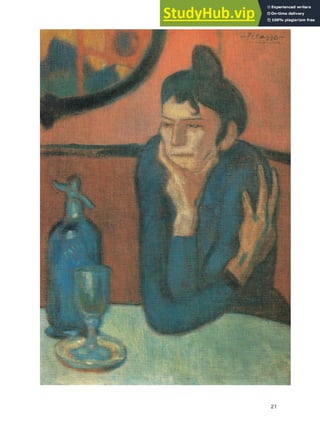
The Absinthe Drinker, 1901.
Oil on canvas,
The Hermitage, St. Petersburg.
20
21
for saving the soul — tell him to send Gaudí and the Sagrada Familia
to hell… Here there are real teachers everywhere.”19
Vast exhibition halls of paintings at the Exposition Universelle
(number 79 in the Spanish section was: Pablo Ruiz Picasso, Les Derniers
Moments), the retrospective Centennale and Décennale de l’art français, great
shows with paintings by Ingres and Delacroix, Courbet and the
Impressionists, up to and including Cézanne; the gigantic Louvre with its
endless halls of masterpieces and sculptures of ancient civilizations;
whole streets of galleries and shops showing and dealing in new-style
painting… “More than sixty years later,” recalls Pierre Daix, “he would
tell me of his delight at what he then discovered. He suddenly took
measure of the limits and stiffness of Barcelona, Spain. He did not
expect it.”20
He was staggered by the abundance of artistic impressions,
by this new feeling of freedom, “not so much of customs,” noted Daix,
“…as of human relations.”21
Picasso’s “real teachers” were the older painters of Montmartre, who
helped him discover the broad spectrum of local subject matter: the
popular dances, the café-concerts with their stars, the attractive and
sinister world of nocturnal joys, electrified by the glow of feminine charms
(Forain and Toulouse-Lautrec), but also the everyday melancholy and
nostalgic atmosphere of small streets on the city outskirts, where the autumn
darkness heightens the plaintive feeling of loneliness (Steinlen — with
whom, Cirlot says, Picasso became personally acquainted). However, it
was not because of Zola’s mystical appeal (which Anatole France said
Death of Casagemas, 1901.
Oil on wood, 27 x 35 cm,
Musée Picasso, Paris.
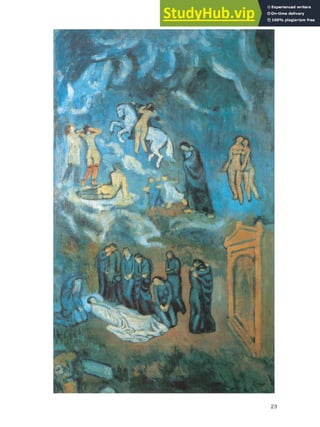
The Burial of Casagemas (Evocation), 1901.
Oil on canvas, 146 x 89 cm,
Petit Palais, Paris.
22
23
inspired Steinlen), nor due to a taste for bizarre lifestyles, nor due to the
satirical impulse that Picasso entered his so-called Cabaret period. This
subject matter attracted him because it afforded the possibility to express
the view that life is a drama and that its heart is the sexual urge. And yet
the direct, expressive and austerely realistic treatment of these subjects
reminds one not so much of French influences as of Goya’s late period
(for instance, such pictures as Third of May, 1808).
This is especially true of the Moscow canvas The Embrace — the
absolute peak of the 1900 Paris period and undoubtedly one of the young
24
Portrait of the poet Sabartés (Glass of Beer),
1901.
Oil on canvas, 82 x 66 cm,
The Pushkin Museum of Fine Arts, Moscow.
Picasso’s masterpieces. Ten years prior to the creation of that painting, in
1890, Maurice Denis jotted down what was to become a famous aphorism:
“A picture — before being a horse, a nude, or an anecdote — is essentially
a flat surface covered with colours assembled in a certain order.”22
This,
however, is especially hard to keep in mind with regard to Picasso’s The
Embrace, so alien is it to any aesthetic pre-consideration, so triumphant is
the internal over the external. This is all the more amazing considering that,
as “a flat surface covered with colours assembled in a certain order”, the
picture is close to the works of the Nabis (perhaps not so much Denis
himself as Vuillard and Bonnard) in its muted, modest colours, the
silhouetted patches, the private, intimate atmosphere. But this unaffected
exterior hides a passionate emotion, and that, of course, is neither the
Nabis nor even Toulouse-Lautrec.
Yakov Tugendhold saw the embracing couple as a “soldier and
woman”,23
while Phoebe Pool described them as “a workman and a
prostitute”.24
Daix reads the scene differently: “Home from work, the
couple are together again, united in frank eagerness, in healthy sensuality
and human warmth.”25
Indeed, The Embrace is no meditation on the
habits of society’s lower orders, but speaks of a feeling so lyrical and
profound as to be extremely moving. Picasso’s bold and inspired brush
spurned superfluous details, leaving on the flat surface, as it were, the
pollen or aroma of life itself, that is, an image of supreme poetic
realism. In that same autumn of 1900, in Paris, the artist produced three
other versions of the same motif: two of them (which clearly preceded
the third) titled Lovers in the Street, and the third called Brutal Embrace,
which, while similar in composition and staffage, is antithetical to the
Moscow picture in the shocking vulgarity of the subject, the number of
genre details, and the sarcastic mood. Picasso’s artistic expression was
direct in character, and whatever his means, they always corresponded
exactly to his intentions. At the age of nineteen he examined the theme
of sexual relations. His mind operated in contrasts: Le Moulin de la
Galette at night is the public sale of love; the women of his café-concerts
are as decorative as artificial flowers; the idylls on the outer boulevards
are somewhat clumsy in the tenderness of their tight embraces; and love
in a poor garret is not the same as in the almost identical room of an
experienced priestess of Venus.
Love was also the underlying reason for the artist’s sudden
departure — one is tempted to say flight — from Paris in December 1900:
his friend Casagemas’s ill-fated affair. Scholars of Picasso’s works began
to study the circumstances of this tragic love affair once it became clear
that the artist produced paintings in Casagemas’s memory both at the
initial stage of his Blue Period (1901) and at its height (1903). Casagemas
shot himself in a café on the Boulevard de Clichy in February 1901, after
returning to Paris despite Picasso’s attempts to help him find a measure
of peace under the Spanish sun.
Picasso was at that time still in Madrid, where he had undertaken the
publication of a magazine called Arte Joven (Young Art), four issues of
which had appeared, and also painted society scenes and female portraits
that emphasized the repulsive features of his models: their rapaciousness
or doll-like indifference. Daix believes this was not without influence on
Casagemas’s drama.26
This short “society” period (to a certain extent, a young artist’s
reaction to the temptations of public recognition) ran itself out by the
spring of 1901 when, after a stay in Barcelona, Picasso returned to Paris.
An exhibition of his works was planned in the gallery of the well-known
Art Nouveau dealer Ambroise Vollard.
Throughout May and the first half of June 1901, Picasso worked very
hard, on some days producing two or even three paintings. He “had begun
25
where he had broken off six months before”27
but the scope of his
Parisian subject matter was now broader, while his technique was more
avant-garde. Picasso painted not only the stars of the café-concerts and
the courtesans of the demimonde, but also urban scenes: women selling
flowers, upper-class couples out for a walk, crowds at the races, interiors
of cheap cafés, children in their best Sunday clothes walking in the
Luxembourg Gardens, passengers on double-decker buses sailing high
above the Seine and the sea of Parisian squares. He used the Impressionist
freedom of sinuous brushstrokes, the Japanese precision of Degas’s
compositions and Toulouse-Lautrec’s posters, the heightened, exalted
vividness of Van Gogh’s colours, heralding the coming of Fauvism, which
manifested itself fully only in 1905. But Picasso’s so-called pre-Fauvism of
the spring of 1901 was, once again, of a purely aesthetic, rather than of a
subjective, psychological nature. As Zervos was justly to note: “Picasso took
great care not to fall in with the eccentricities of Vlaminck, who used
vermilions and cobalts in order to set fire to the École des Beaux-Arts.
Picasso used pure colours only to satisfy his natural inclination to go every
time as far as his nervous tension would allow.”28
Picasso exhibited over sixty-five paintings and drawings at the Vollard
exhibition which opened on 24 June. Some had been brought from Spain,
but the overwhelming majority were done in Paris. Jarring, often shocking
subjects, spontaneous, insistent brushwork, nervous, frenzied colours
(certainly not joyous, as Daix claims), typify the so-called Vollard style. But
even though the exhibition was a financial success, many of the pre-Fauve
Vollard-style paintings would be painted over in the very near future,
thereby reflecting a change in their maker’s mood.
“He that increaseth knowledge increaseth sorrow.” As if in response
to those words from Ecclesiastes, Picasso’s outlook gradually took on
tragic dimensions — the result of his personal experiences, but also
26
Prostitutes at the Bar, 1902.
Oil on canvas, 80 x 91.4 cm,
Hiroshima Museum of Art, Hiroshima.
predetermined by natural psychological development during this
formative period. This new pessimistic outlook, firmly established by the
autumn of 1901, may explain what Daix called the “violation of material
appearances.”29
Indeed, Picasso’s creative endeavours now turned
towards the art of internally dictated, conceptual, generalized images.
Instead of many subjects taken from the trivial external world, he
concentrated on a few images, on his subjective inner reality rather than
on the objectively tangible. Instead of responding to life with spontaneous
and sharpened Fauve-like colours, he now painted somewhat abstract
picturesque allegories with poetic and symbolic details and a compositional
structure based on colour and rhythm. Here we find two canvases dating
from this period — the autumn of 1901 — Harlequin and His Companion
and The Absinthe Drinker. Both deal with one of the early Picasso’s
favourite subjects: people in cafés. From the viewpoint of style they are
sometimes characterized as examples of the so-called Stained Glass
Period (because of the powerful, flexible dark line dividing the major
Poverty-Stricken Woman, 1902.
Oil on canvas, 101.2 x 66 cm,
Hiroshima Museum of Art, Hiroshima.
27
28
colour planes, typical of work of that period). This style of painting had
close aesthetic ties with the Art Nouveau (it derives from Gauguin’s
Cloisonnism and the arabesques of Toulouse-Lautrec’s posters — something
Picasso rated highly at that time); here, however, it is a poetic testament
to the predominance of the intellectual principle in Picasso’s work, to
concentrated and generalized thought. Earlier (from 1899 to the first half
of 1901) when depicting a café scene in the style of turn-of-the-century
art, Picasso was attracted by the modern city’s “physiology”, by the anomalies
of actual existence; now, in the second half of 1901, the social aspect
retreats far into the background, serving only to set off the universal
symbolic meaning of the painted image. Thus, in Harlequin and his
Companion (p. 17) one recognizes the concrete, tangible reality of that
period: it is set in a café that served as a kind of employment bureau for
second-rate actors, a market where they were bought and sold. In the
novel written about their lives by Yvette Guilbert, the famous café-concert
star immortalized by Toulouse-Lautrec, we find a description of one such
café and its clients that perfectly suits the characters of Picasso’s painting:
“These happy unemployed comics, these jokers in the streets, these
singers, declaimers and eccentric dancers, all those who in the evenings,
under lights, tomorrow perhaps, in some run-down place will share
laughter and joy with a public that believes them to be happy and
envies them… And they come here every day, to the Chartreuse,
seeking any engagement, eyes open for the agent who will enter the
premises… in need… of a soliloquist or a singer.
For there are also the women.
Poor girls!
Livid in the bright day’s cruelty, with an obligatory smile, fleeting or
frozen, reddened or grape-coloured, pallid from cheap powder, their
eyelids blue, their eyes encircled by pencilled dark spectacles, they, too,
standing on the sidewalk, attend upon the pleasure of the showman, who
will be kind enough to make use of what remains of a youthfulness almost
gone and a dying voice.”30
But Picasso’s café has no name, it is a shelter for the homeless.
Harlequin, that artistic, nervous gymnast with the white painted face
of a tragic Pierrot, and his companion, whose face is that of either a
ghost or a Japanese Noh mask — these are somehow not people,
but rather the divided bohemian soul made wise by the banality of
“commedia della a vita”. Certain contemporary scholars find an analogy
between these, the earliest of Picasso’s Italian comedy characters, and
the symbolic poetry of Verlaine’s later years.31
But speaking in broader
terms, Picasso’s own artistic expression is now subjected to the poetic
principle; the eye reads the picture like a poem, becoming immersed
in emotions and the symbolic association of colours, grasping the
meaning of congruities, enchanted by the play of rhyming lines which,
like the painting’s colours, are cleansed of everyday prose and endowed
with an exciting music.
There is, however, nothing accidental about the large unfinished
glass of absinthe standing on the table before Harlequin: the bitter
bright-green liqueur is an allegory of life’s sorrows, additional
testimony to the damnation of Harlequin-the-artist. In this period the
idea of the poète or artiste maudit preoccupied Picasso. It dovetailed with
his ideal of authentic art, with Paris, with the contemporary, with his
own life. Baudelaire, Verlaine, Rimbaud, Gauguin, Van Gogh,
Toulouse-Lautrec were all maudit — it was something inseparable from
bohemian life and alcohol. As early as this painting, Picasso hit upon
the idea of alcohol, first as a means of replacing the banality of the
everyday environment with a different, internal, spiritual one; second,
as a parallel, in its burning quality, to the maudit artists’ art and poetry
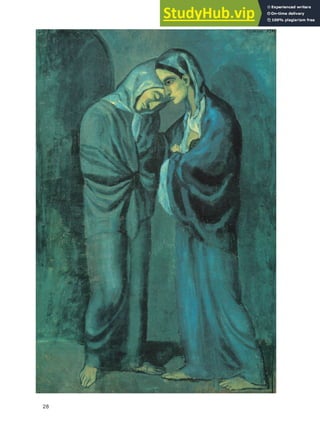
The Visit (Two Sisters), 1902.
Oil on canvas pasted on panel, 152 x 100 cm,
The Hermitage, St. Petersburg. (p. 26)
Woman With a Helmet of Hair
(The Acrobat’s Woman), 1904.
Gouache on cardboard, 42.8 x 31 cm.
The Art Institute of Chicago, Chicago.
29
(Apollinaire, who had a spiritual bond with Picasso, called his first
volume of poems, published in 1913, Alcools); third, as an elixir of
wisdom, but also of mortal melancholy.
In that sense, The Absinthe Drinker is an even purer expression — both
of these ideas and of a poetic form in which words are few but thoughts
soar freely to transcend the mere theme of the painting.
The colours here are as coarse and poor as a hair shirt, but they are
not prosaic; our mind’s eye sees through the bleary blue, the hoarse red,
the pale yellow and divines their noble essence: azure, crimson, gold.
The visible in the painting is an allegory that impresses the viewer with
its own, symbolic and universal aspect: the green absinthe represents
bitterness and sorrow; the wall mirror, that symbolic screen of the woman’s
inner world, reflects vague blotches of colour — her thoughts; the
woman herself, steeped by absinthe in numbness, hallucinations, and
depression, sits in a hunched-up, twisted pose, reminding us of a Notre
Dame gargoyle; she seems less a solitary drunkard in some forsaken
Paris bar than the expression of the world’s evil and its alchemic
attribute — the bitter green elixir shimmering at the bottom of the glass.
In formal terms, Harlequin and His Companion and The Absinthe Drinker
(pp. 19 and 21) continue Gauguin’s line, but emotionally and ideologically,
they follow Van Gogh, who perceived his Night Café as a horrible place,
“a place where one can perish, go insane, commit a crime.”32
Generally speaking, one sees here the predominance of form in the
composition and the sentimental themes that Daix defined as two of the
three essentials of the new style ripening in Picasso throughout the second
half of 1901.33
The third — the use of monochromatic blue — gave this
new style its name: the Blue Period. It came into its own in late 1901 and
lasted to the end of 1904.
Even though Picasso himself repeatedly insisted on the inner,
subjective nature of the Blue Period, its genesis and, especially, the
monochromatic blue were for many years explained as merely the results
of various aesthetic influences. When, however, after sixty-five years of
obscurity, the paintings prompted by the death of his friend Casagemas
in the autumn of 1901 saw the light of day, the psychological motive
behind the Blue Period seemed to have been discovered.
“It was when thinking that Casagemas was dead that I began to paint in
blue,” Picasso told Daix.34
And yet, the artist’s “blue” thoughts about his
friend’s death followed six months after the event, and certain stylistic features
and characteristic images of the almost-blue pictures of the so-called
Casagemas death cycle were clearly formulated in paintings inspired by the
artist’s visit to the Parisian St. Lazare women’s prison in the autumn of 1901.
Considering Picasso’s previous artistic history, these facts prompt us to see
the events of his day-to-day existence only as the “developers” of internal
crises marking major stages of his individuality, his coming-to-be, not as the
actual reasons for these crises.
Carl Gustav Jung, the father of analytical psychology, interpreted
Picasso’s Blue Period as a descent into hell,35
which corresponds to that
special, inner state of adolescence in which the unconscious, life’s bitter
truths, and the heart of evil are all urgently considered issues. Sabartés,
who was of the same age as Picasso and shared his views, confirmed this
analysis when explaining the state of mind of their early youth: “We live
through an age when each of us has to do everything inside himself,
a period of uncertainty which we all see only from the viewpoint of our
own misery. That our life with its torments and sufferings goes through
such periods of pain, of sorrow, and of misery constitutes the very basis
of his [Picasso’s] theory of artistic expression.”36
In reality this “anti-theoretical theory” (as Sabartés called it) was the
summation of Picasso’s views, shared by Sabartés and expressed by him
30
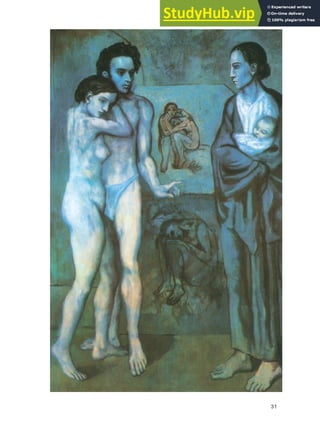
La Vie (Life), 1903.
Oil on canvas, 196.5 x 128.5 cm,
The Cleveland Museum of Art, Cleveland.
31
in the following manner: “If we insist on the artist’s sincerity, we do not
admit that it can exist free of pain… He [Picasso] believes Art to be the
child of Sorrow and Pain… He believes Sorrow lends itself to meditation,
while Pain is the substance of life.”37
But what is both amazing and
unique here is that Picasso, seized by this viewpoint (known to all
Romantics and called Weltschmerz, the leitmotif of a whole cultural era at
the end of the eighteenth and beginning of the nineteenth century),
between the ages of twenty and twenty-three, expressed it through a
purely poetic metaphor — blueness.
Blue is cold, it is the colour of sorrow, grief, misfortune, inner pain;
but blue is also the most spiritual of colours, the colour of space, thoughts
and dreams that know no confines. Blue is beloved by poets.
32
Nude Woman with Crossed Legs, 1903.
Pastel, 58 x 44 cm,
Private Collection.
Rainer Maria Rilke stood studying the paintings at the Salon
d’Automne in 1907 and imagined someone writing the history of the
colour blue in paintings throughout the ages — now spiritual, now gallant,
now devoid of allegorical meaning. In one of his poems of the 1900s
Picasso wrote, “You are the best of what exists in the world. The colour
of all colours… the most blue of all the blues.”
Rilke’s exercise can be applied to the blue of Picasso’s palette and to
poetry alike, for the Blue Period as a whole, throughout its entire three
years, resulted in an art that was heterogeneous and complex, not only in
style but also in content.
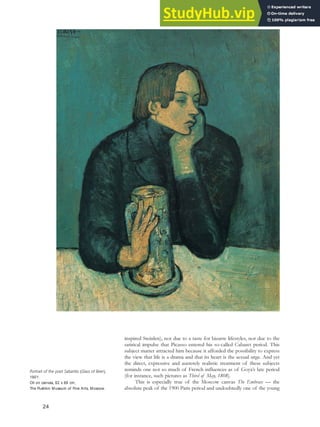
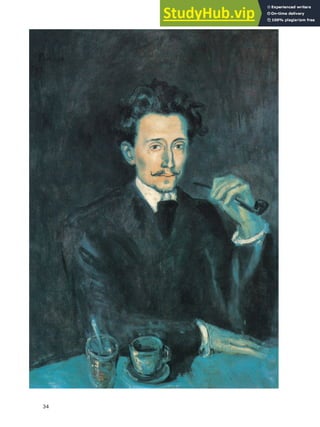
The Portrait of the poet Sabartés (p. 24), according to Sabartés
himself, belongs to the time of the Blue Period’s inception; it was
created in Paris in October-November 1901, and depicts Picasso’s
friend from his Barcelona days when he had just arrived in Paris, a
gigantic, dull, autumnal city in which he felt lost, homeless and alone.
That is how the artist saw him when, arriving late for their meeting, he
observed his friend sadly waiting in a café with a glass of beer. “In a
glance, before I noticed him, he caught my pose. He then shook my
hand, sat down, and we began to talk,” Sabartés recalled forty years
later in his book Picasso, Portraits et Souvenirs.28
The portrait was done in
the subject’s absence, from memory, or, more accurately, from the
inner model in the artist’s mind, which had eclipsed the actual facts
of the meeting. This model — the figure in the café — is a kind of
commentary on a painted story. This time it is about the solitude of a
poet, a myopic dreamer whose melancholy temperament and evident
inclination for Northern symbolism (respected in Barcelona) are
represented here by a huge mug of beer (instead of a glass of some
liquor). To Sabartés the portrait looked like his own reflection in the
blue waters of a mystical lake; in it he recognized the spectre of his
solitude. For Picasso this was not simply the portrait of a friend, but
the image of a poet which, in his view, was a mark of special
distinction, a fact emphasized by the title he himself gave to the
painting when Sergei Shchukin acquired it: Portrait of the Poet Sabartés.
This is probably the first canvas by Picasso with so much blue
(although it still stops short of being completely monochromatic), even
though it is required neither by the subject’s colouring nor by the play
of light. The bluish tones range here from turquoise to the deepest
aquamarine. This, it may be said, is the picture’s actual subject, an
expression of the state of mind of the poet, whose grief was a mark
of his sincerity. The blue colour is abstract and universal, it makes
Sabartés’s figure, seated at a café table, a symbol of poetic melancholy
that looms over the world’s empty horizon.
Blue is the painting’s metaphor for sadness and sorrow; however,
towards the end of 1901, the desire to express these feelings more
directly motivated Picasso to turn to sculpture. The predominance of
form in his paintings, mentioned by Daix, undeniably testifies to this
interest; Picasso began to sculpt not only because the medium made
his plastic idea more concrete, but also because it corresponded to his
need to impose strict limits on himself, to achieve the most ascetic
means of expression. As everything but the lonely human figure gradually
disappears from Picasso’s painting, and as the tonality becomes a fully
monochromatic blue, his inner model, static and tightly closed in on
itself (for example, the figure in the café), arrives at a sculptural idea
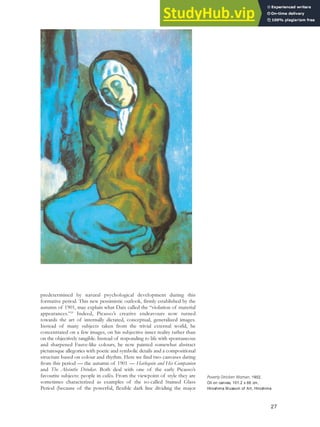
expressing depression. The painting A Drunken Woman Drowsing,
produced in Barcelona during the first months of 1902, is a noteworthy
instance of that development. In subject matter it continues along
the lines of the Paris absinthe drinkers, yet its plastic character leads to
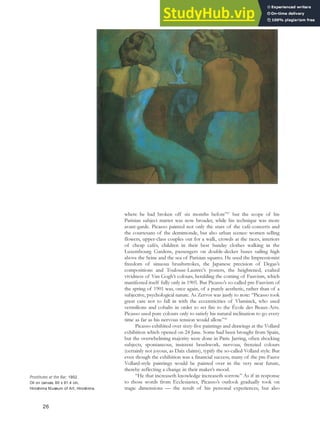
the major work of 1902, The Visit (p. 28): the bent, drooping figure,
33
34
wrapped in the sorrow of its blue cape, totally withdrawn as a tightly
closed shell. The genesis of this sculptural character may also be
traced to the Paris works of the second half of 1901, in which the
figures are, as it were, inscribed in the oval contours of a Romanesque
archway. First and foremost among these is a “cycle” of women
inmates and madonna-like “Maternities” (Daix), which in their own
way reflect Picasso’s impressions of visits to the St. Lazare prison in the
autumn of 1901. The development of all these elements, both plastic
and semantic, constitutes the background to the Hermitage painting
The Visit (see Seated Woman with Folded Arms; Crouching Woman with a
Child and Seated Woman in Voluminous Clothing). “The heart of the wise
is in the house of mourning” — the words of Ecclesiastes seemed to
echo the very thoughts of the twenty-year-old Picasso when he,
continuing his quest for the Eternal Feminine and finding everywhere
suffering and the tragic essence of existence, made his way to the
St. Lazare prison.39
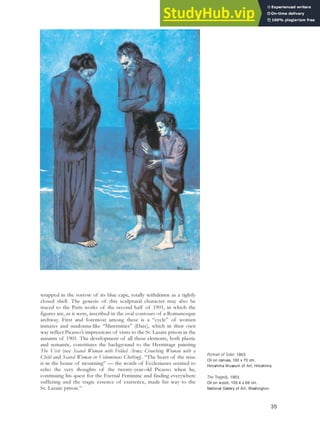
Portrait of Soler, 1903.
Oil on canvas, 100 x 70 cm,
Hiroshima Museum of Art, Hiroshima.
The Tragedy, 1903.
Oil on wood, 105.4 x 69 cm,
National Gallery of Art, Washington.
35
At the beginning of the twentieth century most of the inmates
there were prostitutes. Amid the hustle and bustle of Belle Èpoque Paris,
St. Lazare prison stood out as a strange world, turned in upon itself,
somehow timeless — an atmosphere reinforced by the twelfth-century
architecture of its buildings. The monotonous rhythm of the vaults’
arid arcades, of the long, echoing corridors with their processions of
inmates, the sacral atmosphere of this former monastery — all these
must have affected Picasso, susceptible as he was to such impressions.
Did he know then about the plans of Van Gogh (at the time, his special
favourite) to paint holy women from nature, giving them simultaneously
the appearance of modern city dwellers and that of the early Christians?
If he did not, then the coincidence is highly significant, for the young
Spaniard, who observed the heartrending and touching scenes of women
with their children (the inmates were allowed to keep their infants),
developed the theme of the St. Lazare prostitute-mother into a modern-day
Maternity. These Maternities can, hypothetically, be related to Goethe’s
myth concerning mothers, the great goddess-keepers of the prototypes of
everything that exists (see Faust, Part II). This is not surprising,
considering Goethe’s influence on the culture of symbolism in general
and, in particular, if one notes the many figurative allusions to the two
closing scenes of Faust in a picture created at the same time as the St. Lazare
Maternities, the large programmatic work The Burial of Casagemas (p. 23).
At any rate there is no doubt that Picasso, in the grip of his “blue” world
outlook, found the universal in the concrete: symbolic, suggestive in
meaning and piercing in emotion, an expression of universal sorrow.
This was an existential emotion rather than an empirical one. That is why
when depicting the women that he observed (or imagined?), Picasso
furnished neither individual features nor social details, but expressed
only the dark side of the Eternal Feminine: what he saw as the
metaphysical, suffering essence of women. Even such mundane details
as the hospital ward robes and the inmates’ typical white caps were
transformed into abstract capes and something similar to Marianne’s
Phrygian cap. Changed by the artist’s perception, they become in
Picasso’s work only faint traces of St. Lazare’s realities. However, their
stubborn presence speaks of how powerfully the prison’s harsh reality
affected the imagery and very style of the Blue Period at least
throughout the year of 1902.40
Six months later, having returned from
Barcelona to Paris, Picasso worked on a picture which he described,
writing to Max Jacob, as “a St. Lazare whore and a mother”. That picture
was The Visit.
In the above-mentioned letter (as well as on the drawing that was
enclosed with it, 2.6.436) Picasso calls the picture Two Sisters, which
expresses his own personal view of the painting. The title Two Sisters must,
of course, be understood as an allegory, a symbol, as two metaphysical
aspects of one common feminine essence — the base and the sublime, as
two courses of a woman’s fate — “a St. Lazare whore and a mother”.
Judging by the sketches, Picasso’s initial conception had a sentimental
tinge, the story of how sacred Maternity appeared before a prostitute in
the form of a pregnant woman holding an infant in her arms. Gradually,
however, such secondary details as facial expression and gesture vanished,
along with all particularities of exterior appearance and dress. Everything
pertaining to the depicted event is generalized and frugal: the place is a
wall with an archway; the characters’ poses and gestures are constrained
and passive; the faces are impersonal, their clothing indeterminate and
vague. Picasso not only cut back on details, he consciously limited his
means of expression to the point of asceticism. The indistinct and simple
monochromatic blue corresponds to the composition’s elemental quality,
the generalized plastic and linear character.
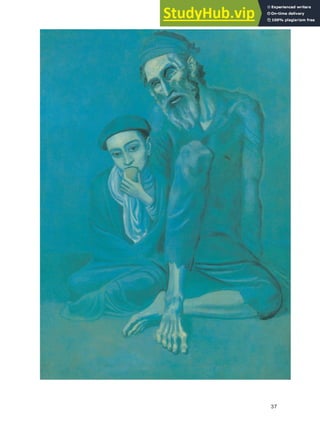
Old Jew with a Boy, 1903.
Oil on canvas, 125 x 92 cm,
The Pushkin Museum of Fine Arts, Moscow.
36
37
While simplifying the form, Picasso gave the content greater
complexity and depth, turning the initial subject into a timeless, universal
event — the mournful meeting of two symbolic sisters in another world.
Their emblematic opposition (the lofty and eternal versus the lowly and
fatal) is expressed through the painting’s structure. The intense, deep
sky-blue tones of the Mother figure correspond to her free-flowing plastic
lines, while the lifeless grey-green shadings (the colour of damp clay) of
the Prostitute correspond to the figure’s rock-like volumes, the ragged
rhythms of her pose, and the funereal shadows in the creases of her cape.
The exalted maternal inspiration and sorrow expresses itself through the
Mother’s all-seeing, gaping eye. The Prostitute’s deep, metaphysical death
dreams show in her heavy, closed eyelids, the shadows on her waxen face,
and her proximity to the yawning archway. Sergei Shchukin probably had
The Visit in mind when he said that Picasso should decorate cathedrals.
Even the picture’s formal components seem to have antecedents in the
traditions of sacred art: the composition being reminiscent of those on
ancient burial stelae as well as of the medieval iconographic depictions of
Mary and Elizabeth; the characters being linked with the noble, epic
figures of Giotto and Masaccio or the spiritual images of Gothic statues;
and the monochromatic colour originating in the supersensual blue-green
tonality of Luis de Morales. Yet, on the contrary, sketches show that
Picasso was not inspired by such ancient iconographic or stylistic
traditions, but rather, by looking beyond them, he revealed his theme of
two women meeting through a plastic idea that embodied the very
archetype of meeting. What was achieved in the sketches by the sisters’
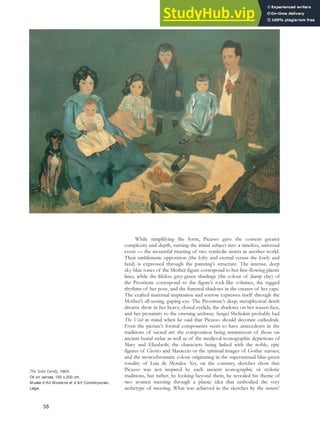
The Soler Family, 1903.
Oil on canvas, 150 x 200 cm,
Musée d’Art Moderne et d’Art Contemporain,
Liège.
38
clasped hands was formulated in the painting by composition: the two
figures bend toward each other and thus simulate an arch that “rhymes”
with the dark archway in the background on the left, thus achieving an
architectural unity for the two-part composition. Picasso simultaneously
endowed the visual idea with the importance of a poetic metaphor:
“meeting at an arch” (visits by charitable groups to the inmates were also
one of the noteworthy features of St. Lazare, something that Picasso
could have witnessed within its vaulted premises).
39
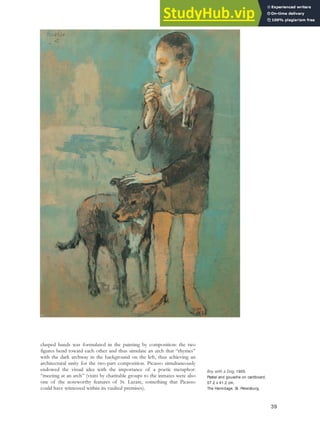
Boy with a Dog, 1905.
Pastel and gouache on cardboard,
57.2 x 41.2 cm,
The Hermitage, St. Petersburg.
40
It may well be that in The Visit Picasso first discovered for himself
the law of the associative and plastic equation of different objects. It
would later become an active and important instrument of his poetic
imagery, the poetry of metamorphosis, born during the Cubist Period
and preserved to the very end.
The Visit, probably completed by the autumn of 1902, is the
culmination of the first phase of the Blue Period, a phase dominated
by the St. Lazare subject matter. During 1902, three-quarters of which
Picasso spent in Barcelona, his art strayed far from reality into the area
of transcendent ideas expressing only his subjective, spiritual
experience. His characters were vague, anonymous, timeless (see The
Dead Man, Scene of Despair). These are images of ideas: their visual
definition has more to do with the plastic modelling of simple forms;
the feeling for volume and broad linear rhythms are more typical of a
sculptor (a sculptor, moreover, of ancient Assyrian reliefs) than of the
inspiration of a painter, grounded in a sense of reality and the
possibilities afforded by brush and colours.
This was a time when Picasso, as Daix noted, wished to achieve the
merger of form and idea. His experiments did not, however, meet with
the understanding of his closest associates in Barcelona, a fact he
complained about in a letter (mentioned earlier in connection with The Two
Sisters) to Max Jacob in Paris. He notes with irony that his friends — local
artists — find too much soul and no form at all in his work. The fact that
Picasso turned to his first Paris friend and a poet for understanding
(they met during the Vollard exhibition in 1901 and quickly became
close) at least in part explains his return in October 1902 to Paris, where
he lived in poverty with Max Jacob. After suffering from the cold
weather for three months, he left in mid-January 1903. “A terrible time
of cold, privation and disgust. Especially disgust,” Sabartés reports.
“This is what he recalls with the greatest repugnance — not because of
material hardship and privation, but because of the moral misery that he
was made to feel by certain Catalan friends who lived in Paris and in
better conditions.”41
Yet, as with previous trips, this visit to Paris introduced something
new to his art. In contrast to his terrible living conditions, during the
winter of 1902-1903 the imagination of Picasso-the-artist lived in the
realm of “pure and simple humanity” (Daix: “d’une humanité simple et
pure”), a world of shepherds and fishermen whose life is hard and frugal,
but yet reflects a heroic stoicism. This majestic world of philosophic
clarity, calm wisdom, simple, powerful emotions, of nature’s overarching
spirituality, seems to echo the sound of some ancient myth, born from
the ideals of Puvis de Chavannes, Gauguin and Alfred de Vigny, but
also from his own memories of the time spent at Horta de Ebro a mere
four years earlier42
(see The Mistletoe Seller; Head of a Picador).
Not having the means to paint in oils in Paris, Picasso made
drawings (see Man with Raised Arms); thus, when he resumed painting in
Barcelona, his new graphic experience manifested itself in his greater
attention to the problems of space, of human anatomy, of the tangible
features of his characters, the range of which broadened considerably
compared with 1902. In the most significant works of the first half of
1903 — Poor People on the Seashore (The Tragedy) (p. 35), La Vie (p. 31) and
The Embrace (p. 15) — Picasso developed the universal Blue Period
themes of Weltschmerz and the Eternal Feminine as scenes of relations
between individualized characters: men, women and children (see Mother
and Children on the Seashore). The artist expressed his emotional
experience in what might be seen as symbolic or mythological “blue”
dreams, and this has led contemporary scholars of the Blue Period to
psychoanalytical interpretations.43
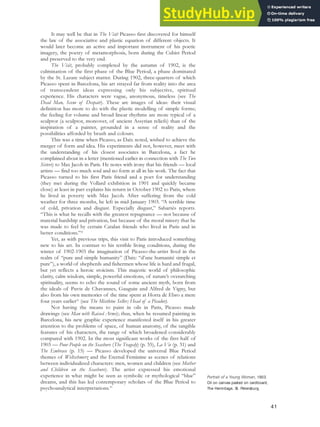
Portrait of a Young Woman, 1903.
Oil on canvas pasted on cardboard,
The Hermitage, St. Petersburg.
41
And yet, as the pressure of Picasso’s emotional crisis began to ease,
his consciousness sought a way out in the external, in reality. This urge
for the concrete was expressed in cityscapes, albeit muffled in the
darkness of night, and especially in the portraiture which manifested
itself in the middle of 1903. That was when the Portrait of Soler was
created, following a portrait of Soler’s wife and a group portrait of the
entire family during a summer picnic. The three canvases actually work
quite well as a triptych, although the Hermitage painting is of a more
intimate and friendly character than the Portrait of Senora Soler or The Soler
Family’s Luncheon on the Grass, both of which are a subtle play on the
typical stiff photo-portraits of those times. Benito Soler Vidal was a
stylish tailor in Barcelona, a friend and patron of the arts and artists
who frequented the Els Quatre Gats café, and a man who stood out in
that city as a particularly snappy dresser. That is how Picasso depicted
him: a melancholy dandy. Once again the mystical power of infinite blue
was used to transport the subject from his mundane surroundings to
those that best suited his noble countenance. Picasso surrounded Soler
with cosmic light, turning his finely featured face into a sort of pale,
heavenly body hardly touched by living colours. Picasso’s artistic
intention clearly takes precedence over the model’s actual psychology;
the Portrait of Soler, however, is significant in that it reveals the artist’s
desire to find a corporeal type expressing an inner sensibility. In that
sense the Hermitage portrait leads to the unquestionable masterpieces
of the autumn of 1903, among them Old Jew and a Boy (p. 37).
Contact with external reality makes the theme of man’s unhappiness
concrete by dramatic images of poverty and physical infirmity:
homelessness, hunger, old age, and blindness. Many authors have noted
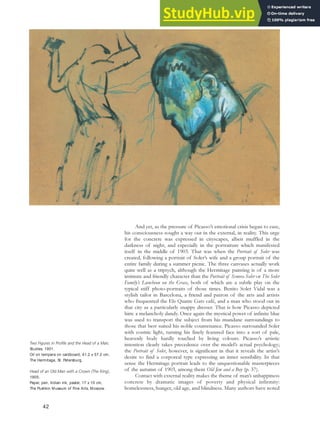
Two Figures in Profile and the Head of a Man,
Studies, 1901.
Oil on tempera on cardboard, 41.2 x 57.2 cm,
The Hermitage, St. Petersburg.
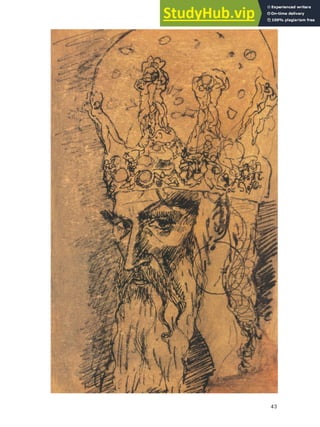
Head of an Old Man with a Crown (The King),
1905.
Paper, pen, Indian ink, pastel, 17 x 10 cm,
The Pushkin Museum of Fine Arts, Moscow.
42
43
44
that beggars and cripples were a common sight in turn-of-the-century
Barcelona and that Isidro Nonell, Picasso’s artist friend, had previously
been attracted to similar subjects with their particular “España negra”
gloomy tonality. Picasso, however, again hits a note higher than the one
written in the score: physical infirmity interests him only as a metaphor
for spirituality honed by suffering. Picasso’s imaginary “Sisyphean tribe”
of the Paris winter of 1902-1903 was of stocky, “Doric” proportions,
embodying the flesh and blood of those people’s epic, massive origins;
now, in the autumn of 1903, in Barcelona, his taste for pure, incorporeal,
elongated lines (succumbing to their musical interplay, Picasso covers
sheet after sheet with sketches of nudes, gestures, poses, and profiles)
gave birth to manneristic, attenuated figures that remind some scholars
of El Greco, Morales, Roman frescoes and Catalan reliefs. Other
scholars link the artist’s new mood to the philosophical ideas of
Nietzsche, then popular among the symbolists of Barcelona,
concerning the “birth of tragedy from the spirit of music”.44
Be that as
45
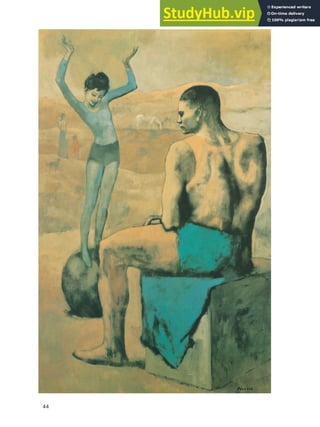
Acrobat on a Ball, 1905.
Oil on canvas, 147 x 95 cm,
The Pushkin Museum of Fine Arts, Moscow.
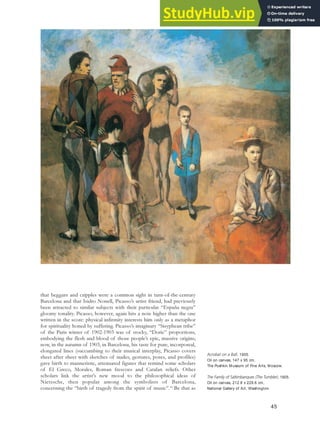
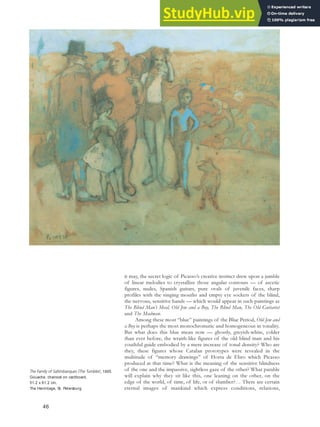
The Family of Saltimbanques (The Tumbler), 1905.
Oil on canvas, 212.8 x 229.6 cm,
National Gallery of Art, Washington.
it may, the secret logic of Picasso’s creative instinct drew upon a jumble
of linear melodies to crystallize those angular contours — of ascetic
figures, nudes, Spanish guitars, pure ovals of juvenile faces, sharp
profiles with the singing mouths and empty eye sockets of the blind,
the nervous, sensitive hands — which would appear in such paintings as
The Blind Man’s Meal, Old Jew and a Boy, The Blind Man, The Old Guitarist
and The Madman.
Among these most “blue” paintings of the Blue Period, Old Jew and
a Boy is perhaps the most monochromatic and homogeneous in tonality.
But what does this blue mean now — ghostly, greyish-white, colder
than ever before, the wraith-like figures of the old blind man and his
youthful guide embodied by a mere increase of tonal density? Who are
they, these figures whose Catalan prototypes were revealed in the
multitude of “memory drawings” of Horta de Ebro which Picasso
produced at that time? What is the meaning of the sensitive blindness
of the one and the impassive, sightless gaze of the other? What parable
will explain why they sit like this, one leaning on the other, on the
edge of the world, of time, of life, or of slumber?… There are certain
eternal images of mankind which express conditions, relations,
The Family of Saltimbanques (The Tumbler), 1905.
Gouache, charcoal on cardboard,
51.2 x 61.2 cm,
The Hermitage, St. Petersburg.
46
conflicts of a general significance and which from time to time in
history assume the character of “wanderers”. The old blind man, made
wise by suffering, the beggar who lost everything he had, the vagabond
eternally damned to move on, were once Oedipus, Job, Ahasuerus.
Perhaps, though, they are only the incarnations of one archetype
expressing the growth of spirituality as the corporeal wanes. In the
nineteenth-century novels of Dickens and Dostoyevsky, humanity
(the highest spirituality in those times) finds its piercing expression in
the image of an old beggar with an orphan girl, an image both deeply
touching and profoundly symbolic.
In Old Jew and a Boy the artist interprets the humanistic myth of the
nineteenth century, but does it with a Biblical hopelessness for human
fate. The painting shows us how Picasso’s aesthetic crisis of the Blue
Period was to be resolved. For here the striving to attain extreme
expressiveness — which had necessitated the tangible interplay of lithe
plastic forms, the complex linear rhythms, the mimetic contrasts of
types, and, finally, the intensely ash-blue colour — this manneristic
exaltation of form, is now based on the piercing power of a relationship.
In that sense the motif of blindness in Old Jew and a Boy had a special
importance for Picasso, as Penrose so profoundly realized. “In
considering the act of perception, Picasso has always been amazed at the
discrepancy between seeing an object and knowing it. Its superficial
appearance is to him absurdly inadequate. Seeing is not enough, neither
is the aid that the other senses can bring. There are other faculties of
the mind which must be brought into play if perception is to lead to
understanding. It is somewhere at the point of junction between sensual
perception and the deeper religion of the mind that there is a metaphorical
inner eye that sees and feels emotionally. Through this eye of the
imagination it is possible to see, to understand and to love even without
sight in the physical sense, and this inner seeing may be all the more
intense when the windows of the outer world are closed.” Penrose then
quotes the mysterious words Picasso said in the 1930s: “In fact it is only
love that matters. Whatever it may be. And they should put out the eyes
of painters as they do to goldfinches to make them sing better.”45
In saying that, Picasso perhaps was thinking about his blind Minotaur
led by a little, defenceless girl, that later echoes of his blind old man and
orphan of 1903, united by the spirituality of love.
In 1904 the Blue Period, with its pessimistic, ingrown character
and furious desire for an aesthetic absolute, reached its climax. This
crisis of youth had to be replaced by a new stage in the process of
individual development — the stage of self-building. Not accidentally,
Picasso now set stock by external conditions, planning another trip to
Paris to breathe different air, speak another language, see other faces
and adopt another lifestyle.
In April 1904 he went back to Paris — for good, as it was to turn out.
He moved into a studio building known as the Bateau-Lavoir (Laundry Barge),
a nickname given to it by Max Jacob for its strange design. A dilapidated
wooden house that clung to the heights of Montmartre, which was
pastorally peaceful in those times, the Bateau-Lavoir became Picasso’s
home for the next five years, and the atmosphere of this bohemian nest,
its texture of poverty, became the atmosphere and texture of his canvases
of 1904-1908.
Picasso’s life soon entered family waters, when he met and took
up with the beautiful Fernande Olivier;46
he acquired new friends and
acquaintances. Home, family social circle — his relationship with life grew
more solid and positive. Being with colleagues became less important to
Picasso than meeting creative figures from other fields, especially poets,
who included André Salmon and Guillaume Apollinaire.
47
Among Picasso’s first Parisian friends were Suzanne Bloch, later a
well-known singer, and her brother, the violinist Henri Bloch. In 1904 he
gave the couple a photo of himself, executed a brilliant portrait of
Suzanne, and presented Henri Bloch with a small canvas, Head of a Woman
with a Scarf.
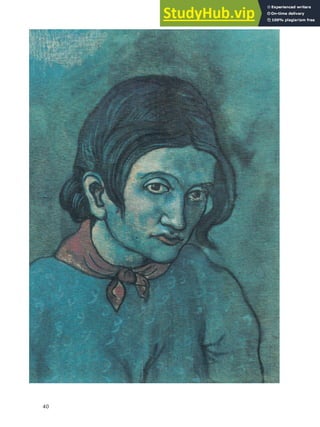
This work, usually dated to 1903, when Picasso was in Barcelona, is
nevertheless more typical of his first Parisian months of 1904, when he
used watercolours extensively and worked in the graphic arts.
The blue has now been diluted, it is nearly translucent and has red
undertones; the drawing is strong and combines attention to detail with
expressive stylization. At the same time (and this is characteristic of the
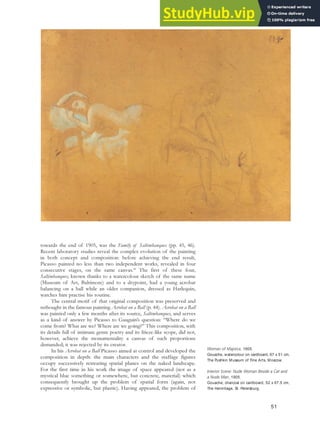
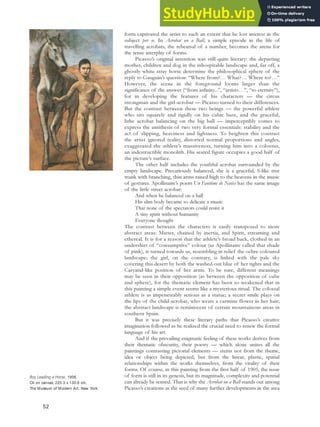
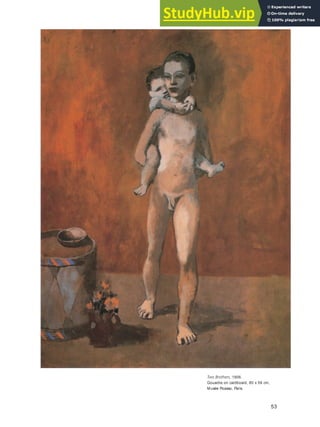
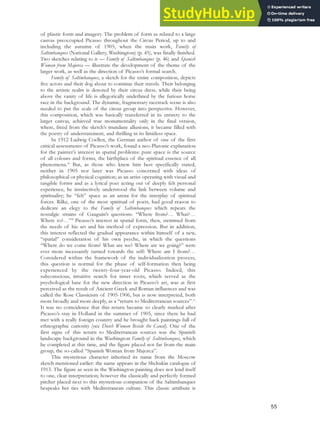
end of the Blue Period), the source of the mood is now the individual
psychology of the character. The woman’s melancholy effacement is
shown through her bent figure, the strand of hanging hair, her features
and expression. This woman, however, with her cropped hair (like the
prisoners of St. Lazare), is probably not a real person, but rather the fruit
of Picasso’s inspired improvisation, the closest forerunner of the blind
man’s famished companion in his 1904 etching The Frugal Repast.
Together with the naturalistic tendencies in Picasso’s drawings, by
1905 there was a growth of the narrative element in his art as a whole.
The Russian poet Alexander Blok noted (also in 1905) this kind of
amazing interrelationship: “Often the basis of a sentence, the noun and
the verb, coincide — the former with colour, the latter with line.”47
Picasso’s line now became lively, sensitive to detail, yet light,
sophisticated and nervous; it seems to sing the form’s highest notes.
Long, flexible bodies rendered at full length, raised, angular elbows,
graceful extremities, refined profiles, unusual curves, angles, wrinkles.
This is a line of lyrical timbre, it demands corresponding themes
resembling blank verse, something intimate in mood and philosophic in
content. The themes came from the world of travelling circuses, rich in
its potential for lyrical and philosophical interpretation. And so it was,
especially for Picasso, who perceived the world of the travelling circus as
a metaphor for his own environment — the artistic Bohemia of
Montmartre, which lived “poorly, but splendidly” (Max Jacob) in feverish
excitement and hunger-sharpened sensitivity, in the brotherhood of
companionable joviality and the wrenching melancholy of alienation.
Picasso’s vision was inspired and picturesque. This was a poet’s vision,
which in content and emotion was very close to the atmosphere of the
Little Poems in Prose by Baudelaire, a spiritual mentor to both Picasso and
his poet-friends. In their roles as social outcasts these young men also
felt a bond with the fate of the poète maudit, and their examination of
history would inevitably come to rest on Baudelaire — the heroic figure
of a rebellious genius who proved to be for them like one of the
lighthouses he once described. In fact, the Montmartre of these young
poets and painters — a garret and an attic in Paris — was to a certain
extent reminiscent of that squalid and yet magical double chamber
(tinted in pink and blue) described by Baudelaire in one of his Little
Poems in Prose.
The Hermitage painting Boy with a Dog (p. 39) seems to be a direct
response to another prose poem by Baudelaire, Les Bons Chiens: “I sing the
dirty dog, the poor dog, the homeless dog, the stray dog, the dog
saltimbanque, the dog whose instinct, like that of the beggar, the
bohemian and the comedian, is so wonderfully sharpened by necessity,
that kind mother, that true patron of all intelligence!” Like no one else,
Picasso grasped Baudelaire’s desire to “sing the good dogs, the poor dogs,
the dirty dogs, those that everyone keeps at a distance as pestiferous and
flea-infested, everyone except the poor, of whom they are the associates,
and poets, who look upon them with a fraternal eye.”
Clown with a Young Acrobat, 1905.
Charcoal, pastel and watercolours on paper,
60 x 47 cm,
Göteborg Konstmuseum, Göteborg.
48
This same instinct, sharpened by need, this taste for the true values
of life and the understanding of its philosophy, is also typical of the
dog’s comrade in Picasso’s gouache — the boy who, though dressed in
rags, has the delicate and angular grace of the Quattrocento. The animal is
calm beneath the boy’s hand, both turn their heads to one rhythm — thus
the painter creates the feeling of warm contact between the solitary boy
and the dog whose intelligent eyes seem to say, as in Baudelaire’s verse:
“Take me with you, and perhaps from our two miseries we shall create a
kind of happiness!”
This mood of calm, sentimental melancholy was the Leitmotif of
Picasso’s works from late 1904 and the first half of 1905, the so-called
Circus or Rose Period. And all the works of that period, including the
gouache Boy with a Dog, are related, some more, some less, to the huge
composition on the life of a travelling circus that the artist envisioned at
the end of 1904. In essence all the work on this composition — all the
conceptual changes, all the sketches and the development of certain
motifs into separate paintings, in other words, all of its roots and
branches — was what comprised the Circus Period, sometimes also
called the Saltimbanque Period. One of the chief products, created
Acrobat Family with a Monkey, 1905.
Gouache, watercolours, pastel and Indian ink
on cardboard, 104 x 75 cm,
Göteborg Konstmuseum, Göteborg.
49
50
towards the end of 1905, was the Family of Saltimbanques (pp. 45, 46).
Recent laboratory studies reveal the complex evolution of the painting
in both concept and composition: before achieving the end result,
Picasso painted no less than two independent works, revealed in four
consecutive stages, on the same canvas.48
The first of these four,
Saltimbanques, known thanks to a watercolour sketch of the same name
(Museum of Art, Baltimore) and to a drypoint, had a young acrobat
balancing on a ball while an older companion, dressed as Harlequin,
watches him practise his routine.
The central motif of that original composition was preserved and
rethought in the famous painting Acrobat on a Ball (p. 44). Acrobat on a Ball
was painted only a few months after its source, Saltimbanques, and serves
as a kind of answer by Picasso to Gauguin’s question: “Where do we
come from? What are we? Where are we going?” This composition, with
its details full of intimate genre poetry and its frieze-like scope, did not,
however, achieve the monumentality a canvas of such proportions
demanded; it was rejected by its creator.
In his Acrobat on a Ball Picasso aimed at control and developed the
composition in depth: the main characters and the staffage figures
occupy successively retreating spatial planes on the naked landscape.
For the first time in his work the image of space appeared (not as a
mystical blue something or somewhere, but concrete, material) which
consequently brought up the problem of spatial form (again, not
expressive or symbolic, but plastic). Having appeared, the problem of
Woman of Majorca, 1905.
Gouache, watercolour on cardboard, 67 x 51 cm,
The Pushkin Museum of Fine Arts, Moscow.
Interior Scene: Nude Woman Beside a Cat and
a Nude Man, 1905.
Gouache, charcoal on cardboard, 52 x 67.5 cm,
The Hermitage, St. Petersburg.
51
form captivated the artist to such an extent that he lost interest in the
subject per se. In Acrobat on a Ball, a simple episode in the life of
travelling acrobats, the rehearsal of a number, becomes the arena for
the tense interplay of forms.
Picasso’s original intention was still quite literary: the departing
mother, children and dog in the inhospitable landscape and, far off, a
ghostly white stray horse determine the philosophical sphere of the
reply to Gauguin’s question: “Where from?… What?… Where to?…”
However, the scene in the foreground looms larger than the
significance of the answer (“from infinity...”, “artists…”, “to eternity”),
for in developing the features of his characters — the circus
strongman and the girl-acrobat — Picasso turned to their differences.
But the contrast between these two beings — the powerful athlete
who sits squarely and rigidly on his cubic base, and the graceful,
lithe acrobat balancing on the big ball — imperceptibly comes to
express the antithesis of two very formal essentials: stability and the
act of slipping, heaviness and lightness. To heighten this contrast
the artist ignored reality, distorted normal proportions and angles,
exaggerated the athlete’s massiveness, turning him into a colossus,
an indestructible monolith. His seated figure occupies a good half of
the picture’s surface.
The other half includes the youthful acrobat surrounded by the
empty landscape. Precariously balanced, she is a graceful, S-like tree
trunk with branching, thin arms raised high to the heavens in the music
of gestures. Apollinaire’s poem Un Fantôme de Nuées has the same image
of the little street acrobat:
And when he balanced on a ball
His slim body became so delicate a music
That none of the spectators could resist it
A tiny spirit without humanity
Everyone thought
The contrast between the characters is easily transposed to more
abstract areas: Matter, chained by inertia, and Spirit, streaming and
ethereal. It is for a reason that the athlete’s broad back, clothed in an
undershirt of “consumptive” colour (as Apollinaire called that shade
of pink), is turned towards us, resembling in relief the ochre-coloured
landscape; the girl, on the contrary, is linked with the pale sky
covering this desert by both the washed-out blue of her tights and the
Caryatid-like position of her arms. To be sure, different meanings
may be seen in their opposition (as between the opposition of cube
and sphere), for the thematic element has been so weakened that in
this painting a simple event seems like a mysterious ritual. The colossal
athlete is as impenetrably serious as a statue; a secret smile plays on
the lips of the child-acrobat, who wears a carmine flower in her hair;
the abstract landscape is reminiscent of certain mountainous areas in
southern Spain.
But it was precisely these literary paths that Picasso’s creative
imagination followed as he realized the crucial need to renew the formal
language of his art.
And if the prevailing enigmatic feeling of these works derives from
their thematic obscurity, their poetry — which alone unites all the
paintings contrasting pictorial elements — stems not from the theme,
idea or object being depicted, but from the linear, plastic, spatial
relationships within the works themselves, from the vitality of their
forms. Of course, in this painting from the first half of 1905, the issue
of form is still in its genesis, but its magnitude, complexity and potential
can already be sensed. That is why the Acrobat on a Ball stands out among
Picasso’s creations as the seed of many further developments in the area
Boy Leading a Horse, 1906.
Oil on canvas, 220.3 x 130.6 cm,
The Museum of Modern Art, New York.
52
53
Two Brothers, 1906.
Gouache on cardboard, 80 x 59 cm,
Musée Picasso, Paris.
Naked Youth, 1905.
Gouache on cardboard, 67.5 x 52 cm,
The Hermitage, St. Petersburg.
54
of plastic form and imagery. The problem of form as related to a large
canvas preoccupied Picasso throughout the Circus Period, up to and
including the autumn of 1905, when the main work, Family of
Saltimbanques (National Gallery, Washington) (p. 45), was finally finished.
Two sketches relating to it — Family of Saltimbanques (p. 46) and Spanish
Woman from Majorca — illustrate the development of the theme of the
larger work, as well as the direction of Picasso’s formal search.
Family of Saltimbanques, a sketch for the entire composition, depicts
five actors and their dog about to continue their travels. Their belonging
to the artistic realm is denoted by their circus dress, while their being
above the vanity of life is allegorically underlined by the furious horse
race in the background. The dynamic, fragmentary racetrack scene is also
needed to put the scale of the circus group into perspective. However,
this composition, which was basically transferred in its entirety to the
larger canvas, achieved true monumentality only in the final version,
where, freed from the sketch’s mundane allusions, it became filled with
the poetry of understatement, and thrilling in its limitless space.
In 1912 Ludwig Coellen, the German author of one of the first
critical assessments of Picasso’s work, found a neo-Platonic explanation
for the painter’s interest in spatial problems: pure space is the source
of all colours and forms, the birthplace of the spiritual essence of all
phenomena.49
But, as those who knew him best specifically stated,
neither in 1905 nor later was Picasso concerned with ideas of
philosophical or physical cognition; as an artist operating with visual and
tangible forms and as a lyrical poet acting out of deeply felt personal
experience, he instinctively understood the link between volume and
spirituality; he “felt” space as an arena for the interplay of spiritual
forces. Rilke, one of the most spiritual of poets, had good reason to
dedicate an elegy to the Family of Saltimbanques which repeats the
nostalgic strains of Gauguin’s questions: “Where from?… What?…
Where to?…”50
Picasso’s interest in spatial form, then, stemmed from
the needs of his art and his method of expression. But in addition,
this interest reflected the gradual appearance within himself of a new,
“spatial” consideration of his own psyche, in which the questions
“Where do we come from? What are we? Where are we going?” were
ever more incessantly turned towards the self: Where am I from?…
Considered within the framework of the individualization process,
this question is normal for the phase of self-formation then being
experienced by the twenty-four-year-old Picasso. Indeed, this
subconscious, intuitive search for inner roots, which served as the
psychological base for the new direction in Picasso’s art, was at first
perceived as the result of Ancient Greek and Roman influences and was
called the Rose Classicism of 1905-1906, but is now interpreted, both
more broadly and more deeply, as a “return to Mediterranean sources”.51
It was no coincidence that this return became so clearly marked after
Picasso’s stay in Holland in the summer of 1905, since there he had
met with a really foreign country and he brought back paintings full of
ethnographic curiosity (see Dutch Woman Beside the Canal). One of the
first signs of this return to Mediterranean sources was the Spanish
landscape background in the Washington Family of Saltimbanques, which
he completed at this time, and the figure placed not far from the main
group, the so-called “Spanish Woman from Majorca”.
This mysterious character inherited its name from the Moscow
sketch mentioned earlier: the name appears in the Shchukin catalogue of
1913. The figure as seen in the Washington painting does not lend itself
to one, clear interpretation; however the classically and perfectly formed
pitcher placed next to this mysterious companion of the Saltimbanques
bespeaks her ties with Mediterranean culture. This classic attribute is
55
absent in the Moscow sketch; nevertheless, in the colours of the sky and
the yellow ochre and the half-length woman’s figure, the work stands as
an illustration of the purely Mediterranean. This so un-Spanish Spanish
woman in a Majorcan veiled head-dress comes across like a prototype
for one of the ancient Tanagra terracotta figurines. She has the graceful
proportions, majestic dignity and alienated charm of an ideal from
classical antiquity. But in her overly refined lines and tonal sophistication
we have yet to feel the real, purely plastic concern with form that was
to grip Picasso as he delved deep into the Mediterranean sources of his
artistic nature.
As a parallel development, the hieratically mysterious figures of the
autumn of 1905 (Spanish Woman from Majorca belongs to this group) were
to disappear from his art while the persistent preoccupation with sources
led him to the theme of primal nudity and youthfulness. In the winter
of 1905-1906 these themes would merge as Picasso imagined a large new
composition with five naked boys and their horses on a deserted
Mediterranean coast. But instead of this multi-figure composition,
abandoned at the developed sketch stage and known generally as The
Watering Place, Picasso completed only the canvas (perhaps originally
meant for the group) Boy Leading a Horse (p. 52) preceded by a multitude
of sketches.
One of these sketches, the Hermitage’s Naked Youth (p. 54), has
something of the air of an independent classroom study but one based
on an imagined model, some ideal adolescent. Here is a youth on the
verge of manhood whose body is flooded with sexuality but whose
spiritual energy is yet dormant; thus, steeped in the process of physical
flowering, he remains in a state of ennui and inertia. Picasso wanted to
pose the figure like a statue, solidly and weightily, in contrast, as it were,
with its relaxed, flowing stance, its displaced centre of gravity and the
light tonality dissolving the sharpness of form. He made the proportions
heavier, hardened the light, flowing silhouette with a clear, sinuous contour,
applied a layer of white gouache, in all its tangible density. But while the
youth’s naked body recalls a warm, pink Greek marble — and his plastic
clarity, the ideal of antique harmony — his solid figure with its large
hands and feet is closer to the image of a peasant youth, to those
descendants of an ancient Mediterranean race that Picasso would encounter
in the summer of 1906 in Gosol, in the Spanish Pyrenees, than it is to
any classical kind of beauty.
His trip to Spain was in itself very significant during that period of
returning to his Mediterranean sources; the time spent in Gosol, a tiny
mountain village near Andorra, is doubly important, for it shows clearly
the sources and the emotions underlying the fascination with archaic
Iberian art that so intrigued Picasso in the autumn of 1906 in Paris.
Gosol was for Picasso, probably, a second Horta de Ebro, the village
where he had spent about a year when he was seventeen and from which,
he professed, he brought back all his knowledge of life. The stark, wild
nature of the eastern Pyrenees — land of shepherds and smugglers,
living a life attuned to the natural surroundings, unchanged since pagan
times, honest and strong characters reflected in the features of local
faces, the assured stride and erect carriage of well-built bodies — such is
the image of Picasso’s Catalan Arcadia, a land to which he immediately
belonged (see The Adolescents, The Peasants; Peasant Woman with Loaves, Man,
Woman and Child). “In Spain I saw him so different from himself,”
Fernande Olivier would recall a quarter of a century later, “or rather, so
different from the Picasso of Paris, joyful, less wild, more brilliant,
animated, calm and controlled in his interests, finally comfortable. He
seemed to reflect an aura of happiness in contrast to his usual character
and attitude.”52
56
Here, amid the mountainous, ochre-toned landscape, largely
without vegetation (so amazingly foreshadowed in Acrobat on a Ball,
Family of Saltimbanques and The Watering Place), with its background of
large and small areas of untamed nature, there occurs a sharpening of
the appreciation of simple, harmonious and reasonably constructed
form, be it that of a human figure or man-made object. Continuing
and delving deeper into the theme of youthful nakedness, Picasso
now found his source not so much in the ephebic type, as in the
architectonics of simplified plastic forms, whether conceived as a youth,
a boy, a woman, a portrait, or a clay utensil. But each of those plastic
ideas lives the life of the image, charming in its spontaneity.
Such is the unpretentious Still Life with Porrón (Glassware), with its
four commonplace objects of peasant life: two made of glass, two of clay.
The simple motif of this group of objects, frontally depicted in the style
of Zurbarán, comes alive through the internal dynamic interplay of
contrasts and resemblances: material and plastic, rhythmic and tonal. Yet
at the same time, in the contrasts between the individual forms of the
elegant carafe and the triangular Porrón, the squat casserole under its lid
and the simple earthenware jug, one feels the hidden humour of an artist
playing at transformation, which was so typical of Picasso’s fantasy. Thus,
an objective depiction of lifeless objects turns into a genre scene in which
an ordinary table becomes the stage for the meeting of two couples: one
glass, the other clay.
As is evident from Still Life with Porrón, the Gosol works reflect a
subconscious, but logical, growth of two basic trends in the development
of the artist’s formal conception: the underlining of the original
Glassware, Still Life with a Porrón, 1906.
Oil on canvas, 38.4 x 56 cm,
The Hermitage, St. Petersburg.
57
expressive simplicity of volumes and the increasingly complex
compositional structure of the whole. These trends would acquire their
greatest stylistic expression in Paris during the autumn of 1906 in
conjunction with Picasso’s discovery of, on the one hand, archaic Iberian
sculpture dating from 1000 B.C., unearthed by archaeologists and
exhibited in the Louvre53
in the spring of 1906, and, on the other, the
painting of El Greco, which Picasso saw with new eyes as a primarily
visionary kind of art.
That both these basic models (their polarity notwithstanding) were
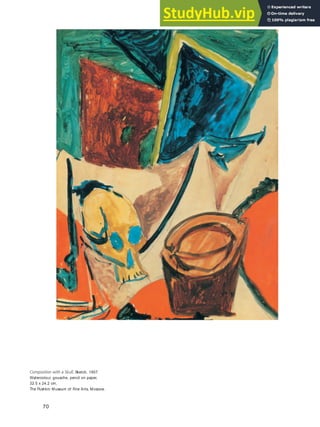
Spanish must have had a special meaning for Picasso, considering his
return to sources and search for his Iberian roots.
Naked Woman, 1906.
Oil on canvas, 151.3 x 93 cm,
The Museum of Modern Art, New York.
58
For Picasso, Gosol was the world of original creativity. Here, far
from cultural centres, he must have felt the relativity and arbitrariness not
only of the artistic techniques taught by academic studies, but even of
generally accepted cultural norms and the whole European tradition
supporting them. In this naked and primeval world, the artist’s every
motion, every contact with formless material must have been felt with
startling sharpness; it was precisely here that Picasso must have fully
perceived the depth of human experience hidden by simplicity of form
and the intensity of spiritual, form-creating labour.
On the other hand, Picasso’s artistic thoughts were very concrete:
forms to him were not some abstractions but rather served to render the
59
Sitting Woman with Crossed Legs, 1906.
Oil on canvas, 151 x 100 cm,
Galerie Nardonie, Prague.
objects to which he related so profoundly. In Gosol, in the summer
of 1906 the nude female form assumed an extraordinary importance
for Picasso — a depersonalized, aboriginal, simple nakedness, like the
concept “woman” (see Two Nudes; Seated Nude with Her Legs Crossed,
Standing Nude). Whether or not the female nudes of Gosol (see also La
Toilette) were Picasso’s response to Ingres’s Bain Turc, shown at the 1905
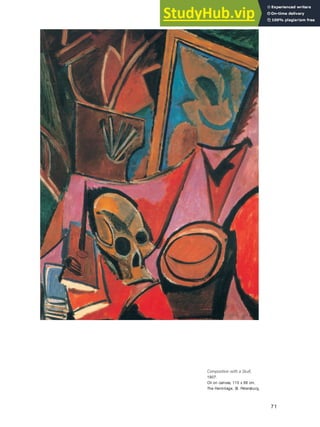
Salon d’Automne,54
has yet to be proven. But from the viewpoint of the
artist’s internal world, their meaning was undoubtedly far more
profound than a simple artistic reaction, and that is confirmed by the
importance that female nudes were to assume as subjects for Picasso in
the next few months: to be precise, in the winter and spring of 1907,
when he developed the composition of the large painting that came to
be known as Les Demoiselles d’Avignon.
Hastily leaving Gosol because of an outbreak of typhus, Picasso
returned to Paris with his head shaved bald. Perhaps that led him to depict
himself in the famous Self-Portrait with a Palette from the autumn of 1906
Self-Portrait with a Palette, 1906.
Oil on canvas, 92 x 73 cm,
Philadelphia Museum of Art, Philadelphia.
60
as a juvenile, youthful Adam-the-artist. It would be more true, however,
to say that that was the way he felt. The gaze of this Adam-the-artist,
with his powerful torso and arms, is not focused on the external; it looks
inwards. His thoughts are metaphorically expressed by a palette
containing four colours: black, ochre, white and rose; most of the palette
is clean — the work still lies ahead, but his colouristic credo is too
restrained to transmit all the fleeting temptations of sight. Picasso looks
here as he did in a photograph taken when he was fifteen, and this
projection of self-as-adolescent tells us that he saw himself as a novice,
striving, for the first time, after what was to be his life’s cause. That, it
would seem, was the sum total of his return to Mediterranean sources;
such were the acquired Iberian roots of his artistic nature.
On 25 October 1906, Picasso turned twenty-five. That date marks
the completion of one full cycle in his artistic development. Working
in the spring of 1907 on Les Demoiselles d’Avignon, he was born anew as
a painter. The Moscow and St. Petersburg collections have only one
work between them relating to this crucial moment in Picasso’s artistic
career — Nude (half-length) (p. 67).
However, it is a peculiarity of that period that a large number of
important events were concentrated in the very short span of a few
months; hence, no one of Picasso’s works (many of which have, moreover,
been lost) can reflect a true picture of the whole. It is only in their entirety
(and there are several dozen of them) that the creations of the spring
of 1907 — the paintings, sketches, studies, drawings, sculptures, that is,
Self-Portrait, 1906.
Oil on canvas, 65 x 54 cm,
Musée Picasso, Paris.
61
the artist’s total expression from that period — can truly reconstruct the
story of Picasso’s “second birth”, a story that has yet to be fully understood
even though there have been many attempts to do so. An understanding of
the general character of the radical change that took place in 1907, to say
nothing of its essence and direction, is achieved neither through references
to individual influences (Iberian, African, Cézanne, El Greco, Ingres),
nor by discussions of the lessons of Derain or Picasso’s disputes with the
Fauvism of Matisse, let alone by philosophical or literary influences, or any
of the other generalities of that particular moment.
The young artists of the early twentieth century undoubtedly
demonstrated an avant-garde spirit of aesthetic radicalism.
Yet even the leader of the Fauves, Matisse, was scandalized when he
visited Picasso and saw Les Demoiselles d’Avignon; to him the painting was an
abuse of modern art, as he could find no aesthetically justified explanation
for it. Could the work indeed be qualified (at least in those days) as modern
art? Many of its first viewers, at any rate, saw it as something Assyrian
(that is how Wilhelm Uhde presented it to Kahnweiler). Douanier Rousseau,
we know, noted in 1908 that Picasso worked in the Egyptian genre. It has
now been proven that during his work on Les Demoiselles d’Avignon Picasso
had two Iberian stone sculptures with which he “took counsel” in his
experiments. As for modern Parisian painting per se, he had had no creative
ties with it since 1901; beginning with his Blue Period, he travelled his own
solitary road. Even Fauvism’s scandalous triumph at the 1905 Salon
d’Automne evoked not the slightest response in his art, which by then had
entered the most harmonious and avant-garde phase of Rose Classicism.
Picasso was always a solitary artist: “He was always free, owing nothing to
anyone but himself ” (Kahnweiler). From the vantage point of over four
decades, here is how the artist himself explained the reasons and essence
of the creative breakthrough of 1907: “I saw that everything had been
done. One had to break, to make one’s revolution and to start at zero.”55
That break, however, that revolution, was neither instantaneously
nor easily achieved. It was carried out amid the conditions of a new
spiritual and creative crisis — one far more profound and all-embracing
than ever before, because it touched on the technical, spiritual and
pictorial possibilities open to the artist (“I saw that everything had been
done”). It affected Picasso’s future as an artist and, hence, his existence
as an individual. This was a solitary, internal revolution, and perhaps
nobody ever understood it as well as Apollinaire, who went through
the same kind of rupture and revolution one year later. In The Cubist
Painters (1913), Apollinaire summed up both his own and Picasso’s
experience in a theory of artistic creation based on a somewhat surprising
criterion: weariness.
“There are poets to whom their muse dictates their works; there
are artists whose hand is guided by an unknown being using them as an
instrument. Such artists never feel fatigue, for they never really work
and can produce abundantly day in and day out, no matter what country
they are in, no matter what season; they are not human beings, but
poetic or artistic machines.
Their reason is not a force inimical to them; they never struggle,
and their works show no sign of strain. They are neither divine nor
self-centred. They are like the prolongation of nature, and their works
do not pass through intellect. They can move us without humanizing
the harmonies they create. And there are other poets and artists who
exert themselves constantly, who turn to nature, but who have no direct
contact with her; they must draw everything from within themselves,
for no demon, no muse inspires them. They live in solitude, and
express only what they are able to enunciate time and again making
effort after effort, attempt after attempt. Men created in the image of
Head, Study for Les Demoiselles d’Avignon,
1907.
Oil on canvas, 96 x 33 cm,
Kunstmuseum, Bâle.
62
God will take a rest one day to admire their work; but what fatigue,
imperfection, crudeness! Picasso began as an artist of the first type.
Never has there been so fantastic a spectacle as the metamorphosis
he underwent in becoming an artist of the second type.”56
While
following the conceptual and compositional stages of the future
painting Les Demoiselles d’Avignon, while watching the development of
its separate images and the parallel appearance of ideas and pictures,
we see how Picasso “formulates what he wishes to express”, critically
studies the creative process itself, stubbornly forces his hand to learn
anew and to discard habitual virtuosity and an almost automatic
mastery. “Never was labour less well paid with joys,” wrote Salmon,57
who observed Picasso in his oppressed, troubled, agitated state of
mind. Derain did not exclude the possibility of suicide.58
Yet Picasso’s
solitude and seclusion were not demoralizing. Recalling that period,
he said that work had saved him; indeed, will-power helped to overcome
the vagueness of his goal as he laboured over the simplest studies and
academic models. Each consecutive stage was a new step into the
unknown, every step was a violation of the status quo, a transcendence
of given limits, a broadening of possibilities. “But what fatigue,
imperfection, crudeness!”
What did Picasso gain at the price of forgetting, with such difficulty,
his former vision based on classic pictorial tradition? A new understanding
63
Chest of a Woman,
Study for Les Demoiselles d’Avignon, 1907.
Oil on canvas, 65 x 58 cm,
Centre Georges Pompidou, Paris.
of the plastic arts, in which their formal language stands in the same
relationship to the forms of the visible world as poetic language stands to
everyday speech. In 1907, Picasso discovered what had only been implied
in the theme of blindness during his Blue Period: the artist has an internal
eye of imagination, it sees and feels emotionally, and it is therefore essential
to the artist “to realize that the world we see is nothing” (as he said many
years later to Kahnweiler).59
Locked up in his studio, working through the night as was his
habit, Picasso stubbornly concentrated on learning anew, changing his
taste, re-educating his personal feelings. There is a reason why nearly
all the works of 1907 have the simplest classroom character: studies of
nudes, half-lengths, heads, still lifes; there is also a reason why all of this
Les Demoiselles d’Avignon, 1907.
Oil on canvas, 243.9 x 233.7 cm,
The Museum of Modern Art, New York.
64
“academic” work was produced without models, by imagination only.
“In those times I worked completely without any models. What I was
looking for was something very different,” Picasso wrote to Daix.60
He
was seeking the power of expression, but not in the subject matter, the
theme or the object per se, but in the lines, colours, forms, strokes and
brushwork taken in their own independent meaning, in the energy of
the pictorial handwriting.
Here he found support in the pre-classic and non-classic experience of
mankind: in archaic, “primitive” and “barbaric” artistic systems akin to his
own view of himself as a new Adam. On the one hand, the awkwardness
and monstrosity of certain 1907 pictures served to re-educate feeling, while,
on the other, they corresponded to Picasso’s pictorial philosophy at the
time. They both activated his emotional perceptions and imbued the image
(thanks to their archaic associations) with a certain timeless atmosphere, a
certain eternal background. However, this awkwardness may more
accurately be ascribed to the feeling of aggressive destruction so typical of
Picasso’s revolutionary spirit in 1907.
André Malraux recalls Picasso’s words concerning the need “to always
work against, even against oneself”,61
and that, it seems, was also a discovery
of the period.
This development prompts comparison with that of Arthur Rimbaud,
who through the “deregulation of all senses” heroically broke out of his
own body and time in an attempt to become clairvoyant, that is, to acquire
the power and freedom of the creative spirit, unfettered by the routine
forms of poetic vision.
The unknown was also the area of Rimbaud’s aspirations and he
considered novelty a great value (let us recall that Vladimir Mayakovsky, too,
defined poetry as a ride into the unknown). But differing from Rimbaud, “a
child brushed much too prematurely by the wing of literature” (Mallarmé)
whose world fell to pieces when he repudiated art, Picasso encountered his
revolution having, as it were, lived the lives of several artists, having gone
through several phases of growth, several periods (which is why Apollinaire
spoke about “forgetting after study”).
In addition, Picasso’s was the language of concrete visual forms,
not the ephemeral material of the word which, equally susceptible to
emotions and meanings, easily leads the imagination into areas of theory,
of purely intellectual abstractions. In 1918 Apollinaire would write:
“The formal quest has now taken on a great importance. It is legitimate.
How could this quest not interest the poet, since it can produce.
Nevertheless, it would seem that during this time Picasso pondered over
the effect of the influence of the word on the imagination: seeing the
reality of the letter and hearing speech, our inner eye discerns images
and we feel the emotions they have created.
But if painting and poetry are the same in essence, then visual elements,
cleansed of their ordinary descriptiveness and understood in their suggestive
power, are capable of combining in metaphors similar to verbal ones and
of bringing into poetic perception new, unknown images, new, captivating
feelings, new discoveries in both thought and lyricism?”62
In 1907, while seemingly engaged in a purely formal quest, Picasso
continually found in his new language various shades of pictorial meaning,
amazing in their vitality and their almost psychological essence. The face
of the Hermitage Nude (half-length) is as impersonal and schematic as a
mask. Yet the slightly inclined head, the closed eyes and other fine mimetic
touches seem to speak about a condition of lyrical reverie or sleepy rest,
while the calm and controlled ratio of warm tones and the thick, fused
density of the colour pigment correspond no less to the “moral condition”
of the model than does the geometrically pure simplicity of the painting’s
plastic structure as a whole.
65
Among the great pictorial revelations of 1907 we find two
masterpieces in the Hermitage collection: The Dance of the Veils (Nude with
Drapery) (p. 69) and Composition with a Death’s Head (p. 71). The title The
Dance of the Veils is mere poetic licence, for in reality the canvas represents
a nude against a background of academically abstract drapery academically
counterpoised in a typical classroom position. However, in spite of the
figure’s relaxed and even somewhat languorous pose, the entire image is
shot through with such varied and dynamically alive currents of energy
that one involuntarily associates it with dance:
Avec ses vêtements ondoyants et nacrés,
Même quand elle marche on croirait qu’elle danse,
Comme ces longs serpents…
Baudelaire, Les Fleurs du Mal, XXV11
Without perhaps noticing it, Picasso in his Dance of the Veils
returned in essence to the plastic concept of the Acrobat on a Ball: a
triangle standing on its apex and precariously balancing on a round
form (there a ball, here an inverted arc); but while in the 1905 painting
it was only the subject, the young acrobat, who stands in precarious
equilibrium, in the 1907 work the very tectonic structure is caught in
the tense, dynamic balance, along with the troubled linear rhythm,
the texture and tonality — in short, the form itself. Contradicting the
Chest of a Woman,
Study for Les Demoiselles d’Avignon, 1906/1907.
Oil on canvas, 58.5 x 56 cm,
Musée Picasso, Paris.
66
67
Nude (half-length), 1907.
Oil on canvas, 61 x 47 cm,
The Hermitage, St. Petersburg.
academic rules of tectonic structure, Picasso used an effect that
shocks the senses — an instability creating the impression of profound,
organic distress. Yet, nevertheless, it is the form that gives the figure
and background pictorial and dynamic unity, in spite of its destructive
plastic concept and disharmonious polychromy, in spite of all its
internal conflicts.
The tension of the form immediately grabs the viewer, who perceives
it as the real subject of the painting. It is purely visual, and although it can
be analysed in formal terms, no description can fully render the impression
created by this form-subject, woven, as it were, like a straw basket, yet
living the brilliant life of a diamond that amazes us with its “luminous
power” (Salmon).
The Dance of the Veils has traditionally — but groundlessly — been
regarded in the context of African influences; the entire year of 1907
is referred to as the African Period. However, Picasso’s “barbarism”
of 1907 is not ethnographic in character, it is negativistic; a “working
against, even against oneself ”, as he was to say later. The Dance of the
Veils is polemically oriented on the European tradition of painting; it
is literally full of various associations with that tradition, more often
than not contradicting it. For instance, even without knowing that
Picasso, while working on the Hermitage canvas, painted a copy of
Ingres’s Grande Odalisque in the same manner, one can feel the
relationship with Ingres’s La Source, famous for its powerful line.
Finally, the texture of the brushwork bristles with such energy that
the viewer is bound to think of the expressive, spontaneous technique
of Van Gogh.
The same link with the European pictorial tradition, if not as
simply discernible, is embedded in the concept of the Composition with a
Skull, which is often, and not without reason, interpreted as Picasso’s
original variation on the Vanitas theme, so widespread in traditional
Western painting. Indeed, the death’s head, a traditional symbol of the
vanity of life, is combined here with the palette and brushes, painting
and books, as well as the pipe, as allegories of intellectual and sensual
pleasure, characteristic of that genre.
At the same time, the pipe, book of verses, palette, brushes, painting
and the skull could be ordinary objects in an artist’s studio, and their being
thrown together in disorder here is typical of a studio such as Picasso’s in
the Bateau-Lavoir (to say nothing of all the others he was to occupy). No
spirit of wisdom, no ethical preaching of philosophy (“remember death”,
“all is vanity”) comes from this still life.
On the contrary, the feverish funereal quality of its cold and
strident tonalities, the collisions and broken lines of its jagged, sharp
surfaces, the headlong fall of its diagonals, all reflect an exalted
mourning of a purely personal kind. Much like a huge nugget of raw
gold, the human skull serves only to give a final definition to the
metaphorical meaning of the form: this is a requiem, though perhaps
an unusual one. In the foreground, “face to face” with the death’s head,
stands an object as mundane as an empty household vessel — a small
pail? a pot? — seen even more clearly and impressively in the sketch. In
the composition, this object is no less meaningful than the skull — and,
perhaps, not only in the composition. Not being a traditional attribute
of the iconographic Vanitas theme, such an extravagance in this serious
context must have had a very significant meaning, even for Picasso’s
unorthodox imagination. If the importance of the subject and the
clearly agitated mood of the artist reflect a profoundly personal reason
for painting this Composition with a Skull, then this object is the key to
its meaning. Its secret may be read through a play on words: an
earthenware jar — jarra in Spanish — suggests the work is dedicated to
The Dance of the Veils, 1907.
Oil on canvas, 150 x 100 cm,
The Hermitage, St. Petersburg.
68
69
Composition with a Skull, Sketch, 1907.
Watercolour, gouache, pencil on paper,
32.5 x 24.2 cm,
The Pushkin Museum of Fine Arts, Moscow.
70
71
Composition with a Skull,
1907.
Oil on canvas, 115 x 88 cm,
The Hermitage, St. Petersburg.
72
Friendship, Sketch, 1908.
Watercolour, gouache on paper, 63 x 47.4 cm,
The Pushkin Museum of Fine Arts, Moscow.
the writer Alfred Jarry, whose sudden death on 1 November 1907, could
not but have affected Picasso.
In fact, the bold comparison in this memorial composition of a skull
and an earthenware jar as two empty vessels is tragically grotesque and full
of sorrow. We feel here not only the artist’s emotions, but also something
of the unconventional, shocking style of Jarry, who was to be remembered
as literature’s eternal impudent rogue.
It is not sufficient to understand the revolutionary upheaval of 1907
only as a search for untraditional formal approaches to traditional themes
in art, only as a renewal of the language of the visual arts.
The main achievement of Picasso’s creative spirit — the result of this
revolution and the foundation of his entire subsequent work — was the
poetic metaphor, that is to say the creation of an image based on the most
unexpected associations, on the interplay and power of imagination. The
development of this new poetry would, during the Cubist Period, lead to
such startling inventions as the inclusion of words as images in a visual
context. That was when Picasso, as he was later to say, would paint with
words. Perhaps the very first step in that direction was his requiem for
Alfred Jarry, Composition with a Death’s Head.
The appearance of this programmatic painting — this still life on the
theme of death — on the eve of 1908 reveals Picasso’s need to express
his new creative consciousness in conceptualized works after a long
period of re-evaluation and re-assessment.
Yet even though from the start of 1908 Picasso sketched and
developed a multitude of subjects, each of which had the potential to lead
to a significant composition, hardly any of them went farther than the
preparatory stage, and those that did turned out differently from their
original concept.
In spite of the attention paid over the past decade to Picasso’s
so-called early Cubist work and all the efforts made to achieve some
order in the understanding of his evolution,63
the clarity one would like
to see in the general comprehension of the period of 1907-1908 is still
lacking. The chronology is confused, reflecting a vague understanding
of the artist’s creative ideas, of their interrelationships and progressions.
The issue of Picasso’s pictorial philosophy at that time has hardly been
examined and, in fact, its importance has yet to be fully appreciated.
The formal approach, the preconceived view of works of that period as
being proto-Cubist or pre-Cubist (as a proto-stage in the development
of Cubism per se) does not allow scholars to assess the artist in his
full significance. Yet it was precisely in 1908, at the height of
“proto-Cubism”, that visitors to Picasso’s studio heard him speak not
“of values and volumes”, but “of the subjective and of the emotions
and instinct”.64
If one leaves aside the concept of proto-Cubism and looks upon
the creative material of 1908 as a single entity, ignoring differences in
sizes and techniques between paintings, sculpture, and minor sketches,
then one sees their organic unity as a monumental ensemble — not of
works as such, but of Picasso’s creative ideas. One involuntarily thinks
of some grandiose concept that was never achieved as a real project:
something akin to Michelangelo’s tomb of Pope Julius II, where
individual sculptures — fragments (often incomplete) of the entire
work — have long enjoyed their own separate museum existence,
playing a role never conceived by the artist, mysteriously meaningful
things-in-themselves, the independently valuable splinters of a non-existent
whole. The same applies to Picasso’s works of 1908, which startle one at
first glance by their significance and power of expression; but for separate
works to acquire their real meaning, one must restore the context of
that art. Like Goethe, Picasso could have said (indeed, he did say, although
73
in different words): “All my works are only fragments of one great
confession; to understand them, one must know their origins, capture
the moment of their conception.”65
Turning from the paintings to the original ideas — sketches, drafts,
studies — one sees everywhere not simply figurative compositions but, as
it were, depictions of certain events, ideas for subjects, each with its own
internal dramaturgy. It seems as though the new form itself - built on the
expressive rhythm of strong, sinuous lines, on sharp, clean, articulated
planes, on the internal equilibrium of the entire pictorial structure, this
morphologically clear and monumentally impressive form — produced in
the artist’s imagination impersonal, timeless, powerful images. What could
be vaguely felt in the works of 1907 as something existing before time, as
some background to eternity, now, thanks to the characteristics of form,
becomes objective reality, emerges in the thematic solution itself. Picasso’s
creative thinking, however, had long before crossed the psychological
frontier into the area of ideas that are alien to story-telling — poetic
“novels” with narrative and psychological links — but from which
prototypes of universal mythological thought emerge. Deeply involved
throughout 1907 in the development of a new plastic anatomy for his
painting, an anatomy based on the material of the human figure,
Picasso imperceptibly, instinctively uncovers and then grasps the
corporal-psychological differences of structure between the male and
the female archetype: the square form (symmetry and static quality) of the
one, and the rhombic form (the capacity for plasticity and the Gothicism)
of the other. Basic morphological structure helps him to grasp the
metaphorically expressed essential truth of natural phenomena.
By that time Picasso had already discovered African wooden
sculpture in the ethnographic museum at the Palais du Trocadero and, like
many other artists, had bought several statues and masks. For him these
were not only works of incredible outward expressiveness, works in
which others sought to find an explanation of his innovations. André
Malraux cites Picasso as saying: “Their forms had no more influence on
me than they did on Matisse. Or Derain. For them, though, the masks
were sculptures like all others. When Matisse showed me his first African
head, he spoke to me of Egyptian art.”66
Picasso, however, immediately
saw in them magical objects with their own artistic idioms. And the
discovery of African art staggered him by its correspondence to his own
deeply personal attitude towards life, his own attitude towards creative
work. Just as in the year before, the desire for self-realization had led
Picasso to prehistoric Iberian sculpture, now the irrational, superstitious
side of his complex nature led him to grasp the universal goals of art
through the magical figures of spirits. During the autumn of 1907 the
artist spent long hours carving strange, fetish-like figurines and primitive
dolls and making sketches for future sculptures (see drawings and
engravings). He was not alone in this passion, for Derain as well was
occupied with carving at that time. Unlike Derain’s wooden sculptures,
however, those of Picasso bore not a hint of decorativeness. These were
indeed fetish figurines, and they exude something grave, threatening,
dramatic. The same figurines became the characters of his paintings near
the beginning of 1908.
Such is the work Friendship (p. 77), the motif of which was originally
intended for a scene depicting bathing in a forest lake and was developed
in a multitude of sketches and in several compositional versions. The
Moscow gouache sketches for the Hermitage painting trace the characters’
basic pictorial features: the feminine figure with the drapery hanging over
her arm is delineated in light ochre tones; leaning on her shoulder, a dark
male figure emerges. Picasso places the two in one block, as if carved
from one piece of wood. He sees human anatomy as a plastic construction,
Woman Seated (Nude Woman Seated),
1907-1908.
Oil on canvas, 150 x 99 cm,
The Hermitage, St. Petersburg.
74
75
the painting as a sculpture. “With these paintings — Picasso told me,” the
sculptor Julio González recalled, “it is only necessary to cut them out — the
colours are only the indications of different perspectives, of planes inclined
from one side or the other — then assemble them according to indications
given by the colour, in order to find oneself in the presence of a ‘sculpture’.
The varnished painting would hardly be missed.”67
In the completed Friendship, Picasso only gave the bodies greater
density, more clearly underlined the relationship of form and planes, and
somewhat subdued the tonality, thereby lending the colour scheme more
severity and strengthening the powerful effect of unity, of the figures’
common movement.
Perceiving the painting as a sculpture, Picasso approached the
subject as a sculptor: if painting is always an illusion, something projected
onto a screen, sculpture is always an objective reality, the image of the
sculpture being present in the character of the object-thing. Although
the title Friendship is frankly conventional, we can “read” the gestures of
support and touch — both gentle and warm; we can see the unity and
agreement of rhythm and the shared somnambulism of the characters.
These qualities inject a psychological aspect, almost even a note of genre,
into the impersonal image on the canvas. They are insufficient for a
theme but enough for us to trace an associative course leading to Picasso’s
pictorial views during that proto-Cubist period.
Friendship, Sketch, 1908.
Oil on canvas, 61.9 x 47.6 cm,
The Pushkin Museum of Fine Arts, Moscow.
Friendship, 1908.
Oil on canvas, 152 x 101 cm,
The Pushkin Museum of Fine Arts, Moscow.
76
77
The reason for, and meaning of, Picasso’s proto-Cubism are
normally explained as the artist’s desire to radically simplify his pictorial
vision of the objective world, to strip away the layers of illusion and
reveal its constructive physical essence. It is usual in this context to cite
the famous words Cézanne wrote in a letter addressed to the artist Emile
Bernard that was published in the autumn of 1907: “Treat nature by
means of cylinder, sphere, cone.” Another of the generally assumed
points of departure for so-called proto-Cubism is the African influence,
which introduced simplification of anatomy and other expressive
features. The combination of these two diametrically opposed
influences — Cézanne’s “perceptualized” art and black Africa’s
“conceptualised” art — is usually employed to explain the stylistic
phenomenon of proto-Cubism as an art entirely preoccupied with the
problem of space.
Yet when we dig deeper into the sources of Picasso’s creative
ideas — the sketchbooks of early 1908 — we find not objective
reality geometrized for geometrization’s sake, but rather a desire to
lend adequate expression to the artist’s subjective truth concerning
the primary and most profound essentials of the human world. Using
the language of words, Apollinaire (Picasso’s alter ego) spoke of the
same thing at the very same time: “But I had the realization of the
eternal differences of man and woman” — this is repeated four times
in a short, obscure, mysterious poem called Onirocritique, published in
January 1908.
Picasso’s proto-Cubism of 1908 began with this expression of the
eternal differences between man and woman. During that time, drafts of
two paintings appeared in his sketchbooks: a seated man and a seated
woman, conceived as a pair.
The man is monolithically cubic, like an Aztec statue, with an
accented frontal plane and a symmetrical structure: both hands are
clasped on the torso, the head is inclined, the eyes are closed, and there
is something morose in the entire figure, with its primitive power. The
woman’s plastic character is more complex: a hieroglyph stressing
asymmetry, broken lines expressing suffering (see a ceramic tile of a
later date). The male sketches were executed in oil only at the end of
1908 (see Man Seated). Woman Seated (p. 75) was immediately created as
a large canvas.
In this painting Picasso was hardly trying to solve the “spatial
problem through a brutal geometrization that here gives the woman
the semblance of a mechanical statue.”68
On the contrary, everything
in Woman Seated is subordinated to expression: not only the figure’s
sorrowful pose, but also the primitive form and the brutal, graphic
style, the depressing brownish colour and the drama of the tonal
contrast, even the scarified brushwork — all are part of the metaphor
of suffering. Deformation of body and expression have a pictorial
meaning here: in these “distortions” one can see an attempt to
express the nature of woman as a machine à souffrir, as Picasso himself
was to say thirty years later.
The second antithesis to the seated man — another facet of
woman, expressive but without suffering — is represented by Woman
with a Fan (p. 103), also originating from the same sketchbook. The
harmonious principle of internal equilibrium holds sway in this work:
mutual reflections, response patterns of form and rhythm, tranquil
shadings of ochre, white and grey tones. First conceived as a portrait
of Fernande Olivier, the painting preserved in its formal structure the
tranquillity, classic clarity and majestic bearing of the model’s character
and physical type. And if the compact, reserved image reminds one of
seated Egyptian statues, in a less literal way, deep inside, its monumental
78
proportions prefigure the gigantic order of Picasso’s so-called Classic
style of the 1920s.
The third variation on the theme of seated women coming from
that same sketchbook of the spring of 1908 led several months later to
the painting Nude in a Landscape (The Dryad) (p. 79), here emphasizing
the dark, primitive nature of sex. The pose of the nude woman who,
in the sketch, seems to be slipping powerlessly from her chair, became
transformed in the painting into a threatening gesture of sexual
aggression. Advancing on the viewer from the depths of a forest, as if
from some niche, the figure is perceived as the incarnation of slumbering,
powerful, blind nature, carrying in its loins not only the power of life but
Nude in a Landscape
(Dryad, or Nude in the Forest), 1908.
Oil on canvas, 185 x 108 cm,
The Hermitage, St. Petersburg.
79
80
the irrational energy of destruction as well. Often called The Dryad,
this menacing nude is older than the minor forest deities of Ancient
Greece — she is a relative of the great goddesses from mankind’s most
ancient mythologies.
Here Picasso, in fact, depicted not a woman but some kind of
prehistoric female statue, with all its attendant sculptural crudeness and
expressively savage distortions. At the same time, it appears that in the
pictorial solution he aimed at the same dramatic effect of harshly
etched nudity that is so striking in the sombre, melancholy darkness of
seventeenth-century religious painting.
Obviously, there was a reason why these paintings struck their
first Russian viewers as examples of cult art (whether “diabolical” or
“barbarian” is of little importance now), just as there was a reason
why Daix, sensitively exploring Picasso’s Cubism, even from formal
positions, kept returning to the ideas and works of Claude Lévi-Strauss
on the subject of myth.69
Without doubt, Picasso’s proto-Cubism — coming
as it did not from the external appearance of events and things, but
from great emotional and instinctive feelings, from the most
profound layers of the psyche — clairvoyantly (as Rimbaud would
have said) arrived at the suprapersonal and thereby borders on the
archaic mythological consciousness.
In formal terms, The Dryad may be seen as an interpretation of the
traditional nineteenth-century theme of a bather in the open air. But in
essence, delving deep into the meaning, Picasso strove to reveal behind
its bucolic appearance woman’s strong ties with the physical world,
especially as they express themselves in her powers of generation.
The key work in which both the formal and the pictorial issues of
Picasso’s proto-Cubism were concentrated was his major canvas of 1908,
Three Women. This, too, took its origins from the bathers theme which
he began to work on about the end of 1907, probably under the
influence of Cézanne’s epic Bathers. Picasso conceived a composition
involving bathers in a forest in which two figures of “friendship”
emerge, as if from the wings of a theatre, from behind trees on the left
and approach the banks of a lake or stream where a group of three
naked bathers sit in a moored rowing-boat. The narrative element
apparent in the motif of friendship and in the boat on the forest lake,
as well as in the general concept, served once again as a springboard
for the imagination, leading not to a story but into an anonymous and
timeless mythic dimension.
But after going through several preliminary studies, Picasso
discarded the narrative elements and, with them, the frieze-like scale of
the composition. In Three Women (p. 86) all that remains of the original
concept of forest bathers is the general structure of the three-figure
group on the right and the colour scheme: the red tonality of the bodies,
the vibrant emerald tones of the vegetation and the silver-grey colour of
the water, transposed to the flowing drapery near the figure on the left.
As for the three gigantic nudes, who seem to have just emerged from
some rock-like source, to be hewn from something more solid than flesh,
they are both in spirit and structure more reminiscent of Michelangelo’s
slaves straining to emerge from the anguish of chaos than of bathers
basking in the lap of nature.
Their existence borders on slumber, their somnambulistic poses
speak of hidden, unconscious, instinctive driving forces: they have no
power over their existence, but in it they are bound together by some
design. Studying these figures, one must not ignore the differences which
subtly but unequivocally separate one from the other in spite of their
apparent homogeneity. These differences are not only the result of each
of the figures having been executed at a different time, but also reflect
Woman Holding a Fan (After the Ball), 1908.
Oil on canvas, 150 x 100 cm,
The Hermitage, St. Petersburg.
81
their status as individual images; the compositional and conceptual unity
and the internal dramaturgy of this strange scene, steeped in torpor, are
built on their correlations. But what are these differences?
The figure on the right is expressly female in character; it is opposed
to the one on the left — expressly male. Calling attention to this fact,
Steinberg notes it would be more correct to call the painting Two or
Three Women.70
However, what follows from his interpretation is that the
figure in the middle does not depict a woman, but is the personification
of a “preconscious hominid, the reserved matrix whence humanity
sunders forth, the he and the she of it.” This American scholar thus
treats the painting’s content from a Freudian perspective as a myth of
creation, a psychogram of the shaping of human life, in which the
separation of the sexes is implicitly dominant. Yet it is precisely this
sort of unequivocal and rationalistic interpretation that calls for caution
in the case of Picasso’s multivalent images, which (borrowing an
expression from Goethe) cannot be divided by reason and still result
in a whole number as a quotient. Here it is better to remain closer to
the material.
Renouncing his original concept of the five-figure Bathers in the
Forest, Picasso also dropped its thematic conflict no matter how vague
it was, that is to say, the drama which was always important to him.
He began to develop the three-figure motif of Three Women, and here
the intermediate stage was the rhythmic version (as Daix called it) of
the motif, with its powerful, dynamic image of a spiralling centrifugal
vortex bordering on abstraction. Yet even this highly stylised image
seemingly implied its own subject, its drama.
This becomes apparent after re-establishing certain links. As was
noted earlier, at the beginning of 1908 Apollinaire revolutionized his
creative outlook under Picasso’s influence. He was inspired by the
experience of painting — that is, by Picasso’s experience — as many of
his poems and writings on aesthetics during the spring of 1908 testify.71
Apollinaire’s imagination then gave birth to the great image that
became central to his poetry, the key to the transformation of his creative
outlook. This image was that of an immense flame and the entire
spectrum of its meanings and metaphors: from the light of his friend
Picasso’s starry eyes to the bonfire of faith that can destroy but also gives
new birth to the phoenix of poetry, to the spark of reason, whose
radiating creative power equals the divine, life-giving bounty of the Sun.
This flame became the poet’s beloved, red-headed beauty.
This image was first born in the spring of 1908 in Apollinaire’s
article on the principles of painting inspired by Picasso’s new
aspirations and called Les Trois Vertus Plastiques. In it the poet
postulated the following: “the flame is a symbol of painting and the
three plastic virtues burn with radiance.” He then examines each of
the three: purity, unity, truth. “Flame has a purity which tolerates
nothing alien and cruelly transforms into itself whatever it touches.
Flame has a magical unity; if it is divided, each fork will be like the
single flame. Finally, it has the sublime and incontestable truth of its
own light.”72
What is important for us here, though, is the amazing historical
and typological parallel between Apollinaire’s image of this enormous
flame as a metaphor of painting (“A surprising art whose light is
without limits”) and the rhythmic version of Three Women. This version
may be seen as a possible metaphor of the flaming vortex cruelly
transforming three women’s bodies in its image; as such, the work has
a magical unity of style and is graced with the supreme persuasiveness
of a work of art. In that sense one must note the hot, terracotta red of
the figures in all the studies, at times literally achieving a flame-like
Versions and Projects for Three Women.
82
intensity, the triple unity of the arrow-like forms impetuously driving
skyward, and the agonizing languor of the poses. As in Apollinaire’s
article, both a three-forked flame and a heraldic lily, the symbol of
purity, are evoked.
Picasso must have known his friend’s articles and verses. In the
Bateau-Lavoir studio Apollinaire must have seen that immense canvas
with its three red nude colossi, seemingly burdened with the mystery
of their existence. Throughout 1908, owing to this new understanding,
Picasso and Apollinaire were again reflected in each other’s work. Once
again, as during the Circus Period, their themes and methods had something
in common: they both aimed to internalise all depiction and produce
the image through layers of subjective association, through the play of
metaphors, and both were unabashed by esoteric expression.
And when Three Women moves from the rhythmic-sketch stage and
the emerald tonality of the Bathers in the Forest sketch reappears, when
these flaming red bodies acquire their individual shapes and their
barbarian, primeval nature is established, then, once again, there appears
a parallel with Apollinaire’s works of 1908, with his book L’Enchanteur
Pourrissant. It, too, contains the motif of a dark, sombre forest with its
slumberous mysteries, all revolving around the central idea of realizing
the different natures of man and woman. The work itself is presented in
the form of a myth, “the roots of which,” as the author says, “reach very
far, into the Celtic depths of our traditions.”73
Three Women is one of those compositions that do not lend
themselves easily to direct verbal interpretation: at the heart of the image
is a secret that radiates a tension directed towards the viewer’s emotional
and intellectual life. In the late series 347 Etchings, in which Picasso
surrendered to the flow of memory and free association, there is sheet
No. 38, which seems to echo that distant year of 1908. The aged artist sits
in the gloom of his studio in front of a huge, towering canvas: he studies
The Bath, 1908.
Oil on canvas, 38 x 62.5 cm,
The Hermitage, St. Petersburg.
83
his work, in which three colossal nudes live in their own autonomous
reality; one of them, with Cubist features in drawing and structure, stands
with lifted elbows, studying the old painter, so small and illusory in
comparison with them. According to scholars, Three Women preoccupied
Picasso for many months in 1908,74
and his efforts during that period
evolved, as it were, against the background of this painting, which
dominated the studio and bore the results of many other parallel works
in both painting and sculpture.
Thus, Picasso’s interest in reproducing volumes on a flat surface
was inseparable in 1908 from sculpture, and it was not before 1909 that
the artist came into contact with Cézanne’s purely pictorial experience,
moving from the colouring of flat planes, inclined this way and that, to
the modulation of volume by means of minute, form-creating daubs.
The form of Three Women is a sculptor’s creation, for one can indeed
imagine its being cut out along dotted lines and rebuilt as a sculpture.
As for Peasant Woman (full-length) with its powerfully hewn volumes
and mass that seems to be charged with dynamite, it originated directly
from work on a carved statue, three-dimensional studies for which appeared
in the notebooks. Picasso’s true sculptor’s temperament, recognized by
Julio González, causes him to be very laconic and to reject incidental
features in order to lay bare the plastic essence of the image and
emphasize its reality. Picasso called such an approach “surreality” and,
even in the days of Cubism, considered himself a realist artist. For
Picasso, sculpture also served to verify the feeling of reality, in the sense
of physical validity, since for him “sculpture is the best comment that a
painter can make on painting.”75
Peasant Woman (half-length) is the portrait of the statue of a
woman in whose house, situated in the village of La Rue-des-Bois, not
far from Paris, the painter spent several weeks at the end of the summer
of 1908. We know her name, and there may even be photographs of her
somewhere, but they can hardly convince us more of the reality of
Madame Putman’s existence than Picasso does in Peasant Woman,
with her coarse features and peasant body, shaped by the backbreaking
labour of farming. The young Van Gogh depicted the same ungainly
common types with a poignant realism, but in Picasso’s monolithic
peasant woman, executed so sparingly and with such precision, we
encounter a super-realism that turns the peasant woman into some great
chthonian goddess, petrified by insurmountable gravity, her face turned
skyward in futility.
“A bottle on a table is as significant as a religious painting” — there
can be no better description of the essence of Picasso’s still lifes of 1908
than the one he himself gave in a conversation with Yakov Tugendhold in
the early 1910s.76
And if scholars now cautiously speak not only of a return to the
concrete but also of a dramatization of the surrounding space (Daix) in
such works as Green Bowl and Black Bottle (p. 90) and Pitcher and Bowls, those
same still lifes in the Shchukin collection were perceived in Russia in the
second decade of this century as some kind of spiritual revelation, “black
icons” of sorts. Consisting not of symbolic or mysterious objects but of
trivial utensils, these images seem, nevertheless, motivated more by a desire
for self-expression than by an interest in material objectivity. Such, at least,
were these initial works. As a matter of fact, they were like all the
compositions, figures, and landscapes executed in Picasso’s Paris studio in
1908 in that they were evidently not drawn from nature. We are shattered
by the dramatic exaltation of Green Bowl and Black Bottle, an effect one
would rather expect from a scene of passion and martyrdom. Forty years
before Abstract Expressionism, the pictorial power of the painting’s
background predicted (and perhaps transcended) that later movement,
Versions and Projects for Three Women.
84
with its “sorrow of final days”, so sharply felt by the Post-Symbolist critics
of Picasso in Russia. Such extraordinary dramatic power must have been
accompanied by no less extraordinary psychological conditions. From
Fernande Olivier’s memoirs we know how deeply Picasso was shocked by
the suicide of his Bateau-Lavoir neighbour, the German painter Wiegels,
on 1 June 1908. While stylistically belonging to the summer works of that
period, the Green Bowl and Black Bottle’s funereal black-and-red tonal chord
may reflect Picasso’s as yet unalleviated anguish. Yet in the still life Pitcher
85
Three Women, Sketch, 1908.
Watercolour, gouache on paper, 54 x 47.7 cm,
The Pushkin Museum of Fine Arts, Moscow.
Three Women, 1908.
Oil on canvas, 200 x 185 cm,
The Hermitage, St. Petersburg.
86
and Bowls, painted soon after, controlled thought dominates over the drama
of emotions. This fact is manifested in several ways: in the incontestable
logic of the spatial plastic structure, as opposed to illusory perspective;
in the monumental grouping of sculptured forms concentrated in an
ascending spiral around a common axis; in the overall rhythm of curves
and ovals; in the vibrant, yet solid equilibrium of the entire tectonic structure;
in the painting’s image; in the contained energy of the brushwork; and,
finally, in the desire to achieve perfection in completeness.
At the end of the summer of 1908, spent in the wooded
countryside of the Ile-de-France, where old Corot’s nymphs seem to
crop up everywhere, the soothing surroundings of La Rue-des-Bois
restored a sense of balance to Picasso’s vision along with a certain
almost naive simplicity. In the landscape House and Trees (House in a
Garden) (p. 93), created there, “a house is without doubt a house, and a
tree is a tree.”77
Like a wood-carver of bas-reliefs, Picasso rendered the
space of his landscape by junctures of broad parallel planes, accenting
the three-dimensional depth through the counterplay of rhythmically
receding trees, as majestic as monuments. But because of the calm, balanced
structure of the composition and the restrained, natural colour scheme,
we have the impression of a more objective view of a world than
previously, a world with a road, a house behind a fence, a ploughed
field, behind the tree to the right, and a low hill rising in the distance
under a cloudy sky.
The still life Pot, Wineglass and Book, also probably painted in La
Rue-des-Bois, has the same quality of objectivity and simplicity. The
overall feeling is one of tranquil contemplation, of both the object-motif
and the formal relations in the canvas. The eye easily takes in the forms,
clear-cut but not harsh, the lines and surfaces, the uncomplicated
compositional relationships of three objects and three planes.
The space that they engender has something of a Byzantine icon’s
unreal, relative quality and of Zurbarán’s ascetic still lifes. However, in
Picasso’s still life, which is alien to symbolism and metaphysics, the
refraction of the pot’s edge in the wineglass immediately introduces an
element of magic into a commonplace, inanimate world, transformed by
an artist whose eye retains the ability to be surprised and who finds a new
formal syntax in reality itself.
In the summer of 1908, Picasso at first turned to the still life genre
because of his depressed state of mind and a desire to find support in
the world of simple realities. Later, his inquisitive and creative penetration
into the specifics of how painting might represent objective realities
opened the way to a completely new method of plastic representation
called Cubism. It is not accidental that the still life genre, with, as
Georges Braque said, its concrete space which one can almost touch,78
became the favourite subject of Cubist painting.
No other genre was so conducive to a concentrated analytical inquiry
into the structural principles of the stable forms in a spatial ensemble, into
the controlled rhythmic discipline of a rectangular surface. For Picasso it
was normal and logical to move from the form of three-dimensional
sculpture to the tangible, objective values of still life compositions. But this
movement, in turn, presupposed a shift in his attention from problems
relating to sculpture to problems of pictorial expressiveness.
The absence of exact dates, which makes it impossible to determine
the absolute chronology of Picasso’s proto-Cubism, is perhaps most
vexatious for the period between his stay in La Rue-des-Bois in August 1908
and his departure for Horta de Ebro at the end of the spring of 1909.79
When one considers as a whole all that was done over these eight
months — that is, everything created on the very threshold of Cubism — one
sees the artist’s thoughts flowing in many directions, some of which led
87
to and synthesized new trends, while others temporarily disappeared
below the surface. What is needed here is a theory of evolution by
which to organize the material and especially an appreciation of the
impulse triggering the entire movement. Having a post factum knowledge
of what might be called the ideal goal of this progression, Cubism,
scholars observe the accumulation in Picasso’s work between the
autumn of 1908 and the spring of 1909 of those formal features which
mark the “most important and certainly the most complete and radical
artistic revolution since the Renaissance”.80
Just as African art is usually considered the factor leading to the
development of Picasso’s classic aesthetics in 1907, the lessons of Cézanne
are perceived as the cornerstone of this new progression. This relates,
first of all, to a spatial conception of the canvas as a composed entity
(Maurice Denis), subjected to a certain constructive system. Georges
Braque, with whom Picasso became friends in the autumn of 1908 and
together with whom he led Cubism during the six years of its apogee,
was amazed by the similarity of Picasso’s pictorial experiments to his
own; he explained that “Cubism’s main direction was the materialization
of space.”81
Not of traditional, optical, illusory space, created by Renaissance
methods of perspective, but of a new space which Braque called “tactile,
manual” and which he sought by means of still life compositions, tonal
spectrums and Cézanne’s modulated strokes. “The contact with Cézanne was
at the origin of everything. It was more than an influence, it was an initiation.
La Fermière (half-length), 1908.
Oil on canvas, 81 x 65 cm,
The Hermitage, St. Petersburg.
88
89
La Fermière (full-length), 1908.
Oil on canvas, 81 x 56 cm,
The Hermitage, St. Petersburg.
Cézanne was the first to have broken with scientific, mechanized perspective
that had been practised by painters over centuries and which had excluded
the possibility of any innovation.”82
If, however, the landscapes and still lifes of the Master of Aix served
Braque, first and foremost, as lessons in well-tempered space in which
objects are nothing but plastic appurtenances, for Picasso these works
constantly conveyed a feeling for the power of Cézanne’s attitude towards
his subjects: the controlled Romantic drama of feelings and emotions,
achieved by a conscious pictorial method, whether it involves pears on a
plate, a pine tree on a cliff, the massive Mont Sainte-Victoire, or nude forest
bathers. And in Picasso’s so-called Cézanne style (as opposed to Braque’s,
their technical and stylistic similarities notwithstanding) there always exists
90
Green Bowl and Black Bottle, 1908.
Oil on canvas, 61 x 51 cm,
The Hermitage, St. Petersburg.
a Romantic, and often thematic, feeling for the reality of the depicted
image, be it a still life, a landscape, or a figure (the latter held no interest
for Braque). Cézanne called himself a primitive of Art Nouveau (like the
great “primitives” in the museums). As early as 1904, having become
friends with Cézanne, the painter Charles Camoin referred to him as a
primitivist of plein air.83
It was that primitive element in Cézanne’s “wild and
yet sophisticated nature” (Pissarro) that Picasso, always sensitive to the
instinctive, preconscious origins of art, must have sensed so keenly in
Cézanne’s paintings.
It was for the same reason that, for just a few francs in a third-rate
shop, Picasso bought a portrait of a woman by Douanier Rousseau which
had amazed him, a portrait that he might have heard about from his old
91
Decanter and Tureens, 1908.
Oil on cardboard, 66 x 50.5 cm,
The Hermitage, St. Petersburg.
acquaintance Alfred Jarry. In November 1908, Picasso gave a banquet in the
Bateau-Lavoir honouring Rousseau. Mentioned in many memoirs, this
sincere and touching celebration combined elements of popular carnival and
bohemian farce. It was probably around the same time that Picasso painted
a small group of still lifes revealing his preoccupation with Rousseau’s art.
One was Flowers in a Grey Jug and Wineglass with Spoon. Picasso’s
bouquet seems to have been picked in Douanier’s luxuriant tropical forests:
the same exotic quality and sinister mystery are present in the various
corollas and petals, in the oily leaves of these flowers. Yet at the same
time the emphatically commonplace character and prosaic simplicity of
the environment sombrely reflect the real fact. In their magnified and
simplified details, awkward proportions, and drained colours, these plants
are clearly reminiscent of those artificial wax flowers made by provincial
artisans like, for instance, the parents of the beautiful Fernande Olivier.
Picasso seems hypnotized by the pseudo-vitality of the artificial flowers.
As with some transformed being, he divines their other, real nature,
then underlines it by comparing it with the unequivocally abstract contour
of the goblet, icy in its transparency and yet recalling a flower on a stem.
The artist emphasized the value of his motif precisely through the
effect of almost solemn representation: the bouquet (which is not free of
the coarseness of a cheap, popular decorative print) stands on a massive
mahogany chest of drawers, as if on a pedestal, and seems to come to life
through the dynamic nervousness of the flowers’ “ears” and “eyes”,
turned this way and that, the “gestures” of their leaves, their muted yet
colourful chord struck against the morose and constrained “Spanish”
atmosphere of the background.
“To be able to see, that is to forget what things are called,” Paul
Valéry wrote,84
describing the painter’s vision. But Picasso, who knew
how to see, had a deep personal conviction about never forgetting the
name of what he depicted; he grasped the realities of his objects and
found their corresponding pictorial equivalents. Throughout his entire
career, the subject — the object-motif — was never irrelevant nor
arbitrary, for it furnished the poetic impulse of creativity. Even though
the Cubist method of total tactile examination provided both of the
pioneers of Cubism with a way to completely master the object, the
difference was that for Braque it was an object of artistic interest, while
for Picasso it was an object of love. Could Picasso, then, ever neglect the
pictorial for the sake of a purely aesthetic goal? Could he have been
seduced by abstraction? His imagination was full of objects and themes
of love, and, even on the very threshold of Cubism (in the winter of
1908-1909), the representational element clearly dominated over the
problem of the structural unity of the work.
During this period of multiple and varied pursuits, Picasso does not
even seem to have been concerned with the problem of “making a
picture” (again differing from Braque); he seems to have had a mania for
images, but in the actual process of work this image material, like wax,
changes and is transformed, while in his hands, into new ideas. One must
imagine the painter’s working quarters (rare photographs help one do this),
imagine him simultaneously “making” several canvases, doing them
again and again, repainting them or taking his lead from something just
discovered… This gave birth to series or, more accurately, families of
paintings, drawings, sketches — still lifes, still lifes in interiors, heads,
figures, figures in interiors with still lifes, thematic scenes, landscapes,
and landscapes with figures forming scenic compositions.
Besides this penchant for the pictorial, several other factors made
Picasso more receptive than before to the purely pictorial solution
of painters, past and present. Among these were his discovery of
Douanier Rousseau as a sort of pre-Renaissance example of the primitive
92
93
House in a Garden, 1908.
Oil on canvas, 73 x 61 cm,
The Hermitage, St. Petersburg.
94
Flowers in a Grey Jug and Wineglass with Spoon,
1908.
Oil on canvas, 81 x 65 cm,
The Hermitage, St. Petersburg.
consciousness, unspoiled by academic aesthetics, and also the beginning of
his friendship with Braque (“It was as if we were married,” Picasso said)85
which ended his creative solitude and brought an element of the moderation
and lucidity typical of the French school. Yet, all of these developments
would appear natural in a period of active search and experimentation.
Thus, the Hermitage Nude in a Landscape (p. 79), coming from a series
crucially important to the Analytical Cubism of the Bather (winter of
1908-1909), seems to be an answer to Matisse (for example, the canvas
Luxe II, 1908), with his tendency to transform the figure into a flat, coloured
arabesque — an organic part of the ripening decorative grand style.
Conversely, Picasso is interested in the figure per se, the figure as a bodily
apparatus which in itself is a powerful tool of expression, as Tugendhold
put it so well. In that sense the Hermitage Nude is heir, paradoxical as this
may seem at first glance, to certain studies by Degas, whose sharp and
objective eye revealed a special “geometrical” rhythm and spatial
articulation in mutually dependent human figures in motion in his series of
nudes bathing, washing, drying, towelling, combing their hair or having it
combed as well as in his depiction of ballet dancers.
It was in connection with such works by Degas that Paul Valéry
recalled Holbein’s “analytical” drawing of a hand: “the fingers have come
together, half flexed, but have yet to be finished, and so the phalanges
have the form of elongated rectangles, square in section.”86
Yet Picasso’s
pre-Cubist Nude is not as Cubist as Holbein’s drawing; her anatomical
distortions speak of an empirical feeling for detail rather than a
preconceived constructive idea. The only constructive element is
Picasso’s artistic will which, heeding the universal law of internal plastic
harmony, pulls together the nude’s dissociated body parts, her different
spatial aspects.
This amazing innovation (which, by the way, dates back to the ancient
past — to the pictographic methods of Ancient Egyptian and Assyrian
painters) not only established the method of Analytical Cubism, but also
opened up a vast area of previously unknown possibilities for the pictorial
metaphor. In that sense, the Hermitage Nude looks into the future and
stands, as Zervos was to note, as the starting point for the poetic element
in all of Picasso’s subsequent work. Made of formal contradictions — frontal
view and profile contours of the torso and left and right halves, lit-up
masses balanced by a clear, linear body outline — this nude deliberately has
something of Mannerism’s unstable style. Its unorthodox anatomy, with its
insect-like joints, elongated proportions, and narrowed limbs, seems to be
a deliberate recollection of Cranach’s angular Venuses, of the sophisticated
elegance of the Dianas of the Fontainebleau School, or of the voluptuous
curves of Ingres’s Odalisques.
Matisse answered reproaches concerning the ugliness of the
women in his paintings by saying that he made paintings, not women.
Picasso, however, makes women in his paintings. Here he soberly
constructs the figure of a female being with youthful forms and an
angular gracefulness of motion; and he brings his creation to life by
dynamic movements, by the pearly, cool light on the left, which splashes
down on the nude’s back and which harmonizes so well with the warm
ochre tones of her body.
Picasso creates a different, male nature in the gouache Man with
Crossed Arms (p. 96), using the same pictorial manner of the winter of
1908-1909. This somewhat clumsy, but solidly assembled half-figure
speaks less of Picasso’s abstract formal pursuits than of his desire to
achieve an expressive character, to reveal the essence in its physical
concreteness: the larger-than-life head with its bulging forehead, the
powerful neck, the crossed arms that bunch up the shoulders and thus
emphasize the athletic and monolithic torso. Yet even now, on the threshold
95
of a new stage in the development of his formal conception, the semantic
polarization of Picasso’s pictorial world of 1908, the basic meanings of his
personal mythology, is still preserved.
Picasso, of course, did not know then that he was entering the period
of Cubism. “To know that we were doing Cubism we should have had to
be acquainted with it. Actually, nobody knew what it was.”87
Internally
experiencing his art, being the centre and source of that art, Picasso had a
more integral, less vague understanding of his goals than did scholars
writing about his work at the time. “The goal I proposed myself in making
Cubism? To paint and nothing more. And to paint seeking a new
expression, divested of useless realism, with a method linked only to my
thought — without enslaving myself with objective reality.”88
If the artist spoke of a quest for new expression, it is because that
was his professional concern — to find adequate means of expression,
an adequate language for the impulses inherent in his thinking. Yet he
also said: “In the early days of Cubism we made experiments… to make
pictures was less important than to discover things all the time.”89
Today,
96
Man with Crossed Arms, 1909.
Watercolour, gouache and charcoal on paper
pasted on cardboard, 65.2 x 49.2 cm,
The Hermitage, St. Petersburg.
Nude, 1908-1909.
Oil on canvas, 100 x 81 cm,
The Hermitage, St. Petersburg.
97
however, three-quarters of a century later, when the formal phenomenon
of Cubism has been studied in depth and in sufficient detail, we can
look upon Picasso’s work of that time not only from the standpoint of
the artist’s self-development, but with an eye more educated and
sensitive to the value of its content.
Indeed, almost every work between the winter of 1908 and the
spring of 1909 has its own content, either relating to the development
of some theme or, as in the case of the still lifes, situating its object-motif
in an atmosphere that seems to vibrate with a strong current. Bread
and Bowl of Fruit on a Table, for example, painted during this period,
is a still life that is a transformation of the so-called Carnival at the
Bistro theme, developed in several sketches. In another still life, the
artist, as if in Cézanne’s honour, depicted a pear, a lemon and Cézanne’s
hat amid the full folds of a draped cloth which has a luxurious yet
controlled leaf-like pattern in the style of the Master of Aix (see Still
Life with Hat).
The still lifes of that period simultaneously address the sense of
reality, the artistic sense, and the viewer’s imagination. While composed
of real, even commonplace objects (usually fruit, table utensils), they are
architectonically organized, and yet at the same time each reveals a certain
energetic expression — an epic, dramatic, intimate quality — more to be
expected of landscapes.
The Hermitage still life Bowl with Fruit and Wineglass is built like a
panoramic view (seen from above) of a group of objects situated on
the deserted plain of a round table. It was perhaps because he so prized
this ambiguous feeling of still life/landscape that Picasso left the
painting unfinished, preserving its ghostliness, refusing to make the
objects materialize fully. Here, in this concept of still life, with its
pauses of empty spaces and its logical interchange of planes, the overall
effect reminds one of a landscape’s illusory space. In another work, the
landscape House in a Garden, Picasso created a three-dimensional
impression on the principles of Braque’s tactile, manual still life space.
And yet in that work, the absence of any sort of analysis, the many
smeared forms in the motif, the capriciously rhythmical lines of
arabesques, do not speak of a search for real space, but rather tell us
that spatial confinement is what the artist needs to heighten the drama
of forces locked in battle. One force is Nature with the turbulent, vital
energy of its greenery and the pathetic gesticulation of the dead tree;
the other is the neatly arranged buildings with their blank walls and
sharp, geometric edges.
This drama, heightened by the strictly controlled relationship of
the cold mineral colours and the tension of the composition, balancing
on a razor’s edge, overwhelms the “inertia” of a pure landscape; the
painting echoes, as it were, the conflicts of the real world. This final
impression corresponds to Picasso’s original idea: to make this piece of
nature the background for a composition with figures, conceived in
the winter and spring of 1909.
Referring to the transformation of the composition Carnival at the
Bistro into the still life Bread and Bowl of Fruit on a Table, Pierre Daix
believes Picasso “could not have better expressed the thought that, at
that stage, every object or character is, above all, a certain spatial rhythm,
a three-dimensional structure which plays its role in the composition
through what it brings to the pictorial structure of the whole and not
through its own reality. Here he again borders on abstraction. He will
treat the Woman with a Fan (p. 103) and Queen Isabeau (p. 101) exactly like
still lifes.”90
Such views, however, are hardly correct, for Picasso at that
stage was still very far from abstraction. Actually his desire to achieve a
full and unified plastic structure for the pictorial whole (for which he
98
99
Compotier, Fruit and Glass, 1909.
Oil on canvas, 92 x 72.5 cm,
The Hermitage, St. Petersburg.
100
House in a Garden, 1909.
Oil on canvas, 92 x 73 cm,
The Pushkin Museum of Fine Arts, Moscow.
101
Queen Isabeau, 1908-1909.
Oil on canvas, 92 x 73 cm,
The Pushkin Museum of Fine Arts, Moscow.
depends on Cézanne’s modulated tones which model forms) does
not contradict his fundamentally literary quality and does not negate
the personal realities of the object and characters. Indeed, the
metamorphosis of the figure scene into the Bread and Bowl of Fruit on a
Table clearly reveals the semantic (not just the plastic) value of the still
life’s object-motifs for Picasso: a bowl of fruit has replaced the female
figure in the composition, while the elongated loaves of bread and
overturned cup replace the rhythms and forms of the two male characters.
An allegorical still life? Whether it is or not, the characteristics of Picasso’s
objects and figures invariably relate to an internal meaning, as is apparent,
for instance, in Queen Isabeau, Woman with a Fan and also Woman with a
Mandolin (p. 104).
The pseudo-historic Queen Isabeau, a direct descendant of the
family of images belonging to the transformed bistro carnival, is
semantically equivalent to Harlequin (one of the bistro group), who
reappeared in Picasso’s works after a three-year absence. This pensive
female Harlequin in her green, leaf-patterned dress and with her
pseudo-medieval head-dress is accompanied by a bowl in a vegetal
form, “gothically” heaped with fruit. The allusion to natural forms
serves as a metaphor of the eternal woman, in this case dressed as a
medieval “fair lady”.
The figure, the stylised arabesques and flat planes, the cool and
somewhat mournful decorativeness, give the picture the quality of old
tapestries, which Picasso found attractive because of their combination
of generalized forms and chromatically graded tones. For Picasso sleep
and dream are also elements of the eternal woman, but in this case
Harlequin-Isabeau’s pensive reverie over a book suggests the character’s
literary past. But why the Middle Ages? Of course, this choice has
nothing to do with a new influence, but rather with a certain resemblance,
felt by Picasso, between stylistic elements of early Cubism and naked,
arrow-like Gothic structures. It also in part related to the mysterious
atmosphere of medieval legends, which obsessed his friend Apollinaire,
then preparing L’Enchanteur pourrissant for publication. Let us note the
appearance in Picasso’s works, during the winter of 1908-1909, of several
more medieval motifs and scenes, just as imaginary as Queen Isabeau.91
Another fair lady, but of a different era, is depicted in Lady with a
Fan, in whom some of Picasso’s contemporaries recognized an
American connoisseur of art. However the resemblance was accidental,
even though the painting definitely has something of an actual portrait
about it. An elegant woman, wearing a rather audacious hat and a jabot
and holding an open fan in one hand and a folded umbrella in the other,
sits in an armchair as if posing for the artist. Notwithstanding the
obviously new pictorial language of the canvas, all its formal solutions
have a wonderful unity that makes one forget the unorthodox manner
and react only to the image, its individual expression. The pictorial
space — satiated with the interplay of rhythmic planes, graded tonal
perspectives and cold malachite and silvery-grey colours — is an
attribute of the personality we read in the woman’s features. Her fixed,
sober gaze from under the brim of her enormous hat hypnotizes the
viewer; her face, though somewhat generalized, retains its regularity of
feature and is treated like a mask, cut and polished by light; the gesture
of her hand, holding the umbrella, is both angular and affectedly
refined; her entire figure reflects the fashionable style of a woman of
the world, a sister of Alexander Blok’s mysterious Unknown Lady
(that was how the Russian Symbolist Georgy Chulkov perceived her).92
If, however, Harlequin-Isabeau’s inclined head, downcast eyes and
pseudo-historical details created the image of a queen from some
romantic dreamland, what Chulkov calls a charming monster, then in
102
103
Woman with a Fan, 1909.
Oil on canvas, 101 x 81 cm,
The Pushkin Museum of Fine Arts, Moscow.
104
Woman with a Mandolin, 1909.
Oil on canvas, 92 x 72.5 cm,
The Hermitage, St. Petersburg.
this other lady we have two strains, differing in expression, two different
halves of one mask. This combination of contemporary urban style
with awkward, almost sharp rhythms lacking in plasticity creates the
image of a mannequin with no more substance than what the eye can
see, rather than that of eternal woman. And while Queen Isabeau’s
femininity was emphasized and expressed by the metaphor of plentiful
vegetal allusions (the leafy ornament, the full fruit dish, the emerald
green tonality), here the pictorial element characterizing the woman with
a fan is an empty, jagged vase.
In Woman with a Mandolin, the interrelationship of the objects
and the character is obvious because it is based on a thematic concept:
a woman plays a musical instrument, while books serve as attributes of
the intellectual atmosphere of music-making. On the other hand, the
regulated and ordered lines of the bookshelves contrast sharply with
the scarlet waterfall of the drapery and the folds of white cloth
streaming along the back of the armchair. These rhythms find their
response in the musician’s emotional state as she obliviously gives
herself to the torrent of music. Picasso rendered this fusion of music
and emotion by shaping the contour of the woman’s figure like that of
a musical instrument (a sort of lute-cum-guitar, rather than a small,
graceful mandolin) and by giving an analogous structure to the woman’s
head and the hemispherical body of the mandolin. For the sake of this
analogy, Picasso analysed and recreated, with clear lines and simple
planes, the sculptural plasticity of the musician’s head; he presented it,
unlike her hands, not in “flesh”, but in “wooden” tones. He likened the
woman’s head to a mandolin, her body to a musical instrument, and he
did so not just in the literary, but in the plastic sense as well. Let us note
that fact as being of prime importance.
In Woman with a Mandolin Picasso was on the way to a discovery that
would in the future radically transform the very principles of his art — the
image presented as a visual metaphor. He stood on the threshold of the
discovery of plastic poetry. A decade later the poet Blaise Cendrars,
looking back on the period of Cubism, would note: “I do not say that
Picasso made literature (like Gustave Moreau), but I insist that he was
the first to introduce into painting certain ‘procedures’ which until then
had been considered to be exclusively literary.”93
This comment pertains
to a visual metaphor that Picasso himself called trompe-l’esprit and that
was to dominate his work somewhat later, during the period of verbal
inclusions and collages. Yet in such pictures as Woman with a Mandolin,
there is still much of the trompe-l’œil, of the desire for plastic concrete
form, for a spatially convincing ratio of volumes — which promoted
Matisse, for instance, to consider Cubism “a kind of descriptive
realism.”94
Basically, from the viewpoint of the development of literary
methods, the shift from trompe-l’œil to trompe-l’esprit is the direction taken
by Picasso’s evolution of Cubism. The formation of this new creative
spirit was accompanied by a renewal of the expressive means
themselves and by a realization of their purity and power. Step by step,
Picasso’s Cubism freed painting from optical fiction, in order to make it
a plastic language suitable for the creation of visual metaphors, to make
it the language of poetry. The stylistic differences (even contradictions)
between the works of the autumn of 1908 and the spring of 1909,
discussed earlier, reflect the absence of any one evolutionary direction
at the beginning of Picasso’s Cubism (in that sense, Braque has greater
integrity and consistency, but is also more formal). Evidently the theme
remained the motivating impulse of his art at that time, although it
did not always lend itself to verbal expression. “If the subjects I have
wanted to express have suggested different ways of expression, I have
never hesitated to adopt them.”95
105
The evolution of Picasso’s Cubism was to assume a certain measure
of consistency and logic beginning with the canvases completed after the
summer of 1909, a season spent at Horta de Ebro, to which he returned
a decade after the happiest days of his early youth. In Horta, Picasso felt
reality with his entire body, with all his senses, with his very conscience;
his art once more made contact with his environment. This contact was,
however, effected with the help of his new “optics”, which the artist
uses to colour his perception in that stern, mountainous country with its
pure, chilly air and cubic structures strewn over the rocky slopes. These
“optics” were amazingly purist in their simplicity and clarity. They
excluded the accidental, the formless and the secondary; they brought
order to nature’s chaos and at the same time sharpened to the limit the
version of form as the interplay of spatial contrasts, turning a scene
into a rich panorama of different aspects arranged according to the
character of the subject. They were to serve as the basis of Cubism’s
formal vocabulary. Let us note, however, that the defining of volume
by a detailed faceting of the form did not result from a preconceived
analysis per se: it came from a feeling for the profound reality of this
Factory in Horta de Ebro, 1909.
Oil on canvas, 53 x 60 cm,
The Hermitage, St. Petersburg.
106
country, with its landscape baked to a hardened crust under the pitiless
light of the Spanish sun. The integrity of that feeling guaranteed the
paintings done at Horta de Ebro a certain unity of style, whether
landscape, still lifes, or portraits.
The Hermitage possesses one of that summer’s landscapes — Factory
in Horta de Ebro. The title speaks for the reality of the subject, which,
however, appears before our eyes cleansed by Picasso’s vision and decorated
by his dream. The verdant palm trees that soften the grim view were,
as the artist admitted, his own invention (they do not grow in Horta or
in that region). The group of geometrically simple buildings seem to
radiate their angular, fractionalized rhythms outwards like a musical
theme that eventually spirals into a sort of spatial fugue. In their magical
interplay of silvery-grey and ochre planes the landscape and factory are
transformed into a prismatic mirage born from the air of the Catalan
mountains, satiated with pure light. This light-carrying air differs from
that of the North: it does not embrace and soften forms but brusquely
shatters itself upon them. It is depicted here by the striking tonal accents
of the sky, an integral part of the overall structure.
Woman Sitting in an Armchair, 1909-1910.
Oil on canvas, 100 x 73 cm,
Centre Georges Pompidou, Paris.
107
108
Nude Woman Sitting in an Armchair
(Young Woman),
Oil on canvas, 100 x 73 cm,
Centre Georges Pompidou, Paris.
The paintings from Horta de Ebro are considered classics of
Analytical Cubism. As early as his return to Paris that autumn, Picasso
summed up the formal solutions they contain by turning to sculpture,
which he called the painter’s best commentary on painting. He made
Head of a Woman in an analytical manner. Without violating the
traditional principle of the integrated sculptural mass, Picasso models
the surface in a series of spectacular slanted planes; these powerful
muscular accents at the constructive joints create an interplay of
rhythms, but they also rip open the epidermis of the sculptural surface.
Recalling Head of a Woman decades later, Picasso told Penrose: “I thought
that the curves you see on the surface should continue into the interior.
I had the idea of doing them in wire.” However, Penrose notes, “this solution
did not please him, because, as he added, it was ‘too intellectual, too
much like painting’.”96
This atmosphere of concentrated intellectual work in the studio is
conjured up by Young Lady, produced in the winter of 1909-1910. By that
time Picasso had moved from the dilapidated Bateau-Lavoir to a
comfortable apartment-with-studio on the Boulevard de Clichy at the
foot of Montmartre. The large studio window, looking north, let in the
even silvery light so beloved by Corot and Cézanne; that partially
explains the unexpected emphasis on colour values evident in the
Hermitage painting. The same tones serve to breathe life into the seated
nude, treated in a completely untraditional manner: she is a female-like
crystal of flesh that at first stuns us with its “deformities”. Picasso now
painted standing close to the canvas, never stepping back to assess the
general effect: it did not interest him. His work is more psychological
than decorative. As the Russian critic Innokenty Aksionov was to note
perceptively: Picasso stares his objects in the eye, as we look into our
lover’s face. He must turn his head to see two objects, and so he moves
the width of the composition of his canvas into the depth.”97
That is
what led Picasso — that painter by calling, innovator by nature,
contradiction by temperament (Sabartés) — to such distortions, through
which he seems to say: there are no beautiful objects, there is only art
(Aksionov). The object of his pictorial studies was not superficial.
Braque recalled Picasso and himself in those days: “We were particularly
very concentrated.”98
Sometimes Picasso would visit the studios of his
friends to draw living models, to become immersed in a given model’s
character, a woman with individual features, rhythms, proportions. Then,
retiring to the seclusion of his studio, he made portraits of his
recollections, clarifying their details by his own method. That explains,
for example, the impression one receives from Young Lady of a concrete
character, of an individual modern urban model; the longer one studies
her, the more one understands who she is. But from the viewpoint of
Cubism, this picture was just one link in a chain of studio works which
led to the ever increasing disintegration of volume by means of values
and its dissociation into small geometric planes — to the creation of the
peculiar esoteric language of Analytical Cubism.
Picasso limited his expressive means to spatial lighting effects: values
and planes. Both reflect the relativity of the analytical vision of painters;
both are instruments to make order in their visual perception, to create
depth on a picture’s surface by the use of colour.
This is an enormously difficult problem. Cézanne always
complained that perspective eluded him; he organized depth in his
painting through receding planes of colour which, like the strips of a
wicker basket, he wove into one pictorial whole, vibrating with the
vitality of living forms. But colour is a special problem. “In colour,”
Braque said, “only the aspect of light preoccupied us. Are not colour and
space interrelated? So we developed them together… And for that we
109
were called abstract!”99
Light and space are concrete in the artist’s eye,
but values and planes are almost as abstract as the letters that make up
words expressing thoughts or denoting objects.
Angularly drawn smoky and semi-transparent planes, slanted this
way and that, link up like metal pieces around a magnet and
incomprehensibly merge in the instantly recognizable Portrait of Ambroise
Vollard. The edges of flat planes become elements of the drawing and
mark the characteristic features of the face, the details of clothing
(buttons, jacket collar, handkerchief in breast pocket), and aspects of the
interior (the bottle on a table). As if trying to square the circle, Picasso
builds the dome of his model’s head out of superimposed planes. With
energetic striation, he marks out the main lines and masses of Vollard’s
heavy, sleepy face: the small broken nose and the hard line of the mouth.
Although there is no imitation in Picasso’s plastic language (as early as
1910 he “does not make from, but makes with, nature, like nature”),100
one cannot miss the staggering accuracy of the sophisticated tonal
gradations; they give the portrait the power of life despite — or perhaps
because of — the obviously relative nature of the forms that compose
it. Vollard’s face fascinates. Looking into its strong, hard features, one
understands why Cézanne, who painted his portrait ten years earlier,
called the successful art dealer from Rue Laffitte a slave merchant.
However there is also a tragic element in Vollard’s lethargic life mask:
it was documented later in photographs, but it also appeared earlier
during the periods of black melancholy and somnambulistic torpor
characteristic of his nature. It seems he was in that state when he posed
for Picasso. Generally considered a masterpiece of Analytical Cubism,
the Moscow Portrait of Ambroise Vollard is a real masterpiece of psychological
realism, illuminating a quality that was perceived in 1910 as one of the
Spanish painter’s paradoxes, when Metzinger noted: “Picasso openly
declares himself a realist.”101
Already in the Portrait of Ambroise Vollard a heightened care for tonal
nuances demanded a brushwork technique reminiscent of the mosaic
manner of the Divisionists; because of that technique, the material
seems to give off a shimmering vibration regulated only by the
constructive framework of vertical, horizontal and diagonal lines in the
drawing, not all of which can be perceived by the eye. Throughout
1910 and 1911, Picasso and Braque, shoulder to shoulder, developed
this hermetic art in which every picture was an autonomous slice of
“pure reality” that did not imitate the environment. And even though
these works had their own subjects, usually still lifes and the figures of
musicians, the reality of this kind of painting was based on more
complex, and not always concrete, feelings.
Decades later Picasso was to explain: “All its forms can’t be
rationalized. At the time, everyone talked about how much reality there
was in Cubism. But they didn’t really understand, it’s not a reality you can
take in your hand. It’s more like a perfume — in front of you, behind
you, to the sides. The scent is everywhere, but you don’t quite know
where it comes from.”102
In these hermetic paintings Picasso communicated
a “scent” of reality that one can grasp through visual allusions: the
contours of a glass, a pipe, the elbow-rest of an armchair, the fringe of a
tablecloth, a fan, the neck of a violin. This was the concrete reality at the
artist’s fingertips — in his studio, in the streets, in cafés. Soon, in the
summer of 1911, another kind of allusion from the real world entered
Picasso’s painting — street signs, newspaper headlines, words from book
jackets, wine bottles, and tobacco labels, musical notes — all of which are
thematically linked to the subject of the canvas.
Although such letters and words had appeared before in paintings
(for instance, in those of Cézanne and Van Gogh, to mention only
Ambroise Vollard. Photograph.
Portrait of Ambroise Vollard, 1910.
Oil on canvas, 93 x 66 cm,
The Pushkin Museum of Fine Arts, Moscow.
110
111
112
Picasso’s closest predecessors), in such objects as a newspaper, a book,
a sign and so on, the use of verbal elements by Braque and Picasso was
of a different character and pursued a different aim. First, for both
masters of Analytical Cubism, letters are flat forms that help create the
spatial relations of the picture. They are also elements of the surrounding
environment that participate in presenting the theme, supporting its
subject, which they enter untransformed. Besides that, words and entire
sentences, parts of words and syllables, are, to artists who live in close
contact with poets (especially to Picasso), also verbal images assuming
meaningful relations with the painting’s pictorial realities, giving the image
a multiplicity of meanings.103
Having acquired equality in the canvas
with plastic forms, verbal print material at the same time heightens the
associative meanings of object motifs, stimulates their literal character
and, ultimately, their recognisability. Yet this combination of two pictorial
levels also leads to the transformation of the picture into a charade
with many meanings, a play on words, a total metaphor — an effect that
Picasso highly prized.
In the painting Bottle of Pernod (Table in a Café), created in the
spring of 1912, the letters crossing the background behind the still life
are part of advertisements painted on the invisible glass panel of the
café window. They endow the picture with the unmistakable look of
modern urban life, while the motif — the bottle of Pernod and the
glass with its spoon and cube of sugar, placed on the oval table — reveals
Picasso’s new taste for a material, concrete environment. The artist
was clearly enthralled with the contrast between the prismatic refractions
of light in the glass objects and the solid, wave-like texture of the
warm-toned wood.
At the same time, his imitation of window advertisements imparts
an element not merely of reality but of new poetry: by their chaotic
nature, as well as by their spatial and semantic relationship to alcohol,
these bits and scraps of advertisements echo the perception of modern
life as inherently intoxicating and bitter. Such ideas were not alien to
Picasso — if only because in 1912 Apollinaire was preparing to publish
his first volume of poetry, Alcools (preliminary title, Eau-de-vie), for which
Picasso drew a Cubist portrait of the author.
In the opening poem of the volume, Zone, we read the following
typical words:
Tu lis les prospects, les catalogues,
les affiches qui chantent tout haut
Voilà la poésie ce matin
et pour la prose il y a les journaux
Il y a les livraisons à 25 centimes…
Et tu bois cet alcool brûlant comme ta vie
Ta vie que tu bois comme une eau-de-vie…
“We are not executors; we live our work” — let us here repeat
Picasso’s assertion, words reminding us that this artist’s work is always the
expression of his existence, his emotional experience, his intellectual and
spiritual growth, or more accurately, the changing, the opening, the
freeing of his individuality. According to the generally accepted
classifications, during the first half of 1912, Picasso’s Cubism underwent
a mutation from Analytic to Synthetic. Somewhere at the very start of the
year Picasso felt the need to work with tangible forms of reality — to
sculpt. At the same time, his introduction into painting of letters and
slogans as naked facts of reality opened the way to other facts of reality: in
particular, the gluing on of different materials with their own ready-made
printed forms, textures, ornaments — and so the collage technique appears.
Such are the features of that transition, caused by a host of reasons and
events, the most important of which were internal.
Bottle of Pernod (Table in a Café), 1912.
Oil on canvas, 45.5 x 32.5 cm,
The Hermitage, St. Petersburg.
113
114
Violin, 1912.
Colour paper, 55 x 46 cm,
The Pushkin Museum of Fine Arts, Moscow.
The appearance of reality — so direct and unequivocal — signalled
the end of the illusory, hermetic and anonymous style of painting called
Analytical Cubism, which Picasso developed for a year and a half in such
intimate contact with Braque that the other virtually became his double
(to the extent that it is difficult to distinguish between their works of
1910-1911). This new orientation was based on a sharpened sensual
perception of the world, a reassessment of its external stimuli: its variety
of colours and wealth of material qualities. This fresh vision was also the
echo of an internal event indeed capable of transforming perception
and thought, the echo of a new love. This rule had long been clearly
established: love brings changes in Picasso’s art. Love is what underlies
his admiration of textures, for contrasting effects; love is the reason here
for the appearance of livelier and more joyful colours. Together with the
woman whose very name, Eva, had symbolic meaning for him, Picasso
began a new life that introduces new overtones in his art.
In the summer and autumn of 1912, while living with Eva in the town
of Sorgues-sur-l’Ouvèze, Picasso was literally possessed by one subject:
some fifteen paintings of that season depict violins and guitars. This
was lyrical painting, steeped in emotions relating the shapes of these
instruments to the female form and aspiring to create a harmonic and
tangible image out of different elements of form, rhythm, texture, both of
Still Life with Chair Caning, 1912.
Collage of oil, oilcloth, and pasted paper
simulating chair caning on canvas, 29 x 37 cm,
Musée Picasso, Paris.
115
material and painted surface, and colour. This art embraces the world’s
sensual diversity; not accidentally some of these still lifes bear the
inscription: J’aime Eva.
Still Life with Violin is one of Picasso’s first and most harmonious
works of that period. As the Russian Cubist Alexei Grishchenko noted,
here we see “consummate skill in realizing the painting’s new concept,
where the forms of objects, profoundly transformed by the artist, make
up a clear, stylistically complete, moving composition; where painting
introduces and constructively fuses the analytically-arrived-at elements
into one indivisible, synthetic whole; where the perspective is furnished
in actuality by the in-depth sections of objects; where every bit of the
canvas reflects the hand of a real artist.”104
The painting can hardly be
classed as a still life: its formative idea is better expressed by the words
tableau-objet, which Picasso himself used. Indeed the painted image of
the violin is already furnished by the harmonious oval of the canvas;
the instrument is recognizably presented in the compositional nucleus
by the frank statement of its material qualities (the wavy texture and
honey-coloured tones of the wood), as well as of its elegant details
(the sound-holes and the curves of the sounding board). This nucleus
seems to bulge spherically outwards owing to the passage of fractionalized
forms that retreat rhythmically towards the edges of the work. Thus, the
entire composition acquires equilibrium, not because of the stability of
the object depicted, nor because of the overall pyramidal construction,
but because of the daring oval shape (a real tectonic challenge), locked
into place by its nucleus like a keystone supporting an arch.
This unstable, vertical ellipse of canvas, which cannot stand but only
hang on a wall, tempted the artist to seek new compositional principles for
sculptures that would seem to hang or float in the space of an oval form.
Thus, in the picture Musical Instruments, on which Picasso worked that same
summer in Sorgues, a cascade of forms, differing in shape, colour, volume
and texture, is solidly held together by the intersection of two black stripes
that serve as the structural base.
The characteristic features of the three instruments emerge from
the wealth of formal details: a rose-white violin, a yellow-brown guitar,
and a dark green, cream-coloured mandolin. They are presented here
by dissociated aspects of their reality — masses, planes and surfaces,
contours and elements, symbols of sorts. For Picasso, however, these
symbols were also sensual equivalents, as is suggested by their
unnatural, subjectively pictorial colour (the spicy pink, velvety blue and
green, deep brown and sandy yellow) and the introduction of such a
powerful and tangible irritant as the “sounds” done in bold relief in
plaster-of-Paris. An entry in his sketchbook tells us that it was indeed in
Sorgues that Picasso began to aspire to “find equilibrium between
nature and one’s imagination.”105
Musical instruments, considered a lyrical subject by Picasso,
continued to occupy his imagination for many months. In the autumn
of 1912, in Paris, attempting to realize his new vision, he again turned
to three-dimensional sculptural forms to create a family of spatial
constructions in the shape of guitars. Made of grey cardboard, these new
“sculptures” do not “imitate” real instruments, but recreate their images
through spatially linked and partially overlapping flat silhouettes of
planes that form open volumes. At the end of 1912, these new lyrical
objects as well as the oval tableau-objets, destined only to hang on walls,
furnished the impulse for endless new interpretations of musical
instruments in pasted-paper works (papiers collés) and pictures (thus
gainsaying the often accepted view that the guitars and violins were cut
to pieces randomly, as if by some cruel vivisectionist, and then put
together helter-skelter).
116
117
Musical Instruments, 1913.
98 x 80 cm,
The Hermitage, St. Petersburg.
118
Violin and Guitar, 1913.
Oil on canvas, 65 x 54 cm,
The Hermitage, St. Petersburg.
Among the works belonging to this period and style we find
such pictures as Violin and Wineglasses on a Table and Clarinet and
Violin (p. 121), in which the clearly dominant structural principle of
flat, frontal planes points to a link with pasted-paper techniques and
sculptured constructions. But if the former seems only a more
imposing, assured and decorative version of the small, oval Violin
from the Moscow museum, the apparently modest canvas Clarinet
and Violin is both a virtuoso sketch with a new compositional
structure and a concise formulation of Picasso’s latest pictorial
conception (in broader terms, of plastic art), which had ripened
over the six years of his Cubism.
An absolutely flat, black plane retreats behind a brown one, to
which it is solidly linked by a small, cream-coloured square. This feeling
of depth, achieved with such simplicity and skill, clarifies the spatial
relations of both instruments, which are sparingly traced by a simple
brush drawing. Meanwhile, the colours of the instruments (ebony for the
clarinet and a grainy coffee-brown for the violin), although proportional
in mass, are dissociated from their shapes and have even shifted from
one instrument to the other and changed their spatial relationships.
Presented simultaneously, but not together, the colours of objects
and forms, their masses and shapes, are conceived as independent
forces that come into play with each other and with our imagination.
This astonishing method clearly reveals the anatomy of the plastic
metaphor that Picasso called trompe-l’esprit, which is actually nothing but
a poetic image — that is, according to Garcia Lorca, one “based on the
mutual exchange of appearance, destination and functions among
Nature’s different objects and ideas.”106
It was with an amazing degree of freedom, resourcefulness and
grace that Picasso applied the rule of plastic metaphor to the pasted-paper
technique, which revolutionized the possibilities of painting. Here is
his own comment: “Aside from rhythm, one of the things that strikes
us most strongly in nature is the difference of textures; the texture of space,
the texture of an object in that space — a tobacco wrapper, a porcelain
vase — and beyond that the relation of form, colour, and volume to
the question of texture. The purpose of papier collé was to give the idea
that different textures can enter into a composition to become the
reality in the painting that competes with the reality in nature. We tried
to get rid of trompe-l’œil to find tomple-l’esprit.”107
Not a single one of the
papier collé components is ever taken in its direct meaning; all are
allegories and metaphors.
In the composition Bowl of Fruit with Bunch of Grapes and Sliced
Pear the vertical piece of paper pasted in the centre represents the
mass and colour of the porcelain fruit bowl, traced by graphic
contours, while the cut-out of grey, marbled paper pasted below
shows that the fruit bowl, with its grapes, pear and Picasso’s personal
card, stands on a mantelpiece with a moulded edge. While the glossiness
of the fruit and of the stucco mantel are negatively rendered by a
velvety, powdered-sawdust texture, the translucence of the space, its
airy and sunlit plenitude, are given almost impressionistically through
a fairy tale of light and mutually penetrating geometric planes, composed
of tiny particles of bright and joyous colours. While not imitating the
environment, the artist convincingly transmits the atmosphere of a
cosy, sunlit room.
The feelings underlying Tavern (The Ham) (p. 125) are quite
different. This still life was done like a provincial tavern sign. The oval
form freed the artist from such considerations as top and bottom,
the need to fill corners, and so he arranged the still life with the most
amazing ease, like a restaurant table plentifully but chaotically laden
119
with food. A luxurious pink ham occupies the centre, a bottle of beer
to the right, and to the left a goblet through which one can read the list
of dishes written on a blackboard; in the foreground a lemon and a
knife and fork lie on a crumpled napkin; there is a menu and, inscribed
in blue letters on the window glass, part of the word “Restaurant”.
Everything is stated; moreover, it is tangible. The motif is brought
as close to the viewer as possible, indeed it seems to fall out from the
painting’s surface, accentuating the reality of the ham and the lemon,
the napkin and the wooden table, the sharp knife and the heavy fork.
Unlike the physically tangible real sawdust, the schematically rendered
bottle and glass, deprived of any reality of their own, seem to be
transparent ghosts — which indeed they are, when empty. While
recalling the carnal richness of Flemish masters, Picasso’s Tavern opposes
them, for it invites us to overcome the routine forms of artistic vision
that fetter our freedom of perception and to partake instead in a feast
of the spirit.
Executed in the spring of 1914, Tavern, Bowl of Fruit with Bunch of
Grapes and Sliced Pear, and another papier collé, Wineglass and Sliced Pear on a
Table, were among the last purchases made by Sergei Shchukin (1854-1937),
a wealthy Moscow industrialist who had acquired a collection particularly
rich in modern art. Shchukin’s Picassos arrived in Moscow on the eve of the
First World War.
Little Horse, c. 1924.
Indian ink on paper, 21 x 27.2 cm,
The Hermitage, St. Petersburg.
120
An outstanding art collector, a man with a free spirit and profound
artistic intuition, Shchukin himself confessed to not always understanding
the young Spaniard’s stunningly innovative art. However, as very few in
those times, he realized and strongly supported the artist’s ultimate
rightness. In the midst of the heated arguments caused by Picasso’s
revolutionary art, the Moscow patron expressed his regard by procuring
fifty of the artist’s works.
However, if he had ever voiced his views as a critic, they would
have coincided with these words by an Englishman: “I frankly disclaim any
pretension to an understanding or even an appreciation of Picasso. I am
awed by him. I do not treat him as other critics are inclined to do, as a madman.
His work is not a blague. Of that I am assured; and anyone who has spoken
Clarinet and Violin, 1913.
Oil on canvas, 55 x 33 cm,
The Hermitage, St. Petersburg.
121
to him will share my assurance… Picasso has done everything. He has painted
delicate watercolours of an infinite subtlety and charm. He has made
drawings with a magical line that leaves one amazed by its sheer and simple
beauty — and yet he has reached a point where none have explained and
none, as far as I know, have truly understood. Yet he declares: ‘I will go to
the goal.’ It is because I am convinced of the genius of the man, because
I know what he has done in the past, that I stand aside, knowing too much
to condemn, knowing too little to praise, because praise needs understanding
if it is to be more than empty mouthing… I feel that Picasso is in some way
greater than the greatest because he is trying to do something more.”108
Shchukin’s domestic gallery opened to visitors and became virtually
the first public museum of modern art in the world, even before the First
World War. Only three paintings — but true masterpieces — come from
the collection of another major Moscow patron of the arts, Ivan Morozov
Composition: Bowl of Fruit and Sliced Pear, 1914.
Wallpaper, gouache and plumbago
on cardboard, 35 x 32 cm,
The Hermitage, St. Petersburg.
122
123
Fruit Vase and Bunch of Grapes, 1914.
Paper, gouache, tempera, sawdust and pencil
on cardboard, 67.7 x 57.2 cm,
The Hermitage, St. Petersburg.
(1871-1921): Harlequin and His Companion (p. 17), Acrobat on a Ball (p. 44),
and Portrait of Ambroise Vollard (p. 111).
Whereas in the Morozov gallery, Picasso’s selected works occupied only
one place, albeit a special one, in an anthology of modern French art
subdivided into periods and directions, the Picasso room in the Shchukin
collection spoke more of the owner’s personal biases. “The entire
collection,” wrote B.N. Ternovets, who was well acquainted with the original
Shchukin gallery, “puts one in mind of the petrified waves of the collector’s
passions: for the art of Monet, Gauguin, Matisse, Picasso, Derain.”109
These waves of passion, seemingly so contradictory, would
sometimes overlap. But Shchukin never repudiated the previous one in
favour of the latest, and while continuing to lovingly follow Matisse’s
career, he simultaneously added Picasso’s work to his collection, and
then that of Douanier Rousseau and of Derain.
As far as Picasso is concerned, it is easier both to explain and to
understand why Shchukin was attracted to this young representative of the
Parisian avant-garde (and of its “anti-Matisse” wing) if one knows of the
collector’s aesthetic Wanderlust, which often took him to unknown shores,
and of his penchant for extremes. His fascination with Picasso could not
have begun earlier than 1909.110
In the autumn of 1908, in Paris, Shchukin acquired several paintings
by Matisse, as did Morozov, Morozov also bought an essentially
Post-Impressionistic work by Picasso, Harlequin and His Companion,
which we know to have been the first Picasso to appear in Russia. Yet
by 1913 Shchukin’s collection included thirty-five paintings and gouaches
by Picasso. It grew to forty by the beginning of 1914 and half a year
later had reached fifty.
The importance of that collection was apparent to its first viewers
and remains unchallenged to this very day. In addition, it would be
neither a mistake nor an exaggeration to state that, in those years, the
visitors to Shchukin’s domestic gallery were better acquainted with the
works of the young Picasso than were art-lovers in other European
cities, Paris included, because Picasso did not exhibit in the great Salons
and refrained from participating in other group expositions. He lived for
his craft, cultivating only his friends, preferring to sell his works through
dealers, caring little about the fame brought by public display.
Although Shchukin admired Picasso and profoundly trusted him,
neither all of the painter’s works nor all of his artistic approaches, were
equally acceptable to this Russian patron of the arts — something we
already suggested earlier. For example, Shchukin procured none of the
works from 1910-1911, the most hermetic and abstract phase of
Cubism, which he possibly considered too abstruse. On the other
hand, the monumentally archaic proto-Cubism of 1908 and the refined
Cézannesque style of 1909, which the collector may have perceived as
a kind of continuation of his favourite Blue Period, are represented
with extraordinary scope and by the most major works.
This choice of paintings reflected Shchukin’s particular view of
Picasso: a Spanish painter, a stern ascetic, a visionary spirit, but also
somewhat demoniacal. Shchukin, who liked to express his thoughts in
contrasts, stated aphoristically: “Matisse should decorate palaces,
Picasso cathedrals.”111
So, in his two-story Empire-style mansion, he placed Matisse’s
works in a large, bright, attractive room (the Rose Salon), while the
Spaniard’s canvases were relegated to a solitary, vaulted room that
Tugendhold simply and expressively called “Picasso’s cell”.
Matisse and Picasso appeared before the Russian public, then, as
the antithesis palace/cathedral, a situation that was to have significant
consequences. No less significant, however, is the fact that Shchukin’s concise
124
125
Tavern (The Ham), 1914.
Oil and sawdust on cardboard, 29.5 x 38 cm,
The Hermitage, St. Petersburg.
126
The Yellow Sweater (Dora Maar), 1939.
Oil on canvas, 81 x 65 cm,
Special Collection, Geneva.
127
Portrait of Thérèse Walter, 1937.
Oil on canvas, 100 x 81 cm,
Musée Picasso, Paris.
128
formula generally reflects the receptiveness of Russian Post-Symbolist
culture to Matisse and Picasso. And since the traditional criterion for
an artistic work in Russia was how it answered the crucial question
“why?”, it is easy to understand that for Russian culture of the 1910s,
a period of heightened spiritual search, the cathedral was incontestably
superior to the palace. This truth is brought home again when one
reads the assessments of the works of Matisse and Picasso by their
first Russian critics.
The serious critics, of course, acknowledged Matisse as a bold
innovator, prized his artistic gift and appreciated the scale of his
creative personality. However, the same critics, who certainly understood
Matisse in essence, stubbornly and all the more significantly refused to
see anything but his “palace” side, that is, the image of a decorative
Eden, akin to Persian and Arabian scenes with glassed walls and
opulent carpets and fabrics.
In the first volume of Apollon for 1914, Yakov Tugendhold wrote:
“It may not be possible to philosophise in Shchukin’s Rose Salon, but
neither can one surrender to Chekhovian feelings… Here, without leaving
your armchair [a reference to Matisse’s own comparison of his artistic
ideal with a good, comfortable armchair] you travel to all the poles and
tropics of emotions.”112
Like Maurice Denis, Tugendhold admits Matisse’s aspirations towards
the absolute. But they are Oriental aspirations, as he will point out in a
letter edition of his essay on the Shchukin gallery.113
Ultimately, for
Tugendhold, Matisse’s work is not great art but rather joyous art and
joyous craftsmanship. It finds its justification in its social function: to be
decorative, to serve as satisfaction for the body and the spirit, something
so necessary in the modern age of haste.
Another critic, Piotr Pertsov, was not captivated like Tugendhold by
the purely painterly qualities of Matisse’s pictures.114
Pertsov represented
a different milieu: the Symbolist literary culture of the 1900s, which had
already faded.
In fact, when Pertsov reads Matisse’s own words concerning his
religious perception of the world, he not only refuses to believe him,
but cannot hide his indignation: “It is difficult to imagine a more
unfortunate self-characterization.” As far as Pertsov is concerned,
“His [Matisse’s] colour cinematography has no script. There is nothing
to ‘say’ about those pictures; they can only be looked at.” And that, in
the critic’s view, is not sufficient for the art of painting. In Matisse’s
portraits, devoid of psychology, and in his compositions of arabesque-like,
faceless figures, Pertsov sees only a pictorial synopsis of reality that is
condensed, as in mathematics, to a few “algebraic” meanings. His final
judgement is: this ornamental and decorative art is an example of
portentous spiritual atavism.
Having “dealt” with Matisse, Pertsov turns to Picasso: “What an
enormous difference of impressions, of entire spiritual content
between these two major modern French artists!… It is as if whole
worlds of space and time lay between them… Where the Oriental
Matisse is ‘contentless’, the Occidental Picasso is packed with ‘content’,
a true son of Aryan culture who does not even notice this involuntary
‘serving of the spirit’.”115
Art as a service to the spirit, art that has content, that is a
philosophic realization of the world, an aesthetic response to
metaphysical questions — those are Pertsov’s general views of Picasso,
and here the Russian critic, with his Symbolist feelings, has much to say.
One must note that the perception of Picasso as an unconscious mystic
whose works reveal more than their creator realizes was typical not only
for Pertsov, but for a whole group of Russian cultural figures who
Portrait of a Young Girl
(Seated Girl in front of a Fireplace), 1914.
Oil on canvas, 130 x 96.5 cm.
Centre Georges Pompidou, Paris.
129
recorded their views of Picasso for posterity. Some, like Pertsov, had
ties with the Symbolist literary movement, including, for instance,
Georgy Chulkov. Others represented the mystical and theosophist
views of the 1910s: Sergei Bulgakov, Nikolai Berdyaev. Only Yakov
Tugendhold was a professional art critic, but one with a penchant for
cultural and philosophical generalizations.
Steeped in their painful spiritual problems, gripped by eschatological
fears, these people entered “Picasso’s cell” on the eve of the First
World War. Out of their own thoughts and impressions, with rare
bits and pieces of the artist’s real biography, they created their own
image-interpretation, which resembles art criticism much less than a
“confession of the children of the age” projected onto Picasso’s work.
I repeat: projected onto Picasso’s work — for that is significant.
In essence, this attitude was adopted immediately; it was the first
impression, which was, nonetheless, profound. “When one enters the
Picasso room of the Shchukin gallery, one is gripped with horror; what
one feels relates not only to painting and the fate of art, but to cosmic
life itself and its fate,”116
wrote Nikolai Berdyaev. “In this room you
immediately feel transported beyond the limits of all other art… You
behold something so strange, so unusual, so nightmarish, that at first you
hesitate to call it art,” wrote Pertsov, who developed his impression as
follows: “One Russian writer, Sergei Bulgakov, compared Picasso’s art
with the ideas of Svidrigailov in Dostoyevsky’s Crime and Punishment, who
described eternity as a cramped log cabin filled with spiders. Yes, there is
something of that log cabin in this room, and its ‘spiderish’ impression
comes from those ominous canvases, now dark, now red, that hang on its
walls and that strike the eye, first and foremost, by the sharp, long lines of
the drawing.”117
This comment pertains to the paintings of 1907-1909, which were
referred to as Cubist, while the period from 1910 to 1914 was considered
Cubo-Futuristic. These so-called Cubist works accounted for half of
Shchukin’s Picassos and overshadowed the rest.
However, this impression of horror, of something strange, unusual
and nightmarish, did not lead to Picasso’s being repudiated or condemned
by Russian thinkers. On the contrary, they were clearly repelled by the
joyous art of Matisse, which, in their eyes, had its counterpart in something
polar to Picasso: Gauguin’s golden dream, full of mysteriously symbolic
meanings. Picasso, however, attracted them like a magnet, drawn by
everything they found in him of the tense, the serious, the pessimistic, the
philosophical. Indeed, he was their daily bread.
Standing before his pictures, they felt themselves to be on the
edge of an abyss, as if facing black icons which radiated a black bliss
that was almost physically tangible in that room — as Bulgakov put it
and Pertsov repeated. Others used similar words to express their
thoughts. Georgy Chulkov saw Picasso’s pictures as Satan’s
hieroglyphs, because in his opinion these forms have no corresponding
emotions outside of Hell; what is more, as Pertsov believed, there was
too much real mysticism in his colourful geometry to fully believe its
formal mask. He considered the metaphysical structure of Picasso’s art
an infernal revelation and used the term Cubism exclusively as an
obeisance to his role of art critic. “Picasso’s Cubist canvases create the
sinister impression of some extra-terrestrial insight, some hellish,
soul-burning flame.”118
Here we must note that such a perception of what constituted true
art, and its very vocabulary and thought patterns, were typical of Russian
Symbolist poets of the 1890s.
In a programmatic article of 1907, entitled On the Contemporary State of
Russian Symbolism, Alexander Blok wrote: “Art is Hell. It is not for nothing
130
131
The Sculptor, 1931.
Oil on contreplaque, 128.5 x 96 cm,
Musée Picasso, Paris.
132
Crying Woman, 1937.
Oil on canvas, 60 x 49 cm,
Tate Gallery, London.
that Valery Bryusov counselled the artist: ‘Like Dante, a subterranean flame
must burn your cheeks!’”119
Even the professional critic Tugendhold, when analysing Picasso’s
creative personality, seems less preoccupied with aesthetic laws and
problems than with the mystic and demonic essence concealed in the artist’s
national character. “Picasso is an authentic Spaniard who combines
religious mysticism with the fanaticism of truth.” Or: “He always remained
a fanatic and a Spaniard with a penchant for the transcendental.”
Or, also: “With the fanatical coldness of a Spanish inquisitor he
becomes a fanatic of the pure idea.”120
Mysticism and transcendence are, for Tugendhold immutable
qualities of Picasso’s internal and creative personality — from his debut
to his latest works. While, in his opinion, “the blue series promised a
major and profound painter in Picasso… He could be a new Puvis de
Chavannes, he could be deeper and more religious than Puvis de
Chavannes…,” the critic discerned nothing less than Faustian, gnomic
truths in the formal construction of the early Cubist landscape Factory.
His analysis of that work is amazing. “The lines of the factory’s walls
and roofs do not merge at the horizon… they diverge, running off into
infinity. Here no mental point of convergence exists, no horizon, no
optics of the human eye, no beginning and no end — only the cold and
the insanity of absolute space. And even the sheen of that factory’s
mirror-like walls, countlessly repeated, reflected from the sky, makes
Factory an enchanted labyrinth of mirrors, a mad hallucination… For
indeed, one could lose one’s mind from this thought and temptation
that is worthy of Ivan Karamazov: there is no end, no unity, no human
being as the measure of all things — there exists only the cosmos, only
the infinite fractionalizing of volumes in infinite space!”121
Here we see, once again, something generally typical of all of
Picasso’s Russian critics — a readiness to define the inner creative essence
of the painter’s oeuvre by literary analogies. Raised in a great literary
tradition, and writers themselves, they would refer to the protagonists of
Dostoyevsky’s “human tragedy” (Bulgakov, Pertsov, Tugendhold) or to
Gogol’s grotesque view of the world’s diabolical face (Pertsov).
Thus perceived and described in their articles, Picasso is a kind of
super-painter: for Chulkov, a genius who expressed pessimistic demonism;
for Berdyaev, a genius who expressed the decay, the splintering, the
atomisation of the physical, corporeal, real world; for Tugendhold, a
fearless Don Quixote, knight of the absolute, devotee of mathematics,
condemned by the eternal futility of his quest but simultaneously the leader
of contemporary decadence.
All these definitions (and I could give more), whatever their few
superficial differences, are facets of one common mental image drawn
after a hidden model that served to create similar interpretations of Picasso.
I would venture to suggest that this hidden model was none other than
Vrubel’s “Nietzschean demon”, born first from the Russian Romantic
tradition and born again at the threshold of the twentieth century by the
Symbolist consciousness. This is a typically Russian hypostasis of the
artiste maudit who is profoundly alien to any decorative heaven, the solitary
artist-outcast, fated to perish in the hell of his art. Thus, Piotr Pertsov wrote
of Picasso’s possible end in terms of Gogol’s prototype in The Portrait.
Georgy Chulkov ended his essay in the following manner: “Picasso’s death
is tragic. Yet how blind and naive are those who believe in imitating Picasso
and learning from him. Learning what? For these forms have no
corresponding emotions outside of Hell. But to be in Hell means to anticipate
death. The Cubists are hardly privy to such unlimited knowledge.”122
Picasso’s death — even if symbolic — inevitably had to crown this
image, created by his first Russian critics of a great contemporary artist,
133
134
The Painter and his Model, 1963.
Oil on canvas, 130 x 162 cm,
Museo Español de Arte Contempraneo.
135
The Two Friends, 1965.
Oil on canvas, 130 x 195 cm,
Musée du Petit Palais, Geneva.
one of the many images of Picasso in the minds of his contemporaries.
Much of what was said about the artist in Russian during the 1910s
remains absolutely true, and today we are discovering it anew.
“It is theoretically impossible to assume,” Pertsov wrote, “that a simple
still life, a bottle, a dish with fruit, some apothecary glassware, could be
steeped in feelings of universal negation and immeasurable hopelessness.
But enter the Picasso room — and you will see that miracle.”123
Even earlier, Chulkov voiced the same amazement: “Picasso has a still
life — clay jugs and bottles standing on the edge of a table, pushed into a
corner. Ascetically severe colour, extreme simplicity of drawing, not even a
hint of the deliberate — and, at the same time, an incredible, astonishing
expressiveness of form with exceptionally significant emotions ideally
corresponding to this form, such as only a genius could have hit upon! I know
of no other painting as fearful as that still life of Picasso’s.”124
Is it not truly
amazing that all this pertains to an art perceived everywhere then, and
for many, many years after, as essentially formal, a purely corporeal-plastic
phenomenon? For historical reasons, that art came to be called Cubism, and
the force behind a formal approach to it has not been fully overcome to this
day. Yet Picasso told Tugendhold in that period: “A bottle on a table is just as
significant as a religious painting.”
Neither should one ignore the following piece of reasoning by Yakov
Tugendhold, because it is essential for an understanding of Picasso’s oeuvre:
“He wants to depict objects not the way they appear to the eye but the way
they are in out thoughts.” Expressed in 1914, that comment by the Russian
critic preceded by twenty to twenty-five years the artist’s own statement:
“I paint not what I see but what I think.”125
But let us leave the penetrating views of the older generation of
Russian critics of the 1910s who, deep inside, remained true to Symbolism,
by then already yesterday’s art. New movements in art and poetry were
reaching their zenith, movements headed by a young generation filled with
an incredible thirst for cultural innovation. These young people sought
new paths, the revolutionary spirit was in their blood. One of their sources
of inspiration was the Shchukin gallery, which Ternovets quite justly called
a kind of academy of new art, which nurtured the luxuriant shoots of
young Moscow painting. And not only painting.
No matter how broad the scope of avant-garde experiments — from
Cézannesque influences to Suprematism — none of the movements of
136
Guernica, 1937.
Oil on canvas, 349.3 x 776.6 cm,
Museo Centro de Arte Reina Sofia, Madrid.
those years escaped the profoundly clarifying and purifying effect of
Shchukin’s collection of Picassos from different periods. Besides,
Picasso’s own example as a heroic innovator-creator stimulated the
non-conformism of radical artists, revolutionized their aesthetic
awareness, and infected them with a thirst for action, and then more
action. Understandably, their view of the young Parisian maitre
differed profoundly from that of their older contemporaries, who
were men of letters. For example, Alexei Grishchenko, as a painter and
supporter of “pure form” art, vehemently differed from Berdyaev and
Andrei Bely in a publication on the subject of Picasso: “The mention
of Picasso’s name after Ciurlionis, the simultaneous acknowledgement
of both as geniuses, stands as an additional and weighty argument
that Berdiayev understands absolutely nothing,” he wrote. Ciurlionis
and Picasso are two poles, mutually exclusive polar phenomena… Do
not the words of this Russian philosopher make one think of the
person who, not understanding a phenomenon, trembles before it and
calls it supernatural?”126
For Grishchenko, “Picasso is not a
supernatural phenomenon. He is a good painter, one who has made
several worthy paintings that fully correspond to our understanding of
painting, that is the first thing; secondly, his painting is the natural fruit
of the organic growth of form and the evolution of the artist’s
awareness. His best works have, like Cézanne’s, become classics.”127
Luncheon on the Grass (after Manet), 1962.
Engraving on linoleum, 53.3 x 64.5 cm.
137
138
And he mentioned a Violin, perhaps the same Violin that Olga Rozanova
was then copying and that is now exhibited in the Pushkin Museum in
Moscow. In this Violin “the new conception of painting is solved
with astonishing mastery… and every part of the canvas is the work
of a real artist.” As for what being a “real artist” implies and what the
art of painting means, Alexei Grishchenko had a serious and lofty
understanding: “Broadening and consciousness, establishing it in reality,
in concrete painterly forms as a picture, obeying some internal voice
and powerful call, the artist through his work instinctively achieves
an understanding of the evolution of the world and of man, the
evolution of his art. Through colour and structure — forms — he puts
his images on canvas in authentic plasticity: the ultimate achievement
of his consciousness.”128
Moreover, Grishchenko’s greatest admiration is reserved for that
period of Picasso’s Cubism which was not represented in Shchukin’s
gallery. “I have in mind,” he wrote, “the artist’s monochromatic paintings
with their supreme and contemporary understanding of form, texture
and structure that have flowered in the soil of the French genius of
painting. One such is The Clarinet in Uhde’s Paris collection” (now in a
French private collection). It should be noted that Kasimir Malevich
also valued Picasso’s Clarinet highly.
Finally, one cannot ignore the first book on Picasso — not only in
Russia, but in the world. It was published in the revolutionary year of 1917.
139
Page 138:
Portrait of Jacqueline, 1963.
Oil on canvas, 92 x 60 cm,
Rosengart Gallery.
Page 139:
Portrait of Jacqueline with Flowers, 1954.
Oil on canvas, 146 x 114 cm,
Heir of Jaqueline Picasso.
This monograph, Picasso and His Environs, was written by Innokenty
Aksionov, a poet belonging to the Moscow Cubo-Futurist association
Centrifuge, in June 1914, according to the author’s dating.129
This monograph is of an unusual type — a kind of essay-collage
consisting of polemical notes, observations, pronouncements, and
thoughts on aesthetic and “adjacent” themes. In his approach, the author
seems bent on following the bohemian, sarcastic and paradoxical spirit of
Picassoism. The 113 paragraphs of the first three parts proceed in this
vein; in the fourth part, the author minutely and very professionally
examines the formal and technical side of Picasso’s craftsmanship over the
entire period of his work. The book was motivated by Aksionov’s
boundless admiration for this most wonderful Spaniard (after El Greco),
while its immediate cause was his desire to contradict Berdyaev and the
other Russian “mystics” mentioned earlier.
It is precisely for that reason that Aksionov writes about Picasso as
a pure artist, someone who creates from the spirit of painting, who
“spent the entire power of his gift embodying the natural requirements
of this external imperative, i.e. the spirit of painting, and was cast beyond
the confines of painting because pictorial art is choking in the chains of
oil tempera, as music is in the cage of 12-note tempered pitch. Picasso is
an attempt to overcome obsolescent techniques and to lay the grounds
for painting with any and all materials.”130
There was nothing mystical about Picasso’s creative process as far as
Aksionov was concerned. He perceived the “red-brown period of 1908”
as essentially intermediary and its representation in Shchukin’s gallery
by such a number of canvases as potentially misleading in respect of its
importance to the process as a whole.
In contrast to Berdyaev’s eschatological premonitions concerning
Picasso, Aksionov essentially expressed not so much his views on art in
general, and contemporary art in particular, as his simple admiration
for an artist he knew personally and his instinctive love for the work. That,
it seems, is what gave the author of Picasso and His Environs a special
perspicacity, a correctness and subtlety so apparent in his brilliant judgements.
These qualities are especially apparent in the comments concerning the
very essence, the secret nerve, of the master’s creative personality. Here are
just a few examples, the most important.
On the metaphorical vision of Picasso-the-Cubist, Aksionov
writes: “The mystique of Picasso’s objects has the same root as the
mystery of ghosts that consist of a chair, a coat and a dangling,
starched shirtfront. Practical jokers have roared with laughter at the
horror caused by these objects, but this phenomenon is worthy of
attention.”131
Indeed, this presages the future Surrealist montages, and
Picasso’s sculptural ensembles of the 1930s-1950s. Here we read about
the optical, that is, the real nature of Cubism’s so-called distortions:
“Picasso stares his objects in the eye, as we look into our lover’s face.”132
Did not the artist confirm this himself with his portraits of women in
the 1930s?
And a final example: Aksionov was unaware of the so-called Ingres
drawings of 1915-1917, long before the beginning of the so-called
Neo-Classicism of the 1920s, far from Paris. Yet he suggests — no, more
accurately, predicts: “Now, stealthily, will not this portraitist of countless
violins, who leads his careless companions into paper and tin jungles,
suddenly turn on them in a frank burst of lofty realism?”133
In an epigraph to his book, Aksionov quoted the words of Grigory
Nissky: “Some see God as a burning fire, others as a light.” For Aksionov
himself, however, Picasso was not an infernal, but a creative, flame.
“And this flame,” wrote Aksionov — and I agree with him in this — “is a
positive force and forms the very basis of world order.”
140
141
Self-Portrait (Head), 1972.
Black crayon and colour crayon on paper,
Fuji Television Gallery, Tokyo.
1. P. Daix, “Éluard et Picasso”, in: Paul Éluard et ses amis peintres,
Paris, 1982, p. 25.
2. J. Sabartés, W. Boeck, Picasso, Paris, 1956, p. 36.
4. D. Ashton, Picasso on Art, A Selection of Views, New York, 1972, p. 131.
5. “There is nothing more dramatic than this corporal quality and this
research for life for life’s sake. That was always a canon of the
Mediterranean,” Lorca wrote to Sebastian Gasch in 1927. Quoted from
F.G. Lorca, On Art, Moscow, 1971, p. 168 (Russian-language edition).
6. R. Penrose, “The Drawings of Picasso” in Picasso’s Picassos (exhibition
catalogue), London, 1981, p. 90.
7. D.-H. Kahnweiler, “Introduction: A Free Man” in Picasso in Retrospect,
Icon, 1980, p. 1.
8. Brassai, Conversations avec Picasso, Paris, 1964, p. 123.
9. M. Gedo, Picasso: Art as Autobiography, Chicago-London, 1980.
10. D.-H. Kahnweiler, “Huit entretiens avec Picasso”, Le Point (Souillac),
7 October 1952, No. 42, p. 29.
11. J. Palau i Fabre, Picasso en Cataluña, Barcelona, 1966, p. 34.
12. J. Sabartés, Picasso. Documents iconographiques, Geneva, 1954.
13. R. Penrose, Picasso: His Life and Work, London, 1958, p. 50. This statement
was familiar to many people with whom Picasso conversed.
14. J. Palau i Fabre, op. cit., p. 58.
15. J.-E. Cirlot, Picasso. Birth of a Genius, New York, Washington,
1972, p. 93.
16. Picasso, Carnet Catalan (preface and notes by D. Cooper), Paris, 1958,
p. 40 (notes, p. 27).
17. M. McCully, R. McVaugh, “New Light on Picasso’s La Vie” in The
Bulletin of the Cleveland Museum of Art, February 1978, pp. 66-71.
18. J. Sabartés, op. cit., No. 70.
19. A Picasso Anthology: Documents, Criticism, Reminiscences, ed. M. McCully,
Princeton, New Jersey, 1982, p. 28.
20. P. Daix, La Vie de peintre de Pablo Picasso, Paris, 1977, p. 37.
21. Ibid.
22. M. Denis, “Définition du néotraditionnisme”, quoted from Masters of
Art on Art, Moscow, 1969, Vol. 5/1, p. 194 (in Russian).
23. Ya. Tugendhold, “The Shchukin Collection of French Paintings”,
Apollon, 1914, Nos. 1-2, p. 31 (in Russian).
24. A. Blunt, P. Pool, Picasso. The Formative Years, London, 1962, No. 87.
25. P. Daix, Picasso, London, 1965, p. 30.
26. P. Daix, La Vie de peintre de Pablo Picasso, p. 39.
27. R. Penrose, Picasso: His Life and Work, p. 74.
28. Ch. Zervos, Pablo Picasso (Catalogue general illustré), Vol. 2, Paris,
1932-1978, p. L.
29. P. Daix, La Vie de peintre…, p. 48.
30. Y. Guilbert, La Vedette, Paris, 1902, pp. 24, 25.
31. Cf. R. Johnson, “Picasso’s Parisian Family and the Saltimbanques”,
Arts Magazine, January 1977, pp. 90-95.
32. Correspondance complete de Vincent van Gogh, Paris, 1960, No. 534.
33. P. Daix, La Vie de peintre de Pablo Picasso, p. 51.
34. Ibid., p. 47.
35. C. G. Jung in A Picasso Anthology: Documents, Criticism, Reminiscences,
ed. M. McCully, pp. 182-186.
36. J. Sabartés, Picasso, portraits et souvenirs, Paris, 1946, p. 73.
37. Ibid., pp. 73, 74.
38. Ibid.
39. The importance of these visits, which were earlier generally understood
in one particular way (R. Penrose, Picasso: His Life and Work, p. 86),
became clear to a large extent thanks to Picasso’s candidness in his
conversations with Daix (P. Daix, La Vie de peintre de Pablo Picasso,
chaps 5-6). This question is the subject of A. Podoksik’s article “The
Origins of Picasso’s Blue Period and the St. Lazare Prison in Paris”,
Transactions of the Hermitage, XXV, 1985 (in Russian).
40. J. Palau i Fabre, Picasso. The Early Years, 1881-1907, New York, 1981,
p. 277, chap. 10; A. Podoksik “The Origins of Picasso’s Blue Period and
the St. Lazare Prison in Paris”.
41. J. Sabartés, Picasso. Documents iconographiques, No. 82.
42. P. Daix, 1977, pp. 54-55.
43. Th. Reff, “Themes of Love and Death in Picasso’s early work”, Picasso
in Retrospect, 1980, pp. 7-21; M. Gedo, op. cit., chap. 3.
44. R. Johnson, “Picasso’s Old Guitarist and the Symbolist Sensibility”,
Artforum, December 1974, pp. 56-62; M. Rosenthal, “The Nietzschean
Character of Picasso’s Early Development”, Arts Magazine, October
1980, pp. 87-91.
45. R. Penrose, Picasso: His Life and Work, p. 90.
46. Fernande Olivier (Fernande Bellevallée, 1881-1965) published her
memoirs in the Mercure de France in 1931 and in book form two years
later: F. Olivier, Picasso et ses amis, Paris, 1933.
47. A. Blok, “Colours and Words”, Complete Works, Vol. 5, Moscow-Leningrad,
1960-1965, p. 23 (in Russian).
48. E. A. Carmean, Picasso. The Saltimbanques, Washington, 1980,
pp. 65-74.
49. L. Cöellen, Die Neue Malerei, Munich, 1912.
50. The fifth Duino Elegy, subtitled Saltimbanques.
51. First mentioned in P. Daix, G. Goudaille, Picasso. The Blue and Rose
Periods. A Catalogue Raisonné of the Paintings. 1900-1906, Greenwich,
Conn., 1967, p. 87.
52. F. Olivier, op. cit., p. 115.
53. In the late 1920s or early 1930s, Picasso himself called Zervos’s
attention to this 1906 passion of his, which was first analysed and
assessed in J. J. Sweeney’s article “Picasso and Iberian Sculpture”, The
Art Bulletin, September 1941, pp. 191-198.
54. P. Daix, La Vie de peintre de Pablo Picasso, chaps. 8-10.
55. A. Liberman, The Artist in His Studio, London, 1969, p. 113.
56. G. Apollinaire, Les Peintres cubists (Méditations esthétiques), Paris, 1913.
pp. 36-37.
57. A. Salmon, La Jeune peinture française, Paris, 1912, p. 42.
58. D.-H. Kahnweiler, My Galleries and Painters, New York, 1971, p. 39.
59. D. Ashton, op. cit., p. 163.
60. P. Daix, “Il n’y a pas ‘d’art nègre’ dans Les Demoiselles d’Avignon”, Gazett
des Beaux-Arts, October 1970, p. 267.
61. A. Malraux, La Tête d’obsidienne, Paris, 1974, p. 131.
62. G. Apollinaire, “L’Esprit nouveau et les poètes”, Oeuvres completes, Vol. 3,
Paris, 1966, p. 901.
63. See the works of Daix, Johnson, Steinberg and Rubin in the Selected
Bibliography.
64. G. Burgess, “The Wild Men of Paris”, The Architectural Record, New
York, XXVII, May 1910, pp. 400-414.
65. J. W. von Goethe, Dichtung and Wahrheit, Book 9.
66. A. Malraux, op. cit., p. 17.
67. J. Gouzáles, “Picasso sculpteur”, Cahiers d’art, Paris, 1936, vol. 11,
p. 189.
68. P. Daix, J. Rosselet, Le Cubisme de Picasso. Catalogue raisonné de l’œuvre. 1907-1916,
Neuchâtel, 1979, p. 169.
69. D. R., pp. 9, 183-184, 187, 188.
70. L. Steinberg, “Resisting Cézanne: Picasso’s Three Women”, Art in America,
November-December 1978, p. 120.
71. See “Lee Trois vertus plastiques” (1908), an article that in 1913 became
the introduction of Apollinaire’s book Les Peintres cubists, and also the
poetic suites of 1907-1908, Le Brasier and Le Fiançailles (Alcools).
72. G. Apollinaire, Chroniques d’art (1901-1918), Paris, 1960, pp. 56-58.
73. Text of that edition’s subscription list, written by Apollinaire. See G.
Apollinaire L’Enchanteur pourrissant, followed by Les Mamelles de Tirésias
and Couleur du Temps, Paris, 1972, p. 7.
74. E. Fry, Cubism, New York, Toronto, 1966, p. 18; W. Rubin,“Cézannism
and the Beginnings of Cubism”, Cézanne, The Late Work, New York,
1977, p. 7.
75. D. Ashton, op. cit., p. 116.
76. Probably in January or February 1913.
77. R. Penrose, Picasso: His Life and Work, p. 142.
142
Notes
78. D. Vallier, “Braque, la peinture et nous”, Cahiers d’Art, October 1954,
p. 16.
79. P. Daix, J. Rosselet, op. cit., pp. 227f (intr. 8), 233 (intr. 9).
80. J. Golding, Cubism: A History and an Analysis, 1907-1914, Boston,
Mass., 1968, p. 15.
81. D. Vallier, op. cit., p. 16.
82. S. Fauchereau, La Révolution cubiste, Paris, 1982, p. 26.
83. Cézanne. Correspondence, Recollections of Contemporaries, Moscow, 1972,
p. 196 (in Russian).
84. Degas. Letters. Recollections of Contemporaries, Moscow, 1971, p. 252
(in Russian).
85. J. Golding, “Cubism”, Concepts of Modern Art, ed. N. Stangos, London,
1981, p. 55.
86. Degas. Letters. Recollections of Contemporaries, p. 221.
87. D. Ashton, op. cit., p. 62.
88. Ibid., pp. 59, 60.
89. R. Penrose, Picasso: His Life and Work, p. 160.
90. P. Daix, La Vie de peintre de Pablo Picasso, pp. 102, 103.
91. D. R., pp. 232b, 257, 273.
92. G. Chulkov, “Demons and Contemporaneity (Some Ideas on French
Painting)”, Apollon, 1914, Nos. 1, 2, p. 74 (in Russian).
93. S. Fauchereau, op. cit., p. 35.
94. J. Flamm, Matisse on Art, New York, 1978, p. 134.
95. D. Ashton, op. cit, p. 5 (interview with Marius de Zayas, 1923).
96. R. Penrose, “Introduction”, Picasso: Sculpture, Ceramics, Graphic Work
(exhibition catalogue), London, 1967, p. 10.
97. I. Aksionov, Picasso and His Environs. Moscow, 1917, p. 18 (in Russian).
98. D. Vallier, op. cit., p. 14.
99. Ibid., p. 16.
100. “Ce n’est pas d’après nature que je travaille, mais devant la nature, avec
elle.” Cf. E. Tériade, “En causant avec Picasso”, L’Intransigeant, 15 June
1932, (quoted from D. Ashton, op. cit., p. 18). Another quotation in
Ashton’s book (p. 19) reads: “Like the Chinese, the Mexicans, I work
not after nature, but like her.”
101. J. Golding, Cubism: A History and an Analysis. 1907-1914, p. 88; E. Fry,
op. cit., p. 60 (first published in J Metzinger, “Note sur la peinture”, Pan,
October-November 1910, pp. 649-651).
102. W. Rubin, E. L. Johnson, R. Castleman, Picasso in the Collection of the
Museum of Modern Art, New York, 1972, p. 72.
103. R. Rosenblum, “Picasso and the Typography of Cubism”, Picasso in
Retrospect, Icon, 1980, pp. 33-47, 183-188 (notes).
104. A. Grishchenko, “Crisis of Art and Modern Painting”, Problems of
Painting, Moscow, 1917, p. 11 (in Russian).
105. E. Fry, “Braque, Cubism and the French Tradition”, Braque: The Papiers
Collés, Washington, 1982, p. 49.
106. F. Garcia Lorca, op. cit., p. 100 (from the lecture “The Poetic Image of
Dons Luis de Góngora”, 1926).
107. F. Gilot, C. Lake, Life with Picasso, New York, 1965, p. 71.
108. A Picasso Anthology: Documents, Criticism, Reminiscences, ed. M. McCully,
pp. 82f.
109. B. N. Ternovets: Letters, Diaries, Articles, compilation and commentaries
by L. S. Salioshina and N. V. Yavorskaya, Moscow, 1977, p. 118
(in Russian).
110. This has yet to be demonstrated conclusively. Scholars have expressed
a variety of opinions. Beverly Kean (B. W. Kean, All the Empty Palaces.
The Merchant Patrons of Modern Art in Pre-Revolutionary Russia, 1983,
p. 167) dates Shchukin’s first acquisition of a Picasso to 1908, wrongly
concluding from Fernande Olivier’s memoirs (F. Olivier, op. cit., p. 143)
that the work in question was Woman with a Fan (After the Ball) of 1908
and not Lady with a Fan from 1909. Fernande informs us that Matisse
brought Shchukin to Picasso’s studio. But in the catalogue Moscow-Paris.
1900-1930, Vol. 1, Moscow, 1981, p. 54 (in Russian), we read that
Shchukin “became an admirer of the avant-garde from 1906. On
Durand-Ruel’s advice he acquired several paintings by Picasso.”
Finally, the caricature portrait of Shchukin, reminiscent of the way
Fernande Olivier described him, is in the Zervos catalogue (Z.22.298)
where it is dated 1905, which seems unbelievable. It is noteworthy that
in the 1908 review of Sergei Shchukin’s collection (see: P. Muratov,
“The Shchukin Gallery”, Russkaya mysl, Vol. 8, 1908, pp. 116-138, in
Russian) no mention is yet made of Picasso. Obviously Fernande
Olivier’s testimony should be given the greatest credence, and one of
Shchukin’s first two acquisitions after meeting Picasso was Lady with a
Fan of 1909. While on the subject, we note that the first of Picasso’s
works to be reproduced in the Russian press was probably the 1904
etching Frugal Repast (see Apollon, March 1910, illustration to the article
“Painting, Sculpture and Decorative Art” by Marius-Arie Leblond).
111. I. Aksionov, op. cit., p. 35.
112. Ya. Tugendhold, op. cit., p. 24; Ya. Tugendhold, The First Museum of
Modern Western Painting (The Former S. I. Shchukin Collection), Moscow,
Petrograd, 1923, p. 72 (in Russian).
113. Ya. Tugendhold, The First Museum of Modern Western Painting (The Former
S. I. Shchukin Collection), p. 72.
114. P. Pertsov, The Shchukin Collection of French Painting. The Museum of
Modern Western Painting, Moscow, 1921, pp. 86-91 (in Russian).
115. Ibid., p 92.
116. N. Berdyaev, “Picasso”, Sofia, 1913, No. 3, pp. 57-62.
117. P. Pertsov, op. cit., pp. 92f.
118. Ibid., p. 96.
119. A. Blok, op. cit., p. 433.
120. Ya. Tugendhold, “The Shchukin Collection of French Paintings”,
pp. 30-32; Ya Tugendhold, The First Museum of Modern Western Painting
(The Former S. I. Shchukin Collection), pp. 112, 116, 118.
121. Ya. Tugendhold, “The Shchukin Collection of French Paintings”, p. 35;
Ya. Tugendhold, The First Museum of Modern Western Painting (The Former
S. I. Shchukin Collection), p. 128 (slightly abridged).
122. G. Chulkov, op. cit., p. 74.
123. P. Pertsov, op. cit., pp. 96f.
124. G. Chulkov, op. cit., pp. 72f.
125. Ibid., p. 32; Ya. Tugendhold, The First Museum of Modern Western
Painting (The Former S. I. Shchukin Collection), p. 120.
126. A. Grishchenko, op. cit., p. 10.
127. Ibid., p. 11.
128. Ibid., p. 3.
129. See Selected Biography. Written (most of it at least) on the eve of
World War I and, perhaps, in Paris, the book underwent further work
over the following year or two (as some of the author’s remarks seem
to indicate).
130. I. Aksionov, op. cit., p. 45.
131. Ibid., pp. 24, 26.
132. Ibid., p. 18.
133. Ibid., p. 44.
Pablo Picasso. Photograph with a dedicatory inscription to Suzanne
and Henry Bloch, 1904. Maria Picasso y Lopez, the artist’s mother.
José Ruiz Blasco, the artist’s father. Pablo Picasso. Photograph, 1885.
Pablo Picasso with his sister Lola. Photograph, 1888. The Picador (Z. 6.3).
Pigeons (P.i F. 2). Self-Portrait (P.i F. 154). Self-Portrait (P.i F. 217). Portrait
of an Old Man (Z. 21.41). Beggar in a Cap (Z. 1.4). The First Communion
(Z. 21.49). Self-Portrait (Z. 6.114). Horta de Ebro. Fifteen-years-old
Picasso, Photograph, 1896. Z. 21.209. Z. 1.41.
143
Chronology of the Artist’s Life
1881 25 October. Birth of Pablo Ruiz Picasso at
Málaga. Parents: José Ruiz Blasco, a teacher
of drawing at the School of Fine Arts and
Crafts and curator of the local museum, and
Maria Picasso y Lopez.
1888-1889 The first of little Pablo’s paintings, Picador.
1891 The Ruiz-Picasso family moves to La Coruña,
where Pablo studies drawing and painting
under his father.
1894 The third year of his studies at the School of
Fine Arts in La Coruña. Passing the Drawing
and Ornament class and the Life Drawing
class, he paints oil portraits of his parents and
models, sketches battle scenes. Overwhelmed
by his son’s talent, Don José gives him his
own brushes and palette, declaring that he
himself will never paint again.
1895 The family moves to Barcelona. Pablo visits
Madrid, where in the Prado he sees the
paintings of Velázquez and Goya for the
first time. Enrolls at the School of Fine
Arts in Barcelona, popularly called “La
Lonja”, skipping the early classes in favour
of the most advanced. His father rents a
studio for him.
1895-1896 Paints his first large academic canvas, First
Communion.
1897 At the beginning of the year paints a second
large academic work, Science and Charity; it
receives honourable mention in the national
exhibition of fine arts in Madrid, in June, and
later receives a gold medal at Málaga. Picasso
is admitted to the Royal Academy of San
Fernando in Madrid.
1898 After a hard winter in Madrid, and a bout of
scarlet fever, he returns to Barcelona in June.
Together with Manuel Pallarés goes to Horta
de Ebro (renamed Horta de San Juan in 1910)
and spends eight months there.
1899 In Barcelona joins a group of avant-garde
intellectual artists who frequent the café Els
Quatre Gats. Modernist tendencies appear in
144
Page 144, top: Pablo Picasso. Photograph from 1885.
Page 144, bottom: Pablo Picasso and his sister Lola. Photograph from 1888.
Page 145, left: Maria Picasso Lopez, Pablo Picasso’s mother.
Page 145, right: José Ruiz Blasco, Pablo Picasso’s father.
his works: portraits of his friends and a
large painting The Last Moments.
1900 Leaves for Paris and settles at 49, Rue
Gabrielle in Montparnasse. Meets his first
dealers: Pedro Manach and Berthe Weill.
Cabaret and Montparnasse themes. The
Last Moments is exhibited at the Paris
Exposition Universelle.
1901 During the winter in Madrid, makes
portraits of high-society women; together
with Francisco Soler publishes the review
Arte Joven; makes the acquaintance of Pio
Barojo and others of the generation of
1898. That spring in Barcelona, uses
divisionist brushwork. Spanish brutalism
prevails in the subject matter. Returns to
Paris in May; development of pre-Fauvist
style; Cabaret period. 24 June-14 July,
sixty-five of his works exhibited at the
145
Page 146: Pablo Picasso. Photograph from 1922.
Page 147, top: S.I. Shchukin. Photograph from 1900.
Page 147, bottom: M.A. Morozov surrounded by his family (second row in the centre).
Photograph From circa 1910.
Chronology of the Artist’s Life
Galerie Vollard. Friendship with Max Jacob.
Félicien Fagus publishes review in La Revue
Blanche. Visits the St. Lazare prison.
Influenced by Lautrec and Van Gogh. The
Casagemas death cycle. First Blue paintings.
Inmates and Maternities of St. Lazare.
1902 Develops Blue style in Barcelona. First
preserved statue: Woman Seated. Again
returns to Paris in October. Has an
exhibition at Berthe Weill’s; Charles Morice
reviews the show in Mecure de France and
presents Picasso with a copy of Paul
Gauguin’s Noa Noa. Lives in poverty in Paris
with Max Jacob.
1903 Blue Period in Barcelona.
1904 In April leaves for Paris, moves into the
Bateau-Lavoir in Montmartre. End of Blue
Period. Takes up engraving. Friendship with
Apollinaire and Salmon. Meets Fernande
Olivier (1881-1965).
1905 In February exhibits his first paintings on the
travelling circus theme at Galeries Serrurier.
Apollinaire writes first reviews of Picasso
for La Revue Immoraliste (April) and La Plume
(15 May). In summer goes to Holland.
Completes the large canvas Family of
Saltimbanques. End of the Circus Period.
Meets Leo and Gertrude Stein.
1906 Rose Classicism. Gertrude Stein introduces
Picasso to Matisse, who, with delight, shows
him an African figurine; meets André Derain.
Spends the summer in Gosol (in the Andorra
Valley in the Eastern Pyrenees). That autumn
in Paris completes portrait of Gertrude Stein,
begun in the winter, and paints a self-portrait
reflecting Iberian archaic sculpture.
1907 Les Demoiselles d’Avignon. That summer visits
the ethnographic museum at Palais du
Trocadéro, where he discovers for himself
African sculpture. Meets D.H. Kahnweiler
and Georges Braque. Cézanne retrospective
at Salon d’Automne. Death of Alfred Jarry
(1 November). Carves wooden sculpture.
146
1908 Proto-Cubism. Spends August at La Rue-des-
Bois, north of Paris. In November Braque
exhibits at Kahnweiler’s gallery his L’Estaque
works that were not accepted by the Salon
d’Automne; the term Cubism is born.
Picasso gives a banquet at the Bateau-Lavoir
in honour of Douanier Rousseau.
1909 From May to September works in Horta de
Ebro, develops Analytical Cubism. In the
autumn leaves the Bateau-Lavoir and moves
to 11, Boulevard de Clichy. Sculpts Head
of Fernande. Sergei Shchukin first shows
interest in Picasso.
1910 Travels in summer to Cadaques in Derain.
“High” phase of Analytical Cubism.
Nine works shown at the Grafton
Galleries, London, in the Manet and the Post-
Impressionists exhibition.
1911 Spends the summer at Ceret, where he is
joined by Braque and Max Jacob. Apollinaire
arrested in connection with the theft of the
Mona Lisa (7-12 September). Opening of
Salon d’Automne with large Cubist section;
although Picasso does not exhibit, the
foreign press consistently ties his name to the
exhibition. That autumn meets Eva Gouel
(Marcelle Humbert, 1885-1915).
1912 In winter, makes his first collage, Still Life with
Chair Caning. Leaves with Eva for Ceret, then
goes to Avignon and Sorgues-sur-l’Ouvèze
(May-October). Transition of Cubism to
Synthetic phase. In September moves to a
new studio at 42, Boulevard Raspail. First
papiers collés and constructions.
1913 Painting influenced by his own three-
dimensional constructions and papiers collés.
In March departs for Ceret with Eva.
Death of his father in Barcelona in May. In
August moves to his new studio at 5 bis,
Rue Schoelcher.
1914 New group of papiers collés and coloured
cardboard reliefs. Spends the summer in
Avignon with Eva (June-November). Rococo
147
Pablo Picasso. Photograph from 1960.
Chronology of the Artist’s Life
Cubism combines with Cubist structures in a
foreshadowing of Surrealist methods. War
declared on 2 August. His friends, Braque,
Derain and Apollinaire are mobilized.
1915 “Ingres” portraits. Eva dies (14 December).
1916 Picasso visits Jean Cocteau, who introduces
him to Diaghilev and Erik Satie. Moves to
Montrouge.
1917 Joins the Diaghilev troupe in Rome, works on
décor and costumes for the ballet Parade
(scenario by J. Cocteau, music by E. Satie).
Visits Naples and Pompeii. Scandalous
opening of Parade at Théâtre du Châtelet,
Paris (18 May). Follows the Ballets Russes to
Madrid and Barcelona. Meets ballerina Olga
Khokhlova (1891-1955). Cubism, “Ingres”
style, Pointillism, Classicism.
1918 Picasso and Olga Khokhlova marry (12 July).
Summer in Biarritz. Death of Apollinaire
(9 November). Picasso and his wife move to
23, rue La Boëtie.
1919 Picasso is in London from May to August
with the Ballets Russes to design décor and
costumes for the ballet Le Tricorne (composed
by Manuel de Falla). Spends the autumn at
Saint-Raphael. “Ingres” style, Classicism,
Cubism; ballet and commedia dell’arte
themes, still lifes.
1920 Continues to work with Diaghilev: the
ballet Pulcinella by Stravinsky. Summer in
Juan-les-Pins. Linear Classicism in mythological
subjects. Cubism in still lifes and commedia
dell’arte subjects.
1921 Birth of son Paulo (4 February). Lives at a
villa in Fontainebleau. Continues to work
for Diaghilev (Cuadro Flamenco). Classicism
(mother-and-child subjects), Cubism and
Neo-Classicism of “gigantic” order.
1922 Spends the summer in Dinard (Brittany) with wife
and son. Neo-Classical mother-and-child scenes
148
.1923 Spends the summer at Cap d’Antibes. Meets
André Breton.
1924 Summer at Juan-les-Pins. Continues to do
theatre work, designs décor and costumes
for the ballets Mercure and Le Train Bleu.
Publication of Breton’s Manifeste du
Surréalisme.
1925 Goes to Monte Carlo with the Ballets
Russes. Classical drawings of ballet scenes
and the large Surrealist painting The Dance.
Spends the summer at Juan-les-Pins.
Recognized by the young Surrealists,
participates in their exhibition.
1926 Spends summer at Juan-les-Pins, October in
Barcelona. Paints the large canvas The
Milliner’s Workshop. First issue of Cahiers
d’Art, founded by Christian Zervos.
1927 In January meets seventeen-year-old
Marie-Thérèse Walter. Death of Juan Gris
(11 May). Summer in Cannes. Theme of
biomorphic bathers. First etchings for Le
Chef-d’oeuvre Inconnu by Balzac.
1928 Executes the huge collage Minotaur — the
forerunner of this figure in Picasso’s works
of the 1930s. Studio theme appears in his
painting, and welded constructions in
sculpture (aided by Julio González).
Summer at Dinard.
1929 Continues to work with González on
sculptural constructions. Paints compositions
featuring aggressive biomorphic nudes.
Summer at Dinard.
1930 Crucifixion based on Matthias Grünewald’s
Isenheim Altarpiece; continues to work in
González’s studio. Buys the Château de
Boisgeloup, near Gisors. Summer at Juan-
les-Pins. Series of etchings illustrating
Ovid’s Metamorphoses.
1931 Continues to work in González’s studio and,
later, at the Château de Biosgeloup. Summer
at Juan-les-Pins. Does engravings that will
become part of the Vollard Suite. Images with
149
Paul Éluard and Pablo Picasso in the painter’s studio on the rue des Grands-Augustins.
Photograph from 1938.
Guillaume Apollinaire. Photograph from 1910-1911.
Chronology of the Artist’s Life
features of Marie-Thérèse Walter appear in his
paintings, drawings and sculptures.
1932 Major retrospective (236 works) in Paris
and Zurich. Lives and works at Biosgeloup:
the theme of woman (Marie-Thérèse) is
combined with motifs of plant life and
slumber. Biomorphic/“metamorphic” style.
Returns to Grünewald Crucifixion theme in
drawings. Zervos publishes the first volume
of the Picasso catalogue raisonné.
1933 Sculptor’s Studio theme in etchings of the
Vollard Suite. An Anatomy series of drawings.
First issue of the Surrealist magazine
Minotaure published with a cover designed by
Picasso and with reproductions of his works.
Lives and works in Paris and Biosgeloup.
Summer in Cannes, trip to Barcelona, where
he sees old friends. Bullfight and female
toreador themes appears in his paintings.
Fernande Olivier publishes her memoirs,
Picasso et Ses Amis. Also published is
Bernhard Geiser’s catalogue raisonné of Picasso’s
engravings and lithographs.
1934 Paintings, drawings, engravings of bullfights.
Six etchings for Aristophanes’ Lysistrata. Trip
to Spain with wife and son. Engravings on
the Blind Minotaur theme as part of the
Vollard Suite.
1935 Engraves Minotauromachy. That summer
completely abandons painting in favour of
writing. Maia, daughter of Picasso and
Marie-Thérèse Walter, born (5 October). Jaime
Sabartés, a friend of Picasso’s Barcelona
youth, becomes his companion and secretary.
1936 Beginning of friendship with Paul Éluard.
With support of the Popular Front, a Picasso
exhibition and a series of lectures are
organized in Barcelona. That spring, at
Juan-les-Pins, gradually returns to painting;
drawings, watercolours and gouaches on the
Minotaur theme. Does engraving for Buffon’s
Histoire Naturelle. Beginning of the Civil War
in Spain (18 July); the Republican Government
150
Olga Khokhlova, Pablo Picasso and Jean Cocteau in Rome. Photograph from 1917.
appoints him director of the Prado Museum.
Spends the end of summer in Mougins:
meets Dora Maar (née Markovic), who
becomes his mistress. Together they discover
the town of Vallauris, a nearby ceramics
centre. Works in Vollard’s house at La
Tremblay-sur-Mauldre. Together with Dora,
a professional photographer, experiments with
photo techniques.
1937 Etches the Dream and Lie of Franco. The
Spanish Republican government commissions
Picasso to paint a mural for the Spanish
Pavilion at the Paris Exposition Universelle
of 1937. Finds new studio at 7, Rue de
Grands-Augustins, where he works on
Guernica throughout May. Summer in
Mougins with Dora and the Éluards.
Portraits of Dora and Guernica motifs in
paintings. Travels to Switzerland in October,
where he visits Paul Klee, who is critically
ill. Addresses a statement to the American
Artists’ Congress concerning Franco’s
propaganda on the fate of Spain’s artistic
heritage: “Artists who live and work with
spiritual values cannot and should not
remain indifferent to a conflict in which the
highest values of humanity and civilization
are at stake.”
1938 Makes a wall-size collage, Women at Their
Toilette. Series of seated women (Dora) and
portraits of children (Maia). Summer in
Mougins with Dora and the Éluards.
Exhibition of Guernica and sketches for it at
the New Burlington Galleries in London.
1939 Death of Picasso’s mother in Barcelona
(13 January). Barcelona and Madrid fall.
Guernica exhibited in America. Death of
Ambroise Vollard (22 July). Summer in
Antibes, Monte Carlo, Nice, Mougins.
Paints large canvas Night Fishing at Antibes.
Outbreak of World War II finds him in
Paris. Leaves for Royan, near Bordeaux,
where he stays, on and off, until
December. Major retrospective, Picasso:
151
Pablo Picasso in his studio in the villa “ California” . Photograph from 1955-1958.
Chronology of the Artist’s Life
Forty Years of His Art, at the Museum of
Modern Art, New York.
1940 Works in Royan and Paris. Returns to
occupied Paris, refuses financial aid from the
occupation authorities, as well as advice that
he had better emigrate to America.
1941 Works in Paris, where he writes, paints,
clandestinely has bronzes made of his
plaster models.
1942 Death of the sculptor Julio González
(27 March). Picasso attacked in the press.
Maintains contact with friends in the
Resistance. First drawings on the theme Man
with Sheep.
1943 Continues to work on Man and Sheep motif,
creating drawings and statues. Paints
interiors, still lifes, women’s portraits. Makes
the acquaintance of the young painter
Françoise Gilot.
1944 Max Jacob arrested, dies in Drancy
concentration camp (5 March). Paints
ascetic still lifes and views of Paris, which
is liberated on 25 August. Gouache after
Poussin’s Bacchanal. Sees Resistance
friends. Opening of Salon d’Automne
(Salon de la Libération), where Picasso
exhibits 74 paintings and 5 sculptures.
Joins the French Communist Party in
October, stating this is the logical
conclusion of his whole life and work.
“I have always been an exile,” he explained,
“and I have found in [the French
Communist Party] those that I most value,
the greatest scientists, the greatest poets,
all those beautiful faces of Parisian
insurgents that I saw during the August
days; I am once more among my brothers.”
1945 Paints the anti-war themed The Charnel
House. In summer leaves for Cap d’Antibes.
Is attracted to lithography that autumn, in
the studio of the printer Fernand Mourlot.
The first lithograph is a portrait of Françoise
Gilot. Lithograph of a bull.
152
Pablo Picasso in his studio on the rue des Grands-Augustins. Photograph from 1938.
1946 Painting Monument aux Espagnols. Spring at
Golfe-Juan with Françoise. Visits Matisse in
Nice. Begins living with Françoise Gilot.
She appears in his paintings and drawings.
Death of Gertrude Stein (27 July). That
autumn in Antibes creates works for the Palais
Grimaldi, soon renamed the Musée Picasso;
the themes include fauns, naiads, centaurs.
1947 Lithograph David and Bathsheba after
Cranach the Elder. Donates ten paintings to
the Musée National d’Art Moderne in Paris.
Birth of Claude, first child of Françoise
and Picasso (15 May). With Françoise and
the baby leaves for Golfe-Juan. Takes up
ceramics in Vallauris, revitalizing the
ceramics industry of the ancient town.
1948 Completes series of lithographs illustrating
Pierre Reverdy’s Le Chant des Morts and 41
etchings for Gongora’s Vingt Poèmes. Lives in
Vallauris. Together with Éluard, flies to
Wroclaw, Poland, for the Congress of
Intellectuals for Peace; visits Auschwitz,
Krakow, Warsaw; receives Commander’s
Cross with Star of the Order of the
Renaissance of the Polish Republic. Creates
paintings, lithographs, ceramics. Exhibits
149 ceramics in November in Paris.
1949 Lithograph of a dove for the poster of the
Peace Congress in Paris. This image
quickly becomes known as the Dove of
Peace — a symbol of the struggle against
war. Birth of Paloma (19 April), daughter
of Picasso and Françoise Gilot. Works on
sculptures in Vallauris.
1950 Lives and works in Vallauris. Attends the
Second World Peace Conference in
Sheffield, England. Awarded the Lenin
Peace Prize.
1951 Paints Massacre in Korea, exhibited at Salon de
Mai, Paris. Most of the time lives in the Midi,
works at Vallauris, visits Matisse in Nice.
1952 Panels War and Peace conceived for Peace
Temple in Vallauris. Creates paintings,
153
The great café room “ Els Quatre Gats” . Photograph from 1899.
Chronology of the Artist’s Life
lithographs, sculptures; does literary work.
Paul Éluard dies (18 November).
1953 Major retrospectives in Rome, Milan,
Lyons, São Paulo. Works in Vallauris and
Paris. Trip to Perpignan. Separation from
Françoise Gilot.
1954 Drawings in Painter and Model series.
Portrait of Jacqueline Roque, whom Picasso
met a year earlier. They begin to live together.
Death of Derain (8 September) and Matisse
(3 November). Series of paintings based on
Delacroix’s Women of Algiers.
1955 Olga Khokhlova dies (11 February). Major
retrospective (150 works) at the Musée des
Arts Decoratifs, Paris. Henri-Georges
Clouzot’s film Le Mystère Picasso. Moves
with Jacqueline to La Californie, a villa
overlooking Cannes.
1956 Paints and produces sculptures in Cannes:
portraits, studio scenes, bathers. Major
exhibitions in Moscow and St. Petersburg on
the occasion of Picasso’s 75th
birthday.
1957 The Maids of Honour (Las Meninas) after
Velázquez.
1958 Fall of Icarus mural for the UNESCO building
in Paris.
1959 Moves to Château de Vauvenargues in
the shadow of Mont Sainte-Victoire near
Aix-en-Provence. Begins long series of
works, using different techniques, on theme
of Manet’s Déjeuner sur l’Herbe. Experiments
with linocuts.
1960 Major retrospective in London. Paintings,
sketches for “graffiti” and monumental
sculpture.
1961 Picasso and Jacqueline Roque marry (2 March).
Moves to villa Notre-Dame-de-Vie near
village of Mougins, above Cannes. Works on
folded and painted metal cutouts.
1962 Awarded the Lenin Peace Prize for the
second time.
154
1963 Opening of Museo Picasso in Barcelona.
Death of Braque (31 August) and Cocteau
(11 October). At Mougins, works on
engravings.
1964 Works on the model for a giant sculpture
to appear in Chicago’s Civic Centre. Exhibitions
in Canada, Paris, Japan.
1965 Last trip to Paris: operation at clinic in Neuilly.
Death of Fernande Olivier. Self-portrait in
front of a canvas.
1966 Major retrospective in Paris in honour of
85th
birthday.
1967 Paints and draws in Mougins: nudes,
portraits, bucolic and circus scenes, artists’
studios. Sculpture exhibition in London.
1968 Death of Jaime Sabartés (13 February). In
his memory Picasso donates his Las Meninas
series to the Museo Picasso in Barcelona.
Paints and draws in Mougins: the 347
Engravings series (March-October).
1969 Mougins: paintings, drawings, engravings.
Illustrations for El Entierro del Conde de Orgaz
(The Burial of Count Orgaz).
1970 Picasso’s relatives in Barcelona donate all
paintings and sculptures to Museo Picasso,
Barcelona. Some 45 drawings and 167 oils,
made between January 1969 and end of
January 1970, exhibited at the Palais des
Papes in Avignon. The Bateau-Lavoir
destroyed by fire on 12 May. Death of
Christian Zervos (12 September).
1971 Exhibition in the Grand Gallery of the
Louvre in honour of Picasso’s 90th
birthday.
1972 Continues to work in Mougins: engravings,
drawings, paintings. Prepares a new exhibition
of most recent works for the Palais des Papes
in Avignon.
1973 Exhibition of 156 engravings at Galerie
Louise Leiris, Paris. 8 April: Picasso dies at
Notre-Dame-de-Vie in Mougins. Buried
on 10 April in the grounds of the Château
de Vauvenargues.
155
Picasso’s room in S.I. Shchukin painting gallery.
Bibliography
G. APOLLINAIRE, Les Peintres cubists (Méditations esthétiques), PARIS, 1913.
B. G. BLOCH, Pablo Picasso. Catalogue de l’œuvre gravé et lithographié, BERN,
1968-1972, VOLS. 1-3.
A. BARSKAYA, A. IZERGHINA, B. ZERNOV, The Hermitage. Leningrad. French 20th
Century
Masters, PRAGUE, 1970.
M. BESSONOVA, Impressionists and Post Impressionists in Soviet Museums, AURORA ART
PUBLISHERS, LENINGRAD, 1985.
A. BLUNT, PH. POOL, Picasso. The Formative Years, LONDON, 1962.
E. A. CARMEAN, Picasso. “The Saltimbanques”, WASHINGTON, 1980.
J.-E. CIRLOT, Picasso. Birth of a Genius. NEW YORK, WASHINGTON, 1972.
P. DAIX, La Vie de peintre de Pablo Picasso, PARIS 1977.
P. DAIX, G. BOUDAILLE, Picasso. The Blue and Rose Periods. A Catalogue Raisonné of
the Paintings. 1900-1906, GREENWHICH, CONN., 1967.
P. DAIX, J. ROSSELET, Le Cubisme de Picasso. Catalogue raisonné de l’œuvre. 1907-1916,
NEUCHÂTEL, 1979.
B. GEISER, Picasso. Peintre graveur. Catalogue illustré de l’œuvre gravé et lithographié.
1898-1931, 2 VOLS., BERN, 1933.
E. GEORGIJEVSKAYA, I. KUZNETSOVA, La Peinture française au Musée Pouchkine,
LENINGRAD, 1980 (ENGL. ED.: E. GEORGIJEVSKAYA, I. KUZNETSOVA, French
Painting from the Pushkin Museum of Fine Arts, Moscow, 17TH TO 20TH CENTURY,
LENINGRAD, 1979).
A. IZERGHINA, A. BARSKAYA, La Peinture française. Seconde moitié du XIXe
-début du
XXe
siècle. Musée de l’Ermitage, Leningrad, LENINGRAD, 1975.
R. JOHNSON, The Early Sculpture of Picasso. 1901-1914, NEW YORK, LONDON,
1976.
B. W. KEAN, All the Empty Palaces, The Merchant Patrons of Modern Art
in Pre-revolutionary Russia, BARRIE & JENKINS, 1983.
KUBISMUS. Künstler, Themen, Werke. 1907-1920, COLOGNE, 1982.
Picasso, Masterpieces from the Marina Picasso Collection and from Museums in USA. and
U.S.S.R. Tokyo: 2 April-29 May 1983. THE NATIONAL MUSEUM OF MODERN
ART, TOKYO-KYOTO.
Musée Picasso. Catalogue sommaire des collections. Introduction de Mominique Bozo,
PARIS, 1985.
F. OLIVIER, Picasso et ses amis, PARIS, 1933.
J. PALAU I FABRE, Picasso en Cataluña, BARCELONA, 1966 (2nd
ED.: 1975).
J. PALAU I FABRE, Picasso. The Early Years, 1881-1907, NEW YORK, 1981.
P. PERTSOV, The Shchukin Collection of French Painting. The Museum of Modern Western
Painting, MOSCOW, 1921 (IN RUSSIAN).
Picasso on Art: A Selection of Views (ED. BY D. ASHTON, NEW YORK, 1980).
“Picasso in Retrospect” (ADV. EDITORS: SIR RONALD PENROSE, DR. JOHN GOLDING),
“ICON”, 1980 (FIRST PUBLISHED: Picasso, 1881-1973, LONDON, 1973).
Pablo Picasso. A Retrospective (EDITED BY WILLIAM RUBIN; CHRONOLOGY BY JANE
FLUEGEL), NEW YORK, 1980.
A Picasso Anthology: Documents, Criticism, Reminiscences (EDITED BY M. MCCULLY),
LONDON, 1981.
Picasso’s Picassos. An Exhibition from the Musée Picasso, Paris. Hayward Gallery, Londres,
17 juillet-11 octobre, LONDON 1981.
Der junge Picasso: Frühwerk und Blaue Periode (HERAUSGEGEBEN VON JÜRGEN
GLAESEMER, SACHBERATENDE MITARBEIT MARILYN MCCULLY), BERN, 1984.
M. RAYNAL, Picasso, PARIS, 1922.
L. RÉAU, Catalogue de l’art français dans les musées russes, PARIS, 1929.
F. RUSSOLI, F. MINERVINO, L’Opera completa di Picasso cubista, MILAN, 1972.
J. SABARTÉS, Picasso, portraits et souvenirs, PARIS, 1946.
D. SUTTON, P. LECALDANO, The Complete Paintings of Picasso Blue and Rose Periods,
LONDON, 1971.
W. SPIES, Pablo Picasso. Das Plastische Werk, STUTTGART, 1971.
G. TINTEROW, Master Drawings by Picasso, CAMBRIDGE, MASS., 1981.
VERCORS, D.-H. KAHNWEILER, H. PARMELIN, Picasso. Œuvres des musées de Leningrad
et de Moscou, PARIS, 1955.
CH. ZERVOS, Pablo Picasso (Catalogue général illustré), PARIS, 1932-1978, VOLS. 1-3.
THE COLLECTIONS OF THE RUSSIAN MUSEUMS: HISTORY,
PUBLICATIONS
The State Hermitage. Department of Western European Art. Catalogue of Paintings, VOL 1,
LENINGRAD, MOSCOW, 1958 (IN RUSSIAN).
The State Hermitage. Western European Painting. Catalogue. VOL. 1: Italy, Spain, France,
Switzerland, LENINGRAD, 1976 (IN RUSSIAN).
The Pushkin Museum of Fine Arts. Catalogue of the Picture Gallery: Paintings, Sculptures,
MOSCOW, 1961 (IN RUSSIAN).
The Pushkin Museum of Fine Arts. Catalogue of the Picture Gallery: Paintings, Sculptures,
Miniatures, MOSCOW, 1986 (IN RUSSIAN).
“CATALOGUE OF PAINTINGS BY FRENCH ARTISTS FROM THE SHCHUKIN
COLLECTION”, Apollon, 1914, NOS. 1-2, PP. 38-46 (IN RUSSIAN).
S. MAKOVSKY, “FRENCH ARTISTS FROM THE MOROZOV COLLECTION”, Apollon,
1912, NOS. 3-4 (IN RUSSIAN).
B. TERNOVETS, “LE MUSÉE D’ART MODERNE DE MOSCOU”, L’Amour de l’Art,
1925, NO. 12.
B. TERNOVETS, Letters. Diaries. Articles. Compilation and commentaries BY L. ALIOSHINA
AND N. YAVORSKAYA, MOSCOU, 1977 (IN RUSSIAN).
Y. TUGENDHOLD, “THE SHCHUKIN COLLECTION OF FRENCH PAINTINGS”, Apollon,
1914, NOS. 1-2, PP. 5-37 (IN RUSSIAN).
Y. TUGENDHOLD, First Museum of Modem Western Painting (Former S. I. Shchukin
Collection), MOSCOW-PETROGRAD, 1923 (IN RUSSIAN).
Picasso in Russia. Opere del Museo d’Arte Occidentale di Mosca (Album), ROME, 1954.
GENERAL AND BASIC MONOGRAPHS
I. AKSIONOV, Picasso and His Environs, MOSCOW, 1917 (IN RUSSIAN).
D. ASHTON, Picasso on Art. A Selection of Views, NEW YORK, 1972.
A. H. BARR, Picasso. Fifty Years of His Art, NEW YORK, 1946.
F. A. BAUMANN, Pablo Picasso. Leben und Werk, STUTTGART, 1976.
P. CABANNE, Le Siècle de Picasso, PARIS, 1975, VOL. 1.
J. CASSOU, Picasso, LONDON-PARIS-NEW YORK, 1940.
G. CHULKOV, “DEMONS AND CONTEMPORANEITY
(SOME IDEAS ON FRENCH PAINTING)”, Apollons, 1914, NOS. 1-2, PP. 64-75
(IN RUSSIAN).
P. DAIX, Picasso, LONDRES, 1965 (FIRST PUBLISHED PARIS, 1964).
C. ROY, D. VALLIER, Picasso (COLLECTION GÉNIES ET RÉALITÉS), PARIS, 1967.
N. DMITRIYEVA, Picasso, MOSCOW, 1971 (IN RUSSIAN).
F. ELGAR, R. MAILLARD, Picasso, LONDON, 1957 (FIRST PUBLISHED PARIS, 1956).
P. ÉLUARD, A Pablo Picasso, GENEVA-PARIS, 1944.
I. ERENBURG, M. ALPATOV, Picasso’s Graphic Works, MOSCOW, 1967 (IN RUSSIAN).
A. FERMIGIER, A Picasso, PARIS, 1969.
M. M. GEDO, Picasso. Art as Autobiography, CHICAGO-LONDON, 1980.
T. HILTON, Picasso, LONDON, 1975.
H. KAY, Picasso’s World of Children, NEW YORK, 1965.
A. LEVEL, Picasso, PARIS, 1928.
J. LEYMARIE, Picasso. Métamorphoses et unité, GENEVA, 1971.
E. D’ORS, Pablo Picasso, PARIS, 1930.
PALAU I FABRE J., La Extraordinaria vida de Picasso, BARCELONA, 1972.
R. PENROSE, Picasso. His life and work, LONDON, 1958.
156
A Picasso Anthology. Documents, Criticism, Reminiscences (ED. BY MARILYN MCCULLY),
LONDON 1981.
M. RAPHAEL, Von Monet zu Picasso.
P. REVERDY, Pablo Picasso, PARIS, 1924.
W. RUBIN, E. L. JOHNSON, R. CASTLEMAN, Pablo Picasso in the Collection of the Museum
of Modern Art, NEW YORK, 1972.
J. RUNNQVIST, Minotauros. En Studie i Förhallandet mellan ikonografi och form i Picasso
knost, 1900-1937, STOCKHOLM, 1959.
J. SABARTÉS, Picasso. Documents iconographiques, GENEVA.
J. SABARTÉS, W. BOECK, Picasso, PARIS, 1956.
G. STEIN, Picasso, PARIS, 1938 (ENGL. ED. BOSTON, 1969).
Gertrude Stein on Picasso (EDITED BY EDWARD BURNS), NEW YORK, 1970.
A. VALLENTIN, Pablo Picasso, PARIS, 1957.
N. YAVORSKAYA, Pablo Picasso, MOSCOW, 1933 (IN RUSSIAN).
A. BANIN, “ABOUT THE REVERSE SIDE OF PICASSO’S CANVAS The Absinthe Drinker”,
Proceedings of the State Hermitage, 1978, ISSUE 43, PP. 21-23 (IN RUSSIAN).
A. BABIN, “ABOUT THE PROCESS OF PICASSO’S WORK ON The Visit” Proceedings of
the State Hermitage, 1977, ISSUE 42, PP. 14-18 (IN RUSSIAN).
A. BABIN, “NEW INFORMATION ON THE Portrait of a Young Woman BY P. PICASSO”,
Proceedings of the State Hermitage, 1980, issue 45, PP. 24-26 (IN RUSSIAN).
A. BABIN, “ABOUT Girl on a Ball BY P. PICASSO” IN: Classical Antiquity. The Middle
Ages. Modern Times (A COLLECTION OF ARTICLES), MOSCOW, 1977, PP. 250-256
(IN RUSSIAN).
D. CHEVALIER, Picasso. The Blue and Rose period, LUGANO, 1969.
A. CIRICI-PELLICER, Picasso avant Picasso, GENEVA, 1950.
S. FINKELSTEIN, Der junge Picasso, DRESDEN, 1970.
A. GRISHCHENKO, About Relations of Russian Painting with Byzantium and the West,
MOSCOW, 1913 (IN RUSSIAN)
R. JOHNSON, “PICASSO’S PARISIAN FAMILY AND THE Saltimbanques”, Arts Magazine,
JANVIER 1977, PP. 90-95.
A. KANTOR-GUKOVSKAYA, “ABOUT PICASSO’S SKETCH IN THE HERMITAGE
COLLECTION OF DRAWINGS”, Proceedings of the State Hermitage, 1981, ISSUE 46,
PP. 22-24.
A. PODOKSIK, “DIE ENTSTEHUNG DER BLAUEN PERIODE PICASSO UND DAS
PARISER GEFÄNGNIS VON ST. LAZARE”, IN: Picasso (junge), 1984, PP. 177-191.
A. PODOSIK, “THE ORIGINS OF PICASSO’S BLUE PERIOD AND THE ST. LAZARE
PRISON IN PARIS”, Transactions of the State Hermitage, XXV, 1985, PP. 128-139
(IN RUSSIAN).
V. PROKOFYEV, “PICASSO. THE FORMATIVE YEARS”, IN: From the History of Classical
Art of the West (a collection of articles), MOSCOW, 1980 (IN RUSSIAN).
TH. REFF, “THEMES OF LOVE AND DEATH IN PICASSO’S EARLY WORK”, IN: Picasso
in Retrospect, PP. 5-30, 177-183.
CUBISM
D. SUTTON, Picasso, peintures, époques Bleue et Rose, PARIS, 1944.
N. BERDIAYEV, “PICASSO”, Sofia, 1914, NO. 3, PP. 57-62 (IN RUSSIAN).
S. BULGAKOV, “THE CORPSE OF BEAUTY”, Russkaya mysl, 1915, NO. 8 (IN RUSSIAN).
G. BURGESS, “THE WILD MEN OF PARIS”, IN: The Architectural Record, NEW YORK,
MAY 1910, P. 400-414.
P. CABANNE, L’Epopée du cubisme, PARIS, 1963.
J. CAMÓN AZNAR, Picasso y el cubismo, MADRID, 1956.
D. COOPER, The Cubist Epoch, LONDON- LOS ANGELES-NEW YORK, 1971.
P. DAIX, “IL N’Y A PAS ‘D’ART NÈGRE’ DANS Les Demoiselles d’Avignon” IN: Gazette des
Beaux-Arts, OCTOBER 1970, PP. 247-270.
P. DAIX, “BRAQUE AND PICASSO AT THE TIME OF PAPIERS COLLÉS”, IN: Braque. The
Papiers Collés, WASHINGTON, 1982, PP. 23-43.
S. FAUCHEREAU, La Révolution cubiste, PARIS, 1982.
E. FRY, Cubism, NEW YORK-TORONTO, 1966.
J. GOLDING, Cubism. A History and an Analysis, 1907-1914, BOSTON, MASS., 1968.
S. GOHR, “FIGUR UND STILLEBEN IN DER KUBISTISCHEN MALEREI VON PICASSO UND
BRAQUE”, IN: Kubismus. Künstler, Themen, Werke, 1907-1920, COLOGNE, 1982.
A. GRISHCHENKO, “CRISIS OF ART AND MODERN PAINTING”, Problems of Painting,
MOSCOW, 1917, ISSUE 4 (IN RUSSIAN).
D.-H. KAHNWEILER, Der Weg zum Kubismus, MUNICH, 1920.
D.-H. KAHNWEILER, Les années héroïques du cubisme, PARIS, 1954.
J. LAUDE, La Peinture française (1905-1914) et l’Art Nègre, PARIS, 1968.
A. MARTINI, Picasso e il cubismo, MILAN, 1967.
A. OZENFANT, CH.-E. JEANNERET, La Peinture moderne, PARIS, 1925.
A. PODOKSIK, “ON PICASSO’S PAINTING CONCEALED UNDER HIS STILL LIFE
Pitcher and Bowls”, Proceedings of the State Hermitage, 1978, ISSUE 43, S. 23-25
(IN RUSSIAN).
A. PODOKSIK, “CONCERNING THE STORY OF Woman with a Fan BY PICASSO”,
Proceedings OF the State Hermitage, 1980, ISSUE 45 S. 26-30 (IN RUSSIAN).
A. PODOKSIK, “Queen Isabeau BY P. PICASSO”, IN: Studies of the Paintings in the Pushkin
Museum of Fine Arts, MOSKAU, 1986, S. 201-220 (IN RUSSIAN).
R. ROSENBLUM, Cubism and Twentieth-Century Art, NEW YORK, 1960 (1976, 3rd
ED REVISED).
R. ROSENBLUM, “PICASSO AND THE TYPOGRAPHY OF CUBISM”, IN: Picasso in
Retrospect, PP. 33-47, 183-188 (NOTES).
W. RUBIN, “CÉZANNISM AND THE BEGINNINGS OF CUBISM”, IN: Cézanne. The
Late Work, NEW YORK, 1977.
W. RUBIN, “PABLO AND GEORGES AND LEO AND BILL”, IN: Art in America,
MARCH-APRIL 1979, PP. 128-147.
P. W. SCHWARTZ, Cubism, NEW YORK-WASHINGTON, 1971.
L. STEINBERG, “THE PHILOSOPHICAL BROTHEL”, Art News, SEPTEMBER 1972,
PP. 20-29; OCTOBER 1972, PP. 38-47.
L. STEINBERG, Other Criteria, NEW YORK, 1972.
L. STEINBERG, “RESISTING CÉZANNE: PICASSO’S Three Women”, Art in America,
NOVEMBER-DÉCEMBER 1978, PP. 115-133.
L. STEINBERG, “THE POLEMICAL PART”, Art in America, MARCH-APRIL 1979,
PP. 115-127.
L. STEINBERG, “CÉZANNISMUS UND FRÜHKUBISMUS”, IN: Kubismus, Künstler, Themen,
Werke, 1907-1920, COLOGNE, 1982.
M. L. TEUBER, “FORMVORSTELLUNG UND KUBISMUS ODER PABLO PICASSO UND
WILLIAM JAMES”, IN: Kubismus. Künstler, Themen, Werke, 1907-1920, COLOGNE,
1982.
THEATRE
D. COOPER, Picasso et le Théâtre, PARIS, 1967.
J. STAROBINSKI, Portrait de l’artiste en saltimbanque, GENEVA, 1970.
157
Academic Study, 1895. 8
Acrobat Family with a Monkey, 1905. 49
Acrobat on a Ball, 1905. 44
Ambroise Vollard, Photograph. 110
Bottle of Pernod (Table in a Café), 1912. 112
Boy Leading a Horse, 1906. 52
Boy with a Dog, 1905. 39
Chest of a Woman, Study for Les Demoiselles d’Avignon. 66
Chest of a Woman, Study for Les Demoiselles d’Avignon, 1907. 63
Clarinet and Violin, 1913. 121
Clown with a Young Acrobat, 1905. 48
Composition with a Skull, 1907. 71
Composition with a Skull, sketch, 1907. 70
Composition: Bowl of Fruit and Sliced Pear, 1914. 122
Compotier, Fruit and Glass, 1909. 99
Crying Woman, 1937. 132
Death of Casagemas, 1901. 22
Decanter and Tureens, 1908. 91
Luncheon on the Grass (after Manet), 1962. 137
Factory in Horta de Ebro, 1909. 106
First Communion, 1896. 11
Flowers in a Grey Jug and Wineglass with Spoon, 1908. 94
Friendship, 1908. 77
Friendship, Sketch, 1908. 72
Friendship, Sketch, 1908. 76
Fruit Vase and Bunch of Grapes, 1914. 123
Glassware, Still-Life with a Porrón, 1906. 57
Green Bowl and Black Bottle, 1908. 90
Guernica, 1937. 136
Harlequin and His Companion (Two Performers), 1901. 17
Head of an Old Man with a Crown (The King), 1905. 43
Head, Study for Les Demoiselles d’Avignon, 1907. 62
Horta de Ebro. 12
House in a Garden, 1908. 93
House in a Garden, 1909. 100
Interior Scene: Nude Woman beside a Cat and a Nude Man, 1905. 51
La Fermière (full-length), 1908. 89
La Fermière (half-length), 1908. 88
La Vie (Life), 1903. 31
Les Demoiselles d’Avignon, 1907. 64
Little Horse, c. 1924. 120
Man with Crossed Arms, 1909. 96
Musical Instruments, 1913. 117
Naked Woman, 1906. 58
Nude (half-length), 1907. 67
Nude in a Landscape (Dryad, or Nude in the Forest), 1908. 79
Nude Woman Sitting in an Armchair (Young Woman). 108
Nude Woman with Crossed Legs, 1903. 32
Naked Youth, 1905. 54
Nude, 1908-1909. 97
Old Jew with a Boy, 1903. 37
Pablo Picasso, Photograph, 1904. 6
Pierrot and Dancer, 1900. 18
Portrait of a Young Girl (Seated Girl in front of a Fireplace), 1914. 128
Portrait of a Young Woman, 1903. 40
Portrait of Ambroise Vollard, 1910. 111
Portrait of Jacqueline with Flowers, 1954. 139
Portrait of Jacqueline, 1963. 138
Portrait of Soler, 1903. 34
Portrait of the Artist’s Father, 1896. 7
Portrait of the Poet Sabartés (Glass of Beer), 1901. 24
Portrait of Therèse Walter, 1937. 127
Portrait of the Artist’s Mother, 1896. 10
Poverty-Stricken Woman, 1902. 27
Prostitutes at the Bar, 1902. 26
Queen Isabeau, 1908-1909. 101
Reading Woman, 1900. 16
Rendez-Vous (The Embrace), 1900. 15
Self-Portrait (Head), 1972. 141
Self-Portrait with a Palette, 1906. 60
Self-Portrait, 1896. 13
Self-Portrait, 1906. 61
Sitting Woman with Crossed Legs, 1906. 59
Still Life with Chair Caning, 1912. 115
Study of a Nude, Seen from the Back, 1895. 9
Tavern (The Ham), 1914. 125
The Absinthe Drinker, 1901. 19
The Absinthe Drinker, 1901. 21
The Bath, 1908. 83
The Burial of Casagemas (Evocation), 1901. 23
The Dance of the Veils, 1907. 69
The Family of Saltimbanques (The Tumbler), 1905. 45
The Family of Saltimbanques (The Tumbler), 1905. 46
The Painter and His Model, 1963. 134
The Sculptor, 1931. 131
The Soler Family, 1903. 38
The Tragedy, 1903. 35
The Two Friends, 1965. 135
The Visit (Two Sisters), 1902. 28
The Yellow Sweater (Dora Maar), 1939. 126
Three Women, 1908. 86
Three Women, Sketch, 1908. 85
Two Brothers, 1906. 53
Two Figures in Profile and the Head of a Man, Studies, 1901. 42
Versions and Projects for Three Women. 82
Versions and Projects for Three Women. 84
Violin and Guitar, 1913. 118
Violin, 1912. 114
Woman Holding a Fan (After the Ball), 1908. 80
Woman of Majorca, 1905. 50
Woman with a Mandolin, 1909. 104
Woman Seated (Nude Woman Seated), 1907-1908. 75
Woman Sitting in an Armchair, 1909-1910. 107
Woman with a Fan, 1909. 103
Woman with the Head of Hair (The Acrobat’s Woman), 1904. 29
Index
158
I
n this book one can find many artworks created by Picasso between 1881 and 1914.
The first style of the artist was influenced by the works of El Greco, Munch and
Toulouse-Lautrec, artists that he discovered when he was a student in Barcelona.
Picasso, fascinated by the psychological expression during his Blue period (1901-1904),
expresses his own mental misery: his genre paintings, still-lifes and portraits were full of
melancholy. Later, Picasso began to paint acrobats during his Circus period. After his
voyage to Paris, in 1904, his aestheticism evolved considerably. Cezanne’s influence and
Spanish culture led him to Cubism, which is characterised by the multiple points of view
over the surface of the painting. Apart from a selection of Picasso’s first paintings, this
book presents several drawings, sculptures and photographs.

Anatoli Podoksik Pablo Picasso.pdf

  • 1.
  • 2.
    Text: Anatoli Podoksik Layout:Baseline Co. Ltd 61A-63A Vo Van Tan Street 4th floor District 3, Ho Chi Minh City ISBN : 978-1-78042-299-2 © Confidential Concepts, worldwide, USA © Sirrocco, London, UK (English version) © Picasso Estate / Artists Rights Society, New York, USA All rights reserved. No part of this may be reproduced or adapted without the permission of the copyright holder, throughout the world. Unless otherwise specified, copyright on the works reproduced lies with the respective photographers, artists, heirs or estates. Despite intensive research, it has not always been possible to establish copyright ownership. Where this is the case, we would appreciate notification.
  • 3.
    Anatoli Podoksik Raphael’s greatsuperiority is the result of his capacity to feel deeply which, in his case, destroys form. The form in his works is what it should be in ours: only a pretext for the transmission of ideas, sensations, diverse poesies. Honoré de Balzac. Le Chef-d’œuvre inconnu. Pablo Picasso 1881-1973
  • 5.
    Contents Life and Work7 Notes 142 Chronology of the Artist's Life 144 Bibliography 156 Index 158
  • 6.
  • 7.
    Pablo Picasso, Photograph,1904. Dedicated to Suzanne and Henri Bloch. Portrait of the Artist’s Father, 1896. Oil on canvas and cardboard, 42.3 x 30.8 cm, Museo Picasso, Barcelona. Although, as Picasso himself put it, he “led the life of a painter” from very early childhood, and although he expressed himself through the plastic arts for eighty uninterrupted years, the essence of Picasso’s creative genius differs from that usually associated with the notion of “artiste-peintre”. It might be more correct to consider him an artist-poet because his lyricism, his psyche, unfettered by mundane reality, his gift for the metaphoric transformation of reality are no less inherent in his visual art than they are in the mental imagery of a poet. According to Pierre Daix, “Picasso always considered himself a poet who was more prone to express himself through drawings, paintings and sculptures.”1 Always? That calls for clarification. It certainly applies to the 1930s, when he wrote poetry, and to the 1940s and 1950s, when he turned to writing plays. There is, however, no doubt that from the outset Picasso was always “a painter among poets, a poet among painters”.2 Picasso had a craving for poetry and attracted poets like a magnet. When they first met, Guillaume Apollinaire was struck by the young Spaniard’s unerring ability “to straddle the lexical barrier” and grasp the fine points of recited poetry. One may say without fear of exaggeration that while Picasso’s close friendship with the poets Jacob, Apollinaire, Salmon, Cocteau, Reverdy, and Éluard left an imprint on each of the major periods of his work, it is no less true that his own innovative work had a strong influence on French (and not only French) twentieth-century poetry. And this assessment of Picasso’s art — so visual and obvious, yet at times so blinding, opaque and mysterious — as that of a poet, is dictated by the artist’s own view of his work. Picasso once said: “After all, the arts are all the same; you can write a picture in words just as you can paint sensations in a poem.”3 He even expressed the following thought: “If I had been born Chinese, I would not be a painter but a writer. I’d write my pictures.”4 Picasso, however, was born a Spaniard and, so they say, began to draw before he could speak. As an infant he was instinctively attracted to the artist’s tools. In early childhood he could spend hours in happy concentration drawing spirals with a sense and meaning known only to himself; or, shunning children’s games, trace his first pictures in the sand. This early self-expression held out promise of a rare gift. The first phase of life, preverbal, preconscious, knows neither dates nor facts. It is a dream-like state dominated by the body’s rhythms and external sensations. The rhythms of the heart and lungs, the caresses of warm hands, the rocking of the cradle, the intonation of voices — that is what it consists of. Now the memory awakens, and two black eyes follow the movements of things in space, master desired objects, express emotions. Sight, that great gift, begins to discern objects, imbues ever new shapes, captures ever-broader horizons. Millions of as yet meaningless visual images enter the infantile world of internal sight where they strike Life and Work 7
  • 8.
    immanent powers ofintuition, ancient voices, and strange caprices of instinct. The shock of purely sensual (visual-plastic) impressions is especially strong in the South, where the raging power of light sometimes blinds, sometimes etches each form with infinite clarity. And the still mute, inexperienced perception of a child born in these parts responds to this shock with a certain inexplicable melancholy, an irrational sort of nostalgia for form. Such is the lyricism of the Iberian Mediterranean, a land of naked truths, of a dramatic “search for life for life’s sake”,5 in the words of Garcia Lorca, one who knew these sensations well. Not a shade of the Romantic here: there is 8 Academic Study, 1895. Oil on canvas, 82 x 61 cm, Museo Picasso, Barcelona.
  • 9.
    no room forsentimentality amid the sharp, exact contours and there exists only one physical world. “Like all Spanish artists, I am a realist”, Picasso would say later. Gradually the child acquires words, fragments of speech, building blocks of language. Words are abstractions, creations of consciousness made to reflect the external world and express the internal. Words are the subjects of imagination, which endows them with images, reasons, meanings, and conveys to them a measure of infinity. Words are the instrument of learning and the instrument of poetry. They create the second, purely human, reality of mental abstractions. In time, after having become friends with poets, Picasso would discover that the visual and verbal modes of expression are identical for the creative imagination. It was then that he began to introduce elements of poetic technique into his work: forms with multiple meanings, metaphors of shape and colour, quotations, rhymes, plays on words, paradoxes, and other tropes that allow the mental world to be made visible. Picasso’s visual poetry attained total fulfilment and concrete freedom by the mid-1940s in a series of paintings of nudes, portraits, and interiors executed with “singing” and “aromatic” colours; these qualities are also evident in a multitude of India ink drawings traced as if by gusts of wind. “We are not executors; we live our work.”6 That is the way in which Picasso expressed how much his work was intertwined with his life; he also used the word “diary” with reference to his work. D.H. Kahnweiler, who knew Picasso for over sixty-five years, wrote: “It is true that I have described his œuvre as ‘fanatically autobiographical’. That is the same as saying that he depended only on himself, on his Erlebnis. He was always free, owing nothing to anyone but himself.”7 Jaime Sabartés, who knew Picasso most of his life, also stressed his complete independence from external conditions and situations. Indeed, everything convincingly shows that if Picasso depended on anything at all in his art, it was the constant need to express his inner state with the utmost fullness. One may, as Sabartés did, compare Picasso’s œuvre with therapy; one may, as Kahnweiler did, regard Picasso as a Romantic artist. However, it was precisely the need for self-expression through creativity that lent his art that universal quality that is inherent in such human documents as Rousseau’s Confessions, Goethe’s The Sorrows of Young Werther and Rimbaud’s A Season in Hell. Let it also be noted that Picasso looked upon his art in a somewhat impersonal manner, took pleasure in the thought that the works, which he dated meticulously and helped scholars to catalogue, could serve as material for some future science. He imagined that branch of learning as being a “science of man — which will seek to learn about man in general through the study of the creative man.”8 But something akin to a scientific approach to Picasso’s œuvre has long been current in that it has been divided into periods, explained both by creative contacts (so-called influences, often only hypothetical) and reflections of biographical events (in 1980 a book called Picasso: Art as Autobiography9 appeared). If Picasso’s work has for us the general significance of universal human experience, this is due to its expressing, with the most exhaustive completeness, man’s internal life and all the laws of its development. Only by approaching his œuvre in this way can we hope to understand its rules, the logic of its evolution, and the transition from one putative period to another. The works of Picasso published in the present volume — the entire collection in Russian museums — cover those early periods which, based on considerations of style (less often subject matter), have been classified as Steinlenian (or Lautrecian), Stained Glass, Blue, Circus, Rose, Classic, “African”, proto-Cubist, Cubist (analytic and synthetic)… the definitions Study of a Nude, Seen from the Back, 1895. Oil on wood, 22.3 x 13.7 cm, Museo Picasso, Barcelona. 9
  • 10.
    could be evenmore detailed. However, from the viewpoint of the “science of man”, these periods correspond to the years 1900-1914, when Picasso was between nineteen and thirty-three, the time which saw the formation and flowering of his unique personality. There is no question about the absolute significance of this stage in spiritual and psychological growth (as Goethe said, to create something, you must be something); the Russian collection’s extraordinarily monolithic and chronological concentration allows us to examine, through the logic of that inner process, those works which belong to possibly the least accessible phase of Picasso’s activity. By 1900, the date of the earliest painting in the Russian collection, Picasso’s Spanish childhood and years of study belonged to the past. And yet certain cardinal points of his early life should not be ignored. Málaga must be mentioned, for it was there, on 25 October 1881, that Pablo Ruiz Picasso was born and there that he spent the first ten years of his life. Although he never depicted that town on the Andalusian coast, Málaga was the cradle of his spirit, the land of his childhood, the soil in which many of the themes and images of his mature work are rooted. He first saw a picture of Hercules in Málaga‘s municipal museum, witnessed bullfights on the Plaza de Toros, and at home watched the cooing doves that served as models for his father, a painter of “pictures for dining rooms”, as Picasso put it. The young Pablo drew all of this (see Pigeons) and by the age of eight took up brush and oils to paint a bullfight (see The Picador). His father allowed him to draw the feet of the doves in his pictures, for the boy did this well and with real knowledge. He had a favourite pigeon with which he refused to part, and when the time came for him to start school, he carried the bird in a cage to classes. School was a place that demanded obedience — Pablo hated it from the first day and opposed it furiously. And that was how it would always be: a revolt against everything that felt like school, that encroached upon originality and individual freedom, that dictated general rules, determined norms, imposed outlooks. He would never agree to adapt to his environment, to betray himself or, in psychological terms, to exchange the pleasure principle for reality. The Ruiz Picasso family never lived an easy life. Financial difficulties forced them to move to La Coruña, where Pablo’s father was offered a position as teacher of drawing and painting in a secondary school. On the one hand, Málaga, with its voluptuous and gentle nature, “the bright star in the sky of Mauritanian Andalusia, the Orient without poison, the Occident without activity” (as Lorca put it); and, on the other, La Coruña on the northern tip of the Iberian peninsula with its stormy Atlantic Ocean, rains and billowing fog. The two towns are not only the geographical, but also the psychological poles of Spain. For Picasso they were stages in life: Málaga the cradle and La Coruña the port of departure. When the Ruiz Picasso family moved to La Coruña in 1891 with the ten-year-old Pablo, a somewhat rural atmosphere reigned over the town; artistically speaking, it was far more provincial than Málaga, which had its own artistic milieu to which Picasso’s father belonged. La Coruña did, however, have a School of Fine Arts. There the young Pablo Ruiz began his systematic studies of drawing and with prodigious speed completed (by the age of thirteen!) the academic Plaster Cast and Nature Drawing Classes. What strikes one most in his works from this time is not so much the phenomenal accuracy and exactitude of execution (both of which are mandatory for classroom model exercises) as what the young artist introduced into this frankly boring material: a treatment of light and shade that transformed the plaster Portrait of the Artist’s Mother, 1896. Pastel on paper, Museo Picasso, Barcelona. 10
  • 11.
    torsos, hands andfeet into living images of bodily perfection overflowing with poetic mystery. He did not, however, limit his drawing to the classroom; he drew at home, all the time, using whatever subject matter came to hand: portraits of the family, genre scenes, romantic subjects, animals. In keeping with the times, he “published” his own journals — La Coruña and Asul y Blanco (Blue and White) — writing them by hand and illustrating them with cartoons. Let us note here that the young Picasso’s spontaneous drawings have a narrative, dramatic quality; for him the image and the word were 11 First Communion, 1896. Oil on canvas, Museo Picasso, Barcelona.
  • 12.
    almost identical. Bothof these points are extremely significant to the future development of Picasso’s art. At home, under his father’s tutelage — the good man was so impressed by his son’s achievements that he gave him his palette, brushes and paints — during his last year in La Coruña, Pablo began to paint live models in oils (see Portrait of an Old Man and Beggar in a Cap). These portraits and figures, free of academic slickness, speak not only of the early maturity of the thirteen-year-old painter, but also of the purely Spanish nature of his gift: a preoccupation with human beings, whom he treated with profound seriousness and strict realism, uncovering the monolithic and “cubic” character of these images. They look less like school studies than psychological portraits, less like portraits than universal human characters akin to the Biblical personages of Zurbarán and Ribera. Kahnweiler testifies that in his old age Picasso spoke with greater approval of these early paintings than of those done in Barcelona, where the Ruiz Picasso family moved in the autumn of 1895 and where Pablo immediately enrolled as a student of painting in the School of Fine Arts called La Lonja. But the academic classes of Barcelona had little to offer in the way of developing the talent of the young creator of the La Coruña masterpieces; he could improve his craftsmanship on his own. However, it seemed at that time that “proper schooling” was the only way of becoming a painter. So as not to upset his father, Picasso spent two more years at La Lonja during which time he could not but fall, albeit temporarily, under the deadening influence of academism, inculcated by the official school along with certain professional skills. “I hate the period of my training at Barcelona,” Picasso confessed to Kahnweiler.10 However, the studio which his father rented for him (when he was only fourteen) and which gave him a certain freedom from both school and the stifling atmosphere of family relations was a real support for his independence. “A studio for an adolescent who feels his vocation with overwhelming force is almost like a first love: all his illusions meet and crystallize in it,” writes Josép Palau i Fabre.11 It was here that Picasso summarized the achievements of his school years by executing his first large canvas: The First Communion (winter of 1895-1896) — an interior composition with figures, drapery and still life, displaying beautiful lighting effects — and Science and Charity (beginning of 1897) — a huge canvas Horta de Ebro. 12
  • 13.
    with larger-than-life figures,something akin to a real allegory. The latter received honourable mention at the national exhibition of fine arts in Madrid and was later awarded a gold medal at an exhibition in Málaga. If one assesses the early Picasso’s creative biography from the standpoint of a Bildungsroman, then his departure from home for Madrid in the autumn of 1897, supposedly to continue his formal education at the Royal Academy of San Fernando, in fact ushered in the period of post-study years — his years of wandering. Moving from place to place, Picasso began the haphazard travel that is typical of this period and corresponds to the inner uncertainty, the search for self-identity and the urge for independence that denote the forming of personality in a young man. 13 Self-Portrait, 1896. Oil on canvas, Museo Picasso, Barcelona.
  • 14.
    Pablo Picasso’s yearsof travel consisted of several phases within a seven-year period, from sixteen to twenty-three, from his initial departure to Madrid, the country’s artistic capital, in 1897, to his final settling in Paris, artistic capital of the world, in the spring of 1904. As it had during his first visit, on his way to Barcelona in 1895, Madrid to Picasso meant first and foremost the Prado Museum, which he frequented more often than the Royal Academy of San Fernando in order to copy the Old Masters (he was particularly attracted by Velazquez). However, as Sabartés was to note, “Madrid left a minimal imprint on the development of his spirit.”12 It might be said that the most important events for Picasso in the Spanish capital were the harsh winter of 1897-1898 and the subsequent illness that symbolically marked the end of his “academic career”. In contrast, the time spent at Horta de Ebro — a village in the mountainous area of Catalonia, where he went to convalesce and where he remained for eight long months (until the spring of 1899) — was of such significance for Picasso that even decades later he would invariably repeat: “All that I know, I learnt in Palarés’s village.”13 Together with Manuel Palarés, a friend he had met in Barcelona, who invited him to live in the family home at Horta, Pablo carried his easel and sketchbook over all the mountain paths surrounding the village, which had preserved the harsh quality of a medieval town. With Palarés, Picasso scaled the mountains, spent much of the summer living in a cave, sleeping on beds of lavender, washing in mountain springs, and wandering along cliffs with the risk of plunging into the turbulent river far below. He experienced nature’s power and came to know the eternal values of a simple life with its work and holidays. Indeed, the months spent at Horta were significant not so much in the sense of artistic production (only a few studies and the sketchbooks have survived) as for their key role in the young Picasso’s creative biography, with its long process of maturing. This basically short biographic period merits a special chapter in Picasso’s Bildungsroman, a chapter portraying scenes of bucolic solitude spent amid pure, powerful and life-giving nature, reflecting feelings of freedom and fulfilment, offering a view of natural man and of life flowing in harmony with the epic rhythms of the seasons. But, as is always the case in Spain, this chapter also includes the brutal interplay of the forces of temptation, salvation and death — those “backstage players” in the drama of human existence. Palau i Fabre, who described Picasso’s first stay at Horta, notes: “It seems more than paradoxical — I nearly said providential — that Picasso should have been reborn, so to speak, at that time, when he left Madrid and the copying of the great masters of the past in order to strengthen his links with the primitive forces of the country.”14 Another point: the value of the young Picasso’s experience at Horta de Ebro is that it should provide scholars with food for thought, regarding both the question of his Mediterranean sources and Iberian archaism at a crucial moment of his formation in 1906 and his second trip to Horta ten years later (1909), which marked a new stage in his artistic development: Cubism. After his first stay at Horta de Ebro, a matured and renewed Picasso returned to Barcelona, which he now saw in a new light: as a centre of progressive trends and as a city open to modern ideas. Indeed, Barcelona’s cultural atmosphere was, on the eve of the twentieth century, brimming with optimism. Calls for a Catalan regional renaissance, the agitation of anarchists, the latest technological wonders (the automobile, electricity, the phonograph, the cinema), and the novel idea of mass production served as a backdrop for the growing certainty in young minds that the 14
  • 15.
    new century wouldusher in an unparalleled flowering of the arts. It was therefore not surprisingly in Barcelona, attracted to contemporary Europe, and not elsewhere in patriarchal, lethargic Spain, that Modernism appeared. The Catalan version of cosmopolitan, artistic fin-de-siècle tendencies combined a broad spectrum of ideological and aesthetic influences, from Scandinavian symbolism to Pre-Raphaelism, from Wagner and Nietzsche to French Impressionism and the style of popular Parisian journals. Picasso, who was not yet eighteen, had reached the point of his greatest rebelliousness; he repudiated academia’s anemic aesthetics along with realism’s pedestrian prose and, quite naturally, joined those who called themselves modernists, that is, the non-conformist artists and writers, those whom Sabartés called “the élite of Catalan thought” and who were grouped around the artists’ café Els Quatre Gats. Rendez-Vous (The Embrace), 1900. Oil on cardboard, 52 x 56 cm, The Pushkin Museum of Fine Arts, Moscow. 15
  • 16.
    16 Reading Woman, 1900. Oilon cardboard, 56 x 52 cm, The Pushkin Museum of Fine Arts, Moscow.
  • 17.
    17 Harlequin and hiscompanion (Two Performers), 1901. Oil on canvas, 73 x 60 cm, The Pushkin Museum of Fine Arts, Moscow.
  • 18.
    Much has beensaid concerning the influence of Barcelona modernism on Picasso’s turn-of-the-century work, regarding which Cirlot notes: “Critics find it very useful to be able to talk about ‘influences’ because it enables them to explain something they do not understand by something they do, often completely erroneously and resulting in utter confusion.”15 Indeed, the issue of temporary influences of style (Ramón Casas, Isidro Nonell, Hermenegildo Angladay Camarasa), which tends only to obscure the authentic, natural elements of Picasso’s profound talent, should be eliminated from our consideration. Barcelona modernism served to give the young Picasso an avant-garde education and to liberate his artistic thinking from classroom clichés. But this avant-garde university was also merely the arena for his coming-to-be. Picasso, who in 1916 compared himself with a tenor who reaches a note higher than the one written in the score,16 was never the slave of what attracted him; in fact, Picasso invariably begins where influence ends. True, during those Barcelona years Picasso was much taken with the graphic “argot” practised by contemporary Parisian magazines (the style of Forain and Steinlen, who drew for Gil Bias and La Vie Parisienne, among others). He cultivated the same kind of sharp, trenchant style, which excludes the superfluous and yet, through the interplay of a few lines and dots, manages to give living Pierrot and Dancer, 1900. Oil on canvas, 38 x 46 cm, Private Collection. 18
  • 19.
    The Absinthe Drinker,1901. Oil on cardboard, Melville Hall Collection, New York. 19
  • 20.
    expression to anycharacter or situation, depicted through ironic eyes. Much later, Picasso was to say that in essence all good portraits are caricatures; during his Barcelona years he drew a wealth of caricature portraits of his avant-garde friends — as if caught up in a frenzy of graphic inspiration. He seems to have been trying to conquer his model, to subject it to his artistic will, to force it into the confines of a graphic formula. It is also true, however, that the literary, narrative quality of the boy Pablo’s handwritten and illustrated La Coruña journals find their way into this new, modernistic form. During 1899 and 1900 the only subjects Picasso deemed worthy of painting were those which reflected the “final truth”: the transience of human life and the inevitability of death (see The Kiss of Death). Bidding the deceased farewell, a vigil by the coffin, a cripple’s agony on a hospital bed, a scene in a death room or near a dying woman’s bed: repentance of a ne’er-do-well husband… a long-haired poet steeped in sorrow… a lover on bended knee… a grief-stricken young monk. All these were versions of that same theme (the Museo Picasso in Barcelona has no less than twenty-five such graphic works and five painted sketches). Finally he executed a large composition called The Last Moments, which was shown in Barcelona at the beginning of 1900 and later that same year in Paris at the Exposition Universelle. Picasso then re-used the canvas for his famous Blue Period painting La Vie (the earlier work was only recently discovered thanks to X-ray examination).17 Everything in The Last Moments is theoretical: its morbid symbolism, its characters (the young priest standing at the dying woman’s bedside) and even its style, which bespeaks the artist’s affinity with the “spiritual” painting of El Greco, then considered the founding father of the anti-academic, modernist tradition. That painting belonged to Picasso only to the extent that he himself belonged to that period, the period of Maeterlinck, Munch, Ibsen, Carrière. The marked resemblance between the Symbolist The Last Moments and Science and Charity of Picasso’s school days is not accidental. Notwithstanding the youthful preoccupation with the theme of death, its quasi-decadent embodiment here creates the impression of an abstract exercise, as do many of the works Picasso produced in the Catalan modernist style. Decadence was foreign to Picasso; he inevitably looked at it with an ironically raised eyebrow, as a manifestation of weakness and lifelessness. He passed too rapidly through modernism and, having exhausted it, found himself at a dead end, without a future. It was Paris that saved him, and after only two seasons there he wrote to his French friend Max Jacob in the summer of 1902 about how isolated he had felt in Barcelona among his friends, “local painters” (he sceptically underlined these words in his letter), who wrote “very bad books” and painted “idiotic pictures”.18 Picasso arrived in Paris in October 1900. He moved into a studio in Montparnasse, where he remained until the end of the year. Although his contacts were limited to the Spanish colony, and even though he involuntarily looked at his surroundings with the eyes of a highly curious foreigner, Picasso immediately and without hesitation found his subject, becoming a painter of Montparnasse. A joint letter by Picasso and his inseparable friend, the artist and poet Carlos Casagemas, bears the date of his nineteenth birthday (25 October 1900). Written a few days after Pablo’s arrival in Paris, it records their Parisian life; the pair inform a friend in Barcelona of their intensive work, of their intention to exhibit paintings at the Salon and in Spain, of their going to café-concerts and theatres in the evening; they describe their new acquaintances, their leisure activities, their studio. The letter exudes high spirits and reflects their intoxicating delight with life: “If you see Opisso, tell him to come, since it’s good The Absinthe Drinker, 1901. Oil on canvas, The Hermitage, St. Petersburg. 20
  • 21.
  • 22.
    for saving thesoul — tell him to send Gaudí and the Sagrada Familia to hell… Here there are real teachers everywhere.”19 Vast exhibition halls of paintings at the Exposition Universelle (number 79 in the Spanish section was: Pablo Ruiz Picasso, Les Derniers Moments), the retrospective Centennale and Décennale de l’art français, great shows with paintings by Ingres and Delacroix, Courbet and the Impressionists, up to and including Cézanne; the gigantic Louvre with its endless halls of masterpieces and sculptures of ancient civilizations; whole streets of galleries and shops showing and dealing in new-style painting… “More than sixty years later,” recalls Pierre Daix, “he would tell me of his delight at what he then discovered. He suddenly took measure of the limits and stiffness of Barcelona, Spain. He did not expect it.”20 He was staggered by the abundance of artistic impressions, by this new feeling of freedom, “not so much of customs,” noted Daix, “…as of human relations.”21 Picasso’s “real teachers” were the older painters of Montmartre, who helped him discover the broad spectrum of local subject matter: the popular dances, the café-concerts with their stars, the attractive and sinister world of nocturnal joys, electrified by the glow of feminine charms (Forain and Toulouse-Lautrec), but also the everyday melancholy and nostalgic atmosphere of small streets on the city outskirts, where the autumn darkness heightens the plaintive feeling of loneliness (Steinlen — with whom, Cirlot says, Picasso became personally acquainted). However, it was not because of Zola’s mystical appeal (which Anatole France said Death of Casagemas, 1901. Oil on wood, 27 x 35 cm, Musée Picasso, Paris. The Burial of Casagemas (Evocation), 1901. Oil on canvas, 146 x 89 cm, Petit Palais, Paris. 22
  • 23.
  • 24.
    inspired Steinlen), nordue to a taste for bizarre lifestyles, nor due to the satirical impulse that Picasso entered his so-called Cabaret period. This subject matter attracted him because it afforded the possibility to express the view that life is a drama and that its heart is the sexual urge. And yet the direct, expressive and austerely realistic treatment of these subjects reminds one not so much of French influences as of Goya’s late period (for instance, such pictures as Third of May, 1808). This is especially true of the Moscow canvas The Embrace — the absolute peak of the 1900 Paris period and undoubtedly one of the young 24 Portrait of the poet Sabartés (Glass of Beer), 1901. Oil on canvas, 82 x 66 cm, The Pushkin Museum of Fine Arts, Moscow.
  • 25.
    Picasso’s masterpieces. Tenyears prior to the creation of that painting, in 1890, Maurice Denis jotted down what was to become a famous aphorism: “A picture — before being a horse, a nude, or an anecdote — is essentially a flat surface covered with colours assembled in a certain order.”22 This, however, is especially hard to keep in mind with regard to Picasso’s The Embrace, so alien is it to any aesthetic pre-consideration, so triumphant is the internal over the external. This is all the more amazing considering that, as “a flat surface covered with colours assembled in a certain order”, the picture is close to the works of the Nabis (perhaps not so much Denis himself as Vuillard and Bonnard) in its muted, modest colours, the silhouetted patches, the private, intimate atmosphere. But this unaffected exterior hides a passionate emotion, and that, of course, is neither the Nabis nor even Toulouse-Lautrec. Yakov Tugendhold saw the embracing couple as a “soldier and woman”,23 while Phoebe Pool described them as “a workman and a prostitute”.24 Daix reads the scene differently: “Home from work, the couple are together again, united in frank eagerness, in healthy sensuality and human warmth.”25 Indeed, The Embrace is no meditation on the habits of society’s lower orders, but speaks of a feeling so lyrical and profound as to be extremely moving. Picasso’s bold and inspired brush spurned superfluous details, leaving on the flat surface, as it were, the pollen or aroma of life itself, that is, an image of supreme poetic realism. In that same autumn of 1900, in Paris, the artist produced three other versions of the same motif: two of them (which clearly preceded the third) titled Lovers in the Street, and the third called Brutal Embrace, which, while similar in composition and staffage, is antithetical to the Moscow picture in the shocking vulgarity of the subject, the number of genre details, and the sarcastic mood. Picasso’s artistic expression was direct in character, and whatever his means, they always corresponded exactly to his intentions. At the age of nineteen he examined the theme of sexual relations. His mind operated in contrasts: Le Moulin de la Galette at night is the public sale of love; the women of his café-concerts are as decorative as artificial flowers; the idylls on the outer boulevards are somewhat clumsy in the tenderness of their tight embraces; and love in a poor garret is not the same as in the almost identical room of an experienced priestess of Venus. Love was also the underlying reason for the artist’s sudden departure — one is tempted to say flight — from Paris in December 1900: his friend Casagemas’s ill-fated affair. Scholars of Picasso’s works began to study the circumstances of this tragic love affair once it became clear that the artist produced paintings in Casagemas’s memory both at the initial stage of his Blue Period (1901) and at its height (1903). Casagemas shot himself in a café on the Boulevard de Clichy in February 1901, after returning to Paris despite Picasso’s attempts to help him find a measure of peace under the Spanish sun. Picasso was at that time still in Madrid, where he had undertaken the publication of a magazine called Arte Joven (Young Art), four issues of which had appeared, and also painted society scenes and female portraits that emphasized the repulsive features of his models: their rapaciousness or doll-like indifference. Daix believes this was not without influence on Casagemas’s drama.26 This short “society” period (to a certain extent, a young artist’s reaction to the temptations of public recognition) ran itself out by the spring of 1901 when, after a stay in Barcelona, Picasso returned to Paris. An exhibition of his works was planned in the gallery of the well-known Art Nouveau dealer Ambroise Vollard. Throughout May and the first half of June 1901, Picasso worked very hard, on some days producing two or even three paintings. He “had begun 25
  • 26.
    where he hadbroken off six months before”27 but the scope of his Parisian subject matter was now broader, while his technique was more avant-garde. Picasso painted not only the stars of the café-concerts and the courtesans of the demimonde, but also urban scenes: women selling flowers, upper-class couples out for a walk, crowds at the races, interiors of cheap cafés, children in their best Sunday clothes walking in the Luxembourg Gardens, passengers on double-decker buses sailing high above the Seine and the sea of Parisian squares. He used the Impressionist freedom of sinuous brushstrokes, the Japanese precision of Degas’s compositions and Toulouse-Lautrec’s posters, the heightened, exalted vividness of Van Gogh’s colours, heralding the coming of Fauvism, which manifested itself fully only in 1905. But Picasso’s so-called pre-Fauvism of the spring of 1901 was, once again, of a purely aesthetic, rather than of a subjective, psychological nature. As Zervos was justly to note: “Picasso took great care not to fall in with the eccentricities of Vlaminck, who used vermilions and cobalts in order to set fire to the École des Beaux-Arts. Picasso used pure colours only to satisfy his natural inclination to go every time as far as his nervous tension would allow.”28 Picasso exhibited over sixty-five paintings and drawings at the Vollard exhibition which opened on 24 June. Some had been brought from Spain, but the overwhelming majority were done in Paris. Jarring, often shocking subjects, spontaneous, insistent brushwork, nervous, frenzied colours (certainly not joyous, as Daix claims), typify the so-called Vollard style. But even though the exhibition was a financial success, many of the pre-Fauve Vollard-style paintings would be painted over in the very near future, thereby reflecting a change in their maker’s mood. “He that increaseth knowledge increaseth sorrow.” As if in response to those words from Ecclesiastes, Picasso’s outlook gradually took on tragic dimensions — the result of his personal experiences, but also 26 Prostitutes at the Bar, 1902. Oil on canvas, 80 x 91.4 cm, Hiroshima Museum of Art, Hiroshima.
  • 27.
    predetermined by naturalpsychological development during this formative period. This new pessimistic outlook, firmly established by the autumn of 1901, may explain what Daix called the “violation of material appearances.”29 Indeed, Picasso’s creative endeavours now turned towards the art of internally dictated, conceptual, generalized images. Instead of many subjects taken from the trivial external world, he concentrated on a few images, on his subjective inner reality rather than on the objectively tangible. Instead of responding to life with spontaneous and sharpened Fauve-like colours, he now painted somewhat abstract picturesque allegories with poetic and symbolic details and a compositional structure based on colour and rhythm. Here we find two canvases dating from this period — the autumn of 1901 — Harlequin and His Companion and The Absinthe Drinker. Both deal with one of the early Picasso’s favourite subjects: people in cafés. From the viewpoint of style they are sometimes characterized as examples of the so-called Stained Glass Period (because of the powerful, flexible dark line dividing the major Poverty-Stricken Woman, 1902. Oil on canvas, 101.2 x 66 cm, Hiroshima Museum of Art, Hiroshima. 27
  • 28.
  • 29.
    colour planes, typicalof work of that period). This style of painting had close aesthetic ties with the Art Nouveau (it derives from Gauguin’s Cloisonnism and the arabesques of Toulouse-Lautrec’s posters — something Picasso rated highly at that time); here, however, it is a poetic testament to the predominance of the intellectual principle in Picasso’s work, to concentrated and generalized thought. Earlier (from 1899 to the first half of 1901) when depicting a café scene in the style of turn-of-the-century art, Picasso was attracted by the modern city’s “physiology”, by the anomalies of actual existence; now, in the second half of 1901, the social aspect retreats far into the background, serving only to set off the universal symbolic meaning of the painted image. Thus, in Harlequin and his Companion (p. 17) one recognizes the concrete, tangible reality of that period: it is set in a café that served as a kind of employment bureau for second-rate actors, a market where they were bought and sold. In the novel written about their lives by Yvette Guilbert, the famous café-concert star immortalized by Toulouse-Lautrec, we find a description of one such café and its clients that perfectly suits the characters of Picasso’s painting: “These happy unemployed comics, these jokers in the streets, these singers, declaimers and eccentric dancers, all those who in the evenings, under lights, tomorrow perhaps, in some run-down place will share laughter and joy with a public that believes them to be happy and envies them… And they come here every day, to the Chartreuse, seeking any engagement, eyes open for the agent who will enter the premises… in need… of a soliloquist or a singer. For there are also the women. Poor girls! Livid in the bright day’s cruelty, with an obligatory smile, fleeting or frozen, reddened or grape-coloured, pallid from cheap powder, their eyelids blue, their eyes encircled by pencilled dark spectacles, they, too, standing on the sidewalk, attend upon the pleasure of the showman, who will be kind enough to make use of what remains of a youthfulness almost gone and a dying voice.”30 But Picasso’s café has no name, it is a shelter for the homeless. Harlequin, that artistic, nervous gymnast with the white painted face of a tragic Pierrot, and his companion, whose face is that of either a ghost or a Japanese Noh mask — these are somehow not people, but rather the divided bohemian soul made wise by the banality of “commedia della a vita”. Certain contemporary scholars find an analogy between these, the earliest of Picasso’s Italian comedy characters, and the symbolic poetry of Verlaine’s later years.31 But speaking in broader terms, Picasso’s own artistic expression is now subjected to the poetic principle; the eye reads the picture like a poem, becoming immersed in emotions and the symbolic association of colours, grasping the meaning of congruities, enchanted by the play of rhyming lines which, like the painting’s colours, are cleansed of everyday prose and endowed with an exciting music. There is, however, nothing accidental about the large unfinished glass of absinthe standing on the table before Harlequin: the bitter bright-green liqueur is an allegory of life’s sorrows, additional testimony to the damnation of Harlequin-the-artist. In this period the idea of the poète or artiste maudit preoccupied Picasso. It dovetailed with his ideal of authentic art, with Paris, with the contemporary, with his own life. Baudelaire, Verlaine, Rimbaud, Gauguin, Van Gogh, Toulouse-Lautrec were all maudit — it was something inseparable from bohemian life and alcohol. As early as this painting, Picasso hit upon the idea of alcohol, first as a means of replacing the banality of the everyday environment with a different, internal, spiritual one; second, as a parallel, in its burning quality, to the maudit artists’ art and poetry The Visit (Two Sisters), 1902. Oil on canvas pasted on panel, 152 x 100 cm, The Hermitage, St. Petersburg. (p. 26) Woman With a Helmet of Hair (The Acrobat’s Woman), 1904. Gouache on cardboard, 42.8 x 31 cm. The Art Institute of Chicago, Chicago. 29
  • 30.
    (Apollinaire, who hada spiritual bond with Picasso, called his first volume of poems, published in 1913, Alcools); third, as an elixir of wisdom, but also of mortal melancholy. In that sense, The Absinthe Drinker is an even purer expression — both of these ideas and of a poetic form in which words are few but thoughts soar freely to transcend the mere theme of the painting. The colours here are as coarse and poor as a hair shirt, but they are not prosaic; our mind’s eye sees through the bleary blue, the hoarse red, the pale yellow and divines their noble essence: azure, crimson, gold. The visible in the painting is an allegory that impresses the viewer with its own, symbolic and universal aspect: the green absinthe represents bitterness and sorrow; the wall mirror, that symbolic screen of the woman’s inner world, reflects vague blotches of colour — her thoughts; the woman herself, steeped by absinthe in numbness, hallucinations, and depression, sits in a hunched-up, twisted pose, reminding us of a Notre Dame gargoyle; she seems less a solitary drunkard in some forsaken Paris bar than the expression of the world’s evil and its alchemic attribute — the bitter green elixir shimmering at the bottom of the glass. In formal terms, Harlequin and His Companion and The Absinthe Drinker (pp. 19 and 21) continue Gauguin’s line, but emotionally and ideologically, they follow Van Gogh, who perceived his Night Café as a horrible place, “a place where one can perish, go insane, commit a crime.”32 Generally speaking, one sees here the predominance of form in the composition and the sentimental themes that Daix defined as two of the three essentials of the new style ripening in Picasso throughout the second half of 1901.33 The third — the use of monochromatic blue — gave this new style its name: the Blue Period. It came into its own in late 1901 and lasted to the end of 1904. Even though Picasso himself repeatedly insisted on the inner, subjective nature of the Blue Period, its genesis and, especially, the monochromatic blue were for many years explained as merely the results of various aesthetic influences. When, however, after sixty-five years of obscurity, the paintings prompted by the death of his friend Casagemas in the autumn of 1901 saw the light of day, the psychological motive behind the Blue Period seemed to have been discovered. “It was when thinking that Casagemas was dead that I began to paint in blue,” Picasso told Daix.34 And yet, the artist’s “blue” thoughts about his friend’s death followed six months after the event, and certain stylistic features and characteristic images of the almost-blue pictures of the so-called Casagemas death cycle were clearly formulated in paintings inspired by the artist’s visit to the Parisian St. Lazare women’s prison in the autumn of 1901. Considering Picasso’s previous artistic history, these facts prompt us to see the events of his day-to-day existence only as the “developers” of internal crises marking major stages of his individuality, his coming-to-be, not as the actual reasons for these crises. Carl Gustav Jung, the father of analytical psychology, interpreted Picasso’s Blue Period as a descent into hell,35 which corresponds to that special, inner state of adolescence in which the unconscious, life’s bitter truths, and the heart of evil are all urgently considered issues. Sabartés, who was of the same age as Picasso and shared his views, confirmed this analysis when explaining the state of mind of their early youth: “We live through an age when each of us has to do everything inside himself, a period of uncertainty which we all see only from the viewpoint of our own misery. That our life with its torments and sufferings goes through such periods of pain, of sorrow, and of misery constitutes the very basis of his [Picasso’s] theory of artistic expression.”36 In reality this “anti-theoretical theory” (as Sabartés called it) was the summation of Picasso’s views, shared by Sabartés and expressed by him 30 La Vie (Life), 1903. Oil on canvas, 196.5 x 128.5 cm, The Cleveland Museum of Art, Cleveland.
  • 31.
  • 32.
    in the followingmanner: “If we insist on the artist’s sincerity, we do not admit that it can exist free of pain… He [Picasso] believes Art to be the child of Sorrow and Pain… He believes Sorrow lends itself to meditation, while Pain is the substance of life.”37 But what is both amazing and unique here is that Picasso, seized by this viewpoint (known to all Romantics and called Weltschmerz, the leitmotif of a whole cultural era at the end of the eighteenth and beginning of the nineteenth century), between the ages of twenty and twenty-three, expressed it through a purely poetic metaphor — blueness. Blue is cold, it is the colour of sorrow, grief, misfortune, inner pain; but blue is also the most spiritual of colours, the colour of space, thoughts and dreams that know no confines. Blue is beloved by poets. 32 Nude Woman with Crossed Legs, 1903. Pastel, 58 x 44 cm, Private Collection.
  • 33.
    Rainer Maria Rilkestood studying the paintings at the Salon d’Automne in 1907 and imagined someone writing the history of the colour blue in paintings throughout the ages — now spiritual, now gallant, now devoid of allegorical meaning. In one of his poems of the 1900s Picasso wrote, “You are the best of what exists in the world. The colour of all colours… the most blue of all the blues.” Rilke’s exercise can be applied to the blue of Picasso’s palette and to poetry alike, for the Blue Period as a whole, throughout its entire three years, resulted in an art that was heterogeneous and complex, not only in style but also in content. The Portrait of the poet Sabartés (p. 24), according to Sabartés himself, belongs to the time of the Blue Period’s inception; it was created in Paris in October-November 1901, and depicts Picasso’s friend from his Barcelona days when he had just arrived in Paris, a gigantic, dull, autumnal city in which he felt lost, homeless and alone. That is how the artist saw him when, arriving late for their meeting, he observed his friend sadly waiting in a café with a glass of beer. “In a glance, before I noticed him, he caught my pose. He then shook my hand, sat down, and we began to talk,” Sabartés recalled forty years later in his book Picasso, Portraits et Souvenirs.28 The portrait was done in the subject’s absence, from memory, or, more accurately, from the inner model in the artist’s mind, which had eclipsed the actual facts of the meeting. This model — the figure in the café — is a kind of commentary on a painted story. This time it is about the solitude of a poet, a myopic dreamer whose melancholy temperament and evident inclination for Northern symbolism (respected in Barcelona) are represented here by a huge mug of beer (instead of a glass of some liquor). To Sabartés the portrait looked like his own reflection in the blue waters of a mystical lake; in it he recognized the spectre of his solitude. For Picasso this was not simply the portrait of a friend, but the image of a poet which, in his view, was a mark of special distinction, a fact emphasized by the title he himself gave to the painting when Sergei Shchukin acquired it: Portrait of the Poet Sabartés. This is probably the first canvas by Picasso with so much blue (although it still stops short of being completely monochromatic), even though it is required neither by the subject’s colouring nor by the play of light. The bluish tones range here from turquoise to the deepest aquamarine. This, it may be said, is the picture’s actual subject, an expression of the state of mind of the poet, whose grief was a mark of his sincerity. The blue colour is abstract and universal, it makes Sabartés’s figure, seated at a café table, a symbol of poetic melancholy that looms over the world’s empty horizon. Blue is the painting’s metaphor for sadness and sorrow; however, towards the end of 1901, the desire to express these feelings more directly motivated Picasso to turn to sculpture. The predominance of form in his paintings, mentioned by Daix, undeniably testifies to this interest; Picasso began to sculpt not only because the medium made his plastic idea more concrete, but also because it corresponded to his need to impose strict limits on himself, to achieve the most ascetic means of expression. As everything but the lonely human figure gradually disappears from Picasso’s painting, and as the tonality becomes a fully monochromatic blue, his inner model, static and tightly closed in on itself (for example, the figure in the café), arrives at a sculptural idea expressing depression. The painting A Drunken Woman Drowsing, produced in Barcelona during the first months of 1902, is a noteworthy instance of that development. In subject matter it continues along the lines of the Paris absinthe drinkers, yet its plastic character leads to the major work of 1902, The Visit (p. 28): the bent, drooping figure, 33
  • 34.
  • 35.
    wrapped in thesorrow of its blue cape, totally withdrawn as a tightly closed shell. The genesis of this sculptural character may also be traced to the Paris works of the second half of 1901, in which the figures are, as it were, inscribed in the oval contours of a Romanesque archway. First and foremost among these is a “cycle” of women inmates and madonna-like “Maternities” (Daix), which in their own way reflect Picasso’s impressions of visits to the St. Lazare prison in the autumn of 1901. The development of all these elements, both plastic and semantic, constitutes the background to the Hermitage painting The Visit (see Seated Woman with Folded Arms; Crouching Woman with a Child and Seated Woman in Voluminous Clothing). “The heart of the wise is in the house of mourning” — the words of Ecclesiastes seemed to echo the very thoughts of the twenty-year-old Picasso when he, continuing his quest for the Eternal Feminine and finding everywhere suffering and the tragic essence of existence, made his way to the St. Lazare prison.39 Portrait of Soler, 1903. Oil on canvas, 100 x 70 cm, Hiroshima Museum of Art, Hiroshima. The Tragedy, 1903. Oil on wood, 105.4 x 69 cm, National Gallery of Art, Washington. 35
  • 36.
    At the beginningof the twentieth century most of the inmates there were prostitutes. Amid the hustle and bustle of Belle Èpoque Paris, St. Lazare prison stood out as a strange world, turned in upon itself, somehow timeless — an atmosphere reinforced by the twelfth-century architecture of its buildings. The monotonous rhythm of the vaults’ arid arcades, of the long, echoing corridors with their processions of inmates, the sacral atmosphere of this former monastery — all these must have affected Picasso, susceptible as he was to such impressions. Did he know then about the plans of Van Gogh (at the time, his special favourite) to paint holy women from nature, giving them simultaneously the appearance of modern city dwellers and that of the early Christians? If he did not, then the coincidence is highly significant, for the young Spaniard, who observed the heartrending and touching scenes of women with their children (the inmates were allowed to keep their infants), developed the theme of the St. Lazare prostitute-mother into a modern-day Maternity. These Maternities can, hypothetically, be related to Goethe’s myth concerning mothers, the great goddess-keepers of the prototypes of everything that exists (see Faust, Part II). This is not surprising, considering Goethe’s influence on the culture of symbolism in general and, in particular, if one notes the many figurative allusions to the two closing scenes of Faust in a picture created at the same time as the St. Lazare Maternities, the large programmatic work The Burial of Casagemas (p. 23). At any rate there is no doubt that Picasso, in the grip of his “blue” world outlook, found the universal in the concrete: symbolic, suggestive in meaning and piercing in emotion, an expression of universal sorrow. This was an existential emotion rather than an empirical one. That is why when depicting the women that he observed (or imagined?), Picasso furnished neither individual features nor social details, but expressed only the dark side of the Eternal Feminine: what he saw as the metaphysical, suffering essence of women. Even such mundane details as the hospital ward robes and the inmates’ typical white caps were transformed into abstract capes and something similar to Marianne’s Phrygian cap. Changed by the artist’s perception, they become in Picasso’s work only faint traces of St. Lazare’s realities. However, their stubborn presence speaks of how powerfully the prison’s harsh reality affected the imagery and very style of the Blue Period at least throughout the year of 1902.40 Six months later, having returned from Barcelona to Paris, Picasso worked on a picture which he described, writing to Max Jacob, as “a St. Lazare whore and a mother”. That picture was The Visit. In the above-mentioned letter (as well as on the drawing that was enclosed with it, 2.6.436) Picasso calls the picture Two Sisters, which expresses his own personal view of the painting. The title Two Sisters must, of course, be understood as an allegory, a symbol, as two metaphysical aspects of one common feminine essence — the base and the sublime, as two courses of a woman’s fate — “a St. Lazare whore and a mother”. Judging by the sketches, Picasso’s initial conception had a sentimental tinge, the story of how sacred Maternity appeared before a prostitute in the form of a pregnant woman holding an infant in her arms. Gradually, however, such secondary details as facial expression and gesture vanished, along with all particularities of exterior appearance and dress. Everything pertaining to the depicted event is generalized and frugal: the place is a wall with an archway; the characters’ poses and gestures are constrained and passive; the faces are impersonal, their clothing indeterminate and vague. Picasso not only cut back on details, he consciously limited his means of expression to the point of asceticism. The indistinct and simple monochromatic blue corresponds to the composition’s elemental quality, the generalized plastic and linear character. Old Jew with a Boy, 1903. Oil on canvas, 125 x 92 cm, The Pushkin Museum of Fine Arts, Moscow. 36
  • 37.
  • 38.
    While simplifying theform, Picasso gave the content greater complexity and depth, turning the initial subject into a timeless, universal event — the mournful meeting of two symbolic sisters in another world. Their emblematic opposition (the lofty and eternal versus the lowly and fatal) is expressed through the painting’s structure. The intense, deep sky-blue tones of the Mother figure correspond to her free-flowing plastic lines, while the lifeless grey-green shadings (the colour of damp clay) of the Prostitute correspond to the figure’s rock-like volumes, the ragged rhythms of her pose, and the funereal shadows in the creases of her cape. The exalted maternal inspiration and sorrow expresses itself through the Mother’s all-seeing, gaping eye. The Prostitute’s deep, metaphysical death dreams show in her heavy, closed eyelids, the shadows on her waxen face, and her proximity to the yawning archway. Sergei Shchukin probably had The Visit in mind when he said that Picasso should decorate cathedrals. Even the picture’s formal components seem to have antecedents in the traditions of sacred art: the composition being reminiscent of those on ancient burial stelae as well as of the medieval iconographic depictions of Mary and Elizabeth; the characters being linked with the noble, epic figures of Giotto and Masaccio or the spiritual images of Gothic statues; and the monochromatic colour originating in the supersensual blue-green tonality of Luis de Morales. Yet, on the contrary, sketches show that Picasso was not inspired by such ancient iconographic or stylistic traditions, but rather, by looking beyond them, he revealed his theme of two women meeting through a plastic idea that embodied the very archetype of meeting. What was achieved in the sketches by the sisters’ The Soler Family, 1903. Oil on canvas, 150 x 200 cm, Musée d’Art Moderne et d’Art Contemporain, Liège. 38
  • 39.
    clasped hands wasformulated in the painting by composition: the two figures bend toward each other and thus simulate an arch that “rhymes” with the dark archway in the background on the left, thus achieving an architectural unity for the two-part composition. Picasso simultaneously endowed the visual idea with the importance of a poetic metaphor: “meeting at an arch” (visits by charitable groups to the inmates were also one of the noteworthy features of St. Lazare, something that Picasso could have witnessed within its vaulted premises). 39 Boy with a Dog, 1905. Pastel and gouache on cardboard, 57.2 x 41.2 cm, The Hermitage, St. Petersburg.
  • 40.
  • 41.
    It may wellbe that in The Visit Picasso first discovered for himself the law of the associative and plastic equation of different objects. It would later become an active and important instrument of his poetic imagery, the poetry of metamorphosis, born during the Cubist Period and preserved to the very end. The Visit, probably completed by the autumn of 1902, is the culmination of the first phase of the Blue Period, a phase dominated by the St. Lazare subject matter. During 1902, three-quarters of which Picasso spent in Barcelona, his art strayed far from reality into the area of transcendent ideas expressing only his subjective, spiritual experience. His characters were vague, anonymous, timeless (see The Dead Man, Scene of Despair). These are images of ideas: their visual definition has more to do with the plastic modelling of simple forms; the feeling for volume and broad linear rhythms are more typical of a sculptor (a sculptor, moreover, of ancient Assyrian reliefs) than of the inspiration of a painter, grounded in a sense of reality and the possibilities afforded by brush and colours. This was a time when Picasso, as Daix noted, wished to achieve the merger of form and idea. His experiments did not, however, meet with the understanding of his closest associates in Barcelona, a fact he complained about in a letter (mentioned earlier in connection with The Two Sisters) to Max Jacob in Paris. He notes with irony that his friends — local artists — find too much soul and no form at all in his work. The fact that Picasso turned to his first Paris friend and a poet for understanding (they met during the Vollard exhibition in 1901 and quickly became close) at least in part explains his return in October 1902 to Paris, where he lived in poverty with Max Jacob. After suffering from the cold weather for three months, he left in mid-January 1903. “A terrible time of cold, privation and disgust. Especially disgust,” Sabartés reports. “This is what he recalls with the greatest repugnance — not because of material hardship and privation, but because of the moral misery that he was made to feel by certain Catalan friends who lived in Paris and in better conditions.”41 Yet, as with previous trips, this visit to Paris introduced something new to his art. In contrast to his terrible living conditions, during the winter of 1902-1903 the imagination of Picasso-the-artist lived in the realm of “pure and simple humanity” (Daix: “d’une humanité simple et pure”), a world of shepherds and fishermen whose life is hard and frugal, but yet reflects a heroic stoicism. This majestic world of philosophic clarity, calm wisdom, simple, powerful emotions, of nature’s overarching spirituality, seems to echo the sound of some ancient myth, born from the ideals of Puvis de Chavannes, Gauguin and Alfred de Vigny, but also from his own memories of the time spent at Horta de Ebro a mere four years earlier42 (see The Mistletoe Seller; Head of a Picador). Not having the means to paint in oils in Paris, Picasso made drawings (see Man with Raised Arms); thus, when he resumed painting in Barcelona, his new graphic experience manifested itself in his greater attention to the problems of space, of human anatomy, of the tangible features of his characters, the range of which broadened considerably compared with 1902. In the most significant works of the first half of 1903 — Poor People on the Seashore (The Tragedy) (p. 35), La Vie (p. 31) and The Embrace (p. 15) — Picasso developed the universal Blue Period themes of Weltschmerz and the Eternal Feminine as scenes of relations between individualized characters: men, women and children (see Mother and Children on the Seashore). The artist expressed his emotional experience in what might be seen as symbolic or mythological “blue” dreams, and this has led contemporary scholars of the Blue Period to psychoanalytical interpretations.43 Portrait of a Young Woman, 1903. Oil on canvas pasted on cardboard, The Hermitage, St. Petersburg. 41
  • 42.
    And yet, asthe pressure of Picasso’s emotional crisis began to ease, his consciousness sought a way out in the external, in reality. This urge for the concrete was expressed in cityscapes, albeit muffled in the darkness of night, and especially in the portraiture which manifested itself in the middle of 1903. That was when the Portrait of Soler was created, following a portrait of Soler’s wife and a group portrait of the entire family during a summer picnic. The three canvases actually work quite well as a triptych, although the Hermitage painting is of a more intimate and friendly character than the Portrait of Senora Soler or The Soler Family’s Luncheon on the Grass, both of which are a subtle play on the typical stiff photo-portraits of those times. Benito Soler Vidal was a stylish tailor in Barcelona, a friend and patron of the arts and artists who frequented the Els Quatre Gats café, and a man who stood out in that city as a particularly snappy dresser. That is how Picasso depicted him: a melancholy dandy. Once again the mystical power of infinite blue was used to transport the subject from his mundane surroundings to those that best suited his noble countenance. Picasso surrounded Soler with cosmic light, turning his finely featured face into a sort of pale, heavenly body hardly touched by living colours. Picasso’s artistic intention clearly takes precedence over the model’s actual psychology; the Portrait of Soler, however, is significant in that it reveals the artist’s desire to find a corporeal type expressing an inner sensibility. In that sense the Hermitage portrait leads to the unquestionable masterpieces of the autumn of 1903, among them Old Jew and a Boy (p. 37). Contact with external reality makes the theme of man’s unhappiness concrete by dramatic images of poverty and physical infirmity: homelessness, hunger, old age, and blindness. Many authors have noted Two Figures in Profile and the Head of a Man, Studies, 1901. Oil on tempera on cardboard, 41.2 x 57.2 cm, The Hermitage, St. Petersburg. Head of an Old Man with a Crown (The King), 1905. Paper, pen, Indian ink, pastel, 17 x 10 cm, The Pushkin Museum of Fine Arts, Moscow. 42
  • 43.
  • 44.
  • 45.
    that beggars andcripples were a common sight in turn-of-the-century Barcelona and that Isidro Nonell, Picasso’s artist friend, had previously been attracted to similar subjects with their particular “España negra” gloomy tonality. Picasso, however, again hits a note higher than the one written in the score: physical infirmity interests him only as a metaphor for spirituality honed by suffering. Picasso’s imaginary “Sisyphean tribe” of the Paris winter of 1902-1903 was of stocky, “Doric” proportions, embodying the flesh and blood of those people’s epic, massive origins; now, in the autumn of 1903, in Barcelona, his taste for pure, incorporeal, elongated lines (succumbing to their musical interplay, Picasso covers sheet after sheet with sketches of nudes, gestures, poses, and profiles) gave birth to manneristic, attenuated figures that remind some scholars of El Greco, Morales, Roman frescoes and Catalan reliefs. Other scholars link the artist’s new mood to the philosophical ideas of Nietzsche, then popular among the symbolists of Barcelona, concerning the “birth of tragedy from the spirit of music”.44 Be that as 45 Acrobat on a Ball, 1905. Oil on canvas, 147 x 95 cm, The Pushkin Museum of Fine Arts, Moscow. The Family of Saltimbanques (The Tumbler), 1905. Oil on canvas, 212.8 x 229.6 cm, National Gallery of Art, Washington.
  • 46.
    it may, thesecret logic of Picasso’s creative instinct drew upon a jumble of linear melodies to crystallize those angular contours — of ascetic figures, nudes, Spanish guitars, pure ovals of juvenile faces, sharp profiles with the singing mouths and empty eye sockets of the blind, the nervous, sensitive hands — which would appear in such paintings as The Blind Man’s Meal, Old Jew and a Boy, The Blind Man, The Old Guitarist and The Madman. Among these most “blue” paintings of the Blue Period, Old Jew and a Boy is perhaps the most monochromatic and homogeneous in tonality. But what does this blue mean now — ghostly, greyish-white, colder than ever before, the wraith-like figures of the old blind man and his youthful guide embodied by a mere increase of tonal density? Who are they, these figures whose Catalan prototypes were revealed in the multitude of “memory drawings” of Horta de Ebro which Picasso produced at that time? What is the meaning of the sensitive blindness of the one and the impassive, sightless gaze of the other? What parable will explain why they sit like this, one leaning on the other, on the edge of the world, of time, of life, or of slumber?… There are certain eternal images of mankind which express conditions, relations, The Family of Saltimbanques (The Tumbler), 1905. Gouache, charcoal on cardboard, 51.2 x 61.2 cm, The Hermitage, St. Petersburg. 46
  • 47.
    conflicts of ageneral significance and which from time to time in history assume the character of “wanderers”. The old blind man, made wise by suffering, the beggar who lost everything he had, the vagabond eternally damned to move on, were once Oedipus, Job, Ahasuerus. Perhaps, though, they are only the incarnations of one archetype expressing the growth of spirituality as the corporeal wanes. In the nineteenth-century novels of Dickens and Dostoyevsky, humanity (the highest spirituality in those times) finds its piercing expression in the image of an old beggar with an orphan girl, an image both deeply touching and profoundly symbolic. In Old Jew and a Boy the artist interprets the humanistic myth of the nineteenth century, but does it with a Biblical hopelessness for human fate. The painting shows us how Picasso’s aesthetic crisis of the Blue Period was to be resolved. For here the striving to attain extreme expressiveness — which had necessitated the tangible interplay of lithe plastic forms, the complex linear rhythms, the mimetic contrasts of types, and, finally, the intensely ash-blue colour — this manneristic exaltation of form, is now based on the piercing power of a relationship. In that sense the motif of blindness in Old Jew and a Boy had a special importance for Picasso, as Penrose so profoundly realized. “In considering the act of perception, Picasso has always been amazed at the discrepancy between seeing an object and knowing it. Its superficial appearance is to him absurdly inadequate. Seeing is not enough, neither is the aid that the other senses can bring. There are other faculties of the mind which must be brought into play if perception is to lead to understanding. It is somewhere at the point of junction between sensual perception and the deeper religion of the mind that there is a metaphorical inner eye that sees and feels emotionally. Through this eye of the imagination it is possible to see, to understand and to love even without sight in the physical sense, and this inner seeing may be all the more intense when the windows of the outer world are closed.” Penrose then quotes the mysterious words Picasso said in the 1930s: “In fact it is only love that matters. Whatever it may be. And they should put out the eyes of painters as they do to goldfinches to make them sing better.”45 In saying that, Picasso perhaps was thinking about his blind Minotaur led by a little, defenceless girl, that later echoes of his blind old man and orphan of 1903, united by the spirituality of love. In 1904 the Blue Period, with its pessimistic, ingrown character and furious desire for an aesthetic absolute, reached its climax. This crisis of youth had to be replaced by a new stage in the process of individual development — the stage of self-building. Not accidentally, Picasso now set stock by external conditions, planning another trip to Paris to breathe different air, speak another language, see other faces and adopt another lifestyle. In April 1904 he went back to Paris — for good, as it was to turn out. He moved into a studio building known as the Bateau-Lavoir (Laundry Barge), a nickname given to it by Max Jacob for its strange design. A dilapidated wooden house that clung to the heights of Montmartre, which was pastorally peaceful in those times, the Bateau-Lavoir became Picasso’s home for the next five years, and the atmosphere of this bohemian nest, its texture of poverty, became the atmosphere and texture of his canvases of 1904-1908. Picasso’s life soon entered family waters, when he met and took up with the beautiful Fernande Olivier;46 he acquired new friends and acquaintances. Home, family social circle — his relationship with life grew more solid and positive. Being with colleagues became less important to Picasso than meeting creative figures from other fields, especially poets, who included André Salmon and Guillaume Apollinaire. 47
  • 48.
    Among Picasso’s firstParisian friends were Suzanne Bloch, later a well-known singer, and her brother, the violinist Henri Bloch. In 1904 he gave the couple a photo of himself, executed a brilliant portrait of Suzanne, and presented Henri Bloch with a small canvas, Head of a Woman with a Scarf. This work, usually dated to 1903, when Picasso was in Barcelona, is nevertheless more typical of his first Parisian months of 1904, when he used watercolours extensively and worked in the graphic arts. The blue has now been diluted, it is nearly translucent and has red undertones; the drawing is strong and combines attention to detail with expressive stylization. At the same time (and this is characteristic of the end of the Blue Period), the source of the mood is now the individual psychology of the character. The woman’s melancholy effacement is shown through her bent figure, the strand of hanging hair, her features and expression. This woman, however, with her cropped hair (like the prisoners of St. Lazare), is probably not a real person, but rather the fruit of Picasso’s inspired improvisation, the closest forerunner of the blind man’s famished companion in his 1904 etching The Frugal Repast. Together with the naturalistic tendencies in Picasso’s drawings, by 1905 there was a growth of the narrative element in his art as a whole. The Russian poet Alexander Blok noted (also in 1905) this kind of amazing interrelationship: “Often the basis of a sentence, the noun and the verb, coincide — the former with colour, the latter with line.”47 Picasso’s line now became lively, sensitive to detail, yet light, sophisticated and nervous; it seems to sing the form’s highest notes. Long, flexible bodies rendered at full length, raised, angular elbows, graceful extremities, refined profiles, unusual curves, angles, wrinkles. This is a line of lyrical timbre, it demands corresponding themes resembling blank verse, something intimate in mood and philosophic in content. The themes came from the world of travelling circuses, rich in its potential for lyrical and philosophical interpretation. And so it was, especially for Picasso, who perceived the world of the travelling circus as a metaphor for his own environment — the artistic Bohemia of Montmartre, which lived “poorly, but splendidly” (Max Jacob) in feverish excitement and hunger-sharpened sensitivity, in the brotherhood of companionable joviality and the wrenching melancholy of alienation. Picasso’s vision was inspired and picturesque. This was a poet’s vision, which in content and emotion was very close to the atmosphere of the Little Poems in Prose by Baudelaire, a spiritual mentor to both Picasso and his poet-friends. In their roles as social outcasts these young men also felt a bond with the fate of the poète maudit, and their examination of history would inevitably come to rest on Baudelaire — the heroic figure of a rebellious genius who proved to be for them like one of the lighthouses he once described. In fact, the Montmartre of these young poets and painters — a garret and an attic in Paris — was to a certain extent reminiscent of that squalid and yet magical double chamber (tinted in pink and blue) described by Baudelaire in one of his Little Poems in Prose. The Hermitage painting Boy with a Dog (p. 39) seems to be a direct response to another prose poem by Baudelaire, Les Bons Chiens: “I sing the dirty dog, the poor dog, the homeless dog, the stray dog, the dog saltimbanque, the dog whose instinct, like that of the beggar, the bohemian and the comedian, is so wonderfully sharpened by necessity, that kind mother, that true patron of all intelligence!” Like no one else, Picasso grasped Baudelaire’s desire to “sing the good dogs, the poor dogs, the dirty dogs, those that everyone keeps at a distance as pestiferous and flea-infested, everyone except the poor, of whom they are the associates, and poets, who look upon them with a fraternal eye.” Clown with a Young Acrobat, 1905. Charcoal, pastel and watercolours on paper, 60 x 47 cm, Göteborg Konstmuseum, Göteborg. 48
  • 49.
    This same instinct,sharpened by need, this taste for the true values of life and the understanding of its philosophy, is also typical of the dog’s comrade in Picasso’s gouache — the boy who, though dressed in rags, has the delicate and angular grace of the Quattrocento. The animal is calm beneath the boy’s hand, both turn their heads to one rhythm — thus the painter creates the feeling of warm contact between the solitary boy and the dog whose intelligent eyes seem to say, as in Baudelaire’s verse: “Take me with you, and perhaps from our two miseries we shall create a kind of happiness!” This mood of calm, sentimental melancholy was the Leitmotif of Picasso’s works from late 1904 and the first half of 1905, the so-called Circus or Rose Period. And all the works of that period, including the gouache Boy with a Dog, are related, some more, some less, to the huge composition on the life of a travelling circus that the artist envisioned at the end of 1904. In essence all the work on this composition — all the conceptual changes, all the sketches and the development of certain motifs into separate paintings, in other words, all of its roots and branches — was what comprised the Circus Period, sometimes also called the Saltimbanque Period. One of the chief products, created Acrobat Family with a Monkey, 1905. Gouache, watercolours, pastel and Indian ink on cardboard, 104 x 75 cm, Göteborg Konstmuseum, Göteborg. 49
  • 50.
  • 51.
    towards the endof 1905, was the Family of Saltimbanques (pp. 45, 46). Recent laboratory studies reveal the complex evolution of the painting in both concept and composition: before achieving the end result, Picasso painted no less than two independent works, revealed in four consecutive stages, on the same canvas.48 The first of these four, Saltimbanques, known thanks to a watercolour sketch of the same name (Museum of Art, Baltimore) and to a drypoint, had a young acrobat balancing on a ball while an older companion, dressed as Harlequin, watches him practise his routine. The central motif of that original composition was preserved and rethought in the famous painting Acrobat on a Ball (p. 44). Acrobat on a Ball was painted only a few months after its source, Saltimbanques, and serves as a kind of answer by Picasso to Gauguin’s question: “Where do we come from? What are we? Where are we going?” This composition, with its details full of intimate genre poetry and its frieze-like scope, did not, however, achieve the monumentality a canvas of such proportions demanded; it was rejected by its creator. In his Acrobat on a Ball Picasso aimed at control and developed the composition in depth: the main characters and the staffage figures occupy successively retreating spatial planes on the naked landscape. For the first time in his work the image of space appeared (not as a mystical blue something or somewhere, but concrete, material) which consequently brought up the problem of spatial form (again, not expressive or symbolic, but plastic). Having appeared, the problem of Woman of Majorca, 1905. Gouache, watercolour on cardboard, 67 x 51 cm, The Pushkin Museum of Fine Arts, Moscow. Interior Scene: Nude Woman Beside a Cat and a Nude Man, 1905. Gouache, charcoal on cardboard, 52 x 67.5 cm, The Hermitage, St. Petersburg. 51
  • 52.
    form captivated theartist to such an extent that he lost interest in the subject per se. In Acrobat on a Ball, a simple episode in the life of travelling acrobats, the rehearsal of a number, becomes the arena for the tense interplay of forms. Picasso’s original intention was still quite literary: the departing mother, children and dog in the inhospitable landscape and, far off, a ghostly white stray horse determine the philosophical sphere of the reply to Gauguin’s question: “Where from?… What?… Where to?…” However, the scene in the foreground looms larger than the significance of the answer (“from infinity...”, “artists…”, “to eternity”), for in developing the features of his characters — the circus strongman and the girl-acrobat — Picasso turned to their differences. But the contrast between these two beings — the powerful athlete who sits squarely and rigidly on his cubic base, and the graceful, lithe acrobat balancing on the big ball — imperceptibly comes to express the antithesis of two very formal essentials: stability and the act of slipping, heaviness and lightness. To heighten this contrast the artist ignored reality, distorted normal proportions and angles, exaggerated the athlete’s massiveness, turning him into a colossus, an indestructible monolith. His seated figure occupies a good half of the picture’s surface. The other half includes the youthful acrobat surrounded by the empty landscape. Precariously balanced, she is a graceful, S-like tree trunk with branching, thin arms raised high to the heavens in the music of gestures. Apollinaire’s poem Un Fantôme de Nuées has the same image of the little street acrobat: And when he balanced on a ball His slim body became so delicate a music That none of the spectators could resist it A tiny spirit without humanity Everyone thought The contrast between the characters is easily transposed to more abstract areas: Matter, chained by inertia, and Spirit, streaming and ethereal. It is for a reason that the athlete’s broad back, clothed in an undershirt of “consumptive” colour (as Apollinaire called that shade of pink), is turned towards us, resembling in relief the ochre-coloured landscape; the girl, on the contrary, is linked with the pale sky covering this desert by both the washed-out blue of her tights and the Caryatid-like position of her arms. To be sure, different meanings may be seen in their opposition (as between the opposition of cube and sphere), for the thematic element has been so weakened that in this painting a simple event seems like a mysterious ritual. The colossal athlete is as impenetrably serious as a statue; a secret smile plays on the lips of the child-acrobat, who wears a carmine flower in her hair; the abstract landscape is reminiscent of certain mountainous areas in southern Spain. But it was precisely these literary paths that Picasso’s creative imagination followed as he realized the crucial need to renew the formal language of his art. And if the prevailing enigmatic feeling of these works derives from their thematic obscurity, their poetry — which alone unites all the paintings contrasting pictorial elements — stems not from the theme, idea or object being depicted, but from the linear, plastic, spatial relationships within the works themselves, from the vitality of their forms. Of course, in this painting from the first half of 1905, the issue of form is still in its genesis, but its magnitude, complexity and potential can already be sensed. That is why the Acrobat on a Ball stands out among Picasso’s creations as the seed of many further developments in the area Boy Leading a Horse, 1906. Oil on canvas, 220.3 x 130.6 cm, The Museum of Modern Art, New York. 52
  • 53.
    53 Two Brothers, 1906. Gouacheon cardboard, 80 x 59 cm, Musée Picasso, Paris.
  • 54.
    Naked Youth, 1905. Gouacheon cardboard, 67.5 x 52 cm, The Hermitage, St. Petersburg. 54
  • 55.
    of plastic formand imagery. The problem of form as related to a large canvas preoccupied Picasso throughout the Circus Period, up to and including the autumn of 1905, when the main work, Family of Saltimbanques (National Gallery, Washington) (p. 45), was finally finished. Two sketches relating to it — Family of Saltimbanques (p. 46) and Spanish Woman from Majorca — illustrate the development of the theme of the larger work, as well as the direction of Picasso’s formal search. Family of Saltimbanques, a sketch for the entire composition, depicts five actors and their dog about to continue their travels. Their belonging to the artistic realm is denoted by their circus dress, while their being above the vanity of life is allegorically underlined by the furious horse race in the background. The dynamic, fragmentary racetrack scene is also needed to put the scale of the circus group into perspective. However, this composition, which was basically transferred in its entirety to the larger canvas, achieved true monumentality only in the final version, where, freed from the sketch’s mundane allusions, it became filled with the poetry of understatement, and thrilling in its limitless space. In 1912 Ludwig Coellen, the German author of one of the first critical assessments of Picasso’s work, found a neo-Platonic explanation for the painter’s interest in spatial problems: pure space is the source of all colours and forms, the birthplace of the spiritual essence of all phenomena.49 But, as those who knew him best specifically stated, neither in 1905 nor later was Picasso concerned with ideas of philosophical or physical cognition; as an artist operating with visual and tangible forms and as a lyrical poet acting out of deeply felt personal experience, he instinctively understood the link between volume and spirituality; he “felt” space as an arena for the interplay of spiritual forces. Rilke, one of the most spiritual of poets, had good reason to dedicate an elegy to the Family of Saltimbanques which repeats the nostalgic strains of Gauguin’s questions: “Where from?… What?… Where to?…”50 Picasso’s interest in spatial form, then, stemmed from the needs of his art and his method of expression. But in addition, this interest reflected the gradual appearance within himself of a new, “spatial” consideration of his own psyche, in which the questions “Where do we come from? What are we? Where are we going?” were ever more incessantly turned towards the self: Where am I from?… Considered within the framework of the individualization process, this question is normal for the phase of self-formation then being experienced by the twenty-four-year-old Picasso. Indeed, this subconscious, intuitive search for inner roots, which served as the psychological base for the new direction in Picasso’s art, was at first perceived as the result of Ancient Greek and Roman influences and was called the Rose Classicism of 1905-1906, but is now interpreted, both more broadly and more deeply, as a “return to Mediterranean sources”.51 It was no coincidence that this return became so clearly marked after Picasso’s stay in Holland in the summer of 1905, since there he had met with a really foreign country and he brought back paintings full of ethnographic curiosity (see Dutch Woman Beside the Canal). One of the first signs of this return to Mediterranean sources was the Spanish landscape background in the Washington Family of Saltimbanques, which he completed at this time, and the figure placed not far from the main group, the so-called “Spanish Woman from Majorca”. This mysterious character inherited its name from the Moscow sketch mentioned earlier: the name appears in the Shchukin catalogue of 1913. The figure as seen in the Washington painting does not lend itself to one, clear interpretation; however the classically and perfectly formed pitcher placed next to this mysterious companion of the Saltimbanques bespeaks her ties with Mediterranean culture. This classic attribute is 55
  • 56.
    absent in theMoscow sketch; nevertheless, in the colours of the sky and the yellow ochre and the half-length woman’s figure, the work stands as an illustration of the purely Mediterranean. This so un-Spanish Spanish woman in a Majorcan veiled head-dress comes across like a prototype for one of the ancient Tanagra terracotta figurines. She has the graceful proportions, majestic dignity and alienated charm of an ideal from classical antiquity. But in her overly refined lines and tonal sophistication we have yet to feel the real, purely plastic concern with form that was to grip Picasso as he delved deep into the Mediterranean sources of his artistic nature. As a parallel development, the hieratically mysterious figures of the autumn of 1905 (Spanish Woman from Majorca belongs to this group) were to disappear from his art while the persistent preoccupation with sources led him to the theme of primal nudity and youthfulness. In the winter of 1905-1906 these themes would merge as Picasso imagined a large new composition with five naked boys and their horses on a deserted Mediterranean coast. But instead of this multi-figure composition, abandoned at the developed sketch stage and known generally as The Watering Place, Picasso completed only the canvas (perhaps originally meant for the group) Boy Leading a Horse (p. 52) preceded by a multitude of sketches. One of these sketches, the Hermitage’s Naked Youth (p. 54), has something of the air of an independent classroom study but one based on an imagined model, some ideal adolescent. Here is a youth on the verge of manhood whose body is flooded with sexuality but whose spiritual energy is yet dormant; thus, steeped in the process of physical flowering, he remains in a state of ennui and inertia. Picasso wanted to pose the figure like a statue, solidly and weightily, in contrast, as it were, with its relaxed, flowing stance, its displaced centre of gravity and the light tonality dissolving the sharpness of form. He made the proportions heavier, hardened the light, flowing silhouette with a clear, sinuous contour, applied a layer of white gouache, in all its tangible density. But while the youth’s naked body recalls a warm, pink Greek marble — and his plastic clarity, the ideal of antique harmony — his solid figure with its large hands and feet is closer to the image of a peasant youth, to those descendants of an ancient Mediterranean race that Picasso would encounter in the summer of 1906 in Gosol, in the Spanish Pyrenees, than it is to any classical kind of beauty. His trip to Spain was in itself very significant during that period of returning to his Mediterranean sources; the time spent in Gosol, a tiny mountain village near Andorra, is doubly important, for it shows clearly the sources and the emotions underlying the fascination with archaic Iberian art that so intrigued Picasso in the autumn of 1906 in Paris. Gosol was for Picasso, probably, a second Horta de Ebro, the village where he had spent about a year when he was seventeen and from which, he professed, he brought back all his knowledge of life. The stark, wild nature of the eastern Pyrenees — land of shepherds and smugglers, living a life attuned to the natural surroundings, unchanged since pagan times, honest and strong characters reflected in the features of local faces, the assured stride and erect carriage of well-built bodies — such is the image of Picasso’s Catalan Arcadia, a land to which he immediately belonged (see The Adolescents, The Peasants; Peasant Woman with Loaves, Man, Woman and Child). “In Spain I saw him so different from himself,” Fernande Olivier would recall a quarter of a century later, “or rather, so different from the Picasso of Paris, joyful, less wild, more brilliant, animated, calm and controlled in his interests, finally comfortable. He seemed to reflect an aura of happiness in contrast to his usual character and attitude.”52 56
  • 57.
    Here, amid themountainous, ochre-toned landscape, largely without vegetation (so amazingly foreshadowed in Acrobat on a Ball, Family of Saltimbanques and The Watering Place), with its background of large and small areas of untamed nature, there occurs a sharpening of the appreciation of simple, harmonious and reasonably constructed form, be it that of a human figure or man-made object. Continuing and delving deeper into the theme of youthful nakedness, Picasso now found his source not so much in the ephebic type, as in the architectonics of simplified plastic forms, whether conceived as a youth, a boy, a woman, a portrait, or a clay utensil. But each of those plastic ideas lives the life of the image, charming in its spontaneity. Such is the unpretentious Still Life with Porrón (Glassware), with its four commonplace objects of peasant life: two made of glass, two of clay. The simple motif of this group of objects, frontally depicted in the style of Zurbarán, comes alive through the internal dynamic interplay of contrasts and resemblances: material and plastic, rhythmic and tonal. Yet at the same time, in the contrasts between the individual forms of the elegant carafe and the triangular Porrón, the squat casserole under its lid and the simple earthenware jug, one feels the hidden humour of an artist playing at transformation, which was so typical of Picasso’s fantasy. Thus, an objective depiction of lifeless objects turns into a genre scene in which an ordinary table becomes the stage for the meeting of two couples: one glass, the other clay. As is evident from Still Life with Porrón, the Gosol works reflect a subconscious, but logical, growth of two basic trends in the development of the artist’s formal conception: the underlining of the original Glassware, Still Life with a Porrón, 1906. Oil on canvas, 38.4 x 56 cm, The Hermitage, St. Petersburg. 57
  • 58.
    expressive simplicity ofvolumes and the increasingly complex compositional structure of the whole. These trends would acquire their greatest stylistic expression in Paris during the autumn of 1906 in conjunction with Picasso’s discovery of, on the one hand, archaic Iberian sculpture dating from 1000 B.C., unearthed by archaeologists and exhibited in the Louvre53 in the spring of 1906, and, on the other, the painting of El Greco, which Picasso saw with new eyes as a primarily visionary kind of art. That both these basic models (their polarity notwithstanding) were Spanish must have had a special meaning for Picasso, considering his return to sources and search for his Iberian roots. Naked Woman, 1906. Oil on canvas, 151.3 x 93 cm, The Museum of Modern Art, New York. 58
  • 59.
    For Picasso, Gosolwas the world of original creativity. Here, far from cultural centres, he must have felt the relativity and arbitrariness not only of the artistic techniques taught by academic studies, but even of generally accepted cultural norms and the whole European tradition supporting them. In this naked and primeval world, the artist’s every motion, every contact with formless material must have been felt with startling sharpness; it was precisely here that Picasso must have fully perceived the depth of human experience hidden by simplicity of form and the intensity of spiritual, form-creating labour. On the other hand, Picasso’s artistic thoughts were very concrete: forms to him were not some abstractions but rather served to render the 59 Sitting Woman with Crossed Legs, 1906. Oil on canvas, 151 x 100 cm, Galerie Nardonie, Prague.
  • 60.
    objects to whichhe related so profoundly. In Gosol, in the summer of 1906 the nude female form assumed an extraordinary importance for Picasso — a depersonalized, aboriginal, simple nakedness, like the concept “woman” (see Two Nudes; Seated Nude with Her Legs Crossed, Standing Nude). Whether or not the female nudes of Gosol (see also La Toilette) were Picasso’s response to Ingres’s Bain Turc, shown at the 1905 Salon d’Automne,54 has yet to be proven. But from the viewpoint of the artist’s internal world, their meaning was undoubtedly far more profound than a simple artistic reaction, and that is confirmed by the importance that female nudes were to assume as subjects for Picasso in the next few months: to be precise, in the winter and spring of 1907, when he developed the composition of the large painting that came to be known as Les Demoiselles d’Avignon. Hastily leaving Gosol because of an outbreak of typhus, Picasso returned to Paris with his head shaved bald. Perhaps that led him to depict himself in the famous Self-Portrait with a Palette from the autumn of 1906 Self-Portrait with a Palette, 1906. Oil on canvas, 92 x 73 cm, Philadelphia Museum of Art, Philadelphia. 60
  • 61.
    as a juvenile,youthful Adam-the-artist. It would be more true, however, to say that that was the way he felt. The gaze of this Adam-the-artist, with his powerful torso and arms, is not focused on the external; it looks inwards. His thoughts are metaphorically expressed by a palette containing four colours: black, ochre, white and rose; most of the palette is clean — the work still lies ahead, but his colouristic credo is too restrained to transmit all the fleeting temptations of sight. Picasso looks here as he did in a photograph taken when he was fifteen, and this projection of self-as-adolescent tells us that he saw himself as a novice, striving, for the first time, after what was to be his life’s cause. That, it would seem, was the sum total of his return to Mediterranean sources; such were the acquired Iberian roots of his artistic nature. On 25 October 1906, Picasso turned twenty-five. That date marks the completion of one full cycle in his artistic development. Working in the spring of 1907 on Les Demoiselles d’Avignon, he was born anew as a painter. The Moscow and St. Petersburg collections have only one work between them relating to this crucial moment in Picasso’s artistic career — Nude (half-length) (p. 67). However, it is a peculiarity of that period that a large number of important events were concentrated in the very short span of a few months; hence, no one of Picasso’s works (many of which have, moreover, been lost) can reflect a true picture of the whole. It is only in their entirety (and there are several dozen of them) that the creations of the spring of 1907 — the paintings, sketches, studies, drawings, sculptures, that is, Self-Portrait, 1906. Oil on canvas, 65 x 54 cm, Musée Picasso, Paris. 61
  • 62.
    the artist’s totalexpression from that period — can truly reconstruct the story of Picasso’s “second birth”, a story that has yet to be fully understood even though there have been many attempts to do so. An understanding of the general character of the radical change that took place in 1907, to say nothing of its essence and direction, is achieved neither through references to individual influences (Iberian, African, Cézanne, El Greco, Ingres), nor by discussions of the lessons of Derain or Picasso’s disputes with the Fauvism of Matisse, let alone by philosophical or literary influences, or any of the other generalities of that particular moment. The young artists of the early twentieth century undoubtedly demonstrated an avant-garde spirit of aesthetic radicalism. Yet even the leader of the Fauves, Matisse, was scandalized when he visited Picasso and saw Les Demoiselles d’Avignon; to him the painting was an abuse of modern art, as he could find no aesthetically justified explanation for it. Could the work indeed be qualified (at least in those days) as modern art? Many of its first viewers, at any rate, saw it as something Assyrian (that is how Wilhelm Uhde presented it to Kahnweiler). Douanier Rousseau, we know, noted in 1908 that Picasso worked in the Egyptian genre. It has now been proven that during his work on Les Demoiselles d’Avignon Picasso had two Iberian stone sculptures with which he “took counsel” in his experiments. As for modern Parisian painting per se, he had had no creative ties with it since 1901; beginning with his Blue Period, he travelled his own solitary road. Even Fauvism’s scandalous triumph at the 1905 Salon d’Automne evoked not the slightest response in his art, which by then had entered the most harmonious and avant-garde phase of Rose Classicism. Picasso was always a solitary artist: “He was always free, owing nothing to anyone but himself ” (Kahnweiler). From the vantage point of over four decades, here is how the artist himself explained the reasons and essence of the creative breakthrough of 1907: “I saw that everything had been done. One had to break, to make one’s revolution and to start at zero.”55 That break, however, that revolution, was neither instantaneously nor easily achieved. It was carried out amid the conditions of a new spiritual and creative crisis — one far more profound and all-embracing than ever before, because it touched on the technical, spiritual and pictorial possibilities open to the artist (“I saw that everything had been done”). It affected Picasso’s future as an artist and, hence, his existence as an individual. This was a solitary, internal revolution, and perhaps nobody ever understood it as well as Apollinaire, who went through the same kind of rupture and revolution one year later. In The Cubist Painters (1913), Apollinaire summed up both his own and Picasso’s experience in a theory of artistic creation based on a somewhat surprising criterion: weariness. “There are poets to whom their muse dictates their works; there are artists whose hand is guided by an unknown being using them as an instrument. Such artists never feel fatigue, for they never really work and can produce abundantly day in and day out, no matter what country they are in, no matter what season; they are not human beings, but poetic or artistic machines. Their reason is not a force inimical to them; they never struggle, and their works show no sign of strain. They are neither divine nor self-centred. They are like the prolongation of nature, and their works do not pass through intellect. They can move us without humanizing the harmonies they create. And there are other poets and artists who exert themselves constantly, who turn to nature, but who have no direct contact with her; they must draw everything from within themselves, for no demon, no muse inspires them. They live in solitude, and express only what they are able to enunciate time and again making effort after effort, attempt after attempt. Men created in the image of Head, Study for Les Demoiselles d’Avignon, 1907. Oil on canvas, 96 x 33 cm, Kunstmuseum, Bâle. 62
  • 63.
    God will takea rest one day to admire their work; but what fatigue, imperfection, crudeness! Picasso began as an artist of the first type. Never has there been so fantastic a spectacle as the metamorphosis he underwent in becoming an artist of the second type.”56 While following the conceptual and compositional stages of the future painting Les Demoiselles d’Avignon, while watching the development of its separate images and the parallel appearance of ideas and pictures, we see how Picasso “formulates what he wishes to express”, critically studies the creative process itself, stubbornly forces his hand to learn anew and to discard habitual virtuosity and an almost automatic mastery. “Never was labour less well paid with joys,” wrote Salmon,57 who observed Picasso in his oppressed, troubled, agitated state of mind. Derain did not exclude the possibility of suicide.58 Yet Picasso’s solitude and seclusion were not demoralizing. Recalling that period, he said that work had saved him; indeed, will-power helped to overcome the vagueness of his goal as he laboured over the simplest studies and academic models. Each consecutive stage was a new step into the unknown, every step was a violation of the status quo, a transcendence of given limits, a broadening of possibilities. “But what fatigue, imperfection, crudeness!” What did Picasso gain at the price of forgetting, with such difficulty, his former vision based on classic pictorial tradition? A new understanding 63 Chest of a Woman, Study for Les Demoiselles d’Avignon, 1907. Oil on canvas, 65 x 58 cm, Centre Georges Pompidou, Paris.
  • 64.
    of the plasticarts, in which their formal language stands in the same relationship to the forms of the visible world as poetic language stands to everyday speech. In 1907, Picasso discovered what had only been implied in the theme of blindness during his Blue Period: the artist has an internal eye of imagination, it sees and feels emotionally, and it is therefore essential to the artist “to realize that the world we see is nothing” (as he said many years later to Kahnweiler).59 Locked up in his studio, working through the night as was his habit, Picasso stubbornly concentrated on learning anew, changing his taste, re-educating his personal feelings. There is a reason why nearly all the works of 1907 have the simplest classroom character: studies of nudes, half-lengths, heads, still lifes; there is also a reason why all of this Les Demoiselles d’Avignon, 1907. Oil on canvas, 243.9 x 233.7 cm, The Museum of Modern Art, New York. 64
  • 65.
    “academic” work wasproduced without models, by imagination only. “In those times I worked completely without any models. What I was looking for was something very different,” Picasso wrote to Daix.60 He was seeking the power of expression, but not in the subject matter, the theme or the object per se, but in the lines, colours, forms, strokes and brushwork taken in their own independent meaning, in the energy of the pictorial handwriting. Here he found support in the pre-classic and non-classic experience of mankind: in archaic, “primitive” and “barbaric” artistic systems akin to his own view of himself as a new Adam. On the one hand, the awkwardness and monstrosity of certain 1907 pictures served to re-educate feeling, while, on the other, they corresponded to Picasso’s pictorial philosophy at the time. They both activated his emotional perceptions and imbued the image (thanks to their archaic associations) with a certain timeless atmosphere, a certain eternal background. However, this awkwardness may more accurately be ascribed to the feeling of aggressive destruction so typical of Picasso’s revolutionary spirit in 1907. André Malraux recalls Picasso’s words concerning the need “to always work against, even against oneself”,61 and that, it seems, was also a discovery of the period. This development prompts comparison with that of Arthur Rimbaud, who through the “deregulation of all senses” heroically broke out of his own body and time in an attempt to become clairvoyant, that is, to acquire the power and freedom of the creative spirit, unfettered by the routine forms of poetic vision. The unknown was also the area of Rimbaud’s aspirations and he considered novelty a great value (let us recall that Vladimir Mayakovsky, too, defined poetry as a ride into the unknown). But differing from Rimbaud, “a child brushed much too prematurely by the wing of literature” (Mallarmé) whose world fell to pieces when he repudiated art, Picasso encountered his revolution having, as it were, lived the lives of several artists, having gone through several phases of growth, several periods (which is why Apollinaire spoke about “forgetting after study”). In addition, Picasso’s was the language of concrete visual forms, not the ephemeral material of the word which, equally susceptible to emotions and meanings, easily leads the imagination into areas of theory, of purely intellectual abstractions. In 1918 Apollinaire would write: “The formal quest has now taken on a great importance. It is legitimate. How could this quest not interest the poet, since it can produce. Nevertheless, it would seem that during this time Picasso pondered over the effect of the influence of the word on the imagination: seeing the reality of the letter and hearing speech, our inner eye discerns images and we feel the emotions they have created. But if painting and poetry are the same in essence, then visual elements, cleansed of their ordinary descriptiveness and understood in their suggestive power, are capable of combining in metaphors similar to verbal ones and of bringing into poetic perception new, unknown images, new, captivating feelings, new discoveries in both thought and lyricism?”62 In 1907, while seemingly engaged in a purely formal quest, Picasso continually found in his new language various shades of pictorial meaning, amazing in their vitality and their almost psychological essence. The face of the Hermitage Nude (half-length) is as impersonal and schematic as a mask. Yet the slightly inclined head, the closed eyes and other fine mimetic touches seem to speak about a condition of lyrical reverie or sleepy rest, while the calm and controlled ratio of warm tones and the thick, fused density of the colour pigment correspond no less to the “moral condition” of the model than does the geometrically pure simplicity of the painting’s plastic structure as a whole. 65
  • 66.
    Among the greatpictorial revelations of 1907 we find two masterpieces in the Hermitage collection: The Dance of the Veils (Nude with Drapery) (p. 69) and Composition with a Death’s Head (p. 71). The title The Dance of the Veils is mere poetic licence, for in reality the canvas represents a nude against a background of academically abstract drapery academically counterpoised in a typical classroom position. However, in spite of the figure’s relaxed and even somewhat languorous pose, the entire image is shot through with such varied and dynamically alive currents of energy that one involuntarily associates it with dance: Avec ses vêtements ondoyants et nacrés, Même quand elle marche on croirait qu’elle danse, Comme ces longs serpents… Baudelaire, Les Fleurs du Mal, XXV11 Without perhaps noticing it, Picasso in his Dance of the Veils returned in essence to the plastic concept of the Acrobat on a Ball: a triangle standing on its apex and precariously balancing on a round form (there a ball, here an inverted arc); but while in the 1905 painting it was only the subject, the young acrobat, who stands in precarious equilibrium, in the 1907 work the very tectonic structure is caught in the tense, dynamic balance, along with the troubled linear rhythm, the texture and tonality — in short, the form itself. Contradicting the Chest of a Woman, Study for Les Demoiselles d’Avignon, 1906/1907. Oil on canvas, 58.5 x 56 cm, Musée Picasso, Paris. 66
  • 67.
    67 Nude (half-length), 1907. Oilon canvas, 61 x 47 cm, The Hermitage, St. Petersburg.
  • 68.
    academic rules oftectonic structure, Picasso used an effect that shocks the senses — an instability creating the impression of profound, organic distress. Yet, nevertheless, it is the form that gives the figure and background pictorial and dynamic unity, in spite of its destructive plastic concept and disharmonious polychromy, in spite of all its internal conflicts. The tension of the form immediately grabs the viewer, who perceives it as the real subject of the painting. It is purely visual, and although it can be analysed in formal terms, no description can fully render the impression created by this form-subject, woven, as it were, like a straw basket, yet living the brilliant life of a diamond that amazes us with its “luminous power” (Salmon). The Dance of the Veils has traditionally — but groundlessly — been regarded in the context of African influences; the entire year of 1907 is referred to as the African Period. However, Picasso’s “barbarism” of 1907 is not ethnographic in character, it is negativistic; a “working against, even against oneself ”, as he was to say later. The Dance of the Veils is polemically oriented on the European tradition of painting; it is literally full of various associations with that tradition, more often than not contradicting it. For instance, even without knowing that Picasso, while working on the Hermitage canvas, painted a copy of Ingres’s Grande Odalisque in the same manner, one can feel the relationship with Ingres’s La Source, famous for its powerful line. Finally, the texture of the brushwork bristles with such energy that the viewer is bound to think of the expressive, spontaneous technique of Van Gogh. The same link with the European pictorial tradition, if not as simply discernible, is embedded in the concept of the Composition with a Skull, which is often, and not without reason, interpreted as Picasso’s original variation on the Vanitas theme, so widespread in traditional Western painting. Indeed, the death’s head, a traditional symbol of the vanity of life, is combined here with the palette and brushes, painting and books, as well as the pipe, as allegories of intellectual and sensual pleasure, characteristic of that genre. At the same time, the pipe, book of verses, palette, brushes, painting and the skull could be ordinary objects in an artist’s studio, and their being thrown together in disorder here is typical of a studio such as Picasso’s in the Bateau-Lavoir (to say nothing of all the others he was to occupy). No spirit of wisdom, no ethical preaching of philosophy (“remember death”, “all is vanity”) comes from this still life. On the contrary, the feverish funereal quality of its cold and strident tonalities, the collisions and broken lines of its jagged, sharp surfaces, the headlong fall of its diagonals, all reflect an exalted mourning of a purely personal kind. Much like a huge nugget of raw gold, the human skull serves only to give a final definition to the metaphorical meaning of the form: this is a requiem, though perhaps an unusual one. In the foreground, “face to face” with the death’s head, stands an object as mundane as an empty household vessel — a small pail? a pot? — seen even more clearly and impressively in the sketch. In the composition, this object is no less meaningful than the skull — and, perhaps, not only in the composition. Not being a traditional attribute of the iconographic Vanitas theme, such an extravagance in this serious context must have had a very significant meaning, even for Picasso’s unorthodox imagination. If the importance of the subject and the clearly agitated mood of the artist reflect a profoundly personal reason for painting this Composition with a Skull, then this object is the key to its meaning. Its secret may be read through a play on words: an earthenware jar — jarra in Spanish — suggests the work is dedicated to The Dance of the Veils, 1907. Oil on canvas, 150 x 100 cm, The Hermitage, St. Petersburg. 68
  • 69.
  • 70.
    Composition with aSkull, Sketch, 1907. Watercolour, gouache, pencil on paper, 32.5 x 24.2 cm, The Pushkin Museum of Fine Arts, Moscow. 70
  • 71.
    71 Composition with aSkull, 1907. Oil on canvas, 115 x 88 cm, The Hermitage, St. Petersburg.
  • 72.
    72 Friendship, Sketch, 1908. Watercolour,gouache on paper, 63 x 47.4 cm, The Pushkin Museum of Fine Arts, Moscow.
  • 73.
    the writer AlfredJarry, whose sudden death on 1 November 1907, could not but have affected Picasso. In fact, the bold comparison in this memorial composition of a skull and an earthenware jar as two empty vessels is tragically grotesque and full of sorrow. We feel here not only the artist’s emotions, but also something of the unconventional, shocking style of Jarry, who was to be remembered as literature’s eternal impudent rogue. It is not sufficient to understand the revolutionary upheaval of 1907 only as a search for untraditional formal approaches to traditional themes in art, only as a renewal of the language of the visual arts. The main achievement of Picasso’s creative spirit — the result of this revolution and the foundation of his entire subsequent work — was the poetic metaphor, that is to say the creation of an image based on the most unexpected associations, on the interplay and power of imagination. The development of this new poetry would, during the Cubist Period, lead to such startling inventions as the inclusion of words as images in a visual context. That was when Picasso, as he was later to say, would paint with words. Perhaps the very first step in that direction was his requiem for Alfred Jarry, Composition with a Death’s Head. The appearance of this programmatic painting — this still life on the theme of death — on the eve of 1908 reveals Picasso’s need to express his new creative consciousness in conceptualized works after a long period of re-evaluation and re-assessment. Yet even though from the start of 1908 Picasso sketched and developed a multitude of subjects, each of which had the potential to lead to a significant composition, hardly any of them went farther than the preparatory stage, and those that did turned out differently from their original concept. In spite of the attention paid over the past decade to Picasso’s so-called early Cubist work and all the efforts made to achieve some order in the understanding of his evolution,63 the clarity one would like to see in the general comprehension of the period of 1907-1908 is still lacking. The chronology is confused, reflecting a vague understanding of the artist’s creative ideas, of their interrelationships and progressions. The issue of Picasso’s pictorial philosophy at that time has hardly been examined and, in fact, its importance has yet to be fully appreciated. The formal approach, the preconceived view of works of that period as being proto-Cubist or pre-Cubist (as a proto-stage in the development of Cubism per se) does not allow scholars to assess the artist in his full significance. Yet it was precisely in 1908, at the height of “proto-Cubism”, that visitors to Picasso’s studio heard him speak not “of values and volumes”, but “of the subjective and of the emotions and instinct”.64 If one leaves aside the concept of proto-Cubism and looks upon the creative material of 1908 as a single entity, ignoring differences in sizes and techniques between paintings, sculpture, and minor sketches, then one sees their organic unity as a monumental ensemble — not of works as such, but of Picasso’s creative ideas. One involuntarily thinks of some grandiose concept that was never achieved as a real project: something akin to Michelangelo’s tomb of Pope Julius II, where individual sculptures — fragments (often incomplete) of the entire work — have long enjoyed their own separate museum existence, playing a role never conceived by the artist, mysteriously meaningful things-in-themselves, the independently valuable splinters of a non-existent whole. The same applies to Picasso’s works of 1908, which startle one at first glance by their significance and power of expression; but for separate works to acquire their real meaning, one must restore the context of that art. Like Goethe, Picasso could have said (indeed, he did say, although 73
  • 74.
    in different words):“All my works are only fragments of one great confession; to understand them, one must know their origins, capture the moment of their conception.”65 Turning from the paintings to the original ideas — sketches, drafts, studies — one sees everywhere not simply figurative compositions but, as it were, depictions of certain events, ideas for subjects, each with its own internal dramaturgy. It seems as though the new form itself - built on the expressive rhythm of strong, sinuous lines, on sharp, clean, articulated planes, on the internal equilibrium of the entire pictorial structure, this morphologically clear and monumentally impressive form — produced in the artist’s imagination impersonal, timeless, powerful images. What could be vaguely felt in the works of 1907 as something existing before time, as some background to eternity, now, thanks to the characteristics of form, becomes objective reality, emerges in the thematic solution itself. Picasso’s creative thinking, however, had long before crossed the psychological frontier into the area of ideas that are alien to story-telling — poetic “novels” with narrative and psychological links — but from which prototypes of universal mythological thought emerge. Deeply involved throughout 1907 in the development of a new plastic anatomy for his painting, an anatomy based on the material of the human figure, Picasso imperceptibly, instinctively uncovers and then grasps the corporal-psychological differences of structure between the male and the female archetype: the square form (symmetry and static quality) of the one, and the rhombic form (the capacity for plasticity and the Gothicism) of the other. Basic morphological structure helps him to grasp the metaphorically expressed essential truth of natural phenomena. By that time Picasso had already discovered African wooden sculpture in the ethnographic museum at the Palais du Trocadero and, like many other artists, had bought several statues and masks. For him these were not only works of incredible outward expressiveness, works in which others sought to find an explanation of his innovations. André Malraux cites Picasso as saying: “Their forms had no more influence on me than they did on Matisse. Or Derain. For them, though, the masks were sculptures like all others. When Matisse showed me his first African head, he spoke to me of Egyptian art.”66 Picasso, however, immediately saw in them magical objects with their own artistic idioms. And the discovery of African art staggered him by its correspondence to his own deeply personal attitude towards life, his own attitude towards creative work. Just as in the year before, the desire for self-realization had led Picasso to prehistoric Iberian sculpture, now the irrational, superstitious side of his complex nature led him to grasp the universal goals of art through the magical figures of spirits. During the autumn of 1907 the artist spent long hours carving strange, fetish-like figurines and primitive dolls and making sketches for future sculptures (see drawings and engravings). He was not alone in this passion, for Derain as well was occupied with carving at that time. Unlike Derain’s wooden sculptures, however, those of Picasso bore not a hint of decorativeness. These were indeed fetish figurines, and they exude something grave, threatening, dramatic. The same figurines became the characters of his paintings near the beginning of 1908. Such is the work Friendship (p. 77), the motif of which was originally intended for a scene depicting bathing in a forest lake and was developed in a multitude of sketches and in several compositional versions. The Moscow gouache sketches for the Hermitage painting trace the characters’ basic pictorial features: the feminine figure with the drapery hanging over her arm is delineated in light ochre tones; leaning on her shoulder, a dark male figure emerges. Picasso places the two in one block, as if carved from one piece of wood. He sees human anatomy as a plastic construction, Woman Seated (Nude Woman Seated), 1907-1908. Oil on canvas, 150 x 99 cm, The Hermitage, St. Petersburg. 74
  • 75.
  • 76.
    the painting asa sculpture. “With these paintings — Picasso told me,” the sculptor Julio González recalled, “it is only necessary to cut them out — the colours are only the indications of different perspectives, of planes inclined from one side or the other — then assemble them according to indications given by the colour, in order to find oneself in the presence of a ‘sculpture’. The varnished painting would hardly be missed.”67 In the completed Friendship, Picasso only gave the bodies greater density, more clearly underlined the relationship of form and planes, and somewhat subdued the tonality, thereby lending the colour scheme more severity and strengthening the powerful effect of unity, of the figures’ common movement. Perceiving the painting as a sculpture, Picasso approached the subject as a sculptor: if painting is always an illusion, something projected onto a screen, sculpture is always an objective reality, the image of the sculpture being present in the character of the object-thing. Although the title Friendship is frankly conventional, we can “read” the gestures of support and touch — both gentle and warm; we can see the unity and agreement of rhythm and the shared somnambulism of the characters. These qualities inject a psychological aspect, almost even a note of genre, into the impersonal image on the canvas. They are insufficient for a theme but enough for us to trace an associative course leading to Picasso’s pictorial views during that proto-Cubist period. Friendship, Sketch, 1908. Oil on canvas, 61.9 x 47.6 cm, The Pushkin Museum of Fine Arts, Moscow. Friendship, 1908. Oil on canvas, 152 x 101 cm, The Pushkin Museum of Fine Arts, Moscow. 76
  • 77.
  • 78.
    The reason for,and meaning of, Picasso’s proto-Cubism are normally explained as the artist’s desire to radically simplify his pictorial vision of the objective world, to strip away the layers of illusion and reveal its constructive physical essence. It is usual in this context to cite the famous words Cézanne wrote in a letter addressed to the artist Emile Bernard that was published in the autumn of 1907: “Treat nature by means of cylinder, sphere, cone.” Another of the generally assumed points of departure for so-called proto-Cubism is the African influence, which introduced simplification of anatomy and other expressive features. The combination of these two diametrically opposed influences — Cézanne’s “perceptualized” art and black Africa’s “conceptualised” art — is usually employed to explain the stylistic phenomenon of proto-Cubism as an art entirely preoccupied with the problem of space. Yet when we dig deeper into the sources of Picasso’s creative ideas — the sketchbooks of early 1908 — we find not objective reality geometrized for geometrization’s sake, but rather a desire to lend adequate expression to the artist’s subjective truth concerning the primary and most profound essentials of the human world. Using the language of words, Apollinaire (Picasso’s alter ego) spoke of the same thing at the very same time: “But I had the realization of the eternal differences of man and woman” — this is repeated four times in a short, obscure, mysterious poem called Onirocritique, published in January 1908. Picasso’s proto-Cubism of 1908 began with this expression of the eternal differences between man and woman. During that time, drafts of two paintings appeared in his sketchbooks: a seated man and a seated woman, conceived as a pair. The man is monolithically cubic, like an Aztec statue, with an accented frontal plane and a symmetrical structure: both hands are clasped on the torso, the head is inclined, the eyes are closed, and there is something morose in the entire figure, with its primitive power. The woman’s plastic character is more complex: a hieroglyph stressing asymmetry, broken lines expressing suffering (see a ceramic tile of a later date). The male sketches were executed in oil only at the end of 1908 (see Man Seated). Woman Seated (p. 75) was immediately created as a large canvas. In this painting Picasso was hardly trying to solve the “spatial problem through a brutal geometrization that here gives the woman the semblance of a mechanical statue.”68 On the contrary, everything in Woman Seated is subordinated to expression: not only the figure’s sorrowful pose, but also the primitive form and the brutal, graphic style, the depressing brownish colour and the drama of the tonal contrast, even the scarified brushwork — all are part of the metaphor of suffering. Deformation of body and expression have a pictorial meaning here: in these “distortions” one can see an attempt to express the nature of woman as a machine à souffrir, as Picasso himself was to say thirty years later. The second antithesis to the seated man — another facet of woman, expressive but without suffering — is represented by Woman with a Fan (p. 103), also originating from the same sketchbook. The harmonious principle of internal equilibrium holds sway in this work: mutual reflections, response patterns of form and rhythm, tranquil shadings of ochre, white and grey tones. First conceived as a portrait of Fernande Olivier, the painting preserved in its formal structure the tranquillity, classic clarity and majestic bearing of the model’s character and physical type. And if the compact, reserved image reminds one of seated Egyptian statues, in a less literal way, deep inside, its monumental 78
  • 79.
    proportions prefigure thegigantic order of Picasso’s so-called Classic style of the 1920s. The third variation on the theme of seated women coming from that same sketchbook of the spring of 1908 led several months later to the painting Nude in a Landscape (The Dryad) (p. 79), here emphasizing the dark, primitive nature of sex. The pose of the nude woman who, in the sketch, seems to be slipping powerlessly from her chair, became transformed in the painting into a threatening gesture of sexual aggression. Advancing on the viewer from the depths of a forest, as if from some niche, the figure is perceived as the incarnation of slumbering, powerful, blind nature, carrying in its loins not only the power of life but Nude in a Landscape (Dryad, or Nude in the Forest), 1908. Oil on canvas, 185 x 108 cm, The Hermitage, St. Petersburg. 79
  • 80.
  • 81.
    the irrational energyof destruction as well. Often called The Dryad, this menacing nude is older than the minor forest deities of Ancient Greece — she is a relative of the great goddesses from mankind’s most ancient mythologies. Here Picasso, in fact, depicted not a woman but some kind of prehistoric female statue, with all its attendant sculptural crudeness and expressively savage distortions. At the same time, it appears that in the pictorial solution he aimed at the same dramatic effect of harshly etched nudity that is so striking in the sombre, melancholy darkness of seventeenth-century religious painting. Obviously, there was a reason why these paintings struck their first Russian viewers as examples of cult art (whether “diabolical” or “barbarian” is of little importance now), just as there was a reason why Daix, sensitively exploring Picasso’s Cubism, even from formal positions, kept returning to the ideas and works of Claude Lévi-Strauss on the subject of myth.69 Without doubt, Picasso’s proto-Cubism — coming as it did not from the external appearance of events and things, but from great emotional and instinctive feelings, from the most profound layers of the psyche — clairvoyantly (as Rimbaud would have said) arrived at the suprapersonal and thereby borders on the archaic mythological consciousness. In formal terms, The Dryad may be seen as an interpretation of the traditional nineteenth-century theme of a bather in the open air. But in essence, delving deep into the meaning, Picasso strove to reveal behind its bucolic appearance woman’s strong ties with the physical world, especially as they express themselves in her powers of generation. The key work in which both the formal and the pictorial issues of Picasso’s proto-Cubism were concentrated was his major canvas of 1908, Three Women. This, too, took its origins from the bathers theme which he began to work on about the end of 1907, probably under the influence of Cézanne’s epic Bathers. Picasso conceived a composition involving bathers in a forest in which two figures of “friendship” emerge, as if from the wings of a theatre, from behind trees on the left and approach the banks of a lake or stream where a group of three naked bathers sit in a moored rowing-boat. The narrative element apparent in the motif of friendship and in the boat on the forest lake, as well as in the general concept, served once again as a springboard for the imagination, leading not to a story but into an anonymous and timeless mythic dimension. But after going through several preliminary studies, Picasso discarded the narrative elements and, with them, the frieze-like scale of the composition. In Three Women (p. 86) all that remains of the original concept of forest bathers is the general structure of the three-figure group on the right and the colour scheme: the red tonality of the bodies, the vibrant emerald tones of the vegetation and the silver-grey colour of the water, transposed to the flowing drapery near the figure on the left. As for the three gigantic nudes, who seem to have just emerged from some rock-like source, to be hewn from something more solid than flesh, they are both in spirit and structure more reminiscent of Michelangelo’s slaves straining to emerge from the anguish of chaos than of bathers basking in the lap of nature. Their existence borders on slumber, their somnambulistic poses speak of hidden, unconscious, instinctive driving forces: they have no power over their existence, but in it they are bound together by some design. Studying these figures, one must not ignore the differences which subtly but unequivocally separate one from the other in spite of their apparent homogeneity. These differences are not only the result of each of the figures having been executed at a different time, but also reflect Woman Holding a Fan (After the Ball), 1908. Oil on canvas, 150 x 100 cm, The Hermitage, St. Petersburg. 81
  • 82.
    their status asindividual images; the compositional and conceptual unity and the internal dramaturgy of this strange scene, steeped in torpor, are built on their correlations. But what are these differences? The figure on the right is expressly female in character; it is opposed to the one on the left — expressly male. Calling attention to this fact, Steinberg notes it would be more correct to call the painting Two or Three Women.70 However, what follows from his interpretation is that the figure in the middle does not depict a woman, but is the personification of a “preconscious hominid, the reserved matrix whence humanity sunders forth, the he and the she of it.” This American scholar thus treats the painting’s content from a Freudian perspective as a myth of creation, a psychogram of the shaping of human life, in which the separation of the sexes is implicitly dominant. Yet it is precisely this sort of unequivocal and rationalistic interpretation that calls for caution in the case of Picasso’s multivalent images, which (borrowing an expression from Goethe) cannot be divided by reason and still result in a whole number as a quotient. Here it is better to remain closer to the material. Renouncing his original concept of the five-figure Bathers in the Forest, Picasso also dropped its thematic conflict no matter how vague it was, that is to say, the drama which was always important to him. He began to develop the three-figure motif of Three Women, and here the intermediate stage was the rhythmic version (as Daix called it) of the motif, with its powerful, dynamic image of a spiralling centrifugal vortex bordering on abstraction. Yet even this highly stylised image seemingly implied its own subject, its drama. This becomes apparent after re-establishing certain links. As was noted earlier, at the beginning of 1908 Apollinaire revolutionized his creative outlook under Picasso’s influence. He was inspired by the experience of painting — that is, by Picasso’s experience — as many of his poems and writings on aesthetics during the spring of 1908 testify.71 Apollinaire’s imagination then gave birth to the great image that became central to his poetry, the key to the transformation of his creative outlook. This image was that of an immense flame and the entire spectrum of its meanings and metaphors: from the light of his friend Picasso’s starry eyes to the bonfire of faith that can destroy but also gives new birth to the phoenix of poetry, to the spark of reason, whose radiating creative power equals the divine, life-giving bounty of the Sun. This flame became the poet’s beloved, red-headed beauty. This image was first born in the spring of 1908 in Apollinaire’s article on the principles of painting inspired by Picasso’s new aspirations and called Les Trois Vertus Plastiques. In it the poet postulated the following: “the flame is a symbol of painting and the three plastic virtues burn with radiance.” He then examines each of the three: purity, unity, truth. “Flame has a purity which tolerates nothing alien and cruelly transforms into itself whatever it touches. Flame has a magical unity; if it is divided, each fork will be like the single flame. Finally, it has the sublime and incontestable truth of its own light.”72 What is important for us here, though, is the amazing historical and typological parallel between Apollinaire’s image of this enormous flame as a metaphor of painting (“A surprising art whose light is without limits”) and the rhythmic version of Three Women. This version may be seen as a possible metaphor of the flaming vortex cruelly transforming three women’s bodies in its image; as such, the work has a magical unity of style and is graced with the supreme persuasiveness of a work of art. In that sense one must note the hot, terracotta red of the figures in all the studies, at times literally achieving a flame-like Versions and Projects for Three Women. 82
  • 83.
    intensity, the tripleunity of the arrow-like forms impetuously driving skyward, and the agonizing languor of the poses. As in Apollinaire’s article, both a three-forked flame and a heraldic lily, the symbol of purity, are evoked. Picasso must have known his friend’s articles and verses. In the Bateau-Lavoir studio Apollinaire must have seen that immense canvas with its three red nude colossi, seemingly burdened with the mystery of their existence. Throughout 1908, owing to this new understanding, Picasso and Apollinaire were again reflected in each other’s work. Once again, as during the Circus Period, their themes and methods had something in common: they both aimed to internalise all depiction and produce the image through layers of subjective association, through the play of metaphors, and both were unabashed by esoteric expression. And when Three Women moves from the rhythmic-sketch stage and the emerald tonality of the Bathers in the Forest sketch reappears, when these flaming red bodies acquire their individual shapes and their barbarian, primeval nature is established, then, once again, there appears a parallel with Apollinaire’s works of 1908, with his book L’Enchanteur Pourrissant. It, too, contains the motif of a dark, sombre forest with its slumberous mysteries, all revolving around the central idea of realizing the different natures of man and woman. The work itself is presented in the form of a myth, “the roots of which,” as the author says, “reach very far, into the Celtic depths of our traditions.”73 Three Women is one of those compositions that do not lend themselves easily to direct verbal interpretation: at the heart of the image is a secret that radiates a tension directed towards the viewer’s emotional and intellectual life. In the late series 347 Etchings, in which Picasso surrendered to the flow of memory and free association, there is sheet No. 38, which seems to echo that distant year of 1908. The aged artist sits in the gloom of his studio in front of a huge, towering canvas: he studies The Bath, 1908. Oil on canvas, 38 x 62.5 cm, The Hermitage, St. Petersburg. 83
  • 84.
    his work, inwhich three colossal nudes live in their own autonomous reality; one of them, with Cubist features in drawing and structure, stands with lifted elbows, studying the old painter, so small and illusory in comparison with them. According to scholars, Three Women preoccupied Picasso for many months in 1908,74 and his efforts during that period evolved, as it were, against the background of this painting, which dominated the studio and bore the results of many other parallel works in both painting and sculpture. Thus, Picasso’s interest in reproducing volumes on a flat surface was inseparable in 1908 from sculpture, and it was not before 1909 that the artist came into contact with Cézanne’s purely pictorial experience, moving from the colouring of flat planes, inclined this way and that, to the modulation of volume by means of minute, form-creating daubs. The form of Three Women is a sculptor’s creation, for one can indeed imagine its being cut out along dotted lines and rebuilt as a sculpture. As for Peasant Woman (full-length) with its powerfully hewn volumes and mass that seems to be charged with dynamite, it originated directly from work on a carved statue, three-dimensional studies for which appeared in the notebooks. Picasso’s true sculptor’s temperament, recognized by Julio González, causes him to be very laconic and to reject incidental features in order to lay bare the plastic essence of the image and emphasize its reality. Picasso called such an approach “surreality” and, even in the days of Cubism, considered himself a realist artist. For Picasso, sculpture also served to verify the feeling of reality, in the sense of physical validity, since for him “sculpture is the best comment that a painter can make on painting.”75 Peasant Woman (half-length) is the portrait of the statue of a woman in whose house, situated in the village of La Rue-des-Bois, not far from Paris, the painter spent several weeks at the end of the summer of 1908. We know her name, and there may even be photographs of her somewhere, but they can hardly convince us more of the reality of Madame Putman’s existence than Picasso does in Peasant Woman, with her coarse features and peasant body, shaped by the backbreaking labour of farming. The young Van Gogh depicted the same ungainly common types with a poignant realism, but in Picasso’s monolithic peasant woman, executed so sparingly and with such precision, we encounter a super-realism that turns the peasant woman into some great chthonian goddess, petrified by insurmountable gravity, her face turned skyward in futility. “A bottle on a table is as significant as a religious painting” — there can be no better description of the essence of Picasso’s still lifes of 1908 than the one he himself gave in a conversation with Yakov Tugendhold in the early 1910s.76 And if scholars now cautiously speak not only of a return to the concrete but also of a dramatization of the surrounding space (Daix) in such works as Green Bowl and Black Bottle (p. 90) and Pitcher and Bowls, those same still lifes in the Shchukin collection were perceived in Russia in the second decade of this century as some kind of spiritual revelation, “black icons” of sorts. Consisting not of symbolic or mysterious objects but of trivial utensils, these images seem, nevertheless, motivated more by a desire for self-expression than by an interest in material objectivity. Such, at least, were these initial works. As a matter of fact, they were like all the compositions, figures, and landscapes executed in Picasso’s Paris studio in 1908 in that they were evidently not drawn from nature. We are shattered by the dramatic exaltation of Green Bowl and Black Bottle, an effect one would rather expect from a scene of passion and martyrdom. Forty years before Abstract Expressionism, the pictorial power of the painting’s background predicted (and perhaps transcended) that later movement, Versions and Projects for Three Women. 84
  • 85.
    with its “sorrowof final days”, so sharply felt by the Post-Symbolist critics of Picasso in Russia. Such extraordinary dramatic power must have been accompanied by no less extraordinary psychological conditions. From Fernande Olivier’s memoirs we know how deeply Picasso was shocked by the suicide of his Bateau-Lavoir neighbour, the German painter Wiegels, on 1 June 1908. While stylistically belonging to the summer works of that period, the Green Bowl and Black Bottle’s funereal black-and-red tonal chord may reflect Picasso’s as yet unalleviated anguish. Yet in the still life Pitcher 85 Three Women, Sketch, 1908. Watercolour, gouache on paper, 54 x 47.7 cm, The Pushkin Museum of Fine Arts, Moscow.
  • 86.
    Three Women, 1908. Oilon canvas, 200 x 185 cm, The Hermitage, St. Petersburg. 86
  • 87.
    and Bowls, paintedsoon after, controlled thought dominates over the drama of emotions. This fact is manifested in several ways: in the incontestable logic of the spatial plastic structure, as opposed to illusory perspective; in the monumental grouping of sculptured forms concentrated in an ascending spiral around a common axis; in the overall rhythm of curves and ovals; in the vibrant, yet solid equilibrium of the entire tectonic structure; in the painting’s image; in the contained energy of the brushwork; and, finally, in the desire to achieve perfection in completeness. At the end of the summer of 1908, spent in the wooded countryside of the Ile-de-France, where old Corot’s nymphs seem to crop up everywhere, the soothing surroundings of La Rue-des-Bois restored a sense of balance to Picasso’s vision along with a certain almost naive simplicity. In the landscape House and Trees (House in a Garden) (p. 93), created there, “a house is without doubt a house, and a tree is a tree.”77 Like a wood-carver of bas-reliefs, Picasso rendered the space of his landscape by junctures of broad parallel planes, accenting the three-dimensional depth through the counterplay of rhythmically receding trees, as majestic as monuments. But because of the calm, balanced structure of the composition and the restrained, natural colour scheme, we have the impression of a more objective view of a world than previously, a world with a road, a house behind a fence, a ploughed field, behind the tree to the right, and a low hill rising in the distance under a cloudy sky. The still life Pot, Wineglass and Book, also probably painted in La Rue-des-Bois, has the same quality of objectivity and simplicity. The overall feeling is one of tranquil contemplation, of both the object-motif and the formal relations in the canvas. The eye easily takes in the forms, clear-cut but not harsh, the lines and surfaces, the uncomplicated compositional relationships of three objects and three planes. The space that they engender has something of a Byzantine icon’s unreal, relative quality and of Zurbarán’s ascetic still lifes. However, in Picasso’s still life, which is alien to symbolism and metaphysics, the refraction of the pot’s edge in the wineglass immediately introduces an element of magic into a commonplace, inanimate world, transformed by an artist whose eye retains the ability to be surprised and who finds a new formal syntax in reality itself. In the summer of 1908, Picasso at first turned to the still life genre because of his depressed state of mind and a desire to find support in the world of simple realities. Later, his inquisitive and creative penetration into the specifics of how painting might represent objective realities opened the way to a completely new method of plastic representation called Cubism. It is not accidental that the still life genre, with, as Georges Braque said, its concrete space which one can almost touch,78 became the favourite subject of Cubist painting. No other genre was so conducive to a concentrated analytical inquiry into the structural principles of the stable forms in a spatial ensemble, into the controlled rhythmic discipline of a rectangular surface. For Picasso it was normal and logical to move from the form of three-dimensional sculpture to the tangible, objective values of still life compositions. But this movement, in turn, presupposed a shift in his attention from problems relating to sculpture to problems of pictorial expressiveness. The absence of exact dates, which makes it impossible to determine the absolute chronology of Picasso’s proto-Cubism, is perhaps most vexatious for the period between his stay in La Rue-des-Bois in August 1908 and his departure for Horta de Ebro at the end of the spring of 1909.79 When one considers as a whole all that was done over these eight months — that is, everything created on the very threshold of Cubism — one sees the artist’s thoughts flowing in many directions, some of which led 87
  • 88.
    to and synthesizednew trends, while others temporarily disappeared below the surface. What is needed here is a theory of evolution by which to organize the material and especially an appreciation of the impulse triggering the entire movement. Having a post factum knowledge of what might be called the ideal goal of this progression, Cubism, scholars observe the accumulation in Picasso’s work between the autumn of 1908 and the spring of 1909 of those formal features which mark the “most important and certainly the most complete and radical artistic revolution since the Renaissance”.80 Just as African art is usually considered the factor leading to the development of Picasso’s classic aesthetics in 1907, the lessons of Cézanne are perceived as the cornerstone of this new progression. This relates, first of all, to a spatial conception of the canvas as a composed entity (Maurice Denis), subjected to a certain constructive system. Georges Braque, with whom Picasso became friends in the autumn of 1908 and together with whom he led Cubism during the six years of its apogee, was amazed by the similarity of Picasso’s pictorial experiments to his own; he explained that “Cubism’s main direction was the materialization of space.”81 Not of traditional, optical, illusory space, created by Renaissance methods of perspective, but of a new space which Braque called “tactile, manual” and which he sought by means of still life compositions, tonal spectrums and Cézanne’s modulated strokes. “The contact with Cézanne was at the origin of everything. It was more than an influence, it was an initiation. La Fermière (half-length), 1908. Oil on canvas, 81 x 65 cm, The Hermitage, St. Petersburg. 88
  • 89.
    89 La Fermière (full-length),1908. Oil on canvas, 81 x 56 cm, The Hermitage, St. Petersburg.
  • 90.
    Cézanne was thefirst to have broken with scientific, mechanized perspective that had been practised by painters over centuries and which had excluded the possibility of any innovation.”82 If, however, the landscapes and still lifes of the Master of Aix served Braque, first and foremost, as lessons in well-tempered space in which objects are nothing but plastic appurtenances, for Picasso these works constantly conveyed a feeling for the power of Cézanne’s attitude towards his subjects: the controlled Romantic drama of feelings and emotions, achieved by a conscious pictorial method, whether it involves pears on a plate, a pine tree on a cliff, the massive Mont Sainte-Victoire, or nude forest bathers. And in Picasso’s so-called Cézanne style (as opposed to Braque’s, their technical and stylistic similarities notwithstanding) there always exists 90 Green Bowl and Black Bottle, 1908. Oil on canvas, 61 x 51 cm, The Hermitage, St. Petersburg.
  • 91.
    a Romantic, andoften thematic, feeling for the reality of the depicted image, be it a still life, a landscape, or a figure (the latter held no interest for Braque). Cézanne called himself a primitive of Art Nouveau (like the great “primitives” in the museums). As early as 1904, having become friends with Cézanne, the painter Charles Camoin referred to him as a primitivist of plein air.83 It was that primitive element in Cézanne’s “wild and yet sophisticated nature” (Pissarro) that Picasso, always sensitive to the instinctive, preconscious origins of art, must have sensed so keenly in Cézanne’s paintings. It was for the same reason that, for just a few francs in a third-rate shop, Picasso bought a portrait of a woman by Douanier Rousseau which had amazed him, a portrait that he might have heard about from his old 91 Decanter and Tureens, 1908. Oil on cardboard, 66 x 50.5 cm, The Hermitage, St. Petersburg.
  • 92.
    acquaintance Alfred Jarry.In November 1908, Picasso gave a banquet in the Bateau-Lavoir honouring Rousseau. Mentioned in many memoirs, this sincere and touching celebration combined elements of popular carnival and bohemian farce. It was probably around the same time that Picasso painted a small group of still lifes revealing his preoccupation with Rousseau’s art. One was Flowers in a Grey Jug and Wineglass with Spoon. Picasso’s bouquet seems to have been picked in Douanier’s luxuriant tropical forests: the same exotic quality and sinister mystery are present in the various corollas and petals, in the oily leaves of these flowers. Yet at the same time the emphatically commonplace character and prosaic simplicity of the environment sombrely reflect the real fact. In their magnified and simplified details, awkward proportions, and drained colours, these plants are clearly reminiscent of those artificial wax flowers made by provincial artisans like, for instance, the parents of the beautiful Fernande Olivier. Picasso seems hypnotized by the pseudo-vitality of the artificial flowers. As with some transformed being, he divines their other, real nature, then underlines it by comparing it with the unequivocally abstract contour of the goblet, icy in its transparency and yet recalling a flower on a stem. The artist emphasized the value of his motif precisely through the effect of almost solemn representation: the bouquet (which is not free of the coarseness of a cheap, popular decorative print) stands on a massive mahogany chest of drawers, as if on a pedestal, and seems to come to life through the dynamic nervousness of the flowers’ “ears” and “eyes”, turned this way and that, the “gestures” of their leaves, their muted yet colourful chord struck against the morose and constrained “Spanish” atmosphere of the background. “To be able to see, that is to forget what things are called,” Paul Valéry wrote,84 describing the painter’s vision. But Picasso, who knew how to see, had a deep personal conviction about never forgetting the name of what he depicted; he grasped the realities of his objects and found their corresponding pictorial equivalents. Throughout his entire career, the subject — the object-motif — was never irrelevant nor arbitrary, for it furnished the poetic impulse of creativity. Even though the Cubist method of total tactile examination provided both of the pioneers of Cubism with a way to completely master the object, the difference was that for Braque it was an object of artistic interest, while for Picasso it was an object of love. Could Picasso, then, ever neglect the pictorial for the sake of a purely aesthetic goal? Could he have been seduced by abstraction? His imagination was full of objects and themes of love, and, even on the very threshold of Cubism (in the winter of 1908-1909), the representational element clearly dominated over the problem of the structural unity of the work. During this period of multiple and varied pursuits, Picasso does not even seem to have been concerned with the problem of “making a picture” (again differing from Braque); he seems to have had a mania for images, but in the actual process of work this image material, like wax, changes and is transformed, while in his hands, into new ideas. One must imagine the painter’s working quarters (rare photographs help one do this), imagine him simultaneously “making” several canvases, doing them again and again, repainting them or taking his lead from something just discovered… This gave birth to series or, more accurately, families of paintings, drawings, sketches — still lifes, still lifes in interiors, heads, figures, figures in interiors with still lifes, thematic scenes, landscapes, and landscapes with figures forming scenic compositions. Besides this penchant for the pictorial, several other factors made Picasso more receptive than before to the purely pictorial solution of painters, past and present. Among these were his discovery of Douanier Rousseau as a sort of pre-Renaissance example of the primitive 92
  • 93.
    93 House in aGarden, 1908. Oil on canvas, 73 x 61 cm, The Hermitage, St. Petersburg.
  • 94.
    94 Flowers in aGrey Jug and Wineglass with Spoon, 1908. Oil on canvas, 81 x 65 cm, The Hermitage, St. Petersburg.
  • 95.
    consciousness, unspoiled byacademic aesthetics, and also the beginning of his friendship with Braque (“It was as if we were married,” Picasso said)85 which ended his creative solitude and brought an element of the moderation and lucidity typical of the French school. Yet, all of these developments would appear natural in a period of active search and experimentation. Thus, the Hermitage Nude in a Landscape (p. 79), coming from a series crucially important to the Analytical Cubism of the Bather (winter of 1908-1909), seems to be an answer to Matisse (for example, the canvas Luxe II, 1908), with his tendency to transform the figure into a flat, coloured arabesque — an organic part of the ripening decorative grand style. Conversely, Picasso is interested in the figure per se, the figure as a bodily apparatus which in itself is a powerful tool of expression, as Tugendhold put it so well. In that sense the Hermitage Nude is heir, paradoxical as this may seem at first glance, to certain studies by Degas, whose sharp and objective eye revealed a special “geometrical” rhythm and spatial articulation in mutually dependent human figures in motion in his series of nudes bathing, washing, drying, towelling, combing their hair or having it combed as well as in his depiction of ballet dancers. It was in connection with such works by Degas that Paul Valéry recalled Holbein’s “analytical” drawing of a hand: “the fingers have come together, half flexed, but have yet to be finished, and so the phalanges have the form of elongated rectangles, square in section.”86 Yet Picasso’s pre-Cubist Nude is not as Cubist as Holbein’s drawing; her anatomical distortions speak of an empirical feeling for detail rather than a preconceived constructive idea. The only constructive element is Picasso’s artistic will which, heeding the universal law of internal plastic harmony, pulls together the nude’s dissociated body parts, her different spatial aspects. This amazing innovation (which, by the way, dates back to the ancient past — to the pictographic methods of Ancient Egyptian and Assyrian painters) not only established the method of Analytical Cubism, but also opened up a vast area of previously unknown possibilities for the pictorial metaphor. In that sense, the Hermitage Nude looks into the future and stands, as Zervos was to note, as the starting point for the poetic element in all of Picasso’s subsequent work. Made of formal contradictions — frontal view and profile contours of the torso and left and right halves, lit-up masses balanced by a clear, linear body outline — this nude deliberately has something of Mannerism’s unstable style. Its unorthodox anatomy, with its insect-like joints, elongated proportions, and narrowed limbs, seems to be a deliberate recollection of Cranach’s angular Venuses, of the sophisticated elegance of the Dianas of the Fontainebleau School, or of the voluptuous curves of Ingres’s Odalisques. Matisse answered reproaches concerning the ugliness of the women in his paintings by saying that he made paintings, not women. Picasso, however, makes women in his paintings. Here he soberly constructs the figure of a female being with youthful forms and an angular gracefulness of motion; and he brings his creation to life by dynamic movements, by the pearly, cool light on the left, which splashes down on the nude’s back and which harmonizes so well with the warm ochre tones of her body. Picasso creates a different, male nature in the gouache Man with Crossed Arms (p. 96), using the same pictorial manner of the winter of 1908-1909. This somewhat clumsy, but solidly assembled half-figure speaks less of Picasso’s abstract formal pursuits than of his desire to achieve an expressive character, to reveal the essence in its physical concreteness: the larger-than-life head with its bulging forehead, the powerful neck, the crossed arms that bunch up the shoulders and thus emphasize the athletic and monolithic torso. Yet even now, on the threshold 95
  • 96.
    of a newstage in the development of his formal conception, the semantic polarization of Picasso’s pictorial world of 1908, the basic meanings of his personal mythology, is still preserved. Picasso, of course, did not know then that he was entering the period of Cubism. “To know that we were doing Cubism we should have had to be acquainted with it. Actually, nobody knew what it was.”87 Internally experiencing his art, being the centre and source of that art, Picasso had a more integral, less vague understanding of his goals than did scholars writing about his work at the time. “The goal I proposed myself in making Cubism? To paint and nothing more. And to paint seeking a new expression, divested of useless realism, with a method linked only to my thought — without enslaving myself with objective reality.”88 If the artist spoke of a quest for new expression, it is because that was his professional concern — to find adequate means of expression, an adequate language for the impulses inherent in his thinking. Yet he also said: “In the early days of Cubism we made experiments… to make pictures was less important than to discover things all the time.”89 Today, 96 Man with Crossed Arms, 1909. Watercolour, gouache and charcoal on paper pasted on cardboard, 65.2 x 49.2 cm, The Hermitage, St. Petersburg.
  • 97.
    Nude, 1908-1909. Oil oncanvas, 100 x 81 cm, The Hermitage, St. Petersburg. 97
  • 98.
    however, three-quarters ofa century later, when the formal phenomenon of Cubism has been studied in depth and in sufficient detail, we can look upon Picasso’s work of that time not only from the standpoint of the artist’s self-development, but with an eye more educated and sensitive to the value of its content. Indeed, almost every work between the winter of 1908 and the spring of 1909 has its own content, either relating to the development of some theme or, as in the case of the still lifes, situating its object-motif in an atmosphere that seems to vibrate with a strong current. Bread and Bowl of Fruit on a Table, for example, painted during this period, is a still life that is a transformation of the so-called Carnival at the Bistro theme, developed in several sketches. In another still life, the artist, as if in Cézanne’s honour, depicted a pear, a lemon and Cézanne’s hat amid the full folds of a draped cloth which has a luxurious yet controlled leaf-like pattern in the style of the Master of Aix (see Still Life with Hat). The still lifes of that period simultaneously address the sense of reality, the artistic sense, and the viewer’s imagination. While composed of real, even commonplace objects (usually fruit, table utensils), they are architectonically organized, and yet at the same time each reveals a certain energetic expression — an epic, dramatic, intimate quality — more to be expected of landscapes. The Hermitage still life Bowl with Fruit and Wineglass is built like a panoramic view (seen from above) of a group of objects situated on the deserted plain of a round table. It was perhaps because he so prized this ambiguous feeling of still life/landscape that Picasso left the painting unfinished, preserving its ghostliness, refusing to make the objects materialize fully. Here, in this concept of still life, with its pauses of empty spaces and its logical interchange of planes, the overall effect reminds one of a landscape’s illusory space. In another work, the landscape House in a Garden, Picasso created a three-dimensional impression on the principles of Braque’s tactile, manual still life space. And yet in that work, the absence of any sort of analysis, the many smeared forms in the motif, the capriciously rhythmical lines of arabesques, do not speak of a search for real space, but rather tell us that spatial confinement is what the artist needs to heighten the drama of forces locked in battle. One force is Nature with the turbulent, vital energy of its greenery and the pathetic gesticulation of the dead tree; the other is the neatly arranged buildings with their blank walls and sharp, geometric edges. This drama, heightened by the strictly controlled relationship of the cold mineral colours and the tension of the composition, balancing on a razor’s edge, overwhelms the “inertia” of a pure landscape; the painting echoes, as it were, the conflicts of the real world. This final impression corresponds to Picasso’s original idea: to make this piece of nature the background for a composition with figures, conceived in the winter and spring of 1909. Referring to the transformation of the composition Carnival at the Bistro into the still life Bread and Bowl of Fruit on a Table, Pierre Daix believes Picasso “could not have better expressed the thought that, at that stage, every object or character is, above all, a certain spatial rhythm, a three-dimensional structure which plays its role in the composition through what it brings to the pictorial structure of the whole and not through its own reality. Here he again borders on abstraction. He will treat the Woman with a Fan (p. 103) and Queen Isabeau (p. 101) exactly like still lifes.”90 Such views, however, are hardly correct, for Picasso at that stage was still very far from abstraction. Actually his desire to achieve a full and unified plastic structure for the pictorial whole (for which he 98
  • 99.
    99 Compotier, Fruit andGlass, 1909. Oil on canvas, 92 x 72.5 cm, The Hermitage, St. Petersburg.
  • 100.
    100 House in aGarden, 1909. Oil on canvas, 92 x 73 cm, The Pushkin Museum of Fine Arts, Moscow.
  • 101.
    101 Queen Isabeau, 1908-1909. Oilon canvas, 92 x 73 cm, The Pushkin Museum of Fine Arts, Moscow.
  • 102.
    depends on Cézanne’smodulated tones which model forms) does not contradict his fundamentally literary quality and does not negate the personal realities of the object and characters. Indeed, the metamorphosis of the figure scene into the Bread and Bowl of Fruit on a Table clearly reveals the semantic (not just the plastic) value of the still life’s object-motifs for Picasso: a bowl of fruit has replaced the female figure in the composition, while the elongated loaves of bread and overturned cup replace the rhythms and forms of the two male characters. An allegorical still life? Whether it is or not, the characteristics of Picasso’s objects and figures invariably relate to an internal meaning, as is apparent, for instance, in Queen Isabeau, Woman with a Fan and also Woman with a Mandolin (p. 104). The pseudo-historic Queen Isabeau, a direct descendant of the family of images belonging to the transformed bistro carnival, is semantically equivalent to Harlequin (one of the bistro group), who reappeared in Picasso’s works after a three-year absence. This pensive female Harlequin in her green, leaf-patterned dress and with her pseudo-medieval head-dress is accompanied by a bowl in a vegetal form, “gothically” heaped with fruit. The allusion to natural forms serves as a metaphor of the eternal woman, in this case dressed as a medieval “fair lady”. The figure, the stylised arabesques and flat planes, the cool and somewhat mournful decorativeness, give the picture the quality of old tapestries, which Picasso found attractive because of their combination of generalized forms and chromatically graded tones. For Picasso sleep and dream are also elements of the eternal woman, but in this case Harlequin-Isabeau’s pensive reverie over a book suggests the character’s literary past. But why the Middle Ages? Of course, this choice has nothing to do with a new influence, but rather with a certain resemblance, felt by Picasso, between stylistic elements of early Cubism and naked, arrow-like Gothic structures. It also in part related to the mysterious atmosphere of medieval legends, which obsessed his friend Apollinaire, then preparing L’Enchanteur pourrissant for publication. Let us note the appearance in Picasso’s works, during the winter of 1908-1909, of several more medieval motifs and scenes, just as imaginary as Queen Isabeau.91 Another fair lady, but of a different era, is depicted in Lady with a Fan, in whom some of Picasso’s contemporaries recognized an American connoisseur of art. However the resemblance was accidental, even though the painting definitely has something of an actual portrait about it. An elegant woman, wearing a rather audacious hat and a jabot and holding an open fan in one hand and a folded umbrella in the other, sits in an armchair as if posing for the artist. Notwithstanding the obviously new pictorial language of the canvas, all its formal solutions have a wonderful unity that makes one forget the unorthodox manner and react only to the image, its individual expression. The pictorial space — satiated with the interplay of rhythmic planes, graded tonal perspectives and cold malachite and silvery-grey colours — is an attribute of the personality we read in the woman’s features. Her fixed, sober gaze from under the brim of her enormous hat hypnotizes the viewer; her face, though somewhat generalized, retains its regularity of feature and is treated like a mask, cut and polished by light; the gesture of her hand, holding the umbrella, is both angular and affectedly refined; her entire figure reflects the fashionable style of a woman of the world, a sister of Alexander Blok’s mysterious Unknown Lady (that was how the Russian Symbolist Georgy Chulkov perceived her).92 If, however, Harlequin-Isabeau’s inclined head, downcast eyes and pseudo-historical details created the image of a queen from some romantic dreamland, what Chulkov calls a charming monster, then in 102
  • 103.
    103 Woman with aFan, 1909. Oil on canvas, 101 x 81 cm, The Pushkin Museum of Fine Arts, Moscow.
  • 104.
    104 Woman with aMandolin, 1909. Oil on canvas, 92 x 72.5 cm, The Hermitage, St. Petersburg.
  • 105.
    this other ladywe have two strains, differing in expression, two different halves of one mask. This combination of contemporary urban style with awkward, almost sharp rhythms lacking in plasticity creates the image of a mannequin with no more substance than what the eye can see, rather than that of eternal woman. And while Queen Isabeau’s femininity was emphasized and expressed by the metaphor of plentiful vegetal allusions (the leafy ornament, the full fruit dish, the emerald green tonality), here the pictorial element characterizing the woman with a fan is an empty, jagged vase. In Woman with a Mandolin, the interrelationship of the objects and the character is obvious because it is based on a thematic concept: a woman plays a musical instrument, while books serve as attributes of the intellectual atmosphere of music-making. On the other hand, the regulated and ordered lines of the bookshelves contrast sharply with the scarlet waterfall of the drapery and the folds of white cloth streaming along the back of the armchair. These rhythms find their response in the musician’s emotional state as she obliviously gives herself to the torrent of music. Picasso rendered this fusion of music and emotion by shaping the contour of the woman’s figure like that of a musical instrument (a sort of lute-cum-guitar, rather than a small, graceful mandolin) and by giving an analogous structure to the woman’s head and the hemispherical body of the mandolin. For the sake of this analogy, Picasso analysed and recreated, with clear lines and simple planes, the sculptural plasticity of the musician’s head; he presented it, unlike her hands, not in “flesh”, but in “wooden” tones. He likened the woman’s head to a mandolin, her body to a musical instrument, and he did so not just in the literary, but in the plastic sense as well. Let us note that fact as being of prime importance. In Woman with a Mandolin Picasso was on the way to a discovery that would in the future radically transform the very principles of his art — the image presented as a visual metaphor. He stood on the threshold of the discovery of plastic poetry. A decade later the poet Blaise Cendrars, looking back on the period of Cubism, would note: “I do not say that Picasso made literature (like Gustave Moreau), but I insist that he was the first to introduce into painting certain ‘procedures’ which until then had been considered to be exclusively literary.”93 This comment pertains to a visual metaphor that Picasso himself called trompe-l’esprit and that was to dominate his work somewhat later, during the period of verbal inclusions and collages. Yet in such pictures as Woman with a Mandolin, there is still much of the trompe-l’œil, of the desire for plastic concrete form, for a spatially convincing ratio of volumes — which promoted Matisse, for instance, to consider Cubism “a kind of descriptive realism.”94 Basically, from the viewpoint of the development of literary methods, the shift from trompe-l’œil to trompe-l’esprit is the direction taken by Picasso’s evolution of Cubism. The formation of this new creative spirit was accompanied by a renewal of the expressive means themselves and by a realization of their purity and power. Step by step, Picasso’s Cubism freed painting from optical fiction, in order to make it a plastic language suitable for the creation of visual metaphors, to make it the language of poetry. The stylistic differences (even contradictions) between the works of the autumn of 1908 and the spring of 1909, discussed earlier, reflect the absence of any one evolutionary direction at the beginning of Picasso’s Cubism (in that sense, Braque has greater integrity and consistency, but is also more formal). Evidently the theme remained the motivating impulse of his art at that time, although it did not always lend itself to verbal expression. “If the subjects I have wanted to express have suggested different ways of expression, I have never hesitated to adopt them.”95 105
  • 106.
    The evolution ofPicasso’s Cubism was to assume a certain measure of consistency and logic beginning with the canvases completed after the summer of 1909, a season spent at Horta de Ebro, to which he returned a decade after the happiest days of his early youth. In Horta, Picasso felt reality with his entire body, with all his senses, with his very conscience; his art once more made contact with his environment. This contact was, however, effected with the help of his new “optics”, which the artist uses to colour his perception in that stern, mountainous country with its pure, chilly air and cubic structures strewn over the rocky slopes. These “optics” were amazingly purist in their simplicity and clarity. They excluded the accidental, the formless and the secondary; they brought order to nature’s chaos and at the same time sharpened to the limit the version of form as the interplay of spatial contrasts, turning a scene into a rich panorama of different aspects arranged according to the character of the subject. They were to serve as the basis of Cubism’s formal vocabulary. Let us note, however, that the defining of volume by a detailed faceting of the form did not result from a preconceived analysis per se: it came from a feeling for the profound reality of this Factory in Horta de Ebro, 1909. Oil on canvas, 53 x 60 cm, The Hermitage, St. Petersburg. 106
  • 107.
    country, with itslandscape baked to a hardened crust under the pitiless light of the Spanish sun. The integrity of that feeling guaranteed the paintings done at Horta de Ebro a certain unity of style, whether landscape, still lifes, or portraits. The Hermitage possesses one of that summer’s landscapes — Factory in Horta de Ebro. The title speaks for the reality of the subject, which, however, appears before our eyes cleansed by Picasso’s vision and decorated by his dream. The verdant palm trees that soften the grim view were, as the artist admitted, his own invention (they do not grow in Horta or in that region). The group of geometrically simple buildings seem to radiate their angular, fractionalized rhythms outwards like a musical theme that eventually spirals into a sort of spatial fugue. In their magical interplay of silvery-grey and ochre planes the landscape and factory are transformed into a prismatic mirage born from the air of the Catalan mountains, satiated with pure light. This light-carrying air differs from that of the North: it does not embrace and soften forms but brusquely shatters itself upon them. It is depicted here by the striking tonal accents of the sky, an integral part of the overall structure. Woman Sitting in an Armchair, 1909-1910. Oil on canvas, 100 x 73 cm, Centre Georges Pompidou, Paris. 107
  • 108.
    108 Nude Woman Sittingin an Armchair (Young Woman), Oil on canvas, 100 x 73 cm, Centre Georges Pompidou, Paris.
  • 109.
    The paintings fromHorta de Ebro are considered classics of Analytical Cubism. As early as his return to Paris that autumn, Picasso summed up the formal solutions they contain by turning to sculpture, which he called the painter’s best commentary on painting. He made Head of a Woman in an analytical manner. Without violating the traditional principle of the integrated sculptural mass, Picasso models the surface in a series of spectacular slanted planes; these powerful muscular accents at the constructive joints create an interplay of rhythms, but they also rip open the epidermis of the sculptural surface. Recalling Head of a Woman decades later, Picasso told Penrose: “I thought that the curves you see on the surface should continue into the interior. I had the idea of doing them in wire.” However, Penrose notes, “this solution did not please him, because, as he added, it was ‘too intellectual, too much like painting’.”96 This atmosphere of concentrated intellectual work in the studio is conjured up by Young Lady, produced in the winter of 1909-1910. By that time Picasso had moved from the dilapidated Bateau-Lavoir to a comfortable apartment-with-studio on the Boulevard de Clichy at the foot of Montmartre. The large studio window, looking north, let in the even silvery light so beloved by Corot and Cézanne; that partially explains the unexpected emphasis on colour values evident in the Hermitage painting. The same tones serve to breathe life into the seated nude, treated in a completely untraditional manner: she is a female-like crystal of flesh that at first stuns us with its “deformities”. Picasso now painted standing close to the canvas, never stepping back to assess the general effect: it did not interest him. His work is more psychological than decorative. As the Russian critic Innokenty Aksionov was to note perceptively: Picasso stares his objects in the eye, as we look into our lover’s face. He must turn his head to see two objects, and so he moves the width of the composition of his canvas into the depth.”97 That is what led Picasso — that painter by calling, innovator by nature, contradiction by temperament (Sabartés) — to such distortions, through which he seems to say: there are no beautiful objects, there is only art (Aksionov). The object of his pictorial studies was not superficial. Braque recalled Picasso and himself in those days: “We were particularly very concentrated.”98 Sometimes Picasso would visit the studios of his friends to draw living models, to become immersed in a given model’s character, a woman with individual features, rhythms, proportions. Then, retiring to the seclusion of his studio, he made portraits of his recollections, clarifying their details by his own method. That explains, for example, the impression one receives from Young Lady of a concrete character, of an individual modern urban model; the longer one studies her, the more one understands who she is. But from the viewpoint of Cubism, this picture was just one link in a chain of studio works which led to the ever increasing disintegration of volume by means of values and its dissociation into small geometric planes — to the creation of the peculiar esoteric language of Analytical Cubism. Picasso limited his expressive means to spatial lighting effects: values and planes. Both reflect the relativity of the analytical vision of painters; both are instruments to make order in their visual perception, to create depth on a picture’s surface by the use of colour. This is an enormously difficult problem. Cézanne always complained that perspective eluded him; he organized depth in his painting through receding planes of colour which, like the strips of a wicker basket, he wove into one pictorial whole, vibrating with the vitality of living forms. But colour is a special problem. “In colour,” Braque said, “only the aspect of light preoccupied us. Are not colour and space interrelated? So we developed them together… And for that we 109
  • 110.
    were called abstract!”99 Lightand space are concrete in the artist’s eye, but values and planes are almost as abstract as the letters that make up words expressing thoughts or denoting objects. Angularly drawn smoky and semi-transparent planes, slanted this way and that, link up like metal pieces around a magnet and incomprehensibly merge in the instantly recognizable Portrait of Ambroise Vollard. The edges of flat planes become elements of the drawing and mark the characteristic features of the face, the details of clothing (buttons, jacket collar, handkerchief in breast pocket), and aspects of the interior (the bottle on a table). As if trying to square the circle, Picasso builds the dome of his model’s head out of superimposed planes. With energetic striation, he marks out the main lines and masses of Vollard’s heavy, sleepy face: the small broken nose and the hard line of the mouth. Although there is no imitation in Picasso’s plastic language (as early as 1910 he “does not make from, but makes with, nature, like nature”),100 one cannot miss the staggering accuracy of the sophisticated tonal gradations; they give the portrait the power of life despite — or perhaps because of — the obviously relative nature of the forms that compose it. Vollard’s face fascinates. Looking into its strong, hard features, one understands why Cézanne, who painted his portrait ten years earlier, called the successful art dealer from Rue Laffitte a slave merchant. However there is also a tragic element in Vollard’s lethargic life mask: it was documented later in photographs, but it also appeared earlier during the periods of black melancholy and somnambulistic torpor characteristic of his nature. It seems he was in that state when he posed for Picasso. Generally considered a masterpiece of Analytical Cubism, the Moscow Portrait of Ambroise Vollard is a real masterpiece of psychological realism, illuminating a quality that was perceived in 1910 as one of the Spanish painter’s paradoxes, when Metzinger noted: “Picasso openly declares himself a realist.”101 Already in the Portrait of Ambroise Vollard a heightened care for tonal nuances demanded a brushwork technique reminiscent of the mosaic manner of the Divisionists; because of that technique, the material seems to give off a shimmering vibration regulated only by the constructive framework of vertical, horizontal and diagonal lines in the drawing, not all of which can be perceived by the eye. Throughout 1910 and 1911, Picasso and Braque, shoulder to shoulder, developed this hermetic art in which every picture was an autonomous slice of “pure reality” that did not imitate the environment. And even though these works had their own subjects, usually still lifes and the figures of musicians, the reality of this kind of painting was based on more complex, and not always concrete, feelings. Decades later Picasso was to explain: “All its forms can’t be rationalized. At the time, everyone talked about how much reality there was in Cubism. But they didn’t really understand, it’s not a reality you can take in your hand. It’s more like a perfume — in front of you, behind you, to the sides. The scent is everywhere, but you don’t quite know where it comes from.”102 In these hermetic paintings Picasso communicated a “scent” of reality that one can grasp through visual allusions: the contours of a glass, a pipe, the elbow-rest of an armchair, the fringe of a tablecloth, a fan, the neck of a violin. This was the concrete reality at the artist’s fingertips — in his studio, in the streets, in cafés. Soon, in the summer of 1911, another kind of allusion from the real world entered Picasso’s painting — street signs, newspaper headlines, words from book jackets, wine bottles, and tobacco labels, musical notes — all of which are thematically linked to the subject of the canvas. Although such letters and words had appeared before in paintings (for instance, in those of Cézanne and Van Gogh, to mention only Ambroise Vollard. Photograph. Portrait of Ambroise Vollard, 1910. Oil on canvas, 93 x 66 cm, The Pushkin Museum of Fine Arts, Moscow. 110
  • 111.
  • 112.
  • 113.
    Picasso’s closest predecessors),in such objects as a newspaper, a book, a sign and so on, the use of verbal elements by Braque and Picasso was of a different character and pursued a different aim. First, for both masters of Analytical Cubism, letters are flat forms that help create the spatial relations of the picture. They are also elements of the surrounding environment that participate in presenting the theme, supporting its subject, which they enter untransformed. Besides that, words and entire sentences, parts of words and syllables, are, to artists who live in close contact with poets (especially to Picasso), also verbal images assuming meaningful relations with the painting’s pictorial realities, giving the image a multiplicity of meanings.103 Having acquired equality in the canvas with plastic forms, verbal print material at the same time heightens the associative meanings of object motifs, stimulates their literal character and, ultimately, their recognisability. Yet this combination of two pictorial levels also leads to the transformation of the picture into a charade with many meanings, a play on words, a total metaphor — an effect that Picasso highly prized. In the painting Bottle of Pernod (Table in a Café), created in the spring of 1912, the letters crossing the background behind the still life are part of advertisements painted on the invisible glass panel of the café window. They endow the picture with the unmistakable look of modern urban life, while the motif — the bottle of Pernod and the glass with its spoon and cube of sugar, placed on the oval table — reveals Picasso’s new taste for a material, concrete environment. The artist was clearly enthralled with the contrast between the prismatic refractions of light in the glass objects and the solid, wave-like texture of the warm-toned wood. At the same time, his imitation of window advertisements imparts an element not merely of reality but of new poetry: by their chaotic nature, as well as by their spatial and semantic relationship to alcohol, these bits and scraps of advertisements echo the perception of modern life as inherently intoxicating and bitter. Such ideas were not alien to Picasso — if only because in 1912 Apollinaire was preparing to publish his first volume of poetry, Alcools (preliminary title, Eau-de-vie), for which Picasso drew a Cubist portrait of the author. In the opening poem of the volume, Zone, we read the following typical words: Tu lis les prospects, les catalogues, les affiches qui chantent tout haut Voilà la poésie ce matin et pour la prose il y a les journaux Il y a les livraisons à 25 centimes… Et tu bois cet alcool brûlant comme ta vie Ta vie que tu bois comme une eau-de-vie… “We are not executors; we live our work” — let us here repeat Picasso’s assertion, words reminding us that this artist’s work is always the expression of his existence, his emotional experience, his intellectual and spiritual growth, or more accurately, the changing, the opening, the freeing of his individuality. According to the generally accepted classifications, during the first half of 1912, Picasso’s Cubism underwent a mutation from Analytic to Synthetic. Somewhere at the very start of the year Picasso felt the need to work with tangible forms of reality — to sculpt. At the same time, his introduction into painting of letters and slogans as naked facts of reality opened the way to other facts of reality: in particular, the gluing on of different materials with their own ready-made printed forms, textures, ornaments — and so the collage technique appears. Such are the features of that transition, caused by a host of reasons and events, the most important of which were internal. Bottle of Pernod (Table in a Café), 1912. Oil on canvas, 45.5 x 32.5 cm, The Hermitage, St. Petersburg. 113
  • 114.
    114 Violin, 1912. Colour paper,55 x 46 cm, The Pushkin Museum of Fine Arts, Moscow.
  • 115.
    The appearance ofreality — so direct and unequivocal — signalled the end of the illusory, hermetic and anonymous style of painting called Analytical Cubism, which Picasso developed for a year and a half in such intimate contact with Braque that the other virtually became his double (to the extent that it is difficult to distinguish between their works of 1910-1911). This new orientation was based on a sharpened sensual perception of the world, a reassessment of its external stimuli: its variety of colours and wealth of material qualities. This fresh vision was also the echo of an internal event indeed capable of transforming perception and thought, the echo of a new love. This rule had long been clearly established: love brings changes in Picasso’s art. Love is what underlies his admiration of textures, for contrasting effects; love is the reason here for the appearance of livelier and more joyful colours. Together with the woman whose very name, Eva, had symbolic meaning for him, Picasso began a new life that introduces new overtones in his art. In the summer and autumn of 1912, while living with Eva in the town of Sorgues-sur-l’Ouvèze, Picasso was literally possessed by one subject: some fifteen paintings of that season depict violins and guitars. This was lyrical painting, steeped in emotions relating the shapes of these instruments to the female form and aspiring to create a harmonic and tangible image out of different elements of form, rhythm, texture, both of Still Life with Chair Caning, 1912. Collage of oil, oilcloth, and pasted paper simulating chair caning on canvas, 29 x 37 cm, Musée Picasso, Paris. 115
  • 116.
    material and paintedsurface, and colour. This art embraces the world’s sensual diversity; not accidentally some of these still lifes bear the inscription: J’aime Eva. Still Life with Violin is one of Picasso’s first and most harmonious works of that period. As the Russian Cubist Alexei Grishchenko noted, here we see “consummate skill in realizing the painting’s new concept, where the forms of objects, profoundly transformed by the artist, make up a clear, stylistically complete, moving composition; where painting introduces and constructively fuses the analytically-arrived-at elements into one indivisible, synthetic whole; where the perspective is furnished in actuality by the in-depth sections of objects; where every bit of the canvas reflects the hand of a real artist.”104 The painting can hardly be classed as a still life: its formative idea is better expressed by the words tableau-objet, which Picasso himself used. Indeed the painted image of the violin is already furnished by the harmonious oval of the canvas; the instrument is recognizably presented in the compositional nucleus by the frank statement of its material qualities (the wavy texture and honey-coloured tones of the wood), as well as of its elegant details (the sound-holes and the curves of the sounding board). This nucleus seems to bulge spherically outwards owing to the passage of fractionalized forms that retreat rhythmically towards the edges of the work. Thus, the entire composition acquires equilibrium, not because of the stability of the object depicted, nor because of the overall pyramidal construction, but because of the daring oval shape (a real tectonic challenge), locked into place by its nucleus like a keystone supporting an arch. This unstable, vertical ellipse of canvas, which cannot stand but only hang on a wall, tempted the artist to seek new compositional principles for sculptures that would seem to hang or float in the space of an oval form. Thus, in the picture Musical Instruments, on which Picasso worked that same summer in Sorgues, a cascade of forms, differing in shape, colour, volume and texture, is solidly held together by the intersection of two black stripes that serve as the structural base. The characteristic features of the three instruments emerge from the wealth of formal details: a rose-white violin, a yellow-brown guitar, and a dark green, cream-coloured mandolin. They are presented here by dissociated aspects of their reality — masses, planes and surfaces, contours and elements, symbols of sorts. For Picasso, however, these symbols were also sensual equivalents, as is suggested by their unnatural, subjectively pictorial colour (the spicy pink, velvety blue and green, deep brown and sandy yellow) and the introduction of such a powerful and tangible irritant as the “sounds” done in bold relief in plaster-of-Paris. An entry in his sketchbook tells us that it was indeed in Sorgues that Picasso began to aspire to “find equilibrium between nature and one’s imagination.”105 Musical instruments, considered a lyrical subject by Picasso, continued to occupy his imagination for many months. In the autumn of 1912, in Paris, attempting to realize his new vision, he again turned to three-dimensional sculptural forms to create a family of spatial constructions in the shape of guitars. Made of grey cardboard, these new “sculptures” do not “imitate” real instruments, but recreate their images through spatially linked and partially overlapping flat silhouettes of planes that form open volumes. At the end of 1912, these new lyrical objects as well as the oval tableau-objets, destined only to hang on walls, furnished the impulse for endless new interpretations of musical instruments in pasted-paper works (papiers collés) and pictures (thus gainsaying the often accepted view that the guitars and violins were cut to pieces randomly, as if by some cruel vivisectionist, and then put together helter-skelter). 116
  • 117.
    117 Musical Instruments, 1913. 98x 80 cm, The Hermitage, St. Petersburg.
  • 118.
    118 Violin and Guitar,1913. Oil on canvas, 65 x 54 cm, The Hermitage, St. Petersburg.
  • 119.
    Among the worksbelonging to this period and style we find such pictures as Violin and Wineglasses on a Table and Clarinet and Violin (p. 121), in which the clearly dominant structural principle of flat, frontal planes points to a link with pasted-paper techniques and sculptured constructions. But if the former seems only a more imposing, assured and decorative version of the small, oval Violin from the Moscow museum, the apparently modest canvas Clarinet and Violin is both a virtuoso sketch with a new compositional structure and a concise formulation of Picasso’s latest pictorial conception (in broader terms, of plastic art), which had ripened over the six years of his Cubism. An absolutely flat, black plane retreats behind a brown one, to which it is solidly linked by a small, cream-coloured square. This feeling of depth, achieved with such simplicity and skill, clarifies the spatial relations of both instruments, which are sparingly traced by a simple brush drawing. Meanwhile, the colours of the instruments (ebony for the clarinet and a grainy coffee-brown for the violin), although proportional in mass, are dissociated from their shapes and have even shifted from one instrument to the other and changed their spatial relationships. Presented simultaneously, but not together, the colours of objects and forms, their masses and shapes, are conceived as independent forces that come into play with each other and with our imagination. This astonishing method clearly reveals the anatomy of the plastic metaphor that Picasso called trompe-l’esprit, which is actually nothing but a poetic image — that is, according to Garcia Lorca, one “based on the mutual exchange of appearance, destination and functions among Nature’s different objects and ideas.”106 It was with an amazing degree of freedom, resourcefulness and grace that Picasso applied the rule of plastic metaphor to the pasted-paper technique, which revolutionized the possibilities of painting. Here is his own comment: “Aside from rhythm, one of the things that strikes us most strongly in nature is the difference of textures; the texture of space, the texture of an object in that space — a tobacco wrapper, a porcelain vase — and beyond that the relation of form, colour, and volume to the question of texture. The purpose of papier collé was to give the idea that different textures can enter into a composition to become the reality in the painting that competes with the reality in nature. We tried to get rid of trompe-l’œil to find tomple-l’esprit.”107 Not a single one of the papier collé components is ever taken in its direct meaning; all are allegories and metaphors. In the composition Bowl of Fruit with Bunch of Grapes and Sliced Pear the vertical piece of paper pasted in the centre represents the mass and colour of the porcelain fruit bowl, traced by graphic contours, while the cut-out of grey, marbled paper pasted below shows that the fruit bowl, with its grapes, pear and Picasso’s personal card, stands on a mantelpiece with a moulded edge. While the glossiness of the fruit and of the stucco mantel are negatively rendered by a velvety, powdered-sawdust texture, the translucence of the space, its airy and sunlit plenitude, are given almost impressionistically through a fairy tale of light and mutually penetrating geometric planes, composed of tiny particles of bright and joyous colours. While not imitating the environment, the artist convincingly transmits the atmosphere of a cosy, sunlit room. The feelings underlying Tavern (The Ham) (p. 125) are quite different. This still life was done like a provincial tavern sign. The oval form freed the artist from such considerations as top and bottom, the need to fill corners, and so he arranged the still life with the most amazing ease, like a restaurant table plentifully but chaotically laden 119
  • 120.
    with food. Aluxurious pink ham occupies the centre, a bottle of beer to the right, and to the left a goblet through which one can read the list of dishes written on a blackboard; in the foreground a lemon and a knife and fork lie on a crumpled napkin; there is a menu and, inscribed in blue letters on the window glass, part of the word “Restaurant”. Everything is stated; moreover, it is tangible. The motif is brought as close to the viewer as possible, indeed it seems to fall out from the painting’s surface, accentuating the reality of the ham and the lemon, the napkin and the wooden table, the sharp knife and the heavy fork. Unlike the physically tangible real sawdust, the schematically rendered bottle and glass, deprived of any reality of their own, seem to be transparent ghosts — which indeed they are, when empty. While recalling the carnal richness of Flemish masters, Picasso’s Tavern opposes them, for it invites us to overcome the routine forms of artistic vision that fetter our freedom of perception and to partake instead in a feast of the spirit. Executed in the spring of 1914, Tavern, Bowl of Fruit with Bunch of Grapes and Sliced Pear, and another papier collé, Wineglass and Sliced Pear on a Table, were among the last purchases made by Sergei Shchukin (1854-1937), a wealthy Moscow industrialist who had acquired a collection particularly rich in modern art. Shchukin’s Picassos arrived in Moscow on the eve of the First World War. Little Horse, c. 1924. Indian ink on paper, 21 x 27.2 cm, The Hermitage, St. Petersburg. 120
  • 121.
    An outstanding artcollector, a man with a free spirit and profound artistic intuition, Shchukin himself confessed to not always understanding the young Spaniard’s stunningly innovative art. However, as very few in those times, he realized and strongly supported the artist’s ultimate rightness. In the midst of the heated arguments caused by Picasso’s revolutionary art, the Moscow patron expressed his regard by procuring fifty of the artist’s works. However, if he had ever voiced his views as a critic, they would have coincided with these words by an Englishman: “I frankly disclaim any pretension to an understanding or even an appreciation of Picasso. I am awed by him. I do not treat him as other critics are inclined to do, as a madman. His work is not a blague. Of that I am assured; and anyone who has spoken Clarinet and Violin, 1913. Oil on canvas, 55 x 33 cm, The Hermitage, St. Petersburg. 121
  • 122.
    to him willshare my assurance… Picasso has done everything. He has painted delicate watercolours of an infinite subtlety and charm. He has made drawings with a magical line that leaves one amazed by its sheer and simple beauty — and yet he has reached a point where none have explained and none, as far as I know, have truly understood. Yet he declares: ‘I will go to the goal.’ It is because I am convinced of the genius of the man, because I know what he has done in the past, that I stand aside, knowing too much to condemn, knowing too little to praise, because praise needs understanding if it is to be more than empty mouthing… I feel that Picasso is in some way greater than the greatest because he is trying to do something more.”108 Shchukin’s domestic gallery opened to visitors and became virtually the first public museum of modern art in the world, even before the First World War. Only three paintings — but true masterpieces — come from the collection of another major Moscow patron of the arts, Ivan Morozov Composition: Bowl of Fruit and Sliced Pear, 1914. Wallpaper, gouache and plumbago on cardboard, 35 x 32 cm, The Hermitage, St. Petersburg. 122
  • 123.
    123 Fruit Vase andBunch of Grapes, 1914. Paper, gouache, tempera, sawdust and pencil on cardboard, 67.7 x 57.2 cm, The Hermitage, St. Petersburg.
  • 124.
    (1871-1921): Harlequin andHis Companion (p. 17), Acrobat on a Ball (p. 44), and Portrait of Ambroise Vollard (p. 111). Whereas in the Morozov gallery, Picasso’s selected works occupied only one place, albeit a special one, in an anthology of modern French art subdivided into periods and directions, the Picasso room in the Shchukin collection spoke more of the owner’s personal biases. “The entire collection,” wrote B.N. Ternovets, who was well acquainted with the original Shchukin gallery, “puts one in mind of the petrified waves of the collector’s passions: for the art of Monet, Gauguin, Matisse, Picasso, Derain.”109 These waves of passion, seemingly so contradictory, would sometimes overlap. But Shchukin never repudiated the previous one in favour of the latest, and while continuing to lovingly follow Matisse’s career, he simultaneously added Picasso’s work to his collection, and then that of Douanier Rousseau and of Derain. As far as Picasso is concerned, it is easier both to explain and to understand why Shchukin was attracted to this young representative of the Parisian avant-garde (and of its “anti-Matisse” wing) if one knows of the collector’s aesthetic Wanderlust, which often took him to unknown shores, and of his penchant for extremes. His fascination with Picasso could not have begun earlier than 1909.110 In the autumn of 1908, in Paris, Shchukin acquired several paintings by Matisse, as did Morozov, Morozov also bought an essentially Post-Impressionistic work by Picasso, Harlequin and His Companion, which we know to have been the first Picasso to appear in Russia. Yet by 1913 Shchukin’s collection included thirty-five paintings and gouaches by Picasso. It grew to forty by the beginning of 1914 and half a year later had reached fifty. The importance of that collection was apparent to its first viewers and remains unchallenged to this very day. In addition, it would be neither a mistake nor an exaggeration to state that, in those years, the visitors to Shchukin’s domestic gallery were better acquainted with the works of the young Picasso than were art-lovers in other European cities, Paris included, because Picasso did not exhibit in the great Salons and refrained from participating in other group expositions. He lived for his craft, cultivating only his friends, preferring to sell his works through dealers, caring little about the fame brought by public display. Although Shchukin admired Picasso and profoundly trusted him, neither all of the painter’s works nor all of his artistic approaches, were equally acceptable to this Russian patron of the arts — something we already suggested earlier. For example, Shchukin procured none of the works from 1910-1911, the most hermetic and abstract phase of Cubism, which he possibly considered too abstruse. On the other hand, the monumentally archaic proto-Cubism of 1908 and the refined Cézannesque style of 1909, which the collector may have perceived as a kind of continuation of his favourite Blue Period, are represented with extraordinary scope and by the most major works. This choice of paintings reflected Shchukin’s particular view of Picasso: a Spanish painter, a stern ascetic, a visionary spirit, but also somewhat demoniacal. Shchukin, who liked to express his thoughts in contrasts, stated aphoristically: “Matisse should decorate palaces, Picasso cathedrals.”111 So, in his two-story Empire-style mansion, he placed Matisse’s works in a large, bright, attractive room (the Rose Salon), while the Spaniard’s canvases were relegated to a solitary, vaulted room that Tugendhold simply and expressively called “Picasso’s cell”. Matisse and Picasso appeared before the Russian public, then, as the antithesis palace/cathedral, a situation that was to have significant consequences. No less significant, however, is the fact that Shchukin’s concise 124
  • 125.
    125 Tavern (The Ham),1914. Oil and sawdust on cardboard, 29.5 x 38 cm, The Hermitage, St. Petersburg.
  • 126.
    126 The Yellow Sweater(Dora Maar), 1939. Oil on canvas, 81 x 65 cm, Special Collection, Geneva.
  • 127.
    127 Portrait of ThérèseWalter, 1937. Oil on canvas, 100 x 81 cm, Musée Picasso, Paris.
  • 128.
  • 129.
    formula generally reflectsthe receptiveness of Russian Post-Symbolist culture to Matisse and Picasso. And since the traditional criterion for an artistic work in Russia was how it answered the crucial question “why?”, it is easy to understand that for Russian culture of the 1910s, a period of heightened spiritual search, the cathedral was incontestably superior to the palace. This truth is brought home again when one reads the assessments of the works of Matisse and Picasso by their first Russian critics. The serious critics, of course, acknowledged Matisse as a bold innovator, prized his artistic gift and appreciated the scale of his creative personality. However, the same critics, who certainly understood Matisse in essence, stubbornly and all the more significantly refused to see anything but his “palace” side, that is, the image of a decorative Eden, akin to Persian and Arabian scenes with glassed walls and opulent carpets and fabrics. In the first volume of Apollon for 1914, Yakov Tugendhold wrote: “It may not be possible to philosophise in Shchukin’s Rose Salon, but neither can one surrender to Chekhovian feelings… Here, without leaving your armchair [a reference to Matisse’s own comparison of his artistic ideal with a good, comfortable armchair] you travel to all the poles and tropics of emotions.”112 Like Maurice Denis, Tugendhold admits Matisse’s aspirations towards the absolute. But they are Oriental aspirations, as he will point out in a letter edition of his essay on the Shchukin gallery.113 Ultimately, for Tugendhold, Matisse’s work is not great art but rather joyous art and joyous craftsmanship. It finds its justification in its social function: to be decorative, to serve as satisfaction for the body and the spirit, something so necessary in the modern age of haste. Another critic, Piotr Pertsov, was not captivated like Tugendhold by the purely painterly qualities of Matisse’s pictures.114 Pertsov represented a different milieu: the Symbolist literary culture of the 1900s, which had already faded. In fact, when Pertsov reads Matisse’s own words concerning his religious perception of the world, he not only refuses to believe him, but cannot hide his indignation: “It is difficult to imagine a more unfortunate self-characterization.” As far as Pertsov is concerned, “His [Matisse’s] colour cinematography has no script. There is nothing to ‘say’ about those pictures; they can only be looked at.” And that, in the critic’s view, is not sufficient for the art of painting. In Matisse’s portraits, devoid of psychology, and in his compositions of arabesque-like, faceless figures, Pertsov sees only a pictorial synopsis of reality that is condensed, as in mathematics, to a few “algebraic” meanings. His final judgement is: this ornamental and decorative art is an example of portentous spiritual atavism. Having “dealt” with Matisse, Pertsov turns to Picasso: “What an enormous difference of impressions, of entire spiritual content between these two major modern French artists!… It is as if whole worlds of space and time lay between them… Where the Oriental Matisse is ‘contentless’, the Occidental Picasso is packed with ‘content’, a true son of Aryan culture who does not even notice this involuntary ‘serving of the spirit’.”115 Art as a service to the spirit, art that has content, that is a philosophic realization of the world, an aesthetic response to metaphysical questions — those are Pertsov’s general views of Picasso, and here the Russian critic, with his Symbolist feelings, has much to say. One must note that the perception of Picasso as an unconscious mystic whose works reveal more than their creator realizes was typical not only for Pertsov, but for a whole group of Russian cultural figures who Portrait of a Young Girl (Seated Girl in front of a Fireplace), 1914. Oil on canvas, 130 x 96.5 cm. Centre Georges Pompidou, Paris. 129
  • 130.
    recorded their viewsof Picasso for posterity. Some, like Pertsov, had ties with the Symbolist literary movement, including, for instance, Georgy Chulkov. Others represented the mystical and theosophist views of the 1910s: Sergei Bulgakov, Nikolai Berdyaev. Only Yakov Tugendhold was a professional art critic, but one with a penchant for cultural and philosophical generalizations. Steeped in their painful spiritual problems, gripped by eschatological fears, these people entered “Picasso’s cell” on the eve of the First World War. Out of their own thoughts and impressions, with rare bits and pieces of the artist’s real biography, they created their own image-interpretation, which resembles art criticism much less than a “confession of the children of the age” projected onto Picasso’s work. I repeat: projected onto Picasso’s work — for that is significant. In essence, this attitude was adopted immediately; it was the first impression, which was, nonetheless, profound. “When one enters the Picasso room of the Shchukin gallery, one is gripped with horror; what one feels relates not only to painting and the fate of art, but to cosmic life itself and its fate,”116 wrote Nikolai Berdyaev. “In this room you immediately feel transported beyond the limits of all other art… You behold something so strange, so unusual, so nightmarish, that at first you hesitate to call it art,” wrote Pertsov, who developed his impression as follows: “One Russian writer, Sergei Bulgakov, compared Picasso’s art with the ideas of Svidrigailov in Dostoyevsky’s Crime and Punishment, who described eternity as a cramped log cabin filled with spiders. Yes, there is something of that log cabin in this room, and its ‘spiderish’ impression comes from those ominous canvases, now dark, now red, that hang on its walls and that strike the eye, first and foremost, by the sharp, long lines of the drawing.”117 This comment pertains to the paintings of 1907-1909, which were referred to as Cubist, while the period from 1910 to 1914 was considered Cubo-Futuristic. These so-called Cubist works accounted for half of Shchukin’s Picassos and overshadowed the rest. However, this impression of horror, of something strange, unusual and nightmarish, did not lead to Picasso’s being repudiated or condemned by Russian thinkers. On the contrary, they were clearly repelled by the joyous art of Matisse, which, in their eyes, had its counterpart in something polar to Picasso: Gauguin’s golden dream, full of mysteriously symbolic meanings. Picasso, however, attracted them like a magnet, drawn by everything they found in him of the tense, the serious, the pessimistic, the philosophical. Indeed, he was their daily bread. Standing before his pictures, they felt themselves to be on the edge of an abyss, as if facing black icons which radiated a black bliss that was almost physically tangible in that room — as Bulgakov put it and Pertsov repeated. Others used similar words to express their thoughts. Georgy Chulkov saw Picasso’s pictures as Satan’s hieroglyphs, because in his opinion these forms have no corresponding emotions outside of Hell; what is more, as Pertsov believed, there was too much real mysticism in his colourful geometry to fully believe its formal mask. He considered the metaphysical structure of Picasso’s art an infernal revelation and used the term Cubism exclusively as an obeisance to his role of art critic. “Picasso’s Cubist canvases create the sinister impression of some extra-terrestrial insight, some hellish, soul-burning flame.”118 Here we must note that such a perception of what constituted true art, and its very vocabulary and thought patterns, were typical of Russian Symbolist poets of the 1890s. In a programmatic article of 1907, entitled On the Contemporary State of Russian Symbolism, Alexander Blok wrote: “Art is Hell. It is not for nothing 130
  • 131.
    131 The Sculptor, 1931. Oilon contreplaque, 128.5 x 96 cm, Musée Picasso, Paris.
  • 132.
    132 Crying Woman, 1937. Oilon canvas, 60 x 49 cm, Tate Gallery, London.
  • 133.
    that Valery Bryusovcounselled the artist: ‘Like Dante, a subterranean flame must burn your cheeks!’”119 Even the professional critic Tugendhold, when analysing Picasso’s creative personality, seems less preoccupied with aesthetic laws and problems than with the mystic and demonic essence concealed in the artist’s national character. “Picasso is an authentic Spaniard who combines religious mysticism with the fanaticism of truth.” Or: “He always remained a fanatic and a Spaniard with a penchant for the transcendental.” Or, also: “With the fanatical coldness of a Spanish inquisitor he becomes a fanatic of the pure idea.”120 Mysticism and transcendence are, for Tugendhold immutable qualities of Picasso’s internal and creative personality — from his debut to his latest works. While, in his opinion, “the blue series promised a major and profound painter in Picasso… He could be a new Puvis de Chavannes, he could be deeper and more religious than Puvis de Chavannes…,” the critic discerned nothing less than Faustian, gnomic truths in the formal construction of the early Cubist landscape Factory. His analysis of that work is amazing. “The lines of the factory’s walls and roofs do not merge at the horizon… they diverge, running off into infinity. Here no mental point of convergence exists, no horizon, no optics of the human eye, no beginning and no end — only the cold and the insanity of absolute space. And even the sheen of that factory’s mirror-like walls, countlessly repeated, reflected from the sky, makes Factory an enchanted labyrinth of mirrors, a mad hallucination… For indeed, one could lose one’s mind from this thought and temptation that is worthy of Ivan Karamazov: there is no end, no unity, no human being as the measure of all things — there exists only the cosmos, only the infinite fractionalizing of volumes in infinite space!”121 Here we see, once again, something generally typical of all of Picasso’s Russian critics — a readiness to define the inner creative essence of the painter’s oeuvre by literary analogies. Raised in a great literary tradition, and writers themselves, they would refer to the protagonists of Dostoyevsky’s “human tragedy” (Bulgakov, Pertsov, Tugendhold) or to Gogol’s grotesque view of the world’s diabolical face (Pertsov). Thus perceived and described in their articles, Picasso is a kind of super-painter: for Chulkov, a genius who expressed pessimistic demonism; for Berdyaev, a genius who expressed the decay, the splintering, the atomisation of the physical, corporeal, real world; for Tugendhold, a fearless Don Quixote, knight of the absolute, devotee of mathematics, condemned by the eternal futility of his quest but simultaneously the leader of contemporary decadence. All these definitions (and I could give more), whatever their few superficial differences, are facets of one common mental image drawn after a hidden model that served to create similar interpretations of Picasso. I would venture to suggest that this hidden model was none other than Vrubel’s “Nietzschean demon”, born first from the Russian Romantic tradition and born again at the threshold of the twentieth century by the Symbolist consciousness. This is a typically Russian hypostasis of the artiste maudit who is profoundly alien to any decorative heaven, the solitary artist-outcast, fated to perish in the hell of his art. Thus, Piotr Pertsov wrote of Picasso’s possible end in terms of Gogol’s prototype in The Portrait. Georgy Chulkov ended his essay in the following manner: “Picasso’s death is tragic. Yet how blind and naive are those who believe in imitating Picasso and learning from him. Learning what? For these forms have no corresponding emotions outside of Hell. But to be in Hell means to anticipate death. The Cubists are hardly privy to such unlimited knowledge.”122 Picasso’s death — even if symbolic — inevitably had to crown this image, created by his first Russian critics of a great contemporary artist, 133
  • 134.
    134 The Painter andhis Model, 1963. Oil on canvas, 130 x 162 cm, Museo Español de Arte Contempraneo.
  • 135.
    135 The Two Friends,1965. Oil on canvas, 130 x 195 cm, Musée du Petit Palais, Geneva.
  • 136.
    one of themany images of Picasso in the minds of his contemporaries. Much of what was said about the artist in Russian during the 1910s remains absolutely true, and today we are discovering it anew. “It is theoretically impossible to assume,” Pertsov wrote, “that a simple still life, a bottle, a dish with fruit, some apothecary glassware, could be steeped in feelings of universal negation and immeasurable hopelessness. But enter the Picasso room — and you will see that miracle.”123 Even earlier, Chulkov voiced the same amazement: “Picasso has a still life — clay jugs and bottles standing on the edge of a table, pushed into a corner. Ascetically severe colour, extreme simplicity of drawing, not even a hint of the deliberate — and, at the same time, an incredible, astonishing expressiveness of form with exceptionally significant emotions ideally corresponding to this form, such as only a genius could have hit upon! I know of no other painting as fearful as that still life of Picasso’s.”124 Is it not truly amazing that all this pertains to an art perceived everywhere then, and for many, many years after, as essentially formal, a purely corporeal-plastic phenomenon? For historical reasons, that art came to be called Cubism, and the force behind a formal approach to it has not been fully overcome to this day. Yet Picasso told Tugendhold in that period: “A bottle on a table is just as significant as a religious painting.” Neither should one ignore the following piece of reasoning by Yakov Tugendhold, because it is essential for an understanding of Picasso’s oeuvre: “He wants to depict objects not the way they appear to the eye but the way they are in out thoughts.” Expressed in 1914, that comment by the Russian critic preceded by twenty to twenty-five years the artist’s own statement: “I paint not what I see but what I think.”125 But let us leave the penetrating views of the older generation of Russian critics of the 1910s who, deep inside, remained true to Symbolism, by then already yesterday’s art. New movements in art and poetry were reaching their zenith, movements headed by a young generation filled with an incredible thirst for cultural innovation. These young people sought new paths, the revolutionary spirit was in their blood. One of their sources of inspiration was the Shchukin gallery, which Ternovets quite justly called a kind of academy of new art, which nurtured the luxuriant shoots of young Moscow painting. And not only painting. No matter how broad the scope of avant-garde experiments — from Cézannesque influences to Suprematism — none of the movements of 136 Guernica, 1937. Oil on canvas, 349.3 x 776.6 cm, Museo Centro de Arte Reina Sofia, Madrid.
  • 137.
    those years escapedthe profoundly clarifying and purifying effect of Shchukin’s collection of Picassos from different periods. Besides, Picasso’s own example as a heroic innovator-creator stimulated the non-conformism of radical artists, revolutionized their aesthetic awareness, and infected them with a thirst for action, and then more action. Understandably, their view of the young Parisian maitre differed profoundly from that of their older contemporaries, who were men of letters. For example, Alexei Grishchenko, as a painter and supporter of “pure form” art, vehemently differed from Berdyaev and Andrei Bely in a publication on the subject of Picasso: “The mention of Picasso’s name after Ciurlionis, the simultaneous acknowledgement of both as geniuses, stands as an additional and weighty argument that Berdiayev understands absolutely nothing,” he wrote. Ciurlionis and Picasso are two poles, mutually exclusive polar phenomena… Do not the words of this Russian philosopher make one think of the person who, not understanding a phenomenon, trembles before it and calls it supernatural?”126 For Grishchenko, “Picasso is not a supernatural phenomenon. He is a good painter, one who has made several worthy paintings that fully correspond to our understanding of painting, that is the first thing; secondly, his painting is the natural fruit of the organic growth of form and the evolution of the artist’s awareness. His best works have, like Cézanne’s, become classics.”127 Luncheon on the Grass (after Manet), 1962. Engraving on linoleum, 53.3 x 64.5 cm. 137
  • 138.
  • 139.
    And he mentioneda Violin, perhaps the same Violin that Olga Rozanova was then copying and that is now exhibited in the Pushkin Museum in Moscow. In this Violin “the new conception of painting is solved with astonishing mastery… and every part of the canvas is the work of a real artist.” As for what being a “real artist” implies and what the art of painting means, Alexei Grishchenko had a serious and lofty understanding: “Broadening and consciousness, establishing it in reality, in concrete painterly forms as a picture, obeying some internal voice and powerful call, the artist through his work instinctively achieves an understanding of the evolution of the world and of man, the evolution of his art. Through colour and structure — forms — he puts his images on canvas in authentic plasticity: the ultimate achievement of his consciousness.”128 Moreover, Grishchenko’s greatest admiration is reserved for that period of Picasso’s Cubism which was not represented in Shchukin’s gallery. “I have in mind,” he wrote, “the artist’s monochromatic paintings with their supreme and contemporary understanding of form, texture and structure that have flowered in the soil of the French genius of painting. One such is The Clarinet in Uhde’s Paris collection” (now in a French private collection). It should be noted that Kasimir Malevich also valued Picasso’s Clarinet highly. Finally, one cannot ignore the first book on Picasso — not only in Russia, but in the world. It was published in the revolutionary year of 1917. 139 Page 138: Portrait of Jacqueline, 1963. Oil on canvas, 92 x 60 cm, Rosengart Gallery. Page 139: Portrait of Jacqueline with Flowers, 1954. Oil on canvas, 146 x 114 cm, Heir of Jaqueline Picasso.
  • 140.
    This monograph, Picassoand His Environs, was written by Innokenty Aksionov, a poet belonging to the Moscow Cubo-Futurist association Centrifuge, in June 1914, according to the author’s dating.129 This monograph is of an unusual type — a kind of essay-collage consisting of polemical notes, observations, pronouncements, and thoughts on aesthetic and “adjacent” themes. In his approach, the author seems bent on following the bohemian, sarcastic and paradoxical spirit of Picassoism. The 113 paragraphs of the first three parts proceed in this vein; in the fourth part, the author minutely and very professionally examines the formal and technical side of Picasso’s craftsmanship over the entire period of his work. The book was motivated by Aksionov’s boundless admiration for this most wonderful Spaniard (after El Greco), while its immediate cause was his desire to contradict Berdyaev and the other Russian “mystics” mentioned earlier. It is precisely for that reason that Aksionov writes about Picasso as a pure artist, someone who creates from the spirit of painting, who “spent the entire power of his gift embodying the natural requirements of this external imperative, i.e. the spirit of painting, and was cast beyond the confines of painting because pictorial art is choking in the chains of oil tempera, as music is in the cage of 12-note tempered pitch. Picasso is an attempt to overcome obsolescent techniques and to lay the grounds for painting with any and all materials.”130 There was nothing mystical about Picasso’s creative process as far as Aksionov was concerned. He perceived the “red-brown period of 1908” as essentially intermediary and its representation in Shchukin’s gallery by such a number of canvases as potentially misleading in respect of its importance to the process as a whole. In contrast to Berdyaev’s eschatological premonitions concerning Picasso, Aksionov essentially expressed not so much his views on art in general, and contemporary art in particular, as his simple admiration for an artist he knew personally and his instinctive love for the work. That, it seems, is what gave the author of Picasso and His Environs a special perspicacity, a correctness and subtlety so apparent in his brilliant judgements. These qualities are especially apparent in the comments concerning the very essence, the secret nerve, of the master’s creative personality. Here are just a few examples, the most important. On the metaphorical vision of Picasso-the-Cubist, Aksionov writes: “The mystique of Picasso’s objects has the same root as the mystery of ghosts that consist of a chair, a coat and a dangling, starched shirtfront. Practical jokers have roared with laughter at the horror caused by these objects, but this phenomenon is worthy of attention.”131 Indeed, this presages the future Surrealist montages, and Picasso’s sculptural ensembles of the 1930s-1950s. Here we read about the optical, that is, the real nature of Cubism’s so-called distortions: “Picasso stares his objects in the eye, as we look into our lover’s face.”132 Did not the artist confirm this himself with his portraits of women in the 1930s? And a final example: Aksionov was unaware of the so-called Ingres drawings of 1915-1917, long before the beginning of the so-called Neo-Classicism of the 1920s, far from Paris. Yet he suggests — no, more accurately, predicts: “Now, stealthily, will not this portraitist of countless violins, who leads his careless companions into paper and tin jungles, suddenly turn on them in a frank burst of lofty realism?”133 In an epigraph to his book, Aksionov quoted the words of Grigory Nissky: “Some see God as a burning fire, others as a light.” For Aksionov himself, however, Picasso was not an infernal, but a creative, flame. “And this flame,” wrote Aksionov — and I agree with him in this — “is a positive force and forms the very basis of world order.” 140
  • 141.
    141 Self-Portrait (Head), 1972. Blackcrayon and colour crayon on paper, Fuji Television Gallery, Tokyo.
  • 142.
    1. P. Daix,“Éluard et Picasso”, in: Paul Éluard et ses amis peintres, Paris, 1982, p. 25. 2. J. Sabartés, W. Boeck, Picasso, Paris, 1956, p. 36. 4. D. Ashton, Picasso on Art, A Selection of Views, New York, 1972, p. 131. 5. “There is nothing more dramatic than this corporal quality and this research for life for life’s sake. That was always a canon of the Mediterranean,” Lorca wrote to Sebastian Gasch in 1927. Quoted from F.G. Lorca, On Art, Moscow, 1971, p. 168 (Russian-language edition). 6. R. Penrose, “The Drawings of Picasso” in Picasso’s Picassos (exhibition catalogue), London, 1981, p. 90. 7. D.-H. Kahnweiler, “Introduction: A Free Man” in Picasso in Retrospect, Icon, 1980, p. 1. 8. Brassai, Conversations avec Picasso, Paris, 1964, p. 123. 9. M. Gedo, Picasso: Art as Autobiography, Chicago-London, 1980. 10. D.-H. Kahnweiler, “Huit entretiens avec Picasso”, Le Point (Souillac), 7 October 1952, No. 42, p. 29. 11. J. Palau i Fabre, Picasso en Cataluña, Barcelona, 1966, p. 34. 12. J. Sabartés, Picasso. Documents iconographiques, Geneva, 1954. 13. R. Penrose, Picasso: His Life and Work, London, 1958, p. 50. This statement was familiar to many people with whom Picasso conversed. 14. J. Palau i Fabre, op. cit., p. 58. 15. J.-E. Cirlot, Picasso. Birth of a Genius, New York, Washington, 1972, p. 93. 16. Picasso, Carnet Catalan (preface and notes by D. Cooper), Paris, 1958, p. 40 (notes, p. 27). 17. M. McCully, R. McVaugh, “New Light on Picasso’s La Vie” in The Bulletin of the Cleveland Museum of Art, February 1978, pp. 66-71. 18. J. Sabartés, op. cit., No. 70. 19. A Picasso Anthology: Documents, Criticism, Reminiscences, ed. M. McCully, Princeton, New Jersey, 1982, p. 28. 20. P. Daix, La Vie de peintre de Pablo Picasso, Paris, 1977, p. 37. 21. Ibid. 22. M. Denis, “Définition du néotraditionnisme”, quoted from Masters of Art on Art, Moscow, 1969, Vol. 5/1, p. 194 (in Russian). 23. Ya. Tugendhold, “The Shchukin Collection of French Paintings”, Apollon, 1914, Nos. 1-2, p. 31 (in Russian). 24. A. Blunt, P. Pool, Picasso. The Formative Years, London, 1962, No. 87. 25. P. Daix, Picasso, London, 1965, p. 30. 26. P. Daix, La Vie de peintre de Pablo Picasso, p. 39. 27. R. Penrose, Picasso: His Life and Work, p. 74. 28. Ch. Zervos, Pablo Picasso (Catalogue general illustré), Vol. 2, Paris, 1932-1978, p. L. 29. P. Daix, La Vie de peintre…, p. 48. 30. Y. Guilbert, La Vedette, Paris, 1902, pp. 24, 25. 31. Cf. R. Johnson, “Picasso’s Parisian Family and the Saltimbanques”, Arts Magazine, January 1977, pp. 90-95. 32. Correspondance complete de Vincent van Gogh, Paris, 1960, No. 534. 33. P. Daix, La Vie de peintre de Pablo Picasso, p. 51. 34. Ibid., p. 47. 35. C. G. Jung in A Picasso Anthology: Documents, Criticism, Reminiscences, ed. M. McCully, pp. 182-186. 36. J. Sabartés, Picasso, portraits et souvenirs, Paris, 1946, p. 73. 37. Ibid., pp. 73, 74. 38. Ibid. 39. The importance of these visits, which were earlier generally understood in one particular way (R. Penrose, Picasso: His Life and Work, p. 86), became clear to a large extent thanks to Picasso’s candidness in his conversations with Daix (P. Daix, La Vie de peintre de Pablo Picasso, chaps 5-6). This question is the subject of A. Podoksik’s article “The Origins of Picasso’s Blue Period and the St. Lazare Prison in Paris”, Transactions of the Hermitage, XXV, 1985 (in Russian). 40. J. Palau i Fabre, Picasso. The Early Years, 1881-1907, New York, 1981, p. 277, chap. 10; A. Podoksik “The Origins of Picasso’s Blue Period and the St. Lazare Prison in Paris”. 41. J. Sabartés, Picasso. Documents iconographiques, No. 82. 42. P. Daix, 1977, pp. 54-55. 43. Th. Reff, “Themes of Love and Death in Picasso’s early work”, Picasso in Retrospect, 1980, pp. 7-21; M. Gedo, op. cit., chap. 3. 44. R. Johnson, “Picasso’s Old Guitarist and the Symbolist Sensibility”, Artforum, December 1974, pp. 56-62; M. Rosenthal, “The Nietzschean Character of Picasso’s Early Development”, Arts Magazine, October 1980, pp. 87-91. 45. R. Penrose, Picasso: His Life and Work, p. 90. 46. Fernande Olivier (Fernande Bellevallée, 1881-1965) published her memoirs in the Mercure de France in 1931 and in book form two years later: F. Olivier, Picasso et ses amis, Paris, 1933. 47. A. Blok, “Colours and Words”, Complete Works, Vol. 5, Moscow-Leningrad, 1960-1965, p. 23 (in Russian). 48. E. A. Carmean, Picasso. The Saltimbanques, Washington, 1980, pp. 65-74. 49. L. Cöellen, Die Neue Malerei, Munich, 1912. 50. The fifth Duino Elegy, subtitled Saltimbanques. 51. First mentioned in P. Daix, G. Goudaille, Picasso. The Blue and Rose Periods. A Catalogue Raisonné of the Paintings. 1900-1906, Greenwich, Conn., 1967, p. 87. 52. F. Olivier, op. cit., p. 115. 53. In the late 1920s or early 1930s, Picasso himself called Zervos’s attention to this 1906 passion of his, which was first analysed and assessed in J. J. Sweeney’s article “Picasso and Iberian Sculpture”, The Art Bulletin, September 1941, pp. 191-198. 54. P. Daix, La Vie de peintre de Pablo Picasso, chaps. 8-10. 55. A. Liberman, The Artist in His Studio, London, 1969, p. 113. 56. G. Apollinaire, Les Peintres cubists (Méditations esthétiques), Paris, 1913. pp. 36-37. 57. A. Salmon, La Jeune peinture française, Paris, 1912, p. 42. 58. D.-H. Kahnweiler, My Galleries and Painters, New York, 1971, p. 39. 59. D. Ashton, op. cit., p. 163. 60. P. Daix, “Il n’y a pas ‘d’art nègre’ dans Les Demoiselles d’Avignon”, Gazett des Beaux-Arts, October 1970, p. 267. 61. A. Malraux, La Tête d’obsidienne, Paris, 1974, p. 131. 62. G. Apollinaire, “L’Esprit nouveau et les poètes”, Oeuvres completes, Vol. 3, Paris, 1966, p. 901. 63. See the works of Daix, Johnson, Steinberg and Rubin in the Selected Bibliography. 64. G. Burgess, “The Wild Men of Paris”, The Architectural Record, New York, XXVII, May 1910, pp. 400-414. 65. J. W. von Goethe, Dichtung and Wahrheit, Book 9. 66. A. Malraux, op. cit., p. 17. 67. J. Gouzáles, “Picasso sculpteur”, Cahiers d’art, Paris, 1936, vol. 11, p. 189. 68. P. Daix, J. Rosselet, Le Cubisme de Picasso. Catalogue raisonné de l’œuvre. 1907-1916, Neuchâtel, 1979, p. 169. 69. D. R., pp. 9, 183-184, 187, 188. 70. L. Steinberg, “Resisting Cézanne: Picasso’s Three Women”, Art in America, November-December 1978, p. 120. 71. See “Lee Trois vertus plastiques” (1908), an article that in 1913 became the introduction of Apollinaire’s book Les Peintres cubists, and also the poetic suites of 1907-1908, Le Brasier and Le Fiançailles (Alcools). 72. G. Apollinaire, Chroniques d’art (1901-1918), Paris, 1960, pp. 56-58. 73. Text of that edition’s subscription list, written by Apollinaire. See G. Apollinaire L’Enchanteur pourrissant, followed by Les Mamelles de Tirésias and Couleur du Temps, Paris, 1972, p. 7. 74. E. Fry, Cubism, New York, Toronto, 1966, p. 18; W. Rubin,“Cézannism and the Beginnings of Cubism”, Cézanne, The Late Work, New York, 1977, p. 7. 75. D. Ashton, op. cit., p. 116. 76. Probably in January or February 1913. 77. R. Penrose, Picasso: His Life and Work, p. 142. 142 Notes
  • 143.
    78. D. Vallier,“Braque, la peinture et nous”, Cahiers d’Art, October 1954, p. 16. 79. P. Daix, J. Rosselet, op. cit., pp. 227f (intr. 8), 233 (intr. 9). 80. J. Golding, Cubism: A History and an Analysis, 1907-1914, Boston, Mass., 1968, p. 15. 81. D. Vallier, op. cit., p. 16. 82. S. Fauchereau, La Révolution cubiste, Paris, 1982, p. 26. 83. Cézanne. Correspondence, Recollections of Contemporaries, Moscow, 1972, p. 196 (in Russian). 84. Degas. Letters. Recollections of Contemporaries, Moscow, 1971, p. 252 (in Russian). 85. J. Golding, “Cubism”, Concepts of Modern Art, ed. N. Stangos, London, 1981, p. 55. 86. Degas. Letters. Recollections of Contemporaries, p. 221. 87. D. Ashton, op. cit., p. 62. 88. Ibid., pp. 59, 60. 89. R. Penrose, Picasso: His Life and Work, p. 160. 90. P. Daix, La Vie de peintre de Pablo Picasso, pp. 102, 103. 91. D. R., pp. 232b, 257, 273. 92. G. Chulkov, “Demons and Contemporaneity (Some Ideas on French Painting)”, Apollon, 1914, Nos. 1, 2, p. 74 (in Russian). 93. S. Fauchereau, op. cit., p. 35. 94. J. Flamm, Matisse on Art, New York, 1978, p. 134. 95. D. Ashton, op. cit, p. 5 (interview with Marius de Zayas, 1923). 96. R. Penrose, “Introduction”, Picasso: Sculpture, Ceramics, Graphic Work (exhibition catalogue), London, 1967, p. 10. 97. I. Aksionov, Picasso and His Environs. Moscow, 1917, p. 18 (in Russian). 98. D. Vallier, op. cit., p. 14. 99. Ibid., p. 16. 100. “Ce n’est pas d’après nature que je travaille, mais devant la nature, avec elle.” Cf. E. Tériade, “En causant avec Picasso”, L’Intransigeant, 15 June 1932, (quoted from D. Ashton, op. cit., p. 18). Another quotation in Ashton’s book (p. 19) reads: “Like the Chinese, the Mexicans, I work not after nature, but like her.” 101. J. Golding, Cubism: A History and an Analysis. 1907-1914, p. 88; E. Fry, op. cit., p. 60 (first published in J Metzinger, “Note sur la peinture”, Pan, October-November 1910, pp. 649-651). 102. W. Rubin, E. L. Johnson, R. Castleman, Picasso in the Collection of the Museum of Modern Art, New York, 1972, p. 72. 103. R. Rosenblum, “Picasso and the Typography of Cubism”, Picasso in Retrospect, Icon, 1980, pp. 33-47, 183-188 (notes). 104. A. Grishchenko, “Crisis of Art and Modern Painting”, Problems of Painting, Moscow, 1917, p. 11 (in Russian). 105. E. Fry, “Braque, Cubism and the French Tradition”, Braque: The Papiers Collés, Washington, 1982, p. 49. 106. F. Garcia Lorca, op. cit., p. 100 (from the lecture “The Poetic Image of Dons Luis de Góngora”, 1926). 107. F. Gilot, C. Lake, Life with Picasso, New York, 1965, p. 71. 108. A Picasso Anthology: Documents, Criticism, Reminiscences, ed. M. McCully, pp. 82f. 109. B. N. Ternovets: Letters, Diaries, Articles, compilation and commentaries by L. S. Salioshina and N. V. Yavorskaya, Moscow, 1977, p. 118 (in Russian). 110. This has yet to be demonstrated conclusively. Scholars have expressed a variety of opinions. Beverly Kean (B. W. Kean, All the Empty Palaces. The Merchant Patrons of Modern Art in Pre-Revolutionary Russia, 1983, p. 167) dates Shchukin’s first acquisition of a Picasso to 1908, wrongly concluding from Fernande Olivier’s memoirs (F. Olivier, op. cit., p. 143) that the work in question was Woman with a Fan (After the Ball) of 1908 and not Lady with a Fan from 1909. Fernande informs us that Matisse brought Shchukin to Picasso’s studio. But in the catalogue Moscow-Paris. 1900-1930, Vol. 1, Moscow, 1981, p. 54 (in Russian), we read that Shchukin “became an admirer of the avant-garde from 1906. On Durand-Ruel’s advice he acquired several paintings by Picasso.” Finally, the caricature portrait of Shchukin, reminiscent of the way Fernande Olivier described him, is in the Zervos catalogue (Z.22.298) where it is dated 1905, which seems unbelievable. It is noteworthy that in the 1908 review of Sergei Shchukin’s collection (see: P. Muratov, “The Shchukin Gallery”, Russkaya mysl, Vol. 8, 1908, pp. 116-138, in Russian) no mention is yet made of Picasso. Obviously Fernande Olivier’s testimony should be given the greatest credence, and one of Shchukin’s first two acquisitions after meeting Picasso was Lady with a Fan of 1909. While on the subject, we note that the first of Picasso’s works to be reproduced in the Russian press was probably the 1904 etching Frugal Repast (see Apollon, March 1910, illustration to the article “Painting, Sculpture and Decorative Art” by Marius-Arie Leblond). 111. I. Aksionov, op. cit., p. 35. 112. Ya. Tugendhold, op. cit., p. 24; Ya. Tugendhold, The First Museum of Modern Western Painting (The Former S. I. Shchukin Collection), Moscow, Petrograd, 1923, p. 72 (in Russian). 113. Ya. Tugendhold, The First Museum of Modern Western Painting (The Former S. I. Shchukin Collection), p. 72. 114. P. Pertsov, The Shchukin Collection of French Painting. The Museum of Modern Western Painting, Moscow, 1921, pp. 86-91 (in Russian). 115. Ibid., p 92. 116. N. Berdyaev, “Picasso”, Sofia, 1913, No. 3, pp. 57-62. 117. P. Pertsov, op. cit., pp. 92f. 118. Ibid., p. 96. 119. A. Blok, op. cit., p. 433. 120. Ya. Tugendhold, “The Shchukin Collection of French Paintings”, pp. 30-32; Ya Tugendhold, The First Museum of Modern Western Painting (The Former S. I. Shchukin Collection), pp. 112, 116, 118. 121. Ya. Tugendhold, “The Shchukin Collection of French Paintings”, p. 35; Ya. Tugendhold, The First Museum of Modern Western Painting (The Former S. I. Shchukin Collection), p. 128 (slightly abridged). 122. G. Chulkov, op. cit., p. 74. 123. P. Pertsov, op. cit., pp. 96f. 124. G. Chulkov, op. cit., pp. 72f. 125. Ibid., p. 32; Ya. Tugendhold, The First Museum of Modern Western Painting (The Former S. I. Shchukin Collection), p. 120. 126. A. Grishchenko, op. cit., p. 10. 127. Ibid., p. 11. 128. Ibid., p. 3. 129. See Selected Biography. Written (most of it at least) on the eve of World War I and, perhaps, in Paris, the book underwent further work over the following year or two (as some of the author’s remarks seem to indicate). 130. I. Aksionov, op. cit., p. 45. 131. Ibid., pp. 24, 26. 132. Ibid., p. 18. 133. Ibid., p. 44. Pablo Picasso. Photograph with a dedicatory inscription to Suzanne and Henry Bloch, 1904. Maria Picasso y Lopez, the artist’s mother. José Ruiz Blasco, the artist’s father. Pablo Picasso. Photograph, 1885. Pablo Picasso with his sister Lola. Photograph, 1888. The Picador (Z. 6.3). Pigeons (P.i F. 2). Self-Portrait (P.i F. 154). Self-Portrait (P.i F. 217). Portrait of an Old Man (Z. 21.41). Beggar in a Cap (Z. 1.4). The First Communion (Z. 21.49). Self-Portrait (Z. 6.114). Horta de Ebro. Fifteen-years-old Picasso, Photograph, 1896. Z. 21.209. Z. 1.41. 143
  • 144.
    Chronology of theArtist’s Life 1881 25 October. Birth of Pablo Ruiz Picasso at Málaga. Parents: José Ruiz Blasco, a teacher of drawing at the School of Fine Arts and Crafts and curator of the local museum, and Maria Picasso y Lopez. 1888-1889 The first of little Pablo’s paintings, Picador. 1891 The Ruiz-Picasso family moves to La Coruña, where Pablo studies drawing and painting under his father. 1894 The third year of his studies at the School of Fine Arts in La Coruña. Passing the Drawing and Ornament class and the Life Drawing class, he paints oil portraits of his parents and models, sketches battle scenes. Overwhelmed by his son’s talent, Don José gives him his own brushes and palette, declaring that he himself will never paint again. 1895 The family moves to Barcelona. Pablo visits Madrid, where in the Prado he sees the paintings of Velázquez and Goya for the first time. Enrolls at the School of Fine Arts in Barcelona, popularly called “La Lonja”, skipping the early classes in favour of the most advanced. His father rents a studio for him. 1895-1896 Paints his first large academic canvas, First Communion. 1897 At the beginning of the year paints a second large academic work, Science and Charity; it receives honourable mention in the national exhibition of fine arts in Madrid, in June, and later receives a gold medal at Málaga. Picasso is admitted to the Royal Academy of San Fernando in Madrid. 1898 After a hard winter in Madrid, and a bout of scarlet fever, he returns to Barcelona in June. Together with Manuel Pallarés goes to Horta de Ebro (renamed Horta de San Juan in 1910) and spends eight months there. 1899 In Barcelona joins a group of avant-garde intellectual artists who frequent the café Els Quatre Gats. Modernist tendencies appear in 144
  • 145.
    Page 144, top:Pablo Picasso. Photograph from 1885. Page 144, bottom: Pablo Picasso and his sister Lola. Photograph from 1888. Page 145, left: Maria Picasso Lopez, Pablo Picasso’s mother. Page 145, right: José Ruiz Blasco, Pablo Picasso’s father. his works: portraits of his friends and a large painting The Last Moments. 1900 Leaves for Paris and settles at 49, Rue Gabrielle in Montparnasse. Meets his first dealers: Pedro Manach and Berthe Weill. Cabaret and Montparnasse themes. The Last Moments is exhibited at the Paris Exposition Universelle. 1901 During the winter in Madrid, makes portraits of high-society women; together with Francisco Soler publishes the review Arte Joven; makes the acquaintance of Pio Barojo and others of the generation of 1898. That spring in Barcelona, uses divisionist brushwork. Spanish brutalism prevails in the subject matter. Returns to Paris in May; development of pre-Fauvist style; Cabaret period. 24 June-14 July, sixty-five of his works exhibited at the 145
  • 146.
    Page 146: PabloPicasso. Photograph from 1922. Page 147, top: S.I. Shchukin. Photograph from 1900. Page 147, bottom: M.A. Morozov surrounded by his family (second row in the centre). Photograph From circa 1910. Chronology of the Artist’s Life Galerie Vollard. Friendship with Max Jacob. Félicien Fagus publishes review in La Revue Blanche. Visits the St. Lazare prison. Influenced by Lautrec and Van Gogh. The Casagemas death cycle. First Blue paintings. Inmates and Maternities of St. Lazare. 1902 Develops Blue style in Barcelona. First preserved statue: Woman Seated. Again returns to Paris in October. Has an exhibition at Berthe Weill’s; Charles Morice reviews the show in Mecure de France and presents Picasso with a copy of Paul Gauguin’s Noa Noa. Lives in poverty in Paris with Max Jacob. 1903 Blue Period in Barcelona. 1904 In April leaves for Paris, moves into the Bateau-Lavoir in Montmartre. End of Blue Period. Takes up engraving. Friendship with Apollinaire and Salmon. Meets Fernande Olivier (1881-1965). 1905 In February exhibits his first paintings on the travelling circus theme at Galeries Serrurier. Apollinaire writes first reviews of Picasso for La Revue Immoraliste (April) and La Plume (15 May). In summer goes to Holland. Completes the large canvas Family of Saltimbanques. End of the Circus Period. Meets Leo and Gertrude Stein. 1906 Rose Classicism. Gertrude Stein introduces Picasso to Matisse, who, with delight, shows him an African figurine; meets André Derain. Spends the summer in Gosol (in the Andorra Valley in the Eastern Pyrenees). That autumn in Paris completes portrait of Gertrude Stein, begun in the winter, and paints a self-portrait reflecting Iberian archaic sculpture. 1907 Les Demoiselles d’Avignon. That summer visits the ethnographic museum at Palais du Trocadéro, where he discovers for himself African sculpture. Meets D.H. Kahnweiler and Georges Braque. Cézanne retrospective at Salon d’Automne. Death of Alfred Jarry (1 November). Carves wooden sculpture. 146
  • 147.
    1908 Proto-Cubism. SpendsAugust at La Rue-des- Bois, north of Paris. In November Braque exhibits at Kahnweiler’s gallery his L’Estaque works that were not accepted by the Salon d’Automne; the term Cubism is born. Picasso gives a banquet at the Bateau-Lavoir in honour of Douanier Rousseau. 1909 From May to September works in Horta de Ebro, develops Analytical Cubism. In the autumn leaves the Bateau-Lavoir and moves to 11, Boulevard de Clichy. Sculpts Head of Fernande. Sergei Shchukin first shows interest in Picasso. 1910 Travels in summer to Cadaques in Derain. “High” phase of Analytical Cubism. Nine works shown at the Grafton Galleries, London, in the Manet and the Post- Impressionists exhibition. 1911 Spends the summer at Ceret, where he is joined by Braque and Max Jacob. Apollinaire arrested in connection with the theft of the Mona Lisa (7-12 September). Opening of Salon d’Automne with large Cubist section; although Picasso does not exhibit, the foreign press consistently ties his name to the exhibition. That autumn meets Eva Gouel (Marcelle Humbert, 1885-1915). 1912 In winter, makes his first collage, Still Life with Chair Caning. Leaves with Eva for Ceret, then goes to Avignon and Sorgues-sur-l’Ouvèze (May-October). Transition of Cubism to Synthetic phase. In September moves to a new studio at 42, Boulevard Raspail. First papiers collés and constructions. 1913 Painting influenced by his own three- dimensional constructions and papiers collés. In March departs for Ceret with Eva. Death of his father in Barcelona in May. In August moves to his new studio at 5 bis, Rue Schoelcher. 1914 New group of papiers collés and coloured cardboard reliefs. Spends the summer in Avignon with Eva (June-November). Rococo 147
  • 148.
    Pablo Picasso. Photographfrom 1960. Chronology of the Artist’s Life Cubism combines with Cubist structures in a foreshadowing of Surrealist methods. War declared on 2 August. His friends, Braque, Derain and Apollinaire are mobilized. 1915 “Ingres” portraits. Eva dies (14 December). 1916 Picasso visits Jean Cocteau, who introduces him to Diaghilev and Erik Satie. Moves to Montrouge. 1917 Joins the Diaghilev troupe in Rome, works on décor and costumes for the ballet Parade (scenario by J. Cocteau, music by E. Satie). Visits Naples and Pompeii. Scandalous opening of Parade at Théâtre du Châtelet, Paris (18 May). Follows the Ballets Russes to Madrid and Barcelona. Meets ballerina Olga Khokhlova (1891-1955). Cubism, “Ingres” style, Pointillism, Classicism. 1918 Picasso and Olga Khokhlova marry (12 July). Summer in Biarritz. Death of Apollinaire (9 November). Picasso and his wife move to 23, rue La Boëtie. 1919 Picasso is in London from May to August with the Ballets Russes to design décor and costumes for the ballet Le Tricorne (composed by Manuel de Falla). Spends the autumn at Saint-Raphael. “Ingres” style, Classicism, Cubism; ballet and commedia dell’arte themes, still lifes. 1920 Continues to work with Diaghilev: the ballet Pulcinella by Stravinsky. Summer in Juan-les-Pins. Linear Classicism in mythological subjects. Cubism in still lifes and commedia dell’arte subjects. 1921 Birth of son Paulo (4 February). Lives at a villa in Fontainebleau. Continues to work for Diaghilev (Cuadro Flamenco). Classicism (mother-and-child subjects), Cubism and Neo-Classicism of “gigantic” order. 1922 Spends the summer in Dinard (Brittany) with wife and son. Neo-Classical mother-and-child scenes 148
  • 149.
    .1923 Spends thesummer at Cap d’Antibes. Meets André Breton. 1924 Summer at Juan-les-Pins. Continues to do theatre work, designs décor and costumes for the ballets Mercure and Le Train Bleu. Publication of Breton’s Manifeste du Surréalisme. 1925 Goes to Monte Carlo with the Ballets Russes. Classical drawings of ballet scenes and the large Surrealist painting The Dance. Spends the summer at Juan-les-Pins. Recognized by the young Surrealists, participates in their exhibition. 1926 Spends summer at Juan-les-Pins, October in Barcelona. Paints the large canvas The Milliner’s Workshop. First issue of Cahiers d’Art, founded by Christian Zervos. 1927 In January meets seventeen-year-old Marie-Thérèse Walter. Death of Juan Gris (11 May). Summer in Cannes. Theme of biomorphic bathers. First etchings for Le Chef-d’oeuvre Inconnu by Balzac. 1928 Executes the huge collage Minotaur — the forerunner of this figure in Picasso’s works of the 1930s. Studio theme appears in his painting, and welded constructions in sculpture (aided by Julio González). Summer at Dinard. 1929 Continues to work with González on sculptural constructions. Paints compositions featuring aggressive biomorphic nudes. Summer at Dinard. 1930 Crucifixion based on Matthias Grünewald’s Isenheim Altarpiece; continues to work in González’s studio. Buys the Château de Boisgeloup, near Gisors. Summer at Juan- les-Pins. Series of etchings illustrating Ovid’s Metamorphoses. 1931 Continues to work in González’s studio and, later, at the Château de Biosgeloup. Summer at Juan-les-Pins. Does engravings that will become part of the Vollard Suite. Images with 149 Paul Éluard and Pablo Picasso in the painter’s studio on the rue des Grands-Augustins. Photograph from 1938.
  • 150.
    Guillaume Apollinaire. Photographfrom 1910-1911. Chronology of the Artist’s Life features of Marie-Thérèse Walter appear in his paintings, drawings and sculptures. 1932 Major retrospective (236 works) in Paris and Zurich. Lives and works at Biosgeloup: the theme of woman (Marie-Thérèse) is combined with motifs of plant life and slumber. Biomorphic/“metamorphic” style. Returns to Grünewald Crucifixion theme in drawings. Zervos publishes the first volume of the Picasso catalogue raisonné. 1933 Sculptor’s Studio theme in etchings of the Vollard Suite. An Anatomy series of drawings. First issue of the Surrealist magazine Minotaure published with a cover designed by Picasso and with reproductions of his works. Lives and works in Paris and Biosgeloup. Summer in Cannes, trip to Barcelona, where he sees old friends. Bullfight and female toreador themes appears in his paintings. Fernande Olivier publishes her memoirs, Picasso et Ses Amis. Also published is Bernhard Geiser’s catalogue raisonné of Picasso’s engravings and lithographs. 1934 Paintings, drawings, engravings of bullfights. Six etchings for Aristophanes’ Lysistrata. Trip to Spain with wife and son. Engravings on the Blind Minotaur theme as part of the Vollard Suite. 1935 Engraves Minotauromachy. That summer completely abandons painting in favour of writing. Maia, daughter of Picasso and Marie-Thérèse Walter, born (5 October). Jaime Sabartés, a friend of Picasso’s Barcelona youth, becomes his companion and secretary. 1936 Beginning of friendship with Paul Éluard. With support of the Popular Front, a Picasso exhibition and a series of lectures are organized in Barcelona. That spring, at Juan-les-Pins, gradually returns to painting; drawings, watercolours and gouaches on the Minotaur theme. Does engraving for Buffon’s Histoire Naturelle. Beginning of the Civil War in Spain (18 July); the Republican Government 150
  • 151.
    Olga Khokhlova, PabloPicasso and Jean Cocteau in Rome. Photograph from 1917. appoints him director of the Prado Museum. Spends the end of summer in Mougins: meets Dora Maar (née Markovic), who becomes his mistress. Together they discover the town of Vallauris, a nearby ceramics centre. Works in Vollard’s house at La Tremblay-sur-Mauldre. Together with Dora, a professional photographer, experiments with photo techniques. 1937 Etches the Dream and Lie of Franco. The Spanish Republican government commissions Picasso to paint a mural for the Spanish Pavilion at the Paris Exposition Universelle of 1937. Finds new studio at 7, Rue de Grands-Augustins, where he works on Guernica throughout May. Summer in Mougins with Dora and the Éluards. Portraits of Dora and Guernica motifs in paintings. Travels to Switzerland in October, where he visits Paul Klee, who is critically ill. Addresses a statement to the American Artists’ Congress concerning Franco’s propaganda on the fate of Spain’s artistic heritage: “Artists who live and work with spiritual values cannot and should not remain indifferent to a conflict in which the highest values of humanity and civilization are at stake.” 1938 Makes a wall-size collage, Women at Their Toilette. Series of seated women (Dora) and portraits of children (Maia). Summer in Mougins with Dora and the Éluards. Exhibition of Guernica and sketches for it at the New Burlington Galleries in London. 1939 Death of Picasso’s mother in Barcelona (13 January). Barcelona and Madrid fall. Guernica exhibited in America. Death of Ambroise Vollard (22 July). Summer in Antibes, Monte Carlo, Nice, Mougins. Paints large canvas Night Fishing at Antibes. Outbreak of World War II finds him in Paris. Leaves for Royan, near Bordeaux, where he stays, on and off, until December. Major retrospective, Picasso: 151
  • 152.
    Pablo Picasso inhis studio in the villa “ California” . Photograph from 1955-1958. Chronology of the Artist’s Life Forty Years of His Art, at the Museum of Modern Art, New York. 1940 Works in Royan and Paris. Returns to occupied Paris, refuses financial aid from the occupation authorities, as well as advice that he had better emigrate to America. 1941 Works in Paris, where he writes, paints, clandestinely has bronzes made of his plaster models. 1942 Death of the sculptor Julio González (27 March). Picasso attacked in the press. Maintains contact with friends in the Resistance. First drawings on the theme Man with Sheep. 1943 Continues to work on Man and Sheep motif, creating drawings and statues. Paints interiors, still lifes, women’s portraits. Makes the acquaintance of the young painter Françoise Gilot. 1944 Max Jacob arrested, dies in Drancy concentration camp (5 March). Paints ascetic still lifes and views of Paris, which is liberated on 25 August. Gouache after Poussin’s Bacchanal. Sees Resistance friends. Opening of Salon d’Automne (Salon de la Libération), where Picasso exhibits 74 paintings and 5 sculptures. Joins the French Communist Party in October, stating this is the logical conclusion of his whole life and work. “I have always been an exile,” he explained, “and I have found in [the French Communist Party] those that I most value, the greatest scientists, the greatest poets, all those beautiful faces of Parisian insurgents that I saw during the August days; I am once more among my brothers.” 1945 Paints the anti-war themed The Charnel House. In summer leaves for Cap d’Antibes. Is attracted to lithography that autumn, in the studio of the printer Fernand Mourlot. The first lithograph is a portrait of Françoise Gilot. Lithograph of a bull. 152
  • 153.
    Pablo Picasso inhis studio on the rue des Grands-Augustins. Photograph from 1938. 1946 Painting Monument aux Espagnols. Spring at Golfe-Juan with Françoise. Visits Matisse in Nice. Begins living with Françoise Gilot. She appears in his paintings and drawings. Death of Gertrude Stein (27 July). That autumn in Antibes creates works for the Palais Grimaldi, soon renamed the Musée Picasso; the themes include fauns, naiads, centaurs. 1947 Lithograph David and Bathsheba after Cranach the Elder. Donates ten paintings to the Musée National d’Art Moderne in Paris. Birth of Claude, first child of Françoise and Picasso (15 May). With Françoise and the baby leaves for Golfe-Juan. Takes up ceramics in Vallauris, revitalizing the ceramics industry of the ancient town. 1948 Completes series of lithographs illustrating Pierre Reverdy’s Le Chant des Morts and 41 etchings for Gongora’s Vingt Poèmes. Lives in Vallauris. Together with Éluard, flies to Wroclaw, Poland, for the Congress of Intellectuals for Peace; visits Auschwitz, Krakow, Warsaw; receives Commander’s Cross with Star of the Order of the Renaissance of the Polish Republic. Creates paintings, lithographs, ceramics. Exhibits 149 ceramics in November in Paris. 1949 Lithograph of a dove for the poster of the Peace Congress in Paris. This image quickly becomes known as the Dove of Peace — a symbol of the struggle against war. Birth of Paloma (19 April), daughter of Picasso and Françoise Gilot. Works on sculptures in Vallauris. 1950 Lives and works in Vallauris. Attends the Second World Peace Conference in Sheffield, England. Awarded the Lenin Peace Prize. 1951 Paints Massacre in Korea, exhibited at Salon de Mai, Paris. Most of the time lives in the Midi, works at Vallauris, visits Matisse in Nice. 1952 Panels War and Peace conceived for Peace Temple in Vallauris. Creates paintings, 153
  • 154.
    The great caféroom “ Els Quatre Gats” . Photograph from 1899. Chronology of the Artist’s Life lithographs, sculptures; does literary work. Paul Éluard dies (18 November). 1953 Major retrospectives in Rome, Milan, Lyons, São Paulo. Works in Vallauris and Paris. Trip to Perpignan. Separation from Françoise Gilot. 1954 Drawings in Painter and Model series. Portrait of Jacqueline Roque, whom Picasso met a year earlier. They begin to live together. Death of Derain (8 September) and Matisse (3 November). Series of paintings based on Delacroix’s Women of Algiers. 1955 Olga Khokhlova dies (11 February). Major retrospective (150 works) at the Musée des Arts Decoratifs, Paris. Henri-Georges Clouzot’s film Le Mystère Picasso. Moves with Jacqueline to La Californie, a villa overlooking Cannes. 1956 Paints and produces sculptures in Cannes: portraits, studio scenes, bathers. Major exhibitions in Moscow and St. Petersburg on the occasion of Picasso’s 75th birthday. 1957 The Maids of Honour (Las Meninas) after Velázquez. 1958 Fall of Icarus mural for the UNESCO building in Paris. 1959 Moves to Château de Vauvenargues in the shadow of Mont Sainte-Victoire near Aix-en-Provence. Begins long series of works, using different techniques, on theme of Manet’s Déjeuner sur l’Herbe. Experiments with linocuts. 1960 Major retrospective in London. Paintings, sketches for “graffiti” and monumental sculpture. 1961 Picasso and Jacqueline Roque marry (2 March). Moves to villa Notre-Dame-de-Vie near village of Mougins, above Cannes. Works on folded and painted metal cutouts. 1962 Awarded the Lenin Peace Prize for the second time. 154
  • 155.
    1963 Opening ofMuseo Picasso in Barcelona. Death of Braque (31 August) and Cocteau (11 October). At Mougins, works on engravings. 1964 Works on the model for a giant sculpture to appear in Chicago’s Civic Centre. Exhibitions in Canada, Paris, Japan. 1965 Last trip to Paris: operation at clinic in Neuilly. Death of Fernande Olivier. Self-portrait in front of a canvas. 1966 Major retrospective in Paris in honour of 85th birthday. 1967 Paints and draws in Mougins: nudes, portraits, bucolic and circus scenes, artists’ studios. Sculpture exhibition in London. 1968 Death of Jaime Sabartés (13 February). In his memory Picasso donates his Las Meninas series to the Museo Picasso in Barcelona. Paints and draws in Mougins: the 347 Engravings series (March-October). 1969 Mougins: paintings, drawings, engravings. Illustrations for El Entierro del Conde de Orgaz (The Burial of Count Orgaz). 1970 Picasso’s relatives in Barcelona donate all paintings and sculptures to Museo Picasso, Barcelona. Some 45 drawings and 167 oils, made between January 1969 and end of January 1970, exhibited at the Palais des Papes in Avignon. The Bateau-Lavoir destroyed by fire on 12 May. Death of Christian Zervos (12 September). 1971 Exhibition in the Grand Gallery of the Louvre in honour of Picasso’s 90th birthday. 1972 Continues to work in Mougins: engravings, drawings, paintings. Prepares a new exhibition of most recent works for the Palais des Papes in Avignon. 1973 Exhibition of 156 engravings at Galerie Louise Leiris, Paris. 8 April: Picasso dies at Notre-Dame-de-Vie in Mougins. Buried on 10 April in the grounds of the Château de Vauvenargues. 155 Picasso’s room in S.I. Shchukin painting gallery.
  • 156.
    Bibliography G. APOLLINAIRE, LesPeintres cubists (Méditations esthétiques), PARIS, 1913. B. G. BLOCH, Pablo Picasso. Catalogue de l’œuvre gravé et lithographié, BERN, 1968-1972, VOLS. 1-3. A. BARSKAYA, A. IZERGHINA, B. ZERNOV, The Hermitage. Leningrad. French 20th Century Masters, PRAGUE, 1970. M. BESSONOVA, Impressionists and Post Impressionists in Soviet Museums, AURORA ART PUBLISHERS, LENINGRAD, 1985. A. BLUNT, PH. POOL, Picasso. The Formative Years, LONDON, 1962. E. A. CARMEAN, Picasso. “The Saltimbanques”, WASHINGTON, 1980. J.-E. CIRLOT, Picasso. Birth of a Genius. NEW YORK, WASHINGTON, 1972. P. DAIX, La Vie de peintre de Pablo Picasso, PARIS 1977. P. DAIX, G. BOUDAILLE, Picasso. The Blue and Rose Periods. A Catalogue Raisonné of the Paintings. 1900-1906, GREENWHICH, CONN., 1967. P. DAIX, J. ROSSELET, Le Cubisme de Picasso. Catalogue raisonné de l’œuvre. 1907-1916, NEUCHÂTEL, 1979. B. GEISER, Picasso. Peintre graveur. Catalogue illustré de l’œuvre gravé et lithographié. 1898-1931, 2 VOLS., BERN, 1933. E. GEORGIJEVSKAYA, I. KUZNETSOVA, La Peinture française au Musée Pouchkine, LENINGRAD, 1980 (ENGL. ED.: E. GEORGIJEVSKAYA, I. KUZNETSOVA, French Painting from the Pushkin Museum of Fine Arts, Moscow, 17TH TO 20TH CENTURY, LENINGRAD, 1979). A. IZERGHINA, A. BARSKAYA, La Peinture française. Seconde moitié du XIXe -début du XXe siècle. Musée de l’Ermitage, Leningrad, LENINGRAD, 1975. R. JOHNSON, The Early Sculpture of Picasso. 1901-1914, NEW YORK, LONDON, 1976. B. W. KEAN, All the Empty Palaces, The Merchant Patrons of Modern Art in Pre-revolutionary Russia, BARRIE & JENKINS, 1983. KUBISMUS. Künstler, Themen, Werke. 1907-1920, COLOGNE, 1982. Picasso, Masterpieces from the Marina Picasso Collection and from Museums in USA. and U.S.S.R. Tokyo: 2 April-29 May 1983. THE NATIONAL MUSEUM OF MODERN ART, TOKYO-KYOTO. Musée Picasso. Catalogue sommaire des collections. Introduction de Mominique Bozo, PARIS, 1985. F. OLIVIER, Picasso et ses amis, PARIS, 1933. J. PALAU I FABRE, Picasso en Cataluña, BARCELONA, 1966 (2nd ED.: 1975). J. PALAU I FABRE, Picasso. The Early Years, 1881-1907, NEW YORK, 1981. P. PERTSOV, The Shchukin Collection of French Painting. The Museum of Modern Western Painting, MOSCOW, 1921 (IN RUSSIAN). Picasso on Art: A Selection of Views (ED. BY D. ASHTON, NEW YORK, 1980). “Picasso in Retrospect” (ADV. EDITORS: SIR RONALD PENROSE, DR. JOHN GOLDING), “ICON”, 1980 (FIRST PUBLISHED: Picasso, 1881-1973, LONDON, 1973). Pablo Picasso. A Retrospective (EDITED BY WILLIAM RUBIN; CHRONOLOGY BY JANE FLUEGEL), NEW YORK, 1980. A Picasso Anthology: Documents, Criticism, Reminiscences (EDITED BY M. MCCULLY), LONDON, 1981. Picasso’s Picassos. An Exhibition from the Musée Picasso, Paris. Hayward Gallery, Londres, 17 juillet-11 octobre, LONDON 1981. Der junge Picasso: Frühwerk und Blaue Periode (HERAUSGEGEBEN VON JÜRGEN GLAESEMER, SACHBERATENDE MITARBEIT MARILYN MCCULLY), BERN, 1984. M. RAYNAL, Picasso, PARIS, 1922. L. RÉAU, Catalogue de l’art français dans les musées russes, PARIS, 1929. F. RUSSOLI, F. MINERVINO, L’Opera completa di Picasso cubista, MILAN, 1972. J. SABARTÉS, Picasso, portraits et souvenirs, PARIS, 1946. D. SUTTON, P. LECALDANO, The Complete Paintings of Picasso Blue and Rose Periods, LONDON, 1971. W. SPIES, Pablo Picasso. Das Plastische Werk, STUTTGART, 1971. G. TINTEROW, Master Drawings by Picasso, CAMBRIDGE, MASS., 1981. VERCORS, D.-H. KAHNWEILER, H. PARMELIN, Picasso. Œuvres des musées de Leningrad et de Moscou, PARIS, 1955. CH. ZERVOS, Pablo Picasso (Catalogue général illustré), PARIS, 1932-1978, VOLS. 1-3. THE COLLECTIONS OF THE RUSSIAN MUSEUMS: HISTORY, PUBLICATIONS The State Hermitage. Department of Western European Art. Catalogue of Paintings, VOL 1, LENINGRAD, MOSCOW, 1958 (IN RUSSIAN). The State Hermitage. Western European Painting. Catalogue. VOL. 1: Italy, Spain, France, Switzerland, LENINGRAD, 1976 (IN RUSSIAN). The Pushkin Museum of Fine Arts. Catalogue of the Picture Gallery: Paintings, Sculptures, MOSCOW, 1961 (IN RUSSIAN). The Pushkin Museum of Fine Arts. Catalogue of the Picture Gallery: Paintings, Sculptures, Miniatures, MOSCOW, 1986 (IN RUSSIAN). “CATALOGUE OF PAINTINGS BY FRENCH ARTISTS FROM THE SHCHUKIN COLLECTION”, Apollon, 1914, NOS. 1-2, PP. 38-46 (IN RUSSIAN). S. MAKOVSKY, “FRENCH ARTISTS FROM THE MOROZOV COLLECTION”, Apollon, 1912, NOS. 3-4 (IN RUSSIAN). B. TERNOVETS, “LE MUSÉE D’ART MODERNE DE MOSCOU”, L’Amour de l’Art, 1925, NO. 12. B. TERNOVETS, Letters. Diaries. Articles. Compilation and commentaries BY L. ALIOSHINA AND N. YAVORSKAYA, MOSCOU, 1977 (IN RUSSIAN). Y. TUGENDHOLD, “THE SHCHUKIN COLLECTION OF FRENCH PAINTINGS”, Apollon, 1914, NOS. 1-2, PP. 5-37 (IN RUSSIAN). Y. TUGENDHOLD, First Museum of Modem Western Painting (Former S. I. Shchukin Collection), MOSCOW-PETROGRAD, 1923 (IN RUSSIAN). Picasso in Russia. Opere del Museo d’Arte Occidentale di Mosca (Album), ROME, 1954. GENERAL AND BASIC MONOGRAPHS I. AKSIONOV, Picasso and His Environs, MOSCOW, 1917 (IN RUSSIAN). D. ASHTON, Picasso on Art. A Selection of Views, NEW YORK, 1972. A. H. BARR, Picasso. Fifty Years of His Art, NEW YORK, 1946. F. A. BAUMANN, Pablo Picasso. Leben und Werk, STUTTGART, 1976. P. CABANNE, Le Siècle de Picasso, PARIS, 1975, VOL. 1. J. CASSOU, Picasso, LONDON-PARIS-NEW YORK, 1940. G. CHULKOV, “DEMONS AND CONTEMPORANEITY (SOME IDEAS ON FRENCH PAINTING)”, Apollons, 1914, NOS. 1-2, PP. 64-75 (IN RUSSIAN). P. DAIX, Picasso, LONDRES, 1965 (FIRST PUBLISHED PARIS, 1964). C. ROY, D. VALLIER, Picasso (COLLECTION GÉNIES ET RÉALITÉS), PARIS, 1967. N. DMITRIYEVA, Picasso, MOSCOW, 1971 (IN RUSSIAN). F. ELGAR, R. MAILLARD, Picasso, LONDON, 1957 (FIRST PUBLISHED PARIS, 1956). P. ÉLUARD, A Pablo Picasso, GENEVA-PARIS, 1944. I. ERENBURG, M. ALPATOV, Picasso’s Graphic Works, MOSCOW, 1967 (IN RUSSIAN). A. FERMIGIER, A Picasso, PARIS, 1969. M. M. GEDO, Picasso. Art as Autobiography, CHICAGO-LONDON, 1980. T. HILTON, Picasso, LONDON, 1975. H. KAY, Picasso’s World of Children, NEW YORK, 1965. A. LEVEL, Picasso, PARIS, 1928. J. LEYMARIE, Picasso. Métamorphoses et unité, GENEVA, 1971. E. D’ORS, Pablo Picasso, PARIS, 1930. PALAU I FABRE J., La Extraordinaria vida de Picasso, BARCELONA, 1972. R. PENROSE, Picasso. His life and work, LONDON, 1958. 156
  • 157.
    A Picasso Anthology.Documents, Criticism, Reminiscences (ED. BY MARILYN MCCULLY), LONDON 1981. M. RAPHAEL, Von Monet zu Picasso. P. REVERDY, Pablo Picasso, PARIS, 1924. W. RUBIN, E. L. JOHNSON, R. CASTLEMAN, Pablo Picasso in the Collection of the Museum of Modern Art, NEW YORK, 1972. J. RUNNQVIST, Minotauros. En Studie i Förhallandet mellan ikonografi och form i Picasso knost, 1900-1937, STOCKHOLM, 1959. J. SABARTÉS, Picasso. Documents iconographiques, GENEVA. J. SABARTÉS, W. BOECK, Picasso, PARIS, 1956. G. STEIN, Picasso, PARIS, 1938 (ENGL. ED. BOSTON, 1969). Gertrude Stein on Picasso (EDITED BY EDWARD BURNS), NEW YORK, 1970. A. VALLENTIN, Pablo Picasso, PARIS, 1957. N. YAVORSKAYA, Pablo Picasso, MOSCOW, 1933 (IN RUSSIAN). A. BANIN, “ABOUT THE REVERSE SIDE OF PICASSO’S CANVAS The Absinthe Drinker”, Proceedings of the State Hermitage, 1978, ISSUE 43, PP. 21-23 (IN RUSSIAN). A. BABIN, “ABOUT THE PROCESS OF PICASSO’S WORK ON The Visit” Proceedings of the State Hermitage, 1977, ISSUE 42, PP. 14-18 (IN RUSSIAN). A. BABIN, “NEW INFORMATION ON THE Portrait of a Young Woman BY P. PICASSO”, Proceedings of the State Hermitage, 1980, issue 45, PP. 24-26 (IN RUSSIAN). A. BABIN, “ABOUT Girl on a Ball BY P. PICASSO” IN: Classical Antiquity. The Middle Ages. Modern Times (A COLLECTION OF ARTICLES), MOSCOW, 1977, PP. 250-256 (IN RUSSIAN). D. CHEVALIER, Picasso. The Blue and Rose period, LUGANO, 1969. A. CIRICI-PELLICER, Picasso avant Picasso, GENEVA, 1950. S. FINKELSTEIN, Der junge Picasso, DRESDEN, 1970. A. GRISHCHENKO, About Relations of Russian Painting with Byzantium and the West, MOSCOW, 1913 (IN RUSSIAN) R. JOHNSON, “PICASSO’S PARISIAN FAMILY AND THE Saltimbanques”, Arts Magazine, JANVIER 1977, PP. 90-95. A. KANTOR-GUKOVSKAYA, “ABOUT PICASSO’S SKETCH IN THE HERMITAGE COLLECTION OF DRAWINGS”, Proceedings of the State Hermitage, 1981, ISSUE 46, PP. 22-24. A. PODOKSIK, “DIE ENTSTEHUNG DER BLAUEN PERIODE PICASSO UND DAS PARISER GEFÄNGNIS VON ST. LAZARE”, IN: Picasso (junge), 1984, PP. 177-191. A. PODOSIK, “THE ORIGINS OF PICASSO’S BLUE PERIOD AND THE ST. LAZARE PRISON IN PARIS”, Transactions of the State Hermitage, XXV, 1985, PP. 128-139 (IN RUSSIAN). V. PROKOFYEV, “PICASSO. THE FORMATIVE YEARS”, IN: From the History of Classical Art of the West (a collection of articles), MOSCOW, 1980 (IN RUSSIAN). TH. REFF, “THEMES OF LOVE AND DEATH IN PICASSO’S EARLY WORK”, IN: Picasso in Retrospect, PP. 5-30, 177-183. CUBISM D. SUTTON, Picasso, peintures, époques Bleue et Rose, PARIS, 1944. N. BERDIAYEV, “PICASSO”, Sofia, 1914, NO. 3, PP. 57-62 (IN RUSSIAN). S. BULGAKOV, “THE CORPSE OF BEAUTY”, Russkaya mysl, 1915, NO. 8 (IN RUSSIAN). G. BURGESS, “THE WILD MEN OF PARIS”, IN: The Architectural Record, NEW YORK, MAY 1910, P. 400-414. P. CABANNE, L’Epopée du cubisme, PARIS, 1963. J. CAMÓN AZNAR, Picasso y el cubismo, MADRID, 1956. D. COOPER, The Cubist Epoch, LONDON- LOS ANGELES-NEW YORK, 1971. P. DAIX, “IL N’Y A PAS ‘D’ART NÈGRE’ DANS Les Demoiselles d’Avignon” IN: Gazette des Beaux-Arts, OCTOBER 1970, PP. 247-270. P. DAIX, “BRAQUE AND PICASSO AT THE TIME OF PAPIERS COLLÉS”, IN: Braque. The Papiers Collés, WASHINGTON, 1982, PP. 23-43. S. FAUCHEREAU, La Révolution cubiste, PARIS, 1982. E. FRY, Cubism, NEW YORK-TORONTO, 1966. J. GOLDING, Cubism. A History and an Analysis, 1907-1914, BOSTON, MASS., 1968. S. GOHR, “FIGUR UND STILLEBEN IN DER KUBISTISCHEN MALEREI VON PICASSO UND BRAQUE”, IN: Kubismus. Künstler, Themen, Werke, 1907-1920, COLOGNE, 1982. A. GRISHCHENKO, “CRISIS OF ART AND MODERN PAINTING”, Problems of Painting, MOSCOW, 1917, ISSUE 4 (IN RUSSIAN). D.-H. KAHNWEILER, Der Weg zum Kubismus, MUNICH, 1920. D.-H. KAHNWEILER, Les années héroïques du cubisme, PARIS, 1954. J. LAUDE, La Peinture française (1905-1914) et l’Art Nègre, PARIS, 1968. A. MARTINI, Picasso e il cubismo, MILAN, 1967. A. OZENFANT, CH.-E. JEANNERET, La Peinture moderne, PARIS, 1925. A. PODOKSIK, “ON PICASSO’S PAINTING CONCEALED UNDER HIS STILL LIFE Pitcher and Bowls”, Proceedings of the State Hermitage, 1978, ISSUE 43, S. 23-25 (IN RUSSIAN). A. PODOKSIK, “CONCERNING THE STORY OF Woman with a Fan BY PICASSO”, Proceedings OF the State Hermitage, 1980, ISSUE 45 S. 26-30 (IN RUSSIAN). A. PODOKSIK, “Queen Isabeau BY P. PICASSO”, IN: Studies of the Paintings in the Pushkin Museum of Fine Arts, MOSKAU, 1986, S. 201-220 (IN RUSSIAN). R. ROSENBLUM, Cubism and Twentieth-Century Art, NEW YORK, 1960 (1976, 3rd ED REVISED). R. ROSENBLUM, “PICASSO AND THE TYPOGRAPHY OF CUBISM”, IN: Picasso in Retrospect, PP. 33-47, 183-188 (NOTES). W. RUBIN, “CÉZANNISM AND THE BEGINNINGS OF CUBISM”, IN: Cézanne. The Late Work, NEW YORK, 1977. W. RUBIN, “PABLO AND GEORGES AND LEO AND BILL”, IN: Art in America, MARCH-APRIL 1979, PP. 128-147. P. W. SCHWARTZ, Cubism, NEW YORK-WASHINGTON, 1971. L. STEINBERG, “THE PHILOSOPHICAL BROTHEL”, Art News, SEPTEMBER 1972, PP. 20-29; OCTOBER 1972, PP. 38-47. L. STEINBERG, Other Criteria, NEW YORK, 1972. L. STEINBERG, “RESISTING CÉZANNE: PICASSO’S Three Women”, Art in America, NOVEMBER-DÉCEMBER 1978, PP. 115-133. L. STEINBERG, “THE POLEMICAL PART”, Art in America, MARCH-APRIL 1979, PP. 115-127. L. STEINBERG, “CÉZANNISMUS UND FRÜHKUBISMUS”, IN: Kubismus, Künstler, Themen, Werke, 1907-1920, COLOGNE, 1982. M. L. TEUBER, “FORMVORSTELLUNG UND KUBISMUS ODER PABLO PICASSO UND WILLIAM JAMES”, IN: Kubismus. Künstler, Themen, Werke, 1907-1920, COLOGNE, 1982. THEATRE D. COOPER, Picasso et le Théâtre, PARIS, 1967. J. STAROBINSKI, Portrait de l’artiste en saltimbanque, GENEVA, 1970. 157
  • 158.
    Academic Study, 1895.8 Acrobat Family with a Monkey, 1905. 49 Acrobat on a Ball, 1905. 44 Ambroise Vollard, Photograph. 110 Bottle of Pernod (Table in a Café), 1912. 112 Boy Leading a Horse, 1906. 52 Boy with a Dog, 1905. 39 Chest of a Woman, Study for Les Demoiselles d’Avignon. 66 Chest of a Woman, Study for Les Demoiselles d’Avignon, 1907. 63 Clarinet and Violin, 1913. 121 Clown with a Young Acrobat, 1905. 48 Composition with a Skull, 1907. 71 Composition with a Skull, sketch, 1907. 70 Composition: Bowl of Fruit and Sliced Pear, 1914. 122 Compotier, Fruit and Glass, 1909. 99 Crying Woman, 1937. 132 Death of Casagemas, 1901. 22 Decanter and Tureens, 1908. 91 Luncheon on the Grass (after Manet), 1962. 137 Factory in Horta de Ebro, 1909. 106 First Communion, 1896. 11 Flowers in a Grey Jug and Wineglass with Spoon, 1908. 94 Friendship, 1908. 77 Friendship, Sketch, 1908. 72 Friendship, Sketch, 1908. 76 Fruit Vase and Bunch of Grapes, 1914. 123 Glassware, Still-Life with a Porrón, 1906. 57 Green Bowl and Black Bottle, 1908. 90 Guernica, 1937. 136 Harlequin and His Companion (Two Performers), 1901. 17 Head of an Old Man with a Crown (The King), 1905. 43 Head, Study for Les Demoiselles d’Avignon, 1907. 62 Horta de Ebro. 12 House in a Garden, 1908. 93 House in a Garden, 1909. 100 Interior Scene: Nude Woman beside a Cat and a Nude Man, 1905. 51 La Fermière (full-length), 1908. 89 La Fermière (half-length), 1908. 88 La Vie (Life), 1903. 31 Les Demoiselles d’Avignon, 1907. 64 Little Horse, c. 1924. 120 Man with Crossed Arms, 1909. 96 Musical Instruments, 1913. 117 Naked Woman, 1906. 58 Nude (half-length), 1907. 67 Nude in a Landscape (Dryad, or Nude in the Forest), 1908. 79 Nude Woman Sitting in an Armchair (Young Woman). 108 Nude Woman with Crossed Legs, 1903. 32 Naked Youth, 1905. 54 Nude, 1908-1909. 97 Old Jew with a Boy, 1903. 37 Pablo Picasso, Photograph, 1904. 6 Pierrot and Dancer, 1900. 18 Portrait of a Young Girl (Seated Girl in front of a Fireplace), 1914. 128 Portrait of a Young Woman, 1903. 40 Portrait of Ambroise Vollard, 1910. 111 Portrait of Jacqueline with Flowers, 1954. 139 Portrait of Jacqueline, 1963. 138 Portrait of Soler, 1903. 34 Portrait of the Artist’s Father, 1896. 7 Portrait of the Poet Sabartés (Glass of Beer), 1901. 24 Portrait of Therèse Walter, 1937. 127 Portrait of the Artist’s Mother, 1896. 10 Poverty-Stricken Woman, 1902. 27 Prostitutes at the Bar, 1902. 26 Queen Isabeau, 1908-1909. 101 Reading Woman, 1900. 16 Rendez-Vous (The Embrace), 1900. 15 Self-Portrait (Head), 1972. 141 Self-Portrait with a Palette, 1906. 60 Self-Portrait, 1896. 13 Self-Portrait, 1906. 61 Sitting Woman with Crossed Legs, 1906. 59 Still Life with Chair Caning, 1912. 115 Study of a Nude, Seen from the Back, 1895. 9 Tavern (The Ham), 1914. 125 The Absinthe Drinker, 1901. 19 The Absinthe Drinker, 1901. 21 The Bath, 1908. 83 The Burial of Casagemas (Evocation), 1901. 23 The Dance of the Veils, 1907. 69 The Family of Saltimbanques (The Tumbler), 1905. 45 The Family of Saltimbanques (The Tumbler), 1905. 46 The Painter and His Model, 1963. 134 The Sculptor, 1931. 131 The Soler Family, 1903. 38 The Tragedy, 1903. 35 The Two Friends, 1965. 135 The Visit (Two Sisters), 1902. 28 The Yellow Sweater (Dora Maar), 1939. 126 Three Women, 1908. 86 Three Women, Sketch, 1908. 85 Two Brothers, 1906. 53 Two Figures in Profile and the Head of a Man, Studies, 1901. 42 Versions and Projects for Three Women. 82 Versions and Projects for Three Women. 84 Violin and Guitar, 1913. 118 Violin, 1912. 114 Woman Holding a Fan (After the Ball), 1908. 80 Woman of Majorca, 1905. 50 Woman with a Mandolin, 1909. 104 Woman Seated (Nude Woman Seated), 1907-1908. 75 Woman Sitting in an Armchair, 1909-1910. 107 Woman with a Fan, 1909. 103 Woman with the Head of Hair (The Acrobat’s Woman), 1904. 29 Index 158
  • 160.
    I n this bookone can find many artworks created by Picasso between 1881 and 1914. The first style of the artist was influenced by the works of El Greco, Munch and Toulouse-Lautrec, artists that he discovered when he was a student in Barcelona. Picasso, fascinated by the psychological expression during his Blue period (1901-1904), expresses his own mental misery: his genre paintings, still-lifes and portraits were full of melancholy. Later, Picasso began to paint acrobats during his Circus period. After his voyage to Paris, in 1904, his aestheticism evolved considerably. Cezanne’s influence and Spanish culture led him to Cubism, which is characterised by the multiple points of view over the surface of the painting. Apart from a selection of Picasso’s first paintings, this book presents several drawings, sculptures and photographs.