RALPL
RALPL
INDEX
 What do you mean by Analytical Instruments?
 Types of Analytical Instruments.
 Applications
 Scope/Banefits RALPL
WHAT DO YOU MEAN BY ANALYTICAL INSTRUMENTS ?
Machines used to measure and analyse the structure or
properties of chemicals, biological systems, or materials.
They often work by measuring the way in which the sample
interacts with radiations: X-rays (X ray Diffraction spectrometer),
Infra-red (FTIR) , Ultra-violet (UV/Visible spectrometer), or some
kind of electronic or chemical energy.
Software can be vital in interpreting results and chromatogram.
RALPL
TYPES OF MODERN ANALYTICAL INSTRUMENTS.
Based on basic principle of analysis Instruments can be
classified into two parts
1. Chromatography
2. Spectroscopy
RALPL
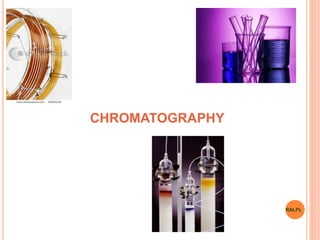
CHROMATOGRAPHY
RALPL
CHROMATOGRAPHY
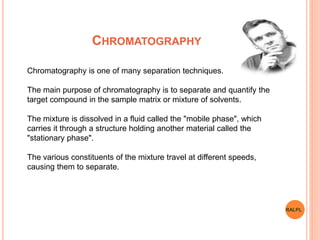
Chromatography is one of many separation techniques.
The main purpose of chromatography is to separate and quantify the
target compound in the sample matrix or mixture of solvents.
The mixture is dissolved in a fluid called the "mobile phase", which
carries it through a structure holding another material called the
"stationary phase".
The various constituents of the mixture travel at different speeds,
causing them to separate.
RALPL
LIST OF CHROMATOGRAPHY
Gas Solid/Liquid Chromatography
Gas chromatography (GC)
Gas Liquid chromatography (GLC)
Liquid chromatography
High performance liquid chromatography (HPLC)
Thin layer chromatography (TLC)
High performance thin layer chromatography (HPTLC)
Ion exchange chromatography
Size exclusion chromatography
Chiral chromatography
EC (Eletrophoresis)
Super-critical Fluid Chromatography
Affinity chromatography
RALPL
GAS SOLID/LIQUID CHROMATOGRAPHY
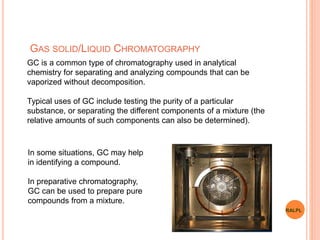
GC is a common type of chromatography used in analytical
chemistry for separating and analyzing compounds that can be
vaporized without decomposition.
Typical uses of GC include testing the purity of a particular
substance, or separating the different components of a mixture (the
relative amounts of such components can also be determined).
In some situations, GC may help
in identifying a compound.
In preparative chromatography,
GC can be used to prepare pure
compounds from a mixture.
RALPL
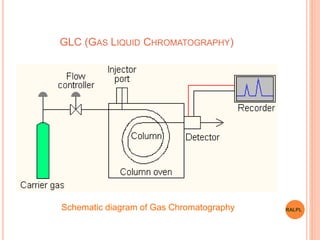
GLC (GAS LIQUID CHROMATOGRAPHY)
Schematic diagram of Gas Chromatography RALPL
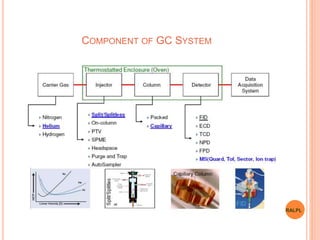
COMPONENT OF GC SYSTEM
RALPL
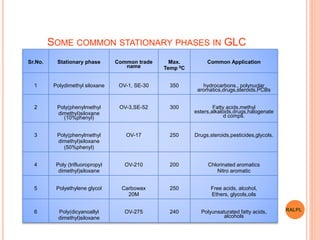
SOME COMMON STATIONARY PHASES IN GLC
Sr.No. Stationary phase Common trade
name
Max.
Temp 0C
Common Application
1 Polydimethyl siloxane OV-1, SE-30 350 hydrocarbons., polynuclar
aromatics,drugs,steroids,PCBs
2 Poly(phenylmethyl
dimethyl)siloxane
(10%phenyl)
OV-3,SE-52 300 Fatty acids,methyl
esters,alkaloids,drugs,halogenate
d comps.
3 Poly(phenylmethyl
dimethyl)siloxane
(50%phenyl)
OV-17 250 Drugs,steroids,pesticides,glycols.
4 Poly (trifluoropropyl
dimethyl)siloxane
OV-210 200 Chlorinated aromatics
Nitro aromatic
5 Polyethylene glycol Carbowax
20M
250 Free acids, alcohol,
Ethers, glycols,oils
6 Poly(dicyanoallyl
dimethyl)siloxane
OV-275 240 Polyunsaturated fatty acids,
alcohols
RALPL
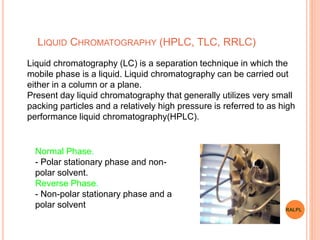
LIQUID CHROMATOGRAPHY (HPLC, TLC, RRLC)
Liquid chromatography (LC) is a separation technique in which the
mobile phase is a liquid. Liquid chromatography can be carried out
either in a column or a plane.
Present day liquid chromatography that generally utilizes very small
packing particles and a relatively high pressure is referred to as high
performance liquid chromatography(HPLC).
Normal Phase.
- Polar stationary phase and non-
polar solvent.
Reverse Phase.
- Non-polar stationary phase and a
polar solvent RALPL
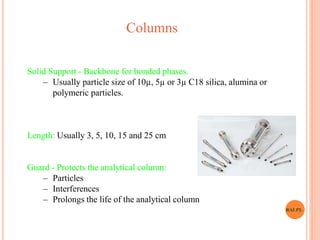
Solid Support - Backbone for bonded phases.
– Usually particle size of 10µ, 5µ or 3µ C18 silica, alumina or
polymeric particles.
Length: Usually 3, 5, 10, 15 and 25 cm
Guard - Protects the analytical column:
– Particles
– Interferences
– Prolongs the life of the analytical column
Columns
RALPL
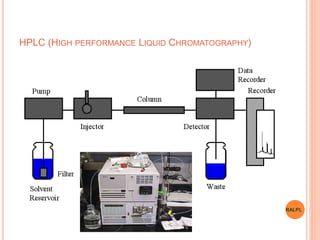
HPLC (HIGH PERFORMANCE LIQUID CHROMATOGRAPHY)
RALPL
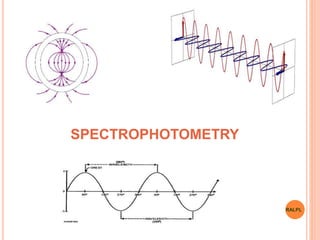
SPECTROPHOTOMETRY
RALPL
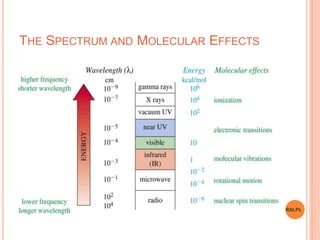
THE SPECTRUM AND MOLECULAR EFFECTS
RALPL
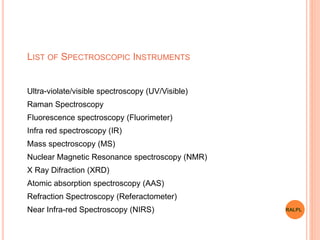
LIST OF SPECTROSCOPIC INSTRUMENTS
Ultra-violate/visible spectroscopy (UV/Visible)
Raman Spectroscopy
Fluorescence spectroscopy (Fluorimeter)
Infra red spectroscopy (IR)
Mass spectroscopy (MS)
Nuclear Magnetic Resonance spectroscopy (NMR)
X Ray Difraction (XRD)
Atomic absorption spectroscopy (AAS)
Refraction Spectroscopy (Referactometer)
Near Infra-red Spectroscopy (NIRS) RALPL
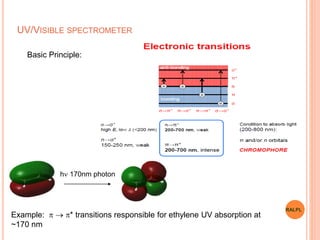
UV/VISIBLE SPECTROMETER
Basic Principle:
Example:   * transitions responsible for ethylene UV absorption at
~170 nm
h 170nm photon
RALPL
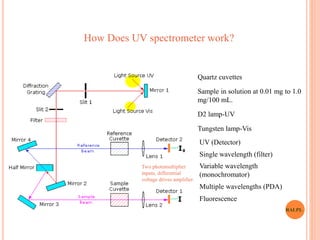
Quartz cuvettes
Sample in solution at 0.01 mg to 1.0
mg/100 mL.
D2 lamp-UV
Tungsten lamp-Vis
How Does UV spectrometer work?
Two photomultiplier
inputs, differential
voltage drives amplifier.
UV (Detector)
Single wavelength (filter)
Variable wavelength
(monochromator)
Multiple wavelengths (PDA)
Fluorescence
RALPL
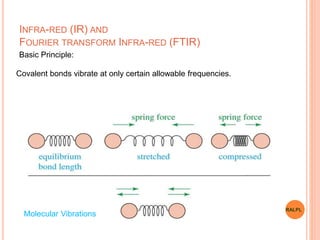
INFRA-RED (IR) AND
FOURIER TRANSFORM INFRA-RED (FTIR)
Covalent bonds vibrate at only certain allowable frequencies.
Molecular Vibrations
Basic Principle:
RALPL
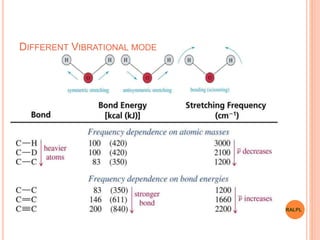
DIFFERENT VIBRATIONAL MODE
=>
RALPL
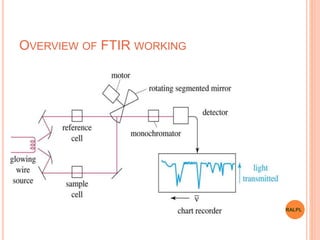
OVERVIEW OF FTIR WORKING
RALPL
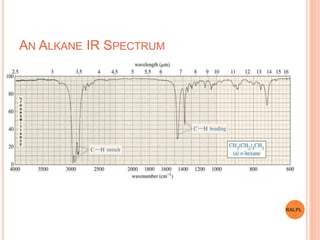
AN ALKANE IR SPECTRUM
RALPL
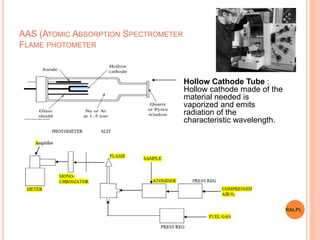
AAS (ATOMIC ABSORPTION SPECTROMETER
FLAME PHOTOMETER
Hollow Cathode Tube :
Hollow cathode made of the
material needed is
vaporized and emits
radiation of the
characteristic wavelength.
w
RALPL
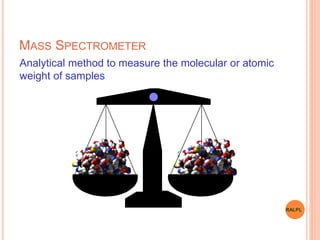
MASS SPECTROMETER
Analytical method to measure the molecular or atomic
weight of samples
RALPL
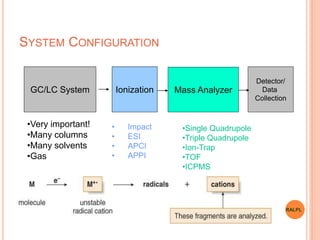
SYSTEM CONFIGURATION
GC/LC System Ionization Mass Analyzer
Detector/
Data
Collection
•Very important!
•Many columns
•Many solvents
•Gas
• Impact
• ESI
• APCI
• APPI
•Single Quadrupole
•Triple Quadrupole
•Ion-Trap
•TOF
•ICPMS
RALPL
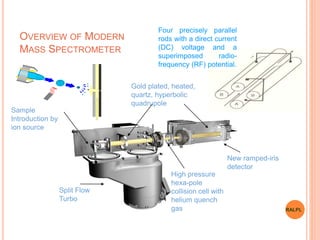
OVERVIEW OF MODERN
MASS SPECTROMETER
Sample
Introduction by
ion source
Gold plated, heated,
quartz, hyperbolic
quadrupole
New ramped-iris
detector
High pressure
hexa-pole
collision cell with
helium quench
gas
Split Flow
Turbo
Four precisely parallel
rods with a direct current
(DC) voltage and a
superimposed radio-
frequency (RF) potential.
+
+
+
++
+
+
+
+
+
+
+
+
+
+
+
+ + +
+
+
+
+
+
+
+
+
+ +
+ + + +
+
+
+
+
+
+
++
+
+
+
+
+
+
+
RALPL
ICP-MS (INDUCTIVELY COUPLED PLASMA-MASS SPECTROMETRY)
FOR TRACE METALS ANALYSIS
Low flow
sample
introduction
system
HMI gas inlet
(7700x)
High
temperature
27 MHz plasma
Cell gas
inlet
Off-axis
lens Octopole
Frequency-matching
RF generator
High-performance
vacuum system
Fast simultaneous
dual mode
detector (9 orders
dynamic range)
3rd generation Octopole
Reaction System (ORS3)
High-frequency
hyperbolic
quadrupole
RALPL
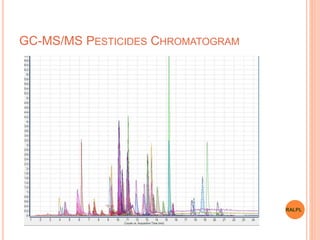
GC-MS/MS PESTICIDES CHROMATOGRAM
RALPL
Applications of Analytical Instruments
• Food Industries : Pesticides residues, fatty acids , cholesterol, etc.
• Pharmaceutical industries : pharmaceutical ingredients, API, Formulation etc.
• Analytical laboratories: Pesticides Residues, Titration, Micro organism, etc.
• Cosmetic Industries : Fragrances, cosmetics, etc.
• Research and Development : To identify new molecule, validation, etc.
• Water, Beverages, Soft Drink, Liquor Industries: Metal traces, Toxins, etc.
• Petroleum Industries : Solvents purity, other impurities, etc.
• Coal, ore and Mine : Metal traces, erosion control, etc.
• Steel industries : Metal traces, etc.
• Environment and Safety : Pollution of toxic gases, pesticides contamination, etc.
• Clinical Research Organization (CRO) : Phramacokinetic and phrmacodynamic studies
• Biotechnology : DNA Sequence, etc.
• Plastic, Rubber, Lubricants and Paints Industries : Heavy metal traces, Toxic substance, etc.
RALPL
BENEFITS/SCOPE
Work in any industry, National research laboratory (NRL), other
Laboratory, CRO or R&D center.
Apply for R & D Chemist, Quality control chemist, laboratory
chemist or research fellow in any field like API, Chemical,
Pharmaceutical, Steel, Food, Rubber, Petroleum, Plastic, Liquor
or Beverage Industries.
Helpful to do project in PhD and Master Degree.
Also Helpful in purification and synthesis of active compounds by
column chromatography.
RALPL
ANY QUESTIONS ?
RALPL
THANK YOU !
RALPL

ANALYTICAL.ppt

  • 1.
  • 2.
    INDEX  What doyou mean by Analytical Instruments?  Types of Analytical Instruments.  Applications  Scope/Banefits RALPL
  • 3.
    WHAT DO YOUMEAN BY ANALYTICAL INSTRUMENTS ? Machines used to measure and analyse the structure or properties of chemicals, biological systems, or materials. They often work by measuring the way in which the sample interacts with radiations: X-rays (X ray Diffraction spectrometer), Infra-red (FTIR) , Ultra-violet (UV/Visible spectrometer), or some kind of electronic or chemical energy. Software can be vital in interpreting results and chromatogram. RALPL
  • 4.
    TYPES OF MODERNANALYTICAL INSTRUMENTS. Based on basic principle of analysis Instruments can be classified into two parts 1. Chromatography 2. Spectroscopy RALPL
  • 5.
  • 6.
    CHROMATOGRAPHY Chromatography is oneof many separation techniques. The main purpose of chromatography is to separate and quantify the target compound in the sample matrix or mixture of solvents. The mixture is dissolved in a fluid called the "mobile phase", which carries it through a structure holding another material called the "stationary phase". The various constituents of the mixture travel at different speeds, causing them to separate. RALPL
  • 7.
    LIST OF CHROMATOGRAPHY GasSolid/Liquid Chromatography Gas chromatography (GC) Gas Liquid chromatography (GLC) Liquid chromatography High performance liquid chromatography (HPLC) Thin layer chromatography (TLC) High performance thin layer chromatography (HPTLC) Ion exchange chromatography Size exclusion chromatography Chiral chromatography EC (Eletrophoresis) Super-critical Fluid Chromatography Affinity chromatography RALPL
  • 8.
    GAS SOLID/LIQUID CHROMATOGRAPHY GCis a common type of chromatography used in analytical chemistry for separating and analyzing compounds that can be vaporized without decomposition. Typical uses of GC include testing the purity of a particular substance, or separating the different components of a mixture (the relative amounts of such components can also be determined). In some situations, GC may help in identifying a compound. In preparative chromatography, GC can be used to prepare pure compounds from a mixture. RALPL
  • 9.
    GLC (GAS LIQUIDCHROMATOGRAPHY) Schematic diagram of Gas Chromatography RALPL
  • 10.
    COMPONENT OF GCSYSTEM RALPL
  • 11.
    SOME COMMON STATIONARYPHASES IN GLC Sr.No. Stationary phase Common trade name Max. Temp 0C Common Application 1 Polydimethyl siloxane OV-1, SE-30 350 hydrocarbons., polynuclar aromatics,drugs,steroids,PCBs 2 Poly(phenylmethyl dimethyl)siloxane (10%phenyl) OV-3,SE-52 300 Fatty acids,methyl esters,alkaloids,drugs,halogenate d comps. 3 Poly(phenylmethyl dimethyl)siloxane (50%phenyl) OV-17 250 Drugs,steroids,pesticides,glycols. 4 Poly (trifluoropropyl dimethyl)siloxane OV-210 200 Chlorinated aromatics Nitro aromatic 5 Polyethylene glycol Carbowax 20M 250 Free acids, alcohol, Ethers, glycols,oils 6 Poly(dicyanoallyl dimethyl)siloxane OV-275 240 Polyunsaturated fatty acids, alcohols RALPL
  • 12.
    LIQUID CHROMATOGRAPHY (HPLC,TLC, RRLC) Liquid chromatography (LC) is a separation technique in which the mobile phase is a liquid. Liquid chromatography can be carried out either in a column or a plane. Present day liquid chromatography that generally utilizes very small packing particles and a relatively high pressure is referred to as high performance liquid chromatography(HPLC). Normal Phase. - Polar stationary phase and non- polar solvent. Reverse Phase. - Non-polar stationary phase and a polar solvent RALPL
  • 13.
    Solid Support -Backbone for bonded phases. – Usually particle size of 10µ, 5µ or 3µ C18 silica, alumina or polymeric particles. Length: Usually 3, 5, 10, 15 and 25 cm Guard - Protects the analytical column: – Particles – Interferences – Prolongs the life of the analytical column Columns RALPL
  • 14.
    HPLC (HIGH PERFORMANCELIQUID CHROMATOGRAPHY) RALPL
  • 15.
  • 16.
    THE SPECTRUM ANDMOLECULAR EFFECTS RALPL
  • 17.
    LIST OF SPECTROSCOPICINSTRUMENTS Ultra-violate/visible spectroscopy (UV/Visible) Raman Spectroscopy Fluorescence spectroscopy (Fluorimeter) Infra red spectroscopy (IR) Mass spectroscopy (MS) Nuclear Magnetic Resonance spectroscopy (NMR) X Ray Difraction (XRD) Atomic absorption spectroscopy (AAS) Refraction Spectroscopy (Referactometer) Near Infra-red Spectroscopy (NIRS) RALPL
  • 18.
    UV/VISIBLE SPECTROMETER Basic Principle: Example:  * transitions responsible for ethylene UV absorption at ~170 nm h 170nm photon RALPL
  • 19.
    Quartz cuvettes Sample insolution at 0.01 mg to 1.0 mg/100 mL. D2 lamp-UV Tungsten lamp-Vis How Does UV spectrometer work? Two photomultiplier inputs, differential voltage drives amplifier. UV (Detector) Single wavelength (filter) Variable wavelength (monochromator) Multiple wavelengths (PDA) Fluorescence RALPL
  • 20.
    INFRA-RED (IR) AND FOURIERTRANSFORM INFRA-RED (FTIR) Covalent bonds vibrate at only certain allowable frequencies. Molecular Vibrations Basic Principle: RALPL
  • 21.
  • 22.
    OVERVIEW OF FTIRWORKING RALPL
  • 23.
    AN ALKANE IRSPECTRUM RALPL
  • 24.
    AAS (ATOMIC ABSORPTIONSPECTROMETER FLAME PHOTOMETER Hollow Cathode Tube : Hollow cathode made of the material needed is vaporized and emits radiation of the characteristic wavelength. w RALPL
  • 25.
    MASS SPECTROMETER Analytical methodto measure the molecular or atomic weight of samples RALPL
  • 26.
    SYSTEM CONFIGURATION GC/LC SystemIonization Mass Analyzer Detector/ Data Collection •Very important! •Many columns •Many solvents •Gas • Impact • ESI • APCI • APPI •Single Quadrupole •Triple Quadrupole •Ion-Trap •TOF •ICPMS RALPL
  • 27.
    OVERVIEW OF MODERN MASSSPECTROMETER Sample Introduction by ion source Gold plated, heated, quartz, hyperbolic quadrupole New ramped-iris detector High pressure hexa-pole collision cell with helium quench gas Split Flow Turbo Four precisely parallel rods with a direct current (DC) voltage and a superimposed radio- frequency (RF) potential. + + + ++ + + + + + + + + + + + + + + + + + + + + + + + + + + + + + + + + + + ++ + + + + + + + RALPL
  • 28.
    ICP-MS (INDUCTIVELY COUPLEDPLASMA-MASS SPECTROMETRY) FOR TRACE METALS ANALYSIS Low flow sample introduction system HMI gas inlet (7700x) High temperature 27 MHz plasma Cell gas inlet Off-axis lens Octopole Frequency-matching RF generator High-performance vacuum system Fast simultaneous dual mode detector (9 orders dynamic range) 3rd generation Octopole Reaction System (ORS3) High-frequency hyperbolic quadrupole RALPL
  • 29.
  • 30.
    Applications of AnalyticalInstruments • Food Industries : Pesticides residues, fatty acids , cholesterol, etc. • Pharmaceutical industries : pharmaceutical ingredients, API, Formulation etc. • Analytical laboratories: Pesticides Residues, Titration, Micro organism, etc. • Cosmetic Industries : Fragrances, cosmetics, etc. • Research and Development : To identify new molecule, validation, etc. • Water, Beverages, Soft Drink, Liquor Industries: Metal traces, Toxins, etc. • Petroleum Industries : Solvents purity, other impurities, etc. • Coal, ore and Mine : Metal traces, erosion control, etc. • Steel industries : Metal traces, etc. • Environment and Safety : Pollution of toxic gases, pesticides contamination, etc. • Clinical Research Organization (CRO) : Phramacokinetic and phrmacodynamic studies • Biotechnology : DNA Sequence, etc. • Plastic, Rubber, Lubricants and Paints Industries : Heavy metal traces, Toxic substance, etc. RALPL
  • 31.
    BENEFITS/SCOPE Work in anyindustry, National research laboratory (NRL), other Laboratory, CRO or R&D center. Apply for R & D Chemist, Quality control chemist, laboratory chemist or research fellow in any field like API, Chemical, Pharmaceutical, Steel, Food, Rubber, Petroleum, Plastic, Liquor or Beverage Industries. Helpful to do project in PhD and Master Degree. Also Helpful in purification and synthesis of active compounds by column chromatography. RALPL
  • 32.
  • 33.