Hook Question
• Haveyou ever had a misunderstanding
because you didn't really listen?
• Let students briefly share their experiences.
3.
What is Listening?
•Listening is more than hearing. It's the active
process of receiving, constructing meaning,
and responding to spoken messages.
4.
Types of Listening
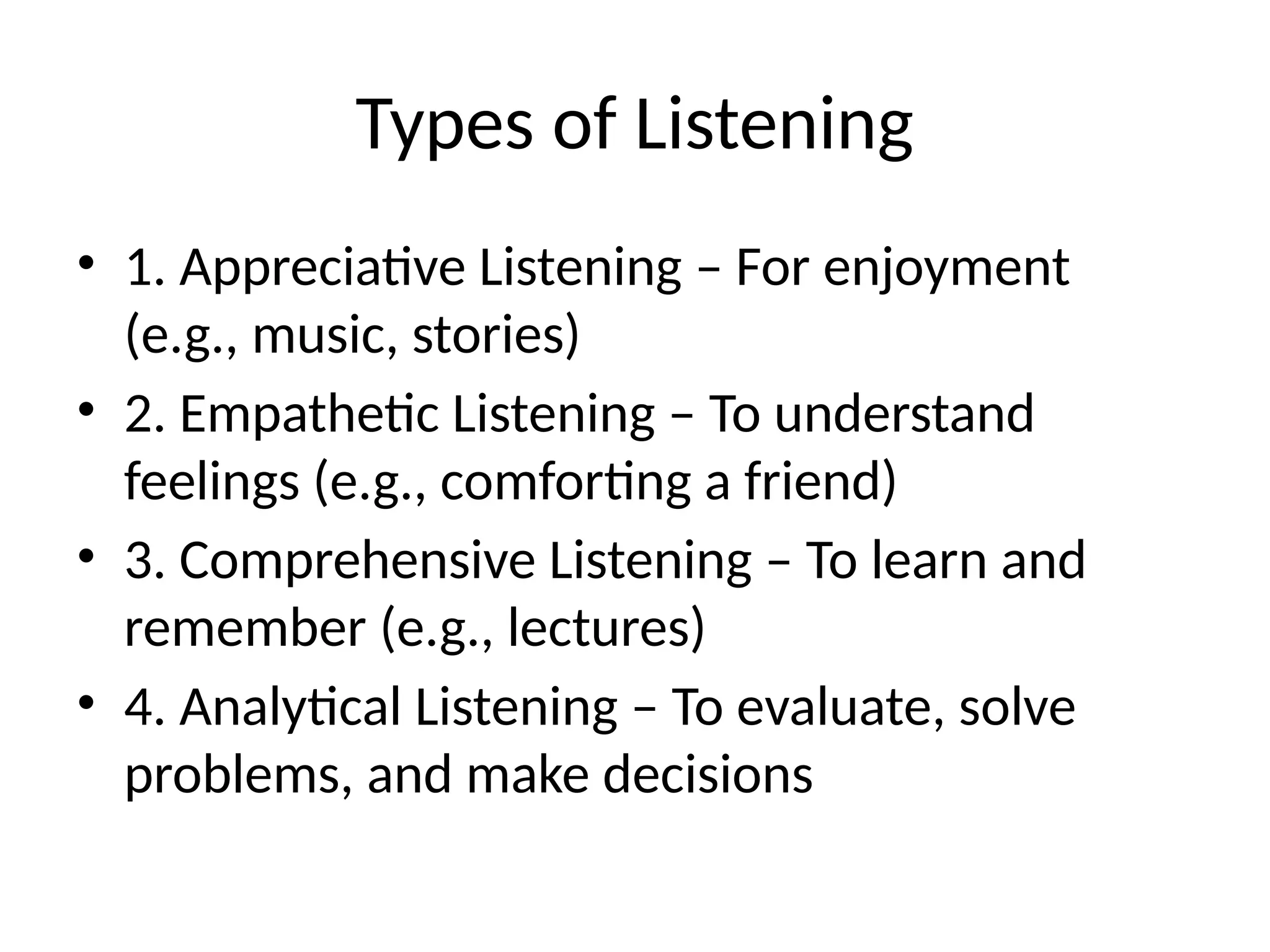
•1. Appreciative Listening – For enjoyment
(e.g., music, stories)
• 2. Empathetic Listening – To understand
feelings (e.g., comforting a friend)
• 3. Comprehensive Listening – To learn and
remember (e.g., lectures)
• 4. Analytical Listening – To evaluate, solve
problems, and make decisions
5.
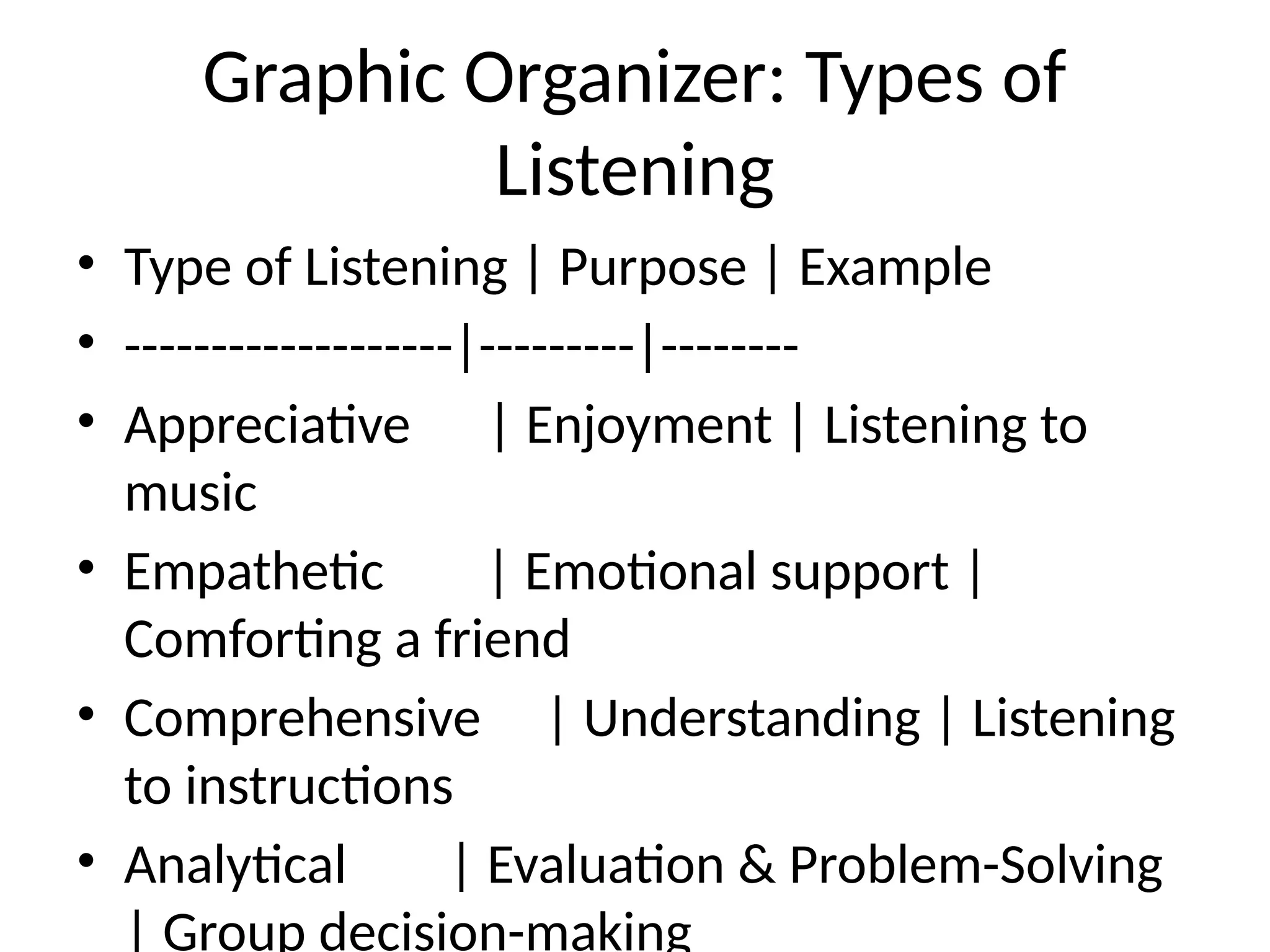
Graphic Organizer: Typesof
Listening
• Type of Listening | Purpose | Example
• -------------------|---------|--------
• Appreciative | Enjoyment | Listening to
music
• Empathetic | Emotional support |
Comforting a friend
• Comprehensive | Understanding | Listening
to instructions
• Analytical | Evaluation & Problem-Solving
| Group decision-making
6.
What is AnalyticalListening?
• - A process of listening carefully to analyze
information
• - Focuses on logic, structure, and clarity
• - Helps in solving problems and making fair
decisions
7.
Why is AnalyticalListening
Important?
• - Helps avoid misunderstandings
• - Strengthens decision-making
• - Encourages collaboration and fairness
8.
Scenario Practice
• Scenario:A group member says, 'I didn’t finish
the task because I was too busy at home.'
• Ask students:
• - What is the speaker’s main point?
• - Is this a fact or an excuse?
• - How can we respond analytically instead of
emotionally?
9.
Analytical Listening inReal Life
• - During group work
• - In family arguments
• - When making tough decisions
• - When resolving conflicts with friends
10.
Activity: Listening RolePlay
• Instructions:
• 1. Pair up.
• 2. One plays the speaker; the other is the
analytical listener.
• 3. Use one of the scenarios provided.
• 4. Switch roles after 5 minutes.
• 5. Reflect: How did analytical listening help?
11.
Reflection Questions
• -How is analytical listening different from just
hearing?
• - What challenges do you face when trying to
listen analytically?
• - How can you improve this skill in your daily
life?
12.
Summary
• - Listeningis a skill, not just a habit.
• - Analytical listening helps us think before we
react.
• - Every conversation is a chance to solve
problems better.
13.
Thank You!
• "Thebiggest communication problem is we do
not listen to understand. We listen to reply."