ANALYTICAL
LISTENING
English 10
Module 5
Analytical Listening
 an ability and a capacity to properly
analyze what is being said
 does not only mean understanding
what the other person is saying and
what they mean to say, but this
also means being able to divide
difficult questions into separate
parts to get to the core.
 its objective is to quickly see logical
connections, as well as detecting
possible gaps in all the information.
LSD Technique
 Listening, Summarizing and
Digging Deeper
 Hear with full concentration
and sink in information;
Summarize info to let the
other feel like they are heard,
offer additions, process what
was heard; Get to the Core
Audio
Productions
 Sounds produced
In Analytical
Listening
 Listener looks for deeper
meaning; beyond the
sound to its underlying
layer
 Not just about the
content, the way
something was said-
intonation, underlying
emotional implications
like in Music
Analytical Capacity
 Useful in many occupation:
leadership roles, technical
occupations, and the
medical world
 a trait that applies to the
analytical listener
 a quality that usually goes
hand in hand with other
abilities one has, such as
empathic capacity,
inquisitiveness, curiosity,
desire to learn, being
critical and open – minded
Pitfalls of Analytical
Listening
 Indecisiveness= Think too
much and hesitate too much
before coming up with a final
judgment
 Conversation partner may
feel attacked or on the spot=
listener asks a lot of
questions
 A lot of “Why” Questions
which will be hard to answer
 Could feel like a negative
confrontation
Analytical Listening
and Problem Solving
 Bring balance to
conversation: Feeling
and Logical Reasoning
 Process information
objectively
 make logical
connections, detect the
actual cause, and think
of fitting solutions
Analytical Listening
and Decision making
 Foundation
 Reconstruct situation
and find rational
solutions
 Lead to Optimal
decisions
 Better Prediction
TYPES
GENERAL
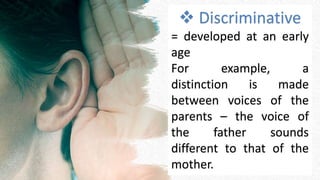
 Discriminative
= developed at an early
age
For example, a
distinction is made
between voices of the
parents – the voice of
the father sounds
different to that of the
mother.
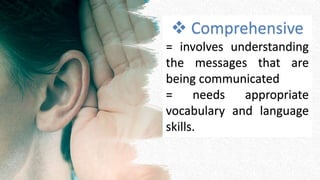
 Comprehensive
= involves understanding
the messages that are
being communicated
= needs appropriate
vocabulary and language
skills.
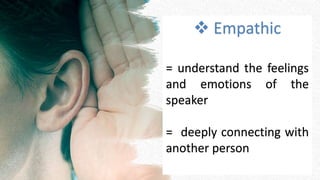
 Empathic
= understand the feelings
and emotions of the
speaker
= deeply connecting with
another person
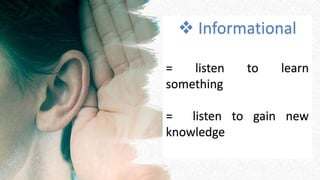
 Informational
= listen to learn
something
= listen to gain new
knowledge
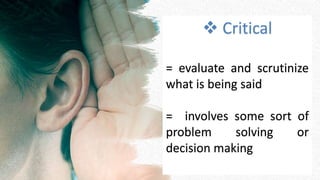
 Critical
= evaluate and scrutinize
what is being said
= involves some sort of
problem solving or
decision making
Listening
is the
beginning
of

Q1 M5 Analytical Listening.pptx

  • 1.
  • 4.
    Analytical Listening  anability and a capacity to properly analyze what is being said  does not only mean understanding what the other person is saying and what they mean to say, but this also means being able to divide difficult questions into separate parts to get to the core.  its objective is to quickly see logical connections, as well as detecting possible gaps in all the information.
  • 5.
    LSD Technique  Listening,Summarizing and Digging Deeper  Hear with full concentration and sink in information; Summarize info to let the other feel like they are heard, offer additions, process what was heard; Get to the Core
  • 6.
    Audio Productions  Sounds produced InAnalytical Listening  Listener looks for deeper meaning; beyond the sound to its underlying layer  Not just about the content, the way something was said- intonation, underlying emotional implications like in Music
  • 7.
    Analytical Capacity  Usefulin many occupation: leadership roles, technical occupations, and the medical world  a trait that applies to the analytical listener  a quality that usually goes hand in hand with other abilities one has, such as empathic capacity, inquisitiveness, curiosity, desire to learn, being critical and open – minded
  • 8.
    Pitfalls of Analytical Listening Indecisiveness= Think too much and hesitate too much before coming up with a final judgment  Conversation partner may feel attacked or on the spot= listener asks a lot of questions  A lot of “Why” Questions which will be hard to answer  Could feel like a negative confrontation
  • 9.
    Analytical Listening and ProblemSolving  Bring balance to conversation: Feeling and Logical Reasoning  Process information objectively  make logical connections, detect the actual cause, and think of fitting solutions Analytical Listening and Decision making  Foundation  Reconstruct situation and find rational solutions  Lead to Optimal decisions  Better Prediction
  • 10.
  • 11.
     Discriminative = developedat an early age For example, a distinction is made between voices of the parents – the voice of the father sounds different to that of the mother.
  • 12.
     Comprehensive = involvesunderstanding the messages that are being communicated = needs appropriate vocabulary and language skills.
  • 13.
     Empathic = understandthe feelings and emotions of the speaker = deeply connecting with another person
  • 14.
     Informational = listento learn something = listen to gain new knowledge
  • 15.
     Critical = evaluateand scrutinize what is being said = involves some sort of problem solving or decision making
  • 16.

Editor's Notes

  • #8 means looking at differences, possible risks, and the things that make no sense
  • #10  Analyses of causes can be made, after which the consequences of a problem and applying models to them. By distinguishing main problems from partial problems, the analytic listener can collect a lot of information, and then research it. After collecting all the data, the analytical listener will be highly able to make logical connections, detect the actual cause, and think of fitting solutions.
  • #12 It is developed from childhood to adulthood. As we grow older and develop our life experiences, our ability to distinguish between different sounds is improved. Not only we can recognize different voices, but we also develop the ability to recognize subtle differences in the way that sounds are made – this is fundamental to ultimately understand what these sounds mean. Differences include many subtleties, recognizing foreign languages, distinguishing between regional accents and clues to the emotions and feelings of the speaker.
  • #13 Using overly complicated language or technical jargon can be a barrier to comprehensive listening. It is further complicated by the fact that two different people listening to the same thing may understand the message in two different ways. This problem can be multiplied in a group setting, like a classroom or business meeting where numerous different meanings can be derived from what has been said.
  • #14 Using overly complicated language or technical jargon can be a barrier to comprehensive listening. It is further complicated by the fact that two different people listening to the same thing may understand the message in two different ways. This problem can be multiplied in a group setting, like a classroom or business meeting where numerous different meanings can be derived from what has been said.
  • #15 Using overly complicated language or technical jargon can be a barrier to comprehensive listening. It is further complicated by the fact that two different people listening to the same thing may understand the message in two different ways. This problem can be multiplied in a group setting, like a classroom or business meeting where numerous different meanings can be derived from what has been said.
  • #16 Using overly complicated language or technical jargon can be a barrier to comprehensive listening. It is further complicated by the fact that two different people listening to the same thing may understand the message in two different ways. This problem can be multiplied in a group setting, like a classroom or business meeting where numerous different meanings can be derived from what has been said.
  • #17 Using overly complicated language or technical jargon can be a barrier to comprehensive listening. It is further complicated by the fact that two different people listening to the same thing may understand the message in two different ways. This problem can be multiplied in a group setting, like a classroom or business meeting where numerous different meanings can be derived from what has been said.