Presented at 2017 World Congress of Psychiatric Genetics by:
Dr. Yin Yao , National Institute of Mental Health, USA
Dr. Hongbao Cao, Elsevier, USA
Analysis of Functional Magnetic Resonance
Imaging (fMRI) data from human brain in Pathway
Studio
Background and purpose
 Schizophrenia (SCZ) is one of the most chronically
disabling psychiatric illnesses with a global median lifetime
morbid risk of 7.2/1000 persons. Both genetic and brain region
pathways were identified as causal regulating tunnels towards
the pathogenesis of SCZ.
 Integrate Functional Magnetic Resonance Imaging (fMRI)
data set and Brain-Gene ResNet (BGR) data could reveal the
functional pathways through which genes regulate the brain
functions associated with SCZ phenotypes.
fMRI data
 functional Magnetic Resonance Imaging (fMRI) data set
 Data were collected with 1.5 T GE MRI scanner;
 Participants were from Kunming, China;
 All 32 patients were treatment resistant;
 All 31 healthy siblings had no schizophrenia history or related symptoms.
 Imaging Data Preprocessing
 SPM8 and REST [1] toolbox: realigned, re-sliced, normalized, band-pass filtered
(0.01~0.08 Hz) and smoothed (3-D Gaussian kernel with 6mm FWHM).
 Whole brain mask was acquired using WFU_PickAtlas toolbox, containing the 116 AAL
brain regions [2].
Brain-Gene Resnet (BGR) data in Pathway Studio
 Pathway Studio ResNet ® Mammalian database
http://pathwaystudio.gousinfo.com/ResNetDatabase.html
 Real-time updated network databases, including curated signaling,
cellular processes and metabolic pathways, ontologies and
annotations, molecular interactions and functional relationships.
 Have been widely used to study modeled relationships between
proteins, genes, complexes, cells, tissues and diseases
http://pathwaystudio.gousinfo.com/Mendeley.html
 The largest literature based network database among known
competitors in the field [3].
Analysis of fMRI data
 Automated Anatomical Labeling (AAL) based whole
brain connectivity analysis to discover inter-/intra-
brain region dysconnectivity in case of SCZ
Integrate with SCZ ResNet data
 SCZ-gene and SCZ-brain region ResNet relation data
analysis for the nominated SCZ brain regions to
identify potential Genetic-Brain Pathways
Data analysis
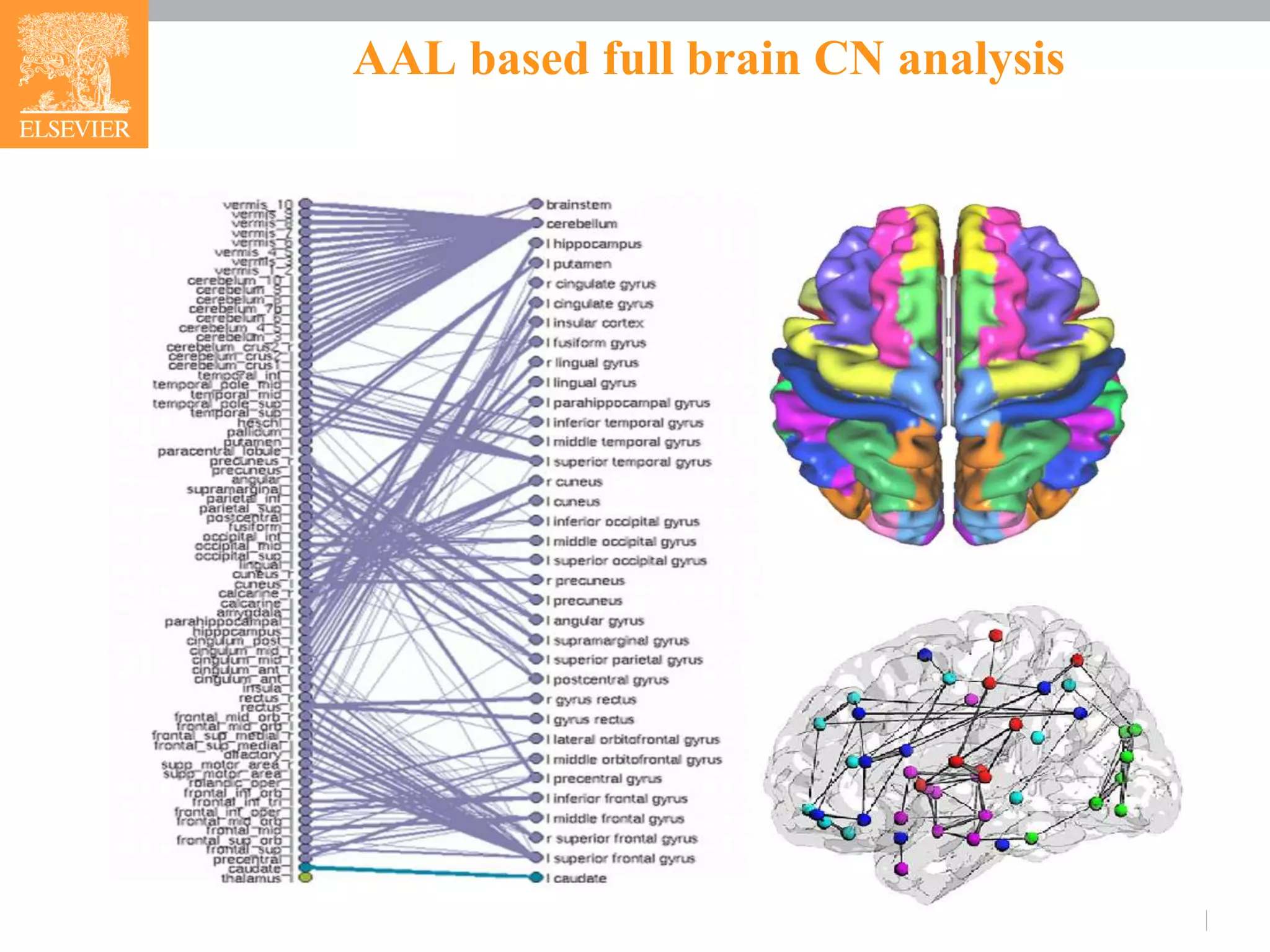
AAL based full brain CN analysis
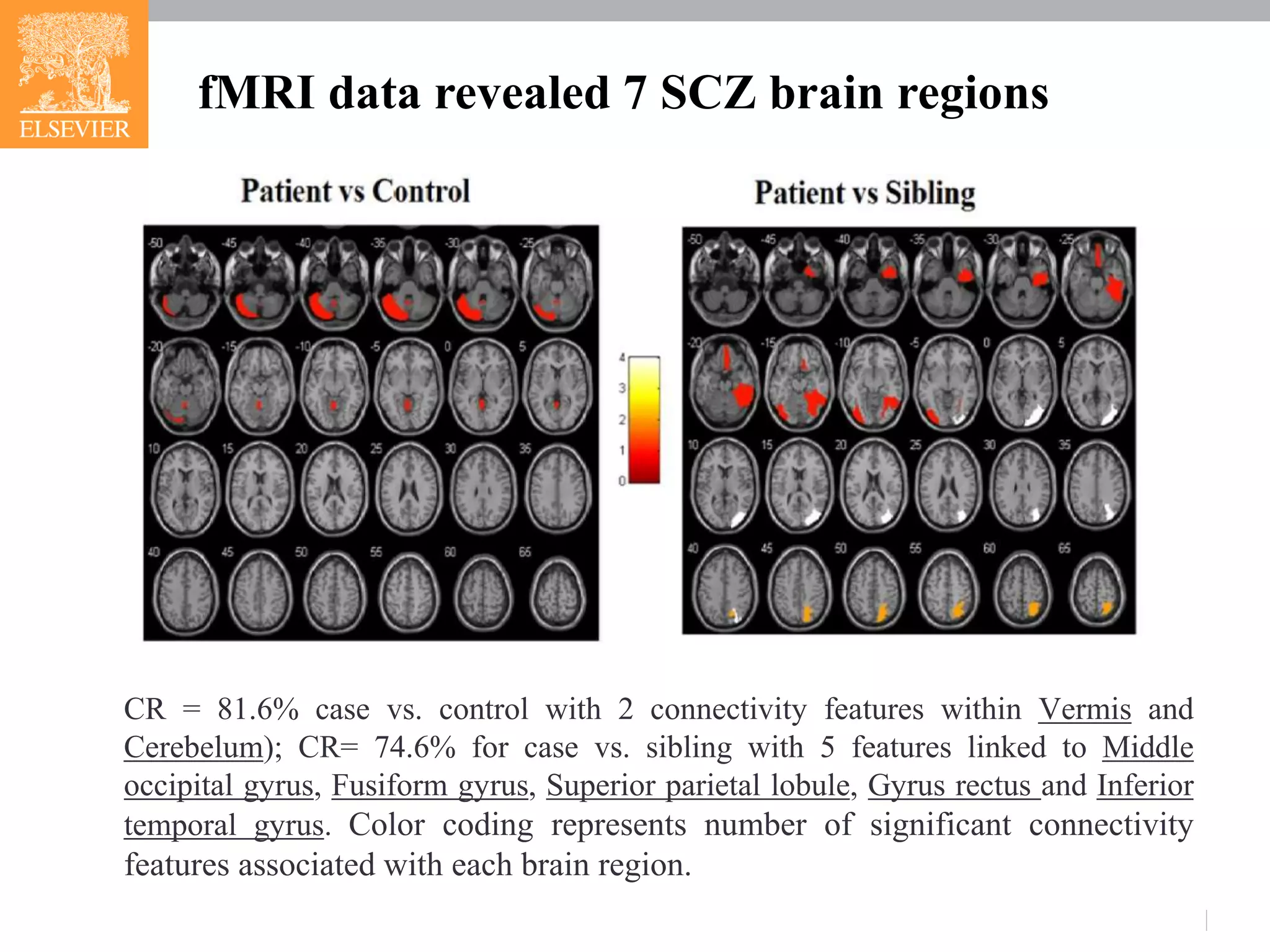
CR = 81.6% case vs. control with 2 connectivity features within Vermis and
Cerebelum); CR= 74.6% for case vs. sibling with 5 features linked to Middle
occipital gyrus, Fusiform gyrus, Superior parietal lobule, Gyrus rectus and Inferior
temporal gyrus. Color coding represents number of significant connectivity
features associated with each brain region.
fMRI data revealed 7 SCZ brain regions
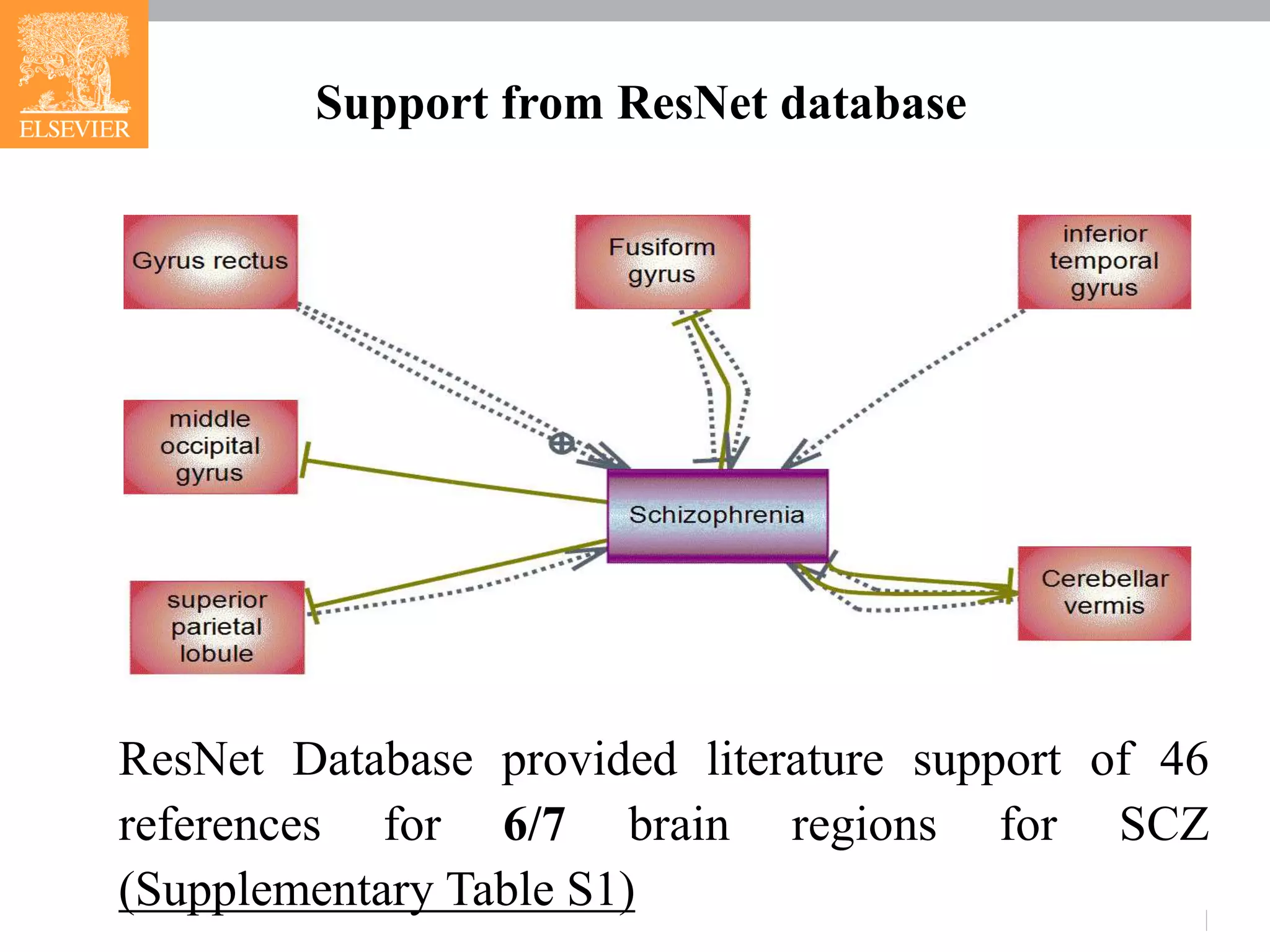
Support from ResNet database
ResNet Database provided literature support of 46
references for 6/7 brain regions for SCZ
(Supplementary Table S1)
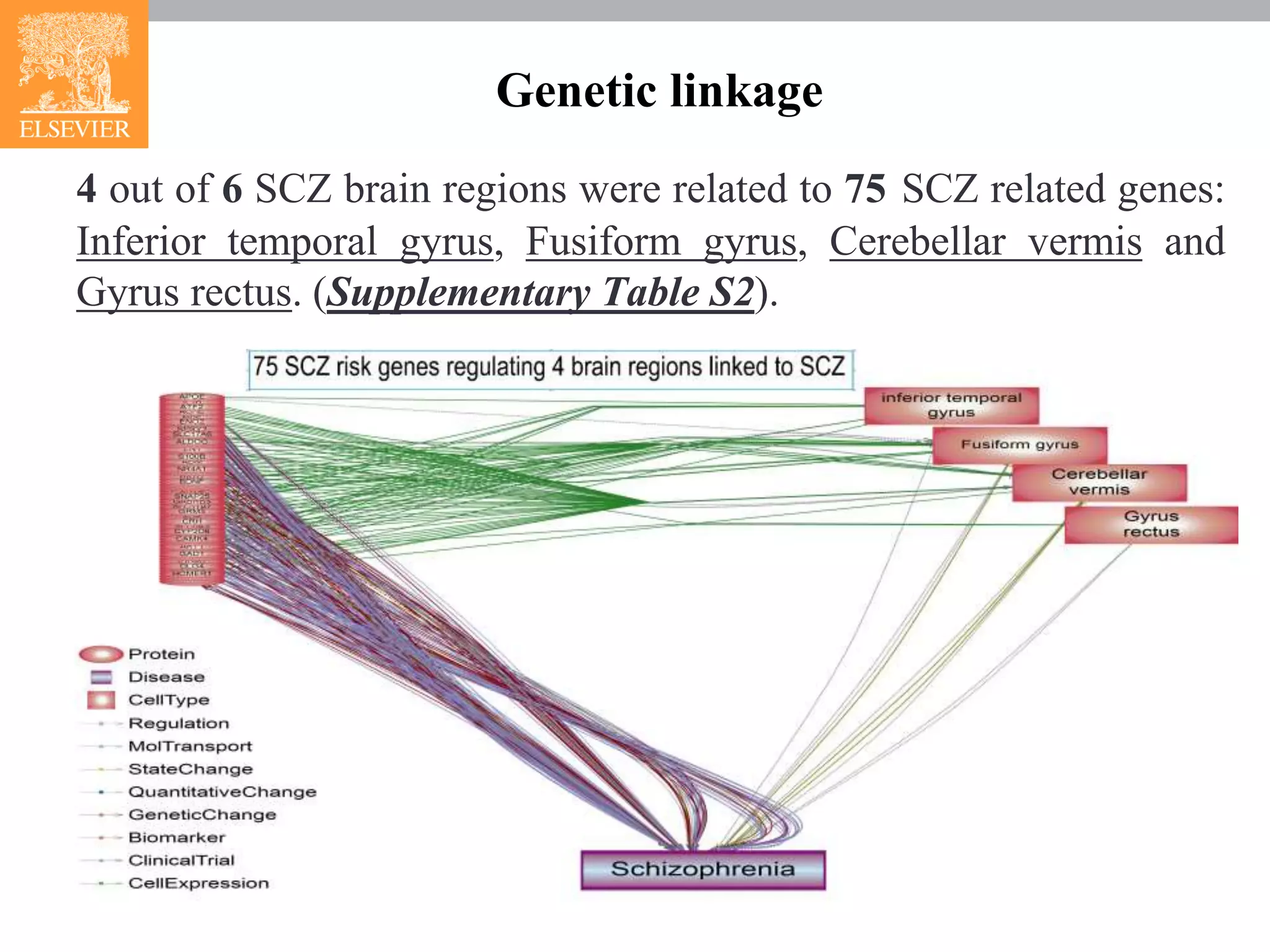
4 out of 6 SCZ brain regions were related to 75 SCZ related genes:
Inferior temporal gyrus, Fusiform gyrus, Cerebellar vermis and
Gyrus rectus. (Supplementary Table S2).
Genetic linkage
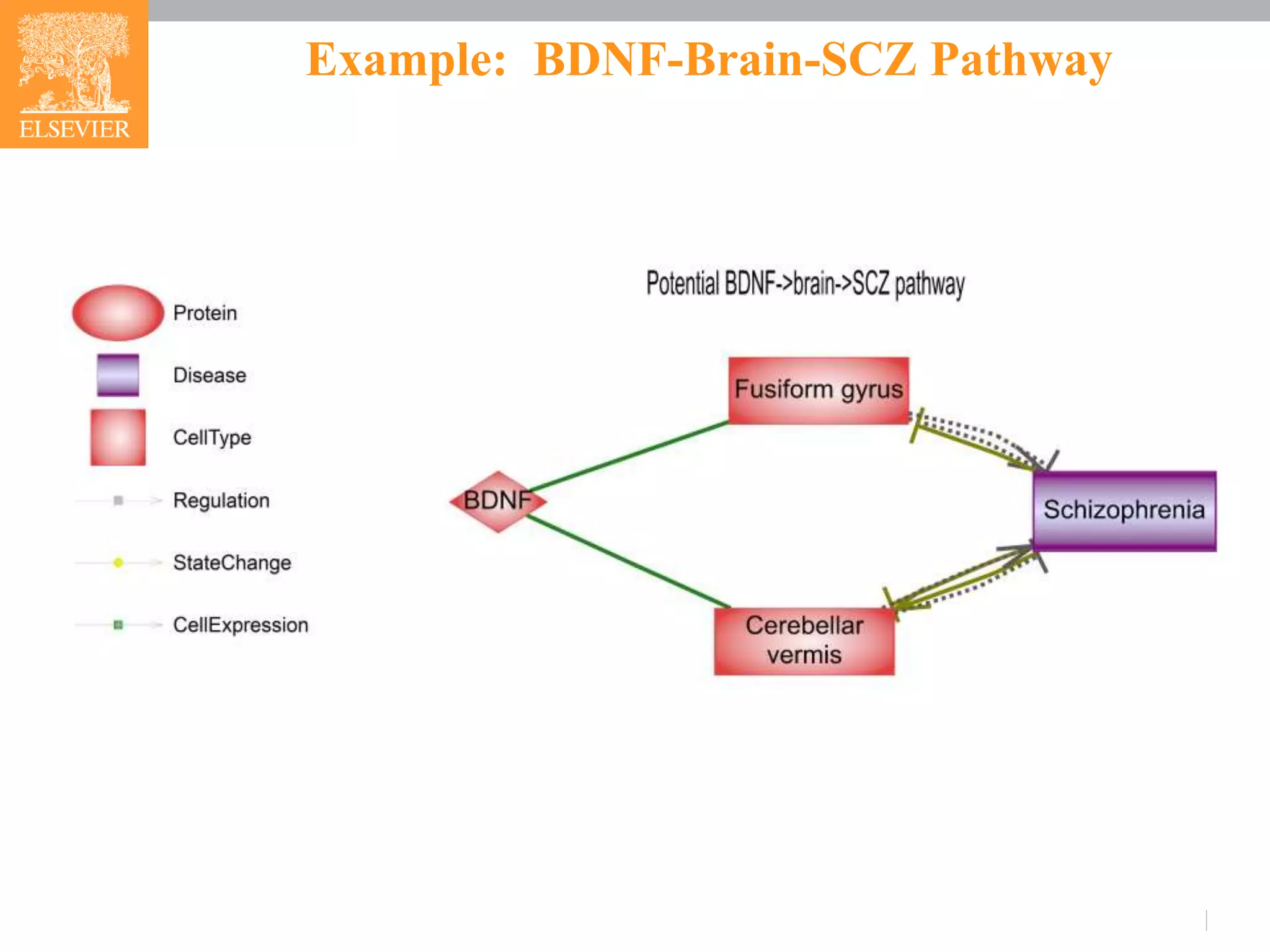
Example: BDNF-Brain-SCZ Pathway
 --Continued
Example: BDNF-Brain-SCZ Pathway
BDNF->Fusiform gyrus-> SCZ
 Distortion of the balance among the 3 BDNF isoforms (pro-BDNF,
truncated BDNF and mature BDNF) could lead to changes in
connectivity and synaptic plasticity and, hence, behavior of
Fusiform gyrus [4].
 Deficits in the fusiform gyrus is suggested as a trait pathology in
SCZ patients [5,6].
BDNF-> Cerebellar vermis-> SCZ
 Decreased cerebellar BDNF mRNA and protein level could lead to
motoric impairment and Purkinje cell loss that damage cerebellar
vermis [7].
 Cerebellar vermis is nominated a potential therapeutic target for the
treatment of SCZ [8, 9].
Three novel genes for SCZ
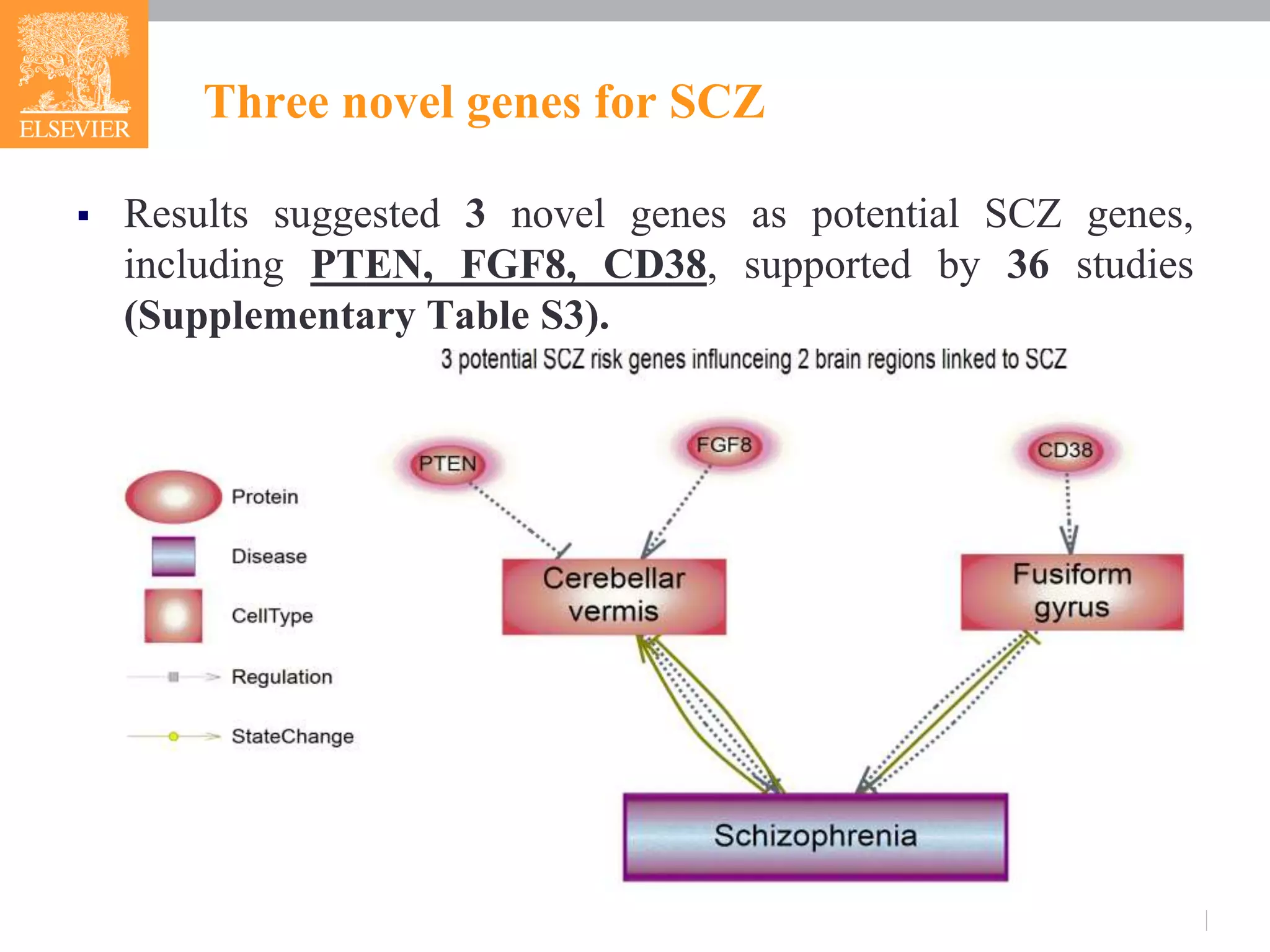
 Results suggested 3 novel genes as potential SCZ genes,
including PTEN, FGF8, CD38, supported by 36 studies
(Supplementary Table S3).
Three novel genes for SCZ
CD38->Fusiform gyrus->SCZ
CD38 genotype is a genetic factor influencing the function of
Fusiform gyrus[10].
PTEN->Cerebellar vermis->SCZ
Deficiency of PTEN could lead to the loss of neurons and tau
hyperphosphorylation in cerebellar vermis [11].
FGF8 ->Cerebellar vermis->SCZ
Mutations in the FGF8 signaling pathway preferentially affect
the growth of the cerebellar vermis [12].
Conclusion
Neuroimaging study alone could gain direct knowledge between
brain regions and the mental health disorders like SCZ
Integrating fMRI data and ResNet data could:
 Generate support for the results from other studies;
 Provide further insights for the understanding of the genetic
mechanism for SCZ;
 Identify novel genes the potentially link to SCZ.
.
Future work
 Brain region pathway based fMRI studies (e.g.,
dopaminergic pathways of schizophrenia)
 Genetic pathway – separate brain region
integration
 Genetic pathway – brain region pathway
integration
References
 [1] Song, X., et al. PLoS.One. 2011; 6(9): 1-12.
 [2] Tzourio-Mazoyer N, et al., Neuroimage. 2002; 15(1):273-89.
 [3] Lorenzi PI et al. Autophagy. 2014; 10(7):1316-26.
 [4] Kim DW, et al. Schizophr Res. 2013;151(1-3):165-74.
 [5] Walther S, et al. Psychiatry Res. 2009;172(3):184-91.
 [6]Choudhary M, et al. Schizophr Res. 2015 ;162(1-3):103-7.
 [7] Firozan B, et al. Eur J Pharmacol. 2014;732:1-11.
 [8] Villanueva R. Psychiatry Res. 2012;198(3):527-32.
 [9] Garg S, et al. Psychiatry Res. 2016;243:413-20.
 [10] Sauer C, et al. Neuropsychopharmacology. 2012;37(6):1474-82.
 [11] Nayeem N, et al. Mol Cell Neurosci. 2007 Mar;34(3):400-8.
 [12] Wen J, et al. PLoS One. 2013;8(5):e64451.

Analysis of Functional Magnetic Resonance Imaging (fMRI) data from human brain in Pathway Studio

  • 1.
    Presented at 2017World Congress of Psychiatric Genetics by: Dr. Yin Yao , National Institute of Mental Health, USA Dr. Hongbao Cao, Elsevier, USA Analysis of Functional Magnetic Resonance Imaging (fMRI) data from human brain in Pathway Studio
  • 2.
    Background and purpose Schizophrenia (SCZ) is one of the most chronically disabling psychiatric illnesses with a global median lifetime morbid risk of 7.2/1000 persons. Both genetic and brain region pathways were identified as causal regulating tunnels towards the pathogenesis of SCZ.  Integrate Functional Magnetic Resonance Imaging (fMRI) data set and Brain-Gene ResNet (BGR) data could reveal the functional pathways through which genes regulate the brain functions associated with SCZ phenotypes.
  • 3.
    fMRI data  functionalMagnetic Resonance Imaging (fMRI) data set  Data were collected with 1.5 T GE MRI scanner;  Participants were from Kunming, China;  All 32 patients were treatment resistant;  All 31 healthy siblings had no schizophrenia history or related symptoms.  Imaging Data Preprocessing  SPM8 and REST [1] toolbox: realigned, re-sliced, normalized, band-pass filtered (0.01~0.08 Hz) and smoothed (3-D Gaussian kernel with 6mm FWHM).  Whole brain mask was acquired using WFU_PickAtlas toolbox, containing the 116 AAL brain regions [2].
  • 4.
    Brain-Gene Resnet (BGR)data in Pathway Studio  Pathway Studio ResNet ® Mammalian database http://pathwaystudio.gousinfo.com/ResNetDatabase.html  Real-time updated network databases, including curated signaling, cellular processes and metabolic pathways, ontologies and annotations, molecular interactions and functional relationships.  Have been widely used to study modeled relationships between proteins, genes, complexes, cells, tissues and diseases http://pathwaystudio.gousinfo.com/Mendeley.html  The largest literature based network database among known competitors in the field [3].
  • 5.
    Analysis of fMRIdata  Automated Anatomical Labeling (AAL) based whole brain connectivity analysis to discover inter-/intra- brain region dysconnectivity in case of SCZ Integrate with SCZ ResNet data  SCZ-gene and SCZ-brain region ResNet relation data analysis for the nominated SCZ brain regions to identify potential Genetic-Brain Pathways Data analysis
  • 6.
    AAL based fullbrain CN analysis
  • 7.
    CR = 81.6%case vs. control with 2 connectivity features within Vermis and Cerebelum); CR= 74.6% for case vs. sibling with 5 features linked to Middle occipital gyrus, Fusiform gyrus, Superior parietal lobule, Gyrus rectus and Inferior temporal gyrus. Color coding represents number of significant connectivity features associated with each brain region. fMRI data revealed 7 SCZ brain regions
  • 8.
    Support from ResNetdatabase ResNet Database provided literature support of 46 references for 6/7 brain regions for SCZ (Supplementary Table S1)
  • 9.
    4 out of6 SCZ brain regions were related to 75 SCZ related genes: Inferior temporal gyrus, Fusiform gyrus, Cerebellar vermis and Gyrus rectus. (Supplementary Table S2). Genetic linkage
  • 10.
  • 11.
    Example: BDNF-Brain-SCZ Pathway BDNF->Fusiformgyrus-> SCZ  Distortion of the balance among the 3 BDNF isoforms (pro-BDNF, truncated BDNF and mature BDNF) could lead to changes in connectivity and synaptic plasticity and, hence, behavior of Fusiform gyrus [4].  Deficits in the fusiform gyrus is suggested as a trait pathology in SCZ patients [5,6]. BDNF-> Cerebellar vermis-> SCZ  Decreased cerebellar BDNF mRNA and protein level could lead to motoric impairment and Purkinje cell loss that damage cerebellar vermis [7].  Cerebellar vermis is nominated a potential therapeutic target for the treatment of SCZ [8, 9].
  • 12.
    Three novel genesfor SCZ  Results suggested 3 novel genes as potential SCZ genes, including PTEN, FGF8, CD38, supported by 36 studies (Supplementary Table S3).
  • 13.
    Three novel genesfor SCZ CD38->Fusiform gyrus->SCZ CD38 genotype is a genetic factor influencing the function of Fusiform gyrus[10]. PTEN->Cerebellar vermis->SCZ Deficiency of PTEN could lead to the loss of neurons and tau hyperphosphorylation in cerebellar vermis [11]. FGF8 ->Cerebellar vermis->SCZ Mutations in the FGF8 signaling pathway preferentially affect the growth of the cerebellar vermis [12].
  • 14.
    Conclusion Neuroimaging study alonecould gain direct knowledge between brain regions and the mental health disorders like SCZ Integrating fMRI data and ResNet data could:  Generate support for the results from other studies;  Provide further insights for the understanding of the genetic mechanism for SCZ;  Identify novel genes the potentially link to SCZ. .
  • 15.
    Future work  Brainregion pathway based fMRI studies (e.g., dopaminergic pathways of schizophrenia)  Genetic pathway – separate brain region integration  Genetic pathway – brain region pathway integration
  • 16.
    References  [1] Song,X., et al. PLoS.One. 2011; 6(9): 1-12.  [2] Tzourio-Mazoyer N, et al., Neuroimage. 2002; 15(1):273-89.  [3] Lorenzi PI et al. Autophagy. 2014; 10(7):1316-26.  [4] Kim DW, et al. Schizophr Res. 2013;151(1-3):165-74.  [5] Walther S, et al. Psychiatry Res. 2009;172(3):184-91.  [6]Choudhary M, et al. Schizophr Res. 2015 ;162(1-3):103-7.  [7] Firozan B, et al. Eur J Pharmacol. 2014;732:1-11.  [8] Villanueva R. Psychiatry Res. 2012;198(3):527-32.  [9] Garg S, et al. Psychiatry Res. 2016;243:413-20.  [10] Sauer C, et al. Neuropsychopharmacology. 2012;37(6):1474-82.  [11] Nayeem N, et al. Mol Cell Neurosci. 2007 Mar;34(3):400-8.  [12] Wen J, et al. PLoS One. 2013;8(5):e64451.

Editor's Notes

  • #7 Note: There are in total 116 AAL brain regions :http://neuro.imm.dtu.dk/wiki/Automated_Anatomical_Labeling
  • #8 Note: CR is classification ratio.
  • #10 Note: Many genes were identified to be linked to SCZ with unknown mechanism. Besides supporting the identified brain region-SCZ relation in the fMRI study, the Brain region--Gene– SCZ network helps in understand the genetic mechanism undying the pathogenic development of SCZ. See the following slides where BDNF-brain region-SCZ were used as an example.
  • #12 Note: The BDNF- Fusiform gyrus and BDNF-Cerebellar vermis study were not necessarily performed in case of SCZ.
  • #13 Note: Although these 4 genes were not previously implicated with SCZ, they demonstrated strong functionally linkage with two brain regions that associated with the development of SCZ. Our results suggested these genes worthy of further study for SCZ.
  • #16 Note: Dopaminergic pathways (https://en.wikipedia.org/wiki/Dopaminergic_pathways) is composed of several brain regions that transmit the neurotransmitter dopamine.