Analysis on Two Methods
Contents
• Introduction
• Descriptions on Two Methods
• Analysis on Two Methods
Introduction
Two methods Relay-Message and Proxy-Ingress
can be used to transfer information about
ingress protection from primary ingress to
backup ingress
These two methods are described in the following
slides and then
Some detailed analysis on them are given for your
references
Contents
• Introduction
• Descriptions on Two Methods
 Changes for Relay-Message vs. Proxy-
Ingress
 Relay-Message with Example
 Proxy-Ingress with Example
• Analysis on Two Methods
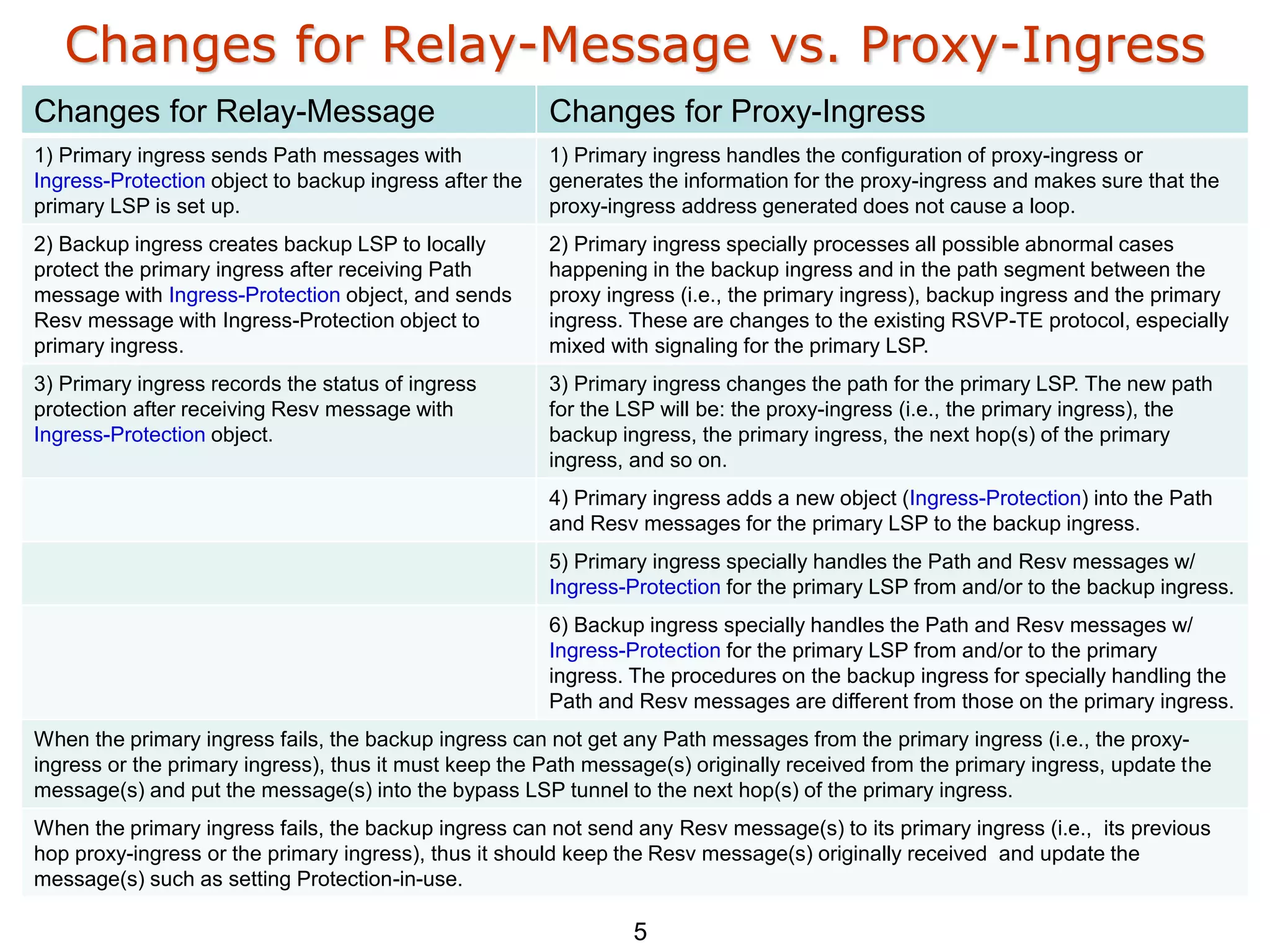
Changes for Relay-Message vs. Proxy-Ingress
Changes for Relay-Message Changes for Proxy-Ingress
1) Primary ingress sends Path messages with
Ingress-Protection object to backup ingress after the
primary LSP is set up.
1) Primary ingress handles the configuration of proxy-ingress or
generates the information for the proxy-ingress and makes sure that the
proxy-ingress address generated does not cause a loop.
2) Backup ingress creates backup LSP to locally
protect the primary ingress after receiving Path
message with Ingress-Protection object, and sends
Resv message with Ingress-Protection object to
primary ingress.
2) Primary ingress specially processes all possible abnormal cases
happening in the backup ingress and in the path segment between the
proxy ingress (i.e., the primary ingress), backup ingress and the primary
ingress. These are changes to the existing RSVP-TE protocol, especially
mixed with signaling for the primary LSP.
3) Primary ingress records the status of ingress
protection after receiving Resv message with
Ingress-Protection object.
3) Primary ingress changes the path for the primary LSP. The new path
for the LSP will be: the proxy-ingress (i.e., the primary ingress), the
backup ingress, the primary ingress, the next hop(s) of the primary
ingress, and so on.
4) Primary ingress adds a new object (Ingress-Protection) into the Path
and Resv messages for the primary LSP to the backup ingress.
5) Primary ingress specially handles the Path and Resv messages w/
Ingress-Protection for the primary LSP from and/or to the backup ingress.
6) Backup ingress specially handles the Path and Resv messages w/
Ingress-Protection for the primary LSP from and/or to the primary
ingress. The procedures on the backup ingress for specially handling the
Path and Resv messages are different from those on the primary ingress.
When the primary ingress fails, the backup ingress can not get any Path messages from the primary ingress (i.e., the proxy-
ingress or the primary ingress), thus it must keep the Path message(s) originally received from the primary ingress, update the
message(s) and put the message(s) into the bypass LSP tunnel to the next hop(s) of the primary ingress.
When the primary ingress fails, the backup ingress can not send any Resv message(s) to its primary ingress (i.e., its previous
hop proxy-ingress or the primary ingress), thus it should keep the Resv message(s) originally received and update the
message(s) such as setting Protection-in-use.
5
6
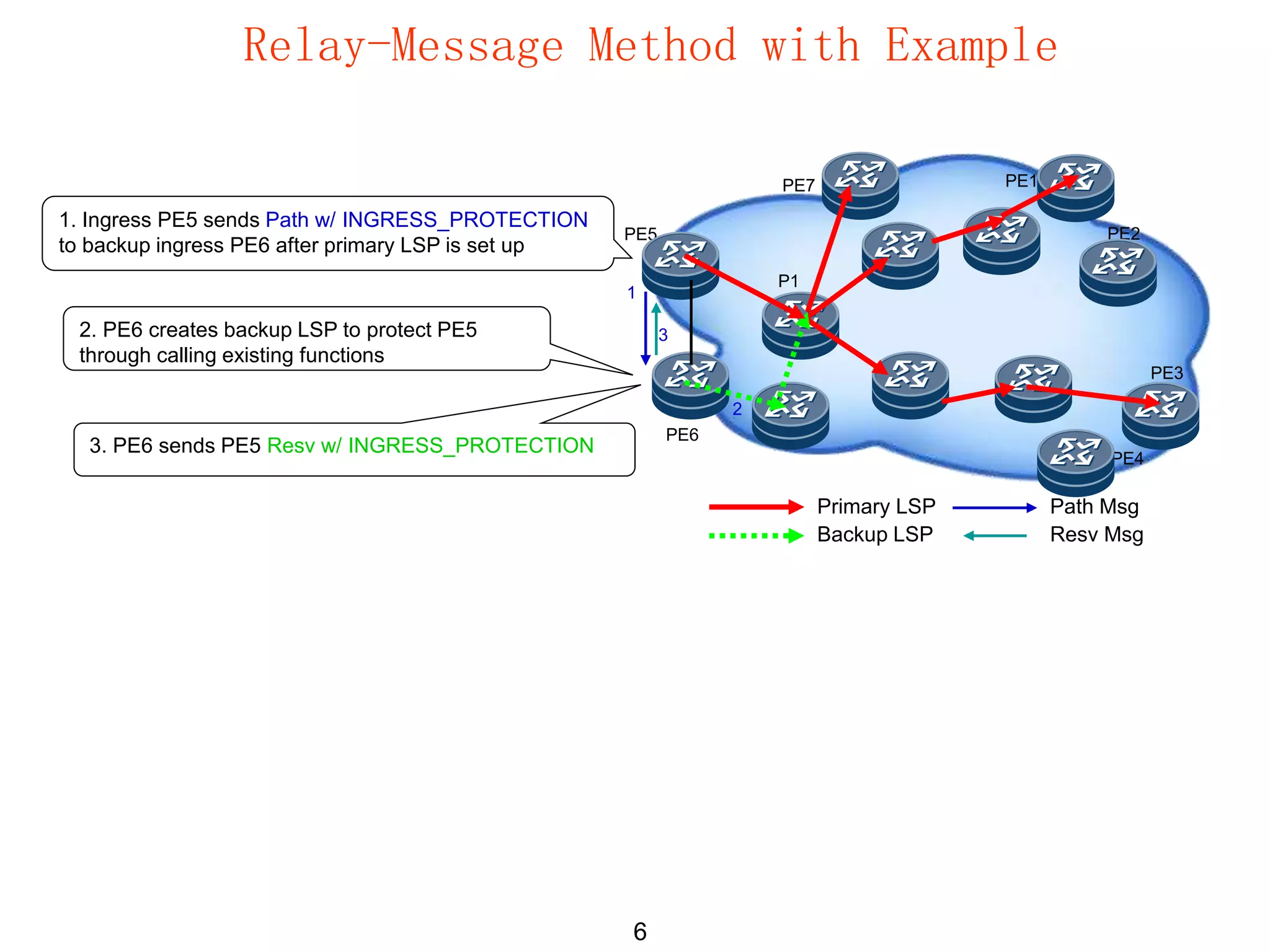
Relay-Message Method with Example
PE1
PE2
PE6
PE5
PE4
PE3
1. Ingress PE5 sends Path w/ INGRESS_PROTECTION
to backup ingress PE6 after primary LSP is set up
2. PE6 creates backup LSP to protect PE5
through calling existing functions
3. PE6 sends PE5 Resv w/ INGRESS_PROTECTION
Primary LSP
Backup LSP
Path Msg
Resv Msg
PE7
P1
1
2
3
7
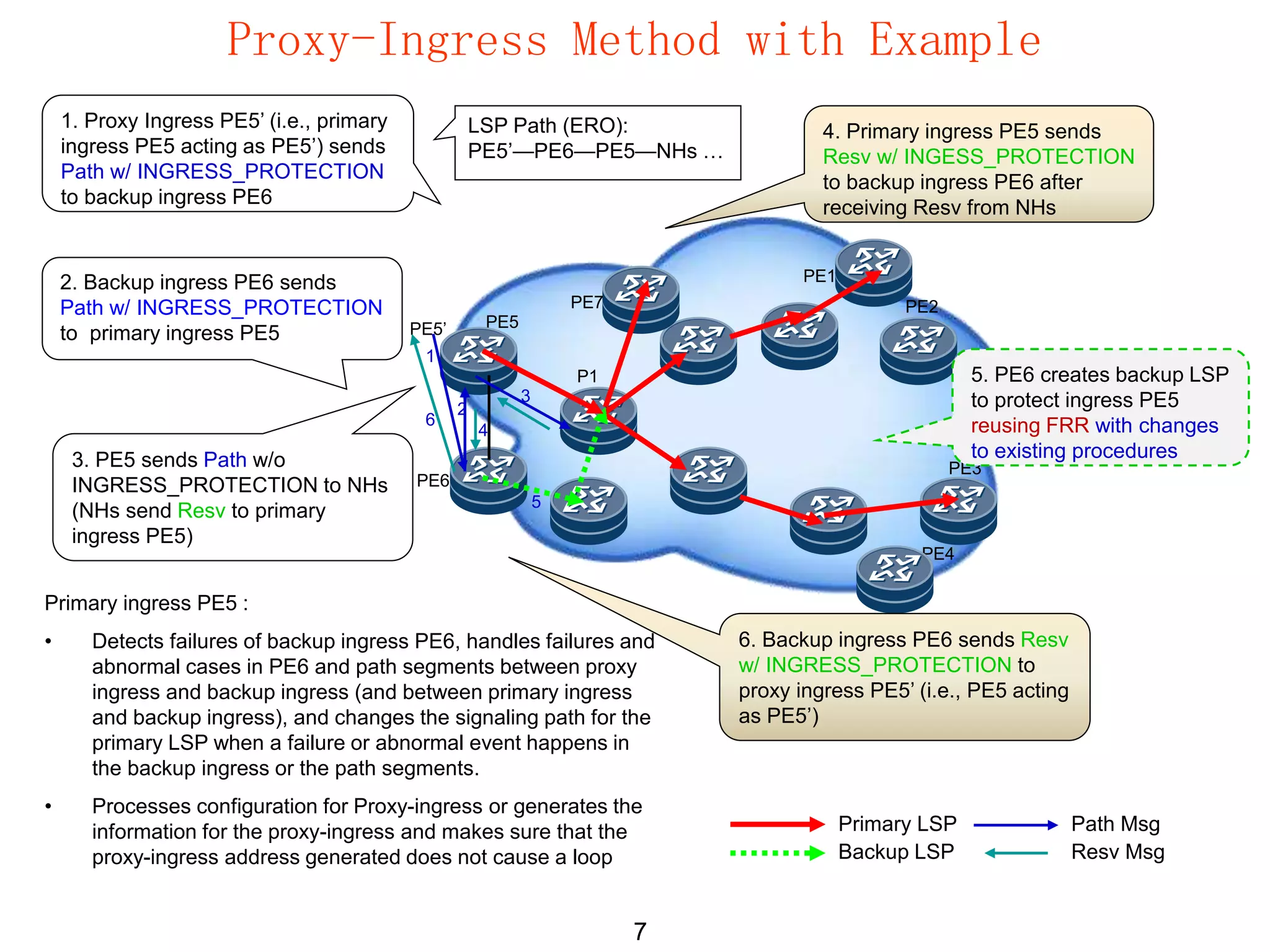
LSP Path (ERO):
PE5’—PE6—PE5—NHs …
1. Proxy Ingress PE5’ (i.e., primary
ingress PE5 acting as PE5’) sends
Path w/ INGRESS_PROTECTION
to backup ingress PE6
2. Backup ingress PE6 sends
Path w/ INGRESS_PROTECTION
to primary ingress PE5
PE1
PE2
PE6
PE5
PE4
PE3
PE5’
Primary ingress PE5 :
• Detects failures of backup ingress PE6, handles failures and
abnormal cases in PE6 and path segments between proxy
ingress and backup ingress (and between primary ingress
and backup ingress), and changes the signaling path for the
primary LSP when a failure or abnormal event happens in
the backup ingress or the path segments.
• Processes configuration for Proxy-ingress or generates the
information for the proxy-ingress and makes sure that the
proxy-ingress address generated does not cause a loop
3. PE5 sends Path w/o
INGRESS_PROTECTION to NHs
(NHs send Resv to primary
ingress PE5)
5. PE6 creates backup LSP
to protect ingress PE5
reusing FRR with changes
to existing procedures
Proxy-Ingress Method with Example
Primary LSP
Backup LSP
Path Msg
Resv Msg
4. Primary ingress PE5 sends
Resv w/ INGESS_PROTECTION
to backup ingress PE6 after
receiving Resv from NHs
6. Backup ingress PE6 sends Resv
w/ INGRESS_PROTECTION to
proxy ingress PE5’ (i.e., PE5 acting
as PE5’)
PE7
P1
1
2
3
4
5
6
Contents
• Introduction
• Descriptions on Two Methods
• Analysis on Two Methods
 Configurations
 Primary LSP Dependency
 Message Overhead
 Special Handlings on Primary Ingress
 Special Handlings on Backup Ingress
 Backup LSP Creation
 Primary LSP Setup Time
 Summary on Analysis
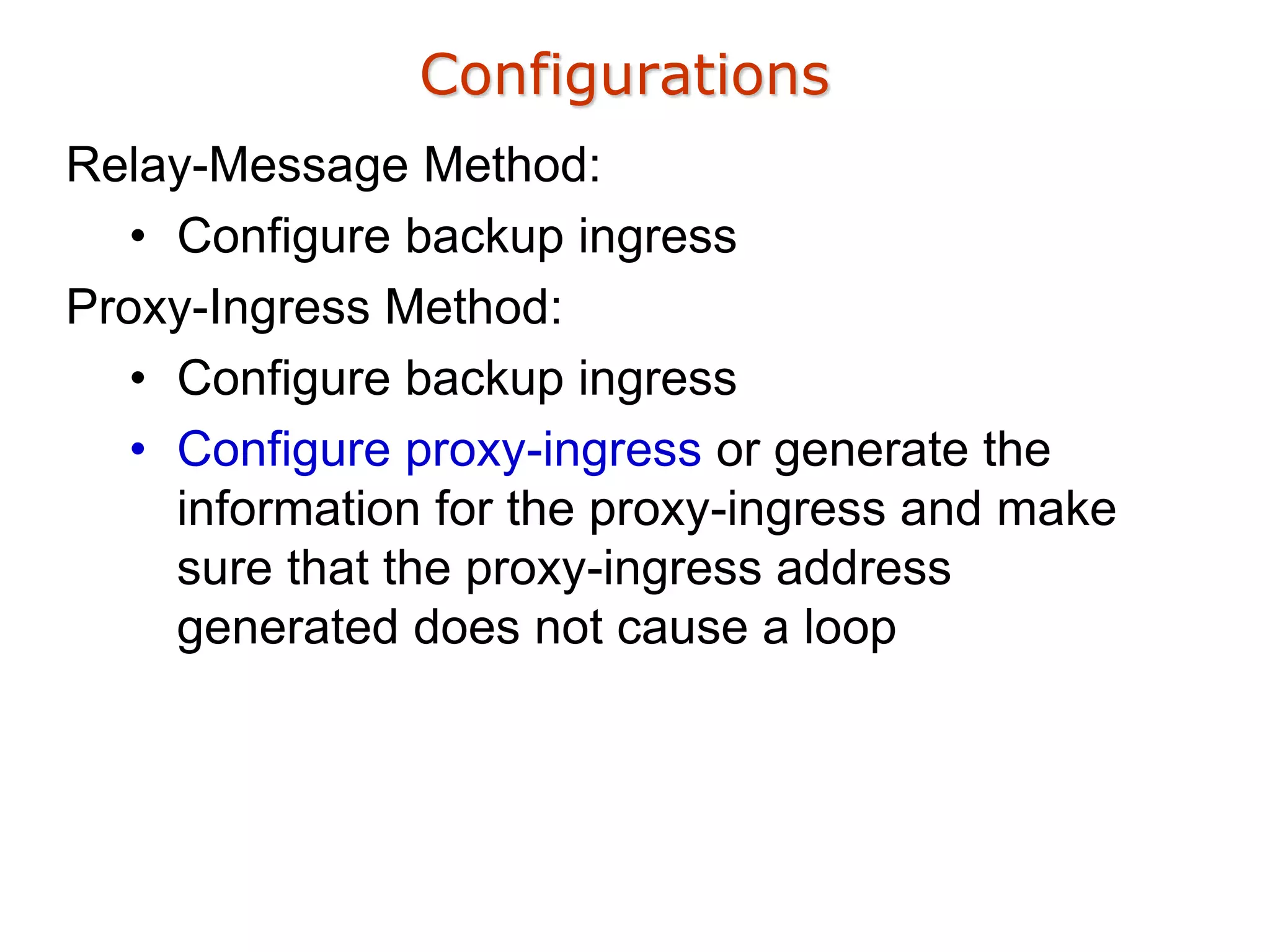
Configurations
Relay-Message Method:
• Configure backup ingress
Proxy-Ingress Method:
• Configure backup ingress
• Configure proxy-ingress or generate the
information for the proxy-ingress and make
sure that the proxy-ingress address
generated does not cause a loop
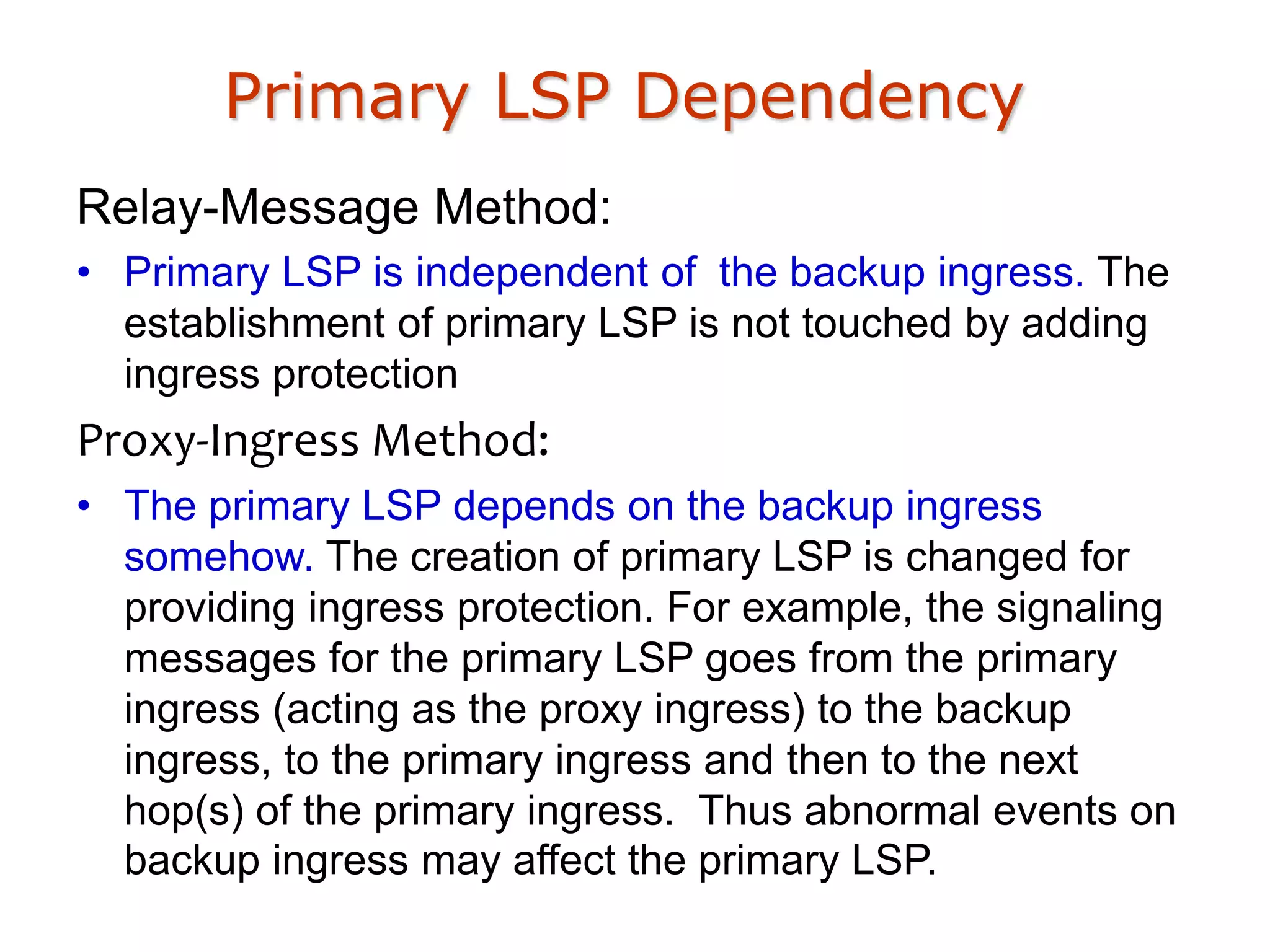
Primary LSP Dependency
Relay-Message Method:
• Primary LSP is independent of the backup ingress. The
establishment of primary LSP is not touched by adding
ingress protection
Proxy-Ingress Method:
• The primary LSP depends on the backup ingress
somehow. The creation of primary LSP is changed for
providing ingress protection. For example, the signaling
messages for the primary LSP goes from the primary
ingress (acting as the proxy ingress) to the backup
ingress, to the primary ingress and then to the next
hop(s) of the primary ingress. Thus abnormal events on
backup ingress may affect the primary LSP.
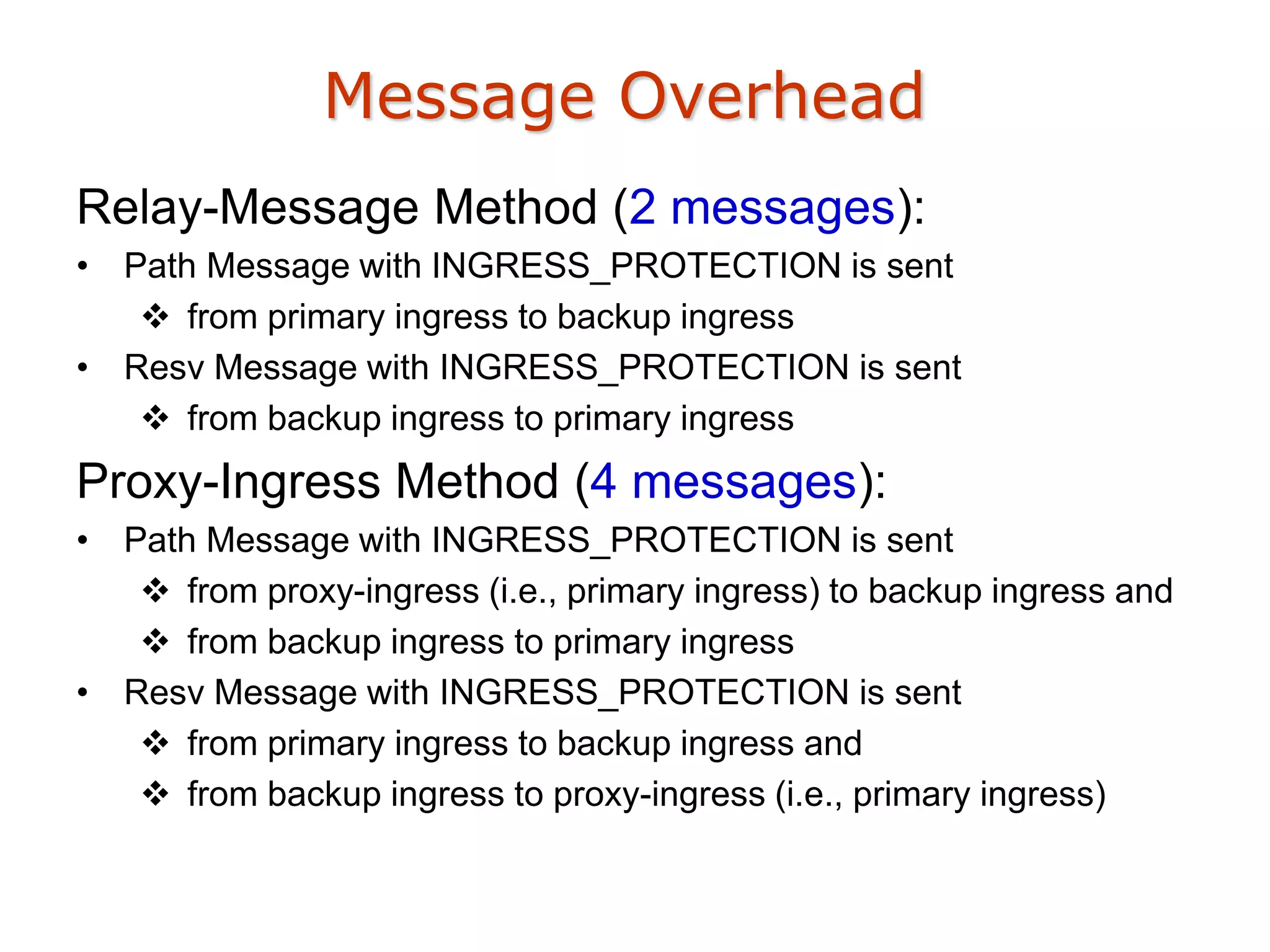
Message Overhead
Relay-Message Method (2 messages):
• Path Message with INGRESS_PROTECTION is sent
 from primary ingress to backup ingress
• Resv Message with INGRESS_PROTECTION is sent
 from backup ingress to primary ingress
Proxy-Ingress Method (4 messages):
• Path Message with INGRESS_PROTECTION is sent
 from proxy-ingress (i.e., primary ingress) to backup ingress and
 from backup ingress to primary ingress
• Resv Message with INGRESS_PROTECTION is sent
 from primary ingress to backup ingress and
 from backup ingress to proxy-ingress (i.e., primary ingress)
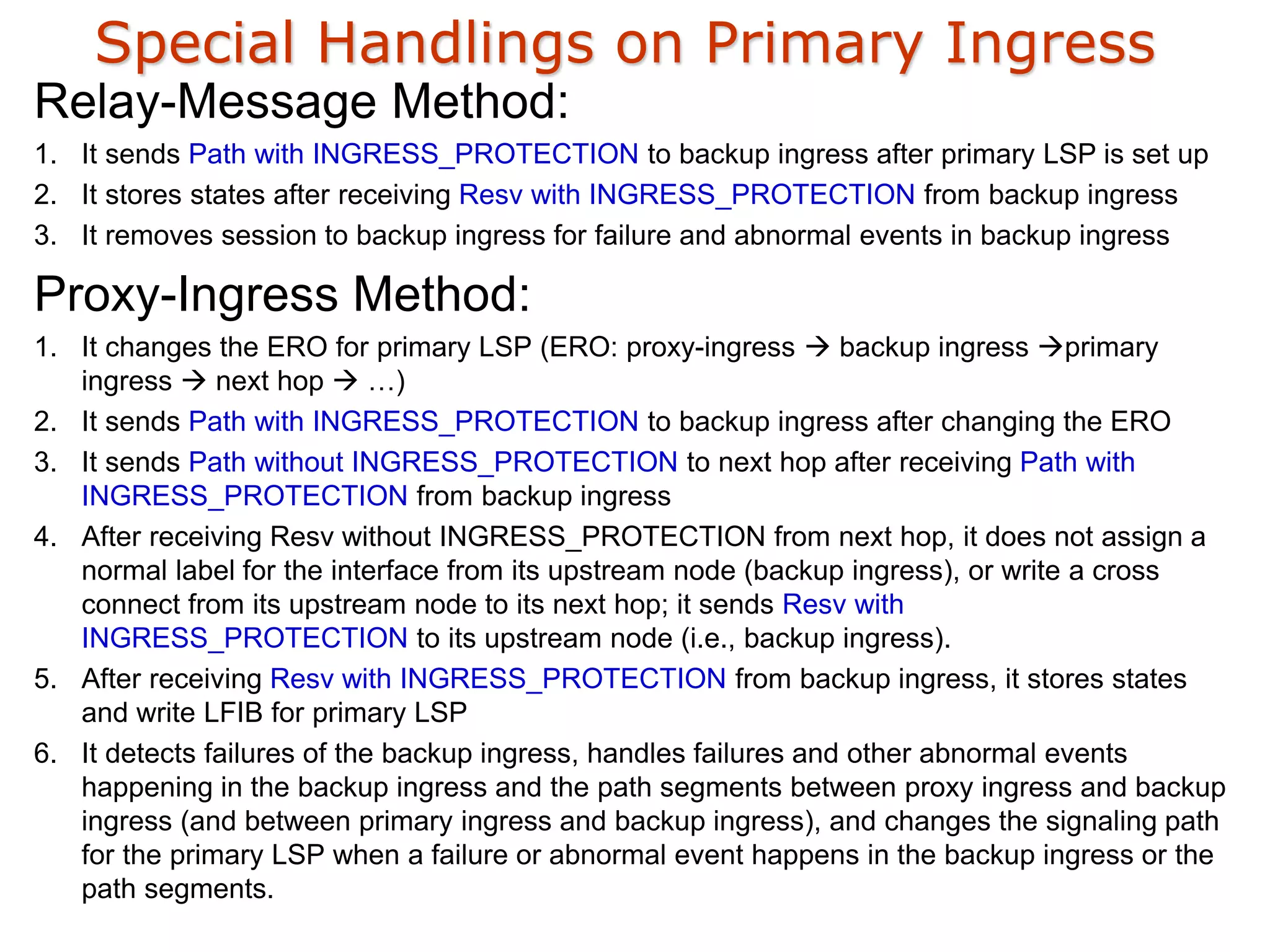
Special Handlings on Primary Ingress
Relay-Message Method:
1. It sends Path with INGRESS_PROTECTION to backup ingress after primary LSP is set up
2. It stores states after receiving Resv with INGRESS_PROTECTION from backup ingress
3. It removes session to backup ingress for failure and abnormal events in backup ingress
Proxy-Ingress Method:
1. It changes the ERO for primary LSP (ERO: proxy-ingress  backup ingress primary
ingress  next hop  …)
2. It sends Path with INGRESS_PROTECTION to backup ingress after changing the ERO
3. It sends Path without INGRESS_PROTECTION to next hop after receiving Path with
INGRESS_PROTECTION from backup ingress
4. After receiving Resv without INGRESS_PROTECTION from next hop, it does not assign a
normal label for the interface from its upstream node (backup ingress), or write a cross
connect from its upstream node to its next hop; it sends Resv with
INGRESS_PROTECTION to its upstream node (i.e., backup ingress).
5. After receiving Resv with INGRESS_PROTECTION from backup ingress, it stores states
and write LFIB for primary LSP
6. It detects failures of the backup ingress, handles failures and other abnormal events
happening in the backup ingress and the path segments between proxy ingress and backup
ingress (and between primary ingress and backup ingress), and changes the signaling path
for the primary LSP when a failure or abnormal event happens in the backup ingress or the
path segments.
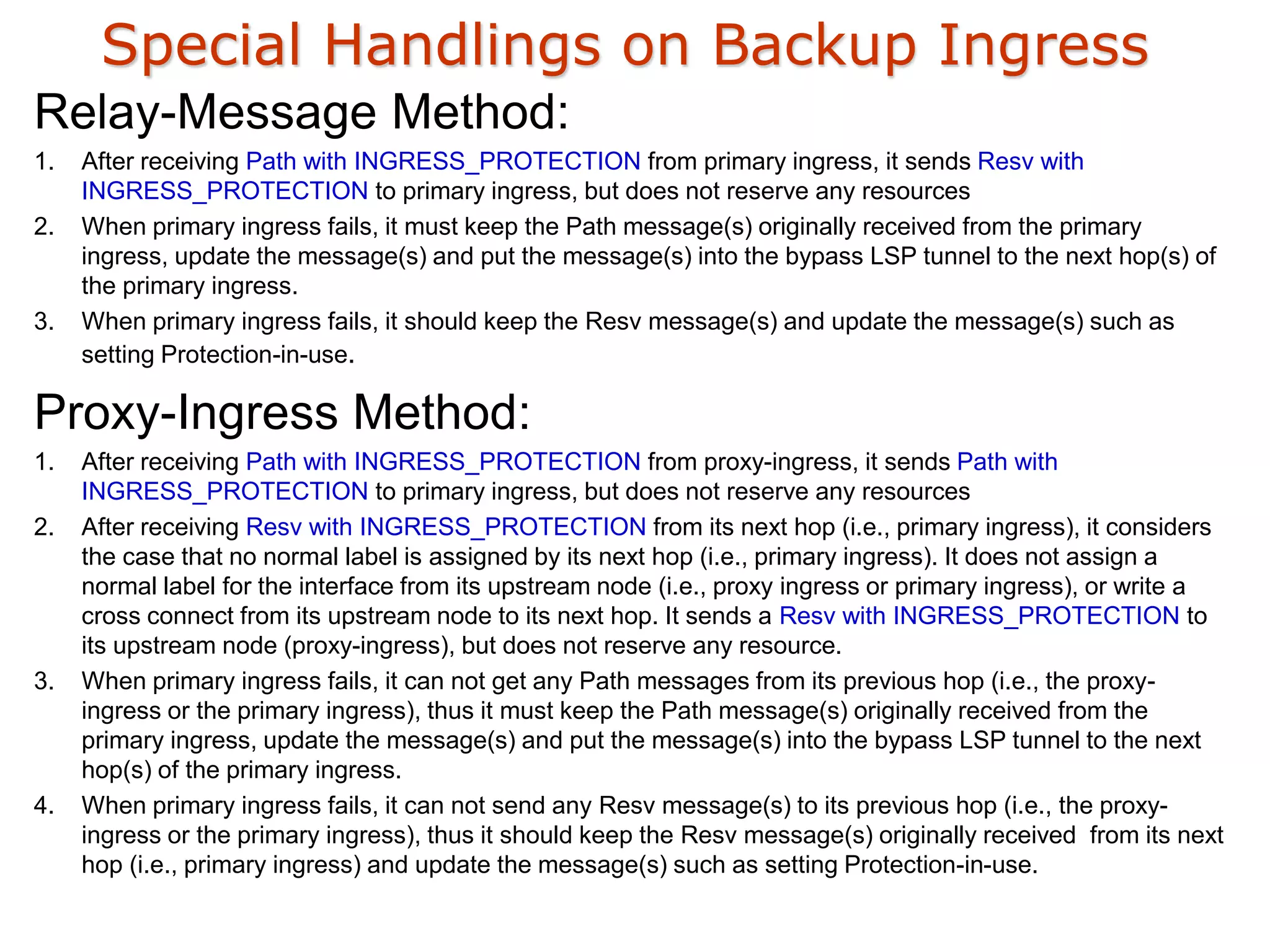
Special Handlings on Backup Ingress
Relay-Message Method:
1. After receiving Path with INGRESS_PROTECTION from primary ingress, it sends Resv with
INGRESS_PROTECTION to primary ingress, but does not reserve any resources
2. When primary ingress fails, it must keep the Path message(s) originally received from the primary
ingress, update the message(s) and put the message(s) into the bypass LSP tunnel to the next hop(s) of
the primary ingress.
3. When primary ingress fails, it should keep the Resv message(s) and update the message(s) such as
setting Protection-in-use.
Proxy-Ingress Method:
1. After receiving Path with INGRESS_PROTECTION from proxy-ingress, it sends Path with
INGRESS_PROTECTION to primary ingress, but does not reserve any resources
2. After receiving Resv with INGRESS_PROTECTION from its next hop (i.e., primary ingress), it considers
the case that no normal label is assigned by its next hop (i.e., primary ingress). It does not assign a
normal label for the interface from its upstream node (i.e., proxy ingress or primary ingress), or write a
cross connect from its upstream node to its next hop. It sends a Resv with INGRESS_PROTECTION to
its upstream node (proxy-ingress), but does not reserve any resource.
3. When primary ingress fails, it can not get any Path messages from its previous hop (i.e., the proxy-
ingress or the primary ingress), thus it must keep the Path message(s) originally received from the
primary ingress, update the message(s) and put the message(s) into the bypass LSP tunnel to the next
hop(s) of the primary ingress.
4. When primary ingress fails, it can not send any Resv message(s) to its previous hop (i.e., the proxy-
ingress or the primary ingress), thus it should keep the Resv message(s) originally received from its next
hop (i.e., primary ingress) and update the message(s) such as setting Protection-in-use.
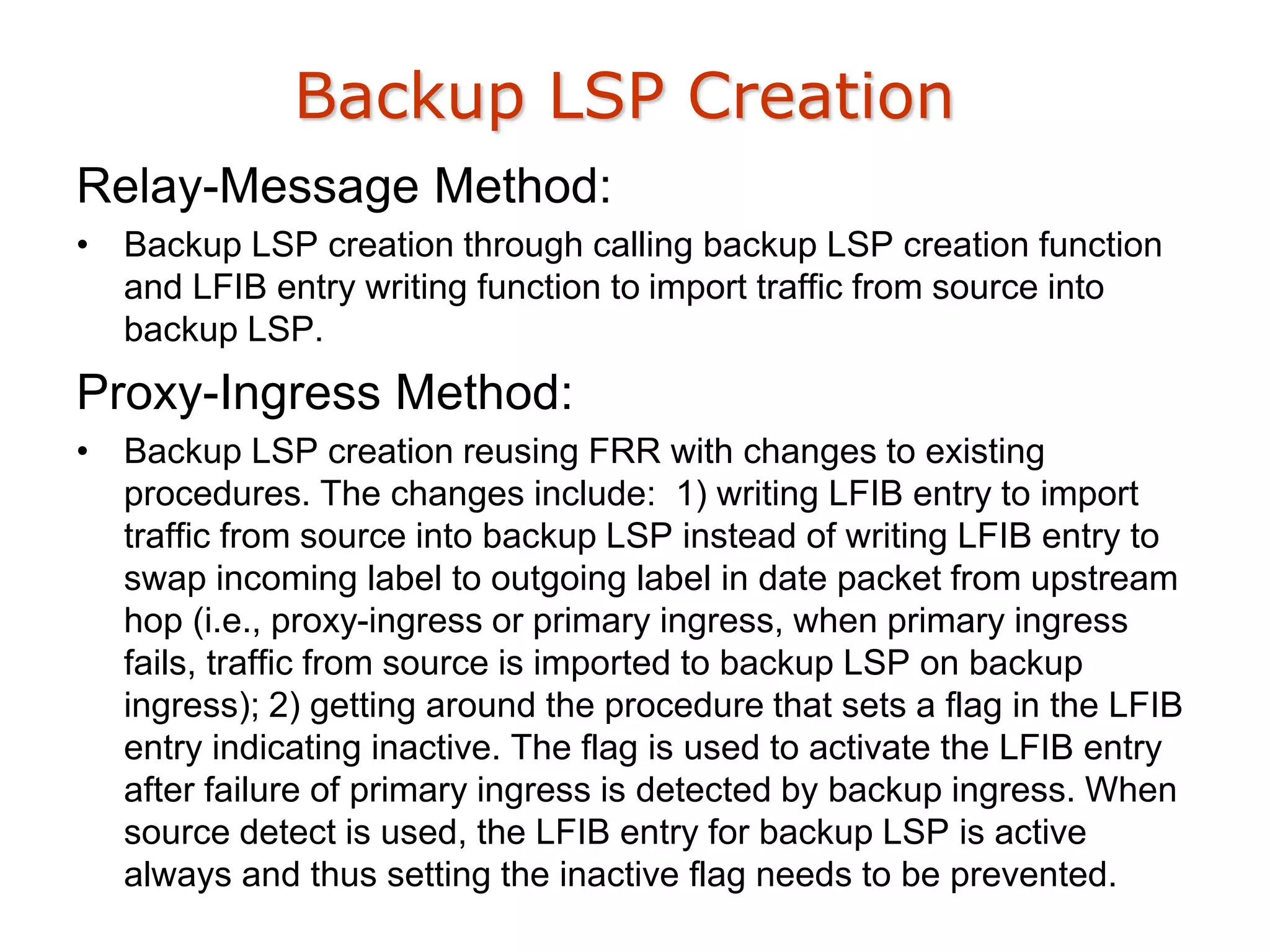
Backup LSP Creation
Relay-Message Method:
• Backup LSP creation through calling backup LSP creation function
and LFIB entry writing function to import traffic from source into
backup LSP.
Proxy-Ingress Method:
• Backup LSP creation reusing FRR with changes to existing
procedures. The changes include: 1) writing LFIB entry to import
traffic from source into backup LSP instead of writing LFIB entry to
swap incoming label to outgoing label in date packet from upstream
hop (i.e., proxy-ingress or primary ingress, when primary ingress
fails, traffic from source is imported to backup LSP on backup
ingress); 2) getting around the procedure that sets a flag in the LFIB
entry indicating inactive. The flag is used to activate the LFIB entry
after failure of primary ingress is detected by backup ingress. When
source detect is used, the LFIB entry for backup LSP is active
always and thus setting the inactive flag needs to be prevented.
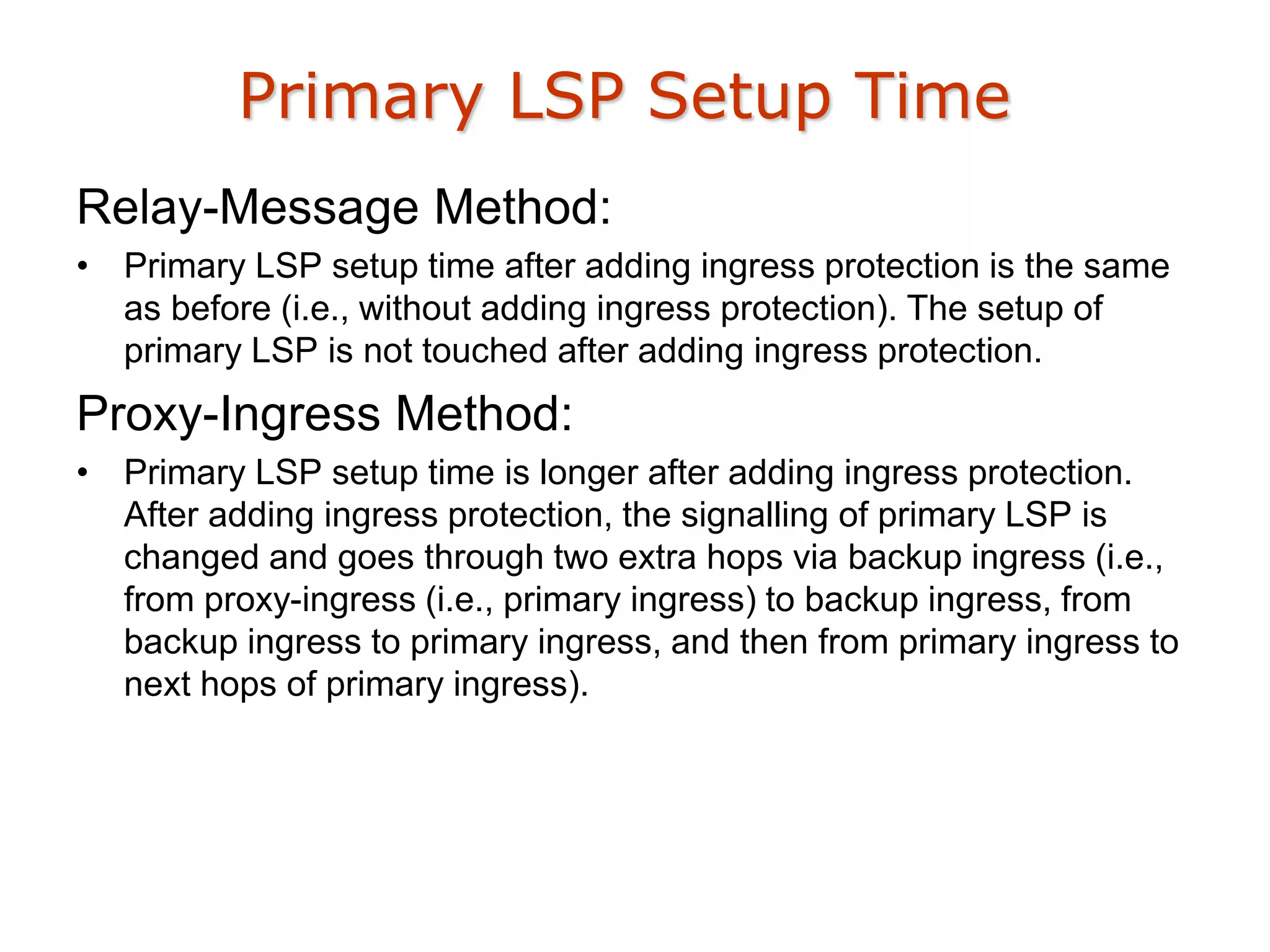
Primary LSP Setup Time
Relay-Message Method:
• Primary LSP setup time after adding ingress protection is the same
as before (i.e., without adding ingress protection). The setup of
primary LSP is not touched after adding ingress protection.
Proxy-Ingress Method:
• Primary LSP setup time is longer after adding ingress protection.
After adding ingress protection, the signalling of primary LSP is
changed and goes through two extra hops via backup ingress (i.e.,
from proxy-ingress (i.e., primary ingress) to backup ingress, from
backup ingress to primary ingress, and then from primary ingress to
next hops of primary ingress).
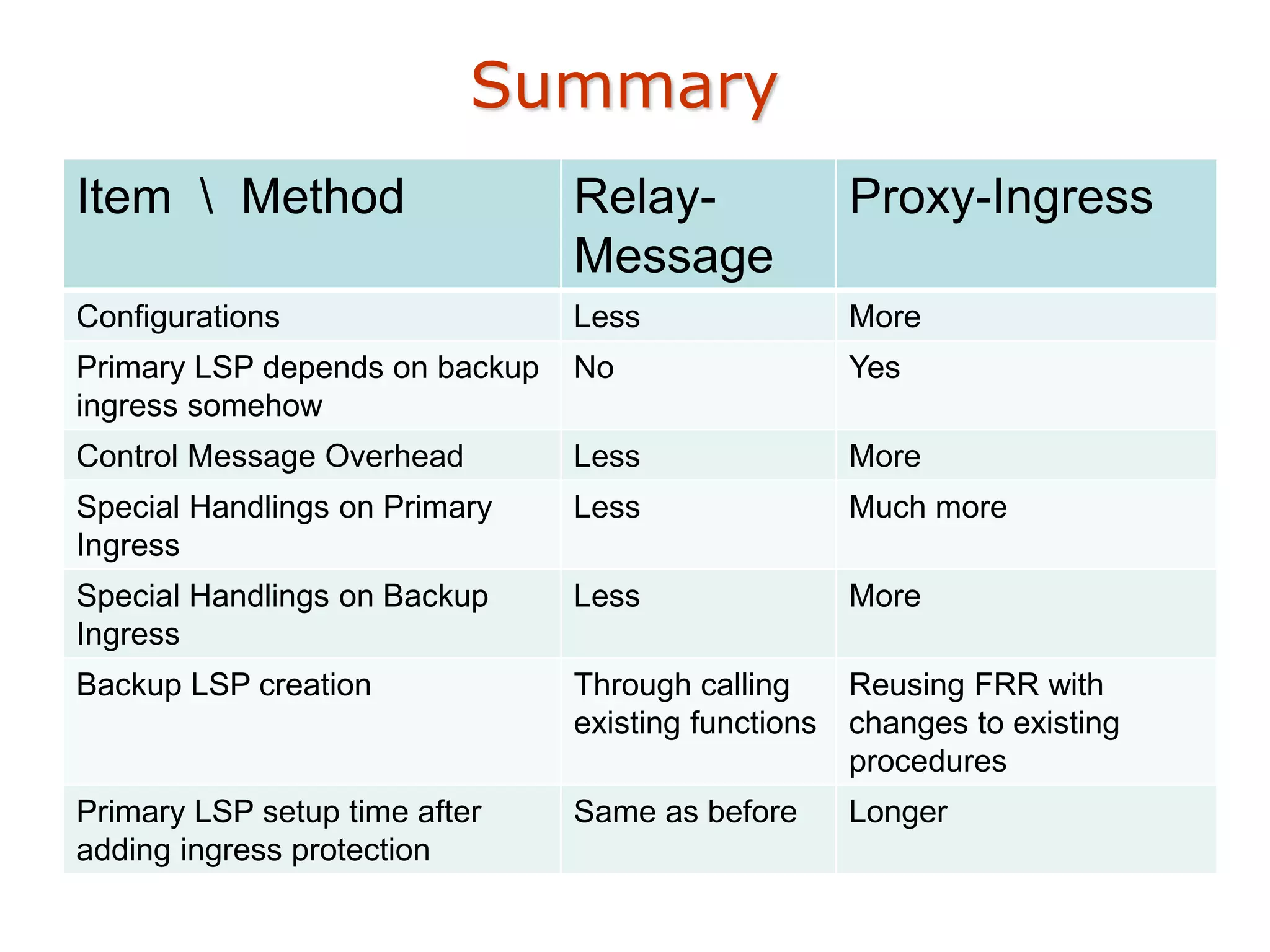
Summary
Item  Method Relay-
Message
Proxy-Ingress
Configurations Less More
Primary LSP depends on backup
ingress somehow
No Yes
Control Message Overhead Less More
Special Handlings on Primary
Ingress
Less Much more
Special Handlings on Backup
Ingress
Less More
Backup LSP creation Through calling
existing functions
Reusing FRR with
changes to existing
procedures
Primary LSP setup time after
adding ingress protection
Same as before Longer
Thanks

Analysis 2-methods

  • 1.
  • 2.
    Contents • Introduction • Descriptionson Two Methods • Analysis on Two Methods
  • 3.
    Introduction Two methods Relay-Messageand Proxy-Ingress can be used to transfer information about ingress protection from primary ingress to backup ingress These two methods are described in the following slides and then Some detailed analysis on them are given for your references
  • 4.
    Contents • Introduction • Descriptionson Two Methods  Changes for Relay-Message vs. Proxy- Ingress  Relay-Message with Example  Proxy-Ingress with Example • Analysis on Two Methods
  • 5.
    Changes for Relay-Messagevs. Proxy-Ingress Changes for Relay-Message Changes for Proxy-Ingress 1) Primary ingress sends Path messages with Ingress-Protection object to backup ingress after the primary LSP is set up. 1) Primary ingress handles the configuration of proxy-ingress or generates the information for the proxy-ingress and makes sure that the proxy-ingress address generated does not cause a loop. 2) Backup ingress creates backup LSP to locally protect the primary ingress after receiving Path message with Ingress-Protection object, and sends Resv message with Ingress-Protection object to primary ingress. 2) Primary ingress specially processes all possible abnormal cases happening in the backup ingress and in the path segment between the proxy ingress (i.e., the primary ingress), backup ingress and the primary ingress. These are changes to the existing RSVP-TE protocol, especially mixed with signaling for the primary LSP. 3) Primary ingress records the status of ingress protection after receiving Resv message with Ingress-Protection object. 3) Primary ingress changes the path for the primary LSP. The new path for the LSP will be: the proxy-ingress (i.e., the primary ingress), the backup ingress, the primary ingress, the next hop(s) of the primary ingress, and so on. 4) Primary ingress adds a new object (Ingress-Protection) into the Path and Resv messages for the primary LSP to the backup ingress. 5) Primary ingress specially handles the Path and Resv messages w/ Ingress-Protection for the primary LSP from and/or to the backup ingress. 6) Backup ingress specially handles the Path and Resv messages w/ Ingress-Protection for the primary LSP from and/or to the primary ingress. The procedures on the backup ingress for specially handling the Path and Resv messages are different from those on the primary ingress. When the primary ingress fails, the backup ingress can not get any Path messages from the primary ingress (i.e., the proxy- ingress or the primary ingress), thus it must keep the Path message(s) originally received from the primary ingress, update the message(s) and put the message(s) into the bypass LSP tunnel to the next hop(s) of the primary ingress. When the primary ingress fails, the backup ingress can not send any Resv message(s) to its primary ingress (i.e., its previous hop proxy-ingress or the primary ingress), thus it should keep the Resv message(s) originally received and update the message(s) such as setting Protection-in-use. 5
  • 6.
    6 Relay-Message Method withExample PE1 PE2 PE6 PE5 PE4 PE3 1. Ingress PE5 sends Path w/ INGRESS_PROTECTION to backup ingress PE6 after primary LSP is set up 2. PE6 creates backup LSP to protect PE5 through calling existing functions 3. PE6 sends PE5 Resv w/ INGRESS_PROTECTION Primary LSP Backup LSP Path Msg Resv Msg PE7 P1 1 2 3
  • 7.
    7 LSP Path (ERO): PE5’—PE6—PE5—NHs… 1. Proxy Ingress PE5’ (i.e., primary ingress PE5 acting as PE5’) sends Path w/ INGRESS_PROTECTION to backup ingress PE6 2. Backup ingress PE6 sends Path w/ INGRESS_PROTECTION to primary ingress PE5 PE1 PE2 PE6 PE5 PE4 PE3 PE5’ Primary ingress PE5 : • Detects failures of backup ingress PE6, handles failures and abnormal cases in PE6 and path segments between proxy ingress and backup ingress (and between primary ingress and backup ingress), and changes the signaling path for the primary LSP when a failure or abnormal event happens in the backup ingress or the path segments. • Processes configuration for Proxy-ingress or generates the information for the proxy-ingress and makes sure that the proxy-ingress address generated does not cause a loop 3. PE5 sends Path w/o INGRESS_PROTECTION to NHs (NHs send Resv to primary ingress PE5) 5. PE6 creates backup LSP to protect ingress PE5 reusing FRR with changes to existing procedures Proxy-Ingress Method with Example Primary LSP Backup LSP Path Msg Resv Msg 4. Primary ingress PE5 sends Resv w/ INGESS_PROTECTION to backup ingress PE6 after receiving Resv from NHs 6. Backup ingress PE6 sends Resv w/ INGRESS_PROTECTION to proxy ingress PE5’ (i.e., PE5 acting as PE5’) PE7 P1 1 2 3 4 5 6
  • 8.
    Contents • Introduction • Descriptionson Two Methods • Analysis on Two Methods  Configurations  Primary LSP Dependency  Message Overhead  Special Handlings on Primary Ingress  Special Handlings on Backup Ingress  Backup LSP Creation  Primary LSP Setup Time  Summary on Analysis
  • 9.
    Configurations Relay-Message Method: • Configurebackup ingress Proxy-Ingress Method: • Configure backup ingress • Configure proxy-ingress or generate the information for the proxy-ingress and make sure that the proxy-ingress address generated does not cause a loop
  • 10.
    Primary LSP Dependency Relay-MessageMethod: • Primary LSP is independent of the backup ingress. The establishment of primary LSP is not touched by adding ingress protection Proxy-Ingress Method: • The primary LSP depends on the backup ingress somehow. The creation of primary LSP is changed for providing ingress protection. For example, the signaling messages for the primary LSP goes from the primary ingress (acting as the proxy ingress) to the backup ingress, to the primary ingress and then to the next hop(s) of the primary ingress. Thus abnormal events on backup ingress may affect the primary LSP.
  • 11.
    Message Overhead Relay-Message Method(2 messages): • Path Message with INGRESS_PROTECTION is sent  from primary ingress to backup ingress • Resv Message with INGRESS_PROTECTION is sent  from backup ingress to primary ingress Proxy-Ingress Method (4 messages): • Path Message with INGRESS_PROTECTION is sent  from proxy-ingress (i.e., primary ingress) to backup ingress and  from backup ingress to primary ingress • Resv Message with INGRESS_PROTECTION is sent  from primary ingress to backup ingress and  from backup ingress to proxy-ingress (i.e., primary ingress)
  • 12.
    Special Handlings onPrimary Ingress Relay-Message Method: 1. It sends Path with INGRESS_PROTECTION to backup ingress after primary LSP is set up 2. It stores states after receiving Resv with INGRESS_PROTECTION from backup ingress 3. It removes session to backup ingress for failure and abnormal events in backup ingress Proxy-Ingress Method: 1. It changes the ERO for primary LSP (ERO: proxy-ingress  backup ingress primary ingress  next hop  …) 2. It sends Path with INGRESS_PROTECTION to backup ingress after changing the ERO 3. It sends Path without INGRESS_PROTECTION to next hop after receiving Path with INGRESS_PROTECTION from backup ingress 4. After receiving Resv without INGRESS_PROTECTION from next hop, it does not assign a normal label for the interface from its upstream node (backup ingress), or write a cross connect from its upstream node to its next hop; it sends Resv with INGRESS_PROTECTION to its upstream node (i.e., backup ingress). 5. After receiving Resv with INGRESS_PROTECTION from backup ingress, it stores states and write LFIB for primary LSP 6. It detects failures of the backup ingress, handles failures and other abnormal events happening in the backup ingress and the path segments between proxy ingress and backup ingress (and between primary ingress and backup ingress), and changes the signaling path for the primary LSP when a failure or abnormal event happens in the backup ingress or the path segments.
  • 13.
    Special Handlings onBackup Ingress Relay-Message Method: 1. After receiving Path with INGRESS_PROTECTION from primary ingress, it sends Resv with INGRESS_PROTECTION to primary ingress, but does not reserve any resources 2. When primary ingress fails, it must keep the Path message(s) originally received from the primary ingress, update the message(s) and put the message(s) into the bypass LSP tunnel to the next hop(s) of the primary ingress. 3. When primary ingress fails, it should keep the Resv message(s) and update the message(s) such as setting Protection-in-use. Proxy-Ingress Method: 1. After receiving Path with INGRESS_PROTECTION from proxy-ingress, it sends Path with INGRESS_PROTECTION to primary ingress, but does not reserve any resources 2. After receiving Resv with INGRESS_PROTECTION from its next hop (i.e., primary ingress), it considers the case that no normal label is assigned by its next hop (i.e., primary ingress). It does not assign a normal label for the interface from its upstream node (i.e., proxy ingress or primary ingress), or write a cross connect from its upstream node to its next hop. It sends a Resv with INGRESS_PROTECTION to its upstream node (proxy-ingress), but does not reserve any resource. 3. When primary ingress fails, it can not get any Path messages from its previous hop (i.e., the proxy- ingress or the primary ingress), thus it must keep the Path message(s) originally received from the primary ingress, update the message(s) and put the message(s) into the bypass LSP tunnel to the next hop(s) of the primary ingress. 4. When primary ingress fails, it can not send any Resv message(s) to its previous hop (i.e., the proxy- ingress or the primary ingress), thus it should keep the Resv message(s) originally received from its next hop (i.e., primary ingress) and update the message(s) such as setting Protection-in-use.
  • 14.
    Backup LSP Creation Relay-MessageMethod: • Backup LSP creation through calling backup LSP creation function and LFIB entry writing function to import traffic from source into backup LSP. Proxy-Ingress Method: • Backup LSP creation reusing FRR with changes to existing procedures. The changes include: 1) writing LFIB entry to import traffic from source into backup LSP instead of writing LFIB entry to swap incoming label to outgoing label in date packet from upstream hop (i.e., proxy-ingress or primary ingress, when primary ingress fails, traffic from source is imported to backup LSP on backup ingress); 2) getting around the procedure that sets a flag in the LFIB entry indicating inactive. The flag is used to activate the LFIB entry after failure of primary ingress is detected by backup ingress. When source detect is used, the LFIB entry for backup LSP is active always and thus setting the inactive flag needs to be prevented.
  • 15.
    Primary LSP SetupTime Relay-Message Method: • Primary LSP setup time after adding ingress protection is the same as before (i.e., without adding ingress protection). The setup of primary LSP is not touched after adding ingress protection. Proxy-Ingress Method: • Primary LSP setup time is longer after adding ingress protection. After adding ingress protection, the signalling of primary LSP is changed and goes through two extra hops via backup ingress (i.e., from proxy-ingress (i.e., primary ingress) to backup ingress, from backup ingress to primary ingress, and then from primary ingress to next hops of primary ingress).
  • 16.
    Summary Item MethodRelay- Message Proxy-Ingress Configurations Less More Primary LSP depends on backup ingress somehow No Yes Control Message Overhead Less More Special Handlings on Primary Ingress Less Much more Special Handlings on Backup Ingress Less More Backup LSP creation Through calling existing functions Reusing FRR with changes to existing procedures Primary LSP setup time after adding ingress protection Same as before Longer
  • 17.