ANAEMIA
Anaemia - definition
 A state where the blood haemoglobin
concentration is below that expected
taking into account age and sex.
 Adult male: <13 g/dl
 Adult female: <12g/dl
Copyright ©2006 American Society of Hematology. Copyright restrictions may apply.
Beutler, E. et al. Blood 2006;107:1747-1750
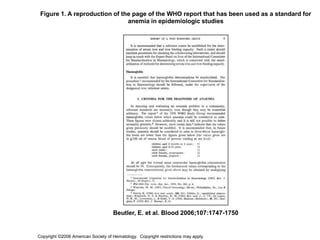
Figure 1. A reproduction of the page of the WHO report that has been used as a standard for
anemia in epidemiologic studies
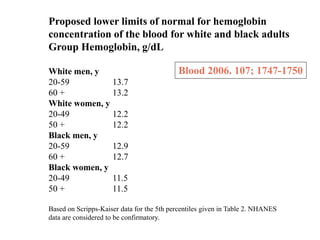
Proposed lower limits of normal for hemoglobin
concentration of the blood for white and black adults
Group Hemoglobin, g/dL
White men, y
20-59 13.7
60 + 13.2
White women, y
20-49 12.2
50 + 12.2
Black men, y
20-59 12.9
60 + 12.7
Black women, y
20-49 11.5
50 + 11.5
Based on Scripps-Kaiser data for the 5th percentiles given in Table 2. NHANES
data are considered to be confirmatory.
Blood 2006. 107; 1747-1750
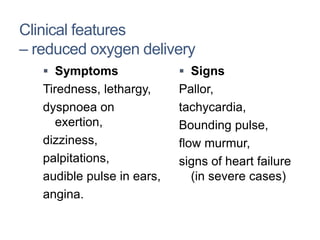
Clinical features
– reduced oxygen delivery
 Symptoms
Tiredness, lethargy,
dyspnoea on
exertion,
dizziness,
palpitations,
audible pulse in ears,
angina.
 Signs
Pallor,
tachycardia,
Bounding pulse,
flow murmur,
signs of heart failure
(in severe cases)
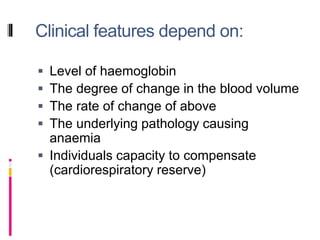
Clinical features depend on:
 Level of haemoglobin
 The degree of change in the blood volume
 The rate of change of above
 The underlying pathology causing
anaemia
 Individuals capacity to compensate
(cardiorespiratory reserve)
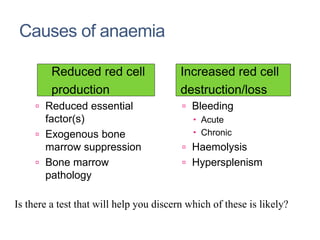
Causes of anaemia
Reduced red cell
production
 Reduced essential
factor(s)
 Exogenous bone
marrow suppression
 Bone marrow
pathology
Increased red cell
destruction/loss
 Bleeding
 Acute
 Chronic
 Haemolysis
 Hypersplenism
Is there a test that will help you discern which of these is likely?
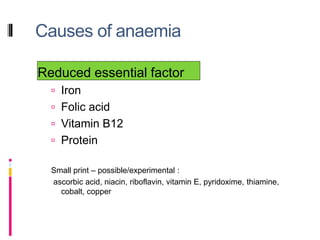
Causes of anaemia
Reduced essential factor
 Iron
 Folic acid
 Vitamin B12
 Protein
Small print – possible/experimental :
ascorbic acid, niacin, riboflavin, vitamin E, pyridoxime, thiamine,
cobalt, copper
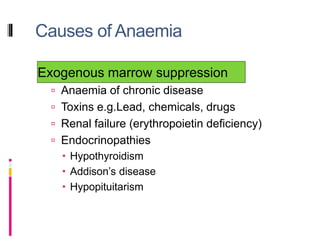
Causes of Anaemia
Exogenous marrow suppression
 Anaemia of chronic disease
 Toxins e.g.Lead, chemicals, drugs
 Renal failure (erythropoietin deficiency)
 Endocrinopathies
 Hypothyroidism
 Addison’s disease
 Hypopituitarism
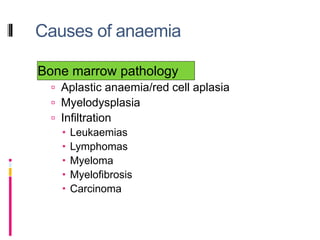
Causes of anaemia
Bone marrow pathology
 Aplastic anaemia/red cell aplasia
 Myelodysplasia
 Infiltration
 Leukaemias
 Lymphomas
 Myeloma
 Myelofibrosis
 Carcinoma
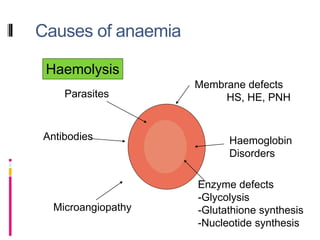
Causes of anaemia
Haemolysis
Membrane defects
HS, HE, PNH
Haemoglobin
Disorders
Enzyme defects
-Glycolysis
-Glutathione synthesis
-Nucleotide synthesis
Parasites
Antibodies
Microangiopathy
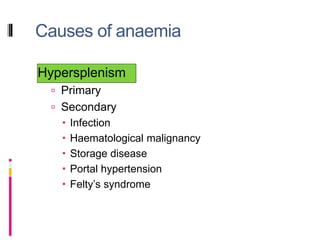
Causes of anaemia
Hypersplenism
 Primary
 Secondary
 Infection
 Haematological malignancy
 Storage disease
 Portal hypertension
 Felty’s syndrome
Red cell indices may help
 Microcytosis
 Macrocytosis
 N/N
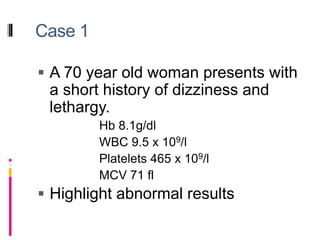
Case 1
 A 70 year old woman presents with
a short history of dizziness and
lethargy.
Hb 8.1g/dl
WBC 9.5 x 10⁹/l
Platelets 465 x 109/l
MCV 71 fl
 Highlight abnormal results
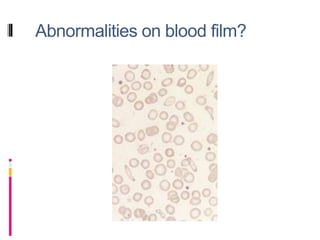
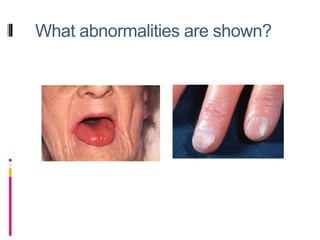
Abnormalities on blood film?
 What aspects of the history &
examination would you concentrate
on?
 What tests would you request at
this stage?
What abnormalities are shown?
Case 1
 Ferritin 5 (normal 14 - 186)
 She has PR bleeding
 What further history do you need?
 What investigations would you request now?
 What treatment would you advise now?
 Give a differential diagnosis
Case 2
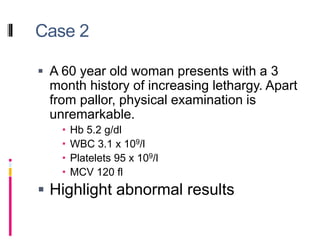
 A 60 year old woman presents with a 3
month history of increasing lethargy. Apart
from pallor, physical examination is
unremarkable.
 Hb 5.2 g/dl
 WBC 3.1 x 10⁹/l
 Platelets 95 x 109/l
 MCV 120 fl
 Highlight abnormal results
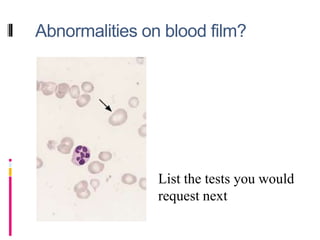
Abnormalities on blood film?
List the tests you would
request next
Case 2
 B12 95 (normal 215-400)
 Folate 2.1 (normal 2.0-5.0)
What tests would you request now?
What treatment would you order?
Name serious complications of this disorder.
Case 3
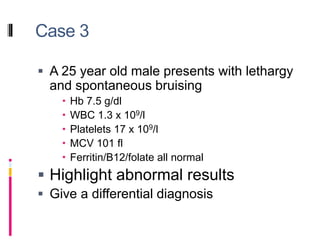
 A 25 year old male presents with lethargy
and spontaneous bruising
 Hb 7.5 g/dl
 WBC 1.3 x 10⁹/l
 Platelets 17 x 109/l
 MCV 101 fl
 Ferritin/B12/folate all normal
 Highlight abnormal results
 Give a differential diagnosis
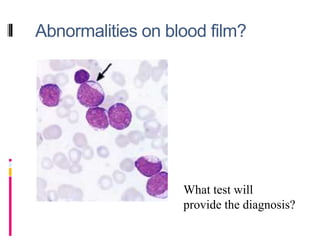
Abnormalities on blood film?
What test will
provide the diagnosis?
Case 4
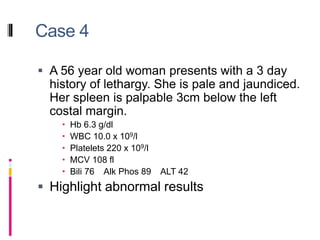
 A 56 year old woman presents with a 3 day
history of lethargy. She is pale and jaundiced.
Her spleen is palpable 3cm below the left
costal margin.
 Hb 6.3 g/dl
 WBC 10.0 x 10⁹/l
 Platelets 220 x 109/l
 MCV 108 fl
 Bili 76 Alk Phos 89 ALT 42
 Highlight abnormal results
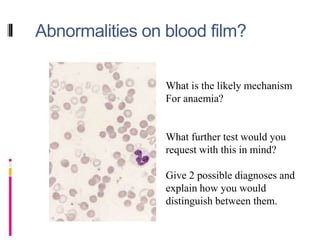
Abnormalities on blood film?
What is the likely mechanism
For anaemia?
What further test would you
request with this in mind?
Give 2 possible diagnoses and
explain how you would
distinguish between them.
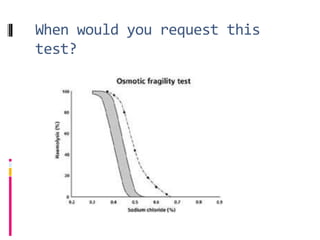
When would you request this
test?
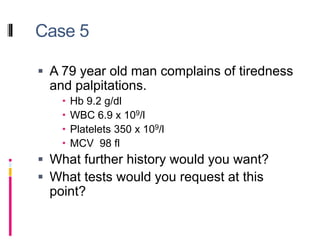
Case 5
 A 79 year old man complains of tiredness
and palpitations.
 Hb 9.2 g/dl
 WBC 6.9 x 10⁹/l
 Platelets 350 x 109/l
 MCV 98 fl
 What further history would you want?
 What tests would you request at this
point?
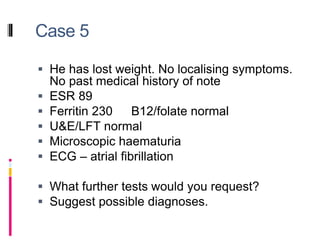
Case 5
 He has lost weight. No localising symptoms.
No past medical history of note
 ESR 89
 Ferritin 230 B12/folate normal
 U&E/LFT normal
 Microscopic haematuria
 ECG – atrial fibrillation
 What further tests would you request?
 Suggest possible diagnoses.

Anaemia.ppt

  • 1.
  • 2.
    Anaemia - definition A state where the blood haemoglobin concentration is below that expected taking into account age and sex.  Adult male: <13 g/dl  Adult female: <12g/dl
  • 3.
    Copyright ©2006 AmericanSociety of Hematology. Copyright restrictions may apply. Beutler, E. et al. Blood 2006;107:1747-1750 Figure 1. A reproduction of the page of the WHO report that has been used as a standard for anemia in epidemiologic studies
  • 4.
    Proposed lower limitsof normal for hemoglobin concentration of the blood for white and black adults Group Hemoglobin, g/dL White men, y 20-59 13.7 60 + 13.2 White women, y 20-49 12.2 50 + 12.2 Black men, y 20-59 12.9 60 + 12.7 Black women, y 20-49 11.5 50 + 11.5 Based on Scripps-Kaiser data for the 5th percentiles given in Table 2. NHANES data are considered to be confirmatory. Blood 2006. 107; 1747-1750
  • 5.
    Clinical features – reducedoxygen delivery  Symptoms Tiredness, lethargy, dyspnoea on exertion, dizziness, palpitations, audible pulse in ears, angina.  Signs Pallor, tachycardia, Bounding pulse, flow murmur, signs of heart failure (in severe cases)
  • 6.
    Clinical features dependon:  Level of haemoglobin  The degree of change in the blood volume  The rate of change of above  The underlying pathology causing anaemia  Individuals capacity to compensate (cardiorespiratory reserve)
  • 7.
    Causes of anaemia Reducedred cell production  Reduced essential factor(s)  Exogenous bone marrow suppression  Bone marrow pathology Increased red cell destruction/loss  Bleeding  Acute  Chronic  Haemolysis  Hypersplenism Is there a test that will help you discern which of these is likely?
  • 8.
    Causes of anaemia Reducedessential factor  Iron  Folic acid  Vitamin B12  Protein Small print – possible/experimental : ascorbic acid, niacin, riboflavin, vitamin E, pyridoxime, thiamine, cobalt, copper
  • 9.
    Causes of Anaemia Exogenousmarrow suppression  Anaemia of chronic disease  Toxins e.g.Lead, chemicals, drugs  Renal failure (erythropoietin deficiency)  Endocrinopathies  Hypothyroidism  Addison’s disease  Hypopituitarism
  • 10.
    Causes of anaemia Bonemarrow pathology  Aplastic anaemia/red cell aplasia  Myelodysplasia  Infiltration  Leukaemias  Lymphomas  Myeloma  Myelofibrosis  Carcinoma
  • 11.
    Causes of anaemia Haemolysis Membranedefects HS, HE, PNH Haemoglobin Disorders Enzyme defects -Glycolysis -Glutathione synthesis -Nucleotide synthesis Parasites Antibodies Microangiopathy
  • 12.
    Causes of anaemia Hypersplenism Primary  Secondary  Infection  Haematological malignancy  Storage disease  Portal hypertension  Felty’s syndrome
  • 13.
    Red cell indicesmay help  Microcytosis  Macrocytosis  N/N
  • 14.
    Case 1  A70 year old woman presents with a short history of dizziness and lethargy. Hb 8.1g/dl WBC 9.5 x 10⁹/l Platelets 465 x 109/l MCV 71 fl  Highlight abnormal results
  • 15.
  • 16.
     What aspectsof the history & examination would you concentrate on?  What tests would you request at this stage?
  • 17.
  • 18.
    Case 1  Ferritin5 (normal 14 - 186)  She has PR bleeding  What further history do you need?  What investigations would you request now?  What treatment would you advise now?  Give a differential diagnosis
  • 19.
    Case 2  A60 year old woman presents with a 3 month history of increasing lethargy. Apart from pallor, physical examination is unremarkable.  Hb 5.2 g/dl  WBC 3.1 x 10⁹/l  Platelets 95 x 109/l  MCV 120 fl  Highlight abnormal results
  • 20.
    Abnormalities on bloodfilm? List the tests you would request next
  • 21.
    Case 2  B1295 (normal 215-400)  Folate 2.1 (normal 2.0-5.0) What tests would you request now? What treatment would you order? Name serious complications of this disorder.
  • 22.
    Case 3  A25 year old male presents with lethargy and spontaneous bruising  Hb 7.5 g/dl  WBC 1.3 x 10⁹/l  Platelets 17 x 109/l  MCV 101 fl  Ferritin/B12/folate all normal  Highlight abnormal results  Give a differential diagnosis
  • 23.
    Abnormalities on bloodfilm? What test will provide the diagnosis?
  • 24.
    Case 4  A56 year old woman presents with a 3 day history of lethargy. She is pale and jaundiced. Her spleen is palpable 3cm below the left costal margin.  Hb 6.3 g/dl  WBC 10.0 x 10⁹/l  Platelets 220 x 109/l  MCV 108 fl  Bili 76 Alk Phos 89 ALT 42  Highlight abnormal results
  • 25.
    Abnormalities on bloodfilm? What is the likely mechanism For anaemia? What further test would you request with this in mind? Give 2 possible diagnoses and explain how you would distinguish between them.
  • 26.
    When would yourequest this test?
  • 27.
    Case 5  A79 year old man complains of tiredness and palpitations.  Hb 9.2 g/dl  WBC 6.9 x 10⁹/l  Platelets 350 x 109/l  MCV 98 fl  What further history would you want?  What tests would you request at this point?
  • 28.
    Case 5  Hehas lost weight. No localising symptoms. No past medical history of note  ESR 89  Ferritin 230 B12/folate normal  U&E/LFT normal  Microscopic haematuria  ECG – atrial fibrillation  What further tests would you request?  Suggest possible diagnoses.