ANAEMIA
Pempho C. Katanga
Thursday 19th August 2021
OBJECTIVES
ď‚´ By the end of the lesson, learners should be able to:
ď‚´ Define anaemia
ď‚´ Describe the aetiology of anaemia
ď‚´ Discuss the risk factors for anaemia
ď‚´ Explain the pathophysiology of anaemia
ď‚´ Describe the classification of anaemia
ď‚´ Describe the clinical manifestations of anaemia
ď‚´ Describe the diagnostic investigations for anaemia
ď‚´ Explain the medical management of anaemia
ď‚´ Explain the nursing management of anaemia
ď‚´ Discuss the education of a client with anaemia
ď‚´ Describe the complications of anaemia
Definition
ď‚´ Anemia is a reduction in either the number of RBCs, the amount of
hemoglobin, or the hematocrit (percentage of packed RBCs per deciliter of
blood).
ď‚´ Anemia is a clinical sign, not a specific disease not a specific disease. It is a
manifestation of a pathologic process and may occur with many health
problems.
ď‚´ Because RBCs transport oxygen (O2), erythrocyte disorders can lead to
tissue hypoxia.
ď‚´ This hypoxia accounts for many of the signs and symptoms of anemia.
Aetiology
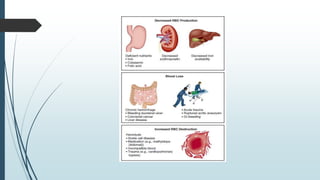
ď‚´ Decreased numbers of circulating RBCs is the usual cause of anemia. This
may arise due to:
ď‚´ Decreased RBC production
ď‚´ Increased RBC loss
ď‚´ Increased RBC destruction
Aetiology and Risk Factors
Decreased RBC production
ď‚´ Can be caused by:
ď‚´ Altered haemoglobin synthesis
ď‚´ Altered DNA synthesis
ď‚´ Bone marrow failure
ď‚´ Altered haemoglobin synthesis
ď‚´ Iron deficiency
ď‚´ Thalassaemias
ď‚´ Chronic inflammation
ď‚´ Altered DNA synthesis
ď‚´ Vitamin B12 malabsorption or deficiency
ď‚´ Folic acid malabsorption or deficiency
ď‚´ Bone marrow failure
ď‚´ Aplastic anaemia (stem cell dysfunction)
ď‚´ Red cell aplasia
ď‚´ Myeloproliferative leukemias
ď‚´ Cancer metastasis, lymphoma
ď‚´ Chronic infection or inflammation, physical and emotional fatigue
Increased RBC loss
ď‚´ Can be due to acute or chronic blood loss
ď‚´ Acute blood loss causes
ď‚´ trauma
ď‚´ Haemorrhage
ď‚´ Blood vessel rupture
ď‚´ Splenic sequestration crisis
ď‚´ Chronic blood loss causes
ď‚´ Gastritis
ď‚´ GI bleeding,
ď‚´ Menorrhagia
ď‚´ Haemorrhoids
Aetiology and Risk Factors . . .
Increased RBC destruction (haemolytic anaemia)
ď‚´ Can be due to:
ď‚´ Hereditary disorders (intrinsic)
ď‚´ Acquired disorders (extrinsic)
ď‚´ Hereditary factors
ď‚´ Hereditary cell membrane disorders
 Defective haemoglobin – sickle cell anaemia or trait
ď‚´ Enzyme deficiency - Pyruvate kinase (PK) or G6PD deficiency affecting glycolysis or cell
oxidation
ď‚´ Acquired factors
ď‚´ Immune mechanisms and disorders (eg blood reaction, hypersensitivity response,
autoimmune disorders)
ď‚´ Splenomegaly and hypersplenism
ď‚´ Infections such as malaria
ď‚´ Toxins
ď‚´ Erythrocyte trauma eg due to cardiopulmonary bypass, haemolytic uremic syndrome
Pathophysiology
ď‚´ A number of different pathologic mechanisms can lead to anemia.
ď‚´ Regardless of the cause, every type of anemia reduces the oxygen-
carrying capacity of the blood due to a deficiency of RBCs or
hemoglobin, leading to tissue hypoxia (low oxygen in your tissues).
ď‚´ The resulting manifestations depend on the severity of the anemia,
how quickly it develops, and other factors such as age and health
status.
ď‚´ As tissue oxygenation decreases, the heart and respiratory rates rise in an
attempt to increase cardiac output and tissue perfusion.
ď‚´ Tissue hypoxia may cause angina, fatigue, dyspnea on exertion, and night
cramps.
ď‚´ It also stimulates erythropoietin release; increased erythropoietin activity
stimulates RBC production in the bone marrow, and may lead to bone
pain.
ď‚´ Cerebral hypoxia can lead to headache, dizziness, and dim vision.
ď‚´ When anemia develops gradually and the RBC reduction is moderate,
successful compensatory mechanisms may result in few symptoms except
when the oxygen needs of the body increase due to exercise or infection.
ď‚´ Symptoms develop as RBCs and hemoglobin levels are further reduced.
ď‚´ Pallor of the skin, mucous membranes, conjunctiva, and nail beds develops
as a result of blood redistribution to vital organs and lack of hemoglobin.
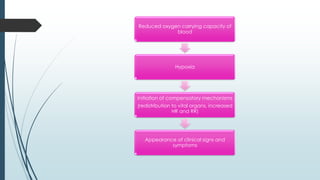
Reduced oxygen carrying capacity of
blood
Hypoxia
Initiation of compensatory mechanisms
(redistribution to vital organs, increased
HR and RR)
Appearance of clinical signs and
symptoms
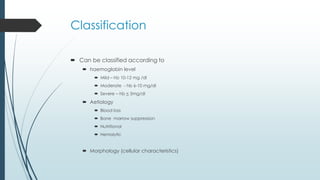
Classification
ď‚´ Can be classified according to
ď‚´ haemoglobin level
 Mild – hb 10-12 mg /dl
ď‚´ Moderate - hb 6-10 mg/dl
 Severe – hb < 5mg/dl
ď‚´ Aetiology
ď‚´ Blood loss
ď‚´ Bone marrow suppression
ď‚´ Nutritional
ď‚´ Hemolytic
ď‚´ Morphology (cellular characteristics)
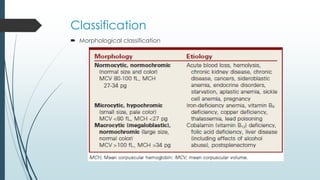
Classification
ď‚´ Morphological classification
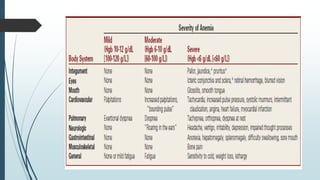
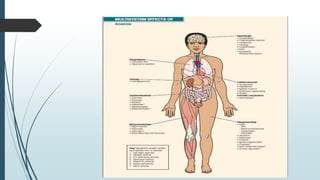
Clinical Manifestations
 Are caused by the body’s response to tissue hypoxia.
ď‚´ Specific manifestations vary depending on the rate at which the anemia
has evolved, its severity, and any coexisting disease.
ď‚´ Mild states of anemia (Hgb 10 to 12 g/dL [100 to 120 g/L]) may exist without
causing symptoms.
ď‚´ If symptoms develop, it is because the patient has an underlying disease or
is experiencing a compensatory response to heavy exercise.
ď‚´ Symptoms include palpitations, dyspnea, and mild fatigue.
ď‚´ In moderate anemia (Hgb 6 to 10 g/dL [60 to 100 g/L]) the
cardiopulmonary symptoms are increased.
ď‚´ The patient may experience them while resting, as well as with activity.
ď‚´ In severe anemia (Hgb less than 6 g/dL [60 g/L]) the patient has many
clinical manifestations involving multiple body systems
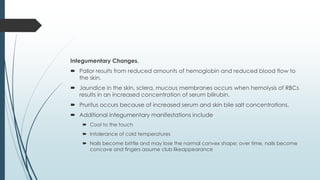
Integumentary Changes.
ď‚´ Pallor results from reduced amounts of hemoglobin and reduced blood flow to
the skin.
ď‚´ Jaundice in the skin, sclera, mucous membranes occurs when hemolysis of RBCs
results in an increased concentration of serum bilirubin.
ď‚´ Pruritus occurs because of increased serum and skin bile salt concentrations.
ď‚´ Additional integumentary manifestations include
ď‚´ Cool to the touch
ď‚´ Intolerance of cold temperatures
ď‚´ Nails become brittle and may lose the normal convex shape; over time, nails become
concave and fingers assume club likeappearance
Cardiopulmonary Manifestations.
ď‚´ Cardiopulmonary manifestations of severe anemia result from additional
attempts by the heart and lungs to provide adequate amounts of oxygen
to the tissues.
ď‚´ Cardiac output is maintained by increasing the heart rate and stroke
volume.
ď‚´ The patient will experience tachycardia at basal activity levels, increasing
with activity and during and immediately after meals
ď‚´ The low viscosity of the blood contributes to the development of systolic
murmurs and bruits.
ď‚´ Orthostatic hypotension
Respiratory Manifestations
ď‚´ Additional symptoms include decreased oxygen saturation levels
Neurologic Manifestations
ď‚´ Additional symptoms include Increased somnolence meaning
Diagnostic tests
ď‚´ When anemia is suspected, diagnostic tests are done to confirm the
presence of anaemia, determine the type of anaemia and to
identify the cause of the anaemia. These may include:
ď‚´ Full blood count (FBC)
ď‚´ Full blood count (FBC) is done to determine blood cell counts, hemoglobin, hematocrit,
and RBC indices.
ď‚´ The severity of the anemia, shape, volume, and iron content of the RBCs can help
determine the cause of anemia.
ď‚´ Iron levels and total iron-binding capacity
ď‚´ to detect iron deficiency anemia.
ď‚´ A low serum iron concentration and elevated total iron-binding capacity are indicative
of iron deficiency anemia.
ď‚´ Serum ferritin
ď‚´ Ferritin is an iron-storage protein produced by the liver, spleen, and bone marrow, it mobilizes stored iron when metabolic
needs are higher than dietary intake.
ď‚´ It is low due to depletion of the total iron reserves available for hemoglobin synthesis.
ď‚´ Sickle cell test
ď‚´ Sickle cell test is a screening test to evaluate hemolytic anemia and detect HbS.
ď‚´ It is used to evaluate hemolytic anemia, diagnose thalassemia, and differentiate sickle
cell trait from sickle cell disease.
ď‚´ Schilling test
ď‚´ measures vitamin B12 absorption before and after intrinsic factor administration to
differentiate between pernicious anemia and intestinal malabsorption of the vitamin.
ď‚´ A 24-hour urine sample is collected following administration of radioactive vitamin B12.
ď‚´ Lower than normal levels of the tagged B12 when intrinsic factor is given concurrently
indicate malabsorption rather than pernicious anemia.
ď‚´ Bone marrow examination
ď‚´ done to diagnose aplastic anemia.
ď‚´ In aplastic anemia, normal marrow elements are significantly decreased as they are
replaced by fat cells.
ď‚´ Quantitative assay of G6PD
ď‚´ Quantitative assay of G6PD may be performed to confirm a diagnosis of G6PD
deficiency.
ď‚´ Blood grouping and cross matching
ď‚´ Done when there is severe anaemia or blood loss requiring blood replacement therapy
ď‚´ Stool examination
ď‚´ To check for occult bleeding
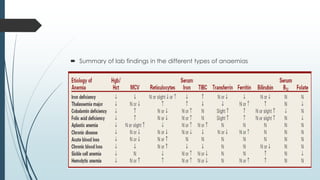
ď‚´ Summary of lab findings in the different types of anaemias
Medical Management
ď‚´ Ensuring adequate tissue oxygenation is the priority of care
ď‚´ Specific therapy is based on the underlying cause of the anaemia and the
patient’s clinical picture.
ď‚´ Usual treatments include
ď‚´ medications,
ď‚´ dietary modifications
ď‚´ blood replacement
ď‚´ supportive interventions
ď‚´ Medications that can be prescribed depending on the cause include.
ď‚´ Iron replacement therapy
ď‚´ Vitamin B12
ď‚´ Hydroxyurea
ď‚´ Erythropoietin
ď‚´ Folic acid
ď‚´ Erythropoietin
ď‚´ may be ordered for patients with low erythropoietin levels (e.g., patients with
chronic renal failure) and people with anemia associated with other chronic
diseases.
ď‚´ Given subcutaneously, and may be given as often as three times a week in
chronic renal failure.
ď‚´ Because erythropoietin stimulates RBC production, adequate iron must be
present.
ď‚´ Patients receiving erythropoietin may require regular intravenous iron therapy as
well
ď‚´ Indications for blood transfusion in adults:
ď‚´ Hb less than 5g/dl
ď‚´ Hb less than 8g/dl and there are clinical complications
 For patients undergoing surgery – if hb less than 8g/dl
 Dose considerations – one unit of whole blood or one unit of packed red cells will
raise a patients haemoglobin by 1 – 1.5g/dl
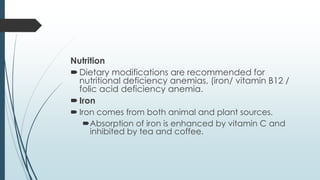
Nutrition
ď‚´Dietary modifications are recommended for
nutritional deficiency anemias, (iron/ vitamin B12 /
folic acid deficiency anemia.
ď‚´Iron
ď‚´ Iron comes from both animal and plant sources.
ď‚´Absorption of iron is enhanced by vitamin C and
inhibited by tea and coffee.
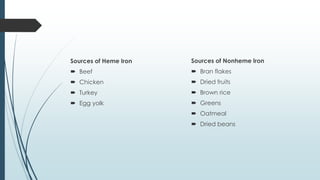
Sources of Heme Iron
ď‚´ Beef
ď‚´ Chicken
ď‚´ Turkey
ď‚´ Egg yolk
Sources of Nonheme Iron
ď‚´ Bran flakes
ď‚´ Dried fruits
ď‚´ Brown rice
ď‚´ Greens
ď‚´ Oatmeal
ď‚´ Dried beans
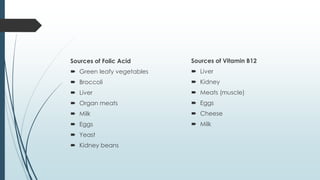
Sources of Folic Acid
ď‚´ Green leafy vegetables
ď‚´ Broccoli
ď‚´ Liver
ď‚´ Organ meats
ď‚´ Milk
ď‚´ Eggs
ď‚´ Yeast
ď‚´ Kidney beans
Sources of Vitamin B12
ď‚´ Liver
ď‚´ Kidney
ď‚´ Meats (muscle)
ď‚´ Eggs
ď‚´ Cheese
ď‚´ Milk
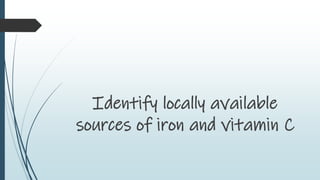
Identify locally available
sources of iron and vitamin C
ď‚´ Iron deficiency anaemia
ď‚´ Assess for a haematological response to iron therapy
ď‚´ Identify and treat the underlying cause
ď‚´ Increased intake of iron rich foods
 Iron supplements e.g Ferrous sulphate 200mg PO daily with meals for 30 days –
the expected haemoglobin rise is approx. 2g/dl every 3 – 6 weeks
ď‚´ Vitamin B12 deficiency anaemia
ď‚´ Increase intake of foods containing vitamin b12 eg meats, eggs and dairy
products
ď‚´ Folic acid and Vitamin B12 supplements in combination
ď‚´ Folic acid 5mg PO daily until hb returns to normal
ď‚´ Vitamin B12 IM 1mg daily for 7 days
ď‚´ Parenteral supplements for deficiency due to malabsorption or lack of intrinsic
factor
ď‚´ Folic acid deficiency anaemia
ď‚´ Increased intake of foods rich in folic acid (folate)
ď‚´ Oral folic acid supplements
ď‚´ Folic acid supplements are also given to women who are pregnant or may
become pregnant to prevent neural tube defects
ď‚´ Sickle cell anaemia
ď‚´ Primary treatment is supportive
ď‚´ Hydroxyurea (15mg/kg daily then increase by 5mg/kg every 12th week to a
maximum of 35mg/kg daily) may be prescribed for patients with sickle cell
disease, particularly those with frequent crises or severe disease.
ď‚´ Hydroxyurea stimulates the production of fetal haemoglobin which is less
likely to turn into a sickle shape
ď‚´ In a sickle cell crisis
ď‚´ Rest
ď‚´ Oxygen therapy to maintain SAO2
ď‚´ Narcotic analgesia
ď‚´ Vigorous hydration
ď‚´ Treatment of precipitating factors
ď‚´ Thalassemia
ď‚´ Regular blood transfusions
ď‚´ Folic acid supplements
ď‚´ Possible splenectomy
ď‚´ Genetic counselling
ď‚´ Aplastic anemia
ď‚´ Withdrawal of the causative agent, if known
ď‚´ Blood transfusions
ď‚´ Bone marrow transplant as indicated
ď‚´ Immunosuppressive therapy with corticosteroids and cyclosporine may be used
Alternative and Complementary Therapies
ď‚´ Therapy is determined by the specific type of anemia.
Which local therapies have you ever heard about?
Nursing Care
ď‚´ Utilise the nursing process
ď‚´ Specific care depends on the presentation (clinical picture) and specific
needs of the patient
ď‚´ Holistic individualized care must be provided
Nursing Assessment
Subjective Data
ď‚´ Health history:
ď‚´ Patient complaints
ď‚´ Patient may complain of shortness of breath with activity, fatigue, weakness,
dizziness or fainting, palpitations; history of previous anemia, bleeding episodes;
Past health history:
ď‚´ Recent blood loss or trauma; history of chronic diseases; chronic liver, endocrine,
or renal disease (including dialysis); GI disease (malabsorption syndrome, ulcers,
gastritis, or hemorrhoids); inflammatory disorders; exposure to radiation or
chemical toxins; infectious diseases (e.g. malaria) or recent travel with possible
exposure to infection
ď‚´ Medication history, Use of vitamin and iron supplements; aspirin, anticoagulants,
oral contraceptives, phenobarbital, penicillins, nonsteroidal antiinflammatory
drugs, omeprazole, phenacetin, phenytoin (Dilantin), sulfonamides, herbal
products
Past health history cont. . .
ď‚´ Surgery or other treatments: Recent surgery, small bowel resection, gastrectomy,
prosthetic heart valves, chemotherapy, radiation therapy
ď‚´ Gynaecological history
ď‚´ Menstrual history
ď‚´ Inquire about PV bleeding of any kind
ď‚´ Social history
ď‚´ economic status
ď‚´ social habits such as alcohol intake or cigarette smoking
ď‚´ Nutritional history
ď‚´ usual diet and patterns
Objective Data
Includes physical examination and lab data
ď‚´ General survey
ď‚´ General appearance,
ď‚´ Lethargy,
ď‚´ apathy,
ď‚´ general lymphadenopathy,
ď‚´ fever,
ď‚´ vital signs
ď‚´ Integumentary
ď‚´ Pallor of the skin and mucous membranes;
ď‚´ Color of the sclera and conjunctiva
ď‚´ Cheilitis (inflammation of the lips);
ď‚´ poor skin turgor;
ď‚´ brittle, spoonshaped fingernails;
Integumentary cont. . .
ď‚´ jaundice;
ď‚´ Petechiae Petechiae are tiny pinpoint purple, red, or brown nonraised perfectly
round spots on the skin that appear as a result of bleeding.;
ď‚´ ecchymoses (Small hemorrhagic spots, larger than petechiae, nonelevated,
round or irregular)
ď‚´ nose or gingival bleeding;
ď‚´ poor healing;
ď‚´ Respiratory
ď‚´ Tachypnea
ď‚´ Dyspnea at rest or on exertion
ď‚´ Oxygen saturation
ď‚´ Cardiovascular
ď‚´ Tachycardia,
ď‚´ systolic murmur,
ď‚´ dysrhythmias;
ď‚´ postural hypotension,
ď‚´ widened pulse pressure,
ď‚´ bruits (especially carotid);
ď‚´ peripheral edema
ď‚´ Gastrointestinal
ď‚´ Hepatosplenomegaly;
ď‚´ Glossitis - inflammation of the tongue.
ď‚´ Beefy, red tongue
ď‚´ Stomatitis - an inflamed and sore mouth
ď‚´ Abdominal distention
ď‚´ Anorexia
ď‚´ Neurologic
ď‚´ Headache,
ď‚´ roaring in the ears,
ď‚´ confusion,
ď‚´ dizziness
ď‚´ impaired judgment,
ď‚´ irritability,
ď‚´ Ataxia - impaired balance or coordination
ď‚´ unsteady gait,
ď‚´ paralysis
Nursing Diagnoses and Interventions
ď‚´ Anemia affects circulating oxygen levels and tissue oxygenation which
becomes the most priority need to manage
ď‚´ When circulation is also compromised it becomes the next priority need
ď‚´ When identifying priorities, always consider A,B,C and safety of both the
patient and others
Nursing diagnoses include
ď‚´ Ineffective breathing pattern, tachypnea, related to reduced oxygen
carrying capacity of the blood secondary to anaemia, evidenced by a
respiratory rate of 36 breaths per minute and use of accessory muscles for
breathing
ď‚´ Risk for decreased cardiac output related to decreased oxygenation
ď‚´ Activity Intolerance related to tissue hypoxia evidenced by dyspnea on
exertion
ď‚´ Impaired oral mucous membranes related to reduced tissue oxygenation
secondary to anaemia evidenced by sores in mouth
ď‚´ Selfcare deficit , bathing/ feeding/ toileting related to body weakness
evidenced by patient looking unkempt
ď‚´ Anxiety related to illness and hospitalization evidenced by patient looking
worried
ď‚´ Knowledge deficit regarding the condition and its management
evidenced by patients verbalization
Nursing Interventions
Ineffective breathing pattern
ď‚´ Position the patient in fowlers position
ď‚´ This will make the abdominal contents go down with gravity, allowing
maximum lung expansion for improved breathing and oxygenation.
 Administer humidified oxygen therapy 4 – 6l per minute in order to
supplement oxygen intake and ease breathing effort/ reduce the work of
breathing
 Encourage deep breathing as tolerated – emphasising slow inhalation,
holding end expiration for a few seconds, passive exhalation and pursed lip
breathing. This promotes deep inspiration which increases oxygenation and
may help slow respirations.
ď‚´ Collect blood sample for grouping and cross matching and send to the lab
together with a request for blood to be administered to the patient. To
enable them to prepare the correct blood to be administered to the
patient
ď‚´ Transfuse one (two or three) pint of blood as ordered to increase
haemoglobin level which will enable improved tissue oxygenation and
improve breathing
ď‚´ Maintain rest to avoid increasing oxygen demands by the body
ď‚´ Monitor respiratory rate, depth, and effort, including the use of accessory
muscles, nasal flaring, and abnormal breathing patterns every hour to note
early any changes and allow for prompt intervention
 Monitor patient’s behavior and mental status for onset of restlessness,
agitation, confusion, and (in the late stages) extreme lethargy. Changes in
behavior and mental status can be early signs of impaired gas exchange,
Cognitive changes may occur with chronic hypoxia. Monitoring will allow
for early detection, reporting and prompt intervention
ď‚´ Observe for nail beds, cyanosis in skin; especially note color of tongue and
oral mucous membranes. Central cyanosis of tongue and oral mucosa is
indicative of serious hypoxia and is a medical emergency. Peripheral
cyanosis in extremities may or may not be serious
ď‚´ Monitor oxygen saturation continuously, using pulse oximeter. For early
detection of changes in oxygenation.
Activity intolerance
ď‚´ Promote bed rest in order to reduce demand for oxygen and
energy
ď‚´ Assist to develop a schedule of alternating activity and rest periods
throughout the day. Rest periods decrease oxygen needs, reducing
strain on the heart and lungs, and allowing restoration of
homeostasis before further activities.
ď‚´ Conduct nursing care in blocks, where possible during the activity
periods in order to promote rest and reduce oxygen and energy
demands.
ď‚´ Help the patient and family establish priorities for tasks and activities. To limit
the patients activity. Family is involved because family members may need
to assume responsibility for additional tasks and need to understand the
care process and goals
ď‚´ Help identify ways to conserve energy when performing necessary or
desired activities such as keeping frequently used items close to the
patients bed so that he doesn’t have to move out to get them.
ď‚´ Assist the patient with all activities requiring high energy use such as
bathing, use of wheelchair for movement in order to reduce oxygen
demands and conserve energy
ď‚´ Encourage 8 to 10 hours of sleep at night. Rest decreases oxygen demands
and increases available energy for morning activities.
ď‚´ Monitor vital signs before and after activity. Vital signs provide a measure of
activity tolerance. Increased heart and respiratory rates or a change in
blood pressure may indicate intolerance of the activity.
ď‚´ Discontinue any activity if any of the following occur:
ď‚´ Complaints of chest pain, breathlessness, or vertigo
ď‚´ Palpitations or tachycardia that does not return to normal within 4 minutes of resting
ď‚´ Bradycardia
ď‚´ Tachypnea or dyspnea
ď‚´ e. Decreased systolic blood pressure
ď‚´ These changes may signify cardiac decompensation due to insufficient
oxygenation. The intensity, duration, or frequency of the activity needs
to be reduced.
ď‚´ Instruct the patient not to smoke. Smoking causes vasoconstriction
and increases carbon monoxide levels in the blood, interfering with
tissue oxygenation.
Impaired oral mucous membranes
ď‚´ Use a mouthwash of saline, saltwater, or half-strength peroxide and water to
rinse the mouth every 2 to 4 hours. This cleanses and soothes oral mucous
membranes and promotes wound healing
ď‚´ Avoid alcohol-based mouthwashes. Alcohol-based mouthwashes further irritate
and dry oral tissues.
ď‚´ Provide frequent oral hygiene (after each meal and at bedtime) with a soft
bristle toothbrush or sponge. Removing food debris from painful fissures
promotes comfort. A soft toothbrush reduces irritation or bleeding of oral
mucosa. Keeping the oral cavity clean also reduces the risk of infection.
ď‚´ Apply a petroleum-based lubricating jelly or ointment to the lips after oral care.
Lubricating ointment helps to retain moisture, facilitate healing, and protect the
lips from other drying agents which can also cause cracking.
ď‚´ Instruct the patient to avoid hot, spicy, or acidic foods. Such foods may
further irritate and dry mucous membranes.
ď‚´ Encourage soft, cool, bland foods such as porridge, mashed potatoes, soft
nsima with beans, mashed fruits and green leafy vegetables. Foods that
are soothing to the mucous membranes promote comfort and help
maintain adequate food and fluid intake. Minimizing oral pain may also
promote compliance with oral care routines while promoting adequate
nutrition for energy and blood cell formation.
ď‚´ Encourage eating four to six small meals daily with high protein, mineral,
and vitamin content. Small, frequent meals may be better tolerated,
increasing intake. Nutrient-rich meals promote healing of the mucous
membranes.
ď‚´ Monitor condition of lips and tongue daily. Glossitis and cheilosis increase
the risk for bleeding and infection and may require medical treatment. Pain
and discomfort may interfere with oral intake, further worsening the
nutritional deficiency.
Self-Care Deficit
ď‚´ Assist the patient to accept the necessary amount of dependence. Being
dependent affects the patients self esteem and counselling will help to
promote acceptance of deficits and provided help. It will also keep the
patient from attempting to do strenuous activities by self which can lead to
injuries and falls
ď‚´ Assist with ADLs, such as bathing, grooming, and eating, toileting as
needed. Assistance decreases energy expenditures and tissue
requirements for oxygen, reducing cardiac workload.
ď‚´ Discuss the importance of rest periods prior to such activities as dressing.
Rest reduces oxygen demand and cardiac workload. The person who is
able to perform self-care in ADLs maintains independence, self-esteem,
and morale.
ď‚´ Assess the patients need for assistive devices as they increase independence in
performing ADLs
 Identify preferences for food, personal care and mobility – the patient is likely to
participate in self-care that supports her personal preferences
ď‚´ Assess ability to perform ADLs effectively and safely on a daily basis. To promote
gradual return to independence
Patient education
ď‚´ With the exception of anemia resulting from acute hemorrhage, most patients with
anemia are treated in the home and community setting unless they need blood
transfusion or treatment for some underlying or concomitant conditions.
ď‚´ Health education becomes a very important part of their care
ď‚´ Education is needed for patients being treated at home and also patients who are
being discharged after treatment for anaemia
ď‚´ Include the following topics when preparing the patient and family for home
care:
ď‚´ Causes of anaemia
ď‚´ Risk factors for anaemia
ď‚´ Clinical presentation of anaemia
ď‚´ Nutritional strategies to address deficiencies, specify nutrient needs and give
locally available examples of such
ď‚´ Prescribed medications, vitamins, or mineral supplements and their appropriate
use, intended effect, possible adverse effects, and interactions with food or
other medications
ď‚´ Encourage compliance
ď‚´ Keep away from children
ď‚´ Advise to come for refills where necessary
What are the side effects of medications used in
the management of anaemia
ď‚´ Importance of rest
ď‚´ Including energy conservation strategies
 Provide information on follow-up care –
ď‚´ when,
ď‚´ where,
ď‚´ its importance
ď‚´ Danger signs to warrant immediate return to the hospital
Prevention
ď‚´ Nursing measures to prevent anemia focus on teaching good dietary habits to
all patients, regardless of age.
ď‚´ Stress the importance of consuming adequate amounts of iron, folate, and the
B vitamins.
ď‚´ Provide a list of dietary sources of these nutrients.
ď‚´ Discuss alternate iron sources with vegetarian patients, and teach them that
foods high in vitamin C enhance the absorption of iron from grains, legumes,
and other sources.
ď‚´ Emphasize the importance of adequate iron intake in women of childbearing
age and older adults.
ď‚´ Stress the increased need for these nutrients during pregnancy
ď‚´ Discuss strategies to ensure an adequate intake.
Complications
ď‚´ Heart failure may develop in severe anemia.
ď‚´ In extreme cases or when concomitant heart disease is present, angina
pectoris and myocardial infarction (MI) may occur if myocardial O2 needs
cannot be met.
ď‚´ Cardiomegaly, pulmonary and systemic congestion, ascites, and
peripheral edema may develop if the heart is overworked for an extended
period.
Reading assignment
1. Blood transfusion reactions and their
management
2. Interpretation of the parameters
on a full blood count result
References
ď‚´ Ignativacious D.D., Workman M.L. (2013). Medical Surgical Nursing- Patient
Centred Collaborative Care. 7th Ed. Elsevier Saunders. St Louis.
ď‚´ Lemone P.; Burke K.; Bauldouff G. (2011).Medical Surgical Nursing- Critical
Thinking In Patient Care. 5th ed. Pearson Education Inc. Boston.
ď‚´ Lewis S.L.; Dirksen, S.R.; Heitkemper M.M.; Bucher L.; Harding M.M. (2014).
Medical Surgical Nursing- Assessment and Management of Clinical
Problems. 9th ed. Elsevier Mosby. St. Loius.
ď‚´ Malawi standard treatment guidelines (2015)

ANAEMIA.pdf

  • 1.
  • 2.
    OBJECTIVES ď‚´ By theend of the lesson, learners should be able to: ď‚´ Define anaemia ď‚´ Describe the aetiology of anaemia ď‚´ Discuss the risk factors for anaemia ď‚´ Explain the pathophysiology of anaemia ď‚´ Describe the classification of anaemia
  • 3.
    ď‚´ Describe theclinical manifestations of anaemia ď‚´ Describe the diagnostic investigations for anaemia ď‚´ Explain the medical management of anaemia ď‚´ Explain the nursing management of anaemia ď‚´ Discuss the education of a client with anaemia ď‚´ Describe the complications of anaemia
  • 4.
    Definition ď‚´ Anemia isa reduction in either the number of RBCs, the amount of hemoglobin, or the hematocrit (percentage of packed RBCs per deciliter of blood). ď‚´ Anemia is a clinical sign, not a specific disease not a specific disease. It is a manifestation of a pathologic process and may occur with many health problems. ď‚´ Because RBCs transport oxygen (O2), erythrocyte disorders can lead to tissue hypoxia. ď‚´ This hypoxia accounts for many of the signs and symptoms of anemia.
  • 5.
    Aetiology ď‚´ Decreased numbersof circulating RBCs is the usual cause of anemia. This may arise due to: ď‚´ Decreased RBC production ď‚´ Increased RBC loss ď‚´ Increased RBC destruction
  • 7.
    Aetiology and RiskFactors Decreased RBC production ď‚´ Can be caused by: ď‚´ Altered haemoglobin synthesis ď‚´ Altered DNA synthesis ď‚´ Bone marrow failure
  • 8.
    ď‚´ Altered haemoglobinsynthesis ď‚´ Iron deficiency ď‚´ Thalassaemias ď‚´ Chronic inflammation
  • 9.
    ď‚´ Altered DNAsynthesis ď‚´ Vitamin B12 malabsorption or deficiency ď‚´ Folic acid malabsorption or deficiency ď‚´ Bone marrow failure ď‚´ Aplastic anaemia (stem cell dysfunction) ď‚´ Red cell aplasia ď‚´ Myeloproliferative leukemias ď‚´ Cancer metastasis, lymphoma ď‚´ Chronic infection or inflammation, physical and emotional fatigue
  • 10.
    Increased RBC loss ď‚´Can be due to acute or chronic blood loss ď‚´ Acute blood loss causes ď‚´ trauma ď‚´ Haemorrhage ď‚´ Blood vessel rupture ď‚´ Splenic sequestration crisis
  • 11.
    ď‚´ Chronic bloodloss causes ď‚´ Gastritis ď‚´ GI bleeding, ď‚´ Menorrhagia ď‚´ Haemorrhoids
  • 12.
    Aetiology and RiskFactors . . . Increased RBC destruction (haemolytic anaemia) ď‚´ Can be due to: ď‚´ Hereditary disorders (intrinsic) ď‚´ Acquired disorders (extrinsic)
  • 13.
     Hereditary factors Hereditary cell membrane disorders  Defective haemoglobin – sickle cell anaemia or trait  Enzyme deficiency - Pyruvate kinase (PK) or G6PD deficiency affecting glycolysis or cell oxidation
  • 14.
    ď‚´ Acquired factors ď‚´Immune mechanisms and disorders (eg blood reaction, hypersensitivity response, autoimmune disorders) ď‚´ Splenomegaly and hypersplenism ď‚´ Infections such as malaria ď‚´ Toxins ď‚´ Erythrocyte trauma eg due to cardiopulmonary bypass, haemolytic uremic syndrome
  • 15.
    Pathophysiology ď‚´ A numberof different pathologic mechanisms can lead to anemia. ď‚´ Regardless of the cause, every type of anemia reduces the oxygen- carrying capacity of the blood due to a deficiency of RBCs or hemoglobin, leading to tissue hypoxia (low oxygen in your tissues). ď‚´ The resulting manifestations depend on the severity of the anemia, how quickly it develops, and other factors such as age and health status.
  • 16.
    ď‚´ As tissueoxygenation decreases, the heart and respiratory rates rise in an attempt to increase cardiac output and tissue perfusion. ď‚´ Tissue hypoxia may cause angina, fatigue, dyspnea on exertion, and night cramps. ď‚´ It also stimulates erythropoietin release; increased erythropoietin activity stimulates RBC production in the bone marrow, and may lead to bone pain. ď‚´ Cerebral hypoxia can lead to headache, dizziness, and dim vision.
  • 17.
    ď‚´ When anemiadevelops gradually and the RBC reduction is moderate, successful compensatory mechanisms may result in few symptoms except when the oxygen needs of the body increase due to exercise or infection. ď‚´ Symptoms develop as RBCs and hemoglobin levels are further reduced. ď‚´ Pallor of the skin, mucous membranes, conjunctiva, and nail beds develops as a result of blood redistribution to vital organs and lack of hemoglobin.
  • 18.
    Reduced oxygen carryingcapacity of blood Hypoxia Initiation of compensatory mechanisms (redistribution to vital organs, increased HR and RR) Appearance of clinical signs and symptoms
  • 19.
    Classification  Can beclassified according to  haemoglobin level  Mild – hb 10-12 mg /dl  Moderate - hb 6-10 mg/dl  Severe – hb < 5mg/dl  Aetiology  Blood loss  Bone marrow suppression  Nutritional  Hemolytic  Morphology (cellular characteristics)
  • 20.
  • 21.
    Clinical Manifestations  Arecaused by the body’s response to tissue hypoxia.  Specific manifestations vary depending on the rate at which the anemia has evolved, its severity, and any coexisting disease.  Mild states of anemia (Hgb 10 to 12 g/dL [100 to 120 g/L]) may exist without causing symptoms.  If symptoms develop, it is because the patient has an underlying disease or is experiencing a compensatory response to heavy exercise.
  • 22.
    ď‚´ Symptoms includepalpitations, dyspnea, and mild fatigue. ď‚´ In moderate anemia (Hgb 6 to 10 g/dL [60 to 100 g/L]) the cardiopulmonary symptoms are increased. ď‚´ The patient may experience them while resting, as well as with activity. ď‚´ In severe anemia (Hgb less than 6 g/dL [60 g/L]) the patient has many clinical manifestations involving multiple body systems
  • 24.
    Integumentary Changes. ď‚´ Pallorresults from reduced amounts of hemoglobin and reduced blood flow to the skin. ď‚´ Jaundice in the skin, sclera, mucous membranes occurs when hemolysis of RBCs results in an increased concentration of serum bilirubin. ď‚´ Pruritus occurs because of increased serum and skin bile salt concentrations. ď‚´ Additional integumentary manifestations include ď‚´ Cool to the touch ď‚´ Intolerance of cold temperatures ď‚´ Nails become brittle and may lose the normal convex shape; over time, nails become concave and fingers assume club likeappearance
  • 25.
    Cardiopulmonary Manifestations. ď‚´ Cardiopulmonarymanifestations of severe anemia result from additional attempts by the heart and lungs to provide adequate amounts of oxygen to the tissues. ď‚´ Cardiac output is maintained by increasing the heart rate and stroke volume. ď‚´ The patient will experience tachycardia at basal activity levels, increasing with activity and during and immediately after meals ď‚´ The low viscosity of the blood contributes to the development of systolic murmurs and bruits. ď‚´ Orthostatic hypotension
  • 26.
    Respiratory Manifestations ď‚´ Additionalsymptoms include decreased oxygen saturation levels Neurologic Manifestations ď‚´ Additional symptoms include Increased somnolence meaning
  • 28.
    Diagnostic tests ď‚´ Whenanemia is suspected, diagnostic tests are done to confirm the presence of anaemia, determine the type of anaemia and to identify the cause of the anaemia. These may include: ď‚´ Full blood count (FBC) ď‚´ Full blood count (FBC) is done to determine blood cell counts, hemoglobin, hematocrit, and RBC indices. ď‚´ The severity of the anemia, shape, volume, and iron content of the RBCs can help determine the cause of anemia.
  • 29.
    ď‚´ Iron levelsand total iron-binding capacity ď‚´ to detect iron deficiency anemia. ď‚´ A low serum iron concentration and elevated total iron-binding capacity are indicative of iron deficiency anemia. ď‚´ Serum ferritin ď‚´ Ferritin is an iron-storage protein produced by the liver, spleen, and bone marrow, it mobilizes stored iron when metabolic needs are higher than dietary intake. ď‚´ It is low due to depletion of the total iron reserves available for hemoglobin synthesis.
  • 30.
    ď‚´ Sickle celltest ď‚´ Sickle cell test is a screening test to evaluate hemolytic anemia and detect HbS. ď‚´ It is used to evaluate hemolytic anemia, diagnose thalassemia, and differentiate sickle cell trait from sickle cell disease. ď‚´ Schilling test ď‚´ measures vitamin B12 absorption before and after intrinsic factor administration to differentiate between pernicious anemia and intestinal malabsorption of the vitamin. ď‚´ A 24-hour urine sample is collected following administration of radioactive vitamin B12. ď‚´ Lower than normal levels of the tagged B12 when intrinsic factor is given concurrently indicate malabsorption rather than pernicious anemia.
  • 31.
    ď‚´ Bone marrowexamination ď‚´ done to diagnose aplastic anemia. ď‚´ In aplastic anemia, normal marrow elements are significantly decreased as they are replaced by fat cells. ď‚´ Quantitative assay of G6PD ď‚´ Quantitative assay of G6PD may be performed to confirm a diagnosis of G6PD deficiency. ď‚´ Blood grouping and cross matching ď‚´ Done when there is severe anaemia or blood loss requiring blood replacement therapy ď‚´ Stool examination ď‚´ To check for occult bleeding
  • 32.
    ď‚´ Summary oflab findings in the different types of anaemias
  • 33.
    Medical Management  Ensuringadequate tissue oxygenation is the priority of care  Specific therapy is based on the underlying cause of the anaemia and the patient’s clinical picture.  Usual treatments include  medications,  dietary modifications  blood replacement  supportive interventions
  • 34.
    ď‚´ Medications thatcan be prescribed depending on the cause include. ď‚´ Iron replacement therapy ď‚´ Vitamin B12 ď‚´ Hydroxyurea ď‚´ Erythropoietin ď‚´ Folic acid
  • 35.
    ď‚´ Erythropoietin ď‚´ maybe ordered for patients with low erythropoietin levels (e.g., patients with chronic renal failure) and people with anemia associated with other chronic diseases. ď‚´ Given subcutaneously, and may be given as often as three times a week in chronic renal failure. ď‚´ Because erythropoietin stimulates RBC production, adequate iron must be present. ď‚´ Patients receiving erythropoietin may require regular intravenous iron therapy as well
  • 36.
     Indications forblood transfusion in adults:  Hb less than 5g/dl  Hb less than 8g/dl and there are clinical complications  For patients undergoing surgery – if hb less than 8g/dl  Dose considerations – one unit of whole blood or one unit of packed red cells will raise a patients haemoglobin by 1 – 1.5g/dl
  • 37.
    Nutrition ď‚´Dietary modifications arerecommended for nutritional deficiency anemias, (iron/ vitamin B12 / folic acid deficiency anemia. ď‚´Iron ď‚´ Iron comes from both animal and plant sources. ď‚´Absorption of iron is enhanced by vitamin C and inhibited by tea and coffee.
  • 38.
    Sources of HemeIron ď‚´ Beef ď‚´ Chicken ď‚´ Turkey ď‚´ Egg yolk Sources of Nonheme Iron ď‚´ Bran flakes ď‚´ Dried fruits ď‚´ Brown rice ď‚´ Greens ď‚´ Oatmeal ď‚´ Dried beans
  • 39.
    Sources of FolicAcid ď‚´ Green leafy vegetables ď‚´ Broccoli ď‚´ Liver ď‚´ Organ meats ď‚´ Milk ď‚´ Eggs ď‚´ Yeast ď‚´ Kidney beans Sources of Vitamin B12 ď‚´ Liver ď‚´ Kidney ď‚´ Meats (muscle) ď‚´ Eggs ď‚´ Cheese ď‚´ Milk
  • 40.
  • 41.
     Iron deficiencyanaemia  Assess for a haematological response to iron therapy  Identify and treat the underlying cause  Increased intake of iron rich foods  Iron supplements e.g Ferrous sulphate 200mg PO daily with meals for 30 days – the expected haemoglobin rise is approx. 2g/dl every 3 – 6 weeks
  • 42.
    ď‚´ Vitamin B12deficiency anaemia ď‚´ Increase intake of foods containing vitamin b12 eg meats, eggs and dairy products ď‚´ Folic acid and Vitamin B12 supplements in combination ď‚´ Folic acid 5mg PO daily until hb returns to normal ď‚´ Vitamin B12 IM 1mg daily for 7 days ď‚´ Parenteral supplements for deficiency due to malabsorption or lack of intrinsic factor
  • 43.
    ď‚´ Folic aciddeficiency anaemia ď‚´ Increased intake of foods rich in folic acid (folate) ď‚´ Oral folic acid supplements ď‚´ Folic acid supplements are also given to women who are pregnant or may become pregnant to prevent neural tube defects
  • 44.
    ď‚´ Sickle cellanaemia ď‚´ Primary treatment is supportive ď‚´ Hydroxyurea (15mg/kg daily then increase by 5mg/kg every 12th week to a maximum of 35mg/kg daily) may be prescribed for patients with sickle cell disease, particularly those with frequent crises or severe disease. ď‚´ Hydroxyurea stimulates the production of fetal haemoglobin which is less likely to turn into a sickle shape
  • 45.
    ď‚´ In asickle cell crisis ď‚´ Rest ď‚´ Oxygen therapy to maintain SAO2 ď‚´ Narcotic analgesia ď‚´ Vigorous hydration ď‚´ Treatment of precipitating factors
  • 46.
    ď‚´ Thalassemia ď‚´ Regularblood transfusions ď‚´ Folic acid supplements ď‚´ Possible splenectomy ď‚´ Genetic counselling
  • 47.
    ď‚´ Aplastic anemia ď‚´Withdrawal of the causative agent, if known ď‚´ Blood transfusions ď‚´ Bone marrow transplant as indicated ď‚´ Immunosuppressive therapy with corticosteroids and cyclosporine may be used
  • 48.
    Alternative and ComplementaryTherapies ď‚´ Therapy is determined by the specific type of anemia. Which local therapies have you ever heard about?
  • 49.
    Nursing Care ď‚´ Utilisethe nursing process ď‚´ Specific care depends on the presentation (clinical picture) and specific needs of the patient ď‚´ Holistic individualized care must be provided
  • 50.
    Nursing Assessment Subjective Data ď‚´Health history: ď‚´ Patient complaints ď‚´ Patient may complain of shortness of breath with activity, fatigue, weakness, dizziness or fainting, palpitations; history of previous anemia, bleeding episodes;
  • 51.
    Past health history: ď‚´Recent blood loss or trauma; history of chronic diseases; chronic liver, endocrine, or renal disease (including dialysis); GI disease (malabsorption syndrome, ulcers, gastritis, or hemorrhoids); inflammatory disorders; exposure to radiation or chemical toxins; infectious diseases (e.g. malaria) or recent travel with possible exposure to infection ď‚´ Medication history, Use of vitamin and iron supplements; aspirin, anticoagulants, oral contraceptives, phenobarbital, penicillins, nonsteroidal antiinflammatory drugs, omeprazole, phenacetin, phenytoin (Dilantin), sulfonamides, herbal products
  • 52.
    Past health historycont. . . ď‚´ Surgery or other treatments: Recent surgery, small bowel resection, gastrectomy, prosthetic heart valves, chemotherapy, radiation therapy ď‚´ Gynaecological history ď‚´ Menstrual history ď‚´ Inquire about PV bleeding of any kind ď‚´ Social history ď‚´ economic status ď‚´ social habits such as alcohol intake or cigarette smoking ď‚´ Nutritional history ď‚´ usual diet and patterns
  • 53.
    Objective Data Includes physicalexamination and lab data ď‚´ General survey ď‚´ General appearance, ď‚´ Lethargy, ď‚´ apathy, ď‚´ general lymphadenopathy, ď‚´ fever, ď‚´ vital signs
  • 54.
    ď‚´ Integumentary ď‚´ Pallorof the skin and mucous membranes; ď‚´ Color of the sclera and conjunctiva ď‚´ Cheilitis (inflammation of the lips); ď‚´ poor skin turgor; ď‚´ brittle, spoonshaped fingernails;
  • 55.
    Integumentary cont. .. ď‚´ jaundice; ď‚´ Petechiae Petechiae are tiny pinpoint purple, red, or brown nonraised perfectly round spots on the skin that appear as a result of bleeding.; ď‚´ ecchymoses (Small hemorrhagic spots, larger than petechiae, nonelevated, round or irregular) ď‚´ nose or gingival bleeding; ď‚´ poor healing;
  • 56.
    ď‚´ Respiratory ď‚´ Tachypnea ď‚´Dyspnea at rest or on exertion ď‚´ Oxygen saturation
  • 57.
    ď‚´ Cardiovascular ď‚´ Tachycardia, ď‚´systolic murmur, ď‚´ dysrhythmias; ď‚´ postural hypotension, ď‚´ widened pulse pressure, ď‚´ bruits (especially carotid); ď‚´ peripheral edema
  • 58.
    ď‚´ Gastrointestinal ď‚´ Hepatosplenomegaly; ď‚´Glossitis - inflammation of the tongue. ď‚´ Beefy, red tongue ď‚´ Stomatitis - an inflamed and sore mouth ď‚´ Abdominal distention ď‚´ Anorexia
  • 59.
    ď‚´ Neurologic ď‚´ Headache, ď‚´roaring in the ears, ď‚´ confusion, ď‚´ dizziness ď‚´ impaired judgment, ď‚´ irritability, ď‚´ Ataxia - impaired balance or coordination ď‚´ unsteady gait, ď‚´ paralysis
  • 60.
    Nursing Diagnoses andInterventions ď‚´ Anemia affects circulating oxygen levels and tissue oxygenation which becomes the most priority need to manage ď‚´ When circulation is also compromised it becomes the next priority need ď‚´ When identifying priorities, always consider A,B,C and safety of both the patient and others
  • 61.
    Nursing diagnoses include ď‚´Ineffective breathing pattern, tachypnea, related to reduced oxygen carrying capacity of the blood secondary to anaemia, evidenced by a respiratory rate of 36 breaths per minute and use of accessory muscles for breathing ď‚´ Risk for decreased cardiac output related to decreased oxygenation ď‚´ Activity Intolerance related to tissue hypoxia evidenced by dyspnea on exertion
  • 62.
    ď‚´ Impaired oralmucous membranes related to reduced tissue oxygenation secondary to anaemia evidenced by sores in mouth ď‚´ Selfcare deficit , bathing/ feeding/ toileting related to body weakness evidenced by patient looking unkempt ď‚´ Anxiety related to illness and hospitalization evidenced by patient looking worried ď‚´ Knowledge deficit regarding the condition and its management evidenced by patients verbalization
  • 63.
    Nursing Interventions Ineffective breathingpattern  Position the patient in fowlers position  This will make the abdominal contents go down with gravity, allowing maximum lung expansion for improved breathing and oxygenation.  Administer humidified oxygen therapy 4 – 6l per minute in order to supplement oxygen intake and ease breathing effort/ reduce the work of breathing  Encourage deep breathing as tolerated – emphasising slow inhalation, holding end expiration for a few seconds, passive exhalation and pursed lip breathing. This promotes deep inspiration which increases oxygenation and may help slow respirations.
  • 64.
    ď‚´ Collect bloodsample for grouping and cross matching and send to the lab together with a request for blood to be administered to the patient. To enable them to prepare the correct blood to be administered to the patient ď‚´ Transfuse one (two or three) pint of blood as ordered to increase haemoglobin level which will enable improved tissue oxygenation and improve breathing ď‚´ Maintain rest to avoid increasing oxygen demands by the body ď‚´ Monitor respiratory rate, depth, and effort, including the use of accessory muscles, nasal flaring, and abnormal breathing patterns every hour to note early any changes and allow for prompt intervention
  • 65.
     Monitor patient’sbehavior and mental status for onset of restlessness, agitation, confusion, and (in the late stages) extreme lethargy. Changes in behavior and mental status can be early signs of impaired gas exchange, Cognitive changes may occur with chronic hypoxia. Monitoring will allow for early detection, reporting and prompt intervention  Observe for nail beds, cyanosis in skin; especially note color of tongue and oral mucous membranes. Central cyanosis of tongue and oral mucosa is indicative of serious hypoxia and is a medical emergency. Peripheral cyanosis in extremities may or may not be serious  Monitor oxygen saturation continuously, using pulse oximeter. For early detection of changes in oxygenation.
  • 66.
    Activity intolerance ď‚´ Promotebed rest in order to reduce demand for oxygen and energy ď‚´ Assist to develop a schedule of alternating activity and rest periods throughout the day. Rest periods decrease oxygen needs, reducing strain on the heart and lungs, and allowing restoration of homeostasis before further activities. ď‚´ Conduct nursing care in blocks, where possible during the activity periods in order to promote rest and reduce oxygen and energy demands.
  • 67.
     Help thepatient and family establish priorities for tasks and activities. To limit the patients activity. Family is involved because family members may need to assume responsibility for additional tasks and need to understand the care process and goals  Help identify ways to conserve energy when performing necessary or desired activities such as keeping frequently used items close to the patients bed so that he doesn’t have to move out to get them.
  • 68.
    ď‚´ Assist thepatient with all activities requiring high energy use such as bathing, use of wheelchair for movement in order to reduce oxygen demands and conserve energy ď‚´ Encourage 8 to 10 hours of sleep at night. Rest decreases oxygen demands and increases available energy for morning activities. ď‚´ Monitor vital signs before and after activity. Vital signs provide a measure of activity tolerance. Increased heart and respiratory rates or a change in blood pressure may indicate intolerance of the activity.
  • 69.
    ď‚´ Discontinue anyactivity if any of the following occur: ď‚´ Complaints of chest pain, breathlessness, or vertigo ď‚´ Palpitations or tachycardia that does not return to normal within 4 minutes of resting ď‚´ Bradycardia ď‚´ Tachypnea or dyspnea ď‚´ e. Decreased systolic blood pressure ď‚´ These changes may signify cardiac decompensation due to insufficient oxygenation. The intensity, duration, or frequency of the activity needs to be reduced. ď‚´ Instruct the patient not to smoke. Smoking causes vasoconstriction and increases carbon monoxide levels in the blood, interfering with tissue oxygenation.
  • 70.
    Impaired oral mucousmembranes ď‚´ Use a mouthwash of saline, saltwater, or half-strength peroxide and water to rinse the mouth every 2 to 4 hours. This cleanses and soothes oral mucous membranes and promotes wound healing ď‚´ Avoid alcohol-based mouthwashes. Alcohol-based mouthwashes further irritate and dry oral tissues. ď‚´ Provide frequent oral hygiene (after each meal and at bedtime) with a soft bristle toothbrush or sponge. Removing food debris from painful fissures promotes comfort. A soft toothbrush reduces irritation or bleeding of oral mucosa. Keeping the oral cavity clean also reduces the risk of infection. ď‚´ Apply a petroleum-based lubricating jelly or ointment to the lips after oral care. Lubricating ointment helps to retain moisture, facilitate healing, and protect the lips from other drying agents which can also cause cracking.
  • 71.
    ď‚´ Instruct thepatient to avoid hot, spicy, or acidic foods. Such foods may further irritate and dry mucous membranes. ď‚´ Encourage soft, cool, bland foods such as porridge, mashed potatoes, soft nsima with beans, mashed fruits and green leafy vegetables. Foods that are soothing to the mucous membranes promote comfort and help maintain adequate food and fluid intake. Minimizing oral pain may also promote compliance with oral care routines while promoting adequate nutrition for energy and blood cell formation.
  • 72.
    ď‚´ Encourage eatingfour to six small meals daily with high protein, mineral, and vitamin content. Small, frequent meals may be better tolerated, increasing intake. Nutrient-rich meals promote healing of the mucous membranes. ď‚´ Monitor condition of lips and tongue daily. Glossitis and cheilosis increase the risk for bleeding and infection and may require medical treatment. Pain and discomfort may interfere with oral intake, further worsening the nutritional deficiency.
  • 73.
    Self-Care Deficit ď‚´ Assistthe patient to accept the necessary amount of dependence. Being dependent affects the patients self esteem and counselling will help to promote acceptance of deficits and provided help. It will also keep the patient from attempting to do strenuous activities by self which can lead to injuries and falls ď‚´ Assist with ADLs, such as bathing, grooming, and eating, toileting as needed. Assistance decreases energy expenditures and tissue requirements for oxygen, reducing cardiac workload. ď‚´ Discuss the importance of rest periods prior to such activities as dressing. Rest reduces oxygen demand and cardiac workload. The person who is able to perform self-care in ADLs maintains independence, self-esteem, and morale.
  • 74.
     Assess thepatients need for assistive devices as they increase independence in performing ADLs  Identify preferences for food, personal care and mobility – the patient is likely to participate in self-care that supports her personal preferences  Assess ability to perform ADLs effectively and safely on a daily basis. To promote gradual return to independence
  • 75.
    Patient education ď‚´ Withthe exception of anemia resulting from acute hemorrhage, most patients with anemia are treated in the home and community setting unless they need blood transfusion or treatment for some underlying or concomitant conditions. ď‚´ Health education becomes a very important part of their care ď‚´ Education is needed for patients being treated at home and also patients who are being discharged after treatment for anaemia
  • 76.
    ď‚´ Include thefollowing topics when preparing the patient and family for home care: ď‚´ Causes of anaemia ď‚´ Risk factors for anaemia ď‚´ Clinical presentation of anaemia ď‚´ Nutritional strategies to address deficiencies, specify nutrient needs and give locally available examples of such ď‚´ Prescribed medications, vitamins, or mineral supplements and their appropriate use, intended effect, possible adverse effects, and interactions with food or other medications ď‚´ Encourage compliance ď‚´ Keep away from children ď‚´ Advise to come for refills where necessary
  • 77.
    What are theside effects of medications used in the management of anaemia
  • 78.
     Importance ofrest  Including energy conservation strategies  Provide information on follow-up care –  when,  where,  its importance  Danger signs to warrant immediate return to the hospital
  • 79.
    Prevention ď‚´ Nursing measuresto prevent anemia focus on teaching good dietary habits to all patients, regardless of age. ď‚´ Stress the importance of consuming adequate amounts of iron, folate, and the B vitamins. ď‚´ Provide a list of dietary sources of these nutrients. ď‚´ Discuss alternate iron sources with vegetarian patients, and teach them that foods high in vitamin C enhance the absorption of iron from grains, legumes, and other sources. ď‚´ Emphasize the importance of adequate iron intake in women of childbearing age and older adults. ď‚´ Stress the increased need for these nutrients during pregnancy ď‚´ Discuss strategies to ensure an adequate intake.
  • 80.
    Complications ď‚´ Heart failuremay develop in severe anemia. ď‚´ In extreme cases or when concomitant heart disease is present, angina pectoris and myocardial infarction (MI) may occur if myocardial O2 needs cannot be met. ď‚´ Cardiomegaly, pulmonary and systemic congestion, ascites, and peripheral edema may develop if the heart is overworked for an extended period.
  • 81.
    Reading assignment 1. Bloodtransfusion reactions and their management 2. Interpretation of the parameters on a full blood count result
  • 82.
    References ď‚´ Ignativacious D.D.,Workman M.L. (2013). Medical Surgical Nursing- Patient Centred Collaborative Care. 7th Ed. Elsevier Saunders. St Louis. ď‚´ Lemone P.; Burke K.; Bauldouff G. (2011).Medical Surgical Nursing- Critical Thinking In Patient Care. 5th ed. Pearson Education Inc. Boston. ď‚´ Lewis S.L.; Dirksen, S.R.; Heitkemper M.M.; Bucher L.; Harding M.M. (2014). Medical Surgical Nursing- Assessment and Management of Clinical Problems. 9th ed. Elsevier Mosby. St. Loius. ď‚´ Malawi standard treatment guidelines (2015)