A certified food protection
manager training program
Module 1: Approved Supplier
The Story
• Winston-Salem, NC, November 2001
• 12 individuals admitted to hospital
– 11 females, 1 male with poor immune system
• Symptoms: fever, chills, abdominal cramps, stiff neck,
vomiting and light sensitivity
Investigating Agencies
• NC Communicable Disease Control Branch
• Forsyth County Health Department
• NC Department of Agriculture & Consumer Services
• Environmental and Natural Resources
• FDA
• CDC
What Happened?
• Sick with Listeria monocytogenes
• 10 sick pregnant women
– 5 stillbirths, 3 premature deliveries, 2 infected
newborns
• 1 woman with meningitis
• 1 man with a poor immune system spent 1 month in the
hospital
What Went Wrong?
• Queso Fresco, soft Mexican-style cheese was made
from contaminated raw milk
• Made in 5 gallon buckets fermented in someone's home
bathtub
• Cheese sold in small grocery stores, parking lots and
door-to door
Problems
Food was not from approved source.
• Raw (unpasteurized) milk used as an ingredient
• Cheese made in non-approved facility
• Lack of temperature control for transporting cheese
before sale
Result: Contaminated cheese caused 12 illnesses
Outbreak Resulted in Big Changes
• NC health authorities stopped sale of raw milk by dairy
farmers to noncommercial processors
• Education of store owners – illegal to sell unregulated
dairy products
• FDA requires pasteurization of all dairy products sold
across state lines except cheese that has aged a
minimum of 60 days
DISCUSSION
Learning Objectives
• Identify growth conditions, control, and symptoms for
Listeria monocytogenes
• List groups of susceptible individuals
• Define approved suppliers and list requirements
• Explain proper procedures for receiving
• Describe: Good Agricultural Practices, Good
Manufacturing Practices and HACCP
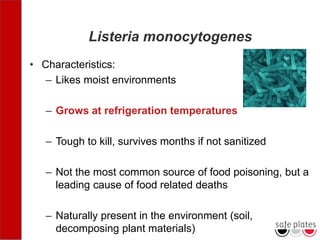
Listeria monocytogenes
• Characteristics:
– Likes moist environments
– Grows at refrigeration temperatures
– Tough to kill, survives months if not sanitized
– Not the most common source of food poisoning, but a
leading cause of food related deaths
– Naturally present in the environment (soil,
decomposing plant materials)
Listeriosis
• Associated with unpasteurized milk, soft cheeses, soft
serve ice cream, cured meats and cold cuts, fish, fresh
fruits and vegetables
• Symptoms include:
– diarrhea, vomiting, fever
– symptoms start after a few hours or 2-3 days
• At risk populations are susceptible (YOPI)
– Can cause stillbirths in pregnant mothers
• Fatality rate estimated to be 15 – 30%
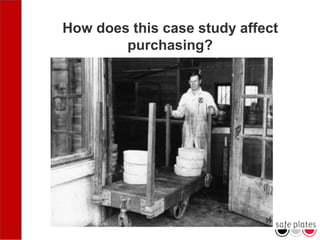
How does this case study affect
purchasing?
Prevention
• Purchase from approved suppliers
• Know your products
• Inspect incoming shipments
… An ounce of prevention is worth a pound of cure!
FDA Food Code Definition
• Approved supplier is acceptable to the regulatory
authority based on conformity to best principles and
practices that protect public health.
Approved Suppliers
• Characteristics:
– Have a good reputation
– Get ingredients from approved sources
– Are inspected by regulators
• May have additional food safety certifications or audits
done by other companies
Know Your Products
• Know regulations a producer must meet to be an
approved supplier
– Good Agricultural Practices
– Good Manufacturing Practices
– HACCP
• Risks involved with your product
– Receiving temperatures
• How to handle that product safely
Good Agricultural Practices (GAPs)
Best practices to verify that fruits and vegetables are
produced, packed, handled and stored in the safest
manner possible to minimize risks of microbial food safety
hazards.
• Water quality for irrigation, sprays and washing produce
• Proper use of compost and manure for fertilizer
• Exclusion of animals from the field
• Employee hygiene
• Safe storage and transportation
• Tracking product and notifying customers of problems
Good Manufacturing Practices (GMPs)
A lot like FDA Food Code but specific to food
processors.
• Employee health, hygiene and training
• Building condition and pest control
• Sanitary procedures for work areas, food contact
surfaces, equipment and tools
• Proper storage
• Processing practices that prevent and control
contamination
• Distribution
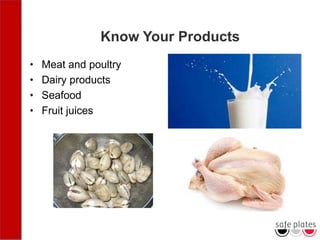
Know Your Products
• Meat and poultry
• Dairy products
• Seafood
• Fruit juices
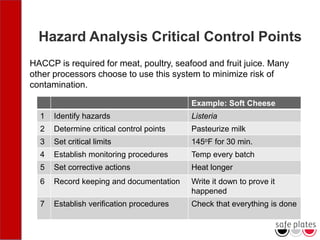
Hazard Analysis Critical Control Points
HACCP is required for meat, poultry, seafood and fruit juice. Many
other processors choose to use this system to minimize risk of
contamination.
Example: Soft Cheese
1 Identify hazards Listeria
2 Determine critical control points Pasteurize milk
3 Set critical limits 145oF for 30 min.
4 Establish monitoring procedures Temp every batch
5 Set corrective actions Heat longer
6 Record keeping and documentation Write it down to prove it
happened
7 Establish verification procedures Check that everything is done
Verifying Supplier Practices
• Do they provide good service at receiving and dealing
with quality issues?
• How do they train their employees in food safety?
• What is the protocol for rejecting and returning products?
• Do their delivery trucks look and smell clean?
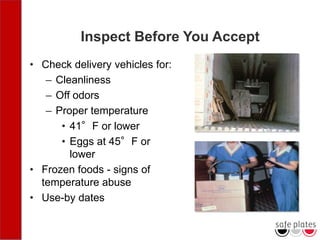
Inspect Before You Accept
• Check delivery vehicles for:
– Cleanliness
– Off odors
– Proper temperature
• 41°F or lower
• Eggs at 45°F or
lower
• Frozen foods - signs of
temperature abuse
• Use-by dates
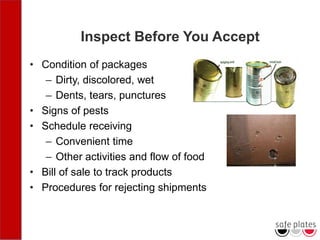
Inspect Before You Accept
• Condition of packages
– Dirty, discolored, wet
– Dents, tears, punctures
• Signs of pests
• Schedule receiving
– Convenient time
– Other activities and flow of food
• Bill of sale to track products
• Procedures for rejecting shipments
What’s Your View?
Have you ever had to reject an incoming
shipment?
Why?
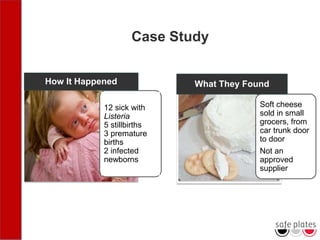
Case Study
12 sick with
Listeria
5 stillbirths
3 premature
births
2 infected
newborns
How It Happened
Soft cheese
sold in small
grocers, from
car trunk door
to door
Not an
approved
supplier
What They Found
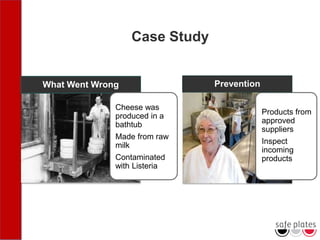
Case Study
What Went Wrong
Products from
approved
suppliers
Inspect
incoming
products
Prevention
Cheese was
produced in a
bathtub
Made from raw
milk
Contaminated
with Listeria
Quiz
When receiving food, which of the following is not a reason
for rejecting food:
a) Frozen food is thawed or partially thawed
b) There is visible mold or slime
c) Temperature Control for Safety Foods are received at
41°F or below
d) Packaging is damaged or dirty
Quiz
When receiving food, which of the following is not a reason
for rejecting food:
a) Frozen food is thawed or partially thawed
b) There is visible mold or slime
c) Temperature Control for Safety Foods are received
at 41°F or below
d) Packaging is damaged or dirty
Quiz
A shipment of frozen fish arrives at your food
establishment. You see that the outside bottoms of shipping
cartons have too much ice and the fish fillets held within the
carton have brown edges. These are signs of:
a) Thawing and refreezing
b) Safe, high quality seafood
c) Seafood that has been kept in frozen storage too long
d) Seafood that has been blast chilled
Quiz
A shipment of frozen fish arrives at your food
establishment. You see that the outside bottoms of shipping
cartons have too much ice and the fish fillets held within the
carton have brown edges. These are signs of:
a) Thawing and refreezing
b) Safe, high quality seafood
c) Seafood that has been kept in frozen storage too long
d) Seafood that has been blast chilled
Review
• Listeria
• Susceptible individuals
• Use only approved suppliers
• Know the requirements for an approved supplier
• Communicate about food safety with your suppliers
• Inspect incoming products

Safe-Plates-Mod-1-Approved-Supplier_3.16.pptx

  • 1.
    A certified foodprotection manager training program Module 1: Approved Supplier
  • 2.
    The Story • Winston-Salem,NC, November 2001 • 12 individuals admitted to hospital – 11 females, 1 male with poor immune system • Symptoms: fever, chills, abdominal cramps, stiff neck, vomiting and light sensitivity
  • 3.
    Investigating Agencies • NCCommunicable Disease Control Branch • Forsyth County Health Department • NC Department of Agriculture & Consumer Services • Environmental and Natural Resources • FDA • CDC
  • 4.
    What Happened? • Sickwith Listeria monocytogenes • 10 sick pregnant women – 5 stillbirths, 3 premature deliveries, 2 infected newborns • 1 woman with meningitis • 1 man with a poor immune system spent 1 month in the hospital
  • 5.
    What Went Wrong? •Queso Fresco, soft Mexican-style cheese was made from contaminated raw milk • Made in 5 gallon buckets fermented in someone's home bathtub • Cheese sold in small grocery stores, parking lots and door-to door
  • 6.
    Problems Food was notfrom approved source. • Raw (unpasteurized) milk used as an ingredient • Cheese made in non-approved facility • Lack of temperature control for transporting cheese before sale Result: Contaminated cheese caused 12 illnesses
  • 7.
    Outbreak Resulted inBig Changes • NC health authorities stopped sale of raw milk by dairy farmers to noncommercial processors • Education of store owners – illegal to sell unregulated dairy products • FDA requires pasteurization of all dairy products sold across state lines except cheese that has aged a minimum of 60 days
  • 8.
  • 9.
    Learning Objectives • Identifygrowth conditions, control, and symptoms for Listeria monocytogenes • List groups of susceptible individuals • Define approved suppliers and list requirements • Explain proper procedures for receiving • Describe: Good Agricultural Practices, Good Manufacturing Practices and HACCP
  • 10.
    Listeria monocytogenes • Characteristics: –Likes moist environments – Grows at refrigeration temperatures – Tough to kill, survives months if not sanitized – Not the most common source of food poisoning, but a leading cause of food related deaths – Naturally present in the environment (soil, decomposing plant materials)
  • 11.
    Listeriosis • Associated withunpasteurized milk, soft cheeses, soft serve ice cream, cured meats and cold cuts, fish, fresh fruits and vegetables • Symptoms include: – diarrhea, vomiting, fever – symptoms start after a few hours or 2-3 days • At risk populations are susceptible (YOPI) – Can cause stillbirths in pregnant mothers • Fatality rate estimated to be 15 – 30%
  • 12.
    How does thiscase study affect purchasing?
  • 13.
    Prevention • Purchase fromapproved suppliers • Know your products • Inspect incoming shipments … An ounce of prevention is worth a pound of cure!
  • 14.
    FDA Food CodeDefinition • Approved supplier is acceptable to the regulatory authority based on conformity to best principles and practices that protect public health.
  • 15.
    Approved Suppliers • Characteristics: –Have a good reputation – Get ingredients from approved sources – Are inspected by regulators • May have additional food safety certifications or audits done by other companies
  • 16.
    Know Your Products •Know regulations a producer must meet to be an approved supplier – Good Agricultural Practices – Good Manufacturing Practices – HACCP • Risks involved with your product – Receiving temperatures • How to handle that product safely
  • 17.
    Good Agricultural Practices(GAPs) Best practices to verify that fruits and vegetables are produced, packed, handled and stored in the safest manner possible to minimize risks of microbial food safety hazards. • Water quality for irrigation, sprays and washing produce • Proper use of compost and manure for fertilizer • Exclusion of animals from the field • Employee hygiene • Safe storage and transportation • Tracking product and notifying customers of problems
  • 18.
    Good Manufacturing Practices(GMPs) A lot like FDA Food Code but specific to food processors. • Employee health, hygiene and training • Building condition and pest control • Sanitary procedures for work areas, food contact surfaces, equipment and tools • Proper storage • Processing practices that prevent and control contamination • Distribution
  • 19.
    Know Your Products •Meat and poultry • Dairy products • Seafood • Fruit juices
  • 20.
    Hazard Analysis CriticalControl Points HACCP is required for meat, poultry, seafood and fruit juice. Many other processors choose to use this system to minimize risk of contamination. Example: Soft Cheese 1 Identify hazards Listeria 2 Determine critical control points Pasteurize milk 3 Set critical limits 145oF for 30 min. 4 Establish monitoring procedures Temp every batch 5 Set corrective actions Heat longer 6 Record keeping and documentation Write it down to prove it happened 7 Establish verification procedures Check that everything is done
  • 21.
    Verifying Supplier Practices •Do they provide good service at receiving and dealing with quality issues? • How do they train their employees in food safety? • What is the protocol for rejecting and returning products? • Do their delivery trucks look and smell clean?
  • 22.
    Inspect Before YouAccept • Check delivery vehicles for: – Cleanliness – Off odors – Proper temperature • 41°F or lower • Eggs at 45°F or lower • Frozen foods - signs of temperature abuse • Use-by dates
  • 23.
    Inspect Before YouAccept • Condition of packages – Dirty, discolored, wet – Dents, tears, punctures • Signs of pests • Schedule receiving – Convenient time – Other activities and flow of food • Bill of sale to track products • Procedures for rejecting shipments
  • 24.
    What’s Your View? Haveyou ever had to reject an incoming shipment? Why?
  • 25.
    Case Study 12 sickwith Listeria 5 stillbirths 3 premature births 2 infected newborns How It Happened Soft cheese sold in small grocers, from car trunk door to door Not an approved supplier What They Found
  • 26.
    Case Study What WentWrong Products from approved suppliers Inspect incoming products Prevention Cheese was produced in a bathtub Made from raw milk Contaminated with Listeria
  • 27.
    Quiz When receiving food,which of the following is not a reason for rejecting food: a) Frozen food is thawed or partially thawed b) There is visible mold or slime c) Temperature Control for Safety Foods are received at 41°F or below d) Packaging is damaged or dirty
  • 28.
    Quiz When receiving food,which of the following is not a reason for rejecting food: a) Frozen food is thawed or partially thawed b) There is visible mold or slime c) Temperature Control for Safety Foods are received at 41°F or below d) Packaging is damaged or dirty
  • 29.
    Quiz A shipment offrozen fish arrives at your food establishment. You see that the outside bottoms of shipping cartons have too much ice and the fish fillets held within the carton have brown edges. These are signs of: a) Thawing and refreezing b) Safe, high quality seafood c) Seafood that has been kept in frozen storage too long d) Seafood that has been blast chilled
  • 30.
    Quiz A shipment offrozen fish arrives at your food establishment. You see that the outside bottoms of shipping cartons have too much ice and the fish fillets held within the carton have brown edges. These are signs of: a) Thawing and refreezing b) Safe, high quality seafood c) Seafood that has been kept in frozen storage too long d) Seafood that has been blast chilled
  • 31.
    Review • Listeria • Susceptibleindividuals • Use only approved suppliers • Know the requirements for an approved supplier • Communicate about food safety with your suppliers • Inspect incoming products

Editor's Notes

  • #8 Aged cheese is less risky because of the lowered raw activity and decrease in pH due to the production of lactic acid.
  • #9 Discuss the case study briefly, why it is important, and transition into what we teach in this lesson.
  • #20 Meat and poultry products must be from an USDA inspected facility and a HACCP plan Dairy products should meet FDA Pasteurized Milk Ordinance requirments Seafood suppliers must have a HACCP Plan Fruit Juices must have a HACCP Plan
  • #21 Food Code: “After December 18, 1997, all processors of fish are required by 21 CFR 123 to have conducted a hazard analysis of their operation, identify each hazard that is reasonably likely to occur, and implement a HACCP plan to control each identified hazard. Retailers should assure that their seafood suppliers have complied with this requirement. Hazards known to be associated with specific fish species are discussed in the FDA Fish and Fishery Products Hazards and Controls Guide, available from the FDA Office of Seafood. Species-related hazards include pathogens, parasites, natural toxins, histamine, chemicals, and drugs.“ “Recreationally caught fish received for sale or service may be approved by the regulatory authority.“
  • #24 Ask about receiving surprise deliveries.
  • #28 Answer c). Maker sure they read the question closely, notice the word “not”
  • #29 Answer c). Maker sure they read the question closely, notice the word “not”
  • #30 Answer: a)
  • #31 Answer: a)