Concealed Object Recognition using
Search Identification Network
(SINet)
ADARSHA DHAKAL
PUL078MSCSK003
PROBLEM DOMAIN
i. Some objects that are concealed in images
are difficult to find.
ii. High intrinsic similarities between object
and background.
iii. COR is for detecting concealed objects
from image.
2
OBJECTIVES
• Study on object detection from a concealed vision perspective.
• To detect the concealed part of an image using Search Identification Network
(SINet).
12/11/2022 3
LITERATURE REVIEW
• Two remarkable studies on concealed animals from Abbott Thayer [2] and
Hugh Cott [3] are still hugely influential.
• COD Datasets. CHAMELEON [4] is an unpublished dataset that has only
76 images with manually annotated object-level ground-truths (GTs).
• Another contemporary dataset is CAMO [5], which has 2.5K images (2K
for training, 0.5K for testing) covering eight categories.
12/11/2022 4
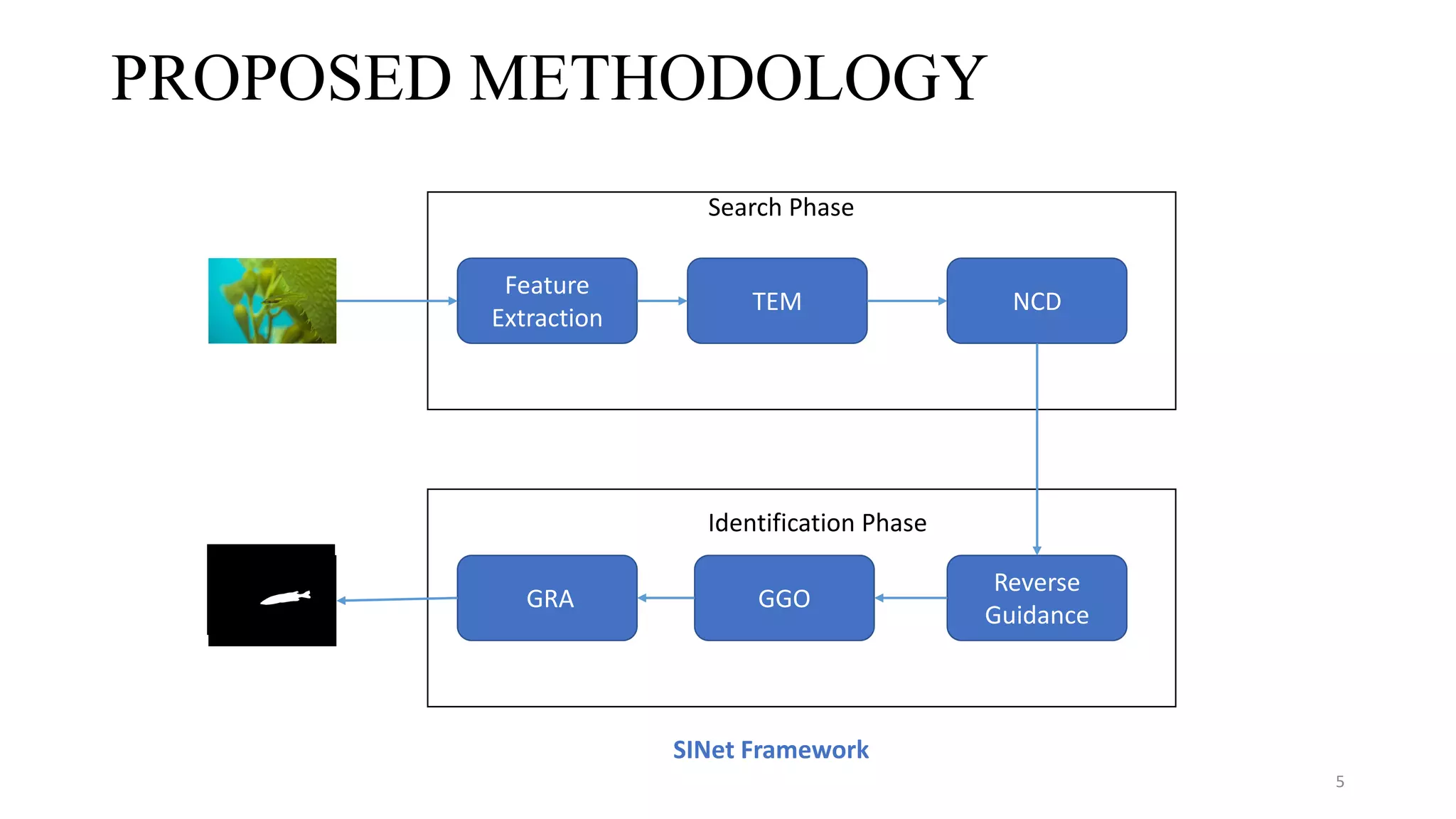
PROPOSED METHODOLOGY
5
Feature
Extraction
TEM NCD
Search Phase
GRA GGO
Reverse
Guidance
Identification Phase
SINet Framework
Search Phase
• Feature Extraction: The Res2Net represents multi-scale features at a granular
level and increases the range of receptive fields for each network layer [6].
• Texture Enhanced Module(TEM): Used to capture fine-grained textures with
enlarged context cues. It includes four parallel residual branches with
different dilation rates [7].
• Neighbor Connection Decoder(NCD): Provides the location information of
concealed object [8].
12/11/2022 6
Identification Phase
• Reverse Guidance: Principled strategy to mine discriminative concealed
regions by erasing objects by using sigmoid and reverse operation.
• Group Guidance Operation(GGO): It can explicitly isolate the guidance
prior and candidate feature before the subsequent refinement process [9].
• Group Reversal Attention(GRA): Multistage refinement is done with the
assistance of both reverse guidance and GGO to improve performance.
12/11/2022 7
EXPECTED OUTCOME
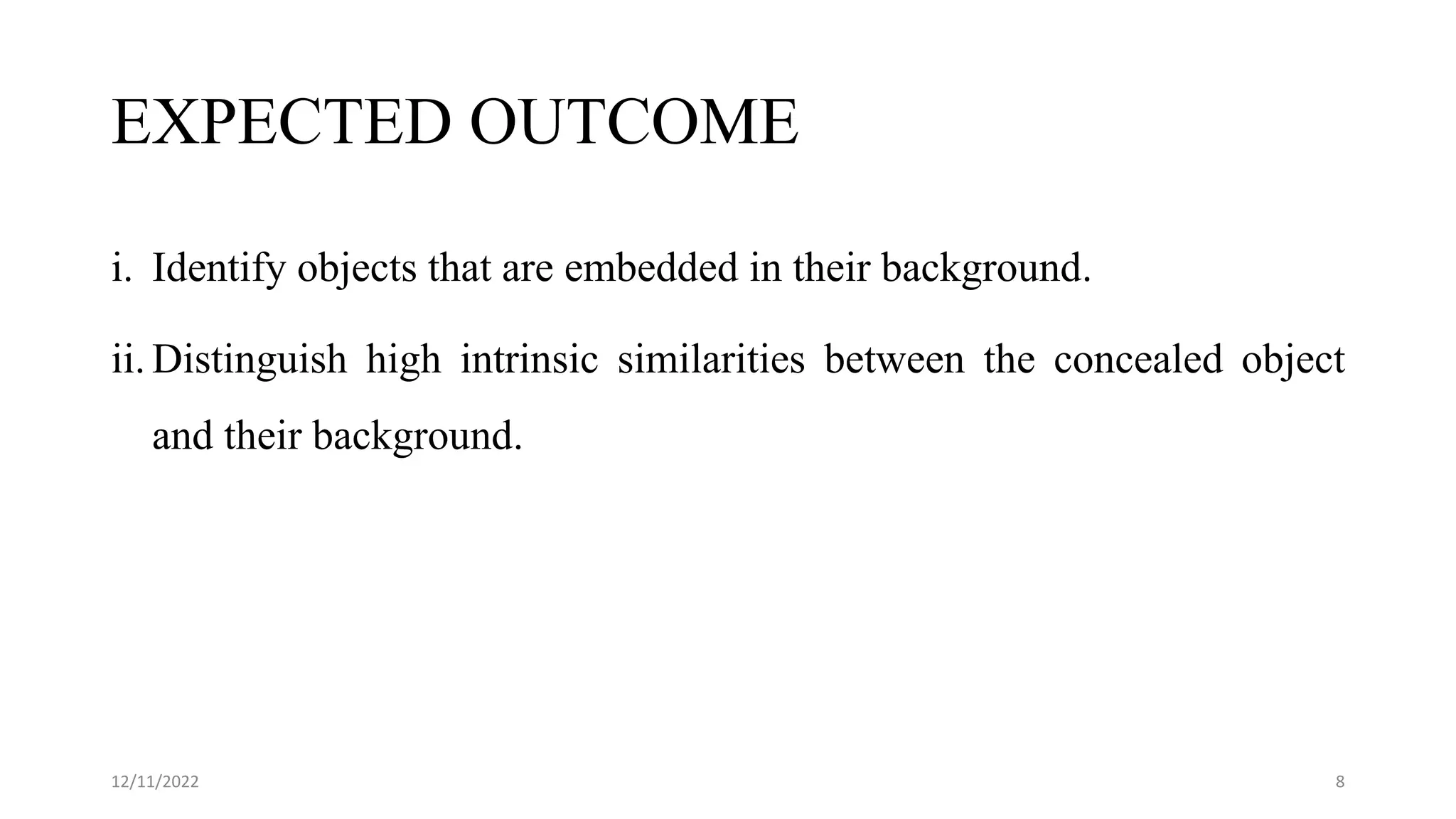
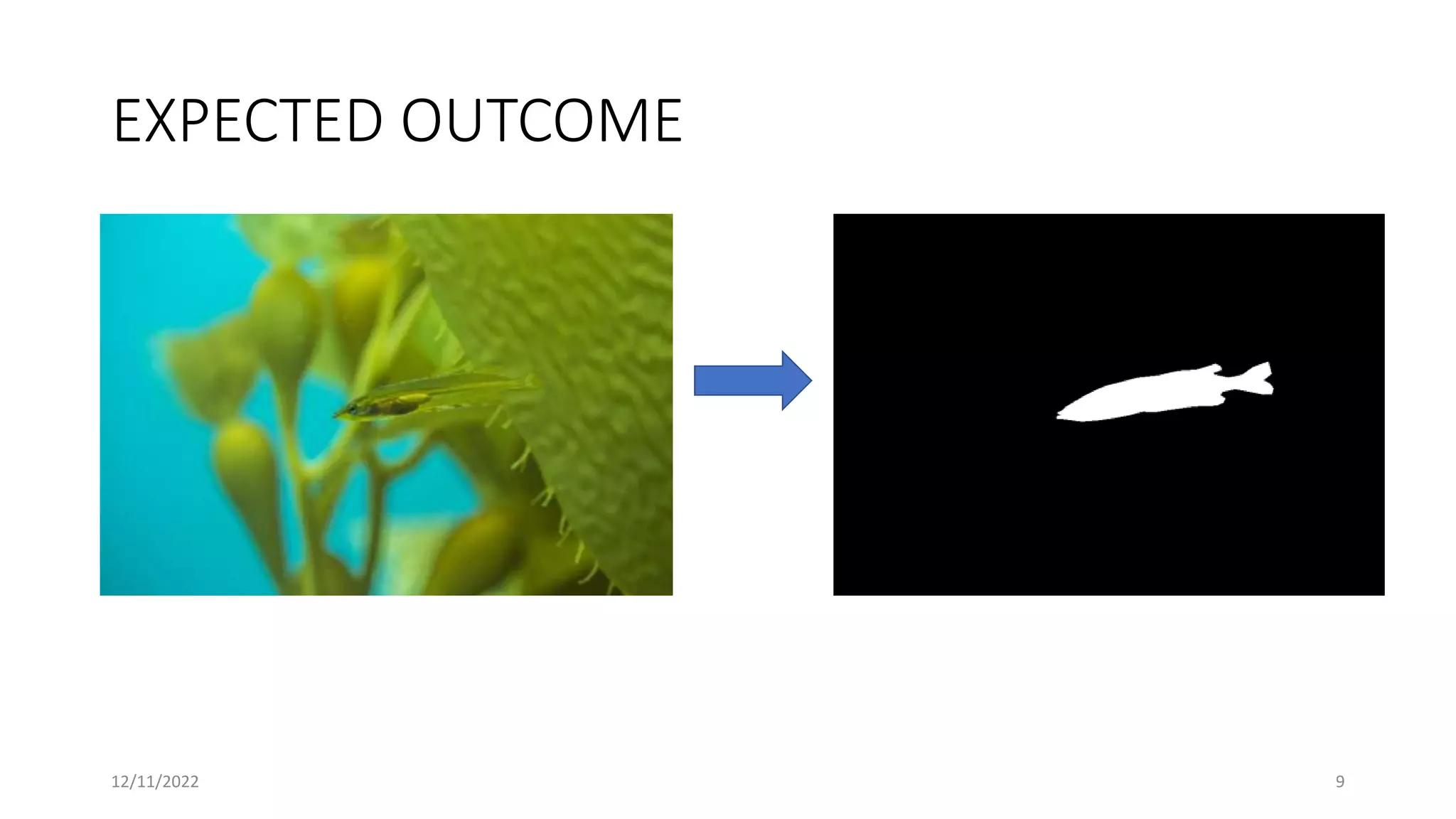
i. Identify objects that are embedded in their background.
ii. Distinguish high intrinsic similarities between the concealed object
and their background.
12/11/2022 8
EXPECTED OUTCOME
12/11/2022 9
TIME SCHEDULE
12/11/2022 10
THANK YOU
12/11/2022 11
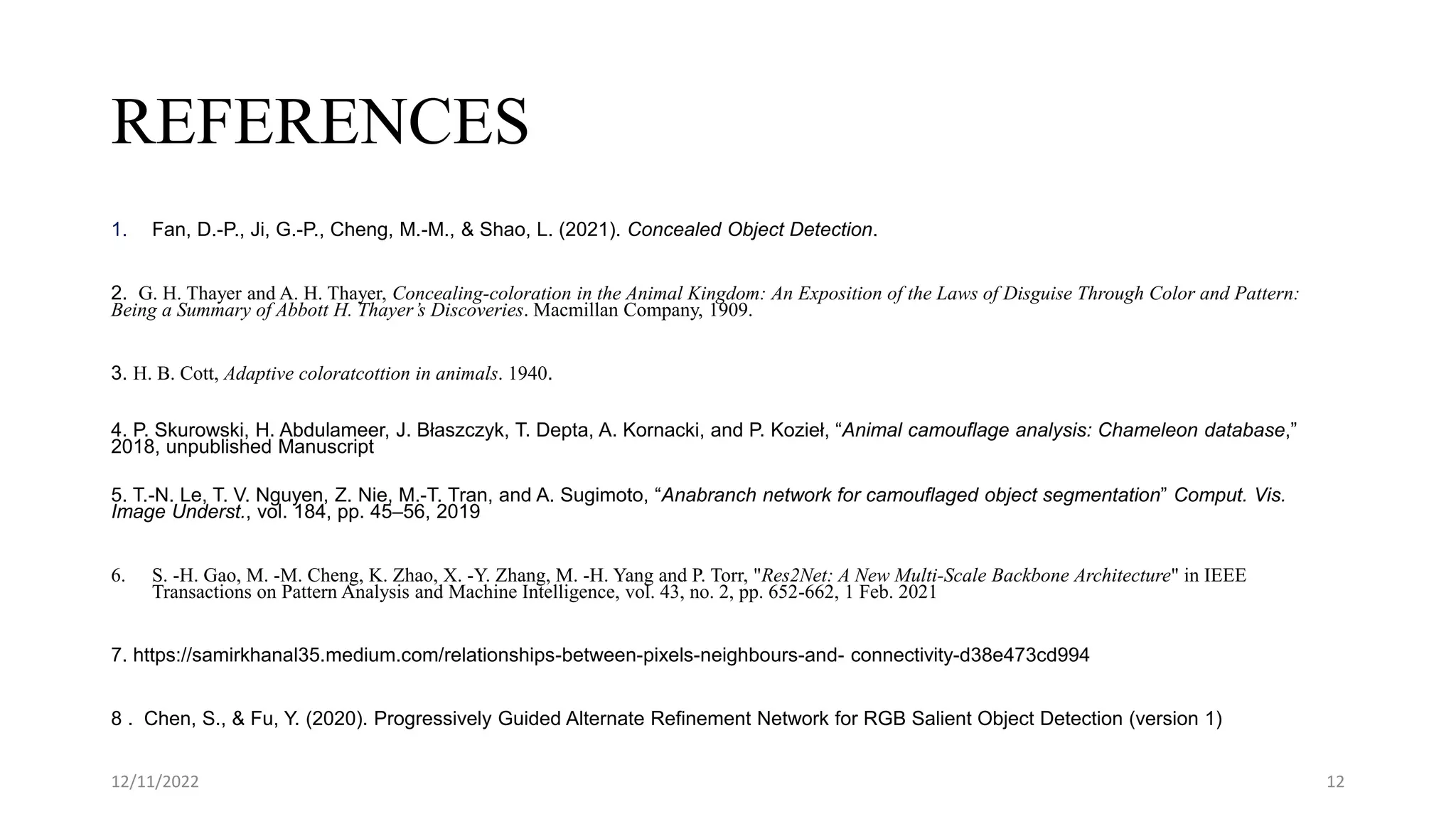
REFERENCES
1. Fan, D.-P., Ji, G.-P., Cheng, M.-M., & Shao, L. (2021). Concealed Object Detection.
2. G. H. Thayer and A. H. Thayer, Concealing-coloration in the Animal Kingdom: An Exposition of the Laws of Disguise Through Color and Pattern:
Being a Summary of Abbott H. Thayer’s Discoveries. Macmillan Company, 1909.
3. H. B. Cott, Adaptive coloratcottion in animals. 1940.
4. P. Skurowski, H. Abdulameer, J. Błaszczyk, T. Depta, A. Kornacki, and P. Kozieł, “Animal camouflage analysis: Chameleon database,”
2018, unpublished Manuscript
5. T.-N. Le, T. V. Nguyen, Z. Nie, M.-T. Tran, and A. Sugimoto, “Anabranch network for camouflaged object segmentation” Comput. Vis.
Image Underst., vol. 184, pp. 45–56, 2019
6. S. -H. Gao, M. -M. Cheng, K. Zhao, X. -Y. Zhang, M. -H. Yang and P. Torr, "Res2Net: A New Multi-Scale Backbone Architecture" in IEEE
Transactions on Pattern Analysis and Machine Intelligence, vol. 43, no. 2, pp. 652-662, 1 Feb. 2021
7. https://samirkhanal35.medium.com/relationships-between-pixels-neighbours-and- connectivity-d38e473cd994
8 . Chen, S., & Fu, Y. (2020). Progressively Guided Alternate Refinement Network for RGB Salient Object Detection (version 1)
12/11/2022 12

Concealed Object Recognition

  • 1.
    Concealed Object Recognitionusing Search Identification Network (SINet) ADARSHA DHAKAL PUL078MSCSK003
  • 2.
    PROBLEM DOMAIN i. Someobjects that are concealed in images are difficult to find. ii. High intrinsic similarities between object and background. iii. COR is for detecting concealed objects from image. 2
  • 3.
    OBJECTIVES • Study onobject detection from a concealed vision perspective. • To detect the concealed part of an image using Search Identification Network (SINet). 12/11/2022 3
  • 4.
    LITERATURE REVIEW • Tworemarkable studies on concealed animals from Abbott Thayer [2] and Hugh Cott [3] are still hugely influential. • COD Datasets. CHAMELEON [4] is an unpublished dataset that has only 76 images with manually annotated object-level ground-truths (GTs). • Another contemporary dataset is CAMO [5], which has 2.5K images (2K for training, 0.5K for testing) covering eight categories. 12/11/2022 4
  • 5.
    PROPOSED METHODOLOGY 5 Feature Extraction TEM NCD SearchPhase GRA GGO Reverse Guidance Identification Phase SINet Framework
  • 6.
    Search Phase • FeatureExtraction: The Res2Net represents multi-scale features at a granular level and increases the range of receptive fields for each network layer [6]. • Texture Enhanced Module(TEM): Used to capture fine-grained textures with enlarged context cues. It includes four parallel residual branches with different dilation rates [7]. • Neighbor Connection Decoder(NCD): Provides the location information of concealed object [8]. 12/11/2022 6
  • 7.
    Identification Phase • ReverseGuidance: Principled strategy to mine discriminative concealed regions by erasing objects by using sigmoid and reverse operation. • Group Guidance Operation(GGO): It can explicitly isolate the guidance prior and candidate feature before the subsequent refinement process [9]. • Group Reversal Attention(GRA): Multistage refinement is done with the assistance of both reverse guidance and GGO to improve performance. 12/11/2022 7
  • 8.
    EXPECTED OUTCOME i. Identifyobjects that are embedded in their background. ii. Distinguish high intrinsic similarities between the concealed object and their background. 12/11/2022 8
  • 9.
  • 10.
  • 11.
  • 12.
    REFERENCES 1. Fan, D.-P.,Ji, G.-P., Cheng, M.-M., & Shao, L. (2021). Concealed Object Detection. 2. G. H. Thayer and A. H. Thayer, Concealing-coloration in the Animal Kingdom: An Exposition of the Laws of Disguise Through Color and Pattern: Being a Summary of Abbott H. Thayer’s Discoveries. Macmillan Company, 1909. 3. H. B. Cott, Adaptive coloratcottion in animals. 1940. 4. P. Skurowski, H. Abdulameer, J. Błaszczyk, T. Depta, A. Kornacki, and P. Kozieł, “Animal camouflage analysis: Chameleon database,” 2018, unpublished Manuscript 5. T.-N. Le, T. V. Nguyen, Z. Nie, M.-T. Tran, and A. Sugimoto, “Anabranch network for camouflaged object segmentation” Comput. Vis. Image Underst., vol. 184, pp. 45–56, 2019 6. S. -H. Gao, M. -M. Cheng, K. Zhao, X. -Y. Zhang, M. -H. Yang and P. Torr, "Res2Net: A New Multi-Scale Backbone Architecture" in IEEE Transactions on Pattern Analysis and Machine Intelligence, vol. 43, no. 2, pp. 652-662, 1 Feb. 2021 7. https://samirkhanal35.medium.com/relationships-between-pixels-neighbours-and- connectivity-d38e473cd994 8 . Chen, S., & Fu, Y. (2020). Progressively Guided Alternate Refinement Network for RGB Salient Object Detection (version 1) 12/11/2022 12

Editor's Notes

  • #3 -- i कै भन्दा FOOD SECURITY सम्बन्धी केहि भन्नु पर्छ... -- ii कै भन्दा ENSEMBLE LEARNING सम्बन्धी केहि भन्नु पर्छ... -- iii कै भन्दा SMART AGRICULTURE सम्बन्धी केहि भन्नु पर्छ... -- iv कै भन्दा SMART AGRICULTURE किन जरूरी छ भन्नु पर्छ र WORLD CONSERVATION STRATEGY सम्बन्धी केहि भन्नु पर्छ...