
AN IoT BASED SECURED SMART e -
CAMPUS
C.BYREGOWDA INSTITUTE OF TECHNOLOGY
Department of Computer Science and Engineering
Kolar - Srinivaspur Road
Kolar-563101
Dept. Of CSE, CBIT 2016-17
Presented by:
SHIVARAJKUMAR T H
(1CK15SCS02)
Mr. RAJA A
Asst. Professor,
Dept. Of CSE, CBIT -
KOLAR
Internal guide:
AGENDA
• ABSTRACT
• INTRODUCTION
• LITERATURE REVIEW
• SYSTEM REQUIREMENT SPECIFICATION
• SYSTEM ANALYSIS
• SYSTEM DESIGN
• SYSTEM IMPLEMENTATION
• SYSTEM TESTING
• CONCLUSION AND FUTURE ENHANCEMENT
ABSTRACT
• New technology like (IoT) in recent years rapidly developing in a computing
world.
• The Internet of things will change the real world, activities and objects from most
complex to simple.
• In digital era our College campus need of IoT technology for classy environment
to utilize secured & modern technology for e-campus activities in academic
course of action.
• In near future drastically make changes for students in highly enabled IoT.
INTRODUCTION
• The IoT concept aims at making the internet even more immersive and
pervasive.
• Today the IoT vision is more aspiring and focuses on enabling smart and context
aware applications for people everywhere in the world.
Problem Description
• In general campus spread over a fairly large area and it is very difficult for
management to track everything that happens.
• Like Fire, Smoking, Theft entering, Ragging Etc………
Cont…
Scope and Objective of the Project
• Primary focus of smart e-campus in the education area, but they also drive the change in
other aspects such as security & safety protection.
• This leads to the adoption of a variety of smart solutions in campus environments to
enhance the quality of life.
Methodology
• Smart and Secure Inventory System.
• Campus Smart Garden Automation Water Flow System.
• GSM Based Alerts Systems.
LITERATURE REVIEW
• Aqeel-ur-Rehman et al:- The present outcomes of their research on one feature
of future smart—sensing with RFID (Radio frequency identification) technology;
it should benefit students and faculty with identification, tracking, lecture room,
lab, Class room and Attendance taking, etc
• Yu et al”:- Argue that with the development of communication and pervasive
computing technology are built to benefit the faculty and students, manage the
available resources and enhance user experience with proactive services.
SYSTEM REQUIREMENT
SPECIFICATIONS
• Functional Requirements:
Functional requirements defines a function of a software system or its
component’s. Function is described as a set of inputs, the behavior and outputs.
• Non-Functional Requirements:
The Non-Functional requirements defines the properties such as GSM
connection, response time, computation time, power supply
Cont…
Hardware Requirements
Arduino mega/uno.
GSM module.
Sensor’s.
Wifi.
Software Requirements
Windows OS
Arduino Software
Embedded C
SYSTEM ANALYSIS
Existing system
 Existing system is purely monitoring based not responsive.
 Monitoring eq: cctv etc.,,,
 Manual gardening system.
 Difficult in tracking /Managing/Maintaining/Retrenching the assets.
 Provides less tracking of students activities.
 Dependency of human interaction is High.
 De-centralized campus management.
Cont….
PROPOSED SYSTEM
• The concept of smart e-campus is defined like a small world where sensor-enabled and network
devices work continuously and collaboratively to make humans more comfort.
Advantages of proposed systems
1. SMART AND SECURED INVENTORY:
2. GSM BASED ALRETS:
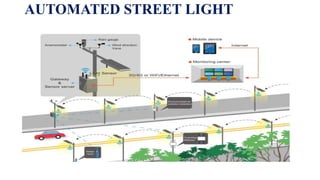
3. AUTOMATED CAMPUS STREET LIGHT:
4. CAMPUS GARDEN AUTOMATION WATER FLOW:
5. GARBAGE & WASTE COLLECTION BINS OVERFLOW ALERT SYSTEM:
12
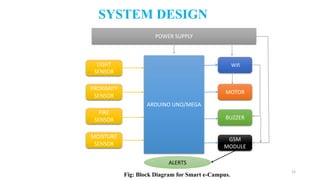
SYSTEM DESIGN
POWER SUPPLY
ARDUINO UNO/MEGA
LIGHT
SENSOR
PROXIMITY
SENSOR
FIRE
SENSOR
MOISTURE
SENSOR
Wifi
MOTOR
BUZZER
GSM
MODULE
ALERTS
Fig: Block Diagram for Smart e-Campus.
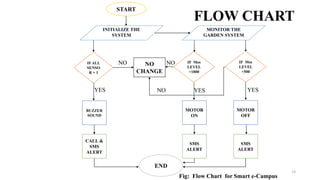
FLOW CHART
Dept of CSE, CBIT 13
START
IF ALL
SENSO
R = 1
BUZZER
SOUND
CALL &
SMS
ALERT
SMS
ALERT
MOTOR
ON
NO
CHANGE
IF Mos
LEVEL
>1000
IF Mos
LEVEL
<500
MOTOR
OFF
SMS
ALERT
YES YESYES
NO NO
NO
INITIALIZE THE
SYSTEM
MONITOR THE
GARDEN SYSTEM
END
Fig: Flow Chart for Smart e-Campus
DATA FLOW DIAGRAMS
Arduino UNO POWER SUPPLY
Light sensor
Fire Sensor
Proximity
Sensor
Arduino UNO POWER SUPPLY
Light sensor
Fire Sensor
Proximity
Sensor
Buzzer Sound
Arduino UNO
Power Supply
Light
sensor
Fire
Sensor
Proxim
ity
Sensor
GSM
Module
Buzzer
Sound
SMS &
CALL
Alerts
Level 1
Level 2 Level 3
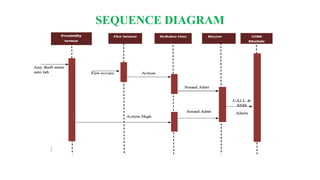
SEQUENCE DIAGRAM
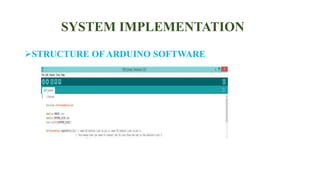
SYSTEM IMPLEMENTATION
STRUCTURE OF ARDUINO SOFTWARE
Module 1- SMART& SECURED INVENTORY
 Each piece of equipment in a lab’s (i.e Cpu, Monitor and Projector
ETC) can have an associated proximity sensor & Fire, which
represents inventory security of all devices.
 Input devices: Proximity Sensor, Fire Sensor, Smoke Sensor, light
Sensor, Arduino, Relay.
 Output devices: Buzzer, GSM modules-900.
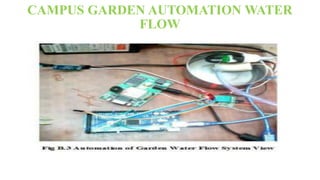
Module 2- CAMPUS GARDEN AUTOMATION
WATER FLOW
 At a glance based on moisture condition in soil. The consumed water
quantity can be reading every time and thereby controlled.
 Input devices: Soil moisture sensor , Arduino, wifi,
 Output devices: GSM modules-900, Water pump motor.
SYSTEM TESTING
Unit testing:
Each and every component is tested individually, and checked for
correct functioning of the component.
Integration testing:
After unit testing integrate the sub-modules and test the working
of the system.
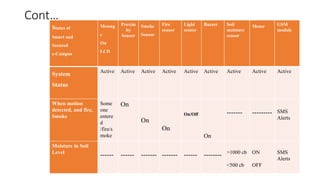
Cont…
Status of
Smart and
Secured
e-Campus
Messag
e
On
LCD
Proxim
ity
Sensor
Smoke
Sensor
Fire
sensor
Light
sensor
Buzzer Soil
moisture
sensor
Motor GSM
module
System
Status
Active Active Active Active Active Active Active Active Active
When motion
detected, and fire,
Smoke
Some
one
entere
d
/fire/s
moke
On
On
On
On/Off
On
------- --------- SMS
Alerts
Moisture in Soil
Level
------ ------ ------- ------- ------ -------- >1000 cb
<500 cb
ON
OFF
SMS
Alerts
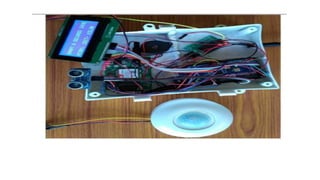
SNAPSHOTS
CAMPUS GARDEN AUTOMATION WATER
FLOW
AUTOMATED STREET LIGHT
GARBAGE & WASTE COLLECTION BINS
OVERFLOW ALERT SYSTEM
CONCLUSION
• It is normal to grow new opportunities for transforming conventional systems in a
smart e-campus.
• Obviously any campus cannot stand outside of this modern trend. If we want to create a
more safe and efficient space all actors in this e-campus environment.
• This secured smart e-campus model can be reused in part of whole educational, security,
safety, and other areas, like private environment can also use.
FUTURE ENHANCEMENT
• In future they may provide the system control via android application.
• They may create a web portal to maintain the data and good interaction.
REFERENCES
• [1] L. Atzori, A. Iera, and G. Morabito, “The internet of things: A survey,”Comput. Netw, vol. 54, no. 15, pp. 2787–2805,
2010.
• [2] Dlodlo N, Foko T, Mvelase P, and Mathaba S “The State of Affairs in Internet of Things Research” The Electronic
Journal Information Systems Evaluation Volume 15 Issue 3 2012, (244- 258), available online at www.ejise.com
• [3] “Five ways the internet of things is already broken—and how to fix it” by Leo Mirani September 23, 2014 retrieved
from http://qz.com on 12 feb 2015.
• [4] “The State of Affairs in Internet of Things Research” by Nomusa Dlodlo, Thato Foko, Promise Mvelase, and Sizakele
Mathaba CSIR Meraka Institute, Pretoria, South Africa in EJISE journal Volume 15 Issue 3.
• [5] “Investing in an Internet of Things (IoT) Solution: Asking the Right Questions to Minimize TCO” by IDC Custom
Solutions and sponsored by Aeris Communications in January 2014 retrieved from www.idc.com
• [6] “The Internet of Everything: Fueling Educational Innovation - Learning@Cisco Overview” retrieved from
http://globalstemalliance.org/media/filer_public/b9/c6/b9c 609e0-deb9-479a-bc19-94770297fd3a/14cs4580-2014 Cisco
and/or its affiliates.
THANK YOU
&
(Q ?????)

An iot based secured smart e-campus

  • 1.
    AN IoT BASEDSECURED SMART e - CAMPUS C.BYREGOWDA INSTITUTE OF TECHNOLOGY Department of Computer Science and Engineering Kolar - Srinivaspur Road Kolar-563101 Dept. Of CSE, CBIT 2016-17 Presented by: SHIVARAJKUMAR T H (1CK15SCS02) Mr. RAJA A Asst. Professor, Dept. Of CSE, CBIT - KOLAR Internal guide:
  • 2.
    AGENDA • ABSTRACT • INTRODUCTION •LITERATURE REVIEW • SYSTEM REQUIREMENT SPECIFICATION • SYSTEM ANALYSIS • SYSTEM DESIGN • SYSTEM IMPLEMENTATION • SYSTEM TESTING • CONCLUSION AND FUTURE ENHANCEMENT
  • 4.
    ABSTRACT • New technologylike (IoT) in recent years rapidly developing in a computing world. • The Internet of things will change the real world, activities and objects from most complex to simple. • In digital era our College campus need of IoT technology for classy environment to utilize secured & modern technology for e-campus activities in academic course of action. • In near future drastically make changes for students in highly enabled IoT.
  • 5.
    INTRODUCTION • The IoTconcept aims at making the internet even more immersive and pervasive. • Today the IoT vision is more aspiring and focuses on enabling smart and context aware applications for people everywhere in the world. Problem Description • In general campus spread over a fairly large area and it is very difficult for management to track everything that happens. • Like Fire, Smoking, Theft entering, Ragging Etc………
  • 6.
    Cont… Scope and Objectiveof the Project • Primary focus of smart e-campus in the education area, but they also drive the change in other aspects such as security & safety protection. • This leads to the adoption of a variety of smart solutions in campus environments to enhance the quality of life. Methodology • Smart and Secure Inventory System. • Campus Smart Garden Automation Water Flow System. • GSM Based Alerts Systems.
  • 7.
    LITERATURE REVIEW • Aqeel-ur-Rehmanet al:- The present outcomes of their research on one feature of future smart—sensing with RFID (Radio frequency identification) technology; it should benefit students and faculty with identification, tracking, lecture room, lab, Class room and Attendance taking, etc • Yu et al”:- Argue that with the development of communication and pervasive computing technology are built to benefit the faculty and students, manage the available resources and enhance user experience with proactive services.
  • 8.
    SYSTEM REQUIREMENT SPECIFICATIONS • FunctionalRequirements: Functional requirements defines a function of a software system or its component’s. Function is described as a set of inputs, the behavior and outputs. • Non-Functional Requirements: The Non-Functional requirements defines the properties such as GSM connection, response time, computation time, power supply
  • 9.
    Cont… Hardware Requirements Arduino mega/uno. GSMmodule. Sensor’s. Wifi. Software Requirements Windows OS Arduino Software Embedded C
  • 10.
    SYSTEM ANALYSIS Existing system Existing system is purely monitoring based not responsive.  Monitoring eq: cctv etc.,,,  Manual gardening system.  Difficult in tracking /Managing/Maintaining/Retrenching the assets.  Provides less tracking of students activities.  Dependency of human interaction is High.  De-centralized campus management.
  • 11.
    Cont…. PROPOSED SYSTEM • Theconcept of smart e-campus is defined like a small world where sensor-enabled and network devices work continuously and collaboratively to make humans more comfort. Advantages of proposed systems 1. SMART AND SECURED INVENTORY: 2. GSM BASED ALRETS: 3. AUTOMATED CAMPUS STREET LIGHT: 4. CAMPUS GARDEN AUTOMATION WATER FLOW: 5. GARBAGE & WASTE COLLECTION BINS OVERFLOW ALERT SYSTEM:
  • 12.
    12 SYSTEM DESIGN POWER SUPPLY ARDUINOUNO/MEGA LIGHT SENSOR PROXIMITY SENSOR FIRE SENSOR MOISTURE SENSOR Wifi MOTOR BUZZER GSM MODULE ALERTS Fig: Block Diagram for Smart e-Campus.
  • 13.
    FLOW CHART Dept ofCSE, CBIT 13 START IF ALL SENSO R = 1 BUZZER SOUND CALL & SMS ALERT SMS ALERT MOTOR ON NO CHANGE IF Mos LEVEL >1000 IF Mos LEVEL <500 MOTOR OFF SMS ALERT YES YESYES NO NO NO INITIALIZE THE SYSTEM MONITOR THE GARDEN SYSTEM END Fig: Flow Chart for Smart e-Campus
  • 14.
    DATA FLOW DIAGRAMS ArduinoUNO POWER SUPPLY Light sensor Fire Sensor Proximity Sensor Arduino UNO POWER SUPPLY Light sensor Fire Sensor Proximity Sensor Buzzer Sound Arduino UNO Power Supply Light sensor Fire Sensor Proxim ity Sensor GSM Module Buzzer Sound SMS & CALL Alerts Level 1 Level 2 Level 3
  • 15.
  • 16.
  • 17.
    Module 1- SMART&SECURED INVENTORY  Each piece of equipment in a lab’s (i.e Cpu, Monitor and Projector ETC) can have an associated proximity sensor & Fire, which represents inventory security of all devices.  Input devices: Proximity Sensor, Fire Sensor, Smoke Sensor, light Sensor, Arduino, Relay.  Output devices: Buzzer, GSM modules-900.
  • 18.
    Module 2- CAMPUSGARDEN AUTOMATION WATER FLOW  At a glance based on moisture condition in soil. The consumed water quantity can be reading every time and thereby controlled.  Input devices: Soil moisture sensor , Arduino, wifi,  Output devices: GSM modules-900, Water pump motor.
  • 19.
    SYSTEM TESTING Unit testing: Eachand every component is tested individually, and checked for correct functioning of the component. Integration testing: After unit testing integrate the sub-modules and test the working of the system.
  • 20.
    Cont… Status of Smart and Secured e-Campus Messag e On LCD Proxim ity Sensor Smoke Sensor Fire sensor Light sensor BuzzerSoil moisture sensor Motor GSM module System Status Active Active Active Active Active Active Active Active Active When motion detected, and fire, Smoke Some one entere d /fire/s moke On On On On/Off On ------- --------- SMS Alerts Moisture in Soil Level ------ ------ ------- ------- ------ -------- >1000 cb <500 cb ON OFF SMS Alerts
  • 21.
  • 23.
  • 24.
  • 25.
    GARBAGE & WASTECOLLECTION BINS OVERFLOW ALERT SYSTEM
  • 26.
    CONCLUSION • It isnormal to grow new opportunities for transforming conventional systems in a smart e-campus. • Obviously any campus cannot stand outside of this modern trend. If we want to create a more safe and efficient space all actors in this e-campus environment. • This secured smart e-campus model can be reused in part of whole educational, security, safety, and other areas, like private environment can also use. FUTURE ENHANCEMENT • In future they may provide the system control via android application. • They may create a web portal to maintain the data and good interaction.
  • 27.
    REFERENCES • [1] L.Atzori, A. Iera, and G. Morabito, “The internet of things: A survey,”Comput. Netw, vol. 54, no. 15, pp. 2787–2805, 2010. • [2] Dlodlo N, Foko T, Mvelase P, and Mathaba S “The State of Affairs in Internet of Things Research” The Electronic Journal Information Systems Evaluation Volume 15 Issue 3 2012, (244- 258), available online at www.ejise.com • [3] “Five ways the internet of things is already broken—and how to fix it” by Leo Mirani September 23, 2014 retrieved from http://qz.com on 12 feb 2015. • [4] “The State of Affairs in Internet of Things Research” by Nomusa Dlodlo, Thato Foko, Promise Mvelase, and Sizakele Mathaba CSIR Meraka Institute, Pretoria, South Africa in EJISE journal Volume 15 Issue 3. • [5] “Investing in an Internet of Things (IoT) Solution: Asking the Right Questions to Minimize TCO” by IDC Custom Solutions and sponsored by Aeris Communications in January 2014 retrieved from www.idc.com • [6] “The Internet of Everything: Fueling Educational Innovation - Learning@Cisco Overview” retrieved from http://globalstemalliance.org/media/filer_public/b9/c6/b9c 609e0-deb9-479a-bc19-94770297fd3a/14cs4580-2014 Cisco and/or its affiliates.
  • 28.