Introduction
to
human evolution
Basics about human origins
Paul M. Matondo
Outline
► Why is it important to teach evolution ?
► What is evolution ?
► How did Humans evolve?
Why is it important to
teach evolution ?
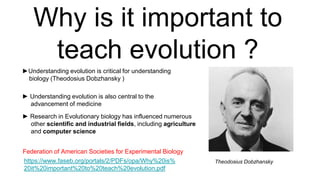
►Understanding evolution is critical for understanding
biology (Theodosius Dobzhansky )
► Understanding evolution is also central to the
advancement of medicine
https://www.faseb.org/portals/2/PDFs/opa/Why%20is%
20it%20important%20to%20teach%20evolution.pdf
Federation of American Societies for Experimental Biology
► Research in Evolutionary biology has influenced numerous
other scientific and industrial fields, including agriculture
and computer science
Theodosius Dobzhansky
What is evolution ?
► Evolution is change in the heritable characteristics
of biological populations over successive generations.
(National Academies of Sciences, Engineering, and Medicine, 2016)
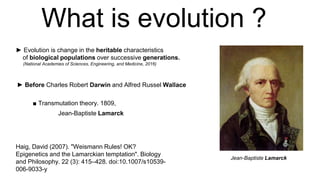
► Before Charles Robert Darwin and Alfred Russel Wallace
Jean-Baptiste Lamarck
Haig, David (2007). "Weismann Rules! OK?
Epigenetics and the Lamarckian temptation". Biology
and Philosophy. 22 (3): 415–428. doi:10.1007/s10539-
006-9033-y
Jean-Baptiste Lamarck
■ Transmutation theory. 1809,
What is evolution ?
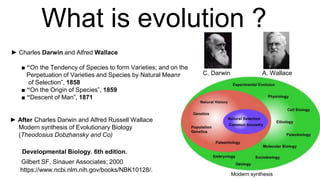
► After Charles Darwin and Alfred Russell Wallace
Modern synthesis of Evolutionary Biology
(Theodosius Dobzhansky and Co)
Modern synthesis
► Charles Darwin and Alfred Wallace
■ “On the Tendency of Species to form Varieties; and on the
Perpetuation of Varieties and Species by Natural Means
of Selection”, 1858
■ “On the Origin of Species”, 1859
■ “Descent of Man”, 1871
C. Darwin A. Wallace
Developmental Biology. 6th edition.
Gilbert SF, Sinauer Associates; 2000
https://www.ncbi.nlm.nih.gov/books/NBK10128/.
How did Humans evolve?
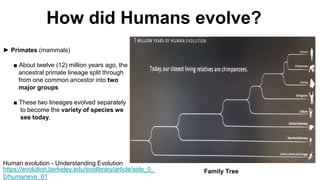
► Primates (mammals)
■ About twelve (12) million years ago, the
ancestral primate lineage split through
from one common ancestor into two
major groups
■ These two lineages evolved separately
to become the variety of species we
see today.
Family Tree
Human evolution - Understanding Evolution
https://evolution.berkeley.edu/evolibrary/article/side_0_
0/humanevo_01
How did Humans evolve?
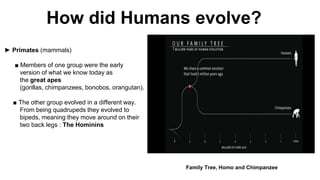
Family Tree, Homo and Chimpanzee
► Primates (mammals)
■ Members of one group were the early
version of what we know today as
the great apes
(gorillas, chimpanzees, bonobos, orangutan).
■ The other group evolved in a different way.
From being quadrupeds they evolved to
bipeds, meaning they move around on their
two back legs : The Hominins
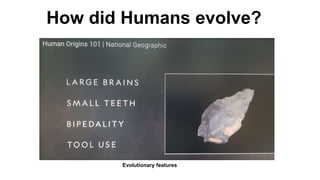
How did Humans evolve?
Evolutionary features
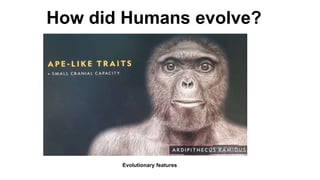
How did Humans evolve?
Evolutionary features
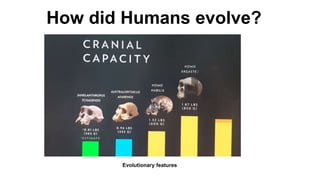
How did Humans evolve?
Evolutionary features
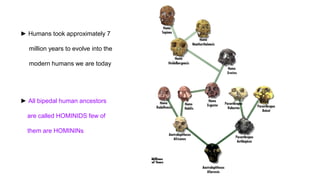
► Humans took approximately 7
million years to evolve into the
modern humans we are today
► All bipedal human ancestors
are called HOMINIDS few of
them are HOMININs
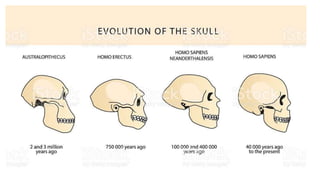
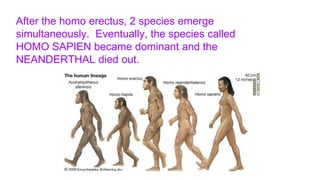
After the homo erectus, 2 species emerge
simultaneously. Eventually, the species called
HOMO SAPIEN became dominant and the
NEANDERTHAL died out.
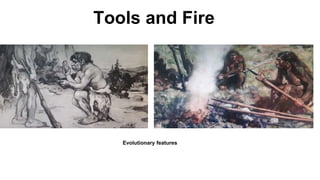
Tools and Fire
Evolutionary features
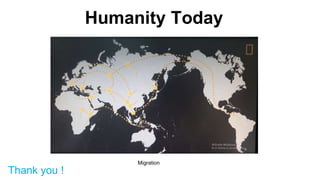
Humanity Today
Migration
Thank you !
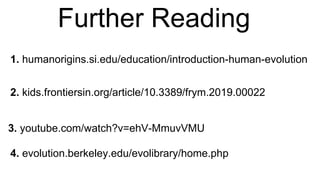
Further Reading
1. humanorigins.si.edu/education/introduction-human-evolution
2. kids.frontiersin.org/article/10.3389/frym.2019.00022
3. youtube.com/watch?v=ehV-MmuvVMU
4. evolution.berkeley.edu/evolibrary/home.php

An Introduction to human evolution

  • 1.
    Introduction to human evolution Basics abouthuman origins Paul M. Matondo
  • 2.
    Outline ► Why isit important to teach evolution ? ► What is evolution ? ► How did Humans evolve?
  • 3.
    Why is itimportant to teach evolution ? ►Understanding evolution is critical for understanding biology (Theodosius Dobzhansky ) ► Understanding evolution is also central to the advancement of medicine https://www.faseb.org/portals/2/PDFs/opa/Why%20is% 20it%20important%20to%20teach%20evolution.pdf Federation of American Societies for Experimental Biology ► Research in Evolutionary biology has influenced numerous other scientific and industrial fields, including agriculture and computer science Theodosius Dobzhansky
  • 4.
    What is evolution? ► Evolution is change in the heritable characteristics of biological populations over successive generations. (National Academies of Sciences, Engineering, and Medicine, 2016) ► Before Charles Robert Darwin and Alfred Russel Wallace Jean-Baptiste Lamarck Haig, David (2007). "Weismann Rules! OK? Epigenetics and the Lamarckian temptation". Biology and Philosophy. 22 (3): 415–428. doi:10.1007/s10539- 006-9033-y Jean-Baptiste Lamarck ■ Transmutation theory. 1809,
  • 5.
    What is evolution? ► After Charles Darwin and Alfred Russell Wallace Modern synthesis of Evolutionary Biology (Theodosius Dobzhansky and Co) Modern synthesis ► Charles Darwin and Alfred Wallace ■ “On the Tendency of Species to form Varieties; and on the Perpetuation of Varieties and Species by Natural Means of Selection”, 1858 ■ “On the Origin of Species”, 1859 ■ “Descent of Man”, 1871 C. Darwin A. Wallace Developmental Biology. 6th edition. Gilbert SF, Sinauer Associates; 2000 https://www.ncbi.nlm.nih.gov/books/NBK10128/.
  • 6.
    How did Humansevolve? ► Primates (mammals) ■ About twelve (12) million years ago, the ancestral primate lineage split through from one common ancestor into two major groups ■ These two lineages evolved separately to become the variety of species we see today. Family Tree Human evolution - Understanding Evolution https://evolution.berkeley.edu/evolibrary/article/side_0_ 0/humanevo_01
  • 7.
    How did Humansevolve? Family Tree, Homo and Chimpanzee ► Primates (mammals) ■ Members of one group were the early version of what we know today as the great apes (gorillas, chimpanzees, bonobos, orangutan). ■ The other group evolved in a different way. From being quadrupeds they evolved to bipeds, meaning they move around on their two back legs : The Hominins
  • 8.
    How did Humansevolve? Evolutionary features
  • 9.
    How did Humansevolve? Evolutionary features
  • 10.
    How did Humansevolve? Evolutionary features
  • 12.
    ► Humans tookapproximately 7 million years to evolve into the modern humans we are today ► All bipedal human ancestors are called HOMINIDS few of them are HOMININs
  • 13.
    After the homoerectus, 2 species emerge simultaneously. Eventually, the species called HOMO SAPIEN became dominant and the NEANDERTHAL died out.
  • 14.
  • 15.
  • 16.
    Further Reading 1. humanorigins.si.edu/education/introduction-human-evolution 2.kids.frontiersin.org/article/10.3389/frym.2019.00022 3. youtube.com/watch?v=ehV-MmuvVMU 4. evolution.berkeley.edu/evolibrary/home.php