An improved feature extraction algorithms of EEG signals
1.
NATIONAL INSTITUTE OFTECHNOLOGY,SILCHAR
An improved feature extraction algorithms of EEG
signals
DEPARTMENT OF ELECTORNICS & COMMUNICATION
BY
Anirban Nath (2424223)
M.Tech (2nd Sem)
A Presentation on
Guided By – Dr. Koushik Guha
2.
Contents
• Introduction toEEG Signal
• Introduction to BCI
• Problem Statement
• Methodology
• Result and Discussion
• Future Work
• Conclusion
• References
3.
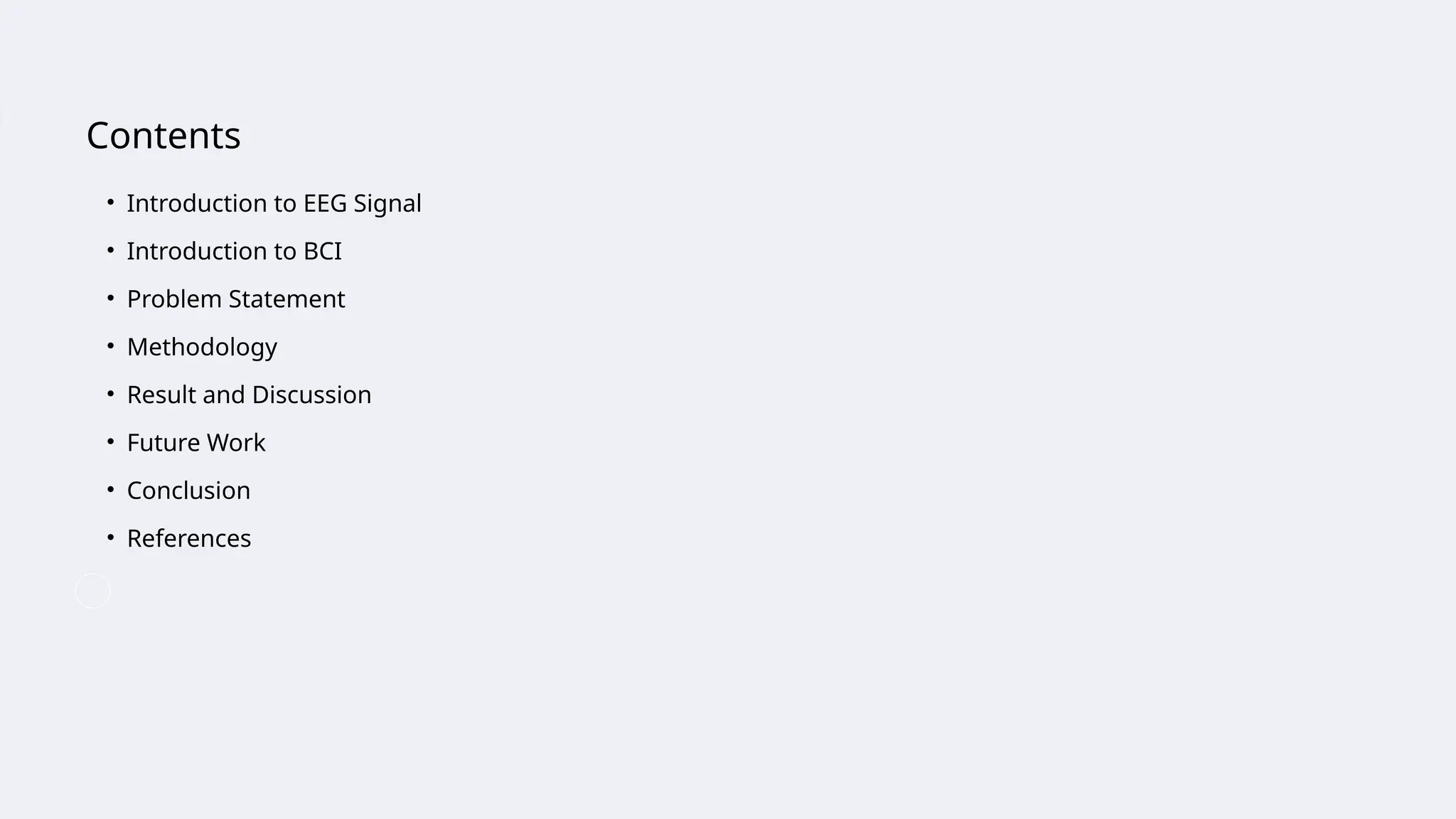
• EEG =Electroencephalogram
• Records electrical activity of the brain using scalp
electrodes.
• Reflects real-time brain function and neural
communication.
Introduction to EEG
Signals
4.
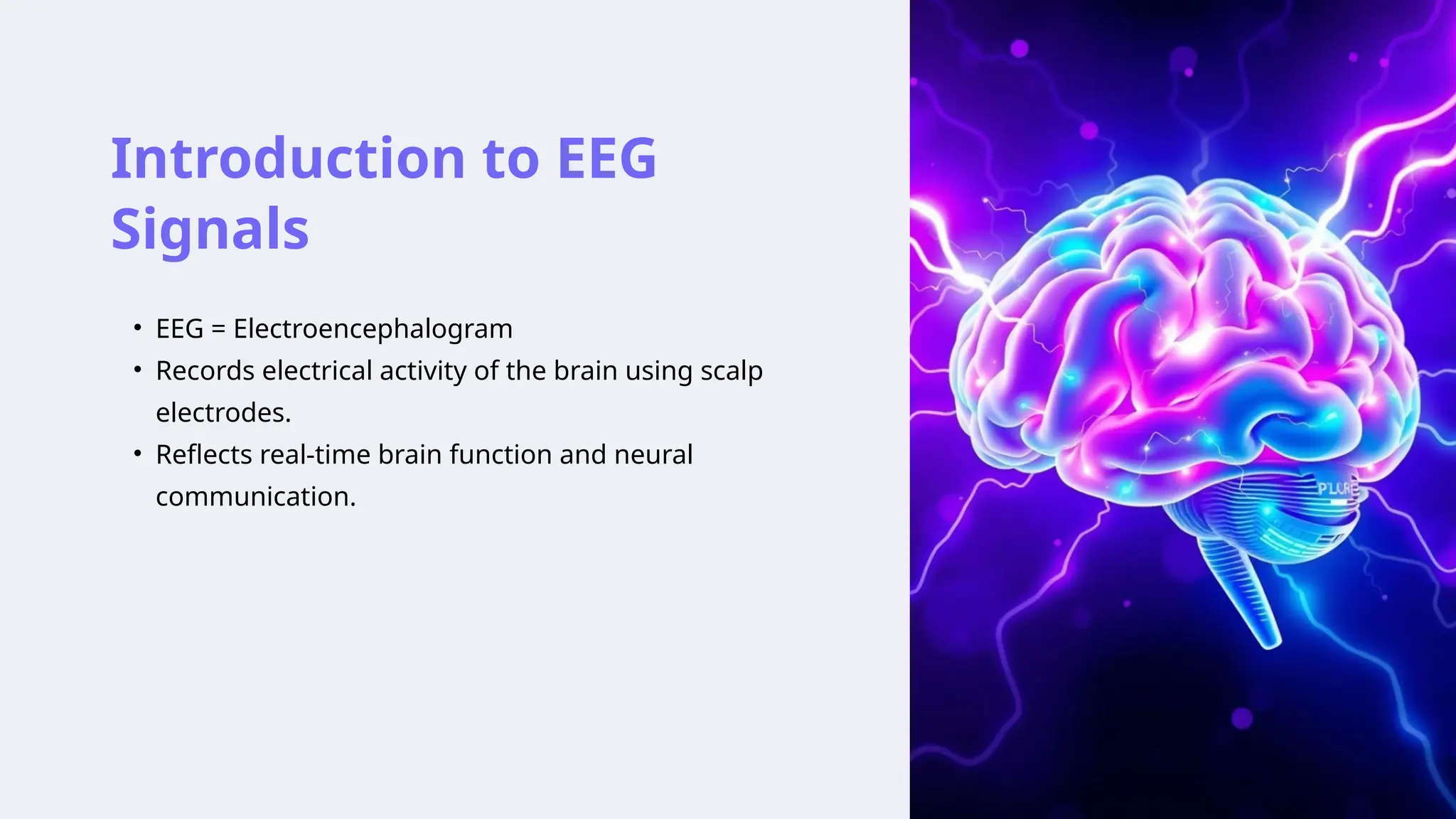
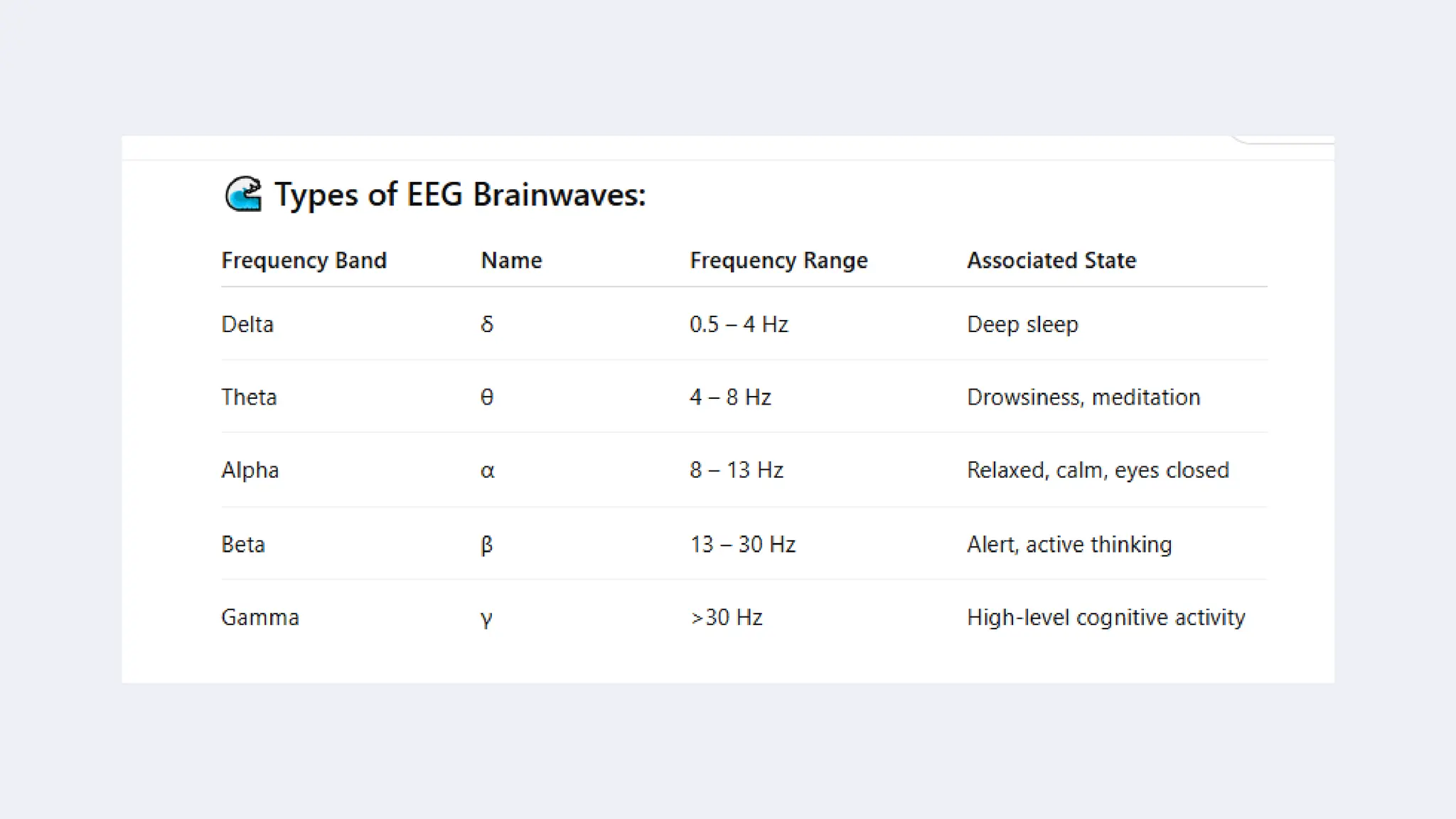
• Low amplitude:10–100 μV
• Frequency range: 0.5 – 100 Hz
• Non-stationary and time-varying
• High temporal resolution (captures millisecond-level activity)
Key Characteristics:
6.
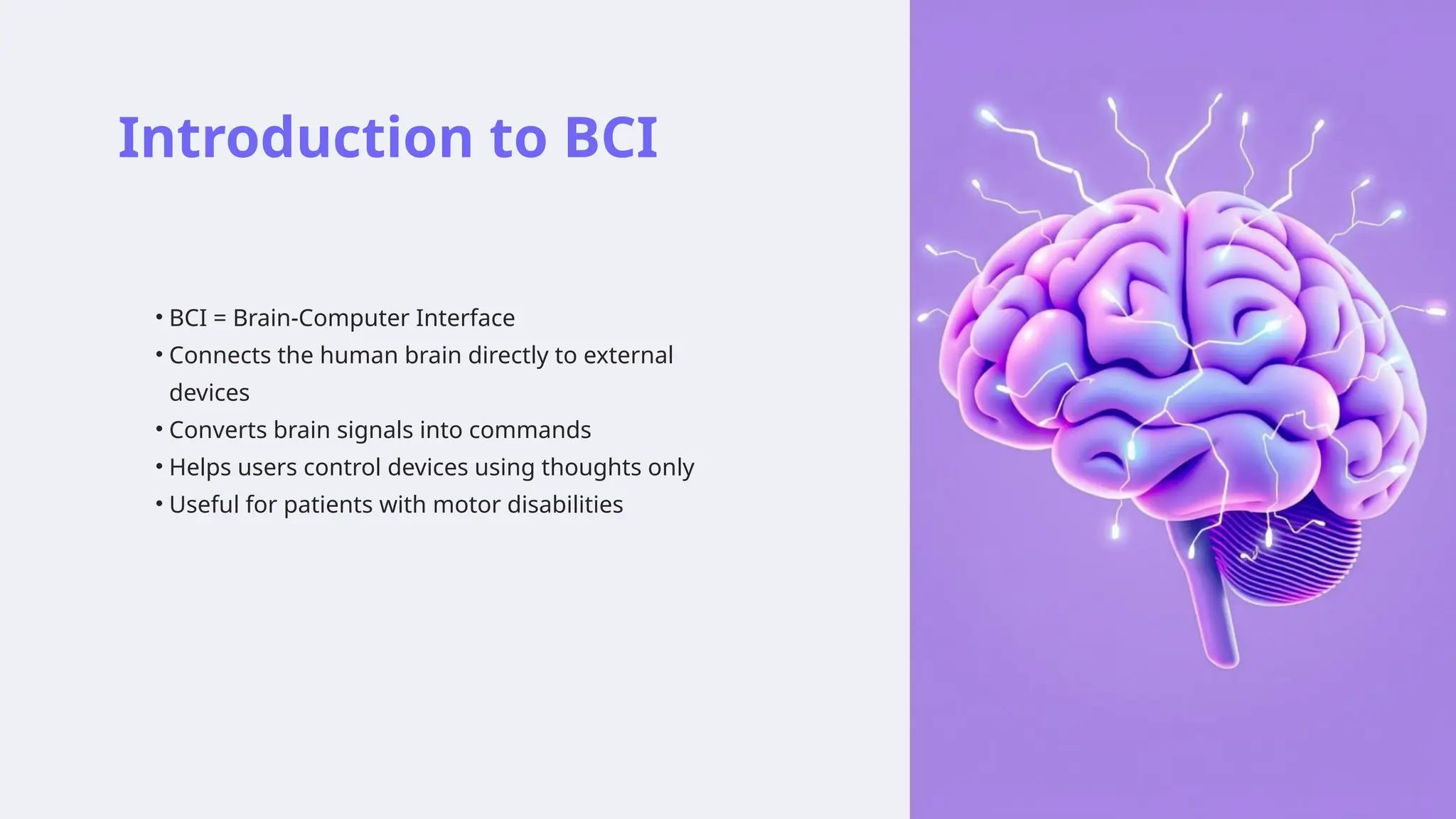
Introduction to BCI
•BCI = Brain-Computer Interface
• Connects the human brain directly to external
devices
• Converts brain signals into commands
• Helps users control devices using thoughts only
• Useful for patients with motor disabilities
7.
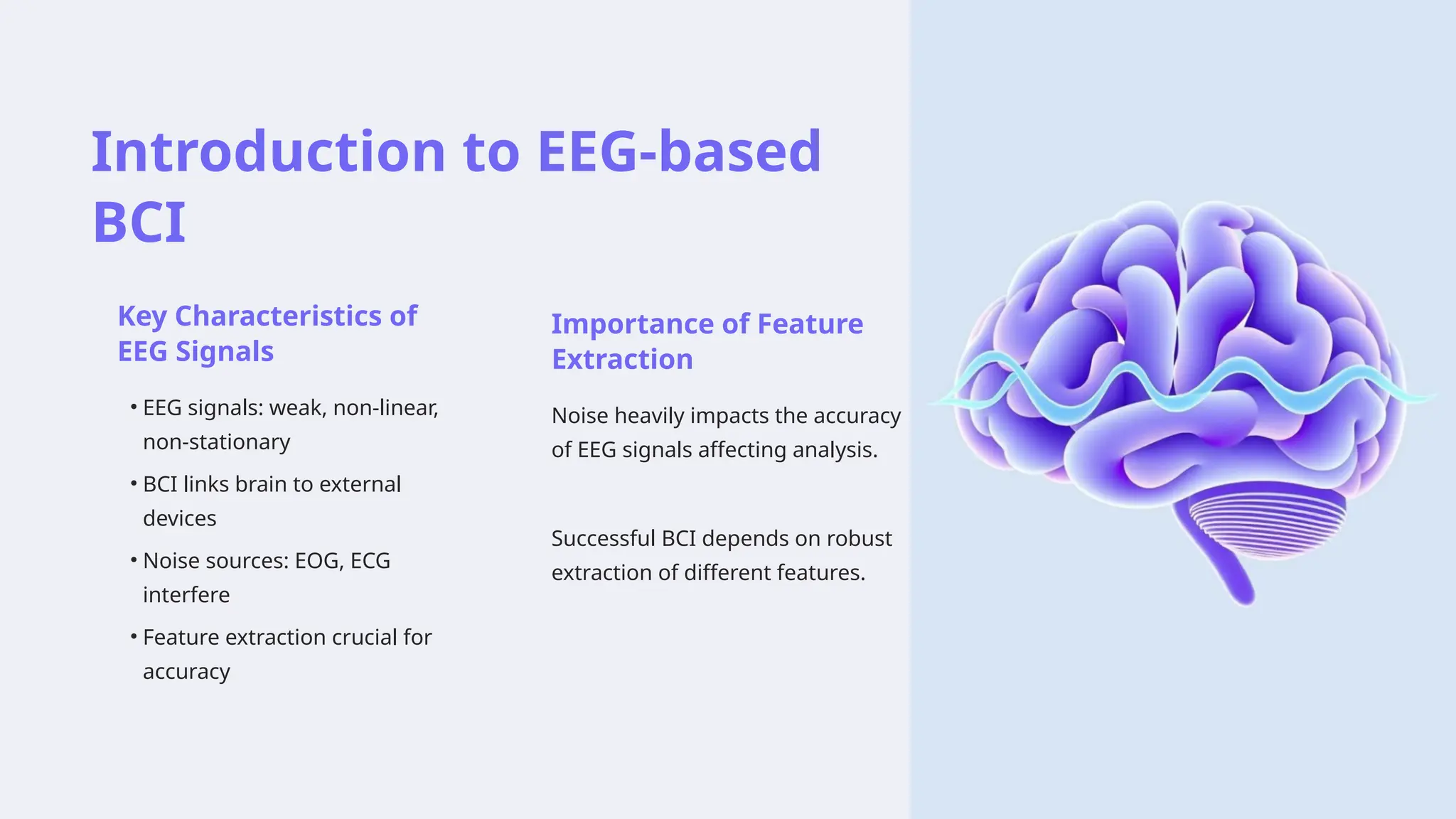
Introduction to EEG-based
BCI
KeyCharacteristics of
EEG Signals
• EEG signals: weak, non-linear,
non-stationary
• BCI links brain to external
devices
• Noise sources: EOG, ECG
interfere
• Feature extraction crucial for
accuracy
Importance of Feature
Extraction
Noise heavily impacts the accuracy
of EEG signals affecting analysis.
Successful BCI depends on robust
extraction of different features.
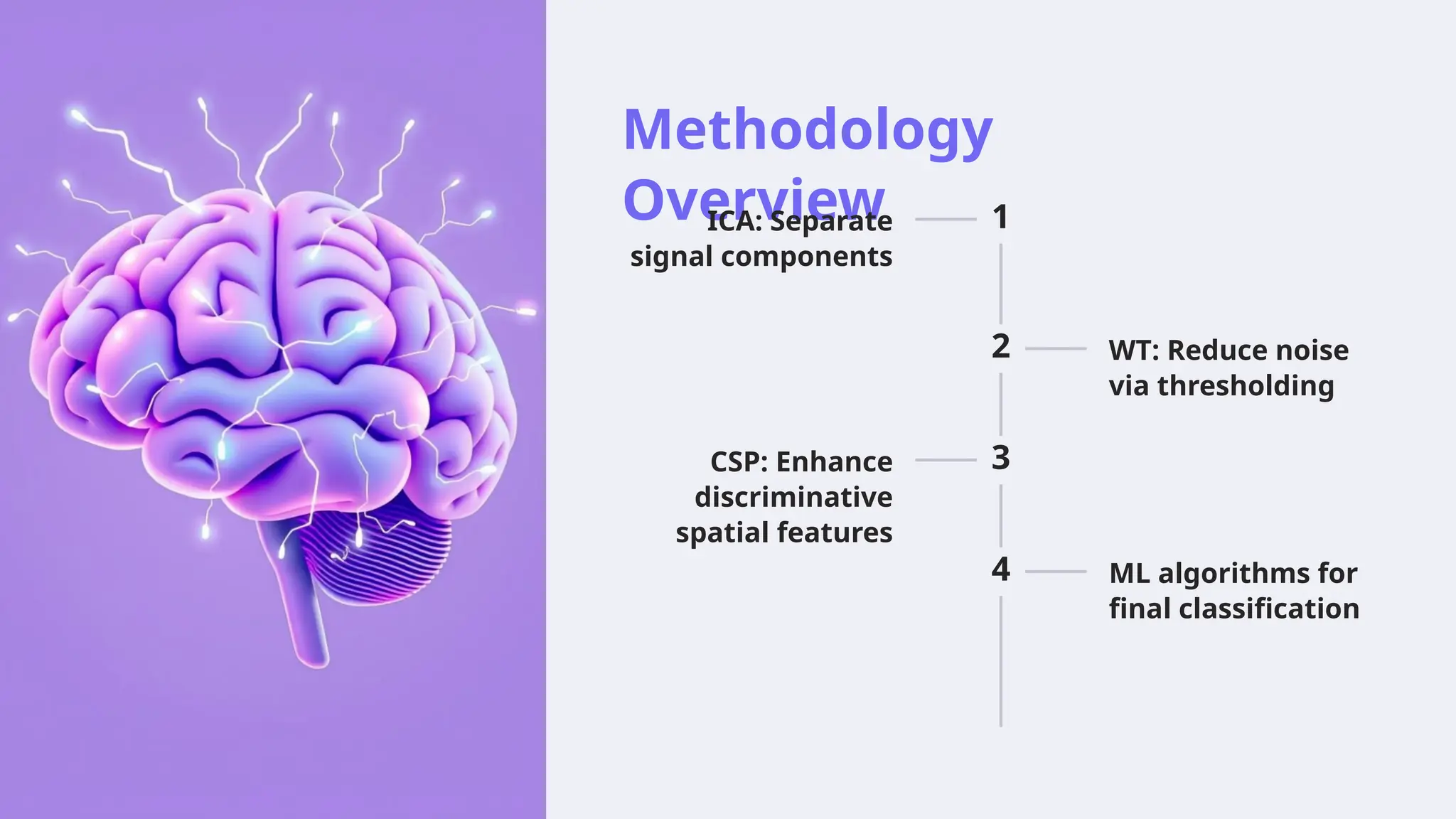
Methodology
Overview 1
ICA: Separate
signalcomponents
2 WT: Reduce noise
via thresholding
3
CSP: Enhance
discriminative
spatial features
4 ML algorithms for
final classification
ICA Mathematical
Model
• Observedsignal: X(t) = A · S(t)
• Output: Y(t) = W · X(t)
Where,
X(t): Observed Signal
A:Mixing Coefficient Matrix
S(t):Source Signal
• S(t)= A-1 . X= WX
Fig: The Mathemetical model of ICA .[1]
12.
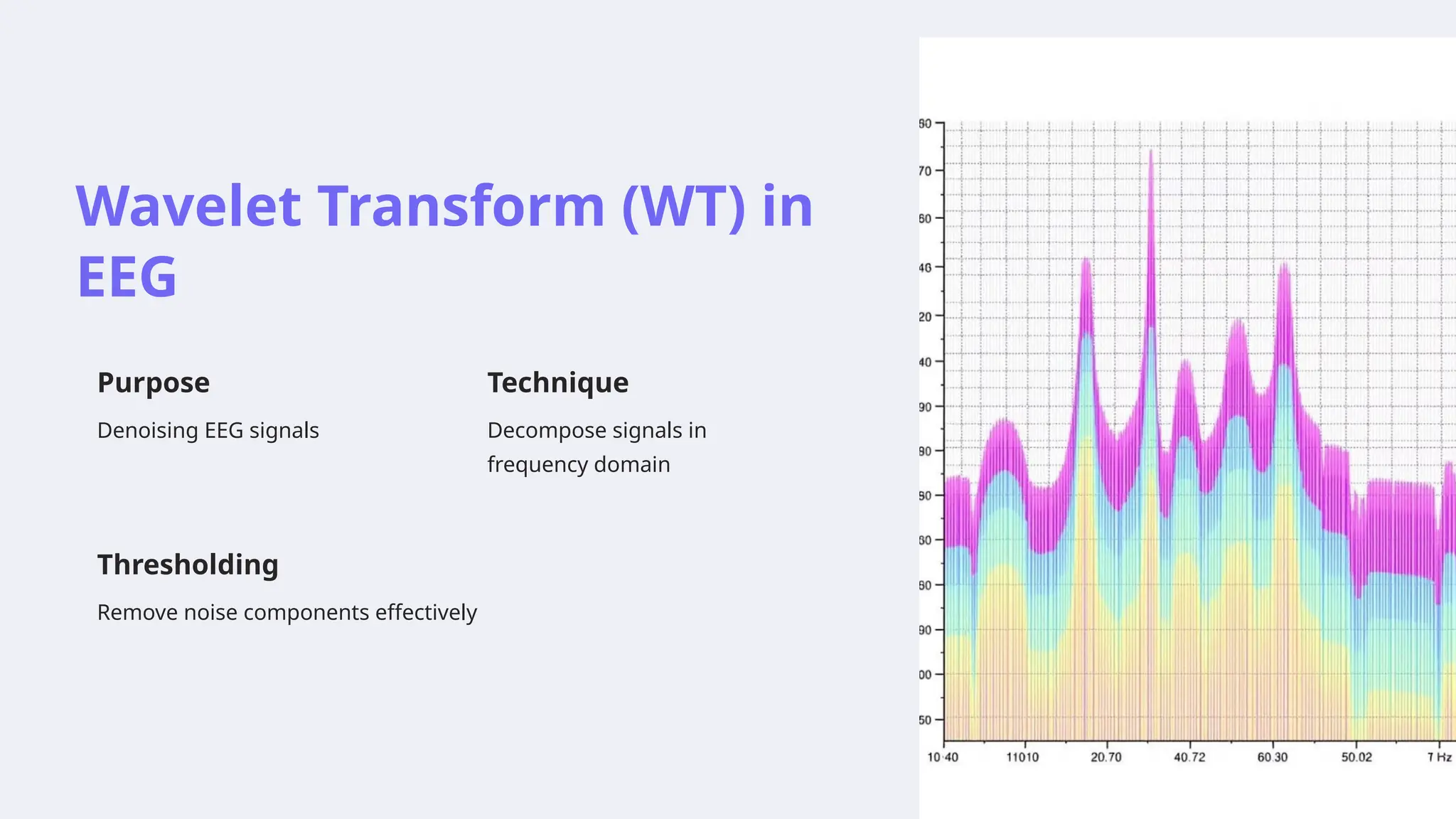
Wavelet Transform (WT)in
EEG
Purpose
Denoising EEG signals
Technique
Decompose signals in
frequency domain
Thresholding
Remove noise components effectively
13.
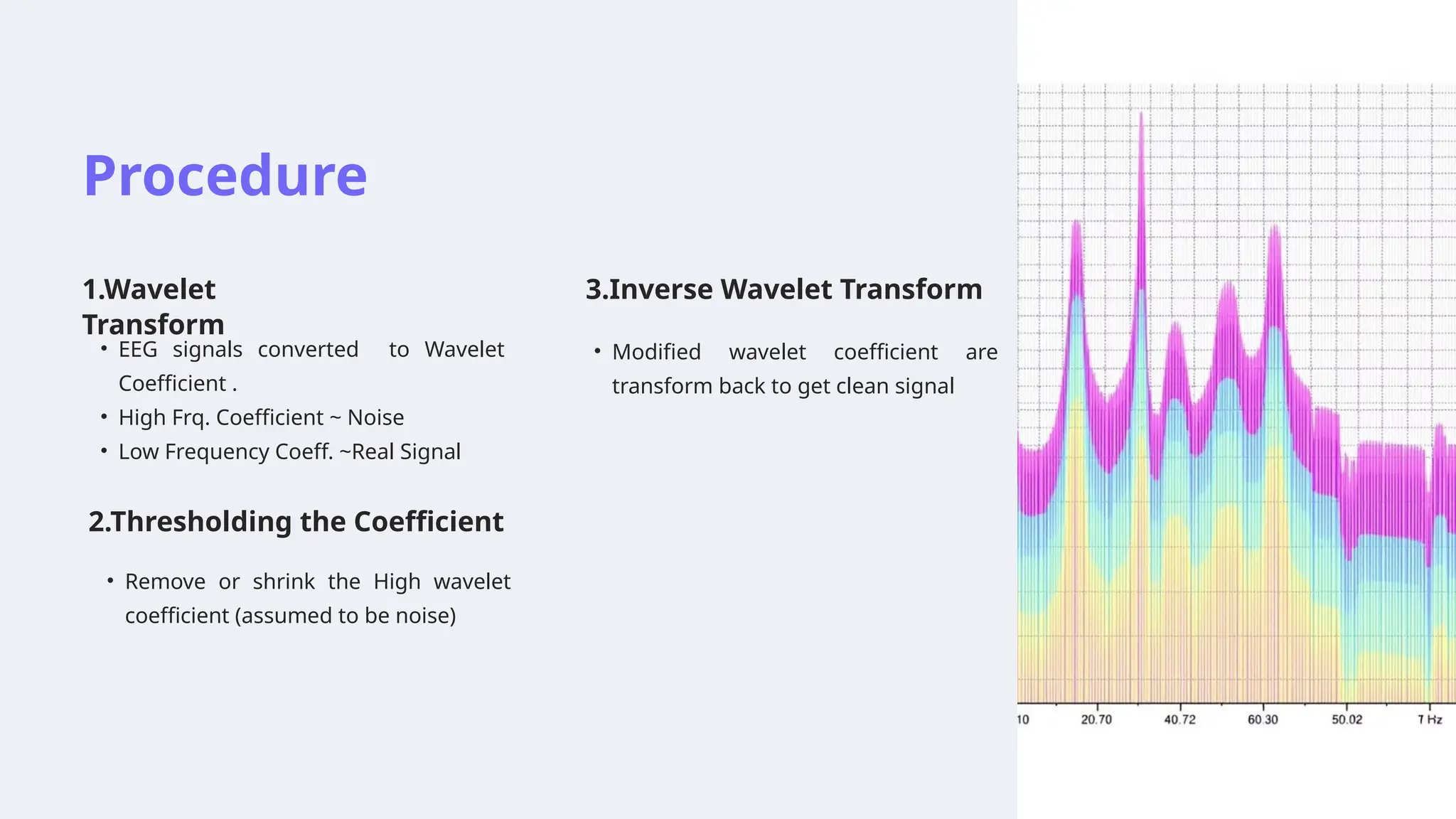
Procedure
1.Wavelet
Transform
• EEG signalsconverted to Wavelet
Coefficient .
• High Frq. Coefficient ~ Noise
• Low Frequency Coeff. ~Real Signal
2.Thresholding the Coefficient
• Remove or shrink the High wavelet
coefficient (assumed to be noise)
3.Inverse Wavelet Transform
• Modified wavelet coefficient are
transform back to get clean signal
14.
Common Spatial Pattern
(CSP)
•Feature Extraction algo
• Used to distinguish between two mental task.
• Example -Imagining Left Hand Vs Right Hand Movement
15.
Proposed Workflow
Step 1:ICA
decomposition
Step 2: WT on ICA
components
Step 3: Wavelet threshold denoising
Step 4: CSP feature
extraction
Step 5:
Classification
Fig 2: The process of the propsed method. [1]
16.
Dataset Description
• EEGdata collected from 109 participants
• Recordings captured from 64 channels using the BCI2000 system
• Included tasks: motor imagery of hands and feet
• Approximately 1,500 total recordings
Fig 3: Electrodes arrangement position.[1]
17.
ICA Results
Key Benefit
ICAseparates signals effectively
Artifact Control
Reduces EOG and ECG artifacts
Improves SNR
References
• [1]Xiaozhong Geng,Dezhi Li, Hanlin Chen, Ping Yu, Hui Yan, Mengzhe Yue, An improved feature extraction
algorithms of EEG signals based on motor imagery brain-computer interface,Alexandria Engineering
Journal,Volume 61, Issue 6,2022,Pages 4807-4820,ISSN 1110-0168, https://doi.org/10.1016/j.aej.2021.10.034.
• [2]International Journal for Modern Trends in Science and Technology Volume 9, Issue 08, pages 45-50 ISSN:
2455-3778 online, DOI: https://doi.org/10.46501/IJMTST0908008
• [3] A. Mohammad, F. Siddiqui and M. Afshar Alam, "Feature Extraction from EEG Signals: A deep learning
perspective," 2021 11th International Conference on Cloud Computing, Data Science & Engineering
(Confluence), Noida, India, 2021, pp. 757-760, doi: 10.1109/Confluence51648.2021.9377108.
• [4] ] Z. Ling, C. Shuyue, S. Yuqiang, M.a. Zhe, Extraction of Evoked Related Potentials by using the Combination
of Independent Component Analysis and Wavelet Analysis, J. Biomed. Eng. 27 (4) (2010) 741–745.
• [5] International Conference on Computational Intelligence and Networks. IEEE, (2016) 84-89
![ICA Mathematical
Model
• Observed signal: X(t) = A · S(t)
• Output: Y(t) = W · X(t)
Where,
X(t): Observed Signal
A:Mixing Coefficient Matrix
S(t):Source Signal
• S(t)= A-1 . X= WX
Fig: The Mathemetical model of ICA .[1]](https://image.slidesharecdn.com/an-improved-feature-extraction-algorithm-of-eeg-signals1-251013144607-32ce0b12/75/An-improved-feature-extraction-algorithms-of-EEG-signals-11-2048.jpg)
![Proposed Workflow
Step 1: ICA
decomposition
Step 2: WT on ICA
components
Step 3: Wavelet threshold denoising
Step 4: CSP feature
extraction
Step 5:
Classification
Fig 2: The process of the propsed method. [1]](https://image.slidesharecdn.com/an-improved-feature-extraction-algorithm-of-eeg-signals1-251013144607-32ce0b12/75/An-improved-feature-extraction-algorithms-of-EEG-signals-15-2048.jpg)
![Dataset Description
• EEG data collected from 109 participants
• Recordings captured from 64 channels using the BCI2000 system
• Included tasks: motor imagery of hands and feet
• Approximately 1,500 total recordings
Fig 3: Electrodes arrangement position.[1]](https://image.slidesharecdn.com/an-improved-feature-extraction-algorithm-of-eeg-signals1-251013144607-32ce0b12/75/An-improved-feature-extraction-algorithms-of-EEG-signals-16-2048.jpg)
![References
• [1]Xiaozhong Geng, Dezhi Li, Hanlin Chen, Ping Yu, Hui Yan, Mengzhe Yue, An improved feature extraction
algorithms of EEG signals based on motor imagery brain-computer interface,Alexandria Engineering
Journal,Volume 61, Issue 6,2022,Pages 4807-4820,ISSN 1110-0168, https://doi.org/10.1016/j.aej.2021.10.034.
• [2]International Journal for Modern Trends in Science and Technology Volume 9, Issue 08, pages 45-50 ISSN:
2455-3778 online, DOI: https://doi.org/10.46501/IJMTST0908008
• [3] A. Mohammad, F. Siddiqui and M. Afshar Alam, "Feature Extraction from EEG Signals: A deep learning
perspective," 2021 11th International Conference on Cloud Computing, Data Science & Engineering
(Confluence), Noida, India, 2021, pp. 757-760, doi: 10.1109/Confluence51648.2021.9377108.
• [4] ] Z. Ling, C. Shuyue, S. Yuqiang, M.a. Zhe, Extraction of Evoked Related Potentials by using the Combination
of Independent Component Analysis and Wavelet Analysis, J. Biomed. Eng. 27 (4) (2010) 741–745.
• [5] International Conference on Computational Intelligence and Networks. IEEE, (2016) 84-89](https://image.slidesharecdn.com/an-improved-feature-extraction-algorithm-of-eeg-signals1-251013144607-32ce0b12/75/An-improved-feature-extraction-algorithms-of-EEG-signals-25-2048.jpg)