STEPHEN SPENDER
A POWERPOINT PRESENTATION BY: MRINAL GHOSH
PGT (ENGLISH), UK ACADEMY ENGLISH MEDIUM
An Elementary School Classroom in a
Slum
AN ELEMENTARY SCHOOL CLASSROOM IN A SLUM
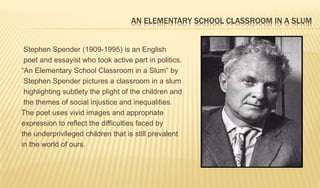
Stephen Spender (1909-1995) is an English
poet and essayist who took active part in politics.
“An Elementary School Classroom in a Slum” by
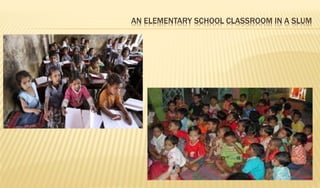
Stephen Spender pictures a classroom in a slum
highlighting subtlety the plight of the children and
the themes of social injustice and inequalities.
The poet uses vivid images and appropriate
expression to reflect the difficulties faced by
the underprivileged children that is still prevalent
in the world of ours.
AN ELEMENTARY SCHOOL CLASSROOM IN A SLUM
Let’s read the poem:
 Far far from gusty waves these children's faces.
 Like rootless weeds, the hair torn round their pallor:
 The tall girl with her weighed-down head. The paper-
 seeming boy, with rat's eyes. The stunted, unlucky heir
 Of twisted bones, reciting a father's gnarled disease,
 His lesson, from his desk. At back of the dim class
 One unnoted, sweet and young. His eyes live in a dream
 Of squirrel's game, in tree room, other than this.
AN ELEMENTARY SCHOOL CLASSROOM IN A SLUM
 On sour cream walls, donations. Shakespeare's head,
 Cloudless at dawn, civilized dome riding all cities.
 Belled, flowery, Tyrolese valley. Open-handed map
 Awarding the world its world. And yet, for these
 Children, these windows, not this map, their world,
 Where all their future's painted with a fog,
 A narrow street sealed in with a lead sky
 Far far from rivers, capes, and stars of words.
AN ELEMENTARY SCHOOL CLASSROOM IN A SLUM
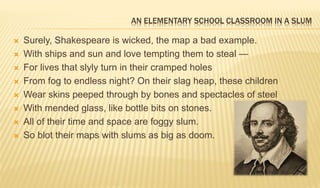
 Surely, Shakespeare is wicked, the map a bad example.
 With ships and sun and love tempting them to steal —
 For lives that slyly turn in their cramped holes
 From fog to endless night? On their slag heap, these children
 Wear skins peeped through by bones and spectacles of steel
 With mended glass, like bottle bits on stones.
 All of their time and space are foggy slum.
 So blot their maps with slums as big as doom.
AN ELEMENTARY SCHOOL CLASSROOM IN A SLUM
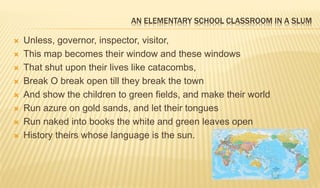
 Unless, governor, inspector, visitor,
 This map becomes their window and these windows
 That shut upon their lives like catacombs,
 Break O break open till they break the town
 And show the children to green fields, and make their world
 Run azure on gold sands, and let their tongues
 Run naked into books the white and green leaves open
 History theirs whose language is the sun.
AN ELEMENTARY SCHOOL CLASSROOM IN A SLUM
 Explanation of First Stanza:
 Walls of the classroom are dirty, yellow in colour like sour cream. Use of ‘sour cream walls’ is a similie.
Description of the posters put up on the walls of the classroom. They are probably donated to the
school. One of them has a picture Of Shakespeare. His head in the picture is bald, looks like the rising
Sun. Education is said to be similar to the rising Sun as it spreads light in all lives just as the Sun
spreads sunlight in all the cities. He is considered to be the symbol of culture, education and
intelligence all over the world. The next poster is of the Tyrolese valley, full of churches and flowers
which symbolize a beautiful creation of nature. Another one is a map of the World. ‘Map’ is a metaphor
used to signify something which is generously sharing its knowledge. But to theses children the world is
not the one shown in these pictures, but it is the one they see out of the class room window. They are
trapped there. Their future is dim and hopeless. A narrow street’ is a metaphor for their future which is
limited. ‘Sealed with a lead sky’ again a metaphor, it indicates sealed with a grey coloured sky. The
children have a dark future as their options in life are limited and are covered with dismay.’ far, far’
repetition means very far away. These children are very far away from the sea side and The ‘stars’
means that as the stars shine in the dark sky, similarly, the light of knowledge could brighten these
children’s future but they are far away from it. ‘Far far’ repetition to lay stress on the distance i.e. very far
away. ‘gusty waves’ sudden rush of strong wind is full of energy and vigor. The faces of the children
are very far from being energetic as they should be.
AN ELEMENTARY SCHOOL CLASSROOM IN A SLUM
 Explanation of the Second Stanza:
 ‘Like rootless weeds’ use of similie. Rootless is without a foundation of values, weeds
being unwanted. So, the children are unwanted and without any bindings, their hair is
smeared all over their pale faces. Description of the children in the classroom. A tall
girl, probably could be older for the class in which she is studying, her head is hung
low due to the burden of poverty.
‘paper seeming boy’ metaphor to describe the boy i.e. his skin is as thin and white as
paper. ‘Rat’s eyes’ is another metaphor to indicate the expression of his eyes as
being greedy. Another boy has deformed body which probably he has inherited from
his father. He cannot stand and is reciting the lesson from his seat; his father has
passed on his disease to his son an inheritance. The classroom is dark, poorly lit.
Another boy is not noticeable as he is at the back of the room. ‘unnoted’ is an
antithesis between this sweet boy and the boy with ‘rat’s eyes’. This boy’s eyes are
bright as if they are dreaming of escaping out into the open, and playing with squirrels
in tree houses rather than being in this small, dim room. There is an antithesis
between the openness of the tree room and the dim closed class room.
AN ELEMENTARY SCHOOL CLASSROOM IN A SLUM
 Explanation of the 3rd Stanza:
 These pictures on the wall have no meaning for the children. The children’s upbringing is such that
they are looking for bad qualities in everyone. So, to them, even Shakespeare is wicked and bad.
There is no benefit to put up his picture in the room. The pictures of maps, ships, sun indicate
travel, love and acceptance. Comprehending these pictures is beyond their abilities.
Instead the desire for love and acceptance will force them to do crimes like stealing. ‘Cramped
holes’ is a metaphor to indicate their small homes which are filled to capacity. They have adapted
themselves to live in these spaces. ‘From Fog’ alliteration is used. Fog is a metaphor used for day.
‘Endless night’ is a metaphor to indicate a never ending torture. The children are so skinny that their
clothes are like a skin and their skeleton is visible through them. This is due to lack of nutrition.
They have worn looking glasses made of steel which are cheap, heavy and uncomfortable. This
signifies that their outlook on life is also hardened with their life’s ruthlessness. ‘like bottle bits on
stones’ is a similie to describe the lenses in their spectacles which have been repaired. Similarly
their dreams have also been broken by the harsh reality of their lives. All of their time and space are
foggy slum’ is a metaphor to show that their life is dark, dirty and without hope. Their chances of
escaping have been further reduced by building bigger slums. The schools and Government
making these slums is the cause for these people to live in them. The education system is such that
it is forcing them to live in these slums and not come out of them.
AN ELEMENTARY SCHOOL CLASSROOM IN A SLUM
 Explanation of the 4th stanza:
 Asking the Government and public to make these maps on the walls, the
children’s vision. To make it their aspiration and an achievable reality for them.
The classroom windows which have restricted their opportunities have to be
broken open. ‘Break o break open’ repetition and alliteration shows urgency to
help them escape and achieve their dreams. They should be taken to green
fields rather than the dim slums.’ Azure’ is deep blue sky used as anti thesis to
the foggy lead sky where they live. The sunny, warm sand of the beaches and
the bright blue sky will instill a hunger in their minds for knowledge and they
will then absorb all of it. ‘White and green leaves’ is a metaphor. White implies
the pages of a book and the green leave signify the clean environment,
prosperity. Economical empowerment will come to these children. Powerful
last line which means that the people who make history are the ones who
speak, think, feel and enjoy the Sun!

AN ELEMENTARY SCHOOL CLASSROOM IN A SLUM
Some Questions and answers:
 What you think is the colour of ‘sour cream’? Why do you think the poet has
used this expression to describe the classroom walls?
Sour cream is yellowish – cream in colour. ‘Sour cream’ is a metaphor which is
used to describe the classroom walls. Sour cream is stale cream and so it tastes
sour. It is spoilt and useless. A similarity is drawn between the sour cream and the
walls. The walls are dirty and colour has turned yellow – cream. Also, they are
spoilt and dirty. They are not fresh, clean.

The walls of the classroom are decorated with the pictures of ‘Shakespeare’,
‘buildings with domes’, ‘world maps’ and beautiful valleys. How do these
contrast with the world of these children?
The pictures on the walls indicate light, empowerment, happiness, colours, beauty,
knowledge while the children in the class room lack all these things in their life.
Their life is dark, sad, black and white, dirty and neglected. A contrast is
highlighted between the world as shown by the pictures on the walls and the lives
of these children.
AN ELEMENTARY SCHOOL CLASSROOM IN A SLUM
 What does the poet want for the children of the slums? How can
their lives be made to change?
The poet wants to take the children out of the confines of the slums,
into the vast, open seaside to give them a better life. The poor system
in the slums does not help in improving their condition.
He feels that a change can be brought about by the Government, to
ensure a better way of living for them. They need better education, an
environment which is prosperous and freedom from the closed walls of
the slums.
AN ELEMENTARY SCHOOL CLASSROOM IN A SLUM

An Elementary school classroom in a Slum

  • 1.
    STEPHEN SPENDER A POWERPOINTPRESENTATION BY: MRINAL GHOSH PGT (ENGLISH), UK ACADEMY ENGLISH MEDIUM An Elementary School Classroom in a Slum
  • 2.
    AN ELEMENTARY SCHOOLCLASSROOM IN A SLUM Stephen Spender (1909-1995) is an English poet and essayist who took active part in politics. “An Elementary School Classroom in a Slum” by Stephen Spender pictures a classroom in a slum highlighting subtlety the plight of the children and the themes of social injustice and inequalities. The poet uses vivid images and appropriate expression to reflect the difficulties faced by the underprivileged children that is still prevalent in the world of ours.
  • 3.
    AN ELEMENTARY SCHOOLCLASSROOM IN A SLUM
  • 4.
    AN ELEMENTARY SCHOOLCLASSROOM IN A SLUM Let’s read the poem:  Far far from gusty waves these children's faces.  Like rootless weeds, the hair torn round their pallor:  The tall girl with her weighed-down head. The paper-  seeming boy, with rat's eyes. The stunted, unlucky heir  Of twisted bones, reciting a father's gnarled disease,  His lesson, from his desk. At back of the dim class  One unnoted, sweet and young. His eyes live in a dream  Of squirrel's game, in tree room, other than this.
  • 5.
    AN ELEMENTARY SCHOOLCLASSROOM IN A SLUM  On sour cream walls, donations. Shakespeare's head,  Cloudless at dawn, civilized dome riding all cities.  Belled, flowery, Tyrolese valley. Open-handed map  Awarding the world its world. And yet, for these  Children, these windows, not this map, their world,  Where all their future's painted with a fog,  A narrow street sealed in with a lead sky  Far far from rivers, capes, and stars of words.
  • 6.
    AN ELEMENTARY SCHOOLCLASSROOM IN A SLUM  Surely, Shakespeare is wicked, the map a bad example.  With ships and sun and love tempting them to steal —  For lives that slyly turn in their cramped holes  From fog to endless night? On their slag heap, these children  Wear skins peeped through by bones and spectacles of steel  With mended glass, like bottle bits on stones.  All of their time and space are foggy slum.  So blot their maps with slums as big as doom.
  • 7.
    AN ELEMENTARY SCHOOLCLASSROOM IN A SLUM  Unless, governor, inspector, visitor,  This map becomes their window and these windows  That shut upon their lives like catacombs,  Break O break open till they break the town  And show the children to green fields, and make their world  Run azure on gold sands, and let their tongues  Run naked into books the white and green leaves open  History theirs whose language is the sun.
  • 8.
    AN ELEMENTARY SCHOOLCLASSROOM IN A SLUM  Explanation of First Stanza:  Walls of the classroom are dirty, yellow in colour like sour cream. Use of ‘sour cream walls’ is a similie. Description of the posters put up on the walls of the classroom. They are probably donated to the school. One of them has a picture Of Shakespeare. His head in the picture is bald, looks like the rising Sun. Education is said to be similar to the rising Sun as it spreads light in all lives just as the Sun spreads sunlight in all the cities. He is considered to be the symbol of culture, education and intelligence all over the world. The next poster is of the Tyrolese valley, full of churches and flowers which symbolize a beautiful creation of nature. Another one is a map of the World. ‘Map’ is a metaphor used to signify something which is generously sharing its knowledge. But to theses children the world is not the one shown in these pictures, but it is the one they see out of the class room window. They are trapped there. Their future is dim and hopeless. A narrow street’ is a metaphor for their future which is limited. ‘Sealed with a lead sky’ again a metaphor, it indicates sealed with a grey coloured sky. The children have a dark future as their options in life are limited and are covered with dismay.’ far, far’ repetition means very far away. These children are very far away from the sea side and The ‘stars’ means that as the stars shine in the dark sky, similarly, the light of knowledge could brighten these children’s future but they are far away from it. ‘Far far’ repetition to lay stress on the distance i.e. very far away. ‘gusty waves’ sudden rush of strong wind is full of energy and vigor. The faces of the children are very far from being energetic as they should be.
  • 9.
    AN ELEMENTARY SCHOOLCLASSROOM IN A SLUM  Explanation of the Second Stanza:  ‘Like rootless weeds’ use of similie. Rootless is without a foundation of values, weeds being unwanted. So, the children are unwanted and without any bindings, their hair is smeared all over their pale faces. Description of the children in the classroom. A tall girl, probably could be older for the class in which she is studying, her head is hung low due to the burden of poverty. ‘paper seeming boy’ metaphor to describe the boy i.e. his skin is as thin and white as paper. ‘Rat’s eyes’ is another metaphor to indicate the expression of his eyes as being greedy. Another boy has deformed body which probably he has inherited from his father. He cannot stand and is reciting the lesson from his seat; his father has passed on his disease to his son an inheritance. The classroom is dark, poorly lit. Another boy is not noticeable as he is at the back of the room. ‘unnoted’ is an antithesis between this sweet boy and the boy with ‘rat’s eyes’. This boy’s eyes are bright as if they are dreaming of escaping out into the open, and playing with squirrels in tree houses rather than being in this small, dim room. There is an antithesis between the openness of the tree room and the dim closed class room.
  • 10.
    AN ELEMENTARY SCHOOLCLASSROOM IN A SLUM  Explanation of the 3rd Stanza:  These pictures on the wall have no meaning for the children. The children’s upbringing is such that they are looking for bad qualities in everyone. So, to them, even Shakespeare is wicked and bad. There is no benefit to put up his picture in the room. The pictures of maps, ships, sun indicate travel, love and acceptance. Comprehending these pictures is beyond their abilities. Instead the desire for love and acceptance will force them to do crimes like stealing. ‘Cramped holes’ is a metaphor to indicate their small homes which are filled to capacity. They have adapted themselves to live in these spaces. ‘From Fog’ alliteration is used. Fog is a metaphor used for day. ‘Endless night’ is a metaphor to indicate a never ending torture. The children are so skinny that their clothes are like a skin and their skeleton is visible through them. This is due to lack of nutrition. They have worn looking glasses made of steel which are cheap, heavy and uncomfortable. This signifies that their outlook on life is also hardened with their life’s ruthlessness. ‘like bottle bits on stones’ is a similie to describe the lenses in their spectacles which have been repaired. Similarly their dreams have also been broken by the harsh reality of their lives. All of their time and space are foggy slum’ is a metaphor to show that their life is dark, dirty and without hope. Their chances of escaping have been further reduced by building bigger slums. The schools and Government making these slums is the cause for these people to live in them. The education system is such that it is forcing them to live in these slums and not come out of them.
  • 11.
    AN ELEMENTARY SCHOOLCLASSROOM IN A SLUM  Explanation of the 4th stanza:  Asking the Government and public to make these maps on the walls, the children’s vision. To make it their aspiration and an achievable reality for them. The classroom windows which have restricted their opportunities have to be broken open. ‘Break o break open’ repetition and alliteration shows urgency to help them escape and achieve their dreams. They should be taken to green fields rather than the dim slums.’ Azure’ is deep blue sky used as anti thesis to the foggy lead sky where they live. The sunny, warm sand of the beaches and the bright blue sky will instill a hunger in their minds for knowledge and they will then absorb all of it. ‘White and green leaves’ is a metaphor. White implies the pages of a book and the green leave signify the clean environment, prosperity. Economical empowerment will come to these children. Powerful last line which means that the people who make history are the ones who speak, think, feel and enjoy the Sun! 
  • 12.
    AN ELEMENTARY SCHOOLCLASSROOM IN A SLUM Some Questions and answers:  What you think is the colour of ‘sour cream’? Why do you think the poet has used this expression to describe the classroom walls? Sour cream is yellowish – cream in colour. ‘Sour cream’ is a metaphor which is used to describe the classroom walls. Sour cream is stale cream and so it tastes sour. It is spoilt and useless. A similarity is drawn between the sour cream and the walls. The walls are dirty and colour has turned yellow – cream. Also, they are spoilt and dirty. They are not fresh, clean.  The walls of the classroom are decorated with the pictures of ‘Shakespeare’, ‘buildings with domes’, ‘world maps’ and beautiful valleys. How do these contrast with the world of these children? The pictures on the walls indicate light, empowerment, happiness, colours, beauty, knowledge while the children in the class room lack all these things in their life. Their life is dark, sad, black and white, dirty and neglected. A contrast is highlighted between the world as shown by the pictures on the walls and the lives of these children.
  • 13.
    AN ELEMENTARY SCHOOLCLASSROOM IN A SLUM  What does the poet want for the children of the slums? How can their lives be made to change? The poet wants to take the children out of the confines of the slums, into the vast, open seaside to give them a better life. The poor system in the slums does not help in improving their condition. He feels that a change can be brought about by the Government, to ensure a better way of living for them. They need better education, an environment which is prosperous and freedom from the closed walls of the slums.
  • 14.
    AN ELEMENTARY SCHOOLCLASSROOM IN A SLUM