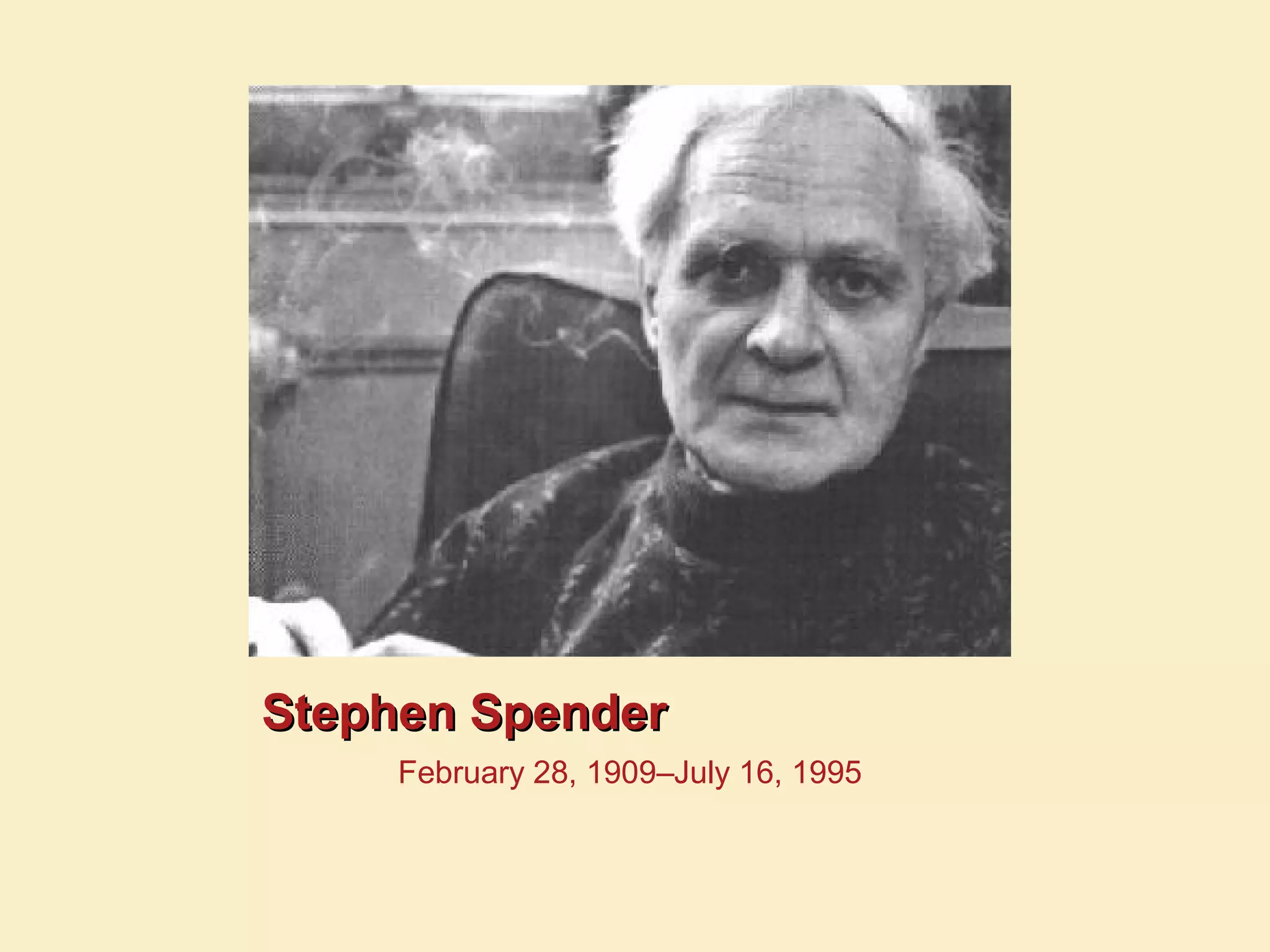
Stephen SpenderStephen Spender
February 28, 1909–July 16, 1995
Stephen SpenderStephen Spender (1909-1995)
• English poet, essayist and writer
• Briefly taught in a school in Devon
• Professor at University College, London
• Professor Emeritus
• Focus on social injustice and class struggle in work
• Tension between poetic lyricism, romantic idealism and
a strong political consciousness
An Elementary SchoolAn Elementary School
Classroom in a SlumClassroom in a Slum
Published in Selected Poems (1964)
Background of the poem
• Published in 1964- outstanding example of political voice
• Expresses his ideology on government , economics and
education
• Written during the Civil Rights Movement in the US
• Commentary on racist issues
• Socialist Proclamation against Capitalism and Social
injustice
• Though British, his extreme left- leaning political
ideologies were in response to the global question
concerning social injustice
• Hence, the poem has a universal significance
Theme
The opening stanza
provides a clear, but dreary depiction of the students in the classroom.
The first child is a "tall girl with [a] weighed-down head.“
is physically and emotionally exhausted,
life seems to have dredged from her body and sapped from her mind.
Her classmates are in no better condition. "The paper- / seeming boy, with rat's
eyes" is paper-thin and weak.
eyes are defensive and scared, like a scavenger, a rat.
prospect for survival, let alone success, is bleak.
Another student, "the stunted, unlucky heir / Of twisted bones," is the victim of
a genetic disorder.-"father's gnarled disease";
left disfigured,
trapped in a physically challenged body.
The opening stanza (cont’d)
Spender then describes the boy "at back of the dim class," stating, "His eyes
live in a dream."
a glimmer of wary hope , a shiver of mental damnation
he is dreaming of a life he may achieve or has lost his mind to the "squirrel's
game."
This vague distinction between these two conflicting interpretations
exposes all the students' futures - there is little or no expectation that
they will succeed, and the best they can hope for is to keep their sanity
and not fall victim to a the reality.
Alternately, the boy's dreaming eyes may harbor an honest desire for true
success. This last boy, "unnoted, sweet and young," may understand his
position in society and see the sadness of his fellow students. With this
understanding, he may represent hope for social change, instead of
merely being an individual who has lost his mind.
The second stanza
The children are from the lowest class; they are the children of the poor.
Spender describes the classroom and its contents.- It is full of "donations “ - of others'
capital The maps, books, and "Shakespeare's head" They are tools to hold them in
place , hope for a better existence and also help them escape
Spender writes,
... for these
Children, these windows, not this map, their world,
Where all their future's painted with a fog,
A narrow street sealed in with a lead sky
Far far from rivers, capes, and stars of words.
The "donations" may give a glimpse of some world to the students, but not of their world.
Their world is not pleasant – it is unpleasant. Their future is bleak, unknown, and
dreary.
The children in "An Elementary School Classroom in a Slum" are trapped by their social
and economic status as children of the have-nots.
The third stanza
Spender's cynicism is a commentary on the upper class and their
circumventing tactics in the effort to hold a firm grip on lower-class citizens :
hope for a better future
initiation into a world of crime
The true victims of the injustice of the class struggle: the children.
Spender is making a resounding humanist statement about the treatment of
children in this poem. It appears that he is more sickened by humanity's
disregard for the children than by the social and economic framework that has
doomed these children to the slums.
The fourth stanza
Spender comes full circle.- replaces cynicism with hope, a plea for a new
manifesto for the children.
Petitions the powers that be
Begs for a change
Free the children
Show them the world directly
Spender further hopes that the children will be able to "let their tongues / Run
naked into books the white and green leaves open.“
Spender claims that if students are truly allowed free exploration--naked
tongues running freely through donated books--then their education and their
"language" will become the "sun" burning away the "fog" that has sealed their
fates and doomed them to "An Elementary School Classroom in a Slum."
History theirs whose language is the sun
considered in the context of all that has gone before:
Spender has been picturing the drab, dull & dreary lives of the children in
their classroom - 'where all their future's painted with a fog'.
By way of contrast, there is the 'escape' into imagination, into new 'worlds':
the vista of 'rivers' and 'capes' (projecting masses of land) in the poster
pictures on the walls. 'Stars of words' conjures up the role of literature
as something 'magical' like the stars at night.
These stars are sometimes seen as 'beacons' or 'points of reference' which
serve to show us the way, both literally & metaphorically -the 'sprinkling'
of words on a page with that of stars in the sky is noteworthy.
Spender ends with a hope for a bright future for these children!
Poetic Technique
• Homeric beginning- lofty nature
• Natural descriptions- the waves in the picture are fascinating but
also reminiscent of the stirrings of Nationalism in Europe.
• Antithetical imagery-contrast between the condition of the children
and the subjects of their learning
• Metaphoric merger of the children with the environment in which
they live
• Implied questions
– Is Shakespeare wicked as well as liberating?
– Are the maps a temptation or hope for a new future?
• Escapism- a sudden desire in the last stanza that these children will be magically
released form bondage into freedom
Poetic Technique (cont’d)
 Focuses on the rigid class distinctions in civil society
 Shows the impact of capitalistic domination
 Hence, their classroom is portrayed metaphorically
“ A narrow street sealed in with a lead sky”
 Shows the failure of education to improve the lives of the children
 Highlights the pathos in the poem
 Ends on a note of prophetic hope
Our assessment
In this poem, Spender speaks about the poverty and lack of
facilities for the poor in a manner so as to awaken the
conscience of the Capitalist rulers in his country.
Incidentally, he also reaches out to the millions of other
readers in whose countries similar situations exist.
Thank you

An Elementary School Classroom in a Slum

  • 1.
  • 2.
    Stephen SpenderStephen Spender(1909-1995) • English poet, essayist and writer • Briefly taught in a school in Devon • Professor at University College, London • Professor Emeritus • Focus on social injustice and class struggle in work • Tension between poetic lyricism, romantic idealism and a strong political consciousness
  • 3.
    An Elementary SchoolAnElementary School Classroom in a SlumClassroom in a Slum Published in Selected Poems (1964)
  • 4.
    Background of thepoem • Published in 1964- outstanding example of political voice • Expresses his ideology on government , economics and education • Written during the Civil Rights Movement in the US • Commentary on racist issues • Socialist Proclamation against Capitalism and Social injustice • Though British, his extreme left- leaning political ideologies were in response to the global question concerning social injustice • Hence, the poem has a universal significance
  • 5.
    Theme The opening stanza providesa clear, but dreary depiction of the students in the classroom. The first child is a "tall girl with [a] weighed-down head.“ is physically and emotionally exhausted, life seems to have dredged from her body and sapped from her mind. Her classmates are in no better condition. "The paper- / seeming boy, with rat's eyes" is paper-thin and weak. eyes are defensive and scared, like a scavenger, a rat. prospect for survival, let alone success, is bleak. Another student, "the stunted, unlucky heir / Of twisted bones," is the victim of a genetic disorder.-"father's gnarled disease"; left disfigured, trapped in a physically challenged body.
  • 6.
    The opening stanza(cont’d) Spender then describes the boy "at back of the dim class," stating, "His eyes live in a dream." a glimmer of wary hope , a shiver of mental damnation he is dreaming of a life he may achieve or has lost his mind to the "squirrel's game." This vague distinction between these two conflicting interpretations exposes all the students' futures - there is little or no expectation that they will succeed, and the best they can hope for is to keep their sanity and not fall victim to a the reality. Alternately, the boy's dreaming eyes may harbor an honest desire for true success. This last boy, "unnoted, sweet and young," may understand his position in society and see the sadness of his fellow students. With this understanding, he may represent hope for social change, instead of merely being an individual who has lost his mind.
  • 7.
    The second stanza Thechildren are from the lowest class; they are the children of the poor. Spender describes the classroom and its contents.- It is full of "donations “ - of others' capital The maps, books, and "Shakespeare's head" They are tools to hold them in place , hope for a better existence and also help them escape Spender writes, ... for these Children, these windows, not this map, their world, Where all their future's painted with a fog, A narrow street sealed in with a lead sky Far far from rivers, capes, and stars of words. The "donations" may give a glimpse of some world to the students, but not of their world. Their world is not pleasant – it is unpleasant. Their future is bleak, unknown, and dreary. The children in "An Elementary School Classroom in a Slum" are trapped by their social and economic status as children of the have-nots.
  • 8.
    The third stanza Spender'scynicism is a commentary on the upper class and their circumventing tactics in the effort to hold a firm grip on lower-class citizens : hope for a better future initiation into a world of crime The true victims of the injustice of the class struggle: the children. Spender is making a resounding humanist statement about the treatment of children in this poem. It appears that he is more sickened by humanity's disregard for the children than by the social and economic framework that has doomed these children to the slums.
  • 9.
    The fourth stanza Spendercomes full circle.- replaces cynicism with hope, a plea for a new manifesto for the children. Petitions the powers that be Begs for a change Free the children Show them the world directly Spender further hopes that the children will be able to "let their tongues / Run naked into books the white and green leaves open.“ Spender claims that if students are truly allowed free exploration--naked tongues running freely through donated books--then their education and their "language" will become the "sun" burning away the "fog" that has sealed their fates and doomed them to "An Elementary School Classroom in a Slum."
  • 10.
    History theirs whoselanguage is the sun considered in the context of all that has gone before: Spender has been picturing the drab, dull & dreary lives of the children in their classroom - 'where all their future's painted with a fog'. By way of contrast, there is the 'escape' into imagination, into new 'worlds': the vista of 'rivers' and 'capes' (projecting masses of land) in the poster pictures on the walls. 'Stars of words' conjures up the role of literature as something 'magical' like the stars at night. These stars are sometimes seen as 'beacons' or 'points of reference' which serve to show us the way, both literally & metaphorically -the 'sprinkling' of words on a page with that of stars in the sky is noteworthy. Spender ends with a hope for a bright future for these children!
  • 11.
    Poetic Technique • Homericbeginning- lofty nature • Natural descriptions- the waves in the picture are fascinating but also reminiscent of the stirrings of Nationalism in Europe. • Antithetical imagery-contrast between the condition of the children and the subjects of their learning • Metaphoric merger of the children with the environment in which they live • Implied questions – Is Shakespeare wicked as well as liberating? – Are the maps a temptation or hope for a new future? • Escapism- a sudden desire in the last stanza that these children will be magically released form bondage into freedom
  • 12.
    Poetic Technique (cont’d) Focuses on the rigid class distinctions in civil society  Shows the impact of capitalistic domination  Hence, their classroom is portrayed metaphorically “ A narrow street sealed in with a lead sky”  Shows the failure of education to improve the lives of the children  Highlights the pathos in the poem  Ends on a note of prophetic hope
  • 13.
    Our assessment In thispoem, Spender speaks about the poverty and lack of facilities for the poor in a manner so as to awaken the conscience of the Capitalist rulers in his country. Incidentally, he also reaches out to the millions of other readers in whose countries similar situations exist.
  • 14.