RelateGateways An Architecture to Enable Spontaneous Mobile Spatial Interaction with Pervasive Services Master Thesis, Dominique Guinard, Fribourg 2007 Supervisors: Hans Gellersen, Denis Lalanne, Rolf Ingold.
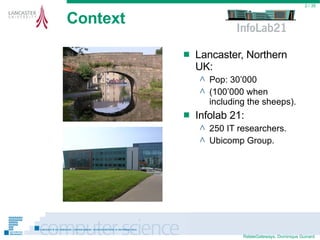
Context Lancaster, Northern UK: Pop: 30’000  (100’000 when including the sheeps). Infolab 21: 250 IT researchers. Ubicomp Group.  / 35
Today’s Menu… Introduction, Aim E2ESD Model Spatial Discovery Video Network and Service Discovery Invocation and Interoperability Cross-device Interactions Evaluation Conclusion  / 35
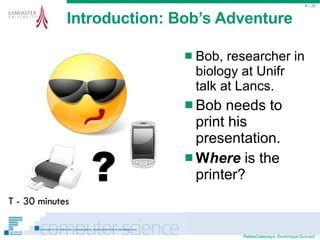
Introduction: Bob’s Adventure Bob, researcher in biology at Unifr talk at Lancs. Bob needs to print his presentation. W here   is the printer?  / 35 ? T - 30 minutes
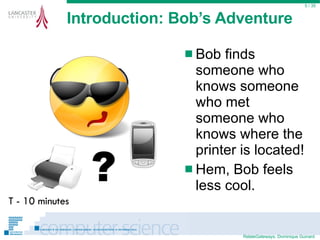
Introduction: Bob’s Adventure Bob finds someone who knows someone who met someone who knows where the printer is located! Hem, Bob feels less cool.  / 35 ? T - 10 minutes
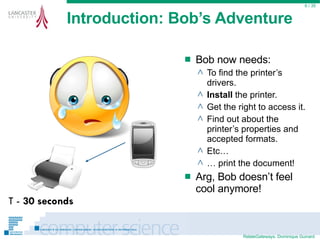
Introduction: Bob’s Adventure Bob now needs: To find the printer’s drivers. Install  the printer. Get the right to access it. Find out about the printer’s properties and accepted formats. Etc… …  print the document! Arg, Bob doesn’t feel cool anymore!  / 35 T -  30 seconds
Introduction: Summary Mobile users can benefit from access to pervasive services. Network and service discovery technologies facilitate spontaneous connections. However, these approaches are not user centric: Difficult for users to  identify  services; Lack of simple and natural interaction techniques: => Lack of  spontaneity  in interaction…  / 35 Introduction
Aim Using the mobile device to: Identify  services available in the user’s immediate environment. Consume  the services in a natural and standard manner.  Need to: Include users in the discovery process. Address identification, discovery  and  invocation.  / 35 Introduction
Today’s Menu… Introduction, Aim E2ESD Model Spatial Discovery Video Network and Service Discovery Invocation and Interoperability Cross-device Interactions Evaluation Conclusion  / 35
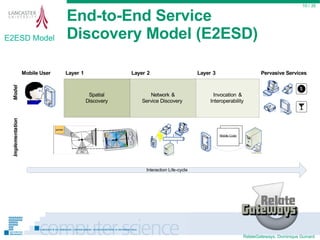
End-to-End Service  Discovery Model (E2ESD)  / 35 E2ESD Model
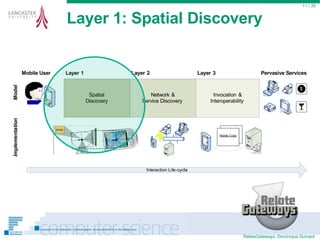
Layer 1: Spatial Discovery  / 35
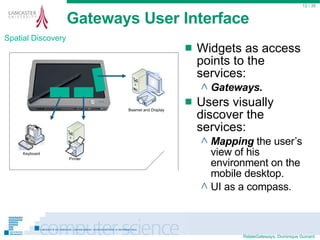
Gateways User Interface Widgets as access points to the services: Gateways. Users visually discover the services: Mapping  the user’s view of his environment on the mobile desktop. UI as a compass.  / 35 Spatial Discovery
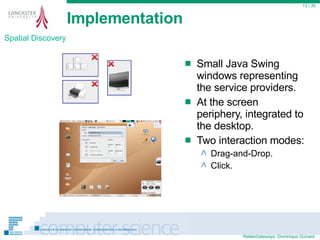
Implementation Small Java Swing windows representing the service providers. At the screen periphery, integrated to the desktop. Two interaction modes: Drag-and-Drop. Click.  / 35 Spatial Discovery
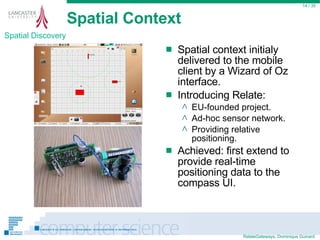
Spatial Context Spatial context initialy delivered to the mobile client by a Wizard of Oz interface. Introducing Relate: EU-founded project. Ad-hoc sensor network. Providing relative positioning. Achieved: first extend to provide real-time positioning data to the compass UI.  / 35 Spatial Discovery
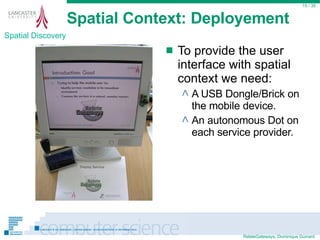
Spatial Context: Deployement To provide the user interface with spatial context we need: A USB Dongle/Brick on the mobile device. An autonomous Dot on each service provider.  / 35 Spatial Discovery
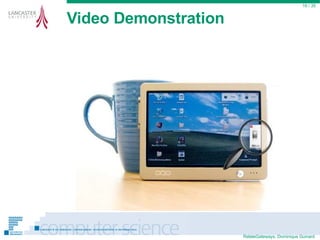
Video Demonstration  / 35
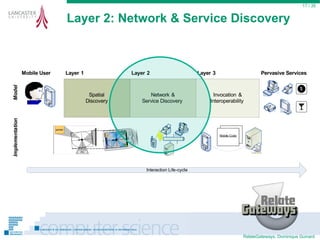
Layer 2: Network & Service Discovery  / 35
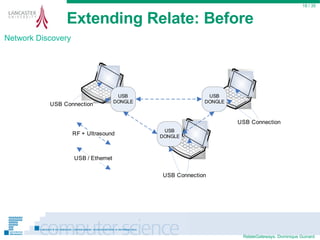
Extending Relate: Before  / 35 Network Discovery
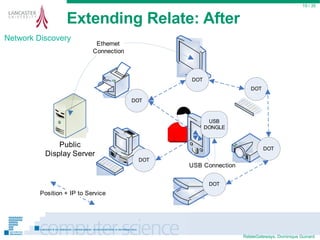
Extending Relate: After  / 35 Network Discovery
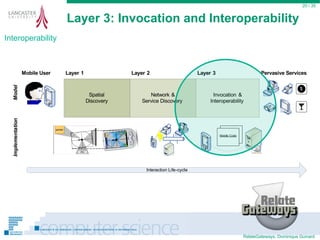
Layer 3: Invocation and Interoperability  / 35 Interoperability
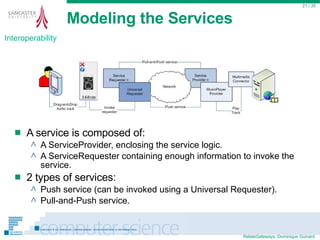
Modeling the Services A service is composed of: A ServiceProvider, enclosing the service logic. A ServiceRequester containing enough information to invoke the service. 2 types of services: Push service (can be invoked using a Universal Requester). Pull-and-Push service.  / 35 Interoperability
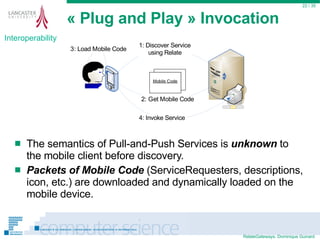
« Plug and Play » Invocation The semantics of Pull-and-Push Services is  unknown  to the mobile client before discovery. Packets of Mobile Code  (ServiceRequesters, descriptions, icon, etc.) are downloaded and dynamically loaded on the mobile device.   / 35 Interoperability
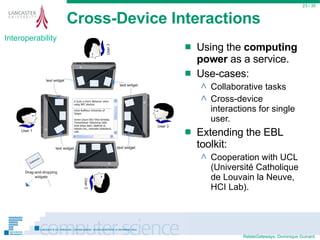
Cross-Device Interactions  Using the  computing power  as a service. Use-cases: Collaborative tasks Cross-device interactions for single user. Extending the EBL toolkit: Cooperation with UCL (Université Catholique de Louvain la Neuve, HCI Lab).  / 35 Interoperability
Today’s Menu… Introduction, Aim E2ESD Model Spatial Discovery Video Network and Service Discovery Invocation and Interoperability Cross-device Interactions Evaluation Conclusion  / 35
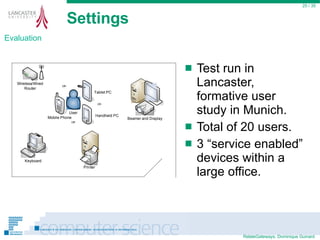
Settings Test run in Lancaster, formative user study in Munich. Total of 20 users. 3 “service enabled” devices within a large office.  / 35 Evaluation
Qualitative Results Most cited benefits: No installation, no configuration: saves time. Ease of interaction with the services: drag and drop. Dynamic spatial arrangement of the gateways: making the UI more natural, especially useful in unknown places. Suggested a number of UI improvements. And  services to implement.  / 35 Evaluation
Today’s Menu… Introduction, Aim E2ESD Model Spatial Discovery Video Network and Service Discovery Invocation and Interoperability Cross-device Interactions Evaluation Conclusion  / 35
Bootstraping Spontaneous Mobile Spatial Interactions Implementation of the E2ESD bundled into a single, runnable application offering: A spatial user interface « toolkit » (MVC based + contextual rules-engine). A Network and Service Discovery system. An Invocation and Interoperability system. An architecture for prototyping pervasive services. Various simulation and debugging tools. A  framework  (SOA) supporting the rapid prototyping of mobile spatial interactions.  / 35 Conclusion
Quantitative Outputs Dissemination 3 accepted workshop papers: MSI @ CHI 07, Permid @ Pervasive 07, SensorNet 07 2 conference papers submited Ubicomp 07 (Demo Paper), LoCA 07 Prototyping Framework: ~16’000 lines of code. ~160 classes (to consolidate!). To few hours of sleep…  / 35 Conclusion
Open Questions Scalability of the application: In terms of user interface. In terms of prototyping framework. User study is formative: Need for a comparative study as well. Need to evaluate the framework and its use for the prototyping of mobile spatial applications. Security concerns: Spontaneity is nice but it leaves a number of doors open for attackers.  / 35 Conclusion
Questions ? Thanks for your attention…. Project’s homepage:  http://ubicomp.lancs.ac.uk/relategateways Contact:  [email_address]  / 35 Conclusion

An Architecture to Enable Spontaneous Mobile Spatial Interaction with Pervasive Services

  • 1.
    RelateGateways An Architectureto Enable Spontaneous Mobile Spatial Interaction with Pervasive Services Master Thesis, Dominique Guinard, Fribourg 2007 Supervisors: Hans Gellersen, Denis Lalanne, Rolf Ingold.
  • 2.
    Context Lancaster, NorthernUK: Pop: 30’000 (100’000 when including the sheeps). Infolab 21: 250 IT researchers. Ubicomp Group. / 35
  • 3.
    Today’s Menu… Introduction,Aim E2ESD Model Spatial Discovery Video Network and Service Discovery Invocation and Interoperability Cross-device Interactions Evaluation Conclusion / 35
  • 4.
    Introduction: Bob’s AdventureBob, researcher in biology at Unifr talk at Lancs. Bob needs to print his presentation. W here is the printer? / 35 ? T - 30 minutes
  • 5.
    Introduction: Bob’s AdventureBob finds someone who knows someone who met someone who knows where the printer is located! Hem, Bob feels less cool. / 35 ? T - 10 minutes
  • 6.
    Introduction: Bob’s AdventureBob now needs: To find the printer’s drivers. Install the printer. Get the right to access it. Find out about the printer’s properties and accepted formats. Etc… … print the document! Arg, Bob doesn’t feel cool anymore! / 35 T - 30 seconds
  • 7.
    Introduction: Summary Mobileusers can benefit from access to pervasive services. Network and service discovery technologies facilitate spontaneous connections. However, these approaches are not user centric: Difficult for users to identify services; Lack of simple and natural interaction techniques: => Lack of spontaneity in interaction… / 35 Introduction
  • 8.
    Aim Using themobile device to: Identify services available in the user’s immediate environment. Consume the services in a natural and standard manner. Need to: Include users in the discovery process. Address identification, discovery and invocation. / 35 Introduction
  • 9.
    Today’s Menu… Introduction,Aim E2ESD Model Spatial Discovery Video Network and Service Discovery Invocation and Interoperability Cross-device Interactions Evaluation Conclusion / 35
  • 10.
    End-to-End Service Discovery Model (E2ESD) / 35 E2ESD Model
  • 11.
    Layer 1: SpatialDiscovery / 35
  • 12.
    Gateways User InterfaceWidgets as access points to the services: Gateways. Users visually discover the services: Mapping the user’s view of his environment on the mobile desktop. UI as a compass. / 35 Spatial Discovery
  • 13.
    Implementation Small JavaSwing windows representing the service providers. At the screen periphery, integrated to the desktop. Two interaction modes: Drag-and-Drop. Click. / 35 Spatial Discovery
  • 14.
    Spatial Context Spatialcontext initialy delivered to the mobile client by a Wizard of Oz interface. Introducing Relate: EU-founded project. Ad-hoc sensor network. Providing relative positioning. Achieved: first extend to provide real-time positioning data to the compass UI. / 35 Spatial Discovery
  • 15.
    Spatial Context: DeployementTo provide the user interface with spatial context we need: A USB Dongle/Brick on the mobile device. An autonomous Dot on each service provider. / 35 Spatial Discovery
  • 16.
  • 17.
    Layer 2: Network& Service Discovery / 35
  • 18.
    Extending Relate: Before / 35 Network Discovery
  • 19.
    Extending Relate: After / 35 Network Discovery
  • 20.
    Layer 3: Invocationand Interoperability / 35 Interoperability
  • 21.
    Modeling the ServicesA service is composed of: A ServiceProvider, enclosing the service logic. A ServiceRequester containing enough information to invoke the service. 2 types of services: Push service (can be invoked using a Universal Requester). Pull-and-Push service. / 35 Interoperability
  • 22.
    « Plug and Play »Invocation The semantics of Pull-and-Push Services is unknown to the mobile client before discovery. Packets of Mobile Code (ServiceRequesters, descriptions, icon, etc.) are downloaded and dynamically loaded on the mobile device. / 35 Interoperability
  • 23.
    Cross-Device Interactions Using the computing power as a service. Use-cases: Collaborative tasks Cross-device interactions for single user. Extending the EBL toolkit: Cooperation with UCL (Université Catholique de Louvain la Neuve, HCI Lab). / 35 Interoperability
  • 24.
    Today’s Menu… Introduction,Aim E2ESD Model Spatial Discovery Video Network and Service Discovery Invocation and Interoperability Cross-device Interactions Evaluation Conclusion / 35
  • 25.
    Settings Test runin Lancaster, formative user study in Munich. Total of 20 users. 3 “service enabled” devices within a large office. / 35 Evaluation
  • 26.
    Qualitative Results Mostcited benefits: No installation, no configuration: saves time. Ease of interaction with the services: drag and drop. Dynamic spatial arrangement of the gateways: making the UI more natural, especially useful in unknown places. Suggested a number of UI improvements. And services to implement. / 35 Evaluation
  • 27.
    Today’s Menu… Introduction,Aim E2ESD Model Spatial Discovery Video Network and Service Discovery Invocation and Interoperability Cross-device Interactions Evaluation Conclusion / 35
  • 28.
    Bootstraping Spontaneous MobileSpatial Interactions Implementation of the E2ESD bundled into a single, runnable application offering: A spatial user interface « toolkit » (MVC based + contextual rules-engine). A Network and Service Discovery system. An Invocation and Interoperability system. An architecture for prototyping pervasive services. Various simulation and debugging tools. A framework (SOA) supporting the rapid prototyping of mobile spatial interactions. / 35 Conclusion
  • 29.
    Quantitative Outputs Dissemination3 accepted workshop papers: MSI @ CHI 07, Permid @ Pervasive 07, SensorNet 07 2 conference papers submited Ubicomp 07 (Demo Paper), LoCA 07 Prototyping Framework: ~16’000 lines of code. ~160 classes (to consolidate!). To few hours of sleep… / 35 Conclusion
  • 30.
    Open Questions Scalabilityof the application: In terms of user interface. In terms of prototyping framework. User study is formative: Need for a comparative study as well. Need to evaluate the framework and its use for the prototyping of mobile spatial applications. Security concerns: Spontaneity is nice but it leaves a number of doors open for attackers. / 35 Conclusion
  • 31.
    Questions ? Thanksfor your attention…. Project’s homepage: http://ubicomp.lancs.ac.uk/relategateways Contact: [email_address] / 35 Conclusion

Editor's Notes

  • #2 ~ 20 slides for 20 minutes (+ 5 min for questions).