Amur Leopard
Stevan Brcko IV-4
The Amur Leopard
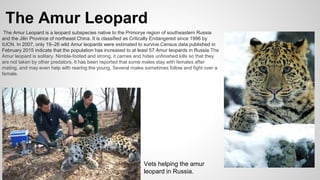
The Amur Leopard is a leopard subspecies native to the Primorye region of southeastern Russia
and the Jilin Province of northeast China. It is classified as Critically Endangered since 1996 by
IUCN. In 2007, only 19–26 wild Amur leopards were estimated to survive.Census data published in
February 2015 indicate that the population has increased to at least 57 Amur leopards in Russia.The
Amur leopard is solitary. Nimble-footed and strong, it carries and hides unfinished kills so that they
are not taken by other predators. It has been reported that some males stay with females after
mating, and may even help with rearing the young. Several males sometimes follow and fight over a
female.
Vets helping the amur
leopard in Russia.
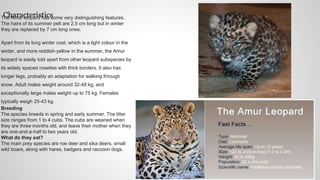
CharacteristicsThe Amur leopard has some very distinguishing features.
The hairs of its summer pelt are 2.5 cm long but in winter
they are replaced by 7 cm long ones.
Apart from its long winter coat, which is a light colour in the
winter, and more reddish-yellow in the summer, the Amur
leopard is easily told apart from other leopard subspecies by
its widely spaced rosettes with thick borders. It also has
longer legs, probably an adaptation for walking through
snow. Adult males weight around 32-48 kg, and
exceptionally large males weight up to 75 kg. Females
typically weigh 25-43 kg.
Breeding
The species breeds in spring and early summer. The litter
size ranges from 1 to 4 cubs. The cubs are weaned when
they are three months old, and leave their mother when they
are one-and-a-half to two years old.
What do they eat?
The main prey species are roe deer and sika deers, small
wild boars, along with hares, badgers and raccoon dogs.
Amur Leopard Threats
Habitat loss
It is estimated that between 1970-1983, the Amur leopard lost an astonishing 80% of its former
territory. Indiscriminate logging, forest fires and land conversion for farming are the main
causes.
Still all is not lost. Even now large tracts of forest, which are ideal leopard habitat exist. If these
areas can be protected from unsustainable logging, rampant forest fires and poaching of
wildlife, the chance exists to increase the population of the subspecies in the wild.
Poaching
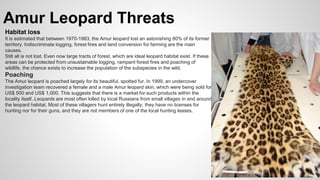
The Amur leopard is poached largely for its beautiful, spotted fur. In 1999, an undercover
investigation team recovered a female and a male Amur leopard skin, which were being sold for
US$ 500 and US$ 1,000. This suggests that there is a market for such products within the
locality itself..Leopards are most often killed by local Russians from small villages in and around
the leopard habitat. Most of these villagers hunt entirely illegally; they have no licenses for
hunting nor for their guns, and they are not members of one of the local hunting leases.
Inbreeding
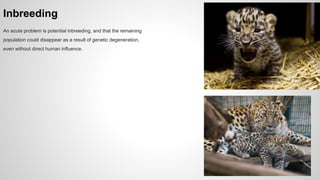
An acute problem is potential inbreeding, and that the remaining
population could disappear as a result of genetic degeneration,
even without direct human influence.
Interesting stuff
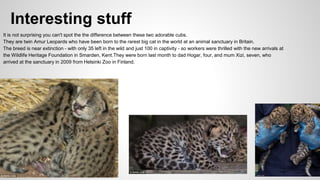
It is not surprising you can't spot the the difference between these two adorable cubs.
They are twin Amur Leopards who have been born to the rarest big cat in the world at an animal sanctuary in Britain.
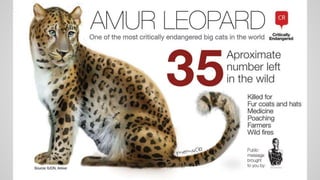
The breed is near extinction - with only 35 left in the wild and just 100 in captivity - so workers were thrilled with the new arrivals at
the Wildlife Heritage Foundation in Smarden, Kent.They were born last month to dad Hogar, four, and mum Xizi, seven, who
arrived at the sanctuary in 2009 from Helsinki Zoo in Finland.
A Safe Haven
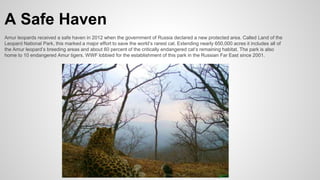
Amur leopards received a safe haven in 2012 when the government of Russia declared a new protected area. Called Land of the
Leopard National Park, this marked a major effort to save the world’s rarest cat. Extending nearly 650,000 acres it includes all of
the Amur leopard’s breeding areas and about 60 percent of the critically endangered cat’s remaining habitat. The park is also
home to 10 endangered Amur tigers. WWF lobbied for the establishment of this park in the Russian Far East since 2001.

Amur leopard stevan

  • 1.
  • 2.
    The Amur Leopard TheAmur Leopard is a leopard subspecies native to the Primorye region of southeastern Russia and the Jilin Province of northeast China. It is classified as Critically Endangered since 1996 by IUCN. In 2007, only 19–26 wild Amur leopards were estimated to survive.Census data published in February 2015 indicate that the population has increased to at least 57 Amur leopards in Russia.The Amur leopard is solitary. Nimble-footed and strong, it carries and hides unfinished kills so that they are not taken by other predators. It has been reported that some males stay with females after mating, and may even help with rearing the young. Several males sometimes follow and fight over a female. Vets helping the amur leopard in Russia.
  • 3.
    CharacteristicsThe Amur leopardhas some very distinguishing features. The hairs of its summer pelt are 2.5 cm long but in winter they are replaced by 7 cm long ones. Apart from its long winter coat, which is a light colour in the winter, and more reddish-yellow in the summer, the Amur leopard is easily told apart from other leopard subspecies by its widely spaced rosettes with thick borders. It also has longer legs, probably an adaptation for walking through snow. Adult males weight around 32-48 kg, and exceptionally large males weight up to 75 kg. Females typically weigh 25-43 kg. Breeding The species breeds in spring and early summer. The litter size ranges from 1 to 4 cubs. The cubs are weaned when they are three months old, and leave their mother when they are one-and-a-half to two years old. What do they eat? The main prey species are roe deer and sika deers, small wild boars, along with hares, badgers and raccoon dogs.
  • 4.
    Amur Leopard Threats Habitatloss It is estimated that between 1970-1983, the Amur leopard lost an astonishing 80% of its former territory. Indiscriminate logging, forest fires and land conversion for farming are the main causes. Still all is not lost. Even now large tracts of forest, which are ideal leopard habitat exist. If these areas can be protected from unsustainable logging, rampant forest fires and poaching of wildlife, the chance exists to increase the population of the subspecies in the wild. Poaching The Amur leopard is poached largely for its beautiful, spotted fur. In 1999, an undercover investigation team recovered a female and a male Amur leopard skin, which were being sold for US$ 500 and US$ 1,000. This suggests that there is a market for such products within the locality itself..Leopards are most often killed by local Russians from small villages in and around the leopard habitat. Most of these villagers hunt entirely illegally; they have no licenses for hunting nor for their guns, and they are not members of one of the local hunting leases.
  • 6.
    Inbreeding An acute problemis potential inbreeding, and that the remaining population could disappear as a result of genetic degeneration, even without direct human influence.
  • 7.
    Interesting stuff It isnot surprising you can't spot the the difference between these two adorable cubs. They are twin Amur Leopards who have been born to the rarest big cat in the world at an animal sanctuary in Britain. The breed is near extinction - with only 35 left in the wild and just 100 in captivity - so workers were thrilled with the new arrivals at the Wildlife Heritage Foundation in Smarden, Kent.They were born last month to dad Hogar, four, and mum Xizi, seven, who arrived at the sanctuary in 2009 from Helsinki Zoo in Finland.
  • 8.
    A Safe Haven Amurleopards received a safe haven in 2012 when the government of Russia declared a new protected area. Called Land of the Leopard National Park, this marked a major effort to save the world’s rarest cat. Extending nearly 650,000 acres it includes all of the Amur leopard’s breeding areas and about 60 percent of the critically endangered cat’s remaining habitat. The park is also home to 10 endangered Amur tigers. WWF lobbied for the establishment of this park in the Russian Far East since 2001.