Hyundai - A case study on its marketing strategies in India
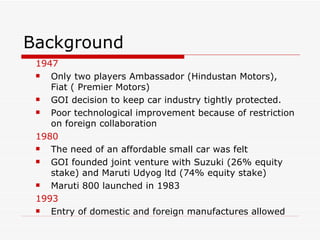
Background 1947 Only two players Ambassador (Hindustan Motors), Fiat ( Premier Motors)  GOI decision to keep car industry tightly protected. Poor technological improvement because of restriction on foreign collaboration 1980 The need of an affordable small car was felt GOI founded joint venture with Suzuki (26% equity stake) and Maruti Udyog ltd (74% equity stake) Maruti 800 launched in 1983 1993 Entry of domestic and foreign manufactures allowed
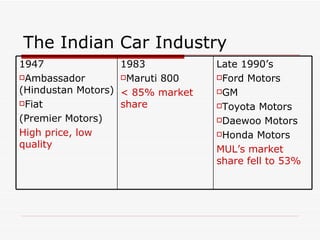
The Indian Car Industry Late 1990’s Ford Motors GM Toyota Motors Daewoo Motors Honda Motors MUL’s market share fell to 53% 1983 Maruti 800 < 85% market share 1947 Ambassador (Hindustan Motors) Fiat  (Premier Motors) High price, low quality
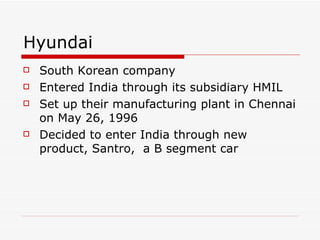
Hyundai South Korean company Entered India through its subsidiary HMIL Set up their manufacturing plant in Chennai on May 26, 1996 Decided to enter India through new product, Santro,  a B segment car
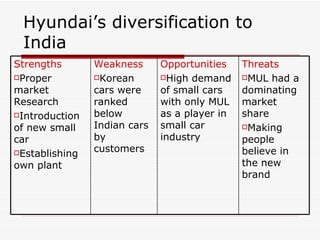
Hyundai’s diversification to India Threats MUL had a dominating market share Making people believe in the new brand Opportunities High demand of small cars with only MUL as a player in small car industry Weakness Korean cars were ranked below Indian cars by customers Strengths Proper market Research Introduction of new small car Establishing own plant
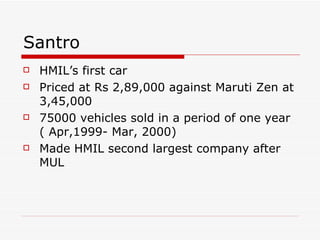
Santro HMIL’s first car Priced at Rs 2,89,000 against Maruti Zen at 3,45,000 75000 vehicles sold in a period of one year ( Apr,1999- Mar, 2000) Made HMIL second largest company after MUL
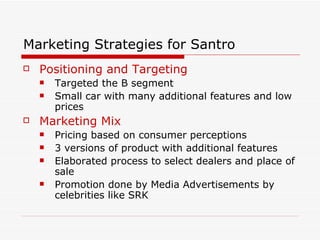
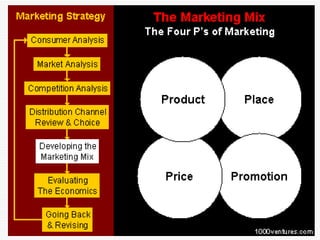
Marketing Strategies for Santro Positioning and Targeting Targeted the B segment Small car with many additional features and low prices Marketing Mix Pricing based on consumer perceptions 3 versions of product with additional features Elaborated process to select dealers and place of sale Promotion done by Media Advertisements by celebrities like SRK
 
Repositioning Santro-2002 Required due to launch of Maruti Alto in 2000 Targeting and Positioning Targeted the age group 25 to 30 Repositioned as sunshine car Marketing Mix Fresh commercials with Preity Zinta and SRK New Variant- Santro Xing Decided to tap the rural market – conducted road shows Signed agreement with PNB for financing its cars
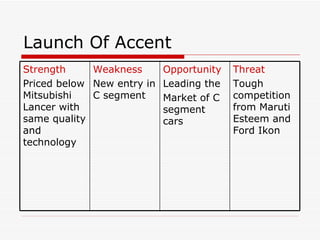
Launch Of Accent Threat Tough competition from Maruti Esteem and Ford Ikon Opportunity Leading the  Market of C segment cars Weakness New entry in C segment Strength Priced below Mitsubishi Lancer with same quality and technology
Factors for success of Hyundai Differentiation in Santro as compared to other B class cars available in India Lower cost Proper market survey Tapping the right market and the need Closer to the customer
Getz No, Getz will not affect the sale of santro because it has a different target market and moreover there is a difference of more than 1.5 lacs in the prices Hyundai’s strategy: Produce one car each year is to maintain their cost leadership strategy in each segment and to put their car in each segment to compete with the other brands
Present Scenario Products- Santro, Getz Prime, Accent, Verna,i-10, i-20, Tucson, Sonata Hyundai in news Hyundai Motor Company, which holds around 50 percent market share in Korea, announced it has sold a total of 250.995 new vehicles at home and abroad. The number represents a 23 percent increase from the same month a year ago.
Thank you Amriteshwar Apurva

Amriteshwar bhullar, Apurva

  • 1.
    Hyundai - Acase study on its marketing strategies in India
  • 2.
    Background 1947 Onlytwo players Ambassador (Hindustan Motors), Fiat ( Premier Motors) GOI decision to keep car industry tightly protected. Poor technological improvement because of restriction on foreign collaboration 1980 The need of an affordable small car was felt GOI founded joint venture with Suzuki (26% equity stake) and Maruti Udyog ltd (74% equity stake) Maruti 800 launched in 1983 1993 Entry of domestic and foreign manufactures allowed
  • 3.
    The Indian CarIndustry Late 1990’s Ford Motors GM Toyota Motors Daewoo Motors Honda Motors MUL’s market share fell to 53% 1983 Maruti 800 < 85% market share 1947 Ambassador (Hindustan Motors) Fiat (Premier Motors) High price, low quality
  • 4.
    Hyundai South Koreancompany Entered India through its subsidiary HMIL Set up their manufacturing plant in Chennai on May 26, 1996 Decided to enter India through new product, Santro, a B segment car
  • 5.
    Hyundai’s diversification toIndia Threats MUL had a dominating market share Making people believe in the new brand Opportunities High demand of small cars with only MUL as a player in small car industry Weakness Korean cars were ranked below Indian cars by customers Strengths Proper market Research Introduction of new small car Establishing own plant
  • 6.
    Santro HMIL’s firstcar Priced at Rs 2,89,000 against Maruti Zen at 3,45,000 75000 vehicles sold in a period of one year ( Apr,1999- Mar, 2000) Made HMIL second largest company after MUL
  • 7.
    Marketing Strategies forSantro Positioning and Targeting Targeted the B segment Small car with many additional features and low prices Marketing Mix Pricing based on consumer perceptions 3 versions of product with additional features Elaborated process to select dealers and place of sale Promotion done by Media Advertisements by celebrities like SRK
  • 8.
  • 9.
    Repositioning Santro-2002 Requireddue to launch of Maruti Alto in 2000 Targeting and Positioning Targeted the age group 25 to 30 Repositioned as sunshine car Marketing Mix Fresh commercials with Preity Zinta and SRK New Variant- Santro Xing Decided to tap the rural market – conducted road shows Signed agreement with PNB for financing its cars
  • 10.
    Launch Of AccentThreat Tough competition from Maruti Esteem and Ford Ikon Opportunity Leading the Market of C segment cars Weakness New entry in C segment Strength Priced below Mitsubishi Lancer with same quality and technology
  • 11.
    Factors for successof Hyundai Differentiation in Santro as compared to other B class cars available in India Lower cost Proper market survey Tapping the right market and the need Closer to the customer
  • 12.
    Getz No, Getzwill not affect the sale of santro because it has a different target market and moreover there is a difference of more than 1.5 lacs in the prices Hyundai’s strategy: Produce one car each year is to maintain their cost leadership strategy in each segment and to put their car in each segment to compete with the other brands
  • 13.
    Present Scenario Products-Santro, Getz Prime, Accent, Verna,i-10, i-20, Tucson, Sonata Hyundai in news Hyundai Motor Company, which holds around 50 percent market share in Korea, announced it has sold a total of 250.995 new vehicles at home and abroad. The number represents a 23 percent increase from the same month a year ago.
  • 14.