CREATED BY
AMIT CHOPADA
EN:- 130210125017
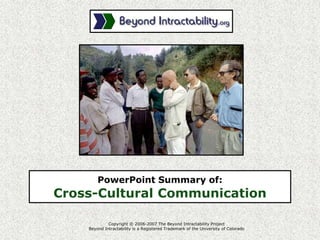
PowerPoint Summary of:
Cross-Cultural Communication
Copyright © 2006-2007 The Beyond Intractability Project
Beyond Intractability is a Registered Trademark of the University of Colorado
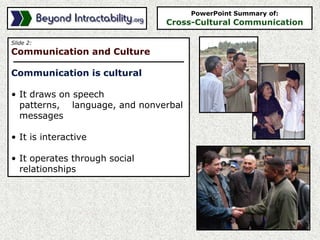
Slide 2:
Communication and Culture
Communication is cultural
• It draws on speech
patterns, language, and nonverbal
messages
• It is interactive
• It operates through social
relationships
PowerPoint Summary of:
Cross-Cultural Communication
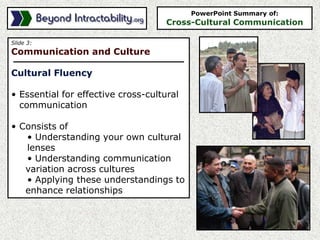
Slide 3:
Communication and Culture
Cultural Fluency
• Essential for effective cross-cultural
communication
• Consists of
• Understanding your own cultural
lenses
• Understanding communication
variation across cultures
• Applying these understandings to
enhance relationships
PowerPoint Summary of:
Cross-Cultural Communication
Slide 4:
Common Cultural Differences
Perception of Time
Perception of Space
Fate and Personal Responsibility
Importance of Face
Nonverbal Communication
PowerPoint Summary of:
Cross-Cultural Communication
Slide 5:
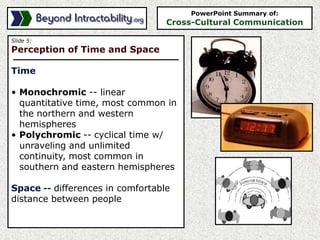
Perception of Time and Space
Time
• Monochromic -- linear
quantitative time, most common in
the northern and western
hemispheres
• Polychromic -- cyclical time w/
unraveling and unlimited
continuity, most common in
southern and eastern hemispheres
Space -- differences in comfortable
distance between people
PowerPoint Summary of:
Cross-Cultural Communication
Slide 6:
Fate and Personal Responsibility
Extent to which we feel ourselves
to be the masters of our lives
Extent to which we see ourselves
as subject to things outside our
control
PowerPoint Summary of:
Cross-Cultural Communication
Slide 7:
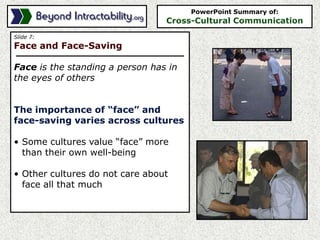
Face and Face-Saving
Face is the standing a person has in
the eyes of others
The importance of “face” and
face-saving varies across cultures
• Some cultures value “face” more
than their own well-being
• Other cultures do not care about
face all that much
PowerPoint Summary of:
Cross-Cultural Communication
Slide 8:
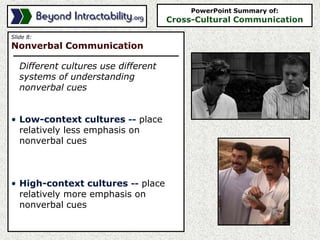
Nonverbal Communication
Different cultures use different
systems of understanding
nonverbal cues
• Low-context cultures -- place
relatively less emphasis on
nonverbal cues
• High-context cultures -- place
relatively more emphasis on
nonverbal cues
PowerPoint Summary of:
Cross-Cultural Communication
Slide 9:
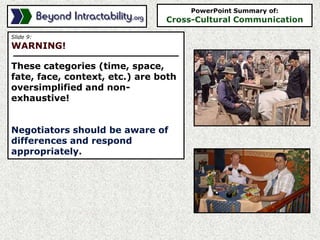
WARNING!
These categories (time, space,
fate, face, context, etc.) are both
oversimplified and non-
exhaustive!
Negotiators should be aware of
differences and respond
appropriately.
PowerPoint Summary of:
Cross-Cultural Communication

AmitChopada_017crosscultural

  • 2.
  • 3.
    PowerPoint Summary of: Cross-CulturalCommunication Copyright © 2006-2007 The Beyond Intractability Project Beyond Intractability is a Registered Trademark of the University of Colorado
  • 4.
    Slide 2: Communication andCulture Communication is cultural • It draws on speech patterns, language, and nonverbal messages • It is interactive • It operates through social relationships PowerPoint Summary of: Cross-Cultural Communication
  • 5.
    Slide 3: Communication andCulture Cultural Fluency • Essential for effective cross-cultural communication • Consists of • Understanding your own cultural lenses • Understanding communication variation across cultures • Applying these understandings to enhance relationships PowerPoint Summary of: Cross-Cultural Communication
  • 6.
    Slide 4: Common CulturalDifferences Perception of Time Perception of Space Fate and Personal Responsibility Importance of Face Nonverbal Communication PowerPoint Summary of: Cross-Cultural Communication
  • 7.
    Slide 5: Perception ofTime and Space Time • Monochromic -- linear quantitative time, most common in the northern and western hemispheres • Polychromic -- cyclical time w/ unraveling and unlimited continuity, most common in southern and eastern hemispheres Space -- differences in comfortable distance between people PowerPoint Summary of: Cross-Cultural Communication
  • 8.
    Slide 6: Fate andPersonal Responsibility Extent to which we feel ourselves to be the masters of our lives Extent to which we see ourselves as subject to things outside our control PowerPoint Summary of: Cross-Cultural Communication
  • 9.
    Slide 7: Face andFace-Saving Face is the standing a person has in the eyes of others The importance of “face” and face-saving varies across cultures • Some cultures value “face” more than their own well-being • Other cultures do not care about face all that much PowerPoint Summary of: Cross-Cultural Communication
  • 10.
    Slide 8: Nonverbal Communication Differentcultures use different systems of understanding nonverbal cues • Low-context cultures -- place relatively less emphasis on nonverbal cues • High-context cultures -- place relatively more emphasis on nonverbal cues PowerPoint Summary of: Cross-Cultural Communication
  • 11.
    Slide 9: WARNING! These categories(time, space, fate, face, context, etc.) are both oversimplified and non- exhaustive! Negotiators should be aware of differences and respond appropriately. PowerPoint Summary of: Cross-Cultural Communication