AMINO ACID: STRUCTUREAND CLASSIFICATION
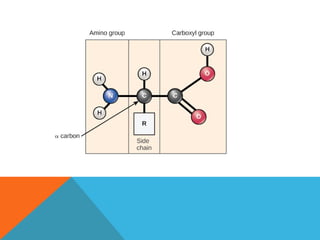
Amino acids are organic compounds that are the fundamental
building blocks of proteins. They contain an amino group (-NH2),
a carboxyl group (-COOH), and a variable side chain (R-
group). There are 20 standard amino acids, some of which are
essential, meaning they must be obtained through diet, while
others can be synthesized by the body.
Key points about amino acids:
•Building Blocks of Proteins:
Amino acids link together through peptide bonds to form
polypeptide chains, which fold into complex three-dimensional
structures to create proteins.
•Essential vs. Non-essential:
The human body can synthesize some amino acids, while others
(essential amino acids) must be obtained from food.
•Diverse Functions:
Amino acids play crucial roles in various biological processes,
4.
Functions
• Protein. synthesis:They are the raw materials for
building all the proteins in the body.
• Enzyme catalysis: Many enzymes, which are
proteins, are essential for catalyzing biochemical
reactions.
• Structural components: Proteins provide structural
support to cells and tissues.
• Hormone and neurotransmitter production: Some
amino acids are precursors for hormones and
neurotransmitters.
5.
20 Standard AminoAcids:
The 20 amino acids found in proteins are:
alanine, arginine, asparagine, aspartic acid, cysteine, glutamic
acid, glutamine, glycine, histidine, isoleucine, leucine, lysine,
methionine, phenylalanine, proline, serine, threonine,
tryptophan, tyrosine, and valine.
6.
Amino Acid Metabolismand Synthesis
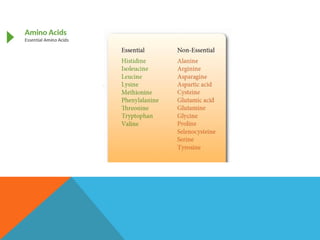
Essential Amino Acids: Cannot be synthesized by the
human body and must be obtained from the diet. The
nine essential amino acids are: histidine, isoleucine,
leucine, lysine, methionine, phenylalanine, threonine,
tryptophan, and valine.
Dietary Sources:
Both animal and plant-based foods contain amino
acids. Good sources include meat, poultry, fish, eggs, dairy
products, beans, lentils, nuts, and seeds.
•Non-Essential Amino Acids: Can be synthesized by
the body. These include alanine, asparagine, aspartic
acid, glutamic acid, serine, arginine, cysteine,
glutamine, glycine, proline, and tyrosine.
8.
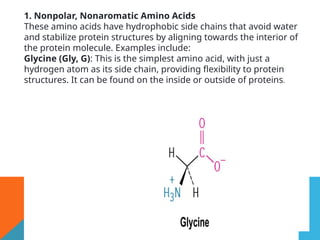
1. Nonpolar, NonaromaticAmino Acids
These amino acids have hydrophobic side chains that avoid water
and stabilize protein structures by aligning towards the interior of
the protein molecule. Examples include:
Glycine (Gly, G): This is the simplest amino acid, with just a
hydrogen atom as its side chain, providing flexibility to protein
structures. It can be found on the inside or outside of proteins.
9.
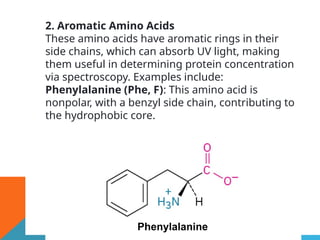
2. Aromatic AminoAcids
These amino acids have aromatic rings in their
side chains, which can absorb UV light, making
them useful in determining protein concentration
via spectroscopy. Examples include:
Phenylalanine (Phe, F): This amino acid is
nonpolar, with a benzyl side chain, contributing to
the hydrophobic core.
10.
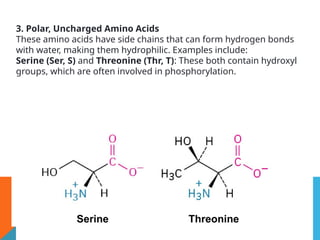
3. Polar, UnchargedAmino Acids
These amino acids have side chains that can form hydrogen bonds
with water, making them hydrophilic. Examples include:
Serine (Ser, S) and Threonine (Thr, T): These both contain hydroxyl
groups, which are often involved in phosphorylation.
11.
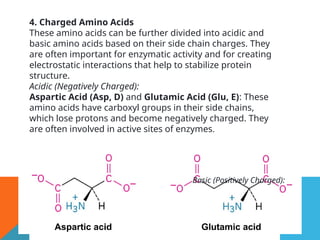
4. Charged AminoAcids
These amino acids can be further divided into acidic and
basic amino acids based on their side chain charges. They
are often important for enzymatic activity and for creating
electrostatic interactions that help to stabilize protein
structure.
Acidic (Negatively Charged):
Aspartic Acid (Asp, D) and Glutamic Acid (Glu, E): These
amino acids have carboxyl groups in their side chains,
which lose protons and become negatively charged. They
are often involved in active sites of enzymes.
Basic (Positively Charged):
13.
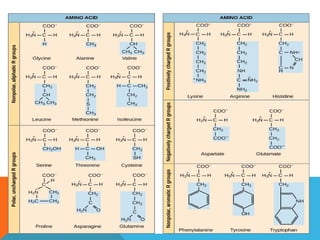
The twenty commonamino acids are often
referred to using three-letter abbreviations. The
structures, names, and abbreviations for the
twenty common amino acids are shown below.
Note that they are all α-amino acids.
14.
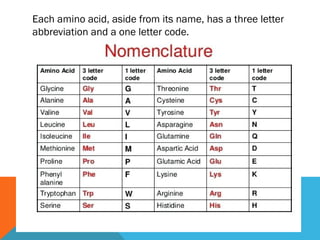
Each amino acid,aside from its name, has a three letter
abbreviation and a one letter code.
15.
Functions of AminoAcids
Apart from being the monomeric constituents of
proteins and peptides, amino acids serve variety
of functions.
(a) Some amino acids are converted to
carbohydrates and are called as glucogenic
amino acids.
16.
(b) Specific aminoacids give rise to specialised
products, e.g.
• Tyrsione forms hormones such as thyroid
hormones, (T3, T4), epinephrine and norepinephrine
and a pigment called melanin.
• Tryptophan can synthesise a vitamin called niacin.
• Glycine, arginine and methionine synthesise
creatine.
17.
PROTEINS
“Protein” refers tothe macronutrient found in many foods and
drinks.
What is the function of proteins?
Proteins keep everything in your body working and moving
so you can keep moving. Proteins are so important that scientists
describe them as your body’s workhorses.
Here are some things proteins do for your body:
•Help cells in your body “read” your genes and use that information to
build new cells and molecules, including new proteins (yes, that’s
right: Proteins indeed help create other proteins)
•Provide structure to cells and tissues throughout your body
•Attach to invaders, like bacteria and viruses, to clear them from your
body
•Break down nutrients in the foods you eat — including fats, proteins
and carbohydrates — into forms your body can use (this might be
another surprise: Some proteins, called enzymes, break
down other proteins!)
•Send chemical signals and carry information from cell to cell
•Speed up (catalyze) chemical reactions within cells, which helps
create the energy your body needs to function
18.
TYPES
Complete proteins containall nine essential amino acids, while
incomplete proteins lack one or more of these. Animal products like
meat, fish, eggs, and dairy are generally complete proteins. Plant-
based proteins (excluding soy, quinoa, and a few others) are often
incomplete.
Complete Proteins (Examples):
•Animal Products: Beef, chicken, fish, pork, turkey, eggs, milk,
cheese, yogurt.
•Plant-Based: Soy (tofu, tempeh, edamame), quinoa, buckwheat,
hemp seed, spirulina.
•
Incomplete Proteins (Examples):
•Legumes: Beans, lentils.
•Nuts & Seeds: Almonds, cashews, walnuts, pumpkin seeds,
sunflower seeds (some, like pistachios, are complete).
•Grains: Rice, wheat, oats.
•Vegetables: Most vegetables.
Important Note: Incomplete proteins can become complete when
combined with other incomplete protein sources to provide all
essential amino acids. For example, rice and beans, or hummus
19.
3 Complementary Peptides:
Complementarypeptides are sequences of amino acids
that are encoded on complementary strands of nucleic
acids. They can bind to each other, suggesting that
proteins may use similar complementary sequences to
interact with other proteins or peptides.
4 Peptides:
Peptides are short chains of amino acids, typically
containing between two and fifty amino acids. They are
smaller than proteins and can be found as independent
molecules or as parts of larger proteins. Some
examples include:
•Signaling peptides: These peptides transmit signals
within the body, such as hormones or
neurotransmitters.
20.
Classification
Proteins can bebroadly classified into simple and
conjugated proteins based on their composition. Simple
proteins consist solely of amino acids linked by peptide
bonds, while conjugated proteins include a non-amino
acid component, known as a prosthetic group, in
addition to amino acids.
Simple Proteins:
•Composition: Made up of only amino acids joined
together by peptide bonds.
•Hydrolysis: When hydrolyzed, they yield only amino
acids.
•Examples: Albumin, globulins, histones, and collagen.
•Further Classification: Simple proteins can be further
classified into fibrous proteins (e.g., collagen, keratin)
and globular proteins (e.g., albumin, globulins).
21.
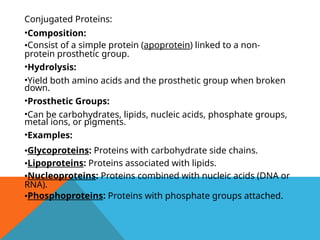
Conjugated Proteins:
•Composition:
•Consist ofa simple protein (apoprotein) linked to a non-
protein prosthetic group.
•Hydrolysis:
•Yield both amino acids and the prosthetic group when broken
down.
•Prosthetic Groups:
•Can be carbohydrates, lipids, nucleic acids, phosphate groups,
metal ions, or pigments.
•Examples:
•Glycoproteins: Proteins with carbohydrate side chains.
•Lipoproteins: Proteins associated with lipids.
•Nucleoproteins: Proteins combined with nucleic acids (DNA or
RNA).
•Phosphoproteins: Proteins with phosphate groups attached.




![Polymer [ बहुलक ] Chemistry Notes PDF - Irfanullah Mehar - JJ Sir Chemistry.pdf](https://cdn.slidesharecdn.com/ss_thumbnails/polymerchemistrynotespdf-irfanullahmehar-jjsirchemistry-260210172118-3f9b37f7-thumbnail.jpg?width=640&height=640&fit=bounds)