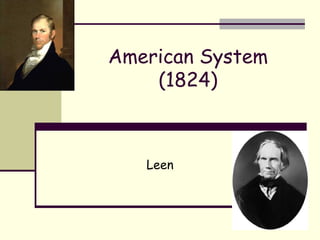
American System (1824) Leen
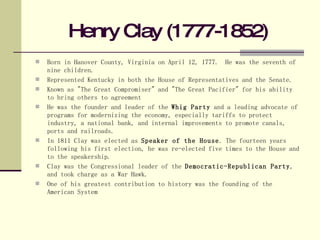
Henry Clay (1777-1852) Born in Hanover County, Virginia on April 12, 1777.  He was the seventh of nine children. Represented Kentucky in both the House of Representatives and the Senate. Known as "The Great Compromiser" and "The Great Pacifier" for his ability to bring others to agreement  He was the founder and leader of the  Whig Party  and a leading advocate of programs for modernizing the economy, especially tariffs to protect industry, a national bank, and internal improvements to promote canals, ports and railroads.  In 1811 Clay was elected as  Speaker of the House . The fourteen years following his first election, he was re-elected five times to the House and to the speakership. Clay was the Congressional leader of the  Democratic-Republican Party , and took charge as a War Hawk.  One of his greatest contribution to history was the founding of the American System
Background info. The American System was designed to strengthen and unify the nation. It was implemented by the U.S. government after the American-British War of 1812 to develop a domestic market. It was advocated by the Whig Party and a number of leading politicians (including  Henry Clay , John C. Calhoun, and John Q. Adams) It was mainly Henry Clay’s idea, he wanted to promote economic growth. It was a new form of federalism that included: Tariffs : support for high tariff to protect American industries from competing manufacturers and to generate revenue for the federal government. Bank : the preservation of the Bank of the United States to stabilize currency and rein in risky state and local banks. Internal Improvements : development of roads and canals which would hold the nation together and be financed by the tariff and land sales revenue.
E f f e c t s  o f  S y s t e m As a result of the system, the Second Bank of the United states was established and various internal improvements were achieved. Congress sought to distribute $1.5 million to the states for internal improvements, but Madison vetoed it, saying it was unconstitutional, thus making the states look for their own money to build the badly needed roads. The veto caused the system to ultimately fail, which is why it is no longer in effect.  The national market that is was originally supposed to create failed The system began as an expression of American nationalism, but resulted in intensifying sectional conflicts within the republic.

American System

  • 1.
  • 2.
    Henry Clay (1777-1852)Born in Hanover County, Virginia on April 12, 1777. He was the seventh of nine children. Represented Kentucky in both the House of Representatives and the Senate. Known as "The Great Compromiser" and "The Great Pacifier" for his ability to bring others to agreement He was the founder and leader of the Whig Party and a leading advocate of programs for modernizing the economy, especially tariffs to protect industry, a national bank, and internal improvements to promote canals, ports and railroads. In 1811 Clay was elected as Speaker of the House . The fourteen years following his first election, he was re-elected five times to the House and to the speakership. Clay was the Congressional leader of the Democratic-Republican Party , and took charge as a War Hawk. One of his greatest contribution to history was the founding of the American System
  • 3.
    Background info. TheAmerican System was designed to strengthen and unify the nation. It was implemented by the U.S. government after the American-British War of 1812 to develop a domestic market. It was advocated by the Whig Party and a number of leading politicians (including Henry Clay , John C. Calhoun, and John Q. Adams) It was mainly Henry Clay’s idea, he wanted to promote economic growth. It was a new form of federalism that included: Tariffs : support for high tariff to protect American industries from competing manufacturers and to generate revenue for the federal government. Bank : the preservation of the Bank of the United States to stabilize currency and rein in risky state and local banks. Internal Improvements : development of roads and canals which would hold the nation together and be financed by the tariff and land sales revenue.
  • 4.
    E f fe c t s o f S y s t e m As a result of the system, the Second Bank of the United states was established and various internal improvements were achieved. Congress sought to distribute $1.5 million to the states for internal improvements, but Madison vetoed it, saying it was unconstitutional, thus making the states look for their own money to build the badly needed roads. The veto caused the system to ultimately fail, which is why it is no longer in effect. The national market that is was originally supposed to create failed The system began as an expression of American nationalism, but resulted in intensifying sectional conflicts within the republic.