AMERICAN COLONIAL
PERIOD
(1898-1940)
POSTWAR REPUBLIC
(1946-1969)
1896
Philippine Revolution
1898
Treaty of Paris
1899-1913
Philippine-American War
SEDITION LAW
This issuance banned the writing, printing, and
publication of materials advocating Philippine
independence, and engaging in activities which
championed this cause.
Juan Abad’s
Tanikalang Guinto
(Golden Chain, 1902) Juan Matapang Cruz’s
Hindi Ako Patay
(I am not dead,1903)
Aurelio Tolentino’s
Kahapon, Ngayon, at Bukas
(Yesterday, Today and Tomorrow,1903)
DRAMA
SIMBOLICO
One-act plays came to represent a deep and profound
yearning for freedom.
Lino Castillejo and Jesus Araullo’s
A Modern Filipina
(1915)
BODABIL
From vaudeville of France, this is a motley
collection of slapstick, songs, dances, acrobatics,
comedy skits, chorus girls, magic acts, and stand-up
comic acts.
In the beginning of the 20th century,
Daniel Burnham
Architect and urban planner
William Parsons
Architect
Burnham Plan
CITY BEAUTIFUL MOVEMENT
• Introduced in 1893 at the Chicago World Fair
• Employed Neoclassic Architecture
Post Office Legislative Building
(now the National Art Gallery)
Tomas Mapua
Juan Arellano
Andres Luna de San Pedro
Antonio Toledo
UNIVERSITY OF THE PHILIPPINES
• Established in 1908
• 1909, opened the School of Fine Arts
• Rafael Enriquez
a peninsulares (Spanish-born residents of the
Philippines)
FABIAN DE LA ROSA
Succeeded Enriquez as director.
Known for his naturalist paintings characterized by
restraint and formality in brushwork, choice of
somber colors and subject matters.
His works:
Planting Rice (1921) El Kundiman (1930)
National Artist (1972)
FERNANDO AMORSOLO
Known for his romantic paintings that captured the
warm glow of the Philippine sunlight. Had produced
numerous portraits of prominent individuals, genre
scenes highlighting the beauty of dalagang Filipina,
idyllic landscapes; historical paintings
The Philippine
Readers
The Independent Logo design for Ginebra San Miguel
AMORSOLO SCHOOL
Irineo Miranda Cesar Buenaventura
Toribio Herrera
Dominador Castaneda
National Artist (1973)
GUILLERMO TOLENTINO
Studied Fine Arts in Rome. Influenced by classical traditions
Oblation (1935)
1958 – bronze cast at UP Oblation Plaza
Bonifacio Monument
1933 in Caloocan
ACADEMIC ART
The kind of art that was influenced by European
academies; tradition of painting and sculpture of
Amorsolo’s and Tolentino’s
National Artist (1976)
VICTORIO EDADES
• Modern Art Movement
• Homecoming Exhibition in 1928 at the Philippine
Columbian Club
National Artist for Sculpture (1976)
NAPOLEON ABUEVA
A sculptor who has worked with a wide variety of
mediums, from hardwood to precious alabaster
MODERN ART
National Artist
CARLOS “BOTONG” V. FRANCISCO
GALO OCAMPO
Brown Madonna (1938)
NATURE’S BOUNTY
(c.a. 1935)
A collaborative work by
the Trumvirate of
Modern Art: Edades,
Francsico and Ocampo.
ART NOUVEAU and ART DECO
Juan Arellano’s
Metropolitan Theater
(Manila, 1935)
THIRTEEN MODERNS
1. Victorio Edades
2. Arsenio Capili
3. Bonifacio Cristobal
4. Demetrio Diego
5. Carlos Francisco
6. N.A. Cesar Legaspi
7. Diosdado Lorenzo
8. Anita Magsaysay-Ho
9. Galo Ocampo
10.NA Hernando R. Ocampo
11.Jose Pardo
12.Ricarte Purugganan
JAPANESE OCCUPATION
(1941-1945)
KALIBAPI (Kapisanan sa Paglilingkos ng Bagong Pilipinas)
1943 winner – Purugganan
1944 winner - Francisco
GREATER EAST ASIA
CO-PROSPERITY SPHERE
A propaganda movement that sought to create a Pan-
Asian identity that rejected Western traditions.
JAPANESE INFORMATION
BUREAU (HODOBU)
Regulates the information campaign for the production
of images, texts, and music to undergo scrutiny
AWIT SA PAGLIKHA NG
BAGONG PILIPINAS
Composed by N.A. FELIPE P. de LEON at “the point of the gun”
An anthem for the period that conveyed allegiance to the
nation reared in East Asia, where Japan was actively
asserting its political power.
AMORSOLO’S PAINTINGS in 1942
Harvest Scene Planting Scene
During the Japanese Occupation…
• Sa Kabukiran sang by Sylvia La Torre and written in
Tagalog by acclaimed composer Levi Celerio (N.A. for
Music and Literature)
• Commisioned portraits of high officials such as
His Excellency, Jorge B. Vargas,
Chairman of the Philippine
Executive Commisiion (1943)
“Independence this year”, said His
Excellency, Premier Tojo (1943)
Themes of some paintings
Crispin Lopez’s
Study of an Aeta (1943)
Amorsolo’s
Bombing of the intendencia (1942) and
Ruins of the Manila Cathedral (1945)
Works which depicted the horrors of war
DIOSDADO LORENZO’s
Atrocities in Paco
DOMINADOR CASTANEDA’s
Doomed Family (1945)
NEO-REALISM, ABSTRACTION
AND OTHER
MODERN ART STYLES
• Alice Guillermo recounts how artists and writers
reflected about national identity as Filipinos were
rising from the ashes of war.
• Artist-writer E. Aguilar Cruz named the movement Neo-
Realism
• Other artist identified with Neo-Realism are Ramon
Estella, Victor Oteyza, and Romeo Tabuena
Manansala’s
The Beggars (1952)
HR Ocampo’s
The Contrast (1940)Legaspi’s
Gadgets II (1949)
Bar Girls (1947)
Tuba Drinkers (1954)
Basis of the stunning tapestry hanging at the
MAIN THEATER or
BULWAGANG NICANOR ABELARDO OF THE CCP
HR Ocampo’s
Genesis (1968)
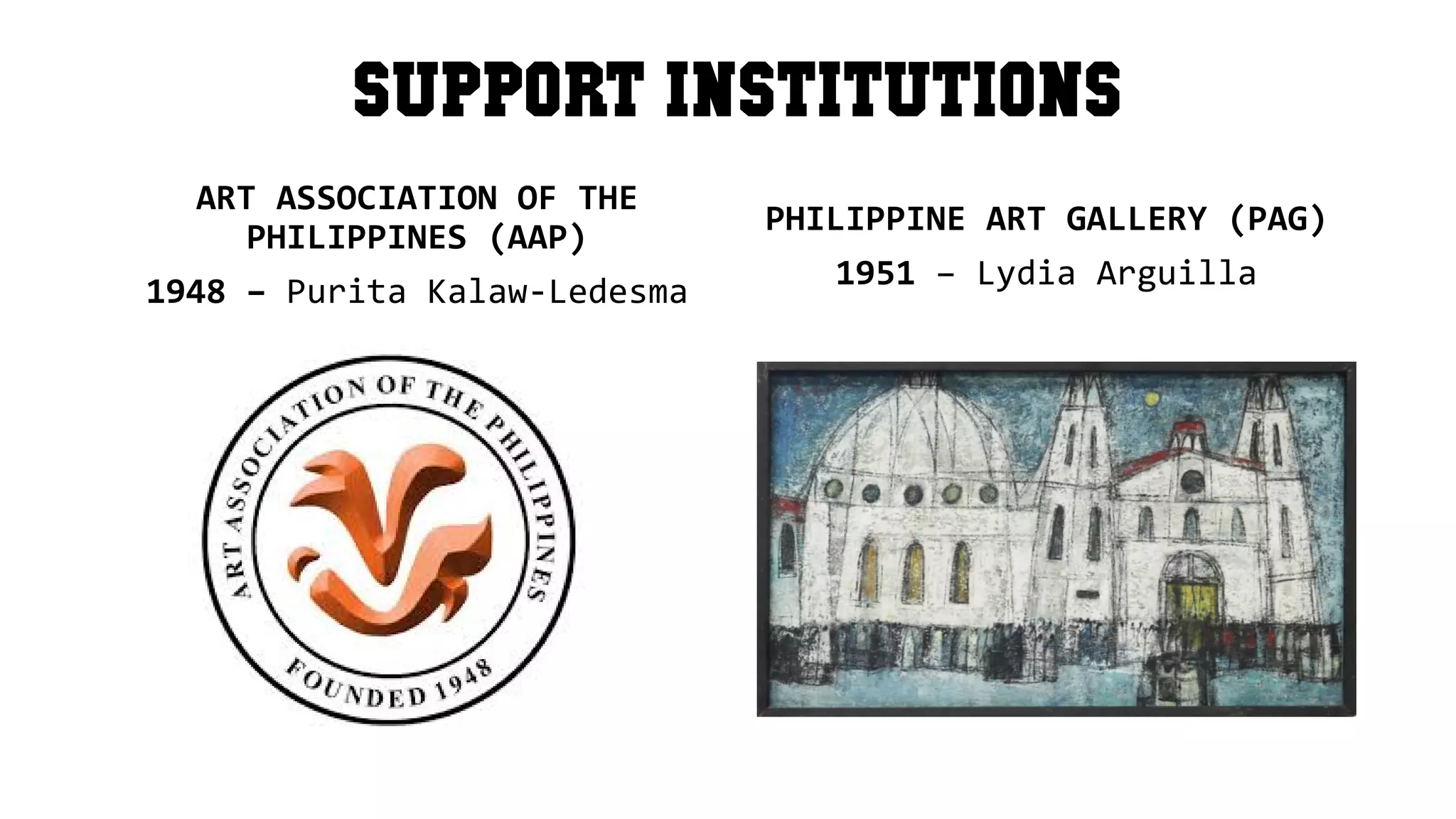
Support Institutions
ART ASSOCIATION OF THE
PHILIPPINES (AAP)
1948 – Purita Kalaw-Ledesma
PHILIPPINE ART GALLERY (PAG)
1951 – Lydia Arguilla
Manuel
Rodriguez Sr.
His printmaking workshop was
opened even when there was little
support for graphic arts at the time.
“Father of Printmaking in the
Philippines”
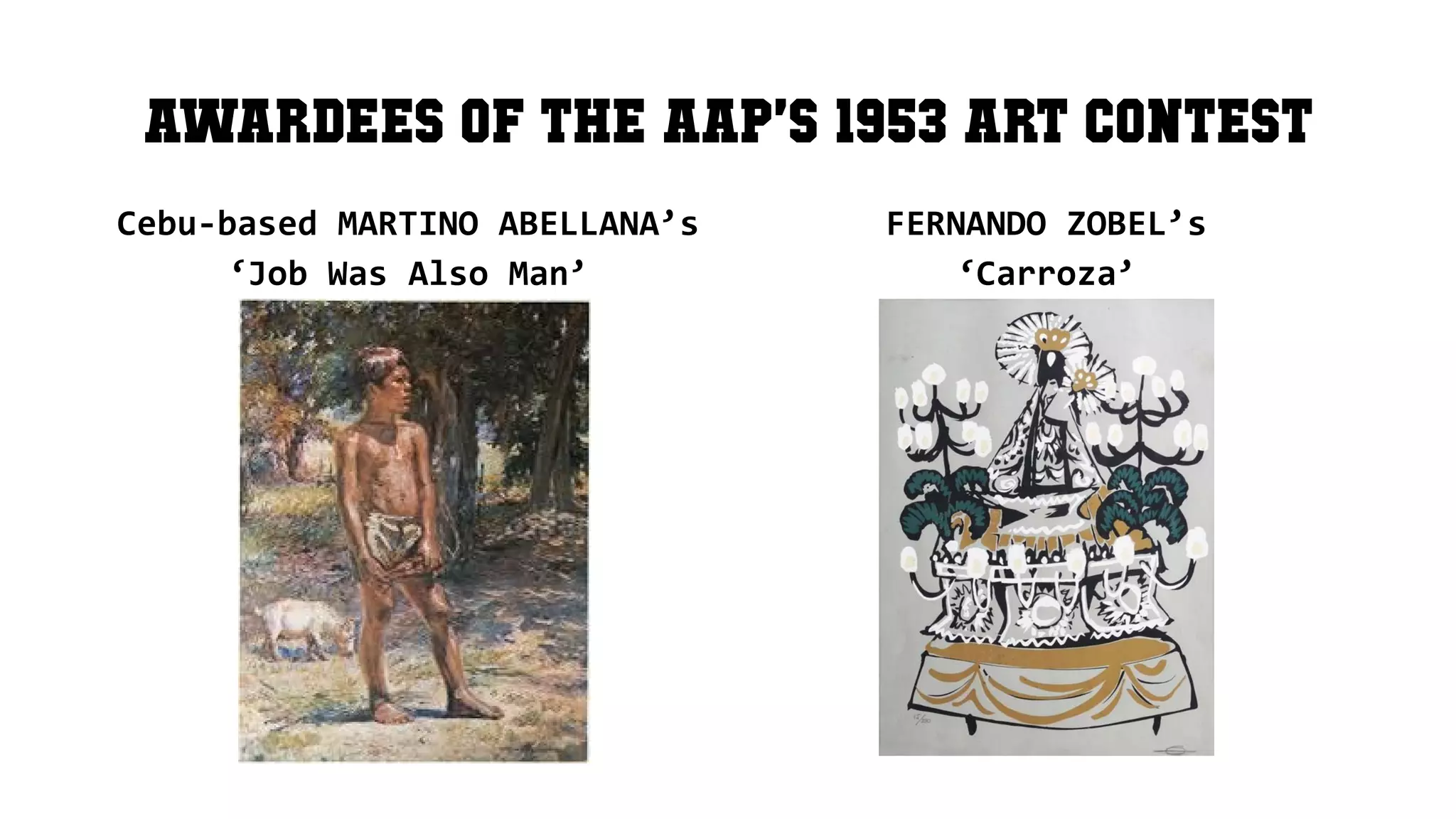
Awardees of the AAP’s 1953 art contest
Cebu-based MARTINO ABELLANA’s
‘Job Was Also Man’
FERNANDO ZOBEL’s
‘Carroza’
MABINI
PAINTERS
Artists who still practiced the
conservative tradition walked
out from the AAP art
competition as a form of
protest and exhibited their
works, making their own
studious lining the street of
Mabini, Manila.
1950s Modern Architectural
structures
UP Diliman’s
Church of Holy Sacrifice (1955)
Church of the Risen Lord
Czech-American architect
Antonin Raymond’s
Chapel of St. Joseph the Worker
(Victorias, Negros)
ANGRY CHRIST
A striking mural of Christ by
Filipino-American artist
Alfonso Ossorio. It utilizes
the expressive use of color,
jagged angularity of the
rendering and the use of
flame-like motifs to bring the
visual entacle of Bacolod’s
Masskara Festival.
ABSTRACTION
A strand of Modern Art that consists of simplified
forms which avoided mimetic representation.
Also referred to as non-representational or non-
objective art.
It emphasized the relationship of line, color and
space or the flatness of the canvas.
Constancio Bernardo
Lee Aguinaldo
N.A. Jose Joya
Fernando Zobel
More modern artists
ARTURO LUZ’s
Street Musicians (1952)
NENA SAGUIL’s
Cargadores (1951)

American Period to Post War Republic (CPAR 11/12)

  • 1.
  • 2.
  • 3.
    1896 Philippine Revolution 1898 Treaty ofParis 1899-1913 Philippine-American War
  • 4.
    SEDITION LAW This issuancebanned the writing, printing, and publication of materials advocating Philippine independence, and engaging in activities which championed this cause.
  • 5.
    Juan Abad’s Tanikalang Guinto (GoldenChain, 1902) Juan Matapang Cruz’s Hindi Ako Patay (I am not dead,1903) Aurelio Tolentino’s Kahapon, Ngayon, at Bukas (Yesterday, Today and Tomorrow,1903)
  • 6.
    DRAMA SIMBOLICO One-act plays cameto represent a deep and profound yearning for freedom.
  • 7.
    Lino Castillejo andJesus Araullo’s A Modern Filipina (1915)
  • 8.
    BODABIL From vaudeville ofFrance, this is a motley collection of slapstick, songs, dances, acrobatics, comedy skits, chorus girls, magic acts, and stand-up comic acts.
  • 9.
    In the beginningof the 20th century, Daniel Burnham Architect and urban planner William Parsons Architect Burnham Plan
  • 10.
    CITY BEAUTIFUL MOVEMENT •Introduced in 1893 at the Chicago World Fair • Employed Neoclassic Architecture Post Office Legislative Building (now the National Art Gallery)
  • 11.
    Tomas Mapua Juan Arellano AndresLuna de San Pedro Antonio Toledo
  • 12.
    UNIVERSITY OF THEPHILIPPINES • Established in 1908 • 1909, opened the School of Fine Arts • Rafael Enriquez a peninsulares (Spanish-born residents of the Philippines)
  • 13.
    FABIAN DE LAROSA Succeeded Enriquez as director. Known for his naturalist paintings characterized by restraint and formality in brushwork, choice of somber colors and subject matters.
  • 14.
    His works: Planting Rice(1921) El Kundiman (1930)
  • 15.
    National Artist (1972) FERNANDOAMORSOLO Known for his romantic paintings that captured the warm glow of the Philippine sunlight. Had produced numerous portraits of prominent individuals, genre scenes highlighting the beauty of dalagang Filipina, idyllic landscapes; historical paintings
  • 16.
    The Philippine Readers The IndependentLogo design for Ginebra San Miguel
  • 17.
    AMORSOLO SCHOOL Irineo MirandaCesar Buenaventura Toribio Herrera Dominador Castaneda
  • 18.
    National Artist (1973) GUILLERMOTOLENTINO Studied Fine Arts in Rome. Influenced by classical traditions Oblation (1935) 1958 – bronze cast at UP Oblation Plaza Bonifacio Monument 1933 in Caloocan
  • 19.
    ACADEMIC ART The kindof art that was influenced by European academies; tradition of painting and sculpture of Amorsolo’s and Tolentino’s
  • 20.
    National Artist (1976) VICTORIOEDADES • Modern Art Movement • Homecoming Exhibition in 1928 at the Philippine Columbian Club
  • 21.
    National Artist forSculpture (1976) NAPOLEON ABUEVA A sculptor who has worked with a wide variety of mediums, from hardwood to precious alabaster
  • 22.
    MODERN ART National Artist CARLOS“BOTONG” V. FRANCISCO GALO OCAMPO Brown Madonna (1938)
  • 23.
    NATURE’S BOUNTY (c.a. 1935) Acollaborative work by the Trumvirate of Modern Art: Edades, Francsico and Ocampo.
  • 24.
    ART NOUVEAU andART DECO Juan Arellano’s Metropolitan Theater (Manila, 1935)
  • 25.
    THIRTEEN MODERNS 1. VictorioEdades 2. Arsenio Capili 3. Bonifacio Cristobal 4. Demetrio Diego 5. Carlos Francisco 6. N.A. Cesar Legaspi 7. Diosdado Lorenzo 8. Anita Magsaysay-Ho 9. Galo Ocampo 10.NA Hernando R. Ocampo 11.Jose Pardo 12.Ricarte Purugganan
  • 26.
    JAPANESE OCCUPATION (1941-1945) KALIBAPI (Kapisanansa Paglilingkos ng Bagong Pilipinas) 1943 winner – Purugganan 1944 winner - Francisco
  • 27.
    GREATER EAST ASIA CO-PROSPERITYSPHERE A propaganda movement that sought to create a Pan- Asian identity that rejected Western traditions.
  • 28.
    JAPANESE INFORMATION BUREAU (HODOBU) Regulatesthe information campaign for the production of images, texts, and music to undergo scrutiny
  • 29.
    AWIT SA PAGLIKHANG BAGONG PILIPINAS Composed by N.A. FELIPE P. de LEON at “the point of the gun” An anthem for the period that conveyed allegiance to the nation reared in East Asia, where Japan was actively asserting its political power.
  • 30.
    AMORSOLO’S PAINTINGS in1942 Harvest Scene Planting Scene
  • 31.
    During the JapaneseOccupation… • Sa Kabukiran sang by Sylvia La Torre and written in Tagalog by acclaimed composer Levi Celerio (N.A. for Music and Literature) • Commisioned portraits of high officials such as His Excellency, Jorge B. Vargas, Chairman of the Philippine Executive Commisiion (1943) “Independence this year”, said His Excellency, Premier Tojo (1943)
  • 32.
    Themes of somepaintings Crispin Lopez’s Study of an Aeta (1943) Amorsolo’s Bombing of the intendencia (1942) and Ruins of the Manila Cathedral (1945)
  • 33.
    Works which depictedthe horrors of war DIOSDADO LORENZO’s Atrocities in Paco DOMINADOR CASTANEDA’s Doomed Family (1945)
  • 34.
    NEO-REALISM, ABSTRACTION AND OTHER MODERNART STYLES • Alice Guillermo recounts how artists and writers reflected about national identity as Filipinos were rising from the ashes of war. • Artist-writer E. Aguilar Cruz named the movement Neo- Realism • Other artist identified with Neo-Realism are Ramon Estella, Victor Oteyza, and Romeo Tabuena
  • 35.
    Manansala’s The Beggars (1952) HROcampo’s The Contrast (1940)Legaspi’s Gadgets II (1949) Bar Girls (1947) Tuba Drinkers (1954)
  • 36.
    Basis of thestunning tapestry hanging at the MAIN THEATER or BULWAGANG NICANOR ABELARDO OF THE CCP HR Ocampo’s Genesis (1968)
  • 37.
    Support Institutions ART ASSOCIATIONOF THE PHILIPPINES (AAP) 1948 – Purita Kalaw-Ledesma PHILIPPINE ART GALLERY (PAG) 1951 – Lydia Arguilla
  • 38.
    Manuel Rodriguez Sr. His printmakingworkshop was opened even when there was little support for graphic arts at the time. “Father of Printmaking in the Philippines”
  • 39.
    Awardees of theAAP’s 1953 art contest Cebu-based MARTINO ABELLANA’s ‘Job Was Also Man’ FERNANDO ZOBEL’s ‘Carroza’
  • 40.
    MABINI PAINTERS Artists who stillpracticed the conservative tradition walked out from the AAP art competition as a form of protest and exhibited their works, making their own studious lining the street of Mabini, Manila.
  • 41.
    1950s Modern Architectural structures UPDiliman’s Church of Holy Sacrifice (1955) Church of the Risen Lord Czech-American architect Antonin Raymond’s Chapel of St. Joseph the Worker (Victorias, Negros)
  • 42.
    ANGRY CHRIST A strikingmural of Christ by Filipino-American artist Alfonso Ossorio. It utilizes the expressive use of color, jagged angularity of the rendering and the use of flame-like motifs to bring the visual entacle of Bacolod’s Masskara Festival.
  • 43.
    ABSTRACTION A strand ofModern Art that consists of simplified forms which avoided mimetic representation. Also referred to as non-representational or non- objective art. It emphasized the relationship of line, color and space or the flatness of the canvas.
  • 44.
  • 45.
    More modern artists ARTUROLUZ’s Street Musicians (1952) NENA SAGUIL’s Cargadores (1951)