Md. Jahurul Islam
Asssistant Professor
Dept. of Law
Pundra University of Science & Technology
Rangpur Road, Gokul, Bogura.
Amendment Procedure of Constitutions:
A Comparative Study of United Kingdom,
United States and Bangladesh
“To change is to improve, to change often
is to improve often and to change
continuously is human endeavor for
perfection.” Churchill.
Abstract
This paper is an attempt to examine and analyze the
amendment procedure of the constitutions of three democratic
countries namely UK, USA and Bangladesh. The purpose of
the study is to pin-point the procedure of amendment of the
aforesaid countries since UK is considered to be the oldest
democratic country from where democracy originated and got
nurtured. USA is also a democratic country but its form is
completely different from that of UK. Bangladesh is also
constitutionally a democratic country although democratic
culture yet to be developed here. The paper is based on
secondary data and personal observation. The paper ends with
concluding remarks.
Introduction
Constitution can be described as the fundamental law of the
land. It is the basis on which all other laws are made and
enforced. We can also say that Constitution is the mother of
all other laws which draws their validity from it. It also sets
the outline and authority and limitation for all laws framed by
the legislative body of any country.
Constitution Amendment
Making of Constitution is one thing and amending it another.
Amendments are introduced as per the changing situations or as per will
of the people or with the will of majority of people. Bangladesh, United
States of America and United Kingdom, all these three countries are
democratic countries of the world. U.K and USA are the two world’s
largest democratic countries. All three of these countries have their ‘own’
system of Governance. Although, Bangladesh is younger democratic
nation than USA and UK, but a mature one. This is also a matter of fact
that in the past both Bangladesh and USA were colonial countries of the
UK. Bangladesh have a written constitution like the USA but lengthy
than USA and UK. In fact, UK does not have a ‘written Constitution’.
The System of Governance is based more on the laws & Acts passed by
its parliament from time to time and no ‘written constitution’ is there like
Bangladesh and US have. It is obvious that when these three countries
have different system of governance then the procedure of amending the
constitution would also be different.
Constitution Amendment
Through this paper I tried to make a comparative study of
amendment procedure available in the Constitution of UK, USA
and Bangladesh. Here we will look into the amendment procedure
of the three countries from a comparison point of view.
Amendment & its necessity
The word ‘amend’ is derived from the French word signifying ‘to make
better’, ‘to change for the better’, ‘to modify for the better’,
‘improve’, ‘to alter formally by modification, deletion or addition,
substitution and omissions’. According to dictionary ‘Amend’ means
to – “free from faults or errors, correct or improve, rectify, reform,
make alteration in detail, to repair, to better and surpass.”
The power to amend in the context is a very wide power and it cannot be
controlled by the literal dictionary meaning of the word amend. The
word ‘amendment’ may have a variety of meanings. Amendment
means –
 a) An alteration or change for the better; correction of a fault or of faults;
reformation of life by quitting vices.
 b) In public bodies; any alternation made or proposed to be made in a bill
or motion by adding, changing, substituting, or omitting.
 c) Correction of an error in a writ or process.
Amendment & its necessity
Justice B.H. Chowdhury said “The term ‘amendment’ implies such an addition or
change within the lines of the original instrument as will effect an improvement or
better carry out the purpose for which it was framed.”
Constitutions are usually classified as ‘flexible’ or ‘rigid’ depending upon the process
through which they can be amended. Prof. A.V. Dicey defines two types of
Constitutions—the flexible as ‘one under which every law of every description
can legally be changed with the same ease and in the same manner by one and the
same body’, and the rigid Constitutions as ‘one under which certain laws generally
known as constitutional or fundamental laws, cannot be changed in the same
manner as ordinary laws’ The UK having an unwritten Constitution, is the best
example of an extremely flexible Constitution as there is no distinction between
the legislative power and the constituent power. The British Parliament has the
power to change the Constitution by the ordinary process of legislation. As
opposed to the U.K. system, the constitutional amendment has an important place
under a written Constitution like that of the U.S.A. Its importance increases where
the system is Federal. In a Federal system, additional safeguards like the
involvement of Legislatures at the State level are also provided with a view to
ensuring the phenomenal fact that the Federal set-up does not get altered only at
the will of the Federal Legislature.
Amendment & its necessity
Now the questions came why are amendments required to
‘any’ Constitution? Simple reason is to react to the
changing situations and circumstances within the country
and internationally also. As per the available history of the
democratic countries no country can function with
‘permanent’ constitution. Few or more amendments are
required as per the changing situations. Like after the 2001
attack on world trade Centre, the USA Congress by a
resolution conferred special power upon the President of
USA to take military action against any nation that may
cause security issue the USA or those who are involved in
the 2001 attack. This was the first of its kind amendment in
the USA Constitution which gives complete ‘sole’ authority
to the President for taking any military action against any
country.
Amendment of Constitution
A constitution is meant to be permanent, but as all changing
situations cannot be envisaged and amendment of the
constitution may be necessary to adapt to the future
developments, provision is made in the constitution itself to
effect changes required by the changing situations. When a
legislature, which is a creature of the constitution, is given the
power of amendment, it is a power given not to subvert the
constitution, but to make it suitable to the changing situations.
Justice Shahabuddin Ahmed said that Amendment of the
Constitution means – “Change or alteration for improvement or
to make it effective or meaningful and not its elimination or
abrogation. Amendment is subject to the retention of the basic
structure. The Court therefore has power to undo an amendment
if it transgresses its limit and alters a basic structure of the
Constitution.”
Comparative Study of United Kingdom, United
States and Bangladesh
UK, USA and Bangladesh, all three of these countries are democratic
countries of the world, United States is the oldest democratic country of
the world and its constitution was made in 1789, whereas Bangladesh
was the Colonial state of the United Kingdom till 1947 and under the
Pakistan till 1971 and the Bangladesh Constitution came into force in 16th
December, 1972. But situation in United Kingdom is different. Although,
UK is the democratic country but the head of the state is monarch.
Besides this one of the uniqueness of the UK’s constitution is that it’s not
codified one like the USA and Bangladesh having. The UK Parliament
can make any law or amendment by simply passing it by majority and
then send to the monarch for his assent, which is just the formality part.
Another difference among these three countries is that United State is a
true federal country and each state has its own constitution while
Bangladesh is a democratic country having only one constitution for
whole country. On the other hand UK is not having the federal structure;
it has the unitary setup of government.
Comparative Study of United Kingdom, United
States and Bangladesh
In Federal system of governance, state legislatures have a say in
amending the constitution but in unitary setup it’s only the
Parliament which has supremacy for amending the constitution.
The British parliament has the power to change the constitution by
the ordinary process of legislation. As opposed to the UK, the
constitution amendment has an important place under the written
Constitution like that of the USA and Bangladesh. Its importance
increases where the system is Federal. In Federal system, additional
safeguards like the involvement of Legislatures at the state level,
are also provided with a view to ensuring that the Federal set-up
does not get altered only at the will of the Federal Legislature.
Now, to compare the amending procedure of these three countries, I
will discuss the amending procedures separately of each country a
provided under their Constitution.
Amending Procedure under USA Constitution
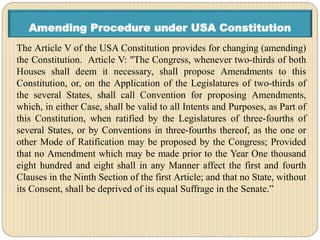
The Article V of the USA Constitution provides for changing (amending)
the Constitution. Article V: "The Congress, whenever two-thirds of both
Houses shall deem it necessary, shall propose Amendments to this
Constitution, or, on the Application of the Legislatures of two-thirds of
the several States, shall call Convention for proposing Amendments,
which, in either Case, shall be valid to all Intents and Purposes, as Part of
this Constitution, when ratified by the Legislatures of three-fourths of
several States, or by Conventions in three-fourths thereof, as the one or
other Mode of Ratification may be proposed by the Congress; Provided
that no Amendment which may be made prior to the Year One thousand
eight hundred and eight shall in any Manner affect the first and fourth
Clauses in the Ninth Section of the first Article; and that no State, without
its Consent, shall be deprived of its equal Suffrage in the Senate.”
Amending Procedure under USA Constitution
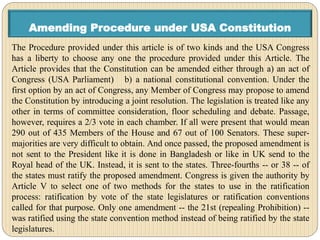
The Procedure provided under this article is of two kinds and the USA Congress
has a liberty to choose any one the procedure provided under this Article. The
Article provides that the Constitution can be amended either through a) an act of
Congress (USA Parliament) b) a national constitutional convention. Under the
first option by an act of Congress, any Member of Congress may propose to amend
the Constitution by introducing a joint resolution. The legislation is treated like any
other in terms of committee consideration, floor scheduling and debate. Passage,
however, requires a 2/3 vote in each chamber. If all were present that would mean
290 out of 435 Members of the House and 67 out of 100 Senators. These super-
majorities are very difficult to obtain. And once passed, the proposed amendment is
not sent to the President like it is done in Bangladesh or like in UK send to the
Royal head of the UK. Instead, it is sent to the states. Three-fourths -- or 38 -- of
the states must ratify the proposed amendment. Congress is given the authority by
Article V to select one of two methods for the states to use in the ratification
process: ratification by vote of the state legislatures or ratification conventions
called for that purpose. Only one amendment -- the 21st (repealing Prohibition) --
was ratified using the state convention method instead of being ratified by the state
legislatures.
Amending Procedure under USA Constitution
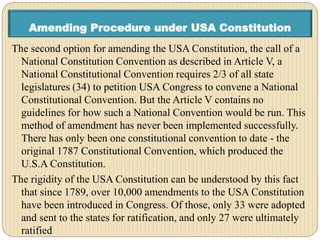
The second option for amending the USA Constitution, the call of a
National Constitution Convention as described in Article V, a
National Constitutional Convention requires 2/3 of all state
legislatures (34) to petition USA Congress to convene a National
Constitutional Convention. But the Article V contains no
guidelines for how such a National Convention would be run. This
method of amendment has never been implemented successfully.
There has only been one constitutional convention to date - the
original 1787 Constitutional Convention, which produced the
U.S.A Constitution.
The rigidity of the USA Constitution can be understood by this fact
that since 1789, over 10,000 amendments to the USA Constitution
have been introduced in Congress. Of those, only 33 were adopted
and sent to the states for ratification, and only 27 were ultimately
ratified
Amending Procedure under USA Constitution
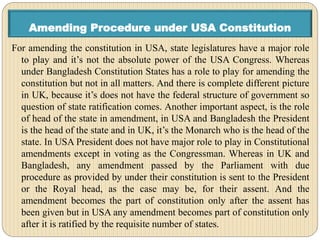
For amending the constitution in USA, state legislatures have a major role
to play and it’s not the absolute power of the USA Congress. Whereas
under Bangladesh Constitution States has a role to play for amending the
constitution but not in all matters. And there is complete different picture
in UK, because it’s does not have the federal structure of government so
question of state ratification comes. Another important aspect, is the role
of head of the state in amendment, in USA and Bangladesh the President
is the head of the state and in UK, it’s the Monarch who is the head of the
state. In USA President does not have major role to play in Constitutional
amendments except in voting as the Congressman. Whereas in UK and
Bangladesh, any amendment passed by the Parliament with due
procedure as provided by under their constitution is sent to the President
or the Royal head, as the case may be, for their assent. And the
amendment becomes the part of constitution only after the assent has
been given but in USA any amendment becomes part of constitution only
after it is ratified by the requisite number of states.
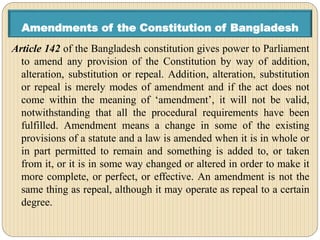
Amendments of the Constitution of Bangladesh
Article 142 of the Bangladesh constitution gives power to Parliament
to amend any provision of the Constitution by way of addition,
alteration, substitution or repeal. Addition, alteration, substitution
or repeal is merely modes of amendment and if the act does not
come within the meaning of ‘amendment’, it will not be valid,
notwithstanding that all the procedural requirements have been
fulfilled. Amendment means a change in some of the existing
provisions of a statute and a law is amended when it is in whole or
in part permitted to remain and something is added to, or taken
from it, or it is in some way changed or altered in order to make it
more complete, or perfect, or effective. An amendment is not the
same thing as repeal, although it may operate as repeal to a certain
degree.
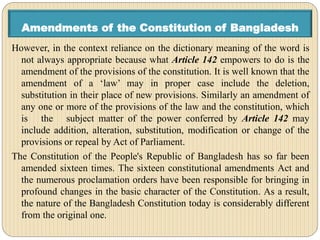
Amendments of the Constitution of Bangladesh
However, in the context reliance on the dictionary meaning of the word is
not always appropriate because what Article 142 empowers to do is the
amendment of the provisions of the constitution. It is well known that the
amendment of a ‘law’ may in proper case include the deletion,
substitution in their place of new provisions. Similarly an amendment of
any one or more of the provisions of the law and the constitution, which
is the subject matter of the power conferred by Article 142 may
include addition, alteration, substitution, modification or change of the
provisions or repeal by Act of Parliament.
The Constitution of the People's Republic of Bangladesh has so far been
amended sixteen times. The sixteen constitutional amendments Act and
the numerous proclamation orders have been responsible for bringing in
profound changes in the basic character of the Constitution. As a result,
the nature of the Bangladesh Constitution today is considerably different
from the original one.
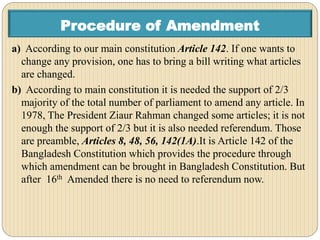
Procedure of Amendment
a) According to our main constitution Article 142. If one wants to
change any provision, one has to bring a bill writing what articles
are changed.
b) According to main constitution it is needed the support of 2/3
majority of the total number of parliament to amend any article. In
1978, The President Ziaur Rahman changed some articles; it is not
enough the support of 2/3 but it is also needed referendum. Those
are preamble, Articles 8, 48, 56, 142(1A).It is Article 142 of the
Bangladesh Constitution which provides the procedure through
which amendment can be brought in Bangladesh Constitution. But
after 16th Amended there is no need to referendum now.
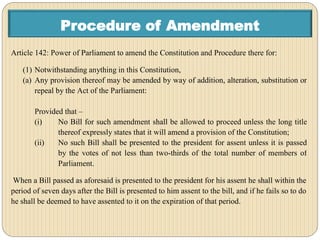
Procedure of Amendment
Article 142: Power of Parliament to amend the Constitution and Procedure there for:
(1) Notwithstanding anything in this Constitution,
(a) Any provision thereof may be amended by way of addition, alteration, substitution or
repeal by the Act of the Parliament:
Provided that –
(i) No Bill for such amendment shall be allowed to proceed unless the long title
thereof expressly states that it will amend a provision of the Constitution;
(ii) No such Bill shall be presented to the president for assent unless it is passed
by the votes of not less than two-thirds of the total number of members of
Parliament.
When a Bill passed as aforesaid is presented to the president for his assent he shall within the
period of seven days after the Bill is presented to him assent to the bill, and if he fails so to do
he shall be deemed to have assented to it on the expiration of that period.
Procedure of Amendment
This procedure of amending the constitution is different as well
similar some manners to the US and UK amending procedure. In
Bangladesh also ratification is required but not in all matters of
amendment as the US Constitution requires. This President’s
assent is similar to the UK where the assent of the Royal head is
required. Amendment procedure under Bangladeshi Constitution is
‘flexible’ as compared to US Constitution whereas the amendment
procedure of UK is the most ‘flexible’ among the three compared
nations.
Amending Procedure under UK Constitution
United Kingdom is not having a codified constitution, although many of the
resources of the constitution are written and documented. Bangladesh
does not have the federal structure but US have. The UK Parliament has
the power to change the Constitution by the ordinary process of
Legislation. Under the UK Constitution, the right to make or unmake any
law whatever; and, further that no person or body is recognized by the
law of England as having a right to override or set aside the legislation of
Parliament (Dicey 1915, 37-38) The another point of difference between
US, Bangladesh and UK is that US and Bangladesh have the elected head
of the State the President, whereas in UK monarch is the royal head of
the state. The amending procedure is simple in UK as compared to the
USA and Bangladesh. There is no special procedure provided under the
UK Constitution for amending it and the theory of ‘Parliament
Sovereignty’ is applied in UK whereas “Constitutional Supremacy” is
applied in USA and Bangladesh.
Conclusion
Going through the different amendment procedures provided in the
respective Country’s constitution I got to know that even though
UK, USA and Bangladesh are democratic countries but their way
of functioning, making laws and amending power are different in
comparisons to each other. The Constitution of Bangladesh is the
younger one among all the three countries. We borrowed some
features of our constitution from the other countries after testing
their suitability to our country. But there are so many differences
between the amending procedures among the compared countries
that the similarities are less than the fingers. Like in USA, there is
no separate constituent body for the purpose of amendment of
constitution. While in UK and Bangladesh, the Parliament that can
amend the Constitution.
Conclusion
The role of the government in Constitutional amendment is limited in
Bangladesh but in USA, states have major role to play and states in US
can even initiate any proposal for amendment of the Constitution.
Whereas in UK and Bangladesh there is no question of states as it does
not have the federal structure. In Bangladesh, the amendment passed by
the Parliament with due procedure as provided under Article 142 which
can become part of Constitution only after the assent of the President,
whereas in UK its monarch whose assent is required to complete the
procedure of amending the constitution. But in USA, the President does
not have such status and no provision of President’s assent is mentioned
in USA Constitution. Compare all the three constitutions, we will find
that it is very difficult to amend the US A Constitution as very easy to
amend the UK constitution Article 142 gives Parliament supremacy in
some matters to amend the constitution but then in some matters it
requires ratification by not less than two third of the members of the
parliament.
Conclusion
The notable point is that both in Bangladesh Constitution and USA
Constitution no time limit has been for ratification has been
prescribed. There is no check or brake on it, no provisions for
reconsideration, or revision, and no scope for “an appeal to Philip
drunk to Philip sober”. At least the president should have been
given right to return it back to parliament for reconsideration.
Whereas, the USA has a rigid constitution and it can be amended
by the USA Congress by means of a special process provided by
the USA Constitution whereas UK has the flexible constitution; it
requires no special procedure for its amendment and can be
amended by the Parliament in the same manner as ordinary laws
are made and Bangladesh lies somewhere in between the USA and
UK, that is to say not so easy to amend and not so difficult to
amend.
Reverences
 1.Ahmed, Moudud, Bangladesh : The Era of Sheikh Mujibur Rahman,
(Dhaka : UPL, 1983).
 2.Ahmed, Moudud, Bangladesh : Constitutional Quest for Autonomy,
(Dhaka : UPL, 1978).
 3.Ahmed, Moudud, Democracy and the Challenge of Development,
(Dhaka : UPL, 1995)
 4.Alder, John, Constitutional and Administrative Law, (London :
Mcmillan, 1989).
 5.Basu, Durga Das, Commentary on the Constitution of India [Calcutta :
S.C. Sarker & Sons (P) Ltd., 1982]
 6.Blessley, Jane, Constitutional Law, (London : HLT Publications, 1990)
 7.Chudhury, Dilara, Constitutional Development in Bangladesh, (Dhaka :
UPL, 1995)
 8.Chudhury, Justice Abdur Rahman, Democracy, Rule of Law and
Human Rights, (Dhaka : Dhaka University, 1992).
 9.Chowdhury, Dr. Najma, The Legislative Process in Bangladesh :
Politics and Functioning of then East Bengal Legistlature 1947-58,
(Dhaka : Dhaka University, 1980).
 11.Dicey, A.V., Introduction to the Study of the Law of the Constitution,
10th ed, (London : ELBS and Macmillan, 1973).
Reverences
 12.Hakim, Muhammad, A, Bangladesh : The Sahabuddin
Interregnum, (Dhaka : UPL, 1993).
 13.Haque, Abul Fazal, Bangladesher Shashanbabastha O
Rajnity (Government and Politics in Bangladesh), 4th ed, (Dhaka
: Sahitha Kosh, 1992).
 14.Hasanuzzaman, Search for a New Dimension, (Dhaka :
Pallab publishers, 1992).
 15.Hussain, Amjad, The Politics and Political Parties in
Bangladesh, (Dhaka : Parua, 1996) (in Bengali).
 16.Islam, Mahmudul, Constitutional Law of Bangladesh, (Dhaka :
Bangladesh Institute of Law and International Affairs, 1995).
 17.Islam, Sirazul, Bangladesher Itihash, (History of Bangladesh),
(Dhaka : Asiatic Society of Banglaesh, 1993.
 18.Jones, BL, Garner’s Administrative Law, 7th ed. (London :
burreworths, 1989).
 19.Kamal, Justice Mustafa, Bangladesh Constitution : Trends
and Issues, (Dhaka : Dhaka University, 1994).
Reverences
 20.Kapoor, A.C. Select Constitutions, 12th ed. [New
Delhi : S. Chand & Company (Pvt.) Ltd. 1989).
 21.Munim, F.K.M.A., Rights of Citizen Under the
Constitution and Law, (Dhaka : Bangladesh Institute
of Law and International Affairs, 1975).
 22.Munim, F.K.M.A., Legal Aspects of Marital Law,
(Dhaka : Bangladesh Institute of Law and
International Affairs, 1989).
 23.Parwari, A.B.M. Mafizul Islam, Protection of the
Constitution and Administrative Law, 7th ed. (London :
English Language Book Society, 1987)
 24.Rahman, Sirajur, Bangladesh : 15 Years of
Independence, (Dhaka : UPL, 1987 (in Bengali).
 25.Ziring, Lawrence, Bangladesh : From Mjuib to
Ershad, (Dhaka, UPL, 1994).
Questionnaire & Answer
Heartiest Thanks to All

Amendment Procedure of Constitutions.pptx

  • 1.
    Md. Jahurul Islam AsssistantProfessor Dept. of Law Pundra University of Science & Technology Rangpur Road, Gokul, Bogura. Amendment Procedure of Constitutions: A Comparative Study of United Kingdom, United States and Bangladesh
  • 2.
    “To change isto improve, to change often is to improve often and to change continuously is human endeavor for perfection.” Churchill.
  • 3.
    Abstract This paper isan attempt to examine and analyze the amendment procedure of the constitutions of three democratic countries namely UK, USA and Bangladesh. The purpose of the study is to pin-point the procedure of amendment of the aforesaid countries since UK is considered to be the oldest democratic country from where democracy originated and got nurtured. USA is also a democratic country but its form is completely different from that of UK. Bangladesh is also constitutionally a democratic country although democratic culture yet to be developed here. The paper is based on secondary data and personal observation. The paper ends with concluding remarks.
  • 4.
    Introduction Constitution can bedescribed as the fundamental law of the land. It is the basis on which all other laws are made and enforced. We can also say that Constitution is the mother of all other laws which draws their validity from it. It also sets the outline and authority and limitation for all laws framed by the legislative body of any country.
  • 5.
    Constitution Amendment Making ofConstitution is one thing and amending it another. Amendments are introduced as per the changing situations or as per will of the people or with the will of majority of people. Bangladesh, United States of America and United Kingdom, all these three countries are democratic countries of the world. U.K and USA are the two world’s largest democratic countries. All three of these countries have their ‘own’ system of Governance. Although, Bangladesh is younger democratic nation than USA and UK, but a mature one. This is also a matter of fact that in the past both Bangladesh and USA were colonial countries of the UK. Bangladesh have a written constitution like the USA but lengthy than USA and UK. In fact, UK does not have a ‘written Constitution’. The System of Governance is based more on the laws & Acts passed by its parliament from time to time and no ‘written constitution’ is there like Bangladesh and US have. It is obvious that when these three countries have different system of governance then the procedure of amending the constitution would also be different.
  • 6.
    Constitution Amendment Through thispaper I tried to make a comparative study of amendment procedure available in the Constitution of UK, USA and Bangladesh. Here we will look into the amendment procedure of the three countries from a comparison point of view.
  • 7.
    Amendment & itsnecessity The word ‘amend’ is derived from the French word signifying ‘to make better’, ‘to change for the better’, ‘to modify for the better’, ‘improve’, ‘to alter formally by modification, deletion or addition, substitution and omissions’. According to dictionary ‘Amend’ means to – “free from faults or errors, correct or improve, rectify, reform, make alteration in detail, to repair, to better and surpass.” The power to amend in the context is a very wide power and it cannot be controlled by the literal dictionary meaning of the word amend. The word ‘amendment’ may have a variety of meanings. Amendment means –  a) An alteration or change for the better; correction of a fault or of faults; reformation of life by quitting vices.  b) In public bodies; any alternation made or proposed to be made in a bill or motion by adding, changing, substituting, or omitting.  c) Correction of an error in a writ or process.
  • 8.
    Amendment & itsnecessity Justice B.H. Chowdhury said “The term ‘amendment’ implies such an addition or change within the lines of the original instrument as will effect an improvement or better carry out the purpose for which it was framed.” Constitutions are usually classified as ‘flexible’ or ‘rigid’ depending upon the process through which they can be amended. Prof. A.V. Dicey defines two types of Constitutions—the flexible as ‘one under which every law of every description can legally be changed with the same ease and in the same manner by one and the same body’, and the rigid Constitutions as ‘one under which certain laws generally known as constitutional or fundamental laws, cannot be changed in the same manner as ordinary laws’ The UK having an unwritten Constitution, is the best example of an extremely flexible Constitution as there is no distinction between the legislative power and the constituent power. The British Parliament has the power to change the Constitution by the ordinary process of legislation. As opposed to the U.K. system, the constitutional amendment has an important place under a written Constitution like that of the U.S.A. Its importance increases where the system is Federal. In a Federal system, additional safeguards like the involvement of Legislatures at the State level are also provided with a view to ensuring the phenomenal fact that the Federal set-up does not get altered only at the will of the Federal Legislature.
  • 9.
    Amendment & itsnecessity Now the questions came why are amendments required to ‘any’ Constitution? Simple reason is to react to the changing situations and circumstances within the country and internationally also. As per the available history of the democratic countries no country can function with ‘permanent’ constitution. Few or more amendments are required as per the changing situations. Like after the 2001 attack on world trade Centre, the USA Congress by a resolution conferred special power upon the President of USA to take military action against any nation that may cause security issue the USA or those who are involved in the 2001 attack. This was the first of its kind amendment in the USA Constitution which gives complete ‘sole’ authority to the President for taking any military action against any country.
  • 10.
    Amendment of Constitution Aconstitution is meant to be permanent, but as all changing situations cannot be envisaged and amendment of the constitution may be necessary to adapt to the future developments, provision is made in the constitution itself to effect changes required by the changing situations. When a legislature, which is a creature of the constitution, is given the power of amendment, it is a power given not to subvert the constitution, but to make it suitable to the changing situations. Justice Shahabuddin Ahmed said that Amendment of the Constitution means – “Change or alteration for improvement or to make it effective or meaningful and not its elimination or abrogation. Amendment is subject to the retention of the basic structure. The Court therefore has power to undo an amendment if it transgresses its limit and alters a basic structure of the Constitution.”
  • 11.
    Comparative Study ofUnited Kingdom, United States and Bangladesh UK, USA and Bangladesh, all three of these countries are democratic countries of the world, United States is the oldest democratic country of the world and its constitution was made in 1789, whereas Bangladesh was the Colonial state of the United Kingdom till 1947 and under the Pakistan till 1971 and the Bangladesh Constitution came into force in 16th December, 1972. But situation in United Kingdom is different. Although, UK is the democratic country but the head of the state is monarch. Besides this one of the uniqueness of the UK’s constitution is that it’s not codified one like the USA and Bangladesh having. The UK Parliament can make any law or amendment by simply passing it by majority and then send to the monarch for his assent, which is just the formality part. Another difference among these three countries is that United State is a true federal country and each state has its own constitution while Bangladesh is a democratic country having only one constitution for whole country. On the other hand UK is not having the federal structure; it has the unitary setup of government.
  • 12.
    Comparative Study ofUnited Kingdom, United States and Bangladesh In Federal system of governance, state legislatures have a say in amending the constitution but in unitary setup it’s only the Parliament which has supremacy for amending the constitution. The British parliament has the power to change the constitution by the ordinary process of legislation. As opposed to the UK, the constitution amendment has an important place under the written Constitution like that of the USA and Bangladesh. Its importance increases where the system is Federal. In Federal system, additional safeguards like the involvement of Legislatures at the state level, are also provided with a view to ensuring that the Federal set-up does not get altered only at the will of the Federal Legislature. Now, to compare the amending procedure of these three countries, I will discuss the amending procedures separately of each country a provided under their Constitution.
  • 13.
    Amending Procedure underUSA Constitution The Article V of the USA Constitution provides for changing (amending) the Constitution. Article V: "The Congress, whenever two-thirds of both Houses shall deem it necessary, shall propose Amendments to this Constitution, or, on the Application of the Legislatures of two-thirds of the several States, shall call Convention for proposing Amendments, which, in either Case, shall be valid to all Intents and Purposes, as Part of this Constitution, when ratified by the Legislatures of three-fourths of several States, or by Conventions in three-fourths thereof, as the one or other Mode of Ratification may be proposed by the Congress; Provided that no Amendment which may be made prior to the Year One thousand eight hundred and eight shall in any Manner affect the first and fourth Clauses in the Ninth Section of the first Article; and that no State, without its Consent, shall be deprived of its equal Suffrage in the Senate.”
  • 14.
    Amending Procedure underUSA Constitution The Procedure provided under this article is of two kinds and the USA Congress has a liberty to choose any one the procedure provided under this Article. The Article provides that the Constitution can be amended either through a) an act of Congress (USA Parliament) b) a national constitutional convention. Under the first option by an act of Congress, any Member of Congress may propose to amend the Constitution by introducing a joint resolution. The legislation is treated like any other in terms of committee consideration, floor scheduling and debate. Passage, however, requires a 2/3 vote in each chamber. If all were present that would mean 290 out of 435 Members of the House and 67 out of 100 Senators. These super- majorities are very difficult to obtain. And once passed, the proposed amendment is not sent to the President like it is done in Bangladesh or like in UK send to the Royal head of the UK. Instead, it is sent to the states. Three-fourths -- or 38 -- of the states must ratify the proposed amendment. Congress is given the authority by Article V to select one of two methods for the states to use in the ratification process: ratification by vote of the state legislatures or ratification conventions called for that purpose. Only one amendment -- the 21st (repealing Prohibition) -- was ratified using the state convention method instead of being ratified by the state legislatures.
  • 15.
    Amending Procedure underUSA Constitution The second option for amending the USA Constitution, the call of a National Constitution Convention as described in Article V, a National Constitutional Convention requires 2/3 of all state legislatures (34) to petition USA Congress to convene a National Constitutional Convention. But the Article V contains no guidelines for how such a National Convention would be run. This method of amendment has never been implemented successfully. There has only been one constitutional convention to date - the original 1787 Constitutional Convention, which produced the U.S.A Constitution. The rigidity of the USA Constitution can be understood by this fact that since 1789, over 10,000 amendments to the USA Constitution have been introduced in Congress. Of those, only 33 were adopted and sent to the states for ratification, and only 27 were ultimately ratified
  • 16.
    Amending Procedure underUSA Constitution For amending the constitution in USA, state legislatures have a major role to play and it’s not the absolute power of the USA Congress. Whereas under Bangladesh Constitution States has a role to play for amending the constitution but not in all matters. And there is complete different picture in UK, because it’s does not have the federal structure of government so question of state ratification comes. Another important aspect, is the role of head of the state in amendment, in USA and Bangladesh the President is the head of the state and in UK, it’s the Monarch who is the head of the state. In USA President does not have major role to play in Constitutional amendments except in voting as the Congressman. Whereas in UK and Bangladesh, any amendment passed by the Parliament with due procedure as provided by under their constitution is sent to the President or the Royal head, as the case may be, for their assent. And the amendment becomes the part of constitution only after the assent has been given but in USA any amendment becomes part of constitution only after it is ratified by the requisite number of states.
  • 17.
    Amendments of theConstitution of Bangladesh Article 142 of the Bangladesh constitution gives power to Parliament to amend any provision of the Constitution by way of addition, alteration, substitution or repeal. Addition, alteration, substitution or repeal is merely modes of amendment and if the act does not come within the meaning of ‘amendment’, it will not be valid, notwithstanding that all the procedural requirements have been fulfilled. Amendment means a change in some of the existing provisions of a statute and a law is amended when it is in whole or in part permitted to remain and something is added to, or taken from it, or it is in some way changed or altered in order to make it more complete, or perfect, or effective. An amendment is not the same thing as repeal, although it may operate as repeal to a certain degree.
  • 18.
    Amendments of theConstitution of Bangladesh However, in the context reliance on the dictionary meaning of the word is not always appropriate because what Article 142 empowers to do is the amendment of the provisions of the constitution. It is well known that the amendment of a ‘law’ may in proper case include the deletion, substitution in their place of new provisions. Similarly an amendment of any one or more of the provisions of the law and the constitution, which is the subject matter of the power conferred by Article 142 may include addition, alteration, substitution, modification or change of the provisions or repeal by Act of Parliament. The Constitution of the People's Republic of Bangladesh has so far been amended sixteen times. The sixteen constitutional amendments Act and the numerous proclamation orders have been responsible for bringing in profound changes in the basic character of the Constitution. As a result, the nature of the Bangladesh Constitution today is considerably different from the original one.
  • 19.
    Procedure of Amendment a)According to our main constitution Article 142. If one wants to change any provision, one has to bring a bill writing what articles are changed. b) According to main constitution it is needed the support of 2/3 majority of the total number of parliament to amend any article. In 1978, The President Ziaur Rahman changed some articles; it is not enough the support of 2/3 but it is also needed referendum. Those are preamble, Articles 8, 48, 56, 142(1A).It is Article 142 of the Bangladesh Constitution which provides the procedure through which amendment can be brought in Bangladesh Constitution. But after 16th Amended there is no need to referendum now.
  • 20.
    Procedure of Amendment Article142: Power of Parliament to amend the Constitution and Procedure there for: (1) Notwithstanding anything in this Constitution, (a) Any provision thereof may be amended by way of addition, alteration, substitution or repeal by the Act of the Parliament: Provided that – (i) No Bill for such amendment shall be allowed to proceed unless the long title thereof expressly states that it will amend a provision of the Constitution; (ii) No such Bill shall be presented to the president for assent unless it is passed by the votes of not less than two-thirds of the total number of members of Parliament. When a Bill passed as aforesaid is presented to the president for his assent he shall within the period of seven days after the Bill is presented to him assent to the bill, and if he fails so to do he shall be deemed to have assented to it on the expiration of that period.
  • 21.
    Procedure of Amendment Thisprocedure of amending the constitution is different as well similar some manners to the US and UK amending procedure. In Bangladesh also ratification is required but not in all matters of amendment as the US Constitution requires. This President’s assent is similar to the UK where the assent of the Royal head is required. Amendment procedure under Bangladeshi Constitution is ‘flexible’ as compared to US Constitution whereas the amendment procedure of UK is the most ‘flexible’ among the three compared nations.
  • 22.
    Amending Procedure underUK Constitution United Kingdom is not having a codified constitution, although many of the resources of the constitution are written and documented. Bangladesh does not have the federal structure but US have. The UK Parliament has the power to change the Constitution by the ordinary process of Legislation. Under the UK Constitution, the right to make or unmake any law whatever; and, further that no person or body is recognized by the law of England as having a right to override or set aside the legislation of Parliament (Dicey 1915, 37-38) The another point of difference between US, Bangladesh and UK is that US and Bangladesh have the elected head of the State the President, whereas in UK monarch is the royal head of the state. The amending procedure is simple in UK as compared to the USA and Bangladesh. There is no special procedure provided under the UK Constitution for amending it and the theory of ‘Parliament Sovereignty’ is applied in UK whereas “Constitutional Supremacy” is applied in USA and Bangladesh.
  • 23.
    Conclusion Going through thedifferent amendment procedures provided in the respective Country’s constitution I got to know that even though UK, USA and Bangladesh are democratic countries but their way of functioning, making laws and amending power are different in comparisons to each other. The Constitution of Bangladesh is the younger one among all the three countries. We borrowed some features of our constitution from the other countries after testing their suitability to our country. But there are so many differences between the amending procedures among the compared countries that the similarities are less than the fingers. Like in USA, there is no separate constituent body for the purpose of amendment of constitution. While in UK and Bangladesh, the Parliament that can amend the Constitution.
  • 24.
    Conclusion The role ofthe government in Constitutional amendment is limited in Bangladesh but in USA, states have major role to play and states in US can even initiate any proposal for amendment of the Constitution. Whereas in UK and Bangladesh there is no question of states as it does not have the federal structure. In Bangladesh, the amendment passed by the Parliament with due procedure as provided under Article 142 which can become part of Constitution only after the assent of the President, whereas in UK its monarch whose assent is required to complete the procedure of amending the constitution. But in USA, the President does not have such status and no provision of President’s assent is mentioned in USA Constitution. Compare all the three constitutions, we will find that it is very difficult to amend the US A Constitution as very easy to amend the UK constitution Article 142 gives Parliament supremacy in some matters to amend the constitution but then in some matters it requires ratification by not less than two third of the members of the parliament.
  • 25.
    Conclusion The notable pointis that both in Bangladesh Constitution and USA Constitution no time limit has been for ratification has been prescribed. There is no check or brake on it, no provisions for reconsideration, or revision, and no scope for “an appeal to Philip drunk to Philip sober”. At least the president should have been given right to return it back to parliament for reconsideration. Whereas, the USA has a rigid constitution and it can be amended by the USA Congress by means of a special process provided by the USA Constitution whereas UK has the flexible constitution; it requires no special procedure for its amendment and can be amended by the Parliament in the same manner as ordinary laws are made and Bangladesh lies somewhere in between the USA and UK, that is to say not so easy to amend and not so difficult to amend.
  • 26.
    Reverences  1.Ahmed, Moudud,Bangladesh : The Era of Sheikh Mujibur Rahman, (Dhaka : UPL, 1983).  2.Ahmed, Moudud, Bangladesh : Constitutional Quest for Autonomy, (Dhaka : UPL, 1978).  3.Ahmed, Moudud, Democracy and the Challenge of Development, (Dhaka : UPL, 1995)  4.Alder, John, Constitutional and Administrative Law, (London : Mcmillan, 1989).  5.Basu, Durga Das, Commentary on the Constitution of India [Calcutta : S.C. Sarker & Sons (P) Ltd., 1982]  6.Blessley, Jane, Constitutional Law, (London : HLT Publications, 1990)  7.Chudhury, Dilara, Constitutional Development in Bangladesh, (Dhaka : UPL, 1995)  8.Chudhury, Justice Abdur Rahman, Democracy, Rule of Law and Human Rights, (Dhaka : Dhaka University, 1992).  9.Chowdhury, Dr. Najma, The Legislative Process in Bangladesh : Politics and Functioning of then East Bengal Legistlature 1947-58, (Dhaka : Dhaka University, 1980).  11.Dicey, A.V., Introduction to the Study of the Law of the Constitution, 10th ed, (London : ELBS and Macmillan, 1973).
  • 27.
    Reverences  12.Hakim, Muhammad,A, Bangladesh : The Sahabuddin Interregnum, (Dhaka : UPL, 1993).  13.Haque, Abul Fazal, Bangladesher Shashanbabastha O Rajnity (Government and Politics in Bangladesh), 4th ed, (Dhaka : Sahitha Kosh, 1992).  14.Hasanuzzaman, Search for a New Dimension, (Dhaka : Pallab publishers, 1992).  15.Hussain, Amjad, The Politics and Political Parties in Bangladesh, (Dhaka : Parua, 1996) (in Bengali).  16.Islam, Mahmudul, Constitutional Law of Bangladesh, (Dhaka : Bangladesh Institute of Law and International Affairs, 1995).  17.Islam, Sirazul, Bangladesher Itihash, (History of Bangladesh), (Dhaka : Asiatic Society of Banglaesh, 1993.  18.Jones, BL, Garner’s Administrative Law, 7th ed. (London : burreworths, 1989).  19.Kamal, Justice Mustafa, Bangladesh Constitution : Trends and Issues, (Dhaka : Dhaka University, 1994).
  • 28.
    Reverences  20.Kapoor, A.C.Select Constitutions, 12th ed. [New Delhi : S. Chand & Company (Pvt.) Ltd. 1989).  21.Munim, F.K.M.A., Rights of Citizen Under the Constitution and Law, (Dhaka : Bangladesh Institute of Law and International Affairs, 1975).  22.Munim, F.K.M.A., Legal Aspects of Marital Law, (Dhaka : Bangladesh Institute of Law and International Affairs, 1989).  23.Parwari, A.B.M. Mafizul Islam, Protection of the Constitution and Administrative Law, 7th ed. (London : English Language Book Society, 1987)  24.Rahman, Sirajur, Bangladesh : 15 Years of Independence, (Dhaka : UPL, 1987 (in Bengali).  25.Ziring, Lawrence, Bangladesh : From Mjuib to Ershad, (Dhaka, UPL, 1994).
  • 29.