Separation of Power
Introduction
French philosopher John Boding and British
politician Locke respectively propounded the
concept of Separation of power
Montesquieu, who for the first time
systematically and scientifically formulated in
his book ‘Spirit of the Laws’ to maintain balance
of power
Aristotle believed that a good government has
to be a limited one
Motesquieu’s Views
• “If the Executive and the legislature are the same
person or body of persons, there would be a danger of
the legislature enacting oppressive laws which the
executive will administer to attain its own ends,
• laws to be enforced by the same body that enacts
them result in arbitrary rule and makes the judge a
legislator rather than a interpreter of law.
• If one person or boy of persons could exercise both
the executive and judiciary powers in the same
matter, there would be arbitrary powers, which
would amount to complete tyranny,
• The value of the doctrine lies in the fact that it seeks
to preserve human liberty by avoiding the
concentration powers in one person or boy of
persons”
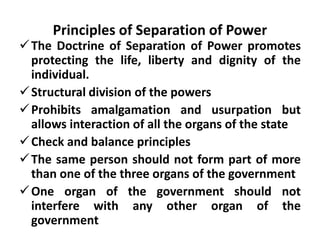
Principles of Separation of Power
The Doctrine of Separation of Power promotes
protecting the life, liberty and dignity of the
individual.
Structural division of the powers
Prohibits amalgamation and usurpation but
allows interaction of all the organs of the state
Check and balance principles
The same person should not form part of more
than one of the three organs of the government
One organ of the government should not
interfere with any other organ of the
government
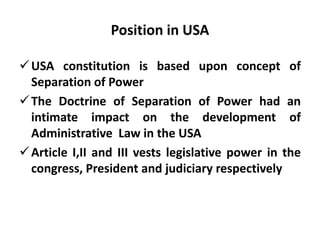
Position in USA
USA constitution is based upon concept of
Separation of Power
The Doctrine of Separation of Power had an
intimate impact on the development of
Administrative Law in the USA
Article I,II and III vests legislative power in the
congress, President and judiciary respectively
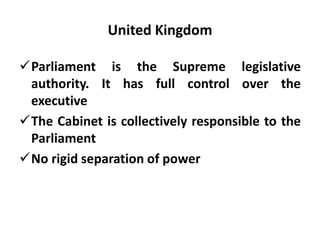
United Kingdom
Parliament is the Supreme legislative
authority. It has full control over the
executive
The Cabinet is collectively responsible to the
Parliament
No rigid separation of power
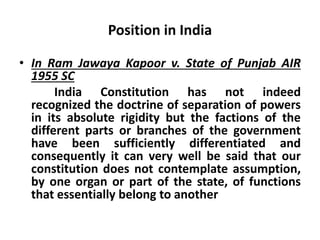
Position in India
• In Ram Jawaya Kapoor v. State of Punjab AIR
1955 SC
India Constitution has not indeed
recognized the doctrine of separation of powers
in its absolute rigidity but the factions of the
different parts or branches of the government
have been sufficiently differentiated and
consequently it can very well be said that our
constitution does not contemplate assumption,
by one organ or part of the state, of functions
that essentially belong to another
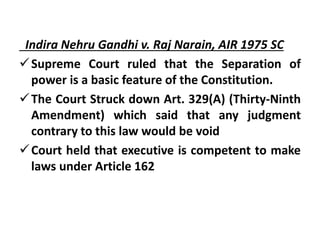
Indira Nehru Gandhi v. Raj Narain, AIR 1975 SC
Supreme Court ruled that the Separation of
power is a basic feature of the Constitution.
The Court Struck down Art. 329(A) (Thirty-Ninth
Amendment) which said that any judgment
contrary to this law would be void
Court held that executive is competent to make
laws under Article 162
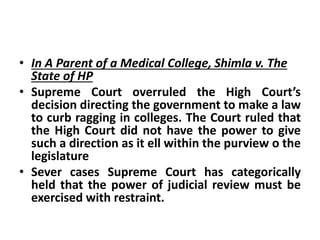
• In A Parent of a Medical College, Shimla v. The
State of HP
• Supreme Court overruled the High Court’s
decision directing the government to make a law
to curb ragging in colleges. The Court ruled that
the High Court did not have the power to give
such a direction as it ell within the purview o the
legislature
• Sever cases Supreme Court has categorically
held that the power of judicial review must be
exercised with restraint.

Separation of power.pptx

  • 1.
  • 2.
    Introduction French philosopher JohnBoding and British politician Locke respectively propounded the concept of Separation of power Montesquieu, who for the first time systematically and scientifically formulated in his book ‘Spirit of the Laws’ to maintain balance of power Aristotle believed that a good government has to be a limited one
  • 3.
    Motesquieu’s Views • “Ifthe Executive and the legislature are the same person or body of persons, there would be a danger of the legislature enacting oppressive laws which the executive will administer to attain its own ends, • laws to be enforced by the same body that enacts them result in arbitrary rule and makes the judge a legislator rather than a interpreter of law. • If one person or boy of persons could exercise both the executive and judiciary powers in the same matter, there would be arbitrary powers, which would amount to complete tyranny, • The value of the doctrine lies in the fact that it seeks to preserve human liberty by avoiding the concentration powers in one person or boy of persons”
  • 4.
    Principles of Separationof Power The Doctrine of Separation of Power promotes protecting the life, liberty and dignity of the individual. Structural division of the powers Prohibits amalgamation and usurpation but allows interaction of all the organs of the state Check and balance principles The same person should not form part of more than one of the three organs of the government One organ of the government should not interfere with any other organ of the government
  • 5.
    Position in USA USAconstitution is based upon concept of Separation of Power The Doctrine of Separation of Power had an intimate impact on the development of Administrative Law in the USA Article I,II and III vests legislative power in the congress, President and judiciary respectively
  • 6.
    United Kingdom Parliament isthe Supreme legislative authority. It has full control over the executive The Cabinet is collectively responsible to the Parliament No rigid separation of power
  • 7.
    Position in India •In Ram Jawaya Kapoor v. State of Punjab AIR 1955 SC India Constitution has not indeed recognized the doctrine of separation of powers in its absolute rigidity but the factions of the different parts or branches of the government have been sufficiently differentiated and consequently it can very well be said that our constitution does not contemplate assumption, by one organ or part of the state, of functions that essentially belong to another
  • 8.
    Indira Nehru Gandhiv. Raj Narain, AIR 1975 SC Supreme Court ruled that the Separation of power is a basic feature of the Constitution. The Court Struck down Art. 329(A) (Thirty-Ninth Amendment) which said that any judgment contrary to this law would be void Court held that executive is competent to make laws under Article 162
  • 9.
    • In AParent of a Medical College, Shimla v. The State of HP • Supreme Court overruled the High Court’s decision directing the government to make a law to curb ragging in colleges. The Court ruled that the High Court did not have the power to give such a direction as it ell within the purview o the legislature • Sever cases Supreme Court has categorically held that the power of judicial review must be exercised with restraint.