An Equal Opportunity Institution 6/16/2014
“BRAIN-EATING AMEBA”
Publication #1401
Around June, a parasite commonly referred to as
“brain-eating ameba” or “ameba” starts to attract
attention for its sudden and sadly, often fatal
impact on humans.
According to the Center for Disease Control and
Prevention (CDC), of the 132 people known to be
infected in the United States since 1962, only three
have survived. From 2004 to 2013, 34 infections
were reported and all but two were fatal. The good
news is ameba infection and the resulting illness
are rare and often avoidable.
What are Amebas?
The term “ameba” is used to describe hundreds of
different organisms; additionally, ameba may be
spelled “amoeba.” The ameba commonly referred
to as “brain-eating ameba” is Naegleria fowleri; a
single-celled organism that loves warm freshwater
bodies, such as the lakes and ponds found in
Central Florida, but can be found around the
world. The often-fatal illness caused by this ameba
is “Primary Amoebic Meningoencephalitis”
(PAM). Fortunately, PAM is exceedingly rare in
Florida and the rest of the United States.
Naegleria fowleri is usually found in the sediments
of warm lakes, rivers, ponds, or springs located in
the southern states.
How Do Amebas Infect People?
Amebas infects people when contaminated water
travels up the nose. This usually occurs as people
take part in freshwater recreation. After an ameba
enters the body, through the nose, it travels to the
brain where it can cause Primary Amoebic
Meningoencephalitis (PAM). PAM destroys brain
tissue and can cause swelling and death.
Infections usually occur in July, August, or
September; however in Florida, the season may
range earlier and later due to our prolonged hot
weather.
You cannot be infected by drinking contaminated
water, intentionally or accidentally. You cannot be
infected by eating fish from contaminated waters.
Naegleria fowleri is not found in salt water (like the
ocean) and infections cannot spread person to
person.
The only way to ‘catch’ an ameba is for
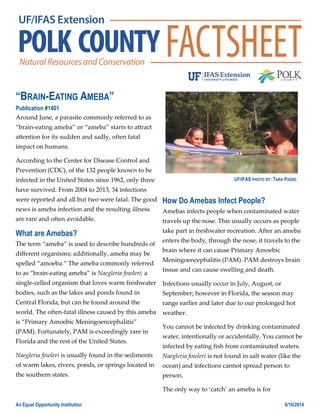
UF/IFAS PHOTO BY: TARA PAISIO
An Equal Opportunity Institution 6/16/2014
contaminated fresh water to enter the body
through the nose.
How Can I Avoid “Brain-Eating Ameba?”
Since Naegleria fowleri is usually found in the
sediments of warm water, the best way to avoid
infection is to avoid stirring up bottom sediments
in the water. Children, especially young children,
should be discouraged from rooting around in the
mud or diving down to dig in the sediments.
Keeping one’s face away from sediments in warm
water will reduce the risk of infection.
You can protect yourself and your family further
by encouraging those playing or swimming in
warm water to wear ear plugs and a nose clip. If
possible, avoid playing or swimming in warm
shallow water during the summer months; this is
the best way to avoid Naegleria fowleri.
What are the Symptoms of PAM?
According to the Center for Disease Control and
Prevention (CDC), symptoms may be mild at first
but will worsen quickly. The CDC lists the
following symptoms:
 Symptoms usually start 5 days post-infection
(may range from 1-7 days post-infection)
 Typically include headache, fever, nausea, or
vomiting
 Later symptoms can include stiff neck,
confusion, loss of balance, seizures,
hallucinations, and lack of attention to people
or surroundings
 After symptoms begin, the illness typically
causes death within 5 days (may range from
1-12 days)
Contact your doctor immediately, if you suspect
infection after playing or swimming in warm
water. In the few known cases of survival, the
patients recognized the symptoms early and
administered proper treatment quickly. If
treatment is to be effective, it must be given
quickly after symptoms show.
Where Can I Find More Information?
For more information on infection rates,
prevention, or information En Español, visit
the Center for Disease Control and Prevention’s
brain-eating ameba website,
www.cdc.gov/naegleria, or contact them at 800-
CDC-INFO (800-232-4636).
For more information on Florida lake
conditions that may favor ameba, read
Florida LAKEWATCH’s circular #106
(http://lakewatch.ifas.ufl.edu/LWcirc.html). For
additional information, contact them at 1-800-
LAKEWATCH (800-525-3928) or visit their
website at http://lakewatch.ifas.ufl.edu/.
Or, Call your County Extension Agent:
Shannon Carnevale
Natural Resources and Conservation
Extension Agent
scarnevale@ufl.edu
863-519-1051
http://polk.ifas.ufl.edu

Ameba_Polk2014

  • 1.
    An Equal OpportunityInstitution 6/16/2014 “BRAIN-EATING AMEBA” Publication #1401 Around June, a parasite commonly referred to as “brain-eating ameba” or “ameba” starts to attract attention for its sudden and sadly, often fatal impact on humans. According to the Center for Disease Control and Prevention (CDC), of the 132 people known to be infected in the United States since 1962, only three have survived. From 2004 to 2013, 34 infections were reported and all but two were fatal. The good news is ameba infection and the resulting illness are rare and often avoidable. What are Amebas? The term “ameba” is used to describe hundreds of different organisms; additionally, ameba may be spelled “amoeba.” The ameba commonly referred to as “brain-eating ameba” is Naegleria fowleri; a single-celled organism that loves warm freshwater bodies, such as the lakes and ponds found in Central Florida, but can be found around the world. The often-fatal illness caused by this ameba is “Primary Amoebic Meningoencephalitis” (PAM). Fortunately, PAM is exceedingly rare in Florida and the rest of the United States. Naegleria fowleri is usually found in the sediments of warm lakes, rivers, ponds, or springs located in the southern states. How Do Amebas Infect People? Amebas infects people when contaminated water travels up the nose. This usually occurs as people take part in freshwater recreation. After an ameba enters the body, through the nose, it travels to the brain where it can cause Primary Amoebic Meningoencephalitis (PAM). PAM destroys brain tissue and can cause swelling and death. Infections usually occur in July, August, or September; however in Florida, the season may range earlier and later due to our prolonged hot weather. You cannot be infected by drinking contaminated water, intentionally or accidentally. You cannot be infected by eating fish from contaminated waters. Naegleria fowleri is not found in salt water (like the ocean) and infections cannot spread person to person. The only way to ‘catch’ an ameba is for UF/IFAS PHOTO BY: TARA PAISIO
  • 2.
    An Equal OpportunityInstitution 6/16/2014 contaminated fresh water to enter the body through the nose. How Can I Avoid “Brain-Eating Ameba?” Since Naegleria fowleri is usually found in the sediments of warm water, the best way to avoid infection is to avoid stirring up bottom sediments in the water. Children, especially young children, should be discouraged from rooting around in the mud or diving down to dig in the sediments. Keeping one’s face away from sediments in warm water will reduce the risk of infection. You can protect yourself and your family further by encouraging those playing or swimming in warm water to wear ear plugs and a nose clip. If possible, avoid playing or swimming in warm shallow water during the summer months; this is the best way to avoid Naegleria fowleri. What are the Symptoms of PAM? According to the Center for Disease Control and Prevention (CDC), symptoms may be mild at first but will worsen quickly. The CDC lists the following symptoms:  Symptoms usually start 5 days post-infection (may range from 1-7 days post-infection)  Typically include headache, fever, nausea, or vomiting  Later symptoms can include stiff neck, confusion, loss of balance, seizures, hallucinations, and lack of attention to people or surroundings  After symptoms begin, the illness typically causes death within 5 days (may range from 1-12 days) Contact your doctor immediately, if you suspect infection after playing or swimming in warm water. In the few known cases of survival, the patients recognized the symptoms early and administered proper treatment quickly. If treatment is to be effective, it must be given quickly after symptoms show. Where Can I Find More Information? For more information on infection rates, prevention, or information En Español, visit the Center for Disease Control and Prevention’s brain-eating ameba website, www.cdc.gov/naegleria, or contact them at 800- CDC-INFO (800-232-4636). For more information on Florida lake conditions that may favor ameba, read Florida LAKEWATCH’s circular #106 (http://lakewatch.ifas.ufl.edu/LWcirc.html). For additional information, contact them at 1-800- LAKEWATCH (800-525-3928) or visit their website at http://lakewatch.ifas.ufl.edu/. Or, Call your County Extension Agent: Shannon Carnevale Natural Resources and Conservation Extension Agent scarnevale@ufl.edu 863-519-1051 http://polk.ifas.ufl.edu