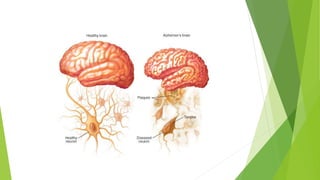
Alzheimer Disease
Dr. Chirayu Regmi
 Most common degenerative disease of the brain
 In 1907, Alzheimer described the case of a 51-year-old woman who died after
a 5-year illness characterized by progressive dementia.
Epidemiology
 Most patients above 60 years of age
 Incidences: 125 new cases per 100,000 of those older than age 60 years
 Prevalence: per 100,000
 300 in the group aged 60 to 69 years; it
 3,200 in the 70- to 79-year-old group
 and 10,800 in those older than age 80.
 more than 30 million persons with Alzheimer disease in the world.
Epidemiologic risk factors
 Birth order
 mother’s age at birth
 family history of Down syndrome
 Depression
 Head injuries
 Lower educational status
 Inheritance
Clinical Features
Early presentation with one of following:
 Amnesia
 Dysnomia
 Visiospatial disorientation
 Paranoia and personality changes
 Impaired Executive function
Clinical Features
 Insidious onset
 May manifest as unusual degree of confusion during and following a federal illness operationor a mild
head, injury
 Dizziness, mental forgiveness non-descript, headaches and vaguely expressed somatic symptoms
 Gradual development of forgetfulness
 Remote memories are preserved. Recent once are lost
Clinical Features
 Halting speech
 Interruption in writing
 Restricted vocabulary
 Expressive language becomes stereotyped and inflexible
 Comprehension is preserved
 Failure to speak in full sentence
 Echolalia, nominal aphasia
 Paucity of speech, reduction in mentation
 Loss of arithmetics skill
 Visuospatial disorientation- person may get lost
 Failure to use common object and tools- cannot use a razor
 Only most habitual and automatic actions are preserved in late stages
 Ideational and ideal motor apraxia
 Neglect of dressing, saving
 Anxiety, restlessness, inertia or placidity
 Disturbance in sleep patterns
 Delusion, hallucinations
 Infatuation with younger person
 Eating maybe the neglected or appetite may increase
 Grasping and soaking reflexes may appear
 Incontinence, akinesia and mutism
 Symptomatic course of illness 5 or more years
 Pre-clinical asymptomatic phase is longer
 Stepwise declining memory and attention span
 Corticospinal and corticosensory function intact
 Visual acuity, ocular movement and visual fields intact
 No hemiparesis, hemiplegia or other focal neurological deficit
 Planter are flexor.
 There is no sensory or cerebellar ataxia
 Tendon reflexes are mostly normal

Diagnosis
 clinical diagnosis, aided by imaging and neuropsychological testing
Diagnostic criteria
 (1) dementia defined by clinical examination, the Mini-Mental Scale/, the
Montreal Cognitive Assessment/Alzheimer Disease Assessment Scale (ADAS)
 (2) patient older than age 40 years
 (3) deficits in two or more areas of cognition and progressive worsening of
memory and other cognitive functions, such as language, perception, and
motor skills (praxis)
 (4) absence of disturbed consciousness
 (5) exclusion of other brain diseases
 biomarkers such as positron emission tomography (PET) ligand for amyloid
 tau/amyloid ratio in CSF
Pathology
Macroscopic:
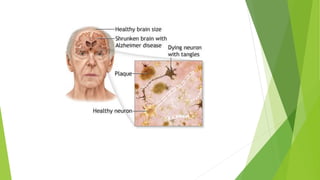
Diffuse atrophy of brain
Brain weight reduced by 20 percent or more
Cerebral convolutions narrowed, sulci widened
Third and lateral ventricles enlarged symmetrically
Microscopic:
Wide spread loss of nerve cells- most pronounced in layer II of entorhinal
cortex.
Also in parahippocampal gyri, subiculum, nucleus basilis of Meynert,
Astrocytic hypertrophy
Pathology
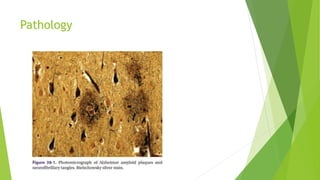
Essential neuropathologic changes of AD include the following:
●Extracellular deposits of amyloid beta peptides
●Neuritic plaques, associated with neuronal injury and characterized by
amyloid formed from amyloid beta with dystrophic neurites
●Neurofibrillary degeneration, best exemplified by neurofibrillary tangles
 Cerebral amyloid angiopathy
 Inclusions of abnormal alpha-synuclein accumulation /(Lewy body)
 Hippocampal sclerosis (HS)/ (FTLD)
 Immunoreactive inclusions of TAR DNA binding protein 43 (TDP-43)/ (ALS)
Pathology
Pathogenesis
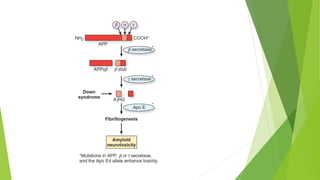
 overproduction and/or decreased clearance of amyloid beta peptides-
their small aggregates called oligomers
 Accumulation of tau protein, which becomes hyperphosphorylated and
aggregates to form paired helical filament (PHF)- a major component
of neurofibrillary tangles
 Inheritance of APOE e4 --> impairment of amyloid beta clearance
from cerebrum.
 reduced cerebral content of choline acetyltransferase, which leads to a
decrease in acetylcholine synthesis and impaired cortical cholinergic function
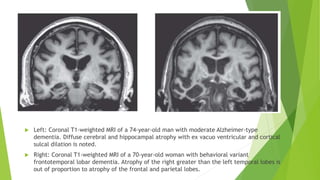
 Left: Coronal T1-weighted MRI of a 74-year-old man with moderate Alzheimer-type
dementia. Diffuse cerebral and hippocampal atrophy with ex vacuo ventricular and cortical
sulcal dilation is noted.
 Right: Coronal T1-weighted MRI of a 70-year-old woman with behavioral variant
frontotemporal lobar dementia. Atrophy of the right greater than the left temporal lobes is
out of proportion to atrophy of the frontal and parietal lobes.
Differential Diagnosis
Treatment
 cerebral vasodilators, stimulants, l-dopa, massive doses of vitamins B, C, and
E, gingko biloba, hyperbaric oxygen, intravenous immunoglobulin, oral
physostigmine, choline, and lecithin- DON'T WORK!
• Cholinesterase inhibitors
 Patients with AD have reduced cerebral content of choline acetyltransferase,
which leads to a decrease in acetylcholine synthesis and impaired cortical
cholinergic function
 (donepezil, rivastigmine, and galantamine) increase cholinergic transmission
by inhibiting cholinesterase at the synaptic cleft
 trial of a cholinesterase inhibitor for symptomatic treatment of cognition and
global functioning
 Modest benefit
 No neuroprotective role
 Do not alter disease activity
N-methyl-D-aspartate (NMDA) receptor antagonist
 proposed to be neuroprotective
 Excessive NMDA stimulation by glutamate leads to excitotoxicity
 Agents that block pathologic stimulation of NMDA receptors -->
protect against further damage
 Moderate to severe Dementia
 Less side effects
 Memantine is initiated 5 mg once daily; the dose can be increased by
5 mg weekly to a maximum tolerated dose of 20 mg per day, usually in
two divided doses
Monoclonal Antibodies
 ADUCANUMAB- recombinant monoclonal antibody directed against amyloid
beta
 reducing amyloid beta plaques in the brain
 Used in mild CI or dementia
 Documented amyloid pathology
Vitamin E
 1000 international units twice daily
 mild to moderate AD
 delays functional progression
 Anti-oxidant effects
NONPHARMACOLOGIC THERAPY AND SUPPORTIVE CARE
SAFETY AND SOCIETAL ISSUES
 Driving
 financial capacity
 Wandering
 living alone.
Thank You

Alzheimer's disease.pptx

  • 1.
  • 3.
     Most commondegenerative disease of the brain  In 1907, Alzheimer described the case of a 51-year-old woman who died after a 5-year illness characterized by progressive dementia.
  • 4.
    Epidemiology  Most patientsabove 60 years of age  Incidences: 125 new cases per 100,000 of those older than age 60 years  Prevalence: per 100,000  300 in the group aged 60 to 69 years; it  3,200 in the 70- to 79-year-old group  and 10,800 in those older than age 80.  more than 30 million persons with Alzheimer disease in the world.
  • 5.
    Epidemiologic risk factors Birth order  mother’s age at birth  family history of Down syndrome  Depression  Head injuries  Lower educational status  Inheritance
  • 6.
    Clinical Features Early presentationwith one of following:  Amnesia  Dysnomia  Visiospatial disorientation  Paranoia and personality changes  Impaired Executive function
  • 7.
    Clinical Features  Insidiousonset  May manifest as unusual degree of confusion during and following a federal illness operationor a mild head, injury  Dizziness, mental forgiveness non-descript, headaches and vaguely expressed somatic symptoms  Gradual development of forgetfulness  Remote memories are preserved. Recent once are lost
  • 8.
    Clinical Features  Haltingspeech  Interruption in writing  Restricted vocabulary  Expressive language becomes stereotyped and inflexible  Comprehension is preserved  Failure to speak in full sentence  Echolalia, nominal aphasia  Paucity of speech, reduction in mentation
  • 9.
     Loss ofarithmetics skill  Visuospatial disorientation- person may get lost  Failure to use common object and tools- cannot use a razor  Only most habitual and automatic actions are preserved in late stages  Ideational and ideal motor apraxia
  • 10.
     Neglect ofdressing, saving  Anxiety, restlessness, inertia or placidity  Disturbance in sleep patterns  Delusion, hallucinations  Infatuation with younger person  Eating maybe the neglected or appetite may increase  Grasping and soaking reflexes may appear  Incontinence, akinesia and mutism
  • 11.
     Symptomatic courseof illness 5 or more years  Pre-clinical asymptomatic phase is longer  Stepwise declining memory and attention span  Corticospinal and corticosensory function intact  Visual acuity, ocular movement and visual fields intact  No hemiparesis, hemiplegia or other focal neurological deficit  Planter are flexor.  There is no sensory or cerebellar ataxia  Tendon reflexes are mostly normal 
  • 12.
    Diagnosis  clinical diagnosis,aided by imaging and neuropsychological testing
  • 13.
    Diagnostic criteria  (1)dementia defined by clinical examination, the Mini-Mental Scale/, the Montreal Cognitive Assessment/Alzheimer Disease Assessment Scale (ADAS)  (2) patient older than age 40 years  (3) deficits in two or more areas of cognition and progressive worsening of memory and other cognitive functions, such as language, perception, and motor skills (praxis)  (4) absence of disturbed consciousness  (5) exclusion of other brain diseases
  • 14.
     biomarkers suchas positron emission tomography (PET) ligand for amyloid  tau/amyloid ratio in CSF
  • 15.
    Pathology Macroscopic: Diffuse atrophy ofbrain Brain weight reduced by 20 percent or more Cerebral convolutions narrowed, sulci widened Third and lateral ventricles enlarged symmetrically Microscopic: Wide spread loss of nerve cells- most pronounced in layer II of entorhinal cortex. Also in parahippocampal gyri, subiculum, nucleus basilis of Meynert, Astrocytic hypertrophy
  • 16.
    Pathology Essential neuropathologic changesof AD include the following: ●Extracellular deposits of amyloid beta peptides ●Neuritic plaques, associated with neuronal injury and characterized by amyloid formed from amyloid beta with dystrophic neurites ●Neurofibrillary degeneration, best exemplified by neurofibrillary tangles
  • 18.
     Cerebral amyloidangiopathy  Inclusions of abnormal alpha-synuclein accumulation /(Lewy body)  Hippocampal sclerosis (HS)/ (FTLD)  Immunoreactive inclusions of TAR DNA binding protein 43 (TDP-43)/ (ALS)
  • 19.
  • 21.
    Pathogenesis  overproduction and/ordecreased clearance of amyloid beta peptides- their small aggregates called oligomers  Accumulation of tau protein, which becomes hyperphosphorylated and aggregates to form paired helical filament (PHF)- a major component of neurofibrillary tangles  Inheritance of APOE e4 --> impairment of amyloid beta clearance from cerebrum.  reduced cerebral content of choline acetyltransferase, which leads to a decrease in acetylcholine synthesis and impaired cortical cholinergic function
  • 22.
     Left: CoronalT1-weighted MRI of a 74-year-old man with moderate Alzheimer-type dementia. Diffuse cerebral and hippocampal atrophy with ex vacuo ventricular and cortical sulcal dilation is noted.  Right: Coronal T1-weighted MRI of a 70-year-old woman with behavioral variant frontotemporal lobar dementia. Atrophy of the right greater than the left temporal lobes is out of proportion to atrophy of the frontal and parietal lobes.
  • 23.
  • 24.
    Treatment  cerebral vasodilators,stimulants, l-dopa, massive doses of vitamins B, C, and E, gingko biloba, hyperbaric oxygen, intravenous immunoglobulin, oral physostigmine, choline, and lecithin- DON'T WORK!
  • 25.
    • Cholinesterase inhibitors Patients with AD have reduced cerebral content of choline acetyltransferase, which leads to a decrease in acetylcholine synthesis and impaired cortical cholinergic function  (donepezil, rivastigmine, and galantamine) increase cholinergic transmission by inhibiting cholinesterase at the synaptic cleft  trial of a cholinesterase inhibitor for symptomatic treatment of cognition and global functioning  Modest benefit  No neuroprotective role  Do not alter disease activity
  • 26.
    N-methyl-D-aspartate (NMDA) receptorantagonist  proposed to be neuroprotective  Excessive NMDA stimulation by glutamate leads to excitotoxicity  Agents that block pathologic stimulation of NMDA receptors --> protect against further damage  Moderate to severe Dementia  Less side effects  Memantine is initiated 5 mg once daily; the dose can be increased by 5 mg weekly to a maximum tolerated dose of 20 mg per day, usually in two divided doses
  • 27.
    Monoclonal Antibodies  ADUCANUMAB-recombinant monoclonal antibody directed against amyloid beta  reducing amyloid beta plaques in the brain  Used in mild CI or dementia  Documented amyloid pathology
  • 28.
    Vitamin E  1000international units twice daily  mild to moderate AD  delays functional progression  Anti-oxidant effects
  • 29.
  • 30.
    SAFETY AND SOCIETALISSUES  Driving  financial capacity  Wandering  living alone.
  • 31.