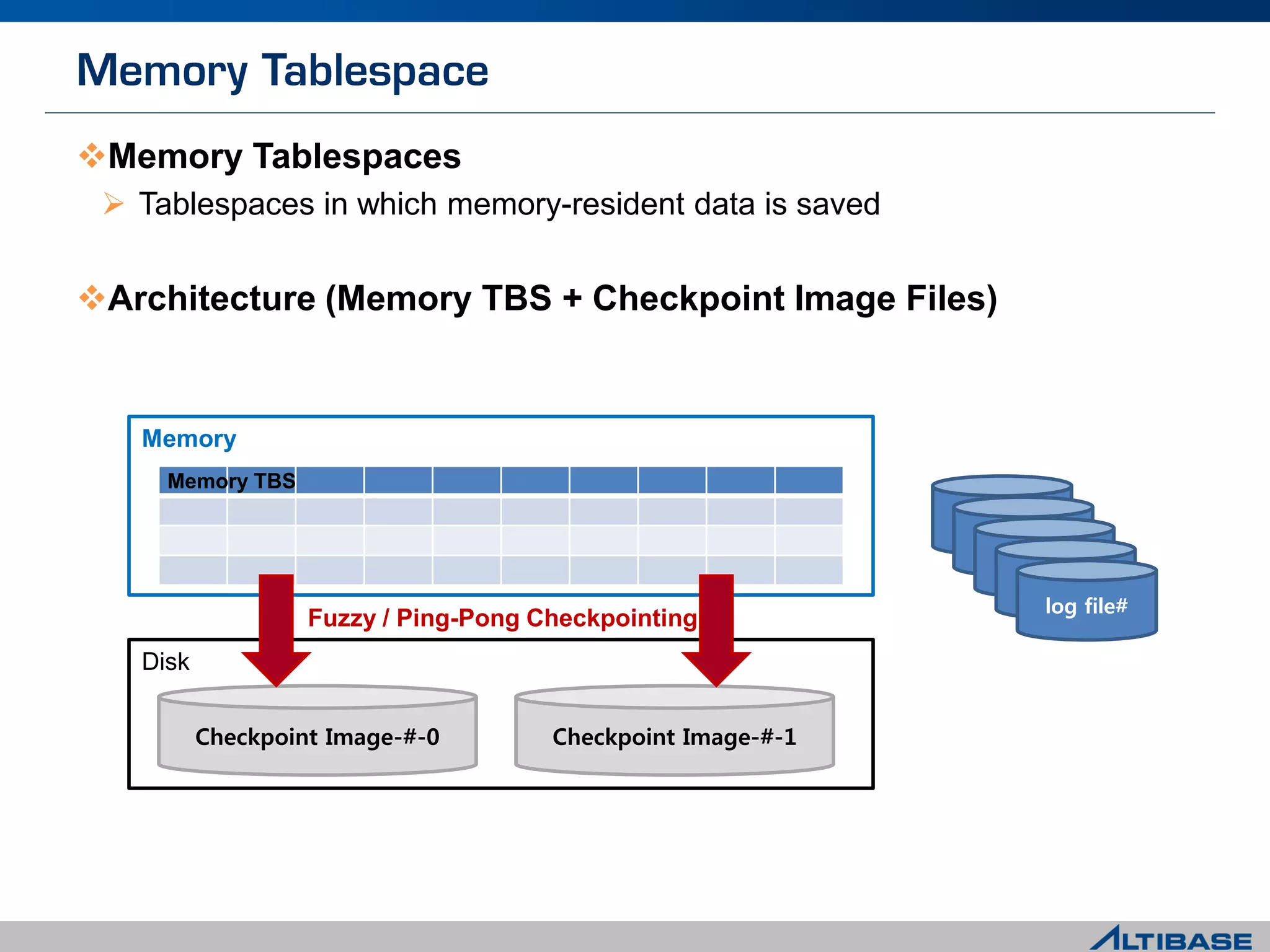
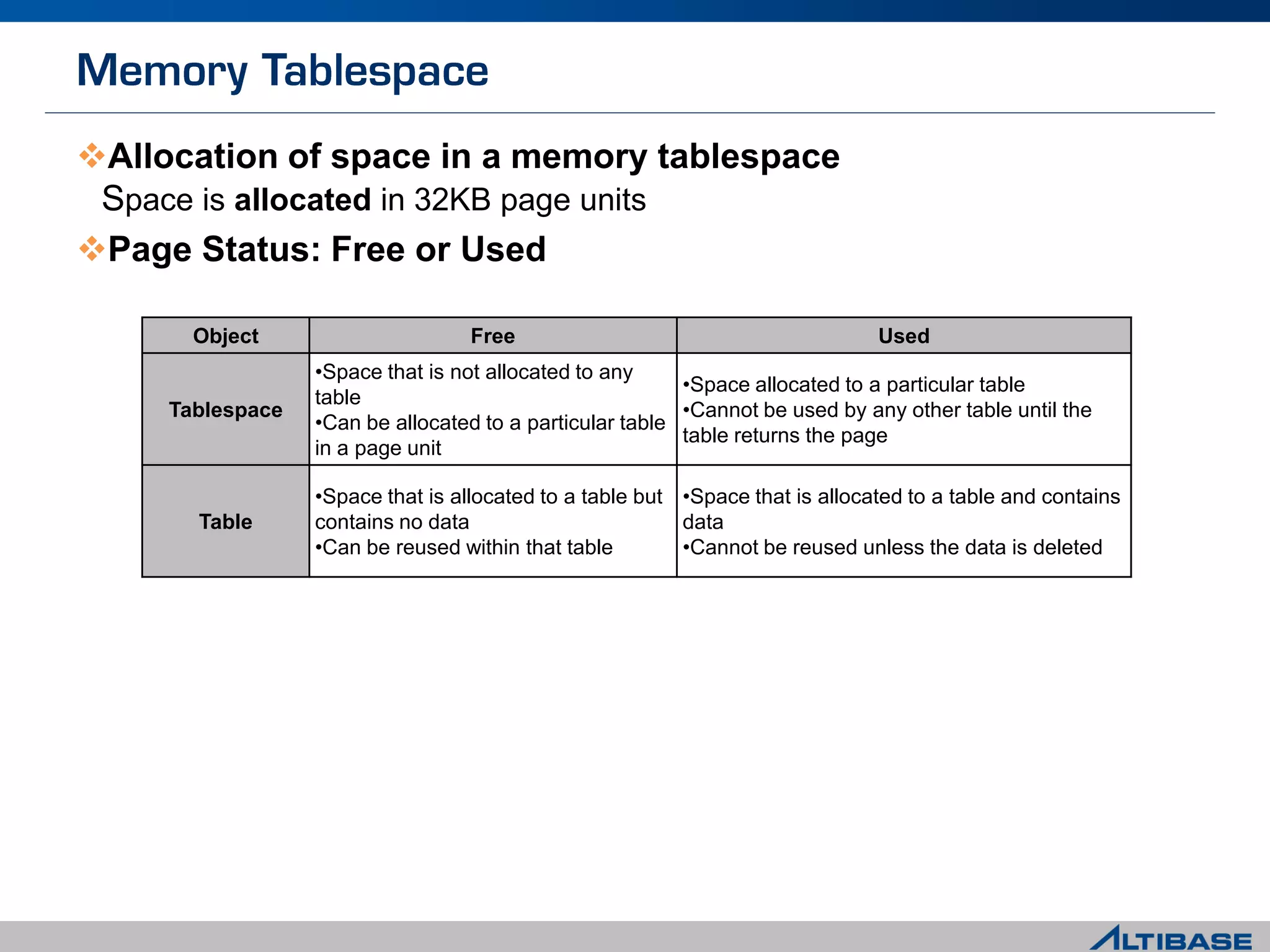
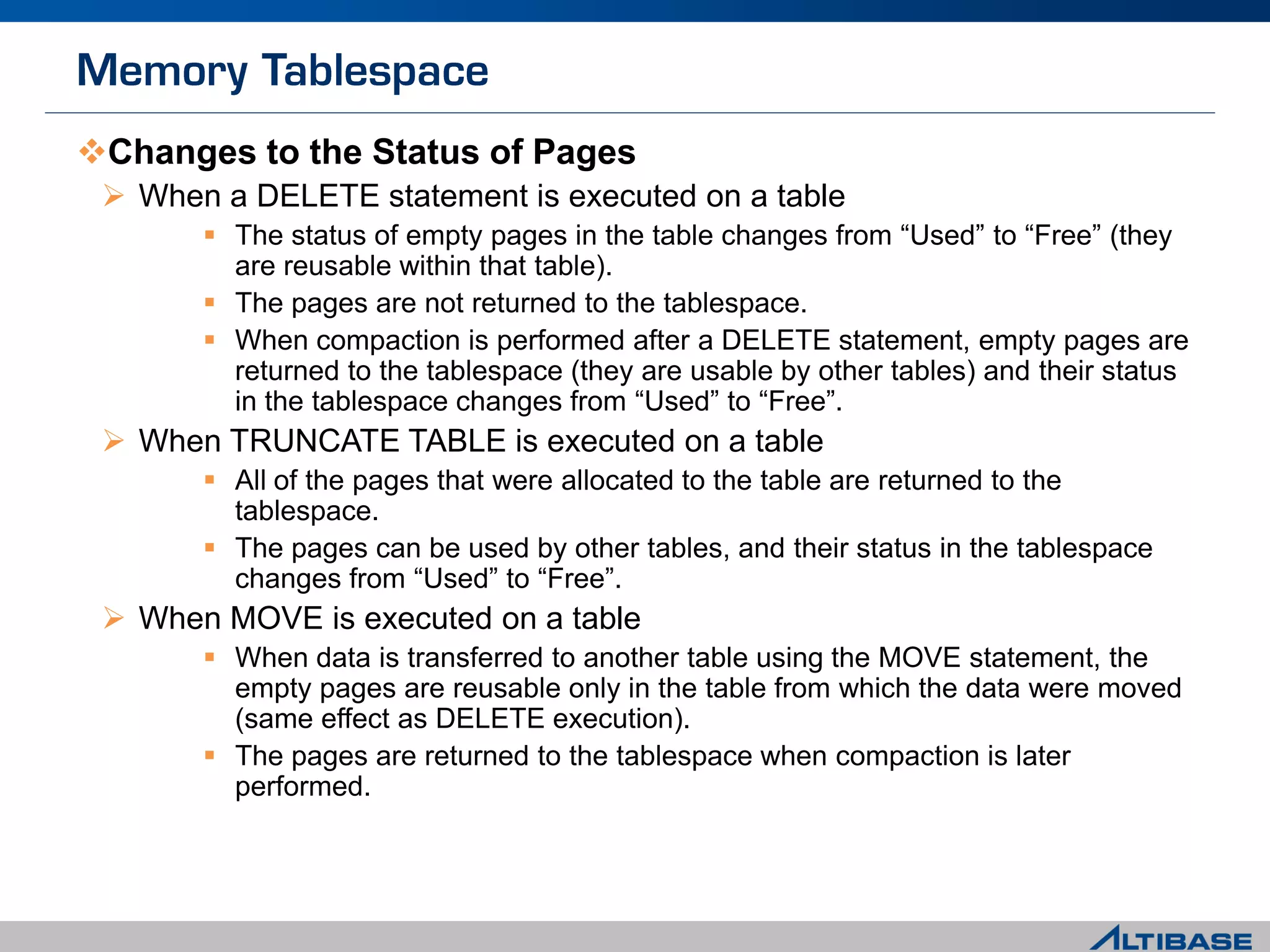
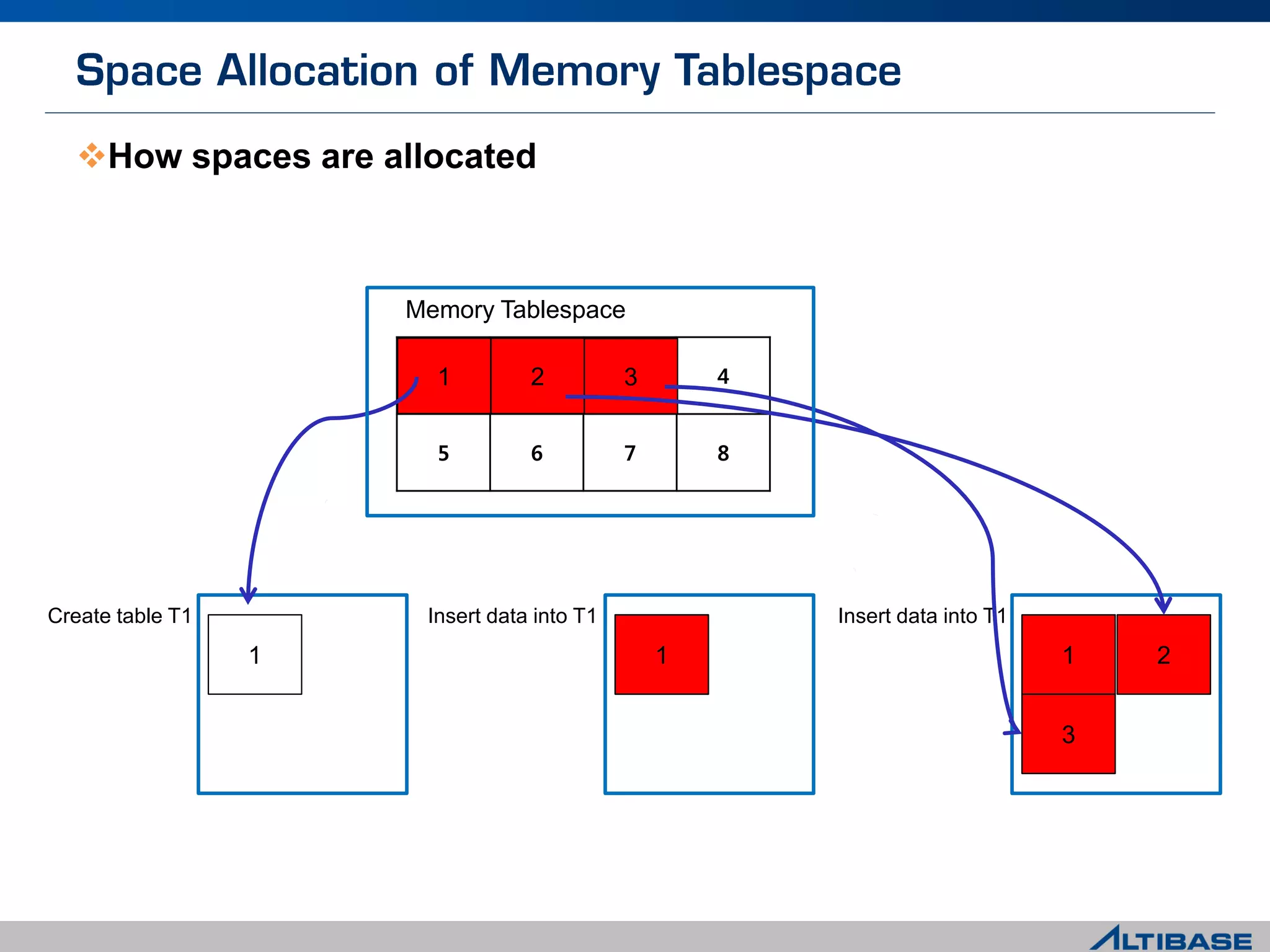
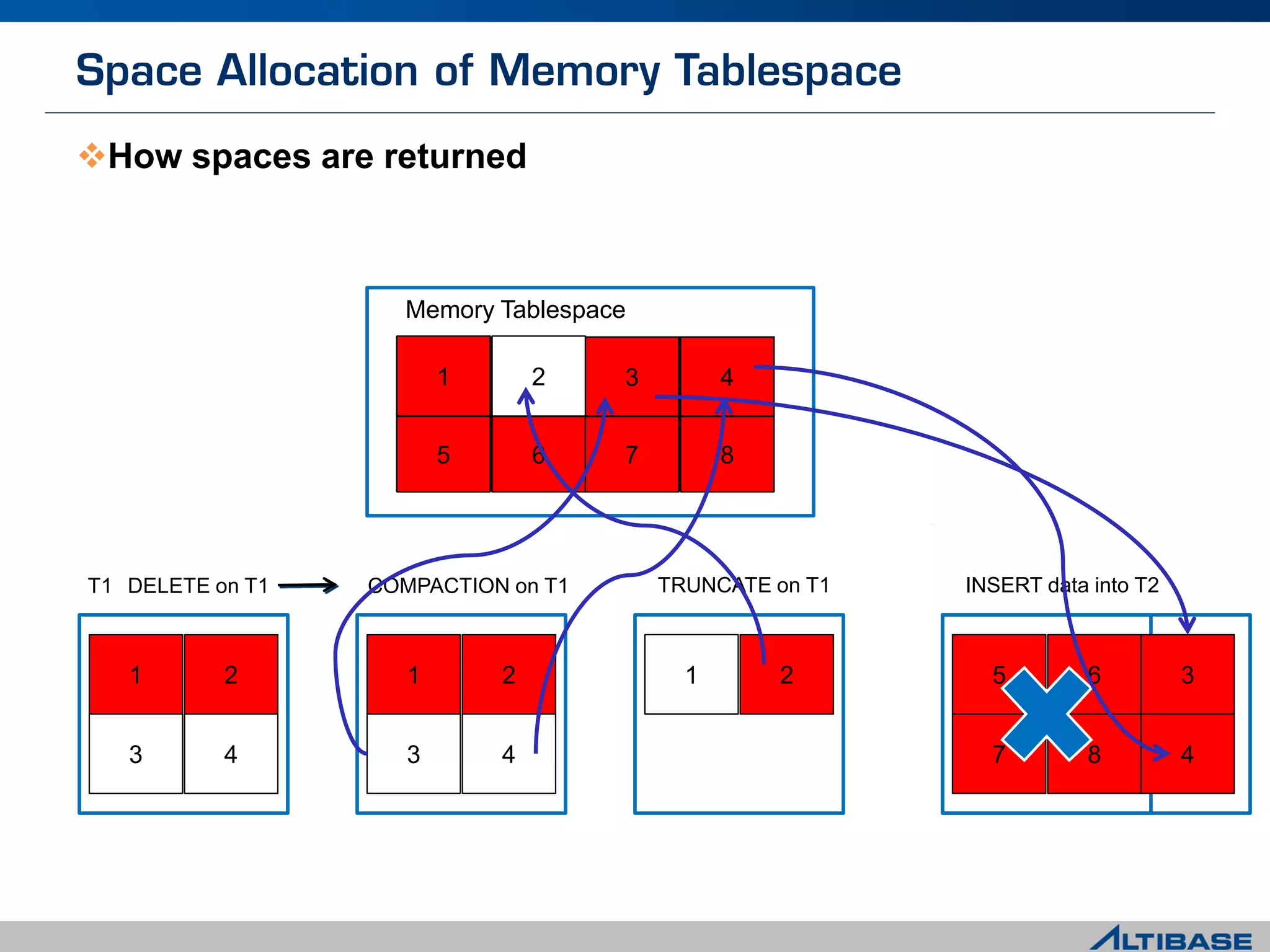
Memory tablespaces store memory-resident data and use checkpoint image files on disk to recover that data if needed. Space in a memory tablespace is allocated in 32KB pages that have a status of either free or used. When data is deleted from a table, the empty pages' status changes to free within that table but they are not returned to the tablespace until compaction. Truncating a table returns all its pages to the tablespace as free.


![[Altibase] 4-4 disk tablespace](https://cdn.slidesharecdn.com/ss_thumbnails/altibase4-4disktablespace-160126070905-thumbnail.jpg?width=640&height=640&fit=bounds)


![[Altibase] 13 backup and recovery](https://cdn.slidesharecdn.com/ss_thumbnails/altibase13backupandrecovery-160126072259-thumbnail.jpg?width=640&height=640&fit=bounds)
![[Altibase] 12 replication part5 (optimization and monitoring)](https://cdn.slidesharecdn.com/ss_thumbnails/altibase12replicationpart5optimizationandmonitoring-160126072237-thumbnail.jpg?width=640&height=640&fit=bounds)
![[Altibase] 1-4 data differentiation](https://cdn.slidesharecdn.com/ss_thumbnails/altibase1-4datadifferentiation-160126054107-thumbnail.jpg?width=640&height=640&fit=bounds)
![[Altibase] 6 what is the mvcc](https://cdn.slidesharecdn.com/ss_thumbnails/altibase6whatisthemvcc-160126071035-thumbnail.jpg?width=640&height=640&fit=bounds)
![[Altibase] 2-4 sql functions](https://cdn.slidesharecdn.com/ss_thumbnails/altibase2-4sqlfunctions-160126064326-thumbnail.jpg?width=640&height=640&fit=bounds)
![[Altibase] 2-1 features](https://cdn.slidesharecdn.com/ss_thumbnails/altibase2-1features-160126054348-thumbnail.jpg?width=640&height=640&fit=bounds)
![[Altibase] 2-3 general functions](https://cdn.slidesharecdn.com/ss_thumbnails/altibase2-3generalfunctions-160126061045-thumbnail.jpg?width=640&height=640&fit=bounds)
![[Altibase] 3-1 architecture](https://cdn.slidesharecdn.com/ss_thumbnails/altibase3-1architecture-160126064412-thumbnail.jpg?width=640&height=640&fit=bounds)
![[Altibase] 4-1 tablespace concept](https://cdn.slidesharecdn.com/ss_thumbnails/altibase4-1tablespaceconcept-160126070026-thumbnail.jpg?width=640&height=640&fit=bounds)
![[Altibase] 9 replication part2 (methods and controls)](https://cdn.slidesharecdn.com/ss_thumbnails/altibase9replicationpart2methodsandcontrols-160126071813-thumbnail.jpg?width=640&height=640&fit=bounds)
![[Altibase] 7 how the buffer is managed in altibase](https://cdn.slidesharecdn.com/ss_thumbnails/altibase7howthebufferismanagedinaltibase-160126071111-thumbnail.jpg?width=640&height=640&fit=bounds)
![[Altibase] 4-5 summary of tablespace management](https://cdn.slidesharecdn.com/ss_thumbnails/altibase4-5summaryoftablespacemanagement-160126073308-thumbnail.jpg?width=640&height=640&fit=bounds)
![[Altibase] 4-3 volatile tablespace](https://cdn.slidesharecdn.com/ss_thumbnails/altibase4-3volatiletablespace-160126070727-thumbnail.jpg?width=640&height=640&fit=bounds)
![[Altibase] 2-2 Altibase storage](https://cdn.slidesharecdn.com/ss_thumbnails/altibase2-2altibasehdbstorage-160126054833-thumbnail.jpg?width=640&height=640&fit=bounds)
![[Altibase] 11 replication part4 (conflict resolution)](https://cdn.slidesharecdn.com/ss_thumbnails/altibase11replicationpart4conflictresolution-160126072111-thumbnail.jpg?width=640&height=640&fit=bounds)
![[Altibase] 8 replication part1 (overview)](https://cdn.slidesharecdn.com/ss_thumbnails/altibase8replicationpart1overview-160126071132-thumbnail.jpg?width=640&height=640&fit=bounds)
![[Altibase] 5 durability](https://cdn.slidesharecdn.com/ss_thumbnails/altibase5durability-160126071012-thumbnail.jpg?width=640&height=640&fit=bounds)
![[Altibase] 3-3 directory contents](https://cdn.slidesharecdn.com/ss_thumbnails/altibase3-3directorycontents-160126064517-thumbnail.jpg?width=640&height=640&fit=bounds)
![[Altibase] 10 replication part3 (system design)](https://cdn.slidesharecdn.com/ss_thumbnails/altibase10replicationpart3systemdesign-160126072046-thumbnail.jpg?width=640&height=640&fit=bounds)
![[Altibase] 1-5 hybrid dbms](https://cdn.slidesharecdn.com/ss_thumbnails/altibase1-5hybriddbms-160126054205-thumbnail.jpg?width=640&height=640&fit=bounds)


