•The Open University (also commonly
referred to by its initialism OU) is a distance
learning and research, a university founded
by Royal Charter in the United Kingdom.

•The university is funded by a combination of
student fees, contract income, and
allocations for teaching and research by the
higher education funding bodies in each of
the four countries of the UK (England,
Scotland, Wales and Northern Ireland).
The Open University Aim
• The OU provides university education to
  those wishing to pursue higher education on
  a part-time and/or distance learning basis,
  including people with health disabilities, who
  are officially a priority group for the
  university, nearly 13,000 OU students have
  health disabilities

• http://www.open.ac.uk/
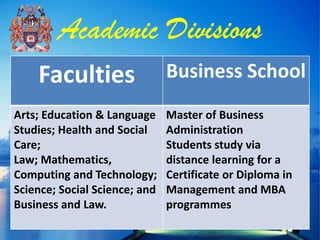
Academic Divisions
    Faculties                  Business School
Arts; Education & Language     Master of Business
Studies; Health and Social     Administration
Care;                          Students study via
Law; Mathematics,              distance learning for a
Computing and Technology;      Certificate or Diploma in
Science; Social Science; and   Management and MBA
Business and Law.              programmes
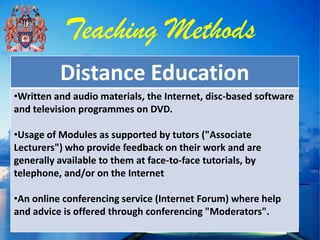
Teaching Methods
          Distance Education
•Written and audio materials, the Internet, disc-based software
and television programmes on DVD.

•Usage of Modules as supported by tutors ("Associate
Lecturers") who provide feedback on their work and are
generally available to them at face-to-face tutorials, by
telephone, and/or on the Internet

•An online conferencing service (Internet Forum) where help
and advice is offered through conferencing "Moderators".
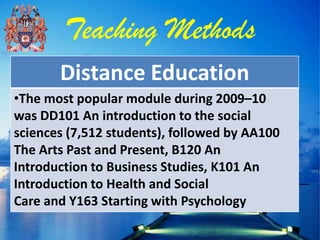
Teaching Methods
       Distance Education
•The most popular module during 2009–10
was DD101 An introduction to the social
sciences (7,512 students), followed by AA100
The Arts Past and Present, B120 An
Introduction to Business Studies, K101 An
Introduction to Health and Social
Care and Y163 Starting with Psychology
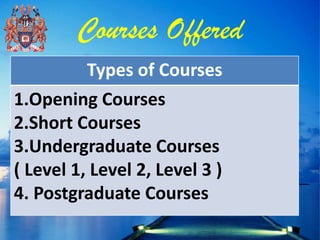
Courses Offered
          Types of Courses
1.Opening Courses
2.Short Courses
3.Undergraduate Courses
( Level 1, Level 2, Level 3 )
4. Postgraduate Courses
Courses
•Open University modules have associated with
them a number of Credit Accumulation and
Transfer Scheme (CATS) credits – usually 30 or 60
– depending on the quantity of the material in
the module and a level (1, 2, 3, or 4)
corresponding to the complexity, with 120
roughly equating to the year of study for a full-
time student.
Degrees
•OU offers Degree in the Named Subject for the
modules taken

•"Open" Bachelor degrees and “Open” Honors
Degree. Example: Bachelor of Arts Open or a
Bachelor of Science Open either with or without
honours.

•Undergraduate Certificates
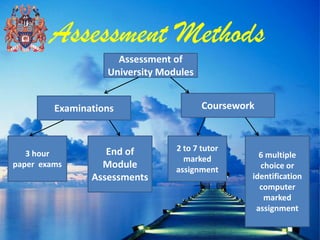
Assessment Methods
                     Assessment of
                   University Modules


         Examinations                   Coursework


                   End of        2 to 7 tutor
   3 hour                                          6 multiple
                                   marked
paper exams       Module         assignment        choice or
                Assessments                      identification
                                                   computer
                                                    marked
                                                  assignment
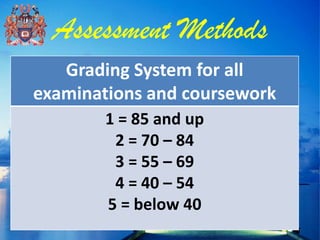
Assessment Methods
   Grading System for all
examinations and coursework
        1 = 85 and up
         2 = 70 – 84
         3 = 55 – 69
         4 = 40 – 54
        5 = below 40
Open Policy
     Open Admissions Policy
A diverse range of students from all walks of life are
attracted to the OU; for most modules there are
no entry requirements other than the ability to
study at an appropriate level, though most
postgraduate modules require evidence of previous
study or equivalent life experience. This
fundamental open admissions policy makes
undergraduate university study accessible to all.
Open Policy
                 Financial Matters
•The average cost of one full-time year or 120 credits will rise to
£5,000, bringing the cost of an average Bachelor's honours
degree for an English student to £15,000.

•From September 2012 the Government will be reducing its
funding for all students residing in England, English students
will for the first time pay higher fees than those living the rest
of the United Kingdom.

•European Union and international students pay more as the
University does not receive government funding for them
Thank You!

Alternative education.britishopenuniversity

  • 5.
    •The Open University(also commonly referred to by its initialism OU) is a distance learning and research, a university founded by Royal Charter in the United Kingdom. •The university is funded by a combination of student fees, contract income, and allocations for teaching and research by the higher education funding bodies in each of the four countries of the UK (England, Scotland, Wales and Northern Ireland).
  • 6.
    The Open UniversityAim • The OU provides university education to those wishing to pursue higher education on a part-time and/or distance learning basis, including people with health disabilities, who are officially a priority group for the university, nearly 13,000 OU students have health disabilities • http://www.open.ac.uk/
  • 7.
    Academic Divisions Faculties Business School Arts; Education & Language Master of Business Studies; Health and Social Administration Care; Students study via Law; Mathematics, distance learning for a Computing and Technology; Certificate or Diploma in Science; Social Science; and Management and MBA Business and Law. programmes
  • 8.
    Teaching Methods Distance Education •Written and audio materials, the Internet, disc-based software and television programmes on DVD. •Usage of Modules as supported by tutors ("Associate Lecturers") who provide feedback on their work and are generally available to them at face-to-face tutorials, by telephone, and/or on the Internet •An online conferencing service (Internet Forum) where help and advice is offered through conferencing "Moderators".
  • 9.
    Teaching Methods Distance Education •The most popular module during 2009–10 was DD101 An introduction to the social sciences (7,512 students), followed by AA100 The Arts Past and Present, B120 An Introduction to Business Studies, K101 An Introduction to Health and Social Care and Y163 Starting with Psychology
  • 10.
    Courses Offered Types of Courses 1.Opening Courses 2.Short Courses 3.Undergraduate Courses ( Level 1, Level 2, Level 3 ) 4. Postgraduate Courses
  • 11.
    Courses •Open University moduleshave associated with them a number of Credit Accumulation and Transfer Scheme (CATS) credits – usually 30 or 60 – depending on the quantity of the material in the module and a level (1, 2, 3, or 4) corresponding to the complexity, with 120 roughly equating to the year of study for a full- time student.
  • 12.
    Degrees •OU offers Degreein the Named Subject for the modules taken •"Open" Bachelor degrees and “Open” Honors Degree. Example: Bachelor of Arts Open or a Bachelor of Science Open either with or without honours. •Undergraduate Certificates
  • 13.
    Assessment Methods Assessment of University Modules Examinations Coursework End of 2 to 7 tutor 3 hour 6 multiple marked paper exams Module assignment choice or Assessments identification computer marked assignment
  • 14.
    Assessment Methods Grading System for all examinations and coursework 1 = 85 and up 2 = 70 – 84 3 = 55 – 69 4 = 40 – 54 5 = below 40
  • 15.
    Open Policy Open Admissions Policy A diverse range of students from all walks of life are attracted to the OU; for most modules there are no entry requirements other than the ability to study at an appropriate level, though most postgraduate modules require evidence of previous study or equivalent life experience. This fundamental open admissions policy makes undergraduate university study accessible to all.
  • 16.
    Open Policy Financial Matters •The average cost of one full-time year or 120 credits will rise to £5,000, bringing the cost of an average Bachelor's honours degree for an English student to £15,000. •From September 2012 the Government will be reducing its funding for all students residing in England, English students will for the first time pay higher fees than those living the rest of the United Kingdom. •European Union and international students pay more as the University does not receive government funding for them
  • 17.