University of Liverpool – Higher Education Achievement Report
Page 1 of 5
Higher Education Achievement Report
(Diploma Supplement)
Contextual Information
The University of Liverpool is a member of the Russell Group, which represents the 24 leading UK universities committed to
maintaining the very best research, an outstanding teaching and learning experience and unrivalled links with business and
the public sector.
This Higher Education Achievement Report incorporates the model developed by the European Commission, Council of
Europe and UNESCO/CEPES for the Diploma Supplement.
The purpose of the Supplement is to provide sufficient recognition of qualifications (diplomas, degrees, certificates etc.). It is
designed to provide a description of the nature, level, context and status of the studies that were pursued and successfully
completed by the individual named on the original qualifications to which this Supplement is appended. It should be free from
any value judgements, equivalence statements or suggestions about recognition. Information in all eight sections should be
provided. Where information is not provided, an explanation should give the reason why.
The University of Liverpool only produces HEARs in a digital format.
1. Information identifying the holder of the qualification
1.1 Family name(s): Ormane
1.2 Given name(s): Emmanuel
1.3 Date of birth (day/month/year): 17th August 1974
1.4 Student identification number or code: 201024919
HESA reference number:* 1311260249197
*HUSID (HESA Unique Student Identifier) is the unique national identifying number for students registered at a UK university. It is defined
by HESA, the UK’s Higher Education Statistics Agency.
2. Information identifying the qualification
2.1 Name of qualification and (if applicable) title
conferred:
Master of Science
The power to award degrees is regulated by law in the UK.
2.2 Main field(s) of study for the qualification: Corporate Finance
2.3 Name and status of awarding institution(s): This degree is awarded by the University of Liverpool, a university
established by Royal Charter and a recognised body for the award of
degrees.
2.4 Name and status of institution(s) (if different
from 2.3) administering studies:
The holder of this Achievement Record was registered as a part time student
of the University of Liverpool on a programme of postgraduate study by
online learning run in collaboration with Laureate Online Education and
leading to the University of Liverpool award indicated.
2.5 Language(s) of instruction/examination: All teaching and assessment that leads to a University of Liverpool award is
in English, except for programmes of study involving language studies, where
some teaching and assessment is in the relevant language(s).
3. Information on the level of the qualification
3.1 Level of qualification: Postgraduate programme assigned to level 7 in the Framework for Higher
Education Qualifications (see Section 8 for further details on the UK Higher
Education System), and Bologna FQ-EHEA 2nd cycle degree compatible
3.2 Official length of programme: Three years
3.3 Access requirement(s): Detailed information regarding admission to the programme is available in the
University's Online Prospectus at
https://www.liverpool.ac.uk/study/postgraduate/courses/taught/
4. Information on the contents and results gained
University of Liverpool – Higher Education Achievement Report
Page 2 of 5
4.1 Mode of study:
2013-2014 - Part time
2014-2015 - Part time
2015-2016 - Part time
2016-2017 - Part time
4.2 Programme requirements:
The aim of the programme is to provide postgraduate-level education in corporate finance principles, theories and practice within a
global context. The programme's aim is to provide a sound theoretical basis for understanding and analysing practical issues in
corporate finance and to provide knowledge of international financial markets and institutions as a context within which corporate
financial decision making takes place. The programme deals with key themes relating to how companies manage their investment,
financing and distributions decisions and the consequences of these decisions for valuation. The intent is to provide students with the
ability to apply concepts and techniques in corporate finance and related disciplines and to understand relevant issues, analyse
problems and provide advice.
1. Enhancing skills of quantitative and qualitative analyses;
2. Promoting understanding of the nature and functions of international financial markets and institutions;
3. Applying knowledge of the principles of finance and accounting to interpret the performance and position of organisations and to
value entities and their financial instruments;
4. Supporting the development of practical knowledge and skills necessary for employment in management and finance positions.
A programme of study leading to a Master's degree award shall normally require successful completion of 180 credits (90 ECTS)
either at FHEQ level 7, or a combination of FHEQ level 7 and up to 30 credits of modules at FHEQ level 6.
4.3 Programme details, and the individual grades/marks/credits obtained:
2013-2014 - The University of Liverpool (UK) - Year 1
2014-2015 - The University of Liverpool (UK) - Year 2
2015-2016 - The University of Liverpool (UK) - Year 3
2016-2017 - The University of Liverpool (UK) - Year 4
* - Indicates a mark obtained at a second or subsequent sitting
M - Indicates Mitigating Circumstances
Dissertation Title: Corporate Dividend Policy: Gender Consideration
4.4 Degree grading scheme and, if available, grade distribution guidance:
Module ID FHEQ
Level
Credits ECTS Semester Title Grade Result
KMGT 661 7 15 7.5 3 Corporate Finance 2 61 P
KMGT 670 7 15 7.5 3 Corporate Finance 1 58 P
Credits Obtained 30
Module ID FHEQ
Level
Credits ECTS Semester Title Grade Result
KMGT 662 7 15 7.5 3 International Corporate Finance 57 P
KMGT 664 7 15 7.5 3 Treasury Management and Ethics 70 P
KMGT 665 7 15 7.5 3 Financial Markets and Institutions 66 P
KMGT 668 7 15 7.5 3 Entrepreneurial Finance 61 P
KMGT 669 7 15 7.5 3 Financial Analysis and Valuation 70 P
KMGT 671 7 15 7.5 3 International Financial Reporting and Analysis 61 P
Credits Obtained 90
Module ID FHEQ
Level
Credits ECTS Semester Title Grade Result
KMGT 650 7 60 30 3 Dissertation 61 P
Credits Obtained 60
Module ID FHEQ
Level
Credits ECTS Semester Title Grade Result
Credits Obtained 0
University of Liverpool – Higher Education Achievement Report
Page 3 of 5
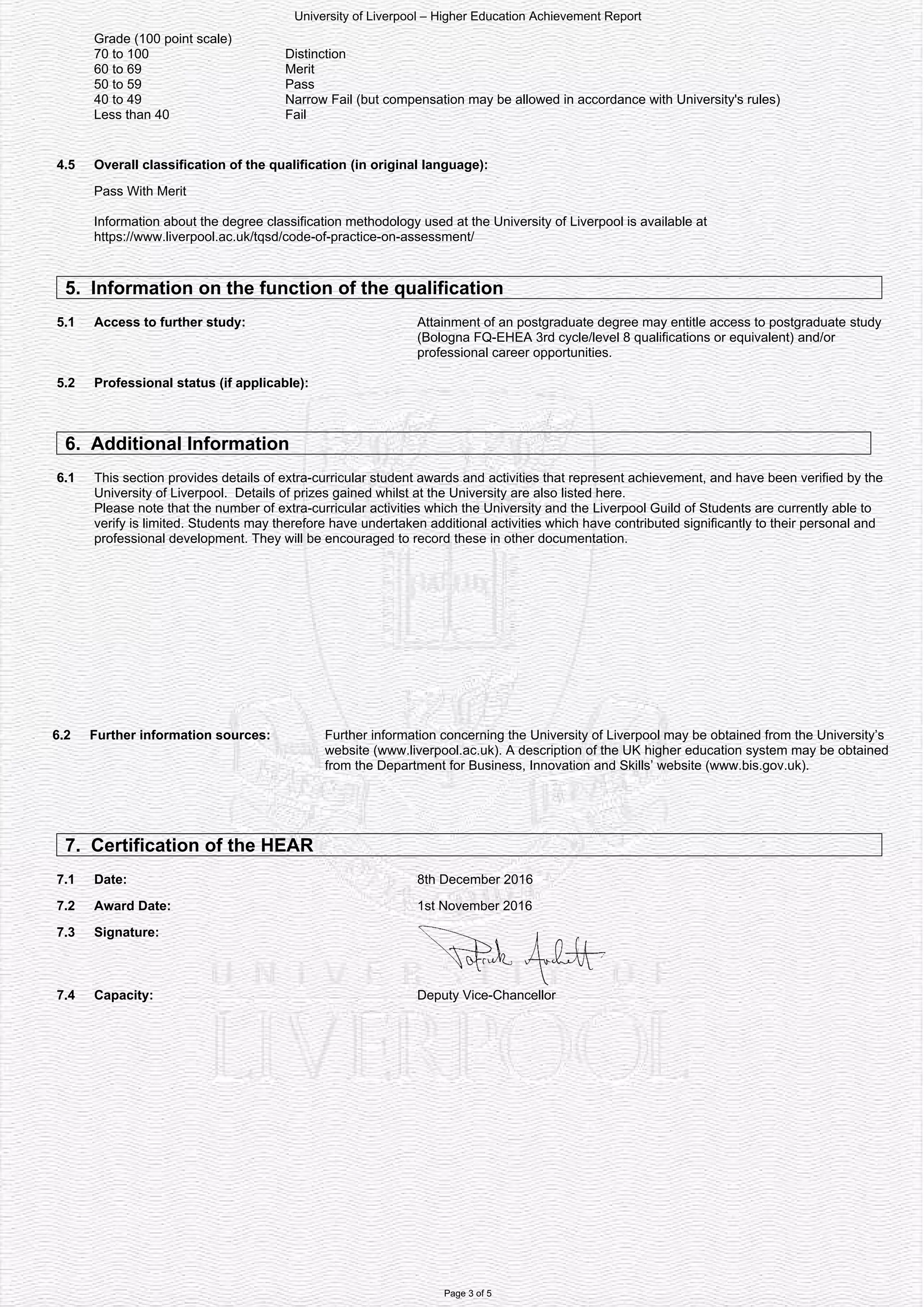
Grade (100 point scale)
70 to 100 Distinction
60 to 69 Merit
50 to 59 Pass
40 to 49 Narrow Fail (but compensation may be allowed in accordance with University's rules)
Less than 40 Fail
4.5 Overall classification of the qualification (in original language):
Pass With Merit
Information about the degree classification methodology used at the University of Liverpool is available at
https://www.liverpool.ac.uk/tqsd/code-of-practice-on-assessment/
5. Information on the function of the qualification
5.1 Access to further study: Attainment of an postgraduate degree may entitle access to postgraduate study
(Bologna FQ-EHEA 3rd cycle/level 8 qualifications or equivalent) and/or
professional career opportunities.
5.2 Professional status (if applicable):
6. Additional Information
6.1 This section provides details of extra-curricular student awards and activities that represent achievement, and have been verified by the
University of Liverpool. Details of prizes gained whilst at the University are also listed here.
Please note that the number of extra-curricular activities which the University and the Liverpool Guild of Students are currently able to
verify is limited. Students may therefore have undertaken additional activities which have contributed significantly to their personal and
professional development. They will be encouraged to record these in other documentation.
6.2 Further information sources: Further information concerning the University of Liverpool may be obtained from the University’s
website (www.liverpool.ac.uk). A description of the UK higher education system may be obtained
from the Department for Business, Innovation and Skills’ website (www.bis.gov.uk).
7. Certification of the HEAR
7.1 Date: 8th December 2016
7.2 Award Date: 1st November 2016
7.3 Signature:
7.4 Capacity: Deputy Vice-Chancellor
University of Liverpool – Higher Education Achievement Report
Page 4 of 5
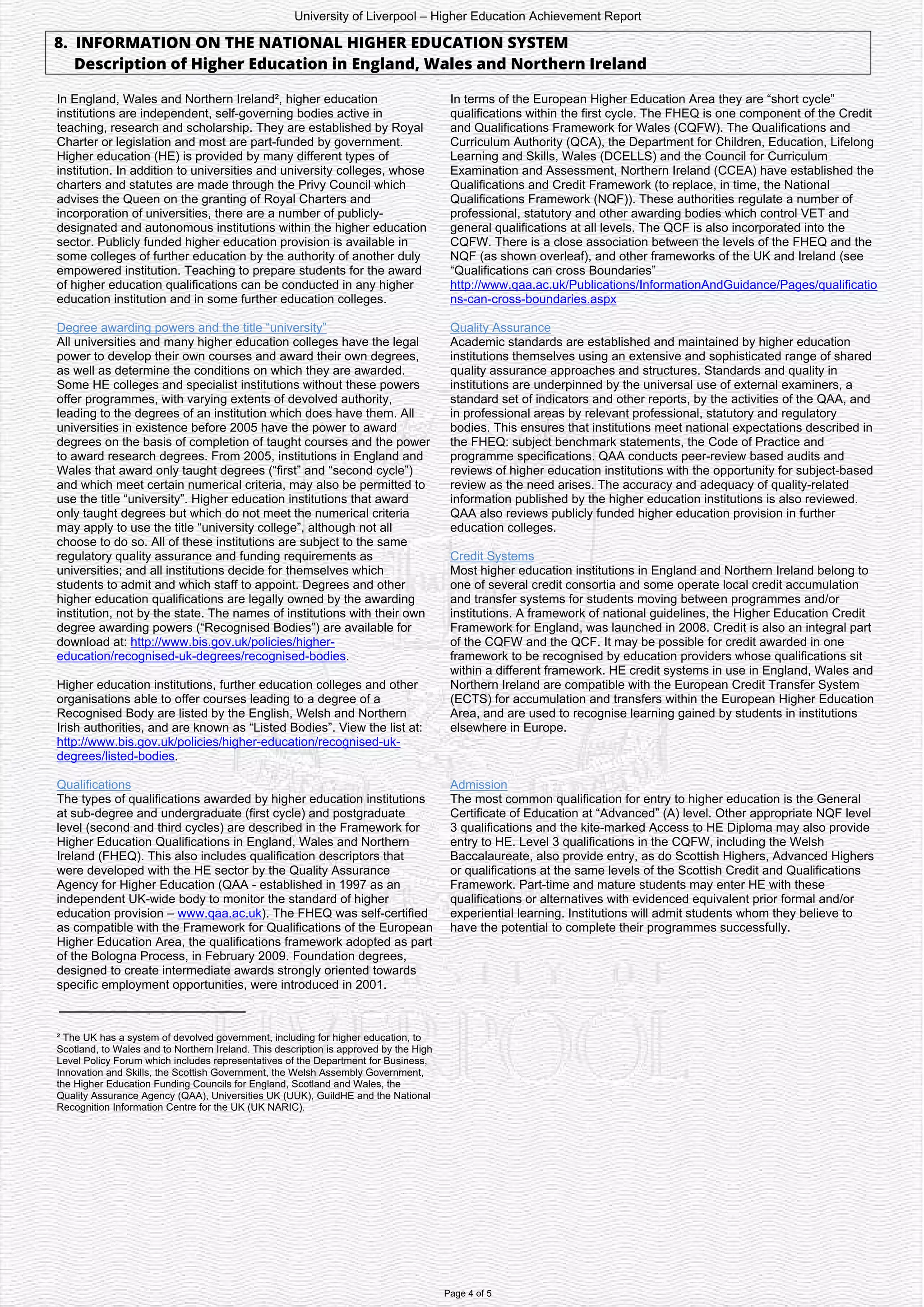
8. INFORMATION ON THE NATIONAL HIGHER EDUCATION SYSTEM
Description of Higher Education in England, Wales and Northern Ireland
In England, Wales and Northern Ireland², higher education
institutions are independent, self-governing bodies active in
teaching, research and scholarship. They are established by Royal
Charter or legislation and most are part-funded by government.
Higher education (HE) is provided by many different types of
institution. In addition to universities and university colleges, whose
charters and statutes are made through the Privy Council which
advises the Queen on the granting of Royal Charters and
incorporation of universities, there are a number of publicly-
designated and autonomous institutions within the higher education
sector. Publicly funded higher education provision is available in
some colleges of further education by the authority of another duly
empowered institution. Teaching to prepare students for the award
of higher education qualifications can be conducted in any higher
education institution and in some further education colleges.
In terms of the European Higher Education Area they are “short cycle”
qualifications within the first cycle. The FHEQ is one component of the Credit
and Qualifications Framework for Wales (CQFW). The Qualifications and
Curriculum Authority (QCA), the Department for Children, Education, Lifelong
Learning and Skills, Wales (DCELLS) and the Council for Curriculum
Examination and Assessment, Northern Ireland (CCEA) have established the
Qualifications and Credit Framework (to replace, in time, the National
Qualifications Framework (NQF)). These authorities regulate a number of
professional, statutory and other awarding bodies which control VET and
general qualifications at all levels. The QCF is also incorporated into the
CQFW. There is a close association between the levels of the FHEQ and the
NQF (as shown overleaf), and other frameworks of the UK and Ireland (see
“Qualifications can cross Boundaries”
http://www.qaa.ac.uk/Publications/InformationAndGuidance/Pages/qualificatio
ns-can-cross-boundaries.aspx
Degree awarding powers and the title “university”
All universities and many higher education colleges have the legal
power to develop their own courses and award their own degrees,
as well as determine the conditions on which they are awarded.
Some HE colleges and specialist institutions without these powers
offer programmes, with varying extents of devolved authority,
leading to the degrees of an institution which does have them. All
universities in existence before 2005 have the power to award
degrees on the basis of completion of taught courses and the power
to award research degrees. From 2005, institutions in England and
Wales that award only taught degrees (“first” and “second cycle”)
and which meet certain numerical criteria, may also be permitted to
use the title “university”. Higher education institutions that award
only taught degrees but which do not meet the numerical criteria
may apply to use the title “university college”, although not all
choose to do so. All of these institutions are subject to the same
regulatory quality assurance and funding requirements as
universities; and all institutions decide for themselves which
students to admit and which staff to appoint. Degrees and other
higher education qualifications are legally owned by the awarding
institution, not by the state. The names of institutions with their own
degree awarding powers (“Recognised Bodies”) are available for
download at: http://www.bis.gov.uk/policies/higher-
education/recognised-uk-degrees/recognised-bodies.
Higher education institutions, further education colleges and other
organisations able to offer courses leading to a degree of a
Recognised Body are listed by the English, Welsh and Northern
Irish authorities, and are known as “Listed Bodies”. View the list at:
http://www.bis.gov.uk/policies/higher-education/recognised-uk-
degrees/listed-bodies.
Quality Assurance
Academic standards are established and maintained by higher education
institutions themselves using an extensive and sophisticated range of shared
quality assurance approaches and structures. Standards and quality in
institutions are underpinned by the universal use of external examiners, a
standard set of indicators and other reports, by the activities of the QAA, and
in professional areas by relevant professional, statutory and regulatory
bodies. This ensures that institutions meet national expectations described in
the FHEQ: subject benchmark statements, the Code of Practice and
programme specifications. QAA conducts peer-review based audits and
reviews of higher education institutions with the opportunity for subject-based
review as the need arises. The accuracy and adequacy of quality-related
information published by the higher education institutions is also reviewed.
QAA also reviews publicly funded higher education provision in further
education colleges.
Credit Systems
Most higher education institutions in England and Northern Ireland belong to
one of several credit consortia and some operate local credit accumulation
and transfer systems for students moving between programmes and/or
institutions. A framework of national guidelines, the Higher Education Credit
Framework for England, was launched in 2008. Credit is also an integral part
of the CQFW and the QCF. It may be possible for credit awarded in one
framework to be recognised by education providers whose qualifications sit
within a different framework. HE credit systems in use in England, Wales and
Northern Ireland are compatible with the European Credit Transfer System
(ECTS) for accumulation and transfers within the European Higher Education
Area, and are used to recognise learning gained by students in institutions
elsewhere in Europe.
Qualifications
The types of qualifications awarded by higher education institutions
at sub-degree and undergraduate (first cycle) and postgraduate
level (second and third cycles) are described in the Framework for
Higher Education Qualifications in England, Wales and Northern
Ireland (FHEQ). This also includes qualification descriptors that
were developed with the HE sector by the Quality Assurance
Agency for Higher Education (QAA - established in 1997 as an
independent UK-wide body to monitor the standard of higher
education provision – www.qaa.ac.uk). The FHEQ was self-certified
as compatible with the Framework for Qualifications of the European
Higher Education Area, the qualifications framework adopted as part
of the Bologna Process, in February 2009. Foundation degrees,
designed to create intermediate awards strongly oriented towards
specific employment opportunities, were introduced in 2001.
Admission
The most common qualification for entry to higher education is the General
Certificate of Education at “Advanced” (A) level. Other appropriate NQF level
3 qualifications and the kite-marked Access to HE Diploma may also provide
entry to HE. Level 3 qualifications in the CQFW, including the Welsh
Baccalaureate, also provide entry, as do Scottish Highers, Advanced Highers
or qualifications at the same levels of the Scottish Credit and Qualifications
Framework. Part-time and mature students may enter HE with these
qualifications or alternatives with evidenced equivalent prior formal and/or
experiential learning. Institutions will admit students whom they believe to
have the potential to complete their programmes successfully.
² The UK has a system of devolved government, including for higher education, to
Scotland, to Wales and to Northern Ireland. This description is approved by the High
Level Policy Forum which includes representatives of the Department for Business,
Innovation and Skills, the Scottish Government, the Welsh Assembly Government,
the Higher Education Funding Councils for England, Scotland and Wales, the
Quality Assurance Agency (QAA), Universities UK (UUK), GuildHE and the National
Recognition Information Centre for the UK (UK NARIC).
University of Liverpool – Higher Education Achievement Report
Page 5 of 5

Higher Education Achievement Report (HEAR) _ 201024919-1

  • 1.
    University of Liverpool– Higher Education Achievement Report Page 1 of 5 Higher Education Achievement Report (Diploma Supplement) Contextual Information The University of Liverpool is a member of the Russell Group, which represents the 24 leading UK universities committed to maintaining the very best research, an outstanding teaching and learning experience and unrivalled links with business and the public sector. This Higher Education Achievement Report incorporates the model developed by the European Commission, Council of Europe and UNESCO/CEPES for the Diploma Supplement. The purpose of the Supplement is to provide sufficient recognition of qualifications (diplomas, degrees, certificates etc.). It is designed to provide a description of the nature, level, context and status of the studies that were pursued and successfully completed by the individual named on the original qualifications to which this Supplement is appended. It should be free from any value judgements, equivalence statements or suggestions about recognition. Information in all eight sections should be provided. Where information is not provided, an explanation should give the reason why. The University of Liverpool only produces HEARs in a digital format. 1. Information identifying the holder of the qualification 1.1 Family name(s): Ormane 1.2 Given name(s): Emmanuel 1.3 Date of birth (day/month/year): 17th August 1974 1.4 Student identification number or code: 201024919 HESA reference number:* 1311260249197 *HUSID (HESA Unique Student Identifier) is the unique national identifying number for students registered at a UK university. It is defined by HESA, the UK’s Higher Education Statistics Agency. 2. Information identifying the qualification 2.1 Name of qualification and (if applicable) title conferred: Master of Science The power to award degrees is regulated by law in the UK. 2.2 Main field(s) of study for the qualification: Corporate Finance 2.3 Name and status of awarding institution(s): This degree is awarded by the University of Liverpool, a university established by Royal Charter and a recognised body for the award of degrees. 2.4 Name and status of institution(s) (if different from 2.3) administering studies: The holder of this Achievement Record was registered as a part time student of the University of Liverpool on a programme of postgraduate study by online learning run in collaboration with Laureate Online Education and leading to the University of Liverpool award indicated. 2.5 Language(s) of instruction/examination: All teaching and assessment that leads to a University of Liverpool award is in English, except for programmes of study involving language studies, where some teaching and assessment is in the relevant language(s). 3. Information on the level of the qualification 3.1 Level of qualification: Postgraduate programme assigned to level 7 in the Framework for Higher Education Qualifications (see Section 8 for further details on the UK Higher Education System), and Bologna FQ-EHEA 2nd cycle degree compatible 3.2 Official length of programme: Three years 3.3 Access requirement(s): Detailed information regarding admission to the programme is available in the University's Online Prospectus at https://www.liverpool.ac.uk/study/postgraduate/courses/taught/ 4. Information on the contents and results gained
  • 2.
    University of Liverpool– Higher Education Achievement Report Page 2 of 5 4.1 Mode of study: 2013-2014 - Part time 2014-2015 - Part time 2015-2016 - Part time 2016-2017 - Part time 4.2 Programme requirements: The aim of the programme is to provide postgraduate-level education in corporate finance principles, theories and practice within a global context. The programme's aim is to provide a sound theoretical basis for understanding and analysing practical issues in corporate finance and to provide knowledge of international financial markets and institutions as a context within which corporate financial decision making takes place. The programme deals with key themes relating to how companies manage their investment, financing and distributions decisions and the consequences of these decisions for valuation. The intent is to provide students with the ability to apply concepts and techniques in corporate finance and related disciplines and to understand relevant issues, analyse problems and provide advice. 1. Enhancing skills of quantitative and qualitative analyses; 2. Promoting understanding of the nature and functions of international financial markets and institutions; 3. Applying knowledge of the principles of finance and accounting to interpret the performance and position of organisations and to value entities and their financial instruments; 4. Supporting the development of practical knowledge and skills necessary for employment in management and finance positions. A programme of study leading to a Master's degree award shall normally require successful completion of 180 credits (90 ECTS) either at FHEQ level 7, or a combination of FHEQ level 7 and up to 30 credits of modules at FHEQ level 6. 4.3 Programme details, and the individual grades/marks/credits obtained: 2013-2014 - The University of Liverpool (UK) - Year 1 2014-2015 - The University of Liverpool (UK) - Year 2 2015-2016 - The University of Liverpool (UK) - Year 3 2016-2017 - The University of Liverpool (UK) - Year 4 * - Indicates a mark obtained at a second or subsequent sitting M - Indicates Mitigating Circumstances Dissertation Title: Corporate Dividend Policy: Gender Consideration 4.4 Degree grading scheme and, if available, grade distribution guidance: Module ID FHEQ Level Credits ECTS Semester Title Grade Result KMGT 661 7 15 7.5 3 Corporate Finance 2 61 P KMGT 670 7 15 7.5 3 Corporate Finance 1 58 P Credits Obtained 30 Module ID FHEQ Level Credits ECTS Semester Title Grade Result KMGT 662 7 15 7.5 3 International Corporate Finance 57 P KMGT 664 7 15 7.5 3 Treasury Management and Ethics 70 P KMGT 665 7 15 7.5 3 Financial Markets and Institutions 66 P KMGT 668 7 15 7.5 3 Entrepreneurial Finance 61 P KMGT 669 7 15 7.5 3 Financial Analysis and Valuation 70 P KMGT 671 7 15 7.5 3 International Financial Reporting and Analysis 61 P Credits Obtained 90 Module ID FHEQ Level Credits ECTS Semester Title Grade Result KMGT 650 7 60 30 3 Dissertation 61 P Credits Obtained 60 Module ID FHEQ Level Credits ECTS Semester Title Grade Result Credits Obtained 0
  • 3.
    University of Liverpool– Higher Education Achievement Report Page 3 of 5 Grade (100 point scale) 70 to 100 Distinction 60 to 69 Merit 50 to 59 Pass 40 to 49 Narrow Fail (but compensation may be allowed in accordance with University's rules) Less than 40 Fail 4.5 Overall classification of the qualification (in original language): Pass With Merit Information about the degree classification methodology used at the University of Liverpool is available at https://www.liverpool.ac.uk/tqsd/code-of-practice-on-assessment/ 5. Information on the function of the qualification 5.1 Access to further study: Attainment of an postgraduate degree may entitle access to postgraduate study (Bologna FQ-EHEA 3rd cycle/level 8 qualifications or equivalent) and/or professional career opportunities. 5.2 Professional status (if applicable): 6. Additional Information 6.1 This section provides details of extra-curricular student awards and activities that represent achievement, and have been verified by the University of Liverpool. Details of prizes gained whilst at the University are also listed here. Please note that the number of extra-curricular activities which the University and the Liverpool Guild of Students are currently able to verify is limited. Students may therefore have undertaken additional activities which have contributed significantly to their personal and professional development. They will be encouraged to record these in other documentation. 6.2 Further information sources: Further information concerning the University of Liverpool may be obtained from the University’s website (www.liverpool.ac.uk). A description of the UK higher education system may be obtained from the Department for Business, Innovation and Skills’ website (www.bis.gov.uk). 7. Certification of the HEAR 7.1 Date: 8th December 2016 7.2 Award Date: 1st November 2016 7.3 Signature: 7.4 Capacity: Deputy Vice-Chancellor
  • 4.
    University of Liverpool– Higher Education Achievement Report Page 4 of 5 8. INFORMATION ON THE NATIONAL HIGHER EDUCATION SYSTEM Description of Higher Education in England, Wales and Northern Ireland In England, Wales and Northern Ireland², higher education institutions are independent, self-governing bodies active in teaching, research and scholarship. They are established by Royal Charter or legislation and most are part-funded by government. Higher education (HE) is provided by many different types of institution. In addition to universities and university colleges, whose charters and statutes are made through the Privy Council which advises the Queen on the granting of Royal Charters and incorporation of universities, there are a number of publicly- designated and autonomous institutions within the higher education sector. Publicly funded higher education provision is available in some colleges of further education by the authority of another duly empowered institution. Teaching to prepare students for the award of higher education qualifications can be conducted in any higher education institution and in some further education colleges. In terms of the European Higher Education Area they are “short cycle” qualifications within the first cycle. The FHEQ is one component of the Credit and Qualifications Framework for Wales (CQFW). The Qualifications and Curriculum Authority (QCA), the Department for Children, Education, Lifelong Learning and Skills, Wales (DCELLS) and the Council for Curriculum Examination and Assessment, Northern Ireland (CCEA) have established the Qualifications and Credit Framework (to replace, in time, the National Qualifications Framework (NQF)). These authorities regulate a number of professional, statutory and other awarding bodies which control VET and general qualifications at all levels. The QCF is also incorporated into the CQFW. There is a close association between the levels of the FHEQ and the NQF (as shown overleaf), and other frameworks of the UK and Ireland (see “Qualifications can cross Boundaries” http://www.qaa.ac.uk/Publications/InformationAndGuidance/Pages/qualificatio ns-can-cross-boundaries.aspx Degree awarding powers and the title “university” All universities and many higher education colleges have the legal power to develop their own courses and award their own degrees, as well as determine the conditions on which they are awarded. Some HE colleges and specialist institutions without these powers offer programmes, with varying extents of devolved authority, leading to the degrees of an institution which does have them. All universities in existence before 2005 have the power to award degrees on the basis of completion of taught courses and the power to award research degrees. From 2005, institutions in England and Wales that award only taught degrees (“first” and “second cycle”) and which meet certain numerical criteria, may also be permitted to use the title “university”. Higher education institutions that award only taught degrees but which do not meet the numerical criteria may apply to use the title “university college”, although not all choose to do so. All of these institutions are subject to the same regulatory quality assurance and funding requirements as universities; and all institutions decide for themselves which students to admit and which staff to appoint. Degrees and other higher education qualifications are legally owned by the awarding institution, not by the state. The names of institutions with their own degree awarding powers (“Recognised Bodies”) are available for download at: http://www.bis.gov.uk/policies/higher- education/recognised-uk-degrees/recognised-bodies. Higher education institutions, further education colleges and other organisations able to offer courses leading to a degree of a Recognised Body are listed by the English, Welsh and Northern Irish authorities, and are known as “Listed Bodies”. View the list at: http://www.bis.gov.uk/policies/higher-education/recognised-uk- degrees/listed-bodies. Quality Assurance Academic standards are established and maintained by higher education institutions themselves using an extensive and sophisticated range of shared quality assurance approaches and structures. Standards and quality in institutions are underpinned by the universal use of external examiners, a standard set of indicators and other reports, by the activities of the QAA, and in professional areas by relevant professional, statutory and regulatory bodies. This ensures that institutions meet national expectations described in the FHEQ: subject benchmark statements, the Code of Practice and programme specifications. QAA conducts peer-review based audits and reviews of higher education institutions with the opportunity for subject-based review as the need arises. The accuracy and adequacy of quality-related information published by the higher education institutions is also reviewed. QAA also reviews publicly funded higher education provision in further education colleges. Credit Systems Most higher education institutions in England and Northern Ireland belong to one of several credit consortia and some operate local credit accumulation and transfer systems for students moving between programmes and/or institutions. A framework of national guidelines, the Higher Education Credit Framework for England, was launched in 2008. Credit is also an integral part of the CQFW and the QCF. It may be possible for credit awarded in one framework to be recognised by education providers whose qualifications sit within a different framework. HE credit systems in use in England, Wales and Northern Ireland are compatible with the European Credit Transfer System (ECTS) for accumulation and transfers within the European Higher Education Area, and are used to recognise learning gained by students in institutions elsewhere in Europe. Qualifications The types of qualifications awarded by higher education institutions at sub-degree and undergraduate (first cycle) and postgraduate level (second and third cycles) are described in the Framework for Higher Education Qualifications in England, Wales and Northern Ireland (FHEQ). This also includes qualification descriptors that were developed with the HE sector by the Quality Assurance Agency for Higher Education (QAA - established in 1997 as an independent UK-wide body to monitor the standard of higher education provision – www.qaa.ac.uk). The FHEQ was self-certified as compatible with the Framework for Qualifications of the European Higher Education Area, the qualifications framework adopted as part of the Bologna Process, in February 2009. Foundation degrees, designed to create intermediate awards strongly oriented towards specific employment opportunities, were introduced in 2001. Admission The most common qualification for entry to higher education is the General Certificate of Education at “Advanced” (A) level. Other appropriate NQF level 3 qualifications and the kite-marked Access to HE Diploma may also provide entry to HE. Level 3 qualifications in the CQFW, including the Welsh Baccalaureate, also provide entry, as do Scottish Highers, Advanced Highers or qualifications at the same levels of the Scottish Credit and Qualifications Framework. Part-time and mature students may enter HE with these qualifications or alternatives with evidenced equivalent prior formal and/or experiential learning. Institutions will admit students whom they believe to have the potential to complete their programmes successfully. ² The UK has a system of devolved government, including for higher education, to Scotland, to Wales and to Northern Ireland. This description is approved by the High Level Policy Forum which includes representatives of the Department for Business, Innovation and Skills, the Scottish Government, the Welsh Assembly Government, the Higher Education Funding Councils for England, Scotland and Wales, the Quality Assurance Agency (QAA), Universities UK (UUK), GuildHE and the National Recognition Information Centre for the UK (UK NARIC).
  • 5.
    University of Liverpool– Higher Education Achievement Report Page 5 of 5