AC Circuits
Biju Mathew 1
A PowerPoint Presentation by
Biju Mathew
Objectives:
• Write and apply equations for calculating
the inductive and capacitive reactance's
for inductors and capacitors in an ac
circuit.
• Describe, with diagrams and equations,
the phase relationships for circuits
containing resistance, capacitance, and
inductance.
• Describe the sinusoidal variation in ac
current and voltage, and calculate their
effective values.
Alternating Currents
An alternating current such as that
produced by a generator has no direction in
the sense that direct current has. The
magnitudes vary sinusoidally with time as
given by:
Vmax
imax
time, t
v = Vmax sin q
i = imax sin q
AC-voltage
and current
q
450
900
1350
1800
2700
3600
E
R = Emax
E = Emax sin q
Rotating Vector Description
The coordinate of the emf at any instant is
the value of Vmax sin q. Observe for
incremental angles. Same is true for i.
q
450
900
1350
1800
2700
3600
v
Radius = Vmax
v = Vmax sin q
Effective AC Current
imax
The average current
in a cycle is zero—
half + and half -.
But energy is
expended, regardless
of direction. So the
“root-mean-square”
value is useful.
2
2 0.707
rms
I I
I  
I = imax
The rms value Irms is
sometimes called the
effective current Ieff:
The effective ac
current:
ieff = 0.707 imax
AC Definitions
One effective ampere is that ac current
for which the power is the same as for
one ampere of dc current.
One effective volt is that ac voltage that
gives an effective ampere through a
resistance of one ohm.
Effective current: ieff = 0.707 imax
Effective voltage: Veff = 0.707 Vmax
Example 1: For a particular device, the
house ac voltage is 120-V and the ac current
is 10 A. What are their maximum values?
ieff = 0.707 imax Veff = 0.707 Vmax
max
10 A
0.707 0.707
eff
i
i   max
120V
0.707 0.707
eff
V
V  
imax = 14.14 A Vmax = 170 V
The ac voltage actually varies from +170 V to
-170 V and the current from 14.1 A to –
14.1 A.
Pure Resistance in AC Circuits
A
a.c. Source
R
V
Voltage and current are in phase, and Ohm’s
law applies for effective currents and
voltages.
Ohm’s law: Vrms = irmsR
Vmax
imax
Voltage
Current
AC and Inductors
Time, t
I
i
Current
Rise
t
0.63I
Inductor
The voltage V peaks first, causing rapid rise in i
current which then peaks as the emf goes to
zero. Voltage leads (peaks before) the current
by 900
. Voltage and current are out of phase.
Time, t
I i
Current
Decay
t
0.37I
Inductor
A Pure Inductor in AC Circuit
A
L
V
a.c.
Vmax
imax
Voltage
Current
The voltage peaks 900
before the current
peaks. One builds as the other falls and vice
versa.
The reactance may be defined as the
nonresistive opposition to the flow of ac current.
Inductive Reactance
A
L
V
a.c.
The back emf induced
by a changing current
provides opposition to
current, called
inductive reactance XL.
Such losses are temporary, however, since the
current changes direction, periodically re-
supplying energy so that no net power is lost in
one cycle.
Inductive reactance XL is a function of both
the inductance and the frequency of the ac
current.
Calculating Inductive
Reactance
A
L
V
a.c.
Inductive Reactance:
2 Unit is the
L
X fL

 
Ohm's law: L L
V iX

The voltage reading V in the above circuit at
the instant the ac current is i can be found
from the inductance in H and the frequency
in Hz.
(2 )
L
V i fL

 Ohm’s law: Vrms = irmsXL
Example 2: A coil having an inductance of
0.6 H is connected to a 120-V, 60 Hz ac
source. Neglecting resistance, what is the
effective current through the coil?
A
L = 0.6 H
V
120 V, 60 Hz
Reactance: XL = 2pfL
XL = 2p(60 Hz)(0.6 H)
XL = 226 W
120V
226
eff
eff
L
V
i
X
 

ieff = 0.531 A
Show that the peak current is Imax = 0.750 A
AC and
Capacitance
Time, t
Qmax
q
Rise in
Charge
Capacitor
t
0.63 I
Time, t
I
i
Current
Decay
Capacitor
t
0.37 I
The voltage V peaks ¼ of a cycle after the
current i reaches its maximum. The voltage
lags the current. Current i and V out of phase.
A Pure Capacitor in AC
Circuit
Vmax
imax
Voltage
Current
A V
a.c.
C
The voltage peaks 900
after the current peaks.
One builds as the other falls and vice versa.
The diminishing current i builds charge on C
which increases the back emf of VC.
Capacitive Reactance
No net power is lost in a complete cycle, even
though the capacitor does provide nonresistive
opposition (reactance) to the flow of ac current.
Capacitive reactance XC is affected by both the
capacitance and the frequency of the ac
current.
A V
a.c.
C
Energy gains and
losses are also
temporary for
capacitors due to the
constantly changing ac
current.
Calculating Inductive
Reactance
Capacitive Reactance:
1
Unit is the
2
C
X
fC

 
Ohm's law: VC C
iX

The voltage reading V in the above circuit at
the instant the ac current is i can be found
from the inductance in F and the frequency in
Hz.
2
L
i
V
fL


A V
a.c.
C
Ohm’s law: VC = ieffXC
Example 3: A 2-mF capacitor is connected
to a 120-V, 60 Hz ac source. Neglecting
resistance, what is the effective current
through the coil?
Reactance:
XC = 1330 W
120V
1330
eff
eff
C
V
i
X
 

ieff = 90.5 mA
Show that the peak current is imax = 128 mA
A V
C = 2 mF
120 V, 60 Hz
1
2
C
X
fC


-6
1
2 (60Hz)(2 x 10 F)
C
X


Memory Aid for AC
Elements
An old, but very
effective, way to
remember the phase
differences for
inductors and
capacitors is :
“E L I” the “i C E” Man
Emf E is before current i in inductors
L; Emf E is after current i in
capacitors C.
“E L i”
“I C E”
man
the
Frequency and AC Circuits
f
R, X
1
2
C
X
fC


2
L
X fL


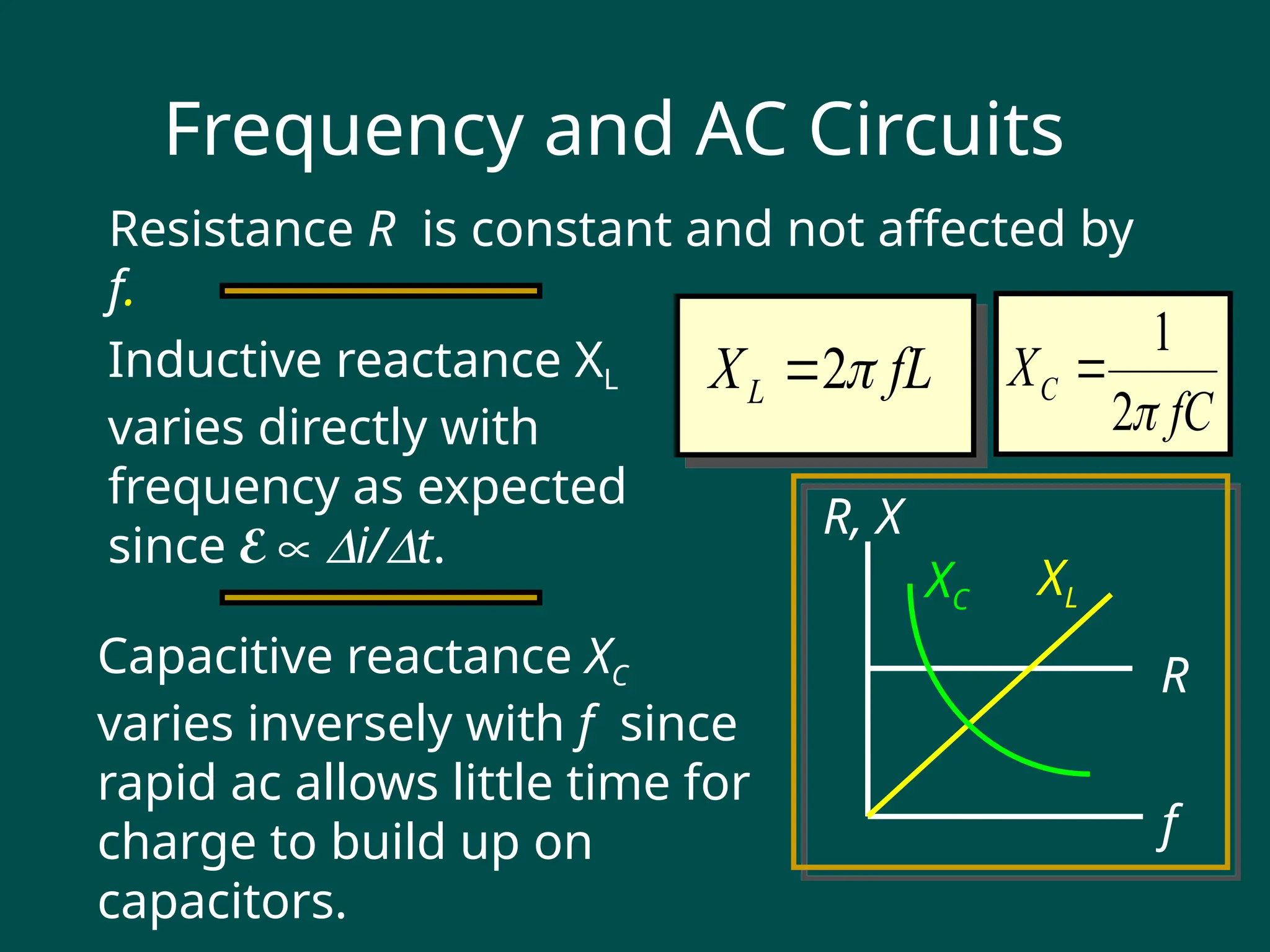
Resistance R is constant and not affected by
f.
Inductive reactance XL
varies directly with
frequency as expected
since E µ Di/Dt.
Capacitive reactance XC
varies inversely with f since
rapid ac allows little time for
charge to build up on
capacitors.
R
XL
XC
Series LRC Circuits
L
VR VC
C
R
a.c.
VL
VT
A
Series ac circuit
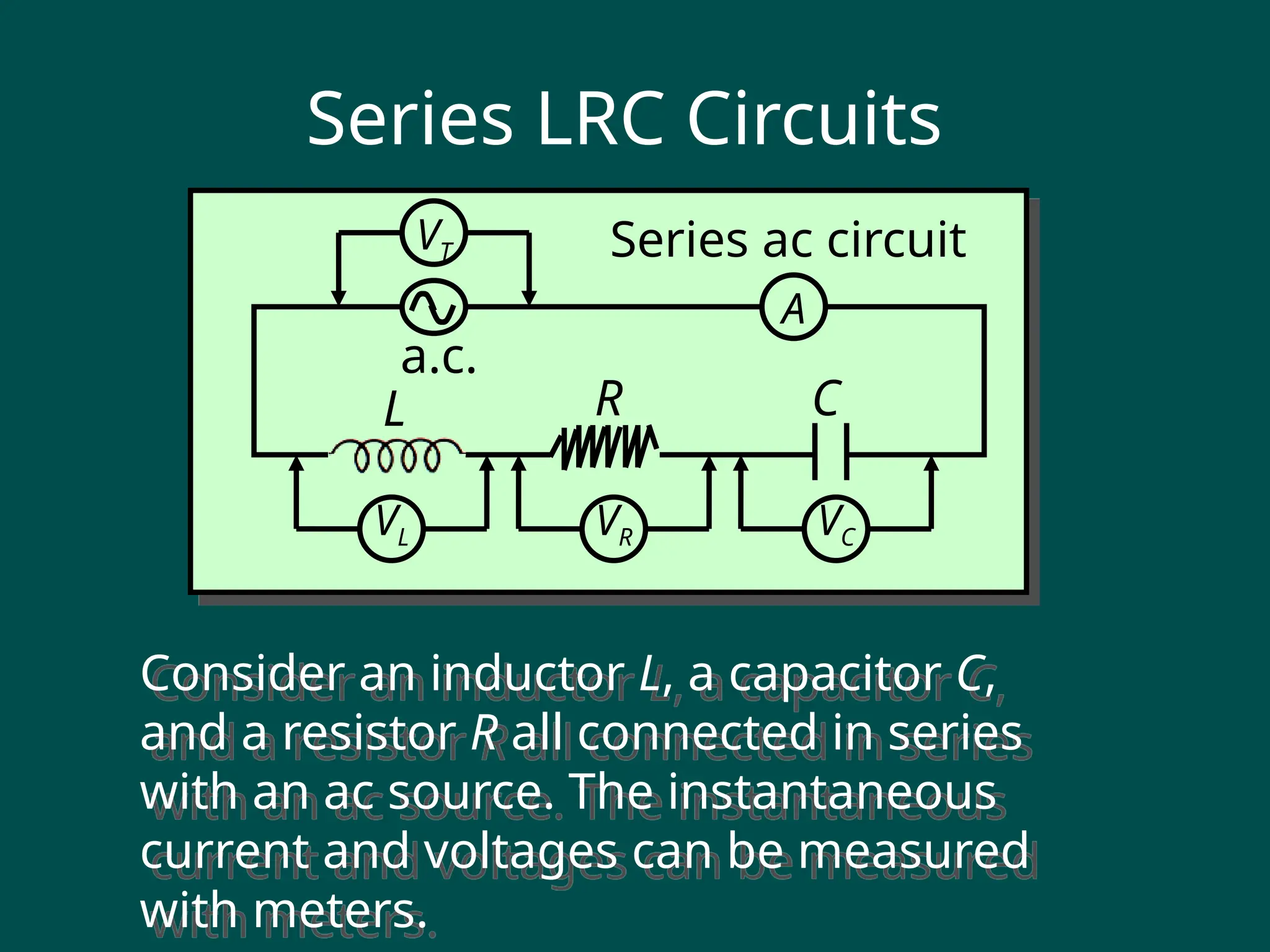
Consider an inductor L, a capacitor C,
and a resistor R all connected in series
with an ac source. The instantaneous
current and voltages can be measured
with meters.
Phase in a Series AC Circuit
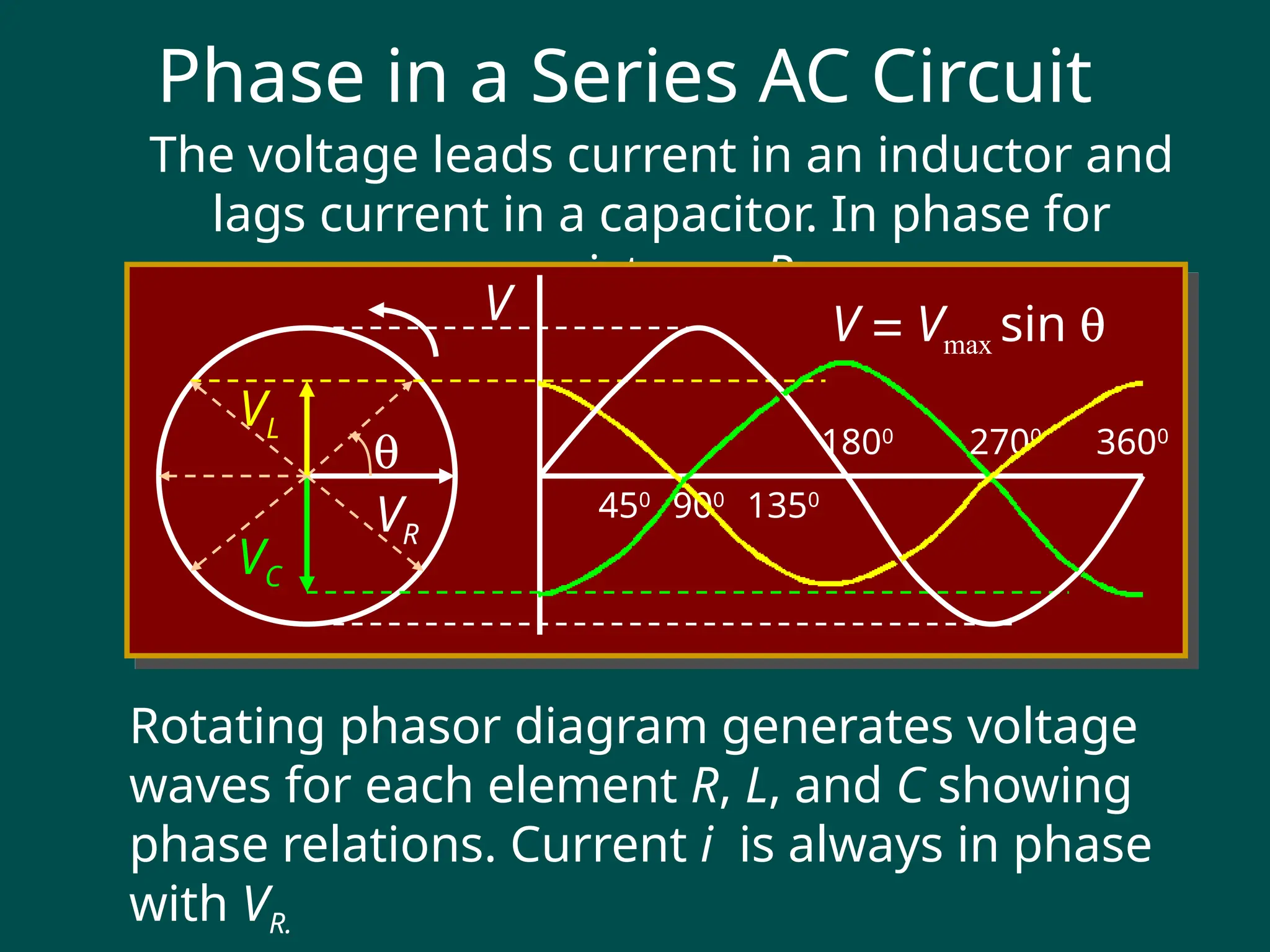
The voltage leads current in an inductor and
lags current in a capacitor. In phase for
resistance R.
q
450
900
1350
1800
2700
3600
V V = Vmax sin q
VR
VC
VL
Rotating phasor diagram generates voltage
waves for each element R, L, and C showing
phase relations. Current i is always in phase
with VR.
Phasors and Voltage
At time t = 0, suppose we read VL, VR and VC for an
ac series circuit. What is the source voltage VT?
We handle phase differences by finding the
vector sum of these readings. VT = S Vi. The
angle q is the phase angle for the ac circuit.
q
VR
VL - VC
VT
Source voltage
VR
VC
VL
Phasor
Diagram
Calculating Total Source
Voltage
q
VR
VL - VC
VT
Source voltage Treating as vectors, we
find:
2 2
( )
T R L C
V V V V
  
tan L C
R
V V
V



Now recall that: VR = iR; VL = iXL; and VC = iVC
Substitution into the above voltage equation
gives:
2 2
( )
T L C
V i R X X
  
Impedance in an AC Circuit
f
R
XL - XC
Z
Impedance 2 2
( )
T L C
V i R X X
  
Impedance Z is
defined:
2 2
( )
L C
Z R X X
  
Ohm’s law for ac current
and impedance:
or T
T
V
V iZ i
Z
 
The impedance is the combined opposition to ac
current consisting of both resistance and
reactance.
Calculating Impedance
calculate the
impedance for
thecircuit:
Next >
VS
IS
L = 2.7 H
C = 1 nF
R = 1 kΩ
f = 2 kHz
or
Calculating Impedance
Example calculation
of impedance for
this circuit:
Next >
VS
IS
L = 2.7 H
C = 1 nF
R = 1 kΩ
f = 2 kHz
XC = 79,567 Ω
Z = √ R 2
+ (XC – XL) 2
2πfC
XC =
1
First we calculate XC :
6.284 × 2 × 10 3
× 1 × 10 -9
XC = Ω
1
6.284 × 2 kHz × 1nF
XC =
1
79.57 kΩ
or
Calculating Impedance
Now we calculate XL:
Next >
XL = 33.93 kΩ
XL = 2πfL
XL = 6.284 × 2 kHz × 2.7 H
XL = 6.284 × 2 × 10 3
× 2.7 Ω
VS
IS
L = 2.7 H
C = 1 nF
R = 1 kΩ
f = 2 kHz
Calculating Impedance
Since XC is larger than XL :
Next >
Z = √ R 2
+ (XC – XL) 2
Insert the known values:
XC – XL = 79.57 kΩ – 33.93 kΩ
Then complete the calculation:
Z = √ (1 kΩ) 2
+ (45.64 kΩ) 2
Z = 45.65 kΩ
VS
IS
L = 2.7 H
C = 1 nF
R = 1 kΩ
f = 2 kHz
Example 3: A 60-W resistor, a 0.6 H inductor, and
an 8mF capacitor are connected in series with a
120-V, 60 Hz ac source. Calculate the impedance
for this circuit.
A
60 Hz
0.6 H
60 W
120 V
8 mF
1
2 and
2
L C
X fL X
fC


 
2 (60Hz)(0.6 H) = 226
L
X 
 
-6
1
332
2 (60Hz)(8 x 10 F)
C
X

  
2 2 2 2
( ) (60 ) (226 332 )
L C
Z R X X
        
Thus, the impedance
is:
Z = 122 W
Example 4: A 60-W resistor, a 0.6 H inductor, and an 8mF
capacitor are connected in series with a 120-V, 60 Hz ac source.
Calculate the impedance for this circuit.
A
60 Hz
0.6 H
60 W
120 V
8 mF
XL = 226 W; XC = 332 W; R = 60 W; Z = 122 W
120 V
122
T
eff
V
i
Z
 

ieff = 0.985 A
Next we find the phase
angle:
f
R
XL - XC
Z
Impedance
XL – XC = 226 – 332 = -106 W
R = 60 W tan L C
X X
R



Continued . . .
Example 4 (Cont.): Find the phase angle f for
the previous example.
-106 W
f
60 W
Z
XL – XC = 226 – 332 = -106 W
R = 60 W tan L C
X X
R



106
tan
60

 


f = -60.50
The negative phase angle means that the
ac voltage lags the current by 60.50
. This is
known as a capacitive circuit.
Resonant Frequency
Because inductance causes the voltage to lead
the current and capacitance causes it to lag
the current, they tend to cancel each other
out.
Resonance (Maximum
Power) occurs when XL = XC
R
XC
XL XL = XC
2 2
( )
L C
Z R X X R
   
1
2
2
fL
fC



1
2
r
f
LC


Resonant fr
XL = XC
Example 5: Find the resonant frequency for
the previous circuit example: L = .5 H, C = 8 mF
1
2
r
f
LC


-6
1
2 (0.5H)(8 x 10 F
f


Resonant fr = 79.6 Hz
At resonant frequency, there is zero reactance
(only resistance) and the circuit has a phase angle
of zero.
A
? Hz
0.5 H
60 W
120 V
8 mF
Resonance XL = XC
Example 6: What is the average power loss
for the previous example: V = 120 V, f = -
60.50
, i = 90.5 A, and R = 60W .
The higher the power factor, the more
efficient is the circuit in its use of ac
power.
A
? Hz
0.5 H
60 W
120 V
8 mF
Resonance XL = XC
P = i2
R = (0.0905 A)2
(60 W)
Average P = 0.491 W
The power factor is: Cos 60.50
Cos f = 0.492 or 49.2%
Summary
Effective current: ieff = 0.707 imax
Effective voltage: Veff = 0.707 Vmax
Inductive Reactance:
2 Unit is the
L
X fL

 
Ohm's law: L L
V iX

Capacitive Reactance:
1
Unit is the
2
C
X
fC

 
Ohm's law: VC C
iX

Summary (Cont.)
2 2
( )
T R L C
V V V V
   tan L C
R
V V
V



2 2
( )
L C
Z R X X
  
or T
T
V
V iZ i
Z
 
tan L C
X X
R



1
2
r
f
LC


Summary (Cont.)
In terms of ac voltage:
P = iV cos f
In terms of the resistance
R:
P = i2
R
Power in AC Circuits:
CONCLUSION
AC Circuits

Alternating Current-wave-propagation.pptx

  • 1.
    AC Circuits Biju Mathew1 A PowerPoint Presentation by Biju Mathew
  • 2.
    Objectives: • Write andapply equations for calculating the inductive and capacitive reactance's for inductors and capacitors in an ac circuit. • Describe, with diagrams and equations, the phase relationships for circuits containing resistance, capacitance, and inductance. • Describe the sinusoidal variation in ac current and voltage, and calculate their effective values.
  • 3.
    Alternating Currents An alternatingcurrent such as that produced by a generator has no direction in the sense that direct current has. The magnitudes vary sinusoidally with time as given by: Vmax imax time, t v = Vmax sin q i = imax sin q AC-voltage and current
  • 4.
    q 450 900 1350 1800 2700 3600 E R = Emax E= Emax sin q Rotating Vector Description The coordinate of the emf at any instant is the value of Vmax sin q. Observe for incremental angles. Same is true for i. q 450 900 1350 1800 2700 3600 v Radius = Vmax v = Vmax sin q
  • 5.
    Effective AC Current imax Theaverage current in a cycle is zero— half + and half -. But energy is expended, regardless of direction. So the “root-mean-square” value is useful. 2 2 0.707 rms I I I   I = imax The rms value Irms is sometimes called the effective current Ieff: The effective ac current: ieff = 0.707 imax
  • 6.
    AC Definitions One effectiveampere is that ac current for which the power is the same as for one ampere of dc current. One effective volt is that ac voltage that gives an effective ampere through a resistance of one ohm. Effective current: ieff = 0.707 imax Effective voltage: Veff = 0.707 Vmax
  • 7.
    Example 1: Fora particular device, the house ac voltage is 120-V and the ac current is 10 A. What are their maximum values? ieff = 0.707 imax Veff = 0.707 Vmax max 10 A 0.707 0.707 eff i i   max 120V 0.707 0.707 eff V V   imax = 14.14 A Vmax = 170 V The ac voltage actually varies from +170 V to -170 V and the current from 14.1 A to – 14.1 A.
  • 8.
    Pure Resistance inAC Circuits A a.c. Source R V Voltage and current are in phase, and Ohm’s law applies for effective currents and voltages. Ohm’s law: Vrms = irmsR Vmax imax Voltage Current
  • 9.
    AC and Inductors Time,t I i Current Rise t 0.63I Inductor The voltage V peaks first, causing rapid rise in i current which then peaks as the emf goes to zero. Voltage leads (peaks before) the current by 900 . Voltage and current are out of phase. Time, t I i Current Decay t 0.37I Inductor
  • 10.
    A Pure Inductorin AC Circuit A L V a.c. Vmax imax Voltage Current The voltage peaks 900 before the current peaks. One builds as the other falls and vice versa. The reactance may be defined as the nonresistive opposition to the flow of ac current.
  • 11.
    Inductive Reactance A L V a.c. The backemf induced by a changing current provides opposition to current, called inductive reactance XL. Such losses are temporary, however, since the current changes direction, periodically re- supplying energy so that no net power is lost in one cycle. Inductive reactance XL is a function of both the inductance and the frequency of the ac current.
  • 12.
    Calculating Inductive Reactance A L V a.c. Inductive Reactance: 2Unit is the L X fL    Ohm's law: L L V iX  The voltage reading V in the above circuit at the instant the ac current is i can be found from the inductance in H and the frequency in Hz. (2 ) L V i fL   Ohm’s law: Vrms = irmsXL
  • 13.
    Example 2: Acoil having an inductance of 0.6 H is connected to a 120-V, 60 Hz ac source. Neglecting resistance, what is the effective current through the coil? A L = 0.6 H V 120 V, 60 Hz Reactance: XL = 2pfL XL = 2p(60 Hz)(0.6 H) XL = 226 W 120V 226 eff eff L V i X    ieff = 0.531 A Show that the peak current is Imax = 0.750 A
  • 14.
    AC and Capacitance Time, t Qmax q Risein Charge Capacitor t 0.63 I Time, t I i Current Decay Capacitor t 0.37 I The voltage V peaks ¼ of a cycle after the current i reaches its maximum. The voltage lags the current. Current i and V out of phase.
  • 15.
    A Pure Capacitorin AC Circuit Vmax imax Voltage Current A V a.c. C The voltage peaks 900 after the current peaks. One builds as the other falls and vice versa. The diminishing current i builds charge on C which increases the back emf of VC.
  • 16.
    Capacitive Reactance No netpower is lost in a complete cycle, even though the capacitor does provide nonresistive opposition (reactance) to the flow of ac current. Capacitive reactance XC is affected by both the capacitance and the frequency of the ac current. A V a.c. C Energy gains and losses are also temporary for capacitors due to the constantly changing ac current.
  • 17.
    Calculating Inductive Reactance Capacitive Reactance: 1 Unitis the 2 C X fC    Ohm's law: VC C iX  The voltage reading V in the above circuit at the instant the ac current is i can be found from the inductance in F and the frequency in Hz. 2 L i V fL   A V a.c. C Ohm’s law: VC = ieffXC
  • 18.
    Example 3: A2-mF capacitor is connected to a 120-V, 60 Hz ac source. Neglecting resistance, what is the effective current through the coil? Reactance: XC = 1330 W 120V 1330 eff eff C V i X    ieff = 90.5 mA Show that the peak current is imax = 128 mA A V C = 2 mF 120 V, 60 Hz 1 2 C X fC   -6 1 2 (60Hz)(2 x 10 F) C X  
  • 19.
    Memory Aid forAC Elements An old, but very effective, way to remember the phase differences for inductors and capacitors is : “E L I” the “i C E” Man Emf E is before current i in inductors L; Emf E is after current i in capacitors C. “E L i” “I C E” man the
  • 20.
    Frequency and ACCircuits f R, X 1 2 C X fC   2 L X fL   Resistance R is constant and not affected by f. Inductive reactance XL varies directly with frequency as expected since E µ Di/Dt. Capacitive reactance XC varies inversely with f since rapid ac allows little time for charge to build up on capacitors. R XL XC
  • 21.
    Series LRC Circuits L VRVC C R a.c. VL VT A Series ac circuit Consider an inductor L, a capacitor C, and a resistor R all connected in series with an ac source. The instantaneous current and voltages can be measured with meters.
  • 22.
    Phase in aSeries AC Circuit The voltage leads current in an inductor and lags current in a capacitor. In phase for resistance R. q 450 900 1350 1800 2700 3600 V V = Vmax sin q VR VC VL Rotating phasor diagram generates voltage waves for each element R, L, and C showing phase relations. Current i is always in phase with VR.
  • 23.
    Phasors and Voltage Attime t = 0, suppose we read VL, VR and VC for an ac series circuit. What is the source voltage VT? We handle phase differences by finding the vector sum of these readings. VT = S Vi. The angle q is the phase angle for the ac circuit. q VR VL - VC VT Source voltage VR VC VL Phasor Diagram
  • 24.
    Calculating Total Source Voltage q VR VL- VC VT Source voltage Treating as vectors, we find: 2 2 ( ) T R L C V V V V    tan L C R V V V    Now recall that: VR = iR; VL = iXL; and VC = iVC Substitution into the above voltage equation gives: 2 2 ( ) T L C V i R X X   
  • 25.
    Impedance in anAC Circuit f R XL - XC Z Impedance 2 2 ( ) T L C V i R X X    Impedance Z is defined: 2 2 ( ) L C Z R X X    Ohm’s law for ac current and impedance: or T T V V iZ i Z   The impedance is the combined opposition to ac current consisting of both resistance and reactance.
  • 26.
    Calculating Impedance calculate the impedancefor thecircuit: Next > VS IS L = 2.7 H C = 1 nF R = 1 kΩ f = 2 kHz or
  • 27.
    Calculating Impedance Example calculation ofimpedance for this circuit: Next > VS IS L = 2.7 H C = 1 nF R = 1 kΩ f = 2 kHz XC = 79,567 Ω Z = √ R 2 + (XC – XL) 2 2πfC XC = 1 First we calculate XC : 6.284 × 2 × 10 3 × 1 × 10 -9 XC = Ω 1 6.284 × 2 kHz × 1nF XC = 1 79.57 kΩ or
  • 28.
    Calculating Impedance Now wecalculate XL: Next > XL = 33.93 kΩ XL = 2πfL XL = 6.284 × 2 kHz × 2.7 H XL = 6.284 × 2 × 10 3 × 2.7 Ω VS IS L = 2.7 H C = 1 nF R = 1 kΩ f = 2 kHz
  • 29.
    Calculating Impedance Since XCis larger than XL : Next > Z = √ R 2 + (XC – XL) 2 Insert the known values: XC – XL = 79.57 kΩ – 33.93 kΩ Then complete the calculation: Z = √ (1 kΩ) 2 + (45.64 kΩ) 2 Z = 45.65 kΩ VS IS L = 2.7 H C = 1 nF R = 1 kΩ f = 2 kHz
  • 30.
    Example 3: A60-W resistor, a 0.6 H inductor, and an 8mF capacitor are connected in series with a 120-V, 60 Hz ac source. Calculate the impedance for this circuit. A 60 Hz 0.6 H 60 W 120 V 8 mF 1 2 and 2 L C X fL X fC     2 (60Hz)(0.6 H) = 226 L X    -6 1 332 2 (60Hz)(8 x 10 F) C X     2 2 2 2 ( ) (60 ) (226 332 ) L C Z R X X          Thus, the impedance is: Z = 122 W
  • 31.
    Example 4: A60-W resistor, a 0.6 H inductor, and an 8mF capacitor are connected in series with a 120-V, 60 Hz ac source. Calculate the impedance for this circuit. A 60 Hz 0.6 H 60 W 120 V 8 mF XL = 226 W; XC = 332 W; R = 60 W; Z = 122 W 120 V 122 T eff V i Z    ieff = 0.985 A Next we find the phase angle: f R XL - XC Z Impedance XL – XC = 226 – 332 = -106 W R = 60 W tan L C X X R    Continued . . .
  • 32.
    Example 4 (Cont.):Find the phase angle f for the previous example. -106 W f 60 W Z XL – XC = 226 – 332 = -106 W R = 60 W tan L C X X R    106 tan 60      f = -60.50 The negative phase angle means that the ac voltage lags the current by 60.50 . This is known as a capacitive circuit.
  • 33.
    Resonant Frequency Because inductancecauses the voltage to lead the current and capacitance causes it to lag the current, they tend to cancel each other out. Resonance (Maximum Power) occurs when XL = XC R XC XL XL = XC 2 2 ( ) L C Z R X X R     1 2 2 fL fC    1 2 r f LC   Resonant fr XL = XC
  • 34.
    Example 5: Findthe resonant frequency for the previous circuit example: L = .5 H, C = 8 mF 1 2 r f LC   -6 1 2 (0.5H)(8 x 10 F f   Resonant fr = 79.6 Hz At resonant frequency, there is zero reactance (only resistance) and the circuit has a phase angle of zero. A ? Hz 0.5 H 60 W 120 V 8 mF Resonance XL = XC
  • 35.
    Example 6: Whatis the average power loss for the previous example: V = 120 V, f = - 60.50 , i = 90.5 A, and R = 60W . The higher the power factor, the more efficient is the circuit in its use of ac power. A ? Hz 0.5 H 60 W 120 V 8 mF Resonance XL = XC P = i2 R = (0.0905 A)2 (60 W) Average P = 0.491 W The power factor is: Cos 60.50 Cos f = 0.492 or 49.2%
  • 36.
    Summary Effective current: ieff= 0.707 imax Effective voltage: Veff = 0.707 Vmax Inductive Reactance: 2 Unit is the L X fL    Ohm's law: L L V iX  Capacitive Reactance: 1 Unit is the 2 C X fC    Ohm's law: VC C iX 
  • 37.
    Summary (Cont.) 2 2 () T R L C V V V V    tan L C R V V V    2 2 ( ) L C Z R X X    or T T V V iZ i Z   tan L C X X R    1 2 r f LC  
  • 38.
    Summary (Cont.) In termsof ac voltage: P = iV cos f In terms of the resistance R: P = i2 R Power in AC Circuits:
  • 39.